

1. Introduction
Crowther et al. (Reference Crowther, Glick, Covey, Bettigole, Maynard, Thomas, Smith, Hintler, Duguid, Amatulli, Tuanmu, Jetz, Salas, Stam, Piotto, Tavani, Green, Bruce, Williams and Bradford2015) estimated that there are 3.04 trillion, or 3.04 × 10¹⁸ (± 0.096 × 10¹⁸), trees worldwide. Although this is an impressive number, it raises a question: How did the scientific team count all the trees on the planet? To better reflect reality, researchers need to collect and treat a huge amount of data sampled in contrasting ecosystems and environmental conditions, which is the role of quantitative plant science (Autran et al., Reference Autran, Bassel, Chae, Ezer, Ferjani, Fleck, Hamant, Hartmann, Jiao, Johnston, Kwiatkowska, Lim, Mahönen, Morris, Mulder, Nakayama, Sozzani, Strader, Tusscher and Wolf2021). However, a research team alone is limited in the amount of work necessary to reach a robust and valid result. International collaborations are part of the answer to overcome the lack of data, but this is insufficient and often not representative of the whole data and ecological diversity.
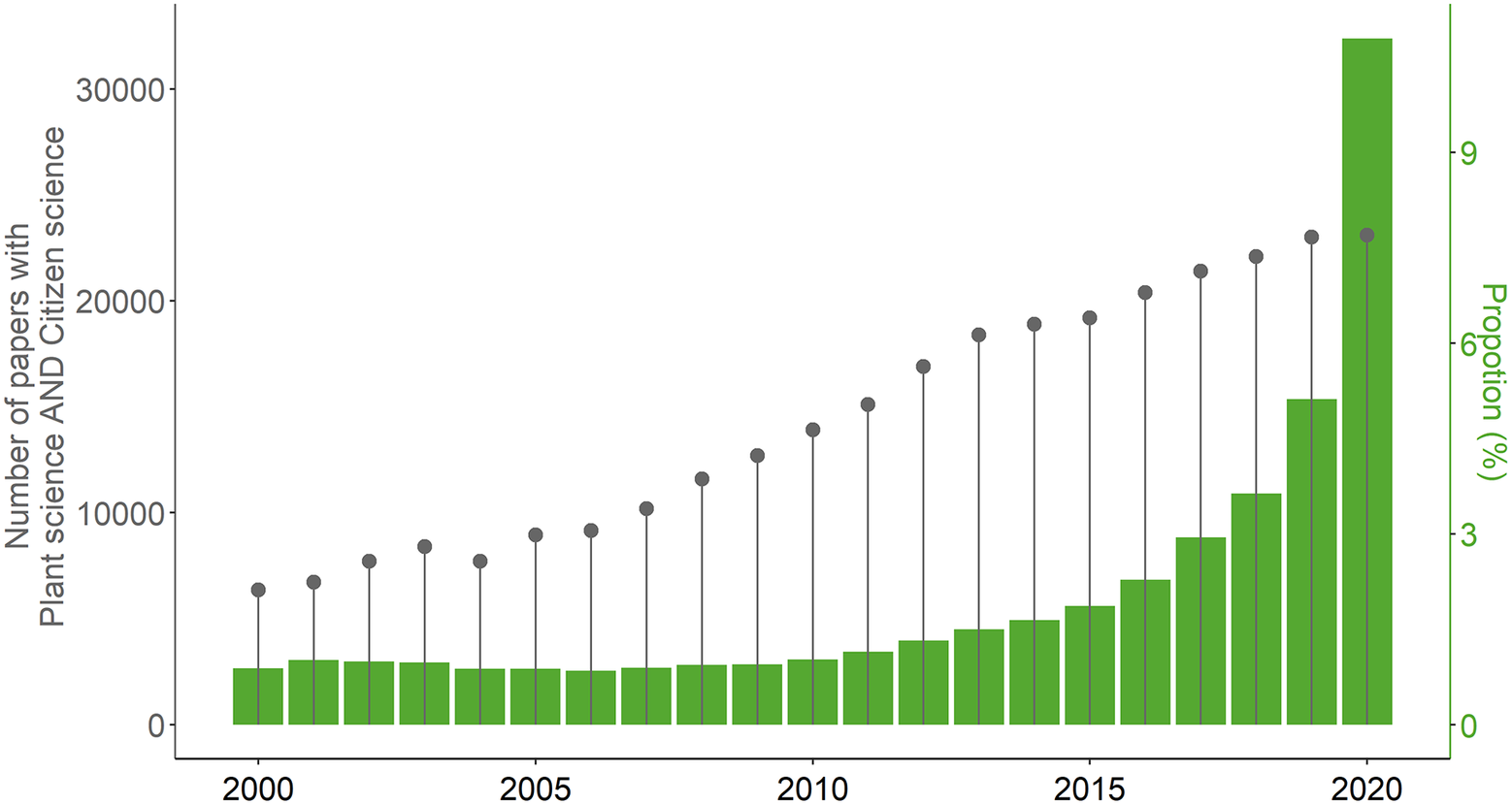
Citizen science (CS) is one way to cover large temporal and spatial scales for sampling. CS is a broad concept, and the definition is still debated (Heigl et al., Reference Heigl, Kieslinger, Paul, Uhlik and Dörler2019). We will merely refer to the general definition of Guerrini et al. (Reference Guerrini, Majumder, Lewellyn and McGuire2018): CS gathers ‘scientific endeavours in which individuals without specific scientific training participate as volunteers in one or more activities relevant to the research process other than (or in addition to) allowing personal data or specimens to be collected from them’. Even if CS projects that are solely based on data collection may partially solve some quantitative plant science challenges (data collection on large areas, at high temporal resolution, higher number of collectors who may quantify variables more often than a scientific team alone), they also require important scientific input to improve their own modelling issues, such as accounting for bias in data collection and heterogeneity in plant species, sites and/or dates of measurements, and ensuring that the protocol was accurately followed. CS projects in plant sciences have bloomed for a decade, gathering huge volunteer communities around scientific questions (Fig. 1, grey points). The number of publications related to CS projects has increased even faster than the total number of publications in plant sciences (Fig. 1, green bars). In turn, this approach allows researchers to share their experience, method and the purpose of the experiment and to directly communicate them to participants. In that sense, CS projects can be seen as collaborative work with a purely scientific interest to answer a question and as an efficient outreach action where ‘non-researchers’ are truly active and have the opportunity to practice the sciences (Heigl et al., Reference Heigl, Kieslinger, Paul, Uhlik and Dörler2019).
Global trend of citizen science projects in the plant science literature from 2000 to 2020: The left grey y-axis (grey dots) represents the number of articles containing the mention ‘plant science’ AND ‘citizen science’ in their title, and the right green y-axis (green bars) represents the ratio of paper numbers with ‘plant science’ AND ‘citizen science’ and the paper numbers containing ‘plant science’ only. The number of papers was extracted from Google Scholar on 01/02/2022.
The benefits of these close and direct interactions between scientists and volunteers are not limited to the scientific sphere and/or the volunteers. Mixing scientists and volunteers, CS can be seen as a motor of complex socio-ecological systems, strengthening the interaction network between society and the environment. CS represents an efficient approach linking knowledge creation and transfer/co-construction with society (Rupprecht et al., Reference Rupprecht, Vervoort, Berthelsen, Mangnus, Osborne, Thompson, Urushima, Kóvskaya, Spiegelberg, Cristiano, Springett, Marschütz, Flies, McGreevy, Droz, Breed, Gan, Shinkai and Kawai2020). The benefits of CS projects spread much further than the scientists–volunteers’ interactions, and they also reach the socio-ecological system if the project is built as a participatory action research project (Cooper et al., Reference Cooper, Dickinson, Phillips and Bonney2007). Quantitative plant ecology can play a major role in encouraging these collaborative sciences. We chose to broaden the scope of this review from plant science to plant ecology and its quantitative aspect.
The goal of this review is to highlight (i) the diversity of tools and networks enabling scientists to run CS projects, (ii) the reciprocal benefits of CS projects between citizens, the scientific community and beyond with the socio-ecosystem and (iii) some remaining obstacles, such as the need to include a ‘facilitator’ in volunteer–scientist relationships; finally, this review (iv) proposes some perspectives for upcoming CS projects.
2. Some CS tools encouraging participation in CS projects
2.1. Plant CS project, a mean to manipulate plant
Plant science is mainly based on trait measurement to explain plants’ trait response to a tested variable (Autran et al., Reference Autran, Bassel, Chae, Ezer, Ferjani, Fleck, Hamant, Hartmann, Jiao, Johnston, Kwiatkowska, Lim, Mahönen, Morris, Mulder, Nakayama, Sozzani, Strader, Tusscher and Wolf2021). The number of replicates is crucial to make the study quantitative and the lab facilities are often limiting as plant culture or field experiment needs space and time. Increasing the number of experimenters may help to solve this issue. Participating to this measurement campaign may be source of motivation for volunteers to engage in CS project and to bring their contribution to the study. Projects including trait measurements allow a direct contact with plant science tools and plant material, which represent a data collection activity very close to the scientific work in a lab. McDonough MacKenzie et al. (Reference McDonough MacKenzie, Gallinat and Zipf2020) described the great interest to engage volunteers in projects including traits’ measurement such as flower phenology; volunteers only need a pencil and a sheet to note their observation regularly. These data may be complementary to dataset at global scale gathering observations at larger scale and with experiments such as twig cutting to assess season effect on leafing-out time (McDonough MacKenzie et al., Reference McDonough MacKenzie, Gallinat and Zipf2020; Primack et al., Reference Primack, Laube, Gallinat and Menzel2015). Moreover, herbaria data and metadata (from label) may also help to increase the phenology legacy of a species (Funk, Reference Funk2003; Nualart et al., Reference Nualart, Ibáñez, Soriano and López-Pujol2017). Extracting and implementing a database are very time consuming; therefore, herbarium may solicit the volunteer’s help to treat each specimen, which what Recolnat or Nature’s Notebook programs propose in France and in the USA, respectively, for instance.
Plant’s traits variation to environmental changes can be studied in a common garden where different species, genotype, cultivars are grown with the same condition. The number of common gardens limits the number of tested environments. The project ‘1000 gardens – the soybean experiment’ benefited from 1000 gardens of volunteers to grow 1710 soybean lines (Würschum et al., Reference Würschum, Leiser, Jähne, Bachteler, Miersch and Hahn2019). Participants received 10 lines or varieties and 16 traits were measured by participant until the harvest such as germination rate, plant height and start of flowering. This project led the scientist to know the most adapted lines for the different Germany regions for future soybean production (Würschum et al., Reference Würschum, Leiser, Jähne, Bachteler, Miersch and Hahn2019). Similarly, a CS project focused on carrot, solicited farmers to assess intraspecific foliar trait variation in Canada. Each farmer was in charge of five varieties of carrot and to collect and send dry leaf samples to the scientific teams for trait’s measurement. Even if farmers did not participate to trait measurements, they allow to test different environment to estimate the intraspecific variability of leaf trait (Isaac & Martin, Reference Isaac and Martin2019). This collaborative CS project leads to closer relationship between research and farms without excessive cost or particular technology.
However, the development of connected tool facilitates data sharing and data availability, which can help to democratize CS participation.
2.2. Make the CS project more global
The tool diversity in CS projects has increased with the number of projects developed. Smartphones are certainly the best example of making collaborative and quantitative sciences an almost ‘common’ activity (Adriaens et al., Reference Adriaens, Sutton-Croft, Owen, Brosens, van Valkenburg, Kilbey, Groom, Ehmig, Thürkow and Van Hende2015; Newman et al., Reference Newman, Wiggins, Crall, Graham, Newman and Crowston2012; Teacher et al., Reference Teacher, Griffiths, Hodgson and Inger2013). The smartphone is useful and promising, especially for quantitative plant science, as it allows high-resolution phenotyping activity to supply deep learning techniques and monitor plants’ responses to stress and diseases (Mohanty et al., Reference Mohanty, Hughes and Salathé2016; Singh et al., Reference Singh, Ganapathysubramanian, Sarkar and Singh2018). For instance, Adriaens et al. (Reference Adriaens, Sutton-Croft, Owen, Brosens, van Valkenburg, Kilbey, Groom, Ehmig, Thürkow and Van Hende2015) reported two applications RINSE and KORINA to record and monitor invasive plant species: volunteers can record the localisation of invasive species with their apps. Their data are then used by scientists and managers to monitor wetlands. However, volunteer participation in a CS program strongly depends on the ease of using the tools, since volunteers can become discouraged if the tools are too difficult to use. Once the tools are available, the research community can rely on a large pool of potential volunteers among social networks (Serret et al., Reference Serret, Deguines, Jang, Lois and Julliard2019). The connected tools play an important role in creating a dynamic and virtuous loop among volunteers and an easy way to interact with scientists (Nov et al., Reference Nov, Arazy and Anderson2014), especially if face-to-face interactions with the research team are organised concomitantly (Cappa et al., Reference Cappa, Laut, Nov, Giustiniano and Porfiri2016). We acknowledge that it may be particularly difficult for the scientific team to interact directly with each volunteer, especially in projects involving hundreds or thousands of participants. This challenge clearly shows the need for intermediaries to avoid losing volunteer motivation and the quantitative benefit of volunteer work (Cappa et al., Reference Cappa, Laut, Nov, Giustiniano and Porfiri2016). Some data, such as geolocation, can be updated and visualised by all the project participants directly after the data are collected and incremented. This may represent a tangible, encouraging reward for volunteers and may motivate them to continue working on the project. Moreover, from a research point of view, collected plant-related data may be used with other datasets, such as meteorological and climate data, increasing the power of the collected data. A recent study showed that from crowd-sourced flower identification data, it was possible to rebuild spatial macroecological gradients (Mahecha et al., Reference Mahecha, Rzanny, Kraemer, Mäder, Seeland and Wäldchen2021). This means that we can potentially extract more information than the app was initially designed to deliver.
The almost global internet access allows an instantaneous sharing of data and facilitates their verification by scientists or volunteers (Deguines et al., Reference Deguines, Flores, Loïs, Julliard and Fontaine2018); hence, it makes data quantity compatible with data quality. However, while the size of the available datasets is growing very fast (e.g., satellite images, video recording, pictures, for instance https://www.zooniverse.org/projects/zooniverse/floating-forests: 750,000 pictures of kelp forests were classified by over 7000 volunteers), the number of scientists available to analyse these data is not growing as fast. Depending on their expertise level, some volunteers may help the leading team check data gathered by other volunteers, a peer-to-peer cross-validation process (Deguines et al., Reference Deguines, Flores, Loïs, Julliard and Fontaine2018; Kosmala et al., Reference Kosmala, Wiggins, Swanson and Simmons2016). Therefore, with the emergence of ‘big data’ and the development of machine learning methods and artificial intelligence, volunteer participation has become increasingly necessary to amplify and to refine the exponential progress in treatment and analysis methods (Ceccaroni et al., Reference Ceccaroni, Bibby, Roger, Flemons, Michael, Fagan and Oliver2019). A successful example is the development of the ‘Leafsnap’ or ‘Pl@ntNet’ mobile app that identifies tree species from pictures of their leaves, fruits, flowers or barks (Joly et al., Reference Joly, Bonnet, Goëau, Barbe, Selmi, Champ, Dufour-Kowalski, Affouard, Carré, Molino, Boujemaa and Barthélémy2016; Kumar et al., Reference Kumar, Belhumeur, Biswas, Jacobs, Kress, Lopez, Soares, Fitzgibbon, Lazebnik, Perona, Sato and Schmid2012).
2.2.1. Topic
It is worth noting that big data from CS project raise some ethical questions such as the intellectual property of the data and the level of acknowledgement for the volunteers (Vohland et al., Reference Vohland, Weißpflug and Pettibone2019): some authors propose to include volunteers in the authorship at least under a collective identity (Vayena & Tasioulas, Reference Vayena and Tasioulas2015; Ward-Fear et al., Reference Ward-Fear, Pauly, Vendetti and Shine2020). These challenges would deserve a review per se, which is not the scope of this one.
2.3. Make a CS community
Online project platforms facilitate discussion between experts and volunteers to share results and questions about the project (Gouveia et al., Reference Gouveia, Fonseca, Câmara and Ferreira2004). Scientists can present preliminary or intermediate results based on the first collected data to inform participants about project progress. Concomitantly, it allows interactions through forums, chats or even video meetings, where volunteers are free to ask questions. These discussions bring scientists closer to the public, and vice versa, and make the relationships less hierarchical. This point is very important regardless of the scientific background of the participants: novices can feel more confident and progress rapidly, which is highly fulfilling (Deguines et al., Reference Deguines, Flores, Loïs, Julliard and Fontaine2018), whereas the more knowledgeable volunteers may be part of the discussion in the data analysis. Engaging volunteers in data analysis is, however, time-consuming if the scientific team aims to achieve volunteer empowerment. The task may be ensured by a ‘facilitator’, that is, someone dedicated to training or educating volunteers on a CS project (Lorke et al., Reference Lorke, Golumbic, Ramjan and Atias2019), but we propose to enlarge this role to align classes/teachers expectations and scientific objectives of the research team. The facilitator should not be substituted for the interactions between volunteers and scientists but instead be a hyphen between both, facilitating their interactions.
2.4. CS in the classrooms
An increasing number of CS projects involve schools (Kermish-Allen et al., Reference Kermish-Allen, Peterman and Bevc2019; Nistor et al., Reference Nistor, Clemente-Gallardo, Angelopoulos, Chodzinska, Clemente Gallardo, Gozdzik, Gras-Velazquez, Grizelj, Kolenberg and Mitropoulou2019; Van Haeften et al., Reference Van Haeften, Milic, Addison-Smith, Butcher and Davies2021), even if they are often not specifically designed for students (Bopardikar et al., Reference Bopardikar, Bernstein and McKenney2021; Williams et al., Reference Williams, Hall and O’Connell2021). The scientific team can take advantage of the time dedicated by the class to the project to train students and improve data quality (Castagneyrol et al., Reference Castagneyrol, Valdés-Correcher, Bourdin, Barbaro, Bouriaud, Branco, Centenaro, Csóka, Duduman, Dulaurent, Eötvös, Faticov, Ferrante, Fürjes-Mikó, Galmán, Gossner, Harvey, Howe, Kaennel-Dobbertin and Tack2020). This does not avoid the requirement for another check after data collection, but it also creates a time for discussion with pupils and teachers about scientific methods and epistemology. This aspect of CS is at least as important as the larger time and spatial scale of data collection because it allows students, and people in general, to be more aware of the world’s complexity (Morin, Reference Morin2007). From a quantitative plant sciences perspective, it is important to clearly explain the benefits of acquiring a large amount of data for building a robust answer to the initial questions, stressing the importance of the variability at different levels of organisation.
Although developing CS with schools appears to be relevant, scientists need to factor in educational constraints that are often incompatible with the protocols. Indeed, teachers do not have an infinite amount of time to allocate to the project, which can have consequences on data validity or decrease the project’s relevance for students and teachers, despite the educational benefits of CS initiatives (Esch et al., Reference Esch, Burbacher, Dodrill, Fussell, Magdich, Norris and Midden2020). Tools and protocols may have been thought to be easily used by non-scientific experts, and the classroom constraints may limit the involvement in a CS project. Moreover, cost, logistical tensions or effort to motivate students with ‘fun’ activities for instance are some knock-down barriers that still remain in addition to schedule constrains (Roche et al., Reference Roche, Bell, Galvão, Golumbic, Kloetzer, Knoben, Laakso, Lorke, Mannion, Massetti, Mauchline, Pata, Ruck, Taraba and Winter2020). Therefore, a ‘facilitator’ may allow, at the genesis of the project, to build a project that meets the requirements of all participants.
3. CS projects: Reciprocal benefits for citizens and academia
3.1. Main benefits for the scientific community
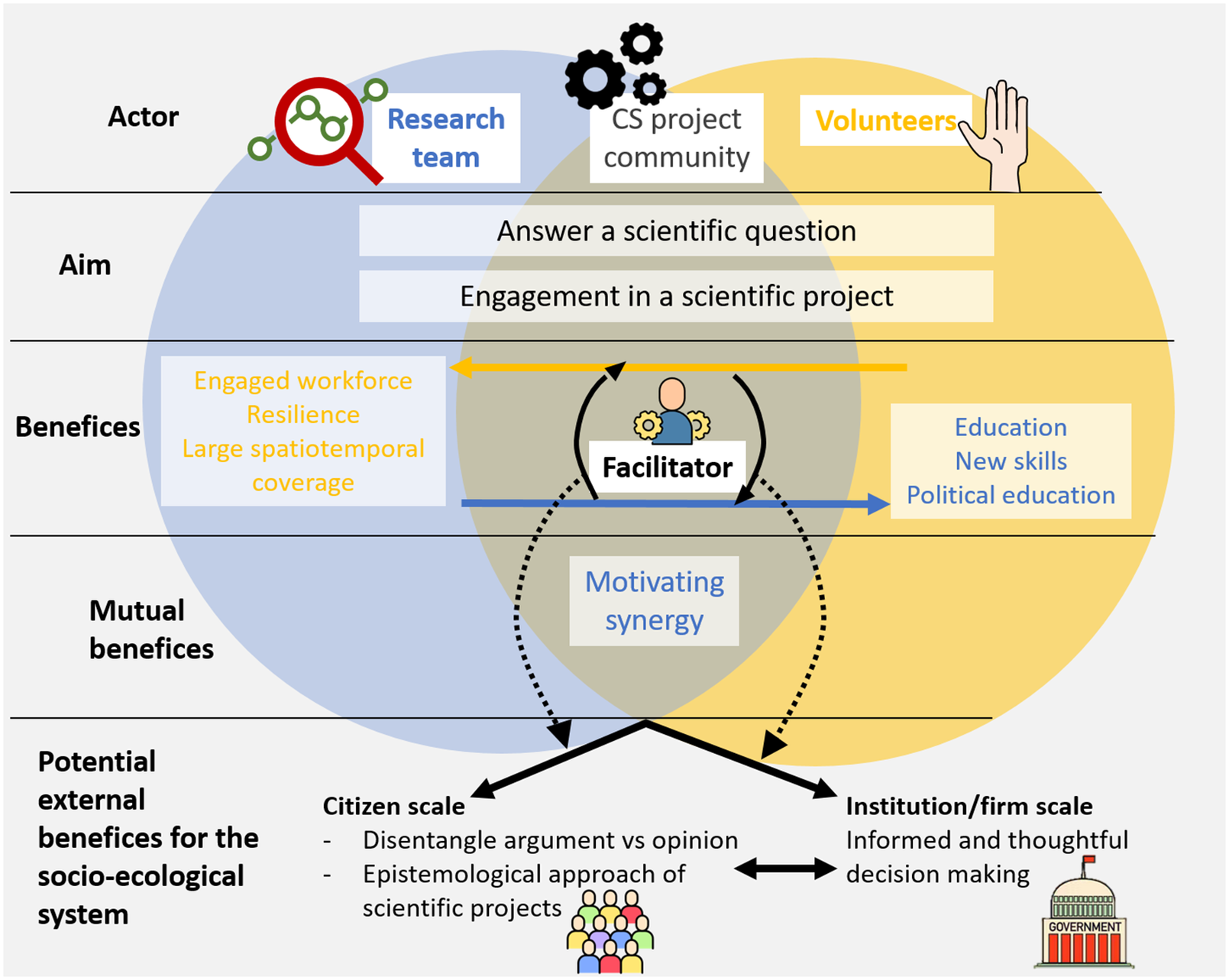
From the scientist point of view, CS projects represent an unprecedented opportunity to rely on an important number of volunteers collecting data (Fig. 2, orange arrow). The ‘many-eyes hypothesis’ has been developed to describe the efficiency of CS in generating, scrutinising and analysing data across vast spatiotemporal scales and multiple taxa (Dickinson et al., Reference Dickinson, Shirk, Bonter, Bonney, Crain, Martin, Phillips and Purcell2012; Earp & Liconti, Reference Earp, Liconti, Jungblut, Liebich and Bode-Dalby2020; Thomas et al., Reference Thomas, Gunawardene, Horton, Williams, O’Connor, McKirdy and van der Merwe2017). In the case of CS, the hypothesis demonstrates that a larger group of people increases the chance of detecting a species/phenomenon and can survey a vaster region. For instance, ‘The conker tree science’ project studied the effect of pest controllers on leaf-mining moths damaging leaf conker trees (http://www.conkertreescience.org.uk/). Researchers asked volunteers to collect infected leaves and count insects that had hatched out. The protocol was very simple, and 3500 citizens, covering all Great Britain, sent their results to the researchers (Pocock & Evans, Reference Pocock and Evans2014). The ‘Oak Bodyguard Citizen Science Project’ has also successfully estimated caterpillar herbivory on Quercus robur in Europe, thanks to an easy protocol, freely available, proposed to different European classes (Castagneyrol, Reference Castagneyrol2019). These two examples highlight the larger area covered by participants: ‘The conker tree science’ project provides results at a national scale when the ‘Oak Bodyguard Citizen Science Project’, on a European scale, has increased the number of sampling points in different countries. It now includes new countries such as Latvia and Lithuania where no scientist works on the project (Castagneyrol et al., Reference Castagneyrol, Valdés-Correcher, Bourdin, Barbaro, Bouriaud, Branco, Centenaro, Csóka, Duduman, Dulaurent, Eötvös, Faticov, Ferrante, Fürjes-Mikó, Galmán, Gossner, Harvey, Howe, Kaennel-Dobbertin and Tack2020). The large-scale response of Conker and Oak trees was obtained, thanks to local volunteers, which would have been unreachable with professional scientists only.
Conceptual framework of the reciprocal benefits from the CS project to the socio-ecological system. Circles represent participants of a CS project, and black arrows show how the scientific and epistemological benefit spreads beyond the project per se. The two dotted arrows represent the indirect added value of the facilitator to spread the CS results to the socio-ecological system.
The development of CS is also an efficient way to widely communicate the results from a research topic. Indeed, CS projects imply generally some side activities, which are not directly linked to the scientific experiment itself. These activities take place in the context of the scientific project, and it is then easier to develop outreach activities with the volunteers as they benefit of the same background. However, to be the most effective, it would judicious to plan it when project leaders build the project (Lakeman-Fraser et al., Reference Lakeman-Fraser, Gosling, Moffat, West, Fradera, Davies, Ayamba and van der Wal2016).
An increasing number of funders (e.g., the European Union) ask to make the results of projects they supported publicly available. We strongly support the spread of scientific result, whatever the means (Poulet et al., Reference Poulet, Dalmas, Goncalves, Noûs and Vernay2021), but we recognise the holistic benefit from participating to a scientific project while learning about the scientific topic and research functioning. The implementation of CS in the research project makes this dissemination step easier, combining scientific knowledge production and outreach activities.
3.2. Important benefits for volunteers
The direct benefits for volunteers participating in CS projects consist first of increasing their own knowledge and/or scientific and technical skills. Practising science makes the learning process more efficient because volunteers face the same constraints as scientists, which makes more sense to the volunteers (Fig. 2, blue arrow, Bonney et al., Reference Bonney, Phillips, Ballard and Enck2016; Freitag, Reference Freitag2016; Kermish-Allen et al., Reference Kermish-Allen, Peterman and Bevc2019; Shirk et al., Reference Shirk, Ballard, Wilderman, Phillips, Wiggins, Jordan, McCallie, Minarchek, Lewenstein, Krasny and Bonney2012). This praxeological approach may be seen as a much more stimulating method than passively listening to a lecture or conference (Barragan-Jason et al., Reference Barragan-Jason, de Mazancourt, Parmesan, Singer and Loreau2021; Smith et al., Reference Smith, Allf, Larson, Futch, Lundgren, Pacifici and Cooper2021). The relationship between professional researchers and the public is often limited to conferences and questions to the researcher who ‘knows’ and the audience who ‘learns’. This method of knowledge transmission is important but should be completed by peer exchanges, that is, between non-professionals, when a volunteer belonging to the project community becomes the link between the project and the audience. The discussion among non-professionals allows the removal of the potential distance that the public can feel between themselves and the researcher (Burke et al., Reference Burke, Welch-Devine, Gustafson, Heynen, Rice, Gragson, Evans and Nelson2016; Watermeyer & Montgomery, Reference Watermeyer and Montgomery2018).
We think that transdisciplinary research programs may be more attractive, as they mix different fields. For example, the Growing Beyond Earth (based in the USA) project enables students to work on a transdisciplinary project where quantitative plant science meets microgravity and space exploration via a CS project led by the Fairchild Botanic Garden (Miami, FL) in partnership with NASA (https://fairchildgarden.org/gbe/). The objective is to identify resistant crops for spaceflight, and as a result, astronauts have grown Pak Choi on the ISS after it was identified as suitable by the large amount of data collected by students. The European Space Agency is pursuing the same objective as the Astroplant project, encouraging citizens and classrooms to gather data on plant growth using a DIY desktop greenhouse (https://www.esa.int/Science_Exploration/Human_and_Robotic_Exploration/AstroPlant_citizen_science_for_growing_plants_in_space).
The Space Chile Grow a Pepper Plant Challenge (https://five.epicollect.net/project/the-spacechilechallenge-cose) is another NASA CS project launched in preparation for an ISS experiment that engages citizens in collecting data on indoor chilli pepper cultivation to tackle some of its inherent challenges. The high valuation of space research in the media makes the task very exciting for volunteers, and it becomes easier for researchers to ‘reward’ participants with visible communication.
3.3. CS: A ways to link citizens with research projects
This deeper understanding of science would strongly support ecological preservation and restoration (Fig. 2). Ecological restoration and preservation programs have succeeded, thanks to the implication of volunteers in different steps of the project and in the decision-making process (Buldrini et al., Reference Buldrini, Simoncelli, Accordi, Pezzi and Dallai2015; Conrad & Hilchey, Reference Conrad and Hilchey2011; Kobori et al., Reference Kobori, Dickinson, Washitani, Sakurai, Amano, Komatsu, Kitamura, Takagawa, Koyama and Ogawara2016). Indeed, volunteers involved in CS projects can be seen as vectors of knowledge dissemination by speaking about the project and the results to people around them (Burke et al., Reference Burke, Welch-Devine, Gustafson, Heynen, Rice, Gragson, Evans and Nelson2016). In this way, volunteers become ‘advocates of environment conservation’, such as in the ‘Ansa e Valli del Mincio’ protected wetlands where volunteers have monitored invasive species (Buldrini et al., Reference Buldrini, Simoncelli, Accordi, Pezzi and Dallai2015). Similarly, a successful program was designed in Texas to monitor Arundo donax. The CS program reported an increase in the giant reed area distribution and can be a scientific resource for ecosystem management (Gallo & Waitt, Reference Gallo and Waitt2011). In 5 years (2005–2010), volunteers reported 9004 observations, which represent 3416.75 h of work. The large-scale monitoring, during a long period, may be hard to set up and the assistance of volunteers helps make plant monitoring more sustainable in space and time. Another fulfilling aspect of CS projects consists of the more important involvement of volunteers in environmental protection agencies (Owen & Parker, Reference Owen and Parker2018). Even if there are still some challenges with some CS projects regarding the inclusion of results in environmental policies despite the merits of the CS approach (see Section 3 and MacPhail & Colla, Reference MacPhail and Colla2020), an increasing number of governments recognise the significant role of citizens in nature preservation and rely on CS projects to act and make decisions. Similarly, a recent global scale review has highlighted that involvement of Indigenous peoples and local communities in the management and decision making represents the primary pathway to effective long-term conservation of biodiversity (Dawson et al., Reference Dawson, Coolsaet, Sterling, Loveridge, Gross-Camp, Wongbusarakum, Sangha, Scherl, Phan, Zafra-Calvo, Lavey, Byakagaba, Idrobo, Chenet, Bennett, Mansourian and Rosado-May2021). Nascimento et al. (Reference Nascimento, Rubio Iglesias, Owen, Schade and Shanley2018) recall that the Scottish government helped some CS projects with training and tools to improve their data collection. This action shows the confidence and value of citizen engagement in nature conservation. Governmental acceptance of CS projects in the formation of policy allows reciprocal benefits not only between volunteers and scientists, but it allows the benefits to spread across society, thanks to the higher citizen involvement in public policies, which is reflected by the increased financial support to CS (Schade et al., Reference Schade, Pelacho, van Noordwijk, Vohland, Hecker, Manzoni, Vohland, Land-Zandstra, Ceccaroni, Lemmens, Perelló, Ponti, Samson and Wagenknecht2021).
CS projects would help to reconnect our society to nature (Barragan-Jason et al., Reference Barragan-Jason, de Mazancourt, Parmesan, Singer and Loreau2021; Gaston & Soga, Reference Gaston and Soga2020) and increase public awareness of the current status of the environment and the threat that humans represent to ecosystem stability (Cerrano et al., Reference Cerrano, Milanese and Ponti2017; Schläppy et al., Reference Schläppy, Loder, Salmond, Lea, Dean and Roelfsema2017). In line with these authors, we want to show that the objectives of CS go far beyond helping research teams or educating the public about the sciences (Bonney et al., Reference Bonney, Shirk, Phillips, Wiggins, Ballard, Miller-Rushing and Parrish2014; Vignola et al., Reference Vignola, Locatelli, Martinez and Imbach2009): In a global change context and a highly complex world, the involvement of citizens and researchers in a more socio-ecological democracy is critical to facing the dangerous global crisis in which we are currently living (Gardner & Wordley, Reference Gardner and Wordley2019; Hagedorn et al., Reference Hagedorn, Kalmus, Mann, Vicca, Berge, Ypersele, Bourg, Rotmans, Kaaronen, Rahmstorf, Kromp-Kolb, Kirchengast, Knutti, Seneviratne, Thalmann, Cretney, Green, Anderson, Hedberg and Hayhoe2019; Steffen et al., Reference Steffen, Broadgate, Deutsch, Gaffney and Ludwig2015).
4. Remaining challenges to improve CS
4.1. Data quality
The suspicion about data quality often rises first in CS projects (Kosmala et al., Reference Kosmala, Wiggins, Swanson and Simmons2016). Data quality is the outcome of several components (Pipino et al., Reference Pipino, Lee and Wang2002), but data accuracy emphasises most of the criticism, that is, the precision of the data relative to its real value. In other words, is the data reported by a volunteer correct or not? The concern may be legitimate because of the diversity of background, training and involvement of volunteers. However, this concern may also be true for professionals (Castagneyrol et al., Reference Castagneyrol, Valdés-Correcher, Bourdin, Barbaro, Bouriaud, Branco, Centenaro, Csóka, Duduman, Dulaurent, Eötvös, Faticov, Ferrante, Fürjes-Mikó, Galmán, Gossner, Harvey, Howe, Kaennel-Dobbertin and Tack2020; McKinley et al., Reference McKinley, Miller-Rushing, Ballard, Bonney, Brown, Evans, French, Parrish, Phillips and Ryan2015; McKinley et al., Reference McKinley, Miller-Rushing, Ballard, Bonney, Brown, Cook-Patton, Evans, French, Parrish, Phillips, Ryan, Shanley, Shirk, Stepenuck, Weltzin, Wiggins, Boyle, Briggs, Chapin and Soukup2017) and should not be an initial bias in the mind of editors and reviewers. Indeed, Kosmala et al. (Reference Kosmala, Wiggins, Swanson and Simmons2016) started their review about CS data quality by citing several projects that led to many publications (Fig. 1), which should make quantitative plant scientists and others more confident about their involvement in CS projects.
As it is not yet a common practice, researchers will need to design CS-dedicated experimental protocols (Burgess et al., Reference Burgess, DeBey, Froehlich, Schmidt, Theobald, Ettinger, HilleRisLambers, Tewksbury and Parrish2017; Pocock & Evans, Reference Pocock and Evans2014), and sometimes researchers are challenged by short-term funding (Crall et al., Reference Crall, Newman, Jarnevich, Stohlgren, Waller and Graham2010; Vasiliades et al., Reference Vasiliades, Hadjichambis, Paraskeva-Hadjichambi, Adamou and Georgiou2021). Therefore, the help of citizen organisations may first link researchers and volunteers by training and supporting volunteers during the process. However, we think that it is of great importance that researchers become involved in the process of sharing science (i.e., training, interacting with volunteers), which is part of their duties. It is not the role of NGOs or associations to remedy the malfunctioning of states or scientific financial institutions, especially in context of social, health, economic and environmental crises (Vohland et al., Reference Vohland, Weißpflug and Pettibone2019). What is today a potential ‘waste of time’ in the mind of some researchers should become part of their daily work and will provide a high return on investment during data analysis. Similarly, the data check should be a necessary task, as is the case when professional scientists collect data (Castagneyrol et al., Reference Castagneyrol, Valdés-Correcher, Bourdin, Barbaro, Bouriaud, Branco, Centenaro, Csóka, Duduman, Dulaurent, Eötvös, Faticov, Ferrante, Fürjes-Mikó, Galmán, Gossner, Harvey, Howe, Kaennel-Dobbertin and Tack2020; Cox et al., Reference Cox, Philippoff, Baumgartner and Smith2012). As researchers, we have to consider the great advantage of CS for quantifying variables of interest at a larger scale and then accept that we will have to spend more time cleaning the data and supporting volunteers.
4.2. Volunteer motivation
Cherry trees in Japan have been monitored for more than a thousand years (Kobori et al., Reference Kobori, Dickinson, Washitani, Sakurai, Amano, Komatsu, Kitamura, Takagawa, Koyama and Ogawara2016). This example highlights the critical aspect of volunteer motivation for the success of these research programs. The resilience of CS projects (i.e., their ability to keep running or restart despite obstacles) is an asset for medium-long-term data requirements (Couvet et al., Reference Couvet, Jiguet, Julliard, Levrel and Teyssedre2008).
To increase volunteer motivation, we believe that the feeling of being a useful piece of the research program may strengthen the involvement of volunteers in the project and open it to new people, as volunteers devote their free, unpaid time (Conrad & Hilchey, Reference Conrad and Hilchey2011; Lakshminarayanan, Reference Lakshminarayanan2007). Volunteer engagement increases if at least the subset of the data they collected may participate in answering local challenges (Freitag, Reference Freitag2016). Schools may represent a more reliable way to ensure student involvement, at least for 1 year. The CS project would benefit from dedicated time by the class to the project tasks but also to an educational time on science epistemology with the teacher and the researcher involved in the project (Castagneyrol et al., Reference Castagneyrol, Valdés-Correcher, Bourdin, Barbaro, Bouriaud, Branco, Centenaro, Csóka, Duduman, Dulaurent, Eötvös, Faticov, Ferrante, Fürjes-Mikó, Galmán, Gossner, Harvey, Howe, Kaennel-Dobbertin and Tack2020; Poulet et al., Reference Poulet, Dalmas, Goncalves, Noûs and Vernay2021). We acknowledge that the project might be a mandatory part of the curriculum rather than a voluntary one, but we hope that students’ contributions to CS projects may open them to new topics and inspire them for future participation.
To involve more volunteers generally in the sciences through CS projects, it is also important to deconsecrate researchers in the eyes of the public. Without the volunteers’ contribution, the scientific project would not exist. Therefore, the project not only belongs to the research team but also to the volunteers who sometimes contribute to the easiest but essential and/or tedious tasks. The globalisation of research collaboration can be enhanced by CS and by considering volunteers worldwide. Currently, there is a high CS project concentration in the Northern Hemisphere, especially in Europe and North America (Earp & Liconti, Reference Earp, Liconti, Jungblut, Liebich and Bode-Dalby2020; Thiel et al., Reference Thiel, Penna-Díaz, Luna-Jorquera, Salas, Sellanes and Stotz2014). However, to multiply the positive feedback of CS projects, it would be necessary to extend the spatial localisation of these projects.
4.3. Connecting scientists and volunteers
Finally, to make science an efficient citizen tool, researchers must involve volunteers deeper into the project’s governance (Conrad & Hilchey, Reference Conrad and Hilchey2011; Heigl et al., Reference Heigl, Kieslinger, Paul, Uhlik and Dörler2019). The basic level of CS consists of collecting data, which per se has a significant impact in increasing the size of a dataset – which is particularly interesting in quantitative science. However, a transition from projects whereby participants mainly collect data to more collaborative and co-created approaches has started and needs to continue (Bonney et al., Reference Bonney, Cooper, Dickinson, Kelling, Phillips, Rosenberg and Shirk2009; Teleki, Reference Teleki2012), with major socio-ecological benefits such as promoting environmental awareness and literacy and empowering citizens and communities. We acknowledge that it is not an easy task to build such a project (Eleta et al., Reference Eleta, Clavell, Righi and Balestrini2019). Coordinating the group requires a lot of time and energy, a task that could be carried by facilitator. However, there are already some encouraging examples. ‘The gardenroots’ project worked on the role of soil contamination in edible plants and human health and it is driven by a non-expert group in collaboration with a researcher. The whole group participates in the experimental design, data collection, analysis, and decision-making process (Ramirez-Andreotta et al., Reference Ramirez-Andreotta, Brusseau, Artiola, Maier and Gandolfi2015). Reis and Glithero (Reference Reis and Glithero2015) showed that even at school, students participating in a CS project can go further than the scientific question, even raising some ecojustice considerations for the benefit of all. However, examples are rare and this holistic goal of CS deserves more research and discussion among stakeholders. The task is huge to democratise this approach but we hope that the scientists working with CS will mobilise in that sense in the future.
Different classifications exist in the literature (Table 1) to highlight a gradient of volunteers’ involvement in the project’s tasks. It is out of the scope of this review to clarify the possible overlap among the terms, but all recognised that the more that volunteers participate in the scientific process (from conception to solution application when the goal was to solve a local issue), the greater they are empowered. It has positive consequences on the citizenry because they become aware of how the data are collected and how data are used, they understand where the money comes from and how it is spent, and finally, they can participate in the decision-making process more easily. This can lead to substantial policy changes, thanks to an awareness of involvement in scientific and societal issues (Hagedorn et al., Reference Hagedorn, Kalmus, Mann, Vicca, Berge, Ypersele, Bourg, Rotmans, Kaaronen, Rahmstorf, Kromp-Kolb, Kirchengast, Knutti, Seneviratne, Thalmann, Cretney, Green, Anderson, Hedberg and Hayhoe2019). Therefore, a specific effort from research teams is needed to allow democratic shared governance (Watermeyer & Montgomery, Reference Watermeyer and Montgomery2018) regardless of the degree of involvement of volunteers.
Summary of citizen science governance types

To conclude, the strength and weakness of CS projects are the participant diversity in terms of scientific level, expectations and motivation. To avoid disappointment, we agree with Lorke et al. (Reference Lorke, Golumbic, Ramjan and Atias2019), who encourage the participation of a facilitator early in the co-construction of the project.
4.4. We need more than guidelines for citizen science
Working on these different points can result in good practice guidelines and toolkits for the future of CS (Silvertown, Reference Silvertown2009). Bonney et al. (Reference Bonney, Cooper, Dickinson, Kelling, Phillips, Rosenberg and Shirk2009) and Tweddle et al. (Reference Tweddle, Robinson, Pocock and Roy2012) offered a roadbook to efficiently start a biodiversity CS projects with some plant science precisions. The main points can be summarised as: (1) choose a scientific question; (2) form a scientist/educator/technologist/evaluator team; (3) develop, test and refine protocols, data forms and educational support materials; (4) recruit participants; (5) train participants; (6) accept, edit and display data; (7) analyse and interpret data; (8) disseminate results and (9) measure outcomes (Castagneyrol, Reference Castagneyrol2019; Hill et al., Reference Hill, Guralnick, Smith, Sallans, Gillespie, Denslow, Gross, Murrell, Conyers, Oboyski, Ball, Thomer, Prys-Jones, Torre, de la Kociolek and Fortson2012; Teacher et al., Reference Teacher, Griffiths, Hodgson and Inger2013). We advise readers to refer to the chapter written by García et al. (Reference García, Pelacho, Woods, Fraisl, See, Haklay and Arias2021) for a more detailed review of the existing guidelines in the book directed by Vohland et al. (Reference Vohland, Land-Zandstra, Ceccaroni, Lemmens, Perelló, Ponti, Samson and Wagenknecht2021). Online platform sharing protocol is also a way to give or to check experimental instructions before engaging in a project as Castagneyrol (Reference Castagneyrol2019) did for the ‘Oak bodyguard Citizen Science project’ on https://www.protocols.io. However, as this review aims to demonstrate, a CS project is not as simple as a ‘recipe’ because each group of volunteers has its own features.
The potential of CS projects for spreading science and the scientific method to the socio-ecosystem may be enhanced if the objectives and limits of each group of participants are taken into account (Freitag & Pfeffer, Reference Freitag and Pfeffer2013). A third party may ensure the match between each stakeholder: For global projects, finding a local interest for volunteers is important to reinforce their engagement and empower them scientifically and democratically (Esch et al., Reference Esch, Burbacher, Dodrill, Fussell, Magdich, Norris and Midden2020; Golumbic et al., Reference Golumbic, Orr, Baram-Tsabari and Fishbain2017; Lorke et al., Reference Lorke, Golumbic, Ramjan and Atias2019). In a classroom, teachers are limited in adapting the curriculum; therefore, the facilitator may help scientific project leaders adapt the protocol to academic constraints. More generally, the interest and skills of volunteers may evolve during the project, leading to changes in their motivations (Rotman et al., Reference Rotman, Preece, Hammock, Procita, Hansen, Parr, Lewis and Jacobs2012). Anticipating the dynamics of volunteer involvement in the project design can enhance the expectations of all participants by stimulating volunteers. As suggested by Zoellick et al. (Reference Zoellick, Nelson and Schauffler2012), the university may play this role of facilitator with students or a specialist of scientific mediation could also assume the role. Local organisations interested in a project may also make the link between scientific teams and the volunteers such as naturalist or environmentalist associations, or at a bigger scale, naturalist learned societies or NGOs.
5. Perspectives and conclusion
CS is currently at a crossroads of demonstrated successes, unresolved challenges and unrealised potential. In particular, the potential mutual benefits for researchers, volunteers and society are still undervalued. These mutual benefits occur at different scales: to solve the research question driving the project, the educational aspect towards the volunteers and the dissemination of knowledge through society. Depending on the involvement of the volunteers in the project, the outreach exchanges can be more or less integrative. Finally, the ongoing crises (health, economic, social and environmental) have highlighted the crucial role of science in explaining the world’s complexity and overcoming obstacles.
On the other hand, citizens are increasingly solicited in the decision-making process in society, and thus they need to have the strongest background possible to make decisions and change their behaviours (Eymard, Reference Eymard2020; Vignola et al., Reference Vignola, Locatelli, Martinez and Imbach2009). Ecology and especially plant ecology have used CS for a long time and are precursors in CS. Applications to identify plants are widely available to the public, and an increasing number of people have participated in global databases, such as those about plant phenology, sometimes for hundreds of years (Amano et al., Reference Amano, Smithers, Sparks and Sutherland2010; Amano et al., Reference Amano, Freckleton, Queenborough, Doxford, Smithers, Sparks and Sutherland2014; Bopardikar et al., Reference Bopardikar, Bernstein and McKenney2021). The long experience of CS projects has allowed to know the strengths and weaknesses of this approach and to propose tools to limit biases (Bird et al., Reference Bird, Bates, Lefcheck, Hill, Thomson, Edgar, Stuart-Smith, Wotherspoon, Krkosek, Stuart-Smith, Pecl, Barrett and Frusher2014; Bonney et al., Reference Bonney, Cooper, Dickinson, Kelling, Phillips, Rosenberg and Shirk2009; Kosmala et al., Reference Kosmala, Wiggins, Swanson and Simmons2016). Still related to plants, the space field has also largely included CS projects, with exciting perspectives for space exploration (see the examples mentioned in Section 2.2). Thanks to this experience, it appears that CS requires changing the typical project construction approach by including, ideally, a facilitator, changing the typical way to make a protocol. This may be the strongest upheaval that some researchers have to face, especially in quantitative plant science but also in other disciplines. We hope this review provides exciting examples and a large body of literature to help quantitative plant biologists become more confident in this approach. The benefit may be significant from a scientific production point of view, but it can also have a crucial social role for public opinion of science and CS. Therefore, we encourage researchers and citizens to promote and launch a CS program for the essential benefit at the socio-ecological scale, spreading the benefits of CS to a more global scale (Fig. 2, Devictor et al., Reference Devictor, Whittaker and Beltrame2010; Hano et al., Reference Hano, Wei, Hubbell and Rappold2020; Lawson et al., Reference Lawson, Stevenson, Peterson, Carrier, Strnad and Seekamp2019).
In our opinion, this may be the main point of CS: Science and knowledge result from a long and rigorous demonstrative process, which gives it a different status from beliefs, ideology or opinion, and this is what researchers should emphasise during their collaboration with volunteers (Poulet et al., Reference Poulet, Dalmas, Goncalves, Noûs and Vernay2021). The active participation of people in scientific research facilitates the transmission of this approach to world complexity and the associated processes. It helps people disentangle scientific arguments from other information and opinions during debates and fight against obscurantism (Eleta et al., Reference Eleta, Clavell, Righi and Balestrini2019). Finally, it can help people build stronger critical thinking skills about our socio-ecological issues and influence the decision-making process (Fig. 2, Carolan, Reference Carolan2006; Heathcote et al., Reference Heathcote, Hobday, Spaulding, Gard and Irons2019; Shanley & López, Reference Shanley and López2009).
However, one point still deserves more attention: How can we honestly ‘reward’ volunteers for their contributions? The publication of articles is very rewarding for researchers. It contributes to the progress of their careers and helps to find new funding for projects. However, it is impossible to include all volunteers in the authorship (but see Ward-Fear et al., Reference Ward-Fear, Pauly, Vendetti and Shine2020), and they would not strongly benefit from this acknowledgement. The project we have launched, the outreach research journal DECODER, proposes publishing an outreach version of an article published in international scientific journals in collaboration with one of the authors and articles written by classes and reviewed by an expert (Poulet et al., Reference Poulet, Vernay, Goncalves, Dalmas and Vernay2020; Poulet et al., Reference Poulet, Dalmas, Goncalves, Noûs and Vernay2021). We acknowledge that this is not strictly a CS project, as it does not produce new scientific knowledge. However, it may be a way to value the work of a class or volunteers by producing and publishing a public-targeted version of their work. A similar initiative was created by Frontiers journal, https://kids.frontiersin.org/. Volunteers can use the whole dataset or only a subsample corresponding to the data they collected, and they can reformulate the question in the context of their environment (Ledley et al., Reference Ledley, Dahlman, McAuliffe, Haddad, Taber, Domenico, Lynds and Grogan2011). Publishing results and manuscripts from volunteers and classes in open access give more value to their contribution (Burke et al., Reference Burke, Welch-Devine, Gustafson, Heynen, Rice, Gragson, Evans and Nelson2016). It can be a way to ‘reward’ them for their work. Then, a comparison with the published version of the research may constitute an interesting tool to address the role of big data in the impact of environmental conditions on the variables, for instance. Another approach would be to have the researcher or institution leading the project gives a certificate to volunteers. It would be interesting to build a standard nomenclature to recognise the work of the volunteers and allow them to use the training they received during the project for a new one, thanks to this standardised system of skills acquisition.
Acknowledgements
We want to thank all the teachers, students and researchers who have trusted us on the DECODER project. They have inspired us to engage in outreach science and to write this review. We also thank Geoffrey Volat for the interesting discussion about the praxeological approach and Pr Olivier Hamant for inviting us to write this review.
Financial support
This research received no specific grant from any funding agency or from commercial or not-for-profit sectors.
Conflict of interest
None.
Authorship contributions
A.R. and A.V. wrote the first draft of the manuscript. A.R. drew Fig. 2, and B.D. and A.R. drew Fig. 1. All authors contributed equally to improving the first version.
Data availability statement
This review does not rely on any data, code or other resources.


 Open access


Comments
Dear Pr Hamant,
First of all, on behalf of the authorship, I would like to thank you to invite us to write this review. I am pleased to propose a review article to the journal Quantitative Plant Biology, currently entitled “Citizen Science: reciprocal benefits from the project community to the socio-ecological system ” by Aurore Receveur (CPS, France), Benjamin Dalmas (Ecole des Mines de St Etienne, France), Barbara Goncalves (Université Clermont Auvergne, France), Lucie Poulet (NASA, US) and Antoine Vernay (Université Claude Bernard Lyon 1, France).
In this review, we propose to highlight the benefits of citizen science from the community associated with the project, to the whole socio-ecological system. In this context, quantitative science should embrace the opportunity offered by citizen science to increase data collection but also to empower volunteers about the scientific method (Conrad & Hilchey, 2011). The benefits of this interaction will spread to society, which will help to face the major crisis we are undergoing (Hagedorn et al., 2019).
Our current version of the manuscript contains 4964 words divided into four main sections. We add the contents of the paper at the end of this letter. First, we show the importance of new technologies in data acquisition. These tools are easily accessible, facilitating the volunteer’s involvement in the project and the check by the research team to then, produce robust quantitative studies (Kosmala et al., 2016). Second, we remind the reciprocal benefits of citizen science projects for the research team and the volunteers. We also broadenour demonstration to show how these benefits have an important effect on the socio-ecosystem. It makes citizen science a powerful praxeological approach to make science closer to the citizens. Third, we analyse some remaining challenges to improve the benefits of citizen science projects, especially from the data quality perspective. Finally, we end the article with further encouraging perspectives for researchers and future volunteers.
We hope that this will encourage the scientific community to engage in citizen science projects. Quantitative plant science will take advantage of this approach in terms of collected data and, by involving volunteers deeper in the scientific method of the project (Autran et al., 2021), the benefits will be exacerbated until the society.
Sincerely yours,
Dr Antoine Vernay, on behalf of the authorship
Autran D, Bassel GW, Chae E, Ezer D, Ferjani A, Fleck C, Hamant O, Hartmann FP, Jiao Y, Johnston IG, et al. 2021. What is quantitative plant biology? Quantitative Plant Biology 2.
Conrad CC, Hilchey KG. 2011. A review of citizen science and community-based environmental monitoring: issues and opportunities. Environmental Monitoring and Assessment 176: 273–291.
Hagedorn G, Kalmus P, Mann M, Vicca S, Berge JV den, Ypersele J-P van, Bourg D, Rotmans J, Kaaronen R, Rahmstorf S, et al. 2019. Concerns of young protesters are justified. Science 364: 139–140.
Kosmala M, Wiggins A, Swanson A, Simmons B. 2016. Assessing data quality in citizen science. Frontiers in Ecology and the Environment 14: 551–560.