


1. Introduction
Laser-induced breakdown spectroscopy (LIBS) is an atomic emission spectroscopic technique based on the spectral analysis of the plasma induced by a pulsed laser beam in gas, liquid, or solid targets to obtain information about the materials under study.
The principles of the LIBS technique are deeply rooted on the preexisting knowledge on flame and plasma spectroscopy which largely precedes the discovery of the laser. After the introduction of the laser, techniques similar to modern LIBS were proposed [Reference Brech and Cross1]; however, as in the 1962 Brech and Cross paper, at those times, the laser was used essentially for ablating a solid sample, while the excitation of the material was obtained through an electrical spark. The main characteristics of LIBS as it is now practiced are, on the other hand, to use the laser for obtaining at the same time the sampling of the material and its heating for producing the atomic optical emission [Reference Palleschi2].
This characteristic is peculiar of the LIBS technique and brings the exceptional advantages of operating on not treated materials in very short time, which in turn allow the use of the technique for remote in situ analysis in hostile environments. On the other hand, the use of a single tool for sampling and excitation prevents the possibility of independent optimization of the two processes, leading to analytical performances that are usually considered modest with respect to other conventional laboratory spectrochemical techniques.
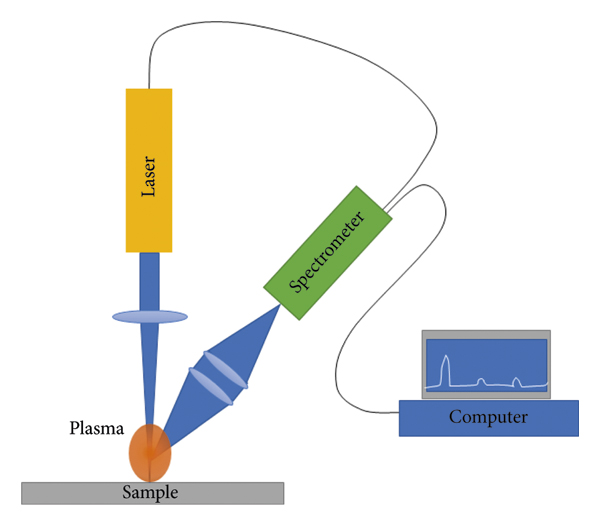
A typical LIBS experiment involves the use of a pulsed laser, typically Nd : YAG, at the fundamental wavelength of 1064 nm, emitting pulses of a few nanoseconds with energy of several tens of milli-Joules and maximum repetition rates of a few Hertz. The light emitted by the laser-induced plasma is collected and sent to a spectrometer (gated or ungated, narrow- or wideband) where the signal is analysed using a suitable delay after the laser pulse, to reduce the continuum bremsstrahlung emission (see Figure 1).
A typical LIBS setup.

Many alternative experimental configurations have been realized, though. A description of some of them is given in [Reference Tognoni, Palleschi, Corsi and Cristoforetti3].
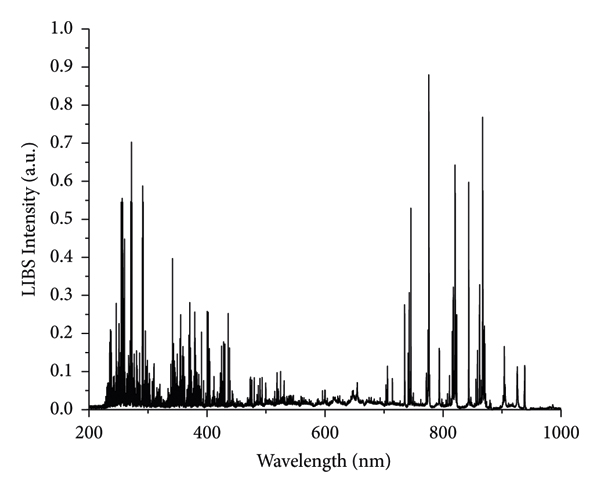
A typical LIBS spectrum, acquired with a broadband spectrometer, is shown in Figure 2.
A typical broadband LIBS spectrum (steel).

The attribution of the emission lines to the corresponding atomic species is usually done manually, based on the information contained in the NIST database of atomic lines [Reference Kramida, Olsen and Ralchemko4], although methods for automatic identification of the lines were also proposed [Reference Amato, Cristoforetti and Legnaioli5].
In the following, we will discuss the exceptional evolution of the LIBS technique in the last 40 years, also highlighting the important role that the Laser and Particle Beams journal has had in this evolution.
2. 1981–1990: The Early Years
The first papers where the acronym LIBS was originally proposed were published by Radziemski and Loree [Reference Radziemski and Loree6, Reference Loree and Radziemski7] in 1981. The two authors, researchers of the Los Alamos National Laboratory (Los Alamos, New Mexico, USA), outlined the principle of the LIBS technique in two companion papers, the first dealing with time-integrated detection of the plasma emission, the second discussing the analytical advantages of a time-resolved detection. The authors analysed by LIBS sodium and potassium in a coal gasifier product, airborne beryllium and phosphorous, sulphur, fluorine, and chlorine (the latter three elements particularly complex to detect by LIBS) in atmosphere. For the next 10 years, the research on LIBS remained essentially confined in North America; with the arrival of the Radziemski group of David Cremers, the application of the LIBS technique was extended to many other interesting fields, such as the study of aerosols [Reference Radziemski, Loree, Cremers and Hoffman8], the analysis of liquids [Reference Cremers, Radziemski and Loree9], detection of beryllium in air [Reference Radziemski, Cremers and Loree10] and in beryllium-copper alloys [Reference Millard, Dalling and Radziemski11], and detection of uranium in solution [Reference Wachter and Cremers12] and cadmium, lead, and zinc in aerosol [Reference Essien, Radziemski and Sneddon13].
3. 1991–2000: Evolution of LIBS
In 1991, the Pisa group published a paper dealing with the quantitative determination of pollutants in air by LIBS [Reference Palleschi, Harith, Salvetti, Singh and Vaselli14]. The paper was published on Laser and Particle Beams, and it represented the first work on LIBS published by a group outside the USA.
In the following years, other works on LIBS were published in Europe (determination of carbon in steel by the Spanish group of Aragón et al. [Reference Aragón, Aguilera and Campos15, Reference Aguilera, Aragon and Campos16]) and in Canada (quantitative analysis of aluminium alloys [Reference Sabsabi and Cielo17]).
In the 1990–2000 decade, several papers on LIBS were published using the “LIPS” (laser-induced plasma spectroscopy) acronym. This occurred mostly in Europe (see, for example [Reference Haisch and Panne18]), but some groups in Canada [Reference St-Onge, Sabsabi and Cielo19] and USA [Reference Martin and Cheng20] also adopted this terminology, which was considered more general than the original “LIBS.”
The LIPS acronym is now deprecated, after the First International LIBS Conference (LIBS 2000), organized by the Pisa group in Tirrenia, Italy [Reference Palleschi21]. It is nevertheless curious that two of the major contributions to LIBS, which introduced two techniques still widely used nowadays, were in fact referring to LIPS as the name of the technique.
The first key paper was published in 1988 by the Sabsabi group in Canada and reported on an alternative experimental configuration in which the laser energy is delivered on the sample surface in two pulses, suitably delayed [Reference St-Onge, Sabsabi and Cielo22]. The authors reported a considerable intensity enhancement in the spectral signal which was substantially independent on the interpulse delay. The physical explanation of the enhancement in double-pulse configuration was fully explained only several years after by the Palleschi group in Pisa [Reference Corsi, Cristoforetti and Giuffrida23, Reference Wen, Mao and Russo24], in terms of the reduced plasma shielding of the plasma produced by the second laser pulse, due to a reduction of the environmental gas density behind the shock wave produced by the first laser pulse. It is worth noting that the essential role of the first shock wave in double-pulse LIBS was firstly hypothesized by the Russian researcher Sergei Pershin; unfortunately, his research, published on a Russian journal [Reference Pershin25], went generally unnoticed, and the author was credited for his original intuition only recently [Reference Cristoforetti and Palleschi26].
The second important paper was published by the Pisa group in 1999 and proposed a new procedure for standard-less LIBS analysis called calibration-free LIPS (now known as CF-LIBS) [Reference Ciucci, Corsi, Palleschi, Rastelli, Salvetti and Tognoni27]. Interestingly enough, an extended description of the method was published the same year on Laser and Particle Beams [Reference Ciucci, Palleschi, Rastelli, Salvetti, Singh and Tognoni28]. The Ciucci et al. paper is the most quoted research paper (thus excluding books and reviews) in the history of LIBS.
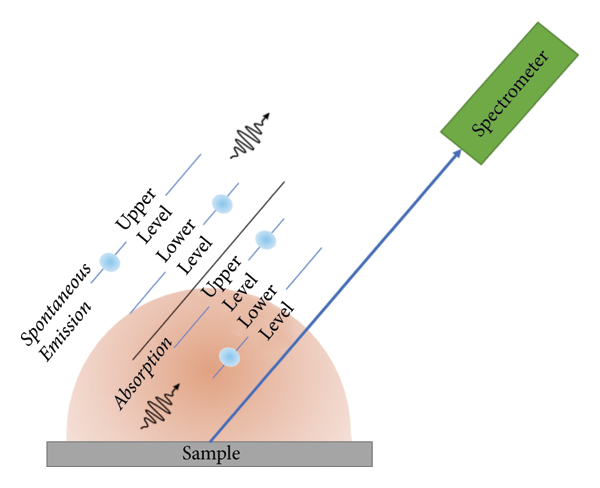
Many applications and improvements of the CF-LIBS method have been proposed since the original papers of 1999. One of the most useful procedures is the compensation of self-absorption effects in the LIBS plasma, which produce a non-linear dependence between the analyte concentration and the LIBS line intensity (see Figure 3).
Schematic representation of the self-absorption effect, showing the balance between spontaneous emission and absorption (stimulated emission is normally negligible in LIBS plasmas).

The effect of self-absorption in laser-induced plasmas was studied in a key paper by the Winefordner group at the University of Florida in Gainesville, USA [Reference Gornushkin, Anzano, King, Smith, Omenetto and Winefordner29], but the implication of this research would not be transferred to CF-LIBS until the beginning of the XXI century.
4. 2001–2021: XXI Century LIBS
The first proposal to use the curve-of-growth approach to compensate for self-absorption effects in LIBS plasmas was published by the Pisa group in 2002 [Reference Bulajic, Corsi and Cristoforetti30]. A simple experimental method for evaluating the self-absorption effect and compensating it using a duplicating optical path mirror was proposed by the Gainesville group of Nicolò Omenetto in 2009 [Reference Moon, Herrera, Omenetto, Smith and Winefordner31]. This method is conceptually very simple, although its realization is rather complex and limited to a laboratory setup. A more versatile method was proposed by the Palleschi group [Reference El Sherbini, El Sherbini and Hegazy32], as a generalization of the theoretical work of Amamou et al. [Reference Amamou, Bois, Ferhat, Redon, Rossetto and Matheron33]. According to this method, the degree of self-absorption of a given emission line can be calculated and, eventually, compensated, by measuring the intensity and full width at half maximum of the emission line and the measured plasma electron number density, once the Stark broadening coefficient of the line is known [Reference Griem34].
The method proposed by the Pisa group offers the possibility of measuring the plasma electron number density from the broadening of the Balmer alpha hydrogen line [Reference Gigosos, González and Cardeñoso35]. The problem was studied in 2013 by Pardini et al. [Reference Pardini, Legnaioli and Lorenzetti36].
Despite the fact that the Pisa method was initially developed for improving the predictions of the calibration-free LIBS technique, its applications have been extended to many situations in which the self-absorption effects are important (see [Reference Rezaei, Cristoforetti, Tognoni, Legnaioli, Palleschi and Safi37] for a detailed discussion). Particularly important in this framework is the criticism to the “branching ratio” method for assessing the self-absorption effect of a spectral line published in 2021 by Urbina Medina et al. [Reference Urbina Medina, Carneiro, Rocha, Farias, Bredice and Palleschi38].
The ability of compensating for self-absorption effects opened new perspectives in the determination of spectroscopic fundamental parameters as transition probabilities [Reference Urbina, Carneiro, Rocha, Farias, Bredice and Palleschi39, Reference Aguilera, Aragón and Manrique40] and Stark broadening coefficients [Reference Poggialini, Campanella and Jafer41, Reference Bredice, Borges and Sobral42].
One of the fundamental hypotheses for the application of the calibration-free LIBS is the fulfilment of the local thermal equilibrium (LTE) condition [Reference Griem43]. An important result, obtained at the end of the first decade of the century, was the extension of the McWhirter criterion for local thermal equilibrium to non-stationary and non-homogeneous LIBS plasmas [Reference Cristoforetti, de Giacomo and Dell’Aglio44]. The implication of that research confirmed the necessity, for the use of CF-LIBS, to use time-resolved detectors. A paper by Grifoni et al. in 2014 [Reference Grifoni, Legnaioli, Lezzerini, Lorenzetti, Pagnotta and Palleschi45] provided a simple tool for extracting time-resolved information from time-integrated spectra, exploiting the differences between two or more spectra taken at different time delays.
The first decade of the century witnessed a great improvement in the performances of the LIBS technique, which accelerated its acceptation as a powerful analytical technique. In 2004, the Gainesville group published a paper, in which LIBS was defined as a possible future superstar among the atomic spectrometric techniques [Reference Winefordner, Gornushkin, Correll, Gibb, Smith and Omenetto46], and in 2010, David Hann and Nicolò Omenetto published an important review on Basic Diagnostics and Plasma-Particle Interactions [Reference Hahn and Omenetto47] which at present time is the most quoted review paper in the LIBS history.
Many applications of LIBS in the analysis of biological materials [Reference Gaudiuso, Melikechi and Abdel-Salam48–Reference Rehse, Salimnia and Miziolek55], cultural heritage and archaeology [Reference Scholten, Teule, Zafiropulos and Heeren56–Reference Arafat, Na’es and Kantarelou62], industry [Reference Bulajic, Cristoforetti and Corsi63–Reference Li, Feng, Oderji, Luo and Ding65], and environment [Reference Karpate, Nayak and Libs66–Reference Nunes, De Carvalho, Santos and Krug69] have been reported.
The group of Javier Laserna at Malaga University, Spain, demonstrated the feasibility of performing stand-off LIBS analysis at long distances (>10 meters) using an open-path configuration [Reference Palanco and Laserna70, Reference Fortes and Laserna71], thus extending dramatically the possible applications of LIBS for the analysis of industrial or environmental samples in hostile environment. Among the many exploitations of the LIBS technique, it is worth mentioning the results of a recent European project (LACOMORE—laser-based continuous monitoring and resolution of steel grades in sequence casting machines), aimed at the optimization of the continuous casting process of steel [Reference Lorenzetti, Legnaioli, Grifoni, Pagnotta and Palleschi72, Reference Cabalín, Delgado, Ruiz, Mier and Laserna73]. The project involved the world’s two most active groups in LIBS development and research of Malaga and Pisa. In the framework of that project, an open-path double-pulse LIBS instrument was successfully used for remote analysis (about 6 meters) of steel up to 900 C temperature.
An important evolution of the LIBS technique, in the first decade of the century, was the introduction of ultra-short lasers sources for plasma generation [Reference Le Drogoff, Margot and Chaker74–Reference Margetic, Niemax and Hergenröder76]. Femtosecond laser pulses produce neater craters on the sample surface compared to nanosecond lasers, and the resulting spectra are characterized by a lower continuum emission because of the temporal separation between the ablation phenomenon and the creation of the plasma, which inhibits the laser-plasma interaction phenomena. The advantages of femtosecond LIBS were exploited for sub-micrometric in-depth measurements [Reference Margetic, Bolshov, Stockhaus, Niemax and Hergenröder77], analysis of biological tissues [Reference Moon, Han, Choi, Shin, Kim and Jeong78], and environmental applications [Reference Hu, Shi, Yan, Wu and Zeng79]. Combined nanosecond-femtosecond [Reference Scaffidi, Pender and Pearman80, Reference Babushok, DeLucia, Gottfried, Munson and Miziolek81] and femtosecond-femtosecond [Reference Piñon, Fotakis, Nicolas and Anglos82] dual-pulse analysis was also proposed. The possibility of maintaining the laser beam collimation at very long distances, due to the filamentation/self-focusing effects that characterize the propagation of fs-laser beams in atmosphere [Reference Hu, Shi, Yan, Wu and Zeng79, Reference Stelmaszczyk, Rohwetter and Méjean83–Reference Hu, Xu, Yuan and Zeng85], has triggered many innovative applications of stand-off LIBS, including the remote analysis of cultural heritage [Reference Tzortzakis, Anglos and Gray86], biological materials [Reference Xu, Méjean and Liu87], geological samples [Reference Abdul Kalam, Balaji Manasa Rao, Jayananda and Venugopal Rao88], and explosives [Reference Shaik, Epuru and Syed89, Reference Shaik and Soma90].
After the modest results of the proposals to use LIBS for Homeland Defense, in the years following the 9/11 tragic events [Reference Fortes and Laserna71, Reference González, Lucena, Tobaria and Laserna91–Reference Gottfried, De Lucia, Munson and Miziolek94], LIBS regained some public consideration for its possible application in the field of space exploration [Reference Knight, Scherbarth, Cremers and Ferris95]. Finally, on August 6, 2012, the NASA Curiosity rover landed on Mars, carrying a LIBS instrument [Reference Wiens, Maurice and Barraclough96] which is still operating after more than 10 years of activity, resulting in hundreds of thousands of spectra taken on Martian rocks. The data obtained by the LIBS instrument on Mars certainly helped in better understanding the Martian geology and contributed to the search of former life traces on the planet, opening the way to the use of LIBS in two other missions landed on Mars in 2021 (the NASA SuperCam instrument, mounted on the Perseverance rover [Reference Wiens, Maurice and Robinson97], and the Chinese MarSCoDe mounted on the Zhurong Mars rover [Reference Xu, Liu and Yan98]). However, the success of LIBS on Mars benefitted more, if possible, the development of LIBS research on Earth. In fact, the first LIBS Mars mission spurred the development of compact hand-held LIBS spectrometers, which rapidly arrived on the market of scientific instrumentation for metal analysis [Reference Afgan, Hou and Wang99, Reference Poggialini, Campanella, Legnaioli, Pagnotta, Raneri and Palleschi100], nuclear industry [Reference Garlea, Bennett, Martin, Bridges, Powell and Leckey101], and environmental applications [Reference VerMeulen, Clausen, Mosell, Morgan, Messan and Beal102], to cite some of the most important applications.
The hand-held LIBS instruments represented an impressive advance with respect to the conventional laboratory or mobile LIBS instrumentation [Reference Senesi, Harmon and Hark103], but their compact size unavoidably imposes some compromise in the analytical performances of the instrumentation. The limitations of the hand-held LIBS hardware require the use of sophisticated chemometric techniques for extracting useful information from the spectra [Reference Afgan, Hou and Wang99, Reference Poggialini, Campanella, Legnaioli, Pagnotta, Raneri and Palleschi100, Reference Zhou, Luo, Zheng and Huang104].
The use of advanced chemometric tools (artificial neural network, ANN) was firstly introduced in LIBS in 1998 [Reference Sattmann, Mönch and Krause105]. However, these techniques became widely used only in the second decade of the century. The chemometric techniques can be used for simplification (for example, principal component analysis [Reference Moncayo, Duponchel and Mousavipak106]), classification (self-organizing map (SOM) [Reference Pagnotta, Grifoni, Legnaioli, Lezzerini, Lorenzetti and Palleschi107], support vector machine (SVM) [Reference Dingari, Barman, Myakalwar, Tewari and Kumar Gundawar108], graph clustering (GC) [Reference Grifoni, Legnaioli, Lorenzetti, Pagnotta and Palleschi109], random forest (RF) [Reference Sheng, Zhang and Niu110], ANN [Reference Pokrajac, Vance and Lazarević111], etc.), and quantification of the LIBS spectra (partial least squares (PLS) analysis [Reference Yaroshchyk, Death and Spencer112], ANN [Reference Sirven, Bousquet and Canioni113], etc.). Numerous applications based on machine learning and chemometric analysis of LIBS spectra have been proposed in recent years. The most impressive are probably the applications to animal and human health (early detection of cancer, for example, [Reference Gaudiuso, Melikechi and Abdel-Salam48]), but many other examples can be cited in cultural heritage [Reference Duchene, Detalle, Bruder and Sirven114], energy production [Reference Legnaioli, Campanella, Pagnotta, Poggialini and Palleschi115], space exploration [Reference Sirven, Sallé, Mauchien, Lacour, Maurice and Manhès116], and several other fields. LIBS elemental imaging [Reference Sancey, Motto-Ros and Busser117, Reference Busser, Moncayo, Coll, Sancey and Motto-Ros118], which represents one of the most interesting developments of the technique, can produce millions of spectra. The construction and interpretation of LIBS elemental maps also benefit the chemometric algorithms [Reference Jolivet, Leprince, Moncayo, Sorbier, Lienemann and Motto-Ros119].
The growing complexity of the chemometric algorithms currently used in LIBS has stimulated some research aimed to obtain a better interpretability of the results obtained [Reference Safi, Campanella and Grifoni120, Reference Képeš, Vrábel and Adamovsky121]. An up-to-date description of the most advanced chemometric techniques can be found in [Reference Palleschi122].
Among the emerging new approaches to LIBS analysis, it is worth mentioning two interesting variations of LIBS which were proposed in the second decade of the century.
In 2011, Rick Russo proposed a technique for isotopic analysis by LIBS based on the detection of molecular emission in the spectrum. The isotopic shift of diatomic oxides or fluorides of the elements is typically larger than the ones of the corresponding atoms, thus allowing for an easier separation of the characteristic emission pattern of the different isotopes. The technique was called laser ablation molecular isotopic spectrometry (LAMIS) [Reference Russo, Bol’šhakov, Mao, McKay, Perry and Sorkhabi123], and its effectiveness was demonstrated for the isotopic analysis of several interesting elements [Reference Bol’šhakov, Mao, González and Russo124].
Another very interesting alternative approach to LIBS analysis was suggested by Alessandro De Giacomo and his group in Bari, Italy, in 2013. de Giacomo et al. reported on the use of nanoparticles to enhance the LIBS signal on metal targets [Reference de Giacomo, Gaudiuso, Koral, Dell’Aglio and de Pascale125]. The enhancement observed was comparable to the ones obtained in double-pulse LIBS, but obtained with a simpler, in principle, experimental apparatus. The mechanism of the enhancement in nanoparticle-enhanced LIBS (NELIBS) is very different from the one observed in DP-LIBS (total ablated mass, plasma electron density, and temperature are found very similar between NELIBS and conventional LIBS at the same energy). The mechanism hypothesized by the inventors of the technique involves a much larger atomization of the ablated mass in NELIBS, produced by the intense electric field which is created between one nanoparticle and the other. A model of the phenomenon has been recently published [Reference de Giacomo, Salajkova and Dell’aglio126], which also explains the dependence of the enhancement on the distance between the nanoparticles (which in turn reflects in a strong dependence of the enhancement on the concentration of the deposited nanoparticle).
The full potential of NELIBS has probably not been yet explored, but this method can possibly change the conventional narrative of LIBS as a mediocre analytical technique. The applications of NELIBS should be mainly confined to the laboratory, though, because of the need of treating, although minimally, the sample under analysis. Proposals have been presented for putting together NELIBS and DP-LIBS, in a way to possibly combine the two enhancements [Reference Poggialini, Campanella, Legnaioli, Pagnotta and Palleschi127]. Finally, in the analysis of insulators, NELIBS offers the advantage of enhancing the signal while reducing the surface damages, a feature that makes this approach particularly useful for the study of precious stones [Reference Koral, Dell’Aglio, Gaudiuso, Alrifai, Torelli and de Giacomo128], for example.
The possibility of obtaining readable LIBS spectra from minimal quantity of ablated material was specifically studied by the Malaga group of Javier Laserna, which demonstrated the feasibility of LIBS for analysis of single nanoparticles [Reference Fortes, Fernández-Bravo and Javier Laserna129] and, in more recent papers [Reference Purohit, Fortes and Laserna130–Reference Purohit, Fortes and Laserna132], essentially debunked the standard narrative describing LIBS as a low sensitivity technique (in [Reference Purohit, Fortes and Laserna130], a limit of detection of 60 attograms was demonstrated in the LIBS analysis of single copper nanoparticles).
5. Conclusions
The LIBS technique has made incredible progresses during its 40 years of existence. Certainly, the evolution of LIBS has been favoured by the technological evolution of the key instrumental parts (lasers, spectrometers, and detectors); however, the improved knowledge of the basic phenomena involved in the laser-sample, laser-plasma, and plasma-sample interactions has helped in better modelling the complex chemical and physical phenomena involved in the generation of the LIBS spectral signal. In this contribution, we have tried to retrace the history of LIBS to its fundamental papers, several of which were published in this journal. The list is far from being complete. A search on the Scopus® database with keywords (LIBS OR LIPS) reports, after removal of non-pertinent works, more than 12,000 papers published on the topic since the first two in 1981, with a growth rate in 2021 of more than 1,000 papers per year. Nevertheless, we hope to have given an idea of the distance that the technique has travelled from the first laboratory application to the present interplanetary missions.
There are still many steps to do and many obstacles to overcome before the LIBS technique could be considered to have growth to its full potential, but we have no doubts that some of these important steps will be presented and commented on this journal, as it was in the past with several key publications which still represent fundamental milestones in LIBS research.
Data Availability
The relevant data are available from the author upon reasonable request.
Conflicts of Interest
The author declares that there are no conflicts of interest regarding the publication of this paper.

 Open access

