





Introduction
‘Having studied your paper, I am writing to inform you on this occasion the journal will not be publishing your paper. Please bear in mind that the journal accepts about 5 per cent of submissions and rejects many papers that go on to be published elsewhere’. Probably all or most of us have received such a desk-rejection letter. Either almost immediately after submission (in the best case) or after months of waiting (in the worst case). And often without any explanation at all. Of course, desk-rejected papers are usually unsound, without merit, or out of the journal’s scope. On the other hand, as many studies have shown, the acceptance or rejection of a paper can be biased in various ways (cf. Sverdlichenko, Xie, and Margolin Reference Sverdlichenko, Xie and Margolin2022; Liu, Rahwan, and AlShebli Reference Liu, Rahwan and AlShebli2023; Kulal, Abhishek, Shareena et al. Reference Kulal, Abhishek, Shareena and Dinesh2025; etc.). For this reason, the growing inequality between the status of editors and authors has also been discussed recently (cf. Feeney, Carson, and Dickinson Reference Feeney, Carson and Dickinson2019; Faggion Reference Faggion2025; Sekerák and Šmídová Reference Sekerák and Šmídová2025 etc.), as well as the need to rethink the current model of relationships in publishing – for example, in the sense that not only reviewers but also editors should be blinded (Sverdlichenko, Xie, and Margolin Reference Sverdlichenko, Xie and Margolin2022; Kulal, Abhishek, Shareena et al. Reference Kulal, Abhishek, Shareena and Dinesh2025; Sekerák and Šmídová Reference Sekerák and Šmídová2025).
Although the peer review process plays a crucial role (cf. Roberts, Overtsreet, Hendrick et al. Reference Roberts, Overtsreet, Hendrick, Mahar and Iphofen2020) and has the potential to reduce bias (Budden, Tregenza, Aarssen et al. Reference Budden, Tregenza, Aarssen, Koricheva, Leimu and Lortie2008), it is ultimately the editors who decide whether a text is accepted or rejected. As the position of editors in the publishing process is quite crucial, it is beneficial to inquire about who these editors are and what potential biases may be involved. It is worth asking this question, even in the knowledge that most editors are highly responsible in their (demanding and usually unpaid or underpaid) work. However, bias need not be intended or even conscious. What should be noted at the very beginning of the paper: I approach the writing of this text from the position of an author who also has editorial experience in several international journals and currently holds the position of associate editor in one of the journals analyzed.
A key feature of journals is their international scope, encompassing both the composition of editorial teams and editorial boards, as well as the representation of authors and countries examined (cf. Liu, Xu, Zhang et al. Reference Liu, Xu, Zhang, Yu and Zhong2025). At the same time, there is clear scope for bias in the relation between these levels. This is also why a number of voices (Imhof and Müller Reference Imhof and Müller2020; Wu, Lu, Li et al. Reference Wu, Lu, Li and Li2020; Liu, Rahwan, and AlShebli Reference Liu, Rahwan and AlShebli2023; Sekerák and Šmídová Reference Sekerák and Šmídová2025) have called for a more diverse composition of editorial boards and editorial teams. Editors should be understood as gatekeepers and those who set research priorities (Simons and Fyfe Reference Simon and Fyfe1994; Feeney, Carson, and Dickinson Reference Feeney, Carson and Dickinson2019; Primack, Regan, Devicotr et al. Reference Primack, Regan, Devictor, Zipf, Godet, Loyola, Maas, Pakeman, Cumming, Bates and Pejchar2019; Nguyen and Vuong Reference Nguyen and Vuong2025), as they are the ones who shape the direction of research in a field by determining what types of work will be published (or not) (Spender Reference Spender and Roberts1981). Due to the importance of editorial positions in terms of epistemic and disciplinary power (Eberle, Smekal, Ocelík et al. Reference Eberle, Smekal, Ocelík and Krpec2021: 201), their composition in terms of institutional, gender, and national diversity (see the following section for more details) is the subject of extensive research. The latter diversity is the one that is relevant to this specific paper.
Although there are inequalities and relations of dependence and dominance between the global North and South in science in general (Aalbers Reference Aalbers2004; Collyer Reference Collyer2018; Deméter Reference Deméter2020; Liu, Rahwan, and AlShebli Reference Liu, Rahwan and AlShebli2023), a clear dominance of the North, or more specifically of Anglophone countries, can be observed specifically in a number of social sciences, such as international relations (Alejandro Reference Alejandro2019; Fonesca Reference Fonesca2019), public administration (Liu, Xu, Zhang et al. Reference Liu, Xu, Zhang, Yu and Zhong2025), or political science (Gunnell Reference Gunnell2002; Carammia Reference Carammia2022), which is the focus of this paper. Using a sample of 187 political science journals indexed in the Social Sciences Citation Index (SSCI), this paper aims to analyze the composition of editorial teams (1240 analyzed editor positions) and editorial boards (7178 analyzed board members) by country in a descriptive manner. This enables the identification of both marginalized and dominant countries or regions, as well as sources of potential bias. In doing so, the analysis contributes to: (1) the debate on the structural factors affecting academic publishing (see the next part); (2) the debate on the internalization of global (cf. Norris Reference Norris, Boncourt, Engeli and Garzia2020) and European (cf. Tronconi and Engeli Reference Tronconi and Engeli2022) political science; (3) and to the call for greater diversity of editorial teams and editorial boards in the field since lack of diversity can lead to a preference of particular topics, methods, or theories (Burgess and Shaw Reference Burgess and Shaw2010).
Research can also reveal a great deal about the field itself – for political science, in particular, journal articles have been an integral part of the research process since the discipline’s inception. Indeed, the Political Research Quarterly was launched at Columbia University in 1886, just six years after the first political science department was established at that institution (Patterson Reference Patterson, Simon and Fyfe1994: 3). Moreover, recent research on citation practices in this field has shown that journals and journal articles have become increasingly important (cf. Yanus and Ardoin Reference Yanus and Ardoin2026).
In relation to the question of European political science, the analysis focuses more closely on the European environment. Although much effort has been made to internationalize the field and build a truly European political science (Engeli, Kostova, and Tronconi Reference Engeli, Kostova and Tronconi2023), the fact remains that Central and Eastern Europe (hereafter CEE) still has a somewhat (semi-) peripheral position (Eberle, Smekal, Ocelík et al. Reference Eberle, Smekal, Ocelík and Krpec2021). This marginal position is reflected not only in the low involvement among gatekeepers, but also in the level of authorship, as well as other aspects of internalization (see below; cf. also Eberle, Smekal, Ocelík et al. Reference Eberle, Smekal, Ocelík and Krpec2021; Carammia Reference Carammia2022; Ilonszki and Roux Reference Ilonszki and Roux2022; Kapidžić, Janušauskienė, and Csanyi Reference Kapidžić, Janušauskienė and Csanyi2022; Tronconi and Engeli Reference Tronconi and Engeli2022; Mišík, Oravcová, Plenta et al. Reference Mišík, Oravcová, Plenta and Hrabušajová2024). Regarding existing studies on Central and Eastern Europe (CEE), and based on the data used in this analysis, which clearly illustrates the position of CEE from both global and European perspectives, this section of the article focuses on the European environment, with an emphasis on CEE. Part of the research is therefore devoted not only to the position of CEE editors and board members in journals at the global level, but also (1) to journals that identify themselves as ‘European’ (with an emphasis on journals published on behalf of the European Consortium for Political Research), and (2) those international journals that focus on the politics in CEE.
The paper is organized as follows. First, I present the conclusions of several recent studies that have informed the intention of this paper, as well as some comments on the editors’ position and the internalization of (European) political science. Then I present the data analyzed. Finally, I present and discuss my findings in a broader context. In this regard, the analysis has a dual focus as already noted. First, I present the results from a global perspective, highlighting the clear Anglo-American dominance in the field. Then, I focus on the European environment, particularly with regard to the position of CEE countries.
Research background
While there are subtle differences across journals and publishers, established patterns exist in how editors are selected (Cascio Reference Cascio, Baruch, Konrad, Aguinis and Starbuck2008; Feldman Reference Feldman, Baruch, Konrad, Aguinis and Starbuck2008). There are differences in the length of tenure –in some cases a single editor (or group of editors) has led a journal for decades, while in other cases editors and editorial board members rotate regularly in multi-year cycles (in the case of the high-ranked journal World Politics, the editorial team is even changed each year). This rotation model (together with a greater gender, seniority, and geographic diversity) can be considered better since it can significantly eliminate or at least weaken ideational, thematic, and methodological lock-in of the journals (see Sekerák and Šmídová Reference Sekerák and Šmídová2025: 949). Subtle differences include whether there is an open competition for the appointment of new editors, whether individual editors or the entire editorial team (often from a single department) are restructured in this way, and so on. Other differences arise from whether the journal is owned by a particular publisher or is published on behalf of an academic institution (usually a university) or a national (such as the American Political Science Institution or the Political Science Institution in the UK) or international (such as the European Consortium for Political Research or the International Political Science Association) scientific association, which has a greater or lesser say in the selection process.
Editors are the ones who actually decide what gets published. First, they decide whether to desk reject a manuscript or to initiate the peer review process. Then they decide who will review the text. In doing so, they also determine the theoretical and methodological perspective through which the text will be evaluated. They also determine how to address the evaluations and recommendations of the reviewers. The editors’ priorities are thus fundamentally reflected in the journal’s content. This process affects not only the quality of the published content but also, secondarily, the ranking of research institutions, which is often based on prestigious publications, and the careers of individual academics (Feeney, Carson, and Dickinson Reference Feeney, Carson and Dickinson2019), including their salaries, as many academics in many contexts and fields rely on funding linked to publications (Naxera Reference Naxera2024b).
Considering all the factors that go into how editors select reviewers (Lerbac and Hanson Reference Lerbac and Hanson2017), it is clear how enormous the scope for bias is, which can ultimately create or exacerbate (but also reduce) inequalities in the scientific field (see also Loui and Fiala Reference Loui and Fiala2024; Kulal, Abhishek, Shareena et al. Reference Kulal, Abhishek, Shareena and Dinesh2025). For example, as Liu, Rahwan, and AlShebli (Reference Liu, Rahwan and AlShebli2023) show in their recent study based on an analysis of 1,000,000 papers from six publishers over two decades, non-white scientists are underrepresented on editorial boards, their articles spend more time under review, and these texts receive fewer citations after publication than would be expected based on textual similarity. Bias in terms of gender is also well documented (Metz, Harzing, and Zyphur Reference Metz, Harzing and Zyphur2016; Feeney, Carson, and Dickinson Reference Feeney, Carson and Dickinson2019; Süleymanoğlu-Kürüm and Turhan Reference Süleymanoğlu-Kürüm and Turhan2024).
Based on extensive research across various journals, Kulal, Abhishek, Shareena et al. (Reference Kulal, Abhishek, Shareena and Dinesh2025) demonstrate a statistically significant tendency for manuscripts from prestigious institutions to be favored, as evidenced by higher acceptance rates and faster review processes. Although the prestige of the institution has a significant impact on these results, the quality of the research also plays a crucial role. Institutional bias thus operates in conjunction with other factors. The study also highlights the negative impact of institutional bias on the diversity of published content, with manuscripts from lower-ranked institutions contributing more to the geographical and thematic diversity of research. As many authors from smaller and/or peripheral countries researching the politics of a particular country have found, a particular case may not be of interest to the general readership, and journals are therefore often inclined to reject it.
Several studies examining institutional bias (Laband and Piette Reference Laband and Piette1994; Hodgson and Rothman Reference Hodgson and Rothman1999; Sverdlichenko, Xie, and Margolin Reference Sverdlichenko, Xie and Margolin2022, among others) have found a correlation between the affiliations of editors and authors. In their recent study, Sverdlichenko, Xie, and Margolin (Reference Sverdlichenko, Xie and Margolin2022) analyze the correlation between the affiliations of editors (both editors-in-chief and editorial board members) and authors in three high-ranked ophthalmology journals. They conclude that a match was found across journals for almost half of the papers. This means that half of the content came from a small subset of 23 to 45 institutions affiliated with the editors. A limitation of the research is that the authors cannot see inside the peer-review process, so it is not possible to know what the editor-author affiliation matches look like in the case of rejected papers, but considering that there are 134 institutions conducting ophthalmology research in North America alone (and taking into account the number of such institutions outside the US and Canada), the authors conclude that the editorial bias associated with authors’ institutional affiliation influences the decision to accept or reject papers. However, institutional diversity is not just a matter of reducing bias in the publication process. As indicated by some research (e.g. Wu, Lu, Li et al. Reference Wu, Lu, Li and Li2020), higher institutional diversity among editors and board members may also have a positive impact on journal quality in terms of scientometrics.
In addition to gender and institutional diversity, the diversity in the composition of editorial teams by country is often examined, with individual studies typically highlighting the lack of internationalization of journals and the dominance of English-speaking countries, especially the US and the UK. Stimulating research in this regard has been carried out, for example, in the fields of geography (Imhof and Müller Reference Imhof and Müller2020) and human geography (Gutiérrez and López-Nieva Reference Gutiérrez and López-Nieva2001), accounting (Dhanani and Jones Reference Dhanani and Jones2017), criminology (Faraldo-Cabana and Lamela Reference Faraldo-Cabana and Lamela2021), school and educational psychology (Wang, Begeny, Hilda et al. Reference Wang, Begeny, Hida and Oluookun2020), or public administration (Liu, Xu, Zhang et al. Reference Liu, Xu, Zhang, Yu and Zhong2025). It is the results of the latter research that are also relevant to political science due to the similarity of the fields. Based on an analysis of 45 prominent journals in public administration over a decade, Liu, Xu, Zhang et al. (Reference Liu, Xu, Zhang, Yu and Zhong2025) show that (despite differences between journals) there is a clear Anglo-American dominance in the composition of editorial teams, which is reflected in a similar dominance in the composition of editorial boards, an Anglo-American dominance among authors, and also the fact that the geographical focus of published research is again Anglo-American dominated. Anglo-American dominance thus influences ‘who’ (authors) says ‘what’ (topics such as countries examined) and uses ‘which channel’ (gatekeepers – editors, boards, referees).
In light of the above, it is therefore highly relevant and interesting to inquire about the composition of editorial teams and editorial boardsFootnote 1 of political science journals. No research has been conducted in political science in this regard, with the exception of two studies focusing on the European environment. Tronconi and Engeli (Reference Tronconi and Engeli2022) and Kapidžić, Janušauskienė, and Csanyi (Reference Kapidžić, Janušauskienė and Csanyi2022) focus their research on various aspects of the internationalization of European political science. They emphasize the participation of political scientists in international research networks, the international publishing industry, and international academic mobility. The studies show not only the differences between Western (which is more internationalized) and Eastern Europe, but also that these regions are not entirely homogeneous in terms of the degree of internationalization. While in the case of ‘Western’ Europe, political science communities in Northern European countries are more internationalized than in Mediterranean European countries, in the case of CEE, we find differences between EU members and non-EU members, especially with regard to possible resources and opportunities (Tronconi and Engeli Reference Tronconi and Engeli2022). Kapidžić, Janušauskienė, and Csanyi (Reference Kapidžić, Janušauskienė and Csanyi2022) also find differences in the degree of internationalization between smaller subregions in CEE. Just as entire regions are not homogeneous, individual countries in both Western and Eastern Europe are also not internally homogeneous. Research on the degree of internationalization in France (Boncourt, Holeindre, Joana et al. Reference Boncourt, Holeindre, Joana and Mayer2022) or the Czech Republic (Eberle, Smekal, Ocelík et al. Reference Eberle, Smekal, Ocelík and Krpec2021) reveals a division of individual scientific communities into two distinct groups: one that is strongly internationalized and another that is more nationally oriented.
Although the above-mentioned studies (Tronconi and Engeli Reference Tronconi and Engeli2022; Kapidžić, Janušauskienė, and Csanyi Reference Kapidžić, Janušauskienė and Csanyi2022) also examine the unequal degree (with a decreasing rate from Northern through Mediterranean Europe to CEE, with EU member states slightly dominating non-EU countries within CEE) of involvement in the international publishing industry (in the form of journal editorship, editorship of book series, reviewing monograph manuscripts for leading international publishers, etc.), their perspective is significantly different from the perspective presented in this analysis. While previous studies have examined the degree of internationalization (or Europeanization) among individual political scientists and national scientific communities, this study, based on a global dataset of editors, focuses on the degree of internationalization (or Europeanization) of academic journals as a key means of communication in the field.
Materials and methods
Determining what can be considered key journals in the field is a complex matter. Nevertheless, it is necessary to define, in a transparent manner and based on clear criteria, which journals are to be included in the analysis; otherwise, the conclusions will be arbitrary. Since one cannot rely on a necessarily subjective determination of representative journals, formal scientometric criteria were chosen. I decided to include in the analysis the full list of journals included in the Web of Science (WoS) SSCI within the field of political science. Although there have been recent changes within WoS to merge all journals in a given field across indexes (such as SSCI or Emerging Sources Citation Index/ESCI) into a single list within the Journal Citation Report (JCR), only journals within the SSCI had an impact factor (IF) until recently, which is often considered by individual national science evaluation systems.
There are several other reasons for not including journals in the ESCI – although the dataset would be expanded to a total of 318 journals (according to the JCR for 2023), a large number of political science journals in the ESCI are of local or regional relevance and have limited outreach to the international community (for examples of journals published in CEE, see Naxera Reference Naxera2024a; Cabada, Jirušek, and Varkočková Reference Cabada, Jirušek and Varkočková2025; Daniel and Karmazin Reference Daniel and Karmazin2025; Karmazin and Daniel Reference Karmazin and Daniel2025; etc.). At the same time, these journals tend to be ranked at the bottom of the rankings (based on IF). For example, in 2023, there were only three ESCI journals among the top 50 political science journals in the JCR. In contrast, only two SSCI journals are in the bottom 20. Of course, there are also many relevant and prestigious journals among the ESCI journals (these are also found outside the WoS), just as there are journals in the SSCI whose international importance is lower; however, the dataset needs to be delimited transparently.
Thus, 187 journals meeting the above criteria in 2023 (with an IF in political science within the SSCI) were included in the analysis. These are the journals that can be considered a representative sample of relevant international-level journals in the field. Their list (sorted by IF) is presented in Table A1 (see the online Appendix).
Not just for context (as the results vary significantly between different publishers), I would like to add the distribution of journals among publishers. Figure A1 (see the online Appendix) summarizes the number of journals published by the five largest commercial publishers of scientific journals (Elsevier, Sage, Springer, Taylor & Francis, and Wiley), which collectively publish a total of 115 of the analyzed journals. Two large university presses (Oxford University Press and Cambridge University Press) also have a significant share. Less than a fifth of the journals analyzed are then published by a mix of more than 30 other publishers, most of which publish a single journal in the dataset, and rarely 2 or 3. This group includes other large commercial (e.g. Brill or De Gruyter) and university presses (e.g. MIT Press or Boston University Press) as well as a number of smaller publishers, often associated with academic institutions (typically journals published outside the Anglo-American area and at the bottom of the list of journals, such as the Czech journal Political Economy, published by the Prague University of Economics and Business).
Lists of editors and editorial board members were then searched on the websites of these journals. This data was downloaded at the end of November and the beginning of December 2024. Of course, some journals have changed their editorial boards since then; nonetheless, it is necessary to analyze the data collected within a single time period. In both categories, individuals were counted for each country based on a listed institution. In this context, it is important to make one methodological and conceptual remark concerning individuals who work at institutions in countries other than their country of origin/education/previous employment. Foreign mobility, often in the form of a one-way process from ‘South to North’, i.e. to countries and institutions at the core of areas of political science, is an integral and natural part of the internationalization of (not only political) science and, as such, is the subject of research both globally (Norris Reference Norris, Boncourt, Engeli and Garzia2020) and in Europe (Kapidžić, Janušauskienė, and Csanyi Reference Kapidžić, Janušauskienė and Csanyi2022; Tronconi and Engeli Reference Tronconi and Engeli2022). Despite often working abroad for a significant part of their academic careers, these individuals can be understood as examples of ‘dual academic citizenship’. However, since it is not possible to identify these trajectories with 100 per cent reliability in a dataset of this size, from a methodological perspective, the only option is to count them according to their current country of affiliation. However, it is essential to acknowledge that the actual internationalization of journals may be (albeit only in the case of a few journals and often to a limited extent) higher than the formal internationalization based on affiliation analysis.
The total dataset numbers 1240 editors and 7178 editorial board members. This averages 6.8 editors and 39.7 editorial board members per journal, although there is considerable variation between journals in this respect. The median is therefore 5 for editors and 37 for editorial boards. For a detailed description of the data corpus creation process, see the online Appendix.
Results: a global overview
Editors in the dataset come from 53 different countries, and editorial board members from 96 different countries. However, as the absolute numbers of editors in Tables A2 and A3 (see the online Appendix) show, the representation of countries varies widely, with a clear dominance of English-speaking countries in both categories, particularly the US and the UK, as well as significant positions for Canada and Australia. Several (Western) European countries are also strongly represented, notably Germany, the Netherlands, Italy, Spain, and France. These nine countries are tied for first place in both categories, although in a slightly different order.
The relatively high representation of editors and editorial board members from some countries outside the main centers of political science is due to the concentration of representatives from these countries in one or a few journals, especially those published in their own countries, which tend to be lower-ranked. For example, 7 out of 8 editors from Slovenian institutions are found in the Slovenian journal Lex Localis, and 10 out of 11 editors from Czech institutions are found in the Czech journal Political Economy. Similarly, all seven Romanian board members are on the editorial board of the Romanian Journal of Political Science. However, this is also the case for some Western European countries, which at first sight appear to be well represented. Of the 155 editorial board members from France, 51 are listed in the French journal Politix, which ranks last. In the case of Spain, the two Spanish journals at the bottom of the ranking represent 17 of the 25 editors and 63 of the 135 editorial board members. The specific position of some of these journals (e.g. those in French or Spanish) is underscored by the fact that they are partly (or mainly) published in languages other than English.
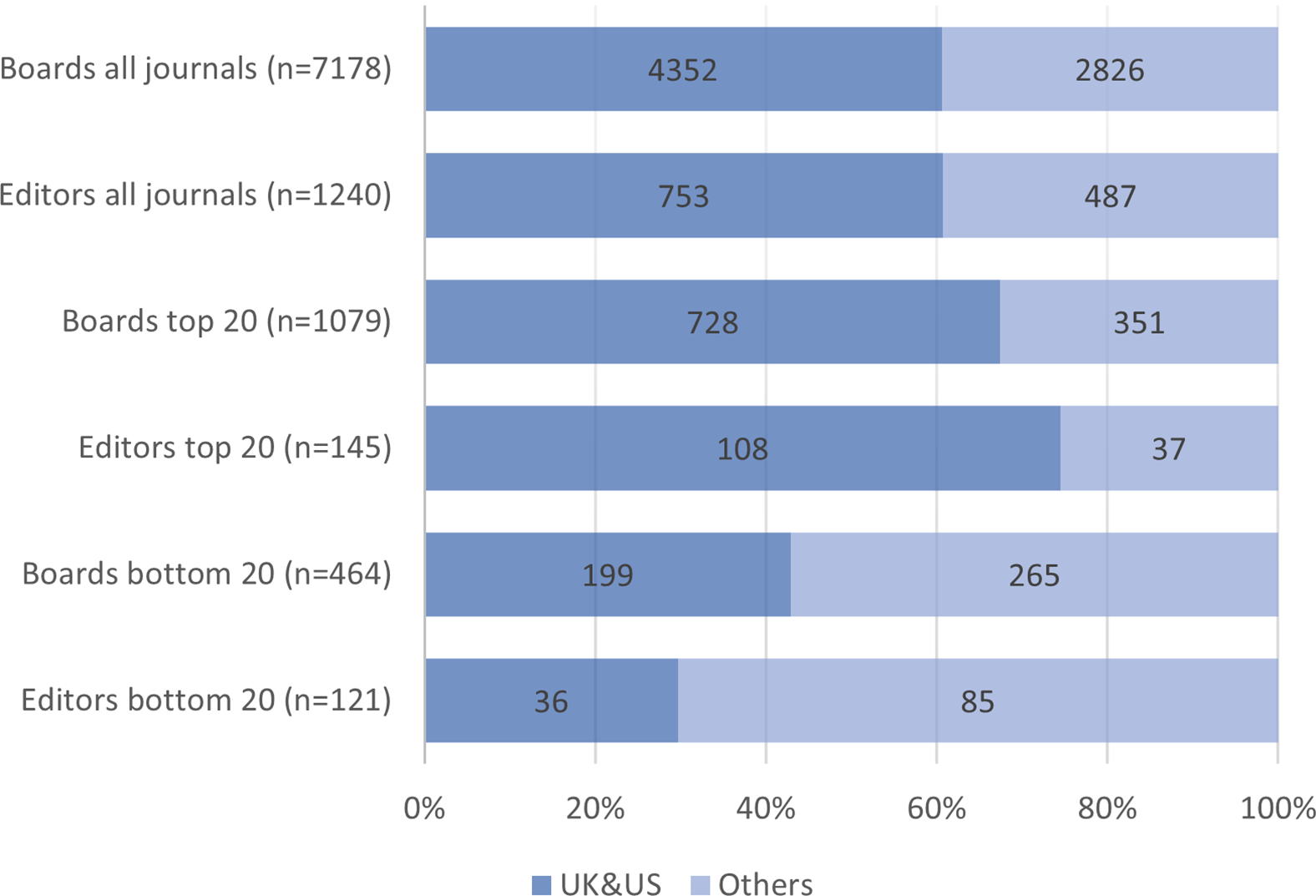
UK and US institutions hold more than 60 per cent of all positions in both categories. If we look only at the top journals, this share is even higher.Footnote 2 By contrast, the position of countries in the Global South is quite different. The dominance of the US and UK is not only evident in the total number of positions, but also in the fact that only 15 journals in the dataset have no editorial board members from the UK, and in the case of the US, only 8 journals (which means approx. 4 per cent of journals). In contrast, a number of US journals have editorial teams and editorial boards that are almost entirely US or US-UK, with a few individuals from other countries (often Australia and Canada). It is therefore clear that there is a clear dominance of the US and UK across the dataset. Figure 1, therefore, shows what proportion (in terms of absolute numbers) of the total number of editors and editorial board members are from the US and UK.
Proportion of US and UK editors and board members (absolute numbers).

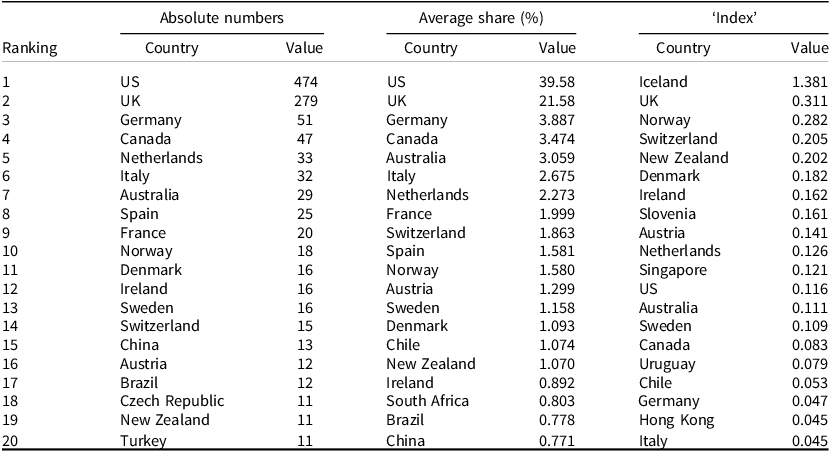
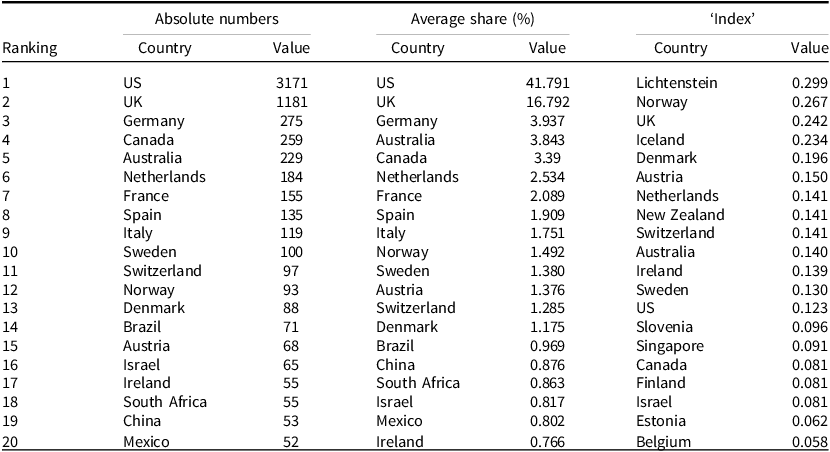
However, while the above figure and tables by country are informative about the overall dataset and country representation, they contain a significant distortion arising from the fact that editorial teams and boards vary in size from journal to journal, and also from the already mentioned fact that academics from different countries are concentrated differently in these unevenly sized bodies. Tables 1 and 2 thus present the first 20 positions in both editorial teams and editorial boards based on the three different indicators: (1) absolute numbers; (2) average share (the percentage share of editors and board members from each country was calculated separately for each journal and then averaged across the list; it is therefore not a proportion of the total number of individuals, but an average of the proportions in each journal); and (3) index constructed as the average share per capita (the average share was weighted with the population of each country in millions and rounded).
Top 20 countries by editors

Top 20 countries by board members

This third step is crucial in accounting for differences in the size of scientific communities across individual countries. While countries such as the US and the UK have thousands of political scientists, others have only one (or even no) department dedicated to the field. Since identifying and quantifying political scientists or political science departments presents several challenges (e.g. who is a political scientist, what about related fields or interdisciplinary authors, should we count departments or entire institutions, etc.), I decided to use the population of a given country as the weighting factor. I did so even though I was aware that this approach produces a certain distortion, but at the same time shows how some countries with a strong representation in terms of absolute numbers or average share fall significantly in the ranking after taking population into account (e.g. France or Spain, but to a large extent, especially in relation to the total population, the US).
It therefore appears that, apart from specific cases such as Liechtenstein and Iceland (due to their small population), the UK is the most overrepresented country. In contrast, the US has fallen in the ranking weighted by population, but the fact remains that in absolute terms and in terms of average share, it is clearly the most significant group. UK and US editors and board members can therefore be considered clearly dominant.
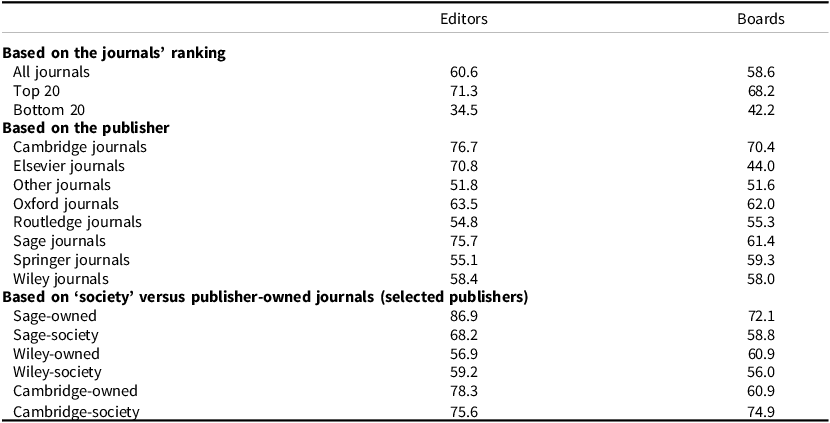
Table 3, therefore, presents the average share of US and UK representatives across the entire dataset, which is 60.6 per cent for editors and 58.6 per cent for board members.Footnote 3 This result provides a more accurate picture of the dominance of the US and UK in the dataset. If we add the other English-speaking countries (Canada, Australia, and New Zealand) to the US and UK, the figures are 68.2 per cent for editors and 66.6 per cent for editorial board members. The table also shows that among the top-ranked journals, the proportion of US and UK editors and board members is significantly higher, while among the journals at the bottom of the list, it is significantly lower.
Average share of US and UK editors and editorial board members (in %)

Additionally, the share of UK and US representatives by publisher, with US and UK editors being most overrepresented (compared to the average) are in journals published by Sage (commercial publisher) and Cambridge (university press). Conversely, the greatest underrepresentation of UK and US editors and board members compared to the average is found in journals in the summary category ‘other publishers’, which includes a diverse mix of publishers (see above).
In connection with Sage and Cambridge, as the two publishers with the largest share of US and UK editors, it is interesting to examine the question of the possible difference between society journals and those owned by the publisher (also discussed above). I decided to add Wiley to these two publishers, as this trio publishes the largest share of society journals (in the case of Cambridge, 13 out of 22, including almost the complete set of journals published on behalf of the American Political Science Association; in the case of Sage, this is 15 out of 26, including the complete set of journals published on behalf of the British Political Science Association; and in the case of Wiley, this is 15 out of 23 journals). While the ratio of UK and US editors and board members in society journals and publisher-owned journals is fairly balanced for journals published by Cambridge and Wiley, their share in Sage-owned journals is significantly higher, although their share in society journals under Sage is also well above the average for the entire dataset. Therefore, no clear conclusions can be drawn regarding the relationship between society and publisher-owned journals that are applicable to the entire dataset.
Figures 2 and 3 visualize the proportion of UK and US editors and editorial board members across the dataset. Thus, it is evident that we find 100 per cent (or nearly 100 per cent) Anglo-American editorial teams and predominantly Anglo-American editorial boards across the entire list of journals. The figures thus show that Anglo-American dominance, although higher among top journals, manifests itself across the entire dataset.
Proportion of US and UK editors across the dataset (in %).

Proportion of US and UK editorial board members across the dataset (in %).

Results: CEE perspective
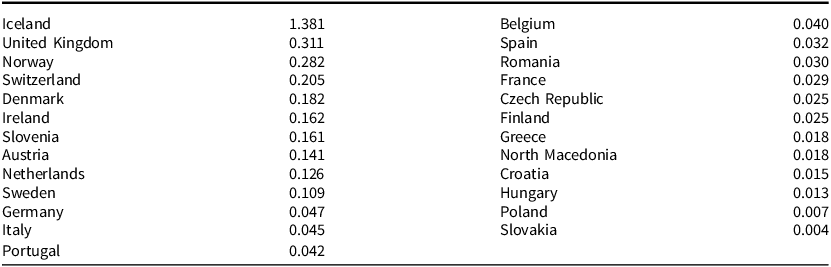
Academics working at European institutions account for a larger share of editors and board members than American academics. However, Table 4 shows that CEE countries contribute a very small share to this total. The table presents editors (across the entire list of journals) affiliated with institutions in European countries. The values are averaged shares weighted by the population of the given country (for the absolute numbers, see Table A2 in the online Appendix). The table thus confirms what some earlier studies have emphasized (albeit based on different data, with a different focus and perspective; see Tronconi and Engeli Reference Tronconi and Engeli2022) – despite some minor exceptions, Northern Europe generally dominates over Mediterranean Europe, which in turn dominates over EU members from CEE. Editors from non-EU CEE countries are (with the exception of one editor from North Macedonia) completely absent (cf. also Kapidžić, Janušauskienė, and Csanyi Reference Kapidžić, Janušauskienė and Csanyi2022).
European editors in the global dataset (averaged share weight by population)

Considering the above, it is interesting to pay attention not only to the global level, but also to the European level. In this regard, we can focus on journals that identify themselves as ‘European’ in their title, in the sense of ‘Journal of European xxx’ or ‘European Journal of xxx’. They therefore take a European perspective or are dedicated to the European area. In this section, I have excluded journals that focus solely on a specific European region (such as East European Politics). There are a total of 12 journals: Journal of European Public Policy, European Journal of Political Research, European Union Politics, European Security, European Political Science Review, Comparative European Politics, European Journal of Political Economy, Journal of European Integration, European Political Science, Journal of Contemporary European Studies, European History Quarterly, and JCMS: Journal of Common Market Studies.Footnote 4
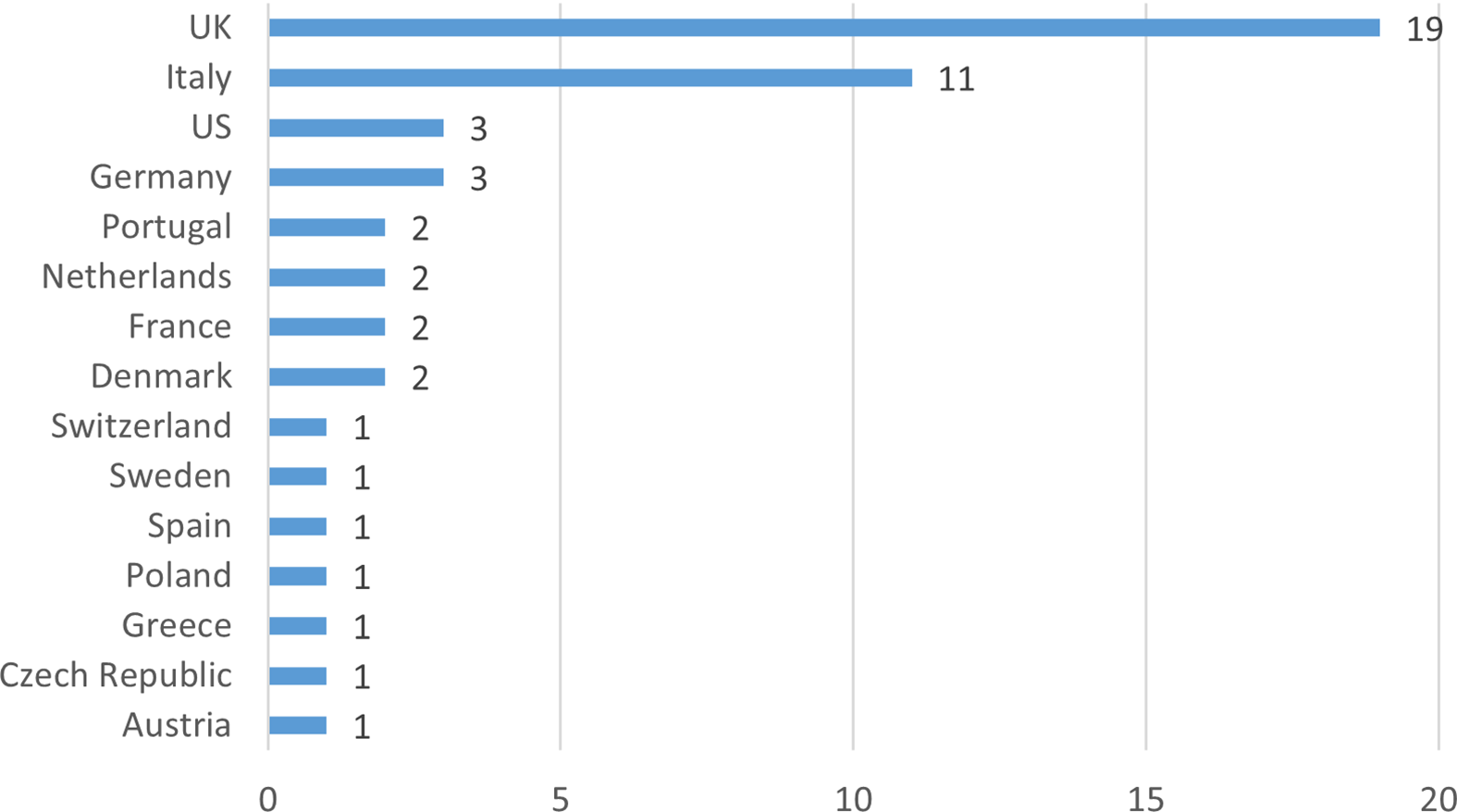
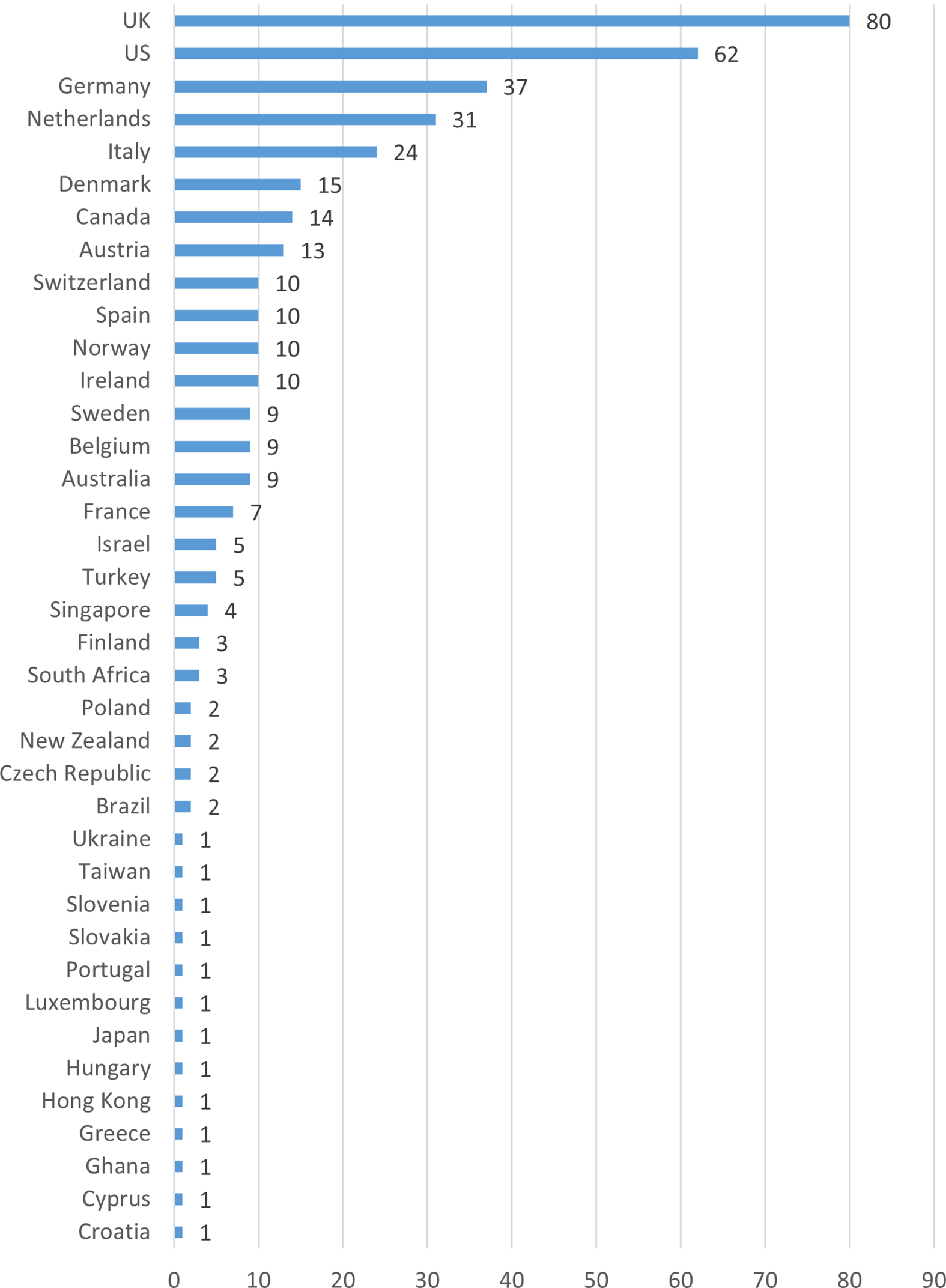
The results show a significant under-representation of CEE academics. Across these 12 journals, we find 51 editors from 15 countries, with British editors being the most prevalent (Figure 4).Footnote 5 In contrast, there are only two editors from the entire CEE region, both in the Journal of Contemporary European Studies (a co-editor from the Czech Republic and a book review editor from Poland), representing 3.9 per cent. A total of 391 people from 38 countries serve on editorial boards (Figure 5), with the UK and the US dominating, and the Netherlands, Germany, and Italy being strongly represented. In the case of editors and boards for ‘European’ journals, the UK dominates over the US. Boards include a large number of academics from non-European institutions (apart from the US, Israel, Canada, and Australia are relatively well represented), while CEE has only nine board members (two from Poland, two from the Czech Republic, one each from Slovakia, Slovenia, Ukraine, Croatia, and Hungary), representing about 2.3 per cent. Also, these results correspond to the previous study (Tronconi and Engeli Reference Tronconi and Engeli2022), with the West prevailing over the East (with non-EU CEE almost missing).
Editors of ‘European’ journals by country (absolute numbers).

Board members of ‘European’ journals by country (absolute numbers).

Journals published on behalf of the European Consortium for Political Research (ECPR), as the largest and most prominent European political science association, which presents itself as ‘European’ (in the sense of encompassing all of Europe), hold a largely prominent position. The ECPR is represented in the dataset by three journals – the European Journal of Political Research, the European Political Science Review, and European Political Science. To provide more comprehensive results in this part of the analysis, I have added two other ECPR journals that do not meet the criteria of my dataset – the European Journal of International Relations (indexed in the SSCI, but in the field of international relations) and the Political Research Exchange (although classified in the field of political science, but indexed in the ESCI). The results show nearly identical trends across the five ECPR journals, published by five different publishers (although now migrating to Cambridge University Press).
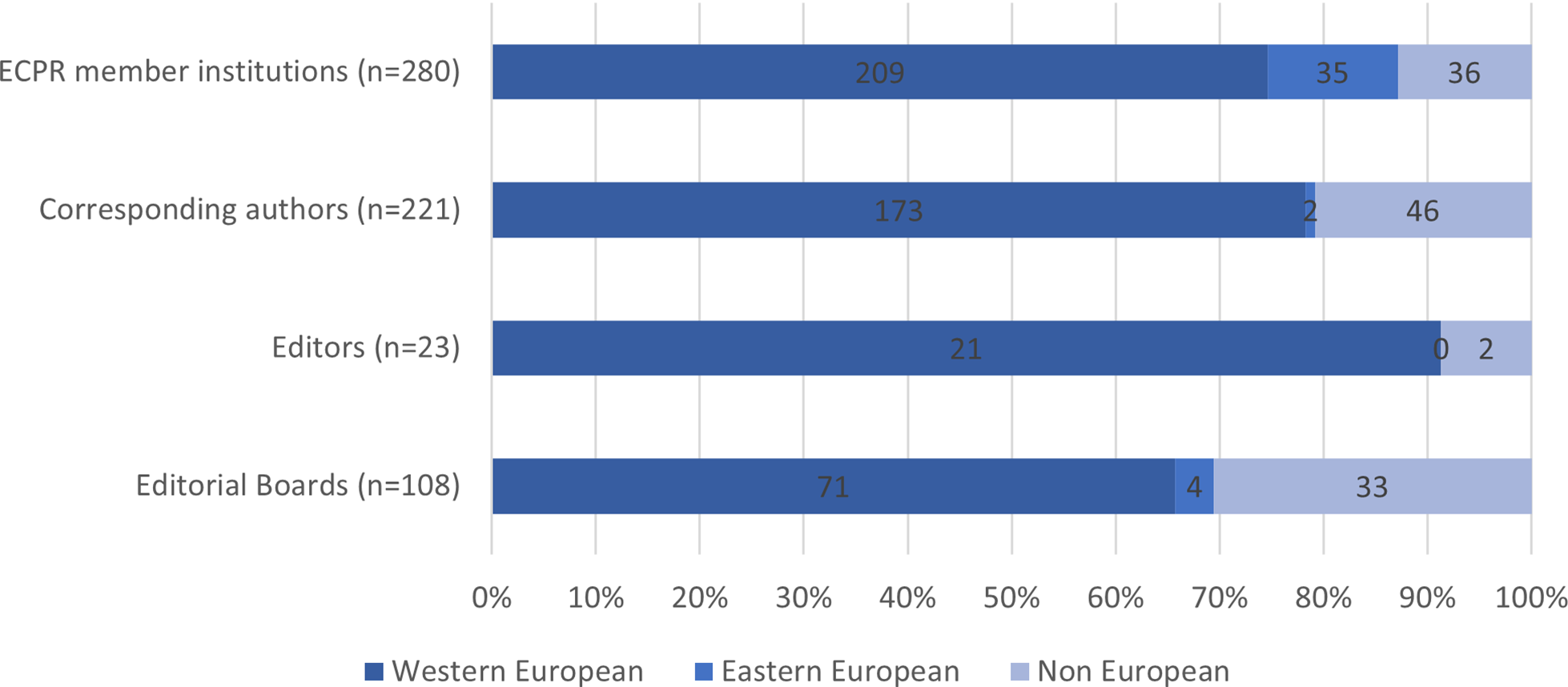
In addition to the membership of editorial boards and editorial teams, I have also examined another aspect of internationalization in the case of ECPR journals, namely the composition of authors. Based on the above and previous studies, I use the labels ‘Western’ for ‘Northern and Mediterranean’ while ‘Eastern’ for ‘EU and non-EU CEE’.Footnote 6 The results show a clear marginalization of academics from the CEE countries at all levels – while there is no one from universities in this region among the 23 editors, there are 4 people from this region (the Czech Republic, Slovakia, Slovenia, and Serbia) among the 108 members of editorial boards. Of the 221 articles published in the 2024 issues of all five journals,Footnote 7 the corresponding authorsFootnote 8 are affiliated with an institution in the region in two cases (Hungary and Estonia, both published in Political Research Exchange), which means less than 1 per cent of the published articles. The marginalization of authors from the CEE region has an impact on the minimal coverage of these countries in published papers (which even stands out in comparison with many other European journals).Footnote 9 This has a direct impact on the fourth aspect of the journals’ internationalization (cf. Liu, Xu, Zhang et al. Reference Liu, Xu, Zhang, Yu and Zhong2025). European, therefore, means Western European in all respects. This corresponds well with the previously described dependent and (semi-) peripheral position of CEE in European political science (cf. Eberle, Smekal, Ocelík et al. Reference Eberle, Smekal, Ocelík and Krpec2021; Tronconi and Engeli Reference Tronconi and Engeli2022; Carammia Reference Carammia2022).
The results are summarized in Figure 6, which includes information about the ECPR member institutions (at the beginning of November 2025). It is thus evident that CEE countries are underrepresented at all three levels (editors, boards, published papers) compared to the share of the member institutions from this region.
Composition of editors, boards, and corresponding authors in the ECPR journals.

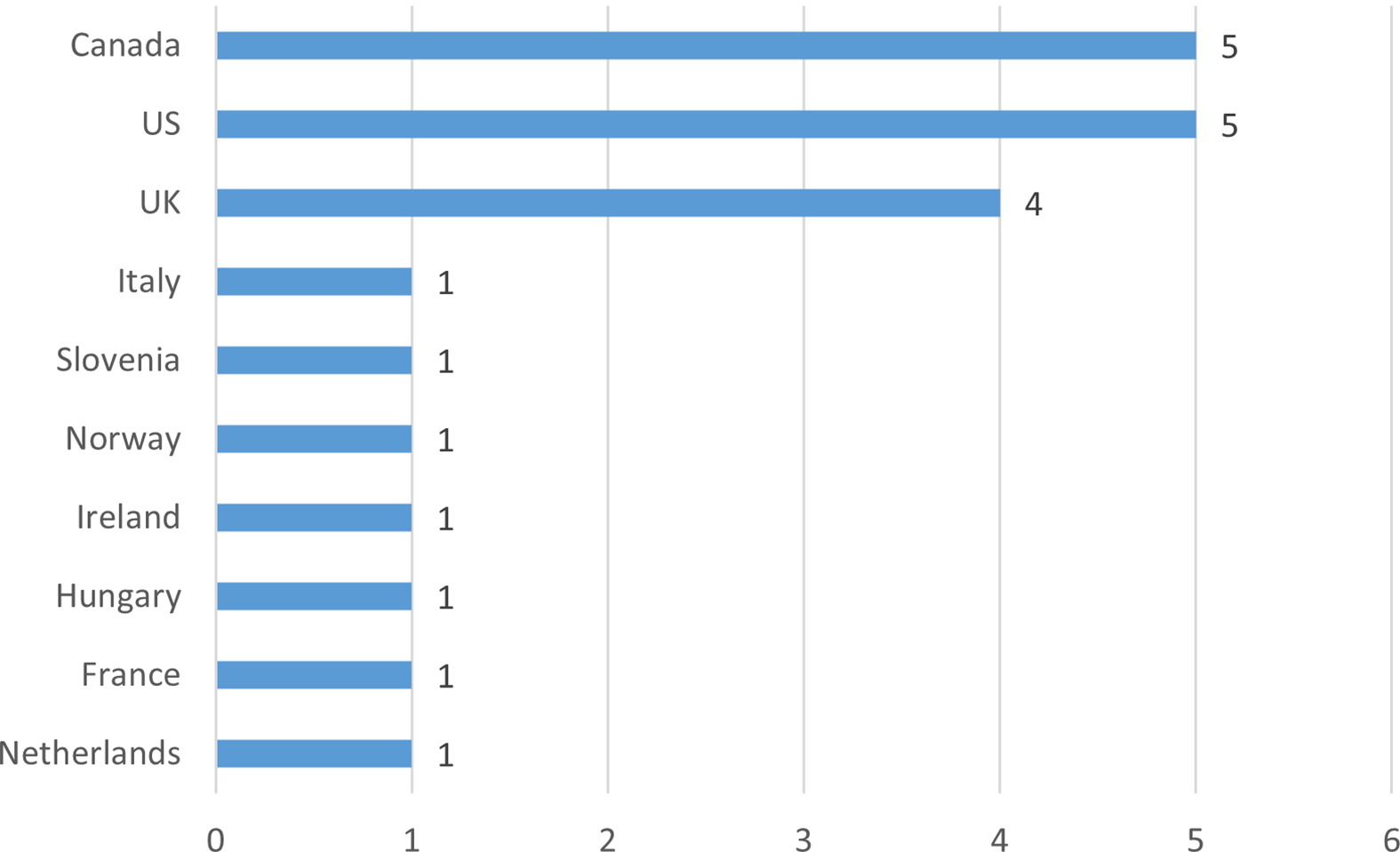
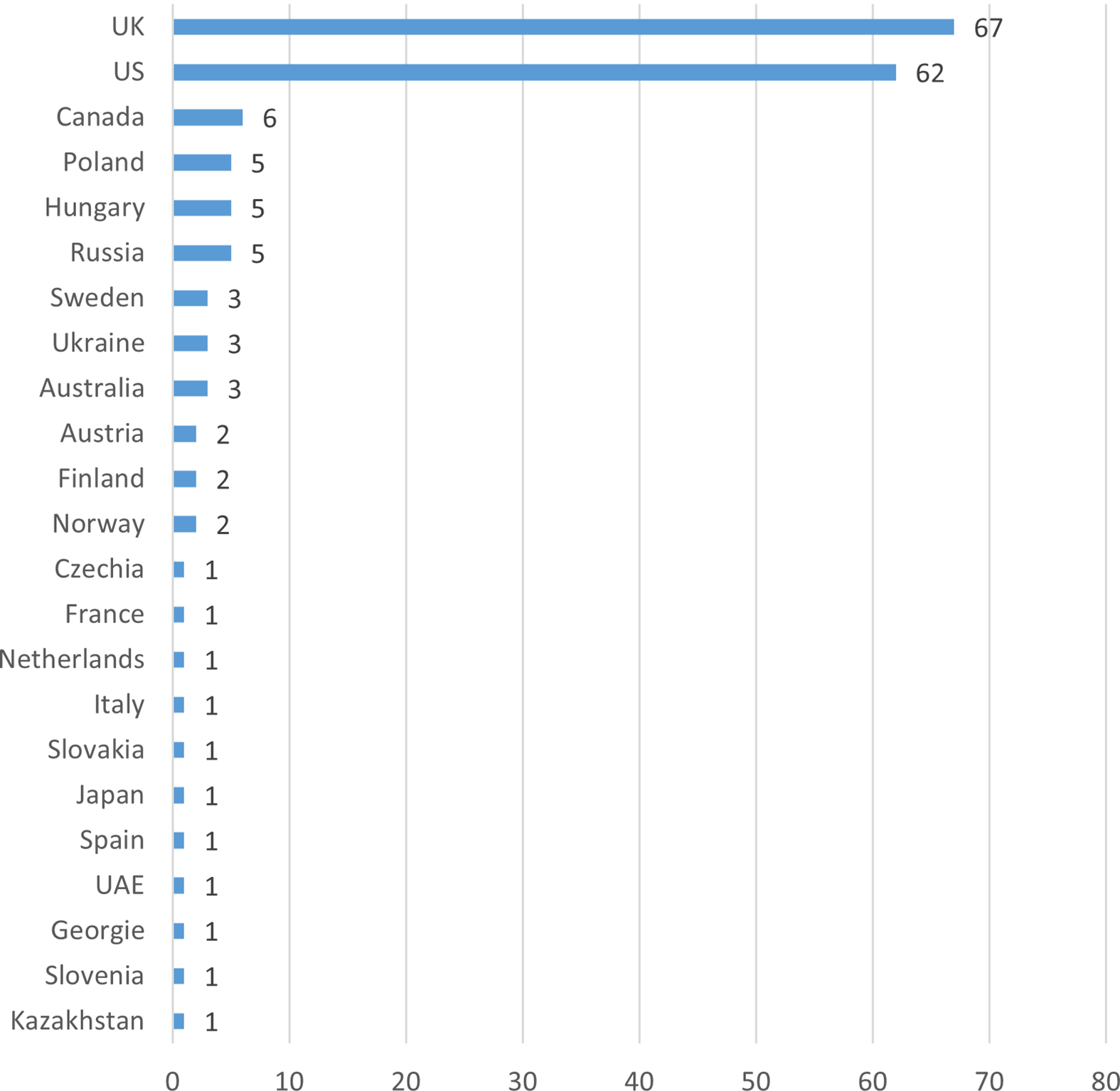
CEE, or more broadly, the post-communist area, is interesting for another reason. It is the region that receives significant attention in the analyzed corpus of all political science journals in the SSCI, as there are six journals that focus on this area. These are East European Politics, East European Politics and Societies, Communist and Post-Communist Studies, Problems of Post-Communism, Europe-Asia Studies, and Post-Soviet Affairs.Footnote 10 The composition of the 21 editors and 196 editorial board members clearly shows the dominance of US and UK academics,Footnote 11 who account for over 73 per cent of all editorial board members. A slightly lower percentage of editorial board members (66 per cent) come from universities in the US, UK, and Canada.Footnote 12 Figures 7 and 8 show the results by country. Contrary to previous parts, the difference between EU and non-EU CEE is slightly smaller, with a few board members from Russian and Ukrainian institutions.Footnote 13
Composition of editorial teams of six journals devoted to the post-communist space (absolute numbers).

Composition of editorial boards of six journals devoted to the post-communist space (absolute numbers).

It is also interesting to look at the distribution of editors and editorial board members from institutions within a given region. One example is Hungary, which has a total of five editorial board members and one editor, making it the most represented country in CEE. However, all six academics are based at the Central European University (CEU), which (not least because of its split between Vienna and Budapest) is in no way representative of a typical Hungarian institution and is in every respect an international, foreign-funded, Western-style university. Indeed, CEU academics clearly dominate the Hungarian representatives throughout the dataset. This is understandable, however, given the extent to which CEU’s scientific output exceeds that of other universities not only in Hungary, but in the whole of CEE.
Discussion and conclusion
The analysis revealed clear trends, notably the overwhelming dominance of Anglophone countries (mainly the US, UK, Australia, and New Zealand) and some European countries in the composition of editorial teams and boards across the entire global journal corpus. However, there are significant differences between European countries. While several Western European countries (besides the UK, mainly Germany, the Netherlands, and Italy) are well represented, CEE has a more (semi-) peripheral and dependent position in this respect. The article thus confirmed the conclusions of some earlier studies that CEE countries are not fully integrated into ‘truly European political science’ (cf. Engeli, Kostova, and Tronconi Reference Engeli, Kostova and Tronconi2023).
The average proportion of representatives of US and UK institutions is 60.6 per cent for editors and 58.6 per cent for editorial boards (with a tendency to be significantly higher in top journals). Compared to recent research in public administration (Liu, Xu, Zhang et al. Reference Liu, Xu, Zhang, Yu and Zhong2025), this difference is a few percentage points lower for editors and a few percentage points higher for board members. However, as already noted, the actual degree of internationalization of journals will be slightly higher, given that a number of editorial positions are held by ‘academic travelers’ working at foreign universities. It is also worth noting that there are significant differences between individual publishers and even individual journals. In the journals published by the ECPR, among others, US dominance is largely absent, and editors and board members affiliated with US institutions are minimal. However, the above research provides an overview of the field as a whole.
There are, of course, many reasons for American dominance. Political science has been closely tied to the American environment since its inception (Gunnell Reference Gunnell2002), as evidenced by the establishment of the oldest departments and journals (Patterson 1994). The American political science community is clearly dominant (in terms of the number of institutions and academics). And many journals are owned and managed in the US (and also in the UK). However, all journals, whether or not they are published on behalf of a particular national scientific organization and can therefore be expected to be heavily represented by academics from that country, define themselves as fully international. However, if we were to say to what extent editorial teams and editorial boards are truly international, we could paraphrase the title of a text examining geographical journals (cf. Imhof and Müller Reference Imhof and Müller2020): not international enough.
As many of the studies cited in this text suggest, there is a significant correlation between the editors of journals and the authors who publish in them. The diversity of authors is reflected in this text only anecdotally in a sample of several issues of ECPR journals. Nevertheless, trends of absolute underrepresentation of CEE authors (not only in ECPR journals, but in top journals in general) are evident, and this is also confirmed by other studies (e.g. Eberle, Smekal, Ocelík et al. Reference Eberle, Smekal, Ocelík and Krpec2021; Carammia Reference Carammia2022; Mišík, Oravcová, Plenta et al. Reference Mišík, Oravcová, Plenta and Hrabušajová2024). Of course, my conclusions about the underrepresentation of CEE authors have significant limitations, which were also encountered by Sverdlichenko, Xie, and Margolin (Reference Sverdlichenko, Xie and Margolin2022), cited above. In contrast to the ratio of published papers, it is not possible to know the ratio of submissions, their distribution among editors and reviewers, the rejection rate of submissions from Western and Eastern Europe, the ratio of desk rejections and rejections based on the review process, and so on. It is therefore possible (though not very likely) that submissions from CEE may in fact represent only one hundredth of all submissions. It is also possible (though equally unlikely) that submissions from this region are hundreds of times worse than other submissions. Alternatively, they may simply address a topic or case that the editors (and possibly the general readership) consider to be of little relevance. A number of authors have received a desk rejection email similar to the one I once received from a ‘European’ journal: ‘The editors think that the paper is interesting and has the potential to make a significant scholarly contribution. However, they feel that it does not fit the broad scope of our Journal. As a “general” journal in political science, the editors want the articles published in the Journal to speak to as large an audience as possible within the discipline’. However, it is precisely for this reason that it would be useful, in terms of transparency, to have anonymized summaries of submissions to individual journals (Loui and Fiala Reference Loui and Fiala2024).Footnote 14
The results thus show a significant potential for bias in political science journals, which has the potential to reinforce relations of dominance and dependence in global or European political science. In light of the above, it can be concluded that (1) there should be greater transparency in the appointment of new editors, who should be rotated regularly, with an effort to increase diversity and the involvement of top academics from (semi-) peripheral academic communities (it is not reasonable to assume that they are not now part of the editorial teams because they do not want to). In line with the aforementioned research, it is reasonable to assume that this move is intended to increase the diversity of published content in terms of topics, cases, theories, and methodologies, which basically means pluralistic research. (2) At the research level, it would be useful if this analysis, which is only a first exploration of the prevailing trends in the dataset, were to be followed up by further research analyzing specific patterns of bias (e.g. in the matching of editors and authors or in relation to the gender gap, which is already well documented in political science; cf. Bettecken, Klöckner, Kurch et al. Reference Bettecken, Klöckner, Kurch and Schneider2022; Süleymanoğlu-Kürüm and Turhan Reference Süleymanoğlu-Kürüm and Turhan2024) in political science journal publishing.
Supplementary material
The supplementary material for this article can be found at https://doi.org/10.1017/S1682098326100447
Data availability statement
The data have been obtained from publicly available sources. Their overview is available through the online Appendix.
Funding statement
No specific funding.
Competing interests
The author works as an associate editor in one of the journals under analysis.




 Open access

