




INTRODUCTION
Toward the end of the Early Classic, the Uci polity in northern Yucatan experienced population declines in both larger centers and rural settlements as regional leaders lost popular support (Hutson Reference Hutson2016b; Hutson et al. Reference Hutson, Aragón, Reyna, Larsen, Lukach, Plank, Terry, Vanessendelft and Falseit2015; Kidder Reference Kidder2019). Yet the Chunhuayum village persisted during these disruptions, as well as through the Late Classic reemergence of local centers. In fact, after the disintegration of the Uci polity and failure of local leadership, Chunhuayum's residents continued to shape increasingly complex relations within their village and expanded their participation in regional trade networks. Thus, Chunhuayum provides an example of increasing local social complexity during political decentralization and population decline. This article examines how rural households shaped and expressed social differentiation within Chunhuayum during the late Early Classic (a.d. 400/500–600/630). Following practice- and agency-based approaches, I consider rural people, through their habituated and innovative actions, as integral to the production, maintenance, and transformation of social differentiation (Blackmore Reference Blackmore2011, Reference Blackmore and Robin2012; Canuto and Fash Reference Canuto, Fash, Golden and Borgstede2004; Hutson et al. Reference Hutson, Aragón, Reyna, Larsen, Lukach, Plank, Terry, Vanessendelft and Falseit2015; Lohse Reference Lohse2013; Meehan Reference Meehan2018; Robin Reference Robin2012a, Reference Robin2013; Schwarz Reference Schwarz2013; Yaeger Reference Yaeger, Canuto and Yaeger2000).
Using data collected from survey and excavations, I compare residential architecture and household assemblages to identify material practices and expressions of differences related to wealth, occupation, and social connectivity. As found in many archaeological studies of inequality throughout Mesoamerica, (Brown et al. Reference Brown, Watson, Gravlin-Beman, Liebovitch and Braswell2012; Carballo Reference Carballo2009; Carmean Reference Carmean1991; Carmean et al. Reference Carmean, Mcanany and Sabloff2011; Gonlin Reference Gonlin, Schwartz and Falconer1994; Hirth Reference Hirth, Stanley and Hirth1993; Hutson Reference Hutson2016a; Kurjack Reference Kurjack1974; Olson and Smith Reference Olson and Smith2016; Tourtellot et. al Reference Tourtellot, Sabloff, Carmean, Chase and Chase1992), residential architecture was a salient marker of wealth at Chunhuayum. Residences, as the settings of socialization and everyday activities, would have simultaneously legitimized asymmetrical relations of wealth and shaped the tone of interactions between villagers. The distinct architecture and artifact assemblages found at household compounds N141 and N148 also reveal that residents engaged in two locally unique activities—shell crafting and hosting village-wide rituals. Variation among households’ decorated and serving ceramic wares, while much subtler, also evince differences in household activities, connectivity, and political-economic strategies. I argue these two households attempted to increase their wealth and non-economic aspects of well-being, with varying degrees of success, by implementing these locally innovative strategies. The rituals at N148 also ensured the continuity of the Chunhuayum settlement by fostering inter-household obligations and a shared sense of place that would continue into the Postclassic period.
This research adds to the growing acknowledgment of the social diversity found within ancient Maya rural settlements and supports a number of points concerning ancient Maya rurality. Notwithstanding the commonality found within many rural settlements, rural people were active and at times innovative in shaping social differences locally and beyond. While Chunhuayum lacks the archaeological proxies often associated with elite social identity, rural residents shaped locally intelligible differences through the materials, labor, specialized skills, ritual spaces, and social relations available to them (Lohse and Valdez Reference Lohse, Fred Valdez, Lohse and Valdez2004). Moreover, following the disintegration of the Uci polity, Chunhuayum did not revert to a decentralized political organization or self-subsistent economies, as posited by cyclical models of collapse and reorganization (see also Hutson et al. Reference Hutson, Aragón, Reyna, Larsen, Lukach, Plank, Terry, Vanessendelft and Falseit2015). Instead, residents engaged in increasingly complex relations within and beyond their village and strengthened local forms of authority, suggesting that local processes were inherent to the social complexity found within this village. Finally, Chunhuayum presents an example of how most rural communities were neither wholly dependent nor fully isolated from larger centers but instead practiced a combination of open- and closed-community strategies. The varied practices and relationships of rural residents, including strategies in facing new circumstances, led to different outcomes for both households and the community at large. Understanding how people distinguished themselves within a rural context challenges underlying cultural hierarchies concerning rural populations—embedded in archaeological research as they are in society writ-large (Ching and Creed Reference Ching and Creed1997)—and highlights the nuanced ways a variety of people partake in social processes.
RURAL HOUSEHOLDS: INTERACTIONS AND HETEROGENEITY
As archaeological scholarship continues to shift away from urban- and elite-centric perspectives, research in various parts of the world has demonstrated the rich and multifaceted lives of rural people. Although city-centric perspectives continue to drive much of the research priorities in Maya archaeology, a growing body of literature shows that variability not only existed among rural settlements but that, within them: rural people were diverse, dynamic, and active agents of social processes (see reviews by Lamb [Reference Lamb, Hutson and Ardren2020, Reference Lamb2022]). In this article, I focus on diversity within the village of Chunhuayum. Following a practice-based perspective, I emphasize household interactions as both enabling and guided by local forms of social differentiation.
Households—here understood as symbolically meaningful activity groups who share a physical dwelling (Ashmore and Wilk Reference Ashmore, Wilk, Wilk and Ashmore1988; Hendon Reference Hendon1996)—did not exist in isolation but rather were linked through diverse economic, political, ecological, and social relations. Through daily and extraordinary interactions, rural households formed the social networks necessary to achieve economic and immaterial well-being, while also shaping relations of difference and inequality. Through residential proximity and livelihood strategies such as farming, water collection, and hunting, households were visible to one another, engaged in common experiences, and worked together, thus (re)producing shared sets of knowledge (Hutson and Welch Reference Hutson and Welch2014; Yaeger Reference Yaeger, Canuto and Yaeger2000). Yet everyday affairs, including the use of familiar and taken-for-granted objects, also shaped and habituated residents’ differences (Bourdieu Reference Bourdieu1977; Miller Reference Miller2010) that were based on factors like household size, wealth, occupation, status, and connectivity. By practicing locally unique activities like crafting, midwifing, or divination, as well accessing or controlling limited resources, households would have engaged in relationships of interdependence and reciprocity (Keller Reference Keller and Robin2012; Kestle Reference Kestle and Robin2012; Potter and King Reference Potter and King1995; VandenBosch et al. Reference VandenBosch, LeCount, Yaeger, LeCount and Yaeger2010; see also Scarborough and Valdez Reference Scarborough and Fred Valdez2009; Valdez et al. Reference Valdez, Trachman and Cortes-Rincon2022) which may have led to heterarchical as well as hierarchical differences within a rural settlement. Households engaging in different or wider external networks would gain opportunities, materials, ideas, and affiliations distinguishing them from their neighbors (Clayton Reference Clayton and Lohse2013; Conlon and Moore Reference Conlon, Moore, Iannone and Connell2003; Yaeger Reference Yaeger, Canuto and Yaeger2000). Finally, rural households interacted through local collective rituals during which differences may have been simultaneously obscured and reproduced (e.g., Brown Reference Brown, Dietler and Hayden2001; Blackmore Reference Blackmore2011; Hageman Reference Hageman2004; Robin et al. Reference Robin, Kosakowsky, Keller and Meierhoff2014; Yaeger Reference Yaeger, Canuto and Yaeger2000). In these and many other aspects of social life, rural households engendered and negotiated relationships of difference which would both constrain and enable their well-being.
Within Maya scholarship, defining the rural has been challenging as characteristics usually attributed to rural spaces, such as agriculture and dispersed settlement, are also found within its larger, including urban, centers. Moreover, because the concepts of rural and urban only have meaning in relation to each other (Cowgill Reference Cowgill2004), drawing the line between two such relative concepts is particularly difficult. Spatial and demographic variables are therefore the most widely used criteria for designating a settlement as rural, and these are certainly important to understanding rurality (Lamb Reference Lamb, Hutson and Ardren2020). While the rural can be defined through its smaller settlement size and population, definitions based purely on these descriptive variables reify and naturalize assumptions about rurality such as its supposed isolated, homogenous, and corporate nature (Lamb Reference Lamb, Hutson and Ardren2020, Reference Lamb2022). I therefore I consider the “rural” through how human interactions and practices are shaped by the spatial and demographic characteristics of small settlements. Because rural settlements are generally less densely populated and expansive than cities or urban settlements, rurality can be conceptualized through a higher degree of social familiarity among a settlement's residents (Lamb Reference Lamb, Hutson and Ardren2020). Greater familiarity among residents, especially those sharing an array of daily experiences and material culture, may have promoted some sense of social cohesion. In this way, many rural villages and towns—although perhaps not dispersed homesteads and farmsteads—share certain spatial and built characteristics with neighborhoods (Arnauld et al. Reference Arnauld, Manzanilla and Smith2012; Hutson Reference Hutson2016a), particularly those that bring about face-to-face interaction such as spatial clustering and the presence of focal nodes (such as N148 in the case of Chunhuayum).
Social familiarity and a sense of social cohesion do not, however, negate the possibility for diversity or inequality. Particularly within rural villages—where collective gatherings took place and residents would have relied on each other for some of their social and economic needs—greater familiarity, interdependence, and similar or overlapping social networks may instead mean that differences were constructed and manifested in subtle ways. Approaching social differentiation from a rural perspective therefore offers a unique vantage from which to investigate the constitution of complex ancient societies (Schwartz and Falconer Reference Schwartz and Falconer1994).
DIMENSIONS OF HOUSEHOLD SOCIAL DIFFERENTIATION
Because social differentiation, particularly inequality, has been a central debate in Maya archaeology for decades (see reviews by Becker [Reference Becker, Hammond and Willey1979], Hutson [Reference Hutson, Hutson and Ardren2020], and Sharer [Reference Sharer, Sabloff and Henderson1993]), some key terms are first defined before discussing archaeological variables used in this study. By social differentiation, I mean the heterogeneity among residents of a settlement, which may be hierarchical and/or heterarchical (Blanton et al. Reference Blanton, Feinman, Kowalewski and Peregrine1996; Crumley Reference Crumley1995; Drennan et al. Reference Drennan, Peterson, Fox, Price and Feinman2010). While social differentiation structured ancient Maya society in numerous ways, my analysis focuses on differences in wealth, occupation, and social connectivity between households.
Wealth refers to the amount of labor and physical resources that a person or group accumulates or disposes of (Hutson Reference Hutson2016a; McAnany Reference McAnany, Sabloff and Henderson1993). The term occupation is used here to denote individuals’ particular economic, but also political and/or spiritual role within their communities, since the Maya conceived of religious and political responsibilities as work (Astor-Aguilera Reference Astor-Aguilera2010; Hutson et al. Reference Hutson, Lamb, Arona, Barber and Joyce2018; Monaghan Reference Monaghan and Monaghan2000; Taube Reference Taube, Gómez-Pompa, Allen, Fedick and Jiménez-Osornio2003:464). Finally, by social connectivity I mean the extent to which households are connected with external networks and institutions (Smith Reference Smith, edited by and Falconer1994:144, Reference Smith, Isendahl and Stump2019). Through external social networks, households can access additional social resources (Coleman Reference Coleman1988; Putnam Reference Putnam2000), economic opportunities, trade-goods, information, and ideas. Households with greater social connectivity and more diverse occupations and skillsets have greater capabilities; they are able to pursue a wider array of goals or a particular goal in diverse ways, which increases their resiliency in changing conditions, may positively impact household wealth, and improves non-material well-being (Arponen et al. Reference Arponen, Müller, Hofmann, Furholt, Ribeiro, Horn and Hinz2016; Sen Reference Sen, Nussbaum and Sen1993; Smith Reference Smith, Isendahl and Stump2019).
Archaeological Variables of Social Differentiation
Scholars of Mesoamerican households have shown that social distinctions are polythetic and must be analyzed through various datasets to avoid homogenizing nuanced social differences that existed in micro-scale interactions (e.g., Blackmore Reference Blackmore and Robin2012; Carballo Reference Carballo2009; Hendon Reference Hendon1991; Hirth Reference Hirth, Stanley and Hirth1993; Gonlin and Lohse Reference Gonlin and Lohse2007; Lohse and Valdez Reference Lohse, Fred Valdez, Lohse and Valdez2004; Marcus Reference Marcus, Lohse and Valdez2004; Sharer Reference Sharer, Sabloff and Henderson1993; Tourtellot et al. Reference Tourtellot, Sabloff, Carmean, Chase and Chase1992; Yaeger and Robin Reference Yaeger, Robin, Lohse and Valdez2004). I therefore rely on residential architecture, ceramic assemblages, shell, and obsidian to identify social differentiation among Chunhuayum's households during the late Early Classic.
Residential buildings are a useful archaeological proxy for wealth (Abrams Reference Abrams1994; Carmean Reference Carmean1991; Hendon Reference Hendon1991; Hirth Reference Hirth, Stanley and Hirth1993; Hutson Reference Hutson2016a; Smith Reference Smith1987, Reference Smith, Isendahl and Stump2019) as numerous cross-cultural comparisons of agrarian societies show a positive correlation between household wealth and residence size (Blanton Reference Blanton1994; Hayden and Cannon Reference Hayden and Cannon1983; Netting Reference Netting1982; Wilk Reference Wilk1983, Reference Wilk, Robert McC., Wilk and Arnould1984; Wilk and Rathje Reference Wilk and Rathje1982). Wealthier households are likely to have larger, more elaborate residences since they control greater labor and resources than less wealthy households and may hold special political or religious functions requiring distinct architectural facilities within their residences (Hirth Reference Hirth, Stanley and Hirth1993).
Relating wealth and architecture can be challenging for archaeologists depending on the method used to quantify construction costs of architecture. While energetics is the most accurate method, I was not able to apply it since requires fully excavated buildings. I therefore use household compound volume and surface area as proxies for cost of residential architecture and thus household wealth. By household compound I refer to the physical structures and areas within which a household resides and conducts its activities. This unit of analysis allows me to consider the entirety of built spaces that individuals invested in and used. Using volume and surface area as proxies for architecture costs is however imperfect when strict chronological control is not available. This is because a building may have been expanded upon over multiple generations and thus, in its final form, may reflect the cumulative investments of many households. Buildings occupied for longer durations also have the potential of having had numerous structural additions; in other words, larger buildings may reflect longer occupations rather than greater household wealth. While fine chronological resolution of household compound occupation was not available at Chunhuayum (see section Previous and Current Research), I choose to utilize architectural size as a proxy for social differentiation for various reasons. First, regardless of whether previous or current residents built them, residences are sites where social relationships are enacted, reinforced, and transformed through daily practice (Bourdieu Reference Bourdieu1977, Reference Bourdieu and Bourdieu1979; Blanton Reference Blanton1994; Bowser and Patton Reference Bowser and Patton2004; Joyce and Gillespie Reference Joyce and Gillespie2000; Hutson Reference Hutson2010a; Lyons Reference Lyons2007; Pauketat and Alt Reference Pauketat and Alt2005; Robin Reference Robin2013). Thus, the overall size of residences relates to the potential value individuals and groups placed on them (Ford and Arnold Reference Ford and Arnold1982). Moreover, excavations at Chunhuayum revealed the presence of various construction episodes in certain household compounds, allowing me to consider the incremental rather than cumulative investments made in these buildings. Finally, because wealth exists in various forms, maintaining architecture as a proxy for wealth allows me to rely on multiple lines of evidence for identifying social differentiation at Chunhuayum.
Domestic ceramic possessions are also useful in examining household differentiation and are often more chronologically sensitive to assessing wealth as household inventories change more rapidly than architecture (Smith Reference Smith1987). Wealthier households are likely to have greater quantities of fancy (decorated and/or fine) wares and imported pottery, as well as greater quantities of serving wares (Douglas and Isherwood Reference Douglas and Isherwood2010; Fry Reference Fry2003; Hayden and Cannon Reference Hayden and Cannon1983; Hirth Reference Hirth, Stanley and Hirth1993; Smith Reference Smith1987, Reference Smith, Isendahl and Stump2019). The number of fancy ceramic types is also used here to identify differences in household social connectivity, since wider social networks lead to greater stylistic breadth of households’ ceramic possessions (Smith Reference Smith, Isendahl and Stump2019). Household possessions of exotic origin, such as obsidian, can serve as indicators of wealth and social connectivity because of their local scarcity, the energetics involved in their procurement, and the wider social network necessary to acquire them, or some combination of these three factors (Smith Reference Smith1987:320). Yet when found within crafting contexts, distributions of exotic materials may not allow for a straightforward interpretation, since crafting households may have accessed such goods through a variety of mechanisms not relating to wealth (Hirth Reference Hirth, Stanley and Hirth1993); for example, patron-client relationships, or participation in segmented production (e.g., Kovacevich Reference Kovacevich, Christian Wells and Davis-Salazar2006). For this reason, I do not rely on obsidian or shell (although the latter is not of exotic origin) in determining wealth differences, since these materials were found heavily concentrated at N141 where shell crafting took place. Uneven distributions of such materials do however indicate different levels of connectivity, which as discussed above could provide households diverse kinds of opportunities as well as greater ability to exercise choice in pursuing their goals.
CHUNHUAYUM AND THE UCI MICROREGION
Previous and Current Research
Located in the northern Plains of the Yucatan Peninsula, Chunhuayum is one of many rural settlements within the Uci microregion (Figure 1), which is defined by the physical connection of various centers—Uci, Kancab, Ucanha, Cansahcab, and smaller sites—by an 18-km causeway system. I consider Chunhuayum as rural because of its smaller spatial extent, architectural size, and settlement density than the four ceremonial centers along this causeway and because of the higher degree of familiarity that likely existed among its residents. This familiarity would have been brought about by Chunhuayum's clustered settlement and the presence of a focal node. By defining Chunhuayum as rural I do not mean, however, that Uci was an urban center but rather that Uci, as well as the other ceremonial centers along the causeway, have a lesser “degree” of rurality due to their larger size and populations and more numerous focal nodes. Additional analysis would be needed to situate these centers within the spectra of rural-to-urban forms of settlement.
Map of the Uci micr-region showing the location Chunhuayum in relation to other archaeological sites and modern towns.

The Ucí-Cansahcab Regional Integration Project (UCRIP) was initiated in 2008 to investigate the processes of integration, materialized by the construction of the causeway system, that took place in this microregion at the end of the Late Preclassic. The project has conducted extensive survey, mapping, and excavation at various centers and smaller settlements both on and along the Uci-Cansahcab causeway (Hutson Reference Hutson and Braswell2012a, Reference Hutson2021; Hutson and Davies Reference Hutson and Davies2015; Hutson and Welch Reference Hutson and Welch2014; Reference Hutson and Welch2021; Hutson et al. Reference Hutson, Aragón, Reyna, Larsen, Lukach, Plank, Terry, Vanessendelft and Falseit2015, Reference Hutson, Kidder, Lamb, Vallejo-Cáliz and Welch2016, Reference Hutson, Lamb, Arona, Barber and Joyce2018, Reference Hutson, Hutson and Ardren2020; Kidder Reference Kidder2019; Vallejo-Caliz et al. Reference Vallejo- Cáliz, Hutson and Plank2018).
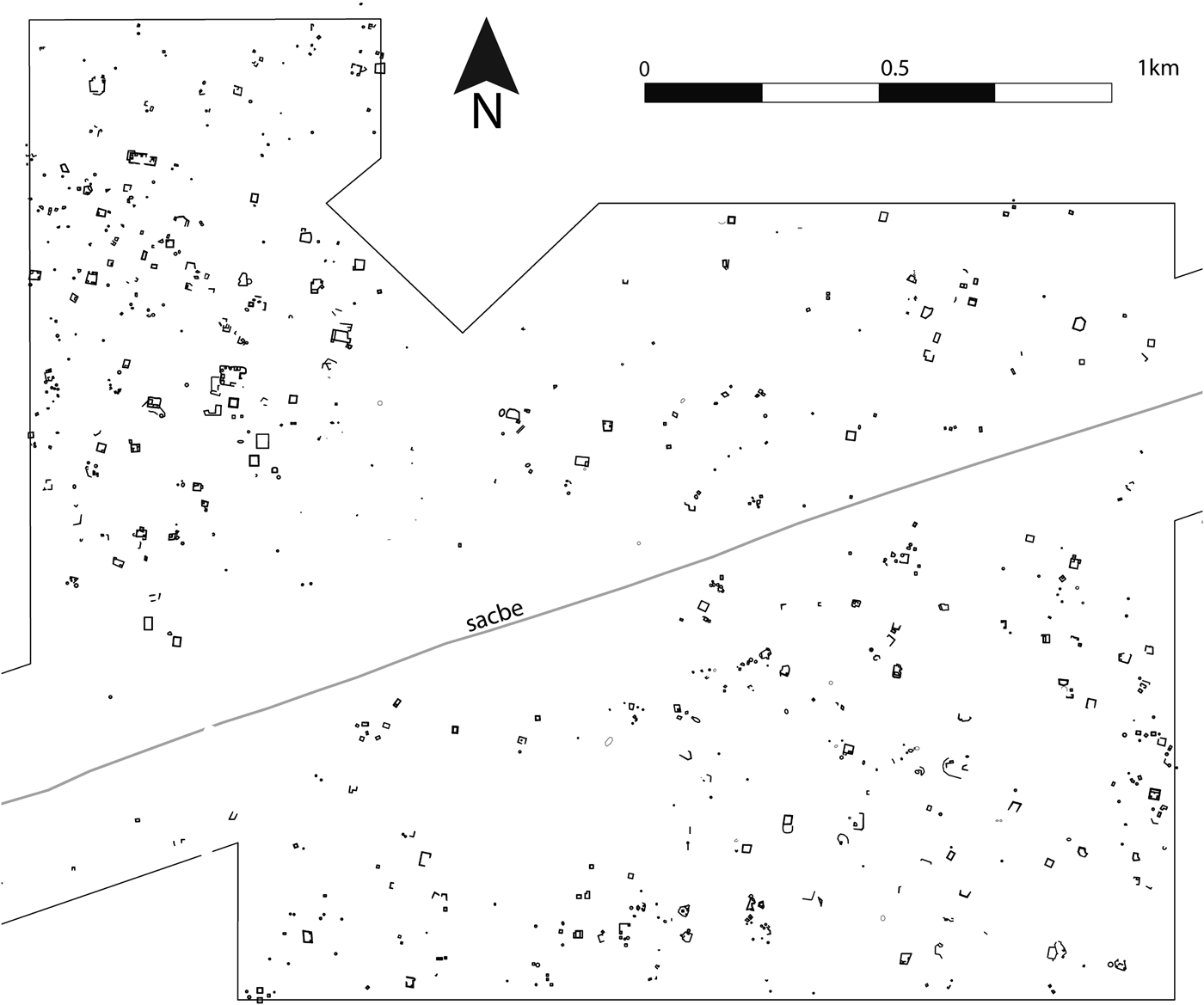
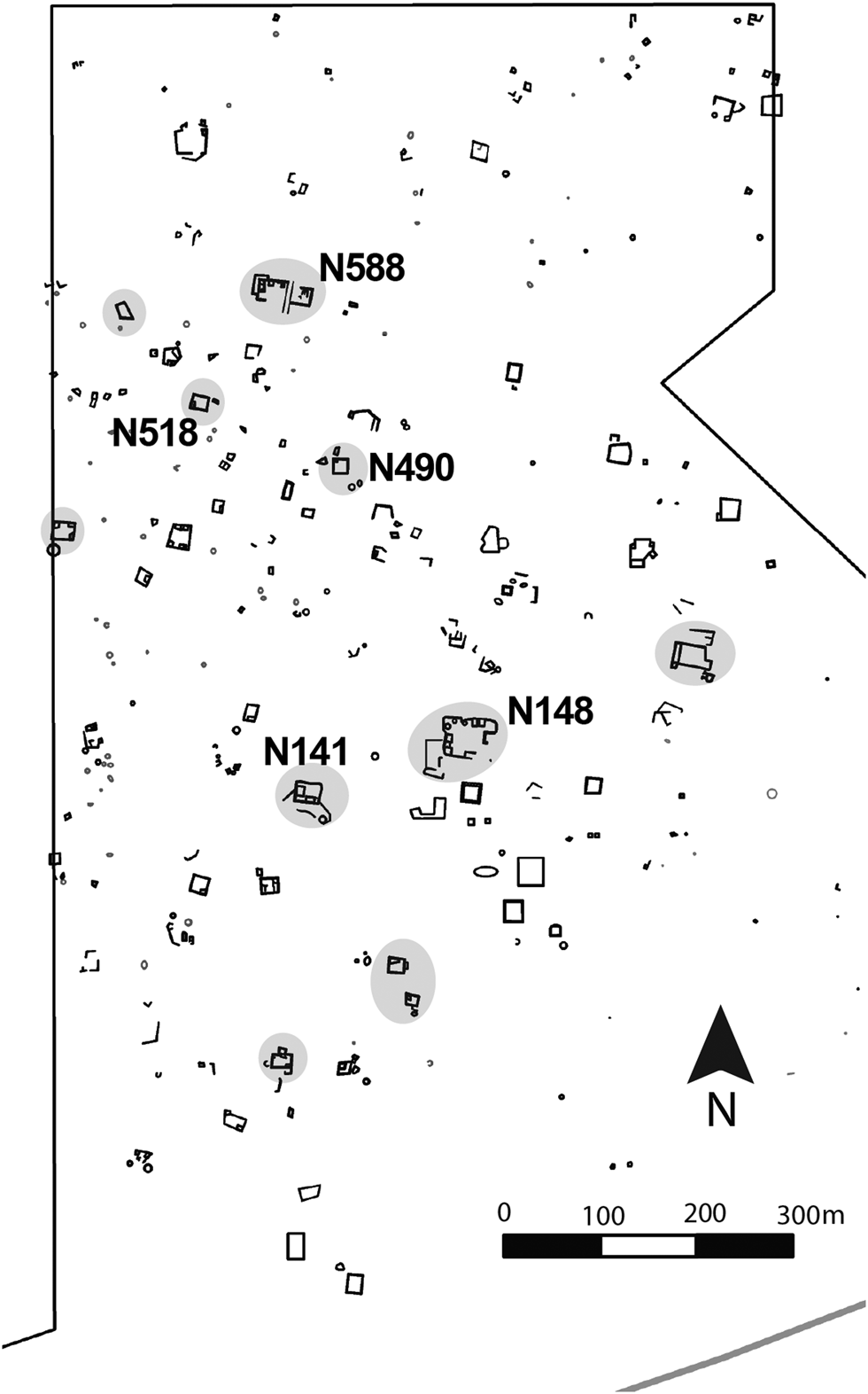
Situated four km east of Uci, Chunhuayum is located in the colloquially named Yaxche rural area (Figures 2 and 3). Chunhuayum has been mapped through systematic pedestrian survey (Lamb Reference Lamb and Hutson2017b; Vallejo-Cáliz Reference Vallejo-Cáliz and Hutson2014), though its western edge has yet to be identified. At Chunhuayum, 20 percent (n = 10) of household compounds have been test pitted, targeting off-mound midden deposits (Figure 3), and five of these compounds have been further excavated through horizontal exposure and test trenches (Figure 4; Lamb Reference Lamb and Hutson2013, Reference Lamb and Hutson2016, Reference Lamb and Hutson2017a; Medina Arona Reference Medina Arona and Hutson2016). These were selected using a stratified random sampling strategy, based on architectural volume and geographic placement within Chunhuayum. Structures under 100m2 were not considered within this sample, however, since previous research in the area has indicated that small structures yield very little material (Hutson Reference Hutson2010b, Reference Hutson2012b). The size of excavations (Table 1 and Figure 4) varied depending platform height, depth of bedrock, features encountered, and varying time constraints of each field season.
Archaeological map of the Yaxche block, including the Chunhuayum settlement cluster in the northwest portion of block.
Map of Chunhuayum indicating in grey all excavated household compounds. Compounds having received extensive excavations are noted by their structure names.
Main platforms of the five household compounds excavated through test pit and horizontal excavations.
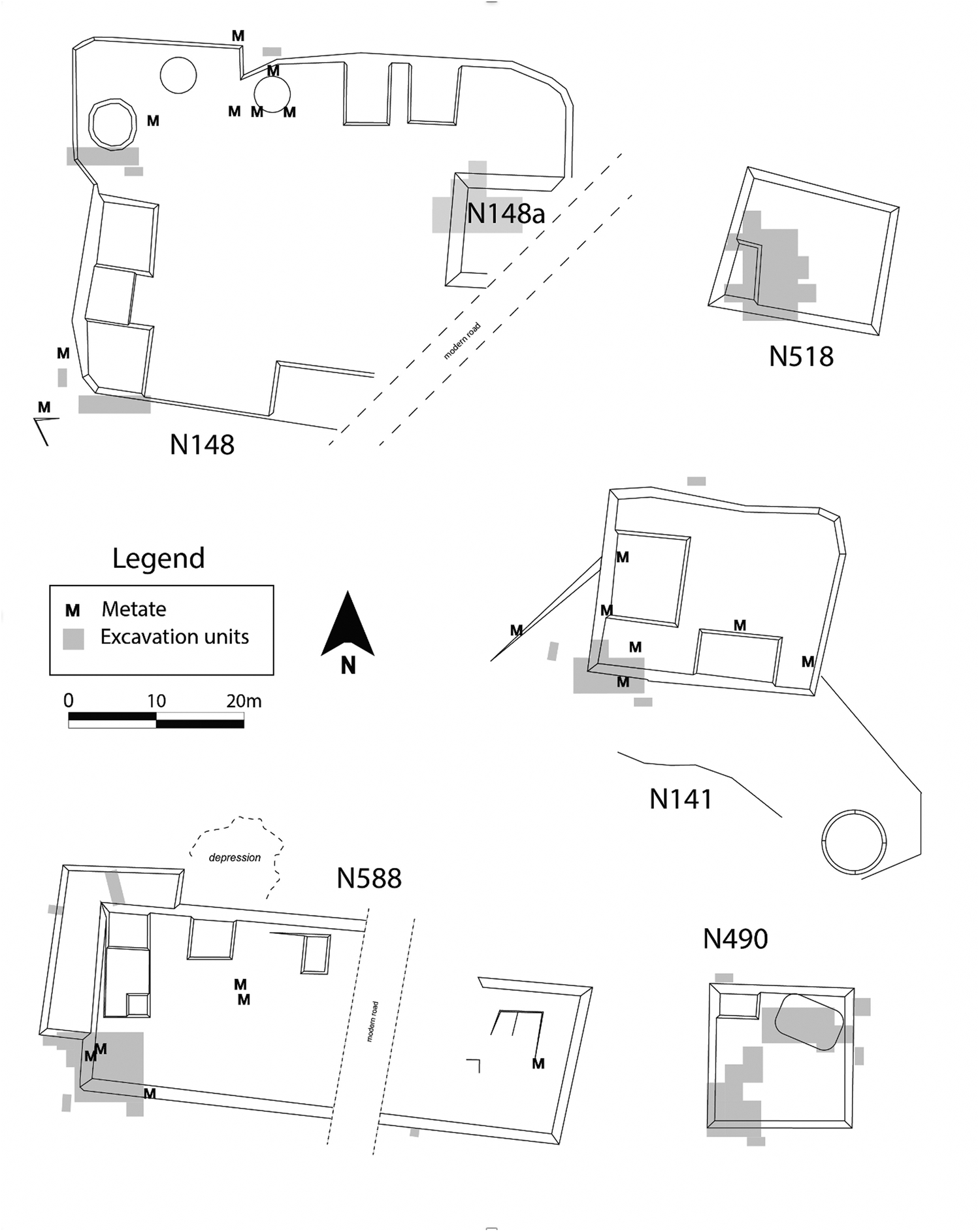
Metric data and features of the five extensively excavated household compounds.
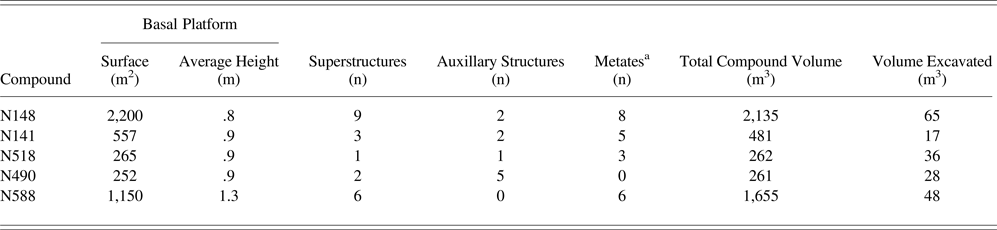
aDoes not include metates found in retaining walls or construction fill.
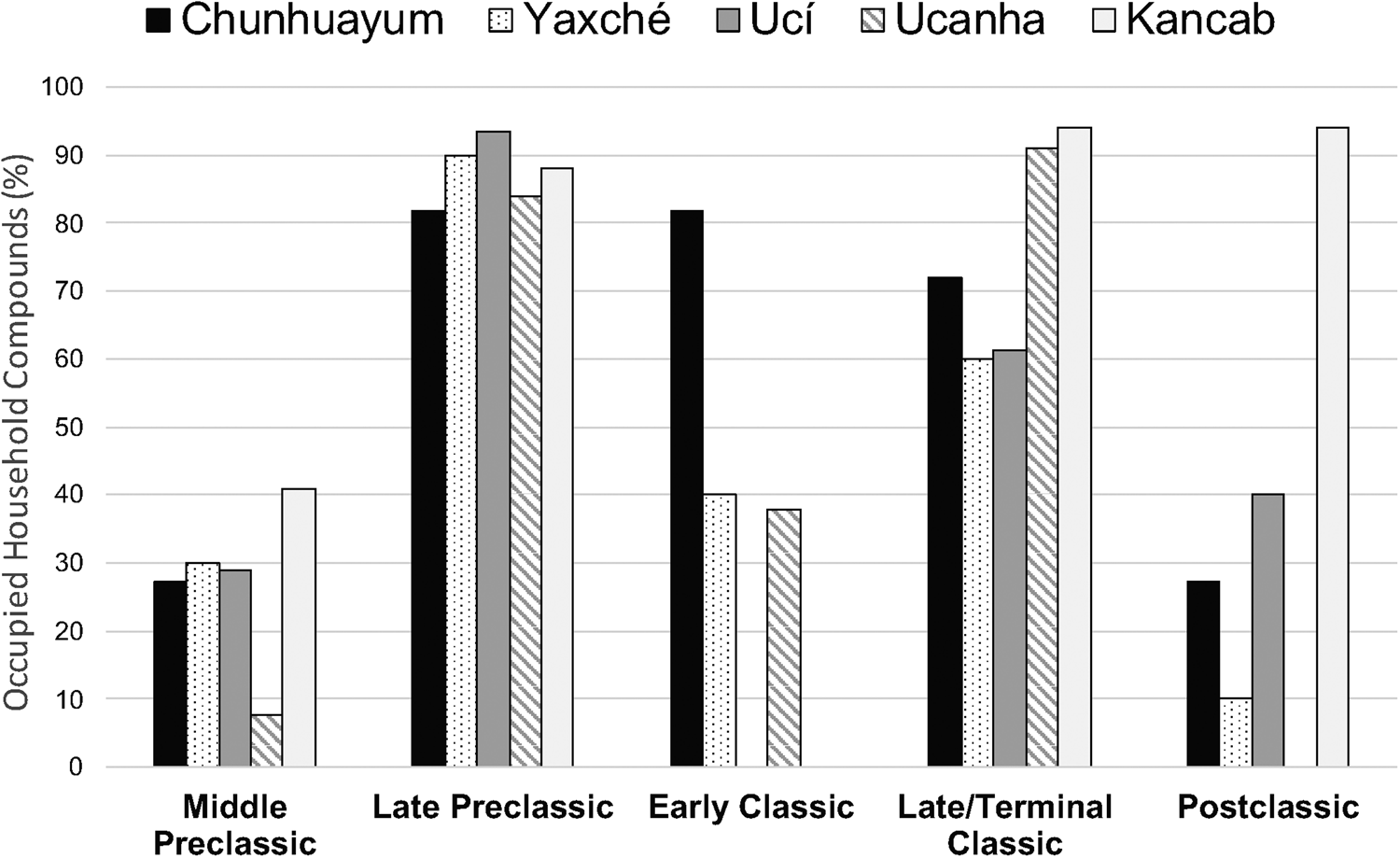
In the present study, I use the entirety of the known Chunhuayum settlement when comparing residential architecture, since the region's thin soils allow for visibility of terminal architecture on the surface. Discussions of household assemblages are restricted to the five broadly excavated compounds as these provide larger artifact samples and greater contextual and chronological control than test-pits. The chronology of Chunhuayum (Figure 5) described in section Chunhuayum's History and Regional Connections and used in determining the occupation and construction episodes of the five household compounds that are the focus of this article was determined through ceramic type-variety analysis of materials recovered from all excavated contexts. Due to the lack of absolute dates and few sealed contexts, site chronology is relatively coarse and periods (e.g., the Late Preclassic) could not be subdivided into phases, with the exception of the early and late facets of the Early Classic.
Bar graph representing the divergent settlement histories within the Ucí microregion.
A brief note on UCRIP's ceramic definition of the Early Classic (a.d. 250-600) is necessary since the Preclassic to Classic transition poses difficulty in the Uci microregion, a problem common throughout the northern lowlands (Glover and Stanton Reference Glover and Stanton2010). This is in large part due to the persistence of many Late Preclassic ceramic groups past a.d. 250. Moreover, only small quantities of diagnostic Early Classic groups, including northern polychrome groups (Tituc, Timucuy, and Dzidzibachi) and central/southern lowland glosswares (Aguila and Balanza) were recovered. Until attribute analysis is completed, UCRIP has designated the long-lived groups mentioned above as Late Preclassic, recognizing this likely underrepresents early Early Classic occupation. A late facet of the Early Classic, however, was defined through the presence of ceramic groups belonging to the Oxkintok Regional Complex. Because UCRIP lacks radiocarbon dates for these groups, we utilize the chronology of Oxkintok and Chunchucmil (Jiménez et al. Reference Jiménez, Magnoni, Mansell, Bond-Freeman and Hutson2016; Varela Torrecilla Reference Varela Torrecilla1998) in attributing this complex and associated ceramics to the late Early Classic, ca. a.d. 400/500-600/630 for our region (Plank et al. Reference Plank, Aragón and Martínez-Muñiz2014). The predominant late Early Classic groups found in the Uci microregion are Oxil and Maxcanu, followed by Hunabchen, Saban (Saban Burdo type, Becoob variety) and Batres (early cazuela and olla forms). Smaller quantities from the Kanachen, Kochol, Chencoh, Chuburna (early forms), and Acu groups were also recovered. This assemblage can be related in general manner to the western Cochuah sphere of the northern lowlands, in particular the Cochuah-Chikin and Cochuah-Puuc spheres as defined by Ceballos Gallareta and Jiménez Álvarez (Reference Ceballos Gallareta, Álvarez, Carrión and Cook2006), although the Saban group indicates connections to the eastern Cochuah sphere.
POLITY DYNAMICS IN THE UCI MICROREGION
During the Late Preclassic (300 b.c.–a.d. 250), as the Uci microregion experiences important demographic growth and construction activity (Figure 5), Uci, Kancab, Ucanha, and Cansahcab were connected by a sacbe system and united into a single polity headed by Uci (Hutson et al. Reference Hutson, Kidder, Lamb, Vallejo-Cáliz and Welch2016). Ucanha and Kancab, however, retained some degree of political and ritual autonomy (Hutson and Welch Reference Hutson and Welch2014; Kidder et al. Reference Kidder, Hutson, Welch and Plank2019; Kidder Reference Kidder2019; Welch Reference Welch and Hutson2016). Within this political alliance, these various ceremonial centers likely continued to compete for pilgrims who could also supply labor and resources (Hutson and Welch Reference Hutson and Welch2021). In tandem with this process of political centralization, ceramics appear to have been distributed through incipient market exchanges (Hutson Reference Hutson2021; Kidder Reference Kidder2019). Based on the wide spread distribution of megalithic architecture throughout the region, Uci may have become a part of a larger political entity toward the end of the Late Preclassic and the beginning of the Early Classic (a.d. 250–400; Burgos Villanueva et al. Reference Burgos Villanueva, Reyna and Góngora2006; Hutson Reference Hutson and Braswell2012a; Mathews and Maldonado Cárdenas Reference Mathews, Cárdenas, Mathews and Morrison2006).
Yet, by the late Early Classic (a.d. 400–630), Uci polity leaders lost political clout, centers and rural settlements cease construction activity, and regional populations appear to have decreased in size (Hutson Reference Hutson2016b; Hutson et al. Reference Hutson, Aragón, Reyna, Larsen, Lukach, Plank, Terry, Vanessendelft and Falseit2015; Kidder Reference Kidder2019). Demographic and political disruptions have also been recorded at northern sites like Dzibilchaltun, Komchen, Yaxuna, and the Yalahau region (Glover and Stanton Reference Glover and Stanton2010; Ringle and Andrews Reference Ringle, Andrews and Rice1990; Suhler et al. Reference Charles and Johnstone1998). Yet nearby Izamal, Ake, Xcambo, as well as Puuc sites such as Chunchucmil, Oxkintok, and Chac II flourished during the Early Classic (Bey Reference Bey, Mathews and Morrison2006; Braswell Reference Braswell and Braswell2012; Hutson Reference Hutson and Braswell2012a, Reference Hutson2017a; Roys and Shook Reference Roys and Shook1966; Sierra Sosa et al. Reference Sierra Sosa, Cucina, Price, Burton and Tiesler2014; Smyth and Rogart Reference Smyth and Rogart2004; Varela Torrecilla Reference Varela Torrecilla1998; Varela Torrecilla and Braswell Reference Varela Torrecilla, Braswell and Braswell2003). Izamal, 33 km southeast of Uci, emerged as a regional superpower, controlling settlements and trade along the northeastern and northern coast (Dzul Gongora et al. Reference Dzul Gongora, Paloma Carrillo, Burgos Villanova and Covarrubias Reyna2017; Hutson Reference Hutson and Braswell2012a; Sierra Sosa et al. Reference Sierra Sosa, Cucina, Price, Burton and Tiesler2014). The spectacular growth of this center, coinciding with the disruptions within the Uci polity, suggests Izamal ultimately subsumed the Uci microregion (Burgos Villanueva et al. Reference Burgos Villanueva, Reyna and Góngora2006; Hutson Reference Hutson and Braswell2012a). Kidder (Reference Kidder2019) has argued Ucanha leaders transitioned from group-oriented to exclusionary political strategies during the early Early Classic, resulting in the loss of constituents’ support. “Voting with their feet” (Inomata Reference Inomata, Lohse and Fred2004), many of the microregion's residents may have simultaneously been drawn to the opportunities afforded by growing nearby regional centers (Hutson Reference Hutson2016a).
Regional leadership, populations, and construction activity within the Uci microregion experienced a resurgence during the Late/Terminal Classic (a.d. 600/630–1000; Hutson Reference Hutson2016b, Reference Hutson2017b). Although Uci continued to be the largest site, Ucanha leaders were reasserting their political independence during this time (Hutson et al. Reference Hutson, Welch, Plank, Kidder, Kosiba, Jnausek and Cummins2020). The final disintegration of the Uci polity is further suggested by the causeway falling out of use, at least for processions and pilgrimages (Hutson Reference Hutson2012b:45–61). By the Postclassic, populations and construction activity declined once more. A large number of people may have moved from Uci and other settlements to Motul (3 km south of Uci), which became the political center of the region at least by the Late Postclassic period, during which it was known as the capital of the Cehpech province.
CHUNHUAYUM'S HISTORY AND REGIONAL CONNECTIONS
Recent investigations at Chunhuayum provide not only a different perspective from which to consider Uci polity dynamics, but also a different story concerning the region's Early Classic activity. Chunhuayum is located approximately four kilometers from both Uci's and Kancab's monumental cores and 800 meters north of the causeway. The known Chunhuayum settlement covers an area of 0.67 km2 and contains 50 household compounds. Chunhuayum is spatially distinguished from the rest of the Yaxché settlement through the decrease of structures to the west and north and an almost entirely vacant space to the south and southwest, corroborated through a cluster analysis. Its higher settlement density (37 versus 13 platforms per km2, using conservative estimates), larger architecture, and occupational history also sets it apart from the surrounding Yaxche settlement.
Chunhuayum was established during the Middle Preclassic (800 b.c.–300 b.c.) by a small population. Analogous to regional trends, Chunhuayum reached its demographic height in the Late Preclassic (300 b.c.–a.d. 250), during which time the N148 compound (further described in section Residential Architecture) emerged as a place of ritual and social significance within the village. Chunhuayum residential architecture and ceramics indicate that residents engaged in the same external networks as those living in neighboring centers during the Late Preclassic and the beginning of Early Classic transition. Yet uneven distributions of bichrome pottery and differences in size among residences indicate wealth disparities already existed among households by the onset of the Early Classic (a.d. 250–600).
Unlike the rest of the microregion, the majority of Chunhuayum's Preclassic residences continue to be occupied through the Early Classic, as evidenced by small amounts of Early Classic polychromes and glosswares and large late Early Classic assemblages described in section Previous and Current Research. Ceramics found at Chunhuayum suggest that, in addition to using local goods, residents continued to participate in regional and long-distance networks that included the rest of the northern plains, the Puuc region, the eastern portion of the northern lowlands, as well as the central lowlands. Non-ceramic artifacts also evince Chunhuayum's ties to diverse parts of the Maya world during the late Early Classic. The biological taxa identified within Chunhuayum's shell assemblage indicate connections with the region's coastal communities. Chert, which was not locally available, would have come from either the Puuc or Rio Bec regions to the west and southwest or from northern Belize, while obsidian likely originated from the Guatemalan highlands.
In the Late/Terminal Classic (a.d. 600/630–100), as neighboring centers and rural settlements increased in population size, Chunhuayum's occupation remained stable. Compared to Yaxché, Chunhuayum's inhabitants enjoyed relative prosperity, connectivity to trade networks, and continued to invest in their household compounds. They used much larger amounts of pottery and acquired nonlocal ceramics, obsidian, and chert in qualities unmatched by most settlements throughout the microregion. By the Postclassic (1000–1450 a.d.), populations declined drastically. The predominance of censer fragments, as opposed to food-related forms within Chunhuayum's Postclassic assemblage indicates activity in the village at this time mainly related to revisitation/pilgrimage rituals, particularly at compound N148.
Although not the focus of this article, polity relations during the Late Preclassic to early Early Classic provide some clues concerning Chunhuayum's resilience during the late Early Classic and households’ ability to engage in innovative strategies of social differentiation. Located equidistantly between Uci and Kancab, individuals from Chunhuayum could walk to these sites within an hour or two. That there was sociopolitical and economic interaction between Chunhuayum and Uci or Kancab, perhaps even Ucanha (nine km to the northeast), is undeniable given their proximity. Chunhuayum residents would have attended ritual ceremonies, visited family and friends, and traded and procured goods at these centers. They also would have provided some of the substantial labor and resources needed for the centers’ monumental constructions and the causeways. Yet, within a polity where centralization was not particularly strong, competition between centers existed, and market economies were emerging, Chunhuayum's residents likely exerted influence through the choices they made. They would have had some opportunities to choose which leaders and projects they supported, which ritual centers they visited, or where they conducted trade (see Brumfiel [Reference Brumfiel, Brumfiel and Fox1994], Lucero [Reference Lucero2007], and Sheets [Reference Sheets2000] for similar arguments). Residents of Chunhuayum surely relied on centers to fulfill certain social and religious needs and access to particular goods, but they would have been able to avoid any one particular affiliation within the polity.
Research throughout the Uci microregion evinces that Chunhuayum weathered, and perhaps shaped in some ways, the ebbs and flows of competing local factions and regional political and demographic transformations. The village's continuous occupation as local leaders lost authority and populations declined, does suggest some degree of autonomy from nearby centers; yet household possessions and activities indicate they maintained regional connections established in the Preclassic. Rather than simply enduring changing conditions, Chunhuayum's residents became more prosperous than the surrounding rural settlements and they engaged in increasingly complex relationships within and beyond their own village. It is within these changing political, economic, and demographic conditions that I explore intra-village dynamics, particularly how rural households shaped and expressed local social differentiation.
IDENTIFYING DIFFERENCE AT CHUNHUAYUM
Residential Architecture
Similar to many northern lowland sites, the most common form of residential architecture at Chunhuayum consists of broad basal platforms between 100 and 600 m2, with smaller structures within approximately 15 m (Hutson et al. Reference Hutson, Kidder, Lamb, Vallejo-Cáliz and Welch2016; see also Pantoja Diaz et al. Reference Pantoja Diaz, Aragon, Coba and Aguilar2022). Household compounds, however, vary in their volume, surface area, and elaboration (Figures 3, 4, and 6, Table 1). The 50 compounds identified ranged from 10 to 2138 m3 in construction volume (x̄ = 305, s = 395), although 72 percent (n = 36) are between 100 and 300 m3. Regarding surface area, compounds ranged from 49 to 2322 m2 (x̄ = 417, s = 397), with half covering 300 m2 or less and 82 percent covering 500 m2 or less.
Views during excavation of the southwest corners of basal platforms N588 facing northeast (above,) and N141 facing north (below). Each square unit measures 2 × 2 m.
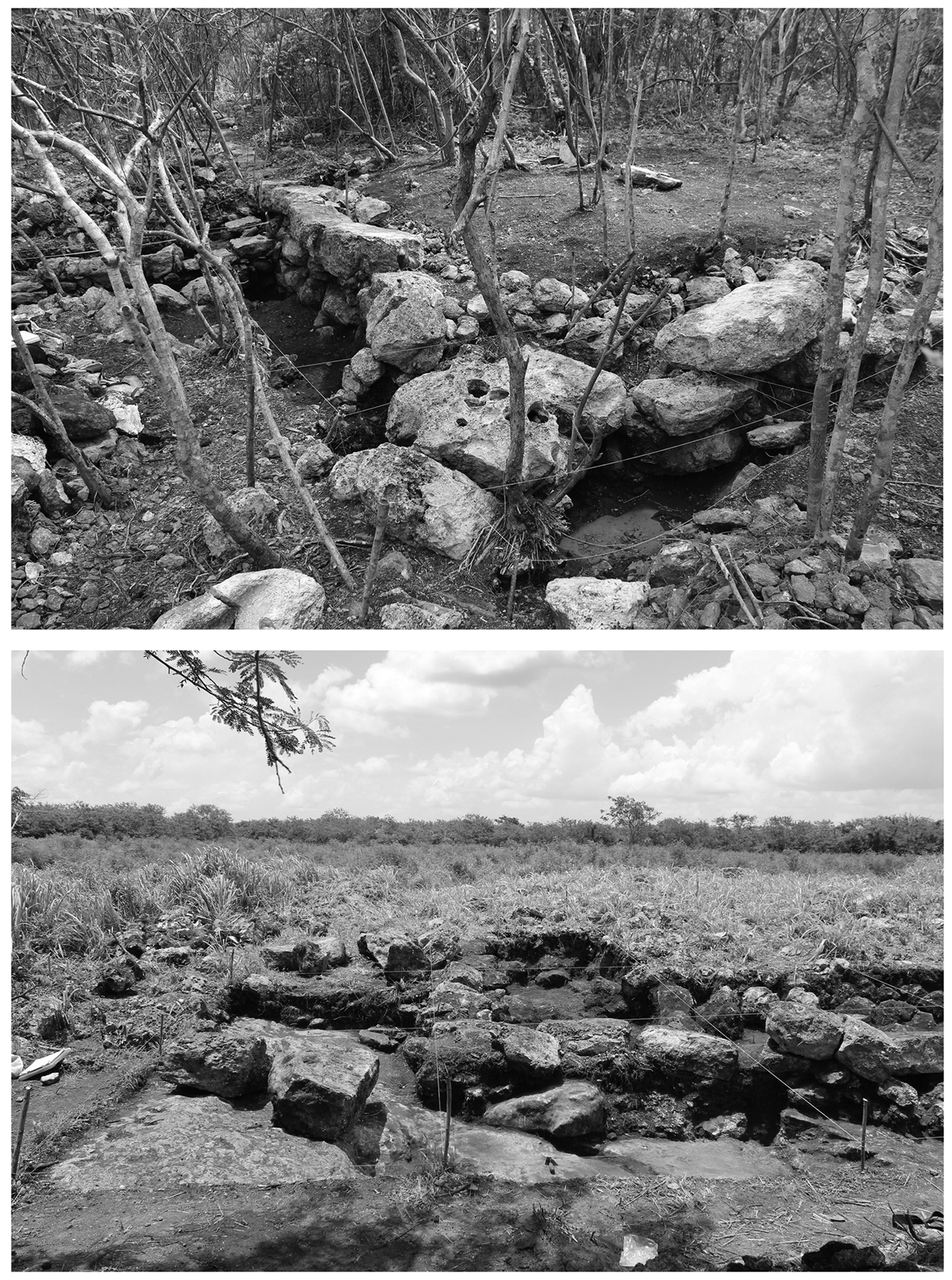
Notable differences also exist in the degree of elaboration, expressed in the number and kinds of architectural features present within Chunhuayum's compounds. No vaulted or full-masonry superstructures were identified at Chunhuayum, meaning that all residents lived in perishable houses. Despite these commonalities, construction techniques for these superstructures differed. Among the largest compounds, 80 percent had visible superstructural platforms and foundation braces, compared to 60 percent among smaller compounds. In this project, I define superstructural platforms as small platforms built on a basal platform that likely served as sustaining surfaces for a superstructure. Superstructural foundation braces are stone alignments, between one and three courses, that do not contain any construction fill and would have supported the walls of perishable superstructures. Assuming that all platforms supported superstructures at one point in time, these differences suggest that smaller compounds more commonly supported superstructures made entirely of perishable materials. Furthermore, foundation braces were more common within smaller compounds, while superstructural platforms were more common in larger compounds. Bilevel superstructural platforms and stairs were rare architectural features found only in larger compounds. Finally, the quality and size of cut-facing stones and megaliths differed throughout the settlement (Figure 6), although no clear pattern of distribution has been identified. The five household compounds used in this analysis (Figure 4, Table 1), capture this variability through their architectural features and known construction histories.
Compound N148 is the largest compound in volume and surface area throughout Chunhuayum (z-scores = 4.638 and 4.786, respectively), as well as Yaxché (Table 1). Among its nine superstructures, most notable is N148A. This eastern, square pyramid has a central axis stairway and reaches 3 m above ground surface, the tallest built point throughout Yaxché. Its earliest known construction, dating to the Late Preclassic, includes a stucco floor, presumably a patio, abutted to the east by a 70 cm platform (N148A-sub3) on its eastern side. N148A-sub3 supported a superstructure with 50-cm tall masonry foundation walls. Toward the end of Late Preclassic or beginning of the Early Classic, N148A-sub3 was covered by a megalithic structure reaching 1.75 m above the plaza floor (N148A-sub2). During the late Early Classic, individuals built a low wall in front of N148A-sub2, in front of which they placed two cache deposits (Figure 7) into the Preclassic patio floor. These features were covered by a significant expansion of the platform, extending about 40 meters west. In the Late/Terminal Classic, the platform was again expanded and N148A was covered a third time, reaching its final form including the axial staircase. Large quantities of Chen Mul Modeled effigy censor fragments, were found on N148A's surface suggest that, during the Postclassic, people returned to N148 as part of processional or revisitation pilgrimages (Freidel and Sabloff Reference Freidel and Sabloff1984; Hutson et al. Reference Hutson, Aragón, Reyna, Larsen, Lukach, Plank, Terry, Vanessendelft and Falseit2015; Milbrath and Walker Reference Milbrath, Walker, Walker, Chase and Chase2016; Milbrath et al. Reference Milbrath, Aimers, Lope and Folan2008; Tozzer Reference Tozzer1941).
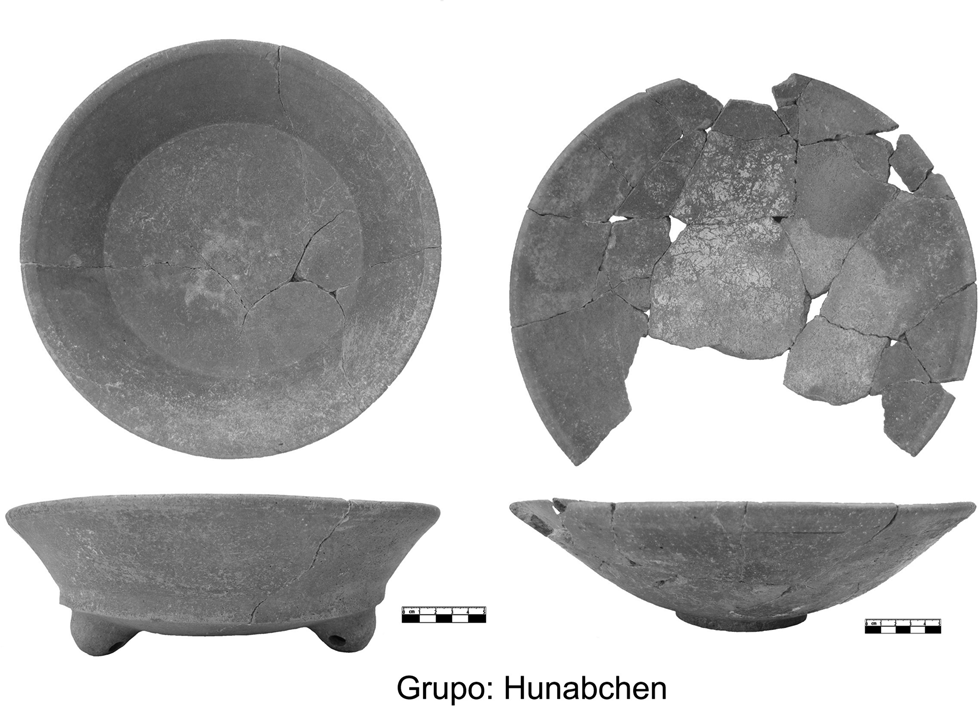
Hunabchen Rojo tripod cajetes recovered from a dedicatory cache at N148. Such cajetes were commonly used throughout Chunhuayum.
Compound N141 is the seventh largest compound in Chunhuayum, although its volume and surface area are only slightly above average (z-scores = 0.444 and 0.551, respectively). Its basal platform (Figure 6) supports two superstructural platforms. Only one construction phase is known for N141, since no buried architectural features were encountered during excavations. Few Late Preclassic sherds (n = 51, 2 percent of total classifiable sherds from N141) were recovered while high amounts of Early Classic materials (n = 1459, or 61 percent), particularly late Early Classic, were found within the platform and its surrounding midden. Late/Terminal Classic materials (37 percent of total classifiable sherds) were found particularly on the platform's surface. The ceramic data and presence of megaliths within the platform's retaining walls suggest N141 was constructed during the early Early Classic and occupied through the Late/Terminal Classic.
Compound N588 consists of the tallest platform and is the second most voluminous (z-score = 3.416) and expansive (z-score = 2.182) compound in Chunhuayum. The platform supports five superstructures, including a bilevel superstructural platform. Ceramic data suggest a Middle Preclassic occupation, although the earliest known construction is the Late Preclassic megalithic platform, still visible above ground surface. This platform was built using some of the largest and most well-cut megaliths identified throughout Chunhuayum (Figure 6). During the late Early Classic, builders slightly raised the platform's surface. In the Late Classic, an extension was built along the northwest edge of the platform, including a stair on its north side. Ceramics recovered indicate a Postclassic occupation that was more permanent than the pilgrimage activities found at N148.
Compounds N518 and N490 are relatively average at Chunhuayum in terms of both volume (z-scores = −0.103 and −0.111, respectively) and surface area (z-scores = −0.339 and −0.131, respectively), although they are the smallest compounds of this sample. The N518 basal platform commenced during the Late Preclassic as a 50-cm tall platform and potentially occupied into the onset of the Early Classic. The diminished proportion of Early Classic ceramics (n = 106, or 2.6 percent, versus 6.5 percent for Late Preclassic materials) cannot be explained by sherd erosion nor excavation size. The N518 ceramic assemblage has the lowest proportion of unclassifiable sherds due to erosion, and the total volume of excavation is above average among the study sample (Tables 1 and 2). Instead, this decrease suggests that during the Early Classic, N518 occupants consumed less pottery, their numbers dwindled, occupation became more intermittent, or some combination of the aforementioned. In the Late/Terminal Classic, the compound reached its final form as individuals covered and expanded outward the initial platform and built a superstructural platform (N158A). Later on, inhabitants dug into the platform fill to the Preclassic floor, on which they buried three individuals and a cache (Lamb and Cetina Batun Reference Lamb and Cetina Batún2019).
Frequency and density of classifiable ceramic sherds recovered from each compound.
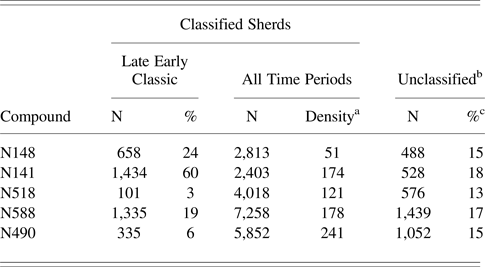
aCalculated as number of sherds per cubic meter of excavation.
bSherds that were unclassifiable due to their small size and/or eroded surfaces.
cPercentage of total ceramics.
The N490 basal platform supports a small superstructural platform and a foundation brace on its northern edge. The two construction phases identified date to the Late/Terminal Classic, although recovered ceramics suggest a continuous occupation starting during the Middle Preclassic. The small quantities of Late Preclassic and Early Classic (each 6 percent of the total classifiable assemblage) compared to the Late/Terminal materials (n = 5016, or 86 percent), along with the platform's known construction history, evince this household's significant growth in size or wealth during the Late/Terminal Classic. Small quantities of Postclassic ceramics suggest ephemeral activities during this time on N490.
While some of these differences in construction size may relate to their length of occupation, excavations indicate both smaller and larger compounds were continuously inhabited from the Late Preclassic through the Late Classic and only one of the three compounds with a Middle Preclassic occupation was much larger than most. During the Late Preclassic, N148 and N588 were already among the largest buildings, and their Early Classic expansions made them the largest and most elaborate residences in this village and throughout the Yaxché area. Residents of these compounds were able to count on larger amounts of labor over long periods of time, some of which probably came from neighboring households. Therefore, differences in late Early Classic residences appear to reflect the size, wealth, and social power of their founding households and later residents’ ability to successfully maintain their material and social resources over time.
Household Ceramic Assemblages
In total, 3863 sherds recovered from these five platforms were attributed to the late Early Classic using type-variety classification (17.3 percent of the 22343 classifiable sherds recovered during excavations; Table 2). Among all late Early Classic sherds, 99 percent could be identified to their form (Table 3). Censers and lid fragments were excluded from analysis due to their paucity. Here I examine household social differentiation through the percentage of serving wares and fancy wares, as well as the number of fancy ceramic varieties among household assemblages.
Distribution of ceramic forms per compound.

aZ-scores are provided in parentheses.
By “fancy” ceramics I mean either or both of two things: (1) Oxkintok thinware (Chencoh, Kochol, and Acu groups; Varela Reference Varela Torrecilla1998) and (2) vessels with more complex surface treatments and decoration, such as bichrome slips, incisions, impressions, grooves, and appliqués. Serving wares refer to ceramic vessels used to serve, as opposed to store, cook, and transport foods (and may or may not be fancy). In the present region of study, this consist in unrestricted dishes (cajetes), semispherical bowls (cuencos), and vases (Figure 8). Due to the small sample size of ceramic sherds that underwent attribute analysis, potential feasting activities were identified by comparing proportions of serving versus preparation/storing wares among household assemblages (Hirth Reference Hirth, Stanley and Hirth1993; Rosenswig Reference Rosenswig2007; Smith Reference Smith1987; Welch and Scarry Reference Welch and Scarry1995).
Schematic of ceramic forms commonly found at Chunhuayum.

On average, 15.4 percent of late Early Classic household ceramic assemblages is serving related (s = 5.841; Table 3). N148 had much higher than average percentages of serving wares, followed by N490, N141, and N588, with N518 falling well below average. Despite having more serving wares than its neighbors, residents of N148 used only cajetes. The N141 assemblage provides the singular strong evidence of the presence of vases and cuencos, indicating its occupants used a wider range of serving forms.
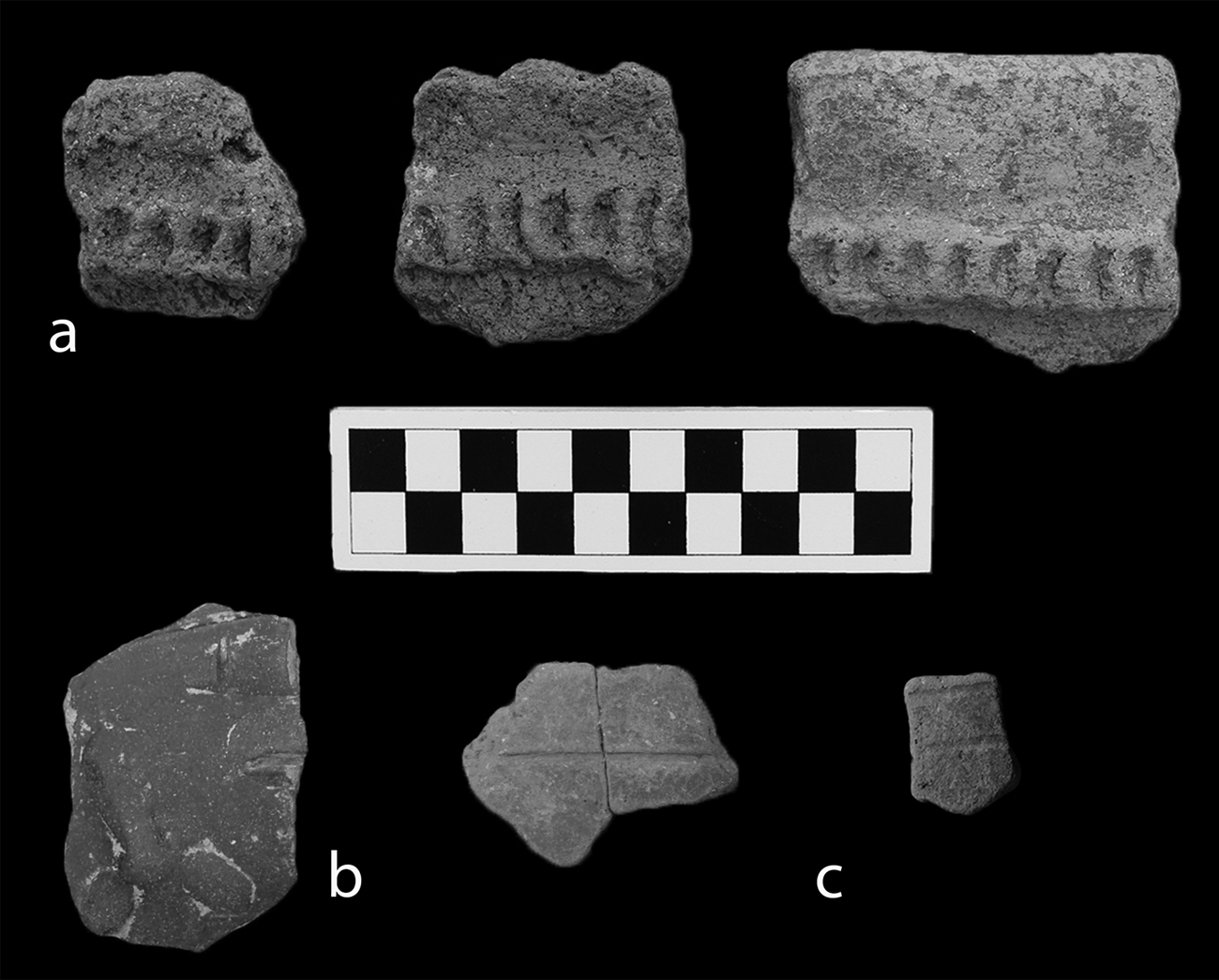
All five households had access to some fancy pottery during the late Early Classic. Ceramic sherds designated as fancy wares (n = 123) represent 10 distinct types within six ceramic groups, presented in Table 4. Fancy wares recovered at Chunhuayum are not as visually ornate as what most Mayanists might commonly consider “fancy” and the eroded nature of the ceramic assemblage may render them lack-luster to some. Yet compared to the wares more commonly found at Chunhuayum, the more complex decoration and finer quality of the pots designated here as fancy would certainly have been visible to individuals using these objects or in eyeshot of them, particularly as they are obtained in small quantities. Fancy pottery at Chunhuayum mainly consisted in monochrome plain types of Oxkintok Thinware within the Kochol and Chencoh groups and bichrome Hunabchen cajetes. Also recovered were smaller quantities of incised, fluted, or composite Thinware pottery (Figures 9b and 9c) and red slipped Batres cazuelas with appliquéd and impressed rims (Figure 9a).
Examples of fancy ceramics from Chunhuayum. (a) Batres: Lakin Impressed Composite cazuela rim fragments. (b) Kochol: Peba Composite vase fragment bearing an anthropomorphic face. (c) Chencoh: Chencoh Thin Orange cuenco rim fragments.
Frequency of late Early Classic fancy ceramic varieties per household compound.
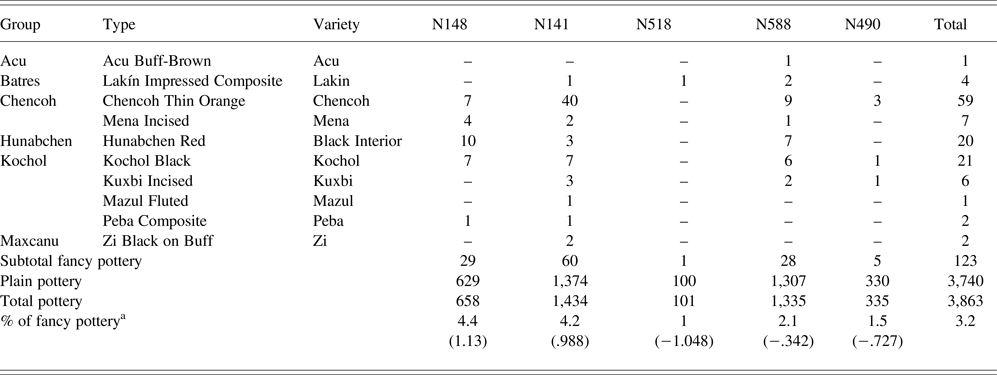
aZ-scores are provided in parentheses.
On average, fancy wares represent 2.6 percent (s = 1.57) of household assemblages. N148 and N141 yielded the highest percentage of fancy wares, followed by N588, N490, and N518. The average number of fancy ceramic types per household compound is five (s = 3.162). N141 yielded the greatest array of fancy types, followed by N588, N148, and N490 and N518. Two types, Zi Black on Buff Bayo and Peba Composite, were found exclusively at N141, including a Peba Composite vase fragment bearing an appliqué anthropomorphic face (Figure 9b), while Acu Buff-Brown tecomate fragments were found exclusively at N588.
Differences among household ceramic assemblages are not as significant as those of residential architecture, possibly due to the smaller sample of excavated compounds. Taken together, however, the three ceramic indicators examined here reveal subtle distinctions. The three households residing in the three largest compounds, N148, N141, and N588, had greater portable wealth and social connectivity than N490 and N518. Residents of N148 had among the greatest proportions of fancy pots and in particular serving ware, although they had lesser variety in their decorated types and serving forms than N141 or N588. As I argue later in this article, this greater homogeneity relates to the more inclusive nature of feasting that took place at N148. Occupants of N588 acquired more kinds of fancy wares than N148, yet their assemblage had among the lowest proportion of fancy pots and, in particular, serving wares. In the case of N141, its inhabitants procured the greatest assortment of fancy ceramics and serving forms, obtaining decorated vessels to which no other households had access. They also had greater proportions of fancy and serving vessels than N588, notwithstanding that their compound was three times smaller. The greater stylistic breadth of assemblages at N141, and to a lesser extent N588, suggests these households’ greater social connectivity.
Household members residing at N518 and N490, the smallest compounds of this sample, had the lowest amount of varieties and percentages of fancy wares. N518 also had the lowest percentage of serving wares. These data reveal these two households possessed lesser portable wealth and participated in smaller social networks than their neighbors. The relatively large percentage of serving wares at N490 may indicate, however, that people at this compound served more food than at N518. I now turn to the nonagrarian strategies practiced by two households, N141 and N148, to achieve increased wealth and opportunities within Chunhuayum during the late Early Classic and the varying outcomes these strategies had over time.
Crafting at N141
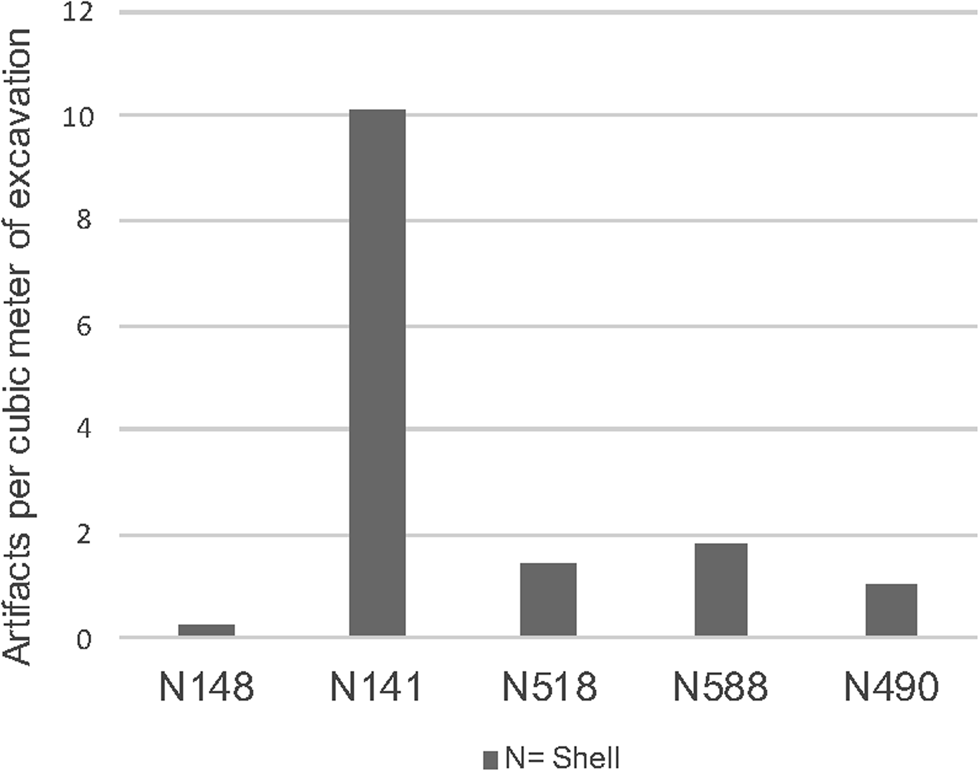
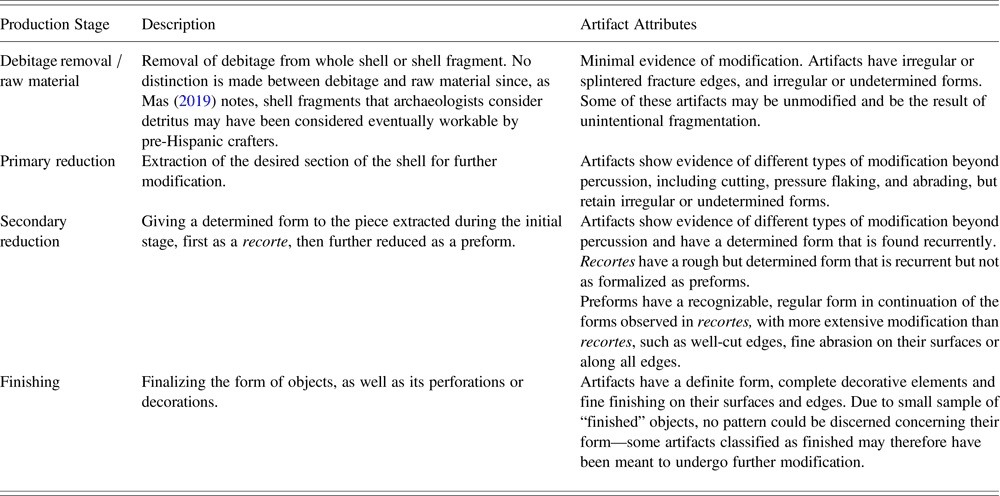
To date, the only evidence of household crafting during the Early Classic is found at N141, where residents engaged in the production of shell ornaments, as indicated by various lines of evidence. N141 yielded the highest amounts and density of shell artifacts among all extensively excavated buildings (Figure 10). Of the 176 shell artifacts attributed to the Early Classic, 169 were recovered from N141 (the remainder were found at N148 and N588). Of all the shell recovered at N141, 85 percent were identified as pertaining to the Strombidae family (likely Strombus spp.). Whole Strombidae shells appear to have been processed at N141, as spires, shoulders, bodies, columellae, and outer lips were recovered. Moreover, production-stage classification (Table 5) of Chunhuayum's shell artifacts indicate N141's Strombidae assemblage (n = 145) encompasses various stages of production (Figure 11), including debitage removal (n = 80), primary (n = 24) and secondary reduction (n = 40), and finishing (n = 1) stage artifacts. Secondary stage artifacts, or blanks, were mostly circular and rounded rectangles in shape. Two artifacts were attributed to the final manufacturing stage, consisting of a Strombidae notched disk and a small polished disk made of unidentified nacreous gastropod shell.
Density of shell artifacts per cubic meter of excavation (all chronological periods included).
Idealized stages of shell adornment manufacturing sequence. From left to right: raw material, recortes, preforms, and finished disks.

Classification of shell-production sequence used throughout Chunhuayum.
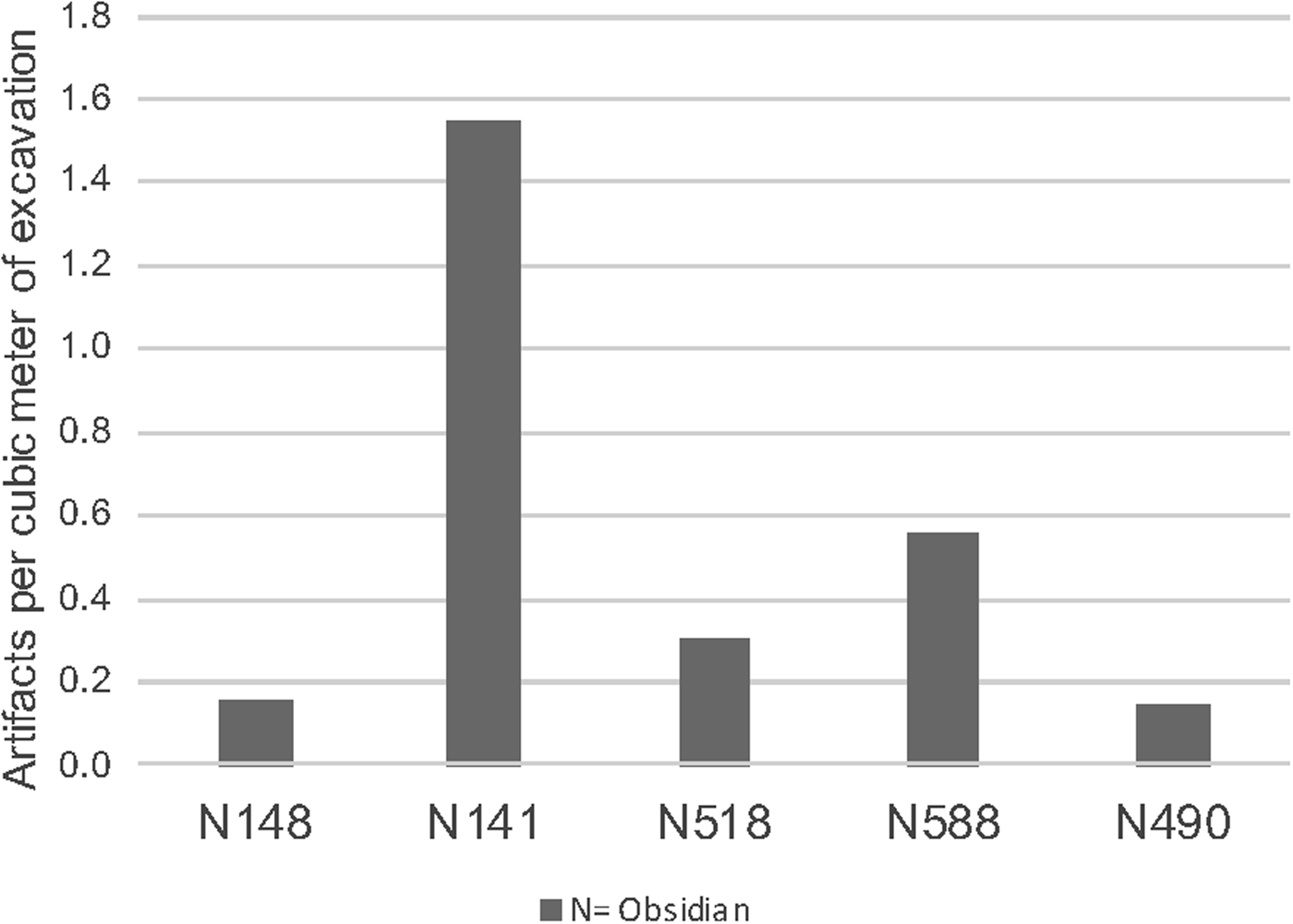
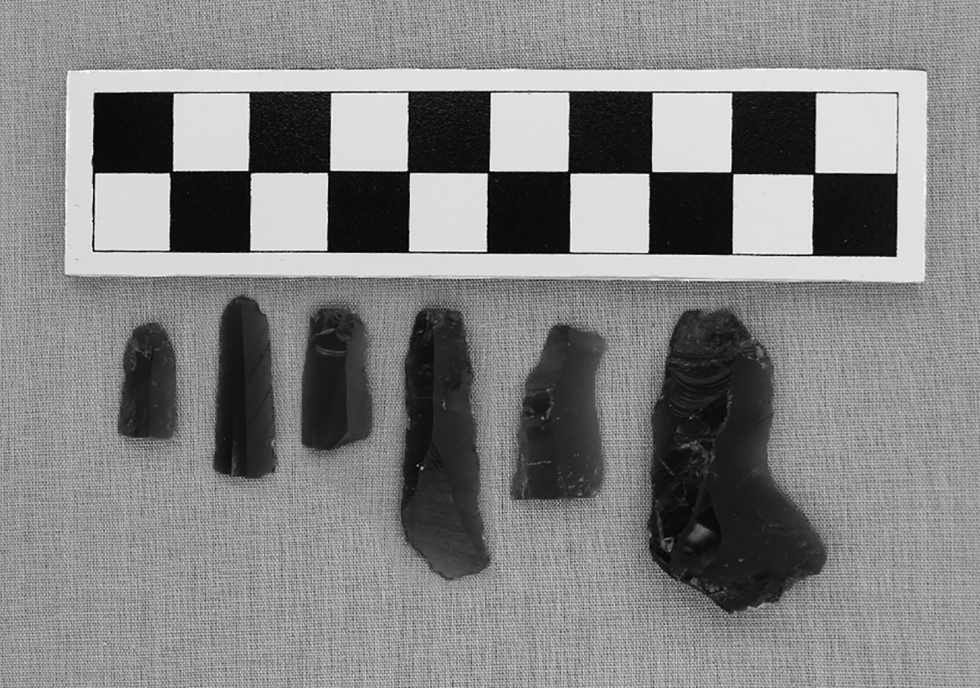
Another line of evidence for crafting is the co-occurrence of high densities of obsidian artifacts and shell. Among the five compounds discussed here, 35 obsidian artifacts were attributed to the Early Classic, 26 (74 percent) of which were found at N141. Late Early Classic residents of N141 obtained greater amounts of this material than any other sampled household throughout Chunhuayum's history as indicated by the higher densities (Figure 12). They also acquired more than most households at Uci, where the majority of obsidian dates to the Late Classic (Daniel Vallejo-Caliz, personal communication 2020) and only two of the 33 platforms excavated in 2016 yielded higher densities that those found at N141 (Hutson Reference Hutson2016b). Most of N141's obsidian artifacts (n = 19) were prismatic blade fragments (Figure 13), many of which showed macroscopic evidence of heavy ware and retouching, suggesting these may have been used on hard and abrasive materials such as shell. Microware analysis of materials from the Maya lowlands (e.g., Alonso Olvera Reference Alonso Olvera2013; Aoyama Reference Aoyama1995; Emery and Aoyama Reference Emery and Aoyama2007; Melgar Tísoc Reference Melgar Tísoc2008; Torres Ochoa Reference Torres Ochoa2017) as well as central and Western Mexico (Mas Reference Mas2019; Walton Reference Walton2019; Velzquez-Castro Reference Velazquez-Castro and Ollich-Castanyer2012) has indicated obsidian in the form of blades, flakes, bifaces, and powder was used to work shell. N141 yielded the most diverse obsidian assemblage, including blade fragments, three flakes, two exhausted polyhedral core fragments, a plunging blade, and a complete biface (Figures 13 and 14). In contrast, the seven Early Classic obsidian artifacts from N148 were all prismatic blade fragments, and the two from N588 were shatter fragments. Although usewear analysis of the Chunhuayum assemblage is needed, the comparatively high density and diversity of obsidian artifacts recovered from N141 may indicate that obsidian was used by occupants for working shell. For example, obsidian powder may have served as an abrader when using string or fiber to saw, cores for shaving off the sculpture of a gastropod fragment, and blades for incising or other fine detailed work. Because obsidian blades have acute angles that are very fragile, other tools were likely used as well by N141's crafters, including chert flakes (found in small quantities at N141), as well as limestone and silicified-limestone tools. Some of the numerous metates found on this platform (n = 7) were perhaps used for abrading tasks, such as shaping preforms, in addition to serving other functions beyond shell working. The use of fixed or handheld abraders, including ground stone, for working shell has been suggested at Xuenkal, approximately 90 km to the west (Alonso Olvera Reference Alonso Olvera2013:262), as well as in other parts of Mesoamerica (Feinman and Nicholas Reference Feinman, Nicholas, Manzanilla and Hirth2011:35; Suárez Diez Reference Suárez Diez1981:34, 40, 41).
Density of obsidian artifacts, for all chronological periods, per m3 excavated at Chunhuayum household compounds (by frequency and mass).
A sample of obsidian prismatic blades and two flakes (far right) recovered from N141.
Obsidian exhausted polyhedral core fragments (left and center) and plunging blade (right) recovered from N141.

The high volume of shell debris, in conjunction with the presence of round-shaped preforms and the very small number of finished pieces indicates that much of this production activity was not intended for internal consumption but instead exchange. Crafting was likely small-scale and intermittent (Hirth Reference Hirth2009) since evidence of food storage, preparation and consumption was also found at this compound. As a nonperishable good, shell is well suited to intermittent crafting, allowing artisans to work this material on-and-off between household maintenance, farming, childcare and other tasks. Surplus production of shell ornaments would have provided various benefits to the N141 household, including developing and maintaining local and external networks with other households, buffering themselves from possible subsistence risk, improving their social standing within the community, and maintaining appropriate relationships with the supernatural (Hirth Reference Hirth2009; McAnany Reference McAnany2014).
Collective Feasting Rituals at N148
Most households in Chunhuayum, as throughout ancient Maya society likely hosted small-scale gatherings such as extended household feasts, but as previously discussed, not all would have had the same ability to host larger groups of people. At Chunhuayum, N148 provides the strongest case for serving as a locus of community-wide, group-oriented ceremonies during the Early Classic. First, N148A provides the only evidence of a shrine at Chunhuayum. Its square footprint, tall height, axial staircase toward the plaza, and central position on the eastern side of the platform recall the form and placement of shrines found in residential groups at other Maya lowland sites (e.g., Becker 2004; Gonlin Reference Gonlin and Lohse2007). Although no human remains were found within this superstructure, its repeated construction since the Preclassic (at which point it was already one of the tallest buildings throughout Chunhuayum's occupation), cached offerings, and concentration of Postclassic censer fragments on its surface further support this interpretation and indicate that N148A was a place of significance throughout Chunhuayum's occupation. Second, the comparatively higher amounts of Early Classic (as well as Late Preclassic and Late Classic) serving vessels recovered from N148 indicate large amounts of foods and liquids were consumed in this compound. Third, eight metates, four of which are clustered around one of its superstructures, where found, while most compounds throughout the Chunhuayum settlement had one or two metates, suggesting N148 was the locus of periodic processing of large amounts of food (see Brown [Reference Brown, Dietler and Hayden2001] for a similar finding at Ceren). Finally, following Inomata's (Reference Inomata2006) conservative estimates of 3.6 m2 of space per person, this platform would have been able to hold over 400 people in its final form. The expanse of this open patio may have also allowed for, in addition to or in association with feasting, performances involving dancers and musicians (Looper Reference Looper2009) or astronomical observations of the night sky (Gonlin and Nowell Reference Gonlin, Nowell, Gonlin and Nowell2018). The full extent of the late Early Classic platform is unknown, but excavations show that it was almost as large as its Late Classic form.
Ceremonies and consumption rituals that took place at N148 during the late Early Classic appear to have been relatively group oriented. All serving vessels were cajetes, in particular larger recto-divergent forms. These open forms would allow for visual presentation of consumables to a larger group and have been found elsewhere associated with public feasting compared to exclusive feasting contexts (LeCount Reference LeCount2001;Welch and Scarry Reference Welch and Scarry1995). Most serving wares were monochrome Hunabchen cajetes (Figure 7), and to a lesser extent Kanachen and Maxcanu cajetes, commonly found throughout Chunhuayum, and none of the fancy serving vessels found at N148 were exclusive to this compound. Following Dietler's (Reference Dietler, Dietler and Hayden2001) model of patron-role feasts, in which inequalities are naturalized through the rhetoric of communal identity, the use of similar and commonly found dishes would have deemphasized differences among participants and may have promoted a sense of unity, even if only at a superficial level, between households of varying socioeconomic positions. Moreover, the courtyard's open and extensive space, lacking internal divisions that would have otherwise reduced accessibility and visibility, further supports the interpretation that all village residents could have participated in events held at N148 (Inomata and Tsukamoto Reference Inomata, Tsukamoto, Tsukamoto and Inomata2014).
DISCUSSION
Through the comparison of households’ residential architecture and ceramic assemblages, along with the examination of non-agrarian strategies of social differentiation, multiple points can be made about ancient Maya rurality at Chunhuayum during the late Early Classic occupation. Chunhuayum not only provides yet another example of social differentiation existing among rural households, but indicates how rural residents constructed these differences through their diverse interactions and practices. Residents of Chunhuayum also engaged in diverse, at times innovative, active strategies in attempting to increase their economic and social well-being. Such strategies included diversifying household occupations, emphasizing internal or external social networks and underlining local similarities or differences—strategies that led to varying outcomes both for households and their greater community.
Rural Diversity and Practices of Social Differentiation
People living in Chunhuayum shared fundamental concerns of subsistence, experienced the same ecological constraints, used comparable sets of culinary wares, and built their household compounds in similar configurations. Residential proximity within this spatially distinct settlement would have also enabled frequent face-to face interactions. While these shared daily experiences and material culture may have fostered a sense of community among Chunhuayum's residents, household heterogeneity, including inequality, simultaneously existed during the late Early Classic. These differences were negotiated and expressed variably through diverse material media and social networks. Residential architecture provides the most marked dimension of difference, particularly wealth. Distinctions in residence size evince households’ unequal ability to invest resources into their homes and, particularly in the case of N588 and N148, greater social power to enlist extra-household labor. The eastern shrine of N148, suggesting greater access to the supernatural or ancestral realm, further denotes the unique position that residents held within their village.
What conditions led to the emergence of inequalities in Chunhuayum are unknown without a larger Preclassic artifact assemblage and a finer chronological resolution allowing to disentangle the different lengths of household compound occupation. Within ancient Maya studies, there is a general consensus that the Principle of First Occupancy (McAnany Reference McAnany1995) largely explains the emergence and reproduction of among households—that is, that length of occupation varies directly with a household's wealth, status, and authority within their settlement. While this principle has been found to apply to various Maya sites (Lamoureux-St-Hilaire et al. Reference Lamoureux-St-Hilaire, Macrae, McCane, Parker and Iannone2015; McAnany Reference McAnany1995; Yaeger Reference Yaeger, Canuto and Yaeger2000; see also Pantoja Diaz et al. Reference Pantoja Diaz, Aragon, Coba and Aguilar2022), some ancient Maya communities do not appear to have operated following this principle (e.g., Blackmore Reference Blackmore2011). What is clear at Chunhuayum is that households who resided in the largest compounds during the Early Classic appear to be the successors of those who during the Late Preclassic were able to mobilize more and higher skilled labor, either through its greater number of members or through other households, and to successfully transmit their wealth and social resources over time. Moreover, it seems feasible that within the politically competitive context of the Late Preclassic, larger and/or higher-ranking households had greater bargaining power than their neighbors when interacting with regional leaders.
Attention to household ceramic assemblages provides a subtler view of social differentiation. Households occupying the largest compounds—N141, N588, and to a lesser extent N148—tended to have greater ceramic wealth than the two other households within the study sample and were the only ones who acquired obsidian. For example, percentage of fancy pottery correlated positively with total compound volume (r = 0.610, p = 0.274) and surface (r = 0.771, p = 0.1269), although these correlations were not statistically significant, likely due to the small sample size. No single compound, however, revealed all three markers of greater ceramic wealth considered in this study, indicating that social differentiation at Chunhuayum was more complex than simply the haves and the have-nots.
The diversity found among Chunhuayum's residences and household assemblages was more than a mere reflection or overt expression of social differences. As physical settings of socialization and daily routinized activities, residences both structure and are shaped by cultural practices and representations; “through the intermediary of the divisions and hierarchies [inhabited space] sets up between things, persons, and practices, this tangible classifying system continuously inculcates and reinforces the taxonomic principles underlying all the arbitrary provisions” (Bourdieu Reference Bourdieu1977:89). The unique size and elaboration of compounds like N148 and N588 would have been apparent to village residents. Yet as people were socialized and went about their daily routines within or in eyeshot of these different physical spaces, the buildings that structured residents’ practices and interactions recursively shaped expectations on what kinds of homes were appropriate to different social standings, thus simultaneously enacting and legitimizing material-based asymmetrical relations as the natural social order (Bourdieu Reference Bourdieu1986). The repeated constructions of N148, already one of the largest residences in Chunhuayum during the Late Preclassic, alludes to the acceptance of this household's greater wealth and social power by those who lived in the compound as well as those who helped build it.
While differences in ceramic assemblages may not be statistically significant, they likely shaped social differentiation at Chunhuayum when understood within the larger material context. The use of greater amounts and more kinds of fancy ceramics within larger and more elaborate residences like N148, N141, and N588, would have contributed to shaping the way people enacted and interpreted social differences.
By crafting shell disks and using a greater array of obsidian tools than their neighbors, residents of N141 learned and practiced forms of material engagement with shell and obsidian, and associated techniques of the body (sensu Mauss Reference Mauss2013 [1935]) that were unique throughout Chunhuayum. Crafting does not appear to have created hierarchical distinctions between N141 and other Chunhuayum households since it did not enable this household greater wealth or authority. Rather, the locally unique bodily dispositions, knowledge, and skillsets likely led to vertical distinctions within Chunhuayum. Additionally, these material practices were likely shared with others outside of Chunhuayum—trade partners or fellow craftspeople for example—thus further distinguishing them within this village.
Although late Early Classic residents of Chunhuayum did not possess jade, polychrome pottery, exotic and rare shell objects, or live within stone masonry and vaulted homes, their material practices shaped locally meaningful distinctions.
Rural Social Differentiation: Strategies and Outcomes
As previously discussed, the group-oriented feasting that took place at N148 appears to have deemphasized differences among participants, based on the serving wares used and the large extent of the compound's courtyard and its lack of internal divisions. Yet feasts are never fully inclusive—“they both unite and divide at the same time” (Dietler Reference Dietler, Dietler and Hayden2001:77, original emphasis; see also Callaghan Reference Callaghan2013; Inomata Reference Inomata2006; Kertzer Reference Kertzer1989; LeCount Reference LeCount2001; Yaeger Reference Yaeger, Canuto and Yaeger2000). Because of the singularity of N148 household's size and the number of people it could host during celebrations in their compound, it is unlikely that participants could equally reciprocate feasts of similar scale at a later time. Instead, these events may have been akin to a patron-role feast, which “involves the formalized use of commensal hospitality to symbolically reiterate and legitimize institutionalized relations of asymmetrical social power” (Dietler Reference Dietler, Dietler and Hayden2001:82–83). The ceramic and architectural data from N148 fit Dietler's description of such feasts—large groups of people sharing large amounts of commonly eaten foods and drink, which guests are not expected nor able to reciprocate. Through their participation, hosts and guests mutually acknowledge their unequal relations of wealth and power. The willingness of less privileged households to participate in such events, however, need not be construed as a sort of false consciousness (Lohse Reference Lohse, Gonlin and Lohse2007); patron-role feasts create binding relationships in which hosts are expected to continue such hospitality and may be openly critiqued if they do not.
When hosting community events, N148 displayed the important material resources expended, their unique ritual competences, privileged access to the supernatural realm associated with the eastern shrine, and reinforced local networks through reciprocal, albeit asymmetrical, obligations. Thus, through the “legitimizing theatricalization” (Bourdieu Reference Bourdieu1990:139) of ritual, N148 mobilized the labor of others without having to reciprocate in kind and maintained their authority to serve as community leaders through the Late Classic.
Households at Chunhuayum also indicate that rural people responded in various ways to the broader political and economic changes of the Uci-Cansahcab microregion during the Early Classic. In the case of N518, the decreased proportions of ceramics hint to some form of socioeconomic strain, such as a decrease in membership, coresidence, or shared consumption. In response to such stress, some members may have integrated more prosperous household. Concerning N490, the small proportions of Early Classic materials, and comparatively low quantities and diversity of fancy wares suggest this household was among the least wealthy. Neither N518 nor N490 diversified their activities or social networks during the Early Classic, likely limited by their comparatively lesser wealth and smaller household size prior to and during the Early Classic—although these residents may have chosen, consciously or tacitly, to maintain the status quo.
Strategies at N141 and N148 were locally innovative within the historically constituted knowledge sets, material and social relations, and institutions that constrained and enabled their actions and motivations. N141 extended their social network beyond local centers and engaged in new productive activities in attempt to increase their well-being. As local political authority weakened, households would have gained greater flexibility in how they invested their time and agricultural surplus, as well as greater opportunities to participate directly in existing trade networks (Braswell Reference Braswell, Garraty and Stark2010; Masson and Freidel Reference Masson and Freidel2012; Meehan Reference Meehan2018). Greater quantities of obsidian have been recovered from N141 than from the majority of Late Preclassic, and all Early Classic contexts at Uci and Ucanha (Hutson Reference Hutson2016b; Kidder Reference Kidder2019). This discrepancy may indicate that N141 householders interacted with people who were more regionally connected than residents of local centers, perhaps participating more directly in regional trade—likely centered around Izamal and Xcambo, than those living at Uci and Ucanha. Forthcoming obsidian sourcing for UCRIP materials may further elucidate the distribution mechanisms and networks in which N141 and other households participated.
Crafting did not enable the N141 household to maintain its social position in the long term. Their access to fancy wares and overall possession decreased in the Late Classic and the compound was not expanded. One possible explanation is that the shell crafting skillsets were not successfully transmitted over time, perhaps due to changes in household priorities or capacities. Another related explanation is that, as market economies burgeoned (Hutson Reference Hutson2016a), and regional elites and populations reestablished themselves at Uci and Ucanha starting in the Late Classic, these crafters may have had more difficulty inserting themselves in a growing web of surplus craft goods and raw material supply networks.
Unfortunately, the chronological resolution at Chunhuayum does not allow for identifying whether crafting contributed to N141's material wealth or if, instead, crafting was a response to a loss in household wealth as evidenced by the Late Classic assemblage. Although some ethnographic research (e.g., Arnold Reference Arnold1985; Cook Reference Cook1970; Deal Reference Deal1998) found that households turn to crafting as a response to diminished agrarian returns or landlessness, this causal relationship cannot be uniformly applied to precontact Mesoamerican households (Hirth Reference Hirth2009; Masson et al. Reference Masson, Hare, Lope, Escamilla Ojeda, Paris, Kohut, Russell and Alvarado2016). Crafting households at Mayapan, Chunchucmil, and Chan, for example, were found to be among the most affluent within non-elite populations (Dahlin Reference Dahlin2009; Masson et al. Reference Masson, Hare, Lope, Escamilla Ojeda, Paris, Kohut, Russell and Alvarado2016; Robin et al. Reference Robin, Kosakowsky, Keller and Meierhoff2014). Access to large amounts of obsidian, at least some of which was used for shell crafting could be suggestive of N141's wealth prior to engaging in craft production. As Hirth (Reference Hirth, Stanley and Hirth1993) has discussed, however, goods used in craft production may not be reliable indicators of wealth, since these may be acquired through particular mechanisms, such as patron-client relations financing production. Regardless of the causal relationship, N141's shell crafting can be understood as a novel initiative to improve their socioeconomic standing, combining existent trade networks with new social interactions and household activities.
N148 provides a different example of innovative social negotiation, using physical and symbolic resources and local social relations established in the Preclassic. By the late Early Classic, the large-scale rituals that local centers had once organized (Hutson and Welch Reference Hutson and Welch2014; Kidder Reference Kidder2019), and in which rural occupants had likely participated, were no longer being performed. At Ucanha, access to the central plaza became restricted, which Kidder (Reference Kidder2019) interprets as a transition from group-oriented to exclusive political strategies. Therefore, people living in rural settlements would have more so relied on local events for their religious and social needs. This appears to have been the case of Santa Teresa (Figure 1), a small settlement about three kilometers northeast of Chunhuayum, where a ball court was built during the Late Classic (Hutson et al. Reference Hutson, Aragón, Reyna, Larsen, Lukach, Plank, Terry, Vanessendelft and Falseit2015). Collective rituals were not novel N148, which was the likely locale of inter-household events during the Preclassic, nor were domestic rituals, found among households of different levels of political authority (Hutson et al. Reference Hutson, Lamb, Arona, Barber and Joyce2018). Yet hosting village-wide events in a rural residential compound (as opposed to public plaza in a town center) that minimized social distinctions, particularly after the heightened material social distinctions of the early Early Classic, does represent a local innovation in ritual practice and material discourse.
By promoting binding and durable relationships with their neighbors through such events, N148 gained social benefits but also constraints. Feasts reinforced their obligations of commensal hospitality toward other households, a responsibility that likely emerged in the Preclassic. These obligations may explain the different expressions of material wealth found at N148 compared to N141 and N588. N148 appears to have invested their resources into obtaining larger amounts of pottery appropriate for feasts. By focusing on local relationships within Chunhuayum, residents of N148 may have lost opportunities afforded by greater social connectivity. Yet this strategy enabled the household's longevity, and greater social power and authority over time, as it significantly expanded its compound during the Late Classic and the meaning of this place was maintained into the Postclassic. Moreover, by supporting face-to-face interaction, attenuating social differentiation —even if only superficially—during ritually charged events, and promoting interdependence, the N148 household likely played a vital role in the longevity and relative stability of Chunhuayum's occupation. Village-wide ritual both divided and united Chunhuayum's households.
The diverse strategies and outcomes found at Chunhuayum show that rural households are not endlessly flexible and adaptive, as they are constrained by existing cultural norms, historically transmitted structures, and their own positions within them. They do, however, demonstrate that rural people attempted to maintain and improve their well-being in diverse ways that could be novel and conventional.
Rural residents of Chunhuayum were neither isolated nor purely dependent on larger centers. The changes identified in household economies and village-wide ritual (and associated construction projects) during the late Early Classic indicate that the broader political transformations were felt by villagers. The longevity and overall prosperity of Chunhuayum compared to other rural settlements, however, suggest this village may not have had a strong dependence on any one particular center, but instead maintained ties to various centers (Sheets Reference Sheets2000; see also Ingalls and Yaeger Reference Ingalls and Yaeger2022; McNeil et al. Reference McNeil, Barrios, X. Hruby, J. Meissner, Tokovinine, Díaz García and Burgos Morakawa2022; Valdez et al. Reference Valdez, Trachman and Cortes-Rincon2022). This would have allowed villagers to continue acquiring nonlocal materials without going through Uci or Ucanha. In fact, the strategies mentioned above illustrate the variable forms in which rural people engage beyond their communities. In some ways, Chunhuayum's residents further turned to each other to fulfill their socio-ritual needs (as local inter-household rituals were in fact developed prior to regional decentralization) and N148 householders focused on mobilizing local relations and strengthening their authority within their village. Yet Chunhuayum was not entirely autonomous or inward-looking. Households maintained involvement in regional and long-distance trade networks to procure nonlocal pottery, obsidian, and shell. N141 took advantage of expanding regional networks and engaged in trade beyond Chunhuayum. Data are currently insufficient to know where and to whom the shell ornaments were distributed and exchanged, although the lack of disks at Chunhuayum's other compounds indicates they were distributed outside of this settlement. A possible locale is Xcambo, 22 km away. This coastal trading port and salt production center, likely controlled by Izamal, had an abundance of Early Classic Peten-style polychromes, Oxkintok Regional wares, and ceramics from the east coast of Yucatan (e.g., Saban Becoob tecomates), as well as obsidian from highland Guatemala (Ceballos Gallareta Reference Ceballos Gallareta2003; Sierra Sosa et al. Reference Sierra Sosa, Cucina, Price, Burton and Tiesler2014). Due to the presence of similar materials at N141, along with the probability that this household acquired whole gastropod shells, it is plausible that N141 was exchanging goods or engaged in patron-client relationships with residents of Xcambo. Within a single rural settlement, Chunhuayum's residents variably used, as well as combined, open and closed strategies (sensu Wolf Reference Wolf1955; see also Wilk Reference Wilk1983) in supporting themselves and, perhaps unintentionally, their community (see Robin [Reference Robin and Robin2012b] for a similar finding at Chan).
CONCLUSIONS
Like in many rural places, householders at Chunhuayum shared a variety of quotidian experiences and spaces that would have promoted and reinforced a sense of commonality. Notwithstanding, Early Classic households in this settlement were socioeconomically diverse, and distinctions appear to have been both hierarchical and heterarchical. Households varied in size, access to labor, portable goods, and social networks and they engaged in different non-agrarian practices. This led to differences in household wealth, occupation, authority, and long-term success. Residential architecture at Chunhuayum was the most salient marker of social differentiation. These differences appear to be the result of larger households having larger labor pools, successfully transmitting their social and physical resources to later generations, thereby reproducing themselves. Portable goods materially manifested socioeconomic difference in more complex and nuanced ways. Within the new circumstances arising from disintegration of the Uci polity, two households at Chunhuayum engaged in craft production and ritual orchestration, seeking to achieve greater well-being and negotiate their standing by influencing the tone of interactions they had with other community members as well as individuals from outside Chunhuayum.
Focusing on the material expressions and constructions of small-scale difference contributes to our understanding of practices and strategies of social differentiation among ancient Maya rural populations. Like urbanites, rural people negotiated complex, at times contradictory, relationships within as well as beyond their community. The lack of archaeological remains often associated with elite social identity (such as jade, stone masonry, and vaulted residential architecture) does not, in the case of Chunhuayum nor elsewhere, negate the presence of socioeconomic heterogeneity. Instead, these rural residents used the materials, labor, specialized skills, ritual spaces, and social relations available to them to construct and negotiate distinctions (Lohse and Valdez Reference Lohse, Fred Valdez, Lohse and Valdez2004). By reframing discussions of complexity to focus on the micro-levels of human interaction within a rural settlement, the example of Chunhuayum counters enduring assumptions about rural populations and contributes to a more inclusive and nuanced understanding of ancient Maya social complexity, in which rural people were active and innovative participants in local and regional continuity and change.
RESUMEN
El pueblo antiguo de Chunhuayum, ubicado a 4 km al este de Ucí, la capital regional en el noroeste de Yucatán, ofrece un ejemplo ilustrativo de la diversidad y diferenciación social constituida por las prácticas y estrategias materiales de los antiguos Mayas durante el fin del clásico temprano. Cuando los líderes regionales del clásico temprano perdieron el apoyo popular y las poblaciones disminuyeron, la ocupación de Chunhuayum persistió a través de este proceso de descentralización regional y los pobladores participaban en relaciones sociales locales y externas complejas. Siguiendo una perspectiva basada en prácticas sociales (Bourdieu Reference Bourdieu1977, Reference Bourdieu1986, Reference Bourdieu1990), este articulo aborda la diferenciación social en Chunhuayum analizando cómo se produce, perpetúa y reestructura a través de las acciones regularizadas de los agentes rurales (por ejemplo, Blackmore Reference Blackmore2011; Hutson et al. Reference Hutson, Aragón, Reyna, Larsen, Lukach, Plank, Terry, Vanessendelft and Falseit2015; Lohse Reference Lohse2013; Meehan Reference Meehan2018; Robin Reference Robin2012a; Schwarz Reference Schwarz2013; Yaeger Reference Yaeger, Canuto and Yaeger2000). Se examina la arquitectura residencial y los conjuntos de cerámica, obsidiana y concha recuperados de cinco unidades domesticas para seguir dos líneas de investigación. Primero, explora las expresiones materiales y las prácticas sociales de diferenciación social. En segundo lugar, se reconstruyen las actividades non-agrícolas de los residentes de dos unidades, N148 y N141, para mejorar sus posiciones social dentro de su aldea. Este análisis revela que los grupos domésticos de Chunhuayum variaron en riqueza, redes sociales locales y externas; así como en gustos, habilidades y conocimientos culturales adquiridos. Se argumenta que, a través de la elaboración de adornos de conchas (N141) y el alojamiento y organización de rituales colectivos (N148), dos grupos intentaron mejorar du bienestar económico e inmaterial mediante estrategias locales innovadoras. Sin embargo, estas dos estrategias tuvieron diversos grados de éxito a través del tiempo. Los residentes de N148 mantuvieron su riqueza y, sobre todo, su mayor autoridad a través del clásico tardío, lo cual parece haber afectado también positivamente la longevidad y estabilidad de la comunidad entera. Por el contrario, la estrategia utilizada por los artesanos del N141 no permitió a esta unidad doméstica mantener su riqueza a lo largo del tiempo. El caso de Chunhuayum demuestra tres aspectos sobre la ruralidad Maya que son cada vez más claros a medida que los arqueólogos continúan enfocándose explícitamente en la gente y los lugares rurales: La gente rural construyó relaciones de diferenciación social en sus localidades a pesar de compartir atributos en común; los pobladores fueron activos y en ocasiones innovadores para enfrentar nuevas circunstancias; y no eran totalmente dependientes ni se encontraban completamente aislados de los centros más grandes. Comprender cómo las personas y grupos se distinguieron activamente dentro de un contexto rural destaca las formas sutiles en que los agentes rurales participan en la constitución de la continuidad, el cambio, y la complejidad social.
ACKNOWLEDGMENTS
This research was conducted with the permission of Mexico's Instituto Nacional de Antropología e Historia and the ejidatarios of Ucí, to whom I thank for allowing me to work on their lands. Research at Chunhuayum was made possible through funding from the Wenner-Gren Foundation for Anthropological Research (2016), University of Kentucky's Robert M. O'Dear '28 '30 Research Fund for research in Latin America (2014, 2015) and Latin American, Caribbean, and Latino Studies Program's Travel Grants for Research (2014), and the National Science Foundation (Hutson 2011:1063667); and the work and support of various individuals from Ucí, Motul and Kancabal, and members past and present of the Ucí-Cansahcab Regional Integration Project. Thanks to Jacob Welch, Jasper Waugh-Quasebarth, Daniel Vallejo-Calíz, Scott Hutson, Nan Gonlin, Megan Parker, and four anonymous reviewers for their helpful comments on earlier drafts of this manuscript. Any errors and omissions are strictly my own. This article was presented in a session organized at the 2018 SAA meetings and I would like to thank participants of the session and this volume for engaging in the continued conversations on the ancient rural Maya.


 Open access

