Refine listing
Actions for selected content:
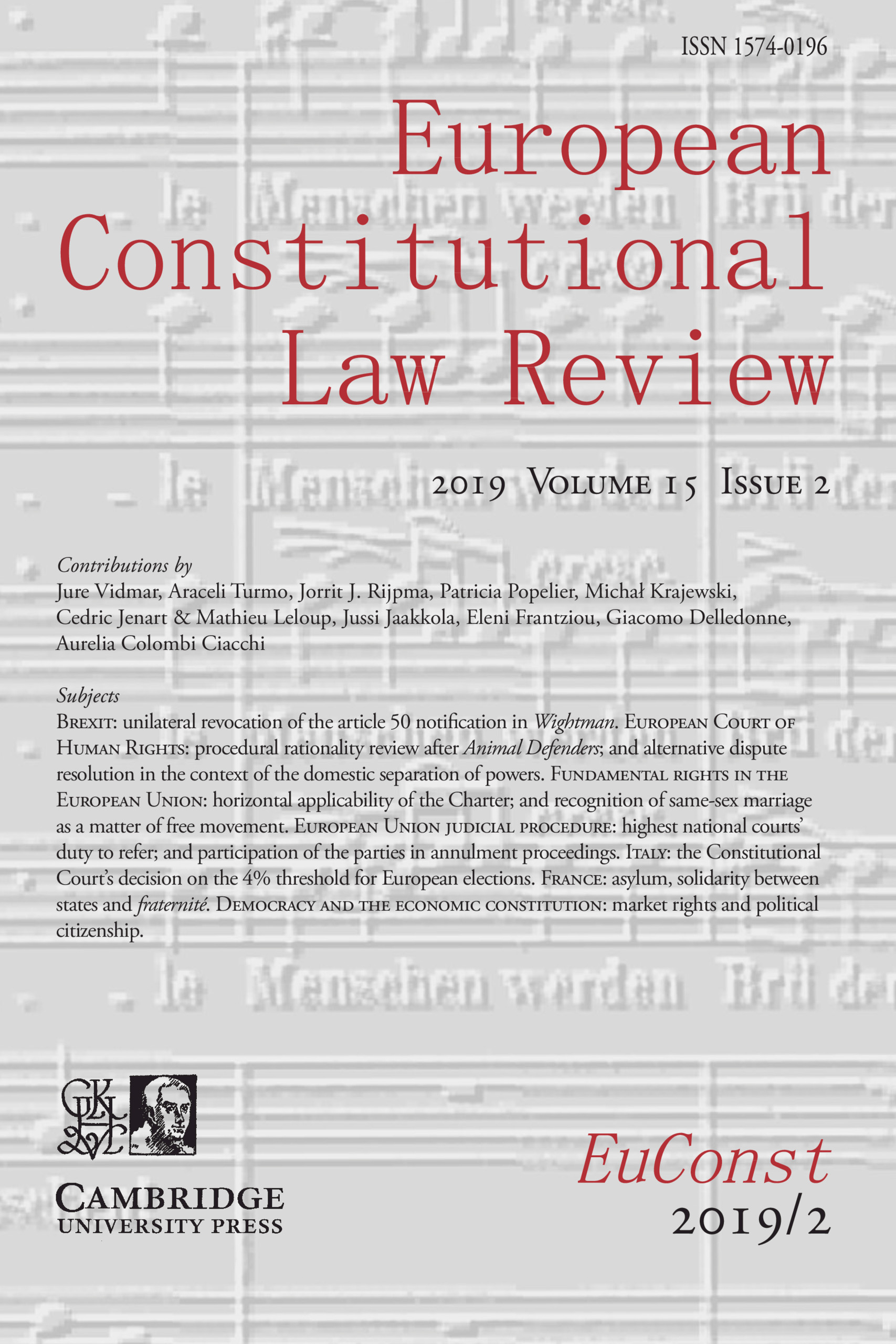
Contents
Editorial
Fraternité
-
- Published online by Cambridge University Press:
- 09 July 2019, pp. 183-193
-
- Article
-
- You have access
- HTML
- Export citation
Articles
Enhancing Political Representation Through the European Economic Constitution? Regressive Politics of Democratic Inclusion
-
- Published online by Cambridge University Press:
- 09 July 2019, pp. 194-219
-
- Article
-
- You have access
- HTML
- Export citation
The Many-faced Court: The Value of Participation in Annulment Proceedings
-
- Published online by Cambridge University Press:
- 19 June 2019, pp. 220-246
-
- Article
-
- You have access
- HTML
- Export citation
Separation of Powers and Alternative Dispute Resolution before the European Court of Human Rights
-
- Published online by Cambridge University Press:
- 13 June 2019, pp. 247-271
-
- Article
-
- You have access
- HTML
- Export citation
Procedural Rationality Review after Animal Defenders International: A Constructively Critical Approach
-
- Published online by Cambridge University Press:
- 20 June 2019, pp. 272-293
-
- Article
-
- You have access
- HTML
- Export citation
Case Notes
The Direct Horizontal Effect of EU Fundamental Rights: ECJ 17 April 2018, Case C-414/16, Vera Egenberger v Evangelisches Werk für Diakonie und Entwicklung e.V. and ECJ 11 September 2018, Case C-68/17, IR v JQ
-
- Published online by Cambridge University Press:
- 13 June 2019, pp. 294-305
-
- Article
-
- You have access
- Open access
- HTML
- Export citation
(Most of) the Charter of Fundamental Rights is Horizontally Applicable: ECJ 6 November 2018, Joined Cases C-569/16 and C-570/16, Bauer et al
-
- Published online by Cambridge University Press:
- 13 June 2019, pp. 306-323
-
- Article
-
- You have access
- HTML
- Export citation
You Gotta Let Love Move: ECJ 5 June 2018, Case C-673/16, Coman, Hamilton, Accept v Inspectoratul General pentru Imigrări.
-
- Published online by Cambridge University Press:
- 31 May 2019, pp. 324-339
-
- Article
-
- You have access
- Open access
- HTML
- Export citation
A Dialogue of Unequals – The European Court of Justice Reasserts National Courts’ Obligations under Article 267(3) TFEU: ECJ 4 October 2018, Case C-416/17, Commission v France
-
- Published online by Cambridge University Press:
- 05 June 2019, pp. 340-358
-
- Article
-
- You have access
- HTML
- Export citation
Unilateral Revocability in Wightman: Fixing Article 50 with Constitutional Tools: ECJ 10 December 2018, Case C-621/18, Andy Wightman and Others v Secretary of State for Exiting the European Union
-
- Published online by Cambridge University Press:
- 31 May 2019, pp. 359-375
-
- Article
-
- You have access
- Open access
- HTML
- Export citation
‘A Goal That Applies to the European Parliament No Differently From How It Applies to National Parliaments’: The Italian Constitutional Court Vindicates the 4% Threshold for European Elections: Italian Constitutional Court, Judgment of 25 October 2018 no. 239/2018
-
- Published online by Cambridge University Press:
- 11 June 2019, pp. 376-389
-
- Article
-
- You have access
- HTML
- Export citation
Front Cover (OFC, IFC) and matter
ECL volume 15 issue 2 Cover and Front matter
-
- Published online by Cambridge University Press:
- 09 July 2019, pp. f1-f4
-
- Article
-
- You have access
- Export citation
Back Cover (IBC, OBC) and matter
ECL volume 15 issue 2 Cover and Back matter
-
- Published online by Cambridge University Press:
- 09 July 2019, pp. b1-b2
-
- Article
-
- You have access
- Export citation