


1. Introduction
When undertaking a community intervention, interventionists frequently recruit the help of community members who serve as key opinion leaders (KOLs). As members of the community, KOLs are often particularly well-positioned to help diffuse information about the intervention, or to encourage adoption of the intervention’s target behaviors. Among the many strategies interventionists might use to select KOLs, network-based strategies that aim to choose KOLs who are optimally positioned to reach others are particularly promising. Identifying such an optimal set of nodes in a network is known as the “keyplayer problem,” and strategies for solving this problem exist (An and Liu Reference An and Liu2016; Borgatti Reference Borgatti2006). However, community interventions are complex, and selecting the optimal KOLs may not be feasible due to a range of practical challenges.
This paper has two overarching goals: (1) to review practical challenges to KOL selection, and (2) to propose some solutions for community interventionists. First, we review past community interventions that have relied on KOLs to identify the types of practical challenges they encountered when selecting KOLs. These challenges have included variations in individuals’ availability to serve as KOLs, lack of clarity about how to measure a KOL team’s breadth of network coverage, lack of clarity about how to balance the costs associated with recruiting a larger KOL team, difficulty ensuring that the KOL team’s membership is diverse, and ambiguity about how to evaluate potential KOL teams in a way that attends to all of these issues. We synthesize these challenges by developing the ABCDE framework, which highlights the potential role of each of these considerations in the selection of KOLs. Second, to provide interventionists with a starting point for confronting these challenges, we introduce the KOLaide R package. This package expands the functionality is existing keyplayer software (An and Liu Reference An and Liu2016; Borgatti Reference Borgatti2006) by allowing users to identify not only the optimal KOL team based on their position in the network, but also to identify good but sub-optimal KOL teams that satisfy constraints imposed by practical challenges in the intervention setting. With these two goals, we aim to build a bridge between the theory and practice of using KOLs to facilitate community intervention, and the methods used to inform KOL selection.
The remainder of the paper is organized in three sections. In section 2, we address the first research goal by discussing the use and selection of KOLs in the implementation of community interventions, and reviewing the practical challenges that can arise. In section 3, we address the second research goal by introducing KOLaide, describing how it offers a solution to each of these challenges, illustrating its application in both small and large networks. Finally, we conclude in section 4 by briefly summarizing these contributions, their limitations, and future directions.
2. Practical challenges using key opinion leaders (KOLs) to facilitate interventions
Drawn from diffusion of innovations theory, opinion leadership “is the degree to which an individual is able to influence other individuals” attitudes or overt behavior informally in a desired way with relative frequency” (Rogers Reference Rogers2003, 27). Individuals with a high level of influence over others’ attitudes or behavior are called key opinion leaders, opinion leaders or popular opinion leaders, hereafter referred to as KOLs (Rogers Reference Rogers2003; Valente and Pumpuang Reference Valente and Pumpuang2007; Waterman et al. Reference Waterman, Edwards, Keyes, Zulfiqar, Banyard and Valente2022). Because KOLs can facilitate the diffusion of new ideas and encourage the adoption of new behaviors, they have often been used in community interventions (Valente Reference Valente2012). For example, interventionists have used KOLs to help prevent tobacco use (e.g., Audrey et al. Reference Audrey, Cordall, Moore, Cohen and Campbell2004; Holliday et al. Reference Holliday, Audrey, Campbell and Moore2017; Valente et al. Reference Valente, Hoffman, Ritt-Olson, Lichtman and Johnson2003), sexual violence (e.g., Waterman et al. Reference Waterman, Edwards, Keyes, Zulfiqar, Banyard and Valente2022), and sexually transmitted diseases (e.g., Kelly et al. Reference Kelly, St Lawrence, Diaz, Stevenson, Hauth, Brasfield, Kalichman, Smith and Andrew1991). In addition, interventionists have used KOLs to encourage the use of evidence-based practices among teachers (e.g., Atkins et al. Reference Atkins, Graczyk, Frazier and Abdul-Adil2003, Reference Atkins, Frazier, Leathers, Graczyk, Talbott, Jakobsons, Adil, Marinez-Lora, Demirtas, Gibbons and Bell2008; Cappella et al. Reference Cappella, DeShazer, Park, Neal, Exner-Cortens and Owens2025; Neal et al. Reference Neal, Shernoff, Frazier, Stachowicz, Frangos and Atkins2008) and physicians (e.g., Curran et al. Reference Curran, Thrush, Smith, Owen, Ritchie and Chadwick2005; Lomas et al. Reference Lomas, Enkin, Anderson, Hannah, Vayda and Singer1991).
KOLs can be identified for community interventions using a variety of strategies (Flodgren et al. Reference Flodgren, O’Brien, Parmelli and Grimshaw2019; Rogers Reference Rogers2003; Rogers and Cartano Reference Rogers and Cartano1962; Valente and Pumpuang Reference Valente and Pumpuang2007). Some interventionists rely on local celebrities, self-selected volunteers, or individuals who self-identify as influential to serve as KOLs. In addition, some interventionists rely on organizational key informants or research experts to select KOLs. Although these techniques have different pros and cons, they are not explicitly based on KOLs’ ability to influence others through existing social networks (Burke et al. Reference Burke, Lich, Neal, Meissner, Yonas and Mabry2015; Kornbluh and Neal Reference Kornbluh, Neal, Jason and Glenwick2016; Valente and Pumpuang Reference Valente and Pumpuang2007).
In contrast, sociometric and keyplayer strategies involve the measurement and analysis of social network data to identify KOLs who are best positioned to influence others in a setting (Valente Reference Valente2012). Interventionists using sociometric strategies measure the whole network in a setting and then select a percentage or number of individuals with the highest number of nominations (i.e., degree) to serve as KOLs (e.g., Atkins et al. Reference Atkins, Graczyk, Frazier and Abdul-Adil2003, Reference Atkins, Frazier, Leathers, Graczyk, Talbott, Jakobsons, Adil, Marinez-Lora, Demirtas, Gibbons and Bell2008; Matous Reference Matous2023; Valente and Davis, Reference Valente and Davis1999; Waterman et al. Reference Waterman, Edwards, Keyes, Zulfiqar, Banyard and Valente2022). Interventionists using keyplayer strategies also measure the whole network in a setting, but then analyze the social network data to select a small number of individuals to serve as a KOL team based on their combined ability to influence others in the network (e.g., An and Liu Reference An and Liu2016; Borgatti Reference Borgatti2006; Cappella et al. Reference Cappella, DeShazer, Park, Neal, Exner-Cortens and Owens2025; Everett and Borgatti Reference Everett and Borgatti1999). Borgatti (Reference Borgatti2006) demonstrates that keyplayer strategies perform better than sociometric strategies because they consider KOLs’ potential influence in the network as an entire team, thereby avoiding potential redundancies among individual KOLs.
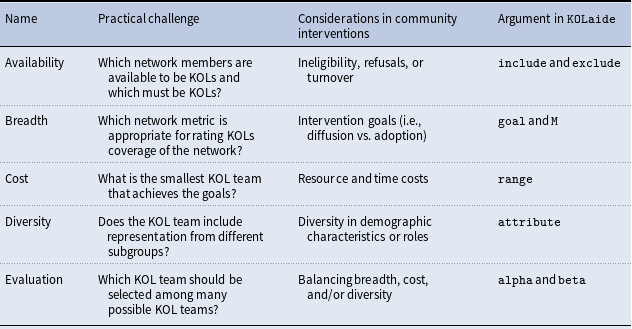
Although keyplayer strategies for selecting KOLs are promising, many practical challenges arise in community intervention contexts that complicate adopting this strategy. In the remainder of this section, we discuss five practical challenges that commonly occur when selecting KOLs for community interventions: Availability, Breadth, Cost, Diversity, and Evaluation (see Table 1).
Practical challenges when picking KOLs

2.1 Availability
Existing methods for using keyplayer strategies to select KOLs assume that anyone in a network is available to be a KOL (An and Liu Reference An and Liu2016; Borgatti Reference Borgatti2006). However, there are often considerations that affect availability. This practical challenge involves asking: Which network members are available to be KOLs, and which must be KOLs? Some network members may be unavailable because they are ineligible based on particular intervention criteria (e.g., Cappella et al. Reference Cappella, DeShazer, Park, Neal, Exner-Cortens and Owens2025; Shernoff et al. Reference Shernoff, Maríñez-Lora, Frazier, Jakobsons, Atkins and Bonner2011, Reference Shernoff, Frazier, Maríñez-Lora, Lakind, Atkins, Jakobsons, Hamre, Bhaumik, Parker-Katz, Neal, Smylie, Patel and Hitchcock2016). For example, in selecting KOLs to encourage teachers’ use of equity-focused positive behavioral supports in classrooms, Cappella et al. (Reference Cappella, DeShazer, Park, Neal, Exner-Cortens and Owens2025) found that principals often held an influential position in their school’s network. However, the research team excluded principals from the KOL team given competing time demands and potential issues with power dynamics. In addition, other network members may be unavailable to be KOLs because they decline to participate in the intervention or due to turnover in the setting (e.g., Cappella et al. Reference Cappella, DeShazer, Park, Neal, Exner-Cortens and Owens2025; Lomas et al. Reference Lomas, Enkin, Anderson, Hannah, Vayda and Singer1991; Neal et al. Reference Neal, Shernoff, Frazier, Stachowicz, Frangos and Atkins2008; Shernoff et al. Reference Shernoff, Maríñez-Lora, Frazier, Jakobsons, Atkins and Bonner2011). For example, when selecting KOLs to support teachers’ implementation of evidence-based practices to support children’s learning and psychosocial adjustment, two of the most influential teachers in a school were uncomfortable with and declined to take on a KOL role (Neal et al. Reference Neal, Shernoff, Frazier, Stachowicz, Frangos and Atkins2008).
Although some network members may be unavailable to be KOLs, other network members may be required to be KOLs. This can happen if certain network members, by the virtue of their role in the setting, must be a part of the KOL team. However, more commonly, this occurs when replacement members of a KOL team are recruited as a result of refusals by or turnovers among originally selected team members. When there are refusals or turnovers, the recruitment of replacement KOLs must account for existing KOLs who are already part of the team. For example, an originally selected KOL team member may leave the setting midway through an intervention. When this happens, any replacement should complement existing team members who must remain on the KOL team.
2.2 Breadth
The keyplayer strategy for KOL selection is focused on identifying the set of KOLs that maximizes the breadth of the network that members of the KOL team can reach (An and Liu Reference An and Liu2016; Borgatti Reference Borgatti2006). As Borgatti (Reference Borgatti2006) notes, optimizing the breadth of a KOL team requires considerations of possible redundancies in the ties of individual members. Existing methods for using keyplayer strategies to select KOLs offer several ways to measure a KOL team’s breadth. For example, the keyplayer package for R offers 8 different ways to operationalize breadth (An and Liu Reference An and Liu2016). Although these options offer flexibility, they also introduce a practical challenge that involves asking: Which network metric is appropriate for rating KOLs coverage of the network?
Answering this question requires considering the goal of the community intervention and understanding which breadth metrics are most appropriate for achieving this goal. For example, when an intervention has a diffusion goal, it may be most useful to define the breadth of a KOL team in terms of the extent to which it can directly or indirectly reach the largest number of others in the network in a few steps. This should allow new ideas or information to spread quickly through the social network. In contrast, when an intervention has an adoption or implementation goal, it may be most useful to define the breadth of a KOL team in terms of the extent to which others in the network have multiple direct connections to KOL team members. This allows for reinforced encouragement of the adoption of new ideas and behaviors and more comprehensive implementation support (Wan et al. Reference Wan, Riedl and Lazer2025).
2.3 Cost
Existing methods for using keyplayer strategies to select KOLs require the interventionist to know in advance how many members the KOL team should include (An and Liu Reference An and Liu2016; Borgatti Reference Borgatti2006). However, it is not always clear in advance how many KOLs are needed to achieve the goals of community intervention and larger-sized teams imply more cost. This practical challenge involves asking: What is the smallest KOL team that achieves the goals? Curran et al. (Reference Curran, Thrush, Smith, Owen, Ritchie and Chadwick2005) noted that the optimal size of KOL teams was an open research question and raised the possibility that it might be possible to have too many team members.
For many community interventions, selecting small KOL teams is helpful due to significant resource and time costs within settings and for interventionists. First, within settings, individual members have finite time and ability to attend to organizational tasks and responsibilities. Becoming a KOL depletes these members’ already limited time and attention and therefore diverts them from participating in other core setting activities. Second, for interventionists, training and supporting KOLs requires significant time and resources. For example, KOL trainings may last multiple days (Audrey et al. Reference Audrey, Cordall, Moore, Cohen and Campbell2004) or even months (Neal et al. Reference Neal, Shernoff, Frazier, Stachowicz, Frangos and Atkins2008).
2.4 Diversity
Existing methods for using keyplayer strategies to select KOLs do not integrate information about individual attributes into the keyplayer strategies used to select KOL teams (An and Liu Reference An and Liu2016; Borgatti Reference Borgatti2006). However, it may be desirable to select KOL teams that reflect diversity with respect to demographic characteristics (Audrey et al. Reference Audrey, Cordall, Moore, Cohen and Campbell2004; Holliday et al. Reference Holliday, Audrey, Campbell and Moore2017; Matous Reference Matous2023), skills (Borgatti Reference Borgatti2006), roles (Cappella et al. Reference Cappella, DeShazer, Park, Neal, Exner-Cortens and Owens2025), disciplines (Curran et al. Reference Curran, Thrush, Smith, Owen, Ritchie and Chadwick2005) or other important characteristics, like building location. This practical challenge involves asking: Does the KOL team include representation from different subgroups? To this end, Borgatti (Reference Borgatti2006) highlighted the incorporation of individual attributes into keyplayer strategies as a promising area for expansion.
Considering individual attributes may be important because selecting KOLs based only on breadth can lead to KOL teams that are homogeneous and non-representative of the population on important characteristics. This non-representativeness can reduce the effectiveness of KOLs in influencing others in the network. For example, in a KOL intervention to improve farming practices among Indonesian cocoa farmers, KOLs selected via sociometric procedures tended to be male (Matous Reference Matous2023). However, being male was also less likely be correlated with peer influence during the intervention.
2.5 Evaluation
Existing methods for using keyplayer strategies to select KOLs identify a single KOL team based solely on the team’s breadth of network coverage (An and Liu Reference An and Liu2016; Borgatti Reference Borgatti2006). However, when cost and diversity must be considered alongside breadth, the evaluation of potential KOL teams becomes more complex. This practical challenge involves asking: Which KOL team should be selected among many possible KOL teams? Determining how to weigh breadth, cost, and diversity when selecting a KOL team is often not straightforward. For example, Cappella et al. (Reference Cappella, DeShazer, Park, Neal, Exner-Cortens and Owens2025) wrote about then challenges of selecting between possible KOL teams of teachers that had nearly equal breadth. Specifically, they used “tie-breakers” to increase diversity in roles and grades.
2.6 The ABCDE framework
Based on this review of practical challenges that commonly arise in the selection of KOL teams to facilitate community interventions, we propose the ABCDE framework. This conceptual framework calls interventionists’ attention to five common challenges—availability, breadth, cost, diversity, and evaluation – that must be confronted when choosing KOLs. In Table 1, we frame each of these challenges as a question the interventionist must ask, and identify the considerations that may be relevant in answering these questions. As a conceptual framework, it is intended to orient thinking about how to identify challenges, but does not necessarily provide specific methods for solving those challenges. In practice, the solutions to these challenges in any given community intervention will depend on specific features of the community context and the intervention, and will require the interventionists’ and community members’ insider knowledge.
3. Identifying KOL teams using KOLaide for R
The ABCDE framework identifies five broad types of challenge that commonly arise in selecting KOL teams to facilitate community interventions. There are many possible ways to formally operationalize and solve each of these challenges, and devising such solutions will often require context-specific knowledge. However, in this section we introduce KOLaide, an R package that extends the functionality of existing keyplayer software (An and Liu Reference An and Liu2016; Borgatti Reference Borgatti2006) by implementing one possible operationalization of and solution to each of these challenges. As a result, it is designed to provide interventionists with a useful starting point for exploring possible solutions when such challenges arise. We begin by discussing how KOLaide offers a preliminary solution to each of the challenges identified by the ABCDE framework, then we illustrate its use to select and plot KOL teams in small and large community intervention contexts.
3.1 Addressing KOL selection challenges
3.1.1 Availability
In some cases, certain network members may be unavailable to serve as KOLs, while certain other network members must serve as KOLs. Although these individuals may have restrictions on their potential KOL role, because their relationships are still potential channels for diffusing information or influencing behavior, it is important to retain them in the network when considering others’ suitability as KOLs. Therefore, interventionists may only want to consider KOL teams that exclude unavailable individuals and include required individuals, but may still want to evaluate these teams based on their members’ position in the entire network. The KOLaide package implements this using the include and exclude parameters.
3.1.2 Breadth
When the goal of a KOL team is to diffuse information, the KOL team’s members should be able to reach a large number of other network members in a relatively small number of steps so that they can share information both widely and quickly. Following Borgatti (Reference Borgatti2006), we propose using $M$
-reach to evaluate a team’s breadth of network coverage for facilitating diffusion. We adopt the definition of
$M$
-reach to evaluate a team’s breadth of network coverage for facilitating diffusion. We adopt the definition of $M$
-reach already implemented in existing keyplayer software (An and Liu Reference An and Liu2016; Borgatti Reference Borgatti2006) – the number of unique nodes that can be reached by members of the KOL team in
$M$
-reach already implemented in existing keyplayer software (An and Liu Reference An and Liu2016; Borgatti Reference Borgatti2006) – the number of unique nodes that can be reached by members of the KOL team in $M$
steps. However, because KOL team members can trivially reach themselves, we normalize this count by the number of non-KOL team members. Thus, we define
$M$
steps. However, because KOL team members can trivially reach themselves, we normalize this count by the number of non-KOL team members. Thus, we define $M$
-reach as the fraction of non-KOL nodes that are reachable in
$M$
-reach as the fraction of non-KOL nodes that are reachable in $M$
steps. When
$M$
steps. When $M = 1$
,
$M = 1$
, $M$
-reach is equivalent to group degree centrality (Everett and Borgatti Reference Everett and Borgatti1999). Larger values of
$M$
-reach is equivalent to group degree centrality (Everett and Borgatti Reference Everett and Borgatti1999). Larger values of $M$
yield a more liberal metric because they allow KOLs to be further away from the individuals to whom they seek to disseminate information.
$M$
yield a more liberal metric because they allow KOLs to be further away from the individuals to whom they seek to disseminate information.
When the goal of a KOL team is to encourage adoption of a behavior, multiple KOL team members should be directly reachable by other network members so that others can quickly receive support and reinforced encouragement. Following Wan et al. (Reference Wan, Riedl and Lazer2025), we propose a new metric, $M$
-reinforcement, to evaluate a team’s breadth of network coverage for facilitating adoption. We define
$M$
-reinforcement, to evaluate a team’s breadth of network coverage for facilitating adoption. We define $M$
-reinforcement as the fraction of non-KOLs who are directly connected to at least
$M$
-reinforcement as the fraction of non-KOLs who are directly connected to at least $M$
KOLs. When
$M$
KOLs. When $M = 1$
,
$M = 1$
, $M$
-reinforcement is equivalent to group degree centrality (Everett and Borgatti Reference Everett and Borgatti1999). Larger values of
$M$
-reinforcement is equivalent to group degree centrality (Everett and Borgatti Reference Everett and Borgatti1999). Larger values of $M$
yield a more conservative metric because they require that non-KOLs have direct connections to more KOLs from whom they might receive reinforcing support and encouragement.
$M$
yield a more conservative metric because they require that non-KOLs have direct connections to more KOLs from whom they might receive reinforcing support and encouragement.
Although there are many other potential ways to measure breadth, including a vast array of group centrality measures (Everett and Borgatti Reference Everett and Borgatti1999), we follow Borgatti (Reference Borgatti2006) in using $M$
-reach to capture diffusion potential, and follow Wan et al. (Reference Wan, Riedl and Lazer2025) in using
$M$
-reach to capture diffusion potential, and follow Wan et al. (Reference Wan, Riedl and Lazer2025) in using $M$
-reinforcement to capture adoption potential. In addition to choosing these metrics based on prior theoretical and empirical literature, they offer several other advantages. First, they have simple, straightforward interpretations that intervention researchers can readily explain to colleagues and community partners who are likely to have limited network expertise. In particular, they have well-defined ranges between 1 for a KOL team whose breadth covers the entire network, to 0 for a KOL team whose breadth does not cover any other network members. Second, missingness is common in field intervention data, but as local degree-based metrics, node missingness has limited impact on these metrics compared to other more global metrics such as betweenness. Finally, unlike more complex centrality metrics such as eigenvector,
$M$
-reinforcement to capture adoption potential. In addition to choosing these metrics based on prior theoretical and empirical literature, they offer several other advantages. First, they have simple, straightforward interpretations that intervention researchers can readily explain to colleagues and community partners who are likely to have limited network expertise. In particular, they have well-defined ranges between 1 for a KOL team whose breadth covers the entire network, to 0 for a KOL team whose breadth does not cover any other network members. Second, missingness is common in field intervention data, but as local degree-based metrics, node missingness has limited impact on these metrics compared to other more global metrics such as betweenness. Finally, unlike more complex centrality metrics such as eigenvector, $M$
-reach can be computed very quickly in linear time, which is essential because it must be computed for every possible KOL team. The KOLaide package implements this using the goal and M parameters.
$M$
-reach can be computed very quickly in linear time, which is essential because it must be computed for every possible KOL team. The KOLaide package implements this using the goal and M parameters.
3.1.3 Cost
Larger KOL teams can often provide greater breadth, but also impose greater costs on both the setting and the interventionist. Therefore, interventionists may want to consider a range of potential KOL team sizes. The KOLaide package implements this using the range parameter.
3.1.4 Diversity
The suitability of a KOL team may depend primarily on the breadth of its members’ network coverage, which allows them to diffuse information to many others in the network, or to encourage many other network members to adopt a behavior. However, the KOL team’s ability to achieve this goal may depend not solely on their network breadth, but also on whether the team members are representative of the wider population. Such representativeness allows target individuals to “see themselves in” the KOLs and thereby facilitates’ buy-in by members of the population. Therefore, given a categorical attribute of population members, interventionists may consider a KOL team’s representativeness by examining the fraction of categories of the characteristic of interest that are represented on the KOL team. For example, if the characteristic of interest is smoking status, then a KOL team would achieve the maximum value of 1 if it includes at least one smoker and one non-smoker. The KOLaide package implements this using the attribute parameter.
3.1.5 Evaluation
Once potential KOL teams’ breadth, cost, and diversity have been determined, interventionists must decide how to integrate this information into an overall evaluation of each KOL team. There are an infinite number of ways that this information might be weighted and combined into an overall evaluation, but any overall evaluation should follow a couple simple rules. Other things being equal:
-
• KOL teams with more breadth of network coverage are better because this is the goal of relying on KOLs for facilitating diffusion and adoption in a network.
-
• When diversity on a given attribute is relevant in a given setting, KOL teams with more diversity are better.
-
• A KOL team’s breadth of network coverage matters more than its diversity, otherwise a network-based approach to KOL selection would not be necessary.
-
• KOL teams with lower cost (i.e., smaller KOL teams) are better.
The KOLaide package returns each KOL team’s score on breadth, diversity, and cost, which interventionists can examine separately, or combine in ways that are most appropriate given the community context. However, to facilitate the evaluation of KOL teams, the package also returns one convenient overall evaluation metric that obeys these rules:
 \begin{equation*}\frac {B^\alpha D^{1-\alpha }}{C^\beta }\end{equation*}
where B is breadth, C is cost, D is diversity, and $\alpha$
and
$\alpha$
and $\beta$
are weighting parameters. Alternatively, in contexts where attribute data is not available or diversity is not relevant,
$\beta$
are weighting parameters. Alternatively, in contexts where attribute data is not available or diversity is not relevant,
 \begin{equation*}\frac {B}{C^\beta }\end{equation*}
may be appropriate. The KOLaide package implements these evaluation metrics using the alpha and beta parameters.
The $\alpha$
parameter controls the relative weight of breadth versus diversity, and can range
$\alpha$
parameter controls the relative weight of breadth versus diversity, and can range $0.5 \leq \alpha \leq 1$
. Intuitively,
$0.5 \leq \alpha \leq 1$
. Intuitively, $\alpha$
can be viewed as the proportion of weight that is assigned to breadth, and
$\alpha$
can be viewed as the proportion of weight that is assigned to breadth, and $1-\alpha$
can be viewed as the proportion of weight that is assigned to diversity. We recommend a default of
$1-\alpha$
can be viewed as the proportion of weight that is assigned to diversity. We recommend a default of $\alpha = 0.9$
, which prioritizes a KOL team’s ability to cover the network, but still considers the diversity of its members. This mirrors the approach used by Cappella et al. (Reference Cappella, DeShazer, Park, Neal, Exner-Cortens and Owens2025), who used the diversity of potential KOL teams as a “tie breaker” for teams that offered similar breadth of network coverage.
$\alpha = 0.9$
, which prioritizes a KOL team’s ability to cover the network, but still considers the diversity of its members. This mirrors the approach used by Cappella et al. (Reference Cappella, DeShazer, Park, Neal, Exner-Cortens and Owens2025), who used the diversity of potential KOL teams as a “tie breaker” for teams that offered similar breadth of network coverage.
The $\beta$
parameter controls how larger KOL teams are penalized to reflect their great cost, and can range
$\beta$
parameter controls how larger KOL teams are penalized to reflect their great cost, and can range $0 \leq \beta \leq 2$
. The value of
$0 \leq \beta \leq 2$
. The value of $\beta$
can capture scenarios when additional KOLs have a diminishing marginal cost (
$\beta$
can capture scenarios when additional KOLs have a diminishing marginal cost ( $\beta \lt 1$
), a linear cost (
$\beta \lt 1$
), a linear cost ( $\beta = 1$
), or an increasing marginal cost (
$\beta = 1$
), or an increasing marginal cost ( $\beta \gt 1$
). Given the economies of scale that are likely involved in recruiting and training additional KOL team members, we recommend a default of
$\beta \gt 1$
). Given the economies of scale that are likely involved in recruiting and training additional KOL team members, we recommend a default of $\beta = 0.9$
, which implies a small diminishing marginal cost.
$\beta = 0.9$
, which implies a small diminishing marginal cost.
3.2 Illustrating KOL selection
3.2.1 A small example
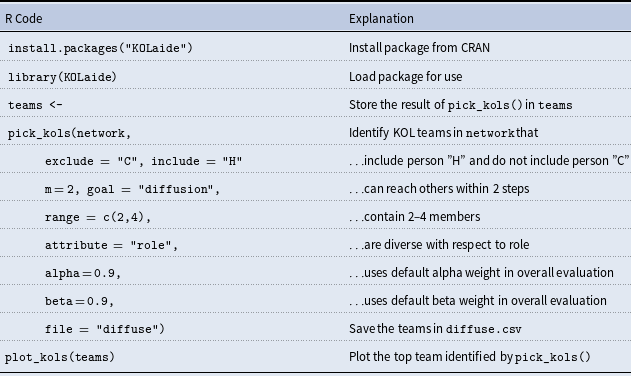
Table 2 shows some example code for using the KOLaide package to identify and plot KOL teams. The code to reproduce these examples is also available at https://osf.io/e2m8g.
Example code to identify and plot KOLs using the KOLaide package

The KOLaide package can be installed from CRAN using install.packages(“KOLaide”), and can be loaded in R using library(KOLaide). Selecting KOLs from a network is performed using the pick_kols() function, which takes an adjacency matrix or igraph network as its input. In this example, we use a randomly generated small-world network of 26 nodes, where each node has been assigned a categorical attribute called “role” with three levels. This network might represent advice seeking among teachers in a school, where each teacher is located in one of three buildings, or teaches at one of three grade levels.
The function allows several optional arguments that control how it addresses the practical challenges that arise in KOL selection. To address the challenge of availability, exclude = “C” indicates that person C is not available to serve as a KOL team and therefore should be excluded from all possible KOL teams, while include = “H” indicates that person H is not only available to serve on KOL teams, but must be included on all possible KOL teams. To address the challenge of breadth, m = 2 and goal = “diffusion” indicate that the goal of the KOL team is to diffuse information, which causes the function to assess each team’s breadth using $M$
-step where
$M$
-step where $M = 2$
. To address the challenge of cost, range = c(2,4) requests that the function identify KOL teams of 2–4 members, which will vary in the costs they impose on both the setting and interventionist. To address the challenge of diversity, attribute = “role” requests that the function consider each team’s diversity with respect to members’ role. Finally, to address the challenge of evaluation, alpha = 0.9 and beta = 0.9 uses the default values for the
$M = 2$
. To address the challenge of cost, range = c(2,4) requests that the function identify KOL teams of 2–4 members, which will vary in the costs they impose on both the setting and interventionist. To address the challenge of diversity, attribute = “role” requests that the function consider each team’s diversity with respect to members’ role. Finally, to address the challenge of evaluation, alpha = 0.9 and beta = 0.9 uses the default values for the $\alpha$
and
$\alpha$
and $\beta$
weights in the summary evaluation score; these values would also be used if these lines were omitted. For convenience, file = “diffuse” requests that a list of all possible KOL teams, with their characteristics, should be saved to the file diffuse.csv for use after exiting R.
$\beta$
weights in the summary evaluation score; these values would also be used if these lines were omitted. For convenience, file = “diffuse” requests that a list of all possible KOL teams, with their characteristics, should be saved to the file diffuse.csv for use after exiting R.
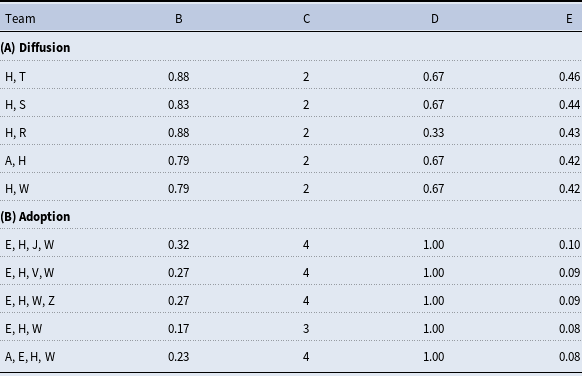
In less than 1 second (using an Apple M1 Max processor from 2021), the function returns a list of all 2,324 valid KOL teams in a KOL object called teams and in a CSV file called diffuse.csv. Table 3A shows the top five teams identified by the function. The "best” team consists of H and T, who can reach 88% of the rest of the network in two or fewer steps, at the cost associated with recruiting 2 KOLs, who represent 67% of the roles in the setting. Combining these characteristics using the default weights, this team is assigned an overall evaluation score of 0.46. The other teams vary in their breadth and diversity, but have similarly high overall evaluations. Notably, as requested, these teams always include person H, and never include person C. Based on this output, an interventionist may choose to recruit H and T as a KOL team, but in the face of other considerations, might view teams such as H-S and H-R as also promising.
Selected KOL teams for (A) diffusion and (B) adoption identified by pick_kols(); B = breadth, C = cost, D = diversity, E = evaluation

Example of KOL teams selected using pick_kols() and plotted using plot_kols() in a 26-node network with the goal of (A) diffusing information or (B) encouraging adoption of a new behavior. Node colors represent a node attribute of interest (e.g., role). Red-bordered nodes are KOLs, while green-bordered nodes are network members whom the KOLs can influence.

To facilitate evaluation of the identified KOL teams, the plot_kols() function plots the network and the KOL team’s coverage. The function takes a KOL object generated by pick_kols() as its input, and allows any additional arguments that are available in igraph’s plot() function. Figure 1A shows the plot generated from the above example. By default, the nodes are colored according to their attribute, with KOLs depicted using a red border and network members covered by KOLs depicted using a green border. This plot highlights that the team of H and T is diverse (H is orange, T is aqua) and cover the majority of the network (most nodes have green borders).
Using all the same settings, but changing to goal = “adoption” generates a list of valid KOL teams where breadth is measured using $M$
-reinforcement, which also requires less than 1 s. Table 3B shows the top five teams identified by the function, while Figure 1B plots the best team. Several differences are apparent when identifying KOL teams with the goal of adoption rather than diffusion. First, the best teams for adoption are larger, despite the fact that larger teams are more costly. Second, even the best KOL teams for adoption have a smaller breadth, covering fewer of the other network members. These differences highlight that encouraging adoption is often more challenging than merely facilitating diffusion, but they also highlight the importance that users (know how to) select the measure of breadth that corresponds to their goal.
$M$
-reinforcement, which also requires less than 1 s. Table 3B shows the top five teams identified by the function, while Figure 1B plots the best team. Several differences are apparent when identifying KOL teams with the goal of adoption rather than diffusion. First, the best teams for adoption are larger, despite the fact that larger teams are more costly. Second, even the best KOL teams for adoption have a smaller breadth, covering fewer of the other network members. These differences highlight that encouraging adoption is often more challenging than merely facilitating diffusion, but they also highlight the importance that users (know how to) select the measure of breadth that corresponds to their goal.
3.2.2 A large example
Identification of a KOL team using a keyplayer strategy like that implemented in keyplayer software (An and Liu Reference An and Liu2016; Borgatti Reference Borgatti2006) and KOLaide requires knowledge of the whole network. Because whole networks are challenging to collect in community settings, this requirement imposes some limits on the size of settings where keyplayer strategies are typically used. For example, a network of 26 teachers may be feasible to collect, such as in the small example, and thus offers a common application for KOL team selection using a keyplayer strategy. In contrast, a network of all students in a large high school may be less feasible to collect, and thus may be a less common application for keyplayer strategies.
Although it may be less common to apply keyplayer strategies to selecting KOL teams in large networks, it is still possible using the KOLaide package. In the small example, the pick_kols() function returns a complete list of all valid KOL teams, and therefore guarantees finding the optimal (as well as each sub-optimal) team. However, because the number of possible teams is defined by $\binom {N}{k}$
, where
$\binom {N}{k}$
, where $N$
is the network size and
$N$
is the network size and $k$
is the KOL team size, this is not practical in a large network where the number of valid teams may be very large. For example, there are over one billion teams of 4 in a network of 400.
$k$
is the KOL team size, this is not practical in a large network where the number of valid teams may be very large. For example, there are over one billion teams of 4 in a network of 400.
To address the challenge of selecting KOLs in large networks, the top = X argument restricts the scope of individuals considered eligible to the $X$
individuals with the highest degree, or highest closeness, or highest betweenness. Because an individual is deemed eligible if they have the highest value on any one of these three metrics, the pool of eligible individuals can range from
$X$
individuals with the highest degree, or highest closeness, or highest betweenness. Because an individual is deemed eligible if they have the highest value on any one of these three metrics, the pool of eligible individuals can range from $X$
if the three centralities are perfectly correlated, to
$X$
if the three centralities are perfectly correlated, to $3X$
if the three centralities are perfectly uncorrelated. This approach assumes that high-centrality individuals are more likely to be useful KOL team members than low-centrality individuals. However, because this assumption is not necessarily correct (Borgatti Reference Borgatti2006), this approach is not guaranteed to find optimal teams, and only offers a heuristic.
$3X$
if the three centralities are perfectly uncorrelated. This approach assumes that high-centrality individuals are more likely to be useful KOL team members than low-centrality individuals. However, because this assumption is not necessarily correct (Borgatti Reference Borgatti2006), this approach is not guaranteed to find optimal teams, and only offers a heuristic.
To illustrate, we use a randomly generated small-world network of 400 nodes. We can still use pick_kols() to identify 2–4 member KOL teams for diffusion, but include top = 30 to restrict the scope of individuals considered as possible KOLs. This takes about 50 s, and returns a list of nearly 200,000 possible teams. The best team identified using this approach is a four-member KOL team that can reach 27% of other network members in up to 2 steps, and has an overall evaluation score of 0.078. Figure 2 is a plot generated by plot_kols() that illustrates this KOL team, with the KOL team’s members shown in red and reachable non-KOLs shown in green. The visualization suggests that this team’s breadth of coverage includes parts of the core, but misses most of the periphery, and may suggest considering still larger KOL teams or a different dissemination strategy.
Example of KOL teams selected using pick_kols() and plotted using plot_kols() in a 400-node network with the goal of diffusing information. Red nodes are KOLs, while green nodes are network members whom the KOLs can influence.

4. Discussion
Although KOLs are frequently used to facilitate the diffusion of information and adoption of behaviors in community interventions, the selection of individuals to serve in these roles is challenging. In this paper, we aimed to bridge the theory and practice of using KOLs with methods of KOL selection by reviewing practical challenges and proposing software-based solutions to these challenges. Addressing our first goal, we identified five common practical challenges that arise in the selection of KOLs to facilitate community interventions: the availability of some individuals to serve as a KOL may be limited, the breadth of network coverage of a KOL team depends on the team’s goal, the cost of a KOL team depends on its size, the diversity of KOL team members may be important to consider, and the evaluation of potential KOL teams must integrate all of this information. We then synthesized these five challenges into the ABCDE framework (see Table 1), which offers an orienting tool that frames each of these challenges as a question the interventionist must ask, and identifies the considerations that may be relevant in answering these questions.
The solutions to these challenges will often be context-specific. However, addressing our second goal, we also introduced the KOLaide R package, which provides interventionists with a starting point for selecting KOL teams under these conditions. The package extends the functionality of existing keyplayer software (An and Liu Reference An and Liu2016; Borgatti Reference Borgatti2006) by implementing possible solutions to common challenges. Whereas existing keyplayer software identifies one optimal KOL team of a given size from all network members, KOLaide identifies both optimal and good but sub-optimal KOL teams of a range of sizes, where team membership may be constrained by availability or diversity considerations. We then demonstrated the use of KOLaide to select a KOL team to both small (26-person) and large (400-person) networks, highlighting its flexibility for different community settings.
Although KOLaide offers solutions to some of the practical challenges that arise in KOL selection, it does have some limitations. First, KOLaide does not handle weighted networks. This was a conscious decision because there are many ways that weights can be recorded (e.g., ordinal, continuous), and many things that weights may represent (e.g., frequency, intensity). For users wishing to select KOLs in a weighted network, we recommend first transforming the network into an unweighted network backbone using one of the backbone extraction models available in R (Neal Reference Neal2022). These models identify and retain statistically significant edges, and allow users to select KOL team members based on their ability to diffuse information or encourage adoption through only their strongest ties. Future research may also explore ways to generalize group centrality metrics such as $M$
-reach for use in weighted networks (Borgatti Reference Borgatti2006; Everett and Borgatti Reference Everett and Borgatti1999).
$M$
-reach for use in weighted networks (Borgatti Reference Borgatti2006; Everett and Borgatti Reference Everett and Borgatti1999).
Second, KOLaide also does not directly handle cases where interventionists wish to select KOLs based on multiple networks, for example, networks of advice seeking on different topics (Cappella et al. Reference Cappella, DeShazer, Park, Neal, Exner-Cortens and Owens2025). For users wishing to select KOLs based on multiple networks, users may consider applying KOLaide to the union of multiple networks if diffusion or adoption is expected to require KOLs to be connected to others by multiple types of relationships. Alternatively, if diffusion or adoption is expected to require KOLs to be connected to others by at least one type of relationship, users may consider applying KOLaide to the interaction of multiple networks. Cappella et al. (Reference Cappella, DeShazer, Park, Neal, Exner-Cortens and Owens2025) used this approach to select KOL team members based on their position in networks of advice seeking on behavior and equity. Finally, users may consider applying KOLaide to each network separately, then comparing the optimal KOL teams identified in each. Future research may also explore ways to generalize group centrality metrics such as $M$
-reach for use in multiplex networks (Borgatti Reference Borgatti2006; Everett and Borgatti Reference Everett and Borgatti1999).
$M$
-reach for use in multiplex networks (Borgatti Reference Borgatti2006; Everett and Borgatti Reference Everett and Borgatti1999).
Finally, the KOL teams identified by KOLaide are ranked by their expected utility for the chosen goal, but there is limited empirical evidence about their actual utility. This is a general issue not only for KOLaide, but also for other keyplayer methods. Empirically evaluating the utility of different KOL team selection strategies (e.g., based on $M$
-reach or
$M$
-reach or $M$
-reinforcement) might be possible by experimentally comparing different strategies when implementing the same intervention in different settings (e.g., encouraging adoption of one behavior across multiple schools), or when implementing different interventions in the same setting (e.g. encouraging adoption of two different behaviors in one school). Although it is possible to imagine such experiments, to our knowledge none have been attempted, likely due to the high cost and other practical challenges that commonly occur in community intervention settings. Therefore, the KOL teams suggested by KOLaide and other keyplayer software should be viewed as suggestions, and may require modification by interventionists who have a more complete understanding of the intervention context.
$M$
-reinforcement) might be possible by experimentally comparing different strategies when implementing the same intervention in different settings (e.g., encouraging adoption of one behavior across multiple schools), or when implementing different interventions in the same setting (e.g. encouraging adoption of two different behaviors in one school). Although it is possible to imagine such experiments, to our knowledge none have been attempted, likely due to the high cost and other practical challenges that commonly occur in community intervention settings. Therefore, the KOL teams suggested by KOLaide and other keyplayer software should be viewed as suggestions, and may require modification by interventionists who have a more complete understanding of the intervention context.
Reliance on KOLs to support the success of community interventions has become a typical feature of community interventions. As a result, interventionists frequently have a need to select KOLs from the community, but doing so requires considering and balancing many pieces of information. The ABCDE framework has articulated the kinds of practical challenges that interventionists encounter, but which are often overlooked in the development of keyplayer optimization algorithms. Additionally, the KOLaide package offers some solutions to these challenges, while also offering a platform for implementing new approaches that address limitations in existing KOL selection strategies.
Funding statement
The authors have no funding to disclose.
Competing interests
The authors disclose no competing interests.
Data availability statement
Data and materials are available at https://osf.io/e2m8g.
Author contributions
The authors have no contribution to disclose.


 Open access

