




Introduction
Towards the end of his al-Ghayth al-Musajjam fī Sharḥ Lāmīyat al-ʿAjam, Khalīl ibn Aybak al-Ṣafadī (d. 1363/764) appears to aim a now widely cited slight at his sometime teacher Ibn Taymiyya (d. 1328/728), saying that he was ‘expansive in knowledge, but lacking in reason’.Footnote 1 Many of Ibn Taymiyya’s detractors have quoted the comment without context; one even misattributed it to Ibn Taymiyya’s arch-rival, Ṭaqī al-Dīn al-Subkī (d. 1355/ 756).Footnote 2 Elsewhere, a modern admirer of Ibn Taymiyya, Abū Faḍl Muḥammad ibn ʿAbd Allāh ibn Aḥmad al-Qūnawī, quotes the passage in full, proceeding to compose an entire treatise to discredit al-Ṣafadī because of this and other remarks in which al-Ṣafadī seems to criticise Ibn Taymiyya’s exegetical and reasoning capabilities.Footnote 3 However, neither allies nor critics of Ibn Taymiyya have attempted to explain why this criticism appears where it does (ostensibly, in a literary commentary), nor indeed attempted any detailed analysis of the highly peculiar passage in question. That analysis is the subject of the present article.
For the purpose of this article, I have chosen to work backwards from the passage, meaning that I have centred my analysis on other parts of the text in which Ibn Taymiyya’s opinions on various matters are discussed, giving appropriate context and contrasting these, where possible, with al-Ṣafadī’s views (particularly his hermeneutics). The image that emerges across these various discussions, commensurate with what we already know about Ibn Taymiyya, is that he was opposed to esotericism, and that he was sceptical of alchemy and of what he regarded as foreign sciences generally. It also seems clear that al-Ṣafadī does not necessarily hold Ibn Taymiyya’s reasoning capabilities in the highest esteem, presenting three instances in which Ibn Taymiyya is silenced or chastened at the end of an exegetical or theological dispute, including one with al-Ṣafadī himself. However, in his parting shot, al-Ṣafadī seems simply to be suggesting, with some irony, that, regardless of what one’s views might be, the important thing is to exercise discretion in disclosing them. This is in keeping with esoteric injunctions to secrecy, which I argue is one of the latent themes in the Sharḥ, although, to be clear, this does not amount to my saying that the entire text is one of coded, esoteric allusions. I would only suggest that, on the basis of al-Ṣafadī’s familiarity with esoteric themes of secrecy (demonstrated below), bearing them in mind may occasionally reveal added layers of meaning in this and potentially other works produced by him.
Nominally, the Sharḥ is a commentary on a poem by alchemist, poet, and slain heretic al-Ṭughrāʾī (d. 1121/515). As al-Ṣafadī tells us on the authority of Zengid and Ayyubid chronicler ʿImād al-Kātib (d. 1201/597), al-Ṭughrāʾī was regarded as a brilliant mind and a gifted poet by his contemporaries, and a respected companion of princes and sultans. According to ʿImād al-Kātib, after the death of Muḥammad I (d. 1119/513), his son al-Masʿūd sought al-Ṭughrāʾī’s counsel and, during his brief success in the fraternal succession struggle, al-Ṭughrāʾī assumed the position of wazīr. However when al-Masʿūd’s fates changed, so did al-Ṭughrāʾī’s, and the new wazīr had him executed, fearing that the widely revered scholar and poet would later usurp him. Some accounts, as al-Ṣafadī tells us, have it that al-Ṭughrāʾī first went into exile before his eventual execution.Footnote 4 Modern commentators suggest that Lāmīyat al-ʿAjam was composed in the immediate aftermath of al-Ṭughrāʾī’s ignominious exit from Baghdad.Footnote 5 The poem’s themes include embitterment and alienation from one’s peers, and the nobility of an itinerant lifestyle. Al-Ṣafadī touches on these and other topics explicitly dealt with in the text itself, although, in truth, the Sharḥ is far more than just a commentary on the poem.
Through a series of apparent digressions, nested within discussions more typical of a poetry commentary (grammar, lexicography, morphology, and analysis of the poem’s intended meaning), al-Ṣafadī covers an inexhaustible range of topics.Footnote 6 In the most cursory sense, the poem follows a structure that is more or less typical of the genre. It opens with a general discussion on adab and its merits, and then discusses the life and works of the author in general, before turning to the poem verse by verse. After quoting each verse, al-Ṣafadī follows with a section on lugha (language), giving definitions and lexical information; then iʿrāb, the Arabic grammatical science of syntactical analysis; and finally maʿnā or meaning, an interpretation of the verse as a whole. However, even in the preambulatory discussions, al-Ṣafadī ranges across wide territory, for example going from a brief mention of al-Ṭughrāʾī’s noted mastery of alchemy to a prolonged discussion of the art and different opinions surrounding its viability.Footnote 7
He justifies these digressions over the first few pages of the treatise, quoting various authorities on the merits of wide learning, including a comment attributed to ninth-century religious scholar Ibn Qutaybah (d. 889/276): ‘“He who wishes to be a scholar [ʿālim] let him pursue one art, but he who wishes to be an adīb, let him widen his sciences” […] for this reason you do not find me standing on narrow footing in this commentary.’Footnote 8 Al-Ṣafadī certainly makes good on this, producing a text that sits somewhere between an encyclopaedia and a literary compendium, the likes of which he cites copiously, such as al-Jāḥiẓ’s (d. 868/255) Kitāb al-Ḥayawān.
I do not analyse the main passage in question simply to decode al-Ṣafadī’s true feelings towards Ibn Taymiyya, though that is one upshot of this article. The main reason for examining this passage, I argue, is that it gives us some insight into al-Ṣafadī’s positions on three topics of growing scholarly interest. The first is esotericism, in this case al-Ṣafadī’s use of esoteric motifs in his writing. Here, esotericism refers to an interrelated set of hermeneutical practices, and other scholarly and spiritual pursuits, that assume the existence of hidden meaning (in the Qur’an and elsewhere) accessible only to a spiritual or intellectual elite, as well as the methods by which these sometimes controversial pursuits were disclosed to others.Footnote 9
The second aspect of al-Ṣafadī’s beliefs highlighted in my analysis is how his programme as an adīb seems to colour his own religious outlook. I argue that this manifests in at least two ways: an emphasis on the grammatical aspect of exegetical disputes and what we might call a pluralistic outlook, which extends to a general tolerance for those holding potentially heterodox positions. The last section of this article expands on this point, arguing that the passage is itself a criticism, not of any particular viewpoint held by Ibn Taymiyya or the heretics to whom he is likened in the passage, but rather of their indiscretion. In sum, I will argue that the correct reading of the passage is that al-Ṣafadī, perhaps as an extension of his own adab-centred episteme and in keeping with contemporary forms of esoteric secrecy, displays a wide tolerance to different views, but urges discretion in expressing them.
The article may also interest those working on the study of heresy in Islam or, more specifically, the portrayal of heretics—not only was al-Ṭughrāʾī executed as a heretic, but so too were the two figures to which Ibn Taymiyya is compared in the main passage under examination.Footnote 10 The study of heresy and its history in the Islamic world can also inform our understanding of the histories of science and philosophy, by shedding light on not just the expressly legal, but also the social consequences of expressing heterodox views. In the history of European science, there already exist several such lines of research, winding their way through the knots of heresy, the occult, superstition, and science. Far from the commonplaces once espoused about church authority wielding accusations of heresy to hamper or divert scientific endeavour, recent work has shown that the relationships between secular authorities, the papacy, and scholarly conceptions of superstition are multilayered and defy simple analysis.Footnote 11 We are a little further from being able to carry out any such analysis in the Islamic world, in part because our understanding of heterodoxy and orthodoxy are often premised on anachronistic or inappropriate understandings of what these terms mean in different parts of the Islamic world.Footnote 12
I would add that this insight into al-Ṣafadī will also aid those who, like most students of the period, have at some stage made recourse to his colossal biographical dictionary, Kitāb al-Wāfī bi-l-Wafayāt (The Complete Book of Necrologies), or his smaller work of the same genre, focusing on contemporaries, Aʿyān al-ʿAsr wa Aʿwān al-Naṣr (The Notables of the Period and the Aides of Victory). The former is the largest of its genre, containing over 140,000 entries.Footnote 13 Anyone who has worked with the dictionaries will know it is no easy task. At the most basic level, the sheer quantity of historical material involved can be overwhelming, from a period often described as seeing an ‘explosion’ of historical writing.Footnote 14 By now, there is a mature tradition in scholarship on Mamluk historiography in trying to tame these gargantuas, including so-called ‘quantitative’ approaches, as well as close textual comparison to tease out original historical material (the dictionaries borrow copiously from one another and from other historical works, past and contemporary).Footnote 15 One important insight that has arisen through these analyses is that these dictionaries cannot be considered mere ‘repositories’ of biographical or historical data, but require a sophisticated toolkit—anthropological, material, semiotic, and otherwise—in order to mine them for their deep and curious historical insights.Footnote 16 This article presents a modest contribution to developing our toolkit, both by providing specific insight into an especially prolific biographer and adīb; and by demonstrating, using this case study of Ibn Taymiyya, the merits of an intertextual and inter-genre approach to the dictionaries.
Esotericism and secrecy in the Sharḥ
The first part of my argument is that al-Ṣafadī’s book should be examined in part through an ‘esoteric’ lens, and I hope to justify this reading in the present section.Footnote 17 In the Sharḥ, al-Ṣafadī utilises certain esoteric motifs that are common to a variety of Sufi religious writings and the occult sciences. When I say that we should examine the text through an esoteric lens, I mean that we should pay attention to these motifs and the hidden layer of meaning they encode, and not treat them as passing and seemingly idiosyncratic remarks to be explained away as mere eclecticism.
The specific motif that I focus on is that of silence or secrecy—the notion, frequent among gnostic Islamic movements and occult scientists, that certain types of knowledge must be hidden from public view, or passed on only to worthy initiates and truth seekers. In recent years, there has been a growing tide of interest in the methods through which thinkers who trafficked in this secret knowledge might have passed it on in their writing.Footnote 18 For example, in writing about the thirteenth-century Sufi and occultist al-Būnī (d. 1225/622), Noah Gardiner argues that, much like his better-known contemporary Ibn ʿArabī (d. 1240/638), al-Būnī employed unexplained technical language and dispersed some of his theories across many texts in a highly elliptical fashion (tabdīd al-ʿilm, or ‘dispersion of knowledge’), as methods of restricting their disclosure to an intended and appropriately primed readership.Footnote 19
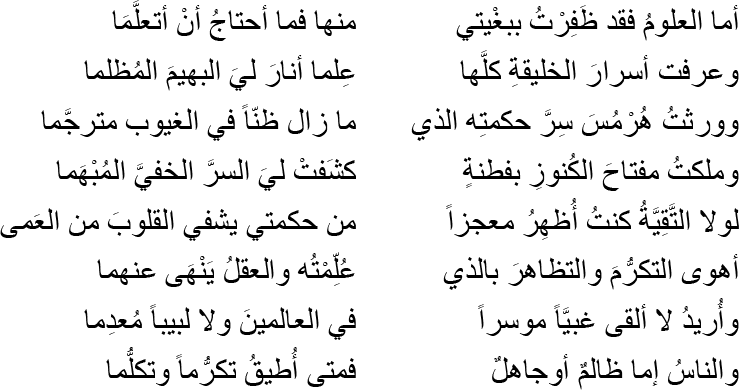
The passages in which al-Ṣafadī touches upon related topics in the Sharḥ suggest that he was aware of these methods and the contexts in which they are typically invoked. Early in the text, after his biographical discussion of al-Ṭughrāʾī, al-Ṣafadī launches into a discussion of alchemy. He first lists a few of al-Ṭughrāʾī’s best-known works in the field and then quotes the following poem by the alchemist:Footnote 20
And as for the sciences, I have taken my fill,
and need not learn more.
And I have learned the secrets of all existence, [asrār al-khalīqati kulli-hā],
knowledge that has lit for me the beastly dark.
And have inherited from Hermes the secret of his wisdom,
wisdom as yet belief, transmitted in mystery [ẓanan fī al-ghuyūbi mutarjama].
And I have possessed the key to treasures,
which unveiled to me the shrouded secret,
But for my concealment [taqiyya] I would have shown a miracle,
that would cure the blindness in people’s hearts.
Would that I could be generous and open with what I know,
but that reason precludes us from both.
Would that I not see a single idiot thriving in all the worlds,
and not a single savant persecuted!
But people are, when not oppressors, ignorants;
when can I finally bear to be generous, and speak?
The poem cited refers to a wide host of esoteric motifs, including the notion of a continual wisdom first passed down to Hermes Trismegistus and its secretive transmission throughout the ages. Al-Ṣafadī’s quoting the poem establishes that he is at least familiar with the language of esotericism.
The ensuing discussion gives us some appreciation of how deep this familiarity runs. Al-Ṣafadī opens a prolonged discussion surrounding the possibility of transmutation, beginning with an unlikely character: Ibn Taymiyya. Al-Ṣafadī tells us that Ibn Taymiyya denied the possibility of transmutation, composing a treatise denouncing the subject.Footnote 21 What follows is a long survey of opinions on the question of whether transmutation is possible, including those of Fakhr al-Dīn al-Rāzī (d. 1209/606), Aristotle, and others he just vaguely describes as the Ṭabīʿiyyūn, or natural philosophers.
What is striking here is that, halfway through, al-Ṣafadī is waylaid by a discussion on the esoteric reading practice of taʾwīl. The discussion is striking for both its content and its placement. Having fleshed out and refuted some of the most popular theoretical objections to alchemy, al-Ṣafadī relates an exchange with someone whom he describes as among the extreme enthusiasts of transmutation (muwlaʿīn bihā). Al-Ṣafadī quotes a poem that effectively says there is no way to make gold from anything that is not already gold, denying transmutation altogether. The alchemist responds by saying that the poem is right in that it simply says what the alchemists already know: ‘that which can become gold in re [bi-l-faʿl] was already gold in potentia [bi-l-qūwa].’Footnote 22 Al-Ṣafadī takes violent objection to this interpretation of the poem and describes it as a form of taʾwīl, which he characterises as a type of obfuscation, or ‘extracting the apparent [ẓāhir] utterance from the explicit and turning it into what can only be understood by chance’.Footnote 23 Al-Ṣafadī insists that the clear and obvious cannot be superseded by the muʾawwal—that which has been arrived at by taʾwīl—and says satirically that, if one wanted, ‘one could make the famous muʿallaqa [hanging poem] of [Imruʾ] al-Qays an elegy for a cat, or an ode to an elephant’.Footnote 24 Needless to say, of course, the poem is neither.
The term taʾwīl is highly loaded in confessional circles and assumed a high pitch of controversy during al-Ṣafadī’s time. Its literal meaning can be read as something like ‘returning [something] to its origin or source’.Footnote 25 In Qur’anic exegetical circles, it can mean to try to discern the original or most fundamental meaning behind a Qur’anic verse. However, through various historical turns, it had for many of al-Ṣafadī’s contemporaries assumed the meaning of an esoteric interpretation of the Qur’an, as opposed to tafsīr or ‘explanation’—the tradition of Qur’anic exegesis that has come to dominate most of the Sunni mainstream (although some would resist this dichotomy).Footnote 26 Taʾwīl, then, for many, is associated with the bāṭin or esoteric meaning of a verse, rather than its apparent or ẓāhir meaning.
For the second time, Ibn Taymiyya appears to be the prime antagonist in this discussion, declaiming against the practice. Ibn Taymiyya was at odds with most of his contemporaries over some doctrinal issue or another, although taʾwīl in the sense of esoteric interpretation is arguably prime among his grievances. Two well-known examples can be used to illustrate this. Ibn Taymiyya was a proponent of the controversial doctrine of tajsīm or anthropomorphism—his belief that Qur’anic references to God’s hands, speech, or throne are to be interpreted literally was the subject of the trial that led to one of many imprisonments.Footnote 27 Another example of his staunch ẓāhirī attitude was his ire at the teachings of the great Sufi and philosopher Ibn ʿArabī—in fact, this was likely the true reason behind this trial.Footnote 28 Across his vast corpus, Ibn ʿArabī offers many interpretations of Qur’anic verses that did not quite tally with their widely accepted or apparent meanings, particularly in his Fuṣūṣ al-ḥikam, including the claim that victims of Noah’s flood did not actually drown, but rather drowned in a sea of gnosis.Footnote 29 Ibn Taymiyya denounced these and other views as heresy, provoking the censure of powerful followers of Ibn ʿArabī, including adviser to Sultan al-Nāṣir Muḥammad, Naṣr al-Manbijī (d. 1319/719).Footnote 30
Al-Ṣafadī, like all of his learned contemporaries, was perfectly aware of Ibn Taymiyya’s views, including his dislike of Ibn ʿArabī. In al-Wāfī bi-l-Wafayāt, al-Ṣafadī names Ibn ʿArabī as one of several major thinkers whom Ibn Taymiyya had publicly denounced or insulted.Footnote 31 The anecdote he tells in the Sharḥ unpacks Ibn Taymiyya’s rejection of Ibn ʿArabī in a little more detail, cashing it out in terms of taʾwīl:
I was told by some notables that Sheikh Ṭaqī al-Dīn ibn Taymiyya was very censorious of Sheikh Muḥyī al-Dīn Ibn ʿArabī. Once it was said to Ibn Taymiyya ‘there is one who takes everything that you deny and by way of taʾwīl reconciles it to the clear [ẓāhir] edicts of the law. For a long time Ibn Taymiyya sought an audience with him though he would not make himself present. Finally they crossed paths, and he [Ibn Taymiyya] was told “that is he”. Ibn Taymiyya then asked him: “what do you think of Ibn ʿArabī’s saying ‘I have entered the sea of the prophets and stood on its shore?’”
And so he replied, ‘He was correct, for the prophets stand on the shores to save those at risk of drowning.’
Ibn Taymiyya replied: ‘This seems unlikely [as an explanation]’
And so the man replied ‘Is it not likely? Or does it simply contradict your own desires for its meaning?’ To which [Ibn Taymiyya] made no reply.Footnote 32
Ibn Taymiyya is trying to criticise Ibn ʿArabī by accusing him of major blasphemy—tannabī (pretending to be a prophet). Ibn ʿArabī’s unnamed follower clearly denies that any such claim is made by Ibn ʿArabī, offering an innocuous interpretation that simply casts Ibn ʿArabī as a good Samaritan. Ibn Taymiyya is dissatisfied, claiming that the disciple is being over-charitable and providing an improbable interpretation (performing the type of obfuscation with which al-Ṣafadī had identified taʾwīl in the preceding passage). The story ends with a chastened Ibn Taymiyya who can make no cogent response to the disciple when he points out that there is nothing unlikely about this reading at all; it is simply Ibn Taymiyya insisting on the reading that suits his own ends (of criticising Ibn ʿArabī).
First, the appearance of this theological argument in the middle of a discussion on alchemy is a well-documented form of tabdīd al-ʿilm, seemingly innovated by the most famous of the Muslim alchemists, Jābir ibn Ḥayyān, who mentions it in his Kitāb al-Aḥjār (Book of Stones).Footnote 33 It is highly improbable that al-Ṣafadī, who references Jābir multiple times in his discussion of alchemy (including directly after this passage), was unaware of this. And, indeed, if this is a mere coincidence, then it would at least suggest that al-Ṣafadī was making the same connections as made by some alchemists, between controversial exegetical practices and the pursuit of alchemy.
The second feature of this passage to point out is the apparent ambiguity shrouding al-Ṣafadī’s religious and philosophical discussions in the Sharḥ. When al-Ṣafadī first mentions taʾwīl, he seemingly uses it negatively, as a way to reject someone’s interpretation of a poem, in essence upholding the standard orthodox position that metaphorical or figurative interpretation is legitimate but cannot supersede the apparent meaning of something (when talking about Qur’anic exegesis). However, he then appears to be self-critical, by criticising Ibn Taymiyya for accusing someone else of taʾwīl, perhaps as a reminder that one should be careful of wielding accusations of taʾwīl too readily. It is also worth pointing out that al-Ṣafadī is decidedly lukewarm about alchemy itself—while he acknowledges that transmutation is possible, he insists that it occurs under very particular conditions and is a very rare skill that few have perfected (he questions whether al-Ṭughrāʾī himself ever did).Footnote 34
At first blush, this ambiguity resembles the ‘cultural ambiguity’ that Thomas Bauer has argued characterised much of the period’s literary and theological landscape.Footnote 35 That is, it exhibits a tendency by scholars throughout Islam to suspend judgement on matters of potential controversy, or entertain seemingly contradictory notions as possibly true, although with varying and ultimately unverifiable degrees of probability. In some sense, this is correct. Bauer highlights that a primary feature of this ambiguity is an understanding and appreciation of the polyvalence of language, and taʾwīl is certainly a word that holds many different and subtly related connotations. (As we see in the following section, al-Ṣafadī uses it in at least two different senses in this text.) That is, it would be rather crude to suggest that al-Ṣafadī is ‘for’ or ‘against’ taʾwīl in every sense of that term, and his treatment of it here confirms his appreciation of its complexities.
However, I would add that this ambiguity can also be read as another form of discretion. Both alchemy and taʾwīl (in the sense of highly figurative, or what we might cautiously dub ‘esoteric interpretation’ of the Qur’an) are among those topics for which discretion has been urged by those engaging in them. My evidence that al-Ṣafadī is exercising a form of esoteric discretion is simply that he has already indicated to the knowing reader that he is aware of some forms that this discretion takes, by playing on tabdīd al-ʿilm when talking about these two topics. The reason for emphasising this is not to suggest that al-Ṣafadī himself holds especially heterodox views. If he does, then I certainly do not detect as much in the passages under analysis in this article. Rather, it is part of my main argument that parts of the text can be read as an injunction to secrecy, regardless of the specifics of one’s views.
At this point, I should add that there are two places in which al-Ṣafadī does seem to more explicitly advocate secrecy. The first comes in his discussion under the verse ‘For I have no friend to whom I can complain of my sadness, and no boon companion with whom to resolve my dispute’.Footnote 36 Towards the end of the commentary specific to this verse, al-Ṣafadī tells us ‘the reasonable one is he who suppresses his affairs, and does not complain to anyone’.Footnote 37 He then quotes several poems playing to the general theme that solitude in one’s suffering is to be preferred, lest one’s confidence be betrayed by their peers.
The second, more explicit endorsement of secrecy contains the main passage under analysis in this article. Before turning to this in the penultimate section, I would first like to emphasise the peculiarity of al-Ṣafadī’s choice to involve Ibn Taymiyya in this way. It is clear from the above that al-Ṣafadī is mirroring a Jabirian form of disclosure—the sort of esoteric practice that was complete anathema to Ibn Taymiyya, whose theological outlook emphasised the ẓāhir in its two interconnected senses: apparent meaning and transparency of dissemination. This alone might not have warranted close attention, as it would be possible to say that Ibn Taymiyya simply presented al-Ṣafadī with an easy mascot for anti-alchemical and anti-esoteric views.
But, taken together with his conspicuous appearance towards the end of the text, it seems more likely that al-Ṣafadī is using Ibn Taymiyya and his views as a foil to discuss a bundle of interrelated topics—primarily secrecy and discretion, but also the wider tensions around contrasting hermeneutics, in which Ibn Taymiyya becomes a figurehead of ẓāhirī thought. To appreciate the full significance of this and learn more about al-Ṣafadī’s own hermeneutics, we would do well to follow the remaining discussions of Ibn Taymiyya in the Sharḥ. The first of these is embedded in a long discussion of raʾy, which itself provides us with a glimpse into al-Ṣafadī’s views and how they compare with those he imputes to Ibn Taymiyya. The following section deals with this discussion of al-Ṣafadī’s opinions, setting us up to contrast them with his portrayal of Ibn Taymiyya’s views, which I discuss across the two sections that follow.
Taʾwīl, raʾy and language: Al-Ṣafadī’s linguistic approach
So far, we have looked at parts of al-Ṣafadī’s preambulatory discussions that touch upon al-Ṭughrāʾī’s life and works, and much else besides. The present section will look at the beginning of the discussion following the first verse of the poem: ‘the originality of my thought [raʾy] has forged me against failure, and the beauty of my grace has adorned me against iniquity.’Footnote 38 The second word of the poem, ‘raʾy’, occasions the first major digression in the heart of the commentary. Al-Ṣafadī defines it as ‘deliberation on the principles of things, surveying their limitations, and the knowledge of what it can lead to [mā tuʾawwal ilay-hi] from right and wrong’.Footnote 39 Raʾy, in its most mundane sense, can simply mean opinion, but once again is a very loaded term in confessional spheres. As early as the eighth century, ahl al-raʾy became a moniker for those who emphasised the application of reason (ʿaql) to arrive at legal dicta from scripture, as opposed to more textualist scholars such as Ibn Taymiyya who emphasised the importance of ḥadīth and sunna in interpreting the Qur’an, often described as ahl al-sunna wa al-ḥadīth. The latter form an overlapping but not coextensive set with those who might be dubbed ahl al-ẓāhir, which is to say people of the apparent, obvious, or exoteric exegesis. Though al-Ṣafadī does not cite him here, Ibn Taymiyya led the charge during his time for complaining that the Ashʿarī mainstream, to which al-Ṣafadī belonged, relied too liberally on figurative interpretations of the Qur’an.Footnote 40
Al-Ṣafadī gives a quick rundown of the main differences between ahl al-raʾy and ahl al-ẓāhir (or, as he says, ahl al-ẓāhira).Footnote 41 The former he describes as the people of taʾwīl (here, he likely means it in the general sense of figurative interpretation) and of qiyās (reasoning by analogy), citing Abū al-Ḥasan al-Ashʿarī (d. 936/234) and Abū Ḥanīfa (d. 767/150) as the main proponents of this.Footnote 42 He sets them up in opposition to ahl al-ẓāhira, naming Aḥmad ibn Ḥanbal (d. 855/241) as their main champion. He then spends some time exploring the differences between ahl al-raʾy and ahl al-ẓāhira, showing his usual familiarity with authorities on both sides, citing poetry and occasionally interjecting with his own (often snide) commentary on specific verses or arguments. While al-Ṣafadī does not let his own opinion dominate the survey (explicitly), there are certain points at which he at least criticises the ahl al-ẓāhir, such as when he quotes a couplet by arch-ẓāhirī Ibn Ḥazm (d. 1064/456) criticising Abū Ḥanīfa: ‘If you were she who lied when transmitting to me, then upon you is the evil of Abū Ḥanīfa and Zufar. They who leap to analogy in wayward rebellion, those who would not hold to the [revealed] signs [athar].’Footnote 43 Al-Ṣafadī describes this as an exaggeration of ugliness, and affirms that neither Abū Ḥanīfa nor his sometime student Zufar ibn Huthayl (d. 775/158) could be described in these terms.
Perhaps a more subtle indication of al-Ṣafadī’s own quite sophisticated hermeneutical leanings becomes apparent in the analogy he draws between the great philologist al-Khalīl ibn Aḥmad al-Farāhīdī (d. 786/170) and Abū Ḥanīfa. Having explained that Abū Ḥanīfa was not against ḥadīth, but simply sceptical of later authorities being cited with similar degrees of authority to the ḥadīth, al-Ṣafadī tells us that
Abū Ḥanīfa’s sayings are like al-Khalīl ibn Aḥmad [al-Farāhīdī] when he said of himself that my likeness as a grammarian is that of the man who walks into a house and knows the wisdom of the builder, and says that this vaulted space is for this reason, like this adjective is for that reason—if he agrees with the builder’s wisdom, great, but if not, he at least comes up with something acceptable to the reason.Footnote 44
Let us for now note this apparent digression with care: as will become apparent, al-Ṣafadī is setting us up with an analogy between reasoning in language and reasoning in matters of faith.
Next, al-Ṣafadī elaborates some more on the divide between ahl al-raʾy and ahl al-ẓāhir, taking us into exegetical territory—one that divides them at a fundamental level. This concerns the seventh verse of the third chapter of the Qur’an, Āl ʿImrān. This particular verse is often used as the grounds for conferring exegetical, and hence spiritual, authority on those who are ‘most firm in knowledge’.Footnote 45 Those favouring or allowing more esoteric readings of the Qur’an—particularly those whose religious practices rely on a more formalised clerical class, as might be said of different strands of Shia Islam, or those who believe in more initiatory progressions through faith, as do many esoteric Sufis—read the verse as saying that the taʾwīl (in the sense of discerning the fundamental meaning) of ambiguous verses is only known to God and those ‘most firm in knowledge’. Ẓāhirīs, atharīs, and even much of what can be considered the Sunni orthodoxy of the fourteenth century deny that those ‘most firm in knowledge’ can know this meaning and say that this knowledge is known only to God.
As al-Ṣafadī quickly identifies, this hinges on a disagreement over the connective wa (‘and’) and whether, in this instance, it is being used for ʿaṭf, which is to say a simple connective, or istiʾnāf, linking separate or independent clauses. Here, al-Ṣafadī stops short of giving his own opinion, instead opting to cite the view of rational theologian Fakhr al-Dīn al-Rāzī, summarising two of his main arguments that the verse is clearly to be read as excluding all but God from access to this knowledge. Al-Ṣafadī contrasts this with what he takes to be al-Ashʿarī’s views that ‘either the apparent meaning of the Qur’an is returned to what is true in reason, or it is accepted in its apparent meaning and ultimate knowledge of it is left to God, and he does not use it for any rulings’.Footnote 46 Al-Ṣafadī also takes a quick jibe at the arguments of the ẓāhirīs (for whom he uses the pejorative al-ḥashwiyya), emphasising that al-Ashʿarī rejects ‘what the ḥashwiyya say about this’ (without specifying exactly what he means).Footnote 47
On the whole, however, al-Ṣafadī seems to leave us dangling in ambiguity, for, although he clearly disparages the outright rejection of taʾwīl by the ẓāhirīs, he does not directly venture an interpretation of the verse himself. That is, al-Ṣafadī does not agree with the almost blanket aversion in ẓāhirī thought to the figurative interpretation of apparently ambiguous verses. However, he does not himself explicitly articulate a clear heuristic for how these verses are to be interpreted (nor indeed as to what constitutes an ambiguous verse). He also steers clear of any suggestion that there are specific individuals who are more or less well primed to perform taʾwīl, as is suggested by some readings of the verse. Perhaps we are to assume that he simply holds the same position as al-Ashʿarī, to whose credal school he belonged and of whom he speaks with great respect—at least this much is suggested by his opening reference to taʾwīl, discussed in the previous section—though he does not make this explicit.
In any case, al-Ṣafadī does not leave us long to contemplate this, returning to his lugha section to define the last few words in the verse, before moving on to iʿrāb. It is here, I argue, that al-Ṣafadī resolves this ambiguity. Arriving at a tricky case ending, he cites the grammarians’ invocation of the term maʿnawī (symbolic) to explain away or earth such errant cases as this—when he interrupts himself with a milḥa (a sweet or pleasant little story).Footnote 48 The milḥa proves to be a brief survey of opinion regarding the required ritual ablutions for using a saucer previously used by a dog. He takes the story as an opportunity to analyse the jurisprudence of Ibn Ḥazm, whose views on the matter he says are based on ḥadīth ‘that violate the general meaning of the Qur’an, and its general meaning takes precedence in the works of many scholars’ (again, he does not explicitly tell us which side he stands on here). However, the fairly dry legal discussion mostly serves as a foil for another comparison. According to al-Ṣafadī, many a faqīh, including Mālik ibn Anas (d. 795/179), was wont to say that stopping our attempts to understand the reason for a judgement at the appropriate point is taʿabbud (pious humility).Footnote 49 He likens this to the ḥakīm (doctor, or philosopher, lit. ‘wise one’) who, when asked to explain why magnets attract iron, ascribes this to the khāṣṣiyya.Footnote 50 This is a technical philosophical term that means something like a ‘species-specific’ or ‘special’ property, often invoked to explain a specific phenomenon that does not yield to further causal analysis (like magnetism).
Here, then, we can see the parallels al-Ṣafadī is drawing so subtly for us in this discussion of exegesis and reason: natural philosophy, faith, and language are all alike in having explanatory dead ends. Each has a word to designate this—khāṣṣiyya, taʿabbud, and maʿnawī, respectively. But I would argue that there is something more specific at play. While al-Ṣafadī is articulating a view that is generally in line with the Ashʿarī outlook, which broadly speaking is that rational discourse has its appropriate limits as it relates to scripture, we cannot escape his emphasis on the role of linguistic or grammatical analysis in ascertaining these limits. We recall that al-Ṣafadī nests this discourse in a lexical discussion of the word raʾy, which quickly turns into a theological discussion. He first interjects in his own voice to emphasise the parallels between ahl al-raʾy theologian Abū Ḥanīfa and the philologist al-Khalīl ibn Aḥmad al-Farāhīdī. This is the first instance in which he digresses from the theological discussion to mention a parallel with language. He then turns again to a theological discussion on the dividing line between ẓāhirīs and bāṭinīs, which he says comes to nothing more than a disagreement over the word wa. Before finally completing his lugha analysis and returning to iʿrāb, al-Ṣafadī emphasises the parallel yet again, this time also including natural philosophy. The point is that al-Ṣafadī, in line perhaps with his own programme as an adīb, repeatedly returns to language as a way of anchoring theological disputes.
The foregoing provides us with an idea of al-Ṣafadī’s linguistic bent, which, on the whole, should not surprise us given what is already well known about him. Our main contemporary source on his life—his friend, the noted jurisconsult Tāj al-Dīn al-Subkī (d. 1370/771)—describes him as the ‘adīb of his time’, while later sources repeat a story of his being banned by his father from seeking gainful employment before turning 20 years old and so he turned to ‘the study of Arabic, the Qur’an, and fine writing’.Footnote 51 Indeed, as a recent survey of al-Ṣafadī’s personal library would suggest, the bulk of his reading was philological and literary, at least early on in his career.Footnote 52 Al-Ṣafadī’s linguistic focus is evident across his entire oeuvre, including such books as Jinān al-Jinās fī ʿIlm al-Badīʿ (The Treasures of Paronomasia in Rhetorical Science) and Ikhtirāʿ al-Khurāʿ (The Invention of Absurdity, a satirical poetry commentary on two nonsensical verses made up by al-Ṣafadī). Indeed, the Sharḥ itself puts forward a literary twist on the convention of devotions to God and affirming his Oneness, praising ‘He who has opened the hearts of those who have taken up adab [subḥān alladhī sharaḥa ṣadra man taʿaddab]’; the Prophet—often described as al-nabī al-ummī, the unlettered Prophet—is praised as being the most linguistically gifted of those to ever speak (afsaḥa nātiqin) and, indeed, his companions and successors are commended for ‘cleaving to his ādāb’.
I provide the above examination of al-Ṣafadī’s focus on linguistic and grammatical analysis for two reasons: the first is to emphasise that al-Ṣafadī clearly did have his own views on acceptable exegetical practices, diffused through the Sharḥ, which emphasise the importance of a solid literary and grammatical foundation (and can therefore be contrasted with views that emphasise the recourse to ḥadīth, though he did not necessarily frame this as a contradiction). The second reason is that, in the overall scheme of my argument, the passages described above also provide some context for his subsequent mention of Ibn Taymiyya. I turn to this and the remaining mentions of Ibn Taymiyya in the following section.
Ibn Taymiyya as motif: Al-Ṣafadī’s portrayal of his anti-esotericism and anti-rationalism
Following his iʿrāb section on the above-mentioned verse, al-Ṣafadī returns to the discussion of raʾy in his maʿnā section. First, he tells us that the meaning of the verse is simply self-praise of the author’s own discerning judgement.Footnote 53 Then, al-Ṣafadī embarks on various, intertwined discussions: on those renowned among the Arabs for their wise judgement, that great men such as ʿAlī ibn Abī Ṭālib also praised good judgement, the centrality of judgement or reason to being human, and of course variably serious poetry on the above.Footnote 54 On the whole, al-Ṣafadī does not interject much in his own voice throughout these discussions, but his selection of poetry singularly in praise of raʾy (in various senses of that term) would serve to confirm that he regarded raʾy as a positive thing.
Al-Ṣafadī turns to another connected meaning of raʾy: counsel. Al-Ṣafadī cites three examples of famous kings seeking the counsel of wise men: Alexander seeking Aristotle’s advice, Saladin’s son seeking the counsel of his father’s trusted and venerated adviser al-Qāḍi al-Fāḍil (d. 1200/596), and the Abbasid caliph al-Maʾmūn (d. 833/218) seeking the counsel of several wise men. He expands on this latter example, telling us that the caliph sought advice on the question of importing books from Christian lands. According to al-Ṣafadī, al-Maʾmūn had befriended a king of Cyprus after signing peace treaties with various Christian powers. The king offered the caliph access to a store of ancient Greek books that were hidden from most and contained, among other things, rare publications on alchemy. The story goes that all al-Maʾmūn’s advisers encouraged him to take these rare books, with the exception of one bishop, who warned him that such books bring ruin upon a nation, though al-Maʾmūn ignored his advice.
This act of al-Maʾmūn, according to al-Ṣafadī, provoked the ire of Ibn Taymiyya.Footnote 55 He tells us that Ibn Taymiyya complained that God was ‘not oblivious’ to this sin and would serve him his comeuppance for encouraging the translation of Greek philosophical texts in Islamic lands, including these alchemical works. Al-Ṣafadī remarks that Ibn Taymiyya’s complaint is misguided, for, among other things, he was not the first to let mass translation occur, citing the important translation of Ibn al-Muqaffaʿ (d. 142/759) of Kalīla wa Dimna from Persian, itself from Sanskrit, and he even mentions that the Umayyad prince Khālid ibn Yazīd ibn Muʿāwiya (d. 704/85) was known to have translated a great many alchemical works (a popular alchemical legend).Footnote 56 What follows is a discussion of translation itself and other diffuse digressions, including (I should mention for completeness) a brief mention of a poem that al-Ṣafadī claims to have heard Ibn Taymiyya recite, encouraging dissent against rulers who accept the recommendations of questionable judgements. This was in the context of a discussion on circular or tautologous arguments, in turn an extension of a discussion on a dispute between al-Ashʿarī and unnamed Muʿtazilī theologians.Footnote 57
Ibn Taymiyya is widely understood to have had strong aversions to the Greek philosophical tradition, culminating in his al-Radd ʿalā al-Manṭiqiyyīn—a systematic attack on Aristotelian logic.Footnote 58 More generally, he was wary of many of the foreign sciences and of the non-religious sciences, although his attitudes varied with respect to the particular discipline and its applications, and we should take care not to distort or caricature his sometimes very well-elaborated positions on the relationship of reason with revelation.Footnote 59 Nonetheless, al-Ṣafadī’s anecdote tells us that, at least in his eyes, Ibn Taymiyya’s aversion to Greek learning contained little nuance. Overall, this third anecdote about Ibn Taymiyya in the text contributes to his image as a figurehead of ẓāhirī and atharī thought, with a strong aversion to esotericism and speculative metaphysics, tinged with xenophobia. We might also detect more than an undercurrent of disdain in al-Ṣafadī’s portrayal.
The next mention of Ibn Taymiyya should serve to further strengthen this point. Here, al-Ṣafadī is commenting on the verse ‘And I fear not the white blade, for it aids me in glimpsing through the gaps in the veil’.Footnote 60 This time, al-Ṣafadī partakes in a long discussion of different instances of wordplay and double meaning, sparked by the phrase ijtimāʿ al-sākinayn—in the grammatical context meaning two consecutive silent vowels or rests, but, as he shows us, also meaning the meeting of two who inhabit the same place, precipitating the discussion of double meaning. For example, a single tool can be the ‘sahm’ for one person, here meaning the thing won by a successful strike of the arrow, but death (maqtal) for the other.Footnote 61 Al-Ṣafadī in fact berates his one-time friend Ibn Nubāta (d. 1366/761) for not understanding that this type of double meaning is only peculiar if we take a very literal ẓāhirī reading, whereas, with recourse to taʾwīl, we can find the intended meaning.Footnote 62
Al-Ṣafadī continues in this vein of double meaning and the necessity for taʾwīl (here, seemingly just careful grammatical analysis) until he digresses to tell us about a meeting that took place between him and Ibn Taymiyya in Damascus in the year AH 717 or 718. Here, he tells us that they engaged in three different disputes, after one of which Ibn Taymiyya was impressed with him and invited him to join his lessons. The first is on the exegesis of the controversial Āl ʿImrān verse mentioned earlier, the second on the terms ‘possible’ and ‘necessary’ in rational theological discourse, and the third on the explanation of an unclear verse regarding the story of Adam and Eve’s first conception. Al-Ṣafadī also discusses all three in more extended detail in his two biographical notices of Ibn Taymiyya but, for now, an overview of the two exchanges to which he devotes longer discussions in the Sharḥ should suffice.Footnote 63
In the first, al-Ṣafadī asks Ibn Taymiyya what he thinks about the part of the verse saying that some Qur’anic verses are clear ‘and others that are similar [mutashābihāt]’, as ‘the grammarians agree that the plural [of something] cannot be given an adjective that cannot be applied to its singular form’.Footnote 64 The term is often translated as meaning metaphorical, allegorical, or unclear. Here, al-Ṣafadī is challenging Ibn Taymiyya to tell him what the singular form of the word is, which he says is mutashābiha. Al-Ṣafadī has begun a reductio ad absurdum, pointing out that the word cannot have any meaning if just applied to one verse of the Qur’an, as something cannot be similar to itself. He supplies another example of a word that requires at least two subjects, also from a Qur’anic verse: fa-wajada fīhā rajulayni yaqtatilāni (in which he found two men fighting, 28:15), where yaqtatilāni can only possibly apply to two men. After discussing the two other disputes (where he is eventually seen to lose patience with Ibn Taymiyya and therefore ‘did not like to prolong the discussion with him’), al-Ṣafadī points out his conversants’ initial mistake: that Arabs made much looser recourse to the construction mufāʿala, in theory used to indicate that two or more subjects partook in a given verb, than Ibn Taymiyya seems to appreciate. For example, he mentions ʿāqabtu al-liṣ (I punished the thief), which does not indicate that two people took part in the act of punishing.Footnote 65 The whole time, then, it is clear that al-Ṣafadī already knew that the answer to this question was simply to take a non-literal or less mechanical approach to understanding that particular verb—it was a test, and al-Ṣafadī found Ibn Taymiyya’s linguistic capabilities lacking.
The second dispute revolves around three seemingly ambiguous verses from the Qur’an. They seem to end with God berating those discussed in the verses regarding that which they associate to be in partnership with God (ʿammā yushrikūn). The controversy turns on whom the story addresses, as it seems upon one reading to suggest that God is chastising Adam and Eve for falling into idolatry. The interpretation first offered by Ibn Taymiyya adopts this line, saying that, on the basis of certain ḥadīth, Satan had tricked Eve into thinking that her unborn child might be a demon and would exit through her stomach or posterior. Having successfully terrified the pregnant Eve, Satan then proceeds to trick her into thinking that he had interceded to God on her behalf and, to show gratitude, the child should be named ʿAbd al-Ḥārith (Servant of Ḥārith, which Ibn Taymiyya tells us was Satan’s title among the angels). The rather peculiar take is also mentioned in the famous exegetical work of his student and devotee Ibn Kathīr (d. 1373/774), although it is not regarded by him as the most plausible interpretation.Footnote 66 Al-Ṣafadī refutes this (and, later, another interpretation offered by Ibn Taymiyya) on four counts, the first and last of which are grammatical or linguistic in nature:
This is corrupt on many fronts. First, in the second verse, God said: ‘Exalted is God above what they associate with Him,’ which indicates that the story applies to a plurality, not just a pair. Second, there is no mention of Satan therein. Third, God taught Adam all the names, so he must have known that al-Ḥārith was a name for Satan. Fourth, God said: ‘Do they associate with Him that which [mā] creates nothing and are [themselves] created?’ [7:191], which indicates that idols are being referred to because mā [what] is used for things without intellect, whereas if it referred to Satan, man [who] would have been, as it is used for beings with intellect.Footnote 67
Before drawing out my conclusions from this, I should briefly mention the penultimate context in which Ibn Taymiyya appears in the text, under the verse ‘And nobility has spoken truth to me, when she said that glory is in the journey’.Footnote 68 The digression here comes in the context of poems in which chess metaphors are used; he quotes Ibn Taymiyya as saying that ‘players at dice are better than players of chess, for at least they admit to fate and predestination, whereas the player of chess rejects this and, insofar as this is the case, is closer to the Muʿtazila’, whom Ibn Taymiyya particularly detested for their views on the relationship of reason to revelation and their various theological doctrines.Footnote 69 It is hard to believe that even the ever-polemical Ibn Taymiyya did in fact ever say this (al-Ṣafadī’s source is ‘one in whom he trusts’), but it serves to heighten this growing caricature of Ibn Taymiyya as a cantankerous pietist. Shortly after, Ibn Taymiyya appears in a discussion on exponential increase (the ‘grains on a chessboard’ thought experiment). Al-Ṣafadī relates a conversation between Ibn Taymiyya and a certain Mawlā Rashīd al-Dīn Yūsuf ibn Abī al-Bayān.Footnote 70 The latter he identifies in Aʿyān as a Jewish convert to Islam who was, among other things, a great reader of Sufi poetry and a frequent interlocutor of Ibn Taymiyya.
In both accounts, al-Ṣafadī tells us that Ibn Taymiyya once said to him that, according to Ibn Ḥazm, ‘the first lie that the Jews ever told was that they entered Egypt in the time of Yūsuf with only 72 men and left as 600,000’. The Jewish convert rejected this, reminding him that the initial number only counted men, and also argued that Ibn Taymiyya betrayed his poor understanding of how quickly doubling can increase numbers. Rashīd al-Dīn also had a ready answer when challenged as to how so many Israelites were fed and watered: Moses had his staff with him, and could therefore strike a rock and provide water for them all. Once again, the exchange ends with Ibn Taymiyya’s silence at having been effectively refuted. And, once again, the small anecdote reveals another facet of Ibn Taymiyya’s parsimonious exegetical framework—this time, his general aversion to earlier Islamic reliance on biblical tradition or Isrāʾīliyyāt.Footnote 71 And, of course, we have Ibn Taymiyya locked in yet another unsuccessful dispute with a Sufi.
The main conclusion I would like to draw in this section is that al-Ṣafadī uses Ibn Taymiyya as the figurehead for a bundle of interrelated positions and attitudes: anti-esoteric, anti-philosophical, and anti-Hellenic. Across his various appearances (mostly in the context of exegetical or theological disputes, and particularly over the question of taʾwīl), he appears as stubbornly clinging onto various atharī and ẓāhirī positions, constantly landing himself in argumentative dead ends, particularly when confronted by al-Ṣafadī himself. It is also difficult to avoid the conclusion that al-Ṣafadī is criticising Ibn Taymiyya for his textualism, showing how frequently he is left silenced by his interlocutors—we might add that, in the case of his dispute with al-Ṣafadī, the latter is once again seen taking an exegetical approach that is distinctly informed by grammatical or linguistic considerations, over and above Ibn Taymiyya’s reliance on ḥadīth and atharī exegetical traditions. Again, this is not to argue that Ibn Taymiyya is the main character or central fixture of the Sharḥ. (We have similarly seen Ibn Ḥazm appear as a representative of ẓāhirī thought.) However, I hope that, in light of the above, we might appreciate the rather peculiar nature of Ibn Taymiyya’s final appearance in the text.
Philosophers, poets, and puritans
It is almost standard practice for students of Mamluk historiography to assess their subjects’ social and religious affiliations by studying their opinions of Ibn Taymiyya.Footnote 72 Ibn Taymiyya and his various clashes with Mamluk authorities appear frequently in the chronicles of his contemporaries, which allows us at least one yardstick against which to measure a given chronicler’s interest in contemporary religious debates and to assess what their stances might have been on the most pressing theological and jurisprudential issues of the day. Using Ibn Taymiyya as one’s main point of orientation has its drawbacks, though. For one thing, his positions are often extreme, and so disagreement with his positions is rife among scholars of his day and might not provide us with the required nuance. There are many things to disagree with when it comes to Ibn Taymiyya’s theological positions and so simply knowing that a given writer or historian disliked the eminent cleric might not shed much light on their views.
The more prevalent issue we encounter, however, is that a disproportionate number of his contemporary chroniclers and biographers are known to have been students and supporters of Ibn Taymiyya. Specifically, an influential group of chroniclers referred to today as the ‘Syrian School’ or ‘Damascus School’ of historians are thought to have been allies or affiliates of Ibn Taymiyya. This includes the likes of al-Kutubī (d. 1362/764), Ibn Kathīr (encountered briefly above), as well as al-Birzālī (d. 1340/739) and al-Dhahabī (d. 1348/748).Footnote 73 Indeed, at least one historian has also described al-Ṣafadī as part of the ‘circle’ around Ibn Taymiyya.Footnote 74 This might, one would suppose, have generated a positively biased view of Ibn Taymiyya, certainly as regards his moral character and legendary courage in challenging authority figures.
However, upon slightly closer examination, there is no such homogeneity among these historians, much less with al-Ṣafadī, who, as we have seen, appears to be almost completely critical of Ibn Taymiyya (at least in the Sharḥ). In the present section, I will argue that, whatever the extent of his disagreement with Ibn Taymiyya over exegesis and related matters, al-Ṣafadī holds that his only unforgivable failing was his lack of discretion. I offer this in support of the argument that al-Ṣafadī is using Ibn Taymiyya (with some irony) as part of a long-running motif that he weaves through the Sharḥ—that of esoteric secrecy.
Owing both to his considerable following of scholars and to his apparent popular appeal, the historico-religious stakes of his portrayal are high (perhaps explaining the inflamed tensions surrounding al-Ṣafadī’s comments mentioned at the outset of this article). Ibn Taymiyya continues to be one of the most divisive figures in Islam, although, despite his contentious theological outlook, he is often painted as having commanded incredible popular appeal in his time—somewhat akin to that of his intellectual forebear Aḥmad ibn Ḥanbal (whom we encountered briefly as al-Ṣafadī’s archetype of ahl al-ḥadīth). Some reports cite up to 60,000 attendees at Ibn Taymiyya’s funeral in 1328.Footnote 75 Indeed, both are painted by many of their contemporaries as dedicated ascetics and defenders of the common man.Footnote 76 Al-Ṣafadī plays to this theme as much as anyone in his notice on Ibn Taymiyya in al-Wāfī bi-l-Wafayāt, retelling an abridged version of Ibn Taymiyya’s famous tirade against the extortive and corrupt Mamluk general Qaṭlūbak (fl. 1311/711).Footnote 77 Or, perhaps less heroically, al-Ṣafadī relates a story of Ibn Taymiyya’s sitting down, uncomplainingly, to eat a badly cooked gourd pudding made by his mother, even after she had insisted that it was bitter and unfit for consumption.Footnote 78
The portrait of the committed and humble man of the people has great polemic appeal. In the case of Aḥmad ibn Ḥanbal, progenitor of the eponymous school of Islamic jurisprudence, his supporters tend to tout the image of a popular preacher who stood up to the challenges of Muʿtazilī theology. Characterised often as ‘rational’ theology, it was their teaching of the Qur’an’s createdness, as opposed to its being the perfect, eternal word of God, that landed them at the heart of the period of unrest known as the miḥna, which ended in the repeal of Muʿtazilī doctrines as the official state doctrine and the demise of Muʿtazilī teachings across much of the Sunni world. The emphasis in Muʿtazilī thought on the use of ʿaql or raʾy garnered them great favour with the political elite of the Abbasid empire at one time, to the point that their doctrine of the createdness of the Qur’an became the official state teaching under al-Maʾmūn (who, as we know, was criticised by Ibn Taymiyya for allowing the translation of Greek texts in the Islamic world). Ibn Ḥanbal’s continued teaching against this doctrine ended in his imprisonment, marking a peak of violent oppression in the miḥna. Not long after al-Maʾmūn’s death, the ugliness of the Abbasid state’s treatment of Ibn Ḥanbal prompted the revocation of Muʿtazilī doctrines, leading to its eventual demise in most of the Sunni world.
Centuries later, Ibn Taymiyya’s main opponents were not the Muʿtazilī scholars, whose thought had faded into irrelevance among the learned Sunni elite. Instead, as we have already seen, Ibn Taymiyya took issue with esoteric Sufism and taʾwīl, as well as the many heterodox groups dotted along the Syrian coast and the periphery of the Mamluk dominions—Alawites (then Nuṣayrīs), Ismailis, and other Shia. Ibn Taymiyya wrote extensive polemics against many of these groups, and even issued fatwas for jihād against the religious minority groups of the Syrian coast (the contents of which still serve as the basis for violence against religious minorities by militant groups today). We have also seen that he was a similarly staunch opponent of the speculative or philosophical strands of Islamic thought—those emphasising raʾy and ʿaql, which he often saw as smuggling in the blasphemous doctrines of Greek philosophy. His aversion to the translation of Greek texts and the Greek philosophical tradition, to the deployment of raʾy, and to esotericism are evident and emphasised throughout the Sharḥ. Add to this, his wider aversion to those he accuses of corrupting Islam with bidʿa and the external influences from other faiths, the final passage in which Ibn Taymiyya appears is doubly striking.
The passage in question comes under the commentary upon the penultimate verse of the poem, al-Ṭughrāʾī’s injunction ‘O exposer of secrets, be silent, for in silence is your saviour from the fall’. Al-Ṣafadī explains the verse as being a clear warning to keep one’s secrets concealed, which, he quickly adds, must be followed by anyone ‘who desires their wellbeing’.Footnote 79 Echoing his early discussions, al-Ṣafadī takes up with zeal the merits of kitmān (suppression of secrets) and the dangers of exposing secrets. He provides us with the cautionary tale of al-Suhrawardī (d. 587/1191), the great philosopher and progenitor of the ishrāqī school of Neoplatonist-inflected philosophy, with its introduction of the proto-phenomenological notion of ‘knowledge by presence’.Footnote 80 Al-Suhrawardī gains the moniker of al-maqtūl, the slain, for his infamous execution at the hands of Saladin, supposedly after fellow scholars complained to the sultan that al-Suhrawardī was corrupting his son with false beliefs.Footnote 81
There are several variations of al-Suhrawardī’s execution, with some accounts claiming he was thrown from the city walls of Aleppo in his early thirties. Al-Ṣafadī appears to base most of his account on the writings of Ibn Khallikān (d. 1282/681), quoting large tracts of his account verbatim. Ibn Khallikān’s account, it should be briefly noted, is itself based on a wide array of sources, mostly sympathetic to al-Suhrawardī, including that of earlier historian and theologian Saif al-Dīn al-ʾĀmidī (d. 1233/631), who was himself accused of heresy.Footnote 82 Ibn Khallikān’s and al-Ṣafadī’s accounts both tell us that the philosopher was apparently gifted in the occult arts, specifically al-sīmiyāʾ (defined by a contemporary and close correspondent of al-Ṣafadī as ‘that of sorcery [siḥr] which is not real’ and which ‘plays on the senses’).Footnote 83 Ibn Khallikān suspends judgement on the reason for his death (which he says happened after a period of imprisonment). Al-Ṣafadī, however, departs here from Ibn Khallikān’s account to specify that al-Suhrawardī was killed after Saladin received word of him polluting his son’s faith by showing him his tricks in al-sīmiyāʾ.
We can see some parallels between the way al-Ṣafadī presents al-Suhrawardī’s story and the story he tells us about al-Ṭughrāʾī in the opening pages of the text. In both cases, the scholars were accused of being a mulḥid (one of no faith), on which al-Ṣafadī does not comment. In both cases, al-Ṣafadī chooses to relay accounts that emphasise their brilliance (and, indeed, their faithfulness). And, in both cases, al-Ṣafadī highlights that they showed unnecessary braggadocio and indiscretion, which did not help their case. On the latter, al-Ṣafadī criticises al-Ṭughrāʾī for a story he heard in which the poet, upon his exit from Baghdad, was ambushed and, in his last words, recited a poem challenging them to strike at his heart and find nothing there but ‘the beloved’s secret’.Footnote 84 Al-Ṣafadī thinks this is not so much ‘steadfastness of heart, but proof of madness’ (thabāt janān, bal thubūt junūn). Al-Suhrawardī’s death is underscored by a similar reprimand of indiscretion, bringing us finally to the main subject of this article:
Whereas most people called [al-Suhrawardī] an atheist, one who believes in nothing, what killed him was his lack of reason [ʿaql] and excess of words [kalām].
It is said that al-Khalīl ibn Aḥmad, may God have mercy on him, met with ʿAbd Allāh ibn al-Muqaffaʿ one night. They talked until dawn and, once they separated, it was asked of al-Khalīl: ‘what did you think of him [Ibn al-Muqaffaʿ]?’ He replied’ ‘I saw a man whose knowledge [ʿilm] was greater than his mind [ʿaql]’. And when [Ibn] al-Muqaffaʿ was asked what he thought of al-Khalīl, he said ‘I saw a man whose mind [ʿaql] was greater than his knowledge [ʿilm]’.
And this was true as well of Ibn al-Muqaffaʿ, for he was slain by his lack of reason [ʿaql] and his excess of words, which led to his most wretched of deaths. He died the worst of deaths.
And so I [al-Ṣafadī] said, and so was the case with the Shaykh, the scholar [ʿālim] and the knowledgeable [al-ʿallāma] Imām Ṭaqī al-Dīn Aḥmad ibn Taymiyya, God rest his soul, expansive [in his knowledge] as one can desire, and yet his mind [ʿaql] was lacking, it would get him into trouble and throw him into dire straits […].Footnote 85
In light of the above discussion, it should be clear precisely why this is so striking. Ibn Taymiyya would have baulked at this comparison, and al-Ṣafadī no doubt understood as much. We have seen that Ibn Taymiyya was averse to speculative metaphysics’ encroachment on Islam and to the excesses of certain Sufi thinkers. Al-Suhrawardī, whose highly original philosophical system was also tinged with a ‘mystical type of knowledge’, would have been a clear target for Ibn Taymiyya’s ire.Footnote 86 Adding to this, of course, were the rumours, repeated by al-Ṣafadī, that he met his demise after dabbling in the occult arts.
The comparison to Ibn al-Muqaffaʿ would be equally jarring to Ibn Taymiyya. He is best known to posterity as the translator of Kalīla wa Dimna, although many translations of Greek and Syriac philosophical texts, including key parts of the Aristotelian Organon, have been attributed to him. That is precisely the sort of translation activity that we saw Ibn Taymiyya complaining about earlier in the text. And, indeed, we may also recall that, in his remark on Ibn Taymiyya’s aversion to the translation movement, al-Ṣafadī actually cites the translation of Kalīla wa Dimna as one of the earliest, most significant instances of translation into Arabic that Ibn Taymiyya failed to take account of. Kalīla wa Dimna also appears earlier in the text, during the discussion of alchemy and taʾwīl, when al-Ṣafadī remarks that some, in their alchemical obsessions, believed that Kalīla wa Dimna is a long, coded alchemical text (although he dismisses this as nothing more than a result of their obsessive passion for the art).Footnote 87 This is all to say that al-Ṣafadī was clearly aware of the various ways in which Ibn Taymiyya would have objected to this comparison. Given Ibn Taymiyya’s well-established suspicion of those who engaged in scholarly activity of this sort, it is also possible that he would have accepted the vague reputation for syncretism that shrouded his reputation after his death—including the ascription to him of blasphemous attempts to mimic Qur’anic prose.Footnote 88 Indeed, by some accounts, the convert from Zoroastrianism is thought to have been the first to have been formally accused and convicted of zandaqa, i.e. heresy, in the Islamic world.
Here at last appears the unifying logic behind al-Ṣafadī’s leitmotif. Time and again, the ever-polemical Ibn Taymiyya has appeared as an (often unsuccessful) agitator against various views or practices that he took to be heterodox (over-figurative exegesis, the practice of alchemy, the integration of philosophy into Islamic learning, and so on). However, when all is said and done, al-Ṣafadī lands on a note of searing irony: that this trigger-happy heresiarch met a similar fate to those alchemists, philosophers, syncretists, and heretics whom he spent his life decrying. Their unifying sin: indiscretion.
Concluding remarks: requiem in a dream?
In this article, I have attempted to elaborate on what I argue is a pseudo-esoteric motif in the al-Ghayth al-Musajjam fī Sharḥ Lāmīyat al-ʿAjam by al-Ṣafadī—a winding and digressive commentary on a poem by famous alchemist and executed heretic al-Ṭughrāʾī. My main argument is that al-Ṣafadī uses parts of the text to advocate something like the Hermetic secrecy of the alchemists, particularly apparent when he discusses alchemy, as well as in the main passage discussed above. More specifically, I have argued that, despite having his own, language-centred approach to theological and exegetical matters, in tension with the crude ẓāhirī and atharī literalism that he imputes to Ibn Taymiyya, the main fault that al-Ṣafadī sees in his contemporary is his lack of discretion. On the whole, al-Ṣafadī appears to be quite permissive of different beliefs. In the case of the slain heretics he discusses, he singles out their indiscretion for specific criticism, rather than any given belief.
I would suggest that al-Ṣafadī’s adab-centred episteme is what facilitates this more permissive attitude. To borrow once again from Bauer’s idea of Islamic cultural ambiguity, cultural and intellectual exchanges in pre-modern Islam were often characterised as having a propensity to entertain ostensibly contradictory hermeneutics, and to suspend final judgement on diffuse matters. Scholars of theology, law, and literature would avoid ascribing definitive truth values where possible, trafficking instead in a language of probability, pluralism, and quietism. This tendency is perhaps most evident among writers of poetry and of literary commentary, who, since the early days of Islam, had developed a keen appreciation for polysemy (and the concomitant epistemic pluralism this generates) and even used this polysemy to cultivate a flourishing literature that emphasises and celebrates it. Al-Ṣafadī, for his part, is a clear and enthusiastic participant in this type of literature, delighting in discussions of double meaning and the rich philological and morphological considerations that underlie it (e.g. in his Jinān al-Jinās, and indeed as we saw briefly in the Sharḥ).
Ibn Taymiyya is to some extent the representative of a religious and philosophical outlook that tries to eradicate this ambiguity. As noted by al-Ṣafadī, Ibn Taymiyya was ever polemical, denouncing many of his peers and their religious beliefs and practices when they fell beyond his narrowly defined sense of the ẓāhir. Al-Ṣafadī’s portrayal of Ibn Taymiyya serves as a rebuke to this rigidity. Studying this portrayal of Ibn Taymiyya also furnishes us with a useful case study in Mamluk historiography. As noted, Ibn Taymiyya serves as a historiographic orientation point, given how frequently he appears in the biographical notices and chronicles of his contemporaries, including al-Ṣafadī’s. I mentioned briefly that both his biographical notices of Ibn Taymiyya contain some version of their exchange. Those notices were in fact somewhat better balanced than the version told in the Sharḥ and, elsewhere in those notices, al-Ṣafadī also stops to praise Ibn Taymiyya on many counts. However, the image presented here is almost entirely negative (or, at any rate, unflattering). One tentative suggestion is that the Sharḥ was intended for a readership that was likely already more disposed against Ibn Taymiyya, at least in that it did not sit in the same genre of ṭabaqāt that some have suggested was dominated by various devotees of Ibn Taymiyya at this time (with notable exceptions such as Tāj al-Dīn al-Subkī’s Ṭabaqāt al-shāfiʿīya al-kubrā).Footnote 89 Or perhaps the genre is simply one that carried fewer (or different) obligations and was regarded as less of a record or memorialisation. Of course, there is also still the possibility that it is simply a matter of al-Ṣafadī’s views evolving over time. Whatever the case, though, I hope that this provides at least one insight into the uses of the Sharḥ and texts like it for the historian interested in investigating the social relations of different prominent figures in the period.
Finally, we might draw out one apparent implication of al-Ṣafadī’s weltanschauung: his relative sympathy for heretics. Al-Ṣafadī’s entire text is of course dedicated to the discussion of a poem by someone executed as a heretic and yet at no point in his biographical discussion does al-Ṣafadī entertain the idea that al-Ṭughrāʾī was killed for holding false beliefs. He is similarly circumspect when he talks about al-Suhrawardī and Ibn al-Muqaffaʿ. Though it would take a more systematic study of his collected works to confirm this, it seems to be a regular feature of his treatment of famous executed heretics. Indeed, al-Ṣafadī rarely uses words such as mulḥid (atheist), zindīq (heretic), or kāfir (infidel) across his oeuvre.Footnote 90
In some regard, this article is a work of mnemohistory. In reaching through the many veils of tense theological and heresiological discourse, it is at least as important to understand how Muslim thinkers—theologians, writers, and philosophers—chose to remember heretics. Arguably, we are left today with nothing but memory—portrayals marshalled and weaponised to make heroes and villains, of faith and of reason, as suits creed, class, and intellectual bent. Al-Ṣafadī, like many of his peers, tells his own tale through his portraits of others and, in remembering with kindness, censure, and humour, perhaps leaves us with some idea of how he too would like to be remembered. I will end, then, on a kindred note, with al-Ṣafadī’s account of yet another executed heretic, this time in his Nakt al-Himyān fī Nukt al-ʿUmyān (Unravelling the Pursestrings in the Tales of the Blind):
And I was told by Aḥmad ibn ʿAbd al-Raḥmān ibn al-Mughayyir, I saw Ibn ͑Abd al-Qaddūs in a dream, smiling and so I asked him: ‘what did Allāh do with you?’ and he said, ‘I was brought before a Lord from whom no secrets are to be withheld and he greeted me with His mercy, telling me “I know you are innocent of the accusations thrown at you”’ […].Footnote 91
Conflicts of interest
None.
Appendix
Passage 1, p. 8
Passage 2, pp. 11–12
حكى لي بعض الفضلاء أن الشيخ تقي الدين بن تيمية كان كثير الحط على الشيخ محيي الدين بن عربي . فقيل له يوماً أن هنا إنساناً يخرج جميع ما تنكره عليه ويرده بالتأويل إلى ما يوافق ظاهر الشريعة ، فطلبه فلم يحضر إليه، فلما كان بعد مدة إتفق اجتماعهما في مكان واحد فقيل له: هذا الذي وصفناه لك. فقال له: ما الذي تفهم من قول محيي الدين بن عربي: دخلت لجة بحر الأنبياء وقوف بساحله؟ فقال له: صدق لأن الأنبياء يقفون على الساحل بصدد من يغرق فينقذونه من الغرق. فقال: هذا بعيد في الاحتمال. فقال: أليس أنه يحتمل ما قلته خلافاً لغرضك وحظ نفسك ؟ فلم يجيبه (…)
Passage 3 (couplet), p. 16

Passage 4, p. 17
مثلي في النحو كمثل رجلٍ دخل داراً قد صحّ عنده حكمة بانيها، فقال: إنما كان الإيوان هنا لكذا، والصفة هنا لكذا، فإن وافق نية الباني وإلا فقد أتى بما يقبله العقل
Passage 5, p. 23 (extended with translation)
وسألت الشيخ الإمام العلامة تقي الدين أحمد بن تيمية رحمه الله سنة سبعمائة وثمانية عشر أو سنة سبعمائة وسبعة عشر بدمشق المحروسة عن قوله تعالى: ≪ وَأُخَرُ مُتَشَابِهَات ≫ فقلت: المعروف بين النحاة أن الجمع لا يوصف إلا بما يوصف به المفرد من الوصف. فقال: كذا هو. ما مفرد متشابهات فقال: متشابهة. فقلت: كيف تكون الآية الواحدة في نفسها متشابهة وإنما يقع التشابه بين الاثنين. وكذا قوله تعالى:≪ فَوَجَدَ فِيهَا رَجُلَيْنِ يَقْتَتِلانِ ≫ كيف يكون الرجل الواحد يقتتل مع نفسه ، فعدل بي من الجواب الى الشكر وقال: هذا ذهن جيد ولو لازمتني سنة انتفعت.
وسألته في ذلك المجلس قبل هذا السؤال مسألة في الواجب والممكن، وذكرت له إشكالاً كان على ذهني في تعريفهما عند المتكلمين فأزاله وقرر ما قالوه.
وسألته أيضاً عن تفسير قوله تعالى: « هو الذي خَلَقَكُمْ مِنْ نَفْسٍ وَاحِدَةٍ وَجَعَلَ مِنْهَا زَوْجَهَا » إلى قوله: ≪ فَتَعَالَى الله عَمَّا يُشْرِكُونَ ≫. فأجاب بما قاله المفسرون في الجواب وهو آدم وحواء وأن حواء لما أثقلت بالحمل أتاها إبليس في صورة رجل وقال أخاف من هذا الذي في بطنك أن يخرج من دبرك أو يشق بطنك وما يدريك لعله يكون بهيمة أو كلياً، فلم تزل في همٍّ حتى أتاها ثانيا وقال: سألت الله أن يجعله بشراً سويا وإن كان كذلك فسميه عبد الحارث وكان اسم ابليس في الملائكة الحارث، فذلك قوله تعالى:≪ فَلَمَّا آتَاهُمَا صَالِحًا جَعَلَا لَهُ شُرَكَاءَ فِيمَا آتَاهُمَا ≫ ، وهذا مروي عن ابن عباس رضي الله عنهما، فقلت له: هذا فاسد من وجوه. الأول: أنه تعالى قال في الآية الثانية ≪فَتَعَالَى اللَّهُ عَمَّا يُشْرِكُونَ≫ فهذا دليل على أن القصة في حق جماعة. الثاني: أنه ليس لإبليس في الكلام ذكر. الثالث: أن الله تعالى علّم آدم الأسماء كلها فلا بد وأنه كان يعلم أن الحارث إسم لإبليس. الرابع: أنه تعالى قال ≪أَيُشْرِكُونَ مَا لَا يَخْلُقُ شَيْئًا وَهُمْ يُخْلَقُونَ≫ وهذا يدل على أن المراد به الأصنام لأن ما لما لا يعقل ولو كان ابليس لقال من هي التي لمن يعقل. فقال الشيخ تقي الدين: قد ذهب بعض المفسرين إلى أن المراد بهذا قضى [sic] لأنه سمى أولاده الأربعة: عبد مناف، وعبد العزى، وعبد قصي، وعبد الدار، والضمير في يشركون له ولأعقابه الذين يسمون أولادهم بهذه الأسماء وأمثالها. قلت: وهذا أيضاً فاسد لأنه تعالى قال:≪خَلَقَكُم مِّن نَّفْسٍ وَاحِدَةٍ ثُمَّ جَعَلَ مِنْهَا زَوْجَهَا≫ وليس كذلك إلا آدم لأن الله تعالى خلق حواء من ضلعه. فقال: المراد بهذا أن زوجته من جنسه قرشية عربية فما رأيت التطويل معه.
وأما الجواب عن متشابهات فهو أن العرب نطقت بهذه الصيغة في أشياء ولم ترد بها المفاعلة كقولهم: طابقت النعل، وعاقبت اللص ، وخامرت الحب، وإن قلت: إن الصيغة على أصل المفاعلة كان الجواب: أن التشابه لا يكون إلا بين اثنين فما فوقها. وإذا اجتمعت الأشياء المتشابهة كان كل منها مشابها الآخر فلما لم يصح التشابه إلا في حالة الاجتماع وصف الجمع بالجمع لأن كل واحد من مفرداته يشابه الآخر.
And I asked the learned Sheikh Ibn Taymiyya (may God have mercy upon him) in the year 718 or 717 of the Hijri calendar in Damascus (the [Divinely] Protected) and His saying ‘and others that are similar’ [3:7]. And so I said, what is known to the grammarians is that the plural cannot be described except by that which the singular can be described. And he said, ‘and so it is’. And I said ‘what is the singular of ‘similar’ [mutashābihāt] ?’ And he said ‘mutashābiha’. And so I said ‘how can one verse be similar to itself? For similarity must occur between two things. And such is the case in His saying ‘and herein he found two men fighting’ [28:15] how can one man be fighting [doubled form] with himself?’ And so he adjusted himself from replying to thanking me, and said ‘this is a good mind, and if you were to study with me for a year you would benefit’.
In that same lesson, before this question, I had asked him about an issue concerning the necessary and the possible, mentioning a problem that troubled my mind regarding their definitions according to the mutakallimūn. He removed my perturbation and explained what they had said.
And I asked him as well about the interpretation of the Exalted’s verse: ‘It is he who created you from a single soul and made from it one pair’ until his saying ‘Exalted is God above what they associate with Him’. [7:189-190]. He answered with what the interpreters [mufassirūn] had said, which is that it refers to Adam and Eve. When Eve became pregnant, Satan came to her in the form of a man, and said, ‘I fear that this child in your womb may emerge from your posterior or tear your stomach, and that it might be an animal or a monster.’ And so she stayed worried until he came upon her again and said ‘I have asked God to make it a well-formed human being, and if it is, name him ʿAbd al-Ḥārith’. The name of Satan among the angels was al-Ḥārith. This is the meaning of the verse: ‘But when He gave them a good [child], they attributed to Him partners concerning that which He had given them’ [7:190]. This is narrated from Ibn ʿAbbās (may God be pleased with him).
I said to him:
This is corrupt on many fronts. First, in the second verse, God said: ‘Exalted is God above what they associate with Him,’ which indicates that the story applies to a plurality, not just a pair. Second, there is no mention of Satan therein. Third, God taught Adam all the names, so he must have known that al-Ḥārith was a name for Satan. Fourth, God said: ‘Do they associate with Him that which [mā] creates nothing and are [themselves] created?’ [7:191], which indicates that idols are being referred to because mā [what] is used for things without intellect, whereas if it referred to Satan, man [who] would have been, as it is used for beings with intellect.
Shaykh Ṭaqī al-Dīn responded: ‘Some interpreters have argued that this story refers to Quṣay [ibn Kilāb], who named his four sons ʿAbd Manāf, ʿAbd al-ʿUzzā, ʿAbd Quṣay, and ʿAbd al-Dār. The pronoun [suffix] in ‘associate’ [yushrikūn] refers to him and his descendants who name their children with these and similar names.’Footnote 92 I said: ‘This is also corrupt because God said: ‘He created you from one soul and made from it its mate’ [7:189] which only applies to Adam, as God created Eve from his rib.’ He replied: ‘What is meant here is that his wife was from his own kind, a Qurayshī Arab woman, so I did not prolong the discussion with him further.’
As for the explanation regarding mutashābihāt, it is that the Arabs used this form in expressions without intending reciprocity [mufāʿala], as in their sayings: ‘I matched [ṭābaqtu] the shoe’, ‘I punished [ʿāqabtu] the thief’, ‘I cleaved to [khāmartu] love’. And if you were to say ‘the construction is upon the original sense of mufāʿala’, then the answer is that tashābuh [similarity] occurs only between two or more things. And if the similar things were all assembled they would all be similar to each other. So it would not be correct to say there is tashābuh except in the case of their all being assembled, describing the plurality with the plural [form], because then each one of its particles would be similar to the other.
Passage 6, p. 28
و أكثر الناس على أنه ملحد لا يعتقد شيئا و أنما قتله قلة عقله، و كثرة كلامه، و يقال أنَّ الخليل بن أحمد رحمه الله اجتمع هو و عبد الله بن المقفع ليلة فتحادثا إلى الغداة، فلما تفرَّقا قيل للخليل: كيف رأيته؟ قال: رأيت رجلاً عقله أكثر من علمه. و كذا كان ابن المقفع فإنه قتله قلة عقله و كثرة كلامه شرّ قتلة و مات شرّ ميتة.
قلت: و كذا أيضاً كان الشيخ الإمام العالم العلّامة تقي الدين أحمد بن تيمية رحمه الله علمه متَّسع جدا إلى الغاية، و عقله ناقص يورطه في المهالك
Passage 7, p. 31
قال أحمد بن عبد الرحمن بن المغير رأيت ابن عبد القدوس في النوم ضاحكاً، فقلت له: ما فعل الله بك وكيف نجوت مما كنت ترمى به، فقال: إني وردت على رب ليس تخفى عليه خافية وإنه استقبلني برحمته ، وقال: قد علمت براءتك مما كنت تقذف به.

 Open access

