





Management Implications
We outline six approaches to regulating cultivars and/or hybrids of invasive plant species. Each approach requires different levels of resources and evidence and results in different levels of risk. We outline the consequences of the different approaches so regulators and stakeholders can choose the best option for their needs.
In general, we recommend a Guilty until Proven Innocent approach. All cultivars or hybrids that are related to at least one regulated taxon should be similarly regulated unless and until there is documented evidence that the cultivar/hybrid is not invasive (i.e., risk analyses should be conducted for each exempted entity). This approach aims to restrict harmful invasions but also to provide stakeholders with a process to advocate for the exemption of entities that are valuable to them (albeit one that requires substantial evidence for a change to be made). We provide a pro forma (template) to support reporting low levels of invasiveness based on observations and/or experiments. We note that, to be effective, the approach requires that the public (and nursery customers) are aware of the process and that sterile cultivars/hybrids can be easily distinguished in practice.
In South Africa, exemptions have been made for several cultivars and hybrids on the basis of presumed sterility. These exemptions emerged from a series of lengthy negotiations between the South African horticulture industry and the regulators and can be typified as a Negotiated Guilt approach. This approach requires fewer resources and is much simpler to execute, but likely leads to more entities being considered safe that are in fact harmful. We motivate for a shift to the Guilty until Proven Innocent approach.
Introduction
Biological invasions have negative impacts on ecosystems and economies (IPBES 2023; Pyšek et al. Reference Pyšek, Jarošík, Hulme, Pergl, Hejda, Schaffner and Vilà2012; Vilà et al. Reference Vilà, Espinar, Hejda, Hulme, Jarošík, Maron, Pergl, Schaffner, Sun and Pyšek2011). To combat or prevent these negative effects, various regulations at different scales (local, regional, or national) have been developed (Hulme et al. Reference Hulme, Brundu, Carboni, Dehnen-Schmutz, Dullinger, Early, Essl, González-Moreno, Groom, Kueffer, Kühn, Maurel, Novoa, Pergl and Pyšek2018; Turbelin et al., Reference Turbelin, Malamud and Francis2017), often including the use of regulatory species lists (García-de-Lomas and Vilà Reference García-de-Lomas and Vilà2015; Pergl et al. Reference Pergl, Sádlo, Petrusek, Laštůvka, Musil, Perglová, Šanda, Šefrová, Šíma, Vohralík and Pyšek2016). These regulatory lists usually focus on taxa that are known or perceived to be harmful (cf. Kumschick et al. [Reference Kumschick, Fernandez Winzer, McCulloch-Jones, Chetty, Fried, Govender, Potgieter, Rapetsoa, Richardson, van Velden, Van der Colff, Miz and Wilson2024] for a discussion on lists of taxa that are of low risk), although all such lists can be complex to develop and will have uncertainties (McGeoch et al. Reference McGeoch, Spear, Kleynhans and Marais2012). One particular issue is that non-native plant taxa are assessed for their invasion risk at the species level (Kumschick and Richardson Reference Kumschick and Richardson2013) and thus are also regulated at this level; that is, species are listed, with minor attention given to infraspecific (such as cultivars, forms, or varieties) or interspecific (hybrids) entities (e.g., in Poland [Tokarska-Guzik et al. Reference Tokarska-Guzik, Bzdęga, Dajdok, Mazurska and Solarz2021] and Japan [Mizutani and Goka Reference Mizutani and Goka2010]).
At the population level, many plant species are individually clustered into distinct genetic lineages across their geographic ranges, suggesting adaptation to local conditions (Hereford Reference Hereford2009; Leimu and Fischer Reference Leimu and Fischer2008; Linhart and Grant Reference Linhart and Grant1996). Gotelli and Stanton-Geddes (Reference Gotelli and Stanton-Geddes2015) suggest that infraspecific variation needs to be considered when modeling shifts in the geographic ranges of plant populations. There can be large variation among infra- and inter specific entities and the parent species. For example, infraspecific entities of port jackson [Acacia saligna (Labill.) H.L.Wendl.] occupy different bioclimatic niches within the species’ native range, and there is evidence that this is also the case in its invasive range (Thompson et al. Reference Thompson, Robertson, Webber, Richardson, Le Roux and Wilson2011). Infraspecific variation can also translate to differences in the impacts caused by invasive taxa, such as spineless cultivars of mission prickly pear [Opuntia ficus-indica (L.) Mill.] which are presumed to be non-invasive due to increased herbivory that regulates these populations (Novoa et al. Reference Novoa, Flepu and Boatwright2018; Zimmermann and Granata Reference Zimmermann, Granata and Nobel2002).
Hybridization in plants can occur between (interspecific) or within (infraspecific) species, resulting in several possible genetic changes (Landry et al. Reference Landry, Hartl and Ranz2007) that can increase or reduce fitness (Charlesworth Reference Charlesworth2009). Such genetic changes can influence invasion success (Buhk and Thielsch Reference Buhk and Thielsch2015), and there are many examples of invasive taxa that evolved after intertaxon hybridization (Dlugosch et al. 2015s; Ellstrand and Schierenbeck Reference Ellstrand and Schierenbeck2000; Hovick and Whitney Reference Hovick and Whitney2014). Infraspecific hybridization can also promote invasiveness, as seen in the case of calley pear (Pyrus calleryana Dence.) (Culley and Hardiman Reference Culley and Hardiman2009). Conversely, hybridization has been used as a tool to develop sterile hybrids of known invasive taxa, such as the sterile hybrids of Britton’s wild petunia (Ruellia simplex C. Wright), which were fruitless with low pollen viability (Freyre et al. Reference Freyre, Moseley, Knox and Wilson2012). It is evident that infra- and interspecific entities can either pose a lower or higher invasion risk. Therefore, not considering infra- or interspecific variation when developing invasive species policies could lead to inaccurate estimates of the invasion risk of such taxa (Gordon et al. Reference Gordon, Flory, Lieurance, Hulme, Buddenhagen, Caton, Champion, Culley, Daehler, Essl, Hill, Keller, Kohl, Koop and Kumschick2016). Economic losses arising from regulating taxa with high ornamental values can cause conflicts of interests among stakeholders, industries, and regulators (Wirth et al. Reference Wirth, Davis and Wilson2004). As such, there is often a demand to develop and exempt infra- or interspecific taxa that are “safe” or “non-invasive” (Freyre et al. Reference Freyre, Wilson and Knox2014; Guo et al. Reference Guo, Prasad, Cheng, Serrano, Deng and Grosser2004).
There have been various attempts to develop sterile cultivars (e.g., Brand et al. Reference Brand, Lehrer and Lubell2012; Spies and du Plessis Reference Spies and du Plessis1987; Wilson and Mecca Reference Wilson and Mecca2003; reviewed by Datta et al. Reference Datta, Kumschick, Geerts and Wilson2020) via methods such as genetic modification (Kanaya et al. Reference Kanaya, Saito, Hayashi, Fukunishi, Ryuto, Miyazaki, Kusumi, Abe and Suzuki2008; Mitsuda et al. Reference Mitsuda, Hiratsu, Todaka, Nakashima, Yamaguchi-Shinozaki and Ohme-Takagi2006), inducing polyploidy (Thammina et al. Reference Thammina, He, Lu, Cao, Yu, Chen, Tian, Chen, McAvoy, Ellis, Zhao, Wang, Zhang and Li2011), and interploid hybridization (Czarnecki et al. Reference Czarnecki, Wilson, Knox, Freyre and Deng2012; Deng et al. Reference Deng, Wilson, Ying, Chen, Freyre, Zayas and Czarnecki2020). Czarnecki et al. (Reference Czarnecki, Wilson, Knox, Freyre and Deng2012) and Deng et al. (Reference Deng, Wilson, Ying, Chen, Freyre, Zayas and Czarnecki2020) successfully bred and recommended various sterile cultivars of Lantana (Lantana camara. L) for ornamental use based on their relatively low seed production and viability. Other examples of sterile cultivars of invasive plants include Japense spirea (Spiraea japonica L. f) (Wilson and Hoch Reference Wilson and Hoch2009), Norway maple (Acer platanoides L.) (Conklin and Sellmer Reference Conklin and Sellmer2009), and heavenly bamboo (Nandina domestica Thunb.) (Knox and Wilson Reference Knox and Wilson2006). Even though these taxa were considered safe and non-invasive, this might change with plant age; for example, presumed sterile cultivars of Japanese barberry (Berberis thunbergii DC.) that were initially seedless started to produce seeds when plants were much older (Brand et al. Reference Brand, Lehrer and Lubell2012). Further, cultivars that have significantly lower seed germination and viability percentages need not necessarily have lower population growth rates (Knight et al. Reference Knight, Havens and Vitt2011; Le Roux et al. Reference Le Roux, Clusella-Trullas, Mokotjomela, Mairal, Richardson, Skein, Wilson, Weyl, Geerts, van Wilgen, Measey, Richardson, Wilson and Zengeya2020; Wansell et al. Reference Wansell, Geerts and Coetzee2022). Therefore, it is crucial that sterility is comprehensively assessed before deeming any infra- or interspecific entity as sterile.
Frameworks and protocols have been developed to identify safe/non-invasive cultivars of invasive plant species. Datta et al. (Reference Datta, Kumschick, Geerts and Wilson2020) framed a set of six questions that must be answered before a cultivar or hybrid is deemed safe. These six questions incorporate the main components of a risk analysis (risk identification, risk assessment, risk management, and risk communication) (Kumschick et al. Reference Kumschick, Foxcroft, Wilson, van Wilgen, Measey, Richardson, Wilson and Zengeya2020a, Reference Kumschick, Wilson and Foxcroft2020b). Another example is the Infraspecifc Taxon Protocol (ITP), a science-based assessment tool developed by researchers in Florida, USA, to assess cultivars with the potential of reduced invasiveness (IFAS 2008; Knox Reference Knox2008). This tool contains a series of questions, the responses to which provide evidence that the cultivar: (1) can be easily distinguished from the wild-type species, (2) has traits that could reduce dispersal and/or spread, (3) is incapable of hybridizing with native flora, (4) does not readily revert to a natural or invasive form, and (5) is likely to have a lowered ecological impact. Applying the ITP protocol, the cultivars of N. domestica ‘Fire Power’ (Knox Reference Knox2008; Knox and Wilson Reference Knox and Wilson2006) and ‘Harbour Dwarf’ (Knox and Wilson Reference Knox and Wilson2006) were deemed safe for Florida. Tools such as the Datta et al. (Reference Datta, Kumschick, Geerts and Wilson2020) framework and the ITP protocol can assist with developing regulations for infra and interspecific entities.
Very few regions have considered infra- or interspecific entities for invasive taxa regulations. In the United States, many states adopt independent procedures and protocols to identify and assess the impact of invasive species (Beaury et al. Reference Beaury, Fusco, Allen and Bradley2021; Lakoba et al. Reference Lakoba, Brooks, Haak and Barney2020). In Florida, as discussed previously, the ITP protocol is used. In Oregon, sterile cultivars can be approved for statewide sale if their seed production is less than 2%; however, a fee must be paid to Oregon State University to conduct a study to evaluate the fecundity of a specific taxon (Culley Reference Culley2016), and the results must be submitted to the Oregon Department of Agriculture for verification. In Minnesota and Wisconsin, decisions on cultivar bans or acceptability are based on scientific data pertaining to specific cultivars (Brand et al. Reference Brand, Lehrer and Lubell2012). Such approaches are backed up by scientific evidence, providing more confidence in the regulatory decisions, and thus results in increased research conducted to acquire evidence for safe/non-invasive cultivars within a specific region (Wilson and Deng Reference Wilson and Deng2023). Other states adopt different approaches, such as a decision-making tree to underpin cultivar exemption in New York (New York State Code of Rules and Regulations, Part 575, 2014) and the formation of a committee to explore sterile cultivar exemptions in Massachusetts, both of which are still evidence based (Brand Reference Brand2016).
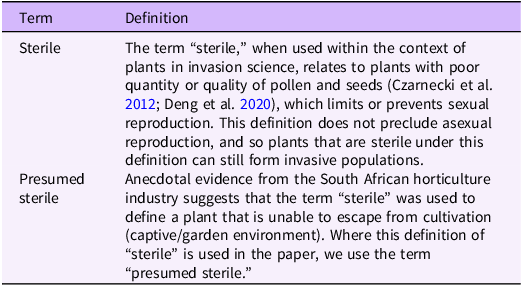
These examples show that the level of sterility deemed acceptable, and in fact how sterility is defined, varies. For example, anecdotal evidence from the South African horticulture industry suggests that the term “sterile” was used to define a plant that is unable to escape from cultivation, but still potentially able to produce viable seeds; therefore, we use the term “presumed sterile” here (see Table 1). The National Environmental Management: Biodiversity Act, Alien & Invasive Species (NEM:BA A&IS) regulations (Department of Environmental Affairs [DEA] 2014; Department of Forestry, Fisheries and the Environment [DFFE] 2020) attempt to accommodate infra- and interspecific variation in plant taxa by granting exemptions for cultivars or hybrids based on sterility. However, the evidence for exempting these “presumed sterile” cultivars and hybrids has not been published (Wilson and Kumschick Reference Wilson and Kumschick2024).
The definition of sterility in plants can vary with the context and goal for which the term is used, thus it is crucial that sterility is accurately assessed and defined when the term is being used.
In this article, we first examine different approaches to regulate cultivars and hybrids of invasive plant species; second, we review how cultivars and hybrids of invasive plant species could be regulated by using South Africa as a case study; and finally, we provide guidelines for assessing sterility in cultivars/hybrids of invasive plant species.
Approaches for Regulating Cultivars and Hybrids of Invasive Plant Species
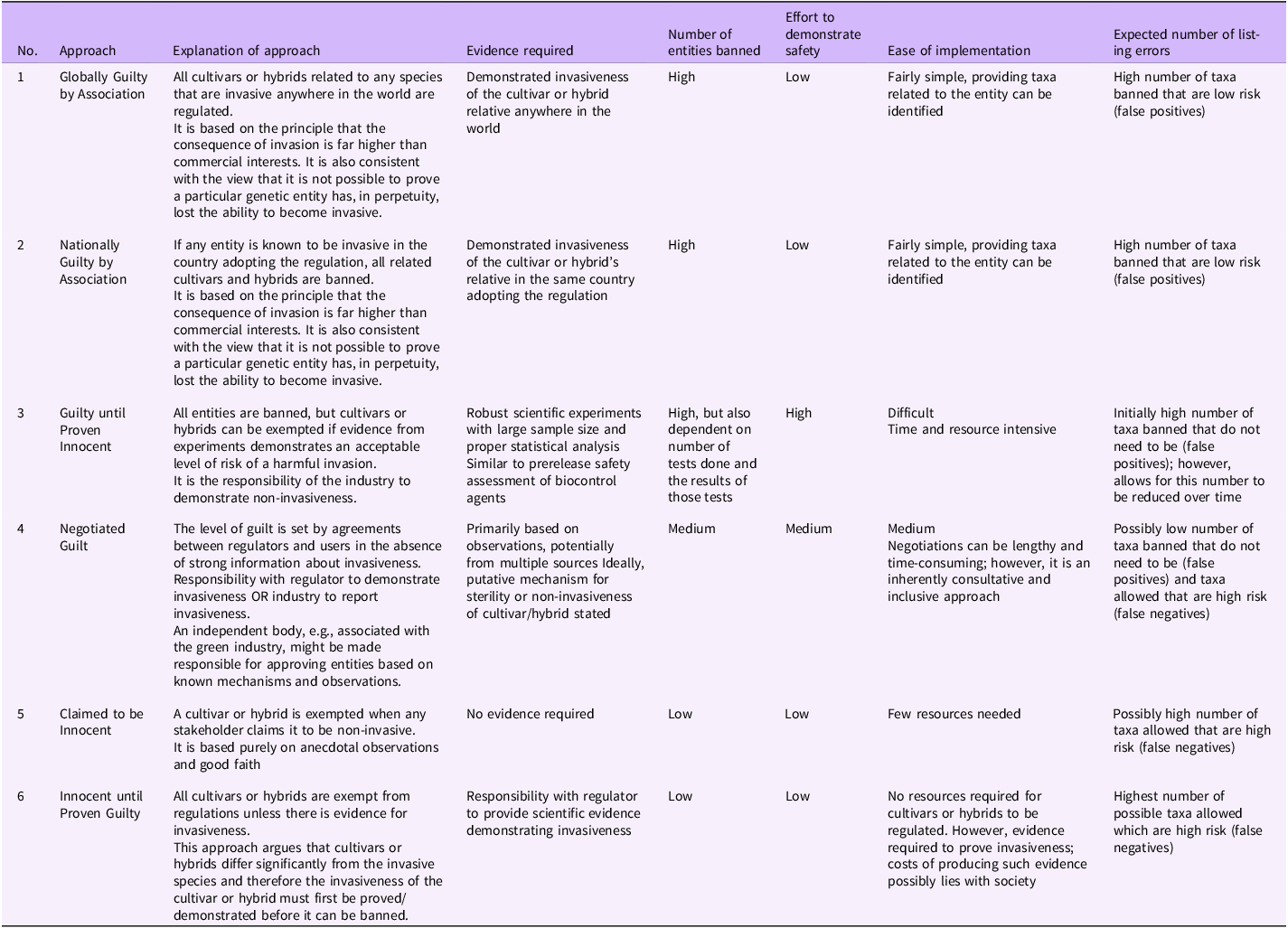
For the regulation and subsequent management of invasive species, Kumschick et al. (Reference Kumschick, Bacher, Dawson, Heikkila, Sendek, Pluess, Robinson and Kuhn2012) suggest that a transparent process is needed, which clearly expresses all the options by identifying and discussing the pros and cons of each. We present six approaches to regulate cultivars and hybrids of invasive plant species: (1) Globally Guilty by Association; (2) Nationally Guilty by Association; (3) Guilty until Proven Innocent; (4) Negotiated Guilt; (5) Claimed to Be Innocent; and (6) Innocent until Proven Guilty. The rationale, predicted number of entities banned, evidence required, expected number of listing errors, and ease of implementation are shown for each approach in Table 2.
Six approaches for regulating cultivars and hybrids of invasive species from precautionary to reactive.
The Rationale and Process Required for the Regulatory Approaches
The approaches range from risk adverse (Globally Guilty by Association) to reactive (Innocent until Proven Guilty). As such, they differ in the degree to which extrapolations of risk are made, resulting in a different risk assessment process for each approach. For the first two approaches “invasive elsewhere” is the only type of evidence required to ban cultivars or hybrids of an invasive taxon, thus no formal risk assessment process is required, rather these approaches are based on the precautionary principle with slightly different implications (see Table 2). While evidence based approaches 3 (Guilty until Proven Innocent) and 4 (Negotiated Guilt) still initially ban all cultivars and hybrids of the regulated invasive taxa; however, cultivars and hybrids of the regulated invasive taxa are allowed to be exempted from regulations if the required evidence is made available. The third approach requires scientific experiments to be conducted to demonstrate the safety of the cultivar or hybrid (this demonstration is usually in terms of sterility, see discussion on this later), which should feed into a formal risk analysis process for the exemption to be recommended. The fourth approach, also evidence based, does not require experiments to be conducted to demonstrate non-invasiveness, instead, the level of “guilt,” or the invasive potential of a cultivar, is negotiated between the regulators and stakeholders (i.e., a formal risk analysis might not be required) (Table 2). The fifth approach (Claimed to be Innocent) requires no evidence, and cultivars or hybrids can be exempted if any stakeholders claim that the entity is non-invasive (see Table 2 for the implications of such an approach). The last approach (Innocent until Proven Guilty) also does not require any evidence for safety. No formal risk assessment or risk analysis is required; all cultivars and hybrids of the regulated invasive taxa are exempted, unless there is specific evidence of invasiveness of the cultivar or hybrid. As such, this approach can be seen as reactive (Table 2).
The Implications of the Various Regulatory Approaches
Each approach has different implications, as outlined in Table 2, and approaches differ in how easy they are to implement. The most resource-intensive approaches are those that require specific risk analyses to be conducted (approaches 3 and 4, Table 2). If cultivars or hybrids are granted exemptions, it is important that those entities can be easily distinguished from their parental genotypes in practice, thus avoiding confusion when such exemptions are implemented. It is also important to note that each approach would vary in other factors, such as number of entities banned, the effort required to demonstrate safety, and the expected number of listing errors (as outlined in Table 2), all of which are important aspects to consider when selecting a regulatory approach to implement.
Given invasiveness and impacts have some phylogenetic signal (Diez et al. Reference Diez, Hulme and Duncan2012), we suggest that a reactive approach would be extremely risky, especially for cultivars or hybrids that have known invasive parent genotypes or congeners. On the other end of the spectrum, adopting the Globally Guilty by Association or Nationally Guilty by Association approach would likely mean a high number of infra- and interspecific taxa were unnecessarily banned, as risk assessments are not done at the infra- or interspecific taxonomic level (Gordon et al. Reference Gordon, Flory, Lieurance, Hulme, Buddenhagen, Caton, Champion, Culley, Daehler, Essl, Hill, Keller, Kohl, Koop and Kumschick2016). Such approaches could lead to significant economic losses in the green industry, potentially generating substantial disputes between the green industry and regulators, particularly if there was no clear route to contest the listing of taxa that stakeholders perceive to be safe.
Regulation of “Presumed Sterile” Cultivars and Hybrids in South Africa
In the following section, we used South Africa as a case study to review the regulation of “presumed sterile” cultivars and hybrids of invasive taxa. There have been various negotiations between the South African horticultural industry and the South African Department of Forestry, Fisheries and the Environment (DFFE) regarding the A&IS Regulations and “presumed sterile” cultivars and hybrids (K Montgomery, personal communication).
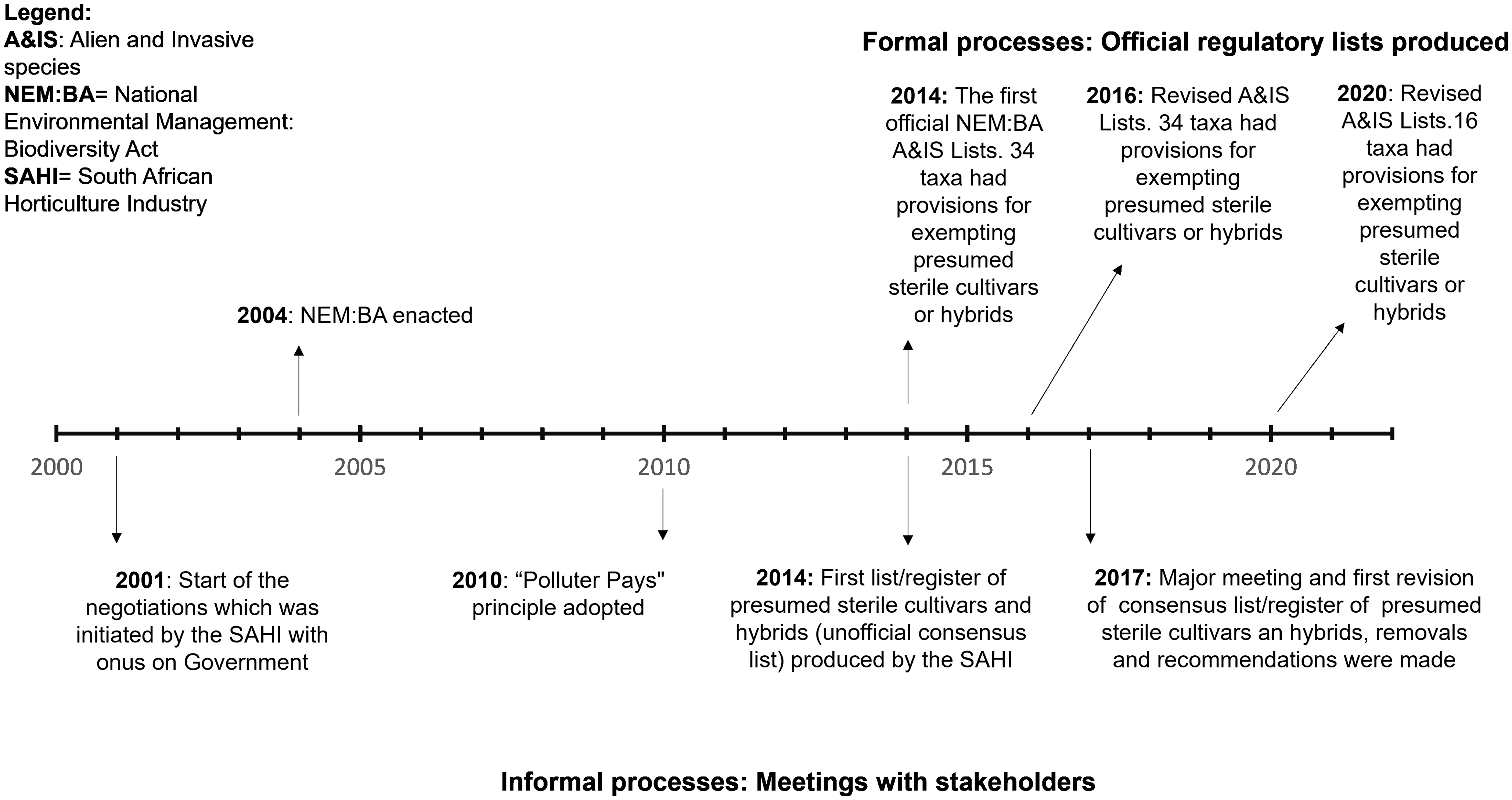
Because all of the “presumed sterile” (discussed later) cultivars or hybrids registered in South Africa (see Supplementary Table S1) are important ornamental plants (see Figure 1 for examples) or horticultural trees (Armitage Reference Armitage2008; Gardening in South Africa 2023), the horticulture industry is a crucially interested and affected stakeholder. Thus, the South African horticulture industry initiated negotiations with the government in 2001 to prevent the regulation of taxa that were horticulturally and economically significant (Figure 2). The negotiations entailed discussions regarding the invasiveness (or lack thereof) of those taxa before implementation of the regulations.
Photo panel illustrating examples of “presumed sterile” cultivars in South: (A) Duranta erecta ‘Sapphire Showers’; (B) Duranta erecta ‘Sheena’s Gold’; (C) Duranta erecta ‘Goldmine’; (D) Vinca major ‘Variegata.’ (Photos by Duran Chetty).

Timeline displaying the major events of the negotiations between the South African Horticultural Industry (SAHI) and the Department of Forestry, Fisheries and the Environment (DFFE) regarding “presumed sterile” cultivars of invasive plants in South Africa. For a detailed timeline of the NEM:BA A&IS Regulations and Lists, see Wilson and Kumschick (Reference Wilson and Kumschick2024).
In 2004, the National Environmental Management: Biodiversity Act (NEM:BA) (Act No. 10 of 2004) was enacted (see Lukey and Hall [Reference Lukey, Hall, van Wilgen, Measey, Richardson, Wilson and Zengeya2020] and Wilson and Kumschick [Reference Wilson and Kumschick2024] for a detailed review of the history of invasive species regulations in South Africa). As part of the NEM:BA, Alien and Invasive Species (A&IS) Regulations were promulgated in 2014 ([DEA] Department of Environmental Affairs, 2014). Under revised lists of October 2020 (DFFE 2020), 382 plant taxa were listed (Wilson Reference Wilson2024). In 2004, when NEM:BA was enacted, the South African horticulture industry requested exemptions for cultivars and hybrids for specific taxa; as such, the NEM:BA A&IS Regulations address infra- and interspecific variation by granting exemptions for cultivars or hybrids based on their presumed sterility.
On this basis, the negotiations moved toward exemptions of cultivars and hybrids that were seemingly safe. These negotiations were lengthy, and it was decided in 2010 (Figure 2) to implement the “polluters pay” principle, suggesting that those responsible for causing harm to the environment should be responsible for the cost of such damage (Luppi et al. Reference Luppi, Parisi and Rajagopalan2012), increasing conflict between the negotiating parties. It was agreed that a consensus had to be reached, but there was still a lack of scientific evidence regarding the invasiveness of the debated taxa.
Eventually, a consensus was reached in 2014. As part of this consensus, and before the first A&IS Lists were promulgated in 2014 ([DEA] Department of Environmental Affairs, 2014), the DFFE gave the industry an opportunity to propose a list of those cultivars and hybrids that it regarded to be sterile (Figure 2, “the unofficial consensus list”; see Supplementary Table S1). This list contained 187 cultivars and/or hybrids from 34 taxa (see Supplementary Table S1). This “presumed sterile” taxa list has changed over time (Figure 2) and currently contains 157 “presumed sterile” cultivars and/or hybrids from 16 taxa (Table 3; Supplementary Table S2). However, the evidence for the sterility of the registered cultivars and hybrids is lacking. Rather, the argument for the requested exemptions was on the basis that none of the cultivars nor hybrids had recorded naturalized populations. For legislative purposes, the government termed these “presumed sterile” taxa as sterile cultivars and hybrids, bringing forth the inception of the term “sterile cultivars and hybrids” in the South African context (see Table 1). However, the industry and DFFE did not publish evidence of sterility for “presumed sterile” cultivars and hybrids (see Table 4 for anecdotes from the green industry regarding “presumed sterile” cultivars).
Taxa listed under the 2014 and 2020 National Environmental Management: Biodiversity Act, Alien and Invasive Species Regulations for which there is or was provision to exempt sterile cultivars or hybrids a .
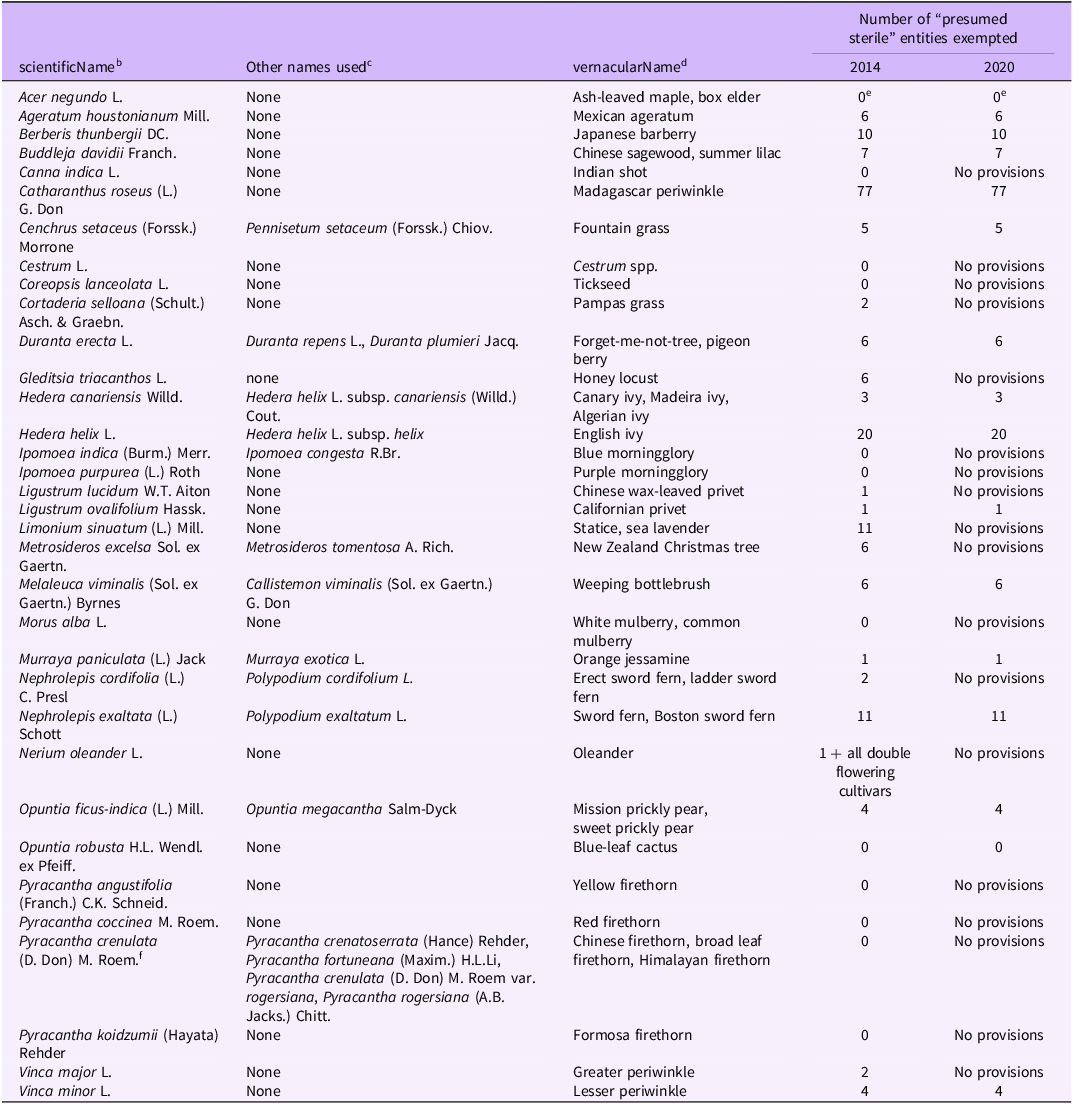
a Column headings are as per DarwinCore terms where available. For full details, see Supplementary Tables S1 and S2.
b The scientificName was taken from Wilson (Reference Wilson2024), with nomenclature checked therein against the Botanical Database of Southern Africa (BODATSA) and Plants of the World Online (POWO) during 2023.
c Other names used are either synonyms used in at least one version of the regulatory lists, synonyms specified in the regulatory listing [e.g., the NEM:BA A&IS List includes the following listing: “Duranta erecta L. (= D. repens L., D. plumieri Jacq.)”], or names misapplied in South Africa specified in the regulations (e.g., Pyracantha fortuneana was misapplied to Pyracantha crenulata).
d The vernacularName is as presented exactly in the NEM:BA A&IS Lists (including capitalization).
e It is unclear if there were any submissions of sterile cultivars/hybrids for Acer negundo, as this taxon does not appear in the unofficial consultative list (Supplementary Table S1); however, there have been provisions for exemptions for this taxon since 2014.
f Pyracantha crenatoserrata is a recognized synonym of Pyracantha crenulata (Plants of the World Online) but is listed separately in the NEM:BA A&IS Lists.
Anecdotes from the green industry regarding “presumed sterile” cultivars or hybrids a .
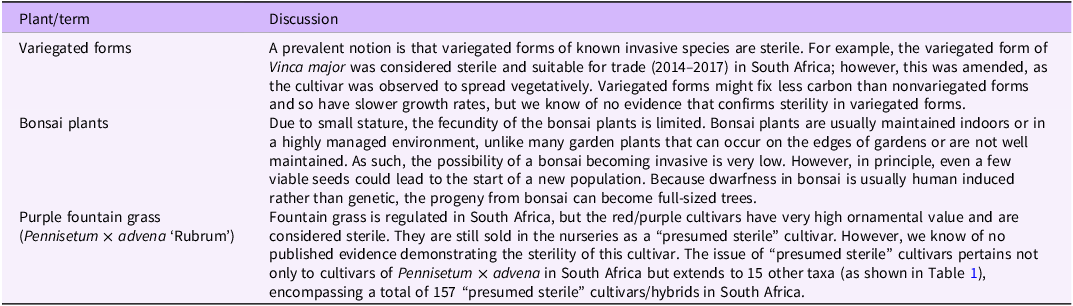
a It is interesting to note existing impressions that among members of the green industries regarding certain cultivars and hybrids perceived to be “non-invasive” and safe for trade. These perceptions are anecdotal evidence based on long-term observations. Some of these are briefly discussed in this table.
In 2017, revisions to the unofficial consultative list included the removal of tickseed (Coreopsis lanceolata L.) cultivars due to a lack of evidence of sterility, and the removal of greater periwinkle (Vinca major L.) cultivars due to the plant spreading more vegetatively than sexually (Figure 2; Supplementary Appendix). The industry was given deadlines (1 to 2 years) to prove the sterility of various listed cultivars and hybrids if they were to remain on the unofficial consultative list (Supplementary Appendix). In the 2020 iteration of the NEM:BA A&IS Lists (DFFE 2020), less than half (16 out of 34) taxa still had regulatory provisions for exemptions of “presumed sterile” cultivars (Figure 2; Table 3; Supplementary Table S2). However, we are not aware of publicly available evidence of sterility for the retained entities or of the precise reason why specific entities were removed from the lists. Thus, it is important to understand how the list proposed by the South African horticulture industry was developed so a transparent, evidence-based approach can be used in future for producing lists that guide policy and action (Butchart et al. Reference Butchart, Walpole, Collen, van Strien, Scharlemann, Almond, Baillie, Bomhard, Brown, Bruno, Carpenter, Carr, Chanson, Chenery and Csirke2010; Perry and Perry Reference Perry and Perry2008).
What Should a Sterility Assessment for Cultivars or Hybrids of Invasive Species Include?
Here, we outline the basic requirements for sterility assessments of cultivars/hybrids of invasive plant species and present a generic pro forma for reporting on sterility (Figure 3). It is important to note that the guidelines presented are not a standardized protocol for sterility assessments but aim to outline various components that should be included in any sterility assessments for invasive plants and to provide examples of the types of experiments that could be conducted to gather the required data. The first three components of the sterility assessment specifically deal with assessing the sexual reproductive pathway, the fourth with quantifying asexual reproduction, and the last component assesses the stability of sterility.
A generic pro forma for reporting sterility based on observations and/or experiments on: flowering, fruiting, pollen, and seeds; the potential for vegetative propagation; and the potential for genetic changes (including hybridization and reversion to fertility).
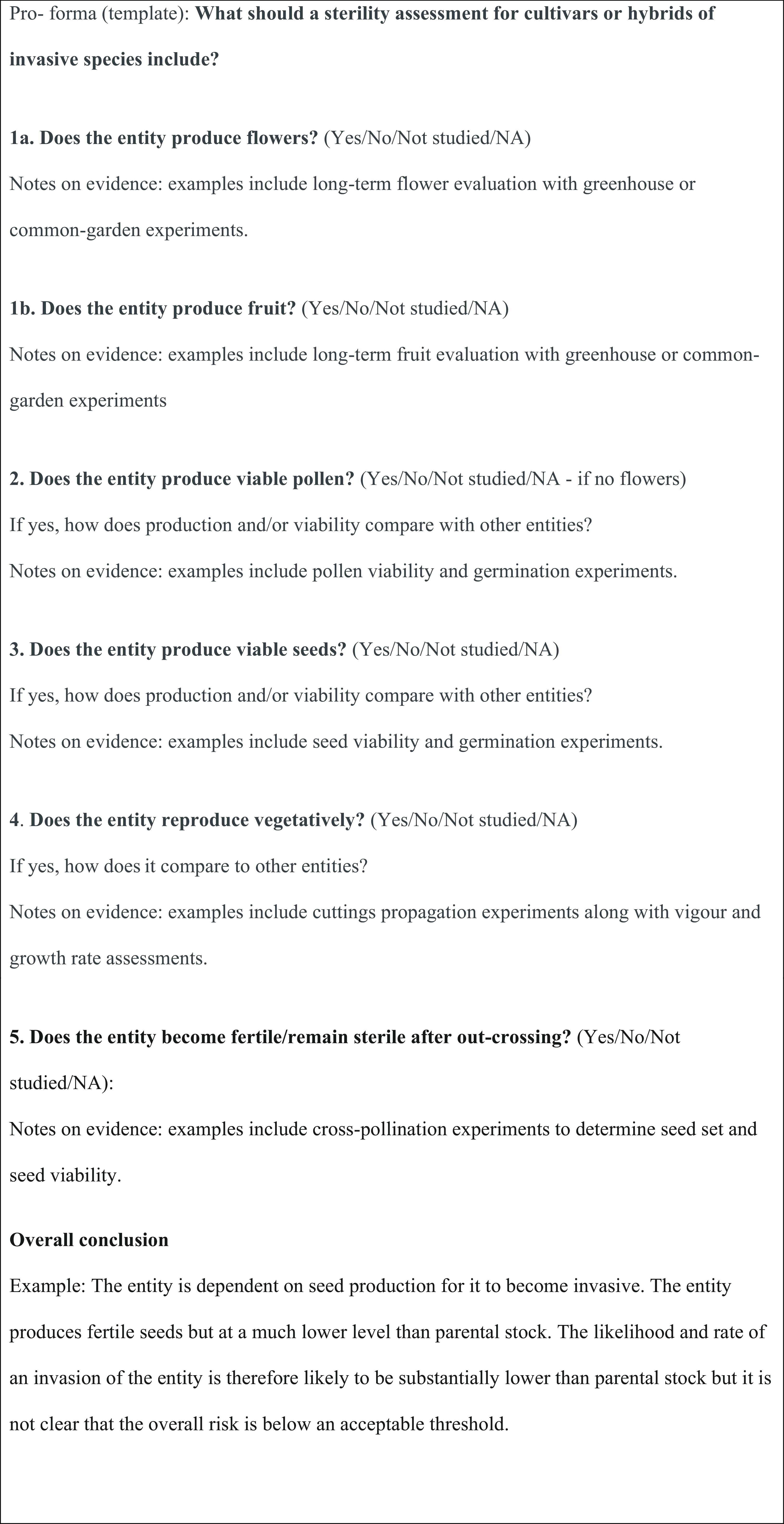
Flower and Fruit Production
Do the cultivars/hybrids produce flowers and fruit, and if so, how many? Common-garden or greenhouse experiments (e.g., Knox and Wilson Reference Knox and Wilson2006) can be set up by growing replicates of each tested cultivar/hybrid for a period of time (until reproductive maturity). Wild-type plants can be grown as controls.
Pollen Analyses
If the tested cultivars/hybrids produce flowers, pollen viability analyses should be done. Pollen viability assessments are often done using biological staining techniques (Jones Reference Jones2012; Pinillos and Cuevas Reference Pinillos and Cuevas2008) or by conducting pollen germination experiments. For the control of these experiments, pollen from wild-type plants (representing the invasive forms) of the tested cultivar/hybrids should be used, and the pollen viability and/or germination percentages should be significantly lower in tested hybrids/cultivars than in the wild type. If no flowers are produced, then the cultivar/hybrid can be defined as truly sterile. However, if pollen viability/germination is below a certain percentage threshold this can mean a taxon is not invasive. It should be up to the legislators and stakeholders within a region/country to agree on an acceptable threshold, as this can vary between various taxa depending on other factors such as time to reproduction (different in fast- and slow-growing species), benefits of cultivar (environmental, economic, or social) and results from seed analyses (step 3). Finally, electron microscopy can be used to supplement pollen viability results, which may identify abnormal pollen grains characteristic of low pollen viability (Shaik et al. Reference Shaik, Chetty and Watt2023).
Seed Analyses
If cultivars/hybrids produce fruit (and subsequently set seed), the number of seeds per fruit should be quantified. Thereafter, seed viability and germination assays (e.g., Czarnecki et al. Reference Czarnecki, Wilson, Knox, Freyre and Deng2012; Deng et al. Reference Deng, Wilson, Ying, Chen, Freyre, Zayas and Czarnecki2020) should be conducted. Seed viability assays can be done using the standard tetrazolium test, and germination assays can be conducted in vitro (petri dishes and incubators) or ex vitro (sowing in soil). A cultivar/hybrid that does not produce seeds or whose seeds have 0% viability or germination can be defined as truly sterile. However, as per the previous step, an acceptable threshold can be defined, which may be context specific. Various other/additional seed analyses can be done (seed mass/ultrastructure analyses, etc.) to understand the mechanisms of sterility.
These three components provide insights into the degree of fertility of a cultivar or hybrid. The next two steps aim to provide a more comprehensive understanding of the invasion risk.
Potential for Vegetative Propagation
Can the cultivars/hybrids reproduce asexually? Experiments can be conducted to determine the survival/success rate of propagation from cuttings (or other types of vegetative propagation, such as bulbils) to gain an understanding of how easily the plants can propagate (or spread) asexually. Further, it is advised that basic vigor assessments be conducted with the surviving cuttings to determine which are the fastest-growing cultivars/hybrids (a trait that increases invasive potential).
Potential for Genetic Changes
Finally, to determine the potential for genetic changes that could affect the stability of sterility, cross-breeding between cultivars and between cultivars and wild-type plants should be investigated. Hand-pollination experiments in the greenhouse are recommended (e.g., Wilson and Hoch Reference Wilson and Hoch2009), and the seeds of the F1 progeny should be tested as per component 3 of the sterility assessment. If seed production is significantly higher, then the risk assessment needs to be adjusted.
Discussion
For the regulation of cultivars and hybrids of invasive taxa, South Africa initially adopted an approach similar to Claimed to be Innocent (Table 2, approach 5), but subsequently moved to something between the Negotiated Guilt (Table 2, approach 4), and Guilty until Proven Innocent (Table 2, approach 3). Adopting a Claimed to be Innocent approach is risky, and the approach may change over time, as seen in the case of South Africa, where taxa that were exempt, such as V. major, among others, were later banned (see Supplementary Appendix for other examples). Hence, we primarily recommend a Guilty until Proven Innocent approach for regulating cultivars or hybrids of invasive taxa at a national scale (i.e., all cultivars or hybrids, where at least one related taxon is regulated should be regulated unless there is documented evidence that the cultivar/hybrid is not invasive). Sterile cultivars or hybrids of invasive plant species could be ideal candidates for such exemptions, but it is crucial that within the supporting evidence, sterility is not only appropriately assessed but also accurately defined.
Allowing for the independent regulation of cultivars and hybrids of invasive plant species by exempting safe/non-invasive (usually synonymous with sterile) taxa that are underpinned by scientific evidence may be the most viable regulatory option. However, there will still remain other risks, such as the misidentification of sterile cultivars or hybrids. Traders may knowingly or unknowingly label specific cultivars or hybrids with the names of the exempted taxa. Thus, it is recommended that procedures are put in place to to help prevent this, such as routine genetic testing (e.g., DNA fingerprinting or sequencing approaches) and plant auditing. Further, public (and nursery customer) awareness would be needed for the approach to be widely acceptable and adopted. If the recommended regulatory approach is adopted nationally, there would be an incentive to patent sterile plants, making plant tracking easier. Finally, generic pro forma for reporting sterility based on observations and/or experiments (such as that presented in Figure 3) may assist with making the regulatory approach easier to implement.
Recommendations
For the case of regulating cultivars or hybrids, we primarily recommend evidence-based approaches such as the Guilty until Proven Innocent or the Negotiated Guilt approaches. The Guilty until Proven Innocent approach is the most time-consuming and stringent, resulting in a relatively high number of taxa being banned, but it is also the most evidence-based approach that seeks to minimize conflict of interest between stakeholders and legislators. This approach can be justified for regulating cultivars or hybrids, because such taxa generally display similar traits to their parent genotypes; thus, the precautionary principle still applies. Although this approach requires substantial information, it still allows for exemptions of cultivars or hybrids based on evidence gained from robust scientific experiments, making provision for “safe” taxa claims. This type of approach has been demonstrated in Oregon, USA, where 18 sterile cultivars of the invasive Chinese sagewood (Buddleja davidii Franch.) were deemed safe for trade/use (underpinned by scientific evidence), which served as a model for other states to follow (Contreras and McAninch Reference Contreras and McAninch2013). Further, adopting a Guilty until Proven Innocent approach encourages research, which increases the output and volume of scientific knowledge pertaining to safe/non-invasive cultivars, as seen in Florida (Wilson and Deng Reference Wilson and Deng2023). In the event that an Innocent until Proven Guilty approach cannot be successfully adopted, we recommend a Negotiated Guilt approach. This approach does not require scientific evidence or assessments, exemptions are based on known mechanisms and long-term observations that an independent body associated with the green industry is responsible for. However, it must be noted that the Negotiated Guilt approach may lead to lengthy negotiations between regulators and users or inaccurate risk assessments of the exempted taxa.
Conclusion
Regulating infra- and interspecific entities of taxa that are known to be invasive can be a complex task but is important if conflicts of interest between various stakeholders (primarily from industry) and regulators are to be resolved. South African regulation of infra- and interspecific entities of invasive taxa is laudable, but the process can be more transparent and evidence based. We recommend that for any country with cultivars or hybrids of non-native plant species, exemptions for infra- and interspecific entities should be on the basis of risk analyses for those entities (e.g., Kumschick et al. [Reference Kumschick, Wilson and Foxcroft2020b] for South Africa). Ideally risk analyses of the related entities should also be produced with clear explanations as to why the risk differs. We believe such exemptions should be specified in official documentation, so they are transparent.
Supplementary material
To view supplementary material for this article, please visit https://doi.org/10.1017/inp.2024.24
Acknowledgments
South African Department of Forestry, Fisheries and the Environment (DFFE) officials are thanked for their input regarding the regulations. Kay Montgomery is thanked for the valuable information provided pertaining to the South African horticultural industry. Katelyn Faulkner, Ashlyn Padayachee, Michael Cheek and two anynonmous reviewers are thanked for comments on the article.
Funding statement
The South African Department of Forestry, Fisheries and the Environment (DFFE) is thanked for funding, noting that this publication does not necessarily represent the views or opinions of DFFE or its employees. DC acknowledges the Cape Peninsula University of Technology for research support. SK acknowledges the support of the Centre for Invasion Biology (CIB) at Stellenbosch University.
Competing interests
The authors declare no competing interests.


 Open access

