





1. Introduction
The decades since the mid-20th century have been marked by unprecedented expansion of economic activity, biophysical resource consumption, environmental pressures, industrialization, urbanisation, and population growth (Head et al., Reference Head, Steffen, Fagerlind, Waters, Poirier, Syvitski, Zalasiewicz, Barnosky, Cearreta, Jeandel, Leinfelder, McNeill, Rose, Summerhayes, Wagreich and Zinke2022; Jouffray et al., Reference Jouffray, Blasiak, Norström, Österblom and Nyström2020; Steffen, Broadgate, et al., Reference Sen2015). Global warming is one symptom of this ‘Great Acceleration,’ with over half of all anthropogenic carbon emissions ever released being emitted since 1990 (IEEP, 2022). Current projections estimate global warming well in excess of the ‘safe’ 1.5 °C target with policies currently in place pointing to a 3.1ºC temperature rise (UNEP, 2024), risking multiple and cascading climate-related tipping points with devastating consequences for human wellbeing (McKay et al., Reference McKay, Staal, Abrams, Winkelmann, Sakschewski, Loriani, Fetzer, Cornell, Rockström and Lenton2022; Rocha et al., Reference Rocha, Peterson, Bodin and Levin2018). Multiple planetary boundaries have been pushed into high-risk zones (Persson et al., Reference Persson, Carney Almroth, Collins, Cornell, de Wit, Diamond, Fantke, Hassellöv, MacLeod, Ryberg, Søgaard Jørgensen, Villarrubia-Gómez, Wang and Hauschild2022; Steffen, Richardson, et al., Reference Sen2015). According to the IPCC, there is now ‘a brief and rapidly closing window of opportunity to secure a liveable and sustainable future for all’ (IPCC, Reference Pörtner, Roberts, Tignor, Poloczanska, Mintenbeck, Alegría, Craig, Langsdorf, Löschke, Möller, Okem and Rama2022, p.33).
Many countries overstep biophysical thresholds before satisfying human wellbeing, with no country yet succeeding in meeting the basic needs of its residents while respecting planetary boundaries (Fanning et al., Reference Fanning, O'Neill, Hickel and Roux2021; Vogel et al., Reference Vogel, Steinberger, O'Neill, Lamb and Krishnakumar2021). Despite large increases in mean incomes, half of the world's population still lives below the 6.85 $/day poverty line, with over 600 million people living in extreme poverty (Schoch et al., Reference Schoch, Tetteh Baah, Lakner and Friedman2022). Contributions to environmental pressures are extremely unequally distributed (Bruckner et al., Reference Bruckner, Hubacek, Shan, Zhong and Feng2022; Oswald et al., Reference Oswald, Owen and Steinberger2020), with a billionaire responsible for a million times the carbon emissions of the average person (Maitland et al., Reference Maitland, Lawson, Stroot, Poidatz, Khalfan and Dabi2022). Yet despite ample evidence that reducing inequality and improving public services are key to sustainably securing wellbeing (Millward-Hopkins & Oswald, Reference Millward-Hopkins and Oswald2023; Vogel et al., Reference Vogel, Steinberger, O'Neill, Lamb and Krishnakumar2021), within-country inequalities are rising and the public share of wealth is declining (Chancel et al., Reference Chancel, Piketty, Saez and Zucman2022).
The Earth4All initiative (https://earth4all.life) was designed to explore solutions to the systemic crises the world is facing through investigating how environmental risks could be minimised while maximising human wellbeing for the global majority throughout the 21st century. Its main publication, Earth for All: A Survival Guide for Humanity,(Dixson-Declève et al., Reference Dixson-Declève, Gaffney, Ghosh, Randers, Rockström and Stoknes2022) was published in connection with the 50th anniversary of The Limits to Growth (Meadows et al., Reference Meadows, Meadows, Randers and Behrens1972). It used system modelling, described in detail here, to spur international debate on the problems of overshoot in human pressures on the environment.
2. The Earth4All model: causal determinants of human wellbeing
The research question that the Earth4All project has aimed to answer is: How can human wellbeing be improved while respecting planetary boundaries in the 21st century?
To investigate such potential big-picture, long-term futures, we chose to develop a new highly aggregated quantitative simulation model, named Earth4All-global. The model is built in a system dynamics approach and represents a complementary alternative to conventional equilibrium-based integrated assessment models (IAMs). It enables transparent exploration of pathways of future human wellbeing where monetary, physical and societal variables interact causally over the long term. The Earth4All model builds on insights gained from earlier integrated system dynamics world modelling endeavours (Forrester, Reference Forrester1961; Hughes, Reference Hughes2019; D. L. D. L. Meadows et al., Reference Meadows, Behrens, Niall, Randers and Zahn1974; Pedercini et al., Reference Pedercini, Arquitt and Chan2020; Randers, Reference Randers2013; Randers et al., Reference Randers, Golüke, Wenstøp and Wenstøp2016, Reference Randers, Rockström, Stoknes, Goluke, Collste, Cornell and Donges2019; Saeed, Reference Saeed2016). The model simulates linked socio-economic and environmental developments over time towards 2100, incorporating global measures from national accounting, population, inequality, and environmental degradation.
To begin with, one might ask if it is at all sensible to build yet another new model: do we have enough understanding of human, societal and biogeophysical processes to construct such a global model, and can a relatively simple model still capture main drivers explaining long-term future developments? Our answer is “yes,” with important caveats. General, high-level trends can be depicted. Over the last 50–100 years, human and Earth system dynamics at the macro level have developed along pathways broadly consistent with some past scenarios. An indication of this is the well-documented correspondence between some of the scenarios published in the 1972 Limits to Growth book and the observed development until 2022 (Herrington, Reference Herrington2021; Turner, Reference Turner2008, Reference Turner2014).
With that said, it remains impossible to make point predictions of long-term future developments. Some macro-trends are triggered by unpredictable events with global consequences. Some would argue that the Anthropocene represents a departure from the predictability of the Holocene into a realm of systemic biosphere risks and uncertainties (Steffen et al., Reference Steffen, Rockström, Richardson, Lenton, Folke, Liverman, Summerhayes, Barnosky, Cornell, Crucifix, Donges, Fetzer, Lade, Scheffer, Winkelmann and Schellnhuber2018). We agree with this judgement to some extent: in the last 50 years, the climate has changed substantially, changes in Earth system processes are accelerating and becoming more visible, and there are growing concerns that profound tipping points are likely to be crossed in the coming decades (McKay et al., Reference McKay, Staal, Abrams, Winkelmann, Sakschewski, Loriani, Fetzer, Cornell, Rockström and Lenton2022). The zone of habitability in the tropics is likely to shrink considerably this century, putting potentially billions of people within climate conditions that today are considered on the edge of habitability (Xu et al., Reference Xu, Kohler, Lenton, Svenning and Scheffer2020).
Climate-related events that cannot be predicted by projecting historical trends have been described as ‘black swans’ or ‘alternative epistemologies of risk’ (Bolton et al., Reference Bolton, Despres, Pereira da Silva, Svartzman and Samama2020). A different group of risks are the systemic risks emerging from global intertwined social–ecological systems interacting across a range of spatial and temporal scales (Keys et al., Reference Keys, Galaz, Dyer, Matthews, Folke, Nyström and Cornell2019). Despite the profound forecasting difficulties posed by emergent behaviour in the Anthropocene (Steffen et al., Reference Steffen, Rockström, Richardson, Lenton, Folke, Liverman, Summerhayes, Barnosky, Cornell, Crucifix, Donges, Fetzer, Lade, Scheffer, Winkelmann and Schellnhuber2018), we argue that this uncertain landscape calls for increased modelling efforts with new modelling approaches. Employing multiple approaches can seize the strengths of different paradigms and methods when exploring potential future scenarios on different levels, their underlying dynamics and consequences for humanity.
To answer the overall research question, the Earth4All model's causal structure is an attempt to account for selected main determinants of the wellbeing for the global human majority. In our overarching conceptualization of what human wellbeing entails, we mainly drew on the capabilities approach (Nussbaum & Sen, Reference Nussbaum and Sen1993; Sen, Reference Sen2001) and the human needs approach (Doyal & Gough, Reference Doyal, Gough, Doyal and Gough1991; Max-Neef et al., Reference Max-Neef, Elizalde and Hopenhayn1991). The capabilities approach emphasises freedom for people “to achieve outcomes that they value and have reason to value” (Sen, Reference Sen2001). The human needs approach understands that a set of universal, non-substitutable, satiable, and cross-generational needs must be met as an essential precondition for human flourishing (Gough, Reference Gough2017). The Wellbeing Economy ALLiance has developed a closely related set of qualitative definitions of wellbeing components(Wellbeing Economy Alliance, n.d..). While many important aspects of wellbeing have qualitative characteristics (including, for example, quality of governments, subjective wellbeing, and legal frameworks allowing for democratic and inclusive decision-making), the development of the model structure requires a conceptualization of wellbeing that can be meaningfully assessed quantitatively and integrated with the other model components, including Earth-system related ones. In the model, we rely on quantitative proxies whose development patterns can be tracked in a simulation model over a time horizon of 30–100 years.
Based on the Wellbeing Economy Alliance's characterisation, we developed a wellbeing index, further described below, that incorporates the following quantitative components along five dimensions:
1. Dignity: Workers’ disposable annual income (measured in PPP-adjusted 2017$)
2. Nature: Global warming (global surface average temperature, in degrees Celsius)
3. Institutions: Government services (spending per person-year indicating government institutions related to infrastructure, health, education, etc., in PPP-adjusted 2017$)
4. Fairness and inequality: the ratio of capital owners’ income share to workers’ income share.
5. Participation as citizens: People's perceived rate of progress in wellbeing improvement relative to earlier levels of wellbeing.
3. Modelling approach
The Earth4All model is an integrated systems model (Pedercini et al., Reference Pedercini, Arquitt and Chan2020, p. 20) with global scope that gives quantitative illustrations for the Earth for All book (Dixson-Declève et al., Reference Dixson-Declève, Gaffney, Ghosh, Randers, Rockström and Stoknes2022). The model links aspects of the natural Earth and the human world, and interactions between the two. Here, we provide a more detailed note on the model than in the main text but refer to the fuller documentation that can be accessed in supplemental material and (Randers & Collste, Reference Randers and Collste2023). The model is built in system dynamics software and the initiative is inspired by the system dynamics methodology and philosophy (Sterman, Reference Sterman2000). The model generates scenarios for the rest of the century for the variables in the focus of the Earth for All study.
As the model has been structured to reflect the past behaviour 1980–2020, it is typically more likely that it more reliably captures megatrends in the period for 2020–2060 than for 2060–2100. The focus of the model is however to provide an overarching image of the hypothesised dynamics of the world-Earth system, to provide further questions for analyses by more detailed and calibrated models, and not to provide precise point predictions. In line with this purpose, the model was calibrated to approximate historical medium- to long-term trends rather than matching data exactly at certain points in time. Furthermore, as we warn in the paper, social-ecological scenario development past 1.5°C and 2°C is profoundly difficult as our species and planet enter terra incognita (McKay et al., Reference McKay, Staal, Abrams, Winkelmann, Sakschewski, Loriani, Fetzer, Cornell, Rockström and Lenton2022). If anything, the assumptions that the model illustrates are underestimating the potential effects of crossing Earth system tipping points (Dixson-Declève et al., Reference Dixson-Declève, Gaffney, Ghosh, Randers, Rockström and Stoknes2022).
The model is a disequilibrium simulation model (Barlas, Reference Barlas1996) that assumes bounded rationality decision making and not an optimization model. It aims to capture some of the global systems’ causal structure with important feedback loops, its cross-sectoral dynamics, and with (degrees of) stock-flow consistency. It can generate internally consistent scenarios to assess potential future long-term developments for the selected human wellbeing variables during the rest of this century.
The model tracks the main determinants and dynamics of the selected indicators over the time period chosen, i.e. 1980–2100. The model starts in 1980 and approximates the main trends and behaviours of societal decision-making and world dynamics for the past time period, 1980–2022. While the reasonably precise replication of past behaviours on its own by no means represents a thorough validation test of the model, together with sound causal hypotheses based on scientific literature and expert knowledge, it supports the argument that the model could continue to approximate global trends in future decades. In the supplemental material we present stylised relationships, labelled ‘guides’, between industrial-capitalist developments (approximated by per-capita GDP) and key socioeconomic variables, showing that the model broadly follows these trends (Randers & Collste, Reference Randers and Collste2023). No structural changes and only a few limited parameter changes were added to the model from 2020. This was done in order to align better with the ‘standard’ middle-of-the-road scenario (SSP2) from the Shared Socioeconomic Pathway scenarios (O'Neill et al., Reference O'Neill, Kriegler, Ebi, Kemp-Benedict, Riahi, Rothman, van Ruijven, van Vuuren, Birkmann, Kok, Levy and Solecki2017), so that the Earth4All model standard run results can be more easily compared with other integrated system modelling work.
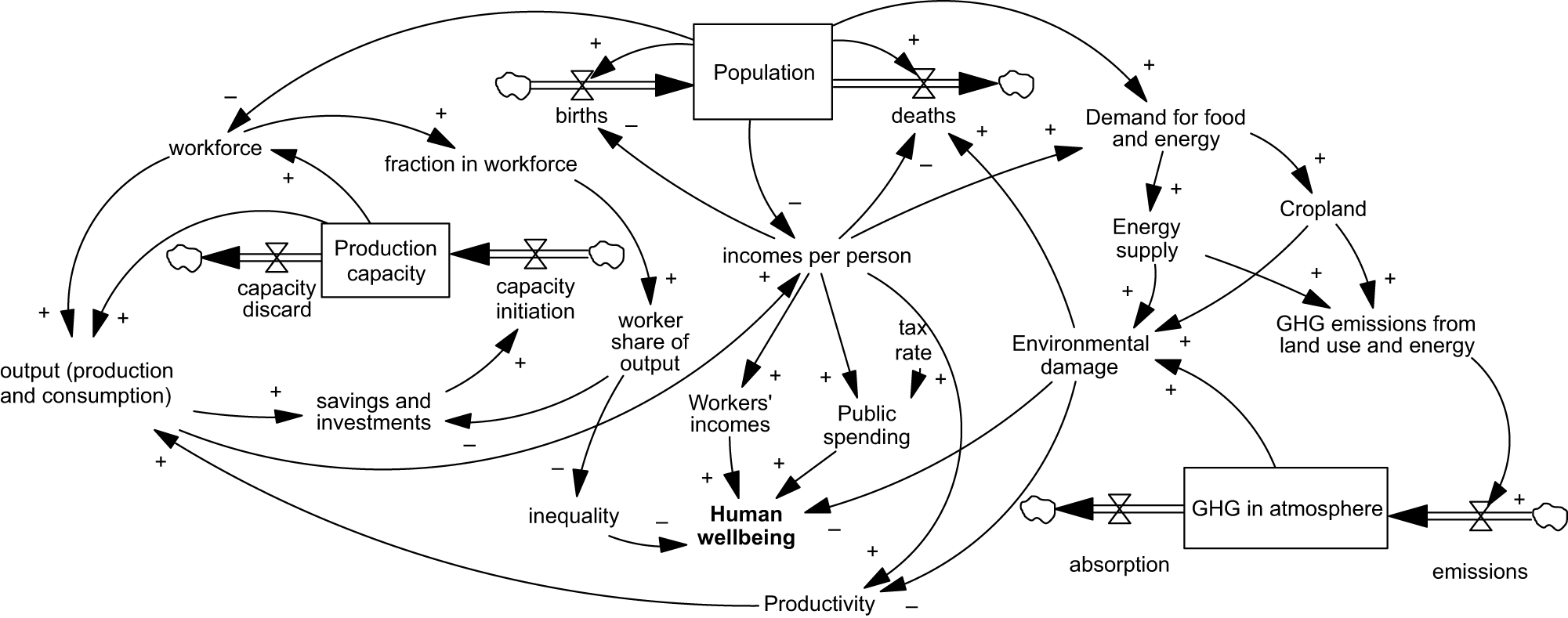
To capture the selected wellbeing indicators, the Earth4All model includes key wellbeing determinants from both the human world and the natural world, as well as the interactions between the two. The model can be described as a highly aggregated global integrated assessment model (Fig. 1).
Representation of the Earth4All model. As simple as possible representation of the Earth4All model showing key links. Each arrow represents a causal relationship. The ‘+’ signs at the arrowhead indicate that the effect is positively related to the cause (e.g. an increase in population causes deaths to rise above what it otherwise would have been). The ‘–’ signs at the arrowhead indicate that the effect is negatively related to the cause (e.g. an increase in environmental damage causes productivity to fall below what it otherwise would have been).
4. Key model modules and cross-sectoral dynamics
In order to understand long-term determinants of human wellbeing over the century one needs to capture how the global population could develop. In the Earth4All model system, the endogenous population module generates the total global population in four different age cohorts. The population age structure provides the number of children (<20 years), people in the child-bearing ages (20–40 years), in the potential workforce (20–60 years), and pensioners (>60 years). These cohorts are central in determining the long-term population and macroeconomic developments. The population development depends on the modelled fertility and mortality rates which are endogenously derived from the causal structure of the model.
The labour market module generates workforce, workforce participation rate, and the workers’ share of output. The model distinguishes between workers, whose primary source of income is paid labour, and owners who receive capital incomes. The labour market module produces a cyclical behaviour in the economy, representing the Juglar cycle, reflecting the undulating co-development of workers’, and owners’ income shares, and related unemployment dynamics. This can be most easily observed in the long-term time series of employment and investments (A'Hearn & Woitek, Reference A'Hearn and Woitek2001; Ayres, Reference Ayres2020; Korotayev & Tsirel, Reference Korotayev and Tsirel2010).
The labour market module feeds into the output module that tracks how investment leads to the formation, accumulation and consequent depreciation of capital. Combined with the total amount of employed labour and the total factor productivity component, it generates the Gross Domestic Product, from which incomes are paid.
The public module calculates public spending based on tax revenues (from workers and owners) and the creation of additional public debt, allocating the budget on governmental goods and services, including welfare transfers. Tax rates also affect owners’ saving rates, and consequently investment rates.
The population and production developments give rise to food and energy demands. The food module tracks the expansion of agricultural and urban lands and the resulting cutting of forests. Agricultural yields depend on productivity determined by fertiliser use and type of agriculture, and are also affected by emissions and global warming. If there is not enough land to satisfy the food demand, then agricultural land use will be expanded causing further deforestation. The production of fertilisers causes N2O emissions that are tracked by the climate module. The model's energy module generates fossil-fuel based and renewable energy production. The consequent greenhouse gas emissions are also tracked by the climate module.
The climate module tracks how greenhouse gas emissions from energy, industry and land use are accumulated in the atmosphere (and eventually absorbed by land and oceans), and how increased radiative forcing gives rise to global warming. Global warming, in turn, serves as a proxy for many environmental problems that negatively affect the economy by causing destruction of capital, increasing the cost of capital and harming productivity. Global warming also, in the long run, increases human mortality rates.
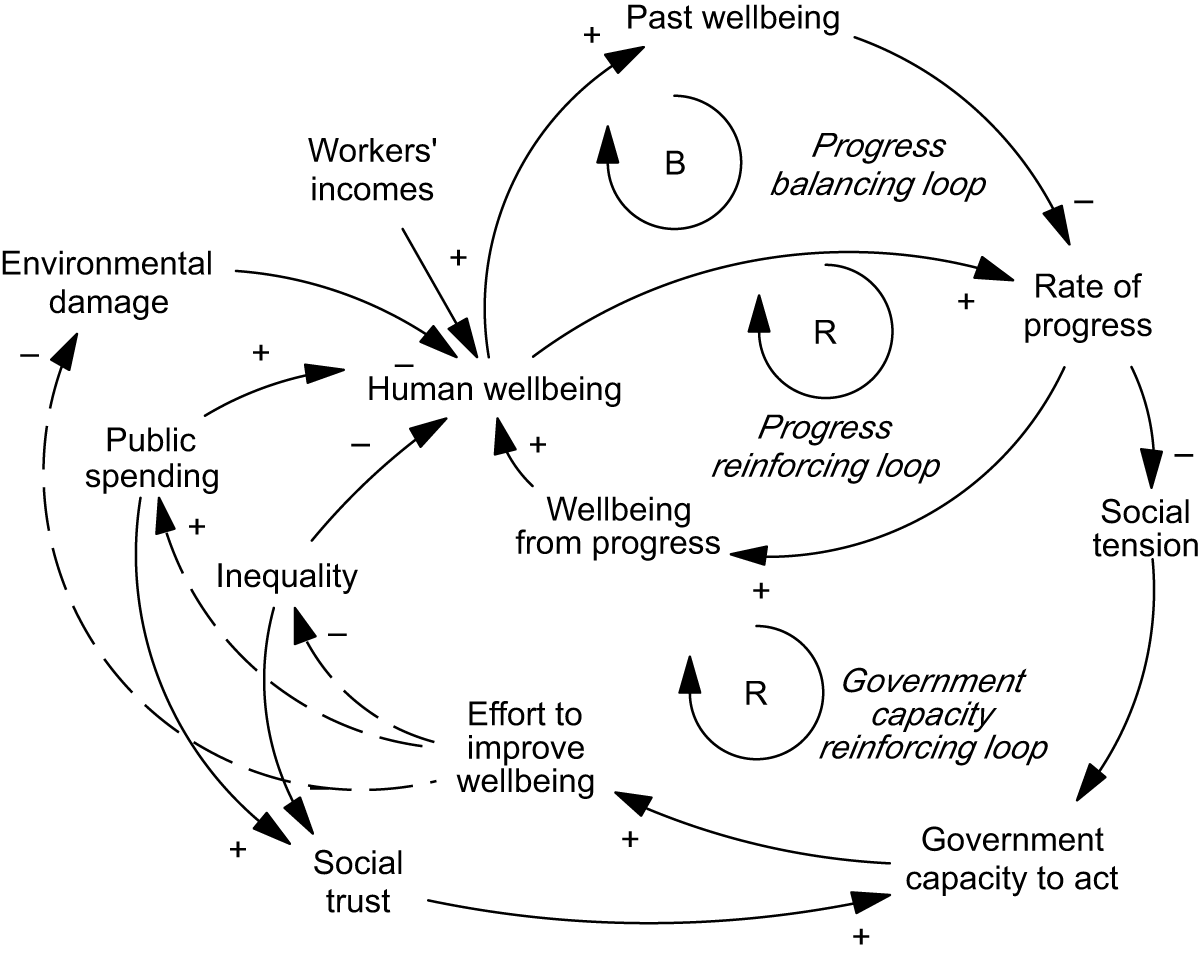
The wellbeing module gives the average wellbeing index from the components mentioned above: incomes per person, public spending per person, inequality, global warming and progress. Figure 2 portrays causal links between these main determinants of human wellbeing. We have chosen to focus on the concept of progress in society, which is novel to this type of world modelling. We introduce a ‘Progress reinforcing loop’: if human wellbeing increases, this gives a sense of social progress being made which, in turn, further increases wellbeing. Figure 2 also portrays the concepts of ‘social tension’ and ‘social trust’. In the model, if ‘rate of progress’ stagnates or decreases, ‘social tension’ builds up, which restricts ‘government capacity to act.’ Our hypothesis is that if citizens experience increasing inequality and limited public investments, then this causes decreasing trust in governmental institutions and ‘social trust’ deteriorates (Blind, Reference Blind2006; Keele, Reference Keele2007; Reiersen, Reference Reiersen and Magnussen2019). This, furthermore, negatively affects ‘government capacities to act’ which slows down policymaking, in the model world referred to as ‘reform delay’ (Blind, Reference Blind2006; Klijn et al., Reference Klijn, Edelenbos and Steijn2010; Wallis & Dollery, Reference Wallis and Dollery2002).
Wellbeing in the Earth4All model. Main determinants and components of wellbeing in the Earth4All model. See the description of the use of links and polarities (‘+’ and ‘-’) in the caption to Fig. 1. ‘R’ signifies a reinforcing loop and ‘B’ a balancing loop.
5. Two scenarios: too little, too late and giant leap
We designed two main scenarios narratives to study wellbeing in the model. The first scenario, Too Little, Too Late (TLTL), reflects decision-making continuing in the same vein as in 1980–2020. The TLTL scenario could be referred to as ‘decision-making as usual’. That is, it does not presume the continuation of current trends but assumes that causal decision-making structures remain the same. Only the same type and scale of societal responses are being made to tackle rising inequalities and growing environmental concerns as in the previous 40 years.
The second scenario is titled Giant Leap (GL). The GL scenario reflects a near-future situation in which governments and investors around the world take extraordinary and transformative actions relative to 1980–2020 to ‘change the system’ by implementing five major policy turnarounds (Dixson-Declève et al., Reference Dixson-Declève, Gaffney, Ghosh, Randers, Rockström and Stoknes2022; Randers et al., Reference Randers, Rockström, Stoknes, Goluke, Collste, Cornell and Donges2019; Stoknes, Reference Stoknes2021). The turnarounds are briefly presented below, with details including the exogenous parameter values for each given in the Supplementary Materials.
1. The Poverty Turnaround: Rapid poverty reduction in all low- and middle-income countries by massive investments in private and public sector capacity, debt cancellation, and increased productivity growth rates.
2. The Inequality Turnaround: Increased government capacity through higher progressive taxes, especially on owners. This generates more transfers to workers. This also incorporates a universal basic dividend, partly funded by taxes on the extraction from commons.
3. The Empowerment Turnaround: Reflecting more opportunities for women and girls, including major improvements in women's health, education and pensions, aiming at gender equity. This is operationalised in the model world through decreased fertility rates and raised taxes.
4. The Food Turnaround: improved food sector productivity through sustainable intensification incorporating more efficient use of fertilisers, eliminating food loss and waste, and change in diets including less consumption of red meats. These changes are operationalized in the model environment through increased crop productivity rates, more regenerative agriculture and less red meat consumption.
5. The Energy Turnaround: Investments in energy efficiency, increasing the fraction of renewables through electrification and investments in renewable electricity capacity. This turnaround also includes carbon capture and storage technologies.
6. Megatrends over the next 80 years
The model was applied to world development between 1980 and 2100, with the resulting behaviour of the main model variables presented in Fig. 3a and b.
Scenario overview. Scenario results of a) Too-Little-Too-Late (TLTL) and b) Giant Leap (GL) for: Population (red), GDP per person (blue), global warming (black), average wellbeing (green), and inequality (pink).
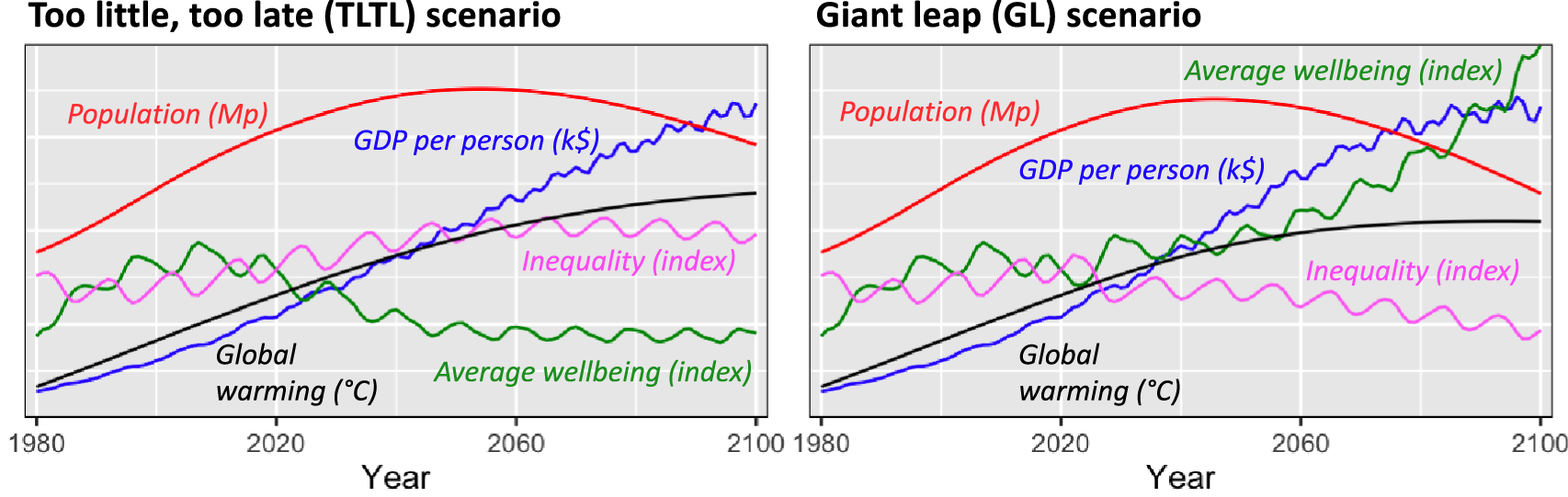
The TLTL scenario (Fig. 3) shows a rapidly increasing world population up to mid-century after which population peaks and starts to decline. The slowing population growth rate is well documented in the literature and reflects how increased access to health and education services enabled through increased incomes causes fertility rates to decline (Callegari & Stoknes, Reference Callegari and Stoknes2023). However, the world population in the TLTL scenario still increases by 10–20% which, together with the increases in incomes, implies significant increases in material consumption and environmental pressures up to mid-century. As a consequence, we see global average temperatures increasing to well above 2.0oC above pre-industrial levels. In the real world, this would imply (unacceptably) high risks of triggering several Earth system tipping points (McKay et al., Reference McKay, Staal, Abrams, Winkelmann, Sakschewski, Loriani, Fetzer, Cornell, Rockström and Lenton2022), worsening environmental damage throughout the century. Inequality continues to rise due to limited taxation as well as a limited public service provision.
In the GL scenario, we assume rapid and ambitious phasing in of the five turnarounds from 2022. In the long term, this leads to curbing of the global population growth which peaks and begins to decline around 2050. The slower population growth compared with the TLTL scenario is interpreted in the model as a consequence of decreased fertility rates due to substantial investments in poverty reduction, health, education and women's empowerment. In the GL scenario, the worsening within-country inequality seen since 1980 is curbed in the model world from the 2020s through progressive taxation and strengthening worker rights and trade unions as well as transfers including Universal Basic Dividend. The income per person continues to rise throughout the century but combined with significantly less environmental damage. This is achieved by first relative then rapid absolute decoupling of GDP from pollution including through electrification, abundant and cheap renewable energy, reforestation, regenerative agricultural practices and a smaller global population in the second half of the century. In this scenario, global warming is kept below 2oC throughout the century, with a declining trend toward 2100.
7. Results and discussion: determinants of human wellbeing over the next 80 years
The model's main megatrends lead to the wellbeing determinants outcomes as shown in Fig. 4. In the TLTL scenario, the wellbeing index declines from the 2020s onwards, despite increasing GDP, private incomes, and public spending per person. This is caused by rising inequality and escalating global warming which in turn also causes rising social tensions. These negative trends outweigh the positive impacts of rising incomes.
Scenario results for the five determinants (components) of global average wellbeing: disposable income, global warming, public spending per person, inequality, and observed rate of progress in wellbeing. The last graph shows the resulting average wellbeing index. Giant Leap (GL) - red solid line, and Too-Little-Too-Late (TLTL) - turquoise dotted line.
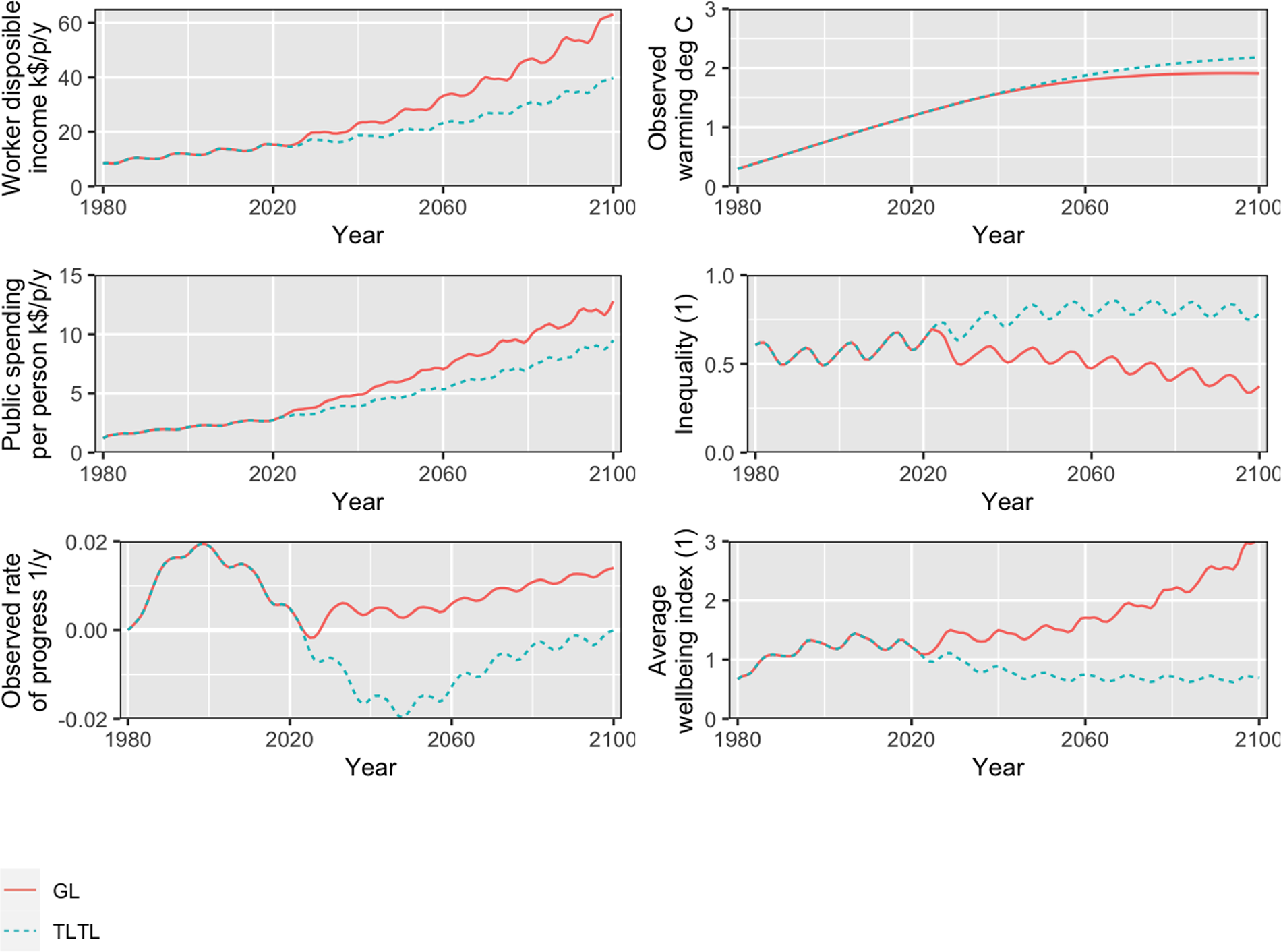
In the GL scenario, on the other hand, the decline in the wellbeing index seen since around 2000 is turned around during the 2020s and wellbeing starts to rise throughout the century. Inequality and environmental degradation are curbed by the exogenously introduced turnarounds from around 2022. The investments in rapid greening of food and energy systems also contribute to societal progress and a reduction in social tensions, feeding back and improving governments’ capacity for further action.
The megatrends and the resulting wellbeing in the model invite two important insights. Firstly, given the model's rather straight-forward structure, it shows how difficult it is to change the course of the world juggernaut: Despite very ambitious five turnarounds introduced in the GL scenario, the world only slowly shifts towards a more sustainable trajectory. Secondly, the five extraordinary turnarounds may nevertheless in the longer run be enough to considerably change the global course of the main constituents of human wellbeing. Although the bifurcation where future development of human wellbeing shifts from a negative to a positive trajectory may be difficult to judge and estimate, the behaviours resulting from the assumptions ingrained in our model suggest that the proposed policies may indicate what ambition level is needed for a more desirable global development.
Furthermore, the modelled wellbeing index illustrates that it is possible to gain an understanding of wellbeing that is compatible with global dynamics taking place in an integrated systems model. While for this analysis the chosen index conceptualizes wellbeing through five distinct components of individual, societal and nature wellbeing, it is possible to also investigate other indicators, such as the Human Development Index or the Sustainable Development Goals (Bernstein et al., Reference Bernstein, Collste, Dixson-Declève and Spittler2023). The exercise also highlights the need to endogenize relationships between the human world and biophysical Earth in order to design policies for societal transformations. Our modelling can provide cues for the designing of integrated policies to advance on the 2030 Agenda and what comes beyond (Dixson-Declève et al., Reference Dixson-Declève, Gaffney, Ghosh, Randers, Rockström and Stoknes2022), and support more transparent science–policy–society dialogues.
The current Earth4all-global model version, as all socio-economic models, comes with many limitations; its greatest value is probably in illuminating our questions by giving better general systems understanding rather than providing precise answers (Saltelli et al., Reference Saltelli, Bammer, Bruno, Charters, Di Fiore, Didier, Nelson Espeland, Kay, Lo Piano, Mayo, Pielke, Portaluri, Porter, Puy, Rafols, Ravetz, Reinert, Sarewitz, Stark and Vineis2020). The model findings, as presented in the Earth4All book (Dixson-Declève et al., Reference Dixson-Declève, Gaffney, Ghosh, Randers, Rockström and Stoknes2022) have therefore been accompanied with expert-consultation scrutiny by the Club of Rome's 30-member Transformational Economics Commission (Earth4All, 2023). It is crucial to mention that although the long-term future always is terra incognita, the further that critical planetary boundaries are transgressed, the less predictable the world is becoming.
Our scenarios explore the intersection between the knowledge-producing processes of global sustainability research, and the actions necessary to achieve global sustainability goals, e.g., in the form of policy implementation. This form of knowledge-action interface can be explored with different types of ‘boundary objects’, including models and scenarios (Franco-Torres et al., Reference Franco-Torres, Rogers and Ugarelli2020). Exploring the knowledge–action interface can allow research to more effectively contribute to translating knowledge to action (Cornell et al., Reference Cornell, Berkhout, Tuinstra, Tàbara, Jäger, Chabay, De Wit, Langlais, Mills, Moll, Otto, Petersen, Pohl and Van Kerkhoff2013; Fæhn & Stoknes, Reference Fæhn and Stoknes2023).
8. Concluding remarks
We asked: How can wellbeing for all be improved while reducing risks of destabilising the biosphere? We have shown, in a new simplified model at least, that this sustainability aim can (still) be achieved. The model outputs from the Giant Leap simulations display impacts of eliminating poverty, healthier diets and clean energy, as well as reducing inequality. Similar to other modelling efforts, the simulation displays a stabilised climate at below 2°C – given the extraordinary efforts relative to past decades. Even this level of warming would bring severe hardship and risks of extreme shocks at unprecedented scales, for example potentially simultaneous breadbasket failures. We also address the ‘how’. The GL scenario's five extraordinary yet plausible and quantified turnarounds that break with ‘decision-making as usual’ seen since 1980 quantifies the scale needed to achieve an increasing human wellbeing on a relatively stable planet by mid-century (in the model world).
Although plausible from a technical perspective, many elements of the five turnarounds characterizing the GL scenario are not consistent with current societal and economic trends. This is why the social policies and a significant political effort, coordinated at the global level, is required for similar outcomes to materialize in the real world. While this might be unlikely, our work shows that such a political shift would hold tremendous potential to contribute to the realization of human wellbeing on a finite planet.
While the GL scenario is far from a utopia, the TLTL scenario displays a gradual slide into what could plausibly become a series of interlinked catastrophes for humanity. It is possible that the widening wealth gap will fuel rising social tensions, this reduces societal cohesion and societies’ abilities to make long-term decisions on issues such as climate change. The global average temperature rises of the TLTL scenario would translate in the real world to profound implications for the long-term viability of societies in vulnerable coastal areas and in large parts of the tropics. Severe climatic and ecological instabilities bring more frequent and costly extremes relative to the pre-2020 world, worsening inequalities and claiming much higher shares of public spending just to maintain and repair after each worsening event. To better understand these effects, we recommend expanding research on damage functions and the social dynamics, especially their interlinkage with the economic system.
The Earth4All model can also be used to illustrate other transformation pathways, both ‘better’ and ‘worse’ than GL or TLTL. Among the novelties of our work is the inclusion of two indices that act as proxies for wellbeing and social tension. In the model we link social tension to perceived social progress. If people feel their standard of living is improving, then social tension will fall. If people feel they are falling further behind the ‘elites’ then social tensions could rise. The assumption is that strong societal cohesion is unlikely if tensions within societies are high, making it challenging to govern effectively for long-term outcomes. The GL scenario thereby requires strong societal cohesion and governments with a strong mandate to act decisively to transform economies.
We draw three key insights from this. First, if the world behaves in a similar vein as in our model, current increases in inequality risk driving deep divisions in society as elites move further away from the majority of society – contributing to rising social tensions, a pullback from democracy, and slow progress on existential challenges like climate change. Second, this trend seems set to continue unless there is a major turnaround. Economic policies in many places are likely to weaken trust in institutions and deepen inequalities. Societal progress is stagnating. This could make it increasingly difficult in the future to effectively address existential challenges. Third, ambitious actions to reduce social tensions and promote social progress will be key to building the necessary political support for the Giant Leap transformations to secure, as the IPCC Chair Hoesung Lee puts it, ‘a liveable and sustainable future for all’ (IPCC, 2023).
Supplementary material
The supplementary material for this article can be found at https://doi.org/10.1017/sus.2025.10013.
Acknowledgements
We gratefully acknowledge the whole Earth4All team for initiating the project, and the Earth4All modeller Ulrich Goluke who also provided scenario design and narratives together with PES. We are also grateful for Felix Barbour who assisted with regressions, assisted in the writing of the paper and documented analysis in the global guides.
Author contributions
P.E.S. initiated the project, contributed to the building of the Earth4All model and narratives with inputs from the rest of the team, and was main editor of the paper. D.C. wrote the initial draft of the paper, and contributed to model building, testing and analysis, including providing country, regional and global time series data. N.S. co-wrote the paper, worked on the model co-edited the paper and worked on the revision. BC and SEC contributed and co-edited the paper. J.R. conceptualised the model, programmed it in Vensim, and provided the technical note.
Financial support
The Earth4All initiative, hosted at Club of Rome, and co-funded by Bennett foundation and Laudes Foundation. David Collste also acknowledges part-funding by a joint grant to FAIRTRANS from Mistra (DIA 2019/28) and Formas via the national research program on climate (2021-00416). Sarah Cornell also acknowledges part-funding by the European Research Council through the grant ERC-2016-ADG-743,080 (the Earth Resilience in the Anthropocene project).
Conflict of interest
All authors declare that they have no conflicts of interest.
Data Availability
All used data are open source. See supplemental materials.


 Open access

