




Introduction
This article revisits one of the most enigmatic pictorial programs in the religious manuscripts of Late Postclassic and early colonial Central Mexico: the 11 painted plates on the reverse of the Codex Cospi (21–31). Its aim is to propose a new interpretation of its imagery, which also offers insights into its original use and its relationship with the sections previously painted on the codex’s obverse. Since Seler’s first intuition (1901–Reference Seler1902:59–60) and especially following the seminal work of Nowotny (2005 [Reference Nowotny, Everett and Sisson1961]), the contents of the Cospi reverse have been understood as depictions of offerings—specifically, bundles of counted objects arranged in precise configurations, in ways reminiscent of ritual performances still observed in present-day Indigenous communities.
I concur that this series concerns gifts to the gods and that it refers to prescriptions or protocols for making ritual deposits, as also argued by Loo (Reference Loo, Boone and Mignolo1994) and Boone (Reference Boone2007). Yet, my interpretation differs in identifying the materiality and the recipients of the offerings, as well as in the reading of the ritual protocols governing the rituals. My analysis approaches the Cospi reverse not primarily through comparison with modern offering ceremonies, but rather through the identification of nearly all its graphic elements by relating them to the iconography of parallel passages in the Borgia Group—the corpus to which the Cospi belongs. This comparative method enables recognition of what these graphic elements represent and how they interact within each image. My interpretation is likewise informed by historical and archaeological data that illuminate Postclassic Central Mexican religion.
This research also builds upon a recent discovery regarding the life history of the Codex Cospi, derived from an examination of its physical features and materiality. In 2021, my inspection of the original manuscript confirmed what several scholars had suspected about its creative process: the paintings on the obverse predate those on the reverse. In fact, the reverse pictorial program was added on a strip of skin appended to an earlier version of the codex (Figure 1), which originally consisted of 15 plates (Dupey et al. Reference Dupey García, Buti, Domenici, Domenici, García and Olivier2026). Before that finding, it had been noted that the pictorial styles and chromatic palettes of the two sides differ sufficiently to suggest that they were produced by distinct teams of artists, though both worked within the Mixteca-Puebla artistic tradition (see recent syntheses on these topics in Buti et al. Reference Buti, Grazia, Domenici, Dupey García, Cartechini, Romani, Rosi, Miliani and Domenici2026; Yanagisawa and Dupey Reference Yanagisawa, Dupey García, Domenici, García and Olivier2026). This observation is further supported by a feature noted since the late nineteenth century: the right-to-left reading direction of the reverse requires a 180° rotation of the codex after consulting the obverse, which is read from left to right (Paso y Troncoso Reference Paso y Troncoso1898). Altogether, these data suggest that the codex changed hands, and that the reverse was likely created in a different temporal and spatial context (Domenici et al. 2019:170–171).
The physical structure and thematic contents of the Codex Cospi. Drawing by Davide Domenici, reproduced with permission. Further reproduction prohibited.

Figure 1 Long description
Structure of the Codex Cospi. A clean schematic diagram shows an accordion folded strip drawn as a zigzag line running horizontally across the middle. Small numbers are printed along the folds to mark the plates of the codex. Four measurement labels appear on the zigzag: 2.3 cm, 1.5 cm, 3 cm, and 2 cm. Above the zigzag, a heading reads OBVERSE. Section titles are spaced across the top with vertical divider marks between groups. The titles read Tonalpohualli in extenso, Venus table, Directional Almanac and Unpainted plates. A label reading Added section appears above a horizontal bar. Below the zigzag, a heading reads REVERSE. Two section titles appear below with divider marks: Unpainted plates and Protocols for rituals. At the far left and far right edges, vertical arrows point upward. Text near the left arrow reads Front cover. Text near the right arrow reads Back cover. Language: English.
A resulting question is why the creators of the Cospi reverse chose to combine their work with a tonalamatl—the Cospi obverse—containing representations of the 260-day count, or tonalpohualli in Nahuatl, the primary language of Postclassic Central Mexico and probably that of the Cospi’s makers (Paso y Troncoso Reference Paso y Troncoso1898). This problem seems to me particularly relevant because, beyond material and stylistic differences, the thematic contents of the reverse diverge considerably from the 260-day count and its associated deities depicted on the obverse. Thus, while we can assume that the obverse’s images were used by a Nahua group for divination, the reverse—though it features gods and calendar dates—likely had a different use. In this regard, a remarkable feature of this section is the inclusion of numerals positioned in the lower half of the plates, suggesting they play a structural role within the images (Figures 2–4).
Codex Cospi, Ms. 4093, Biblioteca Universitaria di Bologna, plate 21. © Alma Mater Studiorum Università di Bologna, Biblioteca Universitaria di Bologna. Further reproduction or duplication by any means is prohibited.
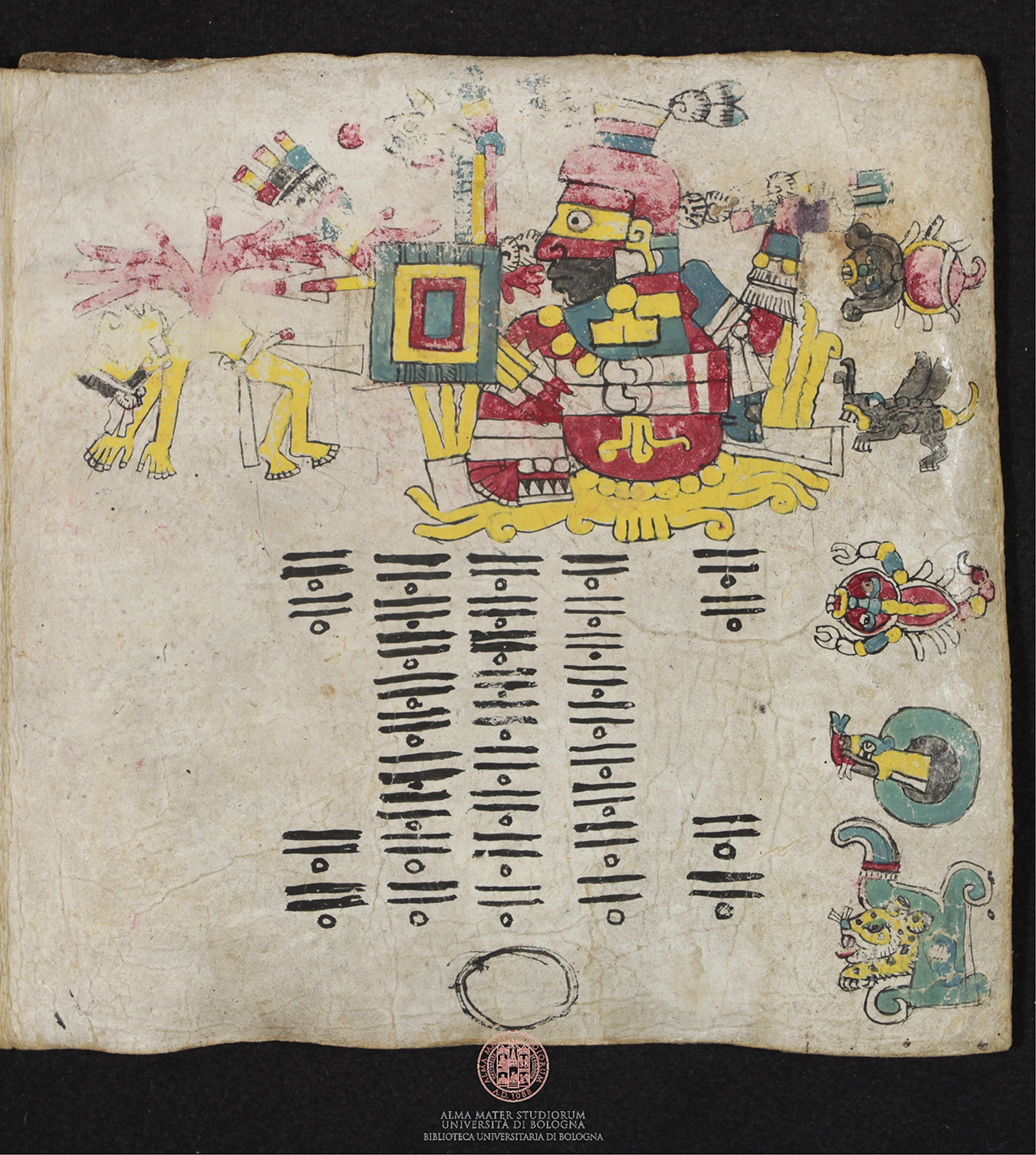
Figure 2 Long description
A painted codex page with a central seated figure drawn with geometric shapes and patterned clothing. The figure has a large headdress and holds a shield at the left side of the body. The representation of a fire sits under the figure. Several smaller stylised figures and animal-like forms appear around the central figure, including one at the left side and multiple at the right side. The lower half of the page contains multiple vertical columns made of repeated dot-and-bar marks. Each column is arranged as stacked groups of short horizontal bars with small round dots placed above or beside the bars. Near the bottom centre is an oval outline. No readable alphabetic text is visible.
Codex Cospi, Ms. 4093, Biblioteca Universitaria di Bologna, plate 25. © Alma Mater Studiorum Università di Bologna, Biblioteca Universitaria di Bologna. Further reproduction or duplication by any means is prohibited.
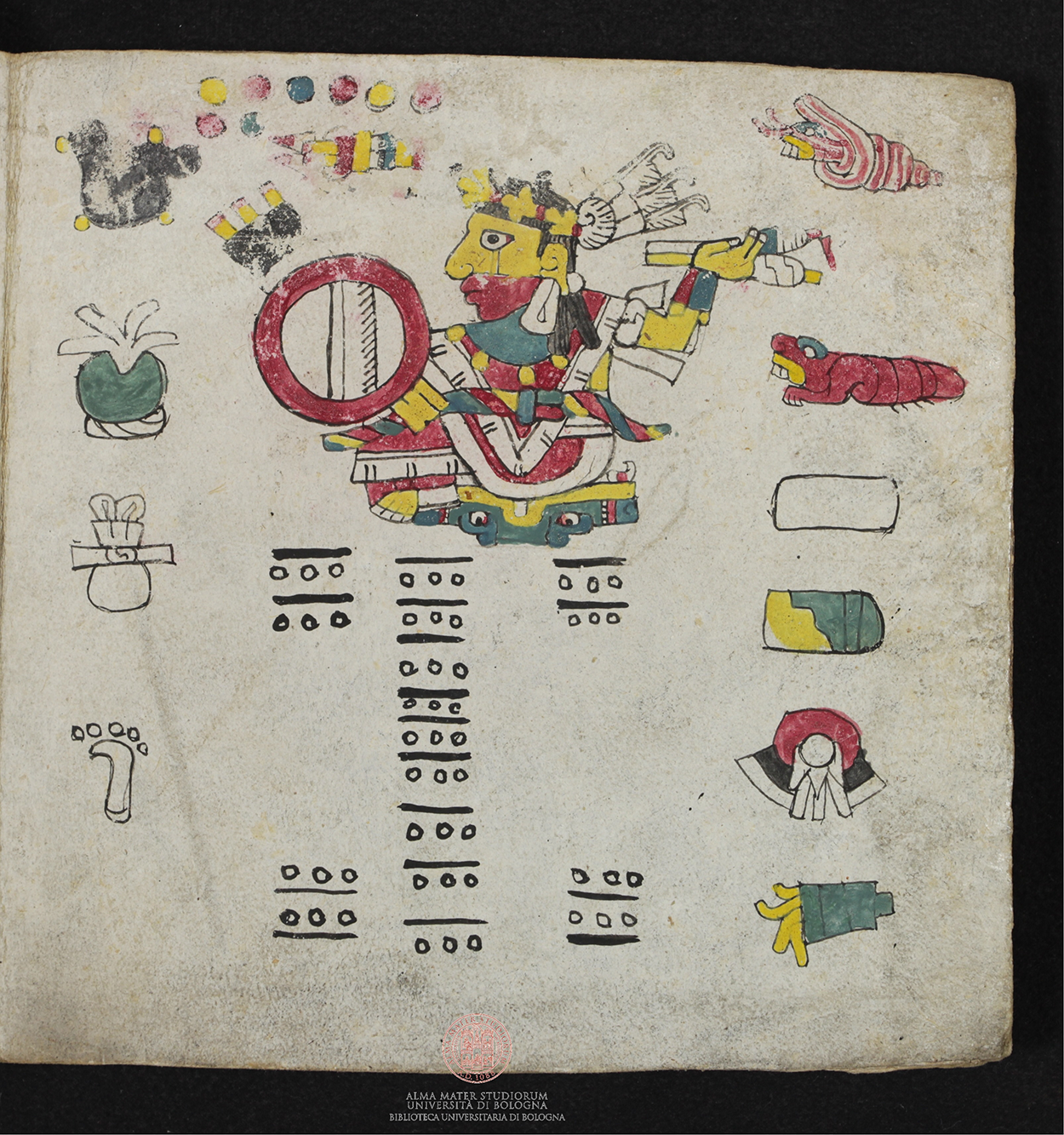
Figure 3 Long description
A codex page with a central seated figure . The figure has a human-like body with multiple limbs extending outward, including an arm raised to the right and another extended to the left. The head has a large eye and a mouth and the figure wears layered clothing with bands and geometric sections. Above the figure, a row of small circular symbols runs near the top edge. To the left of the figure, several smaller stylised figures appear, including a rounded object with a short stem-like top and another small symbol below it. To the right of the figure, a long horizontal animal-like form is drawn and below it are two separate rectangular shapes. Below the central figure, multiple groups of dot-and-bar marks are arranged in vertical columns. The marks are grouped into stacked rows, with dots aligned in lines and short bars placed alongside or above the dots. Additional smaller dot-and-bar groups appear to the lower left and lower right of the main columns. Near the lower right area, a small head-like symbol with a circular top and a face-like center appears above a small separate symbol. The overall style uses outlined forms with flat filled areas and minimal background detail.
Codex Cospi, Ms. 4093, Biblioteca Universitaria di Bologna, plate 27. © Alma Mater Studiorum Università di Bologna, Biblioteca Universitaria di Bologna. Further reproduction or duplication by any means is prohibited.
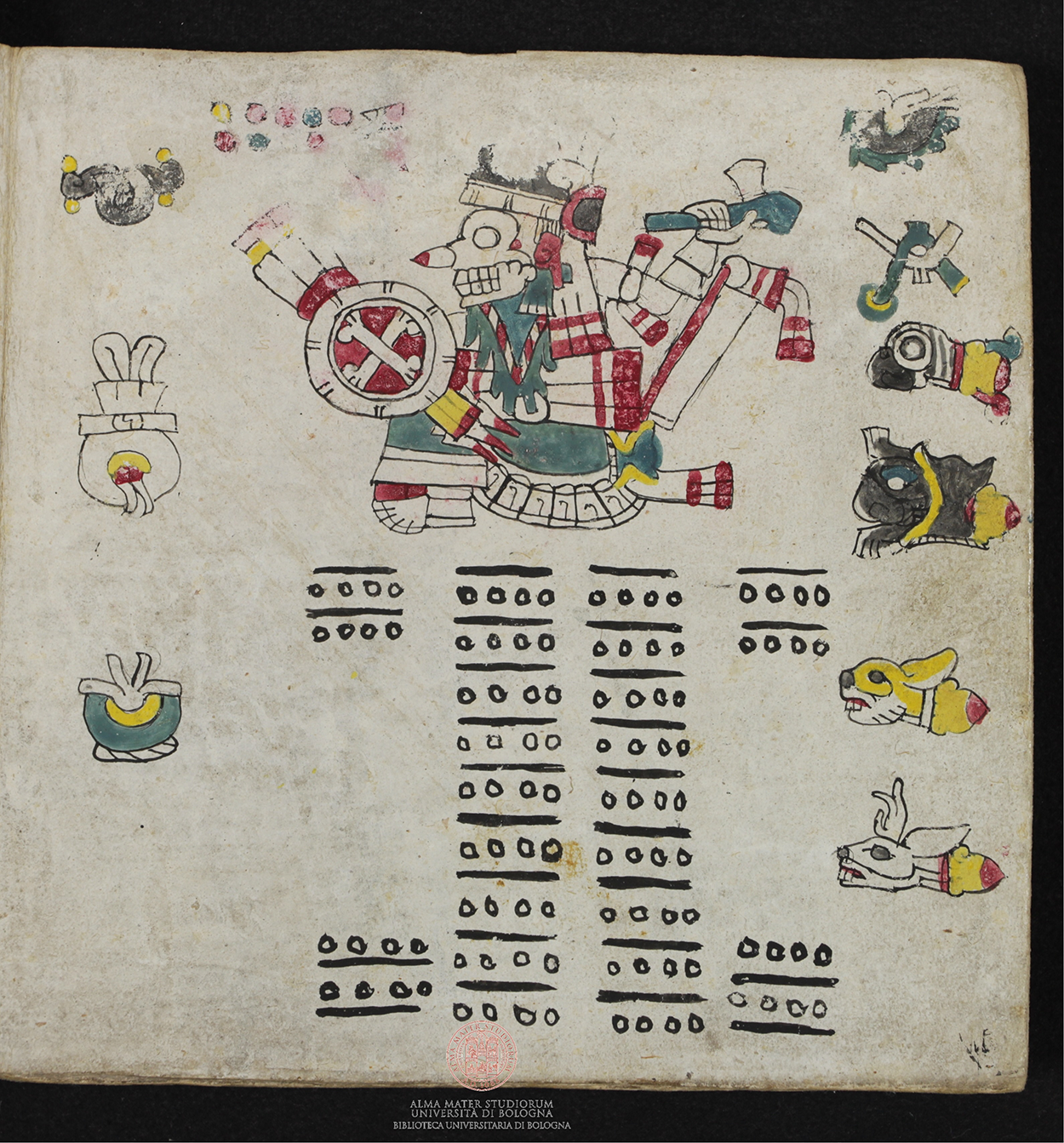
Figure 4 Long description
A codex page with a large seated figure placed near the upper center. The figure faces left and has a tall headdress. The figure’s arms extend outward and the body is covered with patterned bands and blocks. A circular object with crossed lines is positioned in front of the figure. Small separate stylised figures are arranged around the central figure near the page edges. At the upper left is a small animal-like form and a short row of small marks. Along the left side are two separate symbols, one above the other. Along the right side are several small figures and objects placed in a vertical arrangement, including a small animal-like form near the lower right. Below the central figure, the lower half of the page contains multiple horizontal rows of evenly spaced dot-and-bar marks. The groups are arranged in a stepped, block-like layout, with a wider cluster near the middle and narrower clusters toward the left and right.
Although the composition of the reverse differs from that of the obverse, its content is not unique. Other Borgia Group codices include sections prominently featuring numerals (Figures 5–8). The Codex Fejérváry-Mayer (5–14) contains a section with numerals comparable in length and structure to that of the Codex Cospi (Seler 1901–Reference Seler1902) and other plates with numerals and minimalist compositions of iconographic elements (15–22, 43). The Codex Laud (17–22, 45–46) provides more elaborate imagery, in particular two plates which offer a clearer indication of the ritual actions to be performed. Collectively, the sections with numerals of these three manuscripts constitute roughly one-eighth of the Borgia Group contents (Nowotny 2005 [Reference Nowotny, Everett and Sisson1961]). Therefore, while these sections are distinctive, they are neither exceptional nor marginal within the corpus. My interpretation posits that, even if these series were not directly linked to the 260-day divinatory practice, they probably maintained a connection to the tonalamatl that the Cospi originally was, prompting the question: why was this section with numerals incorporated into the reverse, while the obverse was initially dedicated to tonalpohualli-based divination?
Additionally, not only does the Cospi reverse share with the Fejérváry-Mayer and the Laud certain sections exhibiting strong parallels in content, but these codices also have common formal and material traits (Anders et al. Reference Anders, Jansen and van der Loo1994a; Boone Reference Boone2007; Buti et al. Reference Buti, Grazia, Domenici, Dupey García, Cartechini, Romani, Rosi, Miliani and Domenici2026; Domenici et al. Reference Domenici, Miliani, Buti, Brunetti, Sgamellotti, García and de Ágredos Pascual2018; León-Portilla Reference León-Portilla1985; Seler 1901–Reference Seler1902). This raises another question concerning the Cospi’s relationship with these “twin codices,” regarded as such due to the similarity of their pictorial techniques—greatly celebrated for their precision in line drawing, color use, and image composition. By contrast, the Cospi reverse shows a less refined pictorial technique (Figures 2–8). Consequently, I also examine the connections between the reverse section of the Cospi and the “twins,” reflecting on both the features that unite these codices and those that differentiate them.
Codex Fejérváry-Mayer, M12014, World Museum, Liverpool, plate 11. Courtesy National Museums Liverpool, World Museum.
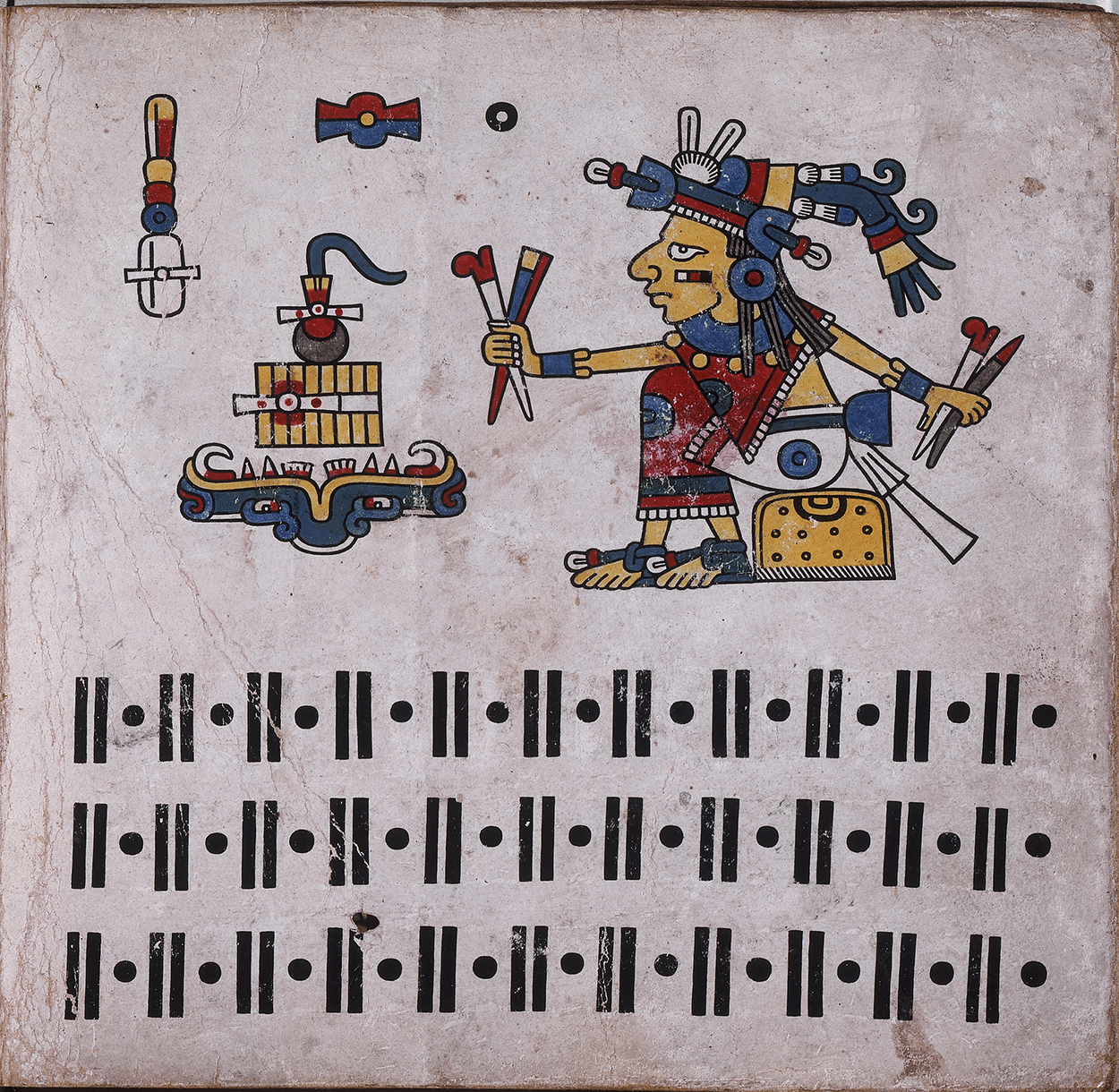
Figure 5 Long description
A codex page. On the right, a seated figure is shown in side view facing left. One arm extends toward the left. The figure wears a large headdress with multiple bands and ornaments, ear ornaments and patterned clothing. The other arm is bent, holding small objects. A long, narrow object is positioned behind the figure. On the upper left, several separate stylised figures appear. One symbol is a vertical object with stacked sections. Another symbol is a small horizontal shape. Another symbol is a small circle. Below these, a larger symbol shows a seated figure on a base-like form, with a curved element rising above it. Near the extended hand, a small upright symbol with short projections is placed. Across the bottom half of the page, repeated numeral groups made of vertical bars and round dots are arranged in multiple horizontal rows. Each group combines bars and dots in a consistent dot-and-bar style.
Codex Fejérváry-Mayer, M12014, World Museum, Liverpool, plate 6. Drawing by Nicolas Latsanopoulos, reproduced with permission. Copyright retained by the artist. Further reproduction prohibited.
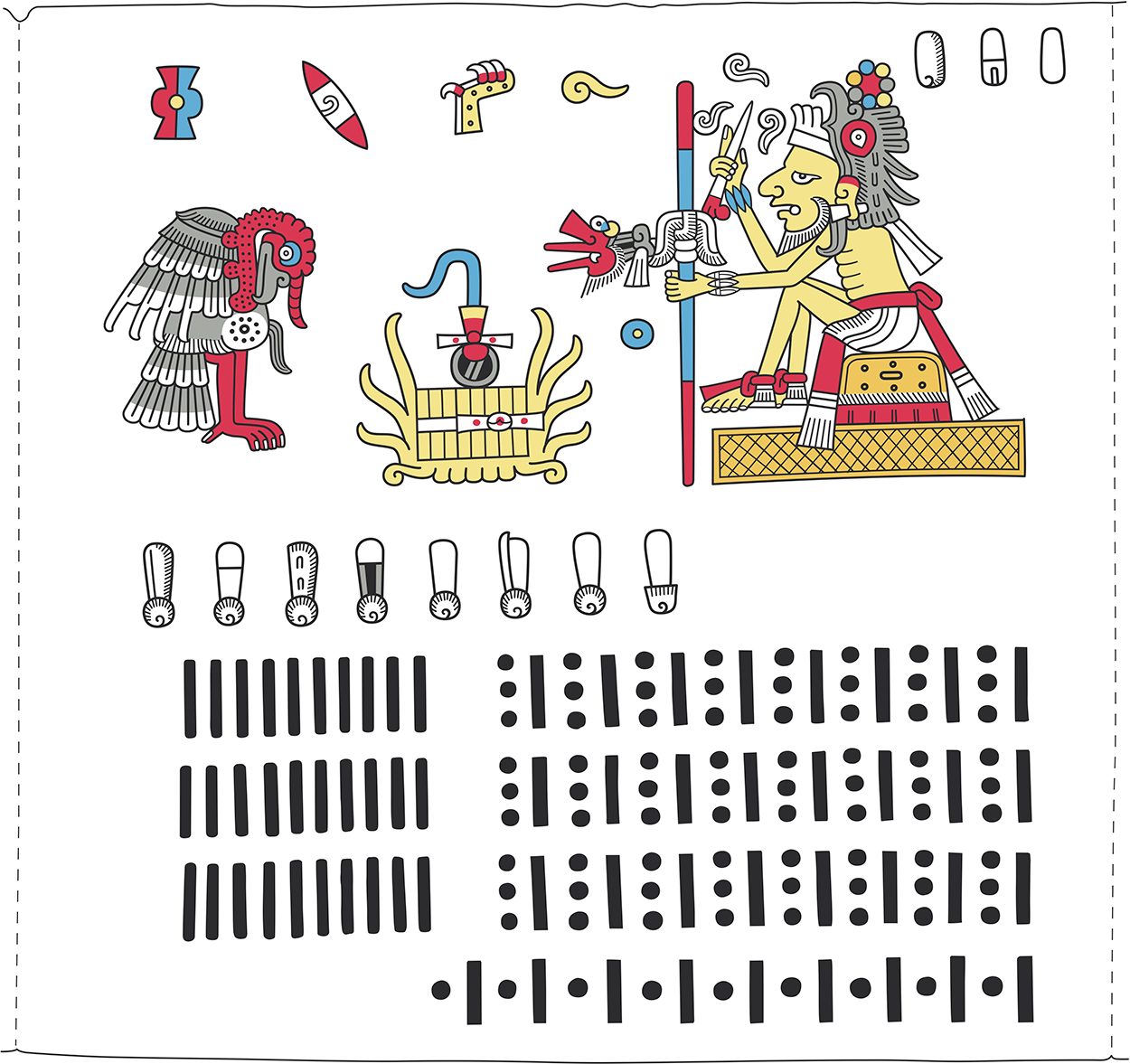
Figure 6 Long description
A codex page with two figures facing each other across the middle of the scene. On the right, a seated anthropomorphic figure sits on a platform. The figure faces left and holds a long vertical staff. One arm extends toward the center. On the left, a standing zoomorphic figure faces right. The figure has a large wing behind the body . Between the two figures is a small central motif with curved lines and small shapes around it. Along the top are several small, separate glyph-like symbols spaced across the width. Below the figures are multiple rows of repeated marks arranged in groups. Some rows show vertical bar marks. Other rows show dot marks arranged in columns. A final row combines dots and vertical bars in grouped sequences.
Codex Laud, Laud Misc. 678, Bodleian Library, plate 46. © Bodleian Libraries, University of Oxford. Terms of use: Creative Commons, https://creativecommons.org/licenses/by-nc/4.0/.
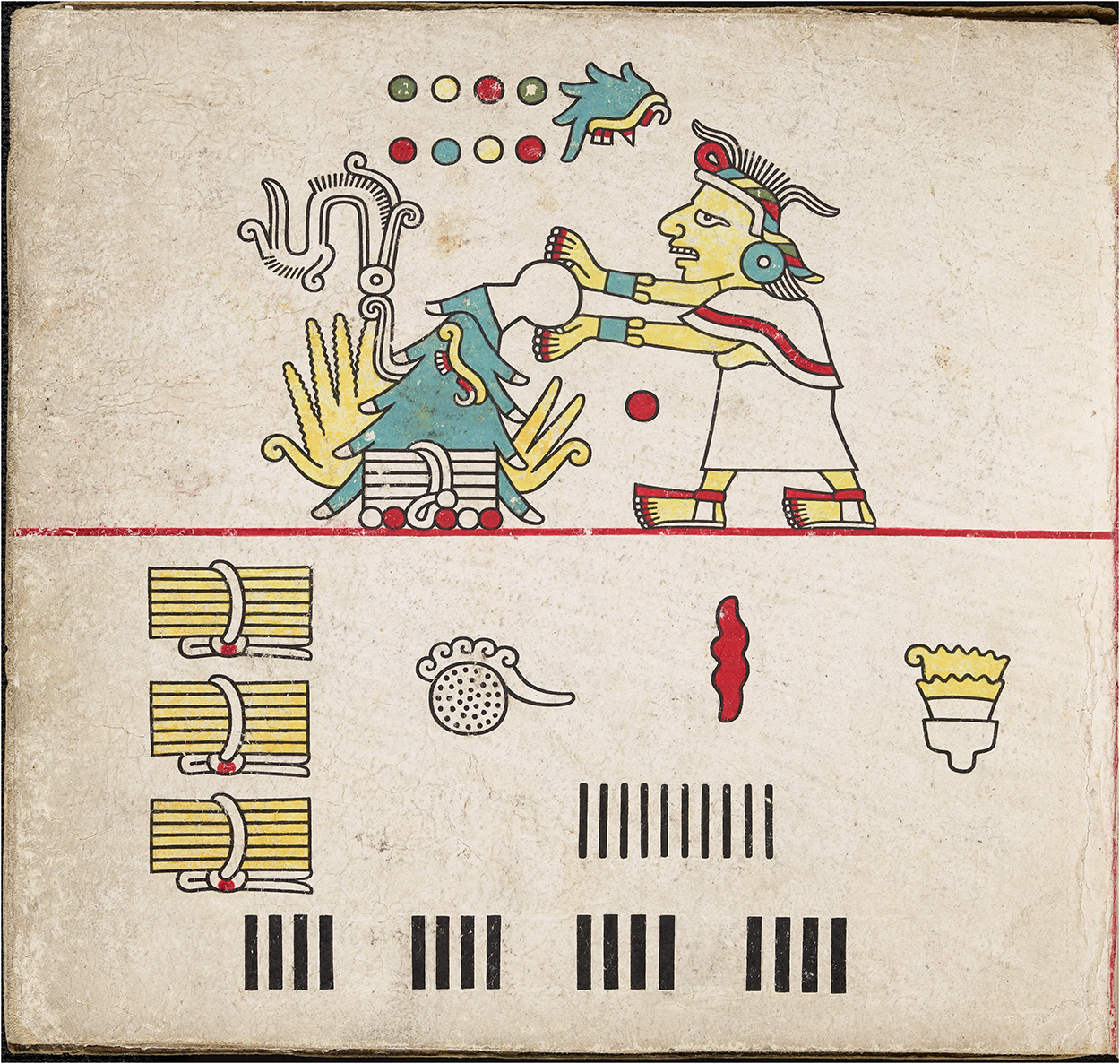
Figure 7 Long description
A codex page with two horizontal sections separated by a single horizontal line. In the upper section, the representation of a fire is on the left. . On the right, a standing figure faces left and extends her arms toward the fire to throw water with a gourd. The water glyph is positioned above the standing figure’s head. Several small circular dots are arranged in rows above the two figures. Additional small circular dots appear near the figures. In the lower section, three stacked rectangular bundle-like symbols are placed on the left. Near the center-left is a circular, spiral-like symbol . Near the center is a single red vertical wavy shape. On the right is a small object with a stepped top and a wider base. Along the bottom are multiple groups of short vertical bars arranged in rows.
Codex Laud, Laud Misc. 678, Bodleian Library, plate 45. © Bodleian Libraries, University of Oxford. Terms of use: Creative Commons, https://creativecommons.org/licenses/by-nc/4.0/.
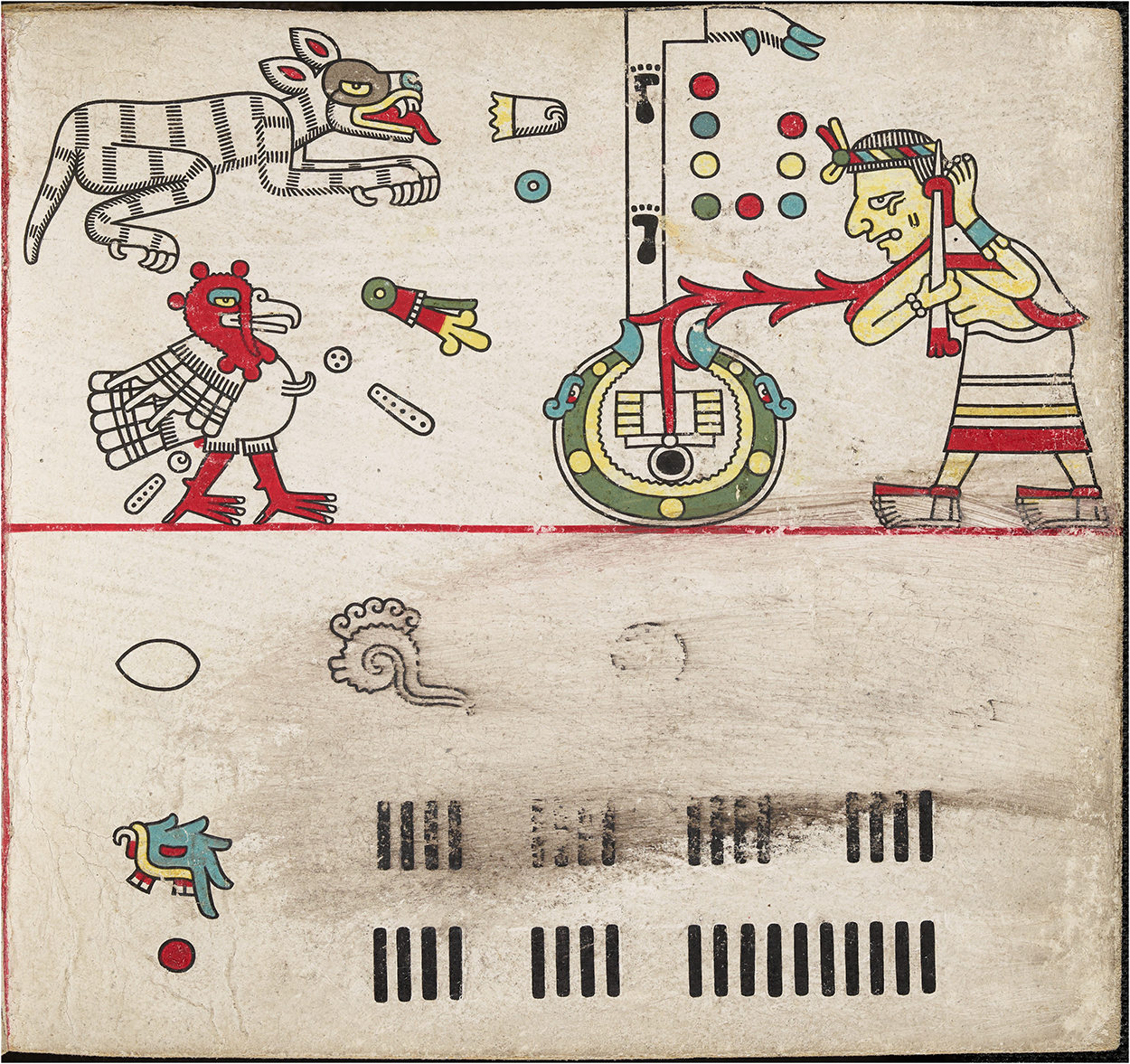
Figure 8 Long description
This codex page shows figures on the left side, one resembling a dog and the other a turkey. Both figures are adorned with intricate designs. On the right, a human figure is depicted percing her ear from which a flow of blow is gushing. Above the blood, there are circular symbols and a vertical arrangement of dots and lines. Below, there are additional symbols including an oval shape, a spiral and the water glyph. A series of vertical lines are arranged in rows, possibly representing numerals.
The Cospi reverse: Structure, iconography, and scholarly interpretations
The 11 painted plates on the reverse of the Cospi display recurring graphic elements arranged in comparable ways. A distinctive feature—linking them to their counterparts in the Fejérváry-Mayer—is the absence of red separating lines between these elements (Figures 2–6), unlike in the Cospi obverse and in the other Borgia Group sections that were used for tonalpohualli-based divination (Boone Reference Boone2007:160). Instead, each plate features, in the upper register, a seated anthropomorphic figure adorned with complex paraphernalia, and, in the lower register, series of black circles and horizontal bars (Figures 2–4).
The anthropomorphic figures are generally accepted as representations of Nahua deities—though they also correspond to Mixtec divine and mythical beings (Laurencich Reference Laurencich Minelli1992)—for the figures exhibit the typical adornments of such entities in Postclassic and colonial imagery. Through comparative analysis with other codices and historical sources, these deities have been identified, albeit with some divergences (Table 1). In the first plate of the series, a scene of heart-extraction sacrifice is displayed before the god (Figure 2). The victim is a nude male with attributes identifying him as a war captive. He lies face up, back arched, with an opening in his chest from which jets of blood gush forth. The presiding god witnesses the sacrifice, seated on a yellow form with ascending and undulating scrolls. These can be recognized as flames, for they are identical to depictions of fire in the codices Fejérváry-Mayer and Laud (Figures 6, 7, 10). Two other deities occupy “seats” in the Cospi: the goddesses in plates 25 and 26 sit atop the open jaws of the Earth Monster (Figure 3).
Divinities depicted in plates 21–31 of the Cospi and their accompanying tonalpohualli dates
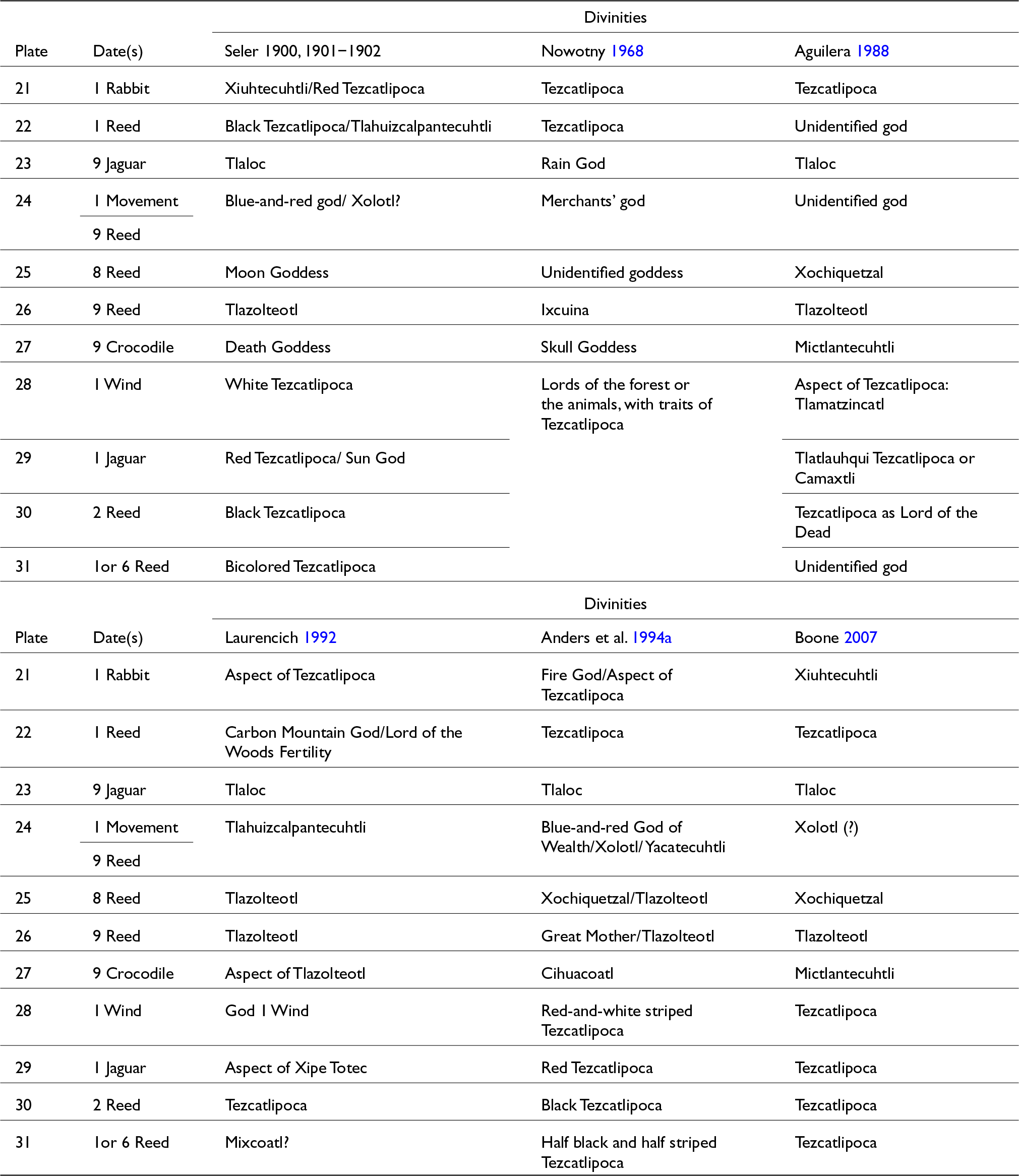
Table 1 Long description
The table lists the gods represented on plates 21 through 31 of the Cospi reverse, their tonalpohualli date or dates, identified by six different scholarly sources. Tezcatlipoca dominates the identifications: plate 21 is usually Tezcatlipoca or Xiuhtecuhtli as a Tezcatlipoca aspect, and plates 22, 28, 29, 30, and 31 are frequently labeled Tezcatlipoca with varying color or role descriptors such as black, red, white, bicolored, or lord of the dead. Plate 23 is the strongest point of agreement, with all sources naming Tlaloc or the Rain God for the date 9 Jaguar. Plate 24 is disputed, variously identified as Xolotl, Tlahuizcalpantecuhtli, a merchants’ or wealth deity, or left unidentified, and it includes an additional date entry of 9 Reed. Plates 25 and 26 tend to cluster around female deities, most often Xochiquetzal and Tlazolteotl, though some sources mark plate 25 as unidentified or blend the two. Plate 27 shows major disagreement, ranging from death or skull goddess and Cihuacoatl to Mictlantecuhtli or an aspect of Tlazolteotl. Several entries are explicitly uncertain or unidentified, so the table reflects interpretive variation rather than a single definitive identification.
Below the divine entities, in the lower section of each plate, appear the clusters of bars and circles. Since the first studies of the Cospi, these were interpreted as numerical notations following the Mesoamerican bar-and-dot system (Paso y Troncoso Reference Paso y Troncoso1898; Seler 1990 [Reference Seler and Bowditch1900]). Specifically, we see combinations of circles and bars forming the numbers 6, 7, 8, 9, and 11, repeated 2, 3, 7, 8, 9, 10, or 11 times. In addition, the first four plates feature a larger black circle positioned either to the left or below the bars and dots (Figure 2). Other numerals take the form of small colored disks and accompany calendrical signs; they are placed in the upper left-hand area, before each deity. These correspond to tonalpohualli dates—the only ones in the codex reverse. However, according to Nowotny (2005 [Reference Nowotny, Everett and Sisson1961]), this section should not be understood as an allusion to the 260-day count. The prevailing interpretation holds that these tonalpohualli dates are related to the deities and represent their calendrical names (Seler 1901–Reference Seler1902, 1990 [Reference Seler and Bowditch1900]; Nowotny 2005 [Reference Nowotny, Everett and Sisson1961]) (Table 1). Finally, along both edges of the plates run vertical rows of animals and objects, some of them difficult to identify at first glance.
The bar-and-dot numerals on the Cospi have generated extensive scholarly debate. At the turn of the nineteenth and twentieth centuries, Paso y Troncoso (Reference Paso y Troncoso1898) and Seler (1901–Reference Seler1902, 1990 [Reference Seler and Bowditch1900]) noted that these numerals differ from the conventional numerical notation of Postclassic Central Mexico, where both the dot and the bar were employed to denote the number one. Thus, they argued that the Cospi’s numerals—like those of the Fejérváry-Mayer and the Laud—reflect the adoption of Maya arithmetic symbols. Paso y Troncoso suggested that this might indicate the use of the Maya system in certain regions of Central Mexico, perhaps in areas bordering on or interacting with Yucatan. Seler proposed that while the calculations related to the numerals remain obscure, they might represent astronomical computations, as in the Maya codices. For the German scholar, the Cospi reverse constituted a manual for sorcerers, who copied these numerals from another source—without comprehending their meaning—to employ them for magic. This idea was later strongly criticized (Anders et al. Reference Anders, Jansen and van der Loo1994a:24–25; García Reference García Granados1939).
A paradigmatic shift in the understanding of the Cospi reverse took place in the 1960s, when Nowotny (Reference Nowotny1968, 2005 [Reference Nowotny, Everett and Sisson1961]) argued that this section—like the Fejérváry-Mayer plates with numerals—referred to ritual practices, precisely hunting rituals involving counted offerings. Drawing on ethnographic fieldwork conducted by Schultze Jena in the 1930s, Nowotny observed formal parallels between the Cospi plates and the offering tables created by the Tlapanecs of Guerrero and the Mixtecs of Oaxaca. He summarized these rituals as follows:
Today only old statues are used…In the fire sacrifice, a mat, a stone or a large leaf serves as an altar. Leaves or reed stems are placed on this altar, followed by flowers. Before the ritual, these sacrificial gifts are counted exactly and tied together. These gifts are placed in rows in a precisely determined sequence. Bunches are placed at the four corners for the feared souls of the dead. The additional bundles atone for errors of omission and commission during the ritual. The other sacrificial gifts consist of lighted candles, copal, turkey blood and pulque (Nowotny 2005 [Reference Nowotny, Everett and Sisson1961]:302).
Connecting this ritual practice to the Cospi, Nowotny interpreted the numerals as the tied bundles placed upon the altar, before the deities, while the lateral elements represented the accompanying gifts. He further subdivided the Cospi reverse into three subsections: rituals against poisonous animals, messengers of the Lord of the Mountain (21–24); rituals against crop pests (25–26); and rituals for expiation after hunting or for propitiating hunting (27–31) (Figures 2–4).
Nowotny’s interpretation was subsequently adopted and refined by most scholars (Aguilera Reference Aguilera García1988; Anders et al. Reference Anders, Jansen and van der Loo1994a; Boone Reference Boone2007; Laurencich Reference Laurencich Minelli1992; Loo Reference Loo1987, Reference Loo, Boone and Mignolo1994). Loo (Reference Loo1987:106) added an important observation: while the numerals were indeed common among the Maya, the same graphic convention appeared at Xochicalco and Monte Albán. Thus, Anders et al. (Reference Anders, Jansen and van der Loo1994a:23–24) argued that these numerals “cannot serve as an argument for locating the place of origin of the Codex Cospi and its parallels in or near the Maya region.” Boone (Reference Boone2007:161) further noted that similar numerals were used at Cacaxtla and in the Mixtec codices, where they functioned as quantitative records.
In sum, the Cospi reverse has generated different interpretive traditions, primarily stemming from the numerals depicted in this section. While I concur that these numerals are key to understanding the plates’ meaning, I also argue that the interpretation must consider not only their formal arrangement—which led Nowotny and his followers to compare them with modern ritual practices—but also their broader context within the Cospi and the Borgia Group. Specifically, I posit that it is necessary to establish a dialogue between the numerals, the deities, and the accompanying elements, for all these components are crucial to unlocking the full meaning of these images.
The divine effigies of the temples
Beyond the individuality of the gods depicted on the Cospi reverse, I focus first on their posture and paraphernalia. It is significant that they all share a seated position, with legs bent and drawn up toward the chest. These are covered by a large cloak in the case of the male deities and by a skirt in the case of the goddesses, with only the feet remaining visible. Their arms also show the same configuration: one extended forward and the other drawn backward. The forward hand holds a shield and a bundle of projectiles, while the other grasps a spear-thrower or an axe, raised in an attitude of attack. The sole exception is the goddess on plate 25, who holds a pair of spindles with bundles of thread (Figures 2–4).
Through comparison with other pre-Hispanic and colonial manuscripts, I argue that the anthropomorphic figures in the Cospi exhibit the defining characteristics of the divine effigies venerated in temples by the Nahua and other Postclassic Central Mexican societies. This identification is confirmed by a detail seen in the Cospi obverse (4), where we observe an individual seated within a temple, his body wrapped in a cloak that conceals his arms and feet. His diminutive body, particularly in relation to the size of his head, suggests that he sits with his legs bent and drawn up toward his torso (Figure 9a). In the same section of the obverse, other characters with similar features sit on thrones (Cospi 3, 6–8) (Figure 9b). In the central section of the Borgia (37, 40, 45), the same kind of thrones are shown inside temples, occupied by deities who are seated but do not wear cloaks.
(a–b) Codex Cospi, Ms. 4093, Biblioteca Universitaria di Bologna, plates 4, 8 (details). © Alma Mater Studiorum Università di Bologna, Biblioteca Universitaria di Bologna. Further reproduction or duplication by any means is prohibited.
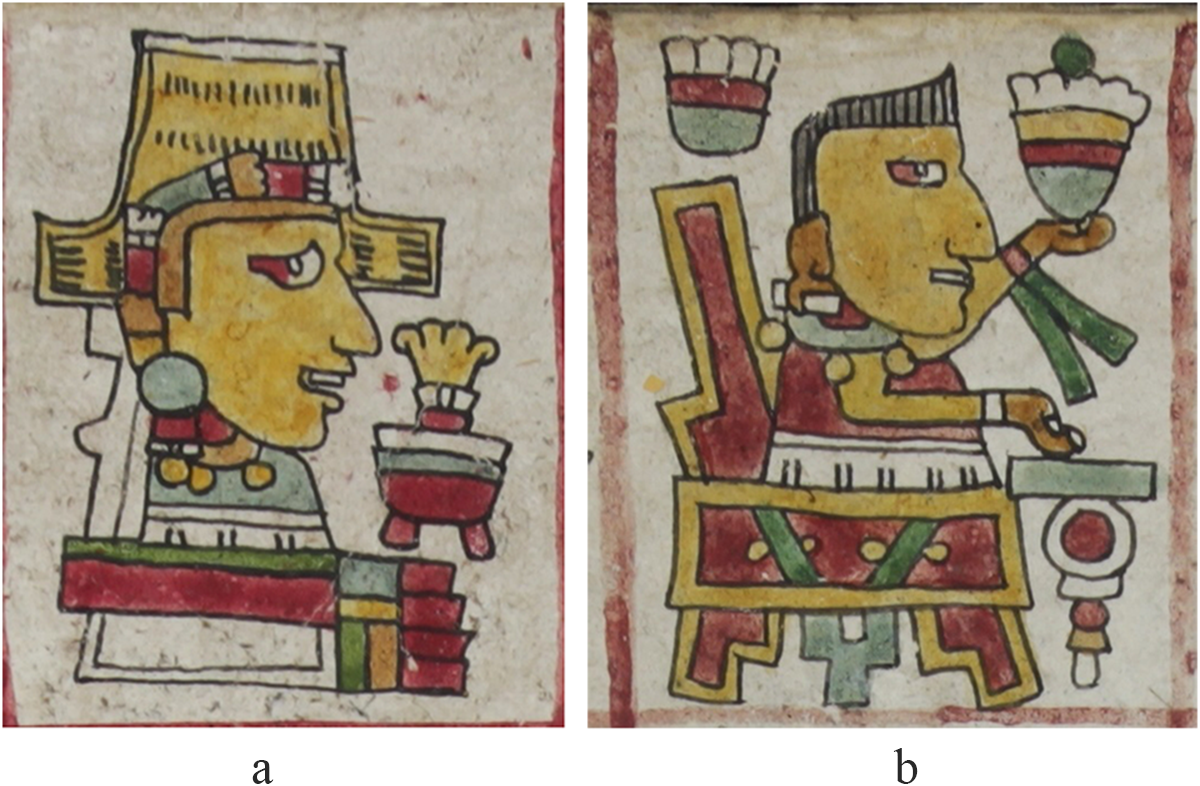
Figure 9 Long description
The image consists of two illustrations labeled a and b. Illustration a shows an anthropomorphic figure seated in a temple in front of a bowl with offerings. The figure is adorned with decorative elements around the neck and waist. Illustration b depicts another anthropomorphic figure seated on a throne, holding a cup. This figure has a distinct hairstyle and wears decorative elements around the neck and waist. Both figures are stylized with bold outlines and geometric patterns.
In the Fejérváry-Mayer (23–25, 30–32, 35–36) and the Laud (2, 13, 15), we also find figures wrapped in textiles and seated on thrones or stools lined with jaguar skin, their legs hidden or drawn up toward the chest. In the plates 30–32 of the Fejérváry-Mayer, these seats appear within temples, occupied by divine effigies. In other scenes, the seats are absent, yet the effigies display features I recognize as typical of cult images in sacred precincts: they are seated, their bodies—and sometimes their limbs—wrapped in a cloak, with legs bent and drawn toward the chest (Fejérváry-Mayer 33–34; Laud 32, 39) (Figure 10). Additionally, the Laud and some colonial manuscripts depict divine effigies sitting in similar postures and garments atop pyramidal platforms, in front of which rituals are performed (Codex Laud 6; Codex Magliabechiano f. 87r; Codex Tudela 2002:f. 73r) (Figure 11). An image from Durán’s Historia is particularly revealing (Figure 12), for the accompanying text identifies it as the sculpture of Tezcatlipoca as it appeared in the temples of Tenochtitlan and Tetzcoco:
They had this idol in a temple…sitting on a wooden seat, dressed in a colored cloak adorned with skulls and crossed bones, holding in his left hand a white shield with five cotton balls…and in his right a throwing stick; threatening with it, his outstretched arm seemed ready to strike…Four arrows protruded from the shield. (Durán Reference Durán, Camelo and Galván1995:vol. 2, p. 56)
Codex Laud, Laud Misc. 678, Bodleian Library, plate 39 (detail). © Bodleian Libraries, University of Oxford. Terms of use: Creative Commons, https://creativecommons.org/licenses/by-nc/4.0/.

Figure 10 Long description
A horizontal codex illustration with a main seated figure in a temple placed on the right . The temple is composed by a plateform and a shrine. T In front of her is placed a bowl with offerings: quetzal feathers, a serpent tail, and the falling stylized figure of an eye with the optic nerve. On top of this composition is shown the starry sky. On the left, other offerings are depicted: a burning wood bundle; and other bundles on a brazier, crown by quetzal feathers and an heart. Along the bottom is a row of calendar glyphs spaced across the width. The row includes a crocodile head, the head of the wind god, a temple, a lizard, a snake, and a skull.
Codex Magliabechiano, BNCF Banco Rari 232, CL XIII–3 Magliabechiano, Biblioteca Nazionale Centrale Firenze, f. 87r (detail). By concession of the Italian Ministry of Culture (MiC). Any further reproduction by any means is prohibited.

Figure 11 Long description
A colonial codex folio drawing on a plain background shows a stepped platform on the right with a seated human figure at the top. The seated figure faces left and sits on a block-like seat. A tall headdress rises behind the head. A small upright object is held in one hand. On the left side, five human figures are arranged in three groups. At the upper left, one seated figure holds a maguey spine and a censer. Near the center left, one standing figure faces right and holds a mantle; several smoke volutes are seen between this standing figure and the platform. At the middle left, one seated figure holds a shallow bowl and a censer. At the lower left, two seated figures face each other; one holds a censer and a maguey spine. Near the center, below the smoke volute, a square container shows flames inside. Below, a rectangular framed area contains a lizard associated with five circles: it is the calendrical date 5 Lizard . To the right of this framed area, a seated figure faces left with a line of small volutes above the head. Several blood streams appear along the front of the platform, and a set of steps rises up the center of the platform to the seated figure.
Diego Durán, Historia de las Indias de Nueva España e Islas de Tierra Firme, Biblioteca Nacional de España, f. 245r (detail). ©Biblioteca Nacional de España. Terms of use: Creative Commons, https://creativecommons.org/licenses/by-nc/4.0/.

Figure 12 Long description
An illustration of Diego Durán's Historia showing a rectangular shrine with a roof band above and a stepped base below. Inside, afigure sits on a seat at the center opening. The left arm holds a round shield in front of the body, and four arrows protrude from the shield. The right arm is raised and holds a long spear. The figure wears patterned clothing and has a forward-facing face with a neutral expression. Vegetation appears in the background.
The image indeed represents a seated god in front of a temple, his body and legs bent and covered by a cloak, while his extended arms hold the same weapons as the divine figures on the Cospi and in two plates of the Fejérváry-Mayer (13–14).
This convergent evidence suggests the existence of a graphic convention—shared by the pre-Hispanic Mixteca-Puebla codices and their colonial descendants—for depicting the divine effigies that inhabited temples and other sacred spaces. This convention involved the following traits: (1) a seated position, sometimes on a throne or a small seat, (2) legs bent toward the chest and covered, along with the torso, by textiles, usually leaving only the feet visible, and (3) often, one arm extended forward and the other backward, holding objects that reveal the deity’s identity. Because of this graphic convention, explicit references to the effigies’ architectural settings were unnecessary for the user to identify them with certainty. I posit this was precisely the case in the Cospi reverse, where the combination of posture and attributes of the divine figures provides sufficient information for identifying them as effigies venerated in temples.
A final example from a colonial manuscript reinforces this proposal. In the Nahuatl text of the Florentine Codex, Sahagún’s collaborators describe an ephemeral sculpture of the maize goddess that received offerings of food in her temple courtyard (Sahagún 1953–Reference Sahagún, Dibble and Anderson1982:bk. 2, pp. 62–65). The associated image depicts the goddess effigy being presented with corn cobs, tortillas, and chili peppers; however, she is not within a sacred enclosure (Figure 13). Her posture and attire nonetheless confirm her identity as a temple effigy: she is seated with her legs covered by her skirt and drawn up toward her chest. Her arms are extended to the sides, holding a shield and a double maize ear—the latter identifying her as the deity of abundance. Just as the divinities of the Cospi are accompanied by tonalpohualli dates that may represent their names, this goddess is seated upon a graphic element referring to her calendrical name: “7 Serpent.”
Bernardino de Sahagún, Florentine Codex, Ms. Med. Palat. 218, Biblioteca Medicea Laurenziana, f. 29v (detail). By concession of the Italian Ministry of Culture (MiC). Any further reproduction by any means is prohibited.

Figure 13 Long description
An illustration of Sahagún’s Florentine Codex depicting a seated figure with legs covered by a red skirt. The figure holds a shield in one hand and a double maize ear in the other, identifying her as a deity of abundance. Surrounding the figure are various offerings, including corn cobs, tortillas and chili peppers. Three people are shown presenting these food items, kneeling in front of the deity. The scene suggests a ceremonial offering to the figure, who is seated upon a graphic element that may refer to her calendrical name: 7 Snake.
Deciphering the offerings: Aromatic substances and precious goods
Identifying the divine figures as cult effigies housed in temples invites an interpretation of the Cospi reverse as a manual for making offerings to these sacred images. This perspective clarifies why a human sacrifice by heart extraction appears on the first plate of the series (Figure 2), for such form of ritual killing was regularly performed in front of the temples in Mesoamerica. This proposal also explains the purpose of the rows of animals and objects on the right and left edges of the Cospi plates: they represent gifts intended for the effigies, whose often-enigmatic iconography can be elucidated through comparison with the parallel series in the Fejérváry-Mayer and the Laud.
One point of convergence among these codices appears in the depiction of a fire-bearing instrument that represents the censers used to offer fragrant smoke to Nahua deities (Dupey Reference Dupey García, Olivier and Neurath2017; López Reference López Luján2012). The artifact appears once in the Fejérváry-Mayer (8) and in the Laud (46) (Figure 7), below the aromatic offering made to the water goddess (cf. Anders et al. Reference Anders, Jansen and Aurora Pérez Jiménez1994b:207). In the Cospi (25–26), the censer is depicted on the two plates featuring female effigies; it is painted green with yellow flames, and it is also associated with aromatic substances (Figure 3). Notably, the instrument shown in all three codices resembles the censer drawn in Sahagún’s Primeros Memoriales (Figure 14), where it accompanies the description of the “fire offering,” a ritual consisting of burning copal before divine effigies in temple courtyards (Primeros Memoriales f. 254v; Sahagún Reference Sahagún, Sullivan and Henry1997:70–71).
Bernardino de Sahagún, Primeros Memoriales, II 3280, Real Biblioteca, Madrid, f. 254v (detail). © Patrimonio Nacional. Real Biblioteca de Palacio. https://rbdigital.realbiblioteca.es/s/manuscritos-de-am-rica/item/11203.

Figure 14 Long description
Handwritten and painted manuscript folio written in brown ink on aged paper. The top line contains a heading in Spanish script . Below this, three section headings written in Nahuatl appear in the left margin. Each heading is followed by dense lines of handwritten Nahuatl text in smaller script running across the page. The text under each heading spans multiple lines . In the upper right margin, two standing figures are painted with different colors. The upper figure stands upright and holds two bowls, one with tortillas and the other with an animal leg. The lower figure stands in a similar pose and holds a censer. Both figures wear skirts and appear barefoot. Viewpoint is side-facing for both figures. The page edges show aging and darkening consistent with an old manuscript.
Among the aromatic substances just mentioned, rubber was one that was burned in honor of divine effigies in Nahua ritual practices (Carreón Reference Carreón Blaine2006; Dupey Reference Dupey García, García and Ríos2020). I identify this material on plates 25 to 31 of the Cospi, where it appears as vaguely circular black forms with scroll-like extensions, surrounded by yellow discs and sometimes topped by white volutes (Figures 3–4, 15a). The association of black circular forms with scrolls supports the identification as rubber balls, as in the depiction of one such ball in plate 29 of the Borgia (Dupey Reference Dupey García, Olivier and Neurath2017:125–126) (Figure 15b). This proposal is further supported by a comparison with the liquid rubber offering presented to the water goddess in plate 8 of the Fejérváry-Mayer (Seler 1901–Reference Seler1902:66), where we see the same color association: the dark hue of the rubber contrasts with the yellow of the flames and the white volutes of rising smoke (Figure 15c).
(a) Codex Cospi, Ms. 4093, Biblioteca Universitaria di Bologna, plate 30 (detail). © Alma Mater Studiorum Università di Bologna, Biblioteca Universitaria di Bologna. Further reproduction or duplication by any means is prohibited, (b) Codex Borgia, Borg. mess. 1, Biblioteca Apostolica Vaticana, plate 29 (detail). Drawing by Elbis Domínguez, reproduced with permission. Copyright retained by the artist. Further reproduction prohibited, (c) Codex Fejérváry-Mayer, M12014, World Museum, Liverpool, plate 8 (detail). Drawing by Aurora Olivier, reproduced with permission. Copyright retained by the artist. Further reproduction prohibited.

Figure 15 Long description
Panel a shows an abstract dark form with two white scroll-like extensions. Two yellow circles are positioned near the lower edges. Panel b depicts a line-art creature with a spiral on the top of the head and a single eye, surrounded by dots and curved lines. In its open mouth is a round form with a central spiral. Panel c features a stylized fire , with symmetrical curling elements extending outward. n the flames, rubber is melting and on top of it a jar of water is shown upside down.
Other aromatic substances central to divine worship—such as copal, tobacco, and liquidambar—could also be denoted on the Cospi reverse by means of white bags, their characteristic containers (Matrícula de Tributos Reference García1997; Dupey Reference Dupey García, Olivier and Neurath2017). In plates 24 to 31 we repeatedly see an element with a rounded lower edge, a knot tied around what seems to be a strip of paper, and one or two oblong shapes resembling handles (Figure 3). Sometimes a yellow circle appears at the center, from which emerge a pair of white volutes tipped with a touch of red (Figure 4), possibly representing serpent fangs (Nowotny Reference Nowotny1968:25). While these elements lack the hanging tassels typical of the xiquipilli bag in Mixteca-Puebla and colonial iconography (Wood 2020) (Figure 16a), they may nevertheless refer to this class of bags.
The yellow content of the bag reinforces this identification, since yellow was the color of copal and liquidambar. A white anthropomorphic figure with yellow spots placed within a censer on the Cospi obverse could represent burning copal (Figure 16b), therefore suggesting the equivalence of this offering to a sacrifice (Dupey 2024:126). The reptilian traits also support this interpretation, since archaeological, iconographic, and textual data reveal that snakes were closely associated with aromatic offerings in Nahua culture, and that certain fragrant materials even bore the Nahuatl name coatl, “snake” (Dupey Reference Dupey García, Olivier and Neurath2017). In the Codex Borbonicus (1991, 16), a serpent’s head emerges from a white tasseled bag, likely signifying that it contains a fragrant substance and identifying it by name (Figure 16a).
(a) Codex Borbonicus, Y 120, Bibliothèque de l’Assemblée nationale, Paris, plate 16 (detail). © Bibliothèque de l’Assemblée nationale, France, (b) Codex Cospi, Ms. 4093, Biblioteca Universitaria di Bologna, plate 13 (detail). © Alma Mater Studiorum Università di Bologna, Biblioteca Universitaria di Bologna. Further reproduction or duplication by any means is prohibited (c) Codex Fejérváry-Mayer, M12014, World Museum, Liverpool, plate 7 (detail). Drawing by Aurora Olivier, reproduced with permission. Copyright retained by the artist. Further reproduction prohibited.

Figure 16 Long description
The image A shows an illustration featuring a serpent emerging from a bag-like structure with tassels and a cross symbol on the front. The image B shows a censer filled with coals and flames and an anthropomorphic figure, painted white with yellow dots, from which emerges volutes of smoke. The image C shows a stylized depiction of an open paper bundle, topped with a rubber ball crown by a quetzal feather, on a base with jaguar skin design. Each illustration is distinct and represents symbolic elements from codices.
In the parallel passage of the Fejérváry-Mayer, however, no elements with handles are depicted, which suggests an alternative, though related, interpretation of the Cospi’s bags. In the former manuscript, we find white wrappings tied with a knot and a paper strip, accompanied by a jade bead and, in one instance, topped with a multicolored feather (Figure 5). These may represent bundles containing precious materials, as they recall the bundles depicted in manuscripts that record tributes. Such bundles appear as oblong shapes tied with knots, with their contents specified by an emblematic item—a chili pepper, a cacao seed, or a cotton flower—placed atop or in front of them (Matrícula de Tributos Reference García1997:18, 25–27, 29–32). In the Fejérváry-Mayer, the jade bead and the feather could thus indicate the bundles’ contents (cf. León-Portilla Reference León-Portilla1985:46–48). Accordingly, the offerings to the gods may have included precious goods such as jade beads and feathers, consistent with the Fejérváry-Mayer’s focus on merchants and their patron deities (León-Portilla Reference León-Portilla1985).
Still, we should not exclude the possibility that these bundles contained precious aromatic substances. In this case, the bead and feather would not denote the materiality of the contents but rather their value. This hypothesis finds support in Nahua imagery, where rubber-ball offerings are consistently topped by quetzal feathers (Dupey Reference Dupey García, Olivier and Neurath2017; Filloy Reference Filloy Nadal and Whittington2001), while, in plate 12 of the Fejérváry-Mayer, this offering is crowned with a jade bead. Further confirmation comes from plate 7 of the Fejérváry-Mayer, where one of the white bundles appears half-open before a divine effigy (Figure 16c). The opening of the bundle takes the form of a flower—a symbol of fragrance (Dupey Reference Dupey García, Olivier and Neurath2017)—topped by a rubber ball with a quetzal feather. I thus cautiously propose that the white bags in the Cospi may have been crowned, not with handles, but with feathers. This would make them analogous to the white bundles tied with a knot and topped with jade beads and quetzal feathers seen in the Fejérváry-Mayer.
More offerings and the protocols for conveying the gifts
On the Cospi reverse, other graphic elements that deserve attention are blue-green disks, often topped with white volutes and set within crowns made of twisted fibers, known as yahualli in Nahuatl and used as vessel pads (Figure 3). I suggest that these represent water gourds capped by jets of liquid, as they closely correspond to depictions of water and its containers in the clearer series of the Fejérváry-Mayer and the Laud. These codices also illustrate how water and other substances were combined in ritual protocols for making aromatic offerings to the water goddess. In the Fejérváry-Mayer (8), for instance, rubber is shown melting in flames, while water is poured over it, releasing volutes of white steam (Figure 15c). The plate 46 of the Laud confirms the procedure, showing that it involved burning a fragrant material—here, copal (Seler 1901–Reference Seler1902:62)—and then pouring water to produce steam (Figure 7). Though the steps of the ritual are not depicted as clearly in the Cospi, a graphic element at the top of plate 27—combining a black shape surrounded by blue volutes and topped with white scrolls—may refer to the same act of pouring water over rubber to generate steam (Figure 4).
Setting aside for a moment the comparison with the “twin codices,” we can observe that the Cospi reverse also includes elements consistent with historical data on Nahua ritual practices. Specifically, there is a convergence between the depictions of projectiles—some lacking their tips—on plates 22 to 24 and the offerings performed in Tenochtitlan during the festival of Quecholli. At the beginning of this feast, a large number of identical arrows were produced and tied in bundles of twenty, which were offered in the following way: “there was their arranging in rows, their ordering in line, their arranging in file to leave [the bundles] there at the foot of…Huitzilopochtli” (Sahagún 1953–Reference Sahagún, Dibble and Anderson1982:bk. 2, p. 135). A few days later, participants in the ceremony crafted arrows for the dead warriors—who were deified in Nahua culture—and then made bundles of four arrows and four pine torches. These gifts were placed on graves together with two tamales and later burned at dusk (Sahagún 1953–Reference Sahagún, Dibble and Anderson1982:bk. 2, pp. 135–136; Olivier Reference Olivier2015:358–359). Converging with the Cospi imagery, this testimony exposes that projectiles were among the offerings delivered in prescribed quantities and specific arrangements before certain deities.
Also noteworthy are the stumps with predator claws—clearly those of a jaguar and possibly an eagle—depicted on plates 22–23 of the Cospi. Similar animal remains have been recovered from Offering V of the Casa de las Águilas in the sacred precinct of Tenochtitlan, where a burial associated with a particularly complex gift was discovered (López Reference López Luján2006:vol. 1, pp. 244–252). Additionally, severed animal legs—clearly those of an eagle and a deer, as well as others unidentified but bearing claws—are depicted among the offerings placed in front or around divine figures in the codices Laud (9, 35) and Borbonicus (Reference Olivier1991, 7–8, 20). This archaeological and codical evidence suggests that such elements were also part of the offerings dedicated to the gods by the ancient Nahua.
Moreover, the parallel with buried offerings in the ceremonial heart of Tenochtitlan resonates with the Earth imagery included in the Borgia Group numeral series. Whereas the Fejérváry-Mayer (5–6, 8–10, 12–14) and the Laud (46) suggest that most offerings were conveyed through burning—and sometimes subsequent extinguishing with water—other images in this corpus reveal that certain gifts passed through the Earth itself or were destined for this entity (cf. Anders et al. Reference Anders, Jansen and Aurora Pérez Jiménez1994b:212). Two scenes from the Laud are particularly explicit. In plate 22 of the Laud, a procession of individuals approaches the open jaws of an Earth Monster, to whom the leading figure presents a rubber ball crowned with a quetzal feather. Behind the Earth Monster appear bundles of firewood, accompanied by numerals noted with bars and dots. The scene in plate 45 of the Laud depicts an offering of blood produced by self-sacrifice of the ear, with the blood flowing directly into the jaws of the Earth Monster, who also receives a bundle of firewood and a rubber ball (Figure 8). The monster’s gaping jaws take on a circular form, reminiscent of a pot into which the offerings are placed, suggesting that the gift was deposited in a hole dug into the ground.
An additional feature reinforces the idea that this protocol enabled the transfer of offerings to the deities: from the jaws emerges a path with footprints, oriented upward to indicate ascent (cf. Robertson Reference Robertson1959:29). The meaning is clear: the Earth receives offerings sprinkled with blood, which then ascend toward other divine recipients. The footprints in the Laud, which show the route of the offerings (Figures 8–10), may help explain the footprints on plates 25 and 31 of the Cospi (Figure 3). Here too, they may allude to the journey of the gifts toward the divinities or, conversely, to the descent of the gods to the place where their effigies are housed in order to receive them. In fact, in another Nahua ritual, the arrival of the gods was materialized by footprints imprinted in flour (Durán Reference Durán, Camelo and Galván1995:vol. 2, p. 157; Sahagún 1953–Reference Sahagún, Dibble and Anderson1982:bk. 2, p. 128).
It is likely that the deities who received offerings through the Earth were distinct from those honored by combustion. To achieve successful communication with the divine, not only were the correct offerings required for each entity, but the proper routes had to be used as well. This is confirmed in plate 11 of the Fejérváry-Mayer, where we see, unusually, a rubber ball and a bundle of firewood placed above the jaws of the Earth Monster, whereas in most plates of this codex’s numeral series these same gifts are delivered to the flames (Figures 5–6). In the Cospi, the imagery is more condensed: the burning fire and the open jaws of the Earth serve as “seats” for the divinities (Figures 2–3). In these synthetic images, the detailed ritual protocols are omitted. Yet the flames and the Earth Monster that serve as the deities’ seats may evoke the routes through which the gifts were to reach them—an interpretation consistent with the close association between seats and offering deposits in pre-Hispanic contexts (Dehouve Reference Dehouve2012).
This is further supported by the structural organization of the Cospi reverse, in which the goddesses’ subsection marks a change in the depicted offerings. Those in the previous plates (21–24) are nearly identical, whereas those in the other two subsections (25–26 and 27–31) share several features. This may suggest that the first god seated on flames signals that all offerings in the first subsection were destined for fire—without that element being repeated on every plate, by contrast with the Fejérváry-Mayer—while the goddesses seated upon the Earth introduce the following two subsections, in which the offerings had to be buried to reach their divine recipients—as shown in the Laud.
Of animals and hearts: Offerings of blood, red dyes, and black unguent
I now turn to the other animals depicted on the Cospi reverse to complete the analysis of the offerings presented to the divine effigies in their temples according to this ritual manual. Archaeological and historical evidence signals that animals were essential components of offerings to the Nahua gods, so their prominent presence in the numeral series of the Cospi and other codices is unsurprising.
A useful point of departure is a text from the Primeros Memoriales, which describes some of the most usual offerings made in temples as “all kinds of animals—such as turkeys, hens, or birds.” This aligns with the depiction of a turkey on plate 6 of the Fejérváry-Mayer, in which the animal bears a ball of copal on its breast (Figure 6) (Seler 1901–Reference Seler1902:61). Several of its feathers appear to serve as gifts for an ancient god effigy, who wears a bird’s helmet (Anders et al. Reference Anders, Jansen and Aurora Pérez Jiménez1994b:202–203; León-Portilla Reference León-Portilla1985:40). A turkey also appears on plate 45 of the Laud, which likewise presents a protocol for offerings (Figure 8). Again, the emphasis on feathers—one reminiscent of copal—suggests that, for certain divinities, offering a turkey and its plumage could be equivalent to offering the aromatic resin. Moreover, these images converge with historical accounts describing the need to gather specific numbers of birds and feathers for ritual objects and ceremonies (Motolinía 1971:62; Sahagún 1953–Reference Sahagún, Dibble and Anderson1982:bk. 2, pp. 73, 136).
Further examining the numeral series in the Fejérváry-Mayer, it is patent that two key parts of animals’ bodies—blood and the heart—were also offerings to the gods. In plate 22, a pair of quadrupeds—one resembling a dog, the other a frog (Seler 1901–Reference Seler1902:84)—lie atop bowls containing copal and firewood (Figure 17a). Both display openings in their chests from which blood spills, clearly indicating the final component of the gift placed in the bowls. In plate 19, a vulture’s head is connected to a heart, presented along with a flower, as well as a rubber ball and a bundle of wood deposited on a fire (Figure 17b). As with bundles topped by elements indicating their contents, I contend that the animal head clarifies the origin of the offered heart—it is a vulture heart.
(a) plate 22 (detail), (b) plate 19 (detail). Codex Fejérváry-Mayer, M12014, World Museum, Liverpool. Drawings by Aurora Olivier, reproduced with permission. Copyright retained by the artist. Further reproduction prohibited.

Figure 17 Long description
Image a shows two quadrupeds, one resembling a dog and the other a frog, lying atop bowls containing copal and firewood bundles. Both animals have openings in their chests from which blood spills, indicating the final component of the gift placed in the bowls. Image b depicts a vulture's head connected to a heart, presented alongside a flower, a rubber ball and a bundle of wood deposited on a fire.
This interpretation also applies to the Cospi reverse, where hearts are associated with animals. To the right of the divine effigies, plates 27 to 31 display rows of animal heads or bodies emerging from hearts (Figure 4). Rabbit, deer, and snake heads are easily identified, as are turtles, whose heads and front legs emerge from their carapace. Another animal in this section has been identified as a dog by Seler (1901–Reference Seler1902:57), while Nowotny (Reference Nowotny1968:26) considers it an iguana. The last animal appears to be a quail, based on the dark stripes on its head and the concentric circles around its eye—features typical of this bird in the Codex Borgia, the Codex Nuttall, and the Tonalamatl Aubin (Argüelles Reference Argüelles Echevarría2025:9–10).
Regarding the meaning of these images, scholars have generally agreed, following Nowotny’s interpretation, that they relate to rituals for hunting success, echoing Tlapanec practices in which animal skulls are preserved in caves to honor the Lord of the Mountain. I diverge from this interpretation and argue that the hearts of these animals were offerings presented to divine effigies in their temples. Just as the heart extraction in the first plate of the Cospi reverse indicates that the effigy of Red Tezcatlipoca received human hearts and blood, the last plates in the series may record the protocol for presenting animal hearts to other avatars of this god. This is reinforced by the depiction of a sacrificial knife before the last effigy, echoing the heart extraction in the first plate.
This proposal is supported by Mesoamerican traditions that describe the ritual killing of deer in manners analogous to human sacrifice, specifically through cardioectomy (Olivier Reference Olivier2015:310–322). Furthermore, the Mixtec Codex Nuttall (44)—which shares many material, stylistic, and iconographic features with the Borgia Group codices—demonstrates that other game and domestic animals, such as canids, could undergo the same ritual treatment, with their hearts offered to divinities (Olivier Reference Olivier2015:313; Millones and Olivier Reference Millones and Olivier2024:146–151). Regarding Mexica practices, Durán (Reference Durán, Camelo and Galván1995:vol. 2, p. 84) refers that, during the feast of Quecholli, captured animals—including deer, hares, rabbits, felines, squirrels, weasels, and snakes—were killed “in the same mode that men were sacrificed,” that is through heart extraction, with the removed organs presented to the effigy of Mixcoatl.
Returning to the Cospi, we may also consider that the protocols do not refer only to the offering of animal hearts; rather, the organ could have functioned as a broader symbol of animal sacrifice (cf. Anders et al. Reference Anders, Jansen and van der Loo1994a:298; Nowotny 2005 [Reference Nowotny, Everett and Sisson1961]:303). In this sense, the codex could also record the offering of animal heads to the divine effigies, particularly those of quails. Throughout the Nahua ceremonial cycle, the heads of these birds, in ritually prescribed numbers, were torn off and cast onto the floor before the divine effigies kept within the temples (Argüelles Reference Argüelles Echevarría2025:23–24; Mazzetto Reference Mazzetto, Milbrath and Baquedano2023). Also, in the case of this bird, the blood spilled during decapitation constituted part of the offering. These data suggest that the Cospi imagery may refer not only to the gift of hearts and heads, but also to animal blood, complementing the human blood obtained through sacrifice (Figure 2). If this is correct, the Cospi manual, like many historical testimonies, would refer to the joint offering of animal and vegetal blood—a combination that deeply pleased the Nahua gods—the latter being materialized by the aromatic substances depicted on the left side of the Cospi plates.
These different sorts of blood lead me to Anders et al.’s (Reference Anders, Jansen and van der Loo1994a:290, 297–298, 314–315) identification of two animals depicted in the second subsection of the Cospi reverse (25–26): a white snail striped with red and a red worm. The authors argue that they refer to the purple snail (Purpura patula pansa) and to cochineal (Dactylopius coccus), which were both used in dyeing fibers and painting activities. In line with this identification, the two rectangles on the right—one white and one multicolored—are interpreted as folded textiles (Anders et al. Reference Anders, Jansen and van der Loo1994a:314). Consequently, Anders and colleagues suggest that these plates depict rituals performed to secure successful outcomes in dyeing and to neutralize the detrimental influence attributed to sexual activity on this craft.
I agree with their identification of the two animals, which is further supported by the bundles seen among the offerings in plates 9–10 of the Fejérváry-Mayer. These are crowned by a jade bead that underscores the precious nature of their contents and display red circular motifs reminiscent of those seen on cochineal bundles in tribute manuscripts (Matrícula de Tributos Reference García1997:23–24). In contrast to Anders et al.’s interpretation, however, I suggest that the representation of cochineal in the Cospi refers to another form of blood integrated into the complex assemblage of offerings presented to the deities. In fact, it would have been a particularly appropriate form of blood for the goddesses depicted in the reverse, who are closely associated with dyeing, spinning, and weaving (Figure 3). In general, coloring materials were part of ritual offerings, and cochineal, in particular, functioned as a form of symbolic blood. When applied to ritual objects—as attested in the Codex Cospi (Buti et al. Reference Buti, Grazia, Domenici, Dupey García, Cartechini, Romani, Rosi, Miliani and Domenici2026; Miliani et al. Reference Miliani, Domenici, Clementi, Presciutti, Rosi, Buti, Romani, Minelli and Sgamellotti2012)—cochineal pigments contributed to enlivening them, transforming painted representations into actual living beings and divine embodiments (Dupey Reference Dupey García, García and de Ágredos Pascual2018).
Finally, focusing on the opening plates of the Cospi reverse, we see rows of animals on the right of plates 21 to 24 (Figure 2): a jaguar emerging from a cave, a snake possibly from a hole, a scorpion, a spider, and two winged insects with stingers—plates 22 and 24 also depict the projectiles and animal stumps. A similar cluster appears below the first effigy in the Fejérváry-Mayer (5), including a coiled serpent, a scorpion, two winged insects, two thorny plants, and the jaguar emerging from a cave. In this codex, the deity displays solar features, reminiscent of Macuilxochitl (Anders et al. Reference Anders, Jansen and Aurora Pérez Jiménez1994b:198), although the tonalpohualli date, 1 Death, is one of the names of Tezcatlipoca (Seler 1901–Reference Seler1902:61). This is not inconsistent, though, because this god’s red manifestation—depicted in the first plate of the Cospi reverse (Figure 2)—is closely linked to Macuilxochitl and other solar deities (Graulich Reference Graulich1999:315–316, 393–394; Nicholson Reference Nicholson and Wauchope1971; Olivier Reference Olivier2003:214–215).
Since Nowotny, scholars agree that plate 5 in the Fejérváry-Mayer as well as plates 21–24 in the Cospi record rituals aimed at protecting humans from poisonous animals or curing injuries caused by them (Aguilera Reference Aguilera García1988; Anders et al. Reference Anders, Jansen and van der Loo1994a, Reference Anders, Jansen and Aurora Pérez Jiménez1994b; Boone Reference Boone2007; Loo Reference Loo1987). I instead propose that most of these animals represent ingredients involved in the preparation of another offering for the gods’ effigies. I argue that they were part of the elaboration of the “divine food,” a black unguent made from venomous animals and hallucinogenic plants. Durán describes this unguent in relation to the effigy of Tezcatlipoca:
[The] divine food…[is] made of poisonous vermin, namely spiders, scorpions, centipedes, geckos, serpents, etc., collected by boys…burned in the god’s brazier in the temple, then crushed in mortars along with live scorpions, spiders, and centipedes to make a devilish, stinking, and deadly ointment.
The Dominican also explains that this unguent was applied to the effigy of the god and to his ministers, enabling them to perform sacrifices in the mountain caves:
Anointed with this ointment, these priests lost all fear, killing men in the sacrifices with the greatest audacity, going at night alone and such anointed through the mountains to the dark caves…, carrying as if by magic the divine food with which they were anointed, disdaining the beasts, taking it for granted that the lions, tigers and other beasts, vermin that breed in the mountains, would flee from them by virtue of that divine ointment. (Durán Reference Durán, Camelo and Galván1995:vol. 2, p. 61)
This passage suggests a close relationship between the temple of Tezcatlipoca, its effigy, and the “divine food,” which was offered to the deity as a form of its own essence wrapped in the appropriate appearance (López Reference López Austin, Noguez and Austin1997:212–218). The correspondence with the first plate of the Cospi reverse is striking, for this image brings together an effigy of Tezcatlipoca, a human sacrifice, a cave inhabited by a jaguar, and the animals mentioned by the friar in the preparation of the “divine food”—along with others of similar nature. For this reason, I do not consider that this scene, nor the subsequent Cospi plates, refer to ritual protocols intended to protect humans from dangerous animals. Rather, I argue that the Cospi and the Fejérváry-Mayer depict the ingredients used to prepare the “divine food,” which was offered to the effigy of Tezcatlipoca in his temple and, possibly, also to other divine embodiments. In the Cospi (23–24), Tlaloc and another deity are likewise associated with this series of animals.
A key strength of this proposal is that it clarifies why these poisonous animals appear together with a human sacrifice in the Cospi reverse—a connection difficult to explain if the scene is interpreted as a protocol for protection or healing. Indeed, it seems excessive to offer a human life to guard against biting or stinging animals (Duverger Reference Duverger1993). By contrast, human sacrifice through heart extraction before the effigy of Tezcatlipoca in his temple is well attested in historical sources (Durán Reference Durán, Camelo and Galván1995:vol. 2, p. 54; Sahagún 1953–Reference Sahagún, Dibble and Anderson1982:bk. 2, p. 71).
Numerals or bundles?
Finally, it is necessary to address the crucial question of the black circles and the horizontal bars in the Cospi. Following the work of Seler, who used them in calculations intended to establish correlations with astral cycles, the interpretation of Nowotny has prevailed. As noted, the Austrian scholar understood these signs as representing bundles distributed before cult images according to a prescribed order, analogous to practices documented in present-day Indigenous communities. The foundation of this interpretation is a schematic drawing included in Indiana, an ethnographic work by Schultze Jena (1933–Reference Schultze Jena1938:vol. 3, p. 145), which has been repeatedly cited in the studies concerned with the Cospi reverse (Figure 18). While I acknowledge the visual resemblance between this drawing and plates 21–31 of this codex, my analysis departs from this interpretive tradition and instead continues building on the parallels between the Cospi, the Fejérváry-Mayer, and the Laud.
Drawing by Leonhard Schultze Jena in Indiana, vol. 3, p. 145, 1933–1938.

Figure 18 Long description
A diagram on a plain background, with many short vertical bar pairs arranged in three curved rows inside a large rectangle. Each bundle is shown as two close, parallel vertical bars. Numbers that indicate the counted elements of each bundle are printed near the bar pairs in a left to right sequence that forms a symmetric layout. Near the top centre, a small rectangle contains the text “Kleines Steinbild des Aku”. To the right of this small rectangle is a small square and the text “Kerze”. Inside the large rectangle, the top row shows numbers 39, 40, 41, 42, 43, 44, 45, 46, 47, 48, 49, 49, 48, 47, 46, 45, 44, 43, 42, 41, 40, 39. The middle row shows numbers 20, 23, 24, 26, 29, 29, 26, 24, 23, 20, with the number 14 printed below the centre. The bottom row shows numbers 6, 7, 8, 9, 10, 11, 12, 13, 14, 14, 13, 12, 11, 10, 9, 8, 7, 6. German text appears below the diagramand reads: Abb. 18. Anordnung der Opfergaben beim Gebet um den Erfolg und Heilung eines Kranken (Text X). Ein Balkenpaar bedeutet immer ein Bundel. Die Ziffern geben fur jedes Bundel die Zahl der Halme an. Die Blumenketten sind nicht eingetragen.
Codex Laud, Laud Misc. 678, Bodleian Library, plate 16. © Bodleian Libraries, University of Oxford. Terms of use: Creative Commons, https://creativecommons.org/licenses/by-nc/4.0/.

Figure 19 Long description
A codex page showing a central figure on a plain background with a thin border line near the bottom. At the center, a human naked figure sits with her legs opened on a turtle. The figure faces toward the right . One arm is raised, holding a bowl with offerings; the other arm bends inward toward the body and holds a maguey spine and a bone owl. A long, branching tree rises behind and above the figure, with multiple limbs extending left and right. At the upper left, four small disks are arranged in a cluster. Below them . To the left of the seated figure, are three offerings: a jar of pulque, a bowl with tamales, and a container with a wood bundle, two maguey spines, and a rubber ball . . Along the bottom, below the border line, a horizontal row of calendrical glyphs appears.
The drawing by Schultze Jena nevertheless deserves attention, as its similarity to the Cospi plates stems from the use of bars to represent Tlapanec bundles—forms that closely resemble those of the Mesoamerican numerical system (Dehouve Reference Dehouve, Domenici, García and Olivier2026). The arrangement of bundles at the corners of the Tlapanec offering also parallels the distribution of numerals in the Cospi (Figures 2–4). In contrast, the ethnographic data on Tlapanec offerings presented by Anders and colleagues (Reference Anders, Jansen and van der Loo1994a:271–280) do not correspond closely to what is observed in the Cospi. Thus, the parallel seems to be limited to a single, specific drawing. This point is crucial, since the resemblance between the two sets of images results from a convergence between the pictorial convention used by Schultze Jena to depict bundles and the broad Mesoamerican convention for representing numerals. If this ethnographic drawing is set aside, and the wide corpus of bars accompanied by circles or discs across Mesoamerica is considered—particularly in Postclassic Maya codices—the signs in the Cospi should more plausibly be interpreted as numerals rather than bundles.
It should also be noted that, according to Schultze Jena’s ethnography, the number of elements composing each bundle varies—a specificity recorded alongside each bar in his drawing (Figure 18). This also contrasts with the Borgia Group imagery, where we generally observe bars and circles that are used to create a same number in each plate (Figures 2–5) (cf. Nowotny 2005 [Reference Nowotny, Everett and Sisson1961]:304). This difference is significant, for in present-day rituals the efficacy of bundle offerings depends on the specific numbers of elements assembled, which convey different messages or intentions (Anders et al. Reference Anders, Jansen and van der Loo1994a:267–295; Boone Reference Boone2007:162–163). The repetition of identical numbers across several plates in the Borgia Group codices calls into question whether the numerals fulfilled the same function.
Additional data further challenge the idea that bars and circles represent counted bundles. While historical and archaeological evidence attests to the Mesoamerican practice of presenting offerings in precisely counted quantities and arranged according to spatial and temporal order, the bundling of offerings does not emerge as an archetypal procedure in the pre-Hispanic past. Available testimonies describe the tying together of long, slender objects—such as the arrows mentioned earlier—a logical means of grouping items whose morphology lends itself to such treatment (Sahagún 1953–Reference Sahagún, Dibble and Anderson1982:bk. 2, p. 127). On the other hand, essential offerings given in large quantities—maize foods, flowers, bloodied maguey spines, and liquids such as pulque—were arranged in piles or garlands, scattered on the ground, inserted into diverse objects, and placed into containers (Figures 14, 19) (Dupey Reference Dupey García2013; Mazzetto Reference Mazzetto, Rosado, de Rojas and Lugones2018; Olivier Reference Olivier, Luján, Carrasco and Cué2006). Thus, while the materiality, quantity, and spatial arrangement of offerings appearred to be essential—on this point, Nowotny’s ethnographically grounded interpretation remains valid—bundling as such was not.
This is verified by the codices themselves. The ritual actions depicted in the Laud do not emphasize the making of bundles (Figures 7–8), but rather actions such as burning or burying materials, pouring water over them, and sprinkling them with blood—gestures also evoked, albeit less explicitly, in the Cospi and Fejérváry-Mayer codices. Pre-Hispanic and colonial manuscripts likewise document offerings placed in vessels or baskets before cult images (Figures 9–10, 13, 19) (Boone Reference Boone2007:157–158). Finally, the identification of the bars and circles as counted bundles is weakened by the fact that the graphic system of the Borgia Group includes a convention for representing tied objects: firewood bundles are depicted as parallel bars bound with a cord and adorned with paper strips (Figures 5–8, 10, 19).
Considering the foregoing, how can we justify identifying signs that fully correspond to the Mesoamerican numerical system as bundles of herbs or reeds in the Cospi and the “twin codices,” while declining to do so in other contexts in which such numerals appear? This question becomes more pressing if we bear in mind that the Mixteca-Puebla stylistic tradition had, as mentioned, a convention for representing tied objects. Thus, why should these signs be understood as counted bundles rather than as numerals? I believe these questions warrant closer examination, and the formal resemblance between complex series from pre-Hispanic codices and a drawing produced by a modern ethnographer must be assessed with lucidity, even if that ethnographic drawing enabled Nowotny to break the code of the Cospi reverse by understanding that it referred to rituals.
Once the bundle theory is set aside, the graphic elements under consideration can be understood simply as numbers. The question then becomes: numbers of what? To address this question, our method should again consist in interrogating the manuscripts themselves, particularly by reflecting on the contexts in which these numerals appear in the Cospi, Fejérváry-Mayer, and Laud codices. Among the questions we may pose, one seems critical: how do these numerals contribute to the scenes in which they appear—bearing in mind that they occupy roughly half of the pictorial space and constitute its “outstanding visual characteristic” (Boone Reference Boone2007:161)? In other words, how do they generate meaning in these plates featuring deities and the offerings destined for them?
In line with Boone (Reference Boone2007:160), who emphasizes that these images focus on the ritual actions to be performed and the objects to be manipulated, the numbers could indicate both the quantity and the configuration in which the offerings represented alongside or beneath the effigies were to be deposited. The Laud may help support this interpretation. In particular, let us return to plate 46, whose significance here lies in the clear separation between materials and action: the substances required for the ritual—bundles of wood, copal, fire, and likely blood as well—are depicted in the lower register of the plate, while the ritual protocol involving them is shown above. This scene is particularly revealing, as the lower section explicitly associates the enlisted materials with numerals, suggesting that the latter record the quantities of the former (Figure 7).
In the Cospi, whose imagery is more schematic, the link between the materials to be offered and the numerals is far from clear. In fact, the only element directly associated with the numerals is a black circle seen in the first four plates (Figure 2). Its referent remains enigmatic, but we may suggest that it evokes the offering of a rounded object, such as tortillas. It may seem that there is little basis for connecting this isolated circle to this maize-based food; however, historical sources reveal that this was one—if not the—archetypal offering in the pre-Hispanic past, which was presented to the gods in large quantities on a daily basis (Sahagún Reference Sahagún, Sullivan and Henry1997:70–71). Additionally, in the numeral series of the Fejérváry-Mayer (19, 21), there appear elements identified as “tortillas” with particular shapes, specifically the xonecuilli, which took the form of an S or an 8 (Anders et al. Reference Anders, Jansen and Aurora Pérez Jiménez1994b:227, 230–231).
Beyond this specific case, a broader examination of the Fejérváry-Mayer reveals that the link between numerals and offerings is likewise less clear here than in the Laud, although certain images suggest such a connection. In plate 8, objects used in the ritual—water, fire, and probably an aromatic substance—are depicted beneath the numerals. In other plates (5–10), bundles, a flower, or a drop of rubber similarly appear above or below the numerals. In these cases, this visual association may indicate that the depicted materials had to be offered in specific quantities. Yet, many of the elements in these scenes remain enigmatic, due to the codex’s minimalist style and the absence of color in these areas. Additionally, in plate 9 of the Fejérváry-Mayer, the “numerals” themselves adopt odd forms: alongside bars and dots, circular and elliptical shapes are employed, associated with a bundle with red dots and topped with a jade bead. This visual code weakens, again, the identification of these signs as counted bundles and instead may point to diverse categories of offerings (cf. Anders et al. Reference Anders, Jansen and Aurora Pérez Jiménez1994b:209), yet without providing evidence—to us—regarding their materiality.
All this said, how are we to decipher these images, in which there is an emphasis on the materiality of certain offerings and references to quantities without a clear indication of what is being counted? One possibility may be that the offerings evoked by the numerals were so common to pre-Hispanic societies that it was unnecessary to refer to them visually. Yet, other interpretive avenues should be considered. Precisely because of the absence, in some cases, of explicit material references, the numerals may instead convey information concerning immaterial components of the ritual practice. In other words, they may refer to quantities of immaterial elements, rather than to material offerings. In this regard, we may recall Nowotny’s (2005 [Reference Nowotny, Everett and Sisson1961]:302) remark that, in order to carry out contemporary rituals, “above all else, it is essential to know the prayers.” His emphasis on these immaterial yet fundamental parts of the rituals—prayers and chants—invites us to ask whether this oral dimension may have been integrated into the religious manuals under study. If so, might the numerals serve to render visible this otherwise immaterial aspect of ritual performance?
On the other hand, it is worth considering another hypothesis by Nowotny (2005 [Reference Nowotny, Everett and Sisson1961]:306; also Anders and Jansen Reference Anders and Jansen1994:213), according to whom these numbers may, in some contexts, refer to periods of time. This is not an isolated proposal, for Seler first interpreted these numeral series as counts of days related to astronomical cycles. Recently, Dehouve (Reference Dehouve, Domenici, García and Olivier2026) argued that the Cospi reverse functions as a set of divinatory tables, in which the numerals serve to count days from one tonalpohualli date to another. If we remain within the framework advanced in this article—namely, that the Cospi reverse was a manual for carrying out offerings directed toward divine effigies in temple contexts—it is plausible that the numerals provided users with information on how to perform the depicted actions at regular intervals. These ritual sequences were perhaps constructed by counting numbers of days—indicated by the numerals in the lower part of each plate—from the tonalpohualli date placed before each deity. According to Boone (Reference Boone2007:164–165), such dates may have been associated with the deities but could also have indicated the appropriate time for performing the rituals. Building on this insight, I suggest that some of the numerals may have functioned to notate temporal intervals structuring ritual practice.
Once again, the Codex Laud appears to lend support to this proposal. In plate 46, two slightly different forms of numeral notation are employed: thin bars directly connected with the components of the ritual—wood bundles, copal, fire, and blood—and thicker bars positioned below. The latter are arranged in four groups of four bars, yielding four instances of the number twenty. Particularly noteworthy is the fact that this image also contains two tonalpohualli dates—1 Water and 8 Water—separated by 20 days. This configuration may indicate that the lower group of numerals inform on the periodicity with which the actions in the upper register were to be performed—namely, at intervals of twenty days.
Taken together, these observations establish that the numerals in the Borgia Group do not appear to follow a uniform logic—a possibility already expressed, albeit without full development, by previous scholars. This variability implies that these signs operated within a more complex, context-dependent system; one that merits further investigation.
Concluding remarks
In light of the insights provided by this analysis of the Cospi reverse, we can now reconsider the questions posed at the beginning of this article. First, because the ideas advanced here provide an explanation for the integration of the numeral series within a tonalamatl, as was the original Codex Cospi. Indeed, this interpretation resonates with Boone’s observation in her work on the Borgia Group:
The daykeepers looked to the almanacs for the auguries of the days and other units of time, but they also needed to know what kinds of offerings or penances these auguries required and what actions might improve them or ensure the most positive fate (Boone Reference Boone2007:157; cf. León-Portilla Reference León-Portilla1985:17).
At the same time, Boone adopted Nowotny’s view that the offerings depicted in the Cospi were related to hunting rituals. However, my proposal that the Cospi reverse was a manual for making offerings to divine effigies kept in sacred precincts aligns more closely with her understanding that the ritual sections of the manuscripts were connected to their divination sections. Specifically, I suggest that, after obtaining information about forthcoming events through the manipulation of the 260-day count, Mesoamerican peoples—and the Nahua in particular—consulted their codices for guidance on the offerings and ritual procedures required to address those future circumstances and, through these actions, sought to influence the course of events. My analysis also supports this by showing that the gifts displayed in the numeral series of the Cospi, the Fejérváry-Mayer, and the Laud match the offerings habitually received by the Nahua deities: foremost, blood, but also aromatic and coloring substances, as well as precious materials, which were transmitted via different routes. Consistent with what historical sources reveal about Nahua religion, several of these materials were conceived of as symbolic blood. This interpretation thus clarifies the meaning of the graphic elements across these plates and explains why the secondary creators of the Cospi reused a tonalamatl to paint these new contents.
Turning to the related issue of the connection between the Cospi, Fejérváry-Mayer, and Laud codices, this interpretation highlights that the former presents the offering protocols in a more concise form than the latter, making the comparative analysis of their imagery crucial for understanding the ritual manual in the Cospi. This simplification aligns with the more limited pictorial technique evident in the Cospi reverse, which complicates the identification of its graphic elements. This feature indicates a less refined pictorial style compared with the exceptional painting mastery exhibited in the Fejérváry-Mayer and the Laud. All this suggests that the last section of the Cospi may have been created in the same region and period as the “twin codices”—hence the thematic similarity—but perhaps within a more modest, rural community, rather than in a powerful city.
Some thematic contents of the manuscript strengthen this idea and allow us to refine the hypothesis about the social context in which the Cospi reverse may have been painted. Indeed, its plates evoke a community in which animal sacrifice appears to be more common than human sacrifice, although the method employed—heart extraction—sought to parallel the highest form of offering. The community could provide hunted or fished animals but had few captives to offer to the gods, even the warlike ones such as Tezcatlipoca, whose avatars received animal hearts, heads, and blood. As Durán’s informants noted, offering animals such as quails was “of low and poor men,” while “offering men who were captives…was of great lords” (Durán Reference Durán, Camelo and Galván1995:vol. 2, p. 145; Mazzetto Reference Mazzetto, Milbrath and Baquedano2023:212).
Regarding the deities, the emphasis on Tezcatlipoca is notable, as several versions of the god—incorporating features of other divinities—appear in six of the 11 reverse plates. This may indicate that Tezcatlipoca was the community’s patron, honored in his red avatar with human sacrifice and “divine food” in the main temple possibly evoked in the first plate, while other avatars perhaps received animal sacrifices in neighborhood temples. The community also revered goddesses of spinning and weaving and may have cultivated cochineal insects. The inclusion of turtles and possibly purple snails among the offerings suggests connections to fishing and coastal collecting.
Accordingly, in contrast with the Fejérváry-Mayer, whose aesthetic refinement and emphasis on merchants suggest production in a major urban center, the Cospi reverse could have originated from a rural community that repurposed a tonalamatl to create its ritual manual, under circumstances that still require further research.
Acknowledgements
I sincerely thank Davide Domenici, Guilhem Olivier, and Elena Mazzetto for their help in the preparation of this article. I further thank my colleagues at the Biblioteca Rafael García Granados of the Instituto de Investigaciones Históricas at Universidad Nacional Autónoma de México for digitalizing the figures from Schultze Jena’s work.
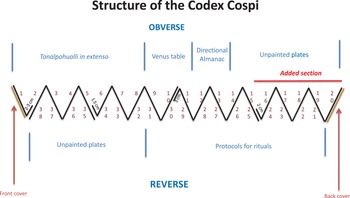
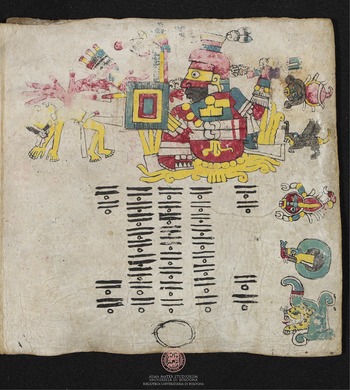
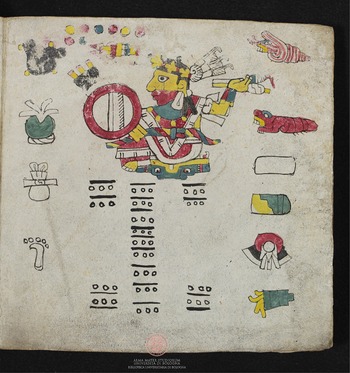
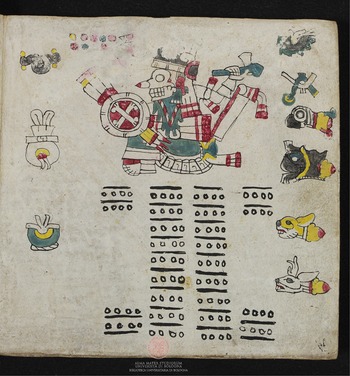
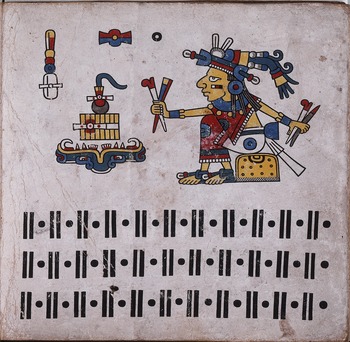
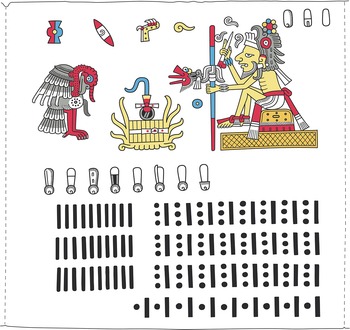
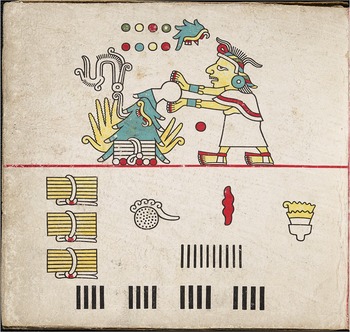
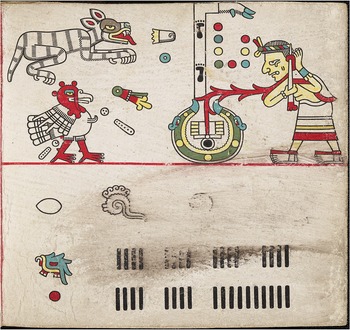
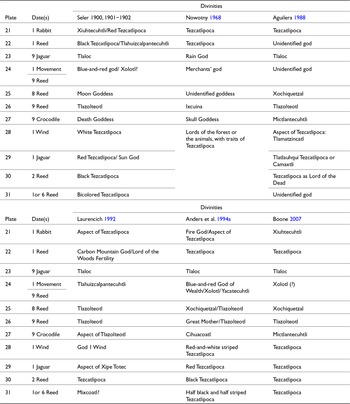
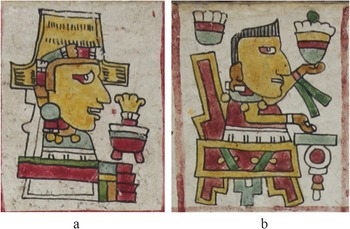
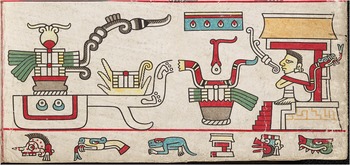
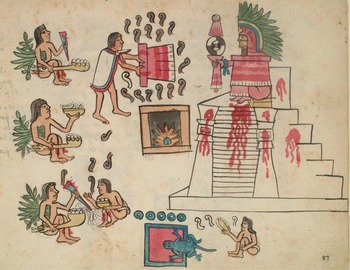

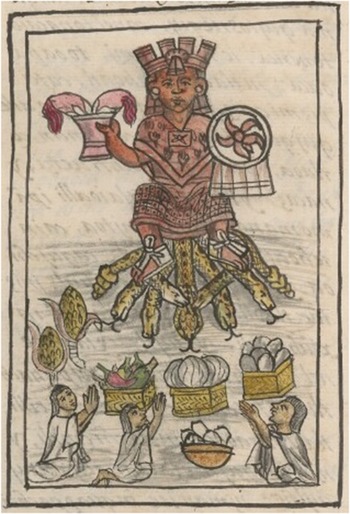
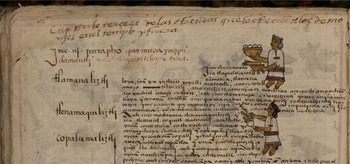

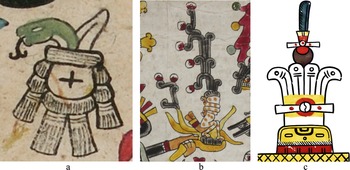
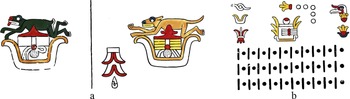

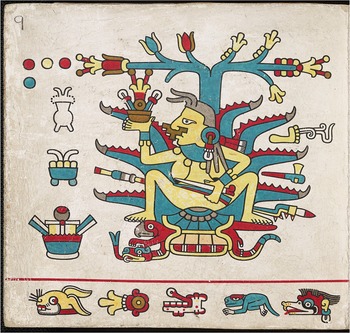

 Open access

