




Introduction
The South Caucasus is a region of big power politics, strategic interests, aspirations for self-determination versus territorial claims, and a fascinating melting pot of cultures, languages, histories, religions, and identities. With the dissolution of the Soviet Union, Caucasia has unfortunately seen approximately thirty years of frozen and reheated conflicts, resulting in it being host to some of the most militarized countries in the world (for Armenia and Azerbaijan, see Bonn International Centre for Conflict Studies (BICC) 2022; and on earlier dynamics and dimensions of the conflict Huttenbach Reference Huttenbach1989; also Reference Huttenbach1990; Reference Huttenbach1991). The peace process over Nagorno Karabakh (NK) has been particularly complex and cumbersome, with “enduring rivalry” between the two countries (Broers Reference Broers2015; see also Cheterian Reference Cheterian2012; Ayunts, Zolyan, and Zakaryan Reference Ayunts, Zolyan and Zakaryan2016; Minasyan Reference Minasyan2017). Since 2020, the conflict has reignited in a particularly severe manner, resulting in a 44-day war in 2020 and an Azerbaijani military offensive in September 2023, during which the Baku leadership successfully reclaimed NK and secured its position within the internationally recognized Azerbaijani borders (see, for example, Babayev Reference Babayev, Babayev, Schoch, Babajew and Spanger2020). The developments have led to a new stage of the Karabakh peace process, in a transformed security environment. The present article analyzes the role of inclusion of women in Armenia in this peace process and the postwar opportunities for women’s agency. It does so against the background of the more general reconceptualization of Armenia’s role in the region, being defeated by Azerbaijan on the NK issue, and seeking to restructure its strategic alliances away from its previously close relationship with the Russian Federation to increased approximation towards the West (see also, Miarka Reference Miarka2023; Mekhtiev Reference Mekhtiev1993). The present work aims to empirically and theoretically contribute to the literature in two ways: first, to advance feminist scholarship which explores the key challenges that persist for implementation of the Women, Peace and Security (WPS) agenda and norms on inclusion; second, to contribute to the debate on women’s agency in post-conflict contexts and how women can “benefit” from war (on women’s agency in post-conflict societies see Yadav Reference Yadav2021), as well as on their opportunities to be included.
During a period demanding increased focus on conflicts in Eastern Europe and the South Caucasus (Ero Reference Ero2023), the article aims to spell out the reasons for the exclusion of women, enriching the existing literature with an empirical study that tests the aforementioned arguments. The Armenian case is particularly notable, due to the difficult situation of the country in the context of Azerbaijan’s military successes since 2020 and the final Azerbaijani victory in NK in 2023. Armenia finds itself in a geopolitical checkmate on the NK issue,Footnote 1 which calls into question militarized discourses, puts additional pressure on the impoverished country and on its society traumatized by the war, and presents both a challenge and opportunity for the meaningful inclusion of women in discussions on the peace process.
Theoretical framework
Extensive literature on the topic of women, gender, and peace has explored the inclusion of women in peace processes theoretically and empirically. Various international commitments exist to increase the participation of women in peace and security, including a potential obligation under international law to ensure inclusion (Pajuste Reference Pajuste2016; Reference Pajuste, Weller, Retter and Varga2021; Pajuste and Vassileva Reference Pajuste and Vassileva2022). However, despite the rhetoric and commitments, the translation of these norms into tangible actions and outcomes remains a challenge (Olsson and Gizelis Reference Olsson, Gizelis, Olsson and Gizelis2015, 1). Progress in integrating women into peace processes has been limited (Pajuste Reference Pajuste, Weller, Retter and Varga2021), especially in Eastern Europe and the Caucasus region (in Ukraine, see Pajuste and Vassileva Reference Pajuste and Vassileva2022; in Georgia, see Vassileva Reference Vassileva2024). Scholars argue that the inclusion of women in conflict resolution efforts is crucial (see, for example, Aggestam and Svensson Reference Aggestam, Svensson, Aggestam and Towns2018, 150) and the field of feminist security studies argues for a gender-focused approach, examining security in a comprehensive manner. This approach covers various dimensions, including human security, domestic violence, economic well-being, social welfare, and environmental sustainability, alongside the traditional notion of state security (Williams Reference Williams2017). The analysis extends to topics such as the intersection of gender and nationalism, gender dynamics in conflict situations, the impact of militarism and masculine norms, sexual- and gender-based violence during wartime, and the roles women play in conflicts, ranging from peace activism to victimization and perpetration (Williams Reference Williams2017).
Additionally, scholars delve into various dimensions of the Women, Peace and Security (WPS) agenda, to understand and address security challenges from diverse perspectives. Gender is highlighted as crucial for developing solutions to global political insecurities (Sjoberg Reference Sjoberg2016, 52), emphasizing the necessity for active participation of women in discussions and negotiations, particularly at decision-making levels (Mlinarević, Porobić, and Rees Reference Mlinarević, Porobić and Rees2015; O’Reilly, Súilleabháin, and Paffenholz Reference O’Reilly, Súilleabháin and Paffenholz2015, 2). Scholarship demonstrates the significance of integrating a gender perspective into peace processes to increase their effectiveness (Anderlini Reference Anderlini and Anderlini2022). Additionally, research indicates that exclusion often exacerbates violence and insecurity (Avant et al. Reference Avant, Braumoeller, Chenoweth, Croco, Siniver and Zarakol2020), once more highlighting the importance of inclusive conflict resolution processes, and the need to include female and other marginalized perspectives and experiences into security dynamics for effective conflict resolution (Idler Reference Idler2019, 280). Overall, there seems to be a general consensus that “so much has been written on WPS” and that “there is still insufficient inclusion of women in peace processes” (Interview (21) IO, Yerevan. 2024).
However, the reasons for the lack of inclusion remain under-explored, and few empirical studies of concrete reasons for exclusion exist. Within the scholarly discourse, there has been extensive exploration of the “potential and limits” of the WPS agenda (Kirby and Shepherd Reference Kirby and Shepherd2016a), the gap between WPS aspirations and realities (Kirby and Shepherd Reference Kirby and Shepherd2016b, 374), the role of National Action Plans (NAPs) (Shepherd Reference Shepherd2016, 324), and trends in WPS policy and the diffusion of norms (True Reference True2016a, 307; True and Wiener Reference True and Wiener2019, 554). These works have underlined the widespread dissemination of WPS principles while recognizing persistent challenges in practical implementation, such as the low representation of women in peace negotiations (Conciliation Resources 2015). Empirical studies have explored the implementation of Resolution 1325 around the world (for example, Aroussi Reference Aroussi and Aroussi2017; Lee-Koo Reference Lee-Koo2016; Lee-Koo and Trojanowska Reference Lee-Koo and Trojanowska2017; Hendricks Reference Hendricks2015; Drumond and Rebelo Reference Drumond, Rebelo and Shepherd2021). In response, scholars have endeavored to look into “new directions” for the agenda (Basu, Kirby, and Shepherd Reference Basu, Kirby and Shepherd2020) and to theorize new avenues for its implementation (Davies and True Reference Davies and True2018; George and Shepherd Reference George and Shepherd2016).Footnote 2 However, there has been a noticeable lack of scholarly attention on the post-Soviet space and the Caucasus region in particular (Santoire Reference Santoire2023). Only recently, work has been published that has examined the reasons for the exclusion of women from the peace process in Georgia, finding that this phenomenon is linked to hard-power negotiation structures (1), “cultural” reasons (2), and the issue of empowerment and self-empowerment of women (3) (Vassileva Reference Vassileva2024). Similar categories for exclusion are found in the present case of Armenia. The article finds that the influence of Armenian women in the NK peace process has been mostly on unofficial channels (for example, Porter Reference Porter2007) and that the following reasons underpin this continued exclusion: (1) elite-dominated hard power negotiation structures and militarized discourses, (2) cultural factors, and (3) “self-exclusion” of women and need for empowerment. These findings are in line with studies that have reported on “common barriers” (ICAN 2018, 11) that women face in being included in peace processes and peace mediation.
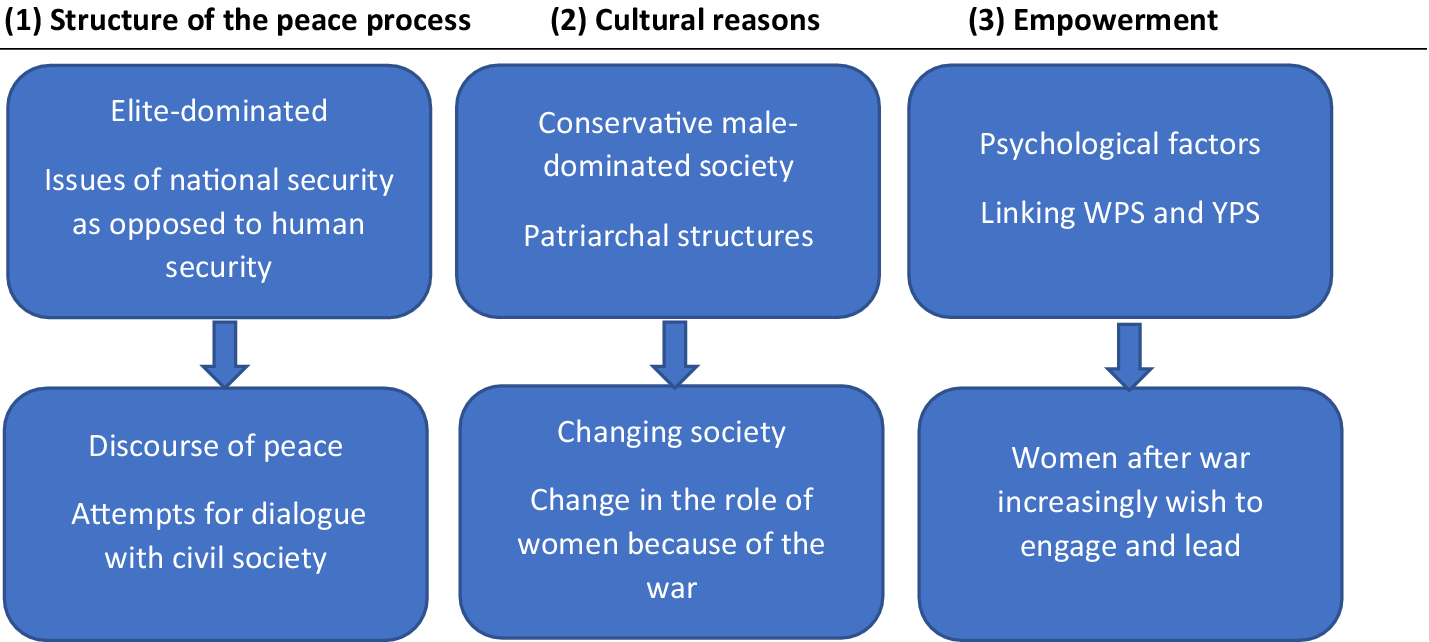
Additionally, for each of those categories, the present article traces opportunities for women to claim agency in the new security environment in Armenia and to shape the peace agenda, ensuring a more effective, sustainable, and inclusive peace process. This adds to the literature on the opportunities for women in post-conflict environments, as scholars have argued that “few studies have looked at the transformative effects of war” (Yadav Reference Yadav2021, 451; citing also Berry Reference Berry2018; Tripp Reference Tripp2015; Yadav Reference Yadav2016), investigating “conflict-induced social and structural changes through the lived experiences of women” (Yadav Reference Yadav2021, 549). Building on similar findings on women’s agency in conflict and post-conflict societies of Yadav, the present work traces opportunities for women’s involvement in the peace process in postwar Armenia. Specifically, Yadav analyzes how post-conflict environments influence the agency of women and the transformative effects and durability of gains in the context of the postwar environment in Nepal (Yadav Reference Yadav2021, 450). She shows that while “conflict is not a positive event,” “the situations created by conflict could become a vehicle for women’s empowerment” (Yadav Reference Yadav2021, 459), as such situations can create a space for critical reflexivity (1), transformation of gender relations and cultural practices (2), and an enabling environment for women to exercise agency (3) (Yadav Reference Yadav2021, 459). This is similar to the present findings on a more critical reflection and reconceptualization of Armenia’s role in the Caucasus region, and increased discourse of peace (1); a change in the role of women in society because of the war (2); and empowerment in the sense that women after the war increasingly wish to engage and lead the peace efforts (3) (for a visualization, see Figure 1). It also links to work which examines the “windows of opportunity” for women in post-conflict negotiations (Anderson Reference Anderson2015), “impact of violent conflicts on households” (Brück and Schindler Reference Brück, Schindler, Naude, Santos-Paulino and McGillivray2014), “new ways” of overcoming victimhood (Andrabi Reference Andrabi2019), as well as armed conflict and effects on women’s agency (Wagha Reference Wagha2014).
Reasons for exclusion and opportunities for women to claim agency.

Methodology
Employing a qualitative research approach, this article focuses on the NK peace process, specifically exploring the involvement of women from the Armenian side, paralleled by work on the cases of Azerbaijan (forthcoming) and Georgia (Vassileva Reference Vassileva2024). I examine international and national legal and policy documents to assess commitments to women’s inclusion and to gauge the extent of their participation (Section VI). This analysis is triangulated with original interview data from 34 semi-structured interviews conducted in Armenia during January and February 2024, drawing upon the methodologies of Halperin and Heath (Reference Halperin and Heath2020) and Leech (Reference Leech2002). These interviews include both female and male respondents, sampled mainly through snowballing and in consultation with local scholars and experts on the topic, categorized into four groups based on affiliation: (i) Armenian public sector, (ii) civil society organizations and think tanks, (iii) academia, and (iv) international organizations (Table 1). The aim was to capture diverse perspectives from women directly and indirectly engaged in NK peacebuilding efforts in Armenia.
Interviewees selection

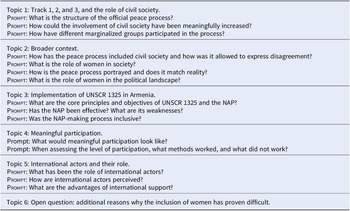
Utilizing Attride-Stirling’s thematic network analysis (Attride-Stirling Reference Attride-Stirling2001), the interviews were transcribed, translated where necessary (from Russian to English), and analyzed to identify common themes, particularly focusing on reasons for exclusion (a similar methodology used for example in Posada-Téllez Reference Posada-Téllez2024; Vassileva Reference Vassileva2024). Attride-Stirling’s thematic network analysis serves as a methodical system for organizing qualitative data, facilitating “insightful and rich exploration of a text’s overt structures and underlying patterns” (Attride-Stirling Reference Attride-Stirling2001, 386). Accordingly, thematic networks “systematize the extraction of: (i) lowest-order premises evident in the text (Basic Themes); (ii) categories of basic themes grouped together to summarize more abstract principles (Organizing Themes); and (iii) super-ordinate themes encapsulating the principal metaphors in the text as a whole (Global Themes)” (Attride-Stirling Reference Attride-Stirling2001, 388). Thus, the common themes from the interview data were categorized and coded into basic themes, which were then further grouped into organizing themes representing the perspectives of interviewees on the overarching topic: the inclusion of women in the NK peace process in Armenia. The open-ended questions and prompts used are detailed in Table 2. In an effort to mitigate the limitations and subjectivity inherent in interview data, I interviewed experienced international and national actors engaged in various sectors in Armenia. During the interviews, I maintained a limited role as author, primarily focusing on note-taking and posing follow-up questions guided by the provided prompts and overarching themes.
Interview questions

It should also be noted that from a methodological perspective, the study is rooted in the interpretative research tradition, researching representations of the exclusion of women from the peace process. In this regard, the analyzed utterances do not bring hard data, but mainly interpretations and perceptions of the phenomenon by informants. While these are a valuable resource and provide insight into local, on-the-ground knowledge of interviewees, it is clear that they are subjective and limited in this regard.
Analysis: Where are the Women in the Peace Process in Armenia?
The legal and policy landscape – Commitments and obligations of Armenia to ensure the inclusion of women in the peace process
In terms of international policy documents, there are concrete commitments to include women at all levels of the peace process in Armenia, the most relevant document being UNSC Resolution 1325/2000 on WPS and its subsequent resolutions (on 1325, see also the work of Atuhaire Reference Atuhaire2013; Wallensteen Reference Wallensteen and Wallensteen2021; Rehn and others Reference Rehn2008). In Armenia, the WPS agenda has been translated into two national action plans (NAPs) (A. Nikoghosyan Reference Nikoghosyan2017; Santoire Reference Santoire2023, 6; on trends in NAPs see, for example, Swaine Reference Swaine and Aroussi2017). The first NAP was decided for the period 2019-2021 and the second NAP for 2022-2024. Within the country, the NAP process was led by the Armenian Ministry of Foreign Affairs, in cooperation with international organizations such as UNFPA, as well as a number of civil society organizations, for technical support and input on the formulation of actions (Interview (4) IO, Yerevan. 2024), addressing the pillars of the WPS agenda (prevention, protection, and participation). Interviewees stated that progress in the provisions could already be seen when comparing the first to the second NAP, which was more comprehensive and included more international actors, CSOs, and government partners in terms of different initiatives (Interview (4) IO representative, Yerevan. 2024). However, interviewees involved in the process noted that the NAP is problematic in various ways.
While the NAP making process included several stages and consultation levels between various stakeholders (Interview (4) IO, Yerevan. 2024; Interview (5) IO, Yerevan. 2024; Interview (6) IO, Yerevan. 2024), civil society organization representatives noted that only a selected number of CSOs were in fact consulted in the drafting process. CSOs stated that they did not have the feeling that their recommendations were meaningfully taken into consideration (Interview (14) CSO, Yerevan. 2024) (on “meaningful inclusion,” see O’Reilly, Súilleabháin, and Paffenholz Reference O’Reilly, Súilleabháin and Paffenholz2015, 26–31), and that the NAP development process was insufficiently inclusive (Interview (18) CSO, Yerevan. 2024).
I think that the second national action plan of Armenia is [a] weak action plan. It covers mostly the post-conflict situation and the needs of forcibly displaced women, and involvement of women in the military. There are no provisions on promoting [the] decision-making power of women (Interview (16) public sector, Yerevan. 2024).
The missing part was basically the communication between the Ministry of Foreign Affairs and the NGO sector. The ministry failed to understand why the process needs to be inclusive when they were drafting the second national action plan. They thought that if there is a decree of the prime minister setting up this committee and if we have some five NGOs there, then that’s fine (Interview (30) public sector/IO/CSO, Yerevan. 2024).
When it comes to participation, a particular emphasis has been placed on the participation of women in the military and defense forces (in line with scholarly findings on the militarization of WPS and NAPS (Otto Reference Otto, Aoláin, Cahn, Francesca Haynes and Valji2015; Reference Otto, Aoláin, Cahn, Francesca Haynes and Valji2017), and the work of Walsh (Reference Walsh, Flaherty, Byrne, Tuso and Matyók2015)). The NAP focuses mostly on women’s engagement in the military but lacks provisions that acknowledge or support women’s engagement in the negotiation processes. The weaknesses lie in the provisions themselves, which are not inclusive and do not provide a balanced implementation of 1325—a resolution that emphasizes women’s participation in all fields, not only the military but also peacebuilding more generally. CSOs and feminist organizations in Armenia claim that 1325 and the NAP strengthen militarism in Armenian society because they mostly promote women’s engagement in military forces. There are not many provisions for women’s participation in peacebuilding, and in this regard, the NAP has become unpopular among certain circles (confirmed by interviewees). This poses a challenge as it means that when “people criticize and abandon it, and it becomes stronger at the hands of military institutions,” it is disregarded by those institutions which are more focused on negotiations (Interview (18) CSO, Yerevan. 2024).
The action plan is not a very good one. Of course, every country makes what they need out of 1325 and unfortunately, our strength is probably only in the military service of women, which has been encouraged on state/government level. And then they do the same about police, including women in the police. So it was mostly about militarization (Interview (30) public sector/IO/CSO, Yerevan. 2024).
Furthermore, the NAP does not have any mechanism for monitoring or evaluation. Hence, “the challenge is that it’s very hard to measure progress” (Interview (4) IO, Yerevan. 2024) as actions are often written in a rather vague manner making it difficult to evaluate. The NAP lacks concrete indicators for goals, results, and achievements (Interview (18) CSO, Yerevan. 2024). It also has no allocated funding or budget which in practice “weakens the entire concept of the NAP” (Interview (18) CSO, Yerevan. 2024).
Lastly, interviewees stated that there is generally a very low understanding of the NAP and very limited localization. This pertains to limited local ownership and a slow localization process. Overall, while the NAP aids in setting out the inclusion of women as a strategic priority for Armenia, the effects in practice remain limited (similar to other cases, for example, Shepherd Reference Shepherd2016, 324; Kirby and Shepherd Reference Kirby and Shepherd2016b, 374; Swaine Reference Swaine2009; Miller, Pournik, and Swaine Reference Miller, Pournik and Swaine2014; Swaine Reference Swaine and Aroussi2017; True Reference True2016b; Shepherd Reference Shepherd2016).
Inclusion in practice: Women’s participation in the peace process in Armenia
While worldwide much is said about the necessity of pushing forward the WPS agenda and women’s participation in peace negotiations (Anderlini Reference Anderlini and Anderlini2022), in Armenia, too, the level of participation and the number of women in the peace process remains low, especially in high-level negotiations. During the entire negotiation process with Azerbaijan before the second Nagorno Karabakh war and after the second Nagorno Karabakh war, there were no women included in the elite-led track 1. This process has been position-based, meaning that only the prime minister, foreign minister, or high-level officials take part in the meetings (see also De Waal Reference De Waal2010); positions that are all held by men, on both the Armenian and Azerbaijani sides (Interview (18) CSO, Yerevan. 2024) (on the track 1 Minsk process see De Waal Reference De Waal2010; Reference De Waal2013).
This is a warning, it’s very important to emphasize this aspect because that means that the negotiations never included women’s perspectives, women’s needs in post-conflict reconstruction and in conflict prevention. Of course, there are two sides to this, and WPS is generally considered an agenda for democracies… but the Armenian side is definitely also to blame for this!” (Interview (16) public sector, Yerevan. 2024).
The participation of women in politics in Armenia is also not equal to men, with only about a third of women in the Armenian parliament being female (World Bank Data 1997), and “that is so only because there is a quota” (Interview (16) public sector, Yerevan. 2024), where every party must have one third female candidates. Certainly, quotas are often criticized, and opinions divide on their usefulness as they could end up being about quantity rather than quality of participation (on “strategies for meaningful participation,” see, for example, O’Reilly, Súilleabháin, and Paffenholz Reference O’Reilly, Súilleabháin and Paffenholz2015, 26–31), but most interviewees held the view that without such a quota, female participation would be even lower (for example, Interview (16) public sector, Yerevan. 2024). This is exemplified, accordingly, in that there are merely two female ministers in Armenia (Interview (16) public sector, Yerevan. 2024). There are, of course, women working on lower levels, inside ministries. “The lower you go the more gender balance there is” (Interview (28) public sector/academia, Yerevan. 2024), but women are generally not well-represented in higher-level decision-making positions. Women’s engagement is rather technical, working as advisors, preparing work in the background, which is then delivered by their male colleagues in leadership positions (Interview (16) public sector, Yerevan. 2024), with no direct influence of women on decision-making (Interview (18) CSO, Yerevan. 2024).
There are few women who are involved in discussions as security experts in Armenia (Interview (16) public sector, Yerevan. 2024). Mostly, only 2–3 names were mentioned by interviewees (for example Armine Margaryan, an active female security analyst). In peace dialogues with Azerbaijan in track 1.5 formats (expert level), there are few women included, according to interviewees. Those who have participated in such formats report that they mostly consist of negotiation teams of 4–5 negotiators, of which, if at all, only one is a woman (Interview (16) public sector, Yerevan. 2024).
On track 2, the picture is a different one, as women in Armenia engage much more actively in the peace process on civil society level (Ghaplanyan Reference Ghaplanyan2010). Various CSOs work on peacebuilding initiatives and aim to lead discussions on the peace process on lower tracks. The contributions have been substantial (see for instance Gevorgyan Reference Gevorgyan2024), but interviewees stressed that there is very limited influence of this track on higher levels. Even when CSOs are present, this does not imply being taken seriously and having recommendations heard (Interview (17) IO/public sector, Yerevan. 2024). Some interviewees commented that there is a more open dialogue in the current context, as new ideas and solutions are needed to ensure a sustainable peace process (Interview (33) IO, Yerevan/online. 2024).
An opportunity for influence and achieving better inclusion of CSOs is also seen through the presence of international organizations, such as the European Union or international embassies (Interview (4) IO, Yerevan. 2024), that have a better standing and more significant role since the distancing of Armenia from the Russian Federation (Interview (1) CSO, Yerevan. 2024; Interview (2) CSO, Yerevan. 2024; Interview (3) IO, Yerevan. 2024; Interview (7) IO, Yerevan. 2024; Interview (8) IO, Yerevan. 2024). Next to being important donors (Interview (30) public sector/IO/CSO, Yerevan. 2024), these international actors sometimes can form a bridge between civil society and the government in terms of delivering messages and priorities and advocating for better inclusion of women (Interview (14) CSO, Yerevan. 2024). Even though not all initiatives are considered successful (for example, CSOs criticized initiatives such as EU4Dialogue or certain other “insufficiently thought-through” initiatives), interviewees mentioned positive results in many instances. Generally, interviewees seemed to note a changed and more positive perception of international organizations in the country (exemplified also through the well-received new EU monitoring mission EUAM in Armenia) (Interview (14) CSO, Yerevan. 2024). Still, some interviewees also stressed that they wish for the Armenian government to retain agency on this matter, that “the government should realize the need itself” (Interview (17) IO/public sector, Yerevan. 2024) and it is “disliked” when there is a too strong push from the outside, from international actors (Interview (17) IO/public sector, Yerevan. 2024) (on the need for a pragmatic approach to human rights advancement by Western powers see for instance Snyder Reference Snyder2022).
Overall, interviewees argued that inclusion has seen a shift in the context of the wars since 2020, before which there was comfort among Armenian society and leadership with the status quo and disbelief that things would change regarding NK: “These were our misperceptions and our delusional thinking” (Interview (18) CSO, Yerevan. 2024). In the context of the losses since 2020, the perception of the international community has also changed as “Armenians felt left alone” (Interview (17) IO/public sector, Yerevan. 2024) by the Russian Federation, which was until then thought to be Armenia’s key security guarantor (Interview (27) academia, Yerevan. 2024) and the country’s number one ally. Since this shift, some positions on the Armenian side have hardened, as “our society is patriarchal, militaristic, and the army and physical force is considered the first guarantee for the security” (Interview (18) CSO, Yerevan. 2024). Women who work on peace, preparing societies for peace by implementing training programs, healing, dealing with consequences, humanitarian aid, and especially women’s organizations that actively advocate for a final establishment of peace, have not only been frequently ignored but have even become subject to attacks and campaigns (Interview (29) CSO, Yerevan. 2024; see also, Santoire Reference Santoire2023), making their work more difficult. As a consequence, women, who are more active at the civil society level, working on peace-building, peace-making, and community issues, are often unable to present those issues at decision-making and higher levels (Interview (18) CSO, Yerevan. 2024).
On the other hand, Azerbaijan’s significant military advantage has left the Armenian government in a situation where peace is seen to be the only way forward (confirmed by various interviewees). This has also meant a transformation of the previously close alliance with the Russian Federation to an increasing orientation towards the West (Interview (9) CSO, Yerevan. 2024; Interview (10) think tank, Yerevan. 2024; Interview (33) IO, Yerevan/online. 2024). According to some, this has opened a broader dialogue in Armenian society about the need to reconsider the country’s role in the region. Azerbaijan has strategically maneuvered its foreign policy efforts in recent years with the aim of achieving a decisive advantage over Armenia concerning Karabakh. As a result, Armenia finds itself in a dire situation, facing economic hardship (World Bank Data 2023), lacking crucial alliances (having been abandoned by its primary security guarantor, the Russian Federation, as noted for example by Kirill Krivosheev/Carnegie Endowment for International Peace 2023a), and outmatched in terms of military capabilities by Azerbaijan (as reported by Statista 2023; ArmedForces.eu 2024). Consequently, Armenia has been compelled to accept the loss of NK (as discussed by Kirill Krivosheev/Carnegie Endowment for International Peace 2023b). The Armenian leadership and society increasingly emphasize a need to build peace, and according to interviewees, this involves an emphasis on the increased role for inclusion of women in this process.
Reasons for the exclusion of women
The following section analyzes data from 34 semi-structured interviews conducted in Yerevan in January and February 2024, from the Armenian public sector, civil society organizations, academia, and international organizations. It thereby explores the key themes that were identified from the interview data as reasons for the prevailing lack of inclusion of women on all levels of the NK peace process in Armenia and how the role of women has transformed in the postwar environment (Figure 1). To explore the factors in depth, the article provides an explanation of each group of reasons, breaking them down into components and subtopics.
Political elites, hard power issues, militarized discourses
The primary factor behind the absence of women in high-level negotiations is the inherent structure of the peace process, which has been predominantly led by elites and operates in a closed manner, maintaining entrenched “gendered relations of power” (Kirby and Shepherd Reference Kirby and Shepherd2021; Squires and Weldes Reference Squires and Weldes2007; Reiter Reference Reiter2015). For a long time, it was not clear who exactly was involved in the negotiation team at the highest level (Interview (30) public sector/IO/CSO, Yerevan. 2024), but interviewees with insight into the structure confirm that there were de facto no women involved (Interview (33) IO, Yerevan/online. 2024). This is so because the team consisted only of the prime minister, foreign minister, deputy foreign minister, and 1–2 very high-level officials—positions which are all taken by men. This finding is in line with literature on the difficulties to involve new constituencies in peace processes (O’Reilly, Súilleabháin, and Paffenholz Reference O’Reilly, Súilleabháin and Paffenholz2015, 4) and case studies on the inclusion of women in the peace processes in Azerbaijan (forthcoming work), Georgia (Vassileva Reference Vassileva2024), and Ukraine (Pajuste and Vassileva Reference Pajuste and Vassileva2022). The field of peace and security, as noted in IV., is generally a male-dominated domain, with women not represented in high positions (Interview (4) IO, Yerevan. 2024; Interview (5) IO, Yerevan. 2024; Interview (6) IO, Yerevan. 2024).
If we want women to be engaged in the process, we need women in those positions. And then people say, there’s only one role of a minister and it’s going to be either a man or a woman. So if we include women, then men wouldn’t be represented. But men have been represented in the past 30 years, why not try a woman? And then they bring the argument that women should not just be there because of the fact that they are women, but because of skills and professionalism. But I do not think the men in those positions are always the most competent and professional either (Interview (14) CSO, Yerevan. 2024).
The discourse for a long time also seemed to evolve around the need for strong leadership, “masculine, showing force and power” (Interview (18) CSO, Yerevan. 2024). For many years, discourse on the conflict was limited, according to interviewees, as “we were taught not to speak about conflict resolution alternatives because we were comfortable with the status quo” (Interview (18) CSO, Yerevan. 2024). The peace process overall is considered a very sensitive and difficult issue, especially in the context of having lost the war and NK territory, and Armenia finding itself in the situation without a real alternative other than peace due to Azerbaijan’s skilled foreign policy game (forthcoming work). Interviewees confirmed that peace and security is one of the hardest topics, and of course, “the harder the topic, the more difficult for women to enter” (Interview (17) IO/public sector, Yerevan. 2024). When women are involved at all, it is mostly organizations working on humanitarian aid and immediate support on the ground (Interview (18) CSO, Yerevan. 2024), on “women’s issues” of human security (Acharya Reference Acharya2001; Carpenter Reference Carpenter2016). Involving women should mean that they are consulted on topics of strategy and negotiations, not being sidelined to humanitarian aid, refugee assistance, and similar topics, as is often done by government officials and by international donors (Interview (14) CSO, Yerevan. 2024; Interview (18) CSO, Yerevan. 2024).
Since the war in 2020, there has been a dynamic alteration in the geopolitical landscape in the Caucasus. Beginning with the war in 2020, devastating for Armenia, through the more recent surrender of Armenians of NK in 2023, “we see an unprecedented degree of change in what was once a frozen conflict” (Interview (10) think tank, Yerevan. 2024). Interviewees and scholars agree that the peace process has completely failed in the past years (also De Waal Reference De Waal2012), especially as Azerbaijan has de facto ended the conflict through the use of force.
For years, Armenia relied almost entirely on the protection of the Russian Federation as their security guarantor (for example H. Nikoghosyan and Ter-Matevosyan Reference Nikoghosyan and Ter-Matevosyan2023). The country missed the moment to realize that Russia, too, pursues national strategic interests and will choose the more advantageous partner, something which the Baku leadership, conscious of the power dynamics in the region, exploited by building relations with Russia (Valiyev Reference Valiyev, Hamilton and Meister2017; Valiyev and Mamishova Reference Valiyev and Mamishova2019) through the Russian interest in Azerbaijani energy supply as well as strategic location as a potential trade road from Russia over Iran to India (Interview (10) think tank, Yerevan. 2024). Because of its reliance on the Russian Federation, Armenia has over the years alienated Europe and the West. Unlike its neighbor, Georgia, Armenia did not seek approximation to the EU or NATO, relying mostly on the premise that this would “upset” Russia and become a threat to the country (confirmed by Armenian interviewees).
In the difficult position in which Armenia finds itself after the loss of the Karabakh territory, it was stated by most interviewees that there is the need for “an agenda looking forward” and the territorial claims Armenia makes are “no longer appropriate.” The agenda by the Yerevan government has thus been to advocate for peace. The discourse increasingly evolves around the benefits of economic cooperation between Caucasian countries (De Waal Reference De Waal2021). Georgia, Armenia, and Azerbaijan are starting to slowly promote regional projects that require the cooperation of all three countries in order to make the cost of a renewed war and hostilities too high, “to sow the seeds of some sort of trust, slowly bringing people to perhaps be willing to come to the table in a more collaborative way” (Interview (11) think tank, Yerevan. 2024). “Currently, there is no alternative to peace” (Interview (17) IO/public sector, Yerevan. 2024).
Still, it is no unheard of fact that post-conflict reconciliation is an immensely difficult endeavor, with hostile discourses and unprocessed trauma being major obstacles to normalization. In Armenia, for years, the discourse has been militarized, with nationalist ideas around NK and with Azerbaijan seen as the enemy state (Terzyan Reference Terzyan2018). Generations of fear on this matter have led many to argue not for peaceful discourse but for increased militarization and investment in defense and the military (confirmed by interviewees). These topics have also dominated the question of the WPS agenda, which is “hijacked by people in the country who understand it as a means to increase women’s participation in the military, serving in the army,” “so that we increase our military capabilities and [the] number of combatants.” Such narratives are disconnected from a discourse of peace, sustainable peace, and durable peaceful relations.
Societal reasons
The Caucasus is a region where patriarchal culture and traditions play a strong role in society (see Abrahamyan, Mammadova, and Tskhvariashvili Reference Abrahamyan, Mammadova and Tskhvariashvili2018; on the role of religion and nationalism in Armenia, see Guroian Reference Guroian1992; for an analysis of the Georgian case, see Barkaia and Waterston Reference Barkaia and Waterston2017; and on the intersection of gender, ethnicity and Islam in Azerbaijan, see Tohidi Reference Tohidi1997). In this context, women have various responsibilities and there is a certain division of “female” and “male” roles. The most frequently invoked word by interviewees was the word “stereotypes” as a key problem (in fact, all 34 interviewees used the word in this context). Stereotypes about what women can and cannot do; about women’s roles in families; about women’s roles as mothers; women as being more delicate because of physical structure; women “not tough enough” for the tough negotiations; and the list goes on (Interview (16) public sector, Yerevan. 2024). It was even noted by one of the interviewees (referring to a quote from the [female] Minister of Education) that all main male monuments in Yerevan have names and are concrete people, “but all female monuments, on the other hand, are called Mother Armenia, Mother Beauty, or the woman who blends flowers; they do not have concrete names” to exemplify society’s perception in the role of women and what women do (Interview (17) IO/public sector, Yerevan. 2024).
According to most interviewees, when people see a woman talking about security and peace, the first reaction is often skeptical, and there is often the perception that women must prove to know the topic and earn respect. Women are thus disadvantaged from the start, before the beginning of negotiations and discussions (on women being disadvantaged before even arriving at the negotiation table see for example the work of Fisher-Yoshida Reference Fisher-Yoshida2023, 69). Frequently, there is the expectation that they must perform much better than men, in order to be listened to (Interview (16) public sector, Yerevan. 2024).
A lot of things that are really embedded in gender dynamics in the systems, gender discrimination on a personal level, structural level, and anywhere. And stereotypes, that’s the deep roots of it (Interview (18) CSO, Yerevan. 2024, 18).
This also links to the Caucasian culture of talks over dinners and drinks (Curro Reference Curro and Ziemer2020), in a “patriarchal manly way, and then over a bottle of vodka or whiskey or whatever they will discuss an agreement” (Interview (14) CSO, Yerevan. 2024). This is a common practice in diplomatic settings (as a general example see Burns Reference Burns2019; furthermore Satow Reference Satow2017), but according to interviewees, such informal settings are perceived as “no place for women” (Curro Reference Curro and Ziemer2020). Women are also less inclined to become diplomats, as the profession is perceived as “professionals who travel alone, and for an Armenian traditional man it’s not respectable to travel somewhere because their wife has a job that requires it; a woman going after a man across the world is fine. The opposite is not” (Interview (14) CSO, Yerevan. 2024).
Anything related to conflict, whether it be the military and armed forces or negotiation tables, is very much limited to men because it’s by default understood and perceived as the domain for men; they are the ones who consider themselves in charge of those difficult issues (Interview (14) CSO, Yerevan. 2024).
Because of the Soviet legacy, religion plays less of a role (see in detail, Zviadadze Reference Zviadadze2021; and also Guroian Reference Guroian1992) and it is also considered normal for women in Armenia to be working. Still, according to all interviewees, women are often taking many more duties in households (“there is currently work done on a survey on this matter, how much more time women spend in the household” (Interview (17) IO/public sector, Yerevan. 2024)) and unpaid care for children or elderly family members or people with disabilities (Interview (17) IO/public sector, Yerevan. 2024). Household chores or taking care of children is still considered the woman’s responsibility, particularly in rural areas (Interview (4) IO, Yerevan. 2024; Interview (5) IO, Yerevan. 2024; Interview (6) IO, Yerevan. 2024). This is connected to the general economic circumstances in the country. Armenia is a severely impoverished country, with a consistently low GDP. The situation has worsened since the influx of people from NK. Economically, women are more vulnerable, “because again, traditionally, in the patriarchal system, men are those who earn the money” (Interview (18) CSO, Yerevan. 2024, 18). Unemployment is high in Armenia, especially among young people, and women are particularly affected by the severe economic conditions (Interview (18) CSO, Yerevan. 2024, 18). The refugee population from NK is even more affected, in part because of the language barrier of speaking a particular dialect which differs from the Armenian language (Interview (19) CSO, Yerevan. 2024), but also because of matters connected to their legal status in Armenia as refugees (confirmed by various interviewees). Again, women mostly occupy those positions that are not paid, such as household chores like childcare, elderly care, and family care (Interview (18) CSO, Yerevan. 2024, 18).
Still, the environment is changing in this regard. As worldwide, Armenian society is modernizing in many ways, with the importance of younger generations being more outspoken and independent, and women standing up for their rights; “the younger generation does not have that many stereotypes yet” (Interview (4) IO, Yerevan. 2024; Interview (5) IO, Yerevan. 2024; Interview (6) IO, Yerevan. 2024). Women’s economic empowerment is considered by interviewees as a key means of ensuring more meaningful inclusion (confirmed by interviewees from all sectors).
Women have become stronger, and I am certain that this is linked directly to women’s economic empowerment. There was a study some years ago on what causes divorces started by women. I think more than 70 percent were that women, once they started to work, to earn money, and to become independent, started this divorce process (Interview (17) IO/public sector, Yerevan. 2024).
In the context of economic empowerment, involving women in local decision-making processes becomes crucial—when women can become a part of the local authorities or form an NGO to be able to present their viewpoints. International organizations and established CSOs are working towards such local empowerment, with projects aiming to implement Resolution 1325 at the local level (Interview (4) IO, Yerevan. 2024; Interview (5) IO, Yerevan. 2024; Interview (6) IO, Yerevan. 2024). Generally, working with refugees and women from bordering communities is a particularly sensitive issue, as they are often severely affected by postwar trauma and fears (confirmed by interviewees from all sectors).
A particular problem connected to postwar trauma in men, and also to poverty in postwar societies, is the issue of violence and domestic violence against women (Harutyunyan Reference Harutyunyan2014; Navabakhsh and Khaghani Fard Reference Navabakhsh and Fard2015). While the number is subject to some uncertainty (as experts say that many cases are not reported), it is estimated that between 65–75 percent of women in Armenia are victims of domestic violence (as observed by an interviewee who is an expert on the topic of domestic violence in Armenian society, Interview (15) CSO, Yerevan. 2024). Some of those cases are so severe that they result in femicides. Many cases of gender-based violence are reported in the context of the recent wars (Interview (5) IO, Yerevan. 2024; Interview (6) IO, Yerevan. 2024), and these circumstances contribute to the oppression of women in society and impede their right to speak up in general, “let alone to be involved in political life or the peace process” (Interview (23) CSO, Yerevan. 2024).
Some male interviewees seemed to state that women lack the will to be involved in the process as a reason for them not being there or lack of time to be in high positions because of stressfulness and time-intensity of such jobs (Interview (13) think tank, Yerevan. 2024; Interview (14) CSO, Yerevan. 2024). Contrary to these opinions, all female interviewees without exception stated that they would definitely like to be involved in the process, especially when it comes to decision-making and policy-shaping on security and peace matters and high-ranking positions. Specifically, younger women claimed their willingness to engage and be involved (Interview (16) public sector, Yerevan. 2024, 16).
Interviewees also emphasized that certain structures have changed because of the role that women had to take during the wars when many men left for the front, and many of these men never returning (see also Yadav Reference Yadav2016; Reference Yadav2021). Female interviewees stressed that women had leadership roles and became more independent in the process, and this also offered the potential for them to be more empowered and active in the postwar environment (Interview (20) academia, Yerevan. 2024; Interview (25) public sector/CSO, Yerevan. 2024). This has led to a reconceptualization of the role of women in society more generally.
“Self-exclusion” and Empowerment
A final significant barrier to women’s meaningful participation in the peace process, negotiations, and discussions is the barriers that women place on themselves. This links to confidence and empowerment to speak up, “stories” that women tell about their role in negotiations (Fisher-Yoshida Reference Fisher-Yoshida2023), being aware that they themselves have a place in those discussions and can claim their space to be involved. Interviewees confirmed that there are numerous women who wish to be included and are fully capable to do so, but they often lack confidence or knowledge on how to participate (Interview (18) CSO, Yerevan. 2024). This emphasizes the “empowerment component” of WPS (Goetz and Jenkins Reference Goetz, Jenkins, Chesler and McGovern2015) and empowerment as crucial for human security (Veneracion Reference Veneracion, Caballero Anthony, Mine and Ishikawa2023, iii).
In general, female interviewees mentioned the impression that women’s expertise is not acknowledged by male experts and the general public. Women were sidelined from the negotiation processes for a long time, meaning that they are either sometimes not familiar with the actual developments and generally do not receive much information on the negotiations (confirmed by interviewees with experience in negotiations and CSO sector; for example, Interview (25) public sector/CSO, Yerevan. 2024, 25). Due to their exclusion, women also feel less empowered and lack the self-confidence to claim space (Interview (18) CSO, Yerevan. 2024). Often, these barriers to participation are not addressed or recognized:
I was lucky and I don’t have confidence issues. It’s just that I sometimes feel like I might not be saying the right thing. I am afraid to say something wrong (anonymous).
I can say just from my own perspective, everybody was more experienced than me. Everyone had been in the field for at least ten years, and I had just started (anonymous).
Participants in negotiations also noted that women behave differently in negotiations and dialogue meetings, while men would be much more blunt and direct, “sometimes even shouting at each other” (Interview (14) CSO, Yerevan. 2024), female negotiators felt that:
Men, when they are discussing some difficult topics, they can yell on each other. For them, it is normal. But it is not normal for me because I’m a woman, I feel like I can’t yell at them… (Interview (16) public sector, Yerevan. 2024).
Men are so self-confident of voicing their standpoint and about their visions of how conflict could be resolved. But that was not the case with women’s groups. That’s why it was different and that’s why I felt uncomfortable being there because [in the men’s groups] I also saw that I was not part of this. That was internal, at a very personal level (Interview (18) CSO, Yerevan. 2024).
Female interviewees also shared that when they are consulted, they are often referred to talk about “women’s issues,” such as domestic violence, displaced women, and social issues (Interview (18) CSO, Yerevan. 2024), and feel like they are not taken seriously when trying to discuss peace and security and related aspects. Given that there are a lot of stereotypes around what women should and should not do and on how women are involved in politics, many women themselves internalize such stereotypes which then prevent them from participating in discussions (Interview (4) IO, Yerevan. 2024). Even simple aspects, such as dress code, become an issue, when women are told “to wear black” (Interview (16) public sector, Yerevan. 2024) or to “not dress like a woman if you want to be taken seriously” (Interview (25) public sector/CSO, Yerevan. 2024).
As opposed to some male interviewees, however, all Armenian female interviewees stressed the pressing need to build peace and that “peace is the only way forward”; that the perception of the role as leaders also changed since the recent wars in that they felt the strong sense to speak up and find sustainable solutions for peace. The mistakes that men had made during the past decades, and the “just so incredibly draining” environment of conflict (Interview (14) CSO, Yerevan. 2024; Interview (18) CSO, Yerevan. 2024) were additional motives and empowered women to want to be involved. Some CSOs lead negotiation academies for women, where they discuss the history of the conflict, geopolitics, and how to improve negotiation skills.
There is a documentary film which portrays the situation before, during, and after the war in [the] 1990s. It shows how many mistakes all these male officials made during the negotiation processes. When we were unpacking this, one of the female participants said: ‘I never thought that I should be in this kind of negotiation processes because I thought that I’m not clever enough and I am afraid to make mistakes. But after watching this documentary, I think I would never make the kind of mistakes that men made.’ That was a good indicator for me, showing that we need more confidence! We have a lot of skilled women, we just need to empower them to be involved (Interview (14) CSO, Yerevan. 2024, 14).
All female interviewees stressed the immense importance of empowerment, of female role models, and of their encouragement and support for each other and younger generations. When confronted constantly with the narrative that “peace and security is not a woman’s thing to do,” it can be discouraging, according to interviewees, to be involved and participate. Women need to be increasingly portrayed and seen as professionals, diplomats, and “as even better negotiators than men, because we need that kind of profiling in order to engage more women in the process.” There was a general consensus that, with empowerment, the environment can start changing (Interview (16) public sector, Yerevan. 2024). A general link was often made between the WPS and YPS agenda (Berents and Mollica Reference Berents and Mollica2022; Klugman and Moore Reference Klugman, Moore and Ensor2021), in that empowering younger women to be actively involved is a key aspect (Interview (30) public sector/IO/CSO, Yerevan. 2024). The younger generation is often said to be “more open,” and while many are willing to participate, it is a challenge to learn how one can engage and have the confidence to speak up (Interview (4) IO, Yerevan. 2024; Interview (5) IO, Yerevan. 2024; Interview (6) IO, Yerevan. 2024).
Lastly, interviewees stressed the importance of involving men in the process and raising awareness among them about the reasons for the exclusion of women (Interview (7) IO, Yerevan. 2024). This entails, accordingly, ensuring that the problem is understood, that the importance of involving women is stressed, and that barriers to inclusion are communicated and acknowledged by male participants in the peace process and negotiations.
Conclusion
The present article has analyzed the role of the inclusion of women in Armenia in the NK peace process. The article has aimed to do so against the background of the more general reconceptualization of Armenia’s role in the region since the recent reescalation of the conflict and the final loss of Karabakh in 2023. Seeking to restructure its strategic alliances away from its previously close relationship with the Russian Federation towards increased approximation with the West, Armenia finds itself in a geopolitical checkmate on the NK issue (see forthcoming work on Azerbaijan), which calls into question militarized discourses, puts additional pressure on the impoverished country and on its society traumatized by war, and presents both a challenge and opportunity for the meaningful inclusion of women in discussions on peace and security. When it comes to the role of women in the process thus far, an interviewee commented that:
Unfortunately, the story of women [being part of the NK peace negotiations] is quite short, because there were not many women involved in the process thus far (Interview (18) CSO, Yerevan. 2024).
Through analysis of original interview data from 34 semi-structured interviews conducted in Yerevan in January and February 2024, the article finds that, overall, women’s substantive inclusion in Armenia’s peace process continues to be limited due to the following reasons: (1) elite-dominated hard power negotiation structures and militarized discourses, (2) societal and economic factors, and (3) “self-exclusion” of women and need for empowerment.
A key reason for the exclusion and limited participation of women in high-level negotiations is the elite-led and closed structure of the peace process dominated by male decision-makers. In the changing security environment in the Caucasus, there is a growing call for a forward-looking agenda advocating for peace. However, post-conflict reconciliation remains challenging, with militarized discourses and unresolved trauma perpetuating hostility. Despite these challenges, there is consensus that there is no alternative to peace, emphasizing the importance of collaborative efforts to build trust and pave the way for a lasting resolution.
A second reason for women’s exclusion is the prevailing stereotypes about women’s roles in both public and private spheres in Armenia. Societal expectations and economic disparities make inclusion challenging. Postwar trauma and gender-based violence continue to suppress women’s voices, despite their expressed desire for involvement and their pivotal roles during wartime.
The third significant barrier to women’s meaningful participation in peace processes, negotiations, and discussions lies in the barriers women place on themselves, stemming from confidence and empowerment issues. While many women wish to be included and are fully capable, they often lack confidence or knowledge on how to participate effectively. However, Armenian women increasingly advocate for greater inclusion, motivated by a desire for sustainable solutions and by past mistakes made by male participants. Encouragement from female role models and involving men in the process are crucial steps towards achieving greater gender parity in peace negotiations in this regard.
Identifying the key reasons for women’s exclusion, the article has also aimed to trace opportunities for women to claim agency in the new security environment in Armenia and shape the peace agenda, ensuring a more effective, sustainable, and inclusive peace process. The postwar environment in Caucasia provides several new opportunities for women to be involved in the process thanks to changed narratives and discourse of peace, the changing role of women in society, and women after the war feeling more empowered and increasingly wishing to engage and lead.
Disclosure
None.


 Open access

