


Introduction
On July 10, 2024, the Food and Drug Administration (FDA) announced a shortage of Becton Dickinson (BD) BACTEC blood culture media bottles. 1 Hospitals across the country were affected to varying degrees depending on their reliance upon BACTEC bottles. In response to this shortage, hospitals had very little time to develop strategies to conserve their supply of blood culture media bottles. Reference Suleyman, Moore and Palavecino2 BD also adapted during the shortage by temporarily reintroducing glass media bottles for anaerobic culture as they replenished inventory of plastic bottles. In October 2024, BD announced that allocations exceeded 100% due to this mitigation strategy, and in December 2024, they announced that the blood culture media bottles had been “restored to preshortage inventory levels in the United States.” Reference Beddard3,Reference Beddard4 To better understand the extent of the impact of this shortage on clinical practice and identify mitigation strategies hospitals used to respond to this challenge, we conducted an online poll of infectious disease specialists to assess their experiences with blood culture utilization during the shortage.
Methods
We developed a 7-question quick query (online poll) prior to inventory restoration to understand the impact of the nationwide BD BACTEC blood culture bottle shortage on healthcare organizations and characterize self-reported practices of blood culture utilization during the national shortage. The survey questions (https://ein.idsociety.org/surveys/survey/180/) evaluated the extent to which the shortage affected healthcare facilities, steps taken at facilities to mitigate the shortage, and the impact of the shortage on management of common infectious disease syndromes. The online poll was disseminated using the Infectious Diseases Society of America (IDSA) Emerging Infections Network (EIN) which is funded by the Centers for Disease Control and Prevention (CDC). The EIN is a sentinel infectious disease network comprised of more than 3,100 infectious disease healthcare professionals who subscribe to a daily moderated listserv. Reference Pillai, Beekmann, Santibanez and Polgreen5 The electronic link was sent to EIN members via an emailed listserv thread 3 times during September 2024, with reminders to only respond to the anonymous poll once. Analysis used descriptive statistics to describe associations between participant responses and geographic location or facility type. We conducted a thematic analysis of all responses to the 3 open-ended questions.
Results
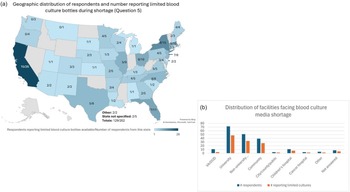
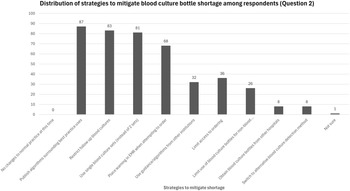
A total of 202 individuals from 39 states responded between September 6 and September 20, 2024 (Figure 1a). One hundred and twenty-nine (64%) respondents indicated that their hospital had limited blood culture bottles available during the survey period. Eight (4%) respondents were unsure how their hospitals were affected, and 65 (32%) indicated that their hospitals were not affected by the national shortage. No respondents reported that blood culture bottle supply reached zero at their hospital. Community (27/39, 69%) and university (48/72, 67%) hospitals were the most affected, while Veteran’s Affairs/Department of Defense hospitals were least affected (3/11, 27%) (Figure 1b). Those unaffected by the shortage primarily used alternate blood culture bottle systems. In response to the shortage, 87 (67%) of affected respondents reported publishing institutional algorithms for best practices in blood culture utilization. Other common mitigation strategies were restricting repeat blood cultures (83/129, 64%), using single blood culture sets (81/129, 63%), and creating electronic health record (EHR)-based alerts for blood culture orders (68/129, 53%) (Figure 2 ).
Respondent geographic and facility type distribution. (a) Geographic distribution of respondents and number reporting limited blood culture bottles during shortage (b) Distribution of facilities facing blood culture media shortage.

Distribution of strategies to mitigate blood culture bottle shortage among respondents.

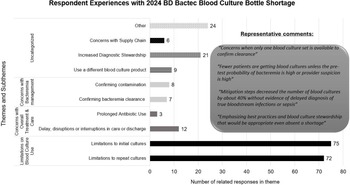
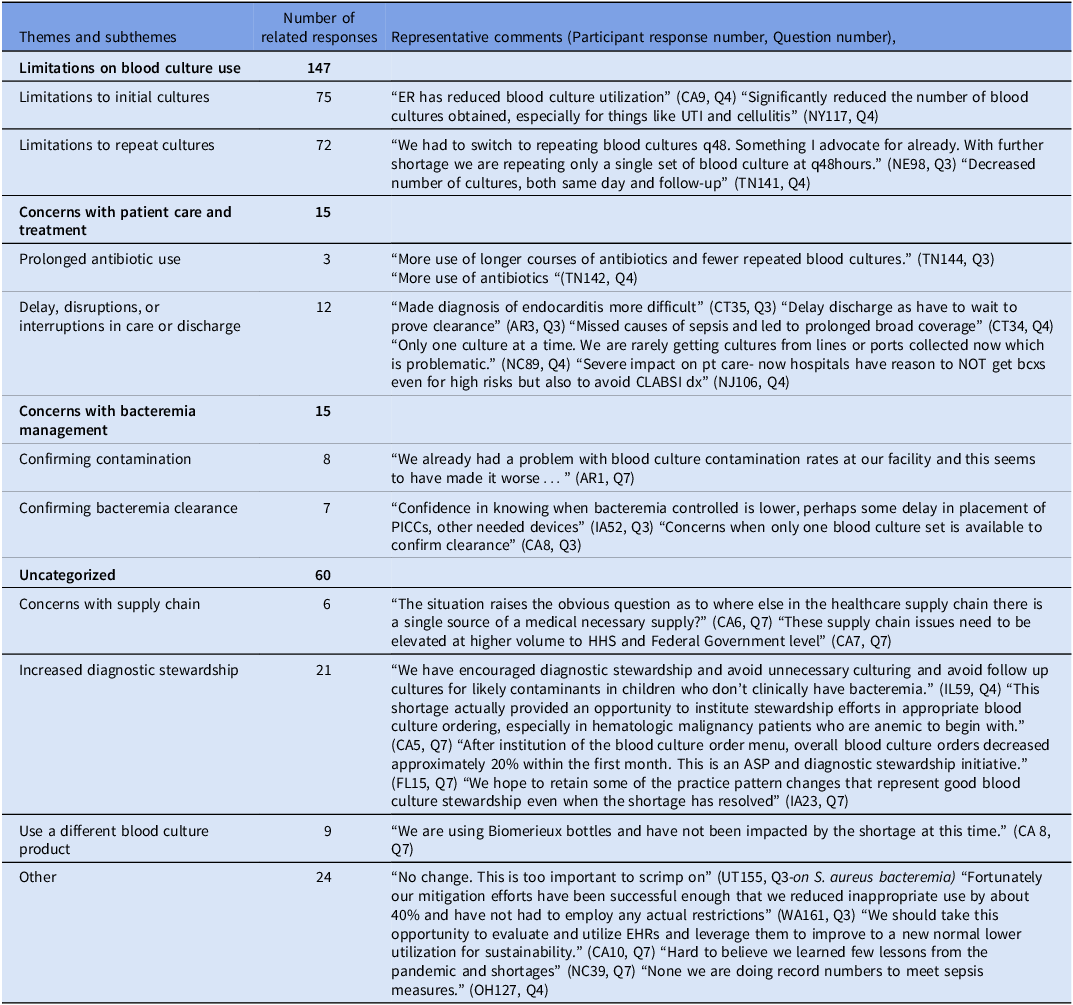
Several overarching themes were identified by respondents. These included limitations on blood culture use (147 responses), identification of diagnostic stewardship opportunities (21 responses), concerns with treatment (15 responses), and concerns with diagnostic management of bacteremia (15 responses) (Figure 3 ). For common infectious disease syndromes, the most prevalent theme in S. aureus bacteremia management was limitations in repeat blood cultures (61/163, 37%; eg, “We had to switch to repeating blood cultures q48. Something I advocate for already. With further shortage we are repeating only a single set of blood culture at q48h”) with concerns about confirming bacteremia clearance (eg, “It is obviously more difficult to ensure clearance in that situation where a follow up may reveal 1/2 low level persistent bacteremia”). The most common theme in inpatient/emergency department management of fever was limitations in initial blood cultures (64/159, 40%; eg, “No longer drawing blood cultures prior to an order being placed, limiting blood culture draws to specific infections on diagnosis rather than standard part of workup for any/all fever or leukocytosis”), with common comments about reducing inappropriate blood cultures (eg, “Reduction in blood cultures for low yield presentations through reinforcement of best practices”). In the final open-ended request for additional comments, 61/202 (30.2%) respondents commented with the most common theme highlighting increased diagnostic stewardship as a positive outcome of the shortage (19/61, 31%; eg, “We reduced our bottle use and intend to use this opportunity for testing stewardship”). Additional representative quotes identifying themes and subthemes are highlighted in Table 1.
Respondent experiences with 2024 BD BACTEC blood culture bottle shortage.

Response themes and subthemes

UTI, urinary tract infection; q48- every 48 hours; pt, patient; bcxs, blood cultures; CLABSI, central line-associated bloodstream infection; dx, diagnosis; ASP, antimicrobial stewardship.
Discussion
This online poll of the EIN demonstrated widespread impacts of the BD blood culture bottle shortage on hospitals nationwide, with variability in mitigation strategies. A common response to the shortage was to publish institutional algorithms surrounding the best practices in the use of blood cultures, capitalizing on opportunities the shortage provided to increase diagnostic stewardship through further education. Both education and recommendations on diagnostic stewardship have previously been published and are available for guidance, including identifying clinical scenarios where blood cultures have high or low diagnostic value and capacity-based thresholds for responding to shortages. Reference Fabre, Carroll and Cosgrove6,Reference Ryder, Van Schooneveld, Diekema and Fabre7
Limiting repeat blood cultures was another common mitigation strategy, which may reduce contamination, while simultaneously increasing diagnostic uncertainty amongst respondents, particularly concerning possible skip-bacteremia phenomenon in S. aureus bacteremia [for example “Limited frequency of follow-up blood cultures. No obvious impact clinically though question if we are missing some skip phenomenon”]. Skip phenomenon is the presence of intermittent negative blood cultures while documenting clearance. There is some data suggesting that more than one set of negative cultures is needed to confirm true bacteremia clearance. Reference Go, Baddour, Lahr, Sohail and Palraj8–Reference Stewart, Graham, Kotsanas, Woolley and Korman10 While repeat blood cultures for S. aureus bacteremia are high yield, routinely repeating blood cultures for “clearance” in non-endovascular infections with non-S. aureus bacteremia (especially g and streptococcal) is a low yield practice. Reference Fabre, Sharara, Salinas, Carroll, Desai and Cosgrove11 Indeed, for the initial management of fever, limitations in initial blood cultures were generally viewed favorably, with comments often highlighting a reduction in inappropriate blood cultures. This brings forward a theme commonly noted in the open-ended response question on hopes for increased diagnostic stewardship in the future as a potential positive outcome of the shortage. Some respondents noted that the shortage had effects on clinical care including delays in discharge and documentation of clearance; in one instance this was also noted to cause an increased duration in antibiotics. This shortage therefore required health systems to focus on their current practices in blood culture utilization and how they could be modified to preserve supply at individual hospitals without negatively affecting patient care. Furthermore, the shortage showcased a need for resiliency within the national supply chain to avoid significant downstream impacts on patient care. While attempts were made to lessen the effects, the responses to this poll suggest concerns from clinicians that the shortage may have compromised patient care.
This online poll had multiple limitations. First, given the format in which this data was collected, we are unable to identify duplicate responses from the same hospital. Additionally, there is no tracking of individuals who respond to the survey in the quick query format. These points could skew responses as some hospitals may have had multiple respondents. This was also a convenience sample that occurred at a single point in time during the shortage, so a formal response rate cannot be calculated. Respondents may not necessarily be in leadership positions with full awareness of the complete state of the blood culture shortage at their hospital. The single point in time represented by this survey was relatively far into the shortage period and the estimated supplies may have been worse at other points in time. The respondents may also be biased towards those who were affected by the shortage as those not affected may have chosen not to respond, although a third of respondents were not affected. Finally, the EIN may not be representative of all ID clinicians, and some states were not represented; however, there was representation from 39/50 states in the US.
Conclusion
The shortage of BD BACTEC blood culture bottles was perceived to have considerable clinical impact by infectious disease clinicians. This poll found that many themes highlight the effects on healthcare systems and to a lesser extent on patient care. This demonstrated a mismatch between media and public perception and the reported outcomes from clinicians. While there were challenges, the mitigation strategies implemented may offer future opportunities to increase diagnostic stewardship and have highlighted the need to strengthen the supply chain or increase compatibility between blood culture systems to prevent similar events in the future.
Acknowledgements
This work was supported by the Cooperative Agreement Number 5 (grant number NU50CK000574), funded by the Centers for Disease Control and Prevention.
Financial support
None.
Competing interests
J. H. R. receives support through the Johns Hopkins Prevention Epicenter Blood Culture Stewardship Collaborative funded by the Prevention Epicenters Program, Centers for Disease Control and Prevention (grant numbers 51U54CK000617–02-00 and 5U54CK00617-03-001). The remaining authors have no relevant conflicts of interest to disclose.
Ethical standard
This work was evaluated and classified as exempt non-human subjects’ research by the University of Iowa Institutional Review Board.
Patient consent
This work does not include factors necessitating patient consent.

 Open access

