

Placed atop a tower of bricks in the middle of a dimly lit gallery, a bust welcomed the public that on September 22, Reference Castillo2015, attended the opening night of RAW, the solo exhibition of Venezuelan artist Deborah Castillo at Mandragoras Art Space in Queens, New York (Figure 1).Footnote 1 Although there was no explanation of whose bust it was, none was needed: the frown, the beard, and the military epaulettes gave it the authoritative air of the caudillo and brought to mind the boundless power historically embedded in that figure and its many visual iterations in the urban and political landscape of Latin America.Footnote 2 There was, however, something odd about Castillo’s caudillo, which particularly stands out when we consider it alongside the many busts and statues made of bronze and marble that are placed in plazas and public buildings in his honor. In comparison to those arresting and seemingly eternal objects of commemoration, Castillo’s caudillo appeared incomplete, vulnerable, and malleable; constructed with unprocessed clay glistening with the water that Castillo would pour on it several times throughout the night, he seemed raw.
Bust of nameless caudillo placed at the center of the gallery. Courtesy of Deborah Castillo.

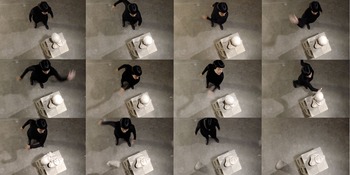
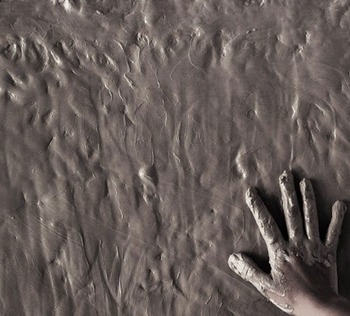
This state of rawness was not unique to the bust; in fact, it permeated the entire gallery space. Six hundred pounds of wet clay had been hand pressed into the windows (Figure 2), and as the clay started to dry, pieces of it fell to the ground, covering it with gray dust that stuck to shoes, clothes, and faces. The space did not feel like an art gallery—with its polished surfaces, clean floors, and bright lights—but like an artist’s workshop: a space that underscored not the finalized product but the rawness of the labor behind it. It was this labor, more than the sculptures it created, that grabbed the public’s attention. It was suggestively embedded in the clay covering the windows, which subtly recalled the physical effort that went into grabbing each pound of clay and pressing it by hand into each window. It made its presence felt in the movement of Castillo’s hand as it slowly masturbated the phallus-shaped nose of another nameless military figure made of clay in the video performance Demagogue, projected on one of the screens. It appeared also in the sensual journey that a pair of clay hands and forearms traced along Castillo’s body, while in the video performance The Unnamable she slowly moved them over her face and down her chest, giving them a sensual dynamism that re-presented them not as objects but as lively appendages. Last, it fueled the moment of climax that ended the night when Castillo, standing in front of the bust of the caudillo, started slapping it, each slap disfiguring the head and separating it little by little from the neck until it finally gave way and fell onto the ground (Figure 3).
Gallery windows covered in clay. Courtesy of Deborah Castillo.

Photograph of the sequence of actions that constituted the live performance Slapping Power. Courtesy of Deborah Castillo.

Three years later, on March 22, 2018, a crowd that included Venezuelans and tourists of other nationalities gathered in New York City’s Washington Square Park around a big black structure made of pieces of wood that formed a seemingly abstract shape covered in small white squares. Closer inspection revealed that the wooden pieces formed the map of Venezuela; furthermore, the white squares turned out to be QR codes that, once scanned with a phone, revealed the identities of the more than two hundred people who lost their lives in Venezuela between February 2014 and February 2018 during protests against Nicolás Maduro’s government. REQUIEM200≤, an installation by the Venezuelan artist Violette Bule, became for the duration of that afternoon part of the set of iconic monuments and statues that make the park one of New York City’s most visited tourist attractions. Unlike them, however, REQUIEM200≤ asked something of those who approached it with their cameras and phones, ready to take a picture. It asked us to come closer, to download the app that Bule had created for the installation, to pick a QR code, to scan it, and to witness as our phone screens were transformed into pocket-sized tombstones for the faraway dead (Figure 4). In other words, it asked us to slow down and let the chatter of the observers dissolve into an uncomfortable silence that brought us together in a wordless requiem.
A child using his phone to scan one of the QR codes in REQUIEM200≤. Photo credit: Raquel Abend van Dalen. Courtesy of Violette Bule.

Analyzed separately, Castillo’s exhibition and Bule’s installation tell two different stories. Castillo’s performances in RAW call into question the structures of power that come into being and ground their authority in the feverish cult that the caudillo has historically given rise to in Venezuela and in Latin America as a whole. Bule’s REQUIEM200≤ is a defiant act of memory that challenges the invisibilization of deaths that, in the context of contemporary Venezuela, remain in the margins of official records and statistics or that have become politicized, their numbers manipulated to serve different political agendas both inside the country and abroad.Footnote 3 When put side by side, however, a compelling similarity emerges between the two works. Both artists rely on raw matter—wood, water, clay, nails, and QR codes—to re-present Venezuela for an international audience that might or might not be familiar with the country’s history and current reality. Members of this audience are nevertheless encouraged to renounce their roles as passive spectators and participate in an act that brings together processes of remembrance, imagination, subversion, and translation, and that links the local and the global, the intimate and the public, the individual and the collective, virtuality and materiality. An act that, in this article, I call crafting nationness.
The term nationness was coined in 1983 by Benedict Anderson (Reference Anderson2006) in Imagined Communities: Reflections on the Origin and Spread of Nationalism to encompass concepts as disparate and difficult to define as nation, nationality, and nationalism. He defines it as “the most universally legitimate value in the political life of our time” (3) and, along with nationalism, as “cultural artefacts of a particular kind” (4). In Disappearing Acts: Spectacles of Gender and Nationalism in Argentina’s “Dirty War,” Diana Taylor (Reference Taylor1997, 277) takes Anderson’s vague definition to mean “the idea of nation, which includes everything from the bureaucratic fact of citizenship to the nationalist’s mythical construct of a nation as an eternal entity,” and focuses on the performativity of nationness, which involves the double mechanism of “imagining and imposing national/gender identity” (93). In the context of Castillo’s and Bule’s work, I propose a different conceptualization of nationness that centers on the –ness, a suffix that evokes both proximity to and distance from the nation—a quality or a state that refers back to the nation and that also appears freed from the boundaries that limit it to a specific time and place. Thus, I understand nationness as the nation outside the nation: a resonance, a feeling, and/or a residue that speaks to and of the nation without having to speak from it, that challenges assumptions regarding the what, where, and how of the nation, and that, as such, underscores movement, malleability, and indetermination. Like Anderson, I take nationness to be a “cultural artefact of a particular kind,” yet unlike him, I do not focus on the ways in which language and literature are mobilized to imagine the nation but on the materials that are used to re-present it. My conceptualization echoes Taylor’s emphasis on performativity; however, I propose that the performative aspect of nationness encompasses not only the ways bodies act and engage with each other (across cultures, times, languages, and geographies) but also the ways they engage with materiality, with the nation as raw matter, with imagination as craft.
This understanding of nationness invites an approach to the nation that deviates from the strict ideological stances that frame the concept in Venezuela along the extremely polarized political divide between those who support the government and those who are part of the opposition.Footnote 4 While it is not entirely unrelated to the issues at the center of this polarization,Footnote 5 nationness illuminates the nuances and complexities that permeate the symbolic and material efforts to remember, imagine, and re-present the nation among the diasporic community of Venezuelan artists like Castillo and Bule.Footnote 6 Forced to leave Venezuela because of political repression, fear of violence, economic hardship, and lack of institutional support for their work, the two artists moved to New York for what they thought would be a brief period. In fact, when asked about the circumstances of her arrival in the United States, Castillo says: “The political and social situation forced me to leave to the US. I left involuntarily, never wanting to live outside of Venezuela for long periods of time.”Footnote 7 Commenting on the difficulties of moving to New York in 2014, Bule states that the biggest challenge has been
to focus and process in order to produce my work while living in alienation and uncertainty. Then, understanding how the American society works, how to fit in, … how to learn a new language, and make enough money to work on my pieces but also to survive. I wanted to work on things that would keep me connected to Venezuela; my biggest fear was always losing that connection. The crises, the anxiety, the sadness have become my work, all of that has been translated into my work. The work I have done on Venezuela, on migration, on survival: I have been able to find a road connecting memory and solace.
For both Castillo and Bule, moving to New York never translated into renouncing their country, or into a clean, painless, and absolute separation. Nor did it translate into a paralyzing feeling of nostalgia that demanded their work remain unchanged and unaffected by their new environment and circumstances. In fact, Castillo notes: “My artistic production has obviously become richer, but it has also undergone important conceptual and technical changes. I had to adapt my system of production to the mobility of the diaspora.” These changes included rethinking power not only in terms of its local configuration in the Venezuelan reality but also from a more global perspective that speaks to her multinational audience. Bule, in turn, notes that once her pieces reach an audience of both Venezuelans and non-Venezuelans, “they become strong and autonomous, reaching audiences both inside and outside the country, regardless of their ideological positioning.”
The artists and their work thus occupy a space of in-betweenness. They oscillate between local concerns and global demands, the virtual and the material, English and Spanish, the catharsis of desahogo and the crafting of memoria. Through this oscillation, Castillo and Bule engage their audience in a “back and forth” between what is happening “over there” and what is happening “over here” that ultimately re-presents Venezuela as Venezuelanness, that is, as nationness, as a body as malleable as Castillo’s clay figures and as indeterminate as Bule’s misshapen map. In this article, I examine the production of nationness in Castillo’s exhibition RAW and Bule’s installation REQUIEM200≤ through the lens of crafting. Crafting, I propose, underscores not the finished product but the very process of making: the ongoingness of the relationship between the maker and the thing being made, the coming together and the coming apart of flesh and clay and breath and wood, the open-endedness of a sculpture that is “not yet.” It takes us into the space of the workshop where the floor is dirty, where the nails are carelessly exposed, and where our own hands are awakened by the tingling sensation that pushes us to touch and shape the stuff a nation is made of. I argue that this act of crafting is interactive—it engages both the artist and her audience—and critical. It does not simply remember Venezuela and reproduce it as a spectacle to be passively consumed, but instead provides the possibility of intervening in systems of power and representation that determine which bodies are visible and which are not, which bodies have power and which do not, which bodies are mourned and who should mourn them. It offers the space and the means to question national identity, to reflect on one’s own position in society, and to advance social change. Inasmuch as my analysis focuses on the nation outside the nation, this article aims to contribute to the debate regarding how diasporic communities of artists continually reinvent nationness beyond the nation-state. More specifically, in the context of Venezuela, it sheds light on the possibility Castillo and Bule present of thinking (about) the country differently, beyond the spatial boundaries of its territory, beyond the icons that monopolize its collective imaginary, and beyond the extreme polarization of its politics.
Crafting, Critical Making, and DIY
In its most basic sense, crafting evokes the act of making something by hand: a personal engagement with the process of making that stands in opposition to industrial manufacturing and mass production. It brings to mind images of potters’ hands, hands weaving yarn, hands ripping up pieces of paper. Capturing materiality in the making, these images underscore agency and an empowering feeling of self-reliance, yet they also veil the social relations, power dynamics, and worldviews that are constituted and challenged through crafting. Crafting, in fact, is never just about hands making things; it is a way of being and becoming in the world. In Crafting in the World: Materiality in the Making (Reference Burke and Spencer-Wood2018), Clare Burke and Suzanne M. Spencer-Wood present crafting as inherently informed by socially and culturally constituted knowledge, beliefs, and expectations—a practice that produces, reproduces, and changes the crafter, the object made, and the world. As an embodied experience, crafting involves “a diverse set of habitual practices, ways of being and processes of doing and becoming that shape both materials and people, through a reciprocal relationship in co-creating a meaningful material social world” (6). This emphasis on reciprocity is key; crafting not only brings into being a material object but also a subject whose body (and whose worldview) is shaped through the sensual experiences of handcrafting. In this process of co-creation, “not only individuals but their social relations, accompanying power dynamics, and worldview are mutually constituted through crafting” (2).
There is thus in crafting the potential to change the material world and the relations between people and things. This conceptualization of crafting renders it a form of “critical making”: an activity that “provides both the possibility to intervene substantively in systems of authority and power and that offers an important site for reflecting on how such power is constituted by infrastructures, institutions, communities and practices” (Reference Ratto and BolerRatto and Boler 2014, 1). Matt Ratto (Reference Ratto2011, 253) uses the term critical making to describe “a desire to theoretically and pragmatically connect two modes of engagement with the world that are often held separate—critical thinking, typically understood as conceptually and linguistically based, and physical ‘making,’ goal-based material work.” Its emphasis is not on the material object to be displayed as a final product, but on the act of shared construction, joint conversation, and reflection. This understanding of critical making sheds light on the politically and socially transformative potential of activities such as low-power FM stations, video productions, and community gardens (Reference Ratto and BolerRatto and Boler 2014, 1), and it informs both Castillo’s and Bule’s approach to the making of their work and to the role the audience plays in it.
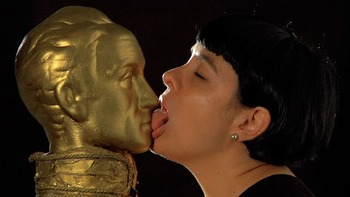
In the case of Castillo, her performances and installations never produce an object for the audience to passively view or admire. What the audience is exposed to is the act of making. This act is, more often than not, sensual; it produces not contemplation but arousal. Whether we are watching Castillo spend over three minutes kissing the face of a golden bust of Simón Bolívar (Emancipatory Kiss, 2013) or carefully masturbate the phallus-shaped nose of a clay military figure (Demagogue, 2015) (Figure 5), we are involuntarily drawn into the movement of her tongue and her hands. Castillo’s actions resonate in our own bodies in a combination of discomfort and pleasure that invites us to ask not what is being made but what is being unmade: which structures and narratives are called into question as Castillo simultaneously shapes and unshapes the virile body of power. It is worth pointing out that Castillo’s actions do not have a clear ending; there is no way to tell when Castillo is done (licking, kissing, masturbating) because the image on the screen simply fades, denying us any sort of closure and forcing us to wonder about and imagine the “after” ourselves. Bule also denies us an “ending.” REQUIEM200≤—which on her webpage appears under the category of “Social Practice”—does not end when the wooden structure is physically removed from the space where it was exhibited, but continues online. Under the tab “REQUIEM200≤—Support,” the archive containing the information of those who were killed during protests against Maduro’s government—regardless of their political affiliationFootnote 8—grows as users provide new data.Footnote 9 The collaboration that started during the installation as the participants used their phones to give visibility to the dead thus carries on, a seemingly fleeting performance turned into ongoing social practice.
Photograph of the video performance Demagogue. Photo credit: Florencia Alvarado. Courtesy of Deborah Castillo.

Both in the artists’ work and in the audience’s engagement with it, there is a message that can be interpreted as a command and as encouragement: “Do it yourself.” No longer describing just the activity of making repairs at home by oneself rather than employing a professional, the DIY ethos shapes the political sphere and informs the uses of media and communications to form hybrid social movements and practices of horizontal, participatory, and direct democracy. In DIY Citizenship: Critical Making and Social Media (2014), Matt Ratto and Megan Boler coin “DIY citizen” to underscore the political nature of DIY activity. This term encompasses emergent communities of critical makers (e.g., crafters, hackers, artists) and political protestors who organize on- and offline and who, through various activities, “deploy and repurpose corporately produced content or create novel properties of their own, often outside the standard systems of production and consumption” (3). As they do so, an opportunity arises to challenge traditional hierarchies of authority and the existing status quo. Outside this conceptualization—but not disconnected from it—DIY culture has developed in connection with the emergence of zines (a practice of both punk and third-wave feminist cultures) and has been mobilized by feminist artists working in craft and activism to denounce the increasing commodification of society.Footnote 10
This connection between crafting and gender points to a change in the more traditional understanding of crafting as a mechanism to discipline and shape female bodies. Historically, crafts such as knitting and embroidering were seen as teaching the women who practiced them values such as placidity, emotional control, passiveness, and decency (Reference Arantes, Burke and Spencer-WoodArantes 2018). There were of course many occasions during which women resisted the idleness of crafting and turned the activity into an opportunity to challenge their exclusion from the workforce and from the male-dominated art world. One such example is discussed at length in Beatriz González Stephan’s “Subversive Needlework: Gender, Class and History at Venezuela’s National Exhibition, 1883” (Reference González Stephan, Andermann and Rowe2005). In 1883 under the presidency of Antonio Guzmán Blanco, Venezuela organized its first National Exhibition to commemorate the birth of the Liberator, Simón Bolívar. The year before the exhibition opened its doors, an official announcement had been made stating that no group was to be excluded from this act of commemoration, and special care was put into inviting Venezuelan women to present their handicrafts and demonstrate their skill and diligence (Reference González Stephan, Andermann and RoweGonzález Stephan 2005, 59). Women’s participation was overwhelming, with hundreds of pieces that included, among many others, carpet and mat making, textiles, weaving, and “hair art.” In this last category, there was a picture of the heroine of Colombian independence, Policarpa Salavarrieta, embroidered with human hair, which was submitted by an unknown Miss J. Paz Guevara. In González Stephan’s analysis, this portrait—and the other works that were made by women and in which, she notes, Bolívar’s face was significantly absent—challenged the monopoly of father figures and notable men populating the collective imagination and turned the exhibition into a starting point to rethink the issue of gender and gendering in the country. For women, she notes, “the Exhibition was a political act that allowed them to rethink the nation, as well as to think themselves part of it. In a certain way, it gave them a voice, if only a voice expressed through the chisel or through needle and thread” (72).
Although over a hundred years separate Venezuela’s 1883 National Exhibition from Castillo’s exhibition and Bule’s installation, the determination to rethink the nation, to reflect on women’s access to and participation in it, and to challenge its male-dominated foundational imaginary, remains urgent and relevant. And once again, this critical exercise is carried out through crafting, though no longer because that is the only means of artistic production at women’s disposal, but because crafting takes the battle for inclusion and representation away from the result—the thing “already made,” the image “already thought of”—and into the space of production: the workshop (Figures 6 and 7) filled with materials waiting to be shaped, the nation suspended in an indefinite “not yet.” There is thus in Castillo’s shaping and reshaping of her raw clay, and in Bule’s sawing and hammering of wood, a will to intervene in the crafting of the nation that brings to mind Mary Louise Pratt’s (Reference Pratt1994) observation that women inhabitants of nations were neither imagined as, nor invited to imagine themselves as, part of the horizontal brotherhood Anderson proposes. In the context of Venezuela, this “horizontal brotherhood” is one that extends across history and that encompasses a series of presidents and dictators, all men, and all committed to safeguarding, through acts of repetition, imitation, and mimesis, Bolívar’s legacy. It is Bolívar’s words that dictate the fate of the nation, and it is his figure that gives shape to the Venezuelan people. As Rafael Sánchez (Reference Sánchez2016, 2) points out, “the figure of the Liberator is universally apprehended in Venezuela as the supreme embodiment and manifestation of the Venezuelan ‘people’—what this people necessarily looks like when contemplated whole, as a fully present, synchronic totality.” Castillo and Bule challenge the monopoly of the Liberator’s figure by presenting themselves as agents in the creation of the nation. It is their hands that give shape to Venezuela and to the figures that constitute it, and that ultimately create a body of the nation that does not look like the Liberator and that does not constitute a synchronic totality: a body that is as yet unimagined, malleable, and thus open to change and new interpretations. A DIY body.
Deborah Castillo’s studio in New York. Photo taken by the author.

Violette Bule’s studio in New York, with the wooden map of REQUIEM200≤ hanging on one of the walls. Photo taken by the author.

This DIY body comes together (and apart) outside the territory of the nation; thus, I have proposed talking about it in terms of nationness: the nation outside the nation, the “stuff” that makes up the nation as it is remembered, imagined, and redefined in transit, through the mobility and instability that characterize diasporic communities.Footnote 11 Within the geographical boundaries of Venezuela, the ethos of the DIY nation needs to be analyzed, on the one hand, against the background of Chávez’s Bolivarian Revolution and the social and political changes it accomplished, which contributed to the empowerment, visibility, and protagonism of the poorest sectors of the population, and encouraged and gave them the means to organize themselves and claim their place as political agents.Footnote 12 On the other hand, it needs to be analyzed in connection with the country’s current multidimensional crisis and the creative solutions people in Venezuela have developed to combat the lack of basic products.Footnote 13 These two approaches to DIY merit further discussion; for the purposes of this article, my focus will remain on nationness and DIY as a practice that guides the work of Bule and Castillo and, more broadly, as an ethos that informs the precarious everyday life of many Latin American immigrants living in the United States.
Within the community of Latin American immigrants who were forced to leave their home countries and who now reside—documented or not—in the United States, DIY has a double meaning. On the one hand, there is the agency and the sense of empowerment and critical reflection discussed so far; on the other, there is “do it yourself” as a command that speaks to a sense of abandonment and to the precarious conditions in which immigrants navigate a system that, due to linguistic, cultural, social, and economic barriers, appears hostile and inaccessible. This other way of understanding DIY is notably present in Bule’s artistic production, which is intrinsically connected to not only her experience as Venezuelan but also her experience as an immigrant who arrived in New York without family, financial security, or stable housing. This experience led her to jobs in restaurants and with Uber and Airbnb that put her in touch with other non-Venezuelan immigrants, and which informed the topics she explores in installations such as Dream America (2015) (Figure 8) and In Someone Else’s Bed (2016–2017) (Figure 9).
Photograph from the installation Dream America. Courtesy of Violette Bule.

Collage of photographs from the installation In Someone Else’s Bed, including the map that registered the country/state of origin of each of the visitors. Courtesy of Violette Bule.

Bule’s experience as a Latin American—and not just Venezuelan—immigrant, and the opportunities she has had to come into contact with other communities, cultures, and languages, broadens the scope of her artistic production in a way that ultimately shapes how Venezuela appears in her work. As REQUIEM200≤ shows, Venezuela and its dead are not presented as a foreign and hermetic spectacle to be observed; they become an experience to be shared, a reality that interpellates Venezuelans and non-Venezuelans alike and that invites us to consider the role Venezuela plays on the global stage, outside of its geographical borders. Similarly, the imperative to make her work relevant to non-Venezuelan audiences has made Castillo open up her critical performance on power to include not only the Venezuelan caudillo but also other figures that allow her to explore the marriage of masculinity and authority, such as Fidel Castro and Mao Zedong. I would argue that this need to “translate” their work—a translation that is not only linguistic but also cultural—leads to a freedom of artistic expression that, when directed at the Venezuelan reality they engage with, becomes productively subversive. As both artists explore new identities, experiment with new materials, and respond to the demands of their new environments, they allow themselves to think the nation differently, free from the constraints imposed by not only the Venezuelan government and its censorship policies, but also by the familiar patterns that, in the national imaginary, define Venezuela within Venezuela. In what follows, I explore this subversion through an analysis of RAW and REQUIEM200≤ that pays close attention to the agencies the works activate, the narratives they call into question, and the figures they reshape, all of which, taken together, rethink Venezuela by crafting Venezuelanness.
RAW
Castillo’s exile in the United States was triggered by a kiss, the Emancipatory Kiss (2013) (Figure 10). Part of the artist’s 2013 exhibition Acción y culto, which took place in Caracas’s Centro Cultural Chacao, the video performance shows Castillo caressing a golden bust of Bolívar and then spending over three minutes kissing him. The kiss is slow and sensual; it is not a sober encounter of two sets of lips but the shameless licking and twisting of Castillo’s wet tongue over Bolívar’s closed and motionless lips. The outrage that this performance caused within the government and among its supporters was captured in a March 2013 segment of the television show Cayendo y corriendo,Footnote 14 where the host, Miguel Ángel Pirela, angrily accused Castillo of being an instrument of the opposition and of disrespecting the memory of Bolívar, the “padre de la patria.”Footnote 15
Photograph of the video performance Emancipatory Kiss. Courtesy of Deborah Castillo.

The accusations and threats that Castillo received because of this performanceFootnote 16 have to be understood not only against the background of the Bolivarian Revolution and, specifically, the intimate connection Chávez claimed he had with Bolívar,Footnote 17 but also—and more broadly—in relation to what the Venezuelan historian Germán Carrera Damas called “the cult of the Liberator” (Reference Carrera Damas1969).Footnote 18 Numerous historians, cultural analysts, political theorists, and anthropologists have developed in-depth studies of the dynamics of the cult and its evolution throughout Venezuela’s history, underscoring Bolívar’s central role in the configuration of the nation’s social, political, religious, and economic identity. Although there are many, and at times conflicting, accounts regarding Bolívar “the man”—what he looked like, his social status, and even his raceFootnote 19—Bolívar “the national icon” remains, as Sánchez (Reference Sánchez2016, 2) points out, “the supreme embodiment and manifestation of the Venezuelan ‘people.’” In Dancing Jacobins: A Venezuelan Genealogy of Latin American Populism, Sánchez draws attention to the saturation of Venezuela’s public spaces with busts, equestrian monuments, and oversized portraits of Bolívar, which, along with commemorative rituals, proclamations, and ceremonies, canonize “the figure of Bolívar as both the father of the people/nation and as this people’s truest, most faithful reflection or representation” (3). Furthermore, as Michael Taussig argues in The Magic of the State (Reference Taussig1997), the endless reproduction of the image and words of Bolívar grounds the authority of the state, which repeatedly invokes the figure of the Liberator in an act that combines the official and the magical, and that ultimately legitimizes its actions and its violence.Footnote 20
Bolívar’s iconic status in Venezuela explains the outrage that an attack on his figure would unleash; while it is true that both the people and the state constantly reimagine and reproduce his image, destroying it seems to be out of the question. Castillo, in fact, does not destroy it, not really; all she does is kiss it. This action evokes and complicates Taussig’s observation regarding the power of icons, which, he argues, lies in their destruction. Icons, he proposes, “burst into consciousness and seem to come alive only with their defacement. … [T]hat which endows an icon with its respect and prestige also demands its defacement” (Reference Taussig, Stapleton and ViselliTaussig 2019, 22). Following Taussig’s reasoning then, destroying Bolívar’s image would ultimately reaffirm the power it holds, rendering said power visible and (even more) unquestionable. Perhaps that is precisely why Castillo does not destroy Bolívar’s bust but chooses instead to kiss him. Doing so constitutes, I propose, an act of subversion that does not reaffirm but successfully destabilizes power, and that is best understood when analyzed in the context of Castillo’s exhibition RAW.
The space of the exhibition and the performances taking place in it give two meanings to the word raw. The first defines raw as an adjective that describes something uncooked, unprocessed, or unprepared, and draws our attention to the malleability, softness, wetness, and overall instability of the material Castillo uses to build her sculptures: clay. Unlike bronze, marble, or stone, raw clay transforms Castillo’s sculptures from what Georges Didi-Huberman (Reference Didi-Huberman and Burk2016, 45) in Being a Skull: Site, Contact, Thought, Sculpture calls “objects of space” into “subtle actions of a site, into taking or having place.” In their “ongoingness,” Castillo’s sculptures refuse to forget their own birth as they emphasize the entanglement of agent, action, and result, ultimately sacrificing the stability and finality of a finished piece to the possibilities opened by the movement of Castillo’s hands over the growing phallus-shaped nose of Demagogue, and over the bust of the still-wet caudillo standing at the center of the gallery space. The eye-catching red of Castillo’s nail polish intensifies the protagonism of Castillo’s hands. As the audience’s eyes focus on the red of the nails, we are reminded that the figures we see—nameless bodies that evoke at once Bolívar and the military heads of state who governed Venezuela after him, as well as military and authoritarian men from other places and other times—are all handmade.
In the world of icons, this realization is far from being inconsequential. As Bruno Latour argues in “What Is Iconoclash?” (2002), to show the hands that make the icon is tantamount to desecrating it, sullying its origin, and weakening its force. If you say that an icon is man-made—or, in this case, woman-made—you “nullify the transcendence of the divinities” (17). A critical mind, he argues, is one that “shows the hands of humans at work everywhere so as to slaughter the sanctity of religion, the belief in fetishes, the worship of transcendent, heaven-sent icons, the strength of ideologies” (Reference Latour, Weibel and LatourLatour 2002, 18). This unsettling force that derives from seeing the hand that shapes the figure before it dries into an icon is at the literal as well as figurative center of Castillo’s performances. In both Demagogue and The Unnamable (Figure 11), the hands occupy the center of the shot, their slow movement lacking the determination to create, once and for all, the figure that is hinted at but never completed in the shaping and unshaping of the raw clay. Instead, the movement of the hands is suspended in a state of indetermination that is marked by pleasure, playfulness, and, in the case of Slapping Power, anger and frustration—all emotions that deviate from the state of respectful contemplation demanded by the sublime and the transcendental. It is thus not the icon, but the “making of the icon”—a process that has no clear ending in any of Castillo’s performances—that the audience watches and is invited to participate in. In fact, as they navigate a space that is not a gallery but a workshop, those in the audience find themselves surrounded by surfaces that beg to be touched (Figure 12), that appear to vibrate with anticipation as they wait for the unexpected-yet-desired encounter with someone’s (anybody’s) wandering hand. Hence the pounds of clay on the windows and the bust occupying the center of the space. In their raw, unprotected, and incomplete state, they articulate a silent but powerful invitation to the audience to craft, them too, a figure that is, through the endless possibilities opened up by the potentiality of a new touch, rendered powerless because it is not done yet (and perhaps never will be).
Photograph of a sequence from the video performance The Unnamable. Photo credit: Florencia Alvarado. Courtesy of Deborah Castillo.

Photograph of the wet clay pressed into the windows of the room in the Mandragoras Art Space where the RAW exhibition took place. Photo credit: Elvira Blanco. Courtesy of Deborah Castillo.

The audience’s involvement in Castillo’s performances brings us to the second meaning of raw, describing naked, irritated, and sore skin. At first glance, this understanding of raw materializes in Castillo’s naked body (The Unnamable) and in the sculptures themselves, in the handcrafting that both shapes and unshapes them, and that overlaps the birth of each of the figure’s features with cuts and abrasions that threaten to destroy or, at the very least, deform them (Demagogue). There is, however, another kind of irritation, one that is tied to the sensuality of crafting and that recasts it as a practice that sensitizes the very surface of the skin—Castillo’s as well as the audience’s. Watching Castillo make her clay figures means watching her caress them, masturbate them, and use their stiff limbs to touch her own naked body; it means watching and participating in a form of handcrafting that is, first and foremost, erotic. Both porn studies and media studies offer us productive ways of understanding the effect that this erotic handcrafting has on the audience that encounters it in Castillo’s exhibition. Vivian Sobchack’s (Reference Sobchack2004, 53) “carnal thoughts,” for instance, speak of the body sensually grasping what it sees on screen, reverberating to all sounds, vibrating to all colors, to a point at which body and image cease to be two separate and discrete units and become surfaces in contact, “engaged in a constant activity of reciprocal re-alignment and inflection.” Elizabeth Grosz (Reference Grosz1993, 46) conceptualizes perception as “the flesh’s reversibility, the flesh touching, seeing, perceiving itself, one fold (provisionally) catching the other in its own self embrace.” Susanna Paasonen (Reference Paasonen2011) uses the term carnal resonance to unravel the material and visceral sensations and vibrations that are caused by encounters with pornography. Last, Linda Williams (Reference Williams2008, 17), following Walter Benjamin, proposes “innervation” to underscore the experience of not only taking in and being moved by the images that surround us but also transmitting energy from the inside of our bodies back to the outside world.
Tying all these concepts together is the understanding that the exposure to images like the ones in RAW—a sensual crafting where surfaces rub against each other, where flesh shapes and unshapes fleshlike clay—charges us with vitality. As the bodies on screen move, we too are moved, we feel our skin vibrate with self-awareness, with self-mastery, and with an energy that cannot be contained by the malleable body that, vulnerable to the touch (Castillo’s and ours), has lost its hold on power, ideology, authority, and signification. The nature of this intimacy is of course undetermined; it might be desirable, surprising, unwanted, disturbing, and even repulsive. Yet what is undeniable is its existence; the power it gives us, whether we want it or not, whether we need it or not. Within the context of RAW, that power finds an actual outlet in the performance Slapping Power,Footnote 21 where Castillo slaps the bust that, throughout the night, she had been reshaping and perfecting through caresses. The slapping, however, is not just hers; it is the audience’s too. Stimulated, energetic, and determined, the bodies in the audience cheer, scream, clap, and encourage Castillo to hit the head harder and faster.Footnote 22 Whom is she actually slapping? As each slap disfigures the face little by little, it is the audience that must provide the answer to that question. It could be Bolívar, it could be Chávez, it could be Maduro, it could be Donald Trump. The name does not matter; what matters is the power of changing the face of power, of being disloyal to tradition, of being careless with masculinity, and of knowing that that power stays with us, in the tingling of our hands, even after the head has finally fallen to the ground.
REQUIEM200≤
Bule’s installation stages the loss of over two hundred lives during the protests that took place in Venezuela between 2014 and 2018 against Maduro’s government. “Translated” into QR codes printed on small white squares, these lives pierce the surface of a structure made of pieces of wood covered in black paint and arranged in a haphazard way that leaves the nails holding it together dangerously exposed and that does not hide the random holes that make each piece resemble a wounded limb. Passersby react to this installation with a combination of rejection and attraction. Without any information that explains—quickly and clearly—what the wood means or what the codes are, we are tempted to walk past what looks like something raw and incomplete: a sort of “work in progress” in the middle of an improvised outdoor workshop or studio. Yet the illegibility that characterizes the installation also pulls us in; the familiarity of the codes triggers our technological curiosity, while the wooden (coffinlike) structure and the requiem in the title alert us to the fact that someone died and moves us to find out whom.
Bule’s decision to render loss illegible in this way not only acts as a form of resistance against the hypervisibility (and thus invisibility) of monuments and the media-produced spectacularity of death, but it also creates an unsettling vulnerability in the audience, which recalls Judith Butler’s understanding of the disorientation of grief as a form of productive unknowingness of the self. In Precarious Life: The Powers of Mourning and Violence, Butler (Reference Butler2006, 30) asks: “If we stay with the sense of loss, are we left feeling only passive and powerless, as some might fear? Or are we, rather, returned to a sense of human vulnerability, to our collective responsibility for the physical lives of one another.” As she then states: “The disorientation of grief—‘Who have I become?’ or, indeed ‘What is left of me?’ ‘What is it in the Other that I have lost?’—posits the ‘I’ in the mode of unknowingness” (30). Standing in front of the map of a country that is presumably but not explicitly Venezuela (Figure 13)—and that thus could also be any other country—and scanning QR codes of two hundred dead who stick to our screens and linger in our phones as forgotten megabytes, we find ourselves wondering, like Butler, who we are and what we have lost.
Photograph of the wooden map with the QR codes exhibited as part of the installation REQUIEM200≤. Photo credit: Raquel Abend van Dalen. Courtesy of Violette Bule.

That we are forced to ask ourselves that question is the result of Bule’s success in, first, using raw matter to create a collectively shared feeling of grief. The raw matter that she uses is wood: an organic material that came from a recently living organism and that—like a corpse—is capable of decay. This connection between the wooden map and the corpse is further implied by what Renu Bora would call the “texxture” of the wooden pieces. Texxture, Bora argues, is dense with information about how an object substantively, historically, and materially came into being, thus differing from texture, which “defiantly or even invisibly blocks or refuses such information” (quoted in Reference SedgwickSedgwick 2003, 14). Texxture is “loud,” it draws our attention to the bumps, blemishes, holes, and rough edges and to the stories that they tell, stories that, in the case of Bule’s installation, speak of the violence of bullets and knives wounding bodies. In fact, each of the pieces that makes up the map appears wounded. There are random holes next to a few of the QR codes, as well as large nails that do not appear to be holding the structure together as much as they appear to be stabbing it and that threaten to injure us too if we are not careful. Furthermore, the black coloring of the wood along with the name of the installation evoke an atmosphere of funerary rites and mourning. We are invited to participate in a requiem for a body that we do not know, that we cannot recognize, but that we nevertheless mourn because it materializes right there in front of us—undeniably present and fatally wounded.
There is thus in Bule’s installation an attempt to turn the audience’s first encounter with the wooden structure into an act of grief that precedes familiarity and recognition. Rather than knowing the life that has been lost and then mourning its absence, we mourn it before we know it. The presence of the wounded and decomposing body—the materialization of vulnerability—wraps us into the sort of interpellation Butler talks about, where we understand (viscerally, if not entirely consciously) that the life lost is somehow connected to us and that we are responsible for it. This grief that is born out of a state of prerecognition is not meant to be paralyzing but becomes an invitation to engage in a form of memory crafting that leads to collective re-membering and that begins with us taking our phones out, downloading the free app Bule designed for the installation, and scanning one of the two hundred QR codes displayed on the map. If the chosen code corresponds to the number V-20.820139, the screen will show the face of Bassil Alejandro Da Costa. Bassil’s death in February 2014 marked the beginning of a new wave of government repression while also becoming a symbol of courage that intensified the desire to continue protesting in support of the resistance organized by university students all over the country. On his digital tombstone, we read his National Identity Number (20.820139), his age at the time of his death (twenty-three), how he died (gunshot to the head), and a Google Maps image of the exact corner where the shooting happened. In the case of Bassil, the access to this information was facilitated by the protagonism that his death acquired in the media; obtaining information about the other deaths was not as easy and remains a work in progress, as Bule points out:
At the beginning, I collected the data with the help of Oriana Bastardo, who lived in Venezuela and used to work with me when I was living in Caracas. It took us a year to obtain and compare information that we acquired through various virtual platforms, newspapers, Twitter, Facebook, blogs, etc. We prepared a list that we kept rechecking, since in many cases the same pictures appeared with different names, or there was information we could not access, until we finally put together a solid and coherent set of data. I used that data to create a visualization that shows how the repression and its consequences were the cause of many deaths, and that also shows the place where they happen and the way in which those accounted for died. I have an open portal in my website where people can write me and corroborate, correct, or add information.Footnote 23
Searching, collecting, and recording the details of the deaths that occurred during the protests—a responsibility that typically lies with the state and its official organisms, with nongovernmental organizations, and/or with the press—thus becomes a task that Bule must take on herself and that leads to the creation of a DIY archive for the dead. The Y in this DIY archive is plural; as Bule explains, the digital archive is ongoing and open to fact-checking, new additions, changes in format, and so on, that can come from her, from Bastardo, and from anyone—in New York, in Venezuela, and anywhere in the world—who has knowledge to contribute. This restless archive that she creates and in which we can participate allows us to contribute to the creation of an afterlife that escapes the reach of the state and the boundaries of the nation-state and that produces a memory that “does not stay put but circulates, migrates, travels; it is more and more perceived as a process, a work that is continually in progress, rather than a reified object” (Reference Bond, Craps and VermeulenBond, Craps, and Vermeulen 2018, 1).
The participatory nature of this restless archive—and of Bule’s installation in general—leads to a form of collective re-membering. Re-membering in this context, is a deliberate process of memory construction rather than a matter of simple recall. Lorraine Hedtke and John Winslade (Reference Hedtke and Winslade2017, 81) coined the term in The Crafting of Grief: Constructing Aesthetic Responses to Loss to refer to a process of becoming “that does not dispatch the memory, legacy, and stories of the dead to the grave but seeks to maximize the possibility of the deceased person being woven into the lives of the living.” Hedtke and Winslade provide a productive framework for the study of grief that underscores the “membership” alluded to in re-membering. In membership, they argue, there is a sense of belonging and the potential of creating a community where relational exchanges occur not only among the living but also among the living and the dead, who “come back” through storytelling, tangible objects, and ceremonial occasions. This community serves “not only to make the deceased visible, but also to enable people to stand against the dominant discourses that dismiss the deceased” (96). In the case of Bule’s installation, this process of re-membering occurs through the creation of a space of networks and “interfaces”: a point of contact—a shared surface—where bodies and (hi)stories stick to each other, reflecting Sara Ahmed’s conception of “stickiness” “as an effect of the histories of contact between bodies, objects, and signs. … That is, stickiness depends on histories of contact that have already impressed upon the surface of the object” (Reference AhmedAhmed 2014, 90). Stickiness, she continues, “involves a form of relationality, or a ‘withness,’ in which the elements that are ‘with’ get bound together” (91). As the virtual dead “leave an impression” on our phones and thus stick to us, a form of memory emerges where re-membering requires being with the other in a space that is neither here nor there, neither theirs nor ours, but that binds us all together in a group where there are no prerequisites (ideology, political allegiance, nationality) for belonging.
Bule’s REQUIEM200≤ therefore creates a community of mourners where the sense of belonging exists outside of (and separated from) the territory and the political polarization of Venezuela. Grief is not a response automatically following the loss of a familiar life but is instead crafted: a deliberate action that Bule constructs through the crafting of a wounded (wooden) body that is grievable in spite of being unfamiliar. Grieving thus become a way of knowing; already grieving, we learn the faces and the stories of the dead, who are already ours, regardless of their national or political identity. In Bule’s installation then we find an echo of Hoskins’s (Reference Hoskins2018, 3) claim that we are “the most accountable generation in history.” Bule makes us accountable not only by making us grievers, but also by creating a digital archive where the dead count and are accounted for, and putting it “in our hands”—literally and figuratively.
Conclusion: Crafting Venezuelanness
Through their artistic practices, Castillo and Bule invite us to reflect on what a nation looks like outside its geographical borders, in an “elsewhere” where nationhood gives way to nationness. This question is not unique to the Venezuelan diaspora or to diasporic communities in general. In an ever-changing world of globalization and new technologies, this question also resonates within national territories where inhabitants must grapple with, if not the reality, at least the possibility of existing in a borderless, horizontal place where selves and identities (individual as well as collective) are constantly being reimagined and remade. Neither Castillo nor Bule provides an answer to that question; they both underscore the potential that lies in the question itself and the possibility it opens up of engaging in an act of crafting where the nation appears as a “work in progress.” Their exhibitions and installations do not produce a stable and easily consumable image of Venezuela for the audience to take with them but instead propose a Venezuela “in the making.” A shapeless lump of clay, a disorienting overlap of wooden pieces and QR codes that do not show us anything but drag us into them, turning us into crafters who participate in an act of critical making for which the end result does not matter as much as the narratives that are exchanged, the agencies that are activated, and the mourning that is shared as Venezuela is reconceptualized as Venezuelanness.
While this form of critical making can (and does) take place inside the nation, outside the nation it becomes subversive in a way that is tied to the particular conditions that characterize the reality of diasporic communities. Always “in between” here and there, the past and the future, the need to remember and the demand to adapt, artists like Castillo and Bule engage in a daily renegotiation of what Venezuela is that, while challenging and at times painful, also results in the freedom to fearlessly and irreverently contest what is deemed sacred or unchangeable within the nation. Castillo’s erotic crafting challenges the power of the male figures that monopolize political power in Venezuela and also here, in the United States. Bule creates a community through an act of mourning and collective re-membering that make the Venezuelan dead everyone’s dead, regardless of national or political identities. It would be tempting to argue that this subversion, like the two artists, remains abroad. However, the fact that the artists’ work exists in the web—circulating, migrating, and traveling across time and space, frequently shared on Instagram, Twitter, and Facebook—suggests that, “in between” here and there, Venezuelanness and Venezuela might find themselves in a productive dialogue that leads to the crafting of new and much needed political futures.
Acknowledgements
This article would not have been possible without the support, the many conversations and exchanges, and the hard work of Venezuelan artists Deborah Castillo and Violette Bule. My sincerest thanks to them.







 Open access

