

1.1 Thinking Politically about Climate Change Mitigation
By the mid 2020s, nearly 30 years after the United Nations (UN) breakthrough climate agreement at Kyoto, climate mitigation policies had resulted in a wide range of changes designed to limit greenhouse gas (GHG) emissions, but global emissions had not yet peaked, let alone fallen. At this time, electoral support for political parties expressing anti-mitigation views also rose in the United States (US) and parts of Europe, whilst many countries were still feeling the political and social effects of multiple crises – from COVID-19 to Russia’s invasion of Ukraine. This represented an increasingly complex political landscape for much-needed accelerations of mitigation policy, but also an opportune moment to critically evaluate the politics of climate change mitigation and to explore how to think politically about policy.
This book argues that the politics of climate mitigation, and its relationship to policy and society, are poorly understood. Mitigation politics is rarely defined, whilst narrow boundaries are often drawn around what politics means, what role should be played by different actor groups, and the temporalities of reducing emissions, even to ‘net’ zero. Limited understandings of and engagement with politics may be related both to the dominance of science and economics over mitigation policy debates and under-representations of political science and sociology insights. Even within the social sciences there are very different perspectives on politics, how to mitigate, timeframes involved, and which aspects of socio-political landscapes need to change.
The relative lack of understanding about mitigation politics really matters. The public policies that we rely on to drive emissions down globally are deeply interconnected with political and social contexts. If we cannot properly understand how politics shapes, and is shaped by, policy choices and outcomes over the timescales required to reduce emissions, we run the risk of designing poor mitigation strategies that also further undermine support.
This book offers a novel, inclusive, and broad conceptualisation of climate mitigation politics, which builds from, and adds to, insights on politics by Colin Hay (Reference Hay2007). It presents politics, policy, and policymaking as dynamically interrelated; overtly recognises the central role of contestation and compromise within politics; takes institutional and material contexts seriously; and foregrounds the importance of features of politics, including capacity, social interaction, and deliberation. This conceptualisation frames the subsequent historicised, multi-scalar analysis of four interrelated phases of climate politics. The analysis starts in the 1970s, when climate mitigation was not a political issue, and explores phases in its construction as an area of public policy – largely at global and national scales. There is some emphasis on constructing mitigation policy in energy sectors in high- and middle-income countries, engaging with the struggles, injustices, and decisions involved in creating low GHG emissions alternatives and phasing out fossil fuels.
Conceptualising politics in broad and more inclusive terms directly informs an overriding argument that climate mitigation has become politicised over the decades in a variety of ways and that that is no bad thing. Indeed, taking too narrow an approach to understanding politics, focusing on certain elements over others, runs the risk of underestimating the societal outcomes of mitigation policy and missing opportunities for deliberation and policy improvement. Drawing narrow boundaries around politics, then, places the political project of mitigation at further risk.
1.2 Intractability of Climate Mitigation
Although, by 2024, over 147 countries, 278 cities, and 1,176 of the world’s largest corporations had made commitments to reaching net zero emissions and renewables had become the fastest growing source of energy in history, the world was not on track to meet UN Paris aims. Consequently, the effects of climate change were becoming more and more widespread, whilst global mean surface air temperature hit 1.54°C in the first nine months of 2024 (WMO 2024). Global GHG emissions still needed to fall 42% by 2030 (IPCC 2023), but based on policy commitments, the world was on track for 2.6 to 3.1°C of warming (UNEP 2024).
Climate change, then, remained one of the most intractable challenges facing policymakers, whilst reducing emissions across all sectors of the economy posed challenges to a wide range of embedded institutions. Its persistent intractability can be partly related to tensions in how the role of politics in processes of climate mitigation was envisaged. Indeed, within many established academic and policymaking circles, politics was framed as explicitly standing in the way of mitigation, encouraging associated tendencies to avoid, deny, or downgrade the role of politics. At the same time, in Intergovernmental Panel on Climate Change (IPCC) and other scenarios where the world meets 1.5 or 2°C limits to warming, public policy is persistently seen as the central driver of low emissions change. These two things, politics as obstacle and policy as driver, can only be true at the same time if policy can somehow be removed from politics.
It is this tricky tension that sits at the heart of the motivation to write this book. I argue that policy and politics are by and large not separable over the prolonged periods required to reduce emissions. If mitigation policy is to drive profound change, then associated climate mitigation politics are inevitable. It follows, then, that if policy is necessary to engendering low emissions change, politics is part of the deal. This is true in several ways. Mitigation policy needs to create the correct structural conditions for significant developments in accessible and affordable low-emissions alternatives across every sector of the economy. For example, the International Energy Agency (IEA) now claims that 80% of the considerable number of new, large-scale renewable projects that will be realised by 2050 will happen due to public policy. At the same time, political negotiations and processes will remain central in enabling the phase-out of deeply socially and economically embedded high-emissions goods, services, and practices. By the 2020s, these latter mitigation processes had started to enter a crucial phase in many parts of the world. What that meant is that some associated socio-economic implications, for example, the potential for job losses, stranded assets, corporate transition risks, and the need to alter aspects of daily lives, were coming into sharper relief, particularly in high-income and some fossil fuel based economies.
Climate mitigation remained, then, profoundly complex in terms of the scale of changes and of political work required across all policy areas, the power of high-emissions economic and social incumbency, and of the unevenly experienced socio-economic outcomes that can be associated with mitigating. Mitigation policy also needs to be sustained over prolonged periods of time and multiple successive governments, given that net zero targets generally range between 2050 and 2070 – so for at minimum another 25 years. The costs and benefits of existing high-emissions systems, energy, transport, and food are also unevenly distributed, whilst climate change exacerbates inequities. The job at hand remained, then, not just to rapidly reduce emissions but to do so in ways that both overcome resistances associated with embedded high-emissions systems and redress their global and societal injustices. If not for moral reasons, then at least to increase political and social momentum behind limiting global warming.
At the same time, mitigation actions, and inactions, affect many of the world’s citizens – as does the quality of policy design with respect to distributional outcomes. It follows, then, that a variety of social views are expressed. It is this aspect of politics, the existence of varied and contesting views – from climate denial to reformist views to calls for more rapid and/or progressive transformations – that can feed into negative attitudes towards politics. Here politics, understood as opening mitigation up to conflict, becomes the problem which should be avoided – a view which emphasises the dangers of contestation but also assumes that mitigation policies can be made and maintained outside of certain political institutions. Several mitigation perspectives, explored in more detail in Chapter 2, reflect such tendencies to oversimplify or diminish politics in search of stable mitigation policy (see also Paterson Reference Paterson2021; Jordan & Moore Reference Jordan and Moore2022). Such ideas speak well to embedded anti-government ideas, particularly in, but not limited to, Anglo-Saxon countries and also resonate with views of politics as ‘partisan’, as opposed to evidence-based, ‘objective’ science.
Whilst climate science has fundamentally underpinned political motivations for mitigation and supported processes of getting climate onto political agendas (Paterson Reference Paterson1996), it has had little to tell us about the complex social and political processes of and contestations involved in driving emissions reduction. This insight was recognised by the IPCC in the 2022 working group III (WGIII) assessment report (2022). Even as support for mitigation has increased over time in many parts of the world, the science-backed view that the world needs to rapidly reduce emissions, which infers considerable further social and material changes, is not accepted by everyone in positions of power nor across societies. Indeed, responses from societal groups affected by fossil fuel phase-out policies have electoral significance, especially at times of cost-of-living and energy crises. Climate mitigation, as an overarching goal, remained both actively pursued and contested.
Whilst it is apparent that climate mitigation politics and policies have both enabled and constrained the changes required to reduce emissions – it is only by analysing them together that we can understand them. This book conceptualises politics as a basis for thinking politically about mitigation policy and how it can be designed in ways that are more sensitive to wider social goals. Doing so offers some counterbalance to a general lack of conceptualisation and discussion of the complex particularities of mitigation as a process (Paterson Reference Paterson2021). This book is also an attempt to see the politics of mitigation policymaking through the eyes of those tasked with this considerable responsibility – to take account of the variety of views and difficult decisions with which they grapple – and to encourage a more proactive and politicised stance. After all, in the words of former EU Environment Agency lead Hans Bruyninckx, “we’ll either change by design or by disaster. I prefer by design” (Bruyninckx Reference Bruyninckx2023). Such an approach comes somewhat late for the many that have already experienced climate-related disasters, but the thinking remains relevant – particularly in consideration of the severe implications of climate change and of future generations.
1.3 Understanding the Politics of Climate Mitigation
Within political science, one approach to exploring mitigation politics starts from the basis that it is informed by a range of different, not always commensurable, perspectives. Such explorations are often organised according to theoretical perspectives, for example, structuralist, institutionalist, market pragmatist, or eco-socialist (Ciplet et al. Reference Ciplet, Roberts, Khan, Biermann and Young2015). Others, more directly interested in policymaking processes, categorise according to political ideologies, that is, conservativism, liberalism, and socialism (Garner Reference Garner2011; Stirling Reference Stirling2014b); or to broader approaches to pursuing net zero like ‘technocratic’, ‘marketised’, ‘state-led’, and ‘citizen-led’ (Scoones et al. Reference Scoones, Leach and Newell2015). Here, the politics of climate mitigation is understood as explicitly situated within broader struggles between different perspectives on, and approaches to, governing. What is also evident, as explored in more detail in Chapter 2, is that some ways of thinking about climate policy, often from market liberal or climate science perspectives, involve very little attempt to reflect on their worldview and how it shapes their assumptions about mitigation policy and politics.
This approach helps to reveal the degrees to which, and explain why, climate mitigation can be framed so differently. In turn, how climate is framed as a policy issue – that is, as market failure, a technological problem, a problem of capitalist growth, and/or as one part of wider ecological crises – influences what solutions are deemed necessary, what approaches to policymaking are appropriate, and who pays policy costs and reaps rewards (Bernstein Reference Bernstein2001; Vogler Reference Vogler2016; Dryzek Reference Dryzek2022). Some scholarship has explored the ways in which market liberal perspectives have influenced climate governance at global and national scales (Bernstein Reference Bernstein2001; Newell & Paterson Reference Newell and Paterson2010; Victor & Heller Reference Victor and Heller2011; Scoones et al. Reference Scoones, Leach and Newell2015; Vogler Reference Vogler2016; Kuzemko et al. Reference Kuzemko, Lockwood, Mitchell and Hoggett2016a). This influence reflects the fact that the early 1990s, when climate mitigation came to be accepted as a policy issue, coincided with a marked rise in the influence of market liberal ideas over policy design in global and some domestic governing bodies. This contributed, amongst other things, towards policy approaches that reified growth (Bernstein Reference Bernstein2001); preferences for market actors as appropriate leaders in driving GHG emissions reduction (Newell & Paterson Reference Newell and Paterson2010); and/or shutting down further deliberation over alternative solutions (Kuzemko Reference Kuzemko2015). This approach to understanding climate mitigation reveals the degree of boundary drawing around acceptable mitigation policy – including who is counted as a relevant stakeholder and included in policymaking processes and whether distributional factors are considered or not. However, in focusing on perspectives on how to reduce emissions, this literature tends not to consider other influential views on climate mitigation, such as denial or objections to specific policies that also profoundly shape mitigation politics.
In part as an antidote to early fixations with market-led solutions, some research has explored the role of state actors. Here the state is seen as having varied roles: in mobilising resources to build governing capacity in climate change (Vogler Reference Vogler2016); in supporting clean innovations through publicly funded research and development (R&D) and new market creation (Fouquet Reference Fouquet2010; Mazzucato Reference Mazzucato2013); and in ensuring more just forms of change, including redistributing costs and benefits (Perez Reference Perez2002; Barry & Eckersley Reference Eckersley2004; Kuzemko Reference Kuzemko2019; Newell & Simms Reference Newell and Simms2020). More recently, some research has foregrounded the role of public policy in shaping opportunities for supporting existing, and creating new, constituents in support of climate mitigation policy (Meckling et al. Reference Meckling, Kelsey, Biber and Zysman2015; Roberts et al. Reference Roberts, Geels, Lockwood, Newell, Schmitz, Turnheim and Jordan2018; Schmid et al. Reference Schmid, Sewerin and Schmidt2019). Taken together, this research highlights a range of important government functions in relation to complex processes of emissions reduction. Rarely, however, is the breadth of governance functions explored together, whilst social and cultural politics often remain peripheral to analyses – both issues that this book seeks to address.
Critical political economy perspectives concentrate our attention on interest-based and other embedded material structures that heavily influence both the need, and political possibilities, for mitigation. Here mitigation policymaking is understood as subsumed within wider capitalist, fossil fuel based power relations that heavily shape capacities for making and implementing mitigation policy (Ciplet et al. Reference Ciplet, Roberts, Khan, Biermann and Young2015; Scoones et al. Reference Scoones, Leach and Newell2015; Mildenberger Reference Mildenberger2020; Stokes Reference Stokes2020; Stoddard et al. Reference Stoddard2021; Buller Reference Buller2022). Powerful fossil fuel interests, often corporate, are understood as an integral part of current varieties of capitalist growth, with direct exposure to these interests actively constraining policymakers’ mitigation choices. These approaches highlight the fact that much of the world is still reliant on fossil fuels for economic development, whilst energy, transport, and agricultural systems are made up of crucial infrastructures upon which many depend. Structuralist approaches, then, reveal the extent to which, even as emissions have started to fall in some parts of the world, hierarchies of power and social inequities within energy and other systems are rarely challenged by low-emissions transitions.
As discussed in Chapters 2 and 3, institutionalist and structuralist research does much to reveal the politics that sit behind policymaking but often tends not to engage with other social and technical factors important to mitigation policy constructions. Such factors can include electoral and cultural politics, social outcomes of mitigation policies, how to respond to contestations of mitigation policies, different phases of climate policymaking over time, and the ways in which policy can drive low-emissions system changes. Here it is worth engaging research, from public policy and political economy, that understands politics as more explicitly as social in its explorations of cultural factors, citizen activism and behaviours, and electoral politics (Paterson Reference Paterson2007; Carter Reference Carter2007; Shove & Walker Reference Shove and Walker2010; Daggett Reference Daggett2018; Willis Reference Willis2020; Newell et al. Reference Newell, Daley and Twena2022). A societal focus takes analysis beyond élite policymaking circles to consider how different public views shape mitigation politics. It matters that high-emissions systems have long underpinned everyday practices in high- and, increasingly, middle-income countries; that products, like high-specification internal combustion engine (ICE) cars, have become so aspirational; and that identities have formed in many communities around fossil fuel extraction and use (Paterson Reference Paterson2007; Daggett Reference Daggett2018). The socially embedded nature of high-emissions systems also increasingly matters given that, in many jurisdictions, citizens are being called upon to turn their backs on conditioned practices. Rebecca Willis’s work on climate mitigation and democracy highlights interactive links between politicians and citizens within democracies by exploring what is being asked of citizens, how it is being asked, and how they respond – including electorally (Reference Willis2020). Approaches that foreground public opinion and electoral processes have also helped to reveal the influence, more recently, of right-wing populism (Lockwood Reference Lockwood2018; Marquardt et al. Reference Marquardt, Oliveira and Lederer2022).
Taken together, these literatures provide us with detailed and nuanced accounts of constraints upon and resistances to emissions reduction policy and, importantly, why they are so often successful. A focus on structural constraints can, however, obscure changes that are occurring because of mitigation choices already made (Kuzemko et al. Reference Kuzemko, Lawrence and Watson2019). There has been a considerable proliferation of emissions reduction, renewable energy, and energy efficiency targets and associated strategies and policies; rapid cost reductions in technologies that enable lower emissions goods and services; and advancements in scientific knowledge about climate change and in measuring its socio-economic costs. These changes mean something for the ongoing politics of mitigation. Although there is much value to be taken from understanding obstacles to rapid emissions reduction, it is also necessary to better understand the capacity of public policy to accommodate, reshape, and otherwise overcome obstacles.
There have been remarkably few attempts to define what is meant by politics. Here I turn to one stand-out exception – Matthew Paterson’s book ‘In Search of Climate Politics’. As he rightly points out, to think politically about mitigating, we need to first set out what we mean by politics. He defines it in three distinct but interrelated ways as: the site of collective decision-making, or as ‘arena’; power relations that determine ‘who gets what, when, and how’; and as inherently conflictual (Paterson Reference Paterson2021). Interestingly, he defines social and political drivers of and obstacles to climate change action separately from the overall definition of politics, via the notion of cultural political economy. Although my conceptualisation of politics comes closest to Paterson’s, sharing his interest in collective decision-making, conflict, and distributional aspects, my approach, building from Colin Hay (Reference Hay2007), includes cultural and social drivers within the overall definition of politics and places a greater emphasis on politics as deliberation.
Paterson takes a further turn in thinking politically about mitigation – he engages two sets of related dynamics, ‘de- and re-politicisation’ and ‘purification and complexity’, that arise out of his definition of politics (Paterson Reference Paterson2021; Paterson et al. Reference Paterson, Tobin and VanDeveer2022). He defines depoliticisation broadly, following John Barry (Reference Barry2002), as political actors seeking to, and succeeding in, taking decisions out of the realm of collective and deliberative public decision-making. Others point to depoliticising ideas as having become popular amongst policymakers in many countries (Wood & Flinders Reference Wood and Flinders2014), and as explicitly reducing government capacities for mitigation policymaking (Kuzemko Reference Kuzemko2015; Johnstone & Newell Reference Johnstone and Newell2018). On another level, depoliticisation can also be used to explain perspectives, discussed above, that actively seek to diminish the role of politics. They are often based on narrow and simplistic understandings of what politics is, drawing boundaries around it, and on a distrust of conflict and self-interested politicians (Paterson Reference Paterson2021).
Within research on (de-)politicisation, however, there has been far more effort engaged in defining and understanding depoliticisation, not least given its increasing use as a governing tactic, over politicisation. This is also the case both for Paterson, who sees re-politicisation largely as a reversal of depoliticising trends and as part of a dialectic between de- and re-politicisation over time (Paterson Reference Paterson2021), and for Hay, whose conceptualisation of politics was applied to better understanding depoliticisation (Reference Paterson2007). Reading more widely, across both public policy and political economy research on (de-)politicisation, some useful definitions of politicisation can be located – most of which are not engaged specifically with climate mitigation but are nonetheless illuminating. Politicisation has been defined as making an issue more salient (Wolff & Ladi Reference Wolff and Ladi2020; Dupont et al. Reference Dupont, Oberthür and von Homeyer2020); moving a subject previously not a policy issue onto governmental agendas where it can be associated with agency and public policymaking (Hay Reference Hay2007; Beveridge & Naumann Reference Beveridge and Naumann2014; Paterson Reference Paterson2021); freeing up policymaking capacities and resources to design and implement policies (Kuzemko Reference Kuzemko2013; Dupont Reference Dupont2019); engendering broader public conversations, deliberation, and learning (Beveridge & Nauman Reference Beveridge and Naumann2014; Kuzemko Reference Kuzemko2015); and as including a wider range of societal groups within processes of policymaking (Paterson et al. Reference Paterson, Tobin and VanDeveer2022).
Taken together, these definitions encompass a wider variety in understanding politicisation and what it entails. They also raise the point that maintaining an issue as political, in the sense that it remains subject to collective public policy choices, involves hard work. Indeed, that mitigation remains a policy issue cannot be taken as a given – especially within the context of limited resources, competition between policy areas, powerful anti-mitigation groups, and multiple crises. Politicisation broadly defined, as in Chapter 3 of this book, includes collective choice, agency, deliberation, and social interaction, can suggest routes towards, and possibilities for, improved mitigation policy (Beveridge & Nauman Reference Beveridge and Naumann2014). This is partly why, even with potentially negative side effects associated with expanding spaces to deliberate climate mitigation, it should remain politicised (Kivimaa & Rogge Reference Kivimaa and Rogge2022; Paterson et al. Reference Paterson, Tobin and VanDeveer2022; Dupont et al. Reference Dupont, Moore and Lerum Boasson2024).
Although rarely explicitly discussed, some of the above described research on the politics of mitigation is bound up with questions of time. Just as there are structural and social contingencies that differently shape mitigation framing and policy choices, so too are there temporal contingencies. Firstly, as already pointed out, reducing emissions to net zero infers that mitigation needs to remain on political agendas over prolonged timeframes (Geels & Schott Reference Geels and Schot2007; Vogler Reference Vogler2016; Rosenbloom et al. Reference Rosenbloom, Meadowcroft and Cashore2019; Paterson Reference Paterson2021; Geels & Turnheim Reference Geels and Turnheim2022). The wide range of target dates for achieving net zero also infers variety at any given point in time between, and within, countries – including in terms of whether emissions are growing, peaking, or falling. A second way of thinking about the importance of time to climate mitigation is by highlighting connections between policy decisions already taken and present (and future) climate politics (Meckling et al. Reference Meckling, Kelsey, Biber and Zysman2015; Roberts et al. Reference Roberts, Geels, Lockwood, Newell, Schmitz, Turnheim and Jordan2018; Rosenbloom et al. Reference Rosenbloom, Meadowcroft and Cashore2019; Sewerin et al. Reference Sewerin, Cashore and Howlett2022). In recognition of these connections, arguments have emerged that policies can be designed to engender future outcomes beneficial to maintaining mitigation on agendas. These include designing political strategies to actively increase numbers of low-emissions constituents and to build winning coalitions for climate mitigation (Meckling et al. Reference Meckling, Kelsey, Biber and Zysman2015; Rosenbloom et al. Reference Rosenbloom, Meadowcroft and Cashore2019).
The passage of time is also important to scholars that understand sociotechnical transitions towards low-emissions systems as phased. Typically, transitions have tended to start with support for niche technologies; then, as niche technologies develop and costs fall, they become more widely distributed, which can then be accompanied by the phase out of existing regimes (Kitzing & Mitchell Reference Kitzing and Mitchell2014; Markard et al. Reference Markard, Geels and Raven2020; Geels & Turnheim Reference Geels and Turnheim2022). Here the understanding is that to phase out GHG emissions whilst maintaining current lifestyles, alternatives to high-emissions systems need first to be accessible and affordable. There are also arguments that the later high-emissions phase-out processes are tougher to navigate for policymakers because they infer higher amounts of intrusion into citizens’ lives and require substantial policy and research efforts (Markard et al. Reference Markard, Geels and Raven2020). Importantly, phases of sociotechnical change necessarily coincide with phases of policy development (Andrews-Speed & Zhang Reference Andrews-Speed and Zhang2019; Breetz et al. Reference Breetz, Mildenberger and Stokes2018; Zaki & Dupont Reference Zaki and Dupont2023). For example, a policy designed to support renewables through the early ‘niche’ phase becomes less necessary when they can compete within existing electricity systems; whilst a policy to phase out fossil fuels will have very different sets of requirements to one designed to boost low-emissions alternatives. As such, mitigation politics is about cumulative policy choices spanning several decades, as well as somewhat varied phases in what mitigation policies need to achieve at a given point in time (Rosenbloom et al. Reference Rosenbloom, Meadowcroft and Cashore2019: 172).
Lastly, briefly, some consensus has started to emerge about the multidimensional nature of mitigation politics. Policymaking, as with many issue areas, takes place at a wide range of scales and places through the involvement of multiple actor groups. At the same time, local, national, regional, transnational, and global policy processes and decisions are dynamically interlinked – that is, domestic decisions about whether and how to mitigate have implications for global negotiations; whilst global commitments can also open up political space for domestic and sub-national action (Schreuers Reference Schreurs2004; Garner Reference Garner2011; Stripple & Bulkeley Reference Stripple and Bulkeley2019; Scoones et al. Reference Scoones, Leach and Newell2015; Death & Tobin Reference Death, Tobin, Corry and Stephenson2017; Bulkeley Reference Bulkeley2016; Vogler Reference Vogler2016; Colgan et al. Reference Colgan, Green and Hale2021; Newell Reference Newell2021). In this book, I am particularly interested in complex processes of public policymaking associated with attempts to phase out emissions in just and lasting manners. These processes and their outcomes are, however, understood as actively shaped by a wide range of different actor groups, including corporations, citizens, and civil society.
1.4 The Approach Taken in This Book
This book is, at its heart, about exploring the ways in which mitigation politics, policymaking, and policy have interacted with one another through time – with some emphasis on different temporal phases of constructing climate policy and on identifying what forms of politicisation have taken place and what that means for climate mitigation policy design. My research focus is, explicitly, on climate change mitigation policy, often shortened to mitigation policy. This is an extremely important but relatively novel area of policy, it did not exist prior to the 1980s, which means that a considerable degree of politicisation has been needed over time. Mitigation policy is also understood in this book as dynamically intertwined in practice with other policy areas and social goals – such as economic growth or security. In focusing on mitigation, complex as it is, this book does not consider in any depth the politics of seeking to address and avoid the many other environmental issues that humans create. There is some emphasis, in Chapters 5 to 7, on political attempts over time to reduce emissions in energy sectors in developed and middle-income countries. This has been partly necessary because of my interest in exploring relationships between mitigation policy and politics over time and because these countries have been relatively active in mitigation policymaking. Further, these are key sites where action is most required given the scale of historic and/or current contributions to climate change. The focus on energy is justified because it has been the focus of global, domestic, and local mitigation policies since the 1990s, not least because it has been and remains the highest emitting sector globally. Analysis of mitigation policy and politics in energy acts as an interesting example of the struggles encountered in seeking to reduce emissions in practice.
Two of the central contributions of this book are the novel and inclusive conceptualisation of climate politics and the, related, development of the concept of politicisation, as specifically attuned to climate mitigation. These, in turn, facilitate the overt focus on exploring politicisations of climate mitigation, as a counterbalance to the relatively greater emphasis on depoliticisation outlined above. As famously observed by Colin Hay, it is hard to understand what is meant by politicisation without first defining politics (Reference Hay2007). In Chapter 3, I build from Hay’s definition of politics as including four features – collective choice, capacity for agency, deliberation, and social interaction – and use this broad conceptualisation to frame how I think about climate mitigation politics.
Hay briefly outlines an understanding of politicisation that is rooted in the movement of any given issue area, in our case climate change, from the realm of ‘fate’, where collective decisions are not made to address it, to the realm of public policy. Here, governing bodies, importantly, remain the legitimate home for deliberating and agreeing collective public policy choices. Chapter 3 of this book offers a significantly extended definition of politicisation to expand how we can envisage politicisation in relation to each feature of politics. This reinforces the importance of moving an issue into the realm of public policy but explores in more detail what politicisation looks like once it is subject to formal legislative procedures. This extended view of politicisation accounts for the significance of issue salience; capacities of public policy to deliver on social goals; how different societal groups interact with policymaking and outcomes; the quality of policymaking and deliberation; and public participation.
Hay’s definition of politics is not specific to climate mitigation. As such, to provide a more nuanced account, I incorporate a wide range of insights from research more explicitly focused on climate change mitigation and sustainable energy transitions. These include the political economy of transformations; climate and energy public policy; and sociotechnical transitions research. Doing so, as explored in detail in Chapter 3, allows me to assemble an overarching understanding of politics that is more attuned to specifics associated with complex processes of mitigation. These include how climate mitigation has been framed and narrated; how mitigation policy and politics interrelate over time; how mitigation policymaking interacts with other policy areas; and the influence of embedded institutions, material and ideational, over policymaking.
Overall, the idea is to conceptualise politicisation in ways that are more constructive – for example, by interpreting contestation not just as an obstacle to mitigation but also as natural to politics and as worth understanding in relation to policy choices. This is where Hay’s inclusion of social interaction as an aspect of politics becomes especially helpful, as a useful counterbalance to climate politics conceived as overly structured. Engaging more proactively with sociological features of mitigation, including how different groups experience and respond to different types of mitigation policies, can enable policymakers to better understand some of the non-emissions implications of mitigation policy. Indeed, different policy designs infer different societal outcomes. For example, policies designed for wider distributions of renewable energy in Germany and Denmark did result in greater access to electricity generation in those countries. Questions of policy design are increasingly relevant for those governing bodies explicitly seeking more just processes of emissions reduction that meet multiple social goals.
A second core insight developed in this book builds from the argument that reducing emissions to ‘net’ zero will take many decades. It involves making low-emissions alternatives, like renewable energy or demand reduction, widely accessible and affordable as well as phasing out the high-emissions goods, services, and systems upon which many depend to deliver everyday functions. This is a tense political, social, and infrastructural balancing act that extends across whole economies. Here, to be clear, policies need to be designed that can deliver considerable changes that also challenge existing interests, practices, technical systems and policies whilst also maintaining sufficient political support for mitigation. These aspects of mitigation policy are novel, unprecedented in some respects, with much learning still to do. Indeed, mitigation policy processes were only really initiated in earnest from the late 1990s/early 2000s onwards – which means that it is still new relative to many other policy areas. At the same time, one of the central arguments of this book is that there are growing opportunities to reflect back on and learn from accumulated political experiences.
This takes us back to the notion of dynamically interlinked temporal phases of climate mitigation. The analysis in chapters 4 to 7 is structured according to inter-related phases in the construction of climate policy and politics. There are identifiable differences in mitigation policy processes over time that coincide with, and respond to, outcomes of previous policy choices. This approach is not based on any assumptions that ‘phases’ of policy are necessarily linear within jurisdictions, domestic party and electoral politics have sometimes put paid to that notion. But it does build on ideas outlined in Section 1.3 about mitigation policy sequencing being related to different stages of a low-emissions transition over medium-term timeframes (Breetz et al. Reference Breetz, Mildenberger and Stokes2018; Setzer & Nachmany Reference Setzer, Nachmany and Jordan2018; Markard et al. Reference Markard, Geels and Raven2020; Stechemesser et al. Reference Stechemesser, Koch, Mark, Dilger, Klösel, Menicacci, Nachtigall, Pretis, Ritter, Schwarz, Vossen and Wenzel2024). An important insight here is that different types of mitigation policies are required at different stages of social and technical changes. For example, when wind and solar generation becomes a significant percentage of electricity systems, this necessitates a new set of policy measures, like support for storage, grid development, and demand side response, to better balance intermittency.
Based on insights from how the politics of mitigation is conceptualised, I define ‘phases’, for want of a better word, somewhat differently, but always in relation to actual constructions of mitigation politics over time. I place a relatively higher degree of emphasis on politicisation, on somewhat varied stages in the construction of mitigation as a policy issue, and on relations over time between policymaking, policy, and politics. Specifically, Chapters 4 to 7 are structured according to exploring four highly interrelated but temporally differentiated phases in the construction of mitigation politics thus far – see Figure 1.1. The earliest phase is characterised here by the prolonged and at times vociferous struggles to make climate change subject to collective public choice from a largely depoliticised issue. In this early, pre-Kyoto phase, the salience of climate change became more broadly recognised, initial framings of mitigation, reflecting varied ideas and interests, were debated and established, and political compromises and collective choices about targets reached, as reflected within the United Nations Framework Convention on Climate Change (UNFCCC). Post Kyoto, given that emissions reduction targets had been accepted by Annex 1 parties to the UNFCCC,Footnote 1 a different phase ensued – that of making complex policy choices about how to meet those targets and of building domestic governing capacities. This second phase reveals new levels of complexity and struggle – how embedded institutions shaped policy choices, the ways climate mitigation extended into and came to interrelate with other policy areas and goals, and how related tensions were utilised by anti-mitigation actors to slow low-emissions change.
‘Phases’ in the constructions of climate policy and politics
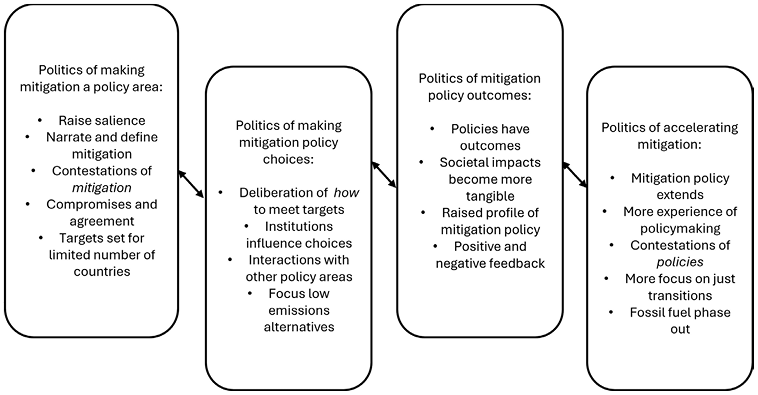
The next phase is defined in relation to the politics of mitigation policy outcomes. Indeed, only once mitigation policies have been implemented can the politics of outcomes become more tangible and possible to research. Over time, emissions and non-emissions related outcomes had started to impact more groups in society, making politics as social interaction particularly relevant. Policy outcomes are also understood as one route through which previous policy choices, and non-choices, effect reformulations of mitigation politics, thereby raising the political profile and importance of mitigation policy choices and design. In the most recent phase, analysed in Chapter 7, policymaking debates centre on struggles to raise the speed and ambition of mitigation policy at a time of multiple crises, growing societal tendencies to differentiate between mitigation policies, and contestations of particular policies. Time matters deeply here, too, given the speed at which the world still needed to reduce emissions to meet IPCC 2030 goals and the UNFCCC Paris aim of limiting warming to 1.5˚C. This phase is also characterised both as one in which fossil fuel phase-down policies started to further complicate the politics of mitigation and social responses and in which some new capacities for deliberation about how to make more just mitigation policy had emerged.
Taking a long, historicised view is an analytical choice made with the intention of reflecting back on decades of climate mitigation policymaking and politics. Doing so assists in identifying how mitigation politics has changed – including what types of policies have emerged and why; how pro- and anti-mitigation interests and arguments evolve; what types of learning and capacities to govern have emerged; how societal responses shift with changes in mitigation policy; and how policy has affected the availability and affordability of low-emissions technologies and infrastructures. This historicised approach also takes account of degrees and types of politicisation over time as mitigation policy was constructed. On another level, this approach accounts for the fact that phases differ within and between countries at any point in time – some jurisdictions might be further along in terms of engendering technical change, or slowing the destruction of rainforests, or phasing out fossil fuels. But, at the same time, globally, each of these phases contributes new experiences, lessons, learnings, contestations, and types of social and material change. Reflecting on processes of establishing new climate bodies, setting goals, making policy choices, and policy outcomes is arguably vital at a time when acceleration and new types of policy are needed (Markard et al. Reference Markard, Geels and Raven2020; Rosenbloom & Meadowcroft Reference Rosenbloom and Meadowcroft2022).
1.5 Brief Summary of Chapters
Following this introductory chapter, Chapter 2 explores a broad range of differing academic and policy views on politics in relation to climate change mitigation – organised according to whether they are more in favour of depoliticising or politicising the issue and/or how it is governed. One of the aims of the chapter is to illuminate how relevant perspectives on politics are to how climate mitigation is approached, which actors are considered to have agency to drive emissions down, and the extent to which dedicating political capacity and public resources to processes of mitigation is deemed necessary. Perspectives on politics also influence what policy is understood to be for, for example, mainly technical or also social change, how its costs are distributed, whom it benefits, and which aspects of human systems need to be altered.
Chapter 3 constructs the broad and historicised conceptualisation of mitigation politics. As discussed above, it does so by building on, critiquing, and combining insights from constructivist political economy; climate policy, political economy of transitions; and sociotechnical transitions research. The aim of this chapter is to present a perspective on mitigation politics that at once allows for analysis of different phases of climate mitigation policymaking and politics over time, recognises and incorporates mitigation related constraints and opportunities, and takes account of a wide range of features of politics – collective choice, agency and capacity, deliberation, and social interaction. Doing so also offers up a more nuanced and detailed account of different but related types of politicisation – and how they interact with one another.
The following four chapters use this broad, historicised framing to explore and interpret different phases of mitigation politics that have emerged over the past 40 years or so. Chapter 4 concentrates on processes of making climate mitigation into a policy area during the early period, essentially 1970s to early 1990s, wherein climate mitigation moved from the realm of ‘fate’, or just relative obscurity, to an area of global governance. The focus is on how this process played out at the global level, albeit global and domestic debates are understood as dynamically intertwined. It explores the ideas, frames, and interests that informed United Nations climate change debates and how it came to be defined as a policy issue, and, ultimately, the specific compromises that were necessary to reaching agreement to set emissions reduction targets for Annex 1 countries. It is not new to claim that early framings shaped later choices, but there is some focus in Chapter 4 on the role of political compromise in processes of reaching agreements and on governing bodies, in this case the UN, as having some responsibilities and capacities to adjudicate between different ideas and interests. Particular interest is also paid to questions of how pro-mitigation groups articulated the need for change, the role of climate science within this, how anti-mitigation groups narrated their contestations, and on understanding the nature and consequences of the particular compromises reached. Although negotiated outcomes were unsatisfactory in many ways, there is a sense that all parties did, to greater or lesser extents, compromise to engender these first stages in the politicisation of climate mitigation.
Chapter 5 is about domestic processes of policymaking, largely in Annex 1 countries, from the immediate post-Kyoto period up to 2008. Although there had been some debate about difficulties in reducing emissions in the pre-Kyoto period, it was during this following phase that more clarity emerged about the choices and contestations policymakers faced in practice. These range from deciding where mitigation decisions should be taken, in existing or new departments or ministries; what the overall approach should be and what types of policy should be preferred; to how reducing emissions relates to objectives in other policy areas and what to do about perceived trade-offs. The politics of making collective mitigation choices, and how those choices were influenced, started to become more tangible, whilst climate mitigation was subject to a range of politicisations in a deliberative sense.
Anticipations of mitigation policy outcomes had been very much part of early climate debates, but in the next phase actual outcomes become central to the analysis. Chapter 6 explores different types of emissions and non-emissions (socio-economic) outcomes of mitigation policies and their relationship to reformulations of the politics of mitigation from 2008 to Reference Kern and Rogge2018. Here, social interaction is particularly important, as it is at this stage that social responses to policies can be better identified and accounted for in policymaking debates. Conceptually, this chapter leans quite heavily on public policy scholarship on how policy decisions, once made, can shape the politics of further rounds of policymaking – but with a greater degree of emphasis on the place of policy outcomes in these processes. Mitigation policy outcomes have had greater levels of impact on other policy goals, have been increasingly varied, and contingent upon policy design. In this phase, then, mitigation policy became politicised in a number of ways – but with some emphasis on new constituents and on higher degrees of social interaction.
Chapter 7 starts in Reference Kern and Rogge2018 and builds toward the early- to mid 2020s. This has been an extremely turbulent and difficult time for many. Aside from extreme situations, COVID-19 and the (re-)starting of armed conflicts, some of this turbulence has been related to the world’s inability to reduce emissions quickly enough and to rising inequalities within and between countries. Despite the many crises faced during this time, key high-emissions parts of the world, not least the EU and China, have continued to dedicate increasing capacities to governing for climate mitigation. This chapter is partly about revisiting the original compromises, struck in 1997 to enable the Kyoto agreement, to assess how they have changed and with what implications for how mitigation is framed and approached today. It is also partly about reflecting on what the analysis undertaken in this book offers up in terms of insights for deliberation and mitigation policymaking. There is a particular emphasis on considering how to improve mitigation policy design so that it can better support, mainly distributional, forms of justice. Not just for moral reasons, but also because of apparent links emerging between policies designed to better distribute the costs and benefits of processes of mitigation and public acceptance.
Lastly, the final chapter of the book explores the ways in which mitigation has been politicised. Each of the four aspects of politics, set out in Chapter 3, is revisited to assess degrees and types of climate mitigation politicisation – partly to better understand the politics of acting to mitigate in this current phase and partly to identify important tensions and opportunities that need to be recognised when thinking politically about mitigation.

 Open access