


Introduction
Charles Francis Hall, an American Explorer, became intrigued by the mystery of Sir John Franklin’s 1845 expedition’s disappearance while seeking the Northwest Passage (Hall, Reference Hall1864; Loomis, Reference Loomis1971; Nourse, Reference Nourse1879; Potter, Reference Potter2016). Hall organised two expeditions (1860–1862, 1864–1969) to rescue any survivors and to secure documents and relics from the expedition (Nourse, Reference Nourse1879). Critically, Hall recorded much of what he learned from the Inuit and their interactions with European explorers including Frobisher, Parry, Ross, McClintock and Franklin (Nourse, Reference Nourse1879). During his second expedition (1864–1869), Hall made several attempts to reach King William Island (KWI) from his base near Repulse Bay, Nunavut, Canada. It was on KWI, and near the mouth of the Back Fish River on the Canadian mainland, where many of Franklin’s crew perished and many artefacts were recovered by the Inuit.
In 1869, at the conclusion of his second expedition, Hall returned to the United States with his papers and relics with the intent of publishing a book and touring to raise money to support future exploits. Almost immediately, Hall began organising a third expedition, but this time intending to reach the North Pole. Before Hall left for the North Pole in 1871, he transferred many of his Franklin relics to the Smithsonian Institute. Unfortunately, during the third expedition, Hall died under suspicious circumstances (Paddock, Loomis, & Perkons, Reference Paddock, Loomis and Perkons1970; Loomis, Reference Loomis1971). Joseph Henry, the first Secretary of the Smithsonian Institute, recognised the historic significance of Hall’s expeditions and negotiated with Hall’s widow to donate her husband’s expedition papers and other materials to the Smithsonian Institute (Nourse, Reference Nourse1879). It later fell upon J.E. Nourse to preserve and organise Hall’s documents, and it is Nourse’s Narrative of the Second Arctic Expedition made by Charles F. Hall (Reference Nourse1879) that has served as the primary source of information pertaining to Hall’s second expedition for many years.
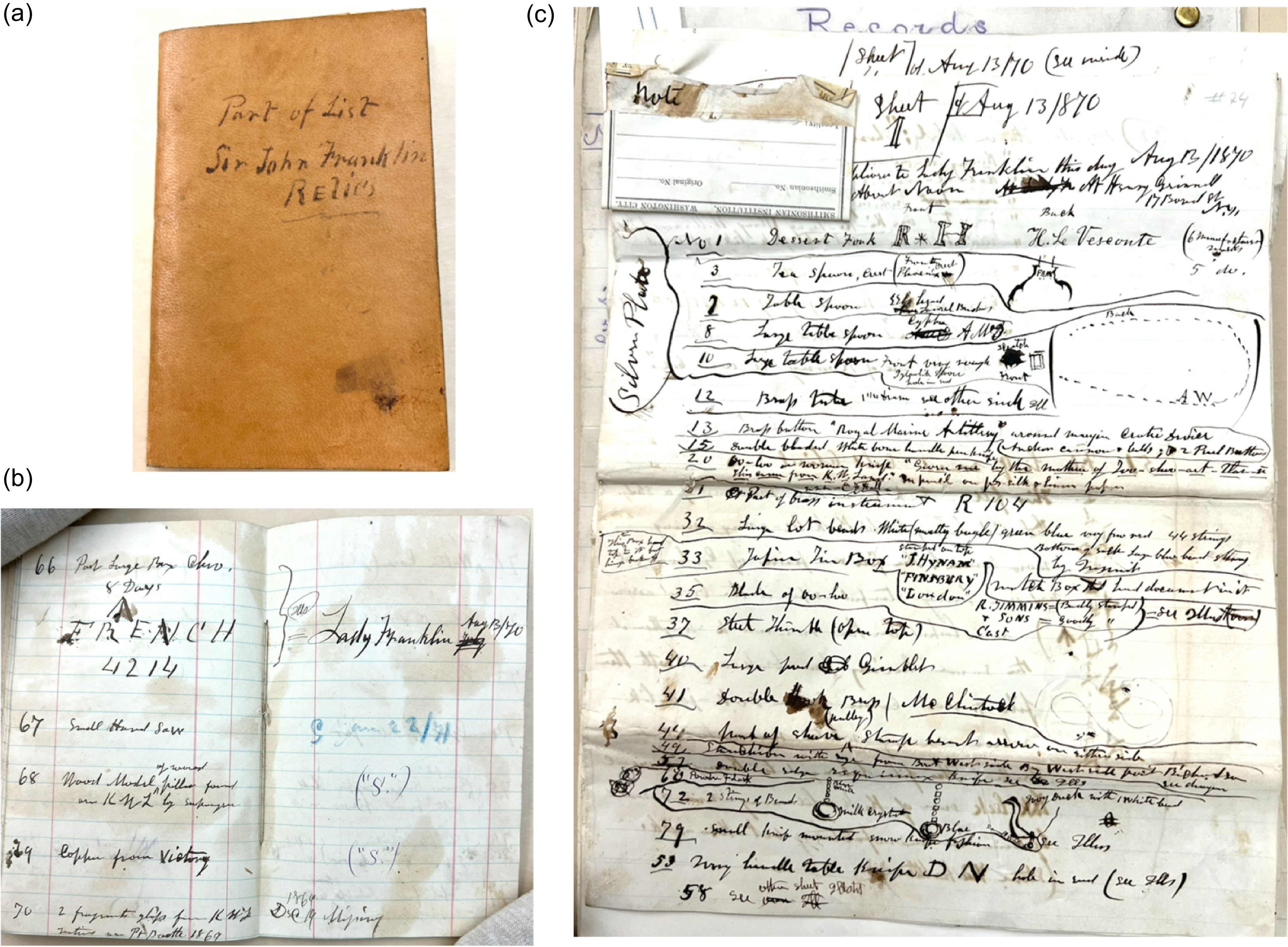
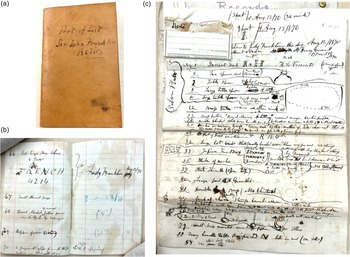
The purpose of this paper is to describe the Franklin relics that Hall donated to the Smithsonian Institution, the majority of which have not been on display in the United States since the Centennial Exhibition in Philadelphia in 1876 (Ingram, Reference Ingram1876; Microfilm, Reference Microfilm1876). The starting point for this examination is Hall’s notebook entitled Part of List Sir John Franklin Relics (Figs. 1a, and 1b) and several loose pages of notes (Fig. 1c) (Hall, 1869b, 1869c) that are preserved at the Archives Center at the National Museum of American History (NAMH). This analysis attempts to correlate Hall’s catalogue of relics at the Smithsonian Institute with those Hall gave to others including Jane, Lady Franklin. Forty-six of the eighty-three relics that Hall catalogued have been identified. Many of these were found in a 1869 contemporary illustration appearing in Harper’s Weekly magazine.
Hall’s relics documents.
(a) Hall’s Part of List Sir John Franklin Relics notebook containing numbering, descriptions and disposition of the relics. (b) Internal page of Part of List Sir John Franklin Relics notebook illustrating relics 66 through 70. (c). Loose notebook pages of relics and selected drawing of items donated to Lady Franklin. Items shown in (a) and (c) are housed in the Smithsonian Institute Archive Center, National Museum of American History in C.F. Hall Collection Folder 2157.105–107.
This analysis of the Smithsonian Institute relics reveals a diverse collection of items, including cutlery, tableware, tools, instruments and personal effects, reflecting the practical needs and personal property of the Franklin Expedition’s crew. Notably, Hall gave away all relics marked with the broad arrow (the symbol (ꙟ) used to mark British government property) to Jane Franklin, Franklin’s widow, or Henry Grinnell, Hall’s major benefactor, and retained only a few items connected to Sir John Franklin. Importantly, this analysis corrects cataloguing errors and provides context for materials scavenged from the Franklin Expedition.
Methods
Hall’s Part of List Sir John Franklin’s Relics (Fig. 1a) spans 22 pages, with entries covering two journal pages (Hall, Reference Hall1869c). On the left-hand pages of the notebook, Hall catalogued the relics, assigned them numbers and provided descriptions (Fig. 1b). The facing pages contain information as to the disposition of each item. Several loose-leaf pages with descriptions and illustrations of the relics are also in the folder (Fig. 1c) (Hall, Reference Hall1869b). The notebook and the loose pages predominantly catalogue items presented to Jane Franklin in 1870 or donated to the Smithsonian Institution in 1871 (Hall, Reference Hall1869b).
Many of the relics described Hall’s Part of List Sir John Franklin’s Relics notebook are currently housed in the NMAH. Items that were considered ethnographic, probably by Smithsonian Institute conservators, are housed in the Museum Support Center (MSC) (Suitland, Maryland, US), the principal off-site conservation and collections storage facility for the NMAH and other associated Smithsonian Institute Museums. In some cases, materials collected by the Inuit from the Franklin Expedition that were fashioned into items of utility are also housed in the MSC.
On 20 and 21 March 2023, the Smithsonian Institute’s NMAH and MSC were visited to identify and photograph the Hall relics and, where possible, correlate them with the list in Hall’s notes.
To curate all of Hall’s Part of List of Sir John Franklin Expedition Relics notebook items, the images and descriptions of items related to the 1845 Franklin expedition, particularly those attributed to Hall, were evaluated during the period of November 2023 to January 2024 using the Collections Online portal on the website of the National Maritime Museum (NMM) (Greenwich, (https://www.rmg.co.uk/collections/objects/search). Interestingly, some of the artefacts listed at NMM are attributed to expeditions led by McClintock or Rae, but appear to be items in Hall’s drawings, and therefore for this investigation considered as part of the relics Hall collected.
Finally, to identify additional relics obtained by Hall, an illustration published on 23 October 1869 in Harper’s Weekly was consulted (“Captain Hall’s Arctic Expedition,” 1869). The article includes a list of relics that Hall brought back from King William Land (“Captain Hall’s Arctic Expedition,” 1869).
Results
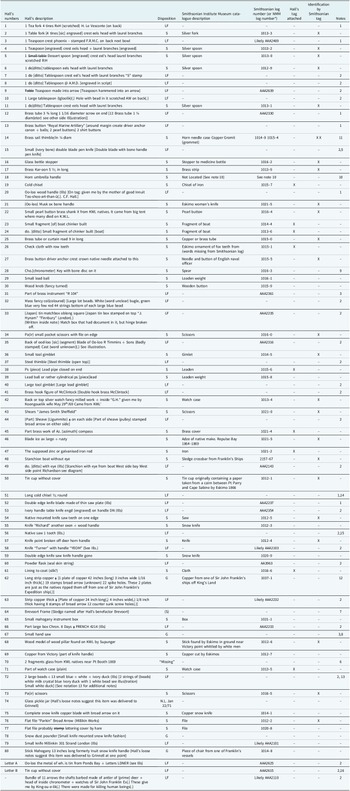
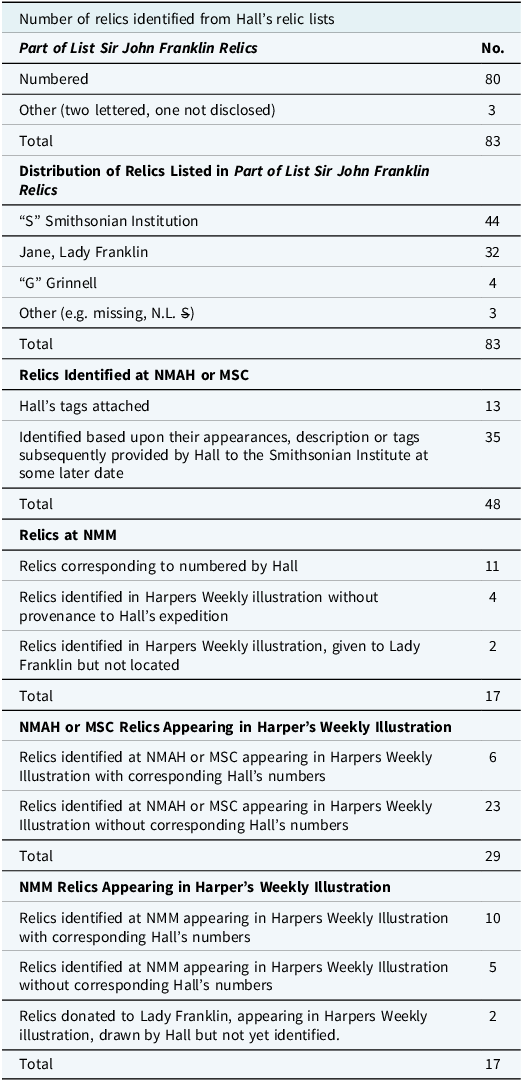
Hall’s Part of List Sir John Franklin Relics notebook lists 83 items that Hall (Hall, Reference Hall1869c) noted and labelled (Table 1). This list consists of items numbered 1–80, items labelled A and B, and an unnumbered item. The unnumbered item is a bundle of 11 arrows that were presented to Lady Franklin (Hall, Reference Hall1869c). Some of the items in the collection, Hall attributed to Parry’s 1824–25 and Ross’s 1829–1833 expeditions.
Correlation of Hall’s relic numbers with disposition and current location
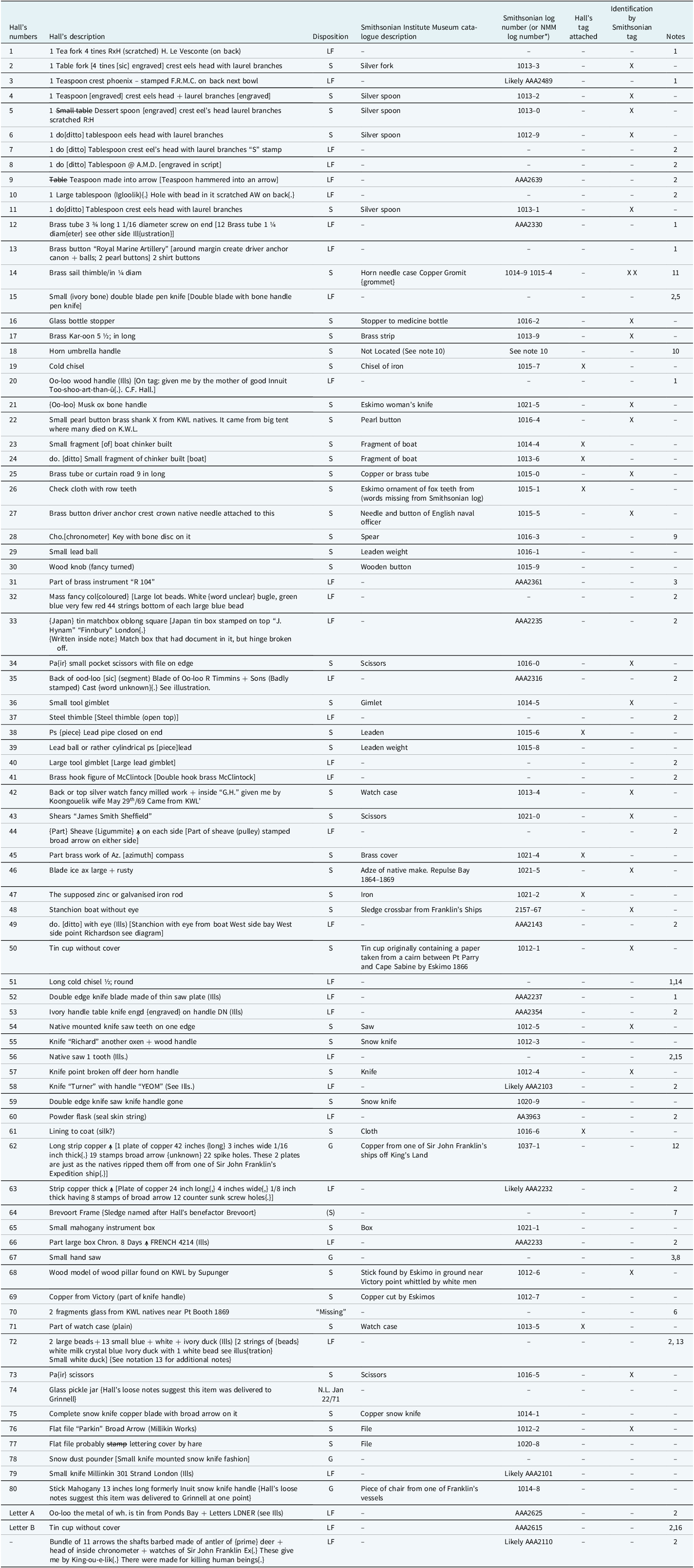
‹ › = Items with ‹brackets› are added by author to indicate items which are unclear or had been abbreviated by Hall.
[ ] = Items with squared brackets are Hall’s loose-leaf notes describing the Franklin relics, some with illustrations.
* = Catalogue number from National Maritime Museum, Greenwich, London if presented by Hall to Lady Franklin.
G = G{rinnell} Jan 22/ 71.
GR = Hall indicated the disposition of this item as “Groton” on Jan 22/71.
N.L. = Likely “not located” on Jan 22/71 or given to another individual.
LF = Lady Franklin.
S = Articles marked “S” Hall indicated he had taken to the “Smithsonian Institution” Feb 1st, 1871, unless specifically indicated.
(S) = Notation by Hall: Sent by express from N.Y with spears{,} bows + arrows etc.
1 = Delivered to Lady Franklin on August 12, 1870, Items: 1,3,12,13,20,51,52.
2 = Delivered to Lady Franklin on August 13, 1870, Items: 7,8,9,10,15,32,33,35,37,40,41,44,49,53,56,58,60,63,66,72, A and B.
3 = Delivered to Lady Franklin on February 1871, Item.
4 = G{rinnell} Jan 22/ 71.
5 = This knife {unclear word, possibly “maping [sic]”} eve of Nov 23d but by advertising in {Cincinnati} daily paper determined AM 26th Nov.
6 = Hall wrote in notebook. “Dsc {discovered} 1869/9 missing.”
7 = Sent by express for N.Y with spears bows + arrows etc. Apparently withdrawn from Smithsonian collection as indicated by (S).
8 = Written in blue pencil unlike other entries which are in ink, delivered in Feb 1871.
9 = Written in pencil unlike most other entries.
10 = An item resembling a horned umbrella handle (Hall’s #18) does not appear to have been logged into the Smithsonian Institute. However, what appears to be an umbrella is shown in the Harper’s Magazine illustration in the middle of the diagram right below an arrow (Fig. 2).
11 = Hall’s item #14 (brass sail thimble) has two listings in the Smithsonian logs: A horn needle case (1014–9) and copper Gromit [sic]{grommet} (1015–5).
12 = Hall indicates item 62 was given to Grinnell Jan 22/71. Why it is noted the Smithsonian Catalogue remains unknown.
13 = From Hall’s loose note papers: This on label: ({unknown} give to Lady Fr. To-day Aug 13) {written on side note: Of {those} seal skin string hooks of {most}} These beads given me by Koong-ee-ou’-leek the son of late Kok-lee-arng. A part of the beads found in a tent where so many dead kob-lunas [white men] in a tent on Ki-ki-tung (King Williams Land) next to the sea called oo-jook-lik + the rest from the ship which drifted into said sea given me Thursday July 12 1866 (60th Enct [Encampment]). The beads belonged to the wife of Koong-ee-ou-ee-leek – “Hall.”
14 = From Hall’s loose note pages: “51 File half round cold chisel. This file I took from the runner of a sledge that did belong to old Kok-lee-arng-nung now mine. The file, a piece of galvanised rod-iron having stamped upon it the broad arrow, was lashed on the runner to strengthen it the same having been broken. Both the file + rod came from Ook-joo-lik where many white men starved to death: The file belonged to Koong-e-ou-e-leek son of Kok-lee-arng-nung + used by him in manufacturing oo-kooo-seek (stone kettles).”
15 = From Hall’s loose note pages: “56. This belonged to Koong-e-ou-e-lik the An-et-koo of the Pelly Bay natives here at 60th Enct [encampment] with us. Yesterday he gave it to the old lady Ev-e-shaung for lifting the divining stone in way of doctoring one of his sick children + today Ev-e-shaung gave it to me for a hand of tobacco she being very fond of the pipe. The metal (steel tooth) came from Oo-joo-lik where the many white men starved to death. So Kong-e-ou-e-lik says.”
16 = From Hall’s loose note pages. Relic B: “This tag to Ooloo is given to Lady Franklin had the following. This Oo-loo or Woman’s knife – made by a native Repulse Bay Sept 4: 1865 + given me by his wife who is a native of Ponds Bay Found on Beacon Hill + then the rust was scraped off with knife by the finder{.} The natives all said that this came from great island where so many white men died. CF Hall Relic sent to – Grinnell with some of my in 1866 CFH{.} Relic R. Timmins + Sons {‘AS.{?}}handled by Innuits [sic]+ the shank (a) put on by Innuits [sic]. ‘This relic found by Ar-mon Sept 4/85 + given me same time that his wife gave him a musket ball found on Beacon Hill{.} The Innuits [sic] all say that this came from Neitchille from the dead white men’. This was a tag as the Oo-loo came to America 1866.”
For items gifted to the Smithsonian Institution, Hall enclosed the letter S in brackets (“S”) in the relic’s notebook (Fig. 1b). Twenty-one Frankin expedition relics were presented to Jane, Lady Franklin on 12 or 13 August 1870 (Table 2), which were denoted as “Lady Franklin” and were also described and drawn on loose-leaf note sheets (Fig. 1c). Hall marked one item that was transferred to G in March of 1871, probably representing Henry Grinnell – a significant benefactor of Hall’s explorations (Hall, Reference Hall1869c). This item consisted of a long strip of copper marked with the broad arrow.
Location of Hall relics today
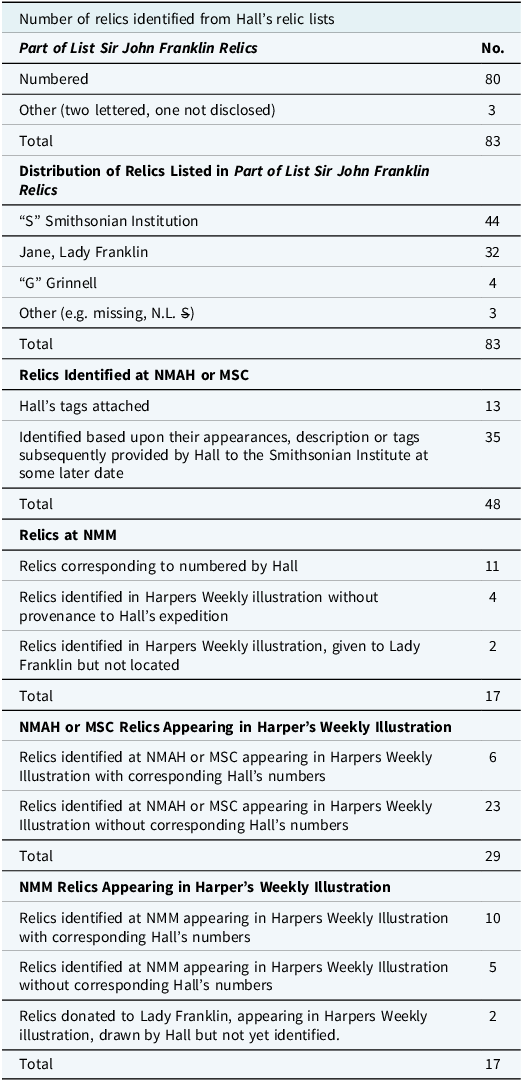
Note: National Museum of American History (NMAH) of the Smithsonian Institute (SI), Museum Support Center (MSC) of the Smithsonian Institute. National Maritime Museum (NMM). N.L. Presumably not located. S Presumably intended for the Smithsonian but not delivered.
After Hall donated the materials to the Smithsonian Institution, they were assigned catalogue numbers (1011–0 to 1043–9) in the Museum Catalogue, No.3. Antiquities 8301–14100. In many cases, Hall’s numbering system was recorded (Table 2), as was a description that roughly matches those recorded by Hall (Hall, Reference Hall1869b, Reference Hall1869c). Interestingly, the museum catalogue ascribed four numbers to Hall’s items that were not recorded in Hall’s relic notebooks including the following:
-
• #166 (walrus harpoon from Igloolik NE side of Beacon Hill 1866, 1013–6).
-
• #268 (bone implement belonging to side of Kyak [sic] for holding instrument – Repulse Bay, 1022–2).
-
• #269 (whale lance of Eskimo Repulse Bay 1864–9, 1026–8).
-
• #290 (otolith from Bowhead whale Field Bay, 1029–4).
These notations suggest that Hall had made an additional list, possibly of Inuit ethnographic items, which to date has not been located. However, most ethnographic items listed in the Museum Catalogue do not have similar numbers originally assigned to them by Hall.
In many cases, Hall’s original labels were attached by a thin white string and paper hang tags of approximately 35 × 22 mm and in some instances Hall hand-fashioned labels and used brown ink to demarcate the items. Not all the items, however, retained their labels, and in some cases, only the string remains. Of the 83 items listed in Hall’s Relic book, 13 could be identified specifically by their numbered tags, and an additional 35 could be identified based upon their appearances, description or tags subsequently provided by the Smithsonian at some later date (Table 1).
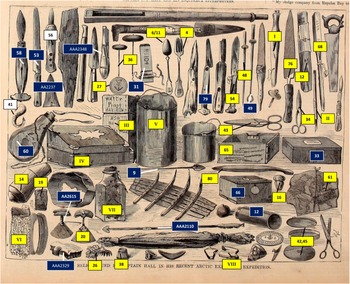
Since Hall donated many items to Lady Franklin, the online archives at the NMM were inspected (Table 1). Based upon Hall’s descriptions, his numbering, and his drawings in the loose-leaf notes, nine relics numbered in the Part of List Sir John Franklin Relics were identified. An additional six relics were observed in the online catalogue, which were presented to Lady Franklin. These relics could not be identified specifically but were depicted in the Harper’s Weekly illustration (Fig. 2).
Current location of Franklin relics collected by C.F. Hall.
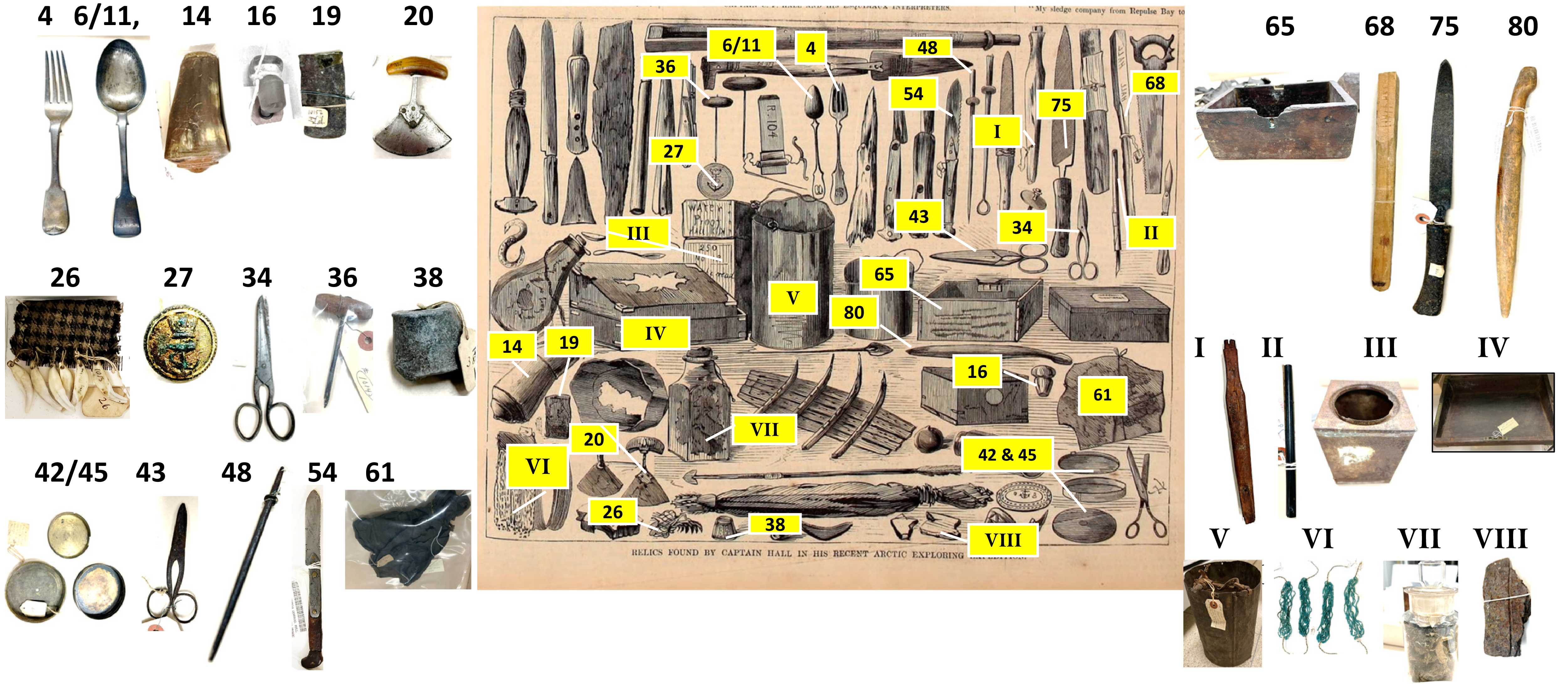
The location of Franklin relics collected by Hall is positioned on top of the relic’s illustration appearing in Harper’s Weekly magazine on October 23, 1869. Relics are numbered as they were catalogued in of Hall’s Part of List Sir John Franklin Relics and their location either at the Smithsonian Institute (SI) National Museum of American History (NMAH) or the Museum Storage Center (MSC), in D.C. or Maryland, respectively (yellow boxes). Items located in the NMAH or MSC which appear in the Harpers Weekly illustration but are not listed in Hall’s relics book are in Roman numerals (I-VIII). Relics located at the National Maritime Museum (NMM) in London, England, are indicated in blue boxes, either with Hall’s relic catalogue numbers or those of the NMM (e.g. AAA2329). Relics illustrated in Harper’s Weekly magazine identified in Hall’s loose-leaf notes of relics given to Lady Franklin are indicated with white boxes were. As of this date, they have not been located.
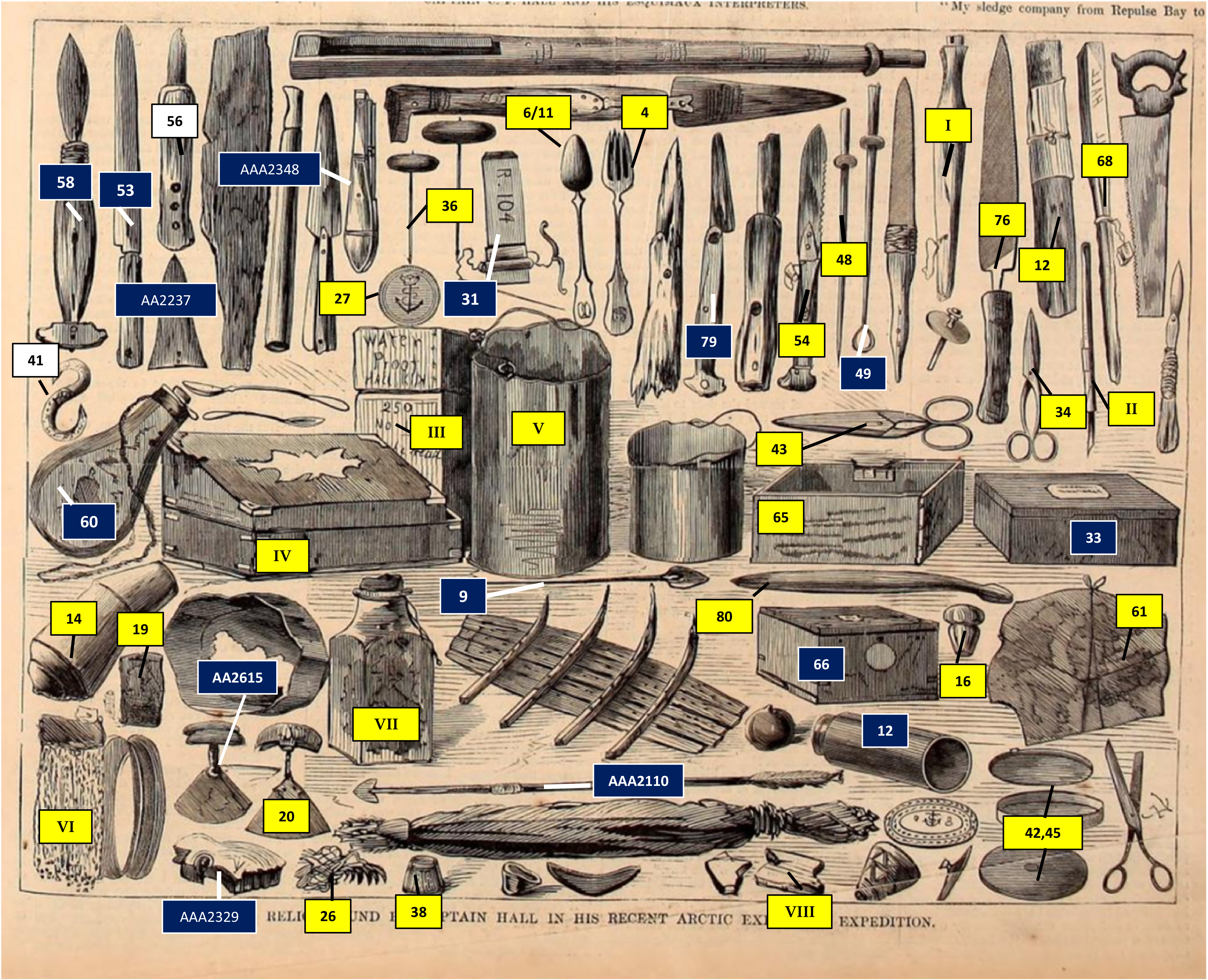
To gain a greater appreciation of Hall’s collection, identifying boxes were placed on the Harper’s Weekly illustration (“Captain Hall’s Arctic Expedition,” 1869). These marks were based upon Hall’s numbering system, his descriptions or his renderings in the loose-leaf papers:
-
• Relics housed at the Smithsonian Institute NMAH or MSC are marked with yellow boxes with Hall’s numbering inside. Yellow boxes containing Roman Numerals letters (I–F) indicate relics which were identified at the NMAH or MSC but were not numbered by Hall.
-
• Relics housed at the NMM are marked with dark blue boxes with Hall’s numbering inside.
-
• Only items #19, #54, #68 and “I” were drawn with the paper tag that had originally been provided by Hall.
-
• Additional items that match those represented in the Harper’s Weekly Magazine illustration and that were identified in the NMM catalogue (but Hall did not provide numbering labels for) are also shown with NMM numbering (in blue).
-
• Two additional objects, drawn by Hall in his loose-leaf notes and given to Lady Franklin (but which to date have not been located), are marked with white boxes. These include Relics #41 and #56, a double brass hook figure of snakes labelled “of McClintock,” and a knife, respectively.
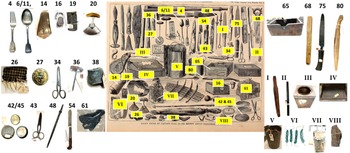
Figure 3 provides contemporary images of the relics identified at the NMAH or MSC as they correspond to the representation of the relics in Harper’s Weekly magazine. Where possible, the numbering in Hall’s Relics Notebook is included. When Hall’s numbering was not available, Roman numerals were used to correlate the contemporary image with what was drawn in Harpers’ Weekly magazine.
Franklin relics collected by C.F. Hall, located in the Smithsonian Institute as they appear today.
Compiled images of Franklin relics collected by Hall are positioned in relation to the relic’s illustration appearing in Harper’s Weekly magazine on October 23, 1869. Relics are numbered as catalogued in of Hall’s Part of List Sir John Franklin Relics . Relics labelled in Roman numerals (I–VIII) were identified in NMAH or the MSC but were not catalogued in Hall’s Part of list Sir John Franklin Relics notebook. Note that neither the contemporary images of the relics nor their representation in the Harper’s Weekly are shown to scale. Images of items IV and V are courtesy of Jennifer Jones (NMAH).
There are two relics that appear to have been misplaced or poorly described.
-
1. In the Part of List Sir John Franklin Relics notebook, Hall lists item 28 as a “Cho.[Chronometer] Key (?) with bone disc on it” (Table 1), but the Smithsonian logs the item as catalogue 1016–3, a “spear.” Curiously, unlike all the other entries in the Smithsonian logs recorded in black ink, this entry is recorded in pencil, suggesting that the entry was made at a different time than when it was received.
-
2. Relic #18 is listed as a horned umbrella handle (Table 1). This item does not appear in the Smithsonian Museum catalogue with the original number #18, nor do any of the other items attributed to Hall match an item resembling a horned umbrella handle. There is an item in the Harper’s Weekly illustration appearing immediately below the arrow (Fig. 2, blue box, AAA2110) that resembles an umbrella. However, it cannot be determined with certainty that this item matches the relic described in Hall’s Franklin Relics notebook.
Several observations can be made by comparing Figures 2 and 3. First, 26 items were identified that match NMAH and MSC holdings with those presented in the Harper’s Weekly illustration. An additional 19 items match closely those in the NMM online catalogue. For specimens identified in the NMAH and MSC holdings, Hall did not label 6 of 26 of these, but they were identified on visual inspection. These are illustrated in Figure 3 marked Roman numerals (I–VIII):
-
A leg from a small table or chair (Fig. 3, I).
-
The stylus of a pen (Fig. 3, II).
-
A tin can (Fig. 3, III).
-
A box (Fig. 3, IV) (see Fig. 4a, bottom)
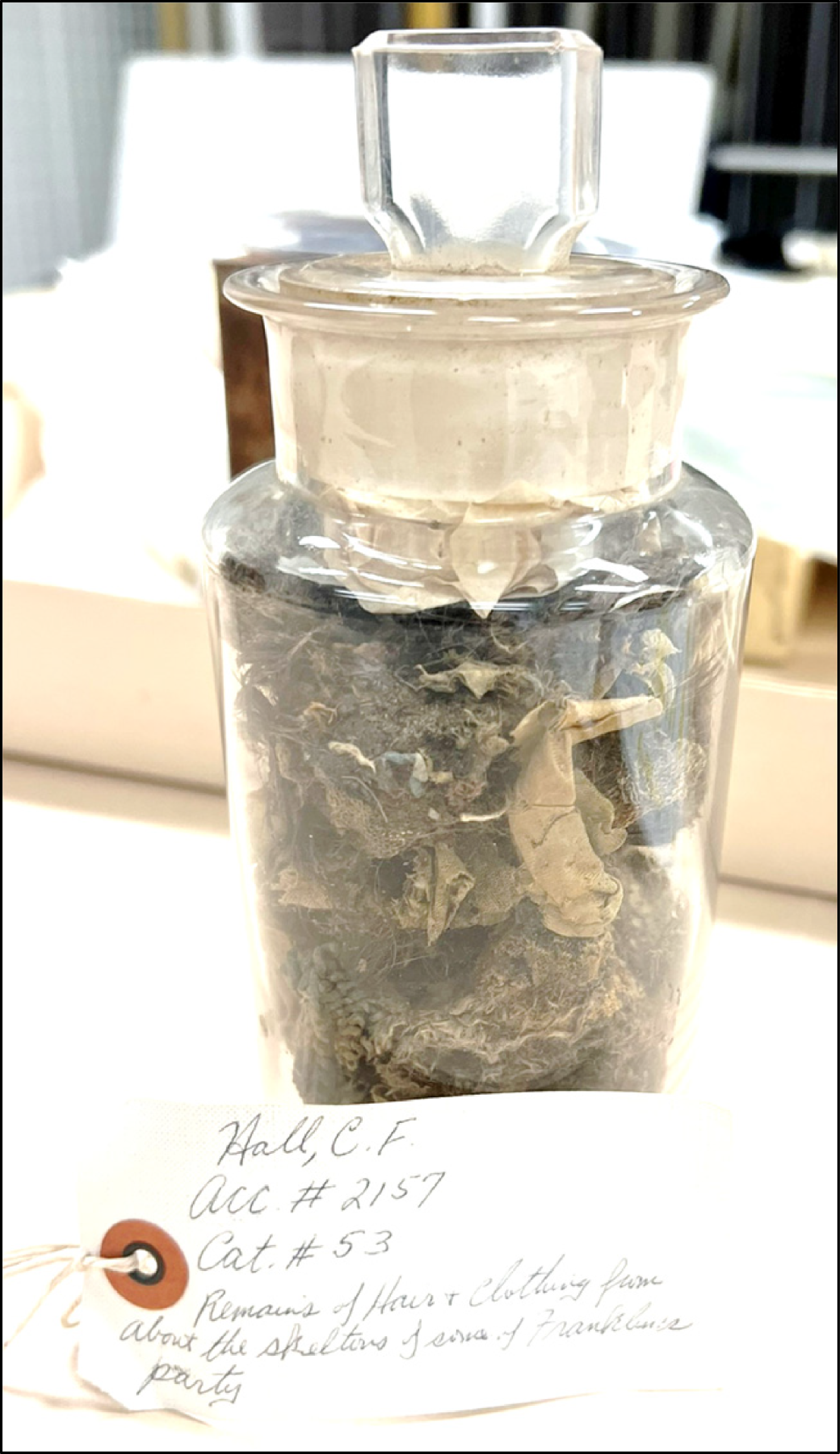
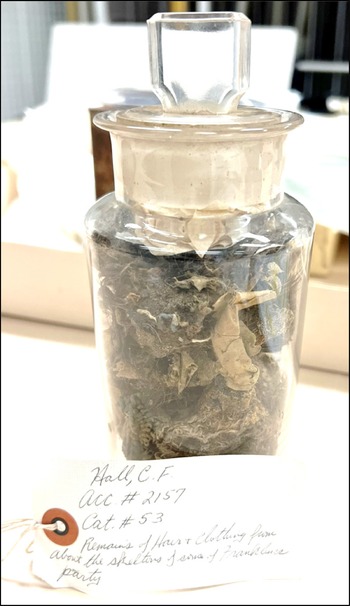
Figure 4.Human remains of Franklin crew recovered from King William Island by C.F. Hall.
A glass jar of human hair and clothing which Hall collected from an officer’s grave on King William Island in 1869 located at the Smithsonian Institute National Museum of American History. The label reads: Remains of hair + clothing from about the skeletons of some of Franklin’s party. See Figures 2 and 3, e for locations on Harper’s Weekly magazine 1869 illustration.

-
A pemmican can (Fig. 3, V)
-
Collection of small fine, turquoise-coloured beads (Fig. 3, VI).
-
A jar of human hair and clothing that Hall collected from an officer’s grave on King William Island in 1869 (Fig. 3, VII, and Fig. 4).
-
A piece of wood presumably from one of the expedition boats (Fig. 3, VIII) which possibly correlates with Hall’s #23 or #24 in the Relics Notebook (Table 1).
-
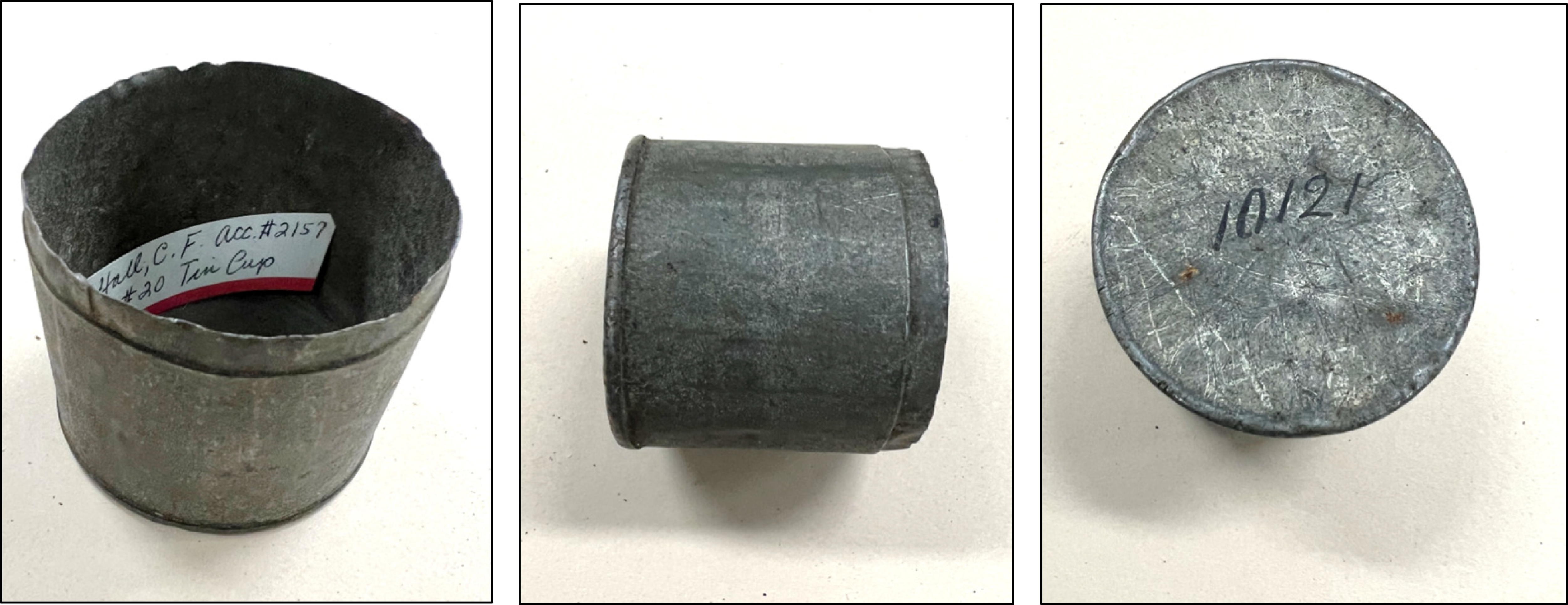
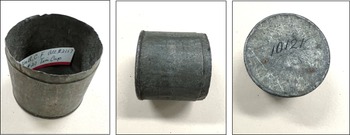
3. Relic #50 in Hall’s Relics notebook (Table 1) is associated with Sŭ-pung-er, an Inuk from Pelly Bay who Hall first met in 1866, and is a “Tin cup without cover” (Fig. 5). The NMAH museum’s log recorded this item as “Tin cup originally containing a paper taken from a cairn between Pt Parry and Cape Sabine by Eskimo 1866.” On May 8th, 1866 Hall wrote in his field notebook:
Figure 5.Sŭ-pung-er’s Cup. Halls Relic No. 50.
Hall obtained a “Tin Cup” originally from Sŭ-pung-er’s and labelled it as Relic No. 50. The cup was originally labelled in Hall’s relic notebook as “Tin cup originally containing a paper taken from a cairn between Pt. Parry and Cape Sabine on (King William’s Island, Nunavut Canada) by Eskimo 1866.” This relic undoubtedly would have contained an official notice of the Franklin Expedition of 1845. Multiple views of the 2” × 2” inch relic shown. It was logged into the Smithsonian Institute as item 10121.
“I asked [Sŭ-pung-er] if he has saw any monuments that he thought had been made by Kob-lū-nas [white men]. He said he once saw a very high + singular E-nook-shoo-yer [monument] near Shar-too – the Shar-too that is near Pelly Bay. It had a piece of wood on top of it. Something like a hand on it pointing a certain way. The monument very high + [and] substantially made of stones . . .
Sŭ-pung-er said he saw a monument somewhere between Port Parry (as he points on McClintock’s map) + Cape Sabine.
… I asked him if he threw it down. He said only a little of it, just enough to find something in it. What did he find? (I asked, being then greatly interested in what he was about to tell. He then said he found a little dish or cap describing its size by his hands + then all at once, he asked if I did not get a little cap from him through Too-koo-li-too the other day? He said that was the very cup, as I took out of my chro. Box, a tin box without top + showed it to him. This was the very cup he found in that monument. I then asked if it had a top to it + wanted he should tell me all about it. He said the cup had a top to it + it fitted very tight + the whole was thickly + lightly wrapped in canvas like what was over my Igloo + tied. On opening the box found it filled with just such looking stuff as that, pointing to a sheet of paper filled with written matter wh.[which] was lying on the bed beside us.
I asked what he + his uncle did with what they found in the little tin cup wh. I held up before him. O, that was good for nothing to Innuits [sic] so it was thrown away or rather given to child. This cup is 2 inches in depth + as many in diameter made of double tin that is really 2 cups in one (Hall, Reference Hall1866c).”
-
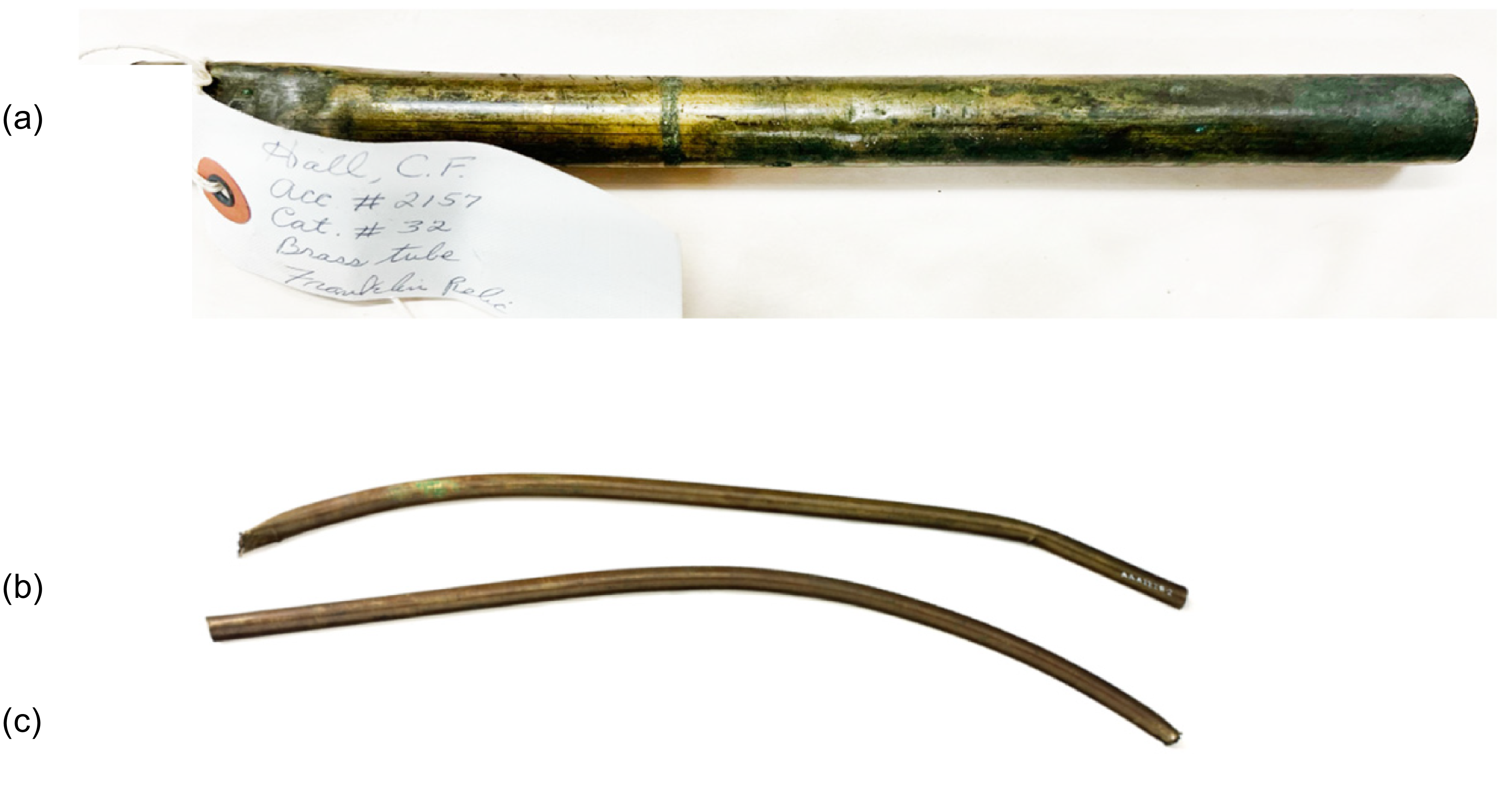
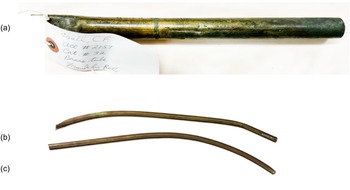
4. Relic #25 (1015–0) was recorded it as a “Brass tube or curtain rod 9 in long” (Hall, Reference Hall1869b) (Fig. 6). Unfortunately, relic #25 was not illustrated in the Harper’s Weekly magazine of 1869 but was identified in the NAMH. Hall acquired the object from In-nook-poo-zhe-jook in 1869. In-nook-poo-zh-jook was one of the first Inuit to discover one of the two ship boats from the expedition at sites (Nglj-2, NgLj3) commonly referred to as the “Boat Place” in Erebus Bay, King William Island. When In-nook-poo-zhe-jook found it at the “Boat Place,” its original length was approximately 16 inches, but was shortened to ∼9 inches sometime prior to Hall’s acquisition. The “Boat Place” represents one of the major sites associated with the Franklin Expedition (Stenton, Keenleyside, & Park, Reference Stenton, Keenleyside and Park2015; Stenton & Park, Reference Stenton and Park2017). Similar curtain rods were reportedly found about Ross’s Pillar near Victory Point by members of the McClintock expedition in 1859 (Stenton, Reference Stenton2014), although analyses suggest they were more likely recovered from Crozier’s landing (Cyriax, Reference Cyriax1952).
Figure 6.Brass curtain rods.
(a) Brass curtain rod labelled #25 by C.F. Hall. Hall acquired the object from In-nook-poo-zhe-jook in 1869. In-nook-poo-zhe-jook stated that he had found it in the second boat that McClintock had not found in Erebus Bay. This piece (1015–0) is in the NAMH. (b, c) Brass curtain rods (AAA2228.1 and AAA228.2) recovered 3 May 1859 near the Ross Cairn, Point Victory by Lieutenant W. Hobson of the McClintock “Fox” expedition. Several pieces of the rods were recovered, and some left in place. These objects are in the NMM. Image provided by © NMM, Greenwich, London.
Four boxes were illustrated in the Harper’s Weekly magazine in 1869 (“Captain Hall’s Arctic Expedition,” 1869) (Fig. 7). The first is a two-piece writing desk (Fig. 7a). This item was not recorded in Hall’s Relics Notebook (Hall, Reference Hall1869c), but it was illustrated in Nourse (Reference Nourse1879): Narrative of the Second Arctic Expedition made by Charles F. Hall (Fig. 7a, top and middle). Nourse indicated that the box had been deposited at the Smithsonian Institution. The relic was also illustrated and annotated by Hall in his travelling notebook #28, on May 4th 1869 (Fig. 7a, middle). Hall noted the following while travelling on the south side of KWI:
In-k [In-nook-poo-je-jook] says the place “where the Ook-joo-ling Innuits [sic] found the part of the cher. ‹cherry› box wh. [which] his son let me have was on a small island quite near but S. of O’Reilly Island, the small island called by the natives Ook-s-oo’-e-too found under a heap of stones when it had been secreted by some other Innuit + near there on the coast amidst ice the Ook-joo-ling-meutes found the top of the mahogany writing desk I have. In-k says on my asking where these things came from, that the Ook-joo-ling-meutes say they came from 3 masted ship that was found in the ice one spring near O’Reilly Island. He says where he (I–K) has found several pieces of mast of that ship is, as the Innuits [sic] out in MacGillivray Bay.”(Hall, Reference Hall1869a).
Franklin relic boxes collected by Hall.
Four relics boxes collected by Hall are illustrated in the Harper’s Weekly magazine in 1869 (“Captain Hall’s Arctic Expedition,” 1869). (a, Top, Middle) Drawing of a 2 piece writing desk as illustrated in Nourse (Nourse, Reference Nourse1879). (a, Middle). Bottom half of desk illustrated by Hall notebook #28, on May 4th 1869. (a, Bottom) The top half of the writing desk today (Courtesy of Jennifer Jones).(b) A second box recorded as relic #65 (yellow box) located in the NMAH) (Hall, Reference Hall1869c). (c) The third box, located in the NMM (blue box) illustrated in Harper’s Weekly, given to Jane, Lady Franklin (“Captain Hall’s Arctic Expedition,” 1869; Hall, Reference Hall1869c). Hall recorded it as relic #33, “Japan tin matchbox oblong square Japan tin box stamped on top ‘J. Hynam’ ‘Finnbury’ London. Image courtesy of National Maritime Museum (NMM), Greenwich, London.” (Cat. AAA2235) (d) Chronometer Box. “8 days FRENCH 4234.” (d, Top) Hall sketched the label of the chronometer in his field book and (d, Bottom) illustrated the box. This relic is housed at the NMM (Cat. AAA2233).
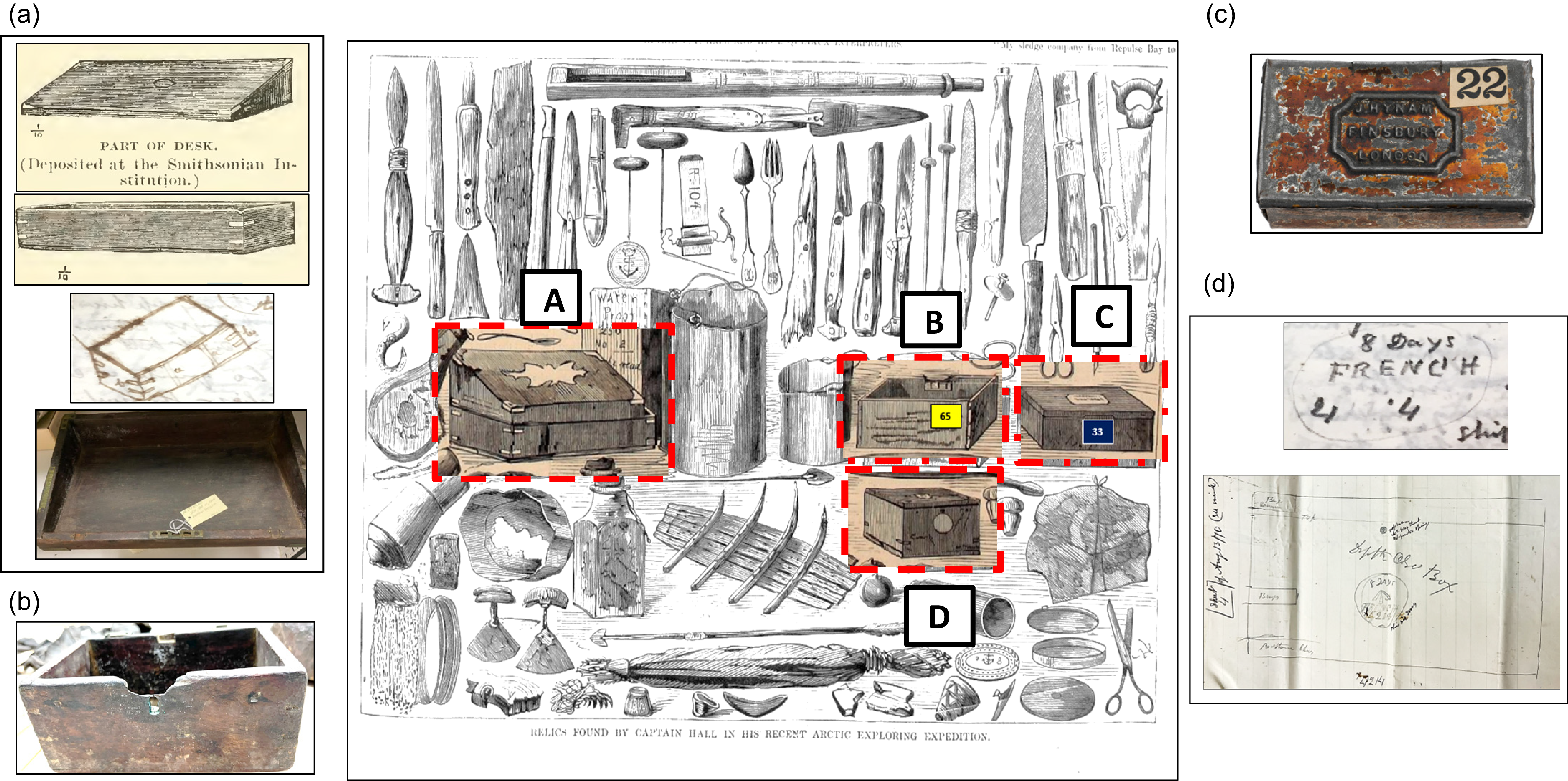
While the author did not observe this item with the other Hall relics during April 2023, it was subsequently located in the Smithsonian holdings (Fig. 7a, Bottom).
A second box Hall recorded in the relics note book was relic #65 (Hall, Reference Hall1869c). Hall acquired this item on 9 May 1869. At his 28th encampment off Booth Point, Hall wrote the following:
a “little box‹,› mahogany box 6 inch long in width deep with brass hinges + recess for lock‹.› Lock gear + teeth gone – dove tail made – this box I obtained it was found on the shore of E-loo-lik south side of Sea of Ook-joo-lik.”(Hall, Reference Hall1866a) (Fig. 7b).
The third box illustrated in Harper’s Weekly, not drawn to scale, Hall gave to Lady Franklin (“Captain Hall’s Arctic Expedition,” 1869; Hall, Reference Hall1869c). Hall recorded it as relic #33 and described it as a “Japan tin matchbox oblong square Japan tin box stamped on top ‘J. Hynam’ ‘Finnbury’ London (Fig. 7c).”
The fourth box illustrated in the Harper’s Weekly magazine (“Captain Hall’s Arctic Expedition,” 1869) was a chronometer box, which was also donated to Jane, Lady Franklin (Fig. 7d). Hall wrote the following on 17 May 1869 in field book #37:
I have been making presents of needles to the women rings to the children + bartering for relics of Franklin’s Ex with the men. I have found in the Ig-loo of the oldest son of In-nook-poo-zhu-jook the upper portion on half of a chronometer box having engraved on a disk of ivory set in the front 8 days FRENCH 4 ‘ 4 + This I barter for‹.› It came from the ship that appeared off the Island O-Reilly Sea of Ook-joo-lik (Hall, Reference Hall1866b). Hall also drew the label in the field book (Fig. 7d, top) and he illustrated part of the box in his loose leaf notes of relics he donated to Lady Franklin (Fig. 7d, bottom) (Hall, Reference Hall1869b).
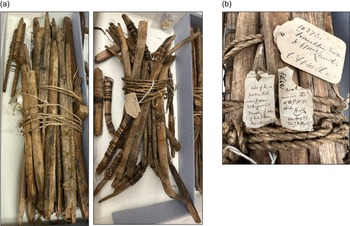
Finally, a relic identified in the MSC storage was a frame of a kayak. This relic was also associated with Sŭ-pung-er, but in this case, it was not included in Hall’s list of relics. On 27 July 1866, Hall wrote:
“This PM Sŭ-pung-er + his small family (Pelly Bay Natives) arrived back, the former bearing on his shoulders the frame of his Ki-a [Kayak][ wh. [which] was made of one of Sir John Franklin’s Expedition Boats … The Ki-a is now in my hands + I intend to send it home this fall to the States” (Hall, Reference Hall1866d).
Most of the kayak pieces were labelled “10373” in black ink (Fig. 8a) (Taichman (Reference Taichman2023b). Attached to the bundles of ribs were paper tags written by Hall stating; “Relics of Franklin’s Expedition. Ribs of Ki-a frame that came from Ook-joo-lik made of one of Sir John Franklin’s boats that was one of the N.W.P. ships[,] Hall See 8/69 ‘Sir J.[John] F.[Franklin.] Book’ (Fig. 8b).”
Sŭ-pung-er’s Kayak (Ki-a).
(a) The kayak’s frame was divided into multiple boxes in the MSC archives, with the main sections still bound by the ropes Hall had used for transportation after disassembly. Most of the kayak pieces were labelled “10373” in black ink. (b) Attached to the bundles of ribs were paper tags stating written by Hall stating “10373, Relics of Franklin’s Expedition,” and “Ribs of Ki-a frame that came from Ook-joo-lik made of one of Sir John Franklin’s boats that was one of the N.W.P. ships[,] Hall See 8/69 Sir J. F[.] Book.”
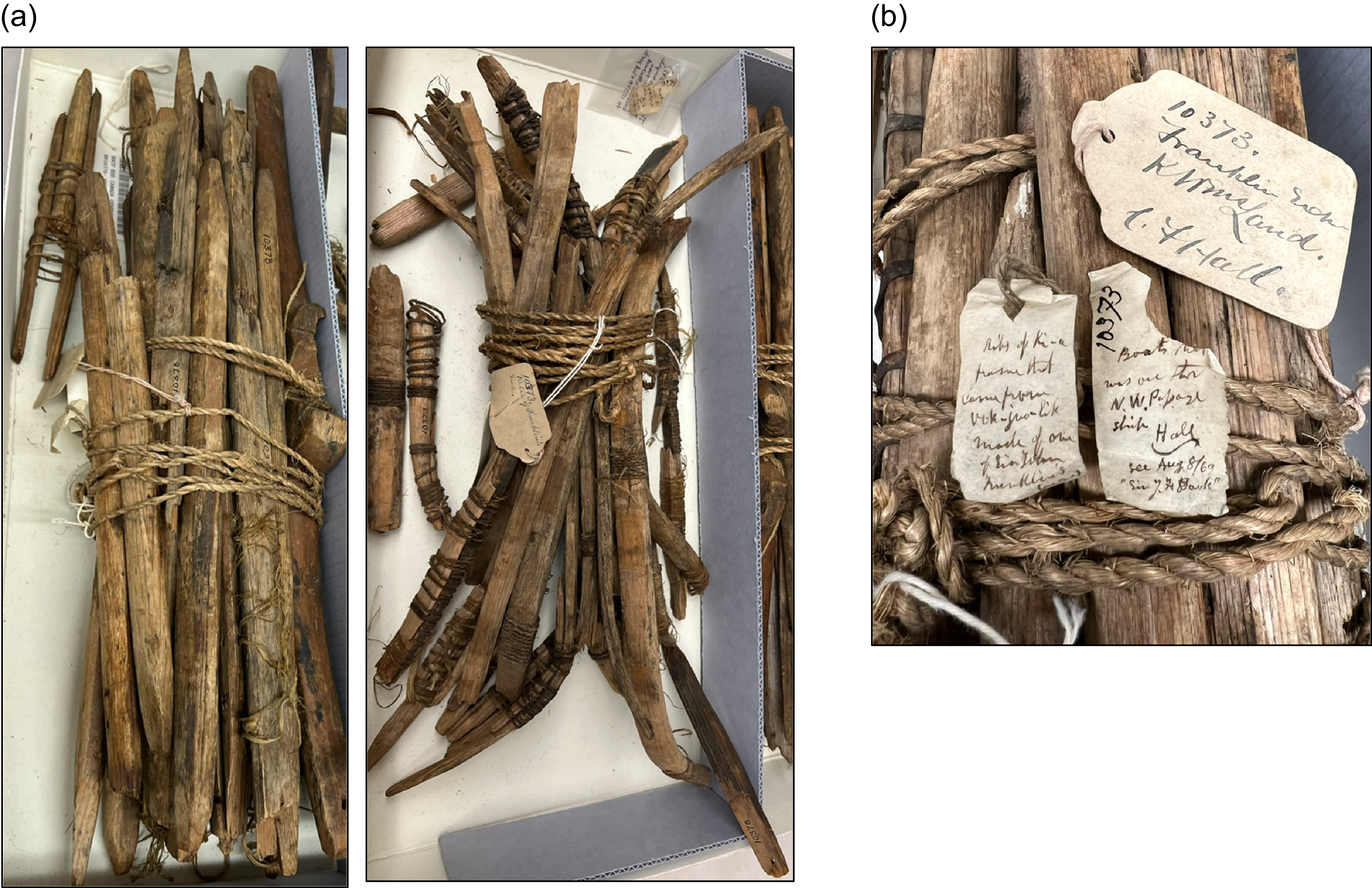
The inscription referenced above led to Hall’s “Sir John Franklin Book” which read;
“I asked In-nook-poo-zhe-jook about the kia-frame I have wh. I showed him. He said that it came from Oo-joo-lik – from the shore of a small Island called Ar-re-wing-mow-ring (as near as I can make out the almost unspeakable word) + that nearby where the ship that drifted to Ook-jo-lik was 1st seen + was finally sunk + broken up, Taichman (Reference Taichman2023b).”
This relic, the writing desk and the chronometer box provide direct evidence of materials scavenged from the Expedition ships.
Discussion
Franklin’s 1845 expedition aimed to navigate the Northwest Passage, but ended in mystery as both his ships, H.M.S. Erebus and H.M.S. Terror, and her crews disappeared. The discovery of artefacts from the expedition, whether equipment or fragments of the vessels themselves, or personal effects of the crew, provides intriguing insights into 19th-century maritime exploration, technological aspects of Arctic expeditions, and in some cases, survival strategies used by the Franklin crew as they attempted to extricate themselves from the Arctic (Potter, Reference Potter2007).
The Franklin relics obtained by Hall and housed in the Smithsonian Institute can be categorised into several types, reflecting their diverse nature. The first category is cutlery and tableware, including tea forks, table forks, teaspoons, dessert spoons and tablespoons, often with intricate engravings and personal marks. The second category consists of tools and instruments, such as chisels, gimlets, saws and brass instrument components, used for navigation and carpentry. The third category includes knives and cutting tools, pen knives, table knives, mounted knives, and saw blades, made from ivory, bone and metal. The collection also features brass buttons, thimbles, pearl buttons and miscellaneous items.
We learn from this analysis that Hall gave away all relics marked with the broad arrow to Jane, Lady Franklin or Henry Grinnell, likely as they were British government property. Hall also gave away relics connected to Franklin Expedition individuals, except for some of Sir John Franklin’s cutlery. Since Hall bartered for most of his collected relics, the collection likely reflects artefacts carried by the retreating Franklin Expedition parties as very few relics were directly connected with scavenging of the expedition ships. Further, these items were predominantly those the Inuit collected, for Hall had limited time on King William Island or the Todd Islands where he was able to scavenge directly for items, suggesting utility and interest to the Inuit.
Hall recorded 83 artefacts in his Part of List Sir John Franklin Relics notebook and accompanying pages, but he likely collected more, as many items in Harper’s Weekly illustration do not match those recorded in his notebook. For example, item #14 is a glass jar identified in both NMAH relics and Harper’s Weekly (Figs. 3, V and 4), labelled “Remains of hair and cloth from about the skeletons of some of Franklin’s party” (Acc # 2157, Cat #47). During Hall’s trip to King William Island on May 12, 1869, he found artefacts and a human skeleton near Ross’ Point. The Inuit had reported several bodies in the area, but only one was found due to snow cover. Hall documented his finds and transported the skeleton in his travelling companion’s (Tookoolito or Hannah) seaman’s chest during travels from the Arctic to the U.S. (Hall, Reference Hall1869). The skeleton was initially identified as Lieutenant Henry Le Vesconte, but recent analyses suggest it belonged to Harry Goodsir (Mays et al., Reference Mays, Ogden, Montgomery, Vincent, Battersby and Taylor2011). Forensic analysis of the jar’s contents has not been reported. Hall’s recovery of human remains was unusual, as he was the first to do so from the Expedition (Craciun, Reference Craciun2014). Unlike his predecessors, Rae and McClintock who brought back relics fit for display (Craciun, Reference Craciun2014), Hall likely considered the body itself a sacred relic and therefore recovered the skeleton for repatriation to Britian.
One advantage of revisiting Hall’s relics and notebooks is for the new insights they can provide. Relic #68 as a poignant example. In spring 1866, Hall interviewed the Inuk hunter Sŭ-pung-er who was from the Boothia Peninsula. Sŭ-pung-er reported discovering an underground structure, now called Sŭ-pung-er’s vault, Franklin’s vault, or Franklin’s Cemented Vault. Hall believed it might house expedition records or that it was a burial site, possibly for Franklin (Hall, Reference Hall1866e). Sŭ-pung-er dismantled a wooden pillar marking the site, which he stated was visible from the shoreline (Gross & Taichman, Reference Gross and Taichman2017; Hall, Reference Hall1866e). Hall noted item 68 as a “wood model of wood pillar found on King William Land by Supunger.” Despite unsuccesful searches and debates questioning the vault’s existence (Coleman, Reference Coleman2020; Gross & Taichman, Reference Gross and Taichman2017; Trafton, Reference Trafton1991; Woodman, Reference Woodman1995), Hall’s documentation and donation of the model to the Smithsonian suggests he believed it was a significant artefact worth preserving (Taichman, Reference Taichman2023a).
Several other relics are also associated with Sŭ-pung-er. A tin “cup” was likely a tin case used by the expedition for documents or to carry other instrumentation (Fig. 5). It is pertinent to note that while Sŭ-pung-er reported that the cup contained documents, it was not likely a container officially supplied to the expedition for the purpose of depositing official notes into stone cairns at prominent points of land to mark their progress as it does not resemble the tubular metal cylinders known to have been supplied and used for that purpose (e.g. NMM AAA2344).
In 1859, a Franklin search expedition led by McClintock discovered a boat on a sledge, containing many personal items and two skeletons, at what is now known as “McClintock Boat Place” (NgLj-3)(Stenton, Keenleyside, & Park, Reference Stenton, Keenleyside and Park2015; Stenton & Park, Reference Stenton and Park2017). The McClintock expedition recovered several artefacts from the boat place. A second boat nearby was visited by In-nook-poo-zhe-jook and later by Schwatka in 1879 (Gilder, Reference Gilder1881; Schwatka, Reference Schwatka1899). In-nook-poo-zhe-jook reported finding a curtain rod at the second boat (NgLj-2) approximately a kilometre from McClintock’s Boat Place (NgLj-3) (Stenton, Keenleyside, & Park, Reference Stenton, Keenleyside and Park2015; Stenton & Park, Reference Stenton and Park2017). A similar object was found in 1859 near Ross’ Cairn at Point Victory by Lieutenant W. Hobson of the McClintock expedition (M’Clintock, Reference M’Clintock1860, Stenton, Reference Stenton2014). Many items discarded at Victory Point and the Boat Place suggest the crew may have expended energy carrying unnecessary items, contributing to their demise. However, the curtain rods might have been brought ashore earlier, potentially for barter with the Inuit. Regardless, the rods were found at several sites, and the rods were valued by the Inuit as shown by their transport to near Pelly Bay, where Hall acquired the relic in 1869.
Importantly, Hall’s collections correlate with Inuit testimony providing the direct evidence that materials were scavenged from the expedition ships themselves, including wood for the kayak frame which Hall traded for with Sŭ-pung-er (Taichman, Reference Taichman2023b), as well as a writing desk top and a chronometer box. These relics were collected near the site which we now know as the site where H.M.S. Erebus sunk. Prior to Hall’s collection efforts, materials scavenged directly from the ships themselves were not recovered by Rae, McClintock or Anderson expeditions. This is critical, for it directly provides clues as to where H.M.S. Erebus had been boarded by Inuit. These clues were largely ignored until the ship was located in 2014 (Zachary, 2021). Moreover, as a point of fact, the 2014 finding of artefacts near the location of the wreck is what directly led to the discovery of Erebus. For despite significant efforts to locate the ships, it was not until September 1, 2014 archaeologists helicoptered to a small island to investigate an Inuit tent ring. On shore, pilot Andrew Stirling spotted a piece of rusted metal identified as a davit pintle, which matched a piece detailed in the plans of H.M.S. Erebus (Johnson, Reference Johnson2014). The size and weight of the artefact, together with Inuit testimony collected by initially by Hall, suggested that a wreck was nearby.
In summary, the search for relics provides clues as to the land-based materials carried by the retreating Franklin Expedition crews and items collected at those sites by the Inuit. Moreover, they provide evidence that the ships were boarded, or relics were scavenged nearby by the Inuit. Hall recorded 83 artefacts related to the Franklin Expedition, though he likely collected more (e.g. a kayak and a jar of human remains). Examining Hall’s relics and notebooks offers insights. For instance, relic #68, a replica of a wooden pillar from “Franklin’s Vault,” has renewed debate about its existence. Relic #58, a tin cup found by Sŭ-pung-er, potentially contained expedition documents, which could have provided clues as to what happened to the expedition; sadly, the contents were discarded. These relics are not just historical artefacts; they represent a cultural heritage tied to a significant exploration event. Analysing them also helps correct cataloguing errors, ensuring the scientific and archaeological records’ accuracy. Hall’s donation of many relics to the Smithsonian Institution, despite having used them in prior lecture series to raise funds, suggests that either he had abandoned future expeditions to find more Franklin relics or he had other relics. The examination of Franklin Expedition relics is about solving a historical puzzle, honouring exploration, understanding the human aspect of these endeavours and preserving a significant part of shared heritage.
Acknowledgments
The author thanks their family and friends for enduring endless hours of banter regarding the Franklin Expedition and the Northwest Passage. The author is grateful to Tom Gross (formerly of Hay River, Northwest Territories, Canada. Current residence Kaslo, British Columbia, Canada) for helpful discussions and ongoing collaborative activities. The author thanks Jonathan Moore and John Ratcliffe, Underwater Archaeologists of the Underwater Archaeology Team, Archaeology, Collections and Curatorial Branch, Parks Canada Agency, Ottawa, Canada for initially supplying digital images of Hall’s relics journals. We thank Logan Zachary for his suggestion to track down the Hall relics and for the suggestion to put these findings into print. We thank Jennifer L. Jones (Division of Military History, NMAH) and Dr. Stephen Loring (Department of Anthropology, Smithsonian Institution, National Museum of Natural History (NMNH)) for serving as able guides through the Franklin relics and ethnographic materials and for images of the writing desk. We also thank the unnamed reviewers for their suggestions which improved the work.
Financial support
The author has received no direct support for the study described herein.
Competing interests
The author declares no conflict of interests.


 Open access

