Management Implications
Indaziflam has proven to be an effective tool for restoring sites that have been degraded by invasive winter annual grasses. Indaziflam provides the residual control necessary to target the soil seedbank and prevents Bromus tectorum (downy brome) reestablishment so that native plant species are released from competition. In this study, burning improved B. tectorum control for several indaziflam treatments when compared with the same treatments applied without burning, likely due to removing accumulated surface litter. Indaziflam (44 and 73 g ai ha−1) plus imazapic provided similar B. tectorum control when applied with and without burning, reducing B. tectorum cover to <1% at 2 YAT. Applying a selective, postemergence herbicide, such as imazapic or rimsulfuron, with higher indaziflam rates can be an option for land managers controlling B. tectorum in arid sites where litter is present. Imazapic and rimsulfuron will provide postemergence control for established B. tectorum and enough residual control to prevent establishment if seeds germinate before indaziflam is activated by precipitation. For sites where litter has been removed by prescribed burning, lower indaziflam rates can be an effective option, as more of the herbicide will reach the soil to control germinating seeds across multiple seasons. The perennial plant community was not negatively impacted by integrating prescribed burning with indaziflam, and this integrated strategy may help maintain or potentially increase species diversity. Removing litter and providing long-term B. tectorum control is beneficial for sites with remnant plant communities, as it increases their access to resources. In addition, our study suggests that combining indaziflam with a selective postemergence herbicide can be a viable option for land managers, as it extends the application window. Indaziflam is now approved for use on sites grazed by domestic livestock under the trade name Rejuvra®; however, it is important to recognize that 73 g ha−1 is the highest use rate for this application.
Introduction
Invasive winter annual grasses are changing rangeland ecosystems in the western United States to a cycle that favors their spread at the expense of native vegetation (DiTomaso Reference DiTomaso2000). The most widespread is downy brome (Bromus tectorum L.), which has invaded more than 22 million ha of western rangeland and wildlands, with an additional 25 million ha projected to be susceptible to invasion in the United States (Duncan et al. Reference Duncan, Jachetta, Brown, Carrithers, Clark, DiTomaso, Lym, McDaniel, Renz and Rice2004; Pellant and Hall Reference Pellant and Hall1994). Bromus tectorum can germinate under diverse environmental conditions, but it typically germinates in early fall and overwinters in a semidormant state. As one of the first plants to break dormancy in early spring, B. tectorum takes advantage of soil moisture and nutrients before native perennial vegetation breaks dormancy (Beck Reference Beck2009; D’Antonio et al. Reference D’Antonio and Vitousek1992). This competitive advantage and opportunistic life cycle has resulted in its rapid expansion into western rangelands, leading to devastating impacts on ecosystem functions (Duncan et al. Reference Duncan, Jachetta, Brown, Carrithers, Clark, DiTomaso, Lym, McDaniel, Renz and Rice2004; Mack and Pyke Reference Mack and Pyke1983). Negative effects include altered nutrient cycling, decreased native vegetation, and increased fire frequency and severity (D’Antonio et al. Reference D’Antonio and Vitousek1992; Knapp Reference Knapp1996).
Increased wildfire frequency is cited as one reason B. tectorum is so successful in outcompeting native plant communities (Melgoza et al. Reference Melgoza, Nowak and Tausch1990; Young and Allen Reference Young and Allen1997). After producing seed and completing the annual life cycle in early summer, senescing plants create dense mats of litter (Evans and Young Reference Evans and Young1970; Klemmedson and Smith Reference Klemmedson and Smith1964). This litter layer acts as a fine fuel source, promoting larger and more frequent fires compared with historical fire regimes (Brooks Reference Brooks2002; D’Antonio et al. Reference D’Antonio and Vitousek1992; Ogle et al. Reference Ogle, Reiners and Gerow2003). In addition, B. tectorum is adapted to fire cycles and quickly reestablishes to dominate native plant communities (Melgoza et al. Reference Melgoza, Nowak and Tausch1990; Wright and Klemmedson Reference Wright and Klemmedson1965; Young et al. Reference Young, Evans and Weaver1976).
Although B. tectorum is adapted to fire cycles, land managers can utilize fire to help control winter annual grasses and promote native plant communities. Prescribed burning provides short-term B. tectorum control and temporarily reduces the soil seedbank (DiTomaso et al. Reference DiTomaso, Brooks, Allen, Minnich, Rice and Kyser2006; Keeley and McGinnis Reference Keeley and McGinnis2007). Prescribed burning can also lead to positive responses from the native plant community by removing accumulated litter. However, if fine fuel is limited, fire intensity may not be sufficient to provide significant B. tectorum control, and it will recover quickly after a fire (DiTomaso et al. Reference DiTomaso, Kyser and Hastings1999, Reference DiTomaso, Brooks, Allen, Minnich, Rice and Kyser2006; Keeley and McGinnis Reference Keeley and McGinnis2007; Kessler et al. Reference Kessler, Nissen, Meiman and Beck2015; Whisenant and Uresk Reference Whisenant and Uresk1990). Unfortunately, the short period of control (<2 yr) does not provide adequate time for the remnant plant community to recover (DiTomaso et al. Reference DiTomaso, Brooks, Allen, Minnich, Rice and Kyser2006; Kessler et al. Reference Kessler, Nissen, Meiman and Beck2015). Thus, prescribed burning is not recommended to manage B. tectorum, unless it is integrated with other management strategies, such as herbicides (DiTomaso et al. Reference DiTomaso, Brooks, Allen, Minnich, Rice and Kyser2006; Keeley and McGinnis Reference Keeley and McGinnis2007).
Herbicides are considered one of the most effective sequential management strategies for invasive winter annual grass control after burning (DiTomaso et al. Reference DiTomaso, Brooks, Allen, Minnich, Rice and Kyser2006; Kessler et al. Reference Kessler, Nissen, Meiman and Beck2015). Imazapic (Plateau®, BASF, Research Triangle Park, NC) and rimsulfuron (Matrix®, Bayer CropScience, Research Triangle Park, NC) are commonly used rangeland herbicides that provide foliar and residual B. tectorum control; however, the duration of control is variable (1 to 2 yr) due to their limited soil activity (Anonymous 1996; Anonymous 2010; Davison and Smith Reference Davison and Smith2007; Elseroad and Rudd Reference Elseroad and Rudd2011; Kessler et al. Reference Kessler, Nissen, Meiman and Beck2015; Mangold et al. Reference Mangold, Parkinson, Duncan, Rice, Davis and Menalled2013; Sebastian et al. Reference Sebastian, Sebastian, Nissen and Beck2016, Reference Sebastian, Fleming, Patterson, Sebastian and Nissen2017a, Reference Sebastian, Nissen, Sebastian and Beck2017b; Wallace and Prather Reference Wallace and Prather2016). In addition, glyphosate has been used to control B. tectorum, but it only provides nonselective control for emerged plants and provides no residual control. Imazapic and rimsulfuron can also temporarily stunt perennial grasses, especially in drier years (Kyser et al. Reference Kyser, DiTomaso, Doran, Orloff, Wilson, Lancaster, Lile and Porath2007; Shinn and Thill Reference Shinn and Thill2004; Wallace and Prather Reference Wallace and Prather2016). Indaziflam (Rejuvra®, Bayer CropScience), a preemergence herbicide, inhibits seedling establishment and provides B. tectorum control for three or more years due to extended soil activity (Anonymous 2020; Clark et al. Reference Clark, Sebastian, Nissen and Sebastian2020; Sebastian et al. Reference Sebastian, Sebastian, Nissen and Beck2016, Reference Sebastian, Fleming, Patterson, Sebastian and Nissen2017a). Indaziflam does not negatively impact established perennial grasses or forbs and can lead to significant increases in native species production due to reduction in B. tectorum competition (Clark et al. Reference Clark, Sebastian, Nissen and Sebastian2019b, Reference Clark, Sebastian, Nissen and Sebastian2020; Koby et al. Reference Koby, Prather, Quicke, Beuschlein and Burke2019; Sebastian et al. Reference Sebastian, Fleming, Patterson, Sebastian and Nissen2017a).
Herbicide efficacy can be improved with litter removal by fire (DiTomaso et al. Reference DiTomaso, Brooks, Allen, Minnich, Rice and Kyser2006). Herbicide interception by B. tectorum litter can be as high as 74% to 84% (Clark et al. Reference Clark, da Silva, Dayan, Nissen and Sebastian2019a; Kessler et al. Reference Kessler, Nissen, Meiman and Beck2015). Due to differences in water solubility, imazapic and rimsulfuron are almost completely released from litter with as little as 12 mm of rainfall, while <50% of indaziflam is released from litter with 24 mm of rainfall (Clark et al. Reference Clark, da Silva, Dayan, Nissen and Sebastian2019a). This suggests that indaziflam binds strongly to litter (Carbonari et al. Reference Carbonari, Gomes, Trindade, Silva and Velini2016; Clark et al. Reference Clark, da Silva, Dayan, Nissen and Sebastian2019a). Lipophilic herbicides, such as indaziflam, are more prone to bind to lignin in litter compared with hydrophilic herbicides like imazapic and rimsulfuron (Dao Reference Dao1991; Shaner Reference Shaner2014). Therefore, integrating indaziflam treatments after prescribed burning could be beneficial for increasing herbicide efficacy, especially at lower indaziflam rates.
Indaziflam does not control established plants, as it only provides preemergence control. Combining indaziflam with a postemergence herbicide, such as glyphosate, has been recommended if there is established B. tectorum (Sebastian et al. Reference Sebastian, Fleming, Patterson, Sebastian and Nissen2017a). This combination provides immediate control of established plants and preemergence control for future germination events; however, because glyphosate is a nonselective herbicide, injury to desirable vegetation can occur if it is applied outside the dormancy window. Additionally, 6 to 13 mm of rainfall before germination occurs is required to incorporate indaziflam into the soil solution (Rejuvra®, Bayer CropScience). This can lead to inconsistent control in the first year if adequate precipitation is not received before new plants germinate (Clark et al. Reference Clark, da Silva, Dayan, Nissen and Sebastian2019a). More water-soluble herbicides, like imazapic and rimsulfuron, which provide short-term preemergence control and selective postemergence activity, require less precipitation to be removed from the litter and incorporated into the soil. Combining these products with indaziflam can provide the necessary postemergence control and short-term preemergence control before sufficient rainfall incorporates indaziflam fully into the soil. Sebastian et al. (Reference Sebastian, Sebastian, Nissen and Beck2016) found that indaziflam plus rimsulfuron applied as a late postemergence treatment provided significant B. tectorum control for 3 yr. Although no published research has evaluated the combination of indaziflam plus imazapic, this combination should provide similar long-term results due to imazapic’s ability to provide both postemergence activity and short-term residual control (Kessler et al. Reference Kessler, Nissen, Meiman and Beck2015; Kyser et al. Reference Kyser, Wilson, Zhang and DiTomaso2013; Mangold et al. Reference Mangold, Parkinson, Duncan, Rice, Davis and Menalled2013). Indaziflam in combination with either of these herbicides could extend the window in which postemergence treatments can be applied and reduce injury to native species by substituting for glyphosate.
The sequential management strategy of prescribed fire followed by indaziflam applications needs to be evaluated in terms of B. tectorum control and the remnant plant community response. While no published research has determined whether removing litter using fire increases indaziflam efficacy, we hypothesized that long-term B. tectorum control could be achieved using these integrated management strategies. We evaluated the effectiveness of combining burning with indaziflam alone and in combination with postemergence herbicides for B. tectorum control and monitored the response of the remnant plant community in Colorado foothill shrublands.
Materials and Methods
Site Description
Two study sites were established in Boulder County, CO, in 2018. Site 1 was located at the Rabbit Mountain Open Space (40.242222°N, 105.210000°W) east of Lyons, CO. Site 2 was located at the Hall Ranch Open Space (40.218889°N, 105.333333°W) located southwest of Lyons, CO. Elevations at Sites 1 and 2 were 1,773 m and 2,041 m, respectively. Sites were approximately 18 km apart in the Foothills Shrubland region of the Great Plains ecoregion. The soil at Site 1 was Baller stony sandy loam (loamy-skeletal, mixed, superactive, mesic Lithic Haplustolls), with 3.8% organic matter in the top 20 cm. The soil at Site 2 was Cypher-Ratake families complex (gravelly sandy loam to gravelly coarse sandy loam, Paralithic Hapflustalfs), with 4.1% organic matter in the top 20 cm (USDA-NRCS 2019). Site 1 had ∼70% B. tectorum cover in the burned plots and ∼60% cover in the non-burned plots. Site 2 had ∼60% B. tectorum cover in the burned plots and ∼40% to 50% cover in the non-burned plots. Each site also supported co-occurring perennial grass and forb communities, along with nonnative forbs (Supplementary Table S1).
Annual precipitation data were collected from a weather station in Lyons, CO, located approximately 9 km from each site. Total annual precipitation was 412 mm in 2018 and 465 mm in 2019. In 2020, a statewide drought occurred in the first 9 mo of the year, and precipitation was reduced to 287 mm. The 11-yr average for the same 9 mo, between 2009 and 2020, was 385 mm (CoCoRaHS 2020).
Experimental Design and Measurements
The experiment was a crossed-nested design, with burn type and herbicide treatment as fully crossed factors and block as a random factor nested within burn type (Schielzeth and Nakagawa Reference Schielzeth and Nakagawa2012). In this design, the herbicide treatments are replicated in blocks within each burn type. In September 2017, a prescribed burn was conducted at the two sites to promote native vegetation growth when B. tectorum was at the early-seedling stage. At each site, plots were established in the burned area as well as the non-burned area. In the burned and non-burned plots at each site, 10 herbicide treatments were established as a late postemergence application in March 2018 to target B. tectorum at the 2- to 3-tiller stage (Table 1). Perennial grasses and forbs were still dormant. A nontreated control was also included in the design. There were 22 treatment combinations (11 treatments by 2 burn types). Treatments were applied in a randomized complete block design within each burn type to 3 by 9 m plots with four replications, resulting in 88 total experimental units at each site (Supplementary Figure S1). Treatments were applied with a CO2-pressurized backpack sprayer using 11002LP flat-fan nozzles (TeeJet® Technologies, Wheaton, IL) pressurized to 206 kPa and calibrated to deliver 187 L ha−1. All treatments included 0.25% v/v nonionic surfactant. Bromus tectorum and plant community responses to burning and herbicide treatments were evaluated in July 2019 and 2020. To evaluate the responses to treatment effects of B. tectorum, perennial grass, and perennial forb and shrub/sub-shrub species, visual percent canopy cover was estimated using a line transect beginning in the middle of the 3-m side of the plot and oriented along the 9-m length of the plot. The number of individual species and cover estimation samples were taken at set intervals of 3 m and 6 m using one 0.75-m2 gridded quadrat at each interval. The quadrats were divided into twenty-five 15-cm by 15-cm squares to capture within-plot variation and were alternated left and right along the transect at the set intervals to account for plant variability within each plot (Nyamai et al. Reference Nyamai, Prather and Wallace2011). All plants were identified to the species level and cover was estimated for all individuals. Species were further categorized into functional groups for analysis and to estimate the quantity (% cover) of each group (i.e., perennial grasses, perennial forbs, shrubs/sub-shrubs). Species richness and diversity indices were used to further evaluate the effect of burning and herbicide treatments on species diversity. The list of co-occurring species present at both sites can be found in Supplementary Table S1.
The desirable plant community diversity was expressed as: (1) species richness, (2) Shannon’s diversity index H, and (3) Simpson’s diversity index D. These assessments were used to identify differences associated with burning and herbicide treatments (Koby et al. Reference Koby, Prather, Quicke, Beuschlein and Burke2019). Individual species were counted in each 0.75-m2 quadrat, and an average number was calculated to determine species richness across both quadrats. Both diversity indices were calculated using the average number of species and percent cover data for the native plant community from the 0.75-m2 quadrat observations.
Shannon’s diversity index (Equation 1) was calculated
 $$H = - \sum {p_i}\,{\rm{ln}}\,\,{p_i}$$
where p i is the proportion of the number of individuals in the ith species divided by the total number of species (n i /N) (Krebs Reference Krebs1989).
Simpson’s diversity index (Equation 2) was calculated
 $$D = 1 - \sum n\left( {n - 1} \right)/N\left( {N - 1} \right)$$
where n is the number of individuals for one species and N is the total number of species.
Statistical Analysis
A linear mixed-effects model was created to test the effects of treatment, burn type, and year on B. tectorum, perennial grass, forb, and shrub/sub-shrub cover; Shannon’s diversity index; and Simpson’s diversity index. Native sub-shrub and shrub species were combined into one vegetation group, while nonnative, undesirable species were excluded from the cover and diversity analyses due to inconsistent cover at each site (Supplementary Table S1). For Sites 1 and 2, B. tectorum cover data were arcsine square-root transformed to meet ANOVA assumptions for normality. After failing to reject the null hypothesis of equal variance for B. tectorum cover, the same residual variance was assumed for Sites 1 and 2 (P = 0.232), and sites were combined for analysis. All other variables were analyzed separately for each site due to variability in native vegetation cover and differences in site characteristics. Testing was done in the lme4 package in R v. 3.5.3, testing for effects at α = 0.05 (R Core Team 2019). For B. tectorum cover, the fixed factors included in the model were year, treatment, burn type, and all possible interactions, while block and site were treated as random factors. To account for the nested design, burn type was nested in site and block was nested in burn type. In the case of vegetation cover data and diversity measures, the fixed effects included in the model were treatment, year, burn type, and all possible interactions, while block was treated as a random factor and nested within burn type. Main effects and interactions were considered significant at P-values ≤ 0.05. Significant main effects or interactions were further analyzed using the emmeans package in R to obtain all pairwise comparisons with a Tukey-Kramer adjustment (R Core Team 2019). Bromus tectorum cover means and SEs presented in Figure 1 are the original, nontransformed data. Species richness was analyzed using a generalized linear mixed model with a Poisson distribution after failing to reject the hypothesis that count data for species richness was from a Poisson distribution (P = 1 for both sites). The same factors used in the linear mixed model were used for the species richness analysis in the lme4 package (R Core Team 2019).
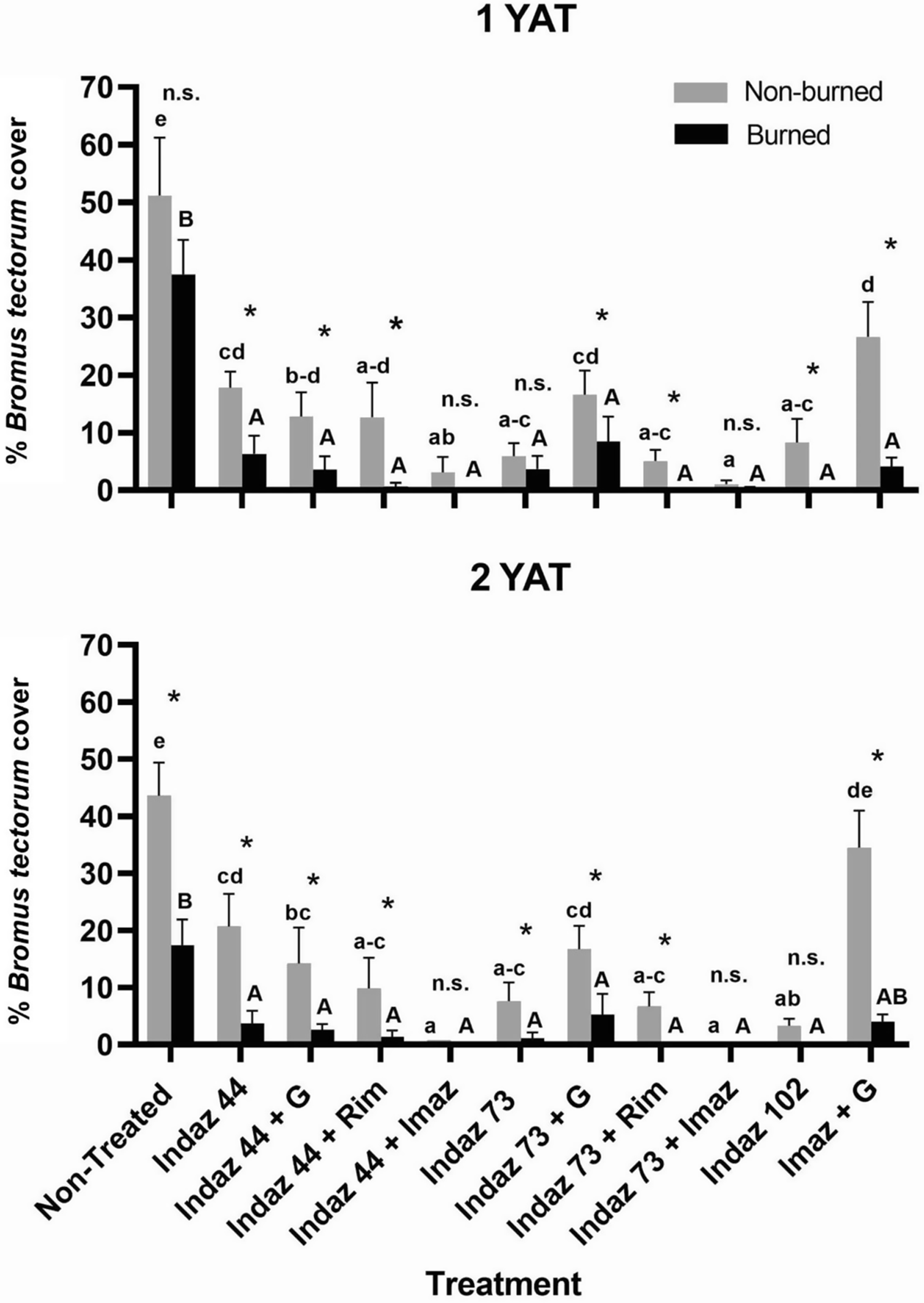
Bromus tectorum cover at 1 and 2 yr after treatment (YAT). Data from sites were combined for ANOVA. Different lowercase letters indicate differences between herbicide treatments in the non-burned plots and different uppercase letters indicate differences between treatments in the burned plots (P < 0.05). Asterisks represent significant differences between burn types for each treatment (P < 0.05). Treatments with “n.s.” represent no significant differences between burn types for each treatment (P < 0.05). Herbicide treatment abbreviations and rates are as follows: Indaz 44 (indaziflam 44 g ai ha−1), Indaz 44 + G (indaziflam 44 g ai ha−1 + glyphosate 755 g ae ha−1), Indaz 44 + Rim (indaziflam 44 g ai ha−1 + rimsulfuron 123 g ai ha−1), Indaz 44 + Imaz (indaziflam 44 g ai ha−1 + imazapic 63 g ae ha−1), Indaz 73 (indaziflam 73 g ai ha−1), Indaz 73 + G (indaziflam 73 g ai ha−1 + glyphosate 755 g ae ha−1), Indaz 73 + Rim (indaziflam 73 g ai ha−1 + rimsulfuron 123 g ai ha−1), Indaz 73 + Imaz (indaziflam 73 g ai ha−1 + imazapic 63 g ae ha−1), Indaz 102 (indaziflam 102 g ai ha−1), Imaz + G (imazapic 123 g ae ha−1 + glyphosate 755 g ae ha−1).
Results and Discussion
Bromus tectorum Response
Burn type interacted with treatment to affect B. tectorum cover (P < 0.01, Supplementary Table S2). At 1 yr after treatment (YAT), all herbicide treatments provided some reduction in B. tectorum cover compared with the nontreated in burned and non-burned plots; however, the reduction in cover provided by imazapic + glyphosate did not extend to 2 YAT (Figure 1). When applied without a postemergence herbicide, B. tectorum cover was reduced more with higher indaziflam rates in the non-burned plots (20.7% ± 5.7, 7.6% ± 3.3, and 3.3% ± 1.7 cover for 44, 73, and 102 g ai ha−1, respectively) at 2 YAT (Figure 1). Indaziflam (44 and 73 g ha−1) + glyphosate treatments did not perform as well as indaziflam + imazapic when applied without burning (Figure 1). All indaziflam rates and tank mixes provided similar reductions in B. tectorum cover when applied after burning (Figure 1).
Burning before herbicide applications increased performance of several treatments. Overall, B. tectorum cover averaged 5.9% in herbicide treatments with burning compared with 14.7% cover without burning. Through 2 YAT, treatments applied after burning resulted in less B. tectorum cover when compared with the same treatment applied without burning, with the exception of indaziflam alone at the highest rate (102 g ha−1) and indaziflam (44 and 73 g ha−1) combined with imazapic (Figure 1). Our data support previous findings that prescribed burning combined with soil-applied herbicides can improve herbicide efficacy and increase the longevity of B. tectorum control (Kessler et al. Reference Kessler, Nissen, Meiman and Beck2015). The indaziflam treatments with similar performance between burn types effectively controlled B. tectorum through 2 YAT regardless of burning. Indaziflam combined with imazapic outperformed several other treatments, averaging <1% B. tectorum cover across burn type, indicating that imazapic likely helped to increase control in non-burned plots when litter was present (Figure 1).
Our study supports the results from similar research evaluating B. tectorum control using prescribed burning followed by herbicide applications (Calo et al. Reference Calo, Brause and Jones2012; Davies and Sheley Reference Davies and Sheley2011; Kessler et al. Reference Kessler, Nissen, Meiman and Beck2015; Kyser et al. Reference Kyser, Wilson, Zhang and DiTomaso2013). Burning before applying herbicide treatments significantly decreased B. tectorum cover for most of the treatments evaluated in this study. Herbicides are intercepted by litter, which reduces the amount of herbicide that reaches the soil (Clark et al. Reference Clark, da Silva, Dayan, Nissen and Sebastian2019a; DiTomaso et al. Reference DiTomaso, Brooks, Allen, Minnich, Rice and Kyser2006; Kessler et al. Reference Kessler, Nissen, Meiman and Beck2015; Monaco et al. Reference Monaco, Osmond and Dewey2005). Indaziflam is a lipophilic herbicide and adsorbs more to litter compared with the water-soluble herbicides rimsulfuron and imazapic (Clark et al. Reference Clark, da Silva, Dayan, Nissen and Sebastian2019a). In our study, we found that for indaziflam applied alone without burning, B. tectorum control increased as the rate increased (Figure 1). On the other hand, indaziflam performed similarly at all rates when applied after burning. These results indicate that some indaziflam was bound to the litter in the non-burned plots, resulting in decreased efficacy, while reducing litter with burning allowed for more herbicide to reach the soil. These data suggest that litter removal can be very beneficial when using indaziflam, especially when using lower rates. Previous observations have shown that control with indaziflam at 44 g ha−1 usually declines by the second season after treatment in sites where litter is present (Sebastian et al. Reference Sebastian, Fleming, Patterson, Sebastian and Nissen2017a), but with the addition of burning, control was maintained for 2 YAT at this rate.
A common recommendation was to combine glyphosate with indaziflam when making a winter dormant application; however, our results suggest that there can be inconsistencies in control when this combination is applied in early spring (Figure 1). Therefore, it is important to evaluate other effective postemergence herbicides that could be combined with indaziflam to increase application flexibility. This study found that without burning, treatments combined with imazapic outperformed the combination with glyphosate. Both imazapic and rimsulfuron provide effective foliar and short-term residual control when applied as a late preemergence or early postemergence treatment (Mangold et al. Reference Mangold, Parkinson, Duncan, Rice, Davis and Menalled2013; Wallace and Prather Reference Wallace and Prather2016). When combined with indaziflam, rimsulfuron and imazapic provided immediate B. tectorum control, while also providing residual control for plants that germinated before indaziflam was activated in the soil through precipitation. Glyphosate does not provide residual control to cover the time period between indaziflam application and activation. This information is critical for land managers applying indaziflam when the desirable plant community is not dormant. Using these selective, short-term residual herbicides with indaziflam provides more flexibility, so herbicide applications can be made with less injury to desirable vegetation while achieving more consistent B. tectorum control in the year of application.
Even though our study illustrates increased control in indaziflam treatments with litter removal, previous studies have shown that indaziflam at higher rates (73 and 102 g ai ha−1) provides long-term control (>3 yr) without litter removal (Sebastian et al. Reference Sebastian, Sebastian, Nissen and Beck2016, Reference Sebastian, Fleming, Patterson, Sebastian and Nissen2017a; Clark et al. Reference Clark, Sebastian, Nissen and Sebastian2020). There is some evidence that soil-applied herbicides adsorbed to litter can be slowly released as the litter decays and are then incorporated in the soil to extend control (Dao Reference Dao1991). Without burning, indaziflam alone at the highest rate (102 g ha−1) did improve control compared with the lower rate (44 g ha−1); therefore, it may be necessary to use a higher labeled rate or conduct a follow-up application in high-litter sites. Land managers should consider combining indaziflam with a short-residual postemergence herbicide, such as imazapic or rimsulfuron, to provide immediate B. tectorum control once germination has occurred. Providing immediate control would allow time for indaziflam to be removed from the litter by precipitation and become incorporated and activated in the soil and would prevent the addition of more B. tectorum seeds to the seedbank in the year of application. Indaziflam continues to be an effective control option for sites where litter is present, but for situations in which burning is desirable to rejuvenate native plant communities infested with B. tectorum, indaziflam can be used as a sequential management strategy with burning to increase and prolong control.
Future research is needed to evaluate the time interval between burning and indaziflam applications. Ash levels may impact indaziflam efficacy when applied shortly after a burn or with higher-intensity fires. As indaziflam is a lipophilic herbicide, the carbon components found in ash could potentially bind the herbicide (Sun et al. Reference Sun, Keiluweit, Kleber, Pan and Xing2011), decreasing the amount of available herbicide in the soil solution. Further research should be conducted to determine these possible post-fire impacts.
Plant Community Cover Responses
Site 1
We observed minimal impacts to perennial grasses, forbs, and shrub/sub-shrub cover at Site 1. There were no differences in perennial grass cover at 1 YAT; however, at 2 YAT, the indaziflam 73 g ha−1 + imazapic treatment had significantly greater cover compared with the nontreated (37.8% ± 6.8 vs. 10.9% ± 3.5, respectively), regardless of burn type (Table 2; Supplementary Table S3). Perennial forb cover was greater in several of the non-burned treatments at 1 YAT compared with the same treatments with burning; however, by 2 YAT, there were no differences (Table 3; Supplementary Table S3). In the first year, perennial forb cover decreased by almost half in the burned plots compared with the non-burned plots (16.5% ± 7.6 vs. 36.2% ± 10.1, respectively; Table 3). It appears that the forb community had recovered after the prescribed fire, because there was no significant difference in cover at 2 YAT. There were minimal impacts to shrub/sub-shrub cover (P < 0.002). Only the indaziflam 44 g ha−1 + rimsulfuron treatment in the non-burned plots showed a difference in shrub/sub-shrub cover compared with the nontreated 2 YAT (33.9% ± 10.6 vs. 4.1% ± 1.6, respectively; Table 3).
Herbicide treatments and rates applied in evaluating Bromus tectorum control and desirable species responses.
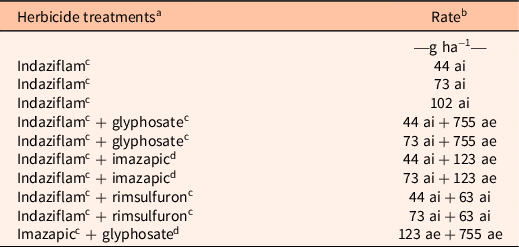
a Nonionic surfactant at 0.25% v/v was added to all herbicide treatments.
b Herbicide rates are provided by their active ingredient (ai) or acid equivalent (ae).
c Bayer CropScience, Research Triangle Park, NC.
d BASF Specialty Products, Research Triangle Park, NC.
Perennial grass cover (mean ± SE) for 1 yr after treatment (YAT) and 2 YAT at Site 1.
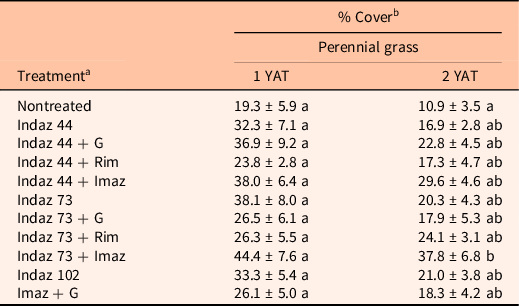
a Herbicide treatment abbreviations and rates are as follows: Indaz 44 (indaziflam 44 g ai ha−1), Indaz 44 + G (indaziflam 44 g ai ha−1 + glyphosate 755 g ae ha−1), Indaz 44 + Rim (indaziflam 44 g ai ha−1 + rimsulfuron 123 g ai ha−1), Indaz 44 + Imaz (indaziflam 44 g ai ha−1 + imazapic 63 g ae ha−1), Indaz 73 (indaziflam 73 g ai ha−1), Indaz 73 + G (indaziflam 73 g ai ha−1 + glyphosate 755 g ae ha−1), Indaz 73 + Rim (indaziflam 73 g ai ha−1 + rimsulfuron 123 g ai ha−1), Indaz 73 + Imaz (indaziflam 73 g ai ha−1 + imazapic 63 g ae ha−1), Indaz 102 (indaziflam 102 g ai ha−1), Imaz + G (imazapic 123 g ae ha−1 + glyphosate 755 g ae ha−1).
b Letters indicate differences between treatments across burn type (P < 0.05).
Perennial forb and shrub/sub-shrub cover (mean ± SE) for 1 yr after treatment (YAT) and 2 YAT at Site 1.
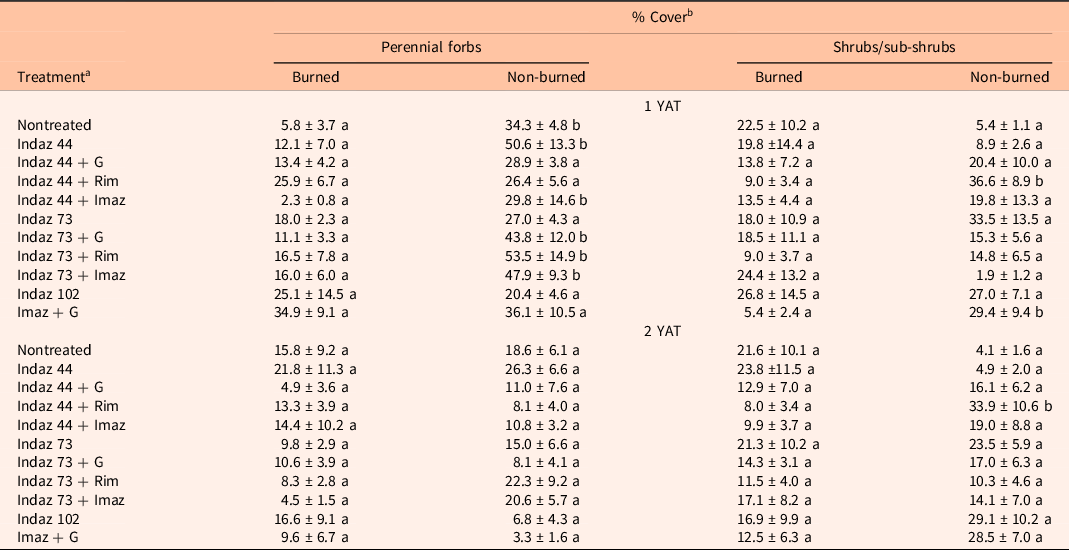
a Herbicide treatment abbreviations and rates are as follows: Indaz 44 (indaziflam 44 g ai ha−1), Indaz 44 + G (indaziflam 44 g ai ha−1 + glyphosate 755 g ae ha−1), Indaz 44 + Rim (indaziflam 44 g ai ha−1 + rimsulfuron 123 g ai ha−1), Indaz 44 + Imaz (indaziflam 44 g ai ha−1 + imazapic 63 g ae ha−1), Indaz 73 (indaziflam 73 g ai ha−1), Indaz 73 + G (indaziflam 73 g ai ha−1 + glyphosate 755 g ae ha−1), Indaz 73 + Rim (indaziflam 73 g ai ha−1 + rimsulfuron 123 g ai ha−1), Indaz 73 + Imaz (indaziflam 73 g ai ha−1 + imazapic 63 g ae ha−1), Indaz 102 (indaziflam 102 g ai ha−1), Imaz + G (imazapic 123 g ae ha−1 + glyphosate 755 g ae ha−1).
b Letters indicate differences between burn type within a treatment separated by year (P < 0.05) for individual vegetation types.
Site 2
Similar to Site 1, minimal impacts to perennial grasses, forbs, and shrubs/sub-shrubs were observed. Perennial grass cover was not impacted by burning or herbicide treatments (Table 4; Supplementary Table S3). Burning did not impact perennial forb cover at Site 2, although there was a slight herbicide treatment effect. Indaziflam 44 g ha−1 + glyphosate had significantly more perennial forb cover compared with the nontreated at 1 YAT, regardless of burning (29.7% ± 5.4 vs. 13.6% ± 4.1, respectively), although these differences were no longer measurable by 2 YAT (Table 4; Supplementary Table S3). The F-test for treatment was significant for shrub/sub-shrub cover; however, no significant differences were observed in the post hoc analysis (P < 0.028).
Perennial grass, forb, and shrub/sub-shrub cover (mean ± SE) for 1 yr after treatment (YAT) and 2 YAT at Site 2 averaged across burn type.
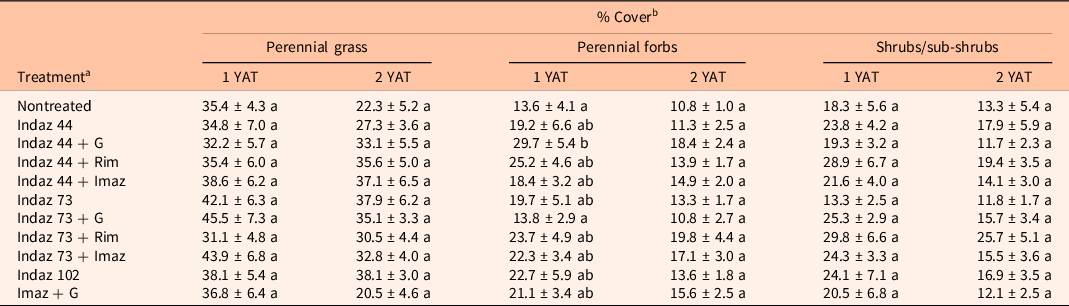
a Herbicide treatment abbreviations and rates are as follows: Indaz 44 (indaziflam 44 g ai ha−1), Indaz 44 + G (indaziflam 44 g ai ha−1 + glyphosate 755 g ae ha−1), Indaz 44 + Rim (indaziflam 44 g ai ha−1 + rimsulfuron 123 g ai ha−1), Indaz 44 + Imaz (indaziflam 44 g ai ha−1 + imazapic 63 g ae ha−1), Indaz 73 (indaziflam 73 g ai ha−1), Indaz 73 + G (indaziflam 73 g ai ha−1 + glyphosate 755 g ae ha−1), Indaz 73 + Rim (indaziflam 73 g ai ha−1 + rimsulfuron 123 g ai ha−1), Indaz 73 + Imaz (indaziflam 73 g ai ha−1 + imazapic 63 g ae ha−1), Indaz 102 (indaziflam 102 g ai ha−1), Imaz + G (imazapic 123 g ae ha−1 + glyphosate 755 g ae ha−1).
b Letters indicate differences between treatment across burn type within each year (P < 0.05) for individual vegetation types.
Although burning can increase grass biomass and cover (Kessler et al. Reference Kessler, Nissen, Meiman and Beck2015), burning did not have an effect on the perennial grass cover in this study. More importantly, perennial grass cover did not decrease with the use of indaziflam, alone or in combination with glyphosate, rimusulfuron, or imazapic, indicating there were no negative impacts to grass cover from herbicide treatments. Once remnant grasses are released from winter annual grass competition and annual grass litter is reduced through burning and/or herbicides, perennial grass cover and biomass can increase as a result of increased resource availability (Clark et al. Reference Clark, Sebastian, Nissen and Sebastian2019b; Davies and Sheley Reference Davies and Sheley2011; DiTomaso et al. Reference DiTomaso, Kyser and Hastings1999; Kessler et al. Reference Kessler, Nissen, Meiman and Beck2015; Koby et al. Reference Koby, Prather, Quicke, Beuschlein and Burke2019; Sebastian et al. Reference Sebastian, Sebastian, Nissen and Beck2016, Reference Sebastian, Fleming, Patterson, Sebastian and Nissen2017a, Reference Sebastian, Nissen, Sebastian, Meiman and Beck2017c). This potential increase in cover and biomass suggests that ecosystem functions and resiliency can be improved in plant communities with desirable remnant native plant species (Davies and Sheley Reference Davies and Sheley2011).
Perennial forb and shrub/sub-shrub cover responded differently to burning across sites and by year (Table 3; Supplementary Table S3). Changes in native plant cover following B. tectorum control could be associated with differences in the pretreatment densities for these species groups (Monaco et al. Reference Monaco, Osmond and Dewey2005). More importantly, no herbicide treatments decreased cover at either site. Other studies have reported that perennial forbs and shrubs/sub-shrubs responded favorably when burning was combined with imazapic to control B. tectorum (Kessler et al. Reference Kessler, Nissen, Meiman and Beck2015; Kyser et al. Reference Kyser, Wilson, Zhang and DiTomaso2013; Monaco et al. Reference Monaco, Osmond and Dewey2005). Although we did not observe increases in perennial vegetation cover, there were no negative impacts to native plant cover with indaziflam applications used with or without prescribed fire. Thus, indaziflam may be an effective tool for land managers to control B. tectorum in areas with high native plant diversity or on sites that have been burned (Clark et al. Reference Clark, Sebastian, Nissen and Sebastian2019b; Sebastian et al. Reference Sebastian, Fleming, Patterson, Sebastian and Nissen2017a).
Species Richness and Diversity Response
Site 1
There were no significant main effects or interactions related to species richness or Shannon’s and Simpson’s diversity indices at Site 1 (Supplementary Table S4). The mean number of individual species in the non-burned plots was 5.5 ± 0.18 and in the burned plots was 5.4 ± 0.19 at 1 YAT. Species richness stayed consistent at 2 YAT for both burn types. Both diversity indices are dependent on species richness in addition to abundance and evenness (Zhang et al. Reference Zhang, Wang, Kaplan and Liu2015).
Site 2
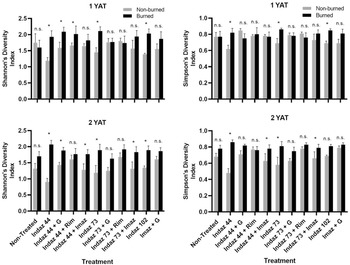
Overall, native plant community richness and diversity were increased with burning at Site 2. The only significant effect on species richness was burn type (Supplementary Table S4). Species richness was greater in the burned plots both years, averaging 9.9 ± 0.3 species compared with 6.6 ± 0.21 species in the non-burned plots. For several indaziflam treatments, Shannon’s diversity and Simpson’s diversity were significantly greater in the burned plots compared with the non-burned plots at 1 and 2 YAT, while burning alone did not increase diversity (Figure 2). There were no differences in Shannon’s diversity or Simpson’s diversity with the imazapic + glyphosate treatment.
Shannon’s diversity index and Simpson’s diversity index at 1 and 2 yr after treatment (YAT) for Site 2. Asterisks represent significant differences between burn types for each treatment (P < 0.05). Treatments with “n.s.” represent no significant differences between burn types for each treatment (P < 0.05). Herbicide treatment abbreviations and rates are as follows: Indaz 44 (indaziflam 44 g ai ha−1), Indaz 44 + G (indaziflam 44 g ai ha−1 + glyphosate 755 g ae ha−1), Indaz 44 + Rim (indaziflam 44 g ai ha−1 + rimsulfuron 123 g ai ha−1), Indaz 44 + Imaz (indaziflam 44 g ai ha−1 + imazapic 63 g ae ha−1), Indaz 73 (indaziflam 73 g ai ha−1), Indaz 73 + G (indaziflam 73 g ai ha−1 + glyphosate 755 g ae ha−1), Indaz 73 + Rim (indaziflam 73 g ai ha−1 + rimsulfuron 123 g ai ha−1), Indaz 73 + Imaz (indaziflam 73 g ai ha−1 + imazapic 63 g ae ha−1), Indaz 102 (indaziflam 102 g ai ha−1), Imaz + G (imazapic 123 g ae ha−1 + glyphosate 755 g ae ha−1).
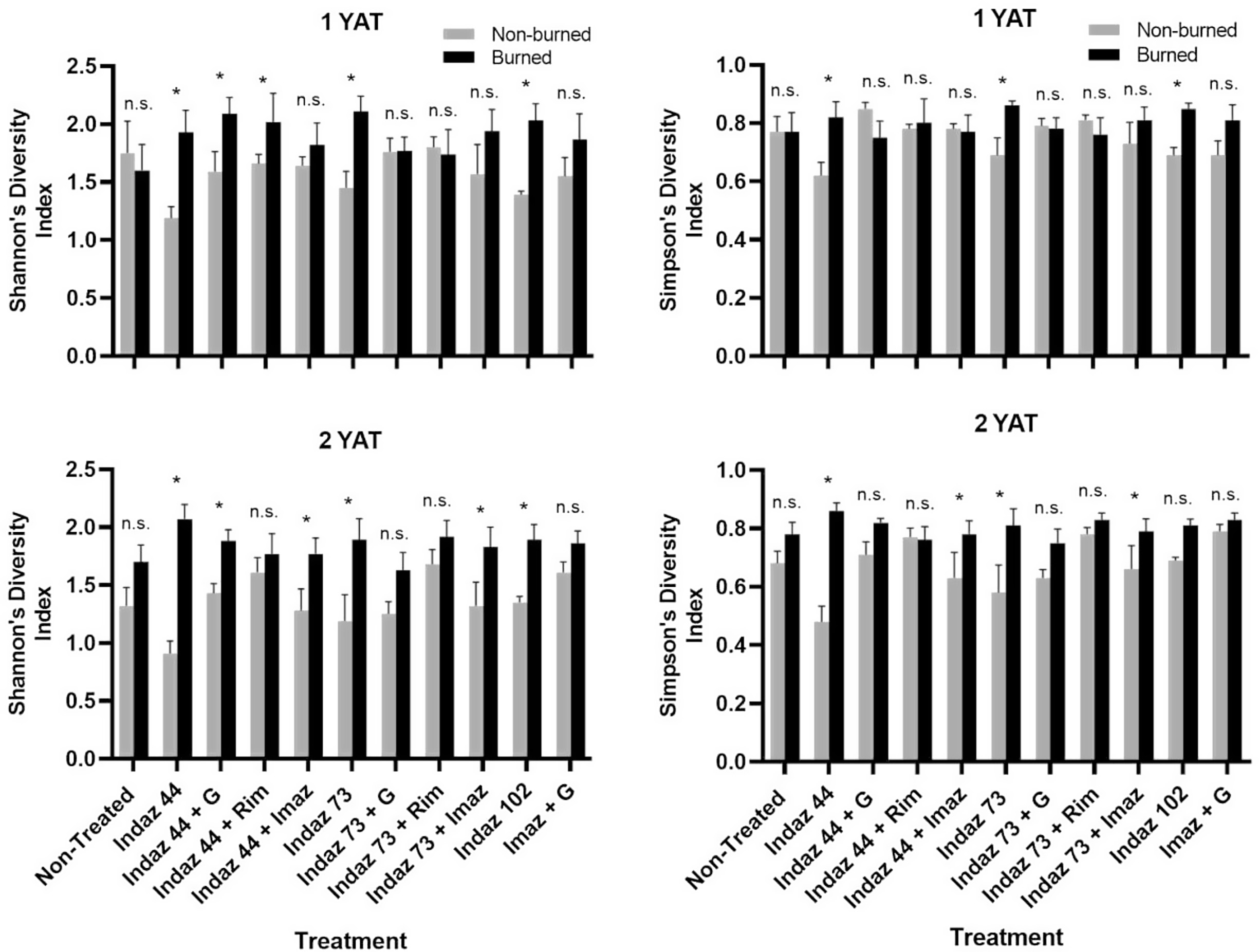
The species richness and diversity responses at Site 2 suggest that burning combined with indaziflam has the potential to increase species diversity in B. tectorum–invaded sites. It is important to consider the remnant plant community at the site, as the response will depend on the plant community before burning (Davies and Svejcar Reference Davies and Svejcar2008; DiTomaso et al. Reference DiTomaso, Brooks, Allen, Minnich, Rice and Kyser2006). Differences in the starting plant community in the non-burned plots potentially explain why diversity increases were not observed at Site 1. Site 1 was dominated by the native, western wheatgrass [Pascopyrum smithii (Rydb.) Á. Löve], while Site 2 was dominated by the introduced, vigorous perennial grasses Kentucky bluegrass (Poa pratensis L.) and Canada bluegrass (Poa compressa L.). Even though perennial grass cover differences were not observed at Site 2 in the burned plots, burning may have reduced competition from the bluegrasses and promoted native forb growth (Ereth et al. Reference Ereth, Hendrickson, Kirby, DeKeyser, Sedivec and West2017).
Burning can be an effective tool for increasing native plant diversity by making more resources available through the removal of B. tectorum litter and subsequent reduction in competition, while stimulating native species growth (DiTomaso et al. Reference DiTomaso, Brooks, Allen, Minnich, Rice and Kyser2006). The native plant community benefits from increased resource availability, but only in the short term because B. tectorum will reestablish from the soil seedbank (DiTomaso et al. Reference DiTomaso, Kyser and Hastings1999, Reference DiTomaso, Brooks, Allen, Minnich, Rice and Kyser2006; Keeley and McGinnis Reference Keeley and McGinnis2007; Kessler et al. Reference Kessler, Nissen, Meiman and Beck2015; Knapp and Seastedt Reference Knapp and Seastedt1986). Burning combined with indaziflam can have long-term beneficial effects, maintaining and improving plant community diversity while providing multiyear B. tectorum control. Effective winter annual grass control in areas with remnant desirable vegetation can begin the passive restoration process (Davies and Svejcar Reference Davies and Svejcar2008). In addition, for sites dominated by a cool-season, perennial grass community, burning followed by indaziflam may also promote forb establishment through the removal of litter and extended B. tectorum control (DiTomaso et al. Reference DiTomaso, Kyser and Hastings1999, Reference DiTomaso, Brooks, Allen, Minnich, Rice and Kyser2006).
Supplementary material
To view supplementary material for this article, please visit https://doi.org/10.1017/inp.2022.11
Acknowledgments
We would like to thank Boulder County Parks and Open Space, especially Steve Sauer and Jim Sebastian, for their assistance in locating research sites and various other efforts. In addition, we would like to thank the numerous individuals who assisted with data collection. This research received no specific grant from any funding agency or the commercial or not-for-profit sectors. No conflicts of interest have been declared.