


1. Introduction
Today, most businesses and production systems are structured according to a linear economic model, which contributes to significant environmental challenges. The “take–make–waste” approach extracts resources from natural sources, transforms them into products, and ultimately disposes of them as waste after use (Reference Ogunmakinde, Sher and EgbelakinOgunmakinde et al., 2021). Over the past decades, the negative environmental impacts of the linear economy have become increasingly evident, including the depletion of finite resources, environmental pollution, and biodiversity loss (Reference Aguiar and JugendAguiar & Jugend, 2022). As economic growth continues and demand for products rises, these challenges are expected to intensify. Moreover, the unequal distribution of resources is likely to exacerbate global dependencies and resource scarcity (Reference LaßLaß, 2023).
To address these environmental challenges, the circular economy has emerged as a promising alternative concept (Reference Schmitt and HansenSchmitt & Hansen, 2022). Since the 1970s, it has evolved as an approach aimed at promoting more responsible and sustainable production and consumption patterns. Although numerous definitions of the circular economy exist, they consistently emphasize the establishment of a regenerative system in which waste is reintegrated as a resource (Reference Bhamra and HernandezBhamra & Hernandez, 2021).
The circular economy is often viewed as an umbrella concept comprising multiple schools of thought (Reference Toxopeus, van den Hout and van DiepenToxopeus et al., 2018). These perspectives can be categorized by different approaches, for example, based on their objectives in slowing, narrowing, or closing material resource loops within the system (Reference LaßLaß, 2023). Another classification distinguishes between eco-efficiency and eco-effectiveness. Eco-efficient concepts focus on a more efficient use of resources by minimizing negative environmental impacts. In contrast, eco-effectiveness aims to prevent environmental harm by embedding principles of circularity into product design (Reference Ogunmakinde, Sher and EgbelakinOgunmakinde et al., 2021).
One circular economy approach advocating eco-effectiveness is the Cradle to Cradle (C2C) concept (Reference Braungart, McDonough and BollingerBraungart et al., 2007). It represents a holistic approach to the circular economy and is grounded in three core principles. The first principle conceptualizes all materials as nutrients circulating within two distinct metabolisms: the biosphere, which encompasses biodegradable materials, and the technosphere, which comprises technical materials designed for reuse, recycling, or other R-strategies (Reference MusicMusic, 2021). The second principle promotes the exclusive use of renewable energy across all processes, while the third emphasizes technological diversity, social equity, and biodiversity (Reference MusicMusic, 2021). By adhering to these three core principles, the C2C concept can be regarded as a promising approach to addressing the environmental challenges associated with the linear economy (Reference LaßLaß, 2023).
However, despite its potential to address the root causes of these challenges, the C2C concept remains insufficiently adopted in industry (Reference Reay, McCool and WithellReay et al., 2011). Reference Schmitt and HansenSchmitt & Hansen (2022) show that implementing C2C in producing companies, particularly within product development processes, is often complex and time-consuming. Reference Bhamra and HernandezBhamra & Hernandez (2021) further highlight the lack of appropriate supportive tools for industrial application. Moreover, the benefits of adopting eco-effective approaches are not yet fully understood, and the knowledge required for their implementation is often lacking (Reference Reay, McCool and WithellReay et al., 2011).
Therefore, it is essential to investigate the implementation of C2C within product development in order to identify effective approaches that support companies in adapting this concept and shifting away from linear thinking. To assess the current state of research, a comprehensive literature review regarding the implementation of C2C in product development would be insightful. However, a literature search on Scopus with the terms “Cradle to Cradle” and “product development”, limited to the document type “review”, yielded only four results. Two of these results focus on case studies, while the others address biological nutrients and energy efficiency. No comprehensive review examining the current state of research on the implementation of C2C in product development was found.
To address this research gap, the aim of this paper is to investigate the implementation of C2C in product development by a thorough literature review. The research questions (RQ) of the paper are the following:
-
• RQ1: What are the main topics of research for the implementation of C2C in product development?
-
• RQ2: What challenges are being discussed regarding the implementation of C2C in product development?
-
• RQ3: What aims regarding eco-efficiency and eco-effectiveness are addressed in the current research?
By addressing these questions, this paper aims to provide a deeper understanding of how C2C can be effectively integrated into the product development process.
2. Methodology
The first part of the methodology—data collection—follows the proceeding described by Reference VernimVernim (2020) for a systematic literature review, including database selection, search string definition, and reduction of the identified literature (see Figure 1).
Twofold methodology with systematic literature reduction; n = number of articles

Figure 1 Long description
The flowchart depicts a twofold methodology for systematic literature reduction. The process begins with data collection, which includes database selection, search string application, and literature reduction. This leads to data analysis, involving topic clustering, challenge summary, and sustainability approach. The identification phase starts with papers identified in Scopus, totaling 1,529. Screening follows, with steps including screening by title, abstract, availability, and text. Exclusions occur at each step: 1,072 by title, 298 by abstract, 7 by availability, and 91 by text. Finally, 61 papers are included in the review.
The selected database for this paper is Scopus due to its broad coverage and relevance for engineering, with high representation of conference papers. The search string consists of three groups of keywords (Cradle to Cradle, product development, implementation), added with two exclusion groups for further precision on technical products and in order to deal with a manageable amount of results (see search string in Figure 1). “Circular economy” is also included in the first keyword group because similar approaches for C2C are often not defined solely under this term, and a sharp differentiation is often not possible. Therefore, further concepts such as eco-design are also included. During the reduction process, however, the broader search results were narrowed down to concepts relevant for C2C. A total of 1,529 articles were identified and reduced (see screening steps in Figure 1) to 61 using an extended PRISMA approach by Reference Page, McKenzie, Bossuyt, Boutron, Hoffmann, Mulrow, Shamseer, Tetzlaff, Akl, Brennan, Chou, Glanville, Grimshaw, Hróbjartsson, Lalu, Li, Loder, Mayo-Wilson, McDonald and MoherPage et al. (2021).
Following data collection, the data analysis phase is structured according to the research questions. To answer the first question (RQ1), categories regarding the main topic of the articles are identified by qualitative clustering. Within these categories, the discussed challenges are collected and summarized (RQ2). For the third research question (RQ3), the articles are analysed qualitatively regarding their sustainability approach for eco-efficiency and eco-effectiveness, and which of these concepts is addressed in their research. Therefore, the definitions provided in Section 1 are applied, and the articles are examined to determine whether they belong to eco-efficiency or eco-effectiveness.
3. Results
3.1. Clustering by main topics
The data analysis step to answer RQ1 identified six main topics of the current research regarding the implementation of C2C in product development. Most articles focus on product development methods (number of articles: 20), assessment tools (13), design rules (11), and barriers/drivers (10), whereas material selection (4) and business models (3) are less frequently represented.Footnote 1
Product development methods: Most found articles present tools or frameworks to support engineers throughout the product development process. Some articles develop definitions (Reference Rocha, Antunes and PartidárioRocha et al., 2023; Reference Vicente and CamochoVicente & Camocho, 2024) and catalogues (Reference Jugend, Pinheiro, Luiz, Junior and Cauchick-MiguelJugend et al., 2020; Reference Rotondo, Bakker, Balkenende and ArquillaRotondo et al., 2025; Reference Tellez Nitzling, Kokoschko and SchabackerTellez Nitzling et al., 2024) of existing tools. Other articles address specific industry sectors, such as electronics (Reference Fontana, Rossi, Nika, Dell’Ambrogio, Sorlini, Pachon, Rosa, van Schaik and ReuterFontana et al., 2024; Reference Rio, Khannoussi, Crebier and LembeyeRio et al., 2020), aviation (Reference Filippatos, Markatos, Tzortzinis, Abhyankar, Malefaki, Gude and PantelakisFilippatos et al., 2024), or certified systems (Reference Meldrum and MeldrumMeldrum, 2023). Articles present tools for specific R-strategies (Reference Hildenbrand, Lindahl, Shahbazi and KurdveHildenbrand et al., 2021; Reference Joustra, Bakker, Bessai and BalkenendeJoustra et al., 2022; Reference Shevchenko, Cluzel, Yannou, Shams Esfandabadi, Ranjbari, Saidani and DankoShevchenko et al., 2024) or aim at different development strategies (Reference Brusa, Gastaldi, Delprete and GiorioBrusa et al., 2024; Reference Riesener, Kuhn, Hellwig, Ays and SchuhRiesener et al., 2023) or lifecycle phases (Reference Evrard, Ben Rejeb, Zwolinski and BrissaudEvrard et al., 2021; Reference Favi, Marconi, Rossi, Cappelletti, Roucoules, Paredes, Eynard, Morer Camo and RizziFavi et al., 2021). Finally, some articles deal with feedback systems (Reference Lindkvist Haziri and SundinLindkvist Haziri & Sundin, 2020), customer requirements (Reference Siwiec, Pacana and GazdaSiwiec et al., 2023), or abstract levels of product design (Reference Peralta, Luna and SolteroPeralta et al., 2020; Reference Sedini, Bianchini, Maffei and CautelaSedini et al., 2024).
Assessment tools: The second largest article group is about developing or combining metrics to evaluate sustainability aspects in product development. Most of the identified tools are specialised for single R-strategies, such as repair and disassembly (Reference Boix Rodríguez and FaviBoix Rodríguez & Favi, 2024), reuse (Reference Pluhnau, Lübke and NagarajahPluhnau et al., 2023), or remanufacturing (Reference Karkasinas, Rentizelas and CorneyKarkasinas et al., 2025), or focus on specific industries, such as electronics (Reference Fang, Lefranc and RioFang et al., 2024), composites (Reference Cappelletti and GermaniCappelletti & Germani, 2024), or lightweight design (Reference König, Mathieu, Vielhaber, Kohl, Seliger, Dietrich and MurKönig et al., 2025). Other articles investigate combinations with creativity (Reference Ruiz-Pastor, Chulvi, Mulet and RoyoRuiz-Pastor et al., 2022) or simulation (Reference Aher, Boudjadar and RamanujanAher et al., 2023), and other circularity indicators (Reference Saidani, Kim, Cluzel, Leroy and YannouSaidani et al., 2020). Also, collections (Reference Saidani and KimSaidani & Kim, 2021) and evaluations (Reference Ko, Guedes, Badurdeen, Jawahir, Morris, Ferrero, Hapuwatte, Bradley and RaihanianKo et al., 2024) of existing assessment methods are discussed, and maturity evaluation (Reference Aguiar and JugendAguiar & Jugend, 2022) and performance metrics (Reference Palsodkar, Nagare, Pansare and NarwanePalsodkar et al., 2024) are considered.
Design rules: This group of articles deals with recommendations or product design attributes supporting specific objectives. Articles are either related to a specific industry, such as electronics (Reference Azua Lahidalga, Valor, Lozano and MendozaAzua Lahidalga et al., 2024; Reference Hakola, Smolander, Rauhala and VilkmanHakola et al., 2024; Reference Hoveling, Svindland Nijdam, Monincx, Faludi and BakkerHoveling et al., 2024; Reference Sangwongwanich, Stroe, Mi and BlaabjergSangwongwanich et al., 2024) or composite materials (Reference Joustra, Flipsen and BalkenendeJoustra et al., 2021), or provide design rules to support the selection process (Reference MesaMesa, 2023a; Reference Willskytt and Brambila-MaciasWillskytt & Brambila-Macias, 2020) and their application (Reference Fröhlich, Fröhlich, Steinbiß, Schmiedeknecht and Loza AdauiFröhlich, 2024; Reference Toxopeus, van den Hout and van DiepenToxopeus et al., 2018). Further articles focus on reviewing design rules (Reference Stölzle, Roth and KreimeyerStölzle et al., 2023) and linking them with other design strategies (Reference van Doorsselaervan Doorsselaer, 2022).
Barriers/drivers: Another group of articles collects barriers and drivers regarding the implementation process in product development. Most of them give an overview of challenges (Reference Chouinard, Pigosso, McAloone, Baron and AchicheChouinard et al., 2019; Reference Dorrego-Viera, Urbinati and LazzarottiDorrego-Viera et al., 2025; Reference Horn, Salo and NissinenHorn et al., 2023; Reference Ries, Wartzack, Zipse, Zipse, Hornegger, Becker, Beckmann, Bengsch, Feige and SchoberRies et al., 2023), also in combination with case studies (Reference Bakker, Wever, Teoh and ClercqBakker et al., 2010; Reference Boorsma, Peck, Bakker, Bakker and BalkenendeBoorsma et al., 2022; Reference Pauw, Karana, Kandachar, Nee, Song and OngPauw et al., 2013). Further articles focus on specific areas, such as medical products (Reference Kane, Bakker and BalkenendeKane et al., 2018), additive manufacturing (Reference Nekin Joshua, Aravind Raj, Sakthi Balan, Ponnambalam, Damodaran, Subramanian and Paulo DavimNekin et al., 2024), or the use phase of products (Reference Da Silva, Barros, Radicchi, Puglieri and PiekarskiDa Silva et al., 2024).
Material selection: A smaller group of four articles investigates the process of material selection during product development. They either develop support for this process (Reference Mardina, Turnbull, Rahimifard, Bibb and CulmerMardina et al., 2025; Reference MesaMesa, 2023b) or give guidance through recommendations (Reference Desing, Braun and HischierDesing et al., 2021; Reference Papile, Del Curto and GambardellaPapile & Del Curto, 2024).
Business models: Three articles focus on economic considerations. While they mostly deal with the combination of business models and circular design (Reference Cappelletti, Manuguerra, Menato and GermaniCappelletti et al., 2024; Reference Pruhs, Kusch, Woidasky and VierePruhs et al., 2024), one article discusses a method to consider user behaviour in this context (Reference Wastling, Charnley and MorenoWastling et al., 2018).
The clustering of the 61 articles identified in the systematic literature review according to their main topics serves as the answer to RQ1.
3.2. Collection of topic-specific challenges
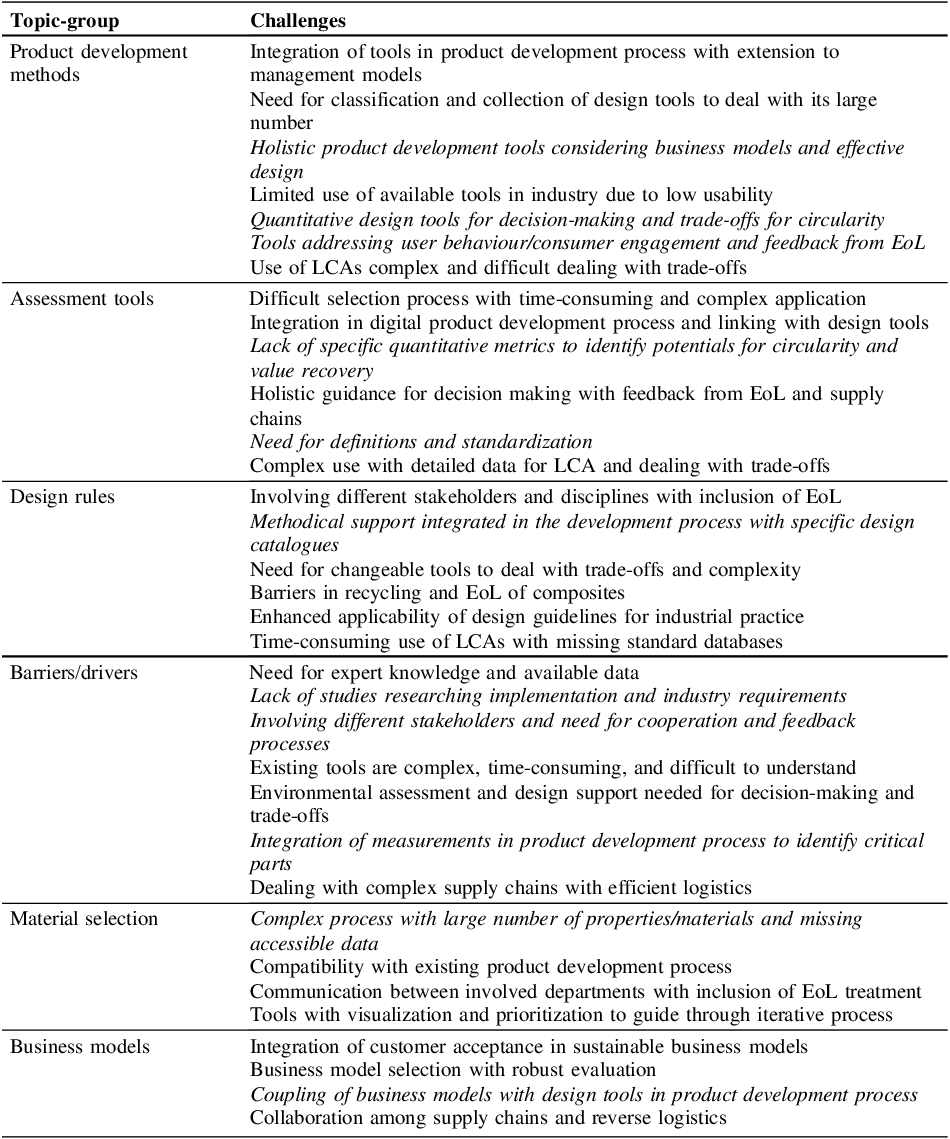
The second analysis aims at extracting challenges (RQ2) that are discussed in research regarding the implementation of C2C in product development. By analysing the considered 61 articles, 34 challenges were identified and clustered for each topic (see Table 1 Footnote 2 ). A short summary is given in the text below.
Identified challenges according to their topic-group with C2C-specific challenges marked

Product development methods: Challenges of this topic group deal with the need for holistic tools that consider design strategies, business models, and management aspects (Reference Rocha, Antunes and PartidárioRocha et al., 2023), while involving user behaviour (Reference Rotondo, Bakker, Balkenende and ArquillaRotondo et al., 2025) and feedback from end of life (EoL). These tools should be integrated in the product development process.
Assessment tools: Challenges for assessment tools involve a difficult selection process and combining them with other tools, such as design methods or LCA (Reference Karkasinas, Rentizelas and CorneyKarkasinas et al., 2025). The integration in the existing development process is emphasized, while holistic guidance with feedback from EoL and supply chains is required.
Design rules: Within design rules, challenges primarily concern the applicability of design guidelines in industrial practice and the involvement of multiple stakeholders throughout the EoL. There is a need for changeable tools to deal with trade-offs, and specific design catalogues should be enhanced with methodical support during the product development process.
Barriers/drivers: This topic group deals mostly with barriers and challenges regarding complexity management within supply chains, various stakeholders, knowledge management, and feedback processes. Also, the complex use of existing tools is highlighted (Reference Horn, Salo and NissinenHorn et al., 2023).
Material selection: Material selection is generally challenging due to the large number of materials and material properties, limited data accessibility, and involvement of multiple departments (Reference Papile, Del Curto and GambardellaPapile & Del Curto, 2024). Compatibility with the product development process and supportive tools also remain challenging.
Business models: Challenges regarding business models are the selection process and the integration in the product development phases, while developing business models with high customer acceptance.
The analysis of the 61 articles of the literature review revealed a variety of challenges for research and industry practitioners as an answer for RQ2.
3.3. Analysis regarding eco-efficiency and eco-effectiveness
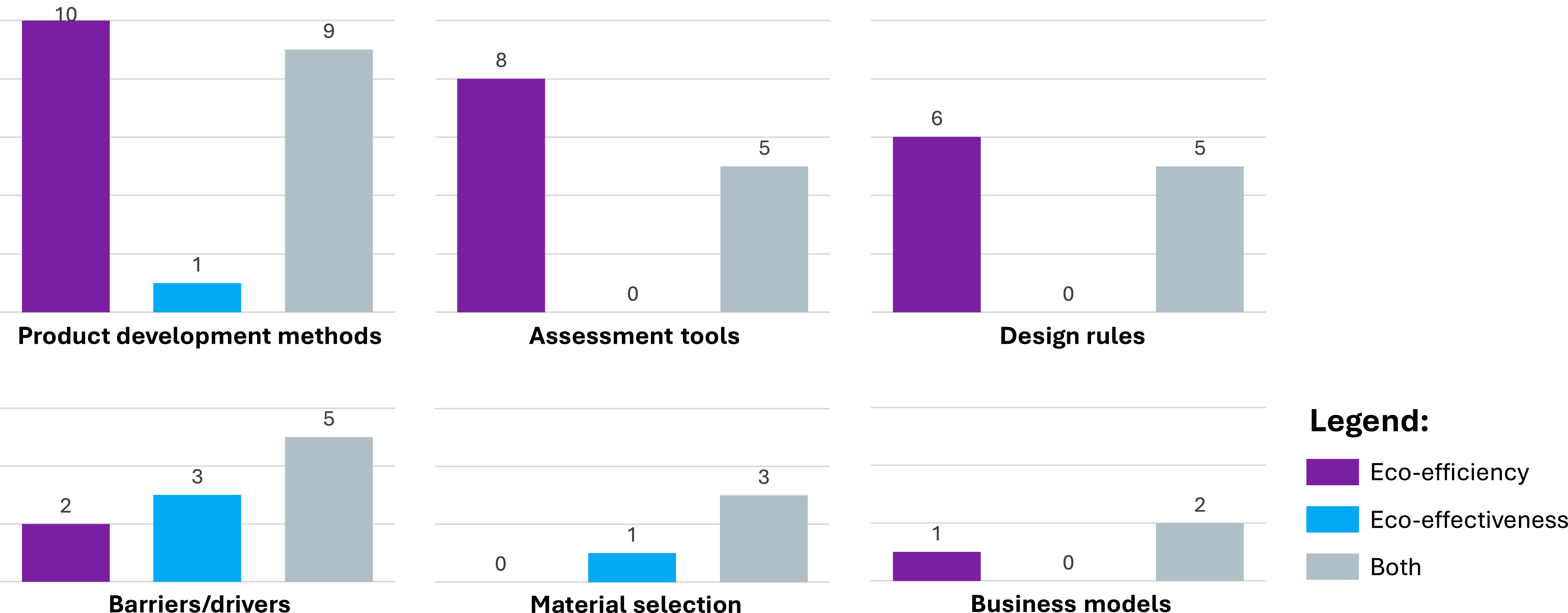
The third analysis focuses on how the articles address environmental issues and which sustainability approach they promote (RQ3). To analyse the addressed approach, each article was qualitatively classified as addressing eco-efficiency, eco-effectiveness, or both.Footnote 3 The results are presented for each topic-group in Figure 2 and are summarised in the following paragraphs.
Product development methods, assessment tools, design rules: Most articles in the three largest topic groups address eco-efficiency. More than half of the articles focus on eco-efficient measures, ten out of 20 in product development methods, eight out of 13 in assessment tools, and six out of 11 in design rules. Only one article in these groups primarily focuses on eco-effectiveness, discussing design for circular economy in a holistic perspective that incorporates added value and business models (Reference Rocha, Antunes and PartidárioRocha et al., 2023). The other articles try to address both approaches, but with different priorities and on different levels of accuracy. Within product development methods, there are nine articles considering both approaches, five within assessment tools, and five within design rules.
Barriers/drivers: Most articles in this group (five out of ten) consider both sustainability approaches. Only two address eco-efficiency solely, and three articles focus on eco-effectiveness.
Material selection, business models: These two smaller topic groups address the sustainability approaches in a balanced way. Most of the articles consider both eco-efficiency and eco-effectiveness (three in material selection, two in business models). One article for material selection focuses on eco-effectiveness, while one article in business models addresses eco-efficiency solely.
A comparison of the analysed articles reveals differences in their approaches to eco-efficiency and eco-effectiveness. Eco-effective concepts often adopt a holistic approach, for example by presenting design tools that incorporate business modelling (Reference Rocha, Antunes and PartidárioRocha et al., 2023) or material selection tools that consider both technical and ethical aspects (Reference Papile, Del Curto and GambardellaPapile & Del Curto, 2024). Negative environmental impacts are prevented by early design decisions, for instance by selecting materials suitable for circularity (Reference Papile, Del Curto and GambardellaPapile & Del Curto, 2024). In contrast, eco-efficient approaches focus on minimizing negative impacts and aim to integrate these principles in the design process. Examples include energy-efficiency measures (Reference Nekin Joshua, Aravind Raj, Sakthi Balan, Ponnambalam, Damodaran, Subramanian and Paulo DavimNekin et al., 2024), increased recycled content (Reference Cappelletti and GermaniCappelletti and Germani, 2024) or lightweight design (Reference König, Mathieu, Vielhaber, Kohl, Seliger, Dietrich and MurKönig et al., 2025).
Number of papers addressing eco-efficiency and eco-effectiveness

4. Discussion
As most articles can be categorized in product development methods, assessment tools, and design rules, these topics appear to be of high importance for both research and industry. Business models and material selection are less frequently addressed, yet their integration within the product development process is essential for a holistic approach. The articles regarding barriers/drivers provide an overview of the current state in research regarding the implementation of C2C in product development. They collect challenges and give insights into the practical implementation process through case studies.
A summary of the most important challenges can be condensed as follows:
-
• Need for a holistic framework to deal with the overall implementation of sustainability in the context of companies, and guidance through a large number of available tools.
-
• Integration in the product development process, with linking between design, business models, and management view.
-
• Development of tools with good usability and practical applicability.
-
• Dealing with trade-offs, and use of measurements for identification of improvement potentials.
-
• Involvement of multiple stakeholders, customers, supply chains, and reverse logistics.
Finally, aspects regarding the addressed sustainability approaches can be added to the findings. Eco-effectiveness is underrepresented within the groups of product development methods, assessment tools, and design rules, as most contributions focus on eco-efficiency or attempt to address both approaches with varying levels of emphasis. Conversely, the groups for material selection and business models demonstrate a more balanced consideration of both aspects. Material selection tools are crucial for eco-effectiveness, as materials determine further environmental impacts on a large scale (Reference Brusa, Gastaldi, Delprete and GiorioBrusa et al., 2024). Business models often need to apply a holistic view and support more eco-effective solutions (Reference Rocha, Antunes and PartidárioRocha et al., 2023). Finally, studies addressing barriers and drivers consider both approaches.
This analysis highlights the differing approaches to sustainability. While most articles primarily address eco-efficiency and focus on optimizing and improving existing products, eco-effective approaches are less frequently found, although they offer a more holistic perspective. Rather than merely minimizing negative environmental impacts, eco-effectiveness aims to prevent these impacts from the outset through appropriate design decisions and by considering the broader context. In this sense, eco-effectiveness can be understood as transformative design that integrates business models, material selection, and further assessments within a holistic framework. The C2C concept, in particular, provides a structured way to implement eco-effectiveness in product design arguably more explicitly than other circular economy approaches. In summary, a gap remains in product development methods, assessment tools, and design rules regarding a clear and consistent focus on eco-effectiveness, indicating the need for further research.
The presented review on the implementation of C2C in product development is subject to limitations. Distinguishing C2C from other circular economy concepts during the literature search was difficult, as some studies address C2C objectives without explicitly using the term. Consequently, a more general search for C2C including other circular economy concepts was used, which further complicates a clear differentiation. Additional limitations include the exclusive reliance on the Scopus database, without incorporating other databases such as Web of Science, as well as the use of a simplified qualitative approach for analysing eco-efficiency and eco-effectiveness.
5. Conclusion
The current practice of the linear economy causes environmental issues; therefore, the circular economy can serve as an alternative concept. There are several approaches within the circular economy, including eco-efficiency and eco-effectiveness, as well as concepts to implement eco-effectiveness, such as Cradle to Cradle. Although C2C appears to be a promising solution to current environmental issues, it is not widely applied in industry due to its difficult implementation in product development. Therefore, this research provides a systematic review of the implementation of C2C in product development.
Six key areas of focus were identified: product development methods, assessment tools, design rules, barriers/drivers, material selection, and business models. The analysis highlights several challenges and reveals a marked underrepresentation of eco-effectiveness in existing research.
To address this gap, future research will develop a holistic framework to support the implementation of eco-effectiveness in product development. This framework is intended to incorporate business models, design rules, material selection, and assessment tools, and to integrate these elements into the dynamic development process of technical products. As illustrated by this study, a stronger focus on eco-effective and therefore holistic methods is required to address the specific challenges associated with C2C. The framework aims to support product development teams in implementing more sustainable solutions, thereby facilitating the transition away from the linear economy and strengthening the application of circular economy principles in industrial practice. In doing so, it seeks to contribute to the practical advancement of broader concepts such as sustainability and eco-innovation.
Generative AI statement
The authors used DeepL and ChatGPT (Open AI) for language improvement and linguistic polishing. All core research content, data analysis, and conclusions are the original work of the authors.


 Open access

