


INTRODUCTION
Vaccination is the cornerstone of control against transmission of measles, mumps and rubella (MMR) infections. In the UK, two doses of MMR vaccine have been recommended since 1996, with the first dose given around age 12 months and the second before school entry at 3·5–5 years. Following the false autism scare in the last decade, MMR uptake in the UK has been well below the recommended 95% uptake for herd immunity, with recent data showing a slow increase in vaccination rate signalling a return in parental confidence [Reference Godlee, Smith and Marcovitch1, 2]. This sub-optimal vaccination uptake has left large numbers of children unprotected against MMR infections and consequently the potential for disease transmission remains high [Reference Choi3]. In response to the decrease in MMR uptake nationally, the Chief Medical Officer (CMO) recommended a one-off catch-up programme in 2008 for those children who did not receive MMR vaccination in early childhood [4].
Offering MMR at the time of teenage booster [tetanus, low-dose diphtheria and inactivated polio vaccine (Td/IPV)] vaccination may be a useful strategy to improve coverage in this under-immunized cohort and hence reduce the risks to the individual as well as the potential for outbreaks [Reference Lashkari and El Bashir5]. In order to improve the coverage of MMR vaccination, we offered one dose of MMR vaccine to children known to be incompletely immunized at the time of teenage booster vaccination in secondary schools in Swindon.
METHODS
The list of children known to be incompletely immunized against MMR in School Year 10 (age 14–15 years) was extracted from the Swindon Child Health Department (CHD) database on 7 January 2011. All incompletely immunized children attending Year 10 classes in schools in Swindon were offered MMR vaccination at the time of routine Td/IPV vaccination. The children in this cohort were born between 1 September 1995 and 30 August 1996 and therefore would have been eligible to receive the two-dose MMR programme introduced in 1996. The MMR vaccination offer letter was sent home with the eligible child for the parent/guardian.
Written informed consent was obtained from the parent/guardian before vaccination. The consent form sought information on previous MMR vaccination and medical contraindications for the child. All girls were asked if they thought they were likely to be pregnant and vaccination was deferred if a positive response was obtained. Pregnancy tests were not done in view of the low risks of pregnancy and the relative safety of MMR during early stages of pregnancy from published data on accidental immunizations.
All MMR immunizations were delivered by the school nursing team in clinics arranged in the schools as part of the Td/IPV programme. All children who had returned a valid completed MMR consent form were given one dose of the vaccine at the same time as Td/IPV vaccination. Depending on the number of children requiring MMR and Td/IPV vaccination, clinic duration was increased and extra nursing staff resources were made available to accommodate vaccination of all eligible children. In line with the usual Td/IPV programme model in Swindon, children absent on the day of vaccination were advised to contact their own General Practitioner (GP) for vaccination.
As the MMR offer was not part of the core service specification for the school nursing and child health team, the costs including staff time and other administrative costs were estimated prior to programme implementation. Uptake rates were calculated by querying the Swindon CHD database in June 2011. After manual checking and validation, data were analysed in Microsoft Excel 2007.
RESULTS
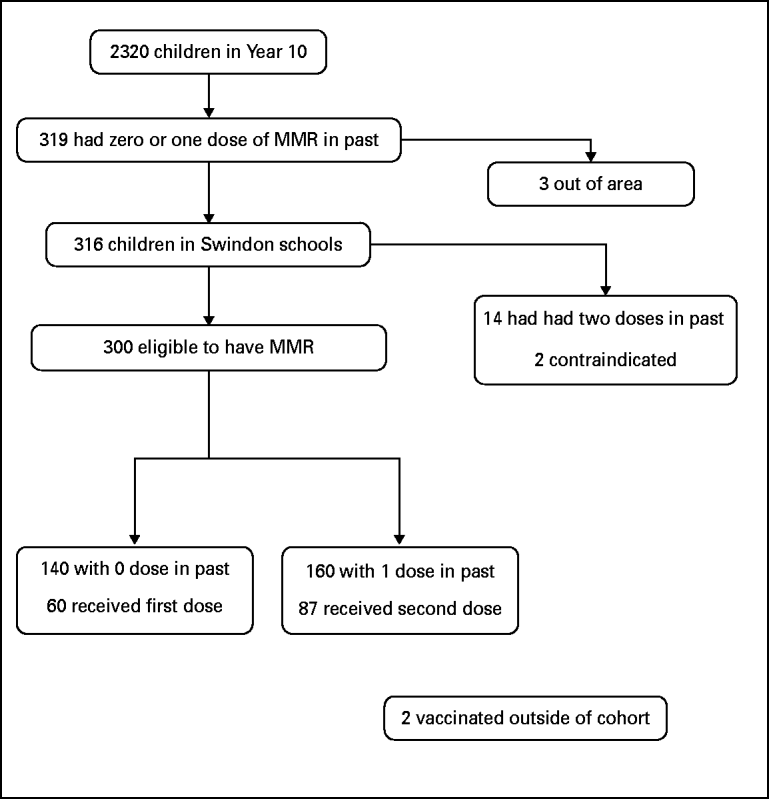
A total of 2320 children were attending Year 10 classes in 15 schools in Swindon according to the Swindon CHD records as of 7 January 2011. Of the 316 children identified as eligible to receive MMR vaccination, 147 received one dose of MMR vaccine (Fig. 1). Excluding the 14 children who had received two doses of MMR and the two with contraindications, uptake for a dose of MMR in this campaign was 49% (147/300). For children with zero and one dose MMR vaccination in the past, acceptance of MMR was 42·9% and 54·3%, respectively (P<0·05). Overall uptake for two doses of MMR increased from 86·3% to 90·6%.
Opportunistic MMR vaccination at the time of teenage booster vaccination in secondary schools in Swindon, 2010–2011.
Prior to programme implementation, the cost of vaccinating 460 children was estimated at £2100. This included CHD costs (data extraction and upload to child health records), school nursing team costs for programme coordination and MMR vaccine administration, and vaccine storage costs. MMR vaccine costs were not included as they are available free of charge from the Department of Health. Since only 149 children were vaccinated, the cost estimate was revised down to £1400.
DISCUSSION
This opportunistic MMR vaccination programme, offered to a targeted group of unimmunized children at the time of routine teenage booster vaccination, demonstrates the feasibility and effectiveness of the approach.
Two strategies were considered during the planning stage – a targeted offer for those known to be unimmunized according to CHD records or a universal offer to all children eligible for teenage booster vaccination. The advantages and disadvantages of a universal offer and a targeted offer are summarized in Table 1. It is widely recognized that data on the numbers of children in secondary schools and their immunization history tend to be incomplete and unreliable [Reference Ramsay, White and Crowcroft6]. A universal offer of MMR is usually appropriate where there are concerns about the completeness and quality of CHD data. In this campaign, a targeted offer based on CHD records was thought to be more practical and effective in managing parental queries, keeping costs down and offering vaccination to the right cohort of unimmunized children.
Comparison of universal and targeted offers of MMR vaccination at secondary schools
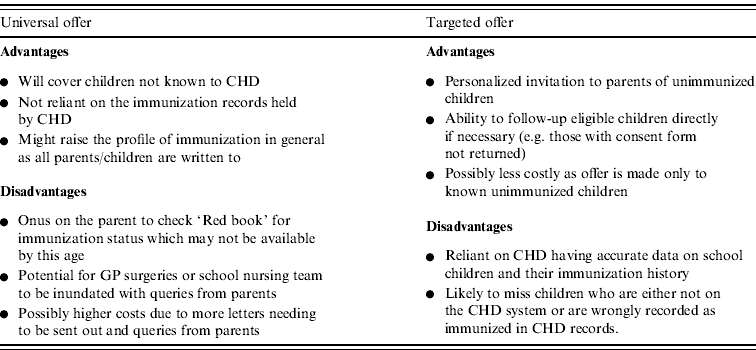
CHD, Child Health Department.
A universal offer of MMR with teenage booster vaccination was implemented in Haringey in 2006. It was reported that 43% of eligible children received a dose of MMR along with teenage booster vaccination [Reference Lashkari and El Bashir5].
Offering MMR vaccination to eligible children at the time of the human papilloma virus (HPV) vaccination programme was considered but discounted in this instance because only girls are currently offered HPV vaccination in the UK. However, since HPV vaccination is a three-dose schedule and therefore provides more opportunities to complete the two-dose MMR course, it might be worth exploring whether MMR vaccine could be opportunistically offered along with the HPV vaccination programme to unimmunized girls with the possibility of including boys where accurate information on immunization status is available.
In this campaign, only 14 out of 316 children turned out to have been fully vaccinated in the past and only three children were not attending Swindon schools, confirming that the Swindon CHD data were reasonably accurate. It is possible that a proportion of those who did not take up the MMR offer were in fact vaccinated fully in the past and hence did not respond to the invitation.
The 153 (51%) children who did not take up the offer of MMR vaccination are likely to include two groups – one, those who are fully immunized but with inaccurate CHD records (data quality issue) and two, the genuine non-consenting unimmunized group. In future, it would be prudent to ask all parents to return the informed consent form to judge whether non-uptake is due to prior vaccination or active refusal. The consent forms could be redesigned to collect information on dates of previous vaccination so that CHD records can be updated and data quality improved. Active follow-up of non-respondents by the school nursing team is also likely to be beneficial but would require consideration of resource implications. A named school nurse immunization coordinator providing leadership and coordination is important for improving uptake of all school-based immunization programmes. Involvement of the child's GP in alleviating any parental concerns by providing appropriate information and in offering opportunistic immunization during attendance at the Practice for other reasons might be helpful. For this to happen, it is essential that the GP has up-to-date records of the child's immunization status and a computer system that could flag up any missing immunizations at every contact with the child.
Further improvements in uptake require a deeper understanding of the barriers to immunization in schools. This may be achieved by either a questionnaire study or semi-structured interviews with parents who decline immunization. On completion of the programme, Td/IPV uptake in children with zero, one and two doses of MMR was 63·8%, 68·9% and 97%, respectively. This suggests that children who did not receive two doses of MMR vaccination were likely to miss other vaccinations as well.
MMR vaccination rates in Swindon in the last decade have been slightly lower than the national average, with the current uptake at 88·2% for the first dose at 2 years and 83% for the second dose at 5 years in 2010/2011. Following the CMO's recommendation, a Locally Enhanced Scheme (LES) was implemented in Swindon between September 2008 and March 2009 for General Practices to proactively contact parents of unimmunized children and offer MMR accordingly. A subsequent audit showed that MMR uptake was poor with only 7% of eligible children vaccinated in this period. Some GPs reported that despite repeated invitation letters and phone calls, uptake remained poor and this might be due to the inability of parents and/or their children to take time off to attend the GP surgery for vaccination. This further reinforces the need to use school-based campaigns to catch-up children more efficiently.
Additional costs for implementing this opportunistic MMR campaign within the teenage booster programme were estimated at £1400 for vaccinating 149 children. This equates to ~£9.50 per child vaccinated with a dose of MMR. As this was the first year MMR was offered as part of the school vaccination campaign, costs are likely to come down in the future.
In this programme, only one dose of MMR was offered by the school nurses and a letter was sent to the GPs of all immunized children in July 2011. The GPs of the 60 children who received the first dose of MMR were advised to invite the child for an appointment to have the second dose at the surgery. It is too early to evaluate the effectiveness of GP follow-up for the second dose of MMR in this cohort but it would be worth studying after a gap of a few months. If there is poor or sub-optimal uptake for the second dose at the GP surgery, it might be cheaper and more effective for the school nursing team to offer the second dose of MMR for this group separately from the teenage booster vaccination programme.
Following the successful implementation in Swindon in 2010/2011, this initiative is now fully embedded within the routine school nursing service specification for future years.
CONCLUSIONS
The valuable uptake achieved in this programme demonstrates that an opportunistic offer of MMR vaccination to unimmunized children at schools is feasible, affordable and beneficial. We recommend that MMR vaccination should be offered routinely to all unimmunized children at the time of school vaccination programmes, especially in areas with sub-optimal MMR coverage in recent years.
ACKNOWLEDGEMENTS
The authors gratefully acknowledge the work of colleagues in the school nursing team, the Swindon Child Health Department and integrated service managers in Swindon Borough Council in delivering this programme. We also thank Dr Noel McCarthy for providing critical comments on an earlier version of the manuscript.
DECLARATION OF INTEREST
None.



