





Introduction
Multidrug-resistant organisms (MDROs) pose a serious threat to public health by causing infections that are difficult to treat, increasing patient mortality and morbidity, and raising healthcare costs1,Reference Johnston, Thorpe, Jacob and Murphy2 . Some MDROs, such as carbapenem-resistant Enterobacterales (CRE), can colonize patients for months or years, allowing patients to serve as reservoirs capable of spreading these organisms during healthcare encountersReference Zimmerman, Assous, Bdolah-Abram, Lachish, Yinnon and Wiener-Well3–Reference Mo, Hernandez-Koutoucheva and Musicha6. Interfacility patient transfers between healthcare facilities pose a risk of spreading MDROs throughout a regionReference Barnes, Harris, Golden, Wasil and Furuno7–Reference Lapp, Octaria and O’Malley12. Therefore, the Centers for Disease Control and Prevention (CDC) recommends using historical transfer patterns from administrative data to guide the containment and prevention of novel and targeted MDROs.13
The association between transfer volumes and facility-level prevalence rates has been evaluated but primarily using patient transfer networks (PTNs) described using hospitalizations of all inpatients or specific payer beneficiaries (eg, fee-for-service Medicare)Reference Donker, Wallinga, Slack and Grundmann8–Reference Bower, Fridkin and Wolford11, rather than PTNs derived solely from hospitalizations of persons at high risk of MDRO colonization or infection. In these studies, increased transfer volume and number of hospital connections were associated with increased MDRO casesReference Donker, Wallinga, Slack and Grundmann8. Hospitalized patients colonized by CRE are more likely to have previous healthcare and medical device exposure, nursing home residence, and underlying medical conditions, which are more common in older patientsReference Bhargava, Hayakawa and Silverman14–Reference Kassem, Raed and Michael17. Therefore, PTNs derived from hospitalization of persons with risk factors for CRE colonization or infection may be more helpful in guiding MDRO containment and prevention than PTNs from less selected groups of patients.
Using Tennessee Department of Health (TDH) CRE and hospitalization data, we evaluated whether PTNs derived from inpatients with similar characteristics to CRE case-patients would be more comparable to a PTN of CRE-colonized or infected inpatients and provide a more accurate estimate of hospital CRE burden than PTNs derived from all inpatients or Medicare/TennCare beneficiaries.
Methods
CRE surrogates
Data Source for CRE Cases. To identify the characteristics that can be used to identify CRE surrogates in the general inpatient population, we analyzed the risk factors for subsequent hospitalization among CRE case patients in Tennessee. A CRE case was defined using the 2017 Council of State and Territorial Epidemiologists case definition, which included all positive specimens within a person’s life as one case18,19 . CRE is a reportable condition in Tennessee; demographic and microbiologic data are managed using the National Disease Surveillance System Base System (NBS). The risk factor analysis included CRE case-patients whose first CRE-positive culture collection dates were between July 1, 2015, and September 30, 2019.
Risk Factors for Subsequent Hospital Admission of CRE Case-patients. Information on healthcare exposures, underlying conditions, hospitalization details, and subsequent hospital admissions of CRE case-patients was gathered by linking patient identifiers from NBS to the Tennessee Hospital Discharge Data System (HDDS) and vital records. Patients hospitalized at their first culture-positive specimen collection date were considered inpatients, and those not hospitalized, including nursing home residents, were considered outpatients. Nursing home residence was identified using HDDS discharge status to a nursing home and by matching patient addresses to a nursing home address. Underlying conditions and healthcare exposure within 365 days before the first CRE-positive culture collection date were gathered using the International Classification of Diseases (ICD)-10 diagnostic and procedural codes, respectively.
Statistical Methods for Subsequent Hospital Admission Risk Factor Model. We used a Cox regression equation to evaluate risk factors for subsequent hospital admission among CRE case-patients within 365 days of discharge from the index hospitalization (patient’s first hospitalization with a CRE-positive culture) for inpatients or since the first CRE-positive culture collection date for outpatients. We evaluated whether the model equation should be stratified by the index hospitalization status, that is, inpatient and outpatient (Details in Supplementary Materials 1).
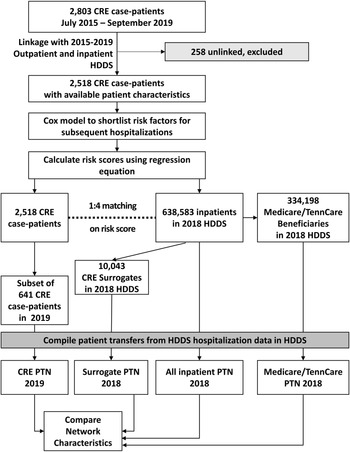
Identification of CRE Surrogates. To identify CRE surrogates among 2018 HDDS inpatients, we used the risk factors identified in the subsequent hospital admission risk factor models. Regression model equations were used to calculate subsequent hospital admission risk scores among 2018 HDDS inpatients and included CRE case patients to match cases with potential surrogates. Case patients were matched without replacement to surrogates in a 1:4 ratio based on age in years, sex, and subsequent hospital admission risk scores with a caliper 0.2 of the risk score distribution standard deviation. Figure 1 shows the study flow diagram and PTN construction.
Study flow diagram for carbapenem-resistant Enterobacterales cases in 2015–2019 and patient transfer network constructions in Tennessee, 2018-2019. Abbreviations: CRE, Carbapenem-resistant Enterobacterales; HDDS, Hospital Discharge Data System, PTN, patient transfer network.

Patient transfer networks
Data Source to Construct PTNs. Patient hospitalization and transfer data were compiled using the 2018–2019 inpatient HDDS, which recorded all hospitalizations during this period in Tennessee hospitals, including short-term acute care hospitals (ACHs), long-term ACHs (LTACHs), inpatient rehabilitation facilities (IRFs), critical access hospitals (CAHs), and psychiatric hospitals. Skilled nursing facilities (SNFs) were not included in the HDDS. Transfers to out-of-state hospitals were not captured in HDDS.
Compilation and Management of Network Data. Patient transfers were characterized as (1) direct transfers or hospitalization at a different hospital within one calendar day of discharge, and (2) indirect transfers or hospitalization at a different hospital after the patient was discharged and spent 2–365 days in the community. We summarized the number of transfers between all hospital pairs. We constructed direct and total (ie, direct + indirect) PTNs from CRE case-patients in 2019 and from three patient populations in the 2018 HDDS: CRE surrogates, all inpatients, and grouped Medicare (either Medicare fee-for-services or Advantage) and TennCare beneficiaries. TennCare, Tennessee’s Medicaid program, primarily serves low-income elderly individuals, those with disabilities, children, and women. Approximately 20% of TennCare beneficiaries are eligible for Medicare20. Transfer data from administrative datasets are typically available after the calendar year, sometimes with significant delays21. The CRE case-patient network was constructed from 2019 data, whereas the non-CRE inpatient networks (all-inpatients, surrogates, and Medicare/TennCare beneficiaries) were constructed from 2018 data to reflect the use of transfer data from past years to contain real-time outbreaks in public health practice.
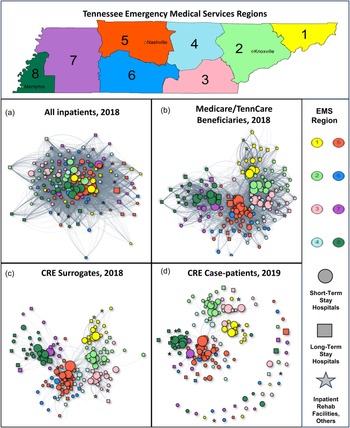
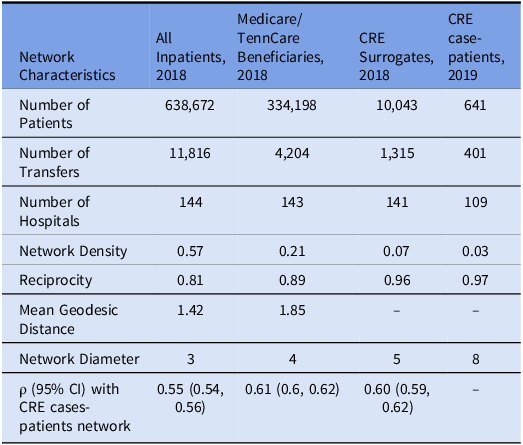
Direct Comparisons of Network Structure. We compared whole network structures and metrics of CRE case-patients’ total PTNs with total PTNs for all inpatients, Medicare/TennCare beneficiaries, and CRE surrogates to assess their suitability for estimating hospital-level CRE burden. We compared the structure and clustering in the network diagrams (Figure 2) and transfer distributions by conducting Pearson correlation tests on the transfer edgelists (ie, the number of patients transferred between each pair of sending and receiving hospitals). Additionally, we compared multiple whole-network metrics defined in Table 1 between PTNs.
Tennessee emergency medical services and the structural comparison of patient transfer networks derived from different inpatient populations, 2018 and 2019. Note: Tennessee Hospital Discharge Data System data within 365 days, including (a) all inpatients in the 2018 Hospital Discharge Data System (HDDS), (b) Medicare/TennCare beneficiaries in the 2018 HDDS, (c) carbapenem-resistant Enterobacterales (CRE) Surrogates in the 2018 HDDS, and (d) patients with CRE infections in 2019. Each node represents one hospital, and the thickness of the connections between the nodes represents the magnitude of patient transfers. The colors of the nodes correspond to the emergency medical service regions where the hospital is located. The shape of the nodes represents the hospital type. Network diagrams were drawn using the Fruchterman-Reingold algorithmReference Hansen, Shneiderman, Smith and Himelboim38.

Whole network measures and hospital-level centrality measures definitions

Note. The definition of network metrics is paraphrased from Jackson’s Social and Economic Networks, First Edition and adapted for interfacility patient transfer network.Reference Jackson37
Statistical Models to Assess Hospital-Level Connectedness and CRE Burden. We used multivariable negative binomial regression models with log transformation to evaluate the association between hospital connectedness metrics, generally referred to as centrality measures in network science, and hospital-level numbers of CRE events, henceforth referred to as the hospital CRE model. The primary centrality measure was weighted in degrees, representing the number of patients transferred to each hospital. Each CRE event represented a patient with a CRE-positive culture during hospitalization at that facility. Multiple positive CRE specimens obtained during the same hospitalization were considered as one event. If a patient tested positive at multiple hospitals in 2019, each hospitalization was considered an event.
The hospital CRE model evaluated the weighted in-degree using raw and transformed values to obtain a model with the best fit, defined by the lowest Akaike Information Criterion (AIC). Potential confounders were evaluated using a priori knowledge of the risk factors for increased CRE hospital burden (Supplementary Materials, Figure S1). The resulting model was a negative binomial with log2-weighted in-degree as the primary exposure and hospital-level numbers of CRE events as the outcome, offset by hospital patient days. The prevalence rate ratio from the base-two log transformation can be interpreted as the change in the rate of CRE events for each doubling of centrality measuresReference Feng, Wang and Lu22,23 . We then evaluated the performance of other commonly used centrality measures (defined in Table 1) instead of the weighted in-degree in the CRE hospital model, using the same log transformation and adjusted using the same confounders.
The statistical analyses were performed using R 4.0.4 (R Core Team, 2021). This study was approved with waived informed consent by the TDH Institutional Review Board§.
Results
CRE risk factor model and CRE surrogates
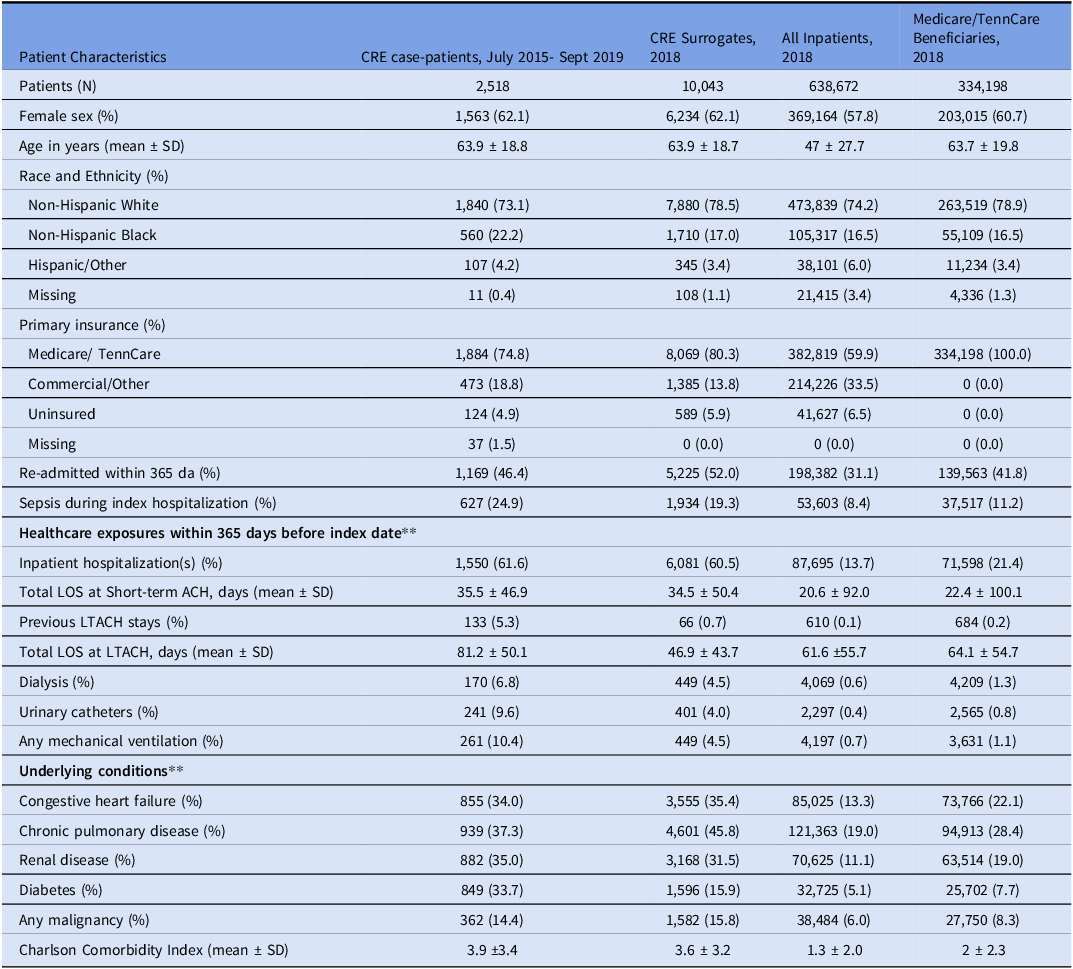
There are 2,803 CRE case-patients with CRE-positive cultures were collected between July 2015 and September 2019. Of these, 45 (1.6%) were identified from positive rectal swab cultures, likely representing surveillance cultures, whereas the remaining 2,758 (98.4%) were identified from clinical cultures. Nearly 90% (n = 2,518) of CRE case-patients had at least one hospitalization during the study period and were included in the risk factor model. Among 2,518 case-patients with at least one hospitalization during the study period, the mean age was 63.9 (SD 18.8) years, 1,564 (62.1%) were female, and 1,550 (61.6%) had ≥1 inpatient hospitalization in the previous 365 days (Table 2).
Characteristics of carbapenem-resistant Enterobacterales (CRE) case-patients in 2015–2019, CRE surrogates, all inpatients, and Medicare/TennCare beneficiaries in Tennessee hospital discharge data in 2018

Abbreviations: SD, standard deviation; LOS, length of stay; Short-term ACHs, Short-Term Acute Care Hospitals; LTACHs, Long-Term Acute Care Hospitals; SNF, skilled nursing facilities.
** Healthcare exposures were quantified within the previous 365 days of the first specimen collection date for CRE case-patients infections/colonization and from the initial admission date of CRE surrogates and inpatient HDDS population.
The CRE risk factor model selected eight risk factors to identify surrogates, including prior hospitalizations within 365 days before the initial positive culture, a higher Deyo-Charlson Comorbidity IndexReference Ladha, Zhao and Quraishi24, a history of chronic lung disease, sepsis during the index hospitalization, having private insurance, length of stay (LOS) in LTACHs, LOS in short-term ACHs, and presence of a urinary catheter within the previous 365 days (detailed model results in Table S2). The matching process of 2,518 CRE case-patients using these risk factors resulted in 10,069 CRE surrogates from the 2018 HDDS. The surrogates had the same age and sex distributions as CRE case-patients and comparable distributions of the included risk factors. The proportion of surrogates who had subsequent hospitalization within 365 days was higher than that of CRE case-patients (52.0% vs 46.4%) (Table 2).
Patient transfer networks
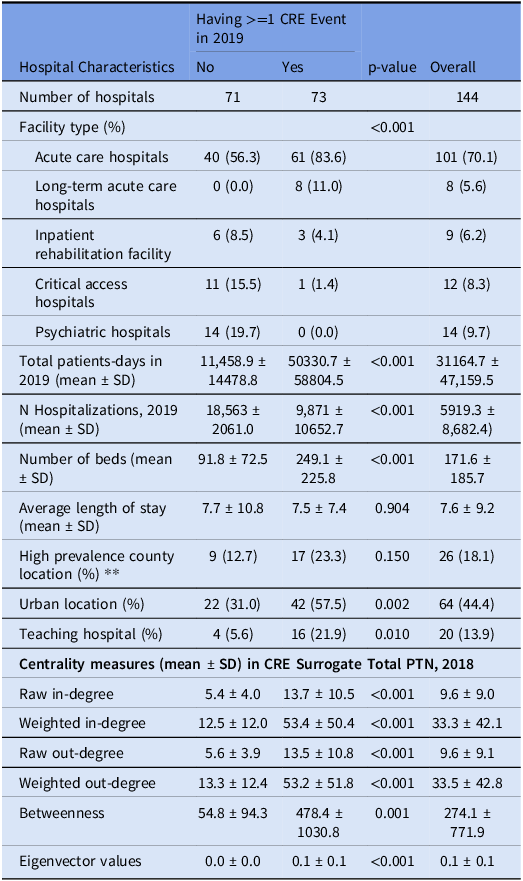
The total PTN from all inpatients (n = 638,583) within the 2018 HDDS dataset included all 144 Tennessee hospitals, including 101 (70.1%) short-term ACHs, 8 (5.6%) LTACHs, 9 (8.3%) IRFs, 12 (8.3%) CAHs, and 14 (9.7%) psychiatric hospitals. Among the 731 CRE cases in 2019, 88.0% (n = 641) were hospitalized and their total transfers connected 109 (76.0%) hospitals. Seventy-three (50.7%) hospitals reported ≥1 CRE event in 2019, including all 8 LTACHs. Hospitals with CRE events were more connected to other hospitals in the network, demonstrated by having higher centrality measures, including raw and weighted in-degree and out-degree, betweenness, and eigenvector, than hospitals without CRE events (all P < .05) (Table 3).
Tennessee hospital characteristics and centrality measures of hospitals in the carbapenem-resistant Enterobacterales (CRE) surrogate total patient transfer network, 2018

* Patient-days is the sum of all hospitalization lengths of stays in the hospital in 2018. Categorical variables are displayed as counts (%) and continuous variables are presented as means (standard deviation).
** The Tennessee Department of Health operationally defined “high prevalence county” as two counties with increased CRE incidence during the study period.
P-values between groups were calculated using the t-test for continuous variables and the chi-square test for categorical variables.
The CRE surrogate total PTN connected 141 of the 144 Tennessee hospitals. The CRE surrogate network diagram and whole network metrics closely resemble the CRE PTN. The characteristics of all-inpatient and Medicare/TennCare PTNs differed from those of surrogate and CRE PTNs. The density of all-inpatient PTN was 0.57, indicating that out of all possible one-way connections between 144 hospitals (144 × 143 = 20,592), 11,737 (57%) were connected by at least one transfer. CRE and surrogate PTNs had comparably low densities. The CRE PTN had a moderate correlation with the surrogate PTN (ρ = 0.60) and Medicare/TennCare PTN (ρ = 0.61), but a lower correlation with the all-inpatient PTN (ρ = 0.55) (Table 4).
Whole network comparisons between transfer networks of Tennessee hospitals

Abbreviations: CRE, Carbapenem-Resistant Enterobacterales; 95% CI, 95% Confidence interval.
Note: Network characteristics were calculated using the ‘statnet’ package in R specified for weighted directed networks. The definitions of these measures are presented in Table 1.
*The correlation coefficients (ρ) and 95% confidence intervals between the edgelists from all-inpatient, Medicare/TennCare, and surrogate networks and the CRE patient network were estimated using Pearson’s correlation.
CRE PTN had a clustering pattern similar to that of Medicare/TennCare and surrogate PTNs. Highly connected hospitals, embedded in the center of a network diagram in the Fruchterman-Reingold layout, primarily consisted of large ACHs in Emergency Medical Services (EMS) region 5 (Nashville Metropolitan Area). Facilities in adjacent EMS regions were more connected to each other than those that were geographically farther away (Figure 2).
Hospital CRE model
The adjusted rate ratio (aRR) for the association between log2-weighted in-degree and hospital-level CRE rate was highest for CRE surrogate PTN (aRR 1.33, 95% CI 1.13,1.59), adjusted for hospital size, type, academic affiliation, and urban location. This model also had the best fit (lowest AIC of 542.41) compared with the model with weighted in-degree from other PTNs. Among the various centrality measures in the CRE surrogate PTN, weighted in-degree had the best fit and the most robust association with CRE prevalence (Table 5).
Comparison of prevalence rate ratios for weighted In-degree in CRE surrogates network with other networks and other centrality measures in Tennessee, 2018

Abbreviations: AIC, Akaike Information Criterion; CI, Confidence Interval; CRE, Carbapenem-Resistant Enterobacterales.
Definitions: Indegree, the number of hospitals sending incoming transfers to each hospital; weighted-in degree, the number of incoming transfers from any hospital; out-degree, the number of hospitals receiving transfers from each hospital; betweenness, the number of times each hospital serves as the shortest path to connect two other hospitals; eigenvector, a measure of how central the hospital is relative to all other hospitals in the network1.
* Wald P < 0.05 of the centrality measures.
Note. All adjusted prevalence rate ratios were estimated using a multivariable model with the outcome of the number of CRE cases and adjusted for urban location, long-term acute care hospital type, and academic affiliation. The model used an offset of log 1,000 patient-days.
Discussion
Our study demonstrated that the transfer patterns of the CRE surrogates better reflected the transfer pattern of CRE case-patients compared to the all-inpatient population. The number of patients transferred into each facility (weighted in-degree) had the strongest association with the number of CRE cases in the surrogate network compared with all-inpatient and Medicare/TennCare beneficiary networks, even after adjustment for facility characteristics. Understanding the transfer patterns of patients with characteristics similar to those of CRE case-patients can facilitate the identification of facilities at higher risk of CRE transmissions or importation. This information could guide public health interventions, such as prioritizing the implementation of MDRO screening in highly connected facilities.
The use of CRE surrogate network was previously demonstrated by Wolford et al., who constructed networks of New York ACHs from CRE surrogates, defined as inpatients with sepsis, selected comorbidities, and prolonged hospital staysReference Wolford, O’Hagan and Paul25. Their surrogate network was strongly correlated (ρ = 0.81) with hospitalized CRE cases from the National Healthcare Safety Network. Our study included outpatients and inpatients with CRE from all hospital types. The lower correlation of our CRE surrogate network (ρ = 0.60) compared with Wolford et al. may be explained by our inclusion of CRE case-patients with less severe clinical infections like urinary tract infections, which were more representative of patients contributing to regional CRE spread.
Our results suggest that a two-fold increase in incoming transfers of patients with similar characteristics to CRE case-patients was associated with a 33% increase in the hospital’s CRE rates in the following year. This finding has practical implications for hospitals of various sizes. We included small hospitals with as few as 500 annual admissions and large academic hospitals with more than 50,000 admissions. To illustrate utility, an additional incoming transfer (non-transformed weighted in-degree) of a high-risk individual would be meaningful to a smaller hospital. A minor increase in the absolute number of transfers to smaller hospitals could be clinically significant and warrant improved infection prevention and control (IPC) awareness to mitigate CRE transmission. However, this additional transfer would be less sequential for large hospitals. A doubling of incoming transfers reflects a potential scenario impacting the MDRO burden for both hospital sizes.
Increases in incoming transfers of patients at a higher risk of CRE acquisition can occur due to increased transfer volumes or changes in patient population makeup. Tennessee hospitals received an average of 1,666 indirect transfers (0–14,309) in 2018. A doubling of transfers of patients at a higher risk of CRE acquisition may represent a growth in hospital market share. However, a sudden increase in hospitalizations or an increased proportion of patients highly susceptible to CRE could result from a sudden increase in hospitalization volumes, such as during surges in COVID-19, which were associated with an increased MDRO incidenceReference Weiner-Lastinger, Pattabiraman and Konnor26–Reference French, Hulse and Nguyen28. Hospitals with increased incoming transfers could be at a higher risk of MDRO outbreaks, especially when an increase in IPC capacity does not accompany an increase in hospitalizations.
Our networks link hospitals through direct and indirect transfers with ≤365 days in the community. Hospital staff often do not consider indirectly transferred patients as transfers or include them in the facility’s MDRO admission screening policy. Indirect transfers pose the risk of CRE introduction into a hospitalReference Bower, Fridkin and Wolford11,Reference Ray, Lin and Tang29,Reference Slayton, Toth and Lee30 . Our findings suggest that considering a patient’s healthcare exposure history to determine MDRO screening during hospital admission may be helpful. The CDC recommends interfacility communication among hospitals regarding previous MDRO cases to prevent MDRO transmissions13. Admission screening of patients with higher risk of MDRO acquisition may help facilitate more rapid and complete implementation of MDRO prevention measures.
Identification of facilities that should consider implementing MDRO screenings, including periodic prevalence surveys and admission screenings, is currently guided by PTNs constructed from all inpatients or fee-for-service Medicare beneficiariesReference Bhargava, Hayakawa and Silverman14,Reference Cincotta, Walters and Ham31,Reference Octaria, Cincotta and Healy32 . Current recommendations prioritize influential or highly connected facilities based on historical transfer patterns for MDRO screening and enhanced infection controlReference Bhargava, Hayakawa and Silverman14. Our study demonstrated the added value of using a CRE surrogate network for public health agencies to identify these facilities since the transfers of surrogates are more representative of the transfer patterns of actual CRE patients and may result in more efficient, focused screening. Our previous work included the development of an interactive dashboard using all-inpatient PTN to identify potential downstream transmission when a rare MDRO was detected in an index facilityReference Lee, Bartsch and Wong33. This CRE surrogate network can be used similarly, especially when a concerning CRE is identified in a facility.
Our study has several strengths. We used a statistical and epidemiological approach to create a CRE surrogate population to maximize the correlation between historical transfer data and current hospital-level CRE burden. We also demonstrated the relative performance of other commonly used patient populations in assessing hospital-level CRE risks. Medicare/TennCare PTN characteristics were similar to those of CRE surrogate PTN. However, the performance of Medicare/TennCare PTN weighted in-degree was slightly inferior to that of the CRE surrogate network. Nevertheless, state and local public health can access Medicare beneficiary PTN data through a CDC-developed interactive, limited-access web application to guide preventive and containment activitiesReference Octaria, Cincotta and Healy32.
Our results should be interpreted with caution. First, we mainly included CRE cases with positive clinical cultures, while CRE colonization has been documented to outweigh clinical infections at an 8:1 ratioReference Lee, Bartsch and Wong33. Longitudinal colonization screening results during non-outbreak conditions may provide more realistic estimates of the facility-level CRE burdenReference Mckinnell, Singh and Miller34,35 . We did not include long-term care facilities (LTCFs), including ventilator-capable skilled nursing facilities (vSNFs), which carry a significant CRE burdenReference Mckinnell, Singh and Miller34. Therefore, our results cannot be generalized to LTCFs and may undermine the risks of increased CRE prevalence in hospitals receiving large transfers from LTCFs. PTN structures and MDRO epidemiology may differ between states. Therefore, our findings may not be generalizable to other states and regions. Finally, transfer networks may be affected by potential changes in transfer patterns from facility ownership or insurance network changes, and the impact of the COVID-19 pandemic. Smaller hospitals, especially in rural areas, reported difficulty in referring patients to tertiary medical centers due to bed shortages during COVID-19 surges. Interregional transfers to mitigate bed shortages have been frequently reported, and the mean transfer distances between facilities have increased by 23–352 milesReference Michelson, Rees and Sarathy36. We should explore the impact of potential changes in PTNs on MDRO burden.
In conclusion, using a CRE surrogate PTN as proxy for CRE PTN provides a more accurate basis for implementing IPC measures than general inpatient PTN. Healthcare facilities and public health officials can prevent MDRO spread by improving interfacility communication, focused screening of patients at higher risk for MDROs, and implementing appropriate IPC.
Supplementary material
The supplementary material for this article can be found at https://doi.org/10.1017/ice.2025.86
Acknowledgements
We thank the Vanderbilt University Epidemiology PhD Program for supporting this project, and the Tennessee Department for surveillance data collection, management, and support. The authors thank the following individuals for their contributions: Prabasaj Paul, Hannah Wolford, Matthew Estes, Kristina McClanahan, and Carolyn Stover.
Author contributions
RO, AC, and MAK contributed to the design and implementation of the research, while RO, AK, RBS, PT, SD, JCS, and PFR contributed to the analysis of the results and the writing of the manuscript. MAK and PT conceived the original and supervised the project.
Financial support
The Tennessee CDC Emerging Infections Program and Vanderbilt University supported this study (Grant # 5 NU50CK000491-03-00).
Competing interests
All authors have completed the International Committee of Medical Journal Editors to disclose potential conflicts of interest. Dr. Kainer reports grants and non-financial support from the Centers for Disease Control and Prevention during the conduct of the study; personal fees and non-financial support from the Infectious Disease Consulting Corporation, personal fees and non-financial support from Pfizer, and personal fees from Gilead outside the submitted work; Dr. Rebeiro reports personal fees from Gilead, personal fees from Johnson & Johnson, and grants from NIH/NIAID outside the submitted work.
Disclaimer
The findings and conclusions of this study are those of the authors and do not necessarily represent the official position of the Tennessee Department of Health or the Centers for Disease Control and Prevention.



 Open access

