




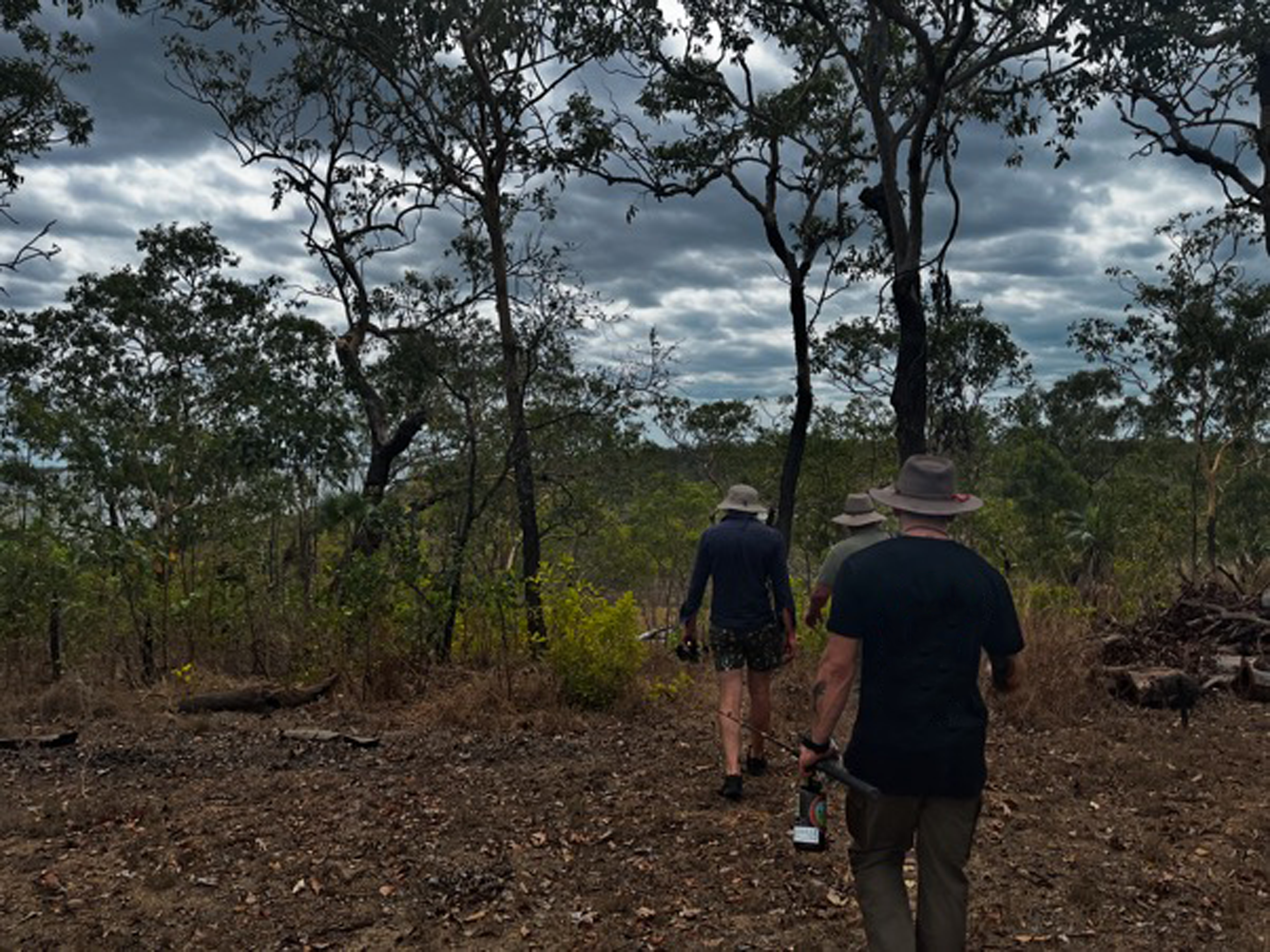
Sweat stung my eyes. My hat felt hot and heavy on my head. Dust from pavers, sausage grease and bait were smeared across my skin and clothing. I probably stunk, but I couldn’t smell it. The air was thick and salty, and the vista was impressive. We walked away from Uncle Bernie’s donga, trying to find a track down to the beach (Figure. 1). “Watch out for those crocs, eeyy. They’ll get ya! The stories we told you blokes aren’t just stories! Hahahaha,” bellowed Uncle Bernie as we walked towards the beach, fishing rods in hands. I kept forcing myself to look at my feet and not out across the turquoise water of Bynoe Harbour – Bakamungie Footnote 1. It was a privilege to be out here, on Larrakia homelands (the Kenbi Land Claim on the Cox Peninsula). We had just spent a few hours with Lachie’s Uncles doing some paving, sharing lunch and hearing lots of stories about Dungalaba (the saltwater crocodile). They were characters larger than life (both the uncles and the crocs!).
Scott J
The research team walking on Larrakia Country.

Figure 1 Long description
Three individuals wearing hats and casual clothing walk along a dirt path in a forested area. The sky is overcast with dark clouds, suggesting an impending storm. The terrain is uneven with scattered logs and dry vegetation. The trees are tall with sparse foliage, and the bushes are dense and green.
Thought ritual: why stories matter
In this article, we focus on the Indigenous research methods of thought ritual (Yunkaporta & Moodie, Reference Yunkaporta, Moodie, McKenna and Onesta2021) and storying (Phillips et al., Reference Phillips, Bunda and Quintero2018) which we introduce in more detail shortly. Thought ritual is an emergent process that combine traditions of Indigenous inquiry and ritualised knowledge production with contemporary theory and practice involving complexity theory and thought experiment (Menzel & Yunkaporta, Reference Menzel and Yunkaporta2022). Storying is making and remaking meaning through dynamic and adaptive processes (Phillips et al., Reference Phillips, Bunda and Quintero2018). Each of these methods helps us to explore and understand potential contributions by the Larrakia people, the traditional owners of Darwin (Garramilla in Larrakia Gulumoerrgin) and surrounding areas, to education about living alongside crocodiles in the Northern Territory (NT), Australia. The stories we include throughout this article help to situate us as researchers, both Indigenous and non-Indigenous, on the doctoral project of Larrakia fella, and former NT park ranger and zookeeper, Lachie. At the time of the NT visit we discuss in this article, the team involved in the project consisted of Lachie and two supervisors, one of whom (Scott A) is Indigenous. In October 2024, as Lachie commenced his PhD, the team was invited by Lachie’s family to visit Bakamungie on Larrakia Country, meet Lachie’s mob, sit down, yarn, “be” in the place and follow protocols for gaining permission for conducting research on Country. Across a full week we listened to stories. We heard stories of crocodiles and crazy adventures in food courts over coffee and muffins, and chuckling stories of near misses with Dungalaba (the Larrakia word for crocodile) in quiet reflection in the dark at Bakamungie. That week revealed to us the importance of story to Larrakia knowledge, its role in knowledge bound by relationships and obligations, and how the telling of stories involves both the transfer and creation of knowledge.
Broadly speaking, this research project is about exploring human-crocodile relationships from Indigenous perspectives, considering how Indigenous voices and methods can inform public education programmes in the NT. We are acutely aware of our diverse positionality as a team of Indigenous and non-Indigenous researchers with different experiences and backgrounds. We pause to outline our positionality relevant to this study.
Lachie – I am of Larrakia heritage and Scottish descent, whose totem is Dungalaba (Saltwater Crocodile) but grew up on Central Arrernte Country. I live on Djaara Country and pay my respects to their Elders and to Country. I do not write alone, though. I am here with the Scott A, Scott J and Stefan, my PhD supervisors, and co-researchers on this project.
Scott A – I am an Indigenous man of Gundungurra and Kamilaroi descent. My father’s Chilean migrant heritage can be seen in my surname. Like Lachie, I live on Djaara Country and have learnt from generous cultural sharing over many years. Visiting Larrakia Country is part of my lifetime of cultural learning, and I undertake this research with deep respect for cultural sovereignty and exchange.
Scott J – I am a non-Indigenous man who was born, lives, and works on unceded Bunurong/Boonwurrung Country. I do not share the ancestral ties to this land held by my Indigenous colleagues, yet I strive to recognise and respect their deep and ongoing connection to Country. Through my work and life, I endeavour to develop my own respectful relationship with this land.
Stefan – I am of German and Spanish-Moroccan Jewish extraction. My family came to Australia as economic migrants when I was six, settling in Barngarla Country (South Australia). I now live on Wurundjeri/Woiwurrung Country. I work closely with First Nations colleagues and students to deepen my understanding of Indigenous knowledges and cultures, including their intersection with my area of digital technologies, and to deploy this in the classes I teach.
In this article we investigate how thought ritual analysis can enhance approaches to educational research. Specifically, we deploy thought ritual to analyse our first visit to Larrakia Country for this research project. As we will reveal throughout this article, this first visit to Larrakia Country was immensely generative in development of relationships (both between researchers and Larrakia traditional owners, between researchers and Larrakia Country and amongst the research team). This article charts our learning process, framed through the method of thought ritual analysis, whilst offering some suggestions as to how it may contribute to future research.
In this work we seek to resist dominant colonial narratives and preference Indigenous practices and Indigenous voices. We do this by enacting Indigenous methods. We engage in a process of (re)storying (Riley, Reference Riley2023) to present our collective experiences held on Larrakia Country. The process of thought ritual was used throughout to analyse our experiences and time on Larrakia Country. We have learned that Larrakia people prioritise knowledge in the form of stories. We know that sharing these stories involves more than capture and retell. We share our experiences as a response to hearing the (re)telling of these stories, demonstrating respect through listening, paying close attention, and reflecting deeply on their meaning.
Why “storying”? Storying is an act of making and remaking meaning, of sharing and renewing. It is a dynamic, adaptive, relational process and differs from storytelling which we understand as a one-way “telling” (Briggs, Reference Briggs2023). In this way, the approach we used in this article differs from storytelling. While we recognise “storytelling” as a commonly used term, we focus on the concept of storying to help convey the dynamism of stories, and the importance of how to engage with them. Stories are experienced; they help us find our way along a similar path to the storyteller; a “something” that has been left behind for us to find (and/or learn).
Storying brings people together in a relational knowledge exchange through stories told and through active listening. It has been part of Indigenous culture for time immemorial and is part of an Indigenous-led resurgence in establishing authority for Indigenous knowledge and methods in academic research (Phillips et al., Reference Phillips, Bunda and Quintero2018; Poelina et al., Reference Poelina, Paradies, Wooltorton, Guimond, Jackson-Barrett and Blaise2023; Shay, Reference Shay2021). Engaging in storying requires an understanding that the process relies on relationships. We acknowledge that the storying in this work is carried in our relations with Larrakia, with Country and with each other (Yunkaporta, Reference Yunkaporta2023). Thus, this is what we aim to explore and offer in this article: an intent to bring Indigenous voices and ways of understanding to the fore, to highlight the importance of relationships (both between people and between people and Country) and the importance of taking the time to prioritise these relationships. By engaging with Indigenous knowledge practices, we demonstrate the generative potential of Indigenous methods for educational programmes and educational research. As we outline our intended contribution in this article, we aim to illustrate how thought ritual – as an Indigenous methodological process of analysis (Yunkaporta et al., Reference Yunkaporta, Moodie, McKenna and Onesta2021) – can provide educational researchers with tools for working towards socio-ecological justice.
Thought ritual is a hybrid method of analysis drawing on Indigenous oral knowledge and thought experiment. It is an approach that aligns with various Indigenous methodological traditions such as relational thinking, collaboratively held knowledge, interconnectedness and the acknowledgement of more-than-human agency. This approach helps by identifying the relational beings (agents, pairings) that are involved in knowledge transfer and the shared experiences that occur in stories of Larrakia Country. The method is comprised of four stages that highlight the practicality and adaptiveness of Indigenous knowledge transfer (Yunkaporta et al., Reference Yunkaporta, Moodie, McKenna and Onesta2021). Drawing upon Yunkaporta and Moodie (Reference Yunkaporta, Moodie, McKenna and Onesta2021, 89), the four non-linear and overlapping stages comprise:
• Connection: Identify the relational pairs of agents (participants), data points, variables etc. and the networks of pairs that they form, and the pairs of networks (i.e. different systems or data sets or thematic categories interacting), using visual modalities to express these relations.
• Diversity: Use narrative in collaboration with other participants to identify similarities, differences and areas of overlap between different variables, agents and data points.
• Interaction: Use oral culture metaphors and forms of expression to replicate the exchanges of energy, information or matter between the different agents, variables and data points in the field.
• Adaptation: Use supra-rational moments of ancestral connection to identify transformative feedback loops and chains of cause and effect in which data points change, attract change or interact with other data points to produce change events. Time is non-linear in this process, so the changes you perceive might be in past, present or future.
What are we analysing? What is the data?
Stories grew into part of our thinking process as researchers on this project – stories became part of our thought ritual. In this sense, stories might be considered the data of this article – the thing we think with. However, we want to highlight that stories as data do not profess to hold a fixed truth or aim to represent an essential fact “out there” in the world (Jukes, Reference Jukes2023). Data is a western term, politically laden, often imbued with enlightenment thinking and positivist research practices. In this article, we choose to think of data differently. For us, stories form part of the data generation. However, as Denzin (Reference Denzin2013) claims:
Language and speech do not mirror experience. They create experience and in the process transform and defer that which is being described. Meanings are always in motion, incomplete, partial contradictory. There can never be a final, accurate, complete representation of a thing, an utterance or an action. There are only different representations of different representations. (354)
From our view, Denzin’s point echoes Indigenous epistemologies, where data are not static but comprise a living system of knowledge (Martin, Reference Martin2017; Wright et al., Reference Wright, Lloyd, Suchet-Pearson, Burarrwanga, Tofa and Bawaka2012; Yunkaporta et al., Reference Yunkaporta, Moodie, McKenna and Onesta2021). To shape this point another way, knowledge grows, evolves, moves and shifts through relational exchanges. Or as Martin (2017) highlights, within an Indigenous worldview “all matter, including knowledge, has agency” (1393) and is relationally connected.
For us, Country, relationships, stories and knowledge come together dynamically, co-constituting data in our thought ritual process. Martin (Reference Martin2017) highlights that western traditions often separate “method (epistemology) and content (knowledge/ontology)” (p, 1393). We follow Martin in attempting to counter this separation, instead seeing the inseparable relationship between method and content (thought ritual and stories). As one of us has written elsewhere, “knowledge is not separate from the practices that produce it” (Jukes, Reference Jukes2023, 39). Such a stance “values the premise of lived experience as ontologically significant within research” (Martin, Reference Martin2017, 1395), countering notions of objectivity. In the context of this article, (re)storying experience is one of the practices that is both part of and helped produce the knowledge we have gained to this point in the project. In other words, stories become places of Country, while Country and its relationships fill stories, with knowledge situated within. In our case, we are (re)storying in various ways. We are not (re)storying Larrakia relationships with Dungalaba, though Lachie as a Larrakia fella will contribute to this work. This article focuses on the (re)storying of relationships of kin and Country and how we as a research team fit amongst these connections.
So what were our methods? After our trip to Garramilla, the first three authors decided to write stories (vignettes) of our time there to make meaning from our experiences for later analysis. We have engaged stories as a way to do this. The brief was simple; write vignettes sharing some of the insightful moments of being on Larrakia Country. We all wrote a series of these short stories, shared them amongst each other, read, re-read, and edited them. This prompted reflection and discussion about the moments shared by the research team, which by now included a third supervisor (non-Indigenous, and fourth author), who offered an outsider’s perspective on the shared stories. The reading of each other’s stories promoted consideration of connections (overlapping relational resonance) and also diversity (respect to differences). What you see shared throughout this article are selections of our stories from Larrakia Country which help show both the context of our research and connection and diversity of thought ritual.
Who are we? Relational connectivity
Our use of thought ritual is emergent and evolving as this doctoral project develops; this article provides an insight into our process at this stage, with further changes and developments likely. We offer this article as an insight into our ongoing experimentation with Yunkaporta and Moodie’s (Reference Yunkaporta, Moodie, McKenna and Onesta2021) articulation of thought ritual.
The use of stories demands a shift where we have foregrounded method over literature to begin. Further, we are deliberate in making changes in our writing based on epistemological necessity. Drawing on Indigenous authors and methods, we identify this “we.” Bawaka Country et al. (Reference Country, Wright, Suchet-Pearson, Lloyd, Burarrwanga, Ganambarr, Ganambarr-Stubbs, Ganambarr and Maymuru2015, Reference Country, Burarrwanga, Ganambarr-Stubbs, Ganambarr, Ganambarr, Maymuru, Wright, lloyd and Suchet-Pearson2024), Spillman et al. (Reference Spillman, Wilson, Nixon and McKinnon2023), Yunkaporta (Reference Yunkaporta2019), and Yunkaporta and Kelleher (Reference Yunkaporta and Kelleher2025) adapt their writing to reflect relational dependence not captured in conventional pronouns. Where the examples above adapt to language around I-in-relation “us-two,” “us-all” (Yunkaporta & Kelleher, Reference Yunkaporta and Kelleher2025, 5) we use the conventional “we,” recognising the complex relational ties that underpin its meaning. Relational approaches to knowledge demand the use of methods that express collective approaches and respect Larrakia and Country as authorities and knowledge holders. As Martin (2017) states, “Country informs people of their identity” (1396).
This project goes beyond me. While I am writing or talking it is more than myself speaking. It is my supervisors, my family, my participants, my ancestors, Country. When I write or talk about the methods I cannot write “I,” it needs to include the research team, and at times beyond them even; Larrakia.
LachieTurning to the literature, we outline the broader academic landscape to establish a foundation from which to approach the analysis. First, we outline the “crocodile problem.” This establishes the limitations in current thinking about crocodile education and management. We then identify potential contributions of Larrakia knowledge to the “problem” as part of future responses and how our use of thought ritual has helped us to clarify starting points in this thinking.
The “crocodile problem” is a “story problem”
Human interactions with estuarine crocodiles are often represented as an “issue” or “problem.” We understand the language of “problem” as limiting and produced by western, human-centric thinking. We use the term “problem” knowing its limits and frame alternative ways forward drawing on Indigenous ways of Being and Knowing. “Problem” framing occurs across the globe as a result of the increasing number of humans and crocodiles living in the same environments (Butler, Reference Butler, Webb and Whitehead1987; Fukuda, Reference Fukuda2024; Fukuda et al., Reference Fukuda, Manolis and Appel2014). Crocodile distribution is often influenced by human behaviours, for instance population distribution into crocodile habitat, recreation behaviours, and urban development. In Australia, ongoing protectionsFootnote 2 have increased crocodile numbers (Fukuda et al., Reference Fukuda, Manolis and Appel2014). During times of unregulated hunting, crocodiles showed wariness towards humans on account of past traumatic experiences (Webb & Messel, Reference Webb and Messel1979); however, Ligtermoet et al. (Reference Ligtermoet, Gumurdul, Nayinggul and Baker2023) explain that currently, younger saltwater crocodiles in the NT are known to be more brazen, as they lack the knowledge of past experiences of recognising humans as a danger.
Western responses to this “problem” produce methods of risk management and species conservation that reveal human-centric thinking. While practices such as trapping and re-release or wildlife exhibiting involve Indigenous participation, these are not reflective of Indigenous knowledge. “Problem crocodiles” are regularly shot or captured and placed in crocodile farms, with an inherent bias towards what is best for humans (Baker et al., Reference Baker, Campbell, Udyawer, Kopf and Campbell2024; Fukuda et al., Reference Fukuda, Webb, Manolis, Delaney, Letnic, Lindner and Whitehead2011, Reference Fukuda, Manolis and Appel2014; Ligtermoet et al., Reference Ligtermoet, Gumurdul, Nayinggul and Baker2023). Western approaches do little to engage with relational understandings of crocodiles as more-than-human kin (Ligtermoet et al., Reference Ligtermoet, Gumurdul, Nayinggul and Baker2023).
Research regarding crocodile education and management is similarly dominated by western approaches with little engagement with Traditional Knowledge holders for crocodile education and management (Ligtermoet et al., Reference Ligtermoet, Gumurdul, Nayinggul and Baker2023). Influential research focuses on human-centric approaches including limiting risk to humans with a focus on frequency of interactions with crocodiles (Fukuda et al., Reference Fukuda, Manolis and Appel2014; Webb et al., Reference Webb, Manolis, Whitehead, Webb and Whitehead1987) and crocodile movement and dispersal (Brien et al. Reference Brien, Gienger, Browne, Read, Joyce and Sullivan2017; Fukuda, Reference Fukuda2024, and Lloyd-Jones et al., Reference Lloyd‐Jones, Brien, Feutry, Lawrence, Beri, Booth, Coulson, Baylis, Villiers, Taplin and Westcott2023). This is often hand-in-hand with research examining crocodile removal and euthanasia (Peterson, Reference Peterson2019; Wallace et al., Reference Wallace, Leslie and Coulson2011), crocodile population control (Stirrat et al. Reference Stirrat, Lawson, Freeland and Morton2001; Fukuda et al., Reference Fukuda, Webb, Manolis, Delaney, Letnic, Lindner and Whitehead2011), and egg harvesting as income (Baker et al., Reference Baker, Campbell, Udyawer, Kopf and Campbell2024). There is also a branch of research that focuses on western notions of risk and a general concern for the nature of human-crocodile interactions (Brien et al., Reference Brien, Gienger, Browne, Read, Joyce and Sullivan2017; Fukuda et al., Reference Fukuda, Manolis and Appel2014). What is missing from the research literature is collaborative engagement with Traditional Owners regarding perspectives on interactions with saltwater crocodiles in the Top End. Engagement with Larrakia Traditional Owners is particularly pertinent, given Dungalaba is a totem species of Larrakia people.
There has been a time in the NT where crocodile-human coexistence was not defined by antagonism or fear. There are Larrakia stories of human-crocodile interaction that extend beyond human-centric focus, stories passed down by ancestors that tell of creation and law giving. Such an approach could reflect a mutually beneficial future (Saunders & Jukes, Reference Saunders and Jukes2025). Larrakia people know these stories – have lived these stories – with such re-storying having a veracity established through generations of teachings (Briggs, Reference Briggs2023). We follow this tradition and assert the importance of story as knowledge-making and transfer specific to developing crocodile-human relationships for healthy coexistence.
Hence, we draw attention to Larrakia stories of Dungalaba centred on lived experiences passed down through generations. The stories shared with us reflect some of the “issues” presented by the literature: the risks of a large population are understood as serious and increasing, and there are plenty of “cheeky crocodile” stories about fearless juveniles. And yet these stories are fundamentally different to the literature. A “cheeky” crocodile has agency. When literature refers to “biomass” and “carrying capacity” (Baker et al., Reference Baker, Campbell, Udyawer, Kopf and Campbell2024; Fukuda et al., Reference Fukuda, Webb, Manolis, Delaney, Letnic, Lindner and Whitehead2011), there is no agency. Old-man Croc who joins Uncle Johnny on the beach is to be respected as kin, even if strictly at a safe distance. These stories tell of relationships, and the agency of the crocodile.
We resist characterising Larrakia stories as singularly traditional, or overly simple with romanticised ideas of harmony or purity. These narratives have been part of damaging and restrictive colonial tropes that render Indigenous knowledge-holders as locked in time or lacking complexity. We acknowledge that Larrakia stories of the twenty-first century reflect a complex weaving of tradition and contemporary attitudes and needs. Further, our exploration at this early part of the research progresses knowing that there are various and differing views held within the Larrakia community.
Currently, these kinds of stories do not inform western approaches to education or management. This is mirrored in other settler societies where First Nations” knowledges have been sidelined. The reinstating of Indigenous authority in such spaces is reflected in joint management of waterways and forests (See for example: Carter et al., Reference Carter, Atkinson, Burchill, Phillips, Humann, Mahoney, Miles, Braid, Buissereth, Cowell, Hill, Huggins, Jackson, Raisbeck‐Brown, Talbot and Wong2022; Jardine et al., Reference Jardine, Reed, Strickert, Massie, McKay-Carriere, MacColl, Steelman and Wantzen2023; Poelina et al., Reference Poelina, Taylor and Perdrisat2019; Steffensen, Reference Steffensen2020). NT crocodile community education programmes sit within the NT Parks and Wildlife Commission (government agency) and are in a loose bureaucratic alignment with wildlife management. The anthropocentric framing is evident in both approaches, with little engagement with Larrakia knowledge. The same limitations of management strategies apply in education programmes; lack of meaningful and expansive engagement with Traditional Knowledge.
The fate of many wildlife populations, including crocodilians, is dependent on coexistence with people. Change in human behaviour may be the answer to long-term educational and conservation management plans (Ligtermoet et al., Reference Ligtermoet, Gumurdul, Nayinggul and Baker2023; Peterson, Reference Peterson2019; Wallace et al., Reference Wallace, Leslie and Coulson2011). The challenge is that the problem or issue is not understood in such a way as to be open to Indigenous approaches that include recognition of agency and the fundamental role of relationships.
Indigenous ways of Being and Knowing lead scholarship in centring Country and relationships. Poelina et al. (Reference Poelina, Wooltorton, Blaise, Aniere, Horwitz, White and Muecke2022, 398) and Poelina et al. (Reference Poelina, Perdrisat, Wooltorton and Mulligan2023) engage Country and stories to “connect, reconnect, heal and recreate linkages celebrated since the dawn of time.” The loss of interaction with Dungalaba or water on Country as a result of unregulated hunting has directly affected the knowledge transfer of customary crocodile relationships (Ligtermoet et al., Reference Ligtermoet, Gumurdul, Nayinggul and Baker2023). This knowledge includes customary obligations to saltwater crocodile and engagement with Country, relationships, and obligations of knowledge transfer. Responses to similar disruptions are gathering momentum across the continent. This is particularly important to environmental education as we navigate a complex future. The reauthorisation of Larrakia stories, traditional and contemporary, can contribute to expanding thinking toward education in light of the crocodile “problem.” The mechanisms of colonial extraction that disrupted knowledge transfer and brought the crocodile population to near-extinction can be challenged by those Larrakia stories that have persevered, along with those that have adapted and shifted with changing conditions.
Using thought ritual as analysis of time on Country and stories
We now engage thought ritual to make sense of our time on Larrakia Country. The stages of thought ritual are not strictly linear but can be engaged to help with sense-making in the analysis phase of research. While we refer to them as stages, we recognise the layer-like qualities that they possess. This helped to free our thinking into a more dynamic state not restricted by linearity or needing to find neat resolutions in order to continue.
The reflections we wrote became a key part of us locating ourselves in the web of connections and relationships we encountered. For Lachie, a Larrakia fella, this process was one part of a much larger set of connections to Country, family, traditions, and his totem. Much of this is not represented here. Our stories pick up the first steps in the doctoral research and contribute to the foundation of the larger body of work.
Connection
The principle of connection involves locating ourselves within a network of relations. We start with connection as it provides orientation to the importance and direction of stories and context. While western thought often has a habit of creating abstractions, the connections made through thought ritual allows us to attune ourselves to contextualised relationship building. This way of being draws out and emphasises complex networks of kinship and relational connections on Country that are often hidden, or slow to emerge. To access relational connections to Country, it is essential to spend time on Country. We met and spent time with Lachie’s family and heard about how everyone fitted together, who was related to whom, and how the family connected with other Larrakia families. We were told stories of Dungalaba and of the terrain. We heard about non-family and trespassers. As these unfolded over the week, we recognised that the stories held embedded connections. Where images or maps can be generated to make connections clear, in this case stories held the necessary information. Stories emerged as key to family knowledge-sharing and as a prime research method. Pairings of importance were identified as being Country-Larrakia, Country-Dungalaba, Larrakia-Dungalaba, Lachie and his father-Uncles, Uncles-researchers. The mapping becomes more complex when introducing ancestors or government policies, but thought ritual maintains coherence by thinking of the relations as pairings. Each part of the pair may have many dimensions and complexities but it retains the simple node.
I was excited when we headed off, we were going to a part of Bakamungie I had never been. I had explored Uncle Johnny’s place but never seen Uncle Bernie’s. He is up higher away from the water, while Uncle Johnny could walk out into the water. This got me thinking whether this was a deliberate choice. Uncle Johnny talks to the croc we all know as ‘Old-Man,’ plus he lives out there nearly fulltime too. Why did Uncle Bernie choose his spot so far away from the water? The view, or for protection?
LachieOur reflection stories are all mapping connections as subjective researchers, as sentient entities in the field. Critical for this study is the recognition of Country and Dungalaba as key agents and connectors as multiple pairs in a complex system. This is also consistent with the recognition of the importance of our more-than-human kin (Bishop, Reference Bishop2022). The purpose of emphasising these networks is to remind ourselves that we need to continue to recognise and respect the agency of each “actor” who engages in the co-production of knowledge on and with Larrakia Country (Wright et al., Reference Wright, Lloyd, Suchet-Pearson, Burarrwanga, Tofa and Bawaka2012). This foundational step may provide concrete starting points for Larrakia knowledge to influencing thinking on education programmes. The mapping of connections based on kinship and more-than-human agency provides a starting point that contrasts with the human-centred approach to programmes.
Diversity
Across the week we spent a few days being driven around by our generous guide and Larrakia man Dean Saunders, over river tracks, up creeks, and into lagoons to find croc traps. We stumbled across traps with stinking bait. We stumbled across croc tracks. Crocs were ever-present. Listening to Dean tell stories about close encounters and changing crocodile behaviours could have made me more nervous than when I started, but it didn’t. I found myself listening to his stories and listening to his familiarity with the places we were in and being reassured by that. I don’t think I was less vigilant in watching the water; every now and then I moved completely away for the fear, but in being there I was calmed by the stories. My fears were still present in varying degrees. The crocs were there in potential and reality. Listening to him recount his time on Country made me feel like it was gonna be okay. It didn’t remove the danger, but it was somehow soothed.
Scott AThe diversity principle involves a collaborative approach to telling stories of each element in the data set. This helps to “identify similarities, differences and overlaps between them” (Yunkaporta et al., Reference Yunkaporta, Moodie, McKenna and Onesta2021, p. 90). Travelling around with Lachie’s dad – all of us jammed in the HiLux – gave us time to story back and forth across the week. In telling his lifetime of stories and recounting our days of fear and excitement under his guidance, we were able to follow necessary protocols of thought ritual. This was consistent with the need to ensure collective analysis and avoid research production through individual processes.
The yarning taking place in the vehicle, and standing by the river, in walking Country and sitting around the fire, revealed the overlapping stages of diversity and interaction.
Interaction
We hit the sand and wandered north, got caught up in some mangroves and lost access to the water so looped back around towards the donga. We had spent the week so far talking about crocs and how people get distracted, become laisse faire or are just plain ignorant around water in the Top End. Lachie’s dad Dean made sure to stress the dangers of croc country. I found myself continually glancing towards the water’s edge, wondering how nervous or vigilant I needed to be. Being here, the subject of inquiry was not just academic, it was a lived reality. This was Larrakia Country, which is croc Country. As I’d come to learn, they could be right in front of me, and I wouldn’t see. Dean seemed comfortable though, so I followed his demeanour. As an outdoor-edder, I’ve spent a lot of time in the bush. I feel pretty adept at attuning to places and reading signs, at least in the places I regularly visit. But I’d not done much fishing nor spent much time in the Top End. I found myself conscious that I might not know the signs – the important things to look for and notice – so I watched the others whilst straining to consider every ripple, wondering if Dungalaba was lurking just beneath.
Scott JThe interaction stage of thought ritual follows a principle involving the flow and transfer of energy and information within the system of knowledge and data. Importantly, the stage involves the expression of oral cultural metaphors (Yunkaporta et al., Reference Yunkaporta, Moodie, McKenna and Onesta2021). In our case, this occurs as time on Country and storying, though it can involve cultural expression through weaving, journeying or further time on Country. It involved translating our data sets (time on Country, storying from yarns) into a further set of reflections and stories. The process is intended to facilitate deeper understandings and patterns. It is recognition of spirit-connection to the field. These stories were then shared amongst the team and with Dean (Lachie’s dad) and discussed as part of the collective analysis.
Adaptation
Our trip to Larrakia Country was the first step of a process that aligns with the thought ritual Adaptation stage, described by Yunkaporta and Moodie (Reference Yunkaporta, Moodie, McKenna and Onesta2021, p. 89) as using “supra-rational moments of ancestral connection to identify transformative feedback loops and chains of cause and effect in which data points change, attract change or interact with other data points to produce change events.” The trip was, for Lachie, the start of a process of reconnecting with family and Country, with attendant impacts downstream for what western conceptions of research practice call “data collection”: future visits to Larrakia Country that, post human ethics approval, will involve interviews with Lachie’s family and people involved in crocodile management. For the non-Larrakia researchers present, the trip initiated an ongoing process of attunement with a new way of working and being as researchers, including getting to know Larrakia Country by being immersed in it. A central element of this process for all has been the slow building of relationships, both to people and to Country, with stories as their primary conduit.
Pertinent to the broader study, thought ritual at this point made concrete the overt agency of the crocodile as more than human. The stories shared with us meant our own stories developed with Dungalaba as a potent agent. In this way, the stories we shared on the trip and those we wrote on reflection, started with a character exerting its physical and cultural presence. This occurred as the stages of thought ritual analysis guided our attention to focus on Country and Dungalaba as key agents, work with collaborative understandings to develop our knowledge, and to attune ourselves to the spiritual presence and force of crocodiles.
We have engaged these phases as a group, through yarning reflections, through storying our experiences and through reflections seeking patterns and overlaps in the narratives. This collective approach to analysis is part of the recognition that knowledge is only valid if it is generated beyond the individual; an inherently collective act of sense-making. It must occur in pairs or groups. Yarning is grounded in Indigenous protocols of communal knowledge production and exchange (Shay, Reference Shay2021; Yunkaporta et al., Reference Yunkaporta, Moodie, McKenna and Onesta2021).
Reinstating Indigenous knowledge
The approach to yarning, storying, and thought ritual analysis is an expression of our engagement with and commitment to Indigenous ways of knowing, being and doing (Burgess et al., Reference Burgess, Thorpe, Egan and Harwood2022; Poelina et al., Reference Poelina, Paradies, Wooltorton, Guimond, Jackson-Barrett and Blaise2023; Yunkaporta et al., Reference Yunkaporta, Moodie, McKenna and Onesta2021). Through using thought ritual, we are prioritising knowledge and methods brought to the project by Indigenous team members while actively de-colonising research practices and positions (Burgess et al., Reference Burgess, Thorpe, Egan and Harwood2022; Kelly et al., Reference Kelly, Marriott-Statham and Mackay2024; Yunkaporta et al., Reference Yunkaporta, Moodie, McKenna and Onesta2021).
This research is being held to a high standard through cultural traditions, the sharing of Larrakia stories over thousands of years generates an internal validity based on evident utility and spiritual connection entwined with customary behaviours. The stories persist over vast timeframes because they adhere to these criteria. The colonial disruptions to land, language and environment have interrupted some of this knowledge but not weakened its authority. The adaptability of Larrakia knowledge is evident in the newer stories emerging over the last century or so. While the older stories still exist, new stories have been generated through the culling and protection period of colonial crocodile management.
Storying and thought ritual: Relational thinking
Our engagement with storying and thought ritual enabled us to pursue an Indigenous methodology for this research. It also produced key insights for the use of thought ritual that can guide the broader research on crocodile education, as well as education research seeking to engage Indigenous knowledge.
The relational approaches of storying and thought ritual we used acknowledge that all beings have agency/autonomy. This process acknowledges more than just the story, through the telling and listening, narrative holds, transfers and generates knowledge. Yarning can ground the participants in their situatedness and prompt an examination of their positionality within a web of relationships. This orients them toward the co-creation of knowledge that is geared to the collective (Barcham, Reference Barcham2023; Yunkaporta et al., Reference Yunkaporta, Moodie, McKenna and Onesta2021). This approach honours the importance of storied knowledge exchange that has been utilised by Aboriginal people for the benefit of future generations.
The processes we engaged can inform how crocodile education programmes are conceived and delivered. It requires that crocodiles are elevated to more than biological or numerical quantities in “biomass” or “ecological niches”. Starting with relationality means crocodiles are understood as kin in a reciprocal relationship. Larrakia stories of Dungalaba reveal ways of relating that could shape education programmes from a foundation of respect and cooperation, rather than antagonism and fear.
This, of course, is not to challenge or remove the need to address serious risks of sharing spaces with crocodiles. We argue that the same goals can be achieved from a relational starting point. Indigenous knowledge and traditions do not dismiss risk, but it is reframed as part of a web of connections. We experienced a rapid shift in our thinking by focusing on these connections as part of thought ritual and became attuned to risk based on respect and relations.
We suggest that education research can be strengthened by considering thought ritual and storying methods. The benefits to this project have been to centre Indigenous knowledge and knowledge holders. The methods demanded we pay attention to process and framing to prioritise Indigenous voice and enable insights that reflected this. While we have yet to engage thought ritual in its full articulation and recognise that some cultural dimensions will be unattainable for non-Indigenous researchers, this first engagement has resulted in fidelity to our goals of centring Indigenous voices and revealed the potential to alter thinking through a relational orientation.
Complex thinking for complex problems
Storying and thought ritual have the capacity to activate Larrakia knowledge in the pursuit of improving crocodile education as cohabitation and population increases combine with unpredictable crocodile behaviours. Engaging through storying meant contemporary Larrakia stories, based on adaptations to living with Dungalaba on Country, reflect the dynamic circumstances of the broader “crocodile problem.” The methods can activate insights and approaches capable of responding to the many needs of human-crocodile cohabitation and inform western ideas of risk-management, policy, sustainability and education. In other words, this is complex thinking for complex problems.
This trip revealed that both methods outlined here take time. This is a necessary part of making connections. To map them without being on Larrakia Country and sitting by the fire is not consistent with the research context we pursued. This may not always be true for thought ritual as there are instances of this method being used without being on Country while still following relevant protocols (Kelly et al., Reference Kelly, Marriott-Statham and Mackay2024; Menzel & Yunkaporta, Reference Menzel and Yunkaporta2022). Storying, on the other hand, is not a fast process. To yarn, to listen, to reflect and do it all again, takes time. It is a method that rewards patience and being in-place.
Our Knowledge Will Forever Be Carried Forward in Our Stories…
It’s another hot and humid day, and our last day in Garramilla, we fly out tonight. What better way to spend the day in the CBD and then head to the artificial beach at the Waterfront for the arvo. I felt hesitant at first to enter the water, I doubted crocs would be in here, but you can never know. So, now I am standing shin deep in the water, both Scotts (A & J) lounging in the shallows. I’m thinking, ‘why am I the one second guessing, this is my Country, I grew up swimming in the Territory? ‘I’ve been gone for too long’.
With the two fellas enjoying the water, I decided to give in, I needed a refreshing dip, and since we swam in Berry Springs the day before, this couldn’t be any more dangerous, could it? Scott A thought out of all places, this had to be the safest, and though I did agree, it just felt hypocritical. I know I have seen and done dodgier things in and around the waterways of the Territory, but this current situation intrigued me. And while I did feel more on edge at Berry Springs and Bakamungie, right now in this current moment I was less inclined to take the risk.
LachieThe understandings that emerged from our trip suggest that it is advantageous to follow slow, time-immersing moments that may not directly answer all our questions. Despite this, Eurocentric connotations of time as a consumable commodity influence how we have engaged in this research. For example, one of our university’s required us to outline a rationale and expected outcomes for the trip (essentially justifying the “spending” of time). This acts as a reminder of the western undertones (and overtones) that shape our work, whilst striving for an anti-colonial praxis. We have come to understand that drawn-out moments, coupled with reflection, are an essential aspect of Indigenous knowledge generation. Such moments have been re-visited and turned over to prompt further insights and avenues of inquiry. Significant social and environmental changes have not altered the foundations of Larrakia’s relationship with Dungalaba (Saunders, Reference Saunders2023). Stories based on relationships are needed to assist with human adaptation to crocodile behaviour and population increase.
Storying and thought ritual have provided a foundation based on Indigenous methods and have revealed the potential of Indigenous knowledge to contribute to education research generally. Preferencing Larrakia knowledge can enrich current thinking and practices for building novel approaches to crocodile education to inform future management (Bishop & Tynan, Reference Bishop, Tynan, Sims, Engel, Hodge, Makuwira, Nakamura, Rigg, Salamanca and Yeophantong2022; Martin, Reference Martin2017). Moreover, we have discussed why these slow time-consuming moments are important, and that we cannot seek to understand this way of storytelling if we do not embed ourselves in and give ourselves to these moments (Bishop & Tynan, Reference Bishop, Tynan, Sims, Engel, Hodge, Makuwira, Nakamura, Rigg, Salamanca and Yeophantong2022; Martin, Reference Martin2017; Saunders, Reference Saunders2023).
Acknowledgements
The authors acknowledge the Traditional Owners of the Countries we are located on – The Dja Dja Wurrung, Bunurong/Boonwurrung and the Wurundjeri Woi-wurrung Peoples of the Kulin Nations. We recognise and honour the Elders, past and present.
Ethical statement
This research has been carried out in alignment with the AIATSIS Code of Ethics for Aboriginal and Torres Strait Islander Research in Australia.
Financial support
The Authors would like to declare that Lachlan Saunders receives funding from the Dennis McDermott Research Scholarship.
Competing interests
The authors declare that there are no competing interests regarding the publication of this paper. The authors would like to disclose that Dr Scott Jukes is an Associate Editor of The Australian Journal of Environmental Education (AJEE). In accordance with AJEE protocols, Dr Jukes was not involved in the editorial process or decision making regarding this manuscript.
Author Biographies
Lachlan D. Saunders. I am a Larrakia person from Darwin who has worked as a Zookeeper and Park Ranger in the Northern Territory for many years, as well as in Victoria, specialising in Crocodilians and Venomous Reptiles. I have also worked as an Outdoor Educator in both the Northern Territory and Victoria, having studied a Bachelor of Outdoor Education (Educational Nature Tourism) at La Trobe University, and a Bachelor of Arts (Humanities) (Honours) at Federation University. I am currently undertaking my Doctor of Philosophy at La Trobe University exploring How can centring First Nations storytelling around Estuarine Crocodiles improve education regarding more-than-human relationships.
Scott Alterator. I am an Indigenous man of Kamilaroi and Gandangara descent through my mother and bear my father’s Chilean migrant heritage in “Alterator.” I have mostly lived on Djaara Country in central Victoria where I taught in High Schools for 12 years before moving into academia. I am Associate Professor Indigenous Education and Head of Department, Social Equity and Inclusive Education in the School of Education at La Trobe University. I investigate decolonisation in education settings with a keen focus on the promotion of Indigenous Knowledge and the role of teachers and leaders.
Scott Jukes. I am a Senior Lecturer in Outdoor Environmental Education at Federation University Australia and member of the Centre for Regional Education Research and Development. He lives and works on Bunurong/Boonwurrung Country and pays his respect to Elders, past and present. He is drawn to the mountains and rivers of south-eastern Australia and enjoys thinking and teaching with these places. Scott’s research attempts to enact relational and post-anthropocentric approaches for rethinking educational contexts. He is the author of Learning to Confront Ecological Precarity: Engaging with More-than-human Worlds.
Stefan Schutt. I am a Senior Educator in Digital Learning Design at La Trobe University, on the lands of the Wurundjeri Woi-wurrung people. My research focuses on community technologies, with projects involving 3D simulations, online communities and augmented reality. I”ve worked with First Nations colleagues on a range of collaborative projects and am currently the only non-Indigenous member of Melbourne Polytechnic’s Aboriginal Advisory Group. I co-founded The Lab, a national network of technology clubs for autistic young people and was previously co-director of the Whittlesea Tech School, a STEM learning innovation centre established by the Victorian government. Before 2017 I led the Cultural Diversity, Technologies and Creativity programme within Victoria University’s Centre for Cultural Diversity and Wellbeing.

 Open access

