


1. Introduction
Design and research are increasingly conducted in an interdisciplinary fashion (Reference Kleinsmann and ValkenburgKleinsmann und Valkenburg 2008, S. 370). Through the combination of different sets of expertise, problems can be solved that are typically outside the reach of individual fields. At the same time, however, interdisciplinary work environments are particularly challenging. In addition to the well-known challenges of planning and coordinating complex projects, interdisciplinary projects have to be accomplished by individuals who do not share the same background knowledge. (Reference Feichtinger, Meixner, Rinker, Koren, Eichelberger and HeinemannFeichtinger et al. 2022) One particular consequence of this internal heterogeneity is the risk of communication failures – individuals do not comprehend each other.
Actors involved in collaborative design teams have to rely on communication to share and create knowledge (Reference Kleinsmann and ValkenburgKleinsmann and Valkenburg 2008). The knowledge shared can be both general or domain-specific and influences the design problem, the design process as well as the resulting design artifacts (Reference SummersSummers 2005). Given that multi- and cross-domain communication will be a core component of Advanced Systems Engineering in the future (Reference Dumitrescu, Albers, Riedel, Stark and GausemeierDumitrescu et al. 2021; Albers Reference Albers2023) understanding and fostering interdisciplinary communication is of great importance.
Especially, the comprehensibility of domain knowledge to other domains is a key challenge in interdisciplinary working environments (Reference Bracken and OughtonBracken und Oughton 2006; Reference Boix Mansilla, Lamont and SatoBoix Mansilla et al. 2016; Reference Bridle, Vrieling, Cardillo, Araya and HinojosaBridle et al. 2013; Donaldson et al. Reference Donaldson, Ward and Bradley2010; Reference Freeth and CanigliaFreeth und Caniglia 2020; Reference Villeneuve, Durán-Rodas, Ferri, Kuttler, Magelund and MögeleVilleneuve et al. 2020; Reference Feichtinger, Meixner, Rinker, Koren, Eichelberger and HeinemannFeichtinger et al. 2022). Most research on that phenomenon adopts a retrospective approach introducing learnings from such projects, but in most cases, these studies do not provide actual support for ongoing projects.
In contrast, there are studies trying to understand elements of communication in real-time: Language is identified as a facilitator to bridge gaps of knowledge. The conducted studies show that comprehensibility of the language used over time increases (Reference DongDong 2005), but also show that only if the represented mental models (from different domains) that are underlying the communication in design teams are congruent, all relevant knowledge is taken into the design activities (Reference Dong, Kleinsmann and DekenDong et al. 2013). In general, current research on multidisciplinary design communication mainly focuses on the importance of a shared understanding, while most of the generated results are only generalizable to a limited degree and are not methodological reproducible: Studies are mostly conducted with students and in laboratory settings. Also, most studies rely on the same data subsets not suited for most research projects. Besides that, industry relevance is not shown in most cases (Reference Nguyen and MougenotNguyen and Mougenot 2022). Also, it is found that the literature mainly focuses on either micro-level analyses of communication episodes or macro-level studies that see communication as an element of a design process (Reference Maier, Eckert and ClarksonMaier et al. 2021).
Especially in collaborative projects on close disciplines such as Mechanical Engineering, Electrical Engineering, and Software Engineering, which are needed to collaborate to design Cyber-Physical Systems (CPSs), it is important to create shared concepts of the disciplines. Such “meta-theories” are key to enabling the disciplines to communicate effectively and to bridge ideological and epistemic gaps that would lead to isolation of the disciplines (Reference Davies, Manning and SöderlundDavies et al. 2018). To create such a “meta-theory” fostering collaborative communication across multiple engineering domains, we need an understanding of the possible impact the differences in engineering disciplines have. Such an understanding needs data: We suggest a reproducible strategy for empirically estimating comprehensibility in multi-disciplinary collaboration environments. We use the example of typical CPS engineering domains to introduce variables that can explain a related variation and apply this strategy to the context of an interdisciplinary and international research project. We offer a proceeding that allows interdisciplinary design teams a better understanding of the comprehensibility challenges.
2. Communication in interdisciplinary design times: towards a tentative model
Design is not a solitary activity, but a social interactive process. This becomes even more relevant when realizing that future products will become more complex. Therefore, collaboration becomes more and more relevant, which only is possible through communication. As communication is a complex phenomenon, there are several approaches to try to understand, describe, or improve it: Even if a full understanding of the patterns of communication can’t be described, all of the description approaches can benefit some aspects of communication (Reference Eckert, Maier and McMahonEckert et al. 2005).
Models of communication may focus on the structure of communication (Reference Schulz von ThunSchulz von Thun 2023; Reference Eckert, Stacey and EarlEckert et al. 2013; Reference Kleinsmann and ValkenburgKleinsmann and Valkenburg 2008; Reference Maier, Eckert and ClarksonMaier et al. 2021), its properties (Reference Ostergaard and SummersOstergaard and Summers 2003, Reference Ostergaard and Summers2009) or its medium (Reference Aurisicchio, Bracewell and WallaceAurisicchio et al. 2010; Reference SummersSummers 2005).
As a consequence of this variety of perspectives, it is crucial to define and delimit our approach to study this concept with a focus on multi-disciplinarity. As the study of interdisciplinary research teams is a scientific discipline founded on multi-disciplinary cooperation at its core, we orient ourselves on current approaches (Reference O’Rourke, Crowley, Eigenbrode and WulfhorstO’Rourke et al. 2013; Reference KleinKlein 2021): Communication in this field is understood as a process of co-constructing meaning to achieve a particular goal (Reference O’Rourke and RobinsonO’Rourke and Robinson 2020), in particular, to alter attitudes, behaviors, or cognition. (Reference Dinh and SalasJulie V. Dinh and Eduardo Salas 2017)
To enable comparability in the result, we only limit this study to one way of communication: meaning-making through the transmission of scientific information between team members. The presentation of information, in either verbal or written form, about scientific phenomena by one actor, i.e., the “sender”, to replace or modify the related prior understandings by other actors, i.e., the “receivers”, is arguably the most basic and prevalent type of communication in teams (Reference MoodyMoody 2009, S. 760).
In this study, we focus on the transmission of scientific information needed to develop collaborative ideas and explicitly exclude other forms of communication, such as meaning-making through negotiation or transmission of hierarchical information. This focus on this fundamental aspect of communication in research teams also implies our use of the term “comprehensibility” in communication. For us, we consider the transmission of scientific information to be comprehensible when the receiver understands the content of the sender’s message, e. g. the scientific concept or theory that is the subject of a conversation or a written internal memo.
Seeing communication as a process whose outcome is open, i.e., the receiver might understand or fail to understand a message, also raises the question of potential determinants of (obstacles to) successful communication in interdisciplinary research teams. In this regard, the study of scientific practice (Reference Hall, Vogel and CroyleHall et al. 2019; Reference Frodeman, Klein and PachecoFrodeman et al. 2017) also suggests some starting points: Actors transmit scientific information about their field is considered to be a function of typical ways of thinking in their discipline. Therefore, the comprehensibility of messages containing scientific information can be hindered by differences in the epistemic frameworks of the sender and receiver in such teams (Reference Crowley and O’RourkeStephen Crowley and Michael O’Rourke 2020; Reference Daniel, McConnell, Schuchardt and PefferDaniel et al. 2022; Reference MacLeodMacLeod 2018). Three elements are particularly relevant in this regard. First, disciplines can vary in the terminology they use to communicate, i. e., linguistic differences. Second, academic fields may define concepts or categorize observations differently, leading to misunderstandings when the same terms carry different meanings, i. e., semantic differences. Third, individual concepts and methods are often embedded within broader theoretical frameworks or paradigms, which can shape how scientists approach their subjects and report about them, i. e. paradigmatic differences. When scientists from different fields collaborate, these epistemic differences – linguistic, semantic, and paradigmatic - can pose substantial barriers to mutual understanding.
3. Research questions and methodology
With this work, we want to introduce a first iterative step to embrace the impact of communication in multi-disciplinary collaboration environments. We introduce a study design both based on a design and research communication science to evaluate the comprehensibility, meaning the successful transaction of an engineering-related mental concept from a sender to a receiver.
As the introduced factors are typically considered generic and are not directly applicable to situation- and demand-oriented support for collaborative work, we propose a possibility to assess both linguistic, semantic, and paradigmatic barriers based on epistemic differences.
To enable teams to assess their communication, a more concrete data foundation is required to gain deeper insights into the actual (in-)comprehensibility. That results in facilitating more effective communication of findings by researchers to their peers and industry practitioners.
For that, we have identified the following research questions which we address in this paper:
-
RQ1: How comprehensible is communication in multi-disciplinary collaboration?
-
RQ2: What factors shape the comprehensibility of communication in multi-disciplinary collaboration?
-
RQ3: Is there a demand for support to increase the comprehensibility of multi-disciplinary collaboration?
Our study applies our proposed procedure to a research project on the engineering of Cyber-Physical Systems (CPSs). CPSs integrate computation and physical processes (Reference LeeLee 2010), thereby expanding mechatronic systems through the possibilities afforded by the Internet of Things (Reference Graessler and HentzeGraessler and Hentze 2020). The creation of CPSs requires the collaboration of diverse domains: Teams comprising mechanical, electrical, and software engineers, along with other relevant specialists, are engaged in their design and development. This team diversity poses not only technical challenges but also communication overhead between the involved engineers (Reference Albers, Koziolek, Völk, Klippert, Pfaff, Stolpmann and SchwarzAlbers et al. 2024; Reference Feichtinger, Meixner, Rinker, Koren, Eichelberger and HeinemannFeichtinger et al. 2022).
In our research project on CPS engineering, we work in a consortium comprising 30 fully-funded scientific employees, several additional scientific employees, and 17 principal investigators from four universities, representing the domains of Mechanical, Electrical, and Software Engineering. As such, it is a prime example of emerging collaboration environments, posing the same comprehensibility problems as described before in our daily research business as in engineering. We need to better understand how to improve comprehensibility in our collaboration: Therefore, in this study, we examine the challenges to an effective exchange of ideas at the early stages of interdisciplinary collaborations in more detail. While this is also not an industry use case, it is more profound than a laboratory study on students as the project involves mature engineering professionals from the involved disciplines who work on design tasks of CPSs. Also, the involved researchers are more accessible for research purposes than i. e. industrial practitioners. We do not want to limit our study to research environments, but see this as a valid starting point for future iterations.
4. An approach to gather empirical data on the comprehensibility in interdisciplinary collaboration
To generate an approach that is not too generic and that fits the situation and demand of an emerging interdisciplinary setting, we used the Goal-Question-Metric (GQM) method (Reference van Solingen and Berghoutvan Solingen und Berghout 2000) to assess the current state of research. Although not originally intended that way, it can assist in structuring the factors to be measured in accordance with the goals outlined in this section.
Considering existing research findings, the overarching goals are:
-
The Creation of evidence of the quality of comprehensibility,
-
The Understanding of the influence of the epistemic background,
-
The Analysis of the need for support for comprehensibility.
We found, that the given research questions, according to the related metrics to measure them, could be found by a two-level survey design:
In the first survey, the researchers were requested to describe their research, with a focus on making it accessible to all project researchers across domains. In the second survey, the same group of researchers rated six randomly selected research descriptions – two from each involved domain - on comprehensibility. Each participant responded to eight questions on the comprehensibility of each research description, addressing aspects such as general comprehensibility or the use of unfamiliar terminology. These evaluations assess the current state of research communication in the context of CPS and contribute to answering the first research question.
To answer the second research question and identify factors affecting the comprehensibility of multi-disciplinary communication, both surveys included questions aimed to capture variables such as prior experience with interdisciplinary collaboration, domain affiliation, and English language proficiency, which may impact comprehensibility. The second survey further addresses the necessity for support in multi-disciplinary communication, contributing to the third research question. In both surveys, additional data was collected from the participants, including demographic data, project-specific data, and data relating to the communication setting.
Participation in both surveys was voluntary and anonymous. The completion required approximately five minutes for the first and 20 minutes for the second survey.
5. Discussion of survey results
5.1. Project setup
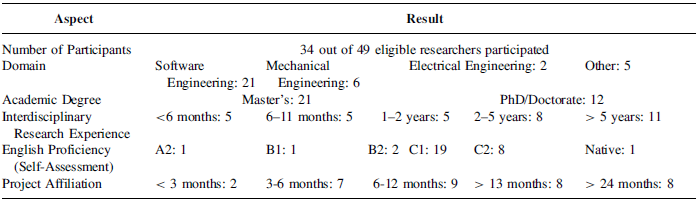
Table 1 provides an overview of the backgrounds of the study participants in the first study.
Overview of the study participants in the first study

Besides the given domains, 5 researchers selected the category other, i. e., Formal Methods, Mathematics, Data engineering, or Mechatronics. The distribution of answers was anticipated due to the research project staffing. Also, our survey showed that the researchers in the research project are experienced in conducting interdisciplinary work and already 16 participants were involved in the project’s proposal phase (affiliation over 13 months). Notably, only one researcher is a native English speaker. Note that we did not test the language level of the researchers.
5.2. Evaluation of the communication setting
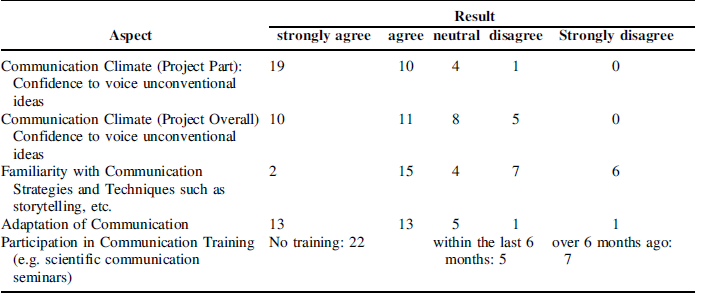
Table 2 summarizes the participants’ views on the communication setting.
Summary of the communication setting of the project

In the first survey, researchers indicated that the research project - regarding the communication of research - is (with some exceptions) a positive research environment. However, there is a difference in terms of experience within the research project. Researchers who are longer members of the project tend to agree more with that statement than researchers with less time within the research project. Due to the project size, it may cause new researchers to be overwhelmed and only be confident enough to speak up with their ideas over time.
5.3. Evaluation of comprehensibility in interdisciplinary collaboration
In the second survey, we used the 34 research descriptions provided by the first survey to understand their comprehensibility within the research project. For that, we randomly selected 6 research descriptions (2 per domain, due to the limited number of available descriptions from electrical engineering) and asked the research project researchers to rate their comprehensibility. The number of 6 descriptions has shown to be a good decision, as participants already responded negatively regarding the time needed to finish the survey. The origin of a certain domain was not shown in the survey. Figure 1 shows the overall distribution for each research description comprehensibility (indicated by “D1” for description 1 to “D6” for description 6), and from which domain the description originated. Across all domains, researchers deemed the descriptions to be in general understandable for them. Except for D3 all of them have a positive mean value.
Distribution of the degree researchers deemed a given research description (D1-D6) from an unknown domain as comprehensible

Exemplarily, for D3 from Software engineering, one of the researchers answered, that “A more non-expert language or description of the term would be useful”. Similarly, another researcher told us that “Many domain-specific terms that were not really clear to me”. These responses indicate that there are major differences in how technical terms are used across the different domains. Interestingly, also software engineers got confused, due to the number of technical terms used.
5.3.1. Influence of domain background on comprehensibility in collaboration
Regarding the influence of having the same background domain as the researchers providing the descriptions, we formed two qualitative summary categories of responses: “Agreement”, “Neutral” and “Disagreement”, consisting of the response options “strongly agree” and “agree”, as well as “strongly disagree”, “disagree”, respectively. One group (“All”) comprised the answers of all respondents to the respective research descriptions. A second group excluded responses by individuals with the same disciplinary background as the research descriptions (“Only non-domain”). One of the results of our statistical analysis is shown in Figure 2.
Overall assessment of agreement by the researchers per research description

In our first research question, we aim to understand how comprehensible interdisciplinary communication is. Based on our data we conclude that research descriptions are partially perceived as incomprehensible. On average, in 66% of all responses, participants agree that the research descriptions allow them to understand the project of their colleague. This assessment is confirmed also by the quantitative inspection of the data that shows an average of 0.7 (on a scale of -2 for “Strongly Disagree” to 2 for “Strongly Agree”).
Further, for individuals outside the domain of the research description, the perception of incomprehensibility is even bigger. On average, individuals outside the discipline of the disciplinary background of the author report higher levels of incomprehensibility.
While these general results are expected, it is interesting to look at the discipline-specific understanding of the individual research descriptions. We asked researchers to name the domain they think the research description originates from. We found that there are major differences in understanding from mechanical and electrical engineering to software engineering and vice versa. In our study, mechanical and electrical engineers were able to recognize research in software engineering, while software engineers had more problems identifying the right domain. The descriptions of software engineers were assigned correctly most of the time.
5.3.2. Influence of domain-specific terms on comprehensibility in collaboration
One of the major challenges reported in communication between different domains is the various technical terms used by the different domains. Nevertheless, some terms are easier to understand because they have been adopted to the new domain from other (related) domains. Thus, the general purpose of a high-level description of research is comprehensible for most researchers, when working together in a single project. In our study, we addressed this issue by asking for the usage of unfamiliar terms in the given descriptions. The results are shown in Figure 3.
Overall assessment of unfamiliar terms by the researchers per research description

Overall, the share of unfamiliar terms in research descriptions varied a lot. In general, the share of participants perceiving unfamiliar terms in the research descriptions increases, if the participants are exclusively from other domains. When looking at the respondents who stated that the description is incomprehensible, the share of participants perceiving unfamiliar terms in the research descriptions is even higher. The only exception to this is D6: While the terms were mostly not the reason for the incomprehensibility (as no one of the participants indicating that the description is incomprehensible was indicating that the terms used are not familiar), a differing understanding of the wording (67% Agreement) as well as unfamiliar ideas or concepts where mentioned (33% Agreement).
Another point of interest is the research description D3: originating from software engineering, it was perceived as incomprehensible by the majority of software engineers. One potential explanation for this could be the existence of additional sub-domains within the domain, each with its own unique interpretation of the terminology.
5.4. Insights into the factors affecting comprehensibility in interdisciplinary collaboration
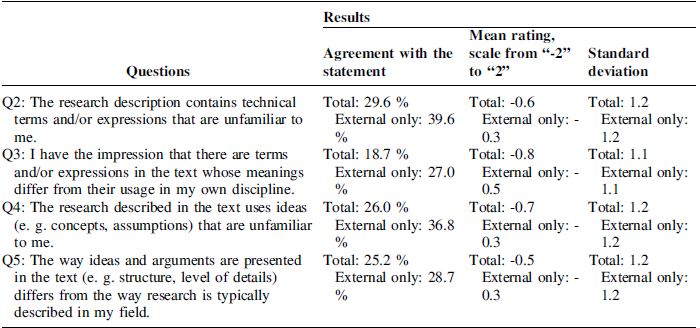
As indicated in section 4, four survey questions (Q2–Q5) with a scale from -2 for “Strongly Disagree” to 2 for “Strongly Agree” test for the factors frequently highlighted in the team science literature as influencing communication quality in interdisciplinary teams and are shown in Table 3.
Survey results on how different factors affect the comprehensibility of communication

However, these factors do not appear to be the primary drivers of the misunderstandings observed in the research descriptions. On average, the factors assessed were not identified as causes of misunderstandings across the six research descriptions. Interestingly, when focusing solely on participants from outside the respective domains, the perceived influence of these factors is more pronounced. Nevertheless, even for this subgroup, the factors are not deemed decisive in explaining potential misunderstandings of the research descriptions. Regarding research question 2, this implies that the driving factors identified in section 2 therefore need further analysis.
5.5. Insights into the demand for support for comprehensibility in interdisciplinary collaboration
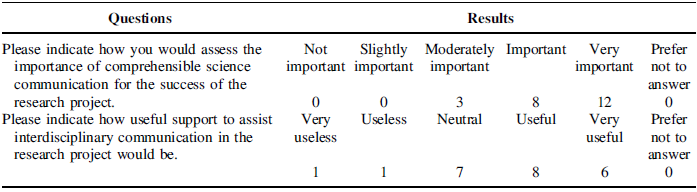
As indicated in section 4, two survey questions (Q6, Q7) test for the subjective opinion on the need for comprehensible communication in the research project. The results are shown in Table 4:
Survey results on the assessment of importance and support for comprehensibility in communication

We see that overall, the majority of participants see a need for comprehensible communication and support for interdisciplinary communication in the research project. While the importance of comprehensible communication is rated mostly “Important” or “Mostly Important”, the Usefulness of support is seen as more neutral. That might be due to many reasons: It might be that support regarding the comprehensibility is not required as most of the descriptions were understood by the respective participant; it might also be seen as not useful due to a lack of imagination about how such support can look like or due to questions like usability or time and resource afford. In general, we conclude that support or a mental model for comprehensibility in interdisciplinary can assist in the very important field of comprehensibility of communication in interdisciplinary settings.
6. Conclusion, outlook and threads to validity
This study provides two major results associated with comprehensibility in a multi-domain research project: First, we propose a study architecture to evaluate the comprehensibility in emerging interdisciplinary collaboration. In general, this architecture and the resulting surveys have shown to be both practicable and accurate, as the generated data foundation exceeds the boundaries of ten pages.
Second, we provide a major takeaway for interdisciplinary comprehensibility in general. We create an empirical data foundation unfolding that the setup in which interdisciplinary collaboration emerges only forms a minor role in the success of comprehensible communication in multi-disciplinary collaboration. The provided research descriptions were written with the intent to be as clear as possible, meaning our findings likely represent a “best-case” scenario of comprehensibility. If we consider the provided research descriptions as a snapshot of the group’s communication pattern and also take into account that the reported values are averages, then even under these favorable conditions, approximately 35% of all conversations could be perceived as (at least partially) incomprehensible. In everyday discussions, where such deliberate efforts for clarity may not be made, incomprehensibility could be even higher. In our example, this resulted in a barrier between digital and physical engineering. That finding might be limited to our research project or the problem of cyber-physical systems engineering, but it enables us to discuss the importance of actually understanding the problem in encoding and decoding between (engineering) domains.
The present study is not without its limitations, so to validate our findings, further studies in industry and research are necessary. For instance, the sample size is limited, particularly the underrepresentation of participants from the field of electrical engineering. This imbalance in disciplinary expertise may have influenced the results and potentially limited the generalisability of the findings. Furthermore, the composition of the participant group could have introduced biases, as certain perspectives and levels of experience may not have been sufficiently represented. This may have influenced the observed patterns of terminology use and adoption. We plan to address this by conducting the study on further collaboration settings both in research and industrial practice.
Additionally, some participants work on only one subproject, while others support multiple subprojects concurrently which can result in a more extensive understanding of the terminology. As the extant literature does not take this variable into account, the present study does not include this variable. Distinguishing between individuals working on a domain-isolated subproject and those interacting in several subprojects could yield a more nuanced understanding of interdisciplinary communication barriers. While we addressed the influence of domains of engineering, we have not taken into account that there might be sub-domains that share major concepts but are represented with highly specific “sub-concepts” hindering understanding between other sub-domains. Another limitation arises from the controlled nature of the study setting; the research descriptions were written to be as clear as possible, and in a normal conversation, this level of care might not be taken. This means that the results probably represent a ‘best-case’ scenario of comprehensibility.
Acknowledgment
This work is funded by the Deutsche Forschungsgemeinschaft (DFG, German Research Foundation) – SFB 1608 – 501798263. Special thanks to our editor.



 Open access

