


Authoritarianism is rising globally. Compared to previous episodes of democratic breakdown in new democracies, characterized by military coups and revolutions, the current phase features a gradual, piecemeal deterioration of democratic norms and rules in countries previously seen as consolidated democracies, such as Hungary and Poland (Haggard and Kaufman Reference Haggard and Kaufman2021). These leaders often come to power by mobilizing voters with populist appeals, and when faced with institutions of horizontal accountability, attempt to disable them and skew elections in their favor (Levitsky and Loxton Reference Levitsky and Loxton2013). Analysts, policymakers, and scholars have termed these processes “democratic backsliding” and have attempted to identify global political, institutional, and economic factors associated with these changes (Waldner and Lust Reference Waldner and Lust2018).
Given the rise of electoral populism, scholars have focused on precisely why populism threatens the institutions of liberal democracy. Populism, as a specific set of discursive practices, exists in normative tension with liberal democracy and constitutionalism by juxtaposing the people against the elite and embracing a thinly majoritarian – and often exclusionary – notion of popular sovereignty (Abts and Rummens Reference Abts and Rummens2007; Galston Reference Galston2018). Attempts to disable formal institutions stem from, as Grzymala-Busse (Reference Grzymala-Busse2019, 709), points out, “[populist] parties’ view of formal democratic institutions as the creatures of corrupt deals and exploitation, rather than as autonomous institutions of democratic accountability and legal constraint.” According to one view, at least part of the explanation for the decline in quality of democracy experienced globally in recent years (see Hellmeier et al. Reference Hellmeier, Cole, Grahn, Kolvani, Lachapelle, Lührmann, Maerz, Pillai and Lindberg2021), may stem from populist leaders’ lack of ideational commitments to liberal democracy and decision-making under constraints (Rivera-Escartin Reference Rivera-Escartin2023). The question remains, however, as to whether democratic backsliding under populists is driven by a contemporaneous micro-level process of shifting voter attitudes against democracy more generally, and institutions of liberal democracy – such as independent courts – more specifically. If populism is most aptly identified by its distinct discursive practices, should we expect populist discourse to change citizens’ attitudes with respect to the courts (Vachudova Reference Vachudova2021, 477)?
To address this question, this paper makes use of two strands of recent scholarship. Firstly, a significant amount of progress has been made in the past decade to measure populist attitudes and identify the effects of populist discourses on individual citizens, as well as particular groups, especially in the European context. Second, a recent rise in comparative research on citizen attitudes toward the courts globally has provided scholars with much-needed evidence of the interplay between institutional design and trust in judiciary, as well as individual factors influencing one’s perceptions of the courts. Building on this work, I explore whether populist discourse – identifying courts as members of the unelected and powerful elite – has the ability to influence citizens’ perceptions of legitimacy, and if so, to what extent does it do so. To help provide an answer to this question, the study experimentally investigates the extent to which voters exposed to a populist, partisan, and biased framing of a decision by the Constitutional Court of Czechia experience a reduction in perceptions of legitimacy attributable to the Court.
Contrary to theoretical expectations, I find no meaningful reductions in the legitimacy of the Constitutional Court in any treatment condition and weak relations between preexisting attitudes and the strength of these effects. Thus, while the study’s descriptive findings are consistent with arguments that voters of populist parties are more likely to mistrust decisions by the judiciary, and that there exists a partisan gap in attitudes toward the courts, the experimental results suggest that – even in newer democracies – citizens’ perceptions of legitimacy remain relatively stable, even in response to skewed portrayal of the courts’ output.
I proceed in several parts. In “Studies of attitudes toward the courts,” I discuss existing experimental and observational studies focusing on judicial legitimacy and support for courts as the main outcome variables. In “Populist discourse and its effects on judicial legitimacy,” I discuss studies on populism and the effect of populist rhetoric on voters’ attitudes. Based on theoretical predictions about the potential effect of populist rhetoric on judicial legitimacy, in the “Research design” section, I describe the research design and institutional setting where the survey was conducted. In “Results,” I report the results. Finally, I conclude in the “Discussion” by discussing the limitations of the project, suggesting future research, and considering the implications for studies of democratic backsliding and judicial independence.
Overview
Studies of attitudes toward the courts
The literature on citizens’ attitudes toward the courts identifies several broad factors affecting beliefs related to courts: ideological or partisan alignment with the court rulings, and the procedures through which judicial decision-making is accomplished. I begin this discussion by highlighting the literature’s roots in the context of the US, where scholars wrestled with the proper conceptualization of legitimacy, and the distinctive characteristics of citizens’ attitude-formation toward the US Supreme Court. I then incorporate growing comparative scholarship, which has attempted to look at a number of theoretically important outcomes, such as citizens’ trust in the judiciary, and which has highlighted a number of factors influencing those outcomes.
At the most general level, to sustain public support, courts need to be known to the public. By supporting individual rights and striking down unpopular legislation, a court can gain “specific support” for its decisions, which, in turn, generates a “reservoir of favorable attitudes” (Easton Reference Easton1967), enabling the public to exhibit “diffuse support” for the court as an institution (Caldeira and Gibson Reference Caldeira and Gibson1992). Decisions matter for most models of legitimacy, yet the extent to which the Supreme Court’s decisions can undermine or restore public confidence is debated. Classical models argue that the public has a “positivity bias” toward the Supreme Court, whereby the symbols associated with the judiciary legitimize the Court’s status without undermining it (Gibson Reference Gibson2007; Gibson and Caldeira Reference Gibson and Caldeira2009a; Gibson, Lodge, and Woodson Reference Gibson, Lodge and Woodson2014; Gibson and Nelson Reference Gibson and Nelson2014). This effect is posited to be particularly observable among particular groups, such as those with higher level of exposure to information about the courts, higher level of political knowledge, and education (Gibson and Caldeira Reference Gibson and Caldeira2009b).
Recently, scholars have questioned these theories, arguing that the relationship between the degree of alignment with a court’s decision is more tightly linked to perceptions of legitimacy than previously observed. Bartels and Johnson (Reference Bartels and Johnston2013), using a survey experiment, argued that ideological congruence with the perceived tenor of the Court’s policymaking strongly influences perceptions of the Court. A significant degree of disagreement in the scholarly research in the US rests on the proper measure of legitimacy: whether legitimacy is properly measured as a multi-item construct that attempts to capture institutional support for the courts, whether generalized trust or confidence in the courts is a proper proxy for capturing such support, and finally, whether individuals’ view toward particularized court-curbing measures is a more appropriate operationalization of legitimacy attitudes (Smyth Reference Smyth, Epstein, Grendstad, Šadl and Weinshall2024). Somewhat to the detriment of constructive interdisciplinary understanding of attitudes toward the judiciary globally, most researchers in comparative politics have focused on alternative measures to judicial legitimacy as diffuse support, such as confidence or trust in courts, support for judicial power, or perceptions of courts’ fairness. With several exceptions (see e.g., Gibson, Caldeira, and Baird Reference Gibson, Caldeira and Baird1998), we have limited cross-country understanding of factors affecting diffuse support.
Despite the measurement differences, comparative studies corroborate the general finding that ideological congruence affects evaluations of the judiciary. Several studies examine how a person’s ideological congruence with an incumbent ruler affect beliefs in courts’ ability to serve as a check on the incumbent; these studies suggest that support for robust separation of powers is contingent on an individual’s alignment with the office-holder (Singer Reference Singer2018; Bartels and Kramon Reference Bartels and Kramon2020; Mazepus and Toshkov Reference Mazepus and Toshkov2022; Magalhães and Garoupa Reference Magalhães and Garoupa2023; Böhringer and Boucher Reference Böhringer and Boucher2024; Driscoll, Aydin-Çakır, and Schorpp Reference Driscoll, Aydin-Çakır and Schorpp2024; Gandur Reference Gandur2024). Similar findings are observed in studies of international courts: in backsliding democracies, support for international tribunals is strongly influenced by whether individuals ideologically align with the incumbents constrained by such tribunals (Cheruvu, Krehbiel, and Mussell Reference Cheruvu, Krehbiel and Mussell2024). An emerging strand of research focuses on how legitimacy and confidence in the judiciary differentially shifts when courts make landmark electoral rulings. For instance, Bartels, Horowitz, and Kramon (Reference Bartels, Horowitz and Kramon2023) find that after the Kenyan Supreme Court decided to annul the incumbent president’s victory, supporters of the incumbent were much less likely to support judicial power generally, and courts’ power over the elections more specifically. On the other hand, Kerr and Wahman (Reference Kerr and Wahman2021) find that while judicial annulment of the elections in Zambia reduced perceptions of electoral integrity among the supporters of the election winner, it seemed to have little effect on judicial legitimacy.
Individuals might be influenced not only by the congruence of particular outcomes with their preexisting beliefs but also by the congruence between their partisan identity and the perceived partisan composition of the courts. Recent experimental evidence in the US suggests that when individuals receive cues that the decision has been made by their co-partisan, they are more likely to (a) accept the decision, and (b) view the Court as a legitimate institution (Nicholson and Hansford Reference Nicholson and Hansford2014), even when they believe a decision unfairly benefits them (Armaly Reference Armaly2020). Such partisan effects are particularly effective when voters are presented with non-legalistic accounts of the Court’s decision (Christenson and Glick Reference Christenson and Glick2015). Outside the US, Gonzales-Ocantos and Dinas (Reference Gonzalez-Ocantos and Dinas2019) find that cues from elected leaders signaling support for landmark judicial rulings may have the effect of increasing individuals’ acceptance of a decision with which they are likely to disagree. Magalhães et. al. (Reference Magalhães, Skiple, Pereira, Arnesen and Bentsen2023) find that exposing individuals to a partisan frame that signals who appointed the judges on the courts in Norway and Portugal reduces perceptions of courts’ fairness as compared to a frame that portrays the decision in purely legalistic terms.
Partisanship not only affects generalized attitudes toward the courts but can also influence support for court-curbing measures (Clark and Kastellec Reference Clark and Kastellec2015). Using a survey and conjoint experiment, Driscoll and Nelson (Reference Driscoll and Nelson2023) find that individuals do not punish co-partisan incumbents who advance measures designed to limit judicial independence and ensure judiciaries are more responsive to the elected leaders. Mazepus and Toshkov (Reference Mazepus and Toshkov2022) experimentally investigate support for court-curbing in Ukraine, and find that support for court-curbing varies depending on alignment with the party advancing such measures. Such findings are particularly insightful in the context of the broader conversation on democratic backsliding: if citizens’ attitudes toward measures designed to limit judicial independence are fluid and highly responsive to partisan and ideological preferences, there are strong reasons to be skeptical of the ability of such institutions to serve as highly effective checks on incumbents seeking to reshape the democratic process.
While ideological alignment appears to matter in attitude-formation, scholars have argued that courts – as legal institutions – are in some sense unique in being able to maintain a level of institutional legitimacy that is independent of the substantive outcomes of the decisions they produce. Judicial institutions are able to elicit compliance and maintain legitimacy when the public believes that decisions are made in a “procedurally fair” manner, that is, the court’s reasoning satisfies the public’s view of the neutrality of the judicial decision-making process (Lind and Tyler Reference Lind and Tyler1988; Tyler Reference Tyler1990). Significant research has demonstrated that procedural fairness matters in generating trust in a variety of legal institutions (Lind and Tyler Reference Lind and Tyler1988; Tyler Reference Tyler1990). If individuals perceive a decision as principled, fair, and neutral, they are more likely to accept it and support the institution that rendered it (Tyler and Mitchell Reference Tyler and Mitchell1994; Gibson, Caldeira, and Spence Reference Gibson, Caldeira and Spence2005). How can a court demonstrate procedural fairness? In the context of the US, Zink, Spriggs, and Scott (Reference Zink, Spriggs and Scott2009) argue that it does so by rendering unanimous decisions or emphasizing precedent as the main factor affecting its decision. By manipulating majority coalition size and precedent in a newspaper vignette, the authors demonstrate that signals of procedural fairness substantially affect individuals’ acceptance of court decisions.
Others doubt the presence of such an effect or offer alternative ways procedural justice can influence outcomes. For instance, in a series of survey experiments, Salamone (Reference Salamone2014) found that majority size does not affect the level of agreement with Court decisions. They also find that among those with ex ante disagreement with the Court decision, dissent, not unanimity, on the bench encourages acceptance. In a rare study outside the US context, Bentsen (Reference Bentsen2019) goes further and demonstrates that even those with ex ante political agreement are more likely to support the judiciary’s decision when they observe dissent. In a slightly different but related stroke, Farganis (Reference Farganis2012) experimentally manipulated the content of a hypothetical Supreme Court opinion, comparing the effect of legalistic reasoning to reasoning based on extra-legal considerations (e.g., religion), concluding that appeal to law is most effective at eliciting acceptance.
While voters’ perceptions of procedural legitimacy have received less attention in experimental studies of courts outside the US, some suggestive evidence exists that links higher level of judicial performance and procedural independence with higher support for courts. For instance, Garoupa and Magalhães (Reference Garoupa and Magalhães2021) find that in Europe, higher levels of judicial independence and accountability are related to higher trust in the judiciary, particularly among those with higher level of political knowledge (see also Bühlmann and Kunz Reference Bühlmann and Kunz2011). Relatedly, these authors also find higher level of judicial performance (e.g., incidence of delays in lower courts’ disposition of cases) is associated with higher level of trust in the judicial system (Magalhães and Garoupa Reference Magalhães and Garoupa2020). Aydin-Çakır (Reference Aydın-Çakır2023) finds that when incumbents use informal, subconstitutional measures to curtail judicial independence—such as forcing sitting judges to resign—it is more likely to result in a subsequent decline in judicial legitimacy compared to reshaping the judiciary through more procedurally acceptable constitutional mechanisms.
Perhaps more important than how the Court reaches its conclusions is how these conclusions are communicated to the public. As Linos and Twist suggest (in the context of the US):
The Supreme Court depends more heavily on the media to convey and translate its messages than do other elite actors. Elites in the executive and legislative branches often speak directly to the public; they also buy advertisements and hold frequent press conferences to ensure that their messages are spread widely. In contrast, the nine justices communicate their views through lengthy and complex judicial opinions. As a result, the media’s role is distinctly important to the Court’s influence on public opinion. (Reference Linos and Twist2016, 225)
Frames communicative actors use to convey this information can profoundly affect how voters update their beliefs about legal institutions. Courts depend on a favorable attitude toward their decisions by “the legal complex” – prosecutors, lawyers, legal academics, legal advisors, and others involved with writing and speaking in legal language (Halliday, Karpik, and Feeley Reference Halliday, Karpik and Feeley2007; Karpik and Halliday Reference Karpik and Halliday2011). These actors selectively communicate aspects of the courts’ decision-making and shape public perceptions by providing information through different frames. The use of symbols and legitimating rhetoric can theoretically dampen the effect of procedural irregularity or ideological incongruence between the voter and the median justice.
By manipulating exposure to images associated with the judiciary (e.g., robes, elevated architecture of the court), Gibson, Lodge, and Woodson (Reference Gibson, Lodge and Woodson2014) demonstrate the link between symbols and institutional support and legitimacy. Off-bench speeches by the justices themselves framing the court as primarily a legal institution are shown to have legitimating effects both in field experiments (Krewson Reference Krewson2019) and in survey experiments (Krewson Reference Krewson2019; Strother and Glennon Reference Strother and Glennon2021). Additionally, multi-wave survey experiments have demonstrated that delegitimizing rhetoric and political framing of the court decrease support for the court (Nelson and Gibson Reference Nelson and Gibson2019).
To conclude, while recent years have seen a wealth of new comparative scholarship investigating the political determinants of attitude-formation toward the judiciary, measurement challenges inhibit effective cross-regional scholarly progress articulating the unique features of courts as legal institutions. It remains unclear whether expectations derived from the studies of the US Supreme Court translate effectively in contexts of younger democracies, and whether considerations regarding how the decision-making process of the courts affects attitudes toward the courts are broadly generalizable. That said, there is growing evidence that ideological and partisan considerations affect citizens’ attitudes toward the judiciary globally. This evidence suggests that individuals may be predisposed to support – or turn a blind eye to – attempts by would-be authoritarian leaders to limit checks and balances on their rule, and to initiate the process of democratic backsliding. There are also some theoretical reasons to believe that, beyond substantive considerations of ideological or partisan congruence and procedural fairness, citizens are also influenced by how ideology, partisanship, and perceived fairness interact in a particular communicative frame. In the next section, I discuss the potential effects of a populist framing of a judicial decision on perceptions of judicial legitimacy.
Populist discourse and its effects on judicial legitimacy
Recent years have seen a dramatic resurgence of work on populism, and its relationship to democracy. Populist rhetoric, which posits that politics should be the expression of majoritarian general will (Mudde Reference Mudde2004), stands in stark tension with thick versions of rule of law that set limits on the capacity of the majorities to infringe on fundamental rights (Adamidis Reference Adamidis2024). Populist messages are defined in scholarship as advancing a notion of a “Manichean struggle between the good and the evil,” where the “will of the people” is defended by a leader, the people’s champion who is besieged and thwarted by the conspiring exclusionary elites (Hawkins, Read, and Pauwels Reference Hawkins, Read, Pauwels, Kaltwasser, Taggart, Espejo and Ostiguy2017). Researchers have identified an increased prevalence of these messages and established their presence in political party manifestos, campaign events, and media appearances (Maškarinec Reference Maškarinec2019). While there is little experimental research on the effect of populist frames directly on judicial legitimacy (an exception being Gonzalez-Ocantos and Dinas Reference Gonzalez-Ocantos and Dinas2019, who find that the effect of populist framing on acceptance of a decision by the judiciary is negligible), recent years have seen a rise in studies examining the effect of populism on a range of other outcome measures.
The literature on populism identifies the widening cognitive gap between insiders and outsiders as a key mechanism through which populist messages affect attitudes and beliefs (Hameleers and de Vreese Reference Hameleers and de Vreese2020). Populism’s distinct dispositional frame attributes causality to “intentional behavior by knowing individuals” (Busby, Gubler, and Hawkins Reference Busby, Gubler and Hawkins2019, 618). Recent experimental research has uncovered the effect of such blame-attributing populist cues on voting intentions (Bos, van der Brug, and de Vreese Reference Bos, van der Brug and de Vreese2013; Hameleers et al. Reference Hameleers, Bos, Fawzi, Reinemann, Andreadis, Corbu and Schemer2018; Busby, Gubler, and Hawkins Reference Busby, Gubler and Hawkins2019), mobilization (Hameleers et al. Reference Hameleers, Bos, Fawzi, Reinemann, Andreadis, Corbu and Schemer2018), stereotyping (Matthes and Schmuck Reference Matthes and Schmuck2017; Hameleers and de Vreese Reference Hameleers and de Vreese2020), and political cynicism (Rooduijn et al. Reference Rooduijn, van der Brug, de Lange and Parlevliet2017). In a large multi-country experiment, researchers found that anti-elitist identity framing increases persuasion and mobilization, moderated by relative deprivation (Bos et al. Reference Bos, Schemer, Corbu, Hameleers, Andreadis, Schulz, Schmuck, Reinemann and Fawzi2020).
From the growing body of research on the impact of populist dispositional frames on voting intentions and attitudes toward out groups, it stands to reason that such frames may affect public perceptions of the judiciary. Ideas matter because they provide maps of understanding, enabling individuals to interpret the political world. The ascendance of populist ideas in a democracy, due to its normative-ideational tension with the principles undergirding liberal constitutionalism, could shift voters’ attitudes toward political institutions. But internalizing the idea that “at the heart of politics lies the struggle between the people and the elite” is not enough; individuals need cues to identify particular institutions within this bifurcated normative space. Thus, populists whose power is limited provide such cues through the media by attacking judges.
The judiciary might be particularly vulnerable to such messages because, unlike politicians, judges are not elected and thus not accountable to the same level to the public. Moreover, because high court judges are likely selected from a select pool of legal professionals and academics, they may not resemble the voting public in education and income levels, making them particularly vulnerable to messages that increase cognitive distance and describe them as out-of-touch elite. In-depth studies of party manifestos of populist parties suggest that populists do indeed focus on the judiciary as part of the broader sets of attacks on what they perceive to be the establishment institutions which stand in line of clearer articulation of popular sovereignty (Mazzoleni and Voerman Reference Mazzoleni and Voerman2020).
Most recent studies lend further credence to the hypothesis that populist frames ought to negatively affect perceptions of judicial legitimacy. Peffley and Rohrschneider (Reference Peffley and Rohrschneider2024) experimentally investigate how voters react to a divisive decision made by the Federal Constitutional Court in Germany, German Parliament, and the European Union, and whether voters are likely to support restricting the powers of an institution that rendered such a decision. They find that voters with populist attitudes are more likely to support court-curbing measures, as compared to non-populist voters.
In sum, there are strong reasons to expect populist framing of the judiciary, which identify it as an institution of the elite, to enable attitudinal shifts among individuals. Populist leaders may employ this rhetoric as part of the toolkit that justifies their gradual disablement of the institutions serving as bulwarks against democratic erosion. Whether or not such tendencies are already observed, and whether they can be activated to weaken judicial legitimacy, is the subject of this study.
Study of judicial legitimacy in Czechia: Hypotheses
The intersection of populism, judicial legitimacy, and democratic backsliding offers critical insights into the fragility of liberal democratic institutions. Populist rhetoric, which frames the judiciary as an unelected, elitist force obstructing popular will, seeks to undermine judicial independence, especially when courts constrain populist leaders. In backsliding democracies, populists often mobilize support to weaken institutional checks. Research on judicial legitimacy shows that public trust is shaped by ideological alignment and procedural fairness, both of which help sustain confidence in the courts. However, when decisions are framed as partisan or procedurally irregular, public support may erode, especially if outcomes appear to favor one political side. This study contributes to the emerging literature on voter reactions to electoral rulings – a crucial avenue of judicial intervention in democracy protection – while also engaging with traditional measures of judicial legitimacy. By using a well-established conceptualization of legitimacy and testing its durability against populist, partisan, and procedural frames in Czechia, this study seeks to offer important insights into how courts’ involvement in electoral disputes affects public perceptions of democratic institutions.
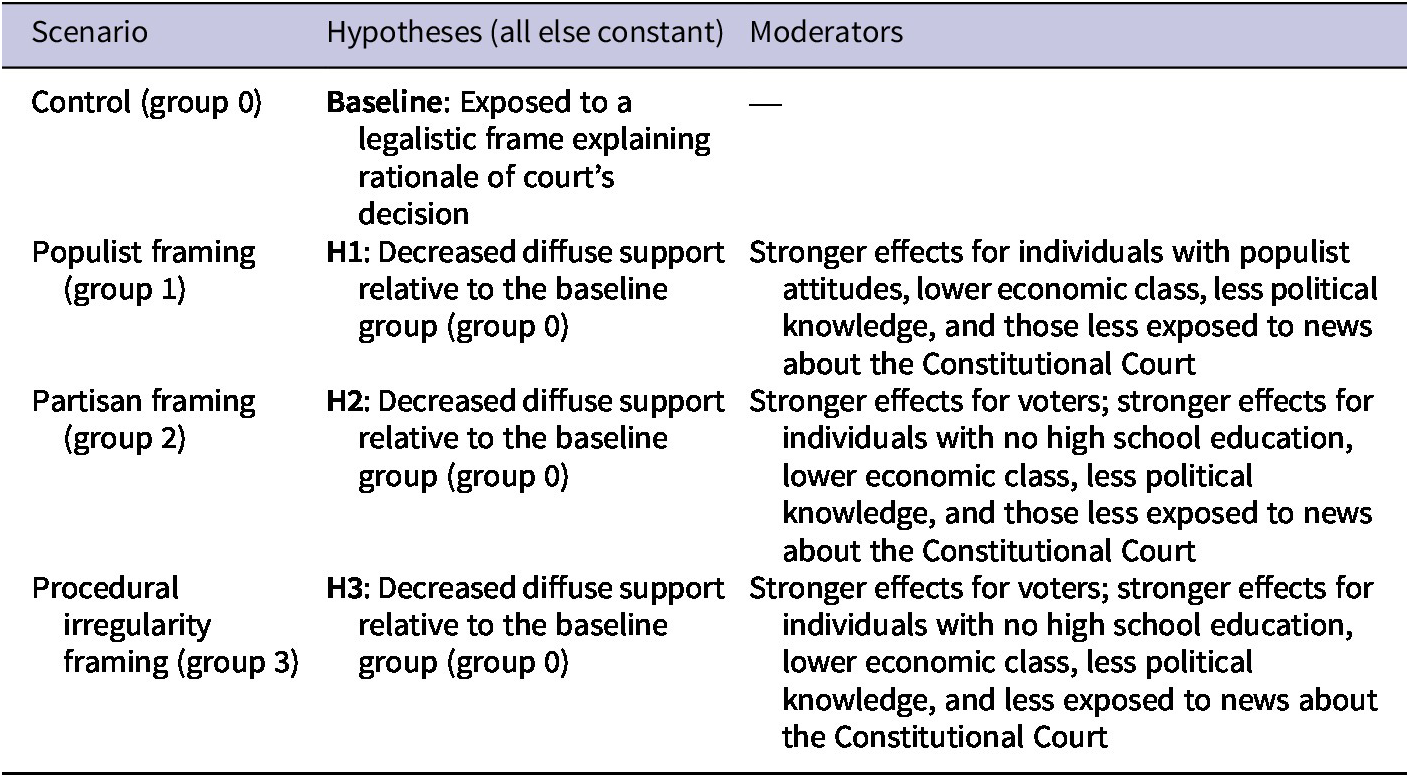
I expect the framing of the Constitutional Court decision on the electoral system emphasizing the elite status of judges (populist framing), partisan affiliations of the court (partisan framing), and procedural irregularity of the decision (procedural irregularity framing), to produce the effect of lowering individuals’ diffuse support for the courts. While the latter two hypotheses are derived from the existing literature on court legitimacy, I derive the first from this paper’s theoretical proposition, inspired by the literature in populism. In particular, I argue that voters who experience populist governance and are routinely exposed to populist rhetoric are likely to internalize the distinctions populists make with regard to the institutions of liberal democracy. When voters receive cues that assign the elite status to particular institutions (in our case, the Constitutional Court), this widens the cognitive distance between the voter and the court, and lowers the diffuse support for the institution. These effects are not likely to be homogeneous, however. Certain types of voters are more likely than others to hold populist attitudes. Following the argument above, I expect the effect of a populist vignette to be more substantial for individuals who hold populist attitudes. In addition, consistent with the findings on the moderators affecting factors capturing populist attitudes (Ferrari Reference Ferrari2021), those with no college degree, men, and those identifying as working class are also expected to experience stronger effects of populist frame.
In concordance with theories about knowledge of the courts (Gibson and Nelson Reference Gibson and Nelson2014, Reference Gibson and Nelson2015), I expect those with higher political knowledge, and prior exposure to information about the Constitutional Court, to experience the effect of the frames less strongly than those with little knowledge about the Court. I also predict the effect of partisanship (H2) to be smaller for individuals who did not vote in the most recent election. A summary of experimental conditions, main effects, and moderator hypotheses can be found in Table 1.Footnote 1
Summary of Hypotheses
Research design
The study features a quasi pre-post between-subjects experimental design with one control and three treatment vignettes containing different portrayals of the decision issued by the Constitutional Court of the Czech Republic in 2021 on the constitutionality of changes to the electoral system. Prior to vignettes, a battery of questions measuring individuals’ demographic characteristics and political views is asked. Included are the variables on education, age, gender, region, economic class, vote in the most recent national election, ideologically closest party, feeling thermometer toward major governmental institutions, populist attitudes, and prior exposure to the news about the Constitutional Court. The control condition includes a modified statement about the Constitutional Court decision mirroring language from the Constitutional Court press office. In the next section, I describe the political context surrounding the Constitutional Court and the decision forming the core of the survey vignette.
Institutional setting: Czech Republic in 2023
The early post-communist political history of Czechia was characterized by the dominance of two parties: the Civil Democrats (ODS) and Social Democrats (ČSSD). These two parties represented the “post-November” transformation and moving away from the totalitarian system of social relations into a new era signified by a move to the market economy and liberal-democratic order (Kim Reference Kim2020, 622). The two parties formed a consensus, within the limitations of the PR system, against the emergence of extreme parties on the right, and more crucially at the time, the Communists (KSČM) on the left. In 2001, the Constitutional Court, which had previously been a less visible political player compared to László Sólyom-led Court in Hungary (Scheppele Reference Scheppele2006), played a crucial role in preventing the consolidation of the two-party system by striking down election law aimed at favoring the two major parties (Kosař and Vyhnánek Reference Kosař and Vyhnánek2020).
The dominant position of the two parties began to unravel in the 2010s with the emergence of the first populist party Public Affairs (VV), economic crisis, and a series of corruption and abuse of power scandals that plagued the ODS-led coalition (Havlík and Hloušek Reference Havlík and Hloušek2014; Kim Reference Kim2020). While the two dominant parties were weakened, the Court’s power steadily grew. It is within the context of the weakening of traditional party politics and unstable coalitions, the Czech Constitutional Court made an unprecedented decision, declaring the constitutional act of dissolution of the lower chamber of parliament unconstitutional, accepting the globally controversial “unconstitutional constitutional amendment” doctrine (Roznai Reference Roznai2014).
The plurality of seats in the 2013 election was ultimately won by “Action of Dissatisfied Citizens” (ANO), led by Czechia’s second-richest man, Andrej Babiš. Pitting itself against the traditional parties, the establishment, and the elites, Babiš was competing directly with other populist parties, especially on the right. ANO’s brand of populism was distinct, especially in comparison with the right-wing Fidesz in Hungary and Law and Justice (PiS) in Poland. Scholars called Babiš a “managerial-centrist populist” (Císař Reference Císař2017) or a “technocratic populist” (Buštíková and Guasti Reference Buštíková and Guasti2019; Havlík Reference Havlík2019; Buštíková and Baboš Reference Buštíková and Baboš2020), emphasizing his approach to politics of ruling the country “like a firm.” Notably, especially in the 2017 election, ANO distanced itself from the right-wing populist “Freedom and Direct Democracy” (SPD) party, by portraying it as radical and irresponsible (Kim Reference Kim2020, 629). After the election, it formed a minority government with the ČSSD and achieved a confidence-and-supply agreement with the Communists (KSČM).
While ANO stressed the nativist elements to a lesser extent compared to its Central and Eastern European counterparts, scholars have documented multiple facets of its populist rhetoric: people-centrism, anti-elitism, and anti-corruption (Engler, Pytlas, and Deegan-Krause Reference Engler, Pytlas and Deegan-Krause2019; Havlík Reference Havlík2019). Babiš depicted ANO as a citizens’ movement opposed to the “inept politicians,” and advocated for a strong majoritarian and centralized system of government with few checks and balances (Hanley and Vachudova Reference Hanley and Vachudova2018). ANO’s election manifesto portrayed the government as being “actually led by behind-the-scenes groups, lobbyists, and advisors” (Kim Reference Kim2020, 628).
ANO has never achieved a constitutional majority in the legislature, and most recently has lost the election (Bakke Reference Bakke, Ramet, Ðorđević and Hassenstab2022) – leading to the formation of a centrist coalition – while retaining substantial support among the population. It held few seats in the Senate, which is directly responsible for approving Constitutional Court justices on the advice of the President. The presence of multiple veto points for the election of the Court members, scholars argue, allowed it to remain relatively independent in an otherwise unwelcoming to liberal democracy environment (Guasti Reference Guasti2020; Pospíšil Reference Pospíšil, Lorenz and Formánková2020). While the Court did exhibit far more restraint in the recent decade (Kühn Reference Kühn, Gárdos-Orosz and Szente2021), it has demonstrated its independence recently by annulling multiple COVID-19-related government decrees and upholding the legislation that would prevent Babiš from bidding for public contracts and holding non-internet media companies (Willoughby Reference Willoughby2020). Public opinion data suggests that the Constitutional Court has enjoyed a steady majority of Czech voters (62% in 2023) that has confidence in its operation, with a peak of 64% in 2019, and a dip to 46% in 2010 over the last fifteen years (Červenka Reference Červenka2020).
In sum, the Czech context represents a particularly fruitful context for this research: there is great heterogeneity in voting preferences and attitudes among the voting public, instances of high-level conflicts between the elected branches and the Court are observed, and until recently it had a populist as its head of the executive who publicly attacked the courts, but who, in comparison with other countries with such leaders in the region, was unable to significantly challenge judicial independence.
Measurement
This study uses a quasi pretest-posttest design (Mutz Reference Mutz2011). As a type of repeated measures design, quasi pretest-posttest design is a between-subjects design where a measure of the outcome variable is taken before participants are exposed to treatment, and after they are exposed to the treatment. The pretreatment measure of the outcome measure can then be controlled for when analyzing main and heterogeneous effects, thereby significantly increasing precision. It is a “quasi” repeated measures design because rather than using the same outcome measure in both stages, I rely on the pretreatment measure that is highly correlated with the posttreatment measure to alleviate demand effects concerns, while retaining a gain in precision. While there are still concerns about the potential introduction of bias, recent work suggests that, unless the researcher’s intent is particularly clear for the participants and they have incentives to behave in expectation of that intent, the demand effects that might bias the estimate are not substantial (Clifford, Sheagley, and Piston Reference Clifford, Sheagley and Piston2020).
I use a feeling thermometer toward state institutions (Gibson and Caldeira Reference Gibson and Caldeira2003), where individuals rate their feelings toward the Constitutional Court, the President, the Senate, the Chamber of Deputies, and the Government on a 0–100 scale. I take participants’ feelings toward the Constitutional Court as the pretreatment measure of the outcome variable. The pilot study revealed a correlation between the initial measure and posttreatment measure to be 0.68, with the lower confidence at 95% at 0.51.
Because existing measures of populist attitudes are relatively intrusive, their inclusion in the pretreatment phase might prime individuals and inadvertently expose them to the populist framing, regardless of the experimental condition. To mitigate this concern, I use a modified three-item populism scale, developed by Van Hauwaert, Schimpf, and Azevedo Reference Van Hauwaert, Schimpf and Azevedo2020. Using Item Response Theory, they have further refined proposed measures of populism (e.g., Akkerman, Mudde, and Zaslove Reference Akkerman, Mudde and Zaslove2014) – which has recently been shown to have high internal coherence and external validity (Silva et al. Reference Silva, Jungkunz, Helbling and Littvay2019) – and demonstrated the effect of reducing redundancies from within the scale.
In line with the articulated need to test the durability of traditional measures of legitimacy in the context of newer democracies, to capture institutional support and attitude toward institutional reform for the main posttreatment measure of the outcome, I use a modified single-dimensional battery of diffuse support questions, measured on a five-point Likert scale (Gibson and Caldeira Reference Gibson and Caldeira2003; Driscoll and Nelson Reference Driscoll and Nelson2023). The measure of legitimacy is particularly appropriate in the context of studies on democratic backsliding and court-curbing since it captures both the perceptions of judges’ fairness and voters’ willingness to abolish the Court, were it to make unpopular decisions. A composite score (mean) the Likert-type items is obtained, normalized, and analyzed at the interval measurement scale.
The study features three experimental and one control condition. The control condition includes a legalistic frame that describes the decision of the Constitutional Court, invalidating the election law, which the Court made in 2021. In 2021, the Constitutional Court invalidated the electoral law that it had previously refused to set aside, on abstract review petition by individual senators. In doing so, the Court moved further toward “proportionality” as the key metric required by the Constitution in evaluating the electoral system. The resulting electoral law allocated unused seats within the electoral constituencies at the national level, thereby increasing proportionality of the electoral system, at the expense of some of the major parties (for context of the decision, as well as its implications, see Antoš and Horák Reference Antoš and Horák2021). The case has several key features important for this study: (a) it involves a real decision made by the Court, which (b) has significant potential political consequences, and (c) the precise normative rationales which are likely not significantly engaged with by the public. As such, if we expect cueing and informational effects to be present, they are more likely to emerge with a decision with which the members of the public are not significantly familiar with, but which is both plausible to the respondents and realistic.Footnote 2
Because the decision involves a ruling that directly affects individuals’ representational rights, we should expect effects related to partisanship and judges’ unelected status to be more salient and discoverable in this context. Lastly, the ambiguity of the decision, its political context, and the mixed impacts on the performance of the political parties provides us with the ability to present a plausible portrayal and characterization of the study, without significantly compromising the internal validity of the various types of information.
The baseline information provided is the description of the court’s decision from a legalistic frame (for effects of a similar frame, see Magalhães et al. Reference Magalhães, Skiple, Pereira, Arnesen and Bentsen2023). The precise wording of the decision mirrors the language used by the Court itself:
[CONTROL] The Czech Republic’s Constitutional Court ruled in February, 2021 to cancel several provisions of the country’s electoral law. The Constitutional Court dismissed, in particular, the usage of D’Hondt method for allocating mandates to political parties, saying it’s not in line with the proportional representation electoral system used in elections for the lower house of Parliament. The Court argued that D’Hondt method of allocating mandates significantly undermines the principle of equality of electoral votes. Therefore, the law was declared as being inconsistent with the Constitution.
To test whether cueing judges of the Court as unaccountable elite, the Populism condition frames the decision, among messages pointing out the judges’ institutional status as indirectly elected members of the judiciary, and highlights their educational status:
[POPULISM] The Czech Republic’s Constitutional Court, mostly composed of judges trained by a small network of scholars at selective law departments at Masaryk and Charles University, ruled in February, 2020 to cancel several provisions of the country’s electoral law passed by the majority of the elected members of Chamber of Deputies. The Constitutional Court, the members of which are not elected by the people, dismissed, in particular, the usage of D’Hondt method for allocating mandates to political parties, saying it’s not in line with the proportional representation electoral system used in elections for the lower house of Parliament. The Court argued that D’Hondt method of allocating mandates significantly undermines the principle of equality of electoral votes. Therefore, the law was declared as being inconsistent with the Constitution.
To test whether cueing judges of the Court as partisan political actors, the Partisanship condition frames the decision with the particular focus on the outcome of the decision, as the one affecting the individual’s ideologically closest party. A minor party is added to the description to reduce researcher demand effects:
[PARTISANSHIP] The Czech Republic’s Constitutional Court ruled in February, 2021 to cancel several provisions of the country’s electoral law. The Constitutional Court dismissed, in particular, the usage of D’Hondt method for allocating mandates to political parties, saying it’s not in line with the proportional representation electoral system used in elections for the lower house of Parliament. The Court argued that D’Hondt method of allocating mandates significantly undermines the principle of equality of electoral votes. Therefore, the law was declared as being inconsistent with the Constitution. The decision made it more difficult for parties such as [PREFERRED PARTY OF THE RESPONDENT] and [SENIORI] to compete in the 2021 elections, and benefitted their competitors.
Finally, to see whether the informational effect of the legalistic frame is significantly undermined by pointing out procedural irregularity with the decision-making of the Court, the Procedural Irregularity condition emphasizes the timing of the decision:
[PROCEDURAL IRREGULARITY] The Czech Republic’s Constitutional Court ruled in February, 2021 to cancel several provisions of the country’s electoral law. The Constitutional Court dismissed, in particular, the usage of D’Hondt method for allocating mandates to political parties, saying it’s not in line with the proportional representation electoral system used in elections for the lower house of Parliament. The Court argued that D’Hondt method of allocating mandates significantly undermines the principle of equality of electoral votes. Therefore, the law was declared as being inconsistent with the Constitution. The Court first received a complaint over three years ago, and unexpectedly announced the decision just 8 months before the election. The decision came as a surprise to those supporting the change and did not allow for sufficient time for parties that supported the election changes to respond to the opposing arguments and constitutional challenges.
Sample characteristics and descriptive statistics
The study was fielded online in June–August of 2023, using advertising features of Meta and (to a significantly smaller degree) Reddit, Inc. A total of 1,996 individuals completed the survey, and 1,312 have passed a screener-type manipulation question (see Berinsky, Margolis, and Sances Reference Berinsky, Margolis and Sances2014). The sample characteristics are provided in Table 2.
Comparison of Sample and Population Proportions
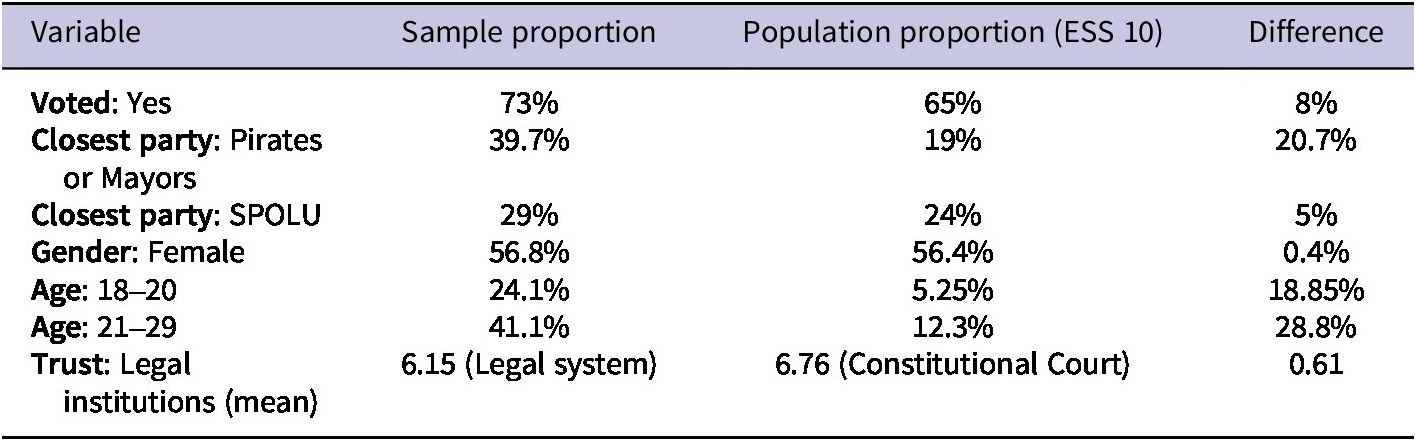
The sample is significantly younger, more educated (or currently receiving education), and more trusting of institutions than the population as a whole. Nonetheless, there is significant variability in the sample with respect to each of the demographic characteristics. As demonstrated by existing experimental research, convenience samples generally produce comparable causal estimates for main treatment effects in survey experiments (see Mullinix et al. Reference Mullinix, Leeper, Druckman and Freese2015 for a discussion of the relationship between convenience sampling, sample variability, and validity of experimental research). Furthermore, given the significant variation across the demographic characteristics, concerns that sample bias, due to treatment heterogeneity on one of the important characteristics, is likely to affect estimates of main treatment effects are not substantial.Footnote 3
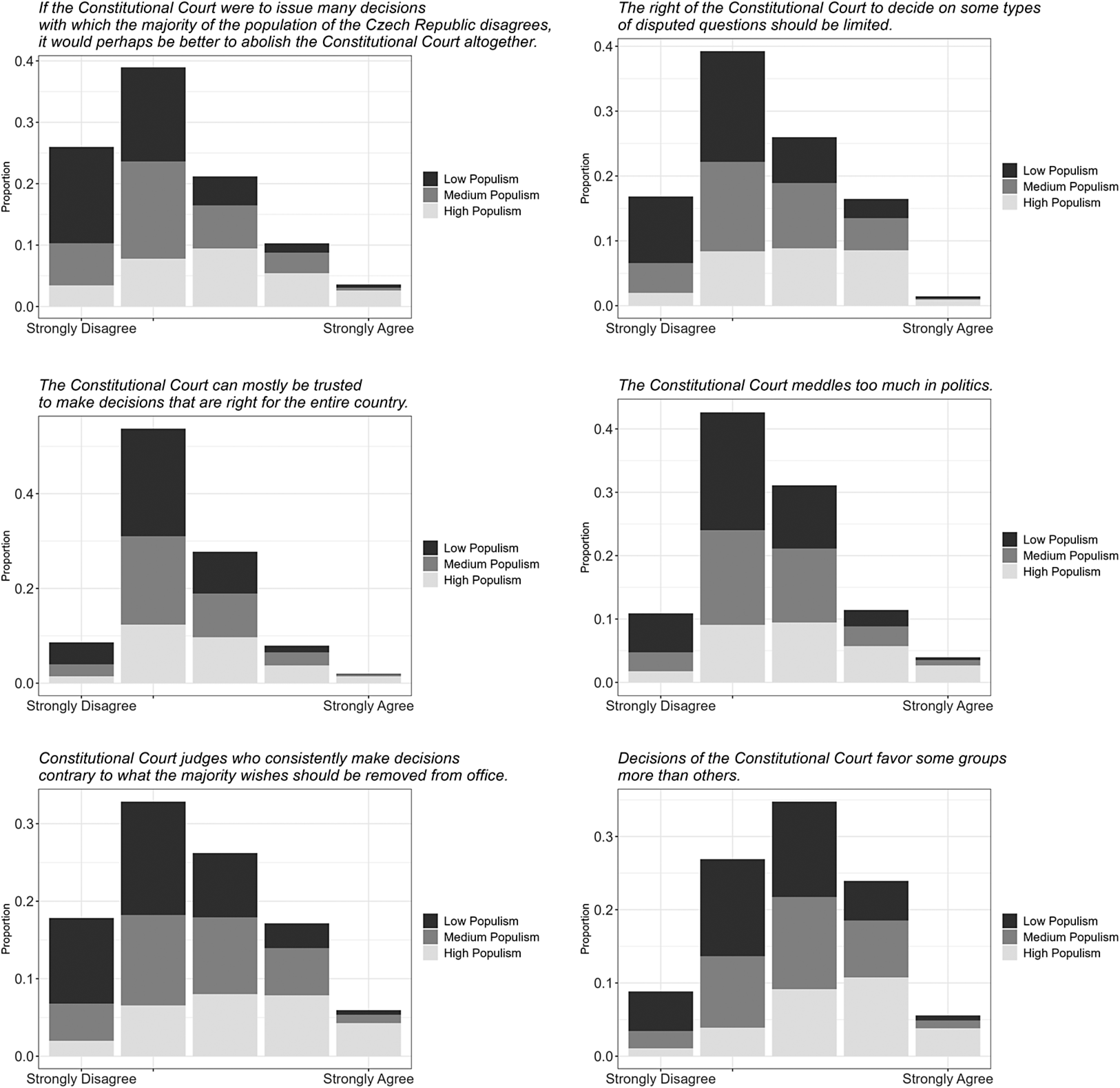
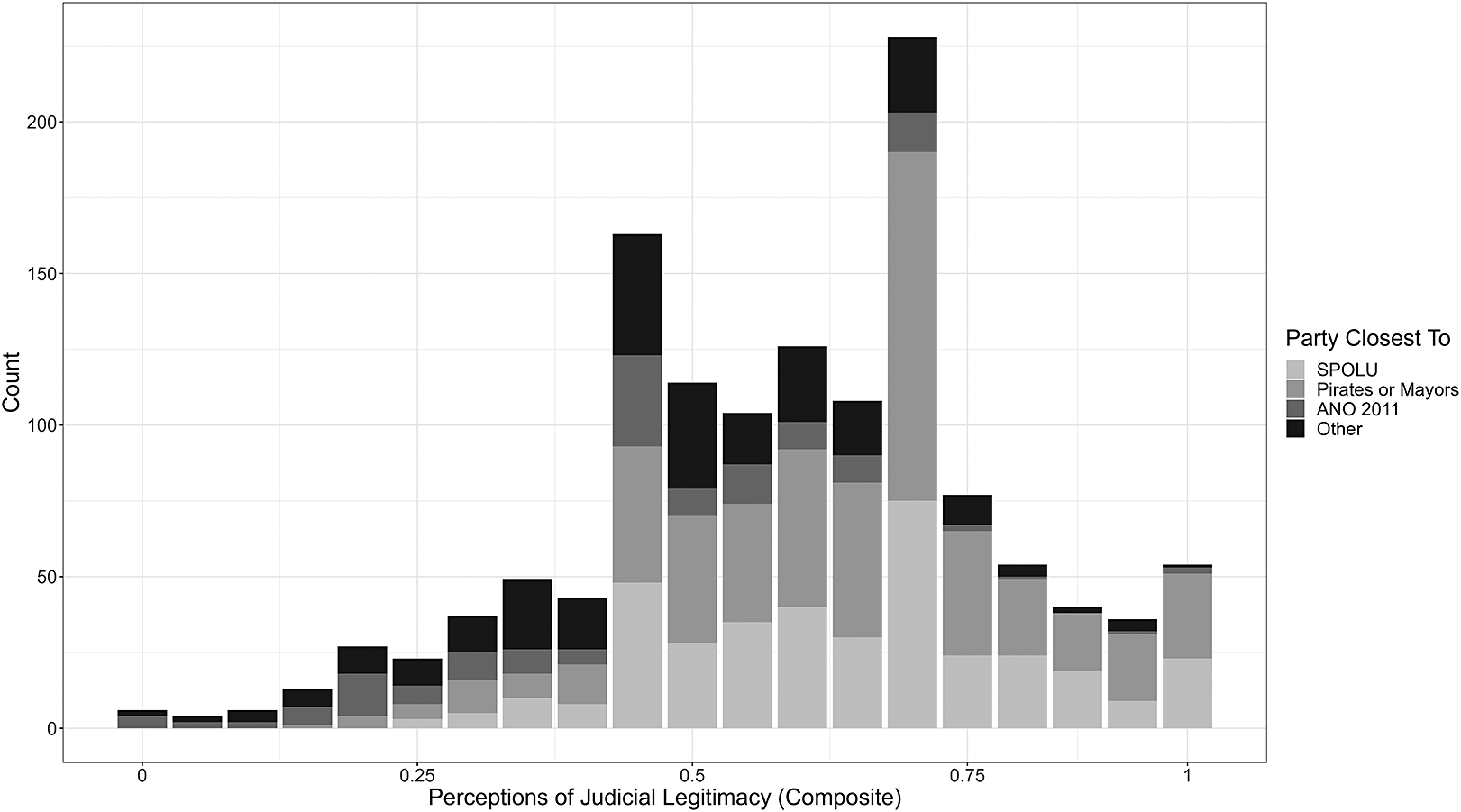
Figure 1 illustrates the relationship between individual outcome variable measures and pretreatment measure of respondents’ populist attitudes. As Figure 1 demonstrates, the descriptive relationship between the three-item populism score and the perceptions of judicial legitimacy is substantial, with individuals prioritizing the “will of the people” and not identifying with the political elite being much more likely to exhibit lower diffuse support for the Constitutional Court. Similarly, as shown in Figure 2, voters of the parties described as more populist in the context of the Czech Republic (Meijers and Zaslove Reference Meijers and Zaslove2021) – including the supporters of ANO 2011 – are significantly less likely to exhibit diffuse support for the judiciary.
Descriptive Relationship Between Populist Attitudes and Facets of Judicial Legitimacy.
Descriptive Relationship Between Political Party and Judicial Legitimacy.
To the extent to which the sample includes individuals with higher preexisting levels of support toward the Constitutional Court than is exhibited in the population, we should expect to see floor effects as less significant of a concern with respect to identifying an effect. In other words, were it true that the sample over-represented individuals who are extremely unlikely to trust the judiciary, one may be concerned that experimental frames are unlikely to further erode perceptions of judicial legitimacy. This is not a concern here.
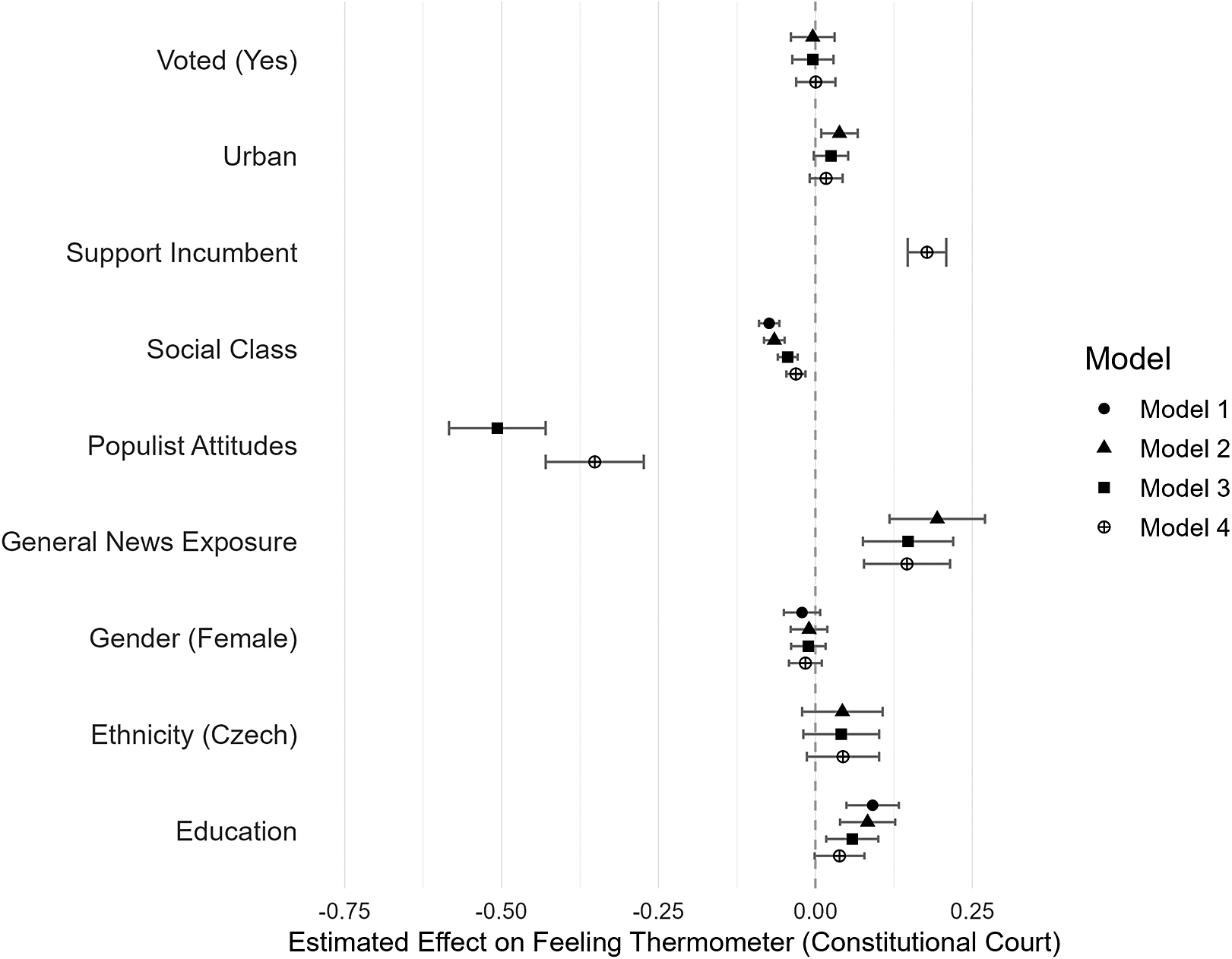
In Figure 3, I estimate the descriptive relationship between various demographic variables and the pretreatment measure of attitudes toward the Constitutional Court. Firstly, the findings corroborate the general findings that political knowledge and higher level of education are associated with higher trust in judicial institutions. Furthermore, individuals’ self-reported economic class is linked in all three models with attitudes to the Court: individuals in lower economic class are more likely to be skeptical of the Constitutional Court. Most significantly, the descriptive findings reveal stark differences in attitudes toward the Court between populist and non-populist voters, even controlling for whether or not individuals are supporters of the party currently in government. Given the descriptive nature of the findings and a convenience sample, it is difficult to generalize these findings to other contexts. Nonetheless, these findings do provide important evidence – consistent with theories posited in this article regarding the nature of populist discourse – that helps contextualize the findings of the experiment and alleviate valid concerns regarding sufficient heterogeneity in theoretically important pretreatment variables.
Descriptive Relationship Between Pretreatment Covariates and a Pretreatment Measure of Attitudes Toward the Constitutional Court. Note: Results from linear regression, and 95% confidence intervals.
Results
In this section, I present the findings of the study, testing the hypotheses that exposure to populist, partisan, and procedural frames can influence citizens’ perceptions of judicial legitimacy in the Czech Republic. The experimental design was structured to isolate these effects using survey vignettes. As demonstrated below, the results show an absence of detectable effects for all three of the experimental conditions, which is further supported by lack of observable interactions between covariates posited in advance to moderate the effect of the frames.
Main effects
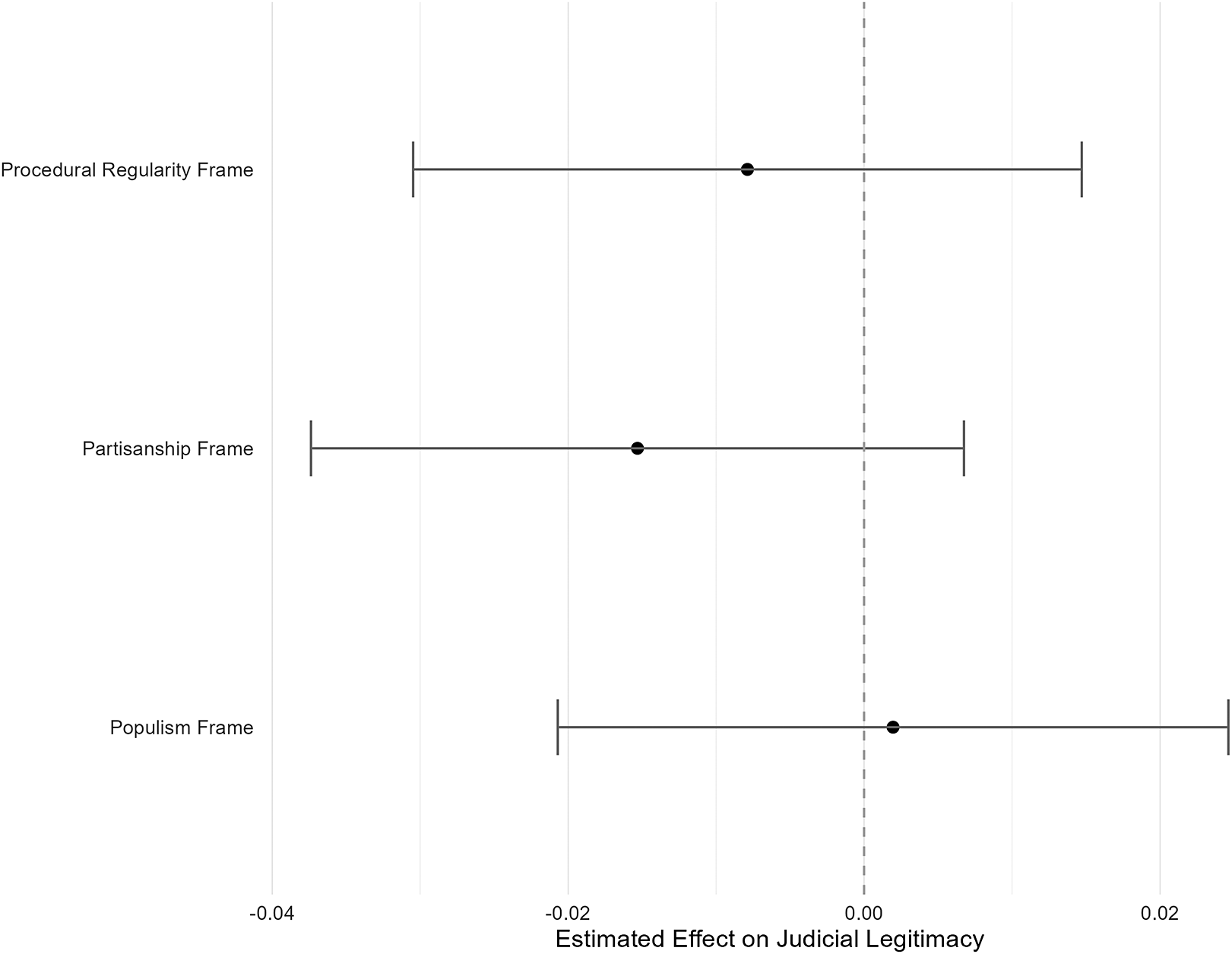
Figure 4 describes the main effects. As can be seen, the experimental vignettes had no observable effect on participants’ perceptions of legitimacy. As compared to providing individuals with a purely legalistic frame describing the Court’s decision in terms of its legal rationales, participants in the treatment conditions did not perceive the Court as more or less legitimate, as measured by their responses to a battery of diffuse support questions. The results remain insensitive to inclusion of a pretreatment repeated measure as a covariate. Thus, I find little support for the three main hypotheses identified above.
Main Experimental Effects. Notes: Results from linear regression, and 95% confidence intervals. Repeated measure covariate omitted from the graph.
Such results are somewhat inconsistent with prior studies that have found strong influence of partisan cues on attitudes to the judiciary. They are consistent, however, with the theoretical propositions of earlier research that view diffuse support as a hard-to-change, durable construct that captures attitudes responsive to events of outsize importance.
Heterogeneous effects
It is possible that absence of unidirectional effects may – at least in part – be driven by treatment heterogeneity. For example, one may argue that individuals cued with judges’ educational status, depending on their preexisting attitudes toward the elite or their education status, may be differently affected by the treatment condition. Thus, we should expect the pretreatment measure of populism to interact with the main effect of a Populism condition.
Similarly, it is reasonable to suggest that individuals who vote in elections may be more likely affected by the frame that portrays the court’s decision to have had an effect on their preferred parties’ performance. Variables such as individuals’ exposure to news may also interact with the Partisan frame. On one hand, individuals more often exposed to the news may have already received the news about the Court’s decision and formed a stable opinion (suggesting that a partisan effect would be lower) or that highly informed individuals engaged with politics would react more strongly to a piece of information regarding the Court’s decision. Regardless, attempting to uncover such effects is warranted.
As Figure 5 demonstrates, however, no strong evidence supports concluding that treatment effects are, indeed, heterogeneous in the way that has been anticipated ex ante. One should be cautious, however, with interpreting the moderating effects of such variables, due to the non-causal nature of moderating effects and the limited extent of the actual presence of heterogeneous effects (Coppock, Leeper, and Mullinix Reference Coppock, Leeper and Mullinix2018). It is plausible that, if the treatments were heterogeneous, such effects would be particularly difficult to observe given the sample sizes needed to uncover such relationships. While the present study is sufficiently powered to uncover even small effects of the main experimental interventions, given the utilization of the quasi pre-post design, these calculations do not apply with the same force to the potential moderators.
Interaction Effects. Notes: Results from linear regression, and 95% confidence intervals. Repeated measure covariate omitted from the graph.
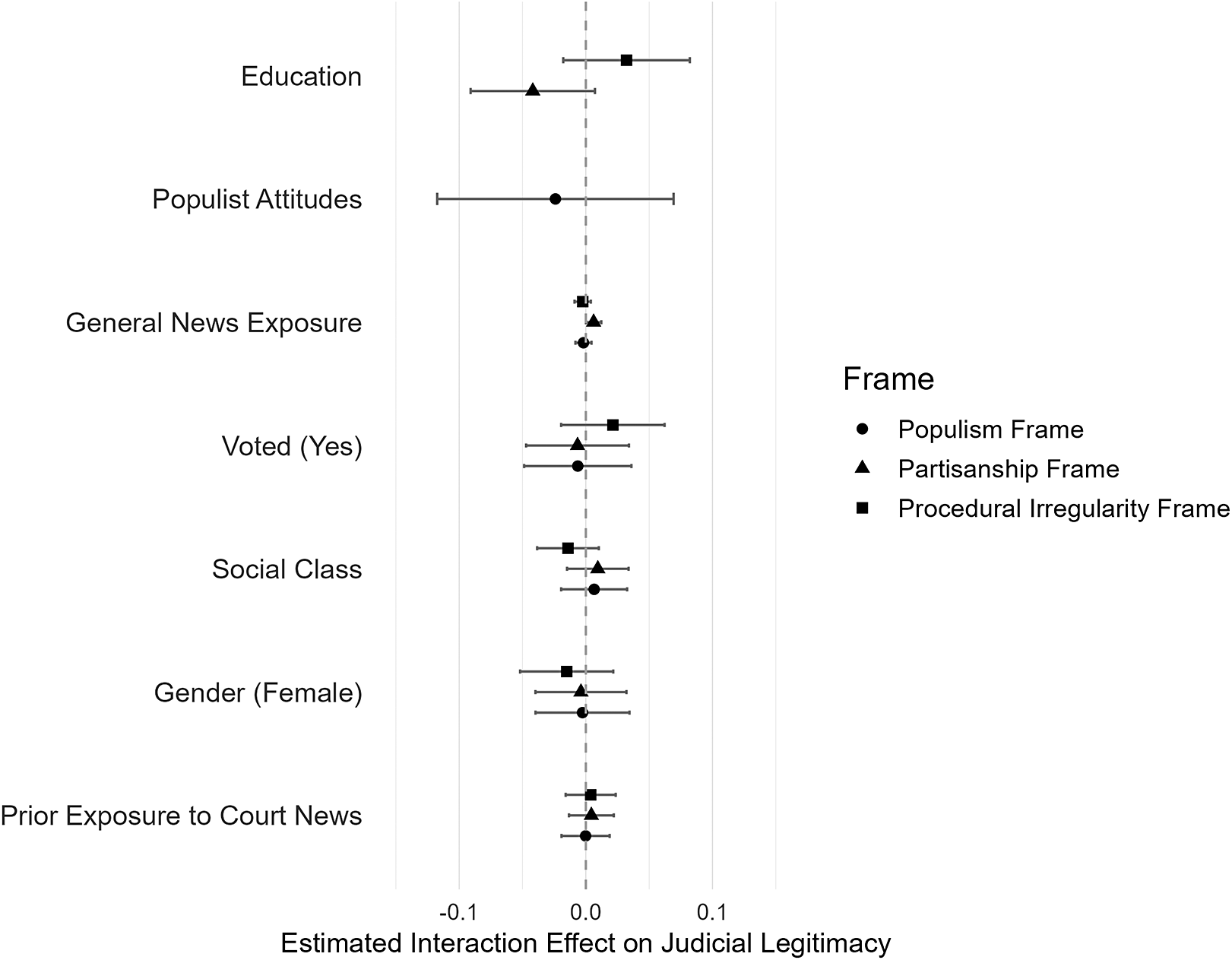
That said, a lack of strong and observable interaction effects does provide support against the alternative explanation of our main results being rooted in any potential deviations between the sample and a random sample.Footnote 4 Indeed, the study finds no interactions between the efficacy of populist, partisan, or procedural irregularity frames and pretreatment demographic variables. A strong objection against using a real-world ruling made by the Constitutional Court is to argue that participants had already been treated by exposure to the news regarding the ruling. In that sense, it would be unsurprising to observe null effects in this study, leading to only limited insights about the general effect of the frames on legitimacy. However, beyond the argument that – as evidenced by the pilot study – a large majority of individuals did not closely follow the ruling, there is also no observable moderating effect of either the exposure to news about the Court specifically or of general awareness of events in the country on any of the treatment conditions. Thus, the observed lack of statistically significant moderators further supports the main findings of the study: that legitimacy attitudes toward the Court are not easily shaped by negative portrayals of the Court decision-making process, its status as an elite, or the outcomes of its decisions.
Discussion
Contrary to the existing evidence of voters’ sensitivity to the characterization of the judicial institutions as illegitimate, and the resulting capacity of the would-be authoritarian leaders to disempower the courts, this study provides evidence that voters’ perceptions of judicial legitimacy are not easily shaped by providing them with biased characterizations of their output. It, thus, lends support to the early research on judicial legitimacy, which emphasized the relative stability of the diffuse support toward judicial institutions and the importance of the age of the judiciary as a crucial factor in its capacity to sustain that support (see e.g., Gibson, Caldeira, and Baird Reference Gibson, Caldeira and Baird1998).
It is unlikely that the unique demographic features explain the lack of observable effects: as discussed above, the Czech Republic experienced a significant period of populist governance leading to change of political attitudes (Dvořák Reference Dvořák2022), the emergence of political cleavages based on populism and nationalism (Havlík Reference Havlík2019), and the level of affective polarization in the country is comparable to that of other European countries (Bettarelli, Reiljan, and Van Haute Reference Bettarelli, Reiljan and Van Haute2023). Recent analyses of the unique pathway of the Czech Constitutional Court highlighted the Court’s gradual, self-constrained, and selective expansion of its judicial power as key to its success: it was able to avoid socially controversial decisions, thus raising the stakes of potential court-curbing (Smekal, Benák, and Vyhnánek Reference Smekal, Benák and Vyhnánek2022; Šipulová and Králová Reference Šipulová and Králová2024).
Nonetheless, it is unclear whether a more significant and continuous public information campaign against the judiciary may provide for a more significant possibility to undermine judicial legitimacy. The observed correlations among some of the voters and their distrust of the Court provide limited evidence that it has already done so. Future research can also address whether individuals’ perceptions of the Court would be significantly altered due to disagreement with the policy effect of their decisions, not necessarily only with their impact on partisan politics. There are several limitations of the present study, including arguably insufficient power to demonstrate the absence of heterogeneous treatment effects, non-ideal representativeness of the sample with respect to the broader Czech population, and the potential interdependence between the realistic vignette employed and the preexisting beliefs about the vignette. The evidence provided here does, however, indicate that scholars of democratic backsliding should consider more carefully institutional and agential dynamics of patterns of democratic (de-)consolidation, which – while related to the broader behavior and electoral dynamics – are not necessarily tightly linked to such and exhibit independent causal forces.
Data availability statement
Replication materials are available in the Journal of Law and Courts Dataverse website and https://osf.io/q4szc/files/github?view_only=/osf.io.
Acknowledgments
The author wishes to thank Jordan Gans-Morse, Andrew Saab, Jason Seawright, and Matej Jungwirth for their insightful feedback on this paper. Appreciation is also extended to the participants of the European Consortium of European Research, Law and Courts section for their valuable contributions.
Financial support
This research was supported by the Northwestern University Graduate Research Grant.
Competing interest
The author has no conflicts of interest to disclose.


 Open access

