

INTRODUCTION
A defining feature of police organizations is that they are moral battlefields (Muir Reference Muir1977; Sherman Reference Sherman2014). The battles occur across two domains: the first concerns questions about the wrongfulness or otherwise of unethical conduct in some situations. Such conduct might take the form of bribe taking, the bending of rules to achieve certain outcomes—for example, evidence planning or suppressing exculpatory evidence—or excessive use of force (Kleinig Reference Kleinig1996). This problem of police misconduct is transnational, varying only in its manifestation, scope, and severity. Police misconduct commands scholarly and policy attention because it poses a threat to public safety, human rights, the rule of law, and confidence in police organizations and democratic governance (Solar Reference Solar2015; Nivette Reference Nivette2016).
The second domain of the moral battle is the reactions of police officers to misconduct by their colleagues (Tankebe Reference Tankebe, Bottoms and Jacobs2023). The detection of police misconduct can come from “premonitory” or “postmonitory” strategies (Sherman Reference Sherman1978). The former includes direct observations such that officers can be apprehended in the act of misconduct, producing audio or video evidence. Postmonitory strategies, on the other hand, are focused on the past, relying on witness accounts. Witnesses to misconduct may be civilian victims who often complain to external accountability institutions or directly to the police. Another source of postmonitory information is police officers themselves—that is, officers who choose to blow the whistle on their colleagues on suspicion of unethical conduct. However, it is well established that, for a variety of reasons, officers are often reluctant to provide information about their colleagues (Casey Review 2022). Yet, unless unethical officers are held to account, they will persist in conduct that threatens the safety of their fellow officers, the well-being of citizens, and the rule of law.
Consequently, understanding the conditions associated with the decisions of officers to blow the whistle on misconduct is a crucial and urgent task. Drawing on data from a survey of police officers in India, our study contributes to the current literature on the prevalence and correlates of whistleblowing decisions in two ways. First, the literature relies mainly on data from the United States and Europe (Wolfe and Piquero Reference Wolfe and Piquero2011; Long et al. Reference Long, Eileen Cross, O’Connor Shelley and Kutnjak Ivković2013; Westmarland and Rowe Reference Westmarland and Rowe2018). We lack similar studies in other global regions such as South Asia. The socioeconomic and political contexts of policing significantly shape the quality of policing in any country. Hence, making general claims about how officers respond to misconduct requires scholarly input from diverse sociopolitical contexts. It also allows us to establish which factors are specific to particular contexts and which factors travel across different contexts. Such knowledge can enhance comparative criminological and socio-legal scholarship. Second, prior studies have investigated the roles of organizational justice and the bonds between police officers (Wolfe and Piquero Reference Wolfe and Piquero2011). In addition to these correlates, we examine the potential role of self-legitimacy, perceived audience legitimacy, and police effectiveness. It is true that decisions are only declarations or intentions and should therefore not be conflated with actions. Moreover, it is well known that “not all decisions lead to action” (Elster Reference Elster2007, 163); in the specific case of whistleblowing by police officers, recent evidence suggests no correlation between whistleblowing intentions and self-reported whistleblowing (Tankebe Reference Tankebe, Bottoms and Jacobs2023). Yet “decisions can have causal efficacy even when they do not generate an action,” and this makes them worthy of social-scientific analysis (Elster Reference Elster2007, 164).
THE DECISION TO BLOW THE WHISTLE ON MISCONDUCT
Consider the following vignette: a police officer has information that fellow officers planted evidence on a suspect. The officer faces an ethical problem to the extent that there are moral rules about what police officers ought to do when colleagues engage in inappropriate conduct (Tankebe Reference Tankebe, Bottoms and Jacobs2023). The formal rules may require officers to report such conduct. Yet there may be other forces beseeching the officer to defy the formal injunction. As an ethical problem, police whistleblowing behavior is explicable in terms of personal and situational conditions (Tankebe Reference Tankebe, Bottoms and Jacobs2023). In what follows, we discuss some of the conditions that we will investigate empirically in this study.
Personal Morality
Humans are quintessentially moral beings. They possess norms and values that shape their views about the propriety or otherwise of conduct in particular situations (Bicchieri Reference Bicchieri2017). According to Charles Taylor (Reference Taylor1989, 3), people act within “inescapable frameworks.” The frameworks are inescapable because they provide the lenses through which people form opinions or act on a range of moral questions (Bottoms Reference Bottoms2022; Tankebe Reference Tankebe, Kutnjak Ivković, Maskály, Donner, Mraović and Das2022a). Ruth Abbey (Reference Abbey2000, 34) observes that, for Taylor, moral frameworks serve as moral maps that allow people to orient themselves in moral spaces and to decide what courses of action are appropriate in particular settings. Morality is an important explanatory factor in criminology (see Hirschi Reference Hirschi1969). In Per-Olof Wikström’s (Reference Wikström, Per-Olof, Oberwittler, Treiber and Hardie2012, 15) “Situational Action Theory,” a person’s morality affects their perceptions and choice of crime as a “viable action alternative.”
Police officers are known to conceptualize their work in highly moral terms. Officers conceive police work as a mission, and they make moral choices regarding how to exercise discretionary authority to achieve that mission (Herbert Reference Herbert1996). When people believe in the morality of a particular course of action, they are more inclined to pursue it (Bicchieri Reference Bicchieri2017). It follows that if officers perceive the behavior of their colleagues as morally wrong, they will be more likely to want to do something about it. In a survey of 208 Ghanaian police officers, Justice Tankebe (Reference Tankebe, Bottoms and Jacobs2023) found that officers who perceived a given behavior to be wrong were more likely to report colleagues who engaged in it. Based on this we formulate our first hypothesis: t he more officers disapprove of misconduct, the more likely they are to report such conduct by their colleagues.
Self-Legitimacy
Legitimacy is a characteristic of a power relationship that is recognized as rightful by relevant parties (Beetham Reference Beetham2013). Anthony Bottoms and Justice Tankebe (Reference Bottoms and Tankebe2012, Reference Bottoms and Tankebe2013) differentiate between audience legitimacy (see further below) and self-legitimacy. Self-legitimacy is rooted in Max Weber’s (Reference Weber, Henrich and Charles2009) seminal work on power and authority. In “Politics as a Vocation,” he argued that, while the external justification of power was important to the stability of systems of authority, even more crucial was the moral convictions that power holders developed about their roles (see also Kronman Reference Kronman1983; Barker Reference Barker2001; Wrong Reference Wrong2017). Used in the context of policing, self-legitimacy describes the beliefs that individual police officers have in the rightness of their authority (Bottoms and Tankebe Reference Bottoms and Tankebe2012, Reference Bottoms and Tankebe2013). Further, Bottoms and Tankebe (Reference Bottoms and Tankebe2012, Reference Bottoms and Tankebe2013) argue that, unless police officers can justify the rightness of their authority and role to themselves, they might struggle to perform their jobs and to command legitimacy among citizens (compare Boulding Reference Boulding1967). Police officers constantly face two extremes: under-confidence and over-confidence in self-legitimacy. Under-confidence can give way to non-performance. In William Muir’s (Reference Muir1977) ethnographic study of twenty-eight rookies in the United States, he identified a type of police officer, described as the avoider. A defining feature of such officers was a failure to develop moral justification for their authority. Consequently, they lacked self-confidence, leading them to avoid interactions with citizens. However, Muir also found officers with over-confidence. These officers were prone to abuse of their authority, preferring interactions that required aggressive enforcement of the law. Self-legitimacy is neither under-confidence nor over-confidence; it is a self-belief that is normatively constrained (Bottoms and Tankebe Reference Bottoms and Tankebe2012, Reference Bottoms and Tankebe2013; Wrong Reference Wrong2017).
Survey-based studies of self-legitimacy have found that officers with high self-legitimacy show greater commitment to procedural justice during interactions with citizens (Jonathan-Zamir and Harpaz Reference Jonathan-Zamir and Harpaz2018) and demonstrate a propensity to respect the rights of suspects (Bradford and Quinton Reference Bradford and Quinton2014). Analyzing data from Slovenian police officers, Tankebe and Gorazd Meško (Reference Tankebe, Meško, Meško and Tankebe2015) found that officers with high self-legitimacy were less prone to the use of force. Jannie Noppe (Reference Noppe2016) analyzed survey data from a sample of 137 Belgian police officers and found that self-legitimacy was negatively associated with self-reported frequency of the use of force. These findings suggest that self-legitimacy can induce ethical behaviors among officers. Extrapolating from these findings, we conjecture that reporting misconduct by colleague officers may be an ethical behavior that self-legitimacy induces. In a survey of 148 American police officers, Sanja Kutnjak Ivković and colleagues (Reference Kutnjak Ivković, Maskaly, Kule, Haberfeld, Kutnjak Ivković, Maskaly, Kule and Haberfeld2022) reported that self-legitimacy was inversely associated with commitments to the code of silence in some cases of misconduct but not others. Thus, our second hypothesis is: the more confident officers are in their legitimacy, the more likely they are to report misconduct.
Personal morality and self-legitimacy concern the individual moral orientations of police officers. Both therefore capture an actor’s moral dispositions and the consequent implications for decisions. However, a person’s ethics or moral character must confront situational pressures (Doris Reference Doris2002). Consequently, empirical analysis of police whistleblowing behavior must also examine situational factors. This is trite given that police officers do not operate in a social vacuum; they are persons rather than individuals; hence, they are a “complex of social relationships” (Radcliffe-Brown Reference Radcliffe-Brown1940, 5). How officers feel they are treated in relationships with peers, supervisors, and local communities is consequential for their ethical behavior.
Bonds with Peers
A staple explanation for behaviors by police officers is the existence of a subculture—that is, “values, norms, perspectives, myths, and craft rules that inform [police] work” (Bowling, Reiner, and Sheptycki Reference Benjamin, Reiner and Sheptycki2019, 170–71). Police culture is not monolithic. The research evidence shows differences in subcultures across police units, roles, and ranks (Reuss-Ianni Reference Reuss-Ianni1983; Chan Reference Chan1996). However, certain characteristics appear common: the “moralizing” of the police mandate not merely as a job but also as a mission; suspiciousness that sometimes leads to the stereotyping of citizens; conservatism; a feeling of isolation from the community coupled with a strong sense of solidarity among officers; and, in some societies, racialized or class-based prejudice (Herbert Reference Herbert1998; Skolnick Reference Skolnick2002).
Of particular interest for us here is the characteristic of solidarity. Solidarity is a feature of all groups. It implies communication, shared commitments, and mutually recognized expectations. According to James Coleman (Reference Coleman1988, 110), “a group within which there is extensive trustworthiness and extensive trust is able to accomplish much more than a comparable group without that trustworthiness and trust.” However, solidarity is a value-neutral notion: it does not tell us anything about the worthiness of the tasks to which it might be directed. Therefore, the consequences of solidarity—or a sense of strong bonding—within a group can be healthy or unhealthy. There is evidence that strong bonds between police officers can help officers cope with the psychological and physical demands of the job (Kleinig Reference Kleinig2001; Skolnick Reference Skolnick2002; Crank Reference Crank2015). It is also known to promote the self-legitimacy of officers (Tankebe and Meško Reference Tankebe, Meško, Meško and Tankebe2015; Nix and Wolfe Reference Nix and Wolfe2017) and to enhance a willingness to engage in pro-organizational behaviors (Tankebe and Meško Reference Tankebe, Meško, Meško and Tankebe2015).
However, strong bonds among police officers are also considered a risk factor for unethical policing by condoning the violation of departmental policies (Sierra-Arévalo Reference Sierra-Arévalo2021). Solidarity among officers induces a “blue wall of silence” (Kleinig Reference Kleinig2001, 5; Skolnick Reference Skolnick2002, 7). This refers to “an unwritten rule that forbids reporting another officer’s illegal activities for any reason” (Heck Reference Heck1992, 253). The conclusions of the royal commission that investigated corruption within the New South Wales police underscored the power of the code of silence among police officers. Even though officers knew about misconduct by their colleagues, “the strength of the code, and the blind hope that no one would break it, prevailed” (Wood Reference Wood1997, 155). In an ethnographic study of American police officers, Michael Sierra-Arévalo (Reference Sierra-Arévalo2021, 71) found that officers were “socialized into the danger imperative—a cultural frame that emphasizes violence and the need for officer safety,” which influenced their responses to rule-breaking behaviors by peers. It creates reciprocal obligations such that those whose rule violations are unreported incur a “moral” duty not to report future misconduct by others (Kleinig Reference Kleinig2001). Given this, it is expected that strong bonds between officers will be inversely associated with a decision to report misconduct. This observation leads to our third hypothesis: the stronger the bond between officers, the less likely officers are to report misconduct by colleagues.
Perceived Audience Legitimacy
Audience legitimacy concerns perceptions of legitimacy by those who are subject to power (Bottoms and Tankebe Reference Bottoms and Tankebe2012, Reference Heck2017). In the context of policing, the audiences might be victims, suspects, or the wider community. Audience legitimacy comprises police responses to, at least, four “basic legitimation expectations”: effective exercise of authority, lawful conduct, distributive justice, and procedural justice (Bottoms and Tankebe Reference Bottoms, Tankebe, Meyerson, Mackenzie and MacDermott2021, 90). Distributive justice concerns the perceived fairness of police decisions, while procedural justice refers to the quality of interpersonal treatment (Tyler Reference Tyler2006; Tyler and Meares Reference Tyler, Meares, Weisburd and Anthony2019). Consequently, the notion of perceived audience legitimacy describes officers’ impression of how well the police are doing in meeting these legitimation expectations (Tankebe and Meško Reference Tankebe, Meško, Meško and Tankebe2015; Nix, Pickett, and Wolfe Reference Nix, Pickett and Wolfe2020).
Police-audience relationships are varied and complex (Bell Reference Bell2016; Worden and McLean Reference Worden and McLean2017; Newburn Reference Newburn2022). In democratic societies, the police are, to some extent, “under the sway of citizen influence” (Herbert Reference Herbert2006, 484). Yet, in practice, police-community relations are often fraught, and the ability of citizens to influence police activities is limited (Cheng Reference Cheng2020, Reference Cheng2022). Mutual cynicism means that, on the one hand, police officers sometimes are predisposed to believe they command low audience legitimacy, that citizens pose a threat to their safety, and that people cannot be relied upon to obey the law or to cooperate with the police to maintain social order. On the other hand, a history of police violence, corruption, unresponsiveness, and discrimination induces public disrespect and distrust of officers and pressures for systemic reform (Epp, Maynard-Moody, and Haider-Markel Reference Epp, Maynard-Moody and Haider-Markel2014; Bell Reference Bell2016; Morris and Shoub Reference Morris and Shoub2023).
Using data from a survey of 567 American law enforcement officers, Justin Nix and Scott Wolfe (Reference Nix and Wolfe2017) showed that perceived negative publicity undermined proactive engagement with the public. Tankebe and Meško (Reference Tankebe, Meško, Meško and Tankebe2015) found that Slovenian police officers who perceive high audience legitimacy are more likely to use verbal warning rather than the threat of force to resolve situations. These studies imply that perceived audience legitimacy should induce misconduct reporting decisions among officers. The logic is clear: unchecked, unethical behavior will incur public displeasure, placing police audience legitimacy at risk. Yet, as the case of police extrajudicial killings in some countries demonstrates, police behaviors that violate principles of the rule of law can sometimes command significant public approval (Belur Reference Belur2010; Johnston and Fernquest Reference Johnston and Fernquest2018). Consequently, where the quality of policing that commands audience legitimacy entails a disregard for the rule of law, officers may be disinclined to report misconduct. Hence, our fourth hypothesis: t he greater the perceived audience legitimacy, the less likely officers are to report misconduct.
Organizational Justice
Justice is important in power relationships (Sen Reference Sen2009; Johnston Reference Johnston2011). Within organizations, it includes people’s experiences and perceptions of fair treatment at their places of work. Among the key dimensions of organizational justice are distributive justice and procedural justice (Colquitt et al. Reference Colquitt, Conlon, Wesson, Porter and Yee Ng2001). Procedural justice concerns judgments about how fairly organizations treat employees (Tyler, Callahan, and Frost Reference Tyler Tom, Callahan and Frost2007; Tyler and Blader Reference Tyler and Blader2013). First, it comprises judgments about the extent to which opportunities are provided for officers to make an input in decisions that affect them. It is not enough to offer a perfunctory voice: officers want to feel that their supervisors sincerely care about their opinions and take them into account when making decisions. Second, it includes trustworthy motives—that is, showing care for the well-being of officers. Third, it means treating officers with respect. This can range from simple acts of courtesy, the tone of voice, and the choice of vocabulary to an awareness of cultural and religious sensibilities. Fourth, it must include neutrality. Officers want supervisors to eschew favoritism, prejudice, and bias in their decisions; on the contrary, their decisions should be evidence and rule based, and the rules should be applied consistently (Tyler and Meares Reference Tyler, Meares, Weisburd and Anthony2019).
Distributive justice, on the other hand, focuses on “the fairness of the ends achieved” (Greenberg Reference Greenberg1990, 400). However, the concern is not with the ends per se but, rather, with the distributional aspect—that is, how many of the ends do different individuals or groups receive and what are their perceived or actual fairness. Within police organizations, we find officers of different races, experiences, ranks, religious beliefs, sexual orientations, and gender. What the police organization distributes across these social categories includes promotions, disciplinary actions, pay, and job assignments. In such a distribution, some officers may question the fairness of what they receive compared to what other officers receive. Thus, lower-ranking officers sometimes feel that misconduct allegations against them are more readily investigated than allegations against senior officers (Punch Reference Punch1985).
Experiences of fairness within police organizations induce a commitment to ethicality and the rule of law. According to Scott Wolfe and Alex Piquero (Reference Wolfe and Piquero2011, 337), “[p]olice officers who perceive their organization to engage in unfair managing procedures, inequitable distribution of resources, or disrespectful interpersonal treatment may be more inclined to violate agency norms and regulations by committing acts of misconduct.” Analyzing data from a police force in the United Kingdom, Ben Bradford and Paul Quinton (Reference Bradford and Quinton2014) reported that officers treated fairly by supervisors expressed a greater willingness to respect the rights of suspects. In Ghana, Tankebe (Reference Tankebe2014) found that police officers who reported being treated procedurally justly were more committed to the fair treatment of citizens. Similarly, in survey data from New York, Tom Tyler, Patrick Callahan, and Jeffrey Frost (Reference Tyler Tom, Callahan and Frost2007) showed that fair treatment by supervisors induced a stronger adherence to rules by law enforcement officials. In the specific case of misconduct reporting, Wolfe and Piquero (Reference Wolfe and Piquero2011) found that officers expressed less commitment to the “code of silence” if they perceived fair treatment by their supervisors. They were also less likely to receive citizens’ complaints against them and to engage in acts of noble-caused corruption. Consequently, we hypothesize as follows: officers who experience fair treatment by supervisors are more likely to express willingness to report misconduct by colleagues.
Police Effectiveness
For any society, “the ‘first’ political question [concerns] the securing of order, protection, safety, trust, and the conditions of cooperation” (Williams Reference Williams2005, 3). Police officers are important actors in the quest to reproduce and maintain social order (Abt Reference Abt2019; Braga et al. Reference Braga, Turchan, Papachristos and Hureau2019; Frowd Reference Frowd2022). How effective the police are in public protection and at what cost to the well-being of citizens remain contested (Chalfin and McCrary Reference Chalfin and McCrary2017; Legewie and Fagan Reference Legewie and Fagan2019; Koehler and Smith Reference Koehler and Smith2021). Of importance to the present study are the subjective assessments by police officers about their institutional effectiveness. Do they believe their agency is effective in preventing crime? What do such perceptions mean for their ethical choices?
When police officers feel powerless to solve a crime and find that their efforts do not yield “justice,” they sometimes “take the law into their own hands and dispense justice, even if it means using violence” (Reiss and Bordua Reference Reiss, David and Bordua1967, 33). Researchers document how police officers in India often stage the extrajudicial killing of criminal suspects—a phenomenon known as “encounters”—in an alleged quest to tackle violent crimes (Belur Reference Belur2010; Jauregui Reference Jauregui and Clark-Decès2011, Reference Jauregui2015). In other cases, the unlawful crime prevention strategies of the police involve partnerships with violent non-state actors. In Sao Paulo, Grahama Denyer Willis (Reference Denyer Willis2015) found evidence of police collusion with organized criminal gangs to kill individuals suspected of violence. Here, ineffectiveness induces powerlessness and an attempt to outsource police work to actors who lack the appropriate legal mandate. Criminologists use the term “noble-caused corruption” to describe police violation of principles of due process and the rule of law in the quest to achieve a perceived “good greater than the harm caused by any illegal behavior of the police” (Crank, Flaherty, and Giacomazzi Reference Crank, Flaherty and Giacomazzi2007, 105). We assume that officers who believe their police organization is effective in tackling crime will be more likely to say they will report misconduct by their colleagues. Hence, our sixth hypothesis: officers who perceive the police to be effective are more likely to report misconduct.
DATA AND METHOD
The data for the study were collected from a survey of police officers. The officers were attending in-service and promotional training at Himachal Pradesh Training College. The college is the principal training institution for officers in Himachal Pradesh. Himachal Pradesh is one of the federal states of India. The state comprises twelve administrative districts, with a population of 6.86 million people, and covers a land area of 55,673 square kilometers (Population Census 2011). The census data further shows just under half of the population (49.3 percent) is female, and most people own their houses, with only 10 percent renting. Himachal Pradesh is a rural state with one in ten of its population living in urban areas (Population Census 2011). The major ethnic-religious group is Hindu, with minority groups comprising Christians, Muslims, and other groups (Population Census 2011; Singh et al. Reference Singh, Sahajpal, Kumar, Shukla, Bhandari, Sharma, Sharma, Chandra, Sharma and Thakur2021). Unlike other states, Himachal Pradesh has been largely insulated from violent agitations by minority groups for independent statehood (Dogra Reference Dogra, Ambagudia and Xaxa2020), although there are concerns about discrimination (Nehria and Ghosh Reference Nehria and Ghosh2023).
The total personnel strength of the Himachal police is eighteen thousand officers, of which 80 percent are of constable ranks. Community-oriented policing strategies have been implemented to foster greater public confidence in the police. The Indian Police Foundation (2021) conducted a national survey in twenty-nine states and found that the people of Himachal Pradesh perceived the police to be of moderately good behavior. The police in each state were rated on a scale of one to ten on key trust dimensions. Himachal Pradesh obtained a score of 6.71 on perceived accountability, 6.85 on being “helpful and friendly,” and 7.17 on overall trust (Indian Police Foundation 2021). However, allegations of misconduct, including bribery persist (Hindustan Times 2021).
Police officers who have information about misconduct by their colleagues are required to report directly to their superior officers. Anecdotal information that we gathered indicates that officers would typically write letters to their superiors about the wrongdoings of their colleagues. This may then trigger an inquiry if the allegations are adjudged to be serious and credible. We could not obtain data from the police on internally generated complaints. The State Vigilance and Anti-Corruption Bureau, established in 2006, is mandated to investigate corruption by police officers and other public officials. Between 2018 and 2022, it registered eighty-four police bribery cases of which the highest proportion (28.6 percent) was recorded in 2019. This declined to 16.7 percent in 2021 and started to rise in 2022 (19 percent). The bureau does not disaggregate its statistics by the source of the complaints. Consequently, we do not know the proportion of complaints that were filed by police officers about their peers.
Officers attending training at Himachal Pradesh Training College were invited to complete a short questionnaire about their views of their authority, their experiences within their departments and with the public, their assessments of the effectiveness of the police, and their willingness to act against misconduct by their colleagues. Access was obtained through the second author, who was part of the college’s management at the time of the study. However, the participant information sheet bore the lead author’s institutional logo. It was made clear that the study was academic research for which participation was voluntary. Officers were given assurances of confidentiality and anonymity. The study had ethics approval from the Ethics Committee of the lead author’s university.
The questionnaire was paper based and self-administered between September and November 2019.Footnote 1 Out of fifteen hundred officers attending the training, 990 valid responses were returned, representing a response rate of 66 percent. However, only fifteen of the officers were female, a figure too low for any meaningful analysis. The current analysis, therefore, focuses on the 975 male officers, who were working in the field as investigators and detectives. Two-thirds (64 percent) were constables, the lowest rank in the Indian police, while 36 percent were inspectors. The officers had served between one and thirty-eight years, with a mean tenure of 21.5 years (standard deviation [SD] = 10.40). In terms of rank, 64.5 percent of the respondents were constables and 35.5 percent were inspectors. Official data on these demographic characteristics were unavailable; hence, it is difficult to establish the representativeness of the sample.
Dependent Variable
Our dependent variable was an officer’s willingness to report misconduct. To measure it, we crafted and presented officers with two scenarios. The first described a case of the planting of evidence on a suspected drug trafficker. It is worth quoting the scenario verbatim:
Police suspect Munish of drug peddling and illicit drug trafficking near college area. They have arrested Munish five times but failed on each occasion to achieve a conviction in court because of the lack of strong evidence. Two District CIA [Central Intelligence Agency] Police staff decided to plant one Kilogram of CHARAS (Cannabis) in his car and then arranged with traffic officers to stop and search Munish’s Car. Munish was arrested for illegal possession of narcotic drugs. He was convicted and sent to prison.
The second scenario concerned the assault of a suspected violent offender:
The police are looking for Arif on suspicion of robbery and attempted murder. Officers were called to a residential robbery and after a clash, Arif was arrested. While transporting him to the police station, the officers occasionally punched and slapped him.
After reading these scenarios, officers were asked to indicate how likely they were to report colleagues who engaged in such conduct to the authorities. The responses were on a five-point scale: very unlikely, unlikely, neither unlikely nor likely, likely, and very likely.
Independent Variables
Personal Morality
In a single item, officers were asked to indicate if they believed the behavior of the officers in the scenarios was morally appropriate. The responses ranged from 1 = very bad to 7 = very good. Thus, a higher score represents moral approval of the misconduct depicted in the scenarios.
Self-legitimacy
Three items, drawn from previous studies (see Tankebe and Meško Reference Tankebe, Meško, Meško and Tankebe2015; Tankebe Reference Tankebe2022b), were used to measure police views of their legitimacy: (1) I am sure I have enough authority to do my job; (2) as a police officer, I have a special kind of authority; and (3) as a police officer, I occupy a special position in India. Each item was measured with response categories ranging from 0 = strongly disagree to 3 = strongly agree. The variable “self-legitimacy” is a summation of responses to the three items (Cronbach’s alpha = 0.689), with higher scores indicating greater self-legitimacy.
Bonds with Peers
This was measured using five items: (1) in my position as a police officer, my fellow officers treat me with respect; (2) my fellow officers support me to do my job; (3) I have a good working relationship with police officers with whom I work; (4) in my position as a police officer, I feel my fellow officers trust me to make the right decisions; (5) as a police officer, I trust my fellow officers to make the right decisions (Tankebe and Meško Reference Tankebe, Meško, Meško and Tankebe2015; Tankebe Reference Tankebe2019). Each item was measured with response categories ranging from 0 = strongly disagree to 3 = strongly agree. The variable “bonds with peers” is a summation of responses to the four items (Cronbach’s alpha = 0.777), with higher scores indicating more positive perceptions of the bonds between officers.
Perceived Audience Legitimacy
Using items from Tankebe (Reference Tankebe2019), we measured officers’ estimation of their legitimacy among the local community with these four items: (1) most people do not believe officers take time to listen to citizens; (2) most people think officers do not fully explain reasons for their actions; (3) most people believe police officers do not obey the law; and (4) most people believe police officers are biased against them. (As currently negatively phrased, the items measure officers’ perceptions that the public thinks of them as illegitimate. We reverse coded the items for the scores to run in a positive direction—hence, to measure perceived audience legitimacy. This reverse coding does not make any material difference to the analysis.) Each item was measured with response categories ranging from 0 = strongly disagree to 3 = strongly agree. The variable “perceived audience legitimacy” is a summation of the responses to the four items (Cronbach’s alpha = 0.763). A higher score means the officers believe citizens consider the police to be legitimate.
Organizational Justice
Nine items were used to measure organizational justice (see Tyler, Callahan, and Frost Reference Tyler Tom, Callahan and Frost2007; Tankebe Reference Tankebe2019): (1) my senior officer uses authority in a respectful way; (2) my senior officers use authority in ways that show care for my well-being on the job; (3) my senior officer does not allow their personal biases to influence decisions about police work (reversed coded); (4) my senior officers listen to my opinions about decisions that affect the use of my authority; (5) my senior officers trust the way in which I use my authority; (6) my senior officers’ decisions are fair to all officers; (7) my senior officers provide me with enough support for my personal development as an officer; (8) the amount of work assigned to me is fair; and (9) my views about conduct that is right or wrong in police work is similar to those of my senior officer. The variable “organizational justice” is a summation of responses to the nine items (Cronbach’s alpha = 0.871), with higher scores indicating more positive experiences of organizational justice.
Perceived Police Effectiveness
We used six items to measure the officers’ perceptions of their organization’s effectiveness at crime control. Officers were asked how well they thought the police were doing in (1) tackling violent crime; (2) providing support for victims of crime; (3) responding to calls to incidents; (4) dealing with public order; (5) investigating crimes; and (6) solving issues that affect local communities. Each item was measured with response categories ranging from 0 = not well at all to 3 = very well. The variable “effectiveness” is a summation of responses to the six items (Cronbach’s alpha = 0.837), with higher scores indicating more favorable perceptions of police effectiveness (see Table 1).
Descriptive statistics for research variables
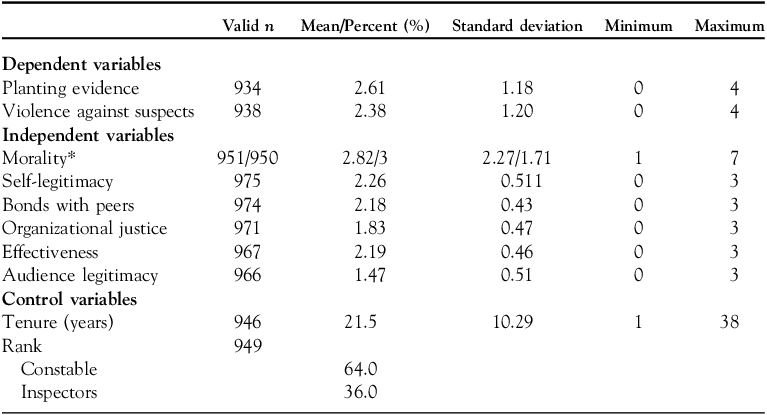
Note: * Scores are for “planting of evidence” and “violence against Suspects,” respectively.
FINDINGS
We start our analysis with a descriptive exploration of data. After reading the scenarios, 62.5 percent said they were “likely” or “very likely” to report colleagues who planted evidence on crime suspects. However, one-fifth (21.4 percent) were unlikely or very unlikely to report such misconduct. The distribution of these findings is comparable to those reported by Tankebe (Reference Tankebe, Bottoms and Jacobs2023) in Ghana: 50.5 percent of his Ghanaian officers were more likely to report planting of evidence by peers, while 32.1 percent indicated they were less likely to do so. In Ghana, 40.5 percent of officers said they would report violence against suspects, while 37.2 percent said they would report it (Tankebe Reference Tankebe, Bottoms and Jacobs2023). Intentions to report this form of misconduct were greater among our sample in India. Thus, just over half (54.2 percent) said they would report their colleagues; nearly one-third (27.9 percent) were unwilling to report. We found that between 16.2 percent (planting of evidence) and 17.8 percent (violence against suspects) were undecided on what they would do. A paired sample test showed that, on average, officers expressed a greater willingness to report the planting of evidence (M = 2.61, SD = 1.18) than to report violence against suspects (M = 2.38, SD = 1.20, t(938) = 6.91, p < 0.001). However, the magnitude of the difference in reporting intentions was small (Cohen’s d = 0.23) (see Table 2).
Police intentions to report misconduct by peers

Next, we conducted multivariate analyses to test our hypotheses concerning the influence of perceived morality, self-legitimacy, perceived legitimacy, organizational justice, and effectiveness. Specifically, we used multinomial regression models to help us estimate what differentiates officers willing to blow the whistle on misconduct from those unwilling to do so. To accomplish this, we categorized the officers into three separate groups: non-whistleblowers (comprising those who decided they were “very unlikely” or “unlikely” to report misconduct); the ambivalent made up of those uncertain about misconduct reporting; and whistleblowers capturing officers who indicated they were “likely” or “very likely” to report misconduct. We treated non-whistleblowers as the reference category against which the ambivalent and whistleblowers were compared. The results are presented in Table 3. They show that organizational justice is the most powerful correlate of whistleblowing decisions. Starting with the planting of evidence on criminal suspects, we found that police officers who experienced greater organizational justice were more likely to be whistleblowers than non-whistleblowers. They were also more likely to be ambivalent than non-whistleblowers. A similar picture emerged in the case of violence against criminal suspects: whistleblowers of this misconduct were more likely to be officers who experienced organizational justice.
Multinomial regression models predicting whistleblowing by officers
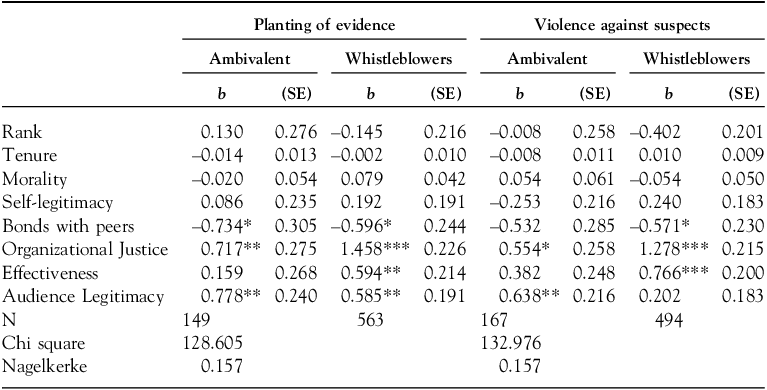
Note: Entries are unstandardized regression coefficients (b), standard errors (SE), *p < 0.05, **p < 0.01, ***p < 0.001.
We found that strong bonds with peers increased the odds that officers would be non-whistleblowers in cases of planting of evidence (β = –734, p < 0.05) and violence against suspects (β = –0.571, p < 0.05), supporting our hypothesis about the effects of solidarity with peers. These bonds also mattered in differentiating between non-whistleblowers and ambivalent officers in the case of the planting of evidence, with the latter less likely to report the planting of evidence; however, in violence against suspects, we found no evidence of differences in whistleblowing intentions between the two groups. Consistent with our hypothesis, perceived police effectiveness was statistically significant: whether in the planting of evidence or violence against suspects, perceived police effectiveness increased the odds that officers would be whistleblowers of misconduct as opposed to non-whistleblowers. With respect to perceived audience legitimacy, we found that it increased the odds that officers would blow the whistle on the planting of evidence. However, in the case of violence against criminal suspects, perceived audience legitimacy only increased the odds that officers would be ambivalent about whistleblowing as opposed to saying they would not blow the whistle on misconduct. There was no statistically significant difference between non-whistleblowers and whistleblowers.
Finally, we conjectured that self-legitimacy and personal morality would influence police decisions to report misconduct by their colleagues. However, contrary to our hypotheses, neither self-legitimacy nor personal morality was related to misconduct-reporting decisions. The finding about personal morality is contrary to what Tankebe (Reference Tankebe, Bottoms and Jacobs2023) reported in Ghana. That study and Louise Westmarland and Michael Rowe’s (Reference Westmarland and Rowe2018) UK study also found that the likelihood of misconduct reporting increased with length of service. Contrary to these findings, we found no evidence that the length of service was a statistically significant correlate of misconduct reporting decisions. Thus, situations rather than personal factors appear more decisive in the whistleblowing decisions of the officers surveyed.
Until now, we have examined the unique influence of personal and situational variables separately. However, as findings from situational action theory show, ethical decisions are often the product of interactions between personal and situational factors (Wikström Reference Wikström, Per-Olof, Oberwittler, Treiber and Hardie2012). To examine this possibility, we included interaction terms between self-legitimacy and morality, on the one hand, and each of our situational variables—bonds with peers, audience legitimacy, effectiveness, and organization justice—on the other hand. The aim was to determine whether the influence of personal factors depended on any of the situational factors. The results for morality are displayed in Appendix A. We found no interaction effects between morality and any of the situational variables. For self-legitimacy (see Appendix B), a statistically significant interaction emerged only for the model on evidence planting (b = –0.995, p < 0.05). Officers with high self-legitimacy were likely to be non-whistleblowers the more they believed the police were effective at crime control.
DISCUSSION AND CONCLUSION
Recent cases of police misconduct have reignited interest in ethics in police work. A key concern remains that unethical police behavior threatens police safety, discredits the rule of law, and violates the rights of the victims of misconduct. A key implication of this concern is that policing requires important structural reforms, including more robust accountability mechanisms. The effectiveness of such mechanisms depends critically on the flow of information not only from citizens but also from other police officers about the unethical conduct of their colleagues. Yet such a flow of information cannot be taken for granted. However, past research has relied on a limited set of factors and in limited global regions. In this analysis, we drew on survey data from a convenience sample of male constables and inspectors in the Indian federal state of Himachal Pradesh to examine police decisions to blow the whistle on misconduct in that state.
Several findings emerged from the analysis. First, similar to previous studies (Westmarland and Conway Reference Westmarland and Conway2020), our sample of male police officers differentiated between the types of misconduct they would report. We found that they would likely report the planting of evidence rather than violence against criminal suspects. How do we explain this difference in reporting intentions across misconduct types? Misconduct reporting is an ethical act—hence, the refusal to report may be viewed as an ethical failure (Tankebe Reference Tankebe, Bottoms and Jacobs2023). Terry Price (Reference Price2006) argues that ethical failures by power holders arise from two types of “cognitive mistakes.” First, there are mistakes concerning “what types of actions are morally permissible or right” or “why certain kinds of actions are wrong” (Price Reference Price2006, 19; emphasis added). Thus, violence against suspect offenders might have been viewed as permissible, especially given the legitimacy that extrajudicial violence commands in India (see Belur Reference Belur2010; Jauregui Reference Jauregui2015). Even if officers recognized the wrongfulness of violence against suspects, they might still rationalize it as a necessary “dirty means” to achieve the “good” of “justice” for victims and society (see Klockars Reference Klockars1980). Thus, in India, police officers admitted to Rachel Wahl (Reference Wahl2014, 807) that “they [used] torture more widely than their own conceptions of justice [allowed], but [saw] this as an imperfect implementation of their principles rather than as a violation of them.” Within such a normative context, officers would be less inclined to blow the whistle on violence against criminal suspects.
Price’s (Reference Price2006, 19; emphasis in the original) second cognitive mistake relates to the “moral status of individuals, especially to beliefs about their place within the moral community and the extent to which these individuals are subject to the rights and responsibilities that membership implies.” On this account, officers could mistakenly believe that their obligations regarding due process and respect for the rights of suspects are variable across types of criminal suspects. Our fictional suspect was depicted as culpable for very serious offences: suspicion of robbery and attempted murder. Consequently, the police officers we studied might have formed the view that such an individual stood outside the domain of moral commitment (Tankebe Reference Tankebe, Bottoms and Jacobs2023). Future studies of misconduct reporting that combine survey data with in-depth interviews will allow us to establish with certainty the reasons that officers believe some types of misconduct are reportable, but others are not.
Second, we found evidence that misconduct reporting decisions are coupled. Coupling is “the idea that behaviours are linked to very specific circumstances and conditions” (Gladwell Reference Gladwell2019, 273). Reporting decisions are coupled, first, to organizational justice. Officers who decided they would blow the whistle on colleagues for planting evidence on criminal suspects or for violence against such suspects were officers who experienced justice within the police organization. That is to say, in comparison with their non-reporting counterparts, these were officers who believed the organization listened to them, showed care for their well-being, treated them with respect, acted with impartiality toward them, and made fair decisions. The findings are broadly consistent with those reported by past research that organizational justice improves respect for the rights of criminal suspects and civil engagement with citizens (Bradford and Quinton Reference Bradford and Quinton2014). Injustice creates resentment and defiance (Agnew Reference Agnew1992; Sherman Reference Sherman1993), leading to disregard for organizational directives.
By inducing an abuse—or, more accurately, the condoning of the abuse—of the rights of criminal suspects, organizational injustice predisposes officers toward “displaced aggression.” In displaced aggression, “a person is provoked, is unwilling or unable to retaliate against the original provocateur and subsequently aggresses against a seemingly innocent target” (Denson, Pedersen, and Miller Reference Denson, Pedersen and Miller2006, 1032). Thus, officers feeling unjustly treated by their organization appear to retaliate by condoning the violation of the rights of citizens. Police organizations can be “objectively” just in their decisions and yet some of their officers feel they are not treated “equally” and act unethically based on this feeling of injustice.Footnote 2 Such criticisms of unequal treatment may appear, prima facie, vexatious. However, they can be understood as pointers to burgeoning moral issues within an organization that may develop into a legitimacy crisis (compare Sparks and Bottoms Reference Sparks and Bottoms1995). For example, the procedures and structures for dealing with officers may lag behind changing officer expectations about fair treatment. Consequently, a wise police supervisor or police chief should track the normative expectations of officers, listening attentively to moral criticisms, and treating officers in ways that can be “defended externally in moral and political arguments” (Sparks and Bottoms Reference Sparks and Bottoms1995, 59).
Given evidence of a “blue wall of silence” in policing (Kleinig Reference Kleinig2001; Skolnick Reference Skolnick2002), it was unsurprising to find that whistleblowing decisions by our Indian police officers were coupled to the strength of bonds among officers. This further reinforces the argument that unethical police conduct is a “network phenomenon” (Ingram, Terrill, and Paoline Reference Ingram, Terrill and Paoline2018; Ouellet et al. Reference Ouellet, Hashimi, Gravel and Papachristos2019; Wood, Roithmayr and Papachristos Reference Wood, Roithmayr and Papachristos2019). Does that mean that relationships between officers are necessarily ethically problematic? In her work on prisons, Alison Liebling (Reference Liebling2011) differentiates between “good” and “right” relationships (485). Good relationships are “too close or too informal, lacking boundaries and professional distance” (491). This can lead to officers turning a blind eye to wrongdoing or, in some cases, facilitating it. Officers, therefore, fail to recognize their obligations and commitments to organizational norms. Right relationships, on the other hand, are “somewhere between formality and informality, closeness and distance, policing-by-consent and imposing order” (491). Stated differently, right relationships are infused with strong ethicality; good relationships are ethically fragile. Our findings about the suppressive effects of peer relationships on whistleblowing permit a (tentative) conclusion that Himachal Pradesh officers operate in a “weak ethical setting”—that is, work settings that foster relationships that are corrosive of ethical injuctions to report misconduct (Tankebe Reference Tankebe, Bottoms and Jacobs2023, 108).
In high-violence societies, the core mandate of the police has particular salience. There is evidence that criminal victimization is a “robust and remarkably consistent predictor of political participation” (Bateson Reference Bateson2012, 584). For police officers, the prevalence of violence can generate support for non-state actors (Tankebe Reference Tankebe2011; Denyer Willis Reference Denyer Willis2015). It is also known to induce frustration and recourse to the “Dirty Harry problem,” where officers seek extrajudicial measures to control crime (Klockars Reference Klockars1980). The evidence from our survey of Indian police officers shows that perceptions of effectiveness affect police whistleblowing decisions. When presented with vignettes on the planting of evidence and violence against suspects, our sample of officers imagined themselves reporting colleagues engaged in such conduct if they believed the police were effective at their mandate. Their non-whistleblowing counterparts were those who perceived the police to be ineffective. Thus, they are willing to condone the abuse of due process and the rights of suspects as part of efforts to tackle violence. As the data also showed, officers with increased self-legitimacy would not report misconduct if they believed the police to be effective. This raises questions about the quality of police effectiveness. It suggests a type of “police effectiveness” that violates the normative principles designed to protect the rights of criminal suspects in democratic societies (Wahl Reference Wahl2014). Consequently, in seeking to achieve and communicate evidence of effectiveness to officers, police managers must avoid a crime reduction imperative (compare Sierra-Arévalo Reference Sierra-Arévalo2021)—that is, a narrow and crude preoccupation with crime trends. Crime prevention measures need to track and minimize risks of iatrogenic effects (Welsh, Yohros and Zane Reference Welsh, Yohros and Zane2020; Koehler and Smith Reference Koehler and Smith2021; Tankebe and Bottoms Reference Tankebe, Bottoms, Welsh, Zane and Mears2024).
Finally, to recall, audience legitimacy describes how much legitimacy officers believe they command in local communities. We found that officers were more likely to report, or to be ambivalent about reporting, noble-caused corruption if they perceived high audience legitimacy. However, in the case of police violence, those who were ambivalent about reporting rather than refusing to report were those who perceived high audience legitimacy. The officers might have felt caught between their commitments to the rule of law, on the one hand, and an audience legitimacy that was linked to police use of extralegal violence. In her ethnographic study in the Indian state of Uttar Pradesh, Beatrice Jauregui (Reference Jauregui2015, 48) quoted a police officer as saying:
I do not kill for personal gain, but for the greater good; when there is no other way out, [killing] must be done. And the people will praise you for it. When my team finished off [a “notorious gangster”], the people in the towns and villages he had been terrorizing were so happy! They threw marigolds on me and put me on their shoulders and carried me around. They queued up by the thousands at the station to thank me for doing what the courts could not.
Such social approval can be a powerful incentive for some officers to police through violence (Johnston and Fernquest Reference Johnston and Fernquest2018). As Steve Herbert (Reference Herbert2006) discussed in his work on Seattle in the United States, officers can sometimes find themselves pulled in conflicting directions by democratic forces, on the one hand, and commitments to a liberal order, on the other hand. Thus, our sample of male officers expressed uncertainty about what they might do when confronted with colleagues using illegitimate violence against suspects.
Limitations
The present study is not without limitations. First, the data were collected in a classroom setting at a training institution where the second author was part of the management team. Although we emphasized it was academic research and had the institutional logo of the lead author, we cannot be sure that the position of the second author did not influence the responses of the officers. Whether that influence is reflected in the relatively higher declarations of intention to report misconduct than was reported in other settings is an important unknown (see, for example, Tankebe Reference Tankebe, Bottoms and Jacobs2023). Unfortunately, we could not obtain data from Himachal Pradesh’s anti-corruption institution to provide an indication of the prevalence of whistleblowing by police officers. Second, the data came from a survey of a convenience sample of male police officers. The findings, therefore, tell us nothing about how female officers will react to misconduct by their colleagues. Are reactions to misconduct and the correlates gendered? How large are any differences between officers of different genders? What are the implications for promoting ethicality in policing? Answering these questions will add a much-needed nuance to the findings reported above. Third, the study employed a cross-sectional design, which is common in all studies on police whistleblowing decisions. Yet, as moral decisions are coupled to specific conditions, whistleblowing decisions are likely to change in response to changes to those coupling conditions. Longitudinal studies that track whistleblowing decisions over time might offer an important insight. Whether cross-sectional or longitudinal, the use of interview data can yield fruitful insights: how do officers understand and interpret the injunction to blow the whistle on misconduct and what sort of conduct do they consider worthy of reporting and why? Fourth, as with previous studies, we measured whistleblowing decisions rather than actions. It is very much an open question as to how far decisions will translate into acts of blowing the whistle on misconduct. This is an important limitation that future studies should address to advance knowledge on whistleblowing by police officers.
A final limitation is that we did not measure the attitude of senior leadership in the Himachal Pradesh police toward whistleblowing. A review into the handling of misconduct complaints in the London Metropolitan Police Service found that the service took almost a year to investigate allegations (Casey Review 2022). Officers interviewed reported that their supervisors sought to discourage reporting and that reporting attracted negative reactions. The Casey Review concluded that “[t]hese experiences reflect a deep mistrust of the misconduct system. Any initiatives which aim to encourage officers to report misconduct will continue to be undermined unless the system responds more effectively to those who have come forward” (7). Given this finding, our inability to measure officers’ impressions of the receptivity of their departments to whistleblowing represents a limitation that future studies should address.
Notwithstanding these limitations, the study shows that personal factors do not explain whistleblowing decisions. On the contrary, whistleblowing decisions are explicable by reference to situational variables—organizational justice, ethics on work teams, effectiveness in crime prevention, and community norms. The implication is that officers refusing to blow the whistle might not simply be “bad apples” but that they operate in environments that suppress whistleblowing. Similar to Tankebe (Reference Tankebe, Bottoms and Jacobs2023), our findings speak, to some extent, to the situationist critique of moral philosophy—specifically, virtue ethics. Situationists argue that, if people possessed virtuous character traits, they would act on their obligations “even under substantial pressure to moral failure” (Doris Reference Doris2002, 1). Thus, “a police officer who has the character trait of ethicality will be expected to act ethically when confronted with misconduct opportunities” (Tankebe Reference Tankebe, Bottoms and Jacobs2023, 120). By being more predisposed to report some types of misconduct than others, the officers studied showed cross-sectional inconsistency. The failure of personal morality and self-legitimacy to influence whistleblowing further suggests that the key to understanding and tackling unethical behaviors in policing is the work environment. Consequently, an institutional approach to police reforms—that is, reforms focused on practices and values within police departments—is required to create an environment that is less conducive to the flourishing of officers with unethical propensities (Tankebe Reference Tankebe, Bottoms and Jacobs2023).
Appendix A. Multinomial regression models exploring interactions between morality and situational variables

Notes: Entries are unstandardized regression coefficients (b), standard errors (SE) *p < 0.05; **p < 0.01; ***p < 0.001.
Appendix B. Multinomial regression models exploring interactions between self-legitimacy and situational variables
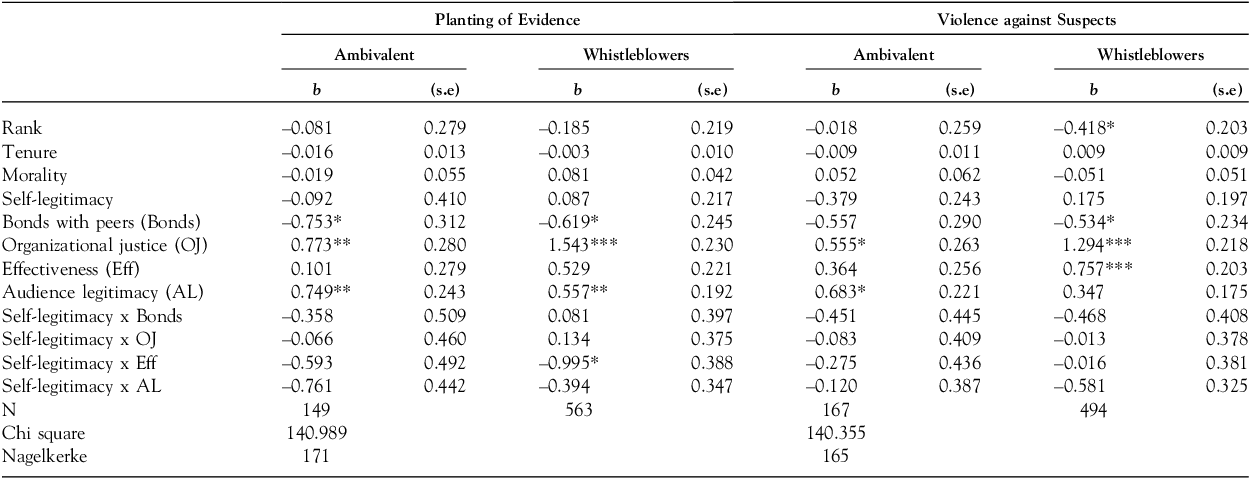
Note: Entries are unstandardized regression coefficients (b), standard errors (SE) *p < 0.05; **p < 0.01; ***p < 0.001.


 Open access

