


4.1 Introduction
Carbon (C) occurs in the mantle in its elemental state in the form of graphite and diamond, but also as oxidized compounds that include carbonate minerals and carbonated magmas, as reduced components such as methane and carbide, and as gaseous phases in the C–O–H chemical system. The occurrence of C-bearing phases characterized by different oxidation states reflects magmatic processes occurring in Earth’s interior that link to its oxygenation through space and time.Reference Kasting, Eggler and Raeburn1 Improving our understanding of the physical and chemical behavior of carbon at extreme conditions sheds light on the type and depth of possible reactions taking place in the interior of Earth and other planets over time and allows the identification of deep carbon reservoirs and mechanisms that move carbon among different reservoirs from the surface to the atmosphere, thereby affecting the total terrestrial budget of carbon ingassing and outgassing.
Carbon occurs in diverse forms depending on surrounding conditions such as pressure, temperature, oxygen fugacity (fO2), and the availability of chemical elements that are particularly reactive with carbon to form minerals and fluids. Despite the low abundance of carbon within Earth,Reference McDonough and Sun2 the stability of C-rich phases in equilibrium with surrounding minerals provides an important geochemical tracer of redox evolution in Earth and other planets, as well as an important economic resource in the form of diamonds.
Knowledge of carbon cycling through the mantle requires an understanding of the stable forms of carbon-bearing phases and their abundance at pressures, temperatures, and fO2 values that are representative of Earth’s interior. Such information is necessary to identify potential carbon reservoirs and the petrogenetic processes by which carbon may be (re)cycled through the mantle over time, eventually being brought to the surface by magmas and to the atmosphere as dissolved gaseous species.
Accurate estimates of carbon abundance in Earth’s interior are challenging for many reasons, such as the unknown primordial budget of carbon,Reference Marty, Alexander and Raymond3 the low solubility of carbon in the dominant silicate minerals of the upper and lower mantle,Reference Keppler, Wiedenbeck and Shcheka4–Reference Hayden and Watson7 the low modal abundance of accessory carbon-bearing minerals and graphite/diamond in mantle xenoliths, and because magmas occurring at shallow depths are the product of igneous differentiation, magma chamber processes, and degassing. Experimental studies conducted at high pressures and high temperatures help to constrain the initial carbon budget resulting from accretion and core–mantle differentiation processes. These estimates can then be used to determine the amount of carbon in the present-day terrestrial mantle by simulating possible reactions within simplified mantle mineral assemblages that identify the roles of pressure, temperature, and bulk chemistry on carbon speciation.
This chapter addresses fundamental questions about carbon within Earth: At which depths does carbon transform into different phases? How has the redox state of the mantle influenced carbon speciation throughout geological history? Are carbonate minerals more stable than diamonds or CO2 fluids under certain conditions? Can minerals control the distribution of carbon within the mantle? Answers to these questions reveal how carbon has evolved in the mantle through time and where it may reside in the present-day mantle.
4.2 The Abundance, Speciation, and Extraction of Carbon from the Upper Mantle over Time
Estimates of carbon abundance in Earth’s interior can be made through analysis of mantle rocks sampled as peridotitic and eclogitic xenoliths carried to the surface by successively erupted lavas, combined with experimental investigations of the carbon contents of synthetic liquids and minerals at upper- and lower-mantle pressures and temperatures. Carbon abundance in upper-mantle rock-forming minerals such as olivine, orthopyroxene, clinopyroxene, and garnet in equilibrium with carbonated magmas (Na2CO3, Ref. Reference Keppler, Wiedenbeck and Shcheka4; olivine tholeiite with ~4 wt.% CO2, Ref. Reference Rosenthal, Hauri and Hirschmann5) were shown to be in the range of a few ppm, as also detected in synthetic minerals representative of the transition zone and lower mantle (<1 ppm; Refs. Reference Shcheka, Wiedenbeck, Frost and Keppler6 and Reference Hayden and Watson7). These findings highlight the extreme geochemical incompatibility of carbon and the role of magmas as its main carriers in space and time.
Experimental investigation of carbon solubility in magmas has revealed that most carbon is generally present as molecular CO2 and CO32– molecules. Their concentrations follow a linear positive trend with pressure and alkali content (K2O + Na2O) and show a negative correlation with SiO2 from alkali basalts to rhyolites and the water content of the melt.Reference Ni and Keppler8 Among the diverse suites of effusive products, basaltic lavas that have erupted along mid-ocean ridges have dissolved CO2 concentrations that are inherited from deep mantle source rock and can therefore be used to estimate the mantle abundance of CO2. However, due to the low solubility of CO2 in magmas during ascent and decompression, the possibility of tracking its history from the carbonated source rock to the surface is limited to few known undegassed lavas (e.g. Siqueiros and 2πD43 popping rocks). Using the observed correlation of undegassed CO2 versus trace elements (e.g. Rb, Ba, and Nb) from olivine-hosted melt inclusions, LeVoyer et al.Reference LeVoyer, Kelley, Cottrell and Hauri9 determined a global average CO2 content of 137 ± 54 ppm, corresponding to an average flux out of mid-ocean ridges (60,864 km length) of 1.8 × 10¹² mol·yr–1. This estimate pertains to a depleted mantle source, given that the carbon content of the bulk silicate Earth, generally determined from mantle plume-like magmas, is higher, ranging from 500 to 1000 ppm.Reference Marty, Alexander and Raymond3 In addition, the LeVoyer value is higher than the 72 ppm measured from Siqueiros melt inclusions by Saal et al.,Reference Saal, Hauri, Langmuir and Perfit10 but much lower than the 1300 ± 800 ppm measured in the 1990s by Dixon et al.Reference Dixon, Clague, Wallace and Poreda11 on alkalic Atlantic lavas. Whether these carbon contents reflect those of the primordial mantle strongly depends on the origin of carbon, its initial budget at the time of Earth’s accretion, and the petrological processes capable of mobilizing deep carbon.
Based on recent experimental studies, it was proposed that mantle carbon was inherited at the time of accretion from a Mercury-sized oxidized C-bearing S-rich body, which established the partitioning of carbon between the metallic core and silicate magma ocean during solidification of the terrestrial mantle.Reference Li, Dasgupta, Tsuno, Monteleone and Shimizu12 An initially delivered carbon content ranging from 700 to 1000 ppm has been proposed for a reduced or S-rich impactor with a mass of 5–30% of Earth in order to match the current carbon concentration in the mantle. The mobilization of this primordial carbon, likely in the form of elemental carbon in Fe(Ni) alloys and CH4 in the magma ocean as proposed by Li et al.,Reference Li, Dasgupta, Tsuno, Monteleone and Shimizu12 links to the evolution of the mantle redox state over time. This issue remains controversial, however, and there is still an open debate on the different C species (CH4, CO2, and CO) that can be transported by mantle magmas (Ref. Reference Ni and Keppler8 and references therein).
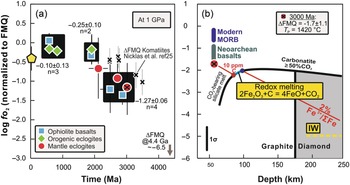
Late addition of oxidized meteoritic bodies and enrichment of the post-core formation mantle in Fe2O3 consequent to the loss of Fe to the metallic core have been proposed, among a plethora of other processes, to explain the increase of fO2 from conditions where C would be stable as diamond and in Fe(Ni) alloys (fO2 ≈ iron–wüstite buffer (IW) – 2; Refs. Reference Frost, Mann, Asahara and Rubie13 and Reference Scaillet and Gaillard14) to conditions where C4+ is the dominant species incorporated in carbonate minerals and melts (IW + 1 < fO2 < IW + 5). Geochemical tracers such as Ce in zircons believed to have crystallized in equilibrium with Hadaean magmasReference Trail, Watson and Tailby15 and the V/Sc ratio of erupted continental basaltsReference Li and Lee16 have been used to argue in favor of a constant mantle redox state over the last 4.4 billion years at values where C4+ is stable, and therefore able to mobilize carbon as CO2 and/or CO32– dissolved in magmas. In contrast, based on the reconstruction of the mantle redox state over time using the V/Sc ratio of Archean spreading ridge-derived metabasalts, Aulbach and StagnoReference Aulbach and Stagno17 found that the ambient mantle became gradually more oxidized by ~1.5 log units between ca. 3 Ga and 1.9 Ga, when fO2 values similar to modern mid-ocean ridge basalts (MORBs) are recorded (Figure 4.1a). Figure 4.1b illustrates how a reduced asthenospheric Archaean mantle expected to host C in the form of diamond (or graphite) and CH4 becomes more oxidized along a decompression path (Figure 4.1b, red line) as a result of the pressure effect on the equilibrium:Reference Stagno, Ojwang, McCammon and Frost18
until the local fO2 at which carbon turns into carbonateReference Stagno and Frost19 is reached (fayalite–magnetite–quartz buffer (FMQ) – 2 log units; Figure 4.1b, blue line) at ~100 km depth. In Eq. (4.1), Fe3+ and Fe2+ refer to the ferric and ferrous iron of the bulk peridotite mantle rock, respectively. A similar equilibrium could be written to explain the distribution and fate of other important magmatic volatiles like H2 and H+, N3– and N2, and S2– and S6+ in igneous systems dominated by Fe-bearing silicates, with dramatic implications for volcanic outgassing and atmospheric composition over time.
(a) fO2 as a function of time calculated from V/Sc of mid-ocean ridge-derived basalts and metabasalts occurring in ophiolites, as orogenic eclogites, or mantle eclogites (data in Aulbach and StagnoReference Aulbach and Stagno17). fO2 values were projected to 1 GPa to avoid bias due to deeper onset of partial melting in warmer ancient convecting mantle. Shown for comparison are results for komatiites from Nicklas et al.Reference Nicklas, Puchtel and Ash25 (b) Thermodynamic prediction of the variation in the mantle oxidation state upon decompression, obtained using oxy-thermobarometry for garnet-bearing peridotite.Reference Stagno, Ojwang, McCammon and Frost18 The graph shows the depth at which melting would occur as soon as 10 ppm C, expected in the Archean convecting mantle and hosted in diamonds, is oxidized to carbonate by the redox reaction shown. A source mantle with 2% Fe2O3 would generate a melt at the local temperature corresponding to the solidus of a carbonated peridotite that would have the fO2 calculated for the igneous protolith of the Lace eclogite suite shown in (a) (after Aulbach and StagnoReference Aulbach and Stagno17).

At these depths, carbonate–silicate melts are likely to have formed by redox melting of graphite-bearing mantle at the near-constant fO2 favored by hotter temperatures during the Archaean, until all carbon (~10 ppm in the case of reduced early EarthReference Dasgupta20) was oxidized. Upon further decompression, the Archaean mantle would have continued to become more oxidized until the oxidation state of Archean MORBs, represented by a metabasaltic eclogite suite from Lace in the Kaapvaal craton,Reference Aulbach and Viljoen21 is reached below the spreading ridge. Given that redox melting – today as well as in the early mantle – requires the reduction of Fe2O3 (i.e. Eq. 4.1), the oxidation state of MORBs does not directly reflect the mantle oxidation state at the source, a concept introduced by Ballhaus and FrostReference Ballhaus and Frost22 in 1994 when they proposed the oxidation of MORBs from a more reduced mantle source due to the coupling between C/carbonate reactions and Fe3+/Fe2+ variations upon decompression as represented by Eq. (4.1). This was demonstrated in recent experiments where measured fO2 values of synthetic MORBs appeared different from the fO2 of the coexisting spinel-bearing peridotite rock source by up to ~3 log units.Reference Sorbadere, Laurenz, Frost, Wenz, Rosenthal, McCammon and Rivard23 Nevertheless, a gradual increase of Fe3+ in the bulk asthenospheric mantle over time has been corroborated by the finding of extremely low Fe3+/∑Fe in mantle eclogites, which is not correlated with indices of subsequent melt depletion,Reference Aulbach, Jacob, Cartigny, Stern, Simonetti and Viljoen24 as well as V-based estimates of fO2 in komatiites, picrites, and basalts of various ages showing a clear trend in the Archaean that levels out at ca. 2 Ga.Reference Nicklas, Puchtel and Ash25
4.3 The Stability of Reduced and Oxidized Forms of Carbon in the Upper Mantle: Continental Lithosphere versus Convective Mantle
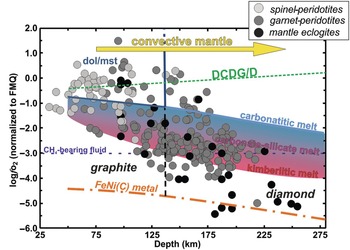
Thermodynamic prediction of the stable form of carbon in the upper mantle can be made using oxy-thermobarometry applied to mantle rocks such as peridotites and eclogites based on the relation between the ferric/ferrous iron ratio of minerals such as spinel and garnet and the buffering capacity of the host rocks. The decreasing fO2 with depth shown in Figure 4.2 links to the volume change of the reactions used as oxy-thermobarometersReference Stagno, Ojwang, McCammon and Frost18, Reference Stagno, Frost, McCammon, Mohseni and Fei26, Reference Ballhaus, Berry and Green27 and suggests that the Archaean continental lithospheric mantle down to ~270 km in depth might have equilibrated with elemental carbon in the form of diamond or graphite, plus a small volume of CO2-bearing melts varying from carbonatitic (Figure 4.2, blue line) to kimberlitic (Figure 4.2, red region) in composition. The fO2 at which diamond and CO2-bearing melts can coexist with peridotite and eclogite depends on the effects that temperature (the local geotherm) and the presence of water have on the equilibria:Reference Stagno and Frost19, Reference Stagno, Frost, McCammon, Mohseni and Fei26
 (4.2)
(4.2)and
 (4.3)
(4.3)Log fO2 (normalized to the FMQ buffer) determined for peridotitic and eclogitic xenoliths using oxy-thermobarometry for spinel/garnet peridotite and eclogite.Reference Stagno, Ojwang, McCammon and Frost18, Reference Stagno, Frost, McCammon, Mohseni and Fei26, Reference Ballhaus, Berry and Green27 The blue curve is the fO2 calculated for Eq. (4.2) along a cratonic geotherm of 40 mW·m–2 that defines the stability field between diamond (or graphite) and solid (liquid) carbonate within peridotite rocks. The orange curve indicates where Fe–Ni metallic alloys (with some C) are stable. The green line indicates the fO2 buffered by Eq. (4.3) (see text).Reference Stagno, Frost, McCammon, Mohseni and Fei26, Reference Luth35 CO2-bearing silicate melts are stable at lower fO2 values than carbonatitic melts in equilibrium with diamantiferous peridotite due to the temperature effect on Eq. (4.1).Reference Stagno, Ojwang, McCammon and Frost18 The yellow arrow indicates the proposed oxidation state of a convective mantle contaminated by variable volumes of subducted carbonated lithologies.Reference Eguchi and Dasgupta37 DCDD/G = dolomite–coesite–diopside–(diamond/graphite).

A direct sampling of deep carbon phases is represented by diamantiferous peridotite and eclogite of Archaean age (1–3% diamonds in the cratonic lithosphere),Reference Garber28 while the observation of carbonated magmas of mantle origin, although predicted by experimental phase equilibria studies on synthetic carbonated peridotites and eclogites, appears quite rare (about 490 deposits)Reference Woolley and Kjarsgaard29 due to a decreasing trend over time coupled to secular mantle cooling and late-stage fractionation and assimilation processesReference Tappe, Romer, Stracke, Steenfelt, Smart, Muehlenbachs and Torsvik30, Reference Tappe, Smart, Torsvik, Massuyeau and de Wit31 that make these products difficult to identify. The decrease of fO2 with depth in the case of eclogite is expected to result in carbonate minerals (or fluids) being reduced to diamond during subduction of a carbonated oceanic crust at variable depths through oxidation of coexisting garnet and clinopyroxene mineral phasesReference Stagno, Frost, McCammon, Mohseni and Fei26 depending on the Fe3+ of the bulk rock.Reference Stagno, Frost, McCammon, Mohseni and Fei26, Reference Aulbach, Woodland, Vasilyev, Galvez and Viljoen32
The Fe(Ni) precipitation curve (Figure 4.2, orange line) marks the fO2 conditions at which diamonds and Fe(Ni) alloys might coexist, therefore promoting the diffusion of carbon into adjacent metal or the formation of Fe(Ni)C intermetallic compounds depending on the local Fe(Ni)/C ratio.Reference Dasgupta and Hirschmann33, Reference Rohrbach, Ghosh, Schmidt, Wijbrans and Klemme34
The extent to which the redox state of the continental mantle resembles that of the convective mantle is highly debated. The model proposed in Figure 4.1b is based on conservative estimates in which a bulk silicate Earth compositionReference McDonough and Sun36 is used as an analogue for the asthenospheric mantle. For this case, the convective mantle is predicted to follow an fO2 trend similar to the one in Figure 4.2 for natural mantle peridotites along a decompression path. This model might apply to a convective early Earth mantle not equilibrated with subducted lithologies. However, correlations between geochemical tracers such as CO2 versus Nb and Ba measured in modern natural oceanic basalts suggest a different trend. These correlations were used to constrain mixing models of two components: a residual mantle peridotitic partial melt plus graphite-saturated partial melts of subducted lithologies (e.g. pyroxenite, MORB-eclogites, sediments) in different proportions. These models, supported by melting experiments, show that generation of CO2-rich basalts of up to ~6 wt.% in the melt like those from Atlantic popping rocksReference Eguchi and Dasgupta37 requires the contribution of subduction-related melts originating from partial melting occurring in the carbonate stability field (fO2 ≥ FMQ – 1; DCDD/G in Figure 4.2) rather than graphite/diamond-saturated sources. This results in a contaminated convective present-day mantle that is more oxidized than the Archaean continental lithospheric mantle (Figure 4.2).
4.4 The Redox State and Speciation of C in the Transition Zone and Lower Mantle
4.4.1 Carbides and C in (Fe,Ni) Alloys
In contrast to the top of the upper mantle, gaining knowledge of the redox state of the deeper upper mantle (300 km and below) is more challenging due to the lack of rocks that can be sampled at the surface. Previous experimental studies,Reference Frost, Liebske, Langenhorst and McCammon38, Reference Rohrbach, Ballhaus, Ulmer, Golla-Schindler and Schönbohm39 recently supported by observations of 53 sublithospheric natural diamonds (termed CLIPPIR due to their Cullinan-like large size, rare occurrence of inclusions, relatively pure nature, and irregular shape and resorption features),Reference Smith, Shirey, Nestola, Bullock, Wang, Richardson and Wang40 provide evidence of C-bearing Fe metal occurring at the pressures of the transition zone and lower mantle. This observation would limit the stability of carbon to diamond and carbide phases, which is also supported by the discovery of Fe(Ni)/C alloys trapped in diamonds.Reference Smith, Shirey, Nestola, Bullock, Wang, Richardson and Wang40–Reference Mikhail43 At the base of the upper mantle, the fO2 at which Fe-carbides (e.g. Fe3C and Fe7C3) would be stable in equilibrium with mantle silicates requires either extremely reducing conditions (~7 log units below the FeNi precipitation curve; orange line in Figure 4.2) or coexistence with olivine and orthopyroxene that is more enriched in ferrous ironReference Schmidt, Gao, Golubkova, Rohrbach and Connolly44 than would be expected for peridotite. In addition, the Fe–Ni–C solidus temperature ranges between 1150 and 1250°C at 10 GPa,Reference Rohrbach, Ghosh, Schmidt, Wijbrans and Klemme34 which is low compared to generally agreed cratonic geotherms. It is likely, therefore, that Fe–Ni–C alloys are either: (1) stable as molten phases;Reference Rohrbach, Ghosh, Schmidt, Wijbrans and Klemme34 (2) limited in their formation to the grain scale as a result of interaction with surrounding C-saturated reduced fluids;Reference Schmidt, Gao, Golubkova, Rohrbach and Connolly44 or (3) result from solid–solid reactions between preexisting Fe–Ni alloys and subducted carbon (carbonate or diamond) of particularly cold slabs.Reference Palyanov, Bataleva, Sokol, Borzdov, Kupriyanov, Reutsky and Sobolev45 In the deep mantle, carbides can be stable in the form of molten Fe7C3 along with coexisting diamondsReference Dasgupta and Hirschmann33 if C is locally more abundant (>~100 ppm) than Fe. Interestingly, the presence of 100–200 ppm of sulfur in the Fe–Ni–C system at high pressures and temperatures was shown to prevent the formation of carbides and promote precipitation of diamonds even in particularly C-poor (5–30 ppm) regions of the deep mantle,Reference Tsuno and Dasgupta46 thus explaining the occurrence of Fe–Ni–S phases trapped in diamonds.Reference Smith, Shirey, Nestola, Bullock, Wang, Richardson and Wang40
4.4.2 Carbonate Minerals in Earth’s Interior
In contrast to the view that bulk mantle redox conditions are reduced at transition-zone and lower-mantle depths, inclusions hosted in super-deep (sublithospheric) diamonds have also shown the presence of solid carbonates.Reference Brenker47, Reference Kaminsky, Ryabchikov and Wirth48 These observations raise important questions: (1) Do these inclusions reflect local fO2 heterogeneities of the deep mantle? (2) What transformations do solid carbonates experience to preserve their stability at high pressures and temperatures to act as main carbon hosts? The latter question links to the possibility that the fO2 of the transition zone and lower mantle could be buffered by an influx of oxidized carbon in the form of solid carbonate, but questions remain as to which carbonates these might be. The speciation of carbon at conditions from the upper to the lower mantle, whether in the form of diamond or carbonate (either liquid or solid), has been a focus of investigations over the last decades. All experimental studies and theoretical calculations suggest that solid carbonates (i.e. the end members CaCO3, MgCO3, FeCO3, and their solid solutions) are stabilized at conditions of Earth’s lower mantle through a series of high-pressure phase transitions that are summarized below. This conclusion is also supported by the observations of extremely low solubility of carbon in deep mantle silicates such as wadsleyite, ringwoodite, bridgmanite, and ferropericlase in experimental studies conducted at high pressures and high temperatures.Reference Shcheka, Wiedenbeck, Frost and Keppler6, Reference Hayden and Watson7
4.4.2.1 Dolomite and Its High-Pressure Polymorphs
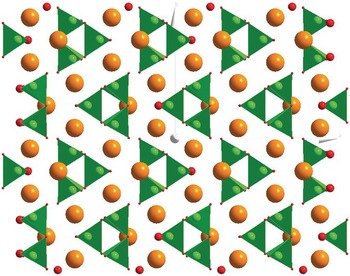
It is generally accepted that dolomite, CaMg(CO3)2, is the dominant carbonate mineral up to about 4 GPa within simplified CaO–MgO–Al2O3–SiO2 + CO2 igneous systems, and is then replaced in dominance by magnesite at higher pressures.Reference Hammouda and Keshav49 However, both the bulk Ca/(Ca + Mg) ratio of the rock and the presence of a small amount of Fe in the structure that reduces the cation-sized misfit between Ca and Mg may play important roles in stabilizing high-pressure polymorphs at the conditions of Earth’s lower mantle. Upon compression at ambient temperature, the rhombohedral dolomite structure is stable up to 17 GPa.Reference Santillan, Williams and Knittle50 Above this pressure, a transition to dolomite-II with triclinic symmetry is observed with no observable volume change. Dolomite-II is stable upon heating to 1500 K;Reference Mao, Armentrout, Rainey, Manning, Dera, Prakapenka and Kavner51 however, it decomposes between 2000 and 2400 K below 35 GPa to form a mixture of oxides and diamond.Reference Merlini, Crichton, Hanfland, Gemmi, Mueller, Kupenko and Dubrovinsky52 Dolomite-II is stable up to 35 GPa, whereupon a second phase transition is observed to triclinic dolomite-III.Reference Mao, Armentrout, Rainey, Manning, Dera, Prakapenka and Kavner51, Reference Merlini, Crichton, Hanfland, Gemmi, Mueller, Kupenko and Dubrovinsky52 Heating dolomite-III above 35 GPa to its melting point without evidence of decomposition demonstrates that dolomite-III can be a stable C-bearing mineral at Earth’s mantle conditions. Theoretical computations indicate that dolomite transforms into a ring-carbonate structure at 115 GPa and 2500°C that features tetrahedrally coordinated carbon and threefold carbonate rings,Reference Merlini53 as shown in Figure 4.3.

In a recent experimental study conducted using a laser-heated diamond anvil cell, Dorfman and coauthorsReference Dorfman, Badro, Nabiei, Prakapenka, Cantoni and Gillet54 explored chemical reactions occurring at the boundary between dolomite and Fe metal to simulate subducted carbonates penetrating the reduced lower mantle saturated in Fe metal (about 1 wt.%Reference Frost, Liebske, Langenhorst and McCammon38) at ~51–113 GPa and 1800–2400 K. Their results suggest that the MgCO3 component of subducted crustal dolomite would react with iron metal to form a mixture of diamond + Fe7C3 + ferropericlase, while CaCO3 with a post-aragonite structure would be preserved. This study supports previous experimental observations on the formation of diamond + carbide by reduction of subsolidus carbonates,Reference Palyanov, Bataleva, Sokol, Borzdov, Kupriyanov, Reutsky and Sobolev45 and it demonstrates the potential role of dolomite as a deep carbon reservoir. So far, however, its transport to the lower mantle appears limited to exotic Ca-rich, Si-poor thick portions of the oceanic slab, likely related to the subduction of sedimentary lithologies.Reference Liu55
4.4.2.2 Deep Carbon Stored as CaCO3-like Phases
Calcite (the rhombohedral form of CaCO3) and aragonite (orthorhombic CaCO3) undergo a series of structural transitions toward denser phases with increasing pressure. Above 15 GPa, a new calcite polymorph, CaCO3-IV, was discovered that shows stability at least up to 40 GPa.Reference Merlini, Hanfland and Crichton56 The density of CaCO3-IV is higher than aragonite (3.78 g/cm3 at 30.4 GPa), which suggests that it might replace aragonite at intermediate mantle depths.Reference Merlini, Hanfland and Crichton56 At pressures of more than ~40 GPa, CaCO3 undergoes yet another phase transition into a so-called post-aragonite phase.Reference Ono, Kikegawa and Ohishi57 Compression to pressures of more than ~100 GPa leads to a different polymorph with a pyroxene-like structure based on CO4 groups with sp3-hybridized carbon.Reference Ono, Kikegawa and Ohishi57–Reference Lobanov60 Chemical bonding in sp3-carbonates is different from bonding in carbonates based on sp2-hybridized carbon; thus, sp2–sp3 crossover, if it occurs in mantle carbonates, may disrupt the silicate–carbonate chemical equilibrium. To date, however, the geochemical and geophysical consequences of sp2–sp3 transitions are not well understood. It is noteworthy, however, that calcite was found as an inclusion in a sublithospheric diamond,Reference Brenker47 confirming its stability in the lower mantle as a potential carbon reservoir and candidate for potential redox reactions through which diamond itself could form.
4.4.2.3 Magnesite and Fe-Bearing Solid Solutions as Deep Carbon Reservoirs
Magnesite and ferro-magnesite solid solutions have been found to occur as inclusions in diamonds that likely originated in Earth’s lower mantle.Reference Kaminsky, Ryabchikov and Wirth48 Despite the lack of evidence of siderite inclusions hosted in such super-deep diamonds, the role of iron in the stability of Fe-carbonates appears relevant in the mid-lower mantle, where spin crossover of Fe2+ from high spin (HS) to low spin (LS) changes the physical and chemical properties of these carbonates,Reference Cerantola61–Reference Lobanov, Holtgrewe and Goncharov63 with important implications for their seismic detectability (discussed below).
Magnesite remains stable at up to 100 GPa and 2200 K without decomposition or associated phase transformations.Reference Isshiki64 Congruent melting of magnesite was reported between 2100 and 2650 K at pressures between 12 and 84 GPa, whereas decomposition to MgO and diamond was observed only above ~3000 K at similar pressures.Reference Solopova65 Isshiki et al.Reference Isshiki64 first reported the transformation of magnesite to its high-pressure polymorph, magnesite-II, at ~115 GPa and ~2200 K. Maeda et al.Reference Maeda, Ohtani, Kamada, Sakamaki, Hirao and Ohishi66 discussed phase relations in the MgCO3–SiO2 system up to 152 GPa and 3100 K. They reported a reaction between MgCO3 phase II and SiO2 (CaCl2-type SiO2 or seifertite) to form diamond and MgSiO3 (bridgmanite or post-perovskite) at deep lower-mantle conditions via the following possible reaction:
indicating that CO2 dissociates above ~33 GPa and at >1700–1800 K to form diamond plus free oxygen and bridgmanite. These results describe a possible mechanism of formation of super-deep diamond in cold slabs descending into the deep lower mantle resulting from the instability of magnesite phase II in the presence of exotic assemblages.
The physical and chemical properties of Fe-bearing carbonates, such as their density, Fe content, elasticity, and optical properties, may have important geological consequences. Melting of FeCO3 was investigated experimentally at high pressures and temperatures equal to or above the terrestrial geotherm. Experiments indicate that iron carbonates melt incongruently up to ~70 GPa and at >2000 K to produce a minor quenched Fe3+-rich phase and CO2 in the liquid.Reference Cerantola67, Reference Kang68 At higher pressures and similar temperatures, new carbonates were observed with tetrahedral C3O9 rings.Reference Boulard69 Merlini et al.Reference Merlini, Hanfland, Salamat, Petitgirard and Müller70 reported the transformation of Mg-siderite at pressures and temperatures corresponding to the top of the D´´ layer (i.e. ~135 GPa and ~2650 K), with formation of Mg2Fe(III)2(C4O13) and a new oxide phase, Fe13O19, thus demonstrating that self-oxidation–reduction reactions can preserve carbonates in Earth’s lower mantle to 2500 km in depth.
When slabs penetrate the lower mantle, redox reactions take place between the hotter outer part of the slab and the surrounding bulk mantle in order to balance the high Fe3+ content of bridgmanite (~80% in equilibrium with magnesite and diamonds),Reference Stagno, Tange, Miyajima, McCammon, Irifune and Frost71 similar to Eq. (4.1). The origin of diamonds in the lower mantle might be therefore linked to redox reactions involving Fe3+-bearing minerals, which could also account for the high proportion of ferropericlase in lower-mantle diamond inclusions.Reference McCammon72 At greater depths, the high degree of trivalent iron incorporation into high-pressure carbonate structures and iron oxides can influence redox processes in the deep mantle, where changes in fO2 could be buffered by the activity of carbon (Eq. 4.5) or oxygen (Eq. 4.6) rather than being controlled by charge balance between iron cations.
4.4.3 Toward Oxy-Thermobarometry of the Deep Mantle and Implications for Carbon Speciation
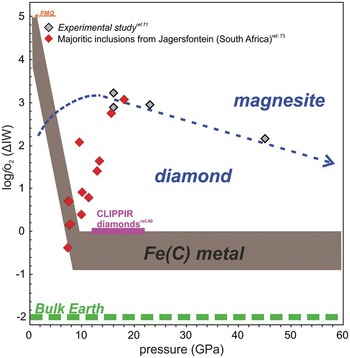
Through the number of redox reactions that can be written to explore the mechanisms of diamond formation in the transition zone and lower mantle, a fundamental question arises: Is the deep mantle intrinsically buffered by abundant Fe-bearing minerals similarly to the upper mantle? A recent estimate of the deep-mantle redox state was proposed by Kiseeva et al.,Reference Kiseeva73 who measured the ferric iron content of majorite inclusions and developed an oxy-thermobarometer based on the self-redox capacity of majorite as a function of pressure. Figure 4.4 shows the fO2 values calculated using Eq. (4.7):
from majoritic inclusions in super-deep diamonds from the Jagersfontein kimberlite (South Africa).Reference Beyer and Frost74 The carbon/carbonate equilibrium bufferReference Stagno, Tange, Miyajima, McCammon, Irifune and Frost71 refers to experimental measurements of the fO2 at which diamond and magnesite coexist with transition-zone (wadsleyite/ringwoodite and clino-enstatite) and lower-mantle (bridgmanite and ferropericlase) mineral phases.Reference Stagno, Tange, Miyajima, McCammon, Irifune and Frost71 The results indicate the heterogeneity of mantle fO2 in the transition zone, varying from about IW to IW + 3, where the high concentration of Fe3+ in majorite (between 8% and 30%) is linearly correlated with pressure and likely related to the oxidizing effect of CO2-rich fluids rather than FeO disproportionation. This suggests that carbonate is, at least locally, a stable phase in Earth’s deep mantle, stabilized at an fO2 value about 2 log units above the iron–wüstite buffer. Carbonate could therefore participate in melting processes depending on the local geotherm and promote carbon mobility through the formation of carbonatitic to kimberlitic melts. At higher pressures, ferropericlase and bridgmanite are expected to play major roles in buffering redox conditions through chemical reactions that involve the Fe3+-bearing mineral end members. However, the crystal chemistry of these phases has been shown to be extremely complex due to simultaneous element substitution in different sites.Reference Ismailova75
fO2 stability of carbon phases at high pressures based on experimental studies,Reference Stagno, Tange, Miyajima, McCammon, Irifune and Frost71 as well as majorite inclusions in diamondsReference Kiseeva73 and metal-bearing “CLIPPIR” diamonds.Reference Smith, Shirey, Nestola, Bullock, Wang, Richardson and Wang40 The blue dashed line indicates the fO2 values at which diamonds and carbonate (magnesite) are in equilibrium.Reference Stagno, Tange, Miyajima, McCammon, Irifune and Frost71

4.5 Seismic Detectability of Reduced and Oxidized Carbon in Earth’s Mantle
The presence of carbon within the mantle may be detectable using seismic data. A recent multidisciplinary study conducted by Garber and coauthorsReference Garber28 showed that diamondiferous lithologies may be responsible for elevated shear-wave velocities (VS; ≥4.7 km/s) detected at 120–150‑km depths in cratonic lithospheric mantle. Diamond and eclogite (known to contain higher concentrations of diamond compared to peridotite)Reference Luth35 are the most likely high-VS candidates that could explain the observed seismic anomalies, implying the presence of up to about 3 vol.% diamond, depending on the peridotite and eclogite compositions and the local geotherm.
The seismic detectability of carbonates in the upper mantle and transition zone is related primarily to their crystal structure. Sanchez-Valle et al.Reference Sanchez-Valle, Ghosh and Rosa76 measured the elastic tensor of Mg1–xFexCO3 with four compositions extending from pure magnesite to pure siderite using single-crystal Brillouin scattering spectroscopy at ambient conditions. They found that Fe substitution has a negligible effect on the adiabatic bulk modulus, KS, of Mg–Fe carbonates, whereas the shear modulus, μ, decreases by 34% from MgCO3 to FeCO3. They concluded that, based on current seismic resolution (with a threshold of 2%), detection of carbonated regions from seismic velocity contrast would require high carbonate contents (~15 wt.% CO2) in eclogite and >20 wt.% CO2 in peridotite. These results are supported by the work of Yang et al.,Reference Yang, Mao, Lin and Prakapenka77 who measured the full elastic stiffness tensor of MgCO3 up to 14 GPa at ambient temperature and up to 750 K at ambient pressure using Brillouin scattering in the diamond anvil cell.
In Fe-bearing carbonates, the pressure-induced splitting of iron 3d energy levels into two leads to the possibility of two different spin configurations for Fe2+: (1) the HS state with four unpaired and two paired electrons; and (2) the LS state with six paired electrons. The spin pairing of electrons causes a volume collapse of the iron atomic volume, followed by shrinking of the octahedral site and ultimately of the unit cell. The first experimental observation of the HS–LS transition of Fe2+ in siderite was reported by Mattila et al.Reference Mattila78 using X-ray emission spectroscopy. They observed the transition to occur at ~50 GPa and at ambient temperature in natural siderite powder. Subsequent experimental and theoretical work provided further evidence of the spin transition in Fe-carbonates at ~45 GPa, as well as insights into how the spin transition affects the physical and chemical properties of carbonates.Reference Shi, Luo, Johansson and Ahuja79–Reference Weis86
The spin transition causes changes in the thermoelastic properties of carbonates and may enhance the seismic detectability of carbon in the lower mantle. Liu et al.Reference Liu, Lin, Mao and Prakapenka87 observed anomalous thermoelastic behavior in natural magnesiosiderite at high pressure and high temperature across the spin transition, including a dramatic increase in the thermal expansion coefficient and decreases in the isothermal bulk modulus and the bulk sound velocity by 75% and 50%, respectively. When compared to MgCO3 at relevant pressure–temperature conditions of subducted slabs, HS magnesiosiderite with 65 mol.% FeCO3 is approximately 21–23% denser and its unit-cell volume is 2–4% larger, whereas the LS state is 28–29% denser and 2% smaller than end-member magnesite. These results indicate that dense LS ferromagnesite can become more stable than HS ferromagnesite at pressures above ~50 GPa, providing a mechanism for (Mg,Fe)-bearing carbonate to be a major carbon host in the deeper lower mantle. Fu et al.Reference Fu, Yang and Lin88 measured the full elastic stiffness tensor of Mg0.35Fe0.65CO3 up to 70 GPa at ambient temperature using Brillouin light scattering and impulsive stimulated light scattering in a diamond anvil cell. They observed a dramatic softening of the C11, C33, C12, and C13 moduli and stiffening of the C44 and C14 moduli across the spin transition in the mixed spin state. Outside the region of the spin transition, they observed a linear increase of all elastic moduli with pressure. Based on their work, mixed spin-state ferromagnesite is expected to exhibit abnormal elasticity in the mid-lower mantle, including a negative Poisson’s ratio and a drastically reduced compressional wave velocity (VP). Similar results were obtained by Stekiel et al.,Reference Stekiel89 who determined the elastic stiffness moduli of FeCO3 across the spin transition up to 60 GPa and at ambient temperature by inelastic X-ray scattering and density functional theory calculations. Based on calculations employing a pyrolitic mantle model and considering varying amounts of Mg1–xFexCO3, the presence of magnesioferrite solid solutions changed the VS more than the VP. At least 3 vol.% of FeCO3 would be needed to produce a shear velocity contrast of more than 1% due to the spin transition, and 8 vol.% of Mg0.85Fe0.15CO3 would be needed to produce the same contrast between carbonated and non-carbonated pyrolitic mantle.
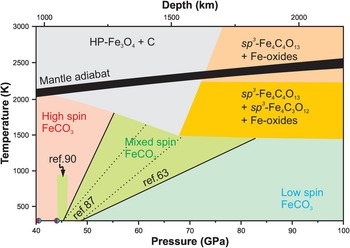
Our knowledge of the iron spin state of FeCO3 is limited to near-room temperature conditions, as probing different electronic structures at combined high pressure–temperature conditions is challenging. Temperature broadens the pressure range of the HS to LS transition, but the depth range over which spin transitions take place remains uncertain (Figure 4.5). In addition, siderite is unstable at greater than ~1500 K (greater than ~40 GPa) and decomposes into iron oxides and C-bearing phases. As a result, FeCO3 is unlikely to occur in the lower mantle at depths greater than ~1200 km. Instead, solid solutions involving iron oxides and sp3-bonded novel Fe-carbonates (Fe4C4O13 and Fe4C3O12) may be the most common carbon-bearing phases at sufficiently oxidizing conditions.
Stability and spin-state diagram of FeCO3 at high pressure–temperature. Mixed blue–red circles depict the spin transition pressure in siderite at 300 K as observed in a soft pressure medium (e.g. Ne) at 40.5 GPa and in more rigid media (KCl, Ar, etc.) at ~44 GPa. Pink and blue regions are high and low spin-state regions, respectively. The pressure–temperature conditions of mixed-spin iron (0.1–0.9 LS) in FeCO3 are uncertain (shown by different green-shaded areas). High-temperature transformations in the FeCO3 system are shown after Cerantola et al.Reference Cerantola67

4.6 Conclusion
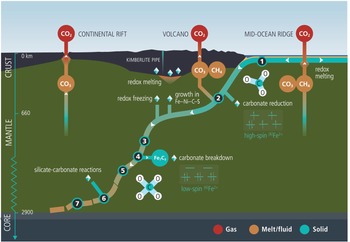
In contrast to the immobile behavior of carbon in the Archaean lithospheric mantle, the deep carbon cycle in modern Earth linked with carbon transport through the convective mantle at varying pressure–temperature–fO2 conditions over time shows evidence of large heterogeneities in mantle redox state, both vertically and laterally, which likely result from the contribution of subducted lithologies with varying degrees of oxidation through space and time. We conclude that the movement of carbon over geologic time is fundamentally controlled by the level of oxygenation of Earth’s interior, which causes elemental carbon to oxidize to CO2-bearing magmas, whose rheology mainly controls their transport properties.Reference Kono91, Reference Stagno, Stopponi, Kono, Manning and Irifune92 The observation of both oxidized carbon and metal trapped as inclusions in sublithospheric diamonds testifies to the heterogeneity of mantle fO2, thereby implying the stability of carbon in various redox states and phases (mineral, melt, or fluid), and even favored by the presence of additional elements like sulfur. The relation between iron oxidation state in mineral inclusions in diamonds and fO2 is an important tool for determining the local redox conditions needed to model carbon speciation. Fluids in equilibrium with reduced mantle regions would be methane dominated and may precipitate diamonds by reduction of Fe, liberating water that could induce partial melting. On the other hand, the possible presence of carbonate as a source of carbon in natural diamond-forming processes is supported by experimental studies at high pressure and temperature that demonstrate the stability of diverse geologically relevant carbonates (and their solid solutions) such as magnesite, calcite/aragonite, and siderite down to the lower mantle. Redox reactions of these carbonates with Fe-bearing minerals in the bulk mantle under initially reducing conditions have been demonstrated to promote the formation of diamond as well as the crystallization of carbide phases, leading to mantle oxidation. Such “conditioned” mantle regions may eventually allow carbonated melts and fluids to be mobilized along ascending (plumes) or descending (slabs) redox fronts, facilitating melt-mediated carbon transfer between different terrestrial reservoirs. Finally, elemental carbon transported upwards in upwelling mantle regions will be subjected to redox melting upon oxidation due to decompression. The resulting carbonated melts eventually erupt at the surface, where they interact with the hydrosphere and atmosphere. Figure 4.6 summarizes the stability of different carbon species through space and (indirectly) time with a particular focus on the asthenospheric mantle, the continental lithosphere, and subducted slabs.
Simplified cartoon showing the distribution and forms of carbon inside Earth. Carbon has low solubility in mantle minerals;Reference Keppler, Wiedenbeck and Shcheka4–Reference Hayden and Watson7 hence, it occurs primarily in the form of gas (red circles), fluids or melts (orange circles), and accessory solid phases (green circles), including diamonds (octahedra). Reactions involving carbon include redox melting (diamond consuming) and freezing (diamond producing),Reference Aulbach and Stagno17, Reference Stagno, Ojwang, McCammon and Frost18 reduction of carbonate to diamond,Reference Stagno, Frost, McCammon, Mohseni and Fei26, Reference Aulbach, Woodland, Vasilyev, Galvez and Viljoen32 growth of diamond from metallic liquids,Reference Dasgupta and Hirschmann33, Reference Rohrbach, Ghosh, Schmidt, Wijbrans and Klemme34, Reference Smith, Shirey, Nestola, Bullock, Wang, Richardson and Wang40, Reference Tsuno and Dasgupta46 breakdown of carbonate under reduced conditions,Reference Palyanov, Bataleva, Sokol, Borzdov, Kupriyanov, Reutsky and Sobolev45, Reference Dorfman, Badro, Nabiei, Prakapenka, Cantoni and Gillet54, Reference Maeda, Ohtani, Kamada, Sakamaki, Hirao and Ohishi66 redox reactions that produce tetracarbonates,Reference Cerantola67, Reference Boulard69 and reactions between carbonate and silicate.Reference Maeda, Ohtani, Kamada, Sakamaki, Hirao and Ohishi66, Reference Stagno, Tange, Miyajima, McCammon, Irifune and Frost71 Numbers indicate the depth at which important phase transitions in carbonates have been proposed to occur: (1) calcite to aragonite,Reference Hammouda and Keshav49 (2) dolomite to dolomite-II,Reference Santillan, Williams and Knittle50, Reference Merlini, Crichton, Hanfland, Gemmi, Mueller, Kupenko and Dubrovinsky52 (3) aragonite to post-aragonite,Reference Ono, Kikegawa and Ohishi57 (4) dolomite-II to dolomite-III,Reference Mao, Armentrout, Rainey, Manning, Dera, Prakapenka and Kavner51, Reference Merlini, Crichton, Hanfland, Gemmi, Mueller, Kupenko and Dubrovinsky52 (5) Fe-carbonate to Fe-tetracarbonate,Reference Cerantola67, Reference Boulard69 (6) post-aragonite to CaCO3 with sp3-hybridized carbon,Reference Ono, Kikegawa and Ohishi57–Reference Lobanov60 and (7) magnesite to magnesite-II.Reference Isshiki64 Ferrous iron in carbonate undergoes a HS to LS transition in the mid-mantle.Reference Mattila78–Reference Müller, Efthimiopoulos, Jahn and Koch-Müller90 The thickness of the crust and slab is vertically exaggerated for clarity.

4.7 Limits to Knowledge and Unknowns
Although great advances have been made, important limits to knowledge remain regarding the stability and mobility of carbon-bearing phases and their interaction with silicates and metals at pressure–temperature–fO2 conditions relevant to the deep Earth. Redox melting and freezing reactions, as a function of fO2, are critical in mediating transitions between the relatively refractory forms of carbon, such as diamond/graphite, carbide, and metal alloys, to highly mobile oxidized forms, such as carbonated melts and CO2-bearing fluids.Reference Stagno, Ojwang, McCammon and Frost18, Reference Frost and McCammon93, Reference Rohrbach and Schmidt94 However, the amount of carbon involved in these reactions, the participating minerals, and the fO2 in the mantle with depth and through time remain highly uncertain. This uncertainty arises because most of our knowledge relies on indirect estimates based on mostly degassed magmas and direct estimates from mantle xenoliths and diamonds entrained in magmas that are irregularly distributed in space and time. Moreover, mantle xenoliths and diamonds are exclusively or dominantly derived from the lithospheric mantle and may sample multiply reactivated fluid and melt pathways that are not representative of the lithospheric mantle and even less so of the convective mantle.Reference O’Reilly and Griffin95 The few sublithospheric diamonds available for study sample anomalous mantle domains characterized by strong compositional and redox gradients at the interface between deeply subducted slabs and ambient mantle.Reference Frost and McCammon93, Reference Foley96 Thus, although it is assumed that the fO2 of the metal-saturated mantle below ~250–300 km in depth is effectively buffered close to the iron–wüstite redox buffer (where carbonates and carbonated melts are unstableReference Rohrbach and Schmidt94), sublithospheric diamonds appear to record much higher fO2 values, linked to the influx of slab-derived oxidizing agents.Reference Kiseeva73 In addition, the CO2 content of oceanic basalts has been suggested to require carbonated redox melting rather than graphite-saturated melting, implying higher fO2 values than are inferred from lithospheric mantle xenoliths.Reference Eguchi and Dasgupta37 The problem of constraining the dominant fO2 and redox equilibria with depth is only exacerbated in deep time, where debate over appropriate sample material and redox proxies continues.Reference Trail, Watson and Tailby15–Reference Aulbach and Stagno17, Reference Litasov, Shatskiy, Kono and Sanloup98
Progress on deciphering the speciation and distribution of carbon in modern Earth’s interior will be made by combining observations from experiments and theoretical studies with increasingly sophisticated remote-sensing tools. For example, the ponded products of redox melting may be increasingly traceable by geophysics due to the increasingly well-characterized melting relations of carbon-bearing mantleReference Sakamaki, Kono and Sanloup99 and constraints on the physical properties of carbonated melts (e.g. viscosity, seismic velocity, and electrical conductivity),Reference Kono91, Reference Stagno, Stopponi, Kono, Manning and Irifune92, Reference Litasov, Shatskiy, Kono and Sanloup98 and they have indeed been linked to low-velocity zones below the oceanic lithosphere.Reference Sifre’, Gardes, Massuyeau, Hashim, Hier-Majumder and Gaillard100 The fate of carbonates in subducting slabs, however, remains poorly constrained, in part due to the unknown variation of mantle fO2 with depth and time. Carbonates do show rich polymorphism at high-pressure, high-temperature conditions, which renders them stable along the geotherm. Therefore, studies that explore the interaction of carbonates with silicates at well-controlled pressure, temperature, and redox conditions will provide important insights into the survival and mobility of oxidized carbon species in the mantle. Recent advances in experimental design that allow fO2 to be controlled and monitored at deep mantle pressuresReference Stagno, Tange, Miyajima, McCammon, Irifune and Frost71, Reference Rohrbach and Schmidt94 will enable the stabilities of various carbonate minerals to be mapped out as a function of depth for complex systems, combined with their predicted seismic velocities based on their crystal structure.Reference Sanchez-Valle, Ghosh and Rosa76 Future improvements in the sensitivity of remote-sensing tools and data processing may allow deep carbonated mantle regions to be detected. Recent studies indicate that Fe-bearing carbonates show remarkably complex chemical and physical behavior at mid-lower mantle depths. The Fe spin transition may shift the chemical equilibrium in favor of Fe-rich carbonates, which in turn would significantly affect their physical properties, with potential implications for carbonate seismic detectability. However, the relevant depth range of spin transitions is not well constrained because of the immense technological challenge of probing spin transitions at combined high-pressure, high-temperature conditions. The iron oxides, oxygen, and elemental carbon that may be produced during reactions that take place when carbonate is transported to the deep mantle may also affect redox conditions and have important (but as yet unexplored) geological consequences.
Acknowledgments
VS acknowledges financial support from the Deep Carbon Observatory and Sapienza University of Rome through “Fondi di Ateneo.” SA is grateful for funding from the German Research Foundation (DFG) under grant AU 356/10. Thoughtful comments by the reviewer Arno Rohrbach and the editor Rajdeep Dasgupta helped to improve the quality of this chapter.
Questions for the Classroom
1 Describe the different ways in which carbon bonds with other elements. Which type of bonding is involved in the carbon phases discussed in this chapter? Can carbon bond with any element in the periodic table? Why or why not? Do you think there are any forms of carbon that have not yet been discovered?
2 Select one form of carbon that occurs on modern Earth’s surface (e.g. dolomite) and follow its subduction journey in terms of the chemical reactions that take place involving its carbon atoms. Repeat the exercise for other carbon forms that are found on modern Earth’s surface.
3 Repeat the previous exercise for the subduction of different forms of carbon in early Earth (at least 3 Ga).
4 Which of the chemical reactions in the two previous exercises are redox reactions? Describe how the cycles of other elements may be linked to the deep carbon cycle.
5 What is the estimated content of carbon in Earth as a function of depth? In which phases does carbon dominantly occur? Construct a histogram showing the variations of carbon phases and their abundance with depth. Now repeat the exercise showing only how the abundance of different oxidation states of carbon varies with depth.
6 Why is it so challenging to estimate the amount of carbon in Earth? Why does knowing how much carbon is present matter?
7 Are there any external manifestations of the deep carbon cycle on Earth’s surface? Has this changed through geologic time?
8 How does the deep carbon cycle affect the habitability of modern Earth? Are there any links to climate change? Do any of the answers to these questions change if we consider early Earth?
9 Describe a high-pressure experiment that could help to answer some of the unknowns regarding carbon and its forms inside Earth.
10 Which types of natural samples could help to resolve these unknowns regarding carbon and its forms inside Earth? Note that the natural samples do not have to have been discovered yet.

 Open access