




Introduction
Antarctica hosts one of the most extreme environments on Earth as well as unique microbial communities that have adapted to these harsh conditions (Convey et al. Reference Convey, Gibson, Hillenbrand, Hodgson, Pugh, Smellie and Stevens2008). The Antarctic Peninsula and the South Shetland Islands are very close to the South American continent, and interest in this region in some South American countries can be evidenced by the presence of their scientific stations. The vast majority of these are concentrated in the South Shetland Islands, which are part of Maritime Antarctica, where there are ice-free areas and high concentrations of wildlife, plants, lagoons and glaciers (Convey Reference Convey, Pentimalli, Giordano, O’Neill, Ranganathan, Sharfstein and Yelon2017).
Understanding the microbiology of Antarctica is crucial for assessing the impacts of human activities and environmental changes on these fragile ecosystems (Zucconi et al. Reference Zucconi, Fierro-Vásquez, Antunes, Bendia, Lavin and González-Aravena2025). One of the drivers of Antarctic science is the investigation of this rich biodiversity, especially microorganisms that comprise the bulk of biodiversity and biomass in Antarctic terrestrial and marine ecosystems (van Dorst et al. Reference van Dorst, Wilkins, Crane, Montgomery, Zhang and Spedding2021, Dutta et al. Reference Dutta, Connors, Trinh, Erazo, Dasarathy and Ducklow2023).
Previous studies have documented the diversity and functional roles of microbial communities in various Antarctic habitats, including soil, water and ice. Microbiological studies have focused on either the wetter environments of the Antarctic Peninsula/Scotia Arc or the exceptionally arid deserts of the Dry Valleys of Continental Antarctica (Chong et al. Reference Chong, Pearce, Convey, Yew and Tan2012). Iconic sites, such as subglacial lakes (e.g. Lake Vostok), are located near the East Antarctic Ice Sheet, and another iconic site is Blood Falls in Taylor Glacier (Mikucki & Priscu Reference Mikucki and Priscu2007, Bulat Reference Bulat2016). Recently, a comprehensive phylogenetic dataset of Antarctic bacteria with wide geographical coverage on the continent and sub-Antarctic islands was created using gene amplicon datasets to investigate bacterial phylogenetic patterns at a continental scale and to assess the major environmental drivers likely to contribute to these patterns (Varliero et al. Reference Varliero, Lebre, Adams, Chown, Convey and Dennis2024).
However, there is limited comprehensive analysis of the scientific output and publication patterns related to Antarctic microbiology in South American countries. A bibliometric analysis of research contributions from South American countries can provide valuable insights into the current trends and future directions in Antarctic microbiology. Bibliometric analysis is a method used to analyse research characteristics and change trends in the literature using various mathematical and statistical techniques (Liu et al. Reference Liu, Sun, Gao and Sui2019). Bibliometric analysis has been widely used in academic research, particularly in the field of microorganism research (He et al. Reference He, Lan, Zhang and Ye2022, Wang et al. Reference Wang, Chi and Song2024). Recent scientific developments in the field of Antarctic microbiology have been analysed through the application of these techniques (Chauhan & Pandey Reference Chauhan and Pandey2024). A limited number of studies have assessed the extent of multidisciplinarity, international collaboration and scientific trends within the national Antarctic programme operating in the South Shetland Islands and Antarctic Peninsula, utilizing methodologies based on social network analysis (SNA; Benayas et al. Reference Benayas, Pertierra, Tejedo, Lara, Bermudez, Hughes and Quesada2013, Stefenon et al. Reference Stefenon, Roesch and Pereira2013, Ji et al. Reference Ji, Pang and Zhao2014, Tejedo et al. Reference Tejedo, Gutierrez, Pertierra and Benayas2015, González-Aravena et al. Reference González-Aravena, Krüger, Rebolledo, Jaña, Aguayo-Lobo and Leppe2023, Vieria et al. Reference Vieria, Oliveira, Michel and Francelino2024).
This study aimed to analyse the trends in Antarctic microbiology research conducted by Latin American countries through a bibliometric assessment of the Web of Science (WoS) database. The main objective was to identify emerging collaboration patterns and thematic focuses within the region, providing insights into how different countries contribute to specific research areas.
Materials and methods
Research design
We used a quantitative methodology to examine the dynamics of Antarctic microbiology research originating from Latin American nations by processing and analysing bibliometric data (Gingras Reference Gingras2016, Öztürk et al. Reference Öztürk, Kocaman and Kanbach2024). The study employed a descriptive research design to analyse scientometric indicators of Antarctic science publications over a span of 45 years, and it included all scientific publications related to Antarctic research indexed in the WoS database from 1978 to 2024. This is one of the leading scientific databases, the original purpose of which being to make international scientific production available across various fields of knowledge (Pranckutė Reference Pranckutė2021). Along with the original purpose of this platform, its evolution and improvement present comparative advantages over other repositories, mainly because of the quality, accuracy and better standardized metadata for authorship and affiliations in WoS than in databases such as Scopus or Crossref (Visser et al. Reference Visser, van Eck and Waltman2021). To analyse Antarctic WoS publications of microbiology studies conducted by Latin American countries, the search criteria were structured as follows: Bacteria AND Antarc* NOT Durvillaea NOT Candida NOT Nothofagus NOT Subantarctica NOT ‘sub antarctic’ NOT sub-Antarctic AND (AD=(Argentina OR Brazil OR Chile OR Colombia OR Mexico OR Peru OR Uruguay OR Venezuela OR Ecuador OR Bolivia OR Paraguay OR Costa Rica OR Panama OR Guatemala OR Honduras OR El Salvador OR Nicaragua OR Cuba OR Dominican Republic OR Puerto Rico)). Articles containing sub-Antarctic species (Durvillaea, Candida and Nothofagus) were excluded to limit the search to the Antarctic territory only.
The global dataset comprises 3742 publications indexed in WoS, without applying geographical restrictions. To identify the field of Antarctic microbiology, the inclusion criterion established was that at least one of the authors had to be affiliated with an institution in a Latin American country. The application of this criterion initially resulted in a subset of 542 publications. Manual control was performed on this database to identify publications that did not strictly refer to Antarctic territory or species, identifying 46 publications to be discarded. The sample then comprised of 496 publications, of which nearly 95% corresponded to articles (90.0%) and reviews (4.2%; Data S1).
To construct the science map, similar lexical expressions were normalized using a thesaurus of synonymous regular expressions (Van Eck & Waltman Reference van Eck and Waltman2011). Once the thesaurus was constructed, lexical expressions in the science map were normalized. In the first instance, the map presented 1321 key words, which were reduced by 6% once the thesaurus was applied. In addition, the expressions ‘antarctic*’ and ‘antarctic bacteria’ were extracted and used in the search syntax to reduce bias in the analysis. Finally, the science map was composed of 1240 keywords. A 6% reduction in the number of original key words was used to construct a thematic field.
Data analysis
Data analysis was performed by preprocessing the information using Microsoft Excel and VOSviewer (v.1.6.20), which enabled statistical analysis as well as lemmatization and subsequent construction of the international collaborative networks and the science map of the field (Van Eck & Waltman Reference van Eck and Waltman2011, Wang et al. Reference Wang, Jing, Chen, Wang, Yu and Shadiev2023). The collected data were analysed using bibliometric techniques to identify trends (Aria & Cuccurullo Reference Aria and Cuccurullo2017), patterns and key indicators in the field of Latin American Antarctic microbiology. Once the information was processed and the graphs were constructed, statistical analyses were performed using R (v.4.4.1) and RStudio (v. 2024.12.1.563). Network analysis and visualization were performed using Gephi software (v.0.10; Cherven Reference Cherven2013).
Results
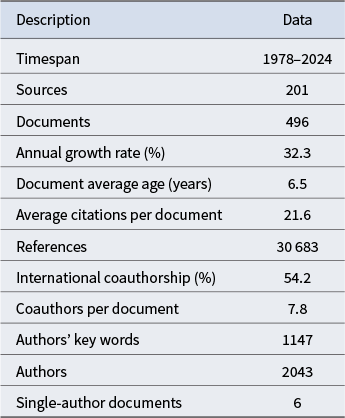
The primary research outcomes are summarized in Table I, which encompasses an examination of 496 publications from 201 different sources spanning 1978–2024. These articles were produced by 2043 researchers and exhibited an annual growth rate of 32.3%, which represents the average annual percentage increase in the production of publications throughout the study period. This study revealed a notably low proportion of single-authored papers, with only six in total. The average number of authors per article was eight, and there was a substantial international collaboration rate of 54.2%. The analysis also identified 1240 key words used by the authors across the documents, offering crucial insights into the research topics and themes explored in this comprehensive body of work. A science map was then constructed using a co-occurrence analysis of these key words to characterize the field’s conceptual structure and emerging trends.
Primary information in relation to this study.

The growth of yearly publications and their citation impact on Antarctic microbiology between 1978 and 2024 are presented in Fig. 1 & Table S1. The year 2024 had the maximum number of publications, with a total publication (TP) value of 53, followed by 2021 (TP = 52) and 2022 (TP = 46). The period between 1978 and 2008 was marked by low annual research output, with only 33 documents produced over 15 years, resulting in sparse documentation from the early decades. In contrast, from 2009 to 2024, there was a substantial increase in publication activity (Data S1).
Number of Antarctic microbiology publications and citations from between 1978 and 2024.

Publication contribution analysis
The analysis of the publications generated by the Latin American countries during the period studied shows that Chile has the highest productivity of articles at 234 (47.08% of the total) articles, followed by Brazil at 124 (24.94%) and Argentina at 98 (19.71%). Uruguay and Ecuador ranked fourth and fifth, contributing 43 (8.65%) and 13 (2.61%) publications, respectively (Fig. 2). Mexico stands out with 23 articles, ranking fifth among the Latin American countries. Venezuela, Peru and Colombia have contributed little to this area.
Most prolific Latin American countries in terms of research publications during the 1978–2024 period.

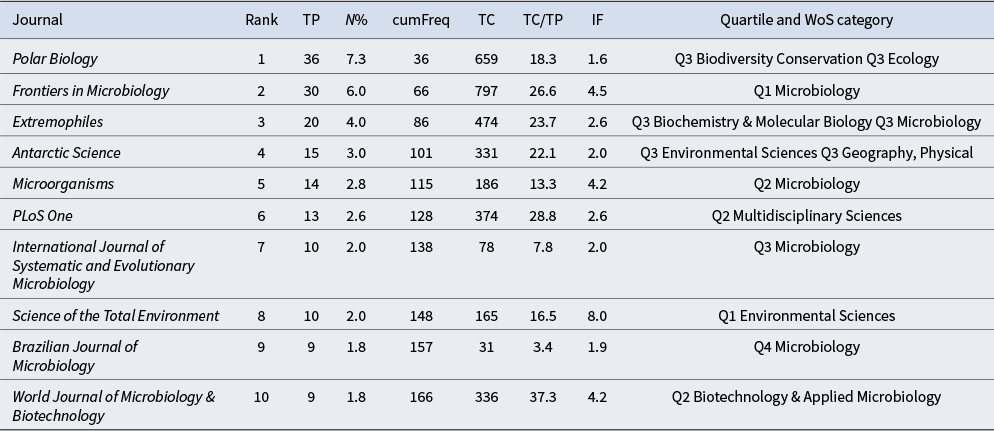
The most prominent 10 journals in Antarctic microbiology for Latin American countries are listed in Table II. The most productive journals in this field are Polar Biology (36 articles; 7.3% of the total), Frontiers in Microbiology (30.6%) and Extremophiles (20.4%), which together account for more than half of the publications in this dataset. These journals show substantial citation impact, with average citations per article ranging from 18.3 to 28.8, and they span quartiles from Q1 to Q4 across categories such as Microbiology, Environmental Sciences and Biotechnology & Applied Microbiology. Polar Biology (established in 1982) leads in publication volume and total citations from older articles, whereas Frontiers in Microbiology reflects recent growth in microbiology-focused outlets. Surprisingly, the Brazilian Journal of Microbiology stands out among these top 10 journals, contributing nine articles to this dataset. As a Q4 microbiology journal with an impact factor close to 1.9, it is a key regional outlet for disseminating Latin American microbiological research. Figure S1 illustrates the annual publication trends in Antarctic microbiology from 1990 to 2024 across key journals, revealing sparse activity before 2005 followed by a sharp increase and diversification post-2010, particularly in Frontiers in Microbiology, Microorganisms and Science of the Total Environment.
Ranking of the most prolific journals from library services in Latin American academic institutions.

cumFreq = cumulative frequency; IF = Impact Factor; N% = total percentage of the sample; TC = total citation count; TP = total publications; WoS = Web of Science.
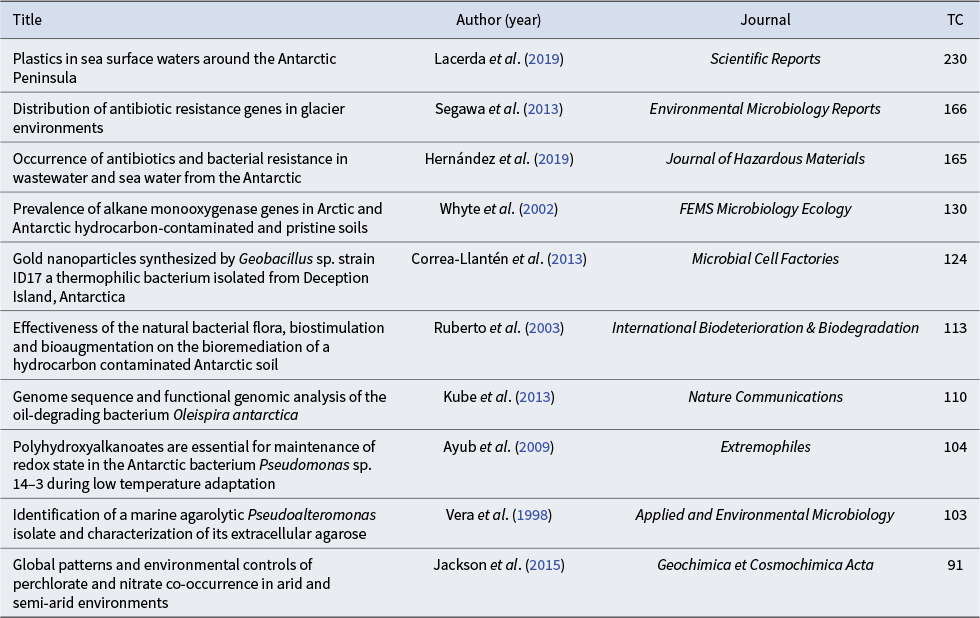
During the period analysed, the article that received the highest number of citations (230) characterized plastic pollution in the Antarctic Peninsula. Although the primary focus is on pollution, it explores the concept of ‘epiplastic communities’, which include bacteria and microalgae as colonizers of plastics and paints (Table III; Lacerda et al. Reference Lacerda, Rodrigues, van Sebille, Rodrigues, Ribeiro and Secchi2019). The next most cited article, with 166 citations, addressed antibiotic resistance in glacial environments (Segawa et al. Reference Segawa, Takeuchi, Rivera, Yamada, Yoshimura and Barcaza2013). The topic with the greatest representation of articles in the top 10 most cited articles corresponds to studies on bioremediation associated with hydrocarbon contamination (Whyte et al. Reference Whyte, Schultz, van Beilen, Luz, Pellizari, Labbé and Greer2002, Ruberto et al. Reference Ruberto, Vazquez and Mac Cormack2003, Kube et al. Reference Kube, Chernikova, Al-Ramahi, Beloqui, Lopez-Cortez and Guazzaroni2013). The overall set of articles in this field has an average of 21 citations, while the median reaches 13 citations, demonstrating an asymmetric distribution of the impacts of the publications within the field. Specifically, 159 articles are above the average number of citations, and the top 25% of the most impactful publications (75th percentile) have a value equal to or greater than 28 citations, reflecting the concentration of academic attention on a relatively small subset of these works.
Top 10 most highly cited articles related to Antarctic microbiology.

TC = total citation count.
Antarctic microbiology mapping
The scientific map was constructed from 1240 key words (nodes) connected through 3787 edges, with an average of 6.11 links (degree centrality; Fig. 3). Nodes were detected with a minimum of one link and a maximum of 97 links. The median betweenness centrality (Ci) reached the threshold for the four total links. Following the detection of network communities, 67 clusters were identified, with the most significant clusters corresponding to ‘Pseudomonas’ and ‘bioremediation’ (Fig. 3b,c).
Mapping Antarctic microbiology research in Latin America, 1978–2024: research topics from key words co-occurrences. a. The global graph has dense areas and different groups with specific themes (extremophiles, bioremediation, bacteria and Pseudomonas). This shows that there are many connected communities and strong links between topics: b. Pseudomonas cluster and c. bioremediation cluster.

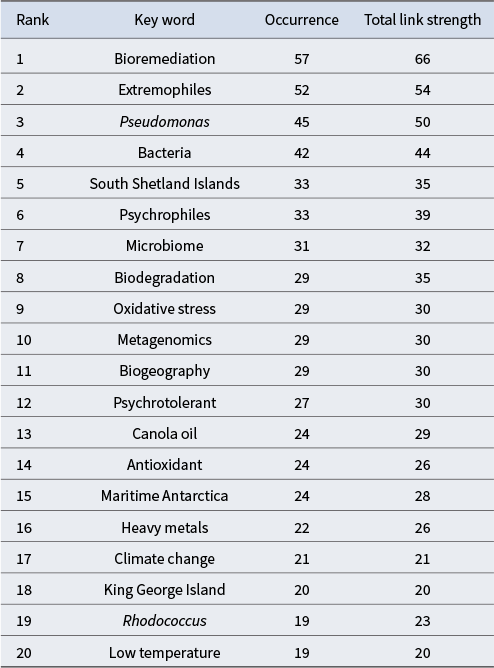
The analysis produced a quality value (modularity) of 0.7748, indicating a highly structured and statistically robust partition in which most of the relevant connections were concentrated within the identified clusters. In total, 67 clusters were detected, reflecting the thematic diversity and existence of multiple subcommunities within the studied domain, some with a core character and others of a more peripheral or specialized nature (at the periphery of the graph). The global graph presents a highly densified structure in some areas, along with group heterogeneity (thematic specialization), indicating the presence of multiple interrelated communities and a high degree of interconnection between topics. At the core of the network, terms with a high degree of centrality were identified, such as ‘extremophiles’ (97 links), ‘bioremediation’ (54 links), ‘bacteria’ (80 links), ‘Pseudomonas’ (54 links), ‘psychrophiles’ (54 links) and ‘biodiversity’ (39 links), which serve as articulating axes of the field. These topics act as central nodes, being part of the group of the most relevant topics in the field, and they operate as connectors between various thematic communities. The radial layout of the network suggests a cognitive structure in which central topics articulate nodes that, when clustered, give rise to central and consolidated thematic clusters within the network. In turn, there are more peripheral clusters composed of terms with lower frequency and specialization, which are characteristic of fields undergoing expansion and thematic diversification. Examining frequently used terms within a specific field reveals key concepts and emerging topics in microbiology. This methodology allows researchers to hypothesize on knowledge structure and identify significant topics within the current research domain. The 20 top-ranked key words in this category are presented in Table IV. The three key words with the highest frequency and total link strength were ‘bioremediation’, ‘extremophiles’ and ‘Pseudomonas’.
The occurrence and total link strength of the top 20 occurrence key words on Antarctic microbiology.

Figure 4 shows the international collaboration network of Latin American countries for Antarctic microbiological research. Each node represents a country, and the links between them reflect coauthorship in scientific publications. The node size indicates each country’s centrality in the network, whereas the connection thickness indicates collaboration intensity. From a Latin American standpoint, and using the coauthored articles between country pairs, Chile, Brazil and Argentina emerged as the leading regional actors in the collaboration network. The strongest dyadic ties in the full network are Chile-Malaysia (Ci = 44), Chile-UK (Ci = 31), Chile-Japan (Ci = 31), Japan-Malaysia (Ci = 24), Chile-Germany (Ci = 21), Chile-USA (Ci = 20) and England-Japan (Ci = 20). Chile functions as a central hub with numerous links to countries traditionally recognized as leaders in international scientific production, including the USA (20 coauthored articles), the UK (31) and Germany (21). Notably, links to Japan (31) and Malaysia (44) exhibited particularly high tie intensities.
Worldwide map indicating international cooperation with Latin American nations for Antarctic microbiological research.

Based on Ci, Brazil (0.069), Chile (0.033) and Ecuador (0.025) acted as primary brokers within the international cooperation network. Ecuador’s role is noteworthy: despite its low degree centrality (Cg = 8), its structural position bridges Latin American countries with a lower degree (e.g. Venezuela, Peru) to European (Germany, Spain) and Asian partners (notably Malaysia). Brazil and Argentina also displayed dense interconnectivity with Europe and the USA, indicating a diversified collaboration portfolio. Considering betweenness (intermediation) centrality, Brazil (0.069), Chile (0.033), Ecuador (0.026) and Spain (0.025) stand out as connectors. Chile’s ties with Malaysia and New Zealand further suggest that collaboration patterns are not exclusively aligned with the north-south axis. With respect to centrality indicators and tie intensity per node, non-Latin American countries show clear leadership. Using the average links per node as a summary metric, Australia, Canada and the USA register 71 links; Spain, China and Italy register 70 links; and Mexico, the UK, Germany and Norway register 69 links.
Discussion
Latin American countries came late to the field of Antarctic microbiology compared with other countries with Antarctic interests (Sieburth Reference Sieburth, van Mieghem and van Oye1965). The first work in our database consulted since 1978 corresponds to the potential impact of seeding on sea-ice microbial communities by Kuosa et al. (Reference Kuosa, Norrman, Kivi and Brandini1992), in which there are two coauthors from Brazil. Consequently, it can be observed that initial research on this subject began in Argentina, Brazil and Chile during the 1990s. The delayed entry of Latin American countries into Antarctic microbiological research suggests a period of catch-up and rapid development in this field. As these countries began to establish their presence in Antarctic research, they probably had to overcome challenges such as limited resources, lack of infrastructure and the need to build expertise in polar microbiology. The main challenge maintaining and sustaining this research, and perhaps advancing greater coordination on issues to avoid duplication and to optimize resources (Kennicutt et al. Reference Kennicutt, Kim, Rogan-Finnemore, Anandakrishnan, Chown and Colwell2016).
The notable annual growth rate of 32.3% and the significant increase in publications, especially between 2012 and 2022, underscores the escalating interest in and significance of Antarctic microbiology research. The year 2024, with the highest number of publications (53), reflects heightened research activity, probably driven by advancements in technology and methodologies and a growing recognition of the field’s importance. The temporary decreases observed in recent years (2022–2023) are more plausibly attributed to the disruptive effects of the COVID-19 pandemic, particularly the restrictions on Antarctic fieldwork and laboratory activities, rather than being evidence of a structural decline in Antarctic microbiology research (Liggett et al. Reference Liggett, Frame, Convey and Hughes2024, Meirmans et al. Reference Meirmans, Postma, Neiman and Singh-Shepherd2025). The increased volume of publications originating from Chile, Brazil and Argentina emphasizes the substantial contributions of South American researchers to the field of Antarctic microbiology. This has been made possible by the development of disciplines such as molecular biology and genetic engineering (Vilchis-Peluyera et al. Reference Vilchis-Peluyera, Alba-Lois, Cancino-Rodezno, Escoar-Sánchez, Segal-Kischinevzky and Valdés-López2020). Despite the interest in potential biotechnological innovations or uses, achieving the level of development found in developed nations requires political and economic stability as well as long-term goals, which are crucial for scientific progress (Ciocca & Delgado Reference Ciocca and Delgado2017).
The prevalence of Polar Biology and Frontiers in Microbiology as primary publication venues underscores the specialized nature of this research area. Although Polar Biology is the most frequently published such journal, the field of microbiology can broaden its focus to non-Antarctic journals with good impact factors. Specialized journals may be highly cited, achieving good results in terms of various quantitative metrics, particularly in certain subfields. On the other hand, switching to broader journals can increase interdisciplinary reach and citation potential (Forsyth Reference Forsyth2020). Research journals in Antarctic microbiology vary in terms of their focus and impact. Although some published more articles, others received more citations. The most frequently cited papers during this period focused on plastic pollution and its associated microorganisms in Antarctica, indicating a thematic interest in microplastic pollution (Parsaeimehr et al. Reference Parsaeimehr, Miller and Ozbay2023, Deylami et al. Reference Deylami, Cárdenas-Escudero, López Ochoa, Ayuso-Haro, Galán-Madruga, Urraca Ruiz and Cáceres2025). However, among the 10 most-cited articles listed in Table IV, a large portion focused on studies of hydrocarbon pollution and bioremediation, corresponding to an important section in the Antarctic Treaty regarding environmental issues (Roslee et al. Reference Roslee, Ahmad, Gomez-Fuentes, Shaharuddin, Khalil and Zulkharnain2021, Zakaria et al. Reference Zakaria, Convey, Gomez-Fuentes, Zulkharnain, Sabri, Shaharuddin and Ahmad2021). Citation counts were used as a descriptive indicator of attention to the corpus rather than as a normalized measure of research impact. Given that citations accrue cumulatively over time and that the number of publications in the earliest years was small, raw citation counts are not directly comparable across years and must be interpreted with caution. More sophisticated field- and age-normalized metrics, such as the Category Normalized Citation Impact (CNCI), were considered but not applied, as the small annual sample sizes would yield unstable values that are overly influenced by a single highly cited paper (Ioannidis et al. Reference Ioannidis, Boyack and Wouters2016, Bornmann Reference Bornmann2020). However, its use allows one to visualize, in a panoramic way, the processes associated with the maturation of a scientific field. Considering the number of publications and the total citations of an article at least makes it possible to support the evolutionary trajectory and consolidation of a community that sustains the field of Latin American Antarctic microbiology.
Previous studies have highlighted the importance of microbiological research in Antarctica for understanding microbial diversity and its functional roles in extreme environments (Pearce Reference Pearce, Stan-Lotter and Fendrihan2017, Goldenberg-Barbosa et al. Reference Goldenberg-Barbosa, Donato, Anjos and Amaral2025). Compared to other regions, South American countries have shown significant interest in bioremediation processes and extremophiles in Antarctic microbiology. This was confirmed when the key words were analysed: the word ‘bioremediation’ ranked first, with 57 occurrences and a total link strength of 66. The prevalence of bioremediation studies related to hydrocarbon contamination in Antarctic microbiology research highlights the growing concern for environmental protection in the South Shetland Islands and the Antarctic Peninsula (Jesus et al. Reference Jesus, Peixoto and Rosado2015, Roslee et al. Reference Roslee, Ahmad, Gomez-Fuentes, Shaharuddin, Khalil and Zulkharnain2021). Antarctic bioremediation studies highlight psychrotrophic bacteria for degrading hydrocarbons, phenols and metals, alongside the use of biostimulation and bioaugmentation strategies in polluted soils. In South America, Argentina, Brazil and Chile focus on native microbiota for hydrocarbon remediation in cold soils, but with distinct emphases: Argentina prioritizes biopiles and nutrient biostimulation; Chile integrates metal co-contamination and bioproduct development; and Brazil advances bioprospecting and microbial-enhanced oil recovery (Alvarez et al. Reference Álvarez, Ruberto, Balbo and MacCormack2017, Lim et al. Reference Lim, Wong, Wong, Zulkharnain, Shaharuddin and Ahmad2021). In addition, some genera of bacteria, such as Pseudomonas, Rhodococcus and Sphingomonas, have been studied for their role in bioremediation. This focus probably stems from the increasing human activity and potential for oil spills in Antarctica, emphasizing the need for effective clean-up strategies that can function in extremely cold environments.
Antarctic Pseudomonas are microorganisms that play essential roles in the extreme ecosystems of the continent. These bacteria belong to a genus known for thriving in diverse environments, and their presence in Antarctica highlights their adaptability to extreme conditions, such as freezing temperatures, intense ultraviolet radiation and limited nutrient availability (Chauhan et al. Reference Chauhan, Kimothi, Sharma and Pandey2023). Recent studies have revealed that Antarctic Pseudomonas possess unique genetic adaptations that enable them to survive and flourish under harsh conditions (Ramasamy et al. Reference Ramasamy, Mahawar, Rajasabapathy, Rajeshwari, Miceli and Pucciarelli2023). These adaptations include antifreeze protein production, enhanced DNA repair mechanisms and specialized metabolic pathways to utilize scarce resources. Researchers have discovered that some Antarctic Pseudomonas strains exhibit promising biotechnological potential, particularly for bioremediation and cold-active enzyme production for industrial applications (Orellana-Saez et al. Reference Orellana-Saez, Pacheco, Costa, Mendez, Miossec and Meneses2019).
Pseudomonas extremaustralis is a bacterium of great interest in Argentina. The Argentinian Antarctic programme has dedicated significant resources to studying this unique microorganism because of its potential applications in biotechnology and environmental remediation (Raiger Lustman et al. Reference Raiger Lustman, Tribelli, Ibarra, Catone, Solar Venero and López2015). Researchers have focused on understanding the metabolic pathways and genetic makeup of P. extremaustralis, which could lead to breakthroughs in industrial processes and bioremediation techniques (López et al. Reference López, Pettinari, Stackebrandt, Tribelli, Põtter, Steinbüchel and Méndez2009, Tribelli et al. Reference Tribelli and López2011, Reference Tribelli, Pezzoni, Brito, Montesinos, Costa and López2020). Additionally, the ability of bacteria to thrive in diverse environments has sparked investigations into their potential use in agriculture and sustainable practices. The Chilean Antarctic programme has focused on obtaining the complete genome sequence of the psychrotolerant extremophile Pseudomonas sp. MPC6, a natural polyhydroxyalkanoate-producing bacterium that can grow rapidly at low temperatures (Orellana-Saez et al. Reference Orellana-Saez, Pacheco, Costa, Mendez, Miossec and Meneses2019).
On the other hand, Brazil’s Antarctic microbiology programme has been developed in association with the Brazilian Antarctic Program (PROANTAR). Brazilian microbiologists have been investigating microbial diversity in various cold environments, including glacial ice, snow, mineral soils, permafrost, lake water, seawater and marine sediments. More recently, the ‘polyextremophile’ bacteria Exiguobacterium antarcticum strain B7 was isolated from Antarctic microbial biofilms near to the Brazilian Antarctic station Comandante Ferraz (Carneiro et al. Reference Carneiro, Ramos, Dall’Agnol, Pinto, de Castro Soares and Santos2012). These investigations have led to the discovery of numerous novel microbial species adapted to extreme cold conditions. The isolation of E. antarcticum strain B7 has opened new avenues for studying microbial adaptations to multiple extreme environmental factors. Brazilian researchers are now focusing on understanding the genetic and metabolic mechanisms that allow these microorganisms to thrive under the harsh Antarctic conditions (Dall’Agnol et al. Reference Dall’agnol, Baraúna, de Sá, Ramos, Nobrega and Nunes2014, Dias et al. Reference Dias, Folador, Oliveira, Ramos, Silva and Baraúna2018).
The implication of this research context is that bibliometric analysis, combined with text mining and SNA techniques, can provide valuable insights into international collaboration patterns and knowledge flows within specific academic fields (Aguilar-Gallegos et al. Reference Aguilar-Gallegos, Martínez-González and Aguilar-Ávila2017). By mapping networks of author affiliations at the country level and applying SNA indicators, researchers can identify key players, influential nations and potential gaps in global scientific collaborations. This approach may inform policy decisions related to research funding, international partnerships and the strategic development of scientific expertise across different countries.
Compared with Latin American countries with over 2 decades of scientific station use and research programme implementation, Mexico’s achievements in this area are remarkable. Mexico recently formalized Antarctic research through the Mexican Antarctic Studies Agency (AMEA). AMEA’s research focuses on microorganisms in extreme environments, monitoring ocean currents and exploring the marine connections between Antarctica and Mexico. However, Ecuador, Venezuela, Peru and Colombia demonstrate limited research output in this field, with minimal contributions to this body of knowledge. This low level of participation may be attributed to various factors, including limited research funding, insufficient infrastructure or a focus on other scientific priorities within these countries. The lack of substantial contributions from these nations potentially creates a gap in regional perspectives and data, which could be valuable for a comprehensive understanding of this subject matter.
The countries with the most significant connections in the network were primarily located in North America and Europe. This network configuration marginalizes Latin American countries, indicating that principal collaborations in the region are facilitated by major global centres in the Global North. This suggests a strategy focused on external growth to enhance productivity rather than fostering collaboration among the Latin American region’s national Antarctic programmes or the broader Global South. Although nations such as Chile and Brazil are notable for their increased contributions to Antarctic scientific publications (Rios-Silva et al. Reference Ríos-Silva, Pertierra, de Filippo, Justel, Tejedo, Lambert and Benayas2025), it is imperative for the region to foster collaborative mechanisms that improve the coordination of scientific and logistical activities. This approach prevents duplication of efforts and maximizes their positive contribution to environmental knowledge and management.
Additionally, it is worth mentioning that this study may have some limitations inherent to bibliometric analyses. First, the limited size of the dataset in the earlier years, together with its concentration in more recent decades, constrains the robustness of long-term trend interpretations. Second, the use of WoS as the sole database may not fully capture all relevant publications, particularly those indexed in regional journals. However, when reviewing the total number of publications on Antarctic research globally indexed in the Scientific Electronic Library Online (SciELO), there are only 26 records, while the scientific output of Latin American countries in this database amounts to 20 publications. Third, despite manual curation and thesaurus-based normalization, there is a potential for key word bias, which may influence the thematic clustering results. Fourth, bibliometric data focus on quantitative indicators, such as publication counts and citation rates, without assessing the qualitative impacts or societal relevance of the research. Despite these constraints, this study provides a valuable and comprehensive overview of Antarctic microbiology research in Latin America, offering key insights that may guide future collaborations, strengthen regional capacity and support the sustainable development of Antarctic science.
Conclusions
This study provides the first comprehensive bibliometric overview of Antarctic microbiology research in Latin America, analysing a total of 496 publications spanning 1978–2024 from the WoS database. The findings reveal a remarkable annual growth rate of 32.3%, reflecting the rapid development of this field over recent past decades. Chile emerged as the leading contributor, with 47% of the total publications, followed by Brazil (25%) and Argentina (20%), highlighting the central role of these nations in Antarctic research. Thematic mapping identified key research focuses on extremophiles, bioremediation and Pseudomonas, demonstrating a strong applied orientation towards environmental remediation and biotechnological innovation. Although global collaborative networks show strong ties with established scientific hubs such as the USA, Germany and the UK, intra-regional collaboration remains limited, presenting an opportunity for Latin American countries to strengthen partnerships and share resources. Despite some methodological constraints such as the limited size of the dataset being used, these results provide valuable insights into research trends and gaps, offering a foundation for future collaboration and policy development. Strengthening regional cooperation and expanding thematic diversity will be crucial for positioning Latin America as a key player in global Antarctic microbiology, supporting biodiversity conservation and sustainable scientific advancement in a rapidly changing world.
Supplementary material
To view supplementary material for this article, please visit http://doi.org/10.1017/S0954102026100625.
Author contributions
MG-A and FB developed the study concept and design. Material preparation, data collection and analysis were performed by MG-A and FB. FB constructed and visualized the bibliometric networks. The first draft of the manuscript was written by MG-A and AB; JO-P wrote, reviewed and edited the final manuscript.
Financial support
This study is a contribution to the ‘Nodos de Especialización Laboratorios Naturales 2023’ programme, grant number NEL 223 0001, supported by ANID. AB was also funded by INACH project RT_24-21.
Competing interests
The authors declare none.





 Open access

