





Introduction
Disasters and crises posed by natural hazards, pandemics, or the effects of conflicts profoundly impact human life and are a great concern worldwide (Kapucu, Reference Kapucu2007; Pörtner et al., Reference Pörtner, Roberts, Tignor, Poloczanska, Mintenbeck, Alegría, Craig, Langsdorf, Löschke, Möller, Okem, Rama, Belling, Dieck, Götze, Kersher, Mangele, Maus, Mühle and Weyer2022). While some countries are currently more affected by natural hazards (Yuan et al., Reference Yuan, Zomorodian, Hashim and Lu2018), disasters induced by climate change, such as heatwaves, floods, and storms, are occurring with more frequency around the world (Walika et al., Reference Walika, De Almeida, Delgado and González2023). The COVID-19 pandemic demonstrated the potential of risks crossing national borders, highlighting the reality that everyone will be affected, regardless of their location, will face the consequences, and must develop effective strategies to prepare for several unforeseen and complex risks (Acosta & Chandra, Reference Acosta and Chandra2013; Walby, Reference Walby2022). To successfully address the diverse challenges posed by various disasters and crises, there is a growing awareness by governments, bilateral and multilateral organizations, and local authorities, of the essential role that civil society organizations (CSOs) can take in addressing these complex situations and risks (Brennan et al., Reference Brennan, Barnett and Flint2005; Lundgren & Fransson, Reference Lundgren and Fransson2023; Özerdem & Jacoby, Reference Özerdem and Jacoby2006). CSOs are often highlighted for having skills, equipment, and competencies that can be utilized in the event of a crisis, whether it be a hurricane, wildfire, infectious disease outbreak, terror attack, or oil spill. (Baker, Reference Baker2020; Cherney & Murphy, Reference Cherney and Murphy2017; Lister, Reference Lister2001; Lu & Xu, Reference Lu and Xu2015; Nguyen et al., Reference Nguyen, Prabhakar and Shaw2009).
However, despite the increasing emphasis from public authorities on the role of civil society in responding to disasters and crises, and the fact that there have been many studies exploring the role CSOs play in different types of crises and disasters (e.g. Chikoto-Schultz et al., Reference Chikoto-Schultz, Xiao, Manson and Amiri2019; Lassa, Reference Lassa and Cutter2018), to our knowledge, there is a lack of consolidated and comprehensive knowledge regarding the role of different CSOs in different types of crises and disasters. Specifically, there is a lack of systematic and interdisciplinary reviews of peer-reviewed articles to understand the full depth and knowledge regarding the participation of CSOs in crisis and disaster management, and how the role differs in the different phases, from preparedness to response and recovery. Previous studies concerning civil society and crisis have mainly reviewed specific issues such as voluntarism (Strand & Eklund, Reference Strand and Eklund2017; Whittaker et al., Reference Whittaker, McLennan and Handmer2015), philanthropy and crowdsourcing (Schad et al., Reference Schad, Oztanriseven and Grabowski2020), collaborative governance, involving civil society, during crises (Nohrsted et al., Reference Nohrsted, Bynander, Parker and Hart2018), or on the role of a specific type of organization, such as religious institutions in disaster (Sheikhi et al., Reference Sheikhi, Seyedin, Qanizadeh and Jahangiri2021). However, few have looked at the role of CSOs more generally. Therefore, this study aims to explore and analyze the current knowledge about the role of CSOs in different types of disasters and crises and different phases, through a systematic literature review. The two research questions that will guide the research are as follows: 1) How does the role of CSOs differ between different types of crises and disasters, and 2) how does the role differ between different phases of the disaster cycle?
This study aims to address existing gaps in knowledge by systematically reviewing and analyzing the roles of CSOs in different types of crises and disaster phases, thereby providing a comprehensive and interdisciplinary understanding. Such insights could offer policymakers and practitioners a framework for developing policies that better integrate CSOs into disaster management strategies.
The roles of CSOs in crises and disaster management
In this article, the term “civil society” is used as a collective term for the array of organizations and associations—formal and informal—that exist outside the government and the commercial sector. Other terms commonly used within the literature are “third sector,” “non-profit sector,” or “voluntary sector” (Anheier et al., Reference Anheier, Glasius and Kaldor2001). The roles attributed to CSOs are highly contextualized, and no generalized framework or typology fully captures their functions and core activities (Zimmer & Priller, Reference Zimmer and Priller2004). However, a widely used framework for defining the roles of CSOs is as “voice and service” (Edwards, Reference Edwards2011; Steen-Johnsen et al., Reference Steen-Johnsen, Eynaud and Wijkström2011). Yet, the role ascribed to CSOs varies significantly depending on the specific issue studied, particularly within the context of disaster and crisis studies. In the field of crisis and disaster management, organizations have often been distinguished based on whether disaster response is central to their core activities. These include established groups, emergent groups, regular task groups, and non-regular task groups (Quarantelli & Dynes, Reference Quarantelli and Dynes1977). A distinction is also made between general-purpose CSOs, which operate across various areas and types of disasters and crises, and specific-purpose CSOs, which focus on aspects of disaster management or specific types of disasters (Ha, Reference Ha2018). However, research on the specific roles that CSOs assume in different disasters and crises remains limited, particularly in understanding how these roles evolve throughout the disaster cycle. In contrast to their roles in a state of normality, where core activities, functions, strategies, and target groups are often clearly defined, CSOs may need to be more flexible and adapt to unplanned roles and functions during emergencies to effectively support those affected.
While numerous frameworks and models exist for managing disasters and crises, the most used ones are based on the disaster management cycle (Sawalha, Reference Sawalha2020). The disaster cycle offers guidance on the various stages and phases where CSOs can play an active role: disaster risk reduction (DRR), emergency response (ER), and post-crisis response (PCR). The first phase includes both mitigation and preparedness. Mitigation refers to actions taken to prevent, reduce, or lessen the effects and consequences for people and property in the event of a crisis or disaster, while preparation refers to the state of readiness, including planning, training, and educational activities (Bullock et al., Reference Bullock, Haddow, Coppola, Haddow, Bullock and Coppola2013). While mitigation and preparation are sometimes divided into two different phases, the term DRR is a commonly used term capturing both preparation and mitigation measures. DRR is often referred to as the “practice of reducing disaster risks through systematic efforts to analyze and manage the causal factors of disasters, including through reduced exposure to hazards, lessened vulnerability of people and property, wise management of land and the environment, and improved preparedness for adverse events” (OCHA, 2009). The second phase (ER) focuses on the responses in the acute phase. This phase is often characterized by the dysfunction of a large part of society, with people often requiring immediate assistance (FEMA, 2024). In this phase, the roles taken are grounded in making sure that suffering is reduced, and the needs of the victims are covered. The last phase (PCR) focuses on recovery, rehabilitation, and rebuilding of affected communities and can include anything from emotional to economic support. Sometimes this phase also co-occurs with efforts to reduce vulnerability to future threats (FEMA, 2024). While these phases help to analyze the role of CSOs in disasters and crises, it is important to note that their role will also most likely depend on the type of crisis or disaster. Therefore, both temporality and the type of crisis and disaster are important.
Methodology
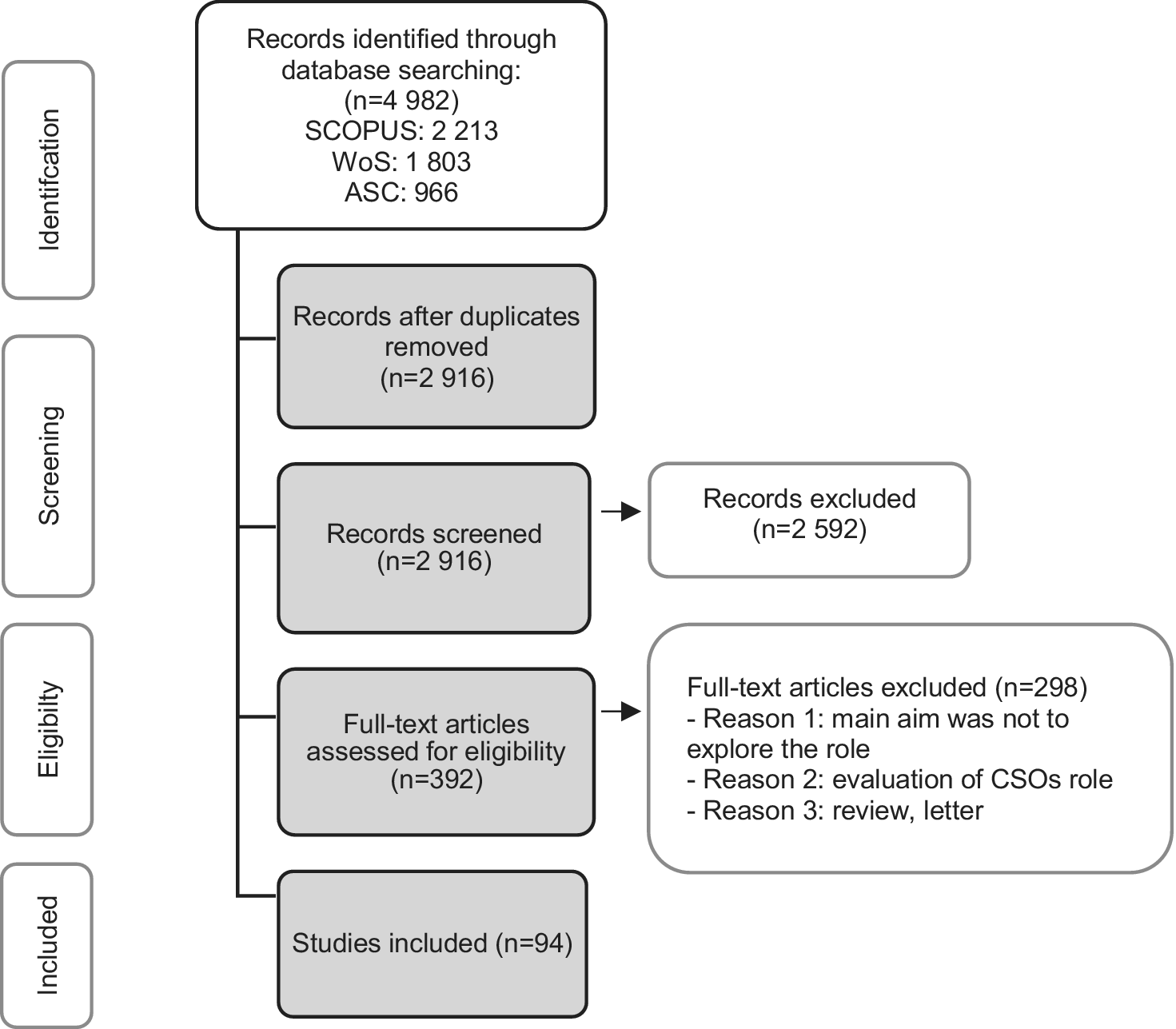
The systematic literature review was conducted adhering to the guidelines outlined in the Preferred Reporting Items for Systematic Reviews and Meta-Analyses (PRISMA) (Gazley, Reference Gazley2022). A visual representation is presented in Figure 1 through the provision of a flow diagram. The whole process was closely guided by the aim of the study and by finding articles that explicitly explored the role of CSO in disaster and crisis management.
Flow diagram.

Fig. 1. Long description
The flowchart is organized into four vertical phases labeled on the left.
1. Identification phase. The top box shows Records identified through database searching with n equals 4 982. This includes SCOPUS 2 213, W o S 1 803, and A S C 966.
2. Screening phase. A vertical line leads to Records after duplicates removed with n equals 2 916. Below this, Records screened with n equals 2 916. A horizontal arrow to the right points to Records excluded with n equals 2 592.
3. Eligibility phase. The main path continues to Full-text articles assessed for eligibility with n equals 392. A horizontal arrow to the right points to Full-text articles excluded with n equals 298. Three reasons are listed for exclusion. Reason 1: main aim was not to explore the role. Reason 2: evaluation of C S O s role. Reason 3: review, letter.
4. Included phase. The final box at the bottom of the main path shows Studies included with n equals 94.
Inclusion and exclusion criteria
The selected databases for the search were SCOPUS, Web of Science (WOS), and Academic Search Complete (ASC). The selection of databases is based on a combination of disciplinary relevance, database quality, and methodological transparency. SCOPUS, WOS, and ASC are three of the most comprehensive and widely used multidisciplinary databases for peer-reviewed research (Adriaanse & Rensleigh, Reference Adriaanse and Rensleigh2013 ; Gusenbauer & Haddaway, Reference Gusenbauer and Haddaway2020).
Only peer-reviewed articles written in English and published between 2001 and 2023 were considered for inclusion. The selection of this timeframe was based on the development and highlighting of CSOs more frequently in disaster and crisis management following the late 1990s and 2000s (Shaw & Takako, Reference Shaw and Takako2014). No limitations were imposed concerning the geographical context of the studies.
Currently, there is no consensus on how to define “crisis” or “disaster,” and the two concepts are often used interchangeably, having similar features even if they also have distinct elements (Al-Dahash et al., Reference Al-Dahash, Thayaparan, Kulatunga, In and Neilson2016; McConnell, Reference McConnell2020). Disasters are often defined as unexpected and sudden events “with natural, technological or social causes that lead to destruction, loss and damage” (Al-Dahash et al., Reference Al-Dahash, Thayaparan, Kulatunga, In and Neilson2016), while the distinctive feature of a crisis is the “unexpectedness and uncontrollability which disrupts and/or impedes normal operation” (Alexander, Reference Alexander, Perry and Quarantelli2005). The interchangeable nature of the concepts means that they together can be understood as—sudden and high-impact events that disrupt and overwhelm society as a whole, and there is an urgent need for assistance or relief (see also Al-Dahash et al., Reference Al-Dahash, Thayaparan, Kulatunga, In and Neilson2016; Alexander, Reference Alexander, Perry and Quarantelli2005). Consequently, conflict-related events such as wars, civil disturbances, and forced migration, as well as non-community disasters such as local accidents or personal crises, and crises specific to business contexts that do not affect the functioning of a community, have not been included in the overall definition (Quarantelli, Reference Quarantelli1988). Long-term crises, such as those related to democracy, economics, morality, and “mental health crises,” which exhibit a more prolonged temporal dimension, were also excluded.
During the process of defining crises and disasters, the question arose regarding whether the widely used—but also heavily criticized—terms such as “migrant crisis” and “refugee crisis” should be included (Krzyżanowski et al., Reference Krzyżanowski, Triandafyllidou and Wodak2018). Some scholars argue that the rapid and substantial influx of refugees, which places significant strain on unprepared national and local authorities, exposes bureaucratic failures and highlights governmental shortcomings in addressing the urgent humanitarian needs of forcibly displaced individuals, and qualifies as a crisis. However, in this article, such crises are viewed as long-term humanitarian or political crises, which require different analytical frameworks (Crawley & Skleparis, Reference Crawley and Skleparis2018).
Like the many understandings associated with the terms “disaster” and “crises,” the concept of “civil society” is also complex and often entails many different meanings and understandings (Cohen & Arato, Reference Cohen and Arato1994; Keane, Reference Keane1988; Trägårdh, Reference Trägårdh2010). In the case of this study, our emphasis is on the organizational role of civil society. This entails a focus on local and international non-state/governmental and non-profit organizations with different purposes and backgrounds, comprising both established organizations as well as those that have arisen in response to crises, including mutual aid groups and organized community groups. Yet, focusing on the organizational role, certain aspects connected to civil society, such as financial aid, crowdsourcing, and voluntarism, were excluded. Also, studies examining the effects of crises on CSOs, or the broader civil society, were deliberately excluded.
An important aspect of this systematic literature review was to adopt an explorative approach to the conceptualizations of crises and disasters in the scholarly discourse, to gain a broader understanding of the role of CSOs in crisis and disaster management. To avoid introducing bias based on preconceived notions, no specific crisis or disaster types were predefined in the chosen search terms. While this approach may have resulted in overlooking certain articles, it offers the advantage of identifying overarching patterns and providing a more comprehensive understanding of how scholars conceptualize the role of CSOs in these contexts.
Search strategy and study selection
Importantly, in terms of inclusion and exclusion, one objective of this systematic literature review was to adopt an explorative stance concerning the conceptualizations of crises and disasters in the scholarly discourse to achieve a prevailing understanding of the role of CSOs in crisis and disaster management. The initial search, therefore, employed the following search terms: “disaster*” or “crisis” or “crises.” Meanwhile, the second search incorporated the following terms: “civil societ*” or “NGO*,” “nongovernmental organi*” or “non-profit organi*” or “NPO*” or “third sector” or “civic organi*” or “charity” or “charities” or “voluntary organi*” or “voluntary association*” and the third incorporated “role*” or “respon*.” Part of the aim of using such broad terms was, as has been described previously, to avoid preconceptions of the research field. These keywords were required to be present either in the abstract or the title of the articles.
As seen in the flow diagram (Figure 1), the first search resulted in 2,916 articles after duplicates were identified. Both authors read all titles and abstracts following the aim of the study and the definitions discussed above. Only the articles that both authors unanimously agreed to include were included for full-text reading, resulting in a total of 392 articles. Following this step, both authors thoroughly reviewed the selected articles, leading to the exclusion of 298 articles for three specific reasons: Reason 1, when the primary aim of the study did not focus on exploring the roles of CSOs; Reason 2, articles primarily aimed at evaluating or assessing outputs on CSOs’ efforts in various disasters; and Reason 3, non-empirical studies such as research notes, letters, and recommendations for policy-makers. Consequently, 94 articles remained and underwent further analysis.
The analytical framework was developed by categorizing the articles according to the type of crisis they addressed and during what phase of the crisis. All activities undertaken by CSOs were listed under each respective crisis and phase. The initial set of articles was jointly analyzed by both researchers to ensure consistency in interpretation and coding. The remaining articles were then divided between the authors for individual analysis. Based on these lists, broader thematic patterns were collaboratively identified and synthesized into a set of categories that define the roles of CSOs. The Supplementary Appendix presents the selected studies along with the identified roles. The results of the analytical framework are explained and exemplified within each category.
Results
Upon reviewing the articles, it became evident that different disasters and crises could be categorized into three main groups, after the initial exclusion criteria: natural hazards, health crises, and technological (man-made) hazards. Most of the reviewed articles address the contributions and roles of CSOs in the management of natural hazards (68%), followed by the handling of health crises (24%). Additionally, there were articles addressing crisis management related to technological (man-made) hazards in general, such as plane crashes and industrial accidents (6%). One article addresses a combination of natural hazards and health crises. Of the selected article nearly half of the articles pertained to Asian countries (47%), followed by North America (15%), the Middle East (9%), and Europe (9%). A fraction of the articles addressed Africa, South America, and Oceania. Additionally, one article adopted a global perspective, and eight articles a transnational perspective. While there is a great diversity of different CSOs represented in the selected articles, there is, however, more emphasis on various types of local CSOs, such as local NGOs, community groups, local faith-based actors, and mutual aid groups.
Regarding the focus on CSOs’ roles across different phases, most articles concentrate on emergency response (ER) during the acute crisis phase (35%). Nearly one-fourth of the examined articles concentrate on both ER and PCR. Importantly, there is less emphasis on DRR (15%), and when it is addressed, it is only in the articles focusing on disasters related to natural hazards. While some roles can be distinctly categorized into either ER or PCR, others tend to span both phases. This overlap is particularly evident in the contexts of health crises and includes roles such as service provision and advocacy. A total of 17 articles address all the different phases of crises—most commonly in articles addressing natural hazards.
CSOs roles in natural hazards
The term “natural hazards” refers to physical phenomena, such as floods, earthquakes, landslides, hurricanes, and tsunamis (Monte et al., Reference Monte, Goldenfum, Michel and de Albuquerque Cavalcanti2021). This is the category with the most articles selected (n = 65) and where most roles have been highlighted. The two natural hazards that received the most attention were floods and earthquakes. Most articles focused on Asia (n = 36)—predominantly South Asia, followed by East and Southeast Asia—followed by North America (n = 10) and Oceania (n = 5). Only three selected articles focused on Europe.
Disaster risk reduction
Of the selected articles, 22% focused on CSOs’ role in DRR. The studies mainly focused on organizations and communities, finding ways to limit the effects of hazards fueled by climate change. Although various roles of CSOs in DRR were identified, two overarching themes emerged: building capacity and creating awareness.
In the theme of capacity building, emphasis was on action-oriented activities aimed at enhancing the abilities of individuals and communities to effectively respond to future disasters, both by developing preparedness and by reducing risks. Firstly, one of the most visible roles involved efforts to organize often vulnerable communities and establish networks for mobilizing them to become more resilient in the face of future disasters. Such efforts involved providing financial and technical support for community-based DRR activities but also supporting communication between local authorities and communities (e.g. Diagne, Reference Diagne2007). Secondly, another approach to capacity building was the role of CSOs in initiating projects aimed at mitigating vulnerability among communities and individuals by addressing poverty (e.g. Badawi & Abdullah, Reference Badawi and Abdullah2022). Thirdly, many CSOs actively contributed to DRR by developing initiatives aimed at mitigating disaster impacts, including formulating land-use plans, identifying at-risk communities, and advocating for the integration of DRR into local and national policies (e.g. Roberts et al., Reference Roberts, Archer and Spencer2021).
The other theme of CSOs’ participation in DRR was to create awareness in local communities by providing information and education. CSOs were seen both to contribute to risk awareness through social media and campaigns and to provide practical information on what to do in the event of a disaster or emergency. In Bangladesh, for example, one study showed that CSOs provided information to vulnerable communities regarding the intensity of upcoming floods, informing where people could gather and take shelter (e.g. Hossain, Reference Hossain2020). In another study from the UK, it was shown how local flood groups contributed to more general local flood-risk awareness through different events, social media, and flyers (Forrest et al., Reference Forrest, Trell and Woltjer2019).
Emergency response
Many of the selected articles broadly examine the responses and contributions of CSOs during the immediate and acute phases of natural hazards, covering a wide range of roles. Notably, numerous studies, especially those focusing on the Global South, highlight that local CSOs are often the first to respond, followed by national and international CSOs, as well as government and local authorities. However, as the acute phase subsides, many CSOs tend to reduce their involvement, transitioning to a supplementary role in support of the state’s aid efforts. Several articles emphasize that the effectiveness of CSO responses during the acute phase is closely linked to the capacity—or shortcomings—of government action. In instances where government responses were inadequate, the rapid intervention of CSOs proved essential (e.g. Fisker-Nielsen, Reference Fisker-Nielsen2012). However, the long-term impact of such interventions is not always guaranteed. In the aftermath of the Haiti earthquake, for instance, many NGO-led initiatives were found to have limited sustainability, often failing to support enduring livelihoods or foster economic development. As Zanotti (Reference Zanotti2010) argues, these programs were frequently donor-driven and lacked participatory planning, resulting in a “cacophony of aid” characterized by overlapping efforts, inefficient resource use, and the marginalization of local governance structures.
One notable observation across the literature is that during this phase of the disaster cycle, CSO roles tend to be highly hands-on and practical. Support provided at this stage is aimed at anyone in need, extending beyond their typical community members. Emergency response is the dominant theme, with 65% of articles highlighting CSOs’ critical role in disaster response, particularly in two key areas: provision of material aid and creation of safe spaces. Material aid encompassed necessities such as food, water, hygiene products, and financial support (e.g. Cook et al., Reference Cook, Shrestha and Htet2018). Additionally, CSOs offered shelter in community centers and religious buildings, which served not only as gathering points for emotional and practical assistance but also as sites for medical aid (e.g. Cheema et al., Reference Cheema, Scheyvens, Glavovic and Imran2014).
The second most frequently highlighted role within ER focuses on how CSOs act as coordinators in local disaster management efforts. A key aspect of this role involves identifying, assessing, and collecting information on the extent of damage, to recruit and organize volunteers. Additionally, CSOs play a role in facilitating collaboration to enhance response effectiveness. For example, following an earthquake in Turkey, NGOs swiftly established the Civil Society Earthquake Coordination Committee to streamline relief efforts on a broader scale (Jalali, Reference Jalali2022). Closely related to this coordination role is the task of providing local communities with accurate information and bridging communication gaps between government authorities and affected populations. Several studies emphasized that CSOs not only provided immediate practical support but also played a significant role in immediate rescue efforts (e.g. Lu et al. Reference Lu, Wang and Zhang2023).
Post-crisis response
The most prominent role in the reviewed articles during PCR involves restoration and clean-up activities. Articles highlight how CSOs contribute by rebuilding and repairing homes, as well as reconstructing essential infrastructure. Another role discussed in the reviewed studies is advocacy, often encompassing legal aspects of recovery. For example, some articles illustrate how CSOs were involved in identifying and securing land for permanent housing construction (Hackworth & Akers, Reference Hackworth and Akers2011). Beyond practical assistance, CSOs also act as advocates and watchdogs, ensuring that the rights of affected individuals are protected. This type of advocacy includes ensuring that people receive access to necessary assistance, government-provided housing, and legal aid. Several studies describe CSOs taking on more confrontational roles, such as supporting communities in filing legal cases against government authorities, as in the Philippines (Luna, Reference Luna2001), or mobilizing for mass protests to demand housing rights for earthquake survivors in Turkey (Jalali, Reference Jalali2022).
The literature also underscores that disasters disrupt not only homes but also livelihoods, making it challenging for affected individuals to regain normalcy. In response, many articles emphasize CSOs’ involvement in livelihood restoration and skills training programs to facilitate workforce reintegration (e.g. Tatebe & Miyamoto, Reference Tatebe and Miyamoto2021). While some CSOs provided platforms for idea-sharing and mutual support, others focused on equipping individuals with new skills to contribute to ongoing restoration efforts. Furthermore, articles highlight the role of CSOs in supporting the emotional recovery of disaster victims, providing counseling services, spiritual guidance, organizing social centers, and supporting children through educational, recreational, and sports activities to aid in emotional healing (e.g. Ngin et al., Reference Ngin, Grayman, Neef and Sanunsilp2020).
CSOs’ roles in health crises
Of the 23 examined articles, 21 addressed the roles of CSOs in the Covid-19 pandemic, and no articles in this category were published before 2020. Two of the selected articles addressed the Ebola outbreak in Sierra Leone, and in these articles, all three crisis phases are discussed. Due to the longer timescale of the Covid-19 pandemic, there are blurred lines between the emergency and recovery phases. The articles covered a wide range of countries, spanning three continents: six from Asia, five from Europe, and three from the Middle East. There was a difference in the approach of CSOs depending on whether it was related to the Global South or Global North. Specifically, in the Global South, the focus tended to be more on emergency relief, rather than service provision. A key finding in the health crises category is that many articles focus on CSOs assisting vulnerable groups, such as migrant workers, people with disabilities, LGBTQ individuals, and not just the general public.
Emergency response
Many roles regarding ER described in the articles fall within the service provision theme. Service provision was described across two levels in the selected articles: “light” service and welfare service. The “light” services category included activities like dog walking, assistance with grocery shopping, and collecting medicine from pharmacies. Welfare services included school services, healthcare, and serving as a link to public welfare services. Within the emergency relief category, emphasis was placed on food provision and financial assistance.
During the pandemic, many individuals lost their jobs, leading to CSOs assuming the role of employment agencies. Like many of the listed roles, employment services were provided for various target groups, often described as vulnerable, such as the elderly (Vameghi et al., Reference Vameghi, Eftekhari, Falahat and Forouzan2022), migrants (e.g. Sim, Reference Sim2020), disabled (Cullingworth et al., Reference Cullingworth, Watson, Shakespeare, Brunner, Pearson and Scherer2022), or economically disadvantaged (e.g. Pongutta et al., Reference Pongutta, Kantamaturapoj, Phakdeesettakun and Phonsuk2021). Another identified role was psychological support—often provided online or through helplines, described in the articles as mental health counseling, emotional support, or offering companionship. In contrast to other crises outlined in the selected articles, there was limited discussion on the advocacy role in relation to the pandemic, even though it was mentioned in a few of the articles. Instead, the role predominantly involved complementing government efforts by raising awareness and providing information (e.g. Lundgren & Fransson, Reference Lundgren and Fransson2023). Additionally, CSOs implemented various protective measures, such as distributing sanitary items and disinfecting public spaces.
CSOs’ roles in technological (man-made) hazards
A technological hazard is referred to as an event that “includes hazardous material releases and spills, acts of terrorism, and nuclear accidents” (FEMA, 2024). This was the category where the least number of articles were identified (n = 6). All concerned different events (the September 11 attacks in 2001; the Beirut explosion in 2020; the oil spill in the Philippines 2006; the oil spills in Mauritius in 2020 as well as in California in 2021; the Malaysia Airlines MH370 incident in 2014; and the Flint water crisis in 2014). The distinction between ER and PCR was often unclear in the reviewed articles, as crises frequently extended beyond the initial incident. However, for clarity, we have categorized efforts aimed at reducing the crisis’ impact as PCR.
Emergency response
The articles on the contribution of CSOs to this category primarily centered on immediate emergency relief. The articles highlighted various forms of relief provided, such as distributing food and hygiene products and addressing the immediate needs of affected populations. Within ER, CSOs also played a role in coordinating the distribution of material and monetary donations, as well as organizing volunteers. In articles examining technological hazards in developing countries, the involvement of CSOs was often seen as a sign of a weak state that had failed to fulfill its responsibilities during the crisis. In contrast, in studies focusing on crises in countries with stronger state institutions, CSOs’ participation was portrayed as a valuable complement to government action.
Post-crisis response
Several articles described how CSOs contributed to reducing the impact of disasters during both the ER and PCR phases. These roles included participating in clean-up operations or restoration, and reducing environmental damage, such as protecting wildlife. In the case of the Malaysia Airlines incident, CSO involvement primarily centered on communication and providing psychological and spiritual support following the crisis (Lee & Han, Reference Lee and Han2016). Another article highlighted CSO advocacy efforts to ban offshore oil drilling in response to an oil spill (Naggea & Miller, Reference Naggea and Miller2023).
Discussion
As previous research has demonstrated, CSOs undeniably play a central role in disasters and crises. This review reaffirms that observation. In the selected articles, it is clear that while there are variations in the roles described in different crises, there is also great consistency and similarities. Despite the variations in their specific functions, three overarching categories emerged that encapsulate the most common roles CSOs assume across all phases of crises and disasters.
The first category is the protection of human life, which includes hands-on support in emergency relief, rescue operations, and security measures. These roles focus on meeting the basic needs of victims and ensuring their safety during a crisis. While certain roles, such as direct participation in rescue operations, may be less prominent in some crises, CSOs’ involvement in emergency relief is the role most consistently highlighted across all types of crises in the analyzed articles. The second category is much more about long-term work and facilitating societal and individual resilience and recovery. This category emphasizes efforts aimed at restoring normality for communities and individuals while also building resilience for future crises. While some activities may begin immediately after a disaster, as ER, most are concentrated in the PCR phase. Many articles highlight the role of CSOs in livelihood restoration and providing social and emotional support to aid recovery. This often extends to preparedness efforts, where CSOs contribute to building capacity for future crises. The third category is advocating for impacted communities and individuals. Though less frequently mentioned than the other two categories, advocacy, awareness-raising, and information dissemination are roles seen in all different crises. CSOs work to influence local policies, protect the rights of vulnerable groups, and ensure that affected individuals receive accurate information and are aware of their rights during and after crises.
While the three categories reveal significant commonalities in the roles of CSOs across different crises, there are also notable distinctions shaped by a range of contextual factors. Cultural, economic, and political conditions significantly influence the nature and scope of CSO involvement. For instance, in contexts with strong community-based traditions—often found in parts of the Global South—CSOs may be more deeply embedded in local communities and thus more directly involved in frontline emergency response and long-term recovery. Conversely, in more institutionalized settings, typically seen in parts of the Global North, CSOs may focus on supplementary or supportive roles, such as providing social services or advocacy. Economically, CSOs in low-resource settings often fill critical gaps left by underfunded state mechanisms, assuming roles that might otherwise be handled by public agencies. This can result in broader responsibilities for CSOs in these contexts, especially in crisis situations where governmental capacity is limited. In contrast, in wealthier regions with robust welfare states, CSOs often work in coordination with governmental bodies rather than acting as primary responders.
The most comprehensive body of literature—and the widest range of documented roles—is concentrated on natural hazards, with CSO involvement explored across different phases of the disaster cycle. Moreover, while studies on natural or man-made disasters tend to focus on broad-based support for victims, research on health crises shows that the undertaking of CSOs often emphasizes targeted aid for specific vulnerable groups.
One of the most noticeable findings of this review is that the role of CSOs in DRR is primarily related to natural hazards. In fact, none of the analyzed articles focused on capacity-building or awareness-raising in other types of crises. This concentration may in part reflect the nature of natural hazards themselves: they occur more frequently, can be geographically widespread, and often affect large populations. Yet, a key question here is whether this variation in roles is due to a lack of studies focusing on this specific aspect, or if CSOs take on different roles during different types of phases and crises. It is evident that articles addressing DRR frequently center on local communities in the Global South, many of whom are acutely aware of the need to prepare for risks posed by natural hazards. Less is written about preparing for less foreseeable risks, such as technical hazards or pandemics. Nevertheless, scholars and global institutions, including the World Health Organization (WHO, 2019) and the United Nations (UNDRR, 2020), stress the need to broaden the understanding of risk in DRR and move the focus beyond natural hazards (Fernando et al., Reference Fernando, Jayasinghe, Amaratunga, Haigh, Siriwardana, Jayasekara, Jayaweera, Amaratunga, Haigh and Dias2021). Overall, this highlights an important area for further research.
While much of the literature on natural hazards focuses on Asia and North America, most studies on the role of CSOs in health crises focused on Europe. The emphasis on CSOs’ roles in responding to natural hazards in Asia and North America is perhaps unsurprising, given that these regions, along with Africa, have experienced the highest frequency of natural hazards (Bündnis Entwicklung Hilft & IFHV, 2025). However, with the increasing frequency of disasters due to climate change, there is a clear lack of studies focusing on South and Central America, Africa, and Europe. When comparing the roles of CSOs in the Global South and Global North, further differences emerge. For instance, during COVID-19, studies from the Global North often highlighted light services, such as walking dogs and assisting with shopping for vulnerable groups. In contrast, support in the Global South tended to be more centered on emergency relief, as discussed above.
Lastly, there are significant opportunities for future research in this area. We strongly emphasize, in alignment with other scholars (Koehrsen & Burchardt, Reference Koehrsen and Burchardt2024), the importance of broadening the scope beyond merely examining CSOs that are actively involved or have participated in crisis management and environmental initiatives. It is crucial to also include those that remain passive, indifferent, or even opposed to such efforts. The studies included in this literature review, while acknowledging various challenges, often focus on positive examples of community groups and CSOs contributing to disaster response. This highlights a potential bias toward showcasing optimistic case studies, potentially overlooking groups that are passive or even obstructive.
Limitations of the study
This study has several limitations that should be considered. Our search was restricted to specific keywords related to “crises” or “disaster,” which may have led to the exclusion of relevant articles that do not explicitly use these terms. For instance, natural hazards are frequently labeled as crises or disasters, while events like the COVID-19 pandemic might not always be framed in the same way. However, this focus aligns with our objective of examining what the literature defines as crises and disasters. Additionally, this review included only peer-reviewed articles in English, which may limit the generalizability of our findings. In particular, the exclusion of non-peer-reviewed reports represents an important limitation. Such reports are common in the NGO sector and often contain practice-based insights into the roles of CSOs. While our focus on peer-reviewed scholarship ensures methodological rigor and comparability, it also means that a substantial body of practitioner knowledge has not been captured in this review.
Finally, there are limitations in the search strategy itself. Although we used three comprehensive databases, our selection is not exhaustive, and relevant articles may exist in other databases. The choice of databases may have influenced the geographic distribution of the articles included, potentially contributing to the underrepresentation of certain regions or contexts. Different search filters, additional databases, or alternative indexing systems could yield a broader set of findings, highlighting the importance of considering database coverage when interpreting the scope and completeness of this review.
Despite these limitations, this study offers valuable insights by synthesizing and examining how the role of CSOs is framed in times of crisis and disaster. By identifying key trends and gaps, this review provides a foundational perspective for future research.
Conclusion
This study aimed to explore and analyze the current knowledge about the role of CSOs in different types of disasters and crises. Through a systematic review of the peer-reviewed literature, we identified three primary functions of CSOs: the protection of human life, societal and individual resilience and recovery, and advocacy. These roles were present across a range of crises, though the nature and emphasis of their involvement varied depending on the type of disaster and geographical context. For example, CSOs in the Global South often emphasized community-based, emergency relief efforts, while those in the Global North emphasized welfare services and longer-term support. Furthermore, the review highlights that CSOs seem to play similar roles across different crises, although their involvement in DRR is largely focused on natural hazards. This raises the question of whether the variation in CSO roles is due to a lack of studies on specific aspects or if their roles differ depending on the crisis. Most research on CSOs in DRR focuses on local communities in the Global South, especially regarding natural hazards, with less emphasis on risks like technical hazards or pandemics. What can be done to bridge the gap between the PCR and DDR is a question for future studies.
Supplementary material
The supplementary material for this article can be found at http://doi.org/10.1017/S0957876526000185.
Author contribution
Both authors have contributed equally to the study and approved the current manuscript.
Funding statement
This study was financed by the Swedish Civil Contingencies Agency, grant number 2021–09094.
Competing interests
The authors declare no competing interests. The findings presented in this manuscript have not been published, and the manuscript is not being simultaneously considered for publication elsewhere.


 Open access

