

13.1 Introduction
When Martin Schulz was elected as the leader of the Social Democratic Party (SPD) of Germany in March 2017, the media and the public were in awe of him. In the first weeks of the campaign, Schulz helped the battered and beaten SPD regain confidence, members, and support in the polls. Initial gains in the polls of over ten percentage points let The Guardian ask if, after three devastating election defeats, “Germany’s Social Democrats [have] found a winner in Martin Schulz?” (Connolly Reference Connolly2017). Others even called the nomination of Schulz as the chancellor candidate and party leader “a tectonic shift” and predicted that “Angela Merkel must prepare for a real fight” (Bartsch et al. Reference Bartsch, Böll, Feldenkirchen, Höhne, Knaup and Neukirch2017). Der Spiegel described Schulz as radiating confidence and having a hunger for power, while his predecessor Sigmar Gabriel was characterized as a politician who struggles and dithers (Bartsch et al. Reference Bartsch, Böll, Feldenkirchen, Höhne, Knaup and Neukirch2017). It was a change that BBC classified as “an attempt to improve the party’s chances” in the upcoming election (“Germany election,” BBC 2017). In March 2017, the scene seemed to be set for an exciting and close election with the party that finally found its stride and was ready to challenge the chancellor, Angela Merkel.
Alas, the excitement lasted only a few months, and on the election day in September 2017, the SPD suffered further election losses. The party’s crash-landing at the ballot box led Schulz to resign from his position less than a year after his historic unanimous appointment. Even a leader as exciting as Schulz was not enough for SPD’s recovery. For the party this was yet another example of a failed leader with a very short tenure in office, a pattern that many pundits blame for the SPD’s decline in recent years. Between Gerhard Schröder’s resignation in 2004 and Sigmar Gabriel’s appointment in 2009, SPD had four additional leaders, each of whom, on average, lasted only about one and a half years in office. During that period, the SPD was in free fall. Its seats in the Bundestag declined from 251 seats (out of 603, 41.6%) in 2002 to 146 seats (out of 622, 23.5%) in 2009. At the same time, their official vote total shrunk from almost 18.48 m votes (38.5%) to 9.99 m (23%).
Even in the 2021 election in Germany, when the SPD emerged as the largest party in the parliament, the SPD received only 11.95 m (25.7%) votes. This is significantly less than the over 20 m votes they received the last time they were the strongest party, the 1998 election in which Gerhard Schröder became chancellor.Footnote 1 Does the electoral diminishment of the SPD during the 2000s and 2010s teach us an important lesson about the significance of party leaders and leader turnover for party performance? Do quick leader turnovers and downturns in electoral performance go hand in hand? Do parties perform better with stable leadership? Or, is there a social democratic exception (or even an SPD exception) at work? Have party leaders and leadership churns contributed to the decline of social democratic parties we witness across Europe?
In this chapter, we use a novel dataset that covers ten advanced democracies between the early 1990s and 2019 to test whether the decline of social democratic parties can be attributed to party leadership changes and especially to the frequency of party leadership changes by answering three questions:
1. What determines the duration of leadership tenure across different party families?
2. Is party leader tenure shorter in social democratic parties? and
3. How does leader turnover (and especially the frequency of leadership turnover) affect party performance both in the short term (for opinion polls) and in the long term (for election results)?
Our findings suggest interesting patterns. First, analyzing the duration of party leaders in office, we see that electoral performance indicators as well as the procedures and results of leader selection have significant effects on party leader duration with some variation across different regions/electoral systems. However, these variables do not vary in their effect on leader duration across party families. Given these results and the prevalence of some of these features for social democratic parties, we then check whether social democratic parties have different leadership turnover rates compared to other party families. The data suggest no, with an important exception for the German SPD. Finally, we analyze the short-term and long-term performance effects of leadership changes and see that while leadership changes and the frequency of leadership changes have some minor impact on short-term polling results, they do not influence election results. These results are consistent across party families and do not suggest a social democratic exceptionalism, although social democratic parties appear to be awarded more in the short term if they change their leaders while in opposition.
Below, we first elaborate on our theoretical expectations for the three research questions we listed earlier. We then describe the novel data that is the foundation of our analysis in more detail, show the results for the duration models testing the factors that explain leader tenure, and discuss the SPD as an extreme case with frequent leadership changes (Seawright and Gerring Reference Seawright and Gerring2008). Afterwards we turn to the analyses of leadership changes’ performance consequences. We conclude this chapter by discussing these results and potential theoretical expectations we derive for future work.
13.2 Theoretical Expectations
Leaders are increasingly crucial for political parties, even in parliamentary systems. Over the past few decades, scholars have noted that politics has become more candidate-centric (Wattenberg Reference Wattenberg2014) and “presidentialized” (Poguntke and Webb Reference Poguntke and Webb2005). As party membership numbers continue to decrease across Europe, leaders have acquired more power and influence: They are now identified as the central actors in running parties’ election campaigns and attracting voters to their parties (Scarrow et al. Reference Scarrow, Webb, Farrell, Dalton and Wattenberg2000).Footnote 2
A growing literature also shows how leaders, their campaigns, personal characteristics, and traits affect vote choice (Butler and Stokes Reference Butler and Stokes1974; LeDuc Reference LeDuc2001; McAllister Reference McAllister, Dalton and Klingemann2007; Bittner Reference Bittner2011; Aarts et al. Reference Aarts, Blais and Schmitt2013). Given the heightened importance of leaders in electoral politics, political parties should be more careful in selecting the best leader and not shy away from replacing them when necessary. But do we see any evidence for these expectations? Do parties replace their leaders when needed? What explains party leadership change? And, are parties successful in boosting their performance following a leadership change? Most important for this chapter, what explains social democratic party leaders’ duration in office, and how do leadership changes affect social democratic parties’ performances?
13.2.1 Understanding Leader Duration in Office
If leadership replacements are strategic affairs and parties are more likely to replace their leaders when voters demand change, then we should see that parties change their leaders following an election defeat, government loss, or because of poor polling performance. Andrews and Jackman (Reference Andrews and Jackman2008) and Ennser-Jedenastik and Müller (Reference Ennser-Jedenastik and Müller2015), focusing on Westminster systems and Austria, respectively, have shown that electoral performance is the most crucial factor affecting leader duration in office. Expanding the sample to other advanced democracies, we argue that parties that lost votes in the recent elections are more likely to replace their leaders. Another retrospective performance indicator for political parties is losing/winning governing status. Following the findings in the literature, we expect a leader who cost a party its government participation to be more likely to be replaced (Bille Reference Bille1997; Ennser-Jedenastik and Schumacher Reference Ennser-Jedenastik, Schumacher, Cross and Pilet2015). Finally, recent polls inform political parties more immediately than past election results about their expected electoral performance. We expect that, as parties rack up continuous losses in public support and as expected losses on election day become more likely, leaders are more likely to resign or be replaced. This latter argument about the opinion poll effects has not been tested in the literature. Still, given the increasing importance of opinion polls for party strategies (Jennings and Wlezien Reference Jennings and Wlezien2016), we believe that polls should affect leader duration in office.
In addition to electoral performance and government status, another performance indicator is about how leaders get elected to the party’s top office. We argue that leaders should last longer in office if they were elected with unanimous support or by acclamation given the wide support they have. Less than unanimous support suggests less enthusiasm about the leader, which should reduce their time in office. Regarding the effects of the leader selection method, we argue that membership inclusion for selection should help leaders last longer in office, given that these elections result in higher legitimacy and competence evaluations for the newly elected leader (Cozza and Somer-Topcu Reference Cozza and Somer-Topcu2021).
The more crucial empirical question we like to answer about leader tenure, however, is whether Social Democrats are more likely to replace their leaders when needed. This is an important question because a party likely suffers further in polls and elections if it is not responsive to voter demands. Given the importance of party leaders across Europe, one such responsiveness indicator would be replacing the party leader when performance is low. Have Social Democrats replaced their leaders when they were asked to? How do different parties react to the performance variables discussed earlier in their decisions to strategically replace their leaders, and do the same variables affect social democratic leaders’ durations in office?
13.2.2 The Effects of Leader Changes on Party Performance
Earlier, we have argued that leadership changes are strategic affairs, and when done right and at the right time, parties would be seen being responsive to changing voter demands. This suggests that leadership changes should help parties electorally. Hence, our first performance hypothesis is that parties polling and electoral performance should improve when they change their leader. There is further evidence in the literature that suggests that leadership changes are beneficial for party performance. A new leader is more likely to attract airtime and newspaper coverage to advocate her leadership and party policies. As the media coverage about the new leader and the party increases, we expect voters to get more exposure to the party and learn more about its policies (Pedersen and Schumacher Reference Pedersen, Schumacher, Cross and Pilet2015). Somer-Topcu (Reference Somer-Topcu2017) and Fernandez-Vazquez and Somer-Topcu (Reference Fernandez-Vazquez and Somer-Topcu2019) show that voters develop more accurate perceptions of party policy positions and agree more on party positions following a recent leadership change. As a result, one may expect a leadership change to bring new dynamism and attention to the party and is more likely to positively influence a party’s electoral performance.
Yet, despite all the intended positive effects of leadership changes, any change is a destabilizing event for party organizations. Leadership changes are especially risky (Harmel et al. Reference Harmel, Heo, Tan and Janda1995), particularly if they are frequent. Frequent leadership changes likely destabilize party organizations, as they are occasions “to rethink the commitment to the present agenda, to reflect on roads not taken in the past, and to review future choices” (Gilmore Reference Gilmore1988: 14). Grusky (Reference Grusky1960), writing in the management literature, argues that leader successions in businesses are disruptive. With leadership changes, the relationships among organization members change, traditional practices are overhauled, and new policies are introduced. Similar studies of the English soccer leagues (Audas et al. Reference Audas, Dobson and Goddard1997, Reference Audas, Dobson and Goddard2002) and the National Hockey League (Rowe et al. Reference Rowe, Cannella, Rankin and Gorman2005) show that within-season coach or general manager changes often result in declined team performance. Add to that the public perception of frequent leadership changes, the party that replaces its leaders often over short periods of time is likely seen as unsuccessful, disorganized, and divided, all of which have negative consequences for party performance (Greene and Haber Reference Greene and Haber2015). Hence, we hypothesize that frequent leadership changes harm parties’ polling and electoral performance.
Only a handful of studies examined how party leadership changes affect party performance, and no work to our knowledge focused on the effects of the frequency of leadership changes on performance. Pedersen and Schumacher (Reference Pedersen, Schumacher, Cross and Pilet2015) was the first comparative work on the question of how leader changes (but not the frequency) affect performance. Using data from four European countries, they showed that leadership changes have minor positive effects on short-term polling rates and no long-term effects on election outcomes. They also present empirical evidence that the short-term polling effects are stronger for those parties with a contested leadership election and those that allow members to vote for party leadership. Cozza and Somer-Topcu (Reference Cozza and Somer-Topcu2021) expanded on these results in a recent paper using data from eleven countries. They confirm that inclusive selectorates have positive effects on short-term party performance but no long-term electoral effects. Using a survey experiment from Australia, they then unpack the mechanisms behind these short-term positive effects and present evidence that leaders that get elected by party membership have higher legitimacy and are evaluated as more competent. Following this work, we test both the short-term polling and long-term electoral effects of leadership changes in this chapter and also examine, for the first time, how frequency of changes affect parties.
Like the duration analyses, what we are especially interested in in this chapter is exploring whether leadership changes and particularly frequent leadership changes affect social democratic parties’ performance. Hence, below we first test our models for all parties and then test how Social Democrats benefit from or hurt because of leadership changes.
13.3 Party Leaders Data and Research Design
Our examination of party leader changes builds on a novel dataset we collected using Keesing’s World Archives, secondary literature, and online newspaper archives and captures information about leadership changes in fifty political parties across ten advanced parliamentary democracies between the early 1990s and 2019. The countries in the dataset include Australia, Canada, Denmark, Germany, Ireland, the Netherlands, New Zealand, Norway, Sweden, and the United Kingdom, which ensures that the analysis is built on a sufficient number of political parties from Westminster as well as European PR systems.Footnote 3
All political parties that received at least 5% of the vote in two consecutive elections between the first election in the 1990s and 2019 and those that did not have shared/dual leadership were coded. The 5% threshold limits the parties to those we consider electorally relevant. A clear definition of who is a political party leader is not straightforward and depends on the time, country, and even the political party under study. The decision on who we coded as the leader of each party was taken based on an extensive reading of the literature and in consultation with country experts.
Comparing the number of leadership replacements of social democratic parties and their main rivals for the chancellor/PM position, moderate right parties (Christian democratic and conservative), we see in Figure 13.1 that there is little difference in the general trajectory of leadership changes in most countries. While the timing of replacement differs from country to country and from party to party, most social democratic parties are within two cumulative leadership changes of their primary opponents by 2020. Except for Australia, where Labour at some point trailed by three cumulative leadership changes before they caught up and started to move in lockstep, this also holds more generally for the entire time since 1979. Most social democratic parties and their main rivals move somewhat in tandem when it comes to replacing their leaders – except for the German Social Democrats.
Leader changes in social democratic and conservative/Christian democratic parties
Note: Figure shows the number of leadership changes in social democratic (dotted) and moderate right (solid) parties since 1980. Shaded area indicates years in which social democratic parties held the office of the chancellor/prime minister. Interim leaders are not included in the calculation of the totals. Canada’s Conservative party experienced a merger in 2003.

As we detail below, the SPD had nine leadership changes more than their main rival, the CDU and only the Australian parties come even close to – but still trail – the total number of changes the SPD had. Truly remarkable for the SPD is the difference compared to its main rival. The CDU’s three leadership changes in about thirty years (between 1990 and 2019) make for quite a different trajectory than the SPD’s twelve during the same period. There are other political parties in the data set that show diverging patterns in leader replacement compared to their main competitors. For instance, the Norwegian Conservative Party has consistently had three more cumulative leader changes than the Norwegian Labour and Christian Democratic parties. But no other party has more leadership changes and is different from its main competitor than the German SPD.
More generally, the pattern for social democratic and other parties appears to be that the leaders tend to stay in office during times of incumbency, at least the frequency of changes goes down, but that leaders are more readily replaced when the party is not holding the office of, for example, chancellor/prime minister. As shown in Figure 13.1, losing control over the government is usually associated with an immediate leader replacement.
Now that we have seen that SPD has been an exception, we would like to discuss the party in more detail. We started this chapter with the Icarian example of Martin Schulz. Initially celebrated as the savior of the SPD, he flew to new heights in the polls, only to have all the gains in public support melt away just before the election day. The party’s downward tumble also spelled the end for Schulz’s time in office as the SPD leader, adding him to the long list of short-lived postwar leaders of the party. The frequent leadership turnover is not something that has been gone unnoticed in public. “One number sums up the misery of the SPD, sums up its crash: 12. That’s how many former leaders the party has.” This is how the online platform of the largest local newspaper in North Rhine-Westphalia, historically a stronghold of the SPD, commented on the resignation of then-party leader Andrea Nahles in 2019 after being in office for only 407 days (“SPD versinkt im Chaos,” der Westen 2019). Shortly before Nahles’ resignation, her deputy leader Malu Dreyer explicitly warned the party against forcing Nahles out of office: “If we have one lesson behind us, it is that permanent changes in the leadership do not get us any further” (Greive and Stratmann Reference Greive and Stratmann2018). This call from within the SPD to end leadership fights, unite the party, and focus on substantive discussions was not new. It was issued only 406 days earlier when Nahles initially took office. Manuela Schwesig, deputy leader and head of the SPD-led government in Mecklenburg-Vorpommern, called on the party to unite and “to get these days of chaos behind us” (“SPD-Vorsitz,” Merkur 2018).
These calls for unity, continuity, and stability come with reasons. The SPD itself identified frequent changes in its leadership (leader, general secretary, and deputy leaders) as a key weakness in its appeal to voters and its ability to organize effective electoral campaigns (Faus et al. Reference Faus, Knaup, Rüter, Schroth and Stauss2018). This sentiment has been echoed in basically every statement of leading SPD politicians when an old leader throws in the towel and a new one steps up. When Martin Schulz resigned, Ralf Stegner, deputy leader of the SPD, called for the end of debates about party office: “Each of us is well advised to put the interests of the party and the country above our ambitions.” Thorsten Schäfer-Gümbel, deputy leader of the SPD, said that it is a top priority of the party to reestablish its ability to act and demanded that the “unsorted nature at the federal level” must be remedied (“Widerstand gegen Nahles,” die ZEIT 2018). Michael Müller, heading the government of the SPD in Berlin, put it more bluntly and called for the party to stop appointing leaders on an annual basis (as quoted in the same article).
The data in Table 13.1 show that the SPD indeed is a party of many leadership changes. Since 1945, the SPD has had seventeen leaders and six acting leaders. To make matters worse, while the initial leadership tenure was long (the first three leaders were in power for over 6, 11, and 23 years, respectively), leaders have been replaced in rather rapid succession afterward. Since Willy Brandt’s resignation in 1987, only two leaders remained in office for more than five years, while two leaders didn’t even last an entire year. The average tenure of an SPD leader following Brandt has been slightly above 2.5 years, resulting in, on average, two new leaders per electoral cycle.
| Name | Appointment | Resignation | Duration | ||
|---|---|---|---|---|---|
| 1 | Kurt Schumacher | 1946-05-11 | 1952-08-20 | 6 years | 103 days |
| 2 | Erich Ollenhauer | 1952-09-27 | 1963-12-14 | 11 years | 80 days |
| 3 | Willy Brandt | 1964-02-15 | 1987-06-14 | 23 years | 125 days |
| 4 | Hans-Jochen Vogel | 1987-06-14 | 1991-05-29 | 3 years | 350 days |
| 5 | Björn Engholm | 1991-05-29 | 1993-05-05 | 1 year | 342 days |
| 6 | Rudolf Scharping | 1993-06-25 | 1995-11-16 | 2 years | 144 days |
| 7 | Oskar Lafontaine | 1995-11-16 | 1999-03-12 | 3 years | 117 days |
| 8 | Gerhard Schröder | 1999-04-12 | 2004-02-06 | 4 years | 301 days |
| 9 | Franz Müntefering | 2004-03-21 | 2005-10-31 | 1 year | 224 days |
| 10 | Matthias Platzeck | 2005-11-15 | 2006-04-10 | 146 days | |
| 11 | Kurt Beck | 2006-05-14 | 2008-09-07 | 2 years | 117 days |
| 12 | Franz Müntefering | 2008-10-18 | 2009-11-13 | 1 year | 26 days |
| 13 | Sigmar Gabriel | 2009-11-13 | 2017-03-19 | 7 years | 128 days |
| 14 | Martin Schulz | 2017-03-19 | 2018-02-13 | 331 days | |
| 15 | Andrea Nahles | 2018-04-22 | 2019-06-03 | 1 year | 42 days |
| 16 | Saskia EskenNorbert Walter-Borjans | 2019-12-06 | 2021-12-11 | 2 years | 5 days |
| 17 | Saskia EskenLars Klingbeil | 2021-12-11 | Current | ||
Note: This table omits the five interim leaders who were in office for periods ranging from 51 to 186 days between 1993 and 2019. Included in the analysis are only leaders that started their tenure before the 1990s, hence SPD leaders before Björn Engholm are excluded. The tenure of Esken and Walter-Borjans as well as Esken and Klingenbeil is outside of the temporal scope of our analysis. However, since these were dual leaderships they would not be coded in our data anyways.
The replacement of leaders has happened for several reasons and mostly not with the strategic goal of maximizing electoral support in the short or long term. A series of changes were unrelated to the performance of the political party. Some of the resignations happened because the leader conflicted with other key party personnel over the party’s direction or office allocation. Oskar Lafontaine left the party leadership in 1999 following a power conflict with then-chancellor Gerhard Schröder. Kurt Beck resigned claiming that he had been wronged in a power struggle with Sigmar Gabriel and Frank-Walter Steinmeier. Franz Müntefering’s first stint as SPD leader was cut short when he failed to place an ally as secretary-general. Sigmar Gabriel resigned leading up to an election because the SPD chancellor candidate Martin Schulz wanted to unite the chancellorship candidacy and party leadership. Matthias Platzeck resigned due to illness after just five months in office.
Another set of leader resignations were performance related, focusing on lost elections on the federal or state level (or the expectation of those losses). Gerhard Schröder resigned due to internal party criticism about the direction of the political agenda and poor polling performance leading into a year with fourteen local, state, and federal elections (“Schröder,” Manager Magazin 2004). Müntefering’s second resignation and the resignations of Nahles and Schulz were related to poor electoral performance in recent elections. However, the immediate polling performance of the party appears to have rarely played a role in the resignations. The SPD explicitly states that. Maximilian Janetzki, SPD member and coauthor of a thorough internal report analyzing the election failures of the SPD in 2017, commented on the expectations that the party has in Andrea Nahles: “I think [she] knows that what counts isn’t the polls taken between elections but she has to make sure that the SPD also shows what it can do during this government. It’s in her own interest to take back control over the discussion” (Chase Reference Chase2018).
Conversely, while the immediate polling performance appears not to be central for the resignation, the new appointments also do not have performance effects. The SPD’s attempt to have a party-wide election of their next leader did not affect the party’s performance (Pergande Reference Pergande2019). The appointment of a new leader, even if done in a very public and with a (what is designed to appear like) highly democratic and participatory selection procedure, does also not necessarily yield immediate electoral gains. Is it maybe the frequency of these leader changes that limit the positive effects of these leader changes? And, are there any systematic factors that affect the leaders’ time in office? We now turn to the cross-national analyses of leader duration and their consequences for party performance.
13.4 Leadership Duration Analyses
As we descriptively showed in Section 13.3, apart from the German SPD, the various parties and party families in our sample appear more similar than different when it comes to party leader replacement. But what we do not know is whether political parties change their leaders when they need to, that is, when their performance is low and when they are expected to be responsive to public preferences. Also, are Social Democrats more or less responsive to public demands compared to other party families?
The dependent variable to answer these questions and run the duration models is the time (in months) a leader is in office. We measure a leader’s tenure from the month of her official appointment to the month of her resignation announcement. We use Cox duration models with a robust variance estimator to examine the factors that determine leader durations.Footnote 4 Proper selection of the underlying hazard rate is still debated in the literature (Warwick Reference Warwick1992; Alt and King Reference Alt and King1994). We use the Cox proportional hazard model because it does not require a specification of an underlying hazard rate shape, as parametric models do. We censor all months for the leaders that are still in the office as of the end of 2019, all leaders who were appointed before the start of our data period (the first leadership appointment in the 1990s), and the two leaders in our data who died in office (John Smith of the UK Labour Party and Jack Layton of the Canadian New Democracy).
Following our theoretical discussions earlier, we first include several performance indicators in our models. We operationalize electoral performance as the change in parties’ electoral performance between the two most recent elections (∆Vote Share). The election results data come from the ParlGov dataset (Döring and Manow Reference Döring and Manow2019). To assess the effects of polling on leader duration in office, we calculated the cumulative changes in the polling performance of a political party over the previous six-month period (∆Polling6 Months, cum.). The monthly polling results data for this calculation come from Jennings and Wlezien (Reference Jennings and Wlezien2016) and are updated using polling data from each of our countries. We focus on the cumulative performance change over six months because we expect that monthly opinion poll changes do not immediately make or break a leader’s chances of survival. Their time in office is more closely tied to the long-term development of the party’s expected electoral performance under their rule. Below we run our models by including and excluding the polling variable because there are large gaps in polling results in several countries.
As a third performance indicator, we include a dummy variable at the party level that is coded 1 if the leader lost the governing party status (Lost Government). The variable is coded 1 starting in the month when the leader’s party is no longer in government and stays 1 until the following leadership change or until the party joins the government again with the same leader. If the leader’s party was never in government during that leader’s tenure, the variable is coded 0 for all the months for that leader. We used the ParlGov data (Döring and Manow Reference Döring and Manow2019) to code the government status.Footnote 5
To test how leadership elections affect leader duration, we add two variables: whether the vote for the party leader was unanimous or whether the appointment was made by acclamation (as opposed to a divided or competitive election) (Unanimous/Acclamation), and whether party members elected the leader as opposed to any other selectorate (such as delegates, parliamentary members of the party, and party elite) (Member Vote). Finally, we also control for leader age (Leader Age) in the models because we expect older leaders to be more likely to be replaced (Andrews and Jackman Reference Andrews and Jackman2008; Cross and Blais Reference Cross and Blais2012) given that they are closer to retirement and often parties go after young blood to energize the party base. We note that the incumbent leaders do not necessarily resign in the same month as the new leader’s appointment.
Therefore, it is crucial that we use the old leader’s resignation date and not the new leader’s appointment date to mark the end of a leader’s tenure. As part of our coding procedure, we not only coded when the new leader was appointed (the information used in the performance analyses below) but also coded the date of the resignation and used this date as the end of a leader’s term. This is an important contribution to the literature as the existing literature mainly uses the appointment date in estimating leaders’ duration in office (see, e.g., Andrews and Jackman Reference Andrews and Jackman2008), which potentially conflates the effects of leader resignation and leader appointment.
Table 13.2 presents the Cox proportional hazard model coefficients where the coefficients of this model represent the risk of experiencing a leadership replacement event. Hence, a negative coefficient would indicate a decrease in the risk of a leader replacement, while a positive coefficient would mean that the covariate is associated with a higher risk of a leader replacement. Columns 1 and 2 pool all countries together. We see that three of our variables have statistically significant effects on leader duration in column 1. Parties are more likely to replace older leaders, leaders who lose votes in elections, and those who have lost government participation. Column 2 adds the polling variable and shows that six-month cumulative polling change also affects leader duration. Leaders who are losing in the polls are more likely to be replaced. The other coefficients stay robust. The remaining columns show the same models separately for the European PR systems of Denmark, Germany, the Netherlands, Norway, and Sweden in columns 3 and 4 and the Westminster systems of Australia, Canada, Ireland, New Zealand, and the UK in columns 5 and 6. So (2018) shows that different institutional features related to opposition party influence in policy-making differently affect opposition party leaders’ duration across the Westminster systems and other advanced democracies. In addition, the argument that politics is more personalized, with party leaders and individual candidates holding more personal political power in elections applies more strongly to the Westminster systems with their plurality/non-PR electoral systems (Poguntke and Webb Reference Poguntke and Webb2005). Finally, there are some critical, descriptive differences across these two regions for some of our independent variables. As widely known, coalition governments are more common in the European PR systems compared to the more frequent single-party governments in the Westminster systems. Hence, losing the government status likely has stronger negative effects on political parties in the Westminster systems than those of the European PR systems. While eleven of the fourteen Westminster system political parties in our dataset have adopted either membership vote or some form of electoral college method with party members having some say in the final leadership election, only seven of the twenty-six parties from the European PR systems have given the right to elect the leader to their party members (two out of six parties in Denmark, one out of three parties in Germany, four out of five parties in the Netherlands, and zero parties in Norway and Sweden). To sum up, it is more appropriate to test the duration models separately for European PR and Westminster systems.
| Variables | All countries | European PR systems | Westminster systems | |||
|---|---|---|---|---|---|---|
| (1) | (2) | (3) | (4) | (5) | (6) | |
| No polling | Polling | No polling | Polling | No polling | Polling | |
| ΔVote share | −0.0621Footnote *** | −0.0366Footnote ** | −0.0928Footnote *** | −0.0722 | −0.0447Footnote * | −0.0183 |
| (0.0175) | (0.0177) | (0.0342) | (0.0445) | (0.0234) | (0.0210) | |
| ΔPolling6 Months, cum. | −0.0392Footnote *** | −0.0223 | −0.0412Footnote *** | |||
| (0.0152) | (0.0340) | (0.0149) | ||||
| Lost government | 1.176Footnote *** | 1.336Footnote *** | 0.771Footnote *** | 0.901Footnote ** | 1.538Footnote *** | 1.460Footnote *** |
| (0.218) | (0.298) | (0.279) | (0.430) | (0.308) | (0.354) | |
| Leader age | 0.0777Footnote *** | 0.0722Footnote *** | 0.0961Footnote *** | 0.0894Footnote *** | 0.0681Footnote *** | 0.0711Footnote *** |
| (0.0124) | (0.0147) | (0.0170) | (0.0223) | (0.0193) | (0.0193) | |
| Member vote | 0.242 | 0.385 | 1.007Footnote *** | 1.574Footnote *** | −0.0809 | −0.181 |
| (0.273) | (0.269) | (0.312) | (0.372) | (0.351) | (0.340) | |
| Unanimous/Acclam. | 0.0498 | −0.150 | −0.158 | −0.559 | 0.207 | 0.0132 |
| (0.186) | (0.249) | (0.242) | (0.363) | (0.330) | (0.331) | |
| Log-likelihood | −455.97 | −292.12 | −233.91 | −113.75 | −126.20 | −104.06 |
| Observations | 9,559 | 6,289 | 5,746 | 3,182 | 3,263 | 2,601 |
Note: Robust standard errors in parentheses.
* p < 0.1, **p < 0.05, ***p < 0.01.
The results from column 3 show robust and statistically significant effects for vote losses, government loss, and age on leader replacements in the European PR systems. However, column 4 shows that when we control for polling changes, the effects of performance indicators on leadership replacement are no longer statistically significant (although still have negative coefficients). In addition, membership election, which is less common in these countries, have a negative effect on leader tenure. Leaders elected through membership vote are likely to be replaced sooner, compared to other leaders. Columns 5 and 6 focus on the Westminster systems and show that, like the European PR systems, vote losses, government loss, and age are detrimental to leader tenure. When we include the polling effects, we see that vote losses no longer affect tenure, but the polling results have significant negative effects on replacement risk. As we expected, government loss has significant and stronger effects on leader tenure in Westminster systems. Selection procedures or selection competitiveness do not affect leader tenure in Westminster systems.
These results explain the determinants of leader replacement. However, the more important question we are interested in is whether social democratic parties have different reasons to replace their leaders. We tested this question by running the duration models for all countries in Table 13.2 (columns 1 and 2) while interacting each variable with a dummy variable for social democratic parties.Footnote 6 Table 13.3 summarizes the results for the conditional effects of social democratic parties.
| All countries | ||
|---|---|---|
| (1) | (2) | |
| Variables | No polling | Polling |
| Social Democrats | −1.837 | −2.360 |
| (1.396) | (1.747) | |
| ΔVote share | −0.0775Footnote *** | −0.0492Footnote * |
| (0.0247) | (0.0269) | |
| ΔVote share × SocDem | 0.0476 | 0.0435 |
| (0.0312) | (0.0353) | |
| ΔPolling6 Months, cum. | −0.0288Footnote * | |
| (0.0161) | ||
| ΔPolling6 Months, cum. × Soc Dem | −0.0412 | |
| (0.0416) | ||
| Lost government | 1.134Footnote *** | 1.195Footnote *** |
| (0.237) | (0.361) | |
| Lost Gov. × Soc Dem | 0.243 | 0.638 |
| (0.468) | (0.625) | |
| Leader age | 0.0663Footnote *** | 0.0533Footnote ** |
| (0.0154) | (0.0209) | |
| Leader age × Soc Dem | 0.0404 | 0.0505Footnote * |
| (0.0247) | (0.0304) | |
| Member vote | 0.279 | 0.594 |
| (0.397) | (0.421) | |
| Member vote × Soc Dem | −0.115 | −0.535 |
| (0.477) | (0.523) | |
| Unanimous/acclamation | 0.112 | −0.0726 |
| (0.216) | (0.345) | |
| Unan./Acc. × Soc Dem | −0.283 | −0.158 |
| (0.415) | (0.501) | |
| Log-likelihood | −453.67 | −288.89 |
| Observations | 9,559 | 6,289 |
Note: Robust standard errors in parentheses. Cox regression, Breslow method for ties.
* p < 0.1, **p < 0.05, ***p < 0.01.
Overall, we see that none of the interaction variables are statistically significant, except some weak effects of leader age in the smaller sample with the polling variable. Column 2 results suggest that older leaders are more likely to be replaced in social democratic parties compared to other parties. However, the effect is significant only at 0.1 level and substantively small. The lack of statistically significant results from Table 13.3 suggests that the same variables affect the tenures of both social democratic and other party families’ leaders and that Social Democrats are not more or less likely to respond to performance indicators as they decide when they should replace their leaders. To sum up the findings from this section, we see that different variables explain leader durations across two regions. However, pretty much the same variables explain leader durations across different party families. Are there any differences in how leadership changes affect party performances? This is the question we turn to now.
| All parties | Social Democrats | Other parties | |
|---|---|---|---|
| Government | −0.30Footnote *** | −0.40Footnote * | −0.26Footnote ** |
| (0.11) | (0.23) | (0.11) | |
| Leader change | −0.04 | 0.85Footnote *** | −0.58 |
| (0.51) | (0.33) | (0.78) | |
| In betw. Elect. changes | −0.16Footnote *** | −0.25Footnote *** | −0.12Footnote ** |
| (0.06) | (0.09) | (0.06) | |
| 10 year cum. | 0.04Footnote ** | 0.01 | 0.07Footnote *** |
| (0.02) | (0.04) | (0.03) | |
| Government × leader change | 0.52 | −1.62Footnote * | 1.60Footnote * |
| (0.65) | (0.86) | (0.88) | |
| Government × in between elections | 0.16 | 0.40Footnote * | 0.05 |
| (0.11) | (0.24) | (0.13) | |
| Government × 10-year cum. | −0.02 | −0.01 | −0.05 |
| (0.04) | (0.07) | (0.04) | |
| ΔPoll | −0.13Footnote ** | −0.12Footnote * | −0.13Footnote * |
| (0.06) | (0.06) | (0.07) | |
| ΔPollt − 1 | −0.13Footnote *** | −0.07Footnote ** | −0.15Footnote ** |
| (0.51) | (0.33) | (0.78) | |
| ΔVotet − 1 | −0.01 | 0.00 | −0.01Footnote * |
| (0.00) | (0.01) | (0.00) | |
| Member vote | −0.05 | −0.05 | −0.02 |
| (0.07) | (0.09) | (0.09) | |
| Unanimous/Acclamation | −0.00 | 0.09 | −0.03 |
| (0.05) | (0.11) | (0.06) | |
| (Intercept) | 0.07 | 0.18 | 0.00 |
| (0.07) | (0.18) | (0.08) | |
| Adj. R2 | 0.02 | 0.01 | 0.02 |
| Num. obs. | 9,149 | 2,869 | 6,280 |
Note: Robust standard errors in parentheses.
* p < 0.1, **p < 0.05, ***p < 0.01.
13.5 What Are the Consequences of (Frequent) Leadership Changes?
Following the existing research on performance outcomes of leadership changes (Pedersen and Schumacher Reference Pedersen, Schumacher, Cross and Pilet2015; Cozza and Somer-Topcu Reference Cozza and Somer-Topcu2021), we test both the short-term polling and long-term electoral effects of leadership changes and frequent leadership changes. The polling data come from Jennings and Wlezien (Reference Jennings and Wlezien2016) and are updated to 2019 using polling data from each of our countries. We use the monthly aggregated polling results and calculate our dependent variable as the change in the monthly polling performance of the party between the current month and two months later (∆Poll). We use the two-month difference in calculating our dependent variable because we believe that leadership changes and other important events likely impact opinion polls with a short lag. In addition, given that opinion polls are not necessarily done based on calendar months, using two-month lags ensures that the field dates of polls do not overlap. We also replicated our results using the monthly polling difference as the dependent variable. The results are weaker (as expected) but in the same direction.
We have three main independent variables in the short-term effects models. First is a dummy variable, coded 1 if a new leader took office that month (Leader Appointment). Given previous work, we expect a positive coefficient for this dummy variable, indicating that political parties gain in the polls from a new leader’s appointment (Pedersen and Schumacher Reference Pedersen, Schumacher, Cross and Pilet2015). The second and third variables are measures of the frequency of leadership changes. The second independent variable is a short-term measure of turnover frequency. It codes the cumulative number of leadership changes between the last election up until the current month (In Between Elections Changes). The variable ranges from 0 to 3, where 0 means that there was no leadership change between the last election and that month, and 3 means that there were three leadership elections between the last election and the current month. The majority of months in our dataset did not have leadership change since the last election (5,235 months out of 8,238 months in our dataset, which is about 64% of the months). There are only seventeen cases with three leadership changes since the previous election. Eleven of these seventeen months were coded for the German Social Democrats between November 2008 and September 2009. The others come from Canada and Australia (and are not social democratic parties).
The third independent variable measures long-term turnover frequency. It codes the number of cumulative leadership changes for the last ten years for each month in our dataset (10 Year Changes). The variable ranges from 0 to 8. There were twenty-five months in the data for which there were eight leadership changes within ten-year period. Nine of these cases were coded for the German Social Democrats between July 2013 and March 2014, and sixteen of them were coded for the New Zealand Labour Party between August 2017 and October 2018. We expect negative performance effects for both of these frequency variables.
We also control for the lagged change in polling performance (change in polling results between months m − 1 and m), ∆Pollm-1; as well as the change in polling outcomes between months m − 2 and m − 1, ∆Pollm-2; the difference in the party’s electoral performance (between elections t − 1 and t), ∆Vote; a dummy variable for whether the party was in government in that month (Government); a dummy variable for whether the leader was elected by party members (Member Vote); and a dummy variable for whether the leader was elected with unanimous support or by acclamation (Unanimous/Acclamation). We expect parties that lost in the recent election (compared to the previous election) to recover more in the polls but lose if they are in government. We add the lagged polling changes to control for serial correlation in the polling data. Following Pedersen and Schumacher (Reference Pedersen, Schumacher, Cross and Pilet2015) and Cozza and Somer-Topcu (Reference Cozza and Somer-Topcu2021), we expect the inclusive leader selection method to affect party performance positively. Finally, we also expect unanimous leader elections to increase party performance by showcasing party unity.
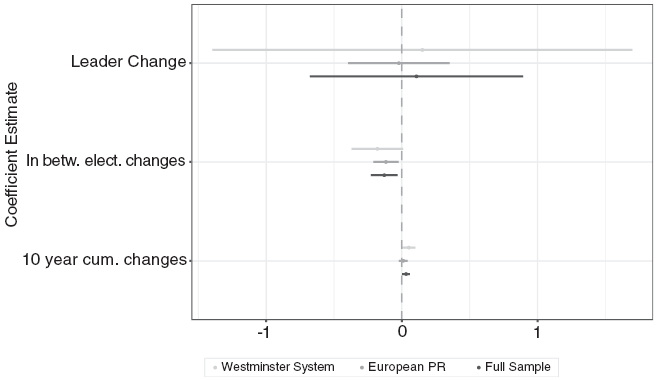
Figure 13.2 shows the short-term effects of party leadership changes and the frequency of party leadership changes for all parties and separately for (1) all countries, (2) European PR systems, and (3) Westminster systems. Once we control for the frequency of leadership changes, the leadership change dummy variable does not affect polling results. Regarding the frequency of changes, between-elections changes negatively affect opinion polls in the European PR systems, but the ten-year cumulative number of changes does not affect performance. None of the frequency variables are statistically significant in the Westminster systems.
The polling effects of leadership changes and the frequency of leadership changes.
Note: Figure shows coefficients and robust standard errors (with 90% confidence interval) of models testing the effect of leader replacement on short-term performance for three different samples. Models are fully specified, but the additional coefficients are not presented for space-saving purposes.
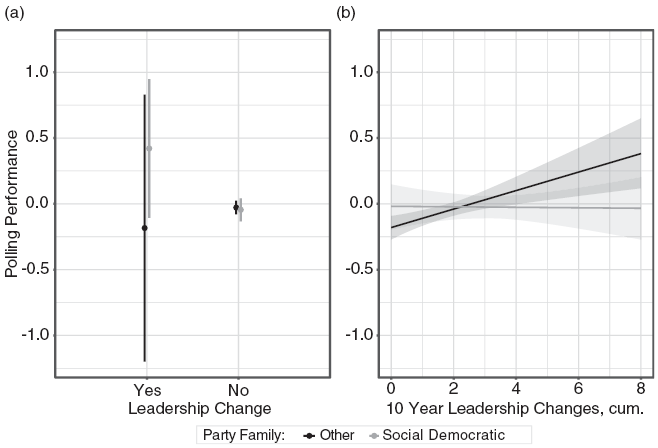
How are these results different for social democratic parties? Once again, we tested this question by running our model from Figure 13.2 by including the interaction variables between the key variables and the social democratic dummy variable. Like the duration models, given the lack of variation in different regions, we tested the results only for all countries together. The results show that the leadership change dummy variable does not have a statistically significant interaction effect with the SPD variable. That is, social democratic parties and other parties’ short-term polling performance do not differ statistically following a leadership change (see Figure 13.3(a)). The cumulative leadership changes in a moving ten-year window, however, demonstrate differences between Social Democratic and other parties (see Figure 13.3(b)). The 10 Year Changes variable is statistically significant and positive (with a 0.08 coefficient), showing that the higher the number of leadership changes within a ten-year period is, the better all other party families (other than Social Democrats) perform in the polls (although the effect is substantively small: If a non-SPD had five leadership changes within ten years, they should expect to increase their polling standing by 0.4%). The interaction variable between the 10 Year Changes variable and the social democratic dummy variable is negative and statistically significant (with a coefficient of −0.10) that suggest that the positive polling effect nullifies for the social democratic parties.
Polling effects of leader changes across party families
Note: Figure shows the statistically significant interaction effect of the social democratic party dummy with the leadership change dummy variable on the left and with the 10-year cumulative leadership changes variables. Models are fully specified, standard errors are clustered, and 95% confidence intervals are used.
To examine the long-term electoral effects of leadership changes, we use the election results in the parliamentary elections following a leadership change, coded using the ParlGov data (Döring and Manow Reference Döring and Manow2019). We are, once again, interested in how the party’s performance changes after the leadership change. However, the often-used change in vote share variable – measuring the change in electoral performance as the difference between the current election result (t) and the result in the previous election (t − 1) – would not be appropriate to test the electoral effect of a leadership change in the interelection period. This is because a decline in vote share compared to the previous election may mean either that the new leader hurt the party’s electoral performance or that the positive impact of the leadership change was simply not (yet) enough to offset earlier losses in public support during the interelection period. Given that we cannot answer which of these scenarios reflects the reality with an electoral performance change variable measured, we use a new measure to test the electoral effects and focus only on those elections before which there was a leadership change.Footnote 7
The dependent variable in these models is the difference between the current vote share of the party in the parliamentary election at time t and the monthly polling result of the party (i.e., the party’s expected vote share) in the month before the leadership change. Using this dependent variable, we can tell whether the leadership change affected the party’s electoral performance by comparing the polling results for the party right before the leadership change to the election outcome following the leadership change.
Our independent variables are (1) the number of leadership changes that happened between the last election and the current election (In Between Elections Changes) and (2) the number of leadership changes for the last ten years before the current election (10 Year cum, changes). Because we only focus on cases where there was a leadership change in these analyses, we cannot include the leadership change dummy or its interaction with the social democratic dummy. Like the polling results models, we control for several factors. Namely, we have the previous change in the party’s electoral performance (between elections t − 2 and t − 1), ∆Votet-1; a dummy variable for whether the party was ever in government in the interelection period between elections t − 1 and t (Government); a dummy variable for whether the leader was elected by party members (Member Vote); and a dummy variable for whether the leader was elected with unanimous support or by acclamation (Unanimous/Acclamation). We also control for two additional variables here. First, we consider the number of months a new leader has been in office and count the months between the leadership change and election day (Time In Office).
We expect that, as the time passes, the potential positive effects of a leadership change might weaken and disappear, since the new leader uses her novelty, and hence media and voters might pay less attention to her. Second, we also control for the time between the announcement of the previous leader’s resignation and the appointment of the new leader (Time In Between Leaders), with the expectation that as the period in between two leaders gets longer, that would signal a divided party and may hurt the party’s electoral performance. Figure 13.4 shows the results for all countries, European PR systems, and Westminster systems. We see that there are no longer-term electoral effects of leadership changes in any of the models.
The electoral effects of leadership changes and the frequency of leadership change
Note: Figure shows coefficients and robust standard errors (with 95% confidence interval) of models testing the effect of leader replacement on electoral performance for three different samples. Models are fully specified but the additional coefficients are not presented for space-saving purposes.
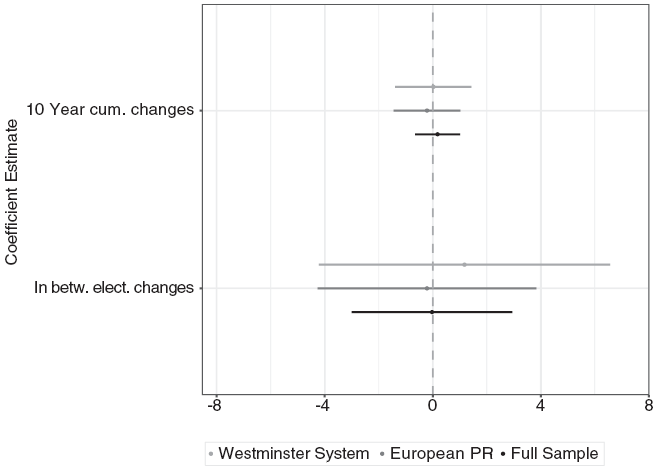
Figure 13.5 shows the conditional long-term electoral effects of the leadership change variables for Social Democrats and other parties by interacting the two leadership changes variables with the social democratic dummy variable. The results show that neither of the frequency of leadership change variables have statistically different effects for Social Democrats and other parties (i.e., the interaction variables are not statistically significant).
The electoral effects of leadership changes and the frequency of leadership changes conditional on party family
Note: Figure shows coefficients and robust standard errors (with 95% confidence interval) of models testing the effect of leader replacement on electoral performance for three different samples while focusing only on social democratic parties. Models are fully specified, but the additional coefficients are not presented for space-saving purposes.
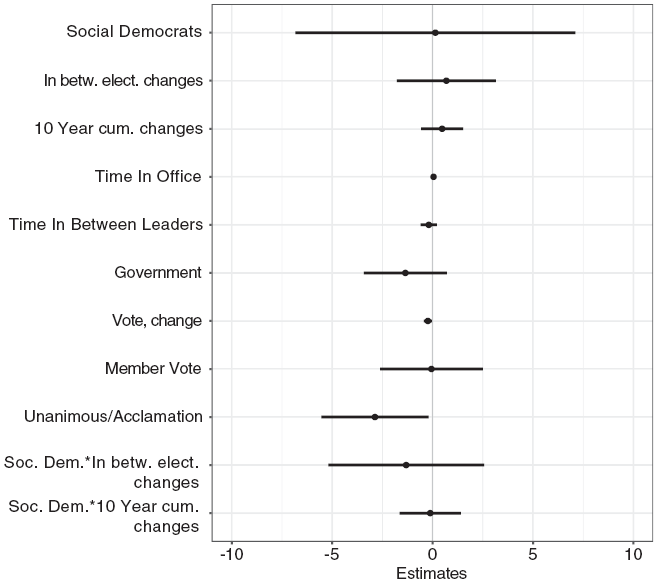
To sum up the performance results, there are no long-term election effects of leadership changes or frequency of leadership changes. This result is consistent with the existing work by Pedersen and Schumacher (Reference Pedersen, Schumacher, Cross and Pilet2015) and Cozza and Somer-Topcu (Reference Cozza and Somer-Topcu2021), which showed no electoral effects of leadership changes. Short-term polling effects exist, and there are a few interesting conditional effects for different party families (the frequency of leadership changes appears to help other party families more than Social Democrats, for instance). Still, the magnitudes of the effects are quite small. Therefore, we cannot confidently conclude that leadership changes matter for party performance or that leadership changes are especially consequential for the Social Democrats.
In additional models, we also tested whether being in government or opposition has any moderating effects on the relationship between leadership changes/frequency of leadership changes and performance. One may argue that governing parties may get punished for changing their leaders, given the leaders’ roles in government. Leadership changes among opposition parties may, however, be seen as responsiveness to bad performance.Footnote 8
Table 13.4 presents the short-term polling effects. Column 1 shows the government interaction effects for all parties, and Columns 2 and 3 show the same results separately for Social Democrats and other parties. We see in Column 1 that government status overall does not condition the effect of leadership changes on performance. However, the separate analyses for Social Democrats (Column 2) and others (Column 3) show that leadership changes have different effects for party families. The results from Column 2 suggest that social democratic parties in opposition (when in government variable = 0) gain in the polls (about 1%, on average) for a leadership change, but they get punished for having too many leadership changes since the last election (for each leadership change since the last election they lose about 0.3% in the polls). Hence, the positive effect of a leadership change disappears if the party has more than three leadership changes since the last election (but note that there are no cases with more than three leadership changes). In addition, the positive effect of a leadership change when in opposition nullifies and even becomes negative for governing social democratic parties (−1.6 interaction effect). The results in the last column for the other party families show that leadership change, on its own, does not help or hurt other party families’ polling standing when they are in opposition (the coefficient for Leader Change is not statistically significant) but a leadership change while in government significantly helps them in the polls (the coefficient for the interaction variable is positive and statistically significant). The frequency of leadership changes do not have any statistically significant differences for other party families’ government status. These results suggest that social democratic parties should be careful not to replace their leaders while in office or replace their leaders too frequently, while there is no such scrutiny for other parties.Footnote 9
13.6 Discussion and Conclusion
Do leaders of social democratic parties last shorter in office? How does their duration in office and frequency of leadership changes affect their performance? Have these party leadership changes played any role in the decline of social democratic parties in advanced democracies? This chapter empirically analyzed these questions using a novel dataset on party leadership changes across ten advanced democracies. Our results show that there are no party family differences, and we do not find evidence of a social democratic exceptionalism. The German SPD notwithstanding, party leaders across party families have stayed in office for similar periods; similar variables explain leader duration in office across different party families; party leadership changes and the frequencies of leadership changes do not have different substantive effects on parties’ short-term polling performance or longer-term electoral performance.
Our results have important implications and contributions. First, our finding of no social democratic exceptionalism suggests that party leadership changes or the frequency of those changes are not the culprits for the social democratic decline. To understand the social democratic decline, we should look into other factors than the turnover in party leadership, as the many exemplary contributions to this edited volume suggest. Second, our leader duration models show that many of the variables that have been shown to affect leader duration in office continue to be important. However, for the first time, we established that there are a few regional differences about which variables determine a leaders’ time in office. While opinion poll performances matter more in Westminster/plurality systems, membership vote is detrimental to party leaders’ continued tenure in the European PR systems.
Third, the results of the minimal effects of leader changes and the frequency of leader changes on performance are similar to the small number of studies on the question (Pedersen and Schumacher Reference Pedersen, Schumacher, Cross and Pilet2015; Cozza and Somer-Topcu Reference Cozza and Somer-Topcu2021). As the growing literature shows, leaders, their campaigns, personal characteristics, and traits affect people’s perceptions and vote choice (Butler and Stokes Reference Butler and Stokes1974; LeDuc Reference LeDuc2001; McAllister Reference McAllister, Dalton and Klingemann2007; Bittner Reference Bittner2011; Aarts et al. Reference Aarts, Blais and Schmitt2013). Nevertheless, our results also question the presidentialization thesis to some extent (Poguntke and Webb Reference Poguntke and Webb2005). According to the thesis, party leaders across parliamentary systems have become more autonomous of their parties and dominate politics (Webb, Poguntke and Kolodny Reference Webb, Poguntke, Kolodny and Helms2012). One implication of this argument is that we should see more consistent and considerable effects of leadership changes on party performance across all our cases. Based on the null results, we propose that information processing about political parties and reactions to party behavior are not overwhelmed by party leaders and are likely affected by messages produced by various party voices. Party leaders might become increasingly central and even extend their control over the organization like a “part-time autocrat” (as Kister (Reference Kister2018) described Sigmar Gabriel’s grip over the SPD), but public perception and short- as well as the long-term performance of political parties appears to depend on more than just the leader. We suggest that the party’s public image, its representation in the media, and the voters’ minds might be more complex than currently theorized.
Future research, therefore, should potentially move beyond the influence of party leadership on party performance, possibly more toward the political composition of party organizations and the changes in the numbers and compositions of party members and activists who set the tone and shape the agenda inside parties. Given that most social democratic parties have increasingly included party members and activists into party decision-making, whether it is about leadership election, candidate selection, or decisions on manifesto content (Cozza and Somer-Topcu Reference Cozza and Somer-Topcu2021), one question that still needs to be answered is whether party organizational inclusiveness has any consequences for social democratic parties. We leave this interesting question to future research.
There are other interesting questions about party leadership changes and their consequences we could not answer with our limited dataset and leave for future research. First, party leadership changes may have different effects if they signal a programmatic shift or continuity. Would Social Democrats benefit more from a leadership change or get hurt if they combine leadership changes with programmatic changes? Second, we control for leadership election results and whether the outcome was unanimous or not. One may argue, however, that the number of candidates or the level of competition for leadership election may also matter for how leadership changes affect party performance. Finally, increasingly more parties are adopting a shared leadership model with two or more leaders with different potential target clienteles at the top of the party. One such example that appears to have resulted in an electoral boost for the party is the German Social Democratic leadership structure since 2019. In the future, as these co-leadership structures become more common, it would be interesting to explore how they affect party performance.
One other future direction may be shifting the focus away from actual polling or election performance to the competence evaluations of political parties/leaders or trust in political parties that have recently changed their leaders or have had frequent leadership changes in the near past. What might matter to voters may not be whether a specific person was recently appointed leader of a party, but whether a party’s cumulative frequency of leader replacement over the entire period instills trust in a party’s competence and reliability of programmatic commitments or makes voters discount this. Given the lack of cross-national survey data exploring trust in or competence evaluations of political parties across our cases, we cannot address these interesting outcome variables but leave it to other scholars to explore these dynamics.


 Open access