




Introduction
The climate crisis is one of the most pressing challenges of the 21st century, threatening ecosystems, biodiversity and human societies. Rising global temperatures, extreme weather events and widespread ecological disruptions are accelerating the degradation of natural environments and jeopardising the survival of countless species. According to the Intergovernmental Panel on Climate Change (n.d.), global temperatures are projected to continue rising over the next few decades – intensifying the impacts of climate change, such as floods, droughts and food insecurity, especially in vulnerable regions. These impacts are disproportionately felt by low- and middle-income countries, such as Pakistan, which contribute minimally to global carbon emissions yet face some of the greatest risks. Pakistan’s unique geographic location, situated between the Himalayas and the Arabian Sea, makes it prone to disasters like glacial melt, shifting monsoon patterns and catastrophic flooding. The devastating floods of 2022, affecting 33 million people (UNICEF, 2023), highlighted the country’s exposure to climate risks and the urgent need for adaptive solutions to mitigate these impacts. Education plays a crucial role in fostering ecological literacy and promoting sustainability. Environmental education (EE) equips individuals with the knowledge and skills necessary to understand and address environmental challenges. Studies have shown that EE can drive pro-environmental behaviours, promote social justice and inspire collective action (Chawla & Cushing, Reference Chawla and Cushing2007; Monroe et al., Reference Monroe, Plate, Oxarart, Bowers and Chaves2019). For example, children who engage in nature-based education are more likely to develop positive environmental attitudes and behaviours (Liefländer et al., Reference Liefländer, Fröhlich, Bogner and Schultz2013). By integrating sustainability into education systems, we can nurture a generation of environmentally conscious citizens who are committed to mitigating climate change and preserving biodiversity. The UNESCO survey at COP27 reinforced this need, with young people worldwide advocating for quality climate education to empower them to act (UNESCO, 2021).
Despite the importance of environmental education, traditional education systems often reinforce anthropocentric and capitalist ideologies that contribute to environmental degradation. These systems typically position humans as separate from and superior to nature, fostering a mindset of domination over Earth’s resources (Bowers, Reference Bowers1995; Kopnina et al., Reference Kopnina, Washington, Taylor and Piccolo2018). This perspective is embedded in curricula that prioritise growth and consumerism over ecological responsibility. In Pakistan, for instance, science and general knowledge textbooks often present an anthropocentric worldview, where the focus is on knowledge retention rather than fostering critical thinking about environmental issues. Such curricula disconnect students from nature, limiting their understanding of human-nature interdependence.
To address these limitations, there is a growing movement to reimagine environmental education, particularly in regions like Pakistan, where environmental threats are escalating. Post-humanist environmental education offers an alternative perspective by challenging the anthropocentric worldview that places humans above nature. Post-humanist theories argue for a relational understanding of the world, where humans are seen as part of a larger ecological system, interconnected with non-human entities, such as plants, animals and ecosystems (Braidotti, Reference Braidotti2013; Latour, Reference Latour, Brightman and Lewis2017). By adopting these frameworks, education can cultivate an understanding of the Earth as a complex web of interdependent life forms, encouraging students to view their role in nature as collaborative rather than exploitative.
Furthermore, post-humanist environmental education aligns with eco-justice pedagogy, which emphasises inclusivity and social equity, especially for marginalised communities affected by environmental degradation. Eco-justice education seeks to dismantle power structures and promote decolonial approaches to environmental learning (Kahn, Reference Kahn2010; Martusewicz et al., Reference Martusewicz, Edmundson and Lupinacci2014). It encourages students to form deep connections with nature and view themselves as co-creators in ecological processes, through experiential learning, storytelling and direct engagement with the natural world (Glenn, Reference Glenn2019). Integrating these principles into primary education in Pakistan could help students develop a sense of ecological responsibility, while also addressing the country’s environmental challenges.
This article explores the transformative potential of environmental education in Pakistan to address the climate crisis and promote sustainability. It examines how primary education can foster ecological literacy, instil a sense of interconnectedness with nature, and equip students to confront climate change. Through a critical analysis of Pakistan’s education system, this article investigates how nature and animals are represented in primary school textbooks, and how these representations influence children’s perceptions of the environment. The following sections provide a comprehensive exploration of this topic, starting with a review of relevant literature on environmental education, climate change, anthropocentrism and eco-justice pedagogies. We then provide an overview of Pakistan’s environmental challenges, including biodiversity loss, deforestation, and pollution, and examine how the current education system perpetuates ecological disengagement. This is followed by an analysis of primary school textbooks, specifically General Knowledge and General Science, to investigate how nature and animals are represented and how these portrayals influence children’s perceptions of the environment. Finally, we present our reflections and offer recommendations for a fundamental shift in Pakistan’s primary education system, advocating for the integration of eco-justice, sustainability and an interconnected understanding of nature to empower future generations to become active participants in climate action and ecological preservation.
Literature review
The global climate crisis is a direct consequence of humanity’s exploitative and fragmented relationship with nature. At the core of this crisis lies an anthropocentric worldview – one that positions humans as superior to and separate from the natural world. This perspective, which has dominated industrial, economic and educational systems, fosters the belief that nature exists primarily to serve human needs. As a result, environmental degradation continues to accelerate, legitimised by structures that prioritise economic growth and technological advancement over ecological sustainability (Kopnina et al., Reference Kopnina, Washington, Taylor and Piccolo2018). To address this crisis, education must be critically examined, as it plays a pivotal role in shaping individuals’ perceptions of and interactions with the environment.
Anthropocentric paradigms are deeply embedded in educational systems worldwide, reinforcing a hierarchical “man over nature” perspective. Prevailing educational frameworks often depict nature as a passive resource for human exploitation rather than as an interconnected and living system. As a result, they fail to challenge the systems of domination that underpin the ecological crisis (Lin et al., Reference Lin, Fiore, Sorensen, Gomes, Haavik and Malik2023). Rooted in colonial and capitalist frameworks, these systems perpetuate exploitative hierarchies that prioritise human progress at the expense of ecological balance. Western education tends to emphasise control over nature, disregarding Indigenous and alternative epistemologies that recognise a sacred cosmos, where all beings contribute to ecological harmony (Fiore & Lin, Reference Fiore and Lin2024). Scholars such as Davies and Speedy (Reference Davies and Speedy2024) challenge this dominant paradigm of viewing ‘nature’ as an external entity by advocating for a framework of deep entanglement, interdependence and intra-species empathy. Their work, influenced by posthumanist and new materialist approaches, urges a rethinking of landscapes as active participants in world-making rather than passive backdrops to human activity. Similarly, Jukes (Reference Jukes2023) critiques the separation of humans from their environments and employs a posthumanist and new materialist approach to emphasise that landscapes are not passive backdrops but vibrant co-actors in world-making, arguing that decolonial pedagogies must emphasise relational and place-based learning to cultivate a more just and sustainable future. Therefore, education must move beyond the colonial construct of ‘nature’ as separate from humanity. Rather than reinforcing a dualistic view, it is imperative to adopt pedagogies that recognise humans as embedded within ecosystems, fostering ethical, relational and interconnected ways of being in the world.
To counteract the limitations of anthropocentric education, scholars have increasingly called for a shift toward eco-centric, holistic and contemplative learning approaches. Eco-justice pedagogies, for instance, reject the traditional subject-object dichotomy and instead foster relational understandings of agency, where humans are seen as coexisting with nature rather than dominating it (Bowers, Reference Bowers1995; Tsing et al., Reference Tsing, Swanson, Gan and Bubandt2017). These frameworks align with Indigenous knowledge systems, which have long emphasised reciprocity, coexistence and the intrinsic value of all life forms (Kopnina et al., Reference Kopnina, Washington, Taylor and Piccolo2018). However, Eurocentric education has historically marginalised these perspectives, reinforcing hierarchical structures that privilege human rationality over ecological wisdom. A decolonised educational model must integrate these Indigenous epistemologies, shifting from a mechanistic view of knowledge to one that is holistic, place-based and relational.
Education in the early years presents a particularly promising avenue for fostering ecological consciousness Research suggests that children possess an innate curiosity about the natural world, making early education a pivotal period for instilling environmental awareness and fostering a sense of interconnectedness (Chawla, Reference Chawla2007, Reference Chawla2009). Children are known to show a positive curiosity and interest in animals and plants in their surroundings in their early lives, which provides a basis for a good start with environmental education and better development of understanding of the human-nature relationship. However, current educational materials suppress the curiosity of children by prioritising rigid, standardised learning that confines children within enclosed spaces and limits their direct engagement with the environment (Tikka et al., Reference Tikka, Kuitunen and Kuitunen2000). Textbooks and classroom practices, as primary vehicles of knowledge dissemination, play a critical role in shaping children’s understanding of humanity’s relationship with nature. While young learners absorb knowledge from various sources, school science textbooks, as carriers of authoritative knowledge, significantly influence their understanding of the relationship between humans and the world (Tikka et al., Reference Tikka, Kuitunen and Kuitunen2000). Yet, these materials often reinforce anthropocentric perspectives, portraying nature as a set of resources to be managed rather than as a complex and interdependent system deserving of respect and care.
To address these shortcomings educators must embrace holistic and contemplative pedagogies that nurture profound relationships with nature. Contemplative approaches encourage reflection, empathy and mindfulness, fostering a sense of gratitude and responsibility toward the environment (Lin, Reference Lin2006). Louise Chawla’s research on children’s environmental experiences highlights the importance of direct interaction with nature in shaping lifelong ecological awareness (Chawla, Reference Chawla2007, Reference Chawla2009). Similarly, Louv (Reference Louv2006) introduces the concept of “nature deficit disorder,” describing the developmental and psychological consequences of children’s growing disconnection from the natural world. With children spending increasing amounts of time in artificial environments, they lose critical opportunities to develop ecological empathy. Integrating place-based, experiential learning into curricula can counteract this trend, encouraging children to view nature as an extension of themselves rather than as an external entity.
Eco-justice pedagogies further challenge the systems of domination and exploitation embedded in traditional education. By centreing relationality, they encourage learners to rethink their role within the ecosystem, cultivating a sense of kinship with all living beings (Kopnina et al., Reference Kopnina, Washington, Taylor and Piccolo2018; Snaza & Weaver, Reference Snaza and Weaver2015). This approach aligns with Freirean principles of liberation and critical consciousness, empowering learners to question exploitative structures and imagine alternative, sustainable futures. Schools must rethink the sources, contents and objectives of education, fostering love-based teacher-learner relationships and incorporating contemplative, reflection-oriented experiences (Lin, Reference Lin2006). Contemporary schooling models reinforce artificial separation between humans and the environment, treating nature as “it” while positioning humans as independent “I’s” responsible only for themselves, therefore, this disconnect contributes to the widespread “nature deficit disorder” (Dickinson, Reference Dickinson2013; Louv, Reference Louv2006).
In the context of Pakistan, primary school curricula, particularly in science and general knowledge subjects, reflect an anthropocentric paradigm that frames nature as a resource for human consumption while neglecting its intrinsic value. These curricula reinforce Freire’s (Reference Freire2020) “banking” model of education, where knowledge is passively transmitted rather than critically examined. As a result, students are often left ill-equipped to engage meaningfully with ecological challenges. To challenge these limitations, reimagining environmental education requires a fundamental shift from anthropocentric to eco-centric paradigms. This involves revising primary school curricula to incorporate holistic and contemplative approaches that emphasise humanity’s interconnectedness with nature (Snaza and Weaver, Reference Snaza and Weaver2015). Textbooks should move beyond passive information delivery to foster critical thinking, compassion, and a sense of stewardship. By integrating place-based learning, hands-on experiences and eco-justice principles, educators can inspire young learners to engage actively in climate action and biodiversity preservation (Chawla, Reference Chawla2007; Dickinson, Reference Dickinson2013).
Background
Context of the environmental challenges in Pakistan
Pakistan is a country with remarkable biodiversity, reflecting its varied landscapes, including snow-capped mountains, vast deserts and pristine beaches. This diversity is home to unique species such as the Indus River dolphins and the elusive snow leopards. Key ecosystems include riverine forests along major riverbanks, mangrove forests in the Indus delta, and coral reefs along the Baluchistan coast (Rais et al., Reference Rais, Saeed, Ali, Ahmed, Hadi and Ain2022). The nation’s borders are delineated by distinct geographical features, with mountain ranges defining the western border with Afghanistan and sandy deserts marking the eastern border with India. The nation’s biodiversity is rich and varied, with the Sixth National Report to the Convention on Biological Diversity (2019) recording 198 mammal species (6 endemic), 700 bird species, 177 reptile species (13 endemic), 22 amphibian species (9 endemic) and 198 freshwater fish species (29 endemic).
However, Pakistan faces severe environmental challenges, ranked among the top 10 nation’s most vulnerable to climate change by the Global Climate Risk Index (Eckstein et al., Reference Eckstein, Künzel and Schäfer2021). Erratic weather patterns have exacerbated ecological vulnerabilities, with floods, droughts and heat waves causing extensive damage to habitats and species. The catastrophic floods of 2022 submerged over one-third of the nation’s territory, displacing millions and destroying farmland, as documented by World Weather Attribution (2022). These events have dire implications for wetland species and ecosystems already under stress.
Human activities further aggravate the situation. Habitat destruction due to agricultural expansion, urbanisation and mining leads to ecosystem fragmentation (Rasool et al., Reference Rasool, Aihetasham, Ali and Ahmad2024). Pollution, overhunting, unsustainable fishing and international wildlife trade have placed many species on the brink of extinction. By 2023, 37 mammal species, 25 bird species and 10 reptile species in Pakistan were categorised as critically endangered (EnvPK, 2023). Additionally, deforestation, fuelled by commercial logging, has left ecosystems increasingly fragile and incapable of supporting their dependent species (Ullah et al., Reference Ullah, Khan, Gul, Shah and Manan2024).
Addressing these challenges demands urgent and concerted efforts. Mitigating climate change through reforestation, wetland conservation and promotion of sustainable resource management is crucial (WWF-Pakistan, 2025). Initiatives like the Ten Billion Tree Tsunami Project provide a hopeful framework for restoring degraded habitats and fostering resilience against climate-related shocks (United Nations Environment Programme, 2021).
The education system in Pakistan
Pakistan’s education system faces significant structural challenges and inequalities. Since independence in 1947, efforts to establish a cohesive framework have largely mirrored colonial-era models, resulting in a fragmented structure. Schools are divided into English-medium institutions for elites, Urdu-medium government schools for the majority, and religious madrassas. This division perpetuates social inequities, with English-medium graduates often securing better opportunities (Rahman, Reference Rahman2004). Moreover, the colonial legacy profoundly influenced Pakistan’s education, embedding Western anthropocentric values that prioritise human exploitation of nature over harmony with the environment. During British rule (mid-19th century to 1947), policies emphasised English proficiency and Western knowledge, sidelining indigenous languages, cultures and traditions, including those related to astronomy, Ayurveda and ecological practices (Rahman, Reference Rahman2004).Footnote 1
Before colonisation, education in the region fostered a close relationship with nature. Teachers and students lived in ashrams, where learning intertwined with moral, spiritual and ecological teachings (Shiva, Reference Shiva, Cooper and Palmer2005). This approach was replaced by formal schooling introduced under British rule, which detached education from nature and marginalised traditional ecological wisdom. Sacred groves, once protected by indigenous communities for their biodiversity and cultural significance, were degraded under colonial land policies and commercial deforestation. This loss symbolised the erosion of ecological practices central to local knowledge systems (Gadgil & Guha, Reference Gadgil and Guha1993).
Post-independence, Pakistan’s reliance on external aid and financial institutions like the IMF and World Bank has perpetuated a cycle of economic vulnerability. Education policies often prioritise globalisation and donor-driven directives, sidelining indigenous knowledge systems and ecological perspectives (Durrani & Halai, Reference Durrani, Halai and Wulff2020).
Despite these challenges, education has the potential to address pressing environmental issues. Integrating sustainability into curricula can raise awareness and foster eco-conscious behaviours. An interdisciplinary approach, blending science with ethical and social dimensions, can help students understand the interconnectedness of environmental, social and economic systems. This awareness empowers youth to lead initiatives in renewable energy, waste reduction and conservation. By prioritising sustainability education, Pakistan can cultivate a generation of leaders committed to environmental stewardship and sustainable development (Sterling & Orr, Reference Sterling and Orr2001).
Methodology
This study investigates the urgent need to reform primary education (grades 1 to 5) in Pakistan to address environmental degradation and biodiversity loss. By focusing on the representation of animals and nature in primary school textbooks, we identify gaps in the curriculum and advocate for a more inclusive and ecologically sensitive approach to education. Our aim is to harness the transformative potential of education to foster a harmonious relationship with the natural world.
We employ content analysis, a systematic research method used to interpret and categorise textual material by identifying patterns, themes and meanings. Specific attention is given to text and images that portray nature, animals and scientific concepts reflecting anthropocentric values. This focus enables us to assess whether the materials encourage environmental stewardship or perpetuate a detached or exploitative stance. Ultimately, this study seeks to provide actionable insights for integrating ecological perspectives into primary education, emphasising the need to cultivate environmental consciousness and responsibility from an early age.
The study examines General Knowledge textbooks from grades 1 to 3 and General Science textbooks from grades 4 and 5, as these materials include content related to the environment and animals. Notably, grades 1 to 3 lacked a dedicated General Science textbook, necessitating the inclusion of General Knowledge materials. Textbooks in Urdu (the national language of Pakistan) were translated into English during the analysis, while the General Science textbooks for grades 4 and 5 were originally in English.
Our content analysis focuses on two primary dimensions:
-
• Representational Elements: Metaphors, depictions and values embedded in the texts, which shape students’ attitudes toward the environment.
-
• Cognitive Elements: Ecological concepts and scientific knowledge that contribute to students’ understanding of environmental systems.
This dual approach aims to uncover how these elements shape children’s perceptions, attitudes and opinions about nature and animals.
To further structure our analysis, we adopt Östman’s (Reference Östman1996, Reference Östman, Roberts and Östman1998) framework for science education discourse, which includes three interrelated dimensions:
-
1. View of Science: Examines how textbooks present scientific understanding, methods and inquiry related to environmental and animal issues.
-
2. View of Nature: Analyzes whether nature is depicted as an interconnected and balanced system or through an anthropocentric perspective.
-
3. View of Human-Nature Relationships: Investigates whether the textbooks promote a sense of responsibility toward the environment or depict humans as detached or exploitative.
Nature and animal representation in Pakistan primary school textbooks
From the earliest grades to more advanced levels, textbooks serve as foundational tools in imparting knowledge and understanding. Our textbook analysis involves a systematic examination of textbooks, with a focus on identifying patterns, themes and discrepancies within and across grade levels. Through the analysis of these textbooks, it becomes evident that there are both strengths and shortcomings in how these materials approach environmental education. Our findings indicate that commendable efforts have been made to introduce concepts such as ecosystems, pollution and conservation. There are also notable gaps in fostering a deeper appreciation for nature’s complexity and interconnectedness, especially in aspects that involve human beings as part of nature and the ecosystem.
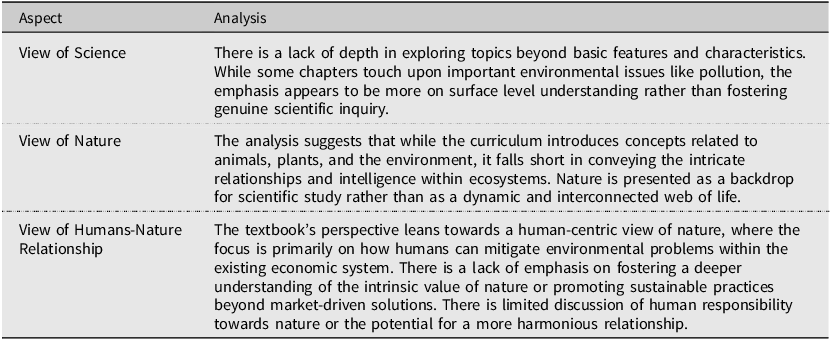
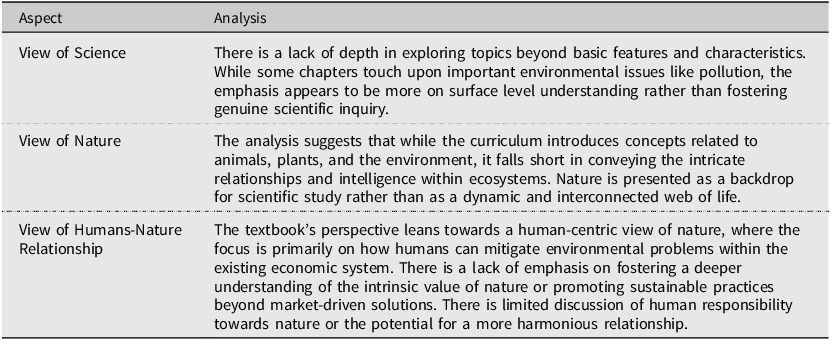
Table 1 provides a brief overview of the themes distilled from our content analysis according to the three interrelated aspects of science discourse as identified by Östman (Reference Östman1996, Reference Östman, Roberts and Östman1998). The textbooks present nature as a mere backdrop for study rather than as a complex, interconnected web of life. They lack emphasis on the intrinsic value of nature, sustainable practices, and human responsibility towards the environment, instead favouring market-driven solutions.
Summary of the content analysis
Next, our analysis delves into the content of each grade level, highlighting areas of problems that need improvement and offering insights into how we can enhance environmental education to cultivate a generation of environmentally conscious and responsible citizens.
General knowledge textbooks (Grade 1 to Grade 3)
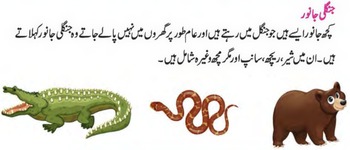
In the grade 1 General Knowledge textbook, there is a brief introduction about animals and plants. Animals are differentiated into domesticated animals and “wild” animals (see Figure 1). There are images of leopards and lions eating meat viciously, enough to terrify a grade 1 student. Associating the term “wild” with animals may contribute to stereotyping these animals as unintelligent or solely driven by aggression. This oversimplified portrayal may hinder a child’s ability to appreciate the complexity and intelligence of wildlife.
Picture from Grade 1 General Knowledge (GK) textbook.Footnote 2 Description: This picture (p. 44) categorises animals that live in the forest as “wild animals.” It gives the example of a lion, beer, snake, and crocodile as wild animals.

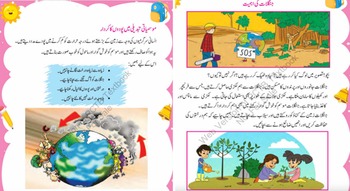
The grade 2 General Knowledge textbook provides a foundational understanding of the natural world, introducing concepts like animals, plants and water. It highlights the role of water in meeting human needs such as cooking, washing and drinking, emphasising its importance in daily life. The textbook introduces the concept of changing weather patterns and the importance of environmental conservation. It points out that one effort of environmental conservation pertains to tree plantations to mitigate Earth’s temperature rise. However, the portrayal of forests primarily as a source of wood for human needs as shown in Figure 2, reflects an anthropocentric viewpoint, where nature is valued primarily for its utility to humans. Hence, while emphasising the significance of safeguarding forests, the educational materials fail to convey a more balanced perspective recognising the intrinsic value of ecosystems and biodiversity, beyond their instrumental value to humans.
Pictures from Grade 2 General Knowledge (GK) textbook.Footnote 3 Description: The picture on the left (p. 47) introduces the topic of rising earth temperature due to human activities and emphasises the role of planting trees in combating it. The picture on the right (p. 64) underscores the importance of trees as a source of wood for various purposes, such as furniture. It highlights how trees contribute to maintaining pleasant weather, preventing soil erosion and flooding, and emphasises the importance of taking care of trees.
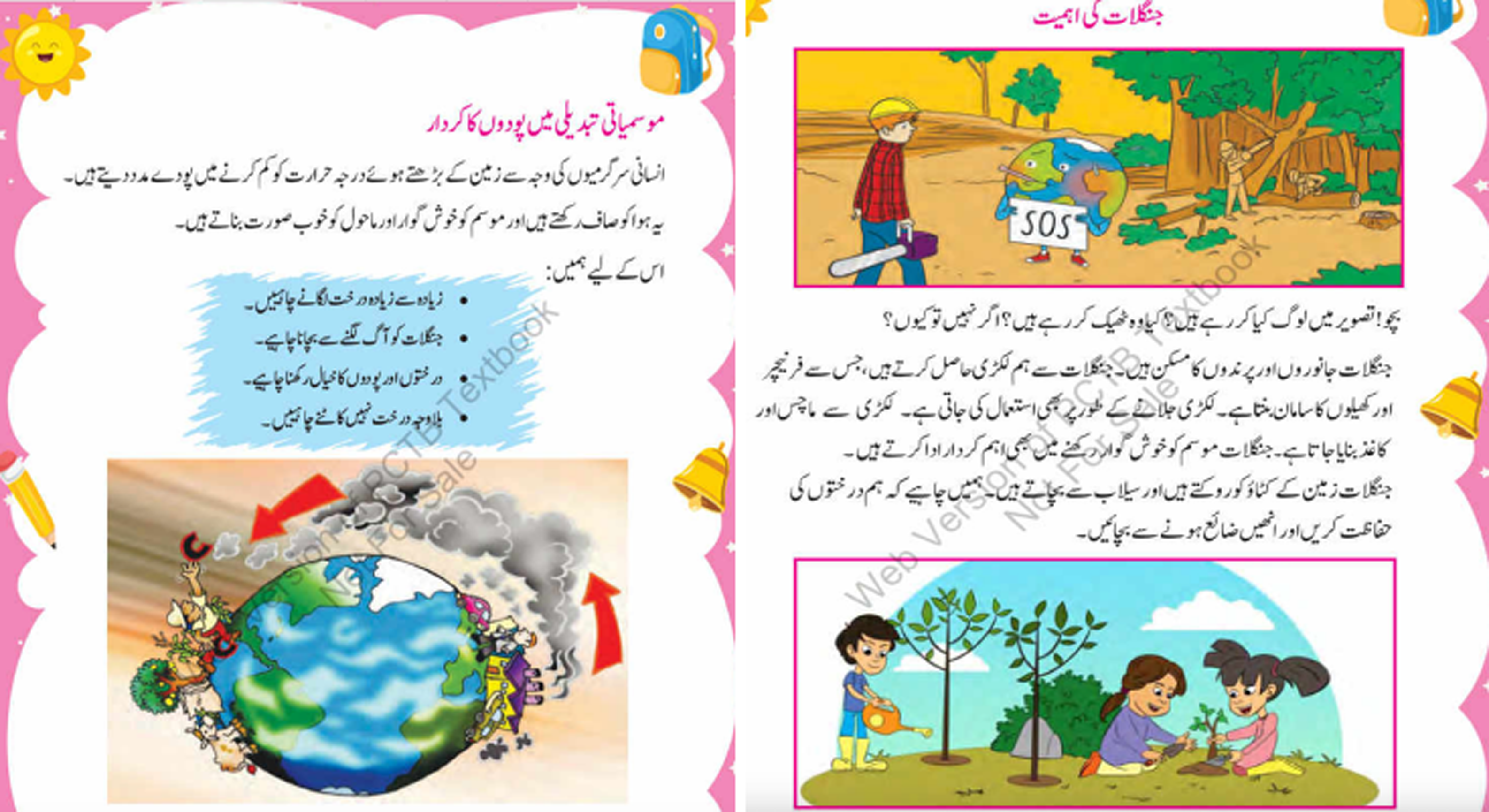
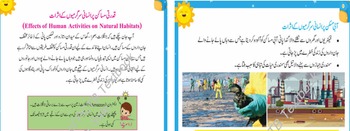
The grade 3 General Knowledge textbook discusses the impacts of human activities on the natural environment, covering topics such as deforestation, water pollution and the endangerment of species due to oil spills. The text as shown in Figure 3. emphasises the detrimental effects of human actions on trees and the habitats of various animals. Notably, it highlights the role of water waste from households and factories in causing pollution and endangering the lives of species inhabiting aquatic environments. The adverse impact of oil spills from ship tankers on marine life is also acknowledged.
Pictures from Grade 3 General Knowledge (GK) textbook.Footnote 4 Description: The picture on the left (p. 43) mentions that human activities such as waste from factories and homes, as well as oil spills from ships can pollute water and pose harm to aquatic life. The picture on the right (p. 42) states that certain human activities are affecting the availability of food, water, and shelter for other living species, endangering their lives.

Furthermore, the textbook delves into the consequences of human activities like hunting, citing specific examples of endangered species, such as the Indus dolphin, snow leopard and Markhor. These examples shed light on the severity of the issue, however, it is noteworthy that the focus is predominantly on larger animals, overlooking the importance of smaller species in the ecosystem. The curriculum introduces conservation measures, advocating for responsible actions such as avoiding water wastage, tree planting and implementing waste treatment processes in factories and households. It is acknowledged that these measures align with environmental protection, yet the emphasis on greening capitalist approaches (such as we can produce waste if we treat them) carries anthropocentric tones and raises questions about the depth of ecological consciousness promoted. A critical observation is the missed opportunity to underscore the interconnectedness of all species and ecosystems, fostering a shared responsibility to protect the precious balance of nature for generations to come. Failing to highlight the interconnectedness of all living beings, the textbooks miss a chance to instil a profound appreciation for the delicate balance that sustains life on Earth.
General science textbooks (Grade 4 and Grade 5)
In the grade 4 General Science textbook, the concept of a balanced ecosystem is introduced to the students as follows:
“Balanced Ecosystem
The Sun is the main source of energy in an ecosystem. The plants make food with the help of sunlight, carbon dioxide and water. They also produce oxygen in this process. This oxygen is used by animals for respiration. During respiration, animals produce carbon dioxide which is used by plants to make food. Such a self-sustaining and durable ecosystem is called balanced ecosystem.
All living things are essential for one another. They affect the lives of one another. Some animals benefit or harm one another.”
(Grade 4 General Science Textbook, p. 24)Footnote 5
This paragraph shows that while the fundamental idea of an ecosystem is conveyed, its choice of language employed in presenting this concept is problematic. The text lacks a sense of humility or gratitude for nature and the symbiotic relationships that sustain life. There is a missed opportunity to use stories and the voices of nature to emphasise the interconnectedness of all living beings and the role each entity plays in maintaining the delicate balance of the ecosystem. Expressing gratitude for the sun’s provision of light and the vital role of plants in providing food could instil a deeper appreciation for the natural world. Moreover, the concluding statement, “Some animals benefit or harm one another,” introduces a dichotomy that may inadvertently foster a sense of disconnection from certain groups of animals. The terminology employed, particularly the notion of animals harming one another, can contribute to an “othering” mentality, distancing students from developing a genuine empathy and understanding for all forms of life. Moreover, the use of the term “animal” lumps together diverse species, rendering other forms of life abstract and seemingly irrelevant to children’s lives. This portrayal also keeps the human out of the game as it refers to other animals harming and benefiting, whereas humans appear to be observers. By treating nature as the other and in abstract ways, the textbook misses an opportunity to introduce students to the intricacies of different ecosystems and the unique roles played by various animal species.
Furthermore, the textbook introduces the concept of competition among organisms, framed within a capitalist ideology of limited resources and the need for competition for food and space. This perspective, which frames all organisms, including humans and animals, as in competition for Earth’s finite resources, can inadvertently foster a sense of separation and competition rather than nurturing a compassionate and caring attitude towards all living beings, particularly among primary grade 4 children. Below is drawn from the Grade 4 General Science textbook:
“Competition among organisms
All the organisms living in an ecosystem depend on the resources which are available in the area. Every area can provide food and place to a limited number of living things. The limited resources in an ecosystem compel the living things to compete for food and place.”
(Grade 4 General Science Textbook, p.27)Footnote 5
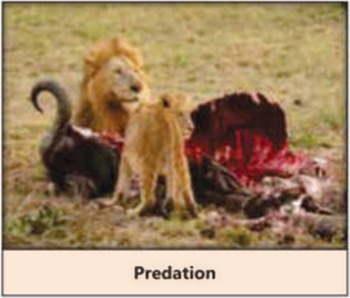
Biologist E. O. Wilson introduced the concept of “biophilia” in 1984, emphasising humans’ inherent connection to other forms of life. In recent years, educators have increasingly recognised this connection in young children and have embraced a philosophy rooted in “biocentrism.” This approach seeks to foster opportunities for children to interact with and appreciate other living beings, emphasising their interconnectedness rather than seeing them as separate entities. However, the portrayal of animals in the textbooks, particularly in depicting predator-prey relationships, holds a significant influence over how children perceive the natural world. Throughout the textbooks, including the use of images as shown in Figure 3, animals are often depicted as engaged in hunting and killing (see Figure 4), potentially fostering a perception that larger predators like lions, tigers, sharks and crocodiles are to be feared. This depiction may inadvertently distance children from animals, hindering the development of a genuine appreciation and empathy for the diverse species that share our planet.
Picture from Grade 4 General Science textbook.Footnote 5
Description: The picture shows a scene of a deer being eaten by two lions.
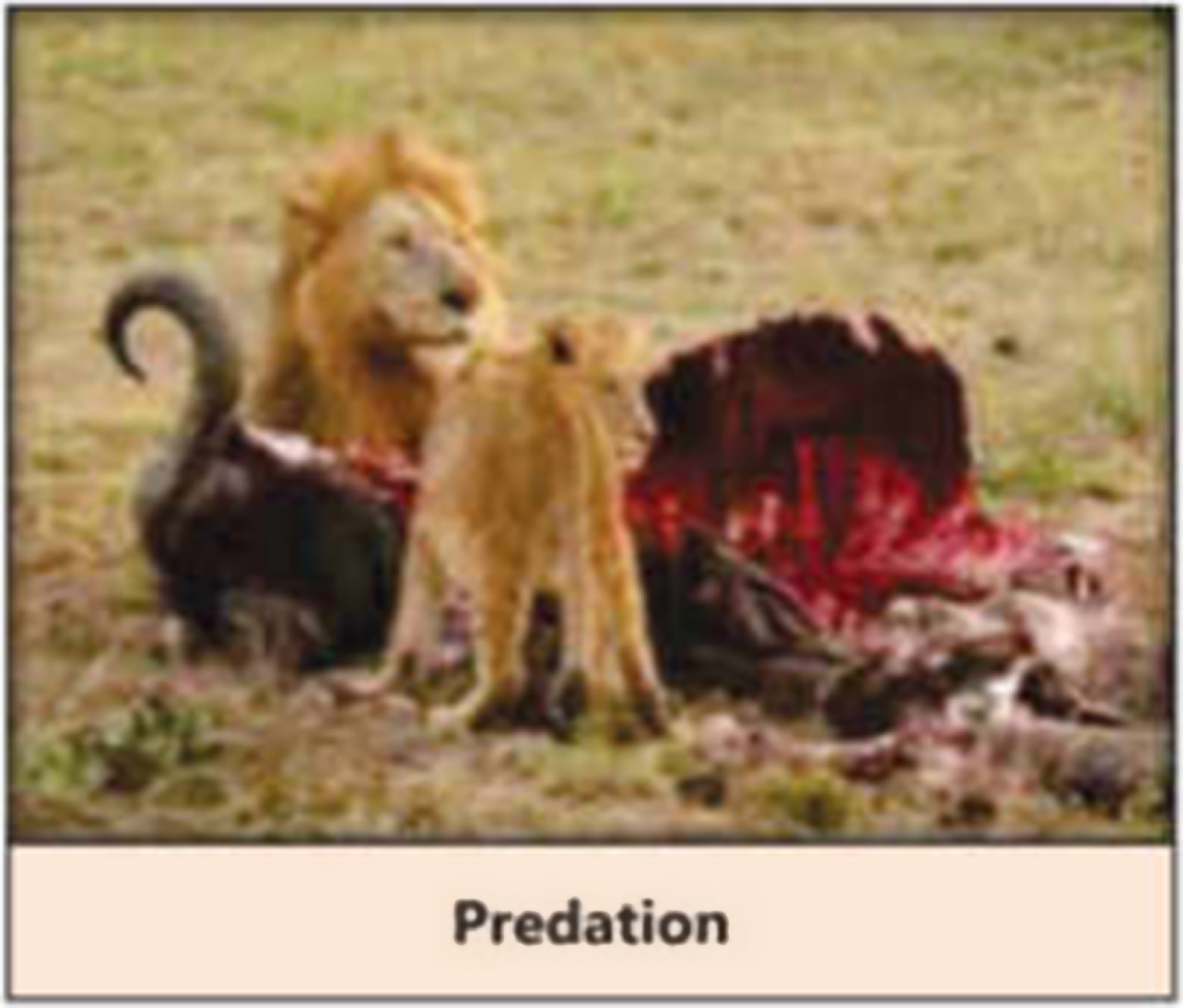
Images play a crucial role in shaping our opinions about the social world (Koch, Reference Koch2001), and the portrayal of animals in textbooks should be mindful of its impact on children’s perceptions and attitudes towards wildlife. In the textbooks we analysed, animals are often not portrayed as unique and intelligent beings with their own skills and wisdom from which humans can learn. Instead, the focus tends to be on depicting them solely within the context of predator-prey relationships or as objects of fear. This narrow representation overlooks the rich complexity of animal behaviour and the valuable lessons they can offer us about adaptation, communication and coexistence. Below is a text from a textbook:
“Predator-Prey Relationship
An animal which eats another living thing by hunting and killing is called a predator. For example, lions, tigers, sharks and lizards. The living thing which is hunted, killed and eaten by a predator is called a prey. For example, zebras, deers, rats and fish. The interaction between predator and prey is called predation…”
(Grade 4 General Science Textbook, p. 26)Footnote 5
The example from the Grade 4 General Science textbooks, while introducing crucial ecological concepts, inadvertently contribute to a sense of fear and competition between humans and animals. Again, there is a missing opportunity here emphasising interconnectedness, empathy, and stewardship, and that children can become proactive advocates for environmental conservation and sustainability.
Moving on, the Grade 5 General Science textbook again primarily focuses on the classification and basic features of organisms while overlooking their intricate interconnectedness and environmental significance. The textbook briefly addresses pollution and proposes solutions, and the emphasis remains on adapting current economic systems rather than advocating for sustainable practices or fostering a reevaluation of the human-nature relationship. The textbook contains texts that prioritise measures such as shifting factories and treating emissions within the existing economic framework while failing to acknowledge the deeper systemic issues that underlie environmental degradation. For example, the textbook introduces concepts related to the greenhouse effect and pollution, however, the proposed solutions adhere to a perspective that aligns with a “Greening capitalism” approach that addresses environmental issues primarily within the framework of market-based solutions. Relying solely on market mechanisms within the existing economic system may overlook the root causes of environmental degradation. An excerpt from the textbook provides a glimpse into these recommended preventative measures:
“Preventative Measures to Reduce Pollution
We should shift factories away from cities to reduce the effects of pollution. The smoke of factories should be made ineffective before releasing in the air. Polluted water should not be poured into rivers, canals and lakes. The garbage and solid wastes of houses and factories should be disposed off in a proper way. The number of vehicles need to be reduced and smoke emitting vehicles should be banned. Cutting of trees and forests should be reduced.”
(Grade 5 General Science Textbook, p. 46)Footnote 6
The emphasis on shifting factories away from cities, making factory emissions ineffective, and proper disposal of waste methods indeed reflects a perspective that seeks to address pollution within the confines of the existing capitalist system. However, it does not recognise the inherent limitations of this system, particularly its tendency to prioritise short-term economic gains over long-term sustainability. In the capitalist framework, nature is often perceived primarily as a source of resources to be exploited for profit, overlooking the finite nature of these resources and the intricate interconnectedness of ecosystems. This often leads to a focus on maximising production and consumption to fuel economic growth, without adequately considering the ecological consequences. The textbook, by viewing nature as “natural capital,” reduces ecosystems to resources with an ecological yield, upon which wealth depends. Consequently, proposed solutions rely on market-based policy instruments, reflecting an orientation towards economic solutions rather than a fundamental shift of the human-nature relationship acknowledging the intrinsic value of nature.
Further, with the single-minded focus on market-based solutions, what fails to be mentioned are the rich reservoir of indigenous knowledge, traditional practices and community-based approaches that offer more holistic and culturally appropriate solutions to environmental challenges. A more comprehensive environmental education curriculum should explore alternative paradigms, fostering a deeper understanding of the intrinsic value of nature and promoting sustainable practices.
Reflections and recommendations
This textbook analysis underscores the urgent need to reimagine education in Pakistan through the lens of eco-justice pedagogy. At its core, this approach must cultivate a deep appreciation for the natural world from the earliest stages of education, instilling in children a profound sense of environmental responsibility and care. Given the climate crisis and biodiversity loss that Pakistan is experiencing, we must fundamentally rethink how we conceptualise the human relationship with nature – shifting away from an anthropocentric worldview that sees nature as separate from humanity and instead embracing the understanding that we are inherently a part of the web of life.
To facilitate a paradigm shift, education systems must adopt pedagogies that nurture an intrinsic connection with the environment. This requires more than intellectual engagement; it demands an education that engages students’ bodies, hearts and spirits. Below, we outline key reflections and recommendations to guide this transformation.
First, textbooks should prioritise the cultivation of attributes of humility and gratitude, with a recognition of our dependence on the environment for survival and an understanding of the interdependence that characterises our relationship with the natural world. One way to achieve this is by moving beyond classroom learning and immersing students in nature. We must not diminish children’s inherent capacity for participatory consciousness by imposing upon them, in the guise of modern science education, a mechanical worldview (Bai, Reference Bai, McKenzie, Bai, Hart and Jickling2009) that objectifies the world and reduces it to mechanistic and quantitative terms. Instead, we must provide ample opportunities for students to learn with nature. For example, engaging in projects and activities that increase their contact and connection with the earth, such as growing plants or flowers in the school garden. Furthermore, gratitude must become an integral aspect of environmental education – not just as a conservation exercise but as a fundamental ethical duty. For instance, students must be encouraged to express appreciation for clean air, fresh water, fertile soil and the beauty of natural landscapes. This heightened awareness lays the foundation for deeper environmental ethics, which can inspire the development of sustainable solutions to pressing ecological challenges.
Furthermore, we must re-frame the language in textbooks. The language utilised in primary school textbooks carries significant weight in shaping children’s perceptions of the environment, influencing their attitudes, values and beliefs. How nature is depicted in these materials is crucial, as it can either perpetuate a mindset that views nature solely as a resource to exploit or foster an appreciation for the intrinsic value of ecosystems and responsible environmental stewardship. The English language itself is deeply problematic in how it conceptualises “nature.” The term implies a world separate from the human world, reinforcing the colonial legacy of division between humanity and the rest of the living world. However, the reality is that humanity is nature – we cannot separate ourselves from the places and environments we inhabit. Traditional cultures, including those in South Asia, have long recognised this fundamental truth. In Pakistani languages such as Urdu and Pashto, there are rich linguistic traditions that reflect a more interconnected worldview. Urdu poetry, for example, often speaks of nature as an extension of the self, weaving landscapes and elements of the earth into expressions of human emotion and spiritual insight (Siddiqa & Naveed, Reference Siddiqa and Naveed2023). Similarly, Pashto poetry, particularly that of Abdul Ghani Khan, embodies an ecological consciousness where nature is not an object to be dominated but a source of wisdom, beauty and spiritual realisation (Dinakhel et al., Reference Dinakhel, Basar Aman and Bakhshali2023). Drawing on these linguistic traditions can help reframe the way students learn about their relationship with the living world.
Textbooks should also critically reassess the terminology used to describe animals and ecosystems. Phrases like “predator-prey” reinforce a capitalist mindset of competition and survival of the fittest, rather than interdependence and coexistence. Likewise, the term “wildlife” carries colonial connotations, implying that animals exist in a space separate from human civilisation – irrational, untamed and to be feared. Even the persistent use of “it” to describe animals in English denies them agency and intelligence, reinforcing the anthropocentric notion that humans are the only conscious beings on Earth.
Instead, education should embrace linguistic frameworks that acknowledge animals as members of distinct communities with their own rights and intelligence. Many. South Asian countries already reflect this perspective, and animals and birds are often referred to with great reverence and respect, reflecting their significance in local cosmologies, spiritual beliefs, and everyday life. For instance, in Tamil, a cow might be called “Pasumai” (green, symbolising fertility), while in Bengali, a tiger might be referred to as “Bagh Mama” (Uncle Tiger), indicating a respectful and familial relationship. By acknowledging animals and birds as sentient beings with intrinsic worth, we can reinforce the notion that we share the planet with intelligent and vibrant cohabitants. This linguistic shift can contribute to a more holistic and empathetic understanding of our relationship with the natural world, fostering a sense of respect and reinforcing the notion that we share the planet with intelligent and vibrant cohabitants.
Beyond language, environmental education must move away from dry factual instruction and instead foster experiential and emotional learning. It can focus on fostering a deeper understanding of their identities, behaviours and roles within ecosystems as equal, intelligent Earth planetary citizens. For example, rather than asking children to study what a wolf is, we can encourage them to explore who a wolf truly is Aikenhead (Reference Aikenhead2001) and what we can learn from him/her. Incorporating sacred wisdom that highlights the interconnectedness of all beings and the importance of learning from our nonhuman kin can also enrich education. Indigenous cultures have long embraced the wisdom of living in harmony with nature, viewing all living beings as relatives rather than resources. Local traditions and elders hold stories that reflect human closeness to and shared characteristics with other living beings. However, these stories are receiving less attention, as elders often live in rural areas, many parents have demanding work schedules, and children’s imaginations are increasingly shaped by technology. This shift can further alienate children from forming strong connections with nature. Schools and children’s communication platforms, such as TV stations, could explore ways to collaborate with elders to preserve and share this valuable knowledge.
Additionally, storytelling as a contemplative pedagogy is a powerful way for children to learn about nature. Textbooks can weave vivid narratives that transcend mere facts, and using stories textbooks can ignite a deep emotional connection to nature. Through imaginative tales, learners not only gain knowledge but also cultivate empathy and a sense of responsibility toward the environment. They learn that we have a deep bond with all other species and as we journey together on Earth, each of us contributes uniquely to the universe’s evolution, elevating one another along the way (Fiore & Lin, Reference Fiore and Lin2024). Creative storytelling allows students to not only consider nature’s role in their lives but also to empathetically immerse themselves in the experiences of other species. The emotional impact of personalised stories, such as those featuring voices of animals losing their habitat and facing extinction, invokes a sense of sorrow and desperation that information alone may fail to elicit. An illustrative example of this is that children can be encouraged to participate in role plays, immersing themselves in the experiences of our earth’s non-human citizens and cultivating empathy towards the natural world. In these plays, students assume roles representing various elements of an ecological system, encompassing animals, plants, humans, or even geological features like rivers or mountains. Each role is endowed with a backstory and a set of characteristics that mirror the challenges and experiences of that element within the ecosystem. Through dialogue and action, children can truly embody the ramifications of environmental degradation on their characters and the broader ecosystem, thereby enriching their understanding and empathy towards nature.
Ultimately, engaging the heart and spirit in learning can enrich educational experiences and foster deeper connections with nature. Exploring pedagogies that blur the line between human and nonhuman can help develop the sensitivity to hearing and resonate with nature through the body, heart and spirit (Lin et al., Reference Lin, Fiore, Sorensen, Gomes, Haavik and Malik2023). Arts, music and contemplative practices like meditation and mindfulness can help open students’ hearts and spirits, fostering a genuine sense of connection with the living world. Indigenous and traditional wisdom offer powerful insights into this process, emphasising that the Earth is not just a resource but a living, sacred presence (Kaur et al., Reference Kaur, Khant, Kistner, McHugh, Yu, Moraga-Prieto, Andebo and Lin2023).
By integrating these approaches into environmental education, we can nurture a generation of students who see themselves not as separate from the natural world but as active participants in its care and flourishing. The future of our planet depends on our ability to cultivate this deep, embodied ecological consciousness – one that moves beyond the legacy of colonial divisions and towards a vision of humanity that embraces its rightful place within the intricate web of life.
Conclusion
Cultivating new generations of learners who love nature requires reimagining new contents and focusing on the primary school curriculum. We need people who embrace nature as themselves to fundamentally address the environmental crisis we are in. The current exploitative mindset, rooted in capitalism and the belief inhuman supremacy, has driven the widespread environmental degradation and threatens the survival of species who co-inhabit the Earth with human beings. Education systems often reinforce this worldview by presenting “nature” as something separate from humanity, as if the human world and the natural world exist independently. This false distinction, deeply embedded, reflects a colonial legacy that has alienated people from their environments and justified the exploitation of land, animals and ecosystems. Humanity is nature. We are not apart from the forests, rivers and animals – we are an extension of the same ecological web that sustains all life. Traditional cultures, including those in South Asia, have always understood this interconnectedness. Similarly, languages spoken in Pakistan like Urdu and Pashto carry poetic and relational understandings of the world, where landscapes, animals and elements are not “resources” but kin, deserving of respect and care. Restoring these ways of thinking through education is essential to breaking free from the colonial legacy that has severed humanity’s relationship with the Earth. Early exposure to environmental education, combined with experiential and holistic learning, is crucial in developing a sense of responsibility among young learners. By shifting educational narratives away from human dominance and toward an understanding that we are all part of a shared, living system, children can grow up seeing the Earth not as a resource to exploit, but as a home to protect. By engaging children’s hearts, spirits and imaginations, we can cultivate a generation that does not see “nature” as something external, but as an inseparable part of who they are. Only then can we inspire the collective action needed to heal the planet and ensure a thriving future for all life.
Acknowledgements
The authors have no acknowledgments to declare.
Financial support
This research received no external funding.
Ethical Standard
No ethical approval was required.
Author Biographies
Maha Shoaib a Ph.D student in International Education Policy at the University of Maryland, serves as a Research Fellow at the Special Olympics Global Center for Inclusion in Education and a Senior Fellow at the Global Campaign for Education-US. Her research lies at the intersection of environmental education, inclusive pedagogy, and education in emergency contexts, with a focus on equity, sustainability, and social justice. She explores how curriculum reform and school systems can foster ecological consciousness, mental well-being, and healing-centered learning, particularly for children in marginalized and crisis-affected communities.
Dr. Jing Lin a professor in International Education at the University of Maryland, focuses on peace, environmental education, spirituality and religion. Her research explores transformative education, ecological ethics and contemplative pedagogies. Dr. Lin has authored and co-edited numerous books, including Love, Peace and Wisdom in Education and Transformative Eco-Education. She has extensively studied Chinese education and women’s education in Africa. As a co-editor of several book series, her work bridges global education, peace and sustainability. Dr. Lin teaches courses on global peace, climate change and holistic education, emphasising social transformation through integrative, embodied learning approaches.

 Open access

