1 INTRODUCTION
The majority of studies on binaries have focused on near-circular orbits (Pichardo et al. Reference Pichardo, Sparke and Aguilar2005). However, it is generally supposed that eccentric binaries are mainly produced as a result from the fragmentation (Bonnell & Bastien Reference Bonnell and Bastien1992; Bate Reference Bate1997; Bate & Bonnell Reference Bate and Bonnell1997). Moreover, the empirical data reveal that the main-sequence binary systems typically have eccentric orbits (Duquennoy & Mayor Reference Duquennoy and Mayor1991). The probable reason the eccentric binaries to be poorly studied is that they are wide stellar systems with long periods (Bate, Bonnell, & Bromm Reference Bate, Bonnell and Bromm2002) requiring prolonged observations. Recently, this condition was satisfied by huge surveys such as the Robotic Optical Transient Search Experiment (ROTSE), Massive Compact Halo Objects (MACHO), All Sky Automated Survey (ASAS), SuperWASP, etc. The next important step was made by the space mission Kepler (Koch et al. Reference Koch2010). Due to its extended and nearly uninterrupted data set above thousand detached systems were discovered, considerable parts of them on eccentric orbits.
Kepler not only provided many new eccentric binaries but the unique precision of its observational data transformed these binary stars from objects of the celestial mechanics to an important field of the stellar astrophysics. They became probes for study of the tidal phenomena: mechanisms for circularisation of the orbits and synchronisation of the stellar rotation with the orbital motion; impermanent mass transfer occurring close to the periastron (Sepinsky, Willems, & Kalogera Reference Sepinsky, Willems and Kalogera2007a; Lajoie & Sills Reference Lajoie and Sills2011); apsidal motion; tidally excited brightening and oscillations.
The theoretical studies reveal that the secular changes of the orbital separation and eccentricity could be positive or negative (depending on the mass ratio and eccentricity), and could occur on timescales ranging from a few million years to a few billion years (Sepinsky et al. Reference Sepinsky, Willems, Kalogera and Rasio2007b, Reference Sepinsky, Willems, Kalogera and Rasio2009). Thus, the widespread assumption for rapid circularisation becomes inapplicable, i.e., binaries can remain on eccentric orbits for long periods of time. Hence, the binary stars on eccentric orbits have an important evolutional role.
The eclipsing eccentric binaries (EEBs) with an apsidal motion provide an important observational test of the theoretical models of stellar structure and evolution (Kopal Reference Kopal1978; Claret & Gimenez Reference Claret and Gimenez1993). The coefficients of internal structure kj are used to describe the external potential of a distorted configuration as a function of its internal structure in the form of series expansion (Claret & Gimenez Reference Claret and Gimenez1991). In most cases, only k 2 is important since higher harmonics in the apsidal motion decrease rapidly. In order to compare with observations, an average value  $\bar{k}_2=(c_{1}k_{12}+c_{2}k_{22})/(c_{1}+c_{2})$ of the contribution of star 1 and 2 (k 12 and k 22) is used. The coefficients c 1 and c 2 are known functions of observable stellar and orbital parameters (eccentricity, radii, masses, and rotational velocities). The individual contributions can be separated in two terms, rotational and tidal. In most cases, tidal terms dominate the apsidal motions of binary systems (Claret & Gimenez Reference Claret and Gimenez1993). Hence, the ‘apsidal motion test’ could be used as a probe of stellar internal structure if precise values of global parameters are available (Claret & Gimenez Reference Claret and Gimenez2010). There are important recent studies of this effect based on the observed apsidal motion of double-lined binaries (Lacy et al. Reference Lacy, Torres, Fekel, Muterspaugh and Southworth2015; Zasche et al. Reference Zasche, Wolf, Vrastil, Liska, Skarka and Zejda2014; Bulut, Bulut, & Cicek Reference Bulut, Bulut and Cicek2014; Garcia et al. Reference Garcia, Stassun, Pavlovski, Hensberge, Chew and Claret2014; Kozyreva & Kusakin Reference Kozyreva and Kusakin2014; Harmanec et al. Reference Harmanec2014; Wilson & Van Hamme Reference Wilson and Van Hamme2014; Hambleton et al. Reference Hambleton2013; Wolf et al. Reference Wolf, Zasche, Kucakova, Lehky, Svoboda, Smelcer and Zejda2013; Claret Reference Claret2012; Zasche Reference Zasche2012; Kuznetsov et al. Reference Kuznetsov2011; Claret & Gimenez Reference Claret and Gimenez2010; Wolf et al. Reference Wolf, Claret, Kotkova, Kucakova, Kocian, Brat, Svoboda and Smelcer2010; Gimenez & Quintana Reference Gimenez and Quintana1992; Barembaum & Etzel Reference Barembaum and Etzel1995; etc.) .
In addition to the classical Newtonian contribution, the observed apsidal motion includes term of the General Relativity (Levi-Civita Reference Levi-Civita1937; Gimenez Reference Gimenez1985). Information for the apsidal motions of 128 targets in our Galaxy can be found in the catalogue of Petrova & Orlov (Reference Petrova and Orlov1999). The study of EEBs in close galaxies SMC and LMC began in the new millenium (Graczyk Reference Graczyk2003; Michalska & Pigulski Reference Michalska and Pigulski2005; Michalska Reference Michalska2007; Bulut & Demircan Reference Bulut and Demircan2007; North et al. Reference North, Gauderon, Barblan and Royer2010; Zasche & Wolf Reference Zasche and Wolf2013; Zasche et al. Reference Zasche, Wolf, Vrastil, Liska, Skarka and Zejda2014).
Probably the most amazing peculiarities of the binary stars on eccentric orbits are the tidally excited oscillations (harmonics of the orbital period) and brightening around the periastron. They were theoretically predicted by Kumar, Ao, & Quataert (Reference Kumar, Ao and Quataert1995) to explain the ~ 1 d oscillations with amplitude of 0.002 of B-type star orbiting a neutron star (radio pulsar PSR 0045–7319 with e = 0.81 and Porb = 51 d). Further, this analytic theory was used for the explanation of (a) the oscillation with frequency of exactly ten times the orbital frequency of the slowly pulsating B-star in the binary HD177863 (De Cat et al. Reference De Cat, Aerts, De Ridder, Kolenberg, Meeus and Decin2000); (b) the oscillations of the A-type primary of the eccentric binary HD 209295 (Handler et al. Reference Handler2002); and (c) the oscillations of the eccentric, short-period early-type binary HD 174884 (Maceroni et al. Reference Maceroni2009).
The theory of the tidally excited phenomena further was developed by Willems (Reference Willems2003), Zahn (Reference Zahn, Claret, Gimnez and Zahn2005), Willems & Claret (Reference Willems and Claret2005), Willems (Reference Willems2007), Hernandez-Gomez et al. (Reference Hernandez-Gomez2011), Gundlach & Murphy (Reference Gundlach and Murphy2011), Burkart et al. (Reference Burkart, Quataert, Arras and Weinberg2012), Song et al. (Reference Song2013), Borkovits et al. (Reference Borkovits2014), etc.
Brilliant confirmations of the theoretical predictions of Kumar et al. (Reference Kumar, Ao and Quataert1995) were discovered by the Kepler mission. KOI 54 exhibits two remarkable features – a periodic brightening spike of 0.7% occurring at the periastron and a 0.1% ‘beat’ pattern of pulsations in phase with the brightening events (Welsh et al. Reference Welsh2011, Burkart et al. Reference Burkart, Quataert, Arras and Weinberg2012). Thompson et al. (Reference Thompson2012) discovered the next 16 similar objects (most of them non-eclipsing) in the Kepler archive and called them ‘heartbeat’ stars due to their shape of light variability reminiscent of an echocardiogram. Their light curves are different– some dim before they brighten, others dim after they brighten, and others show distinct W or M shapes. Stellar oscillations at harmonics of the heartbeat periods of some of these targets were also found.
Answering to the appeal to use the available resources of the Kepler database for additional research, we undertook study of some types of binary systems from the eclipsing binary (EB) catalogue (Dimitrov, Kjurkchieva, & Radeva Reference Dimitrov, Kjurkchieva and Radeva2012; Kjurkchieva & Dimitrov Reference Kjurkchieva and Dimitrov2015). The goal of this study was to obtain the orbits and parameters of ten eccentric binaries based on the Kepler data as well as to search for tidally induced phenomena.
2 SELECTION OF THE TARGETS
Above two thousand EBs have been identified and included in the Kepler EB catalogue (Prsa et al. Reference Prsa2011; Slawson et al. Reference Slawson2011); around 1 261 of them have been initially classified as detached systems. An automate fitting of the light curves have been used for determination of their ephemerides.
We reviewed visually the Kepler EB catalogue to search for detached binaries with eccentric orbits and found around 250 targets in which phase difference between the primary and secondary minimum differed considerably from 0.5 and in which durations of the two light minima were not equal. Most of the found light curves were with quite narrow eclipses (due to the long periods). We chose to model ten binaries with relatively long eclipses (above 0.01 in phase units) allowing precise light curve solutions.
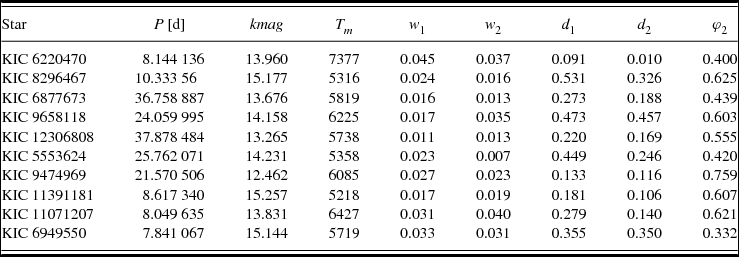
Table 1 presents available information for the targets (Prsa et al. Reference Prsa2011): orbital period P; Kepler magnitude kmag; mean temperature T m; width of the primary eclipse w 1 (in phase units); width of the secondary eclipse w 2 (in phase units); depth of the primary eclipse d 1 (in flux units); depth of the secondary eclipse d 2 (in flux units). We added to the available target data in Table 1 the phases φ2 of their secondary eclipses (the phases φ1 of the primary eclipses are 0.0).
Parameters of the targets from the EB catalogue (period P, Kepler magnitude kmag, mean temperature T m, widths wi, and depths di of the eclipses) and phases of the secondary eclipses φ2.

The detailed review of the Kepler data of our targets revealed that their light curves did not change during the different cycles and observational quarters. This allows for modelling to any data set. We chose to use several consecutive cycles from the middle quarters of each target.
3 LIGHT CURVE SOLUTIONS
We carried out the modelling of the Kepler data by the binary modelling package phoebe (Prsa & Zwitter Reference Prsa and Zwitter2005) . It is based on the Wilson–Devinney (WD) code (Wilson & Devinney Reference Wilson and Devinney1971; Wilson Reference Wilson1979; Wilson & Van Hamme Reference Wilson and Van Hamme2004). phoebe incorporates all the functionality of the WD code but also provides a graphical user interface alongside other improvements, including updated filters for the various recent space missions as Kepler. That is why phoebe is highly appropriate for modelling of the precise Kepler data (Hambleton et al. Reference Hambleton2013).
We used several considerations for the light curve solutions.
(1) The almost flat out-of-eclipse parts of the observed light curve gave us the grounds to use the detached mode of modelling.
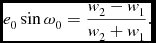
(2) The light curve solution of eccentric binaries by phoebe (also by each light curve synthesis software) without any guessed values of the eccentricity e and periastron angle ω is quite time-consuming task. That is why we calculated preliminary values of these orbit parameters by the formulae
(1) \begin{equation}
e_0 \cos \omega _0=\frac{\pi} {2}[(\varphi _2-\varphi _1)-0.5]
\end{equation}
(2)They were obtained as approximations of formulae (9–25) and (9–37) of Kopal (Reference Kopal1978). We calculated e 0 and ω0 by our expressions (1–2) using the values of φ2, w 1 and w 2 from Table 1 (φ1 = 0). The obtained values of e 0 and ω0 were used as input parameters of phoebe.
\begin{equation}
e_0 \sin \omega _0=\frac{w_2-w_1}{w_2+w_1}.
\end{equation}
\begin{equation}
e_0 \cos \omega _0=\frac{\pi} {2}[(\varphi _2-\varphi _1)-0.5]
\end{equation}
(2)They were obtained as approximations of formulae (9–25) and (9–37) of Kopal (Reference Kopal1978). We calculated e 0 and ω0 by our expressions (1–2) using the values of φ2, w 1 and w 2 from Table 1 (φ1 = 0). The obtained values of e 0 and ω0 were used as input parameters of phoebe.
\begin{equation}
e_0 \sin \omega _0=\frac{w_2-w_1}{w_2+w_1}.
\end{equation}
(3) The mean temperatures T m of our targets (Table 1) allowed us to adopt coefficients of gravity brightening 0.32 and reflection effect 0.5 appropriate for stars with convective envelopes. The only exception was the hot primary of KIC 6220470 requiring parameters of star with radiative envelope (gravity brightening 1.0 and reflection effect 1.0). The contribution of the gravity brightening effect (and its coefficients) is not considerable for detached binaries as our targets.
(4) Initially the synchronicity parameters were kept fixed at values of unity.
(5) Initially the primary temperature T 1 was fixed to be equal to the mean target temperature T m (Table 1) that has been estimated using dedicated pre-launch ground-based optical multi-colour photometry plus Two Micron All Sky Survey (2MASS) J, K, and H magnitudes (Prsa et al. Reference Prsa2011).

Our procedure of the light curve solutions was quite similar to that of Hambleton et al. (Reference Hambleton2013) and was carried out in several stages.
At the very beginning, we input some guessed values of the secondary temperature T 2, mass ratio q, orbital inclination i, and potentials Ω1, 2 and varied only the eccentricity e and periastron angle ω around their input values e 0 and ω0 to search for the best fit of the phases of the eclipses estimated by the value of χ2. It turned out that the final values e and ω differed from the input values up to 10%. This means that the approximated formulae (1–2) could be used successfully for calculation of the input values of eccentricity and periastron angle of eccentric binaries.
At the second stage, we fixed e and ω and varied simultaneously T 2, q, i, and Ω1, 2 (and thus relative radii r 1, 2). We used linear limb-darkening law with limb-darkening coefficients corresponding to the stellar temperatures and Kepler photometric system (Claret & Bloemen Reference Claret and Bloemen2011).
Finally, to adjust the stellar temperatures T 1 and T 2 around the mean value Tm, we used the procedure described in Dimitrov & Kjurkchieva (Reference Dimitrov and Kjurkchieva2015).
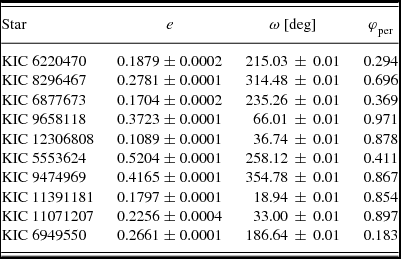
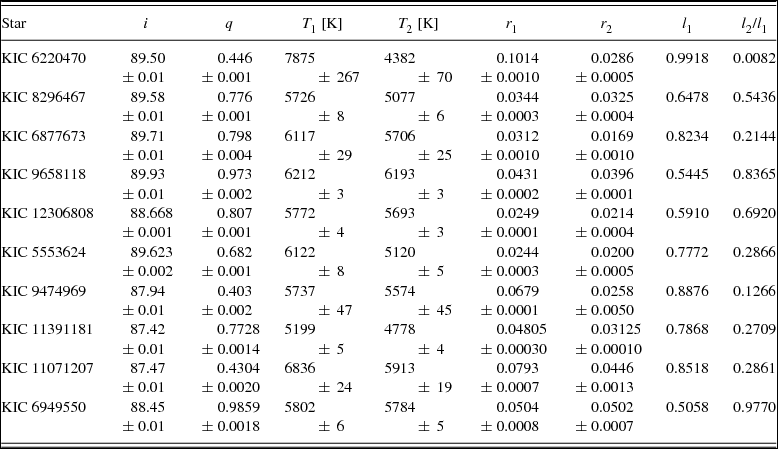
The final parameters of the eccentric orbits are given in Table 2, while Table 3 contains the parameters of the stellar configurations. The synthetic curves corresponding to the parameters of our light curve solutions are shown in Figures 1–10 as continuous lines.
The derived orbital parameters of the targets: eccentricity e, periastron angle ω, and periastron phase φper.
Parameters of the best light curve solutions: orbital inclination i, mass ratio q, temperatures Ti, relative radii ri, and relative luminosities li of the stellar components.
Top: the folded light curve of KIC 6220470 and its fit; Bottom: the corresponding residuals (shifted vertically by different number to save space). Colour version of this figure is available in the online journal.
Same as Figure 1 for KIC 8296467.
Same as Figure 1 for KIC 6877673.
Same as Figure 1 for KIC 9658118.
Same as Figure 1 for KIC 12306808.
Same as Figure 1 for KIC 5553624.
Same as Figure 1 for KIC 9474969.
Same as Figure 1 for KIC 11391181.
Same as Figure 1 for KIC 11071207.
Same as Figure 1 for KIC 6949550.
Any surface spots and third lights were not necessary to reproduce the photometric data and thus, the condition the synchronicity parameters to be fixed at unity turned out without consequence.
The errors in Tables 2–3 are the formal phoebe errors. Most of them are smaller than 1%, excluding the temperatures of the stellar components of KIC 6220470 whose errors exceed 3%. We attributed these bigger errors to the considerably shallower eclipses of this target, especially the secondary one (see Table 1). The small errors of the derived parameters by our light curve solutions are natural consequence of the high precision of the Kepler data.
However, one can see two imperfections in the reproducing of the data.
The first one is the relative bigger residuals during the eclipses (Figures 1–10). Similar behaviour could be seen also for other Kepler binaries (Hambleton et al. Reference Hambleton2013; Lehmann et al. Reference Lehmann, Southworth, Tkachenko and Pavlovski2013; Maceroni et al. Reference Maceroni2014). We attributed them to the effects of finite integration time studied by Kipping (Reference Kipping2010): (i) the large integration times smear out the light curve signal into a broader shape (see Figure 1 of Kipping Reference Kipping2010): the detected ingress and egress durations are bigger than their natural values (introducing an additional curvature into the eclipse wings) and the apparent positions of the contact points are temporally shifted from their true value; (ii) the large integration times smear out the curvature of the eclipse bottom caused by the limb-darkening effect. The two effects are inherent to the long-cadence Kepler data of our targets used for modelling. Coughlin et al. (Reference Coughlin, Lopez-Morales, Harrison, Ule and Hoffman2011) also found that the long-cadence (integration time of 29.43 min) Kepler data of systems with small sum of relative radii significantly alter the morphological shape of a light curve.
The second imperfection is the small ripples on the flat out-of-eclipse sections of some synthetic light curves as well as those on the flat bottom of the total eclipses. We attributed them to numerical shortcoming of the software for the cases of binaries with small relative radii of the components. Such effect (with amplitude below 0.1 mmag) was firstly noted by Maceroni et al. (Reference Maceroni2009) and interpreted by the description of stellar surfaces with a finite number of elements. The result of the surface discretisation seems bigger (with amplitude around 0.2 mmag) for our targets in which components have small relative radii. In fact, this is the reason for the traditional software for light curve synthesis to be not applicable for modelling of exoplanet transits (see for instance phoebescientific reference by Prsa et al. Reference Prsa2011).
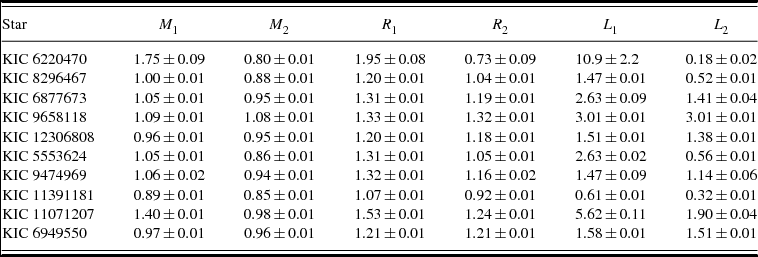
We estimated the global parameters of the target components (Table 4) using the empirical statistical relations mass–temperature, radius–temperature, and luminosity–temperature for MS stars (Boyajian et al. Reference Boyajian2013), which were approximated by combinations of linear functions. Thus, the absolute parameters in Table 4 are result of interpolation of empirical relations, not derived from observational data, and the listed errors are due to the interpolation process.
Masses Mi, radiiRi, and luminositiesLi of the target components (in solar units) according to the empirical relations. Their errors are due to the interpolation process.
4 DISCUSSION
The analysis of the light curve solutions of the chosen ten eccentric binaries led us to several important results.
(1) We established high sensibility of the solutions (measured by χ2) to the mass ratio (Figure 11). This result differed from those of Michalska & Pigulski (Reference Michalska and Pigulski2004) and Terrell & Wilson (Reference Terrell and Wilson2005) who found that for detached EBs equally good fits can be obtained in a very large range of mass ratios. We attributed the sensibility of our solutions to the mass ratio to the following: high precision of the Kepler data, very small relative radii of the stars of our sample, and eccentric orbits of our targets.
(2) The temperatures of the stellar components correspond to spectral type from late A to middle K with dominance of G type. This result is expected taking into account that Kepler observed mainly solar-type stars.
(3) Our targets have quite big eccentricities (0.11 ⩽ e ⩽ 0.52). This result is due to the selection effect and thus does not contradict to the expected distribution of e peaked at 0.0–0.1 (Prsa et al. Reference Prsa2008).
Our targets do not support the expected relation of the eccentricity to be smaller for the shorter period systems (the shorter period orbits undergo stronger tidal forces and they circularise more quickly, leaving a dearth of highly eccentric short period binaries). Such a trend of increasing of e with the period has been established for evolved MS stars in open cluster M67 (Mathieu & Mazeh Reference Mathieu and Mazeh1988).
(4) The orbital inclinations of the targets are quite near to the 90° (Table 3) that is expected for eclipsing systems with periods above 8 d. But only two targets, KIC 6220470 and KIC 9474969, undergo total eclipses.
(5) We did not find evidence for apsidal motion of our targets. The possible reason is the relative short duration of the Kepler observations. Typically, apsidal periods are at least a decade long (Michalska & Pigulski Reference Michalska and Pigulski2005). Moreover, the systems with apsidal motions are with the shortest orbital periods or with the largest sum of relative radii for a given eccentricity (Michalska Reference Michalska2007), but these conditions are not fulfilled for our targets.
(6) The out-of-eclipse light of the targets is constant within 0.2%. Only KIC 6949550 consisting of two solar-type stars reveals semi-regular light variations (Figures 12 and 13) with amplitudes of 0.002–0.004 on timescales of order of 7 d (Figure 12) which are modulated with a period around 400 d (Figure 13). The possibility for these low-amplitude variations to be detected is due to the unprecedented precision of the Kepler data. Their frequency analysis is object of future study.
(7) The review of the light curves of our targets from different quarters did not exhibit any long-term variability (excluding KIC 6949550).
(8) The mass ratios of the targets are within the range 0.4–1.0. North et al. (Reference North, Gauderon, Barblan and Royer2010) obtained that q for detached systems is within 0.8–1.1 and for semidetached and contact binaries within 0.4–0.7. Lucy (Reference Lucy2006) found an excess of binary systems with q ⩾ 0.95 in our Galaxy. Our result implies that the distribution of the mass ratio for eccentric binaries differs from that for circular-orbit systems.
(9) We established some linear trend between the ratio r 2/r 1 and mass ratio q (Figure 14, left) for the ten members of our small sample.
(10) The ratios T 2/T 1 of our targets fall in the range 0.8–1.0 with one exception, KIC 6220470, which value is 0.56 (Figure 14, middle). Opposite discrepancy has been found for HD 174884 (Maceroni et al. Reference Maceroni2009), which components are with equal temperatures irrespective of the negligible secondary eclipse.
(11) The values q st of the mass ratios, obtained by the empirical relation temperature–mass of MS stars (Table 4), differed from those determined by our phoebe models q ≡ q PH (Figure 14, right). The most glaring case is KIC 9474969 with values q st = 0.88 and q PH = 0.4.
Sensibility of our light curve solution of KIC 11391181 (measured by χ2) to the mass ratio (the rest parameters last fixed at their final values).
Short-term semi-regular light variations of KIC 6949550.
Long-term modulation of the light variations of KIC 6949550.
Dependence of r 2/r 1 on mass ratio q (left panel), dependence of T 2/T 1 on mass ratio q (middle panel), and diagram qst – qPH (right panel).
Figure 14 implies that the components of the eccentric binaries, especially those with q ⩽ 0.5, do not follow the empirical relations between the global stellar parameters derived by study of circular-orbit binaries (and with probable dominance of mass ratios around unity). In fact, only targets KIC 9658118 and KIC 6949550 with mass ratio near unity turned out with almost equal values of the ratios of luminosities and radii of their components obtained by the light curve solutions (l 2/l 1 and r 2/r 1 from Table 2) and by the empirical relations for MS stars (L 2/L 1 and R 2/R 1 from Table 4). The biggest discrepancies between the values of these ratios belong to KIC 9474969 with the smallest mass ratio. This result might be considered as some empirical support of the conclusion of Sepinsky et al. (Reference Sepinsky, Willems and Kalogera2007a) about the difference of the Roche geometry of circular-orbit and eccentric-orbit binaries. Another possible reason could be that the empirical relations for MS stars have been derived on the base of binaries with mass ratios around unity.
5 TIDALLY INDUCED HUMPS
The tidal forces change the stellar shape (tidal bulges) and cause brightness variability due to projection of the distorted stellar surfaces on the visible plane (Brown et al. Reference Brown, Kilic, Hermes, Allende Prieto, Kenyon and Winget2011; Welsh et al. Reference Welsh2011; Morris Reference Morris1985). It has double-wave shape (ellipsoidal variations) in the case of circular orbits and light increasing around the periastron in the case of eccentric orbits.
Kumar et al. (Reference Kumar, Ao and Quataert1995) created an analytic model of tidal phenomena in eccentric binary consisting of point source (neutron star) and MS star. The shape of the corresponding light curve depends on inclination, angle of periastron, and eccentricity while its amplitude (of order of mmag) depends on the masses of the objects, their internal stellar structure, and the orbital separation at the periastron (Kumar et al. Reference Kumar, Ao and Quataert1995). According to this model, the shape of the light increase is one-peaked for i ⩽ 30° but becomes two-peaked with central dip (which depth and width increase with i) for the bigger orbital inclination.
Thompson et al. (Reference Thompson2012) calculated a grid of solutions to the model of Kumar et al. (Reference Kumar, Ao and Quataert1995) and found that the larger inclinations cause the light curve firstly to increase in brightness and then to decrease (KIC 3547874), or vice versa (KIC 9790355), depending on the angle of periastron, while the bigger eccentricity led to shorter duration of the heartbeat event.
Three targets from our sample, KIC 6220470, KIC 9474969, and KIC 11071207 (Figure 15), reveal light features around the periastron phase φper (Table 2). The analysis of these observed features led us to the following results:
(a) The observed features around the periastron phase (Figure 15) seem as a ‘hump’ (brightening). Their shapes differ from the expected ones for the big orbital inclinations (with central dips, see Figures 2–3 of Kumar et al. Reference Kumar, Ao and Quataert1995 and Figure 5 of Thompson et al. Reference Thompson2012).
(b) The hump duration is shortest for KIC 9474969, in which eccentricity is above two times bigger than those of the other two ‘humped’ targets (see Table 2 and Figure 15). This result supports the conclusion of Thompson et al. (Reference Thompson2012).
(c) The tops of the humps do not coincide perfectly with the periastron phases: those of KIC 6220470 and KIC 11071207 slightly precede periastron phase while that of KIC 9474969 slightly delays (Figure 15). These small deviations (phase shifts below 0.04) probably are due to the irradiation effect which phase contribution depends on the periastron angle.
(d) Humps were found only for those targets from our sample for which r 1 + r 2 ⩾ 0.09 (Table 2). This implied that the hump amplitude depends strongly on the relative stellar radii. An additional argument was that the hump amplitude was biggest for KIC 6220470 (Figure 15), in which value r 1 + r 2 = 0.13 was the biggest one (Table 3) among the three ‘humped’ targets of our sample.
To derive the dependence of the hump amplitude on the relative radii, we applied the formalism of Kumar et al. (Reference Kumar, Ao and Quataert1995) to eccentric binary consisting of two MS stars and obtained the expression
(3)
\begin{equation}
\frac{\delta F} {F} = 4 \frac{1}{q} \frac{r_2^3}{(1-e)^3} + 4q \frac{r_1^3}{(1-e)^3},
\end{equation}
where F is the total flux of the target. In fact, this formula gives the amplitude of the ‘clean’ tidally induced hump. The irradiation effect, in which contribution depends on the periastron angle, superposes the tidally excited brightening and changes the hump amplitude. Moreover, possible tidally-induced pulsations (Willems & Aerts Reference Willems and Aerts2002) and Doppler boosting (Bloemen et al. Reference Bloemen2011) could cause additional complications.
The hump amplitudes of our targets calculated by expression (1) were around two times bigger than the observed ones. Kumar et al. (Reference Kumar, Ao and Quataert1995) obtained just the same discrepancy for PSR 0045-7319. This led us to the supposition about wrong coefficient of their expressions (2 instead of 4).
We should point out that KIC 6949550 has r 1 + r 2 = 0.1 but does not reveal a hump. We attributed this exception from the rule (existence of detectable hump for r 1 + r 2 ⩾ 0.09) by its semi-regular variations with bigger amplitude which blur the possible hump.
We assume that the obtained limit of 0.09 of r 1 + r 2 depends on the data precision and can be reduced for future space missions.
(e) All targets with periastron brightening have q ≃ 0.45. We attributed this fact as a consequence of the accidental coincidence of the binaries with q ≃ 0.45 and the systems with biggest relative radii because the dependence (1) of δF/F on the relative radii is stronger than that on the mass ratio.
(f) Humps would not be discernable for systems where periastron angle ω is close to 90° or 270° because the periastron phase for these cases will coincide with some of the eclipses. Our targets are not such cases (Table 2), and thus we have not missed some humps for this reason.
(g) We did not find oscillatory modes of any target. This result confirms the conclusion of Kumar et al. (Reference Kumar, Ao and Quataert1995) that the MS stars have small amplitudes of oscillation.

Tidally induced brightening of KIC 6220470 (left panel), KIC 9474969 (middle panel), and KIC 11071207 (right panel).

6 CONCLUSION
This paper presents the results of determination of the orbits and fundamental parameters of ten EBs with eccentric orbits from the Kepler archive. The obtained results allowed us to derive several conclusions.
(1) The formal errors of the derived parameters from the light curve solutions are below 1% (excluding those of KIC 6220470 which exceed 3%).
(2) Our light curve solutions imply that the components of the eccentric binaries (especially those with mass ratios below 0.5) do not follow precisely the empirical relations between the stellar parameters derived from the study of circular-orbit binaries.
(3) KIC 6949550 reveals semi-regular light variations with an amplitude around 0.004 and a period around 7 d which are modulated by long-term variations.
(4) We found tidally induced light ‘hump’ around the periastron phase of three targets: KIC 6220470, KIC 11071207, and KIC 9474969.
(5) We derived formula describing the amplitude of the tidally induced hump of eccentric binary consisting of MS stars. It exhibits that the amplitude of these features increases strongly with the relative stellar radii.
(6) Although we did not find evidences of apsidal motion of our targets in the framework of the relative short duration of the Kepler observations, our EEBs present appropriate targets for future study of this effect due to their big eccentricities.
Obviously, the numerous and exclusive precise Kepler data deserve precise light curve solutions to enrich statistics of the binaries with estimated parameters and thus to improve the empirical relations between them. Moreover, the tidally induced phenomena provide critical data to constrain the theories of tidal forces in stellar binaries (Fuller & Lai Reference Fuller and Lai2011; Burkart et al. Reference Burkart, Quataert, Arras and Weinberg2012).
ACKNOWLEDGEMENTS
The research was supported partly by funds of project RD-08-285 of Scientific Foundation od Shumen University. It used the SIMBAD database and NASA Astrophysics Data System Abstract Service. We worked with the live version of the Kepler EB catalogue.
This publication makes use of data products from the 2MASS, which is a joint project of the University of Massachusetts and the Infrared Processing and Analysis Center/California Institute of Technology, funded by the National Aeronautics and Space Administration and the National Science Foundation (Skrutskie et al. Reference Skrutskie2006). This research makes use of the SIMBAD and Vizier data bases, operated at CDS, Strasbourg, France, and NASA Astrophysics Data System Abstract Service.
The authors are grateful to anonymous referee for the valuable notes and propositions.