

Introduction
We cannot go back to Honduras…. They will kill us. With gangs it is very difficult…. The gang members wear the same vests and use the same guns that the police do. How do they get hold of these guns and vests? From the police.
—A woman who has fled Honduras (UNHCR 2015, 24)For years, Honduras stayed under the radar of international attention, particularly of the US public. This is despite the fact that Honduras has served US interests in Central America in various forms and degrees, playing a key role during the 1980s when it was the staging ground for military operations and training that sustained the wars in that region. However, in recent years, a series of events have thrust Honduras into the limelight, starting with the 2009 coup that ousted the democratically elected president Manuel Zelaya. This event accelerated and exacerbated a security crisis in Honduras and the northern countries of Central America that has resulted in the destabilization of families, worsening of the economy, and increasing violence.Footnote 1 The woman quoted above is one among thousands of women fleeing such conditions and seeking refuge in the United States. Thus, while the Latin American region as a whole seems to have entered a new era of openness, and many countries have agendas to address inequalities and effect fundamental change, not all countries are aligning with this trend. Some, like Honduras, seem to have stepped back into the 1980s with coups, repression, and political violence that now is almost indistinguishable from “common” crime. Honduras recently had the highest homicide rate in the world. Today that distinction belongs to El Salvador, but these two countries have alternated between the first and second places in the past several years. In Honduras, this rate has steadily gone up with the increased militarization of the state since the 2009 coup d’état.Footnote 2 Importantly, in spite of intraregional differences in democratic processes, Latin America as a whole has seen a marked increase in levels of interpersonal violence (PNUD 2013). High levels of violence once again are threatening democracy in the region (Reference Arias and GoldsteinArias and Goldstein 2010).
Increasing exclusion and inequality in Honduras have posed escalating security risks for women in the home and on the streets. Although poverty and marginality affect everyone in the country, these conditions impact women and men differently. Both women and men are robbed, extorted, and killed. However, women suffer qualitatively different and more extreme forms of brutality in the form of feminicide and various other forms of gender violence. In this article, we examine gender-based violence against women, the everyday acts that can result in their deaths, but not as solely interpersonal acts or by linking them primarily to economic deprivation. Rather, we examine the actions and inactions of the state that have served to amplify violence in the lives of Honduran women. While we expose women’s poverty-related vulnerabilities, our approach moves beyond income disparities to highlight inequalities in citizenship rights where the state is a key player in perpetuating and reinforcing unequal access to justice and rights. We point to the confluence of factors that facilitate violent conditions for women that can ultimately culminate in their killings, and in doing so we reveal processes by which structural inequality translates into unequal access to safety and justice for Honduran women.Footnote 3
Before we embark on our discussion, a note about terminology is necessary. Killings of women are often referred to as “femicide,” that is, the killings of women because they are women (Reference Radford and RussellRadford and Russell 1992). We prefer the term “feminicide” because embedded in this term is the role the state plays in these killings. In contexts of impunity such as Honduras, the brutal killings of women denote the complicity of the state through its unwillingness or inability to provide prevention and response mechanisms (see Reference Lagarde, Fregoso and BejaranoLagarde 2010). The state also plays a more direct role in violence used to silence women in the political arena. State agents have committed sexualized violence and participated directly in injuring or killing women. This situation compounds inequality, as women become more afraid to engage in public life, which deeply curtails their citizenship rights. Honduras is characterized by Guillermo O’Donnell’s conceptualization of “brown areas,” that is, areas where the legal state is absent, resulting in a compromised rule of law. In these areas, “whatever formally sanctioned law exists is applied intermittently, if at all” by subnational systems of power (e.g., patrimonial or even gangster-like), with informal legal systems that coexist with national regimes that have formal legal systems and are nominally democratic (Reference O’DonnellO’Donnell 2004, 38–39).
We distinguish between the state’s acts of omission and acts of commission in order to identify the political responsibility and failures of the state that create a fertile ground for these killings (see also Reference Sanford, Stefanos, Salvi, Sanford, Stefanos and SalviSanford, Stefanos, and Salvi 2016). Omission (or inaction) includes indirect mechanisms such as failure to provide prevention, protection, and prosecution. It can also include failure to implement laws to protect women, as when a negligent state “averts its gaze” (Reference Scheper-HughesScheper-Hughes 1992) and simply looks the other way. Commission (or action) includes direct actions, such as sexual violence, threats, and the targeting of women leaders for persecution and police harassment.Footnote 4 Both types of acts have roots in the same social context that normalizes and sustains violence as well as in profound gender inequalities. This context also shapes the lens through which state actors assess information, justify acts, and implement laws. Decoupling the role of the state into commission and omission allows us to analyze the responsibility of the government in the surge of killings before and after the coup.
To be sure, the Honduran government before the coup engaged in actions that disregarded gender-based violence against women and did not take effective steps in addressing it, thus committing acts of omission. These failures have worsened with the post-coup government, which has taken more direct measures that have escalated acts of omission as well as commission in systematically persecuting women leaders and physically and sexually assaulting women. This is perhaps best exemplified by the assassination of environmental activists, such as the killing of indigenous leader Berta Cáceres, who was murdered in March 2016 after receiving multiple threats following her opposition to the construction of a hydroelectric dam. Yet the police alleged her murder had taken place in connection with a robbery. Even if the government is not killing women directly, acts of commission and omission create conditions that promote impunity and increase risks of victimization by normalizing the targeting of women for violence, at home and in the streets. Though acts of omission may not directly involve the state in the killings, inaction can also lead to such killings. Thus, through direct and indirect mechanisms, the post-coup government has exacerbated the context within which women are killed, and impunity is widespread.
Honduras has ratified regional and international conventions and has laws on the books criminalizing intrafamilial violence, rape, and killings of women. However, the police and courts have undermined the aims of these laws by failing to implement them effectively or even by directly assaulting women. We argue that these government actions and inactions are linked to intersections among political, social, and economic exclusion that are a consequence and a cause of gendered inequality, creating a particularly violent context for women. In our conceptualization, the same context that creates conditions for extreme forms of violence also impedes justice as it perpetuates unequal access to the justice system on the basis of gender and, in this way, subverts women’s citizenship rights.
The recent spiral of violence in the lives of women and lack of protection can best be understood by examining the political responsibility of the state within a context of multisided violence. This context includes structural, political, symbolic, and everyday violence that reinforces and undergirds the normalization of persistent impunity and violence in the lives of women. This sociopolitical architecture sustains and perpetuates gendered violence and impunity. We argue that the more extreme the context of multisided violence, the higher the probability that states will fail in their responses to violence against women through normalizing and institutionalizing profound gender inequalities and undermining citizenship rights for women. This context is particularly present in Honduras, especially considering the diminishing power of civil society groups and increased political repression after the coup. Past research has linked levels of feminicide to discrimination, poverty, and negative attitudes toward women (Reference Prieto-Carrón, Thomson and MacDonaldPrieto-Carrón, Thomson, and MacDonald 2007). We move past these associations to reveal more systematically how structural and institutional violence creates a context of violence that cannot be reduced to violent individuals; it is embedded in the broader social order, gender inequality, the perpetuation of violence, impunity, and women’s diminished rights.
We focus on how broader structures of inequality conjoin with political forces to maintain these structures and intensify their impact. This approach allows us to identify root causes of the wide (and widening) gap between laws on the books—which have been passed mostly to satisfy international and domestic organizations pushing for change—and laws in action, that is, implementation on the ground. This gap diminishes women’s citizenship rights and enables the rise of feminicides. A law on the books may not be enough to address an issue if contextual factors do not align with the aims of the law (Reference EisenbergEisenberg 2011). And although we focus on Honduras, we note similar experiences of extreme violence in Guatemala, El Salvador, and other countries in the Latin American region (Grupo Guatemalteco de Mujeres 2012; Reference HumeHume 2009; Reference MenjívarMenjívar 2011; UN 2011; Reference WalshWalsh 2008).
Theoretical Framework
To understand how the state responds (or fails to respond) to violence against women in Honduras, we use an analytic perspective that permits us to factor in the social and structural conditions that shape gender violence and within which laws are written and interpreted. A lens of multisided violence includes aspects of structural, symbolic, and political violence that intersect with gender violence (Reference Walsh and MenjívarWalsh and Menjívar 2016; Reference MenjívarMenjívar 2011; Reference Menjívar and WalshMenjívar and Walsh 2016). The layered and interconnected nature of these forms of violence contributes to their normalization and the internalization of frames through which individuals understand and make sense of the social world (Reference MenjívarMenjívar 2011). A multilayered, normalized context of violence shapes the views, frameworks, and cognitive frames through which individuals (including justice system personnel) view violence, and in this way forms a sociopolitical architecture that orders life and shapes frames of reference. Thus, those who perpetrate violent acts and those in charge of implementing the law to address such acts draw their frameworks, viewpoints, and attitudes about gender roles, women, and violence from the same social “order of things” (see Reference Kleinman, Das, Kleinman, Ramphele and ReynoldsKleinman 2000). The intersection of various forms of violence results in the kind of increased gender violence and impunity that has become a crisis in Honduras.
Structural Violence
Structural violence is exerted both systematically and indirectly, often exposing itself in social structures as inequality. It results in oppressive conditions of poverty and lack of opportunity for marginalized sectors of society such as poor women (Reference MenjívarMenjívar 2011). The state plays a fundamental direct and indirect role in creating structurally violent conditions for large segments of the population. Who ends up poor is not an accident; it is the outcome of deliberate policy decisions that cause and perpetuate social and economic exclusion. Neoliberal reforms that lead to the displacement of workers, increases in unemployment, underemployment, and insecurity lie at the root of expanded forms of structural violence in the lives of the poor today.
Significantly, structural violence is gendered. Women are disproportionately impoverished on a global scale, and Honduras is no exception. While poverty may not impact initial risks of exposure to physical violence, it puts poor women at extreme risk for repeated victimization and at a disadvantage in exercising their citizenship rights. Structural violence is also built into the structure of the state through policy decisions that have shrunk social spending budgets. Some of the effects on women are manifested in social expectations for women to attend to the needs of their families, secure food for their children, and protect them in the face of danger (Reference MenjívarMenjívar 2011). The lack of specialized services for women in the police and courts, despite pressure by women’s organizations to provide them, exemplifies the structural violence of the state’s actions, which maintain women’s marginalization and perpetuate it through systemic failures to provide them with prevention, protection, or prosecution of violence. As Ronderos (Reference Ronderos2011, 2) notes, “In a context of unequal distribution of wealth, scarce resources and weak institutions, impunity prevails within the justice system.” Thus, women are kept disproportionately poor through policy design and become even more vulnerable to violence as policies contribute to maintaining impunity.
Political Violence and State Terror
Although Honduras did not experience an internal armed conflict as did neighboring Central American countries, political violence and state terror prevailed, with gendered expressions. Political violence of the past has been characterized as targeting opposition groups. In contrast, today’s state violence concentrates on “common” criminals, often gangs. The violence used in both cases is remarkably similar; repressive tactics used against the opposition in the past are now used to combat gangs and criminal groups. These tactics contribute to the militarization of society, as in the past, when society became accustomed to seeing violent government actions as ordinary and military power structures as natural and accepted. Thus, Enloe (Reference Enloe2000) observes, lives become militarized not only through direct means and exposure but also when militarized views and attitudes are taken as natural and unproblematic, with a reciprocal relationship between violence from the state and violence in private spheres (Reference Hay, Sarat and KearnsHay 1992). Structural and political violence interact: the structural violence of neoliberal reforms implemented in deeply unequal societies increases poverty and constrains choices for poor Hondurans, who turn to gang membership in order to survive (Reference WolsethWolseth 2011). In turn, the government responds with aggressive policies to combat gang violence, creating new territories of violence (Reference Gutiérrez RiveraGutiérrez Rivera 2013). In a continuum of state violence, there are haunting similarities between signs of gendered violence and sexualized torture found on victims of feminicide today and methods of torture used against women during the civil war years in the region (Reference SanfordSanford 2008). Political violence is maintained and exacerbated through state actions of omission as well as commission—through failing to address issues of impunity for political violence and through committing it directly.
Symbolic Violence
According to Bourdieu (Reference Bourdieu, Scheper-Hughes and Bourgois2004), symbolic violence refers to the internalized humiliations and legitimations of inequality and hierarchy that range from sexism and racism to intimate expressions of class power. A key point in Bourdieu’s conceptualization is that the everyday, normalized familiarity with violence renders it unexceptional; power structures are normalized and accepted—always there—and the mechanisms through which violence is exerted recede from conscious knowing.
Perhaps the most powerful form of symbolic violence, in Bourdieu and Wacquant’s (Reference Bourdieu, Wacquant, Scheper-Hughes and Bourgois2004, 272) conceptualization, comes from “the social order of things.” It normalizes mistreatment against vulnerable members of society, and this normalization becomes part of the cognitive frames through which individuals make sense of the world. This social order reinforces and normalizes expectations of gendered behavior, and thus perpetrators come to expect not to be held accountable for their acts. Impunity then becomes embedded in relations with authorities and the judicial system. The imprint of symbolic violence can be seen in the routinized daily acts of control, humiliations, and stigmatization of women and their bodies, and the naturalized acceptance of women’s manifold forms of social exclusion in education, health, and employment. It is also expressed in a general devaluation of poor women’s lives, as well as in women’s self-recrimination for their own victimization when they fail to meet the norms imposed on them. These expressions do not cause Honduran women’s murders but cumulatively set the conditions for them, as symbolic violence legitimizes the devaluation of women’s lives. Because symbolic violence is constitutive of the social order, it seeps through to permeate state institutions, where it is expressed in the state’s acts of omission and commission. For example, the state may fail to promote policies and campaigns that would value the lives of marginalized citizens in general. Further, they may perpetuate this devaluation when judges and police blame victims for the abuses against them by accusing them of failing to “behave well.” When women encounter these justifications and dismissals of violence against them, the justice system reinforces abuse as a mechanism of subordination.
Gender Violence and Gendered Violence
Gender and gendered violence is a transversal aspect of structural, political, and symbolic violence; all of these types of violence have gendered expressions. Hammar (Reference Hammar1999) observes that differences in a gender-imbalanced political economy that disadvantage women represent gender violence, whereas acts of violence, including physical, psychological and linguistic, constitute gendered violence (1999, 91). And it is precisely the expression of gender violence and gendered violence in everyday life (in the home and the streets) that contributes to their normalization—they are always there, part of the way things are. Everyday practices sustain the normalization of gender violence but also justify punishments for deviations from normative gender role expectations. Gendered and gender violence interact with structural, political, and symbolic violence to produce a multilayered system that increasingly hurts women and affects poor and vulnerable women in particular (Reference MenjívarMenjívar 2011). And gendered and gender violence are maintained and exacerbated through the symbolic violence of state actions of omission and commission. This confluence also sets the conditions for feminicide to occur. In our conceptualization, political exclusion, entrenched gender ideologies, and persistent inequality contribute to escalating security risks for women in Honduras and in other countries that share a similar confluence of factors.
Data and Methods
In a previous study, we inductively identified mechanisms that create conditions for extreme violence in the lives of women in Guatemala and El Salvador (Reference MenjívarMenjívar 2011; Reference Walsh and MenjívarWalsh and Menjívar 2016) and we adapt this lens to examine the Honduran case. We use the “extreme-case” method, which focuses on case studies with extreme outcomes, like notable successes or failures (Reference GerringGerring 2007, 101). This method helps to reveal how normalization operates as a causal mechanism in the relationship between the context of multisided violence (the cause) and extreme violence against women and impunity (the outcome).
There are various approaches to data collection that could be used to examine the questions we address, but we opted for assembling different sources of unobtrusive data to address this sensitive topic. One egregious act of omission on the part of the Honduran state post-coup is that it has increasingly failed to maintain databases on crimes against women and, consequently, there has been a dearth of data on violence against women in the post-coup years. Thus, we have resorted to piecing together the data we could find. Rather than using more direct and extensive interviews and surveys, we use other forms of primary and secondary data.
Our primary data are the laws on the books in Honduras that address violence against women, including intrafamilial violence and feminicide, as the state manifests itself in people’s lives through law. We also reference a recent United Nations High Commissioner for Refugees report (UNHCR 2015) based on interviews with 160 Central American and Mexican women fleeing the violence; Menjívar assisted in the design of the data collection instrument and in writing the report. Further, we rely on two country expert affidavits presented in court proceedings of Honduran women seeking asylum in the United States, which cover the implementation of laws on violence against women in Honduras.Footnote 5 We also use an interview with a Honduran human rights lawyer who is an expert on gender-based violence in her country. Secondary data come from reports by civil society organizations, the Honduran government, the press, and international organizations reporting on the levels and types of violence that women sustain and the advances and limitations of the laws. To complement these sources we make use of country-level statistical data. Culling information from these various sources allows us to triangulate our data and focus on areas of overlapping evidence regarding how women are treated or mistreated in the justice system rather than randomly selecting cases or focusing on outliers.
We examine the laws on the books to identify advances addressing violence against women. We also highlight the laws’ limitations given the context in which they are interpreted and implemented. Drawing from testimonies and reports, we analyze how laws operate on the ground where there are multiple obstacles to implementation in the police and courts. This lens allows us to reveal how the structure and application of laws normalizes and reinstantiates violence against women, rather than combating or eradicating it.
Background and Country Conditions: Foundations for Feminicide
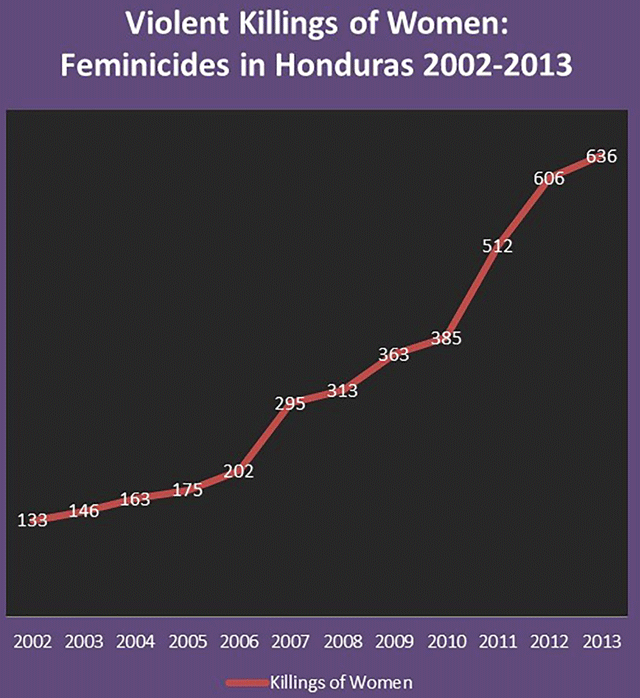
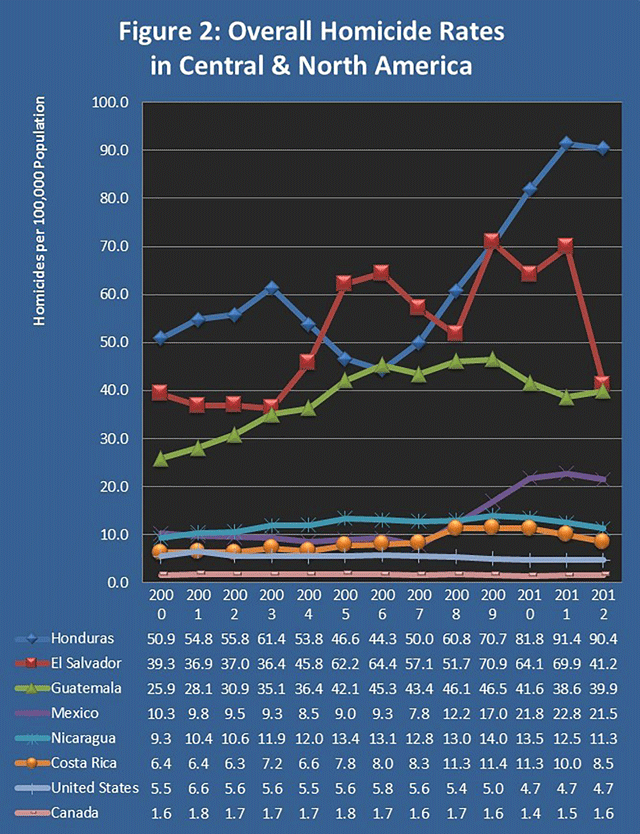
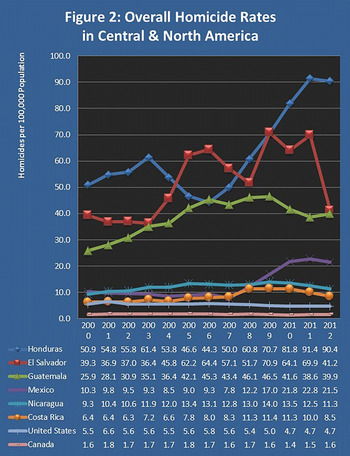
According to the UN Office on Drugs and Crime, Honduras has one of the highest feminicide rates in the world (see Figure 1 for the trend in 2002–2013). The number of women murdered in Honduras has been rising steadily but spiked after 2010. Within Latin America, Honduras recently ranked third in feminicide rates behind El Salvador (the highest in the world today) and Guatemala (the second highest in Latin America), and had higher rates than Colombia and Bolivia (Reference Alvazzi del FrateAlvazzi del Frate 2011).Footnote 6 (See Figure 2 for a comparison of homicide rates in Central and North America, showing a rising rate in Honduras from 2006, which began to exceed murder rates in all other neighboring countries in 2009.)
Number of feminicides in Honduras, 2002–2013. Adapted from Memoria Foro Femicidios 2014, 8.
Overall homicide rates in Central and North America. Adapted from Memoria Foro Femicidios 2014, 8.
While the murder rate for women is lower than that for men, the rate for women has been consistently increasing since 2005, when there have been some periods of decline in the murders of men (Memoria Foro Femicidios 2014, 8). As Incháustegui Romero et al. (Reference Incháustegui Romero2012) observed for feminicide cases in Mexico, the murders of men show more elasticity than those of women, as the murders of men tend to respond to events or conditions with which they are associated, such as increases or decreases in organized crime, while the murders of women occur independently of specific contextual events. And whereas the killings of Honduran women before the coup showed an upward trend, the trend accelerated following the coup, demonstrating that propitious structural conditions for women’s killings already existed pre-coup but were exacerbated post-coup. We argue that the state’s actions played a key role.
Under pressure from domestic groups and international organizations, pre-coup Honduran governments passed a series of laws that offered measures protecting women from violence and discrimination, including a law against domestic violence (1997) and a law of equal opportunities for women (2000). The post-coup de facto government also passed a femicide law with stronger penalties for the killings of women (2013) (see Table 1). Thus, even though Honduras had laws to address violence against women before the coup, they were not effectively implemented. However, implementation has declined further in the post-coup era, even as rates of violence against women have continued to rise. Normalized views and structures that devalue women’s lives and sustain violence against them existed before the coup, but state actions after the coup have amplified these conditions and deepened inequalities.
Honduran laws addressing forms of violence against women.
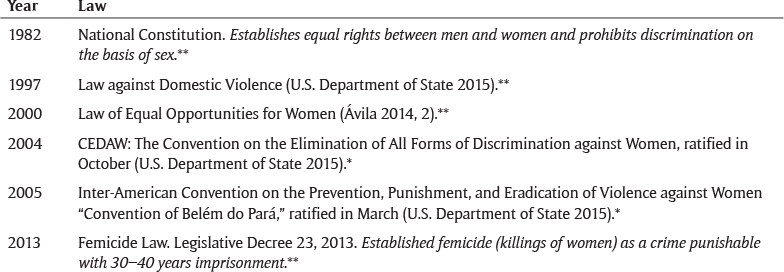
*International or regional convention.
**Domestic legislation.
Thus, despite international recognition of the growing incidence of violence against women in Honduras, over 96 percent of feminicides go unpunished (Inter-American Commission on Human Rights 2011). This impunity, an expression of symbolic and gender violence, sends a powerful message that women’s lives are expendable and unimportant, as unresponsive justice system institutions fall short in implementing the law on the books. Forty percent of the women interviewed for the UNHCR study (2015) who fled the country due to violence did not report abuses to the police because they thought it would be useless.
In the 1980s, the United States used Honduras as a staging ground for the Contra War in Nicaragua and a base for US training of Salvadoran troops to fight against the Farabundo Martí National Liberation Front (FMLN) in El Salvador. During this time, US funding for the Honduran military increased dramatically. While domestic political tensions rose, disappearances and murders became commonplace (Reference Booth, Wade and WalkerBooth, Wade, and Walker 2010). Honduras became what scholars call a democradura: “a nominally democratic government that is really under military rule” (Reference Mateo, Bruneau, Dammert and SkinnerMateo 2011, 90). The country started experiencing a crime wave in the 1990s, after the imposition of neoliberal structural adjustment programs increased inequality and repression (Reference Booth, Wade and WalkerBooth, Wade, and Walker 2010). Wages stagnated through the 1980s and 1990s, and the destruction in 1998 by Hurricane Mitch amplified existing poverty and unemployment trends (Reference Booth, Wade and WalkerBooth, Wade, and Walker 2010). Neoliberal economic reforms exacerbated environmental degradation and prompted migration to urban areas, attracted by the increasing presence of maquila industry employment (Reference Booth, Wade and WalkerBooth, Wade, and Walker 2010; Reference Boyer and PellBoyer and Pell 1999), as well as migration to the United States. Today, more than half of Hondurans live below the poverty line (Reference Mateo, Bruneau, Dammert and SkinnerMateo 2011).
The crime wave that began in the 1990s became a major theme of the 2001 elections (Reference Booth, Wade and WalkerBooth, Wade, and Walker 2010), as the rhetoric of being tough on crime has been used for political gain in Honduras (as well as in other countries in the region) (Reference HollandHolland 2013; Reference KrauseKrause 2014). While the Honduran government has blamed gangs for high murder rates, it is difficult to disaggregate gang activity from other sources of crime, as both are entwined with insecurity, weak and corrupt public institutions, persistent impunity, growing drug trade activity throughout the region, increasing militarization that undermines community ties, widening inequality, and oppressive conditions of poverty (see Reference Mateo, Bruneau, Dammert and SkinnerMateo 2011, 92, 96). It is also hard to distinguish between common crime, social crime, and political crime in a context of lack of rule of law, corruption, and targeted violence against those identified as resistance members (Reference HermannsdorferHermannsdorfer 2012, 16). All these varied forms of violence coalesce and are expressed in state actions to produce a context that normalizes violence and reproduces inequalities that undermine women’s rights.
In 2009, President Manuel Zelaya was overthrown by a right-wing military coup led by Porfirio Lobo, following Zelaya’s referendum to propose a constitutional reform. Under the Zelaya government, there were modest advances for women’s rights and potential for gains, but these were stunted with the coup. The proposed constitutional changes promoted by women’s organizations included equal rights and opportunities, sexual and reproductive health and rights, the right to a life free of violence, sex education in schools, and political participation with the reinforcement of quotas for equitable and just representation in legislative units (Reference RonderosRonderos 2011, 5–6). Ronderos notes, “With the chance to reform the Constitution, women’s civil society organizations self-organized in order to agree on a common agenda that would also ensure their participation in national policy debates and consultations” (Reference Ronderos2011, 4).
Before the coup, there was a core group of progressive women within the National Congress who had the potential to call on the state to be accountable for rights violations, but most of these representatives resigned after the coup (Reference GellGell 2012, 1). Many other women’s advocates have been removed from their posts in state institutions. Also before the coup, women successfully lobbied the National Congress in 2008 to create specialized policing units to investigate cases of killings of women. Under the post-coup de facto government, these police units were relocated within a year of their creation to attend to general street crime, leading to “a much less favourable context for women” (Reference RonderosRonderos 2011, 6). Thus, the coup deepened divisions between an increasingly militarized state and much of civil society that had been mobilizing to resist it. The reallocation of specialized services represents the state’s acts of omission and commission that sustain women’s marginalization through institutional failures to respond to violence against women.
Post-coup Honduras also has been characterized by a heightened context of structural violence for women, who are disproportionately poor and face even more constrained opportunities in the job market and increased levels of poverty, conditions that harm especially indigenous and Afro-descendant populations (UNDP 2010). Honduras’s 2013 Gender Inequality Index ranking of 129 (out of 187 countries worldwide) places the loss in potential human development due to gender inequality at 48.2 percent in 2013. Structural conditions commingle with political conditions (in the form of the state’s actions and inactions). Concomitantly, gender and gendered violence in post-coup Honduras permeate institutions charged with providing security. While the post-coup era has been characterized by political setbacks and obstacles for women’s rights, it has also launched a new wave of violence and state-led repression.
Feminicides and Violence against Women
Feminicides in Honduras have spiked since 2006, rising 300 percent from 202 murders in 2006 to 606 in 2012. As a basis of comparison, Honduras has a smaller population than New York City (approximately 8.1 vs 8.5 million); Honduras’s murder rate would undoubtedly be considered a crisis in New York. In 2012, feminicide was considered the second-highest cause of death for women of reproductive age in Honduras (IACHR 2013, 388). As several data collection activities on gender violence have come to a halt after the coup, there are limited data on the nature of crimes and violence against women in Honduras. But existing reports, such as those from the Autonomous University’s Violence Observatory, suggest that prevalence is high, reporting rates are low, state responses are weak, and impunity is rampant.Footnote 7 Reported rates of domestic violence averaged 14,000 per year between January 2003 and September 2008 (Freedom House 2010, reporting data from the Honduran Center for Women’s Studies, CEM-H). But it was also reported that “few cases of domestic violence are investigated or reach the courts” (Freedom House 2010, para. 31). In 2011, police reported receiving “216 rape cases and other sexually related crimes against women” (Bureau of Democracy 2011, 16). And even though more men than women are killed in the spiral of violence in Honduras, there is an important gender angle to these murders, as they follow qualitatively different patterns by gender.
As in other countries in the region, murders of women are disproportionately committed by intimate partners and have become increasingly brutal and sexualized (IACHR 2013, 288). This is not the case for men. While men may be murdered with a bullet to the head, it is common for women (and rare among men) to also have postmortem signs of sexualized abuse and torture (IACHR 2013, 288). This phenomenon is prevalent in other countries in the region, as has been more widely publicized for Ciudad Juárez, Mexico (Reference Fregoso and BejaranoFregoso and Bejarano 2010; Reference Gaspar de Alba and GuzmánGaspar de Alba and Guzmán 2010; Reference Monárrez FragosoMonárrez Fragoso 2002; Reference Morales TrujilloMorales Trujillo 2010; Reference StaudtStaudt 2008). These distinct gendered patterns and extreme brutality in the killings of women demand an analytical lens that connects the various forms of violence that women face.
Rape was “reportedly a serious and pervasive societal problem and continued to be underreported due to fear of stigma, retribution, and further violence” (Bureau of Democracy 2011, 16). In the Tegucigalpa neighborhoods of Villanueva and Nueva Suyapa, for instance, it was reported that 78 percent of women have experienced some form of violence in public spaces, including sexual and physical assault (UN Women 2013, 1). The stigma associated with sexual violence is pervasive, and often the victims are blamed, a practice that contributes to its normalization and impunity.
Like the women interviewed for the UNHCR report (2015), a representative from the Center for Women’s Rights in Honduras noted that “victims do not generally report cases of sexual violence; consequently, it is very difficult to record the statistics that would demonstrate the severity of the problem. And when women do report, they usually withdraw their complaint because they lack financial resources, fear reprisals, feel ashamed or are afraid of what their family, friends and the general public will say” (Quoted in Research Directorate 2006, para. 7). Compounding fears of reporting, it would seem useless to do so given the lack of guarantees for protection, high levels of impunity (e.g., Freedom House 2010; OAS 2011), and the close collaborations between state authorities and members of criminal groups. Thus, even though there have been advances in the laws, there are key limitations in how they are conceptualized, and implementation is limited (or even blocked).
Laws Addressing Domestic Violence in Honduras and Latin America
The laws that have been passed in Honduras to address violence against women are similar to those created throughout Latin America and suffer from similar problems in their formulation. The 1994 Inter-American Convention on the Prevention, Punishment, and Eradication of Violence against Women (Convention Belém do Pará) established that violence against women constitutes a human rights violation.
Subsequent laws throughout the region were ostensibly created to harmonize local laws with international norms. However, proposals for laws focusing on violence against women were often met with resistance at the national level. With rare exceptions, governments only passed these laws after redefining the focus from the international norm of protecting women from violence to addressing “intrafamily” violence.Footnote 8 This legal move undermined the goal of challenging gender hierarchies (Reference FriedmanFriedman 2009, 349–351) and did so by “implying that family members are ‘equally likely to be perpetrators and victims’” (Reference Craske, Chant and CraskeCraske 2003, 37). In addition, most Latin American countries prosecute offenders in civil or family courts rather than criminal courts and insist on reconciliation or mediation as a first step in legal proceedings (Reference MacaulayMacaulay 2006, 104).Footnote 9 In reconciliation or mediation proceedings, women are often pressured to tolerate or cope with violent situations rather than obtain help to escape them (Reference Jubb and IzuminoJubb and Pasinato Izumino 2002; Reference Jubb, Camacho, D’Angelo, Hernández, Macassi, Meléndez, Molina, Pasinato, Redrobán, Rosas and YáñezJubb et al. 2010). Significantly, these measures are not recommended by the international organizations (IACHR 2007, 16, as noted in Reference FriedmanFriedman 2009) or by regional and local advocates. Allowing mediation is one way that these legal frameworks and procedures undermine advocates’ intent of protecting women. It should also be noted that while the Honduran laws and some practices today resemble broader regional patterns, levels of violence and lack of implementation are much more severe in Honduras given the extreme forms of normalized, structural, symbolic, and gender violence, in conjunction with the failure of appropriate state actions.
Consequently, Honduran laws regarding domestic violence, rape, and feminicide have serious limitations. The 1997 Law against Domestic Violence passed by Congress established a mechanism for abused women to obtain a protective order against an abuser (Reference HermannsdorferHermannsdorfer 2012, 20). This law has the status of a “special law,” part of neither the civil nor criminal code. However, the way it is written reinforces the normalization of violence in women’s lives and the devaluation of their lives and rights, which undermines implementation. For a first offense of domestic abuse, the only legal sanctions are community service and twenty-four-hour preventive detention if the violator is caught in the act (Bureau of Democracy 2012, 15). The maximum sentence for disobeying a restraining order connected with the crime of intrafamilial violence is three years’ imprisonment (Bureau of Democracy 2012, 15). Reflecting social expectations of gendered behavior, the law criminalizes rape as a public crime but does not grant the same status to spousal rape (see Reference Menjívar, Yllö and TorresMenjívar 2016), which is evaluated on a case-by-case basis. In cases of nonspousal rape, a perpetrator can be prosecuted even if the victim does not press charges (Bureau of Democracy 2011). On February 21, 2013, Congress reformed the Criminal Code and added Article 118 A, establishing femicide as a crime for “men who kill women for reasons of gender, with hatred and disdain toward them as women.” However, the law seems to be set up to fail, as it is technically challenging to provide legal evidence of hatred and disdain in the minds of perpetrators as a motive even when these feelings exist. Furthermore, the law establishes that one of the following four circumstances must also be met: “sentimental relationship, history of acts of violence, persecution of any kind, or commission with malice” (IACHR 2013, 388), which carries such a heavy burden of evidence that it is almost impossible to apply.
Institutional mechanisms and bureaucratic units have been created to implement laws, but these institutions are generally underfunded and understaffed, reflecting the symbolic and gender violence in the law as it ignores women’s lives and suffering. After the Domestic Violence Law was passed, a Special Women’s Public Prosecutors Office was created within the Public Ministry in order to enforce it. However, the office had “little power when it came to prosecuting perpetrators of domestic violence” (UNFPA 2009, 39). In 1999, the National Women’s Institute was established as the “government agency responsible for the protection and advancement of Honduran women” (Research Directorate 2010, 3). Additional institutions include the Office of the National Human Rights Commissioner and the Interagency Commission on the Law against Domestic Violence (Research Directorate 2010, 3). However, since the coup, many of these agencies have been weakened or dismantled altogether, exacerbating existing trends. And regarding international agreements, Honduras often fails to submit required reports to monitoring bodies, such as the Convention on the Elimination of All Forms of Discrimination against Women (CEDAW) and the Follow-up Mechanism to the Belém do Pará Convention (MESECVI) (Reference HermannsdorferHermannsdorfer 2012: 20). While it is arguably better to have weak and underfunded institutions than none at all, implementation and responsiveness to violence against women have been lagging, nonexistent, or even unenforced by state institutions. The views of women seeking asylum in the United States show that this can have an insidious effect, as they may conclude that their lives do not matter when laws exist but are ignored (UNHCR 2015). As these asylum seekers explain, women do not turn to authorities charged with implementing laws and protecting them, since state officials will ignore them. With institutional doors closed, women have nowhere to turn and those who can leave the country in search of security. Having laws on the books is necessary but not sufficient for protection. Obstacles to implementation, which we attribute to a context of multisided and normalized violence in which the police and judiciary operate, is the focus of the upcoming section.
Pre- and Post-Coup Political Responsibility for Feminicide: State’s Acts of Omission
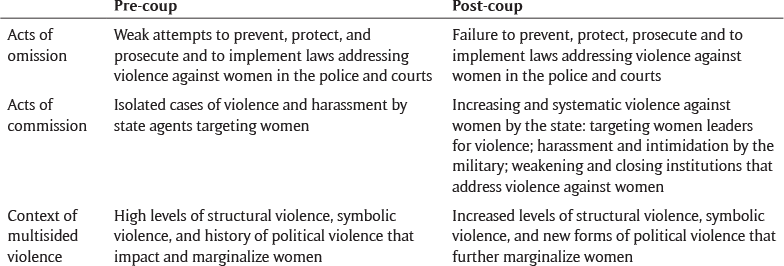
Political responsibility for feminicide operated primarily through omission in the pre-coup era, with some exceptions where the government took direct action to target women. In this section we illustrate the inaction of the police and courts in the pre-coup era, which laid the foundation for a surge in gender-based violence against women, including feminicides, and a post-coup escalation of failures in policing. We then focus on direct acts of post-coup violence initiated or facilitated by the police and courts that have embroiled Honduras in a feminicide crisis today. (See Table 2 for differences between pre-coup and post-coup acts of omission and commission.) We separate the time periods for analytical purposes, but in reality both stem from the same context that normalizes gender inequalities and shapes the cognitive frames of state actors in charge of writing, passing, and implementing laws.
Honduras: Political responsibility for exacerbating violence against women and impunity.
Police Inaction and Multisided Violence: Pre-coup and Post-coup
Inaction by the police was prevalent during the pre-coup era but worsened in the post-coup period. The symbolic violence of the state is embedded in these practices, in the police’s treatment of domestic abuse as part of “the order of things.” Often, officers attribute culpability for abuse to victims instead of abusers, blaming women for failing to avoid maltreatment through altering their behavior and becoming obedient and submissive. This police response further entrenches gender inequality, which is first enforced through abuse and then reinforced (and normalized) by demonstrating that women have no choice but to submit to it. Country expert Claudia Hermannsdorfer (Reference Hermannsdorfer2012) reveals how symbolic and gender violence seep through from the social context to the justice system and shape the cognitive frames through which violence against women is viewed as a normal aspect of relationships. Reporting on police behavior, she notes: “Women who seek help from the police are often told that the issue is a matter for her husband to decide, and that she should go home, be intimate with him, and he will forgive her. Other times, police simply tell the women to stop disobeying their husbands…. Honduran police ignore threats made against women, treating them as nothing more than the product of over-excited emotions” (Reference HermannsdorferHermannsdorfer 2012: 11).
Contributing to normalizing violence and the devaluation of women’s lives, police divert resources toward the investigation of “more serious” crimes such as drug trafficking. At the structural level, this sidelining of women’s interests within the justice system reinforces inequality and sends a message to women (and society) that their lives are unimportant (Reference HermannsdorferHermannsdorfer 2012, 11). Symbolic and gender violence are normalized through the persistent lack of funding for appropriate investigation. Again, Hermannsdorfer observes: “Even if the authorities did want to conduct a sensitive forensic examination in cases of femicide, they lack resources, such as rape kits which are commonly used in other countries, to perform the exam…. Thus, in many cases, it is impossible to make an accurate determination of the extent of sexual violence that is so often associated with the violent deaths of women” (Reference HermannsdorferHermannsdorfer 2012, 27).
Resource diversion existed before the coup but worsened after it. Resource diversion is an anticipated outcome if police lack specialized units that focus on violence against women, because such units help to make serving women an institutional aim rather than a discretionary act resting on an officer’s choice to ignore or dismiss claims (Reference WalshWalsh 2008). Attempts were made to create a Gender Unit within the police that would help institutionalize responsiveness to violence against women before the coup, but this was dismantled after the coup. Among other things, the Gender Unit was relegated to a warehouse far away from the rest of the police force (Reference HermannsdorferHermannsdorfer 2012). Instead of being a reliable state institution for women to turn to for protection, police have reinforced the generalized and entrenched views of gender inequality that make women vulnerable to abuse and undermine their rights.
Victim blaming is a form of omission that elucidates the persistent commingling of symbolic and gender violence that undergirds impunity. It is a practice with a long history that was present in the pre-coup era and persisted after the coup. A poignant example is the police reaction to the assassination of Blanca Guevara’s niece shortly after the coup. Guevara is a labor rights and women’s rights activist with the Network of Women against Violence in Choluteca, Honduras. Her twenty-three-year old niece was murdered in 2010 while working on issues of violence against women. Guevara recounts the police’s treatment of the case, which exemplifies the symbolic violence embedded in state actors’ approach to treating these cases: “When my niece’s father filed the report, the director of the National Bureau of Criminal Investigation (DNIC) started blaming the [niece who was the] victim of the assassination…. There is an interview with the director of the DNIC who said that ‘women walk in places where they should not go’” (Blanca Guevara in Memoria Foro Femicidios 2014, 16–17).
Police reactions and dismissals of the seriousness of violence against women put women at risk for further abuse and even murder. A recent report by the UN High Commissioner for Refugees (UNHCR) quoted women fleeing from violence in Honduras and noted the futility of going to the police, even as police attempted to be helpful:
In the rare cases where police arrested the perpetrators of abuse, the perpetrators were generally released within a few days. “I reported my husband to the police once,” explained a woman from Honduras. “They detained him, but only for 24 hours, and then he was released and was even more angry.” Another Honduran woman, whose mother had been abused by the woman’s father and later her stepfather, sometimes made official complaints on her mother’s behalf. But it was useless, she says. “They put them in jail for 24 hours and then they are out.” (UNHCR 2015, 27)
In these circumstances, women are afraid to report their cases to the police for fear of retaliation from perpetrators. In addition, they now fear police violence against them with the increased militarization of the state since the coup.
Court Inaction and Multisided Violence: Pre-coup and Post-coup
The Honduran court system, pre- and post-coup, has reinforced and perpetuated inequality for women through a persistent lack of institutionalization and specialization of services for women. For example, the Law against Domestic Violence was amended in 2006 to require the creation of specialized domestic violence courts. However, as of 2012, Honduras had not set up this court system, exemplifying the symbolic and gender violence entrenched in the institutional structure of the state.
Feminicide is the most extreme expression of violence against women but has only recently been recognized in the law as an exceptional type of murder through the 2013 Femicide Law, which was passed under international pressure. Before this, Honduran law considered a murder “aggravated” if the victim was a family member or intimate partner, or if the murder was premeditated. This would result in an increased prison term if the law were applied. However, this law was instead applied in favor of men, further exacerbating gender inequalities and the perception that women’s lives are expendable. Victim blaming is not restricted to the police but persists in the courts through the dismissal of women’s murders as “crimes of passion.” These acts of omission exemplify the symbolic violence embedded in cognitive frames throughout justice system personnel who justify the murders of women as a consequence of romance: “Judges tend to consider murders arising from domestic violence as crimes of passion which should not be met with additional penalties, resulting in cases being charged as simple homicide—which carries a lighter sentence—or outright dismissed. Additionally, judges often blame female victims, assuming that the woman may have instigated the murder, and use this as an additional reason not to consider the murder or to dismiss the case” (Reference HermannsdorferHermannsdorfer 2012, 25, emphasis added).
These profound gender inequalities are constitutive of the normalizing cognitive frames that judges and prosecutors deploy in carrying out their work; these frames, which express the symbolic violence of the social milieu, even become an obstacle to initial murder investigations. For example: “When investigators encounter a woman who has obviously been killed by domestic violence, they often reason, ‘well, the prosecutor will not fully prosecute this case because this is a crime of passion, so there is no need to conduct an in-depth forensic examination’” (Reference HermannsdorferHermannsdorfer 2012, 14).
Across both the police and the courts, women have encountered manifold obstacles to accessing justice, which increases their risk of violent victimization. In responding to a survey by the Inter-American Court of Human Rights, the Honduran state noted problems throughout its justice system pathway, reporting various practices that discourage victims from following through on a complaint before the justice system, including:
-
(a) the fact that the woman is revictimized in being compelled to recount the crime she has experienced on several occasions to different people involved in the investigation;
-
(b) the victim is threatened on an ongoing basis by the suspect, relatives or legal representatives to withdraw the complaint and stop the proceedings, and there is no mechanism in place to guarantee the personal safety of the victim or her next of kin;
-
(c) the criminal proceeding takes a long time until it reaches the oral public trial stage;
-
(d) having to travel, in some instances, on her own to different places to receive service … and
-
(e) a lack of confidence in the justice system. (IACHR 2011, para. 369)
Acts of omission on the part of the police and in the courts began before the coup, with the state failing to adequately implement laws. It takes time to set up institutions and train police and judges, but such persistent failures to progress cannot be accounted for by a “learning curve.” In fact, omission appears to have worsened since the coup, and disturbing new patterns of commission have emerged, with state actors targeting women for violence.
Post-Coup Political Responsibility for Feminicide: Increased Acts of Omission and Commission
In the post-coup era, political responsibility for feminicide through omission has intensified, and the government began to more systematically target women and more openly and directly commit acts of violence against them. In addition, increased government inaction to respond to violence against women deteriorated an already acute situation. Together, action and inaction in the context of heightened levels of various forms of violence (e.g., structural, political, everyday, gender) have created a “perfect storm” of structural conditions that sustains government responsibility for creating an environment that not only tolerates routine violence in the lives of women but condones it through its own example. These factors, taken together, help explain the upward spiral in violence against women in the post-coup era.
Violence against women intensified in post-coup Honduras in the context of deteriorating rule of law, escalating repression, and amplified gender-based, state-led violence that has targeted women (Reference KellyKelly 2011; Reference MoralesMorales 2011; Nobel Women’s Initiative 2012). At the same time, generalized violence has increased and there is evidence of linkages between the state and armed drug cartels (IACHR 2013, 29). According to the Women’s Tribune against Feminicides, state responsiveness to violence against women has weakened, in part because “not only did the administrators of justice fail to respond to human rights violations reported by women, the police themselves actually became the agents of repression and violators of women’s rights” (Reference MoralesMorales 2011). Ten percent of the women interviewed for the UNHCR study (2015) reported that the police or other authorities were directly implicated in harming them. And in the month following the coup, Oxfam Honduras reported that there was “a 60% rise in the number of feminicides, with the bodies of more than 50 women found in the two largest cities, Tegucigalpa and San Pedro Sula. The Oxfam report accuses the Lobo government, voted in three months after the coup, of inaction and complicity in the growing wave of murders” (quoted in Reference KellyKelly 2011). It was also post-coup when the UN reported that Honduras had the highest per capita homicide rate in the world as of 2012 (Nobel Women’s Initiative 2012, 10).
In addition to feminicides, “numerous cases of sexual violence have been documented during forced evictions, which are rarely reported for fear of retaliation and due to the rampant impunity in situations of violence against women throughout the country” (Reference JonesJones 2012, 1). This statement is congruent with the women’s own voices in the UNHCR (2015) report. Rochelle Jones, of the Association for Women’s Rights in Development (AWID), also notes that the violence is more serious post-coup against women human rights defenders, who also face public accusations that they are going against traditional roles assigned to women, and they are “threatened with death and sexual violence and are criminalized” (Reference JonesJones 2012, 1). Alicia Reyes, a journalist with Radio Progreso in Honduras, emphasizes how the post-coup military posed a direct threat to women who were considering collective action against the new regime: “From the first day the police and army sent the women a clear warning: ‘You’ll see what happens to you if you go to the streets’” (Reference ReyesReyes 2009, 2).
One form of state omission has been gender-inimical budgeting, which is rooted in the symbolic violence in women’s lives, and has been amplified in the post-coup era. The post-coup government has spent a much higher proportion of the national budget on the military and has failed to allocate funding to the justice sector and women’s institutions. This symbolic violence serves to normalize a militarized “order of things” and sends a message to women that there are other more important issues to address. Honduras is not only failing to invest in public security for women but has weakened and even reversed the institutionalization of security for women.Footnote 10 In 2012, 11.9 percent of the budget was allocated to Defense and Public Security, while only 0.1 percent went to the National Institute of Women and 1.1 percent to the Public Prosecutor’s Office (Memoria Foro Femicidios 2014, 57). Greater militarization and armaments signal an absence of a gender perspective regarding the problem of public security and swells the number of armed men on the streets. Increasing armaments is a direct threat to women, as firearms have been the principal instrument for their killings, constituting 334 murders in 2013 (75 percent of the total).Footnote 11
Another form of post-coup omission has been the government’s systematic concealment of statistical information. The Observatory of Violence at the National Autonomous University of Honduras has denounced the government for concealing statistics and information about the homicide rate.Footnote 12 Between January and June 2013, the Observatory counted 3,547 cases of homicide, but the Secretary of Security only reported 2,629, a difference of 918.Footnote 13
During the Cold War, Honduras implemented a National Security Doctrine marked by political intolerance, which left at least 179 people disappeared from 1980 to 1993.Footnote 14 Forced disappearances were linked to illegal detentions and torture on the part of the police and military. In the post-coup era, these actions appear to be more systematic. From 2008 until 2015, there has been a 281 percent increase in reports of women disappearing, and 697 reports of disappearances were made to the public prosecutor’s office between January and September 2014.Footnote 15 Political violence in Honduras normalizes its gendered forms and fosters impunity, as state agents commit and fail to mitigate the violence.
Since the coup, the military has been increasingly incorporated into the police, and they have used sexual violence as a form of repression (Reference Menjívar, Santamaría and CareyMenjívar 2017). Thus, the government does not merely turn the other way in the face of gender violence through inaction but becomes an active participant in harming women. Women’s rights advocates have criticized the post-coup government’s hostility toward women, which includes using rape as a weapon. The popular feminist slogan in Honduras following the 2009 coup was “Ni golpes de estado, ni golpes a las mujeres” (No coups, and no abuse of women), highlighting the close links between political violence and violence against women (Reference PinePine 2013, 5–6). But the post-coup militarization behind the escalation of police violence in general also involves collaboration of state actors with members of criminal groups in violent acts against women in particular (see UNHCR 2015). This is how symbolic, political, and enduring state terror as well as gender and gendered violence commingle in the lives of Honduran women today.
In response to the repression against women in the post-coup era, women have created legal statutes for the new opposition party, the National Resistance Front, and have been playing a stronger role in the post-coup resistance movement (Reference GellGell 2012, 1). Indeed, it is the investigations by women in the resistance movement that have brought to light grotesque uses of force against women by an increasingly militarized state: “Their investigations documented hundreds of women’s testimonies relating to numerous forms of post-coup related sexual assaults that included groping and beatings of breasts and vaginas, threats of sexual violence, intimidation tactics with explicit sexist insults, as well as gang rapes by soldiers and police during post-protest detentions, curfew sweeps and night raids” (Reference Gervais and EstevezGervais and Estevez 2011, 10).
Militarized acts of violence against the resistance have involved sexualized and chauvinistic forms of violence against women. During demonstrations, security forces have verbally abused women participants, insulting them as “whores” and saying, “What they want is for us to rape them,” and “Go take care of your children.”Footnote 16 Some security agents have been reported to have raped women with their police batons and raped women after they were detained for participating in protests.Footnote 17
Meanwhile, the murders of most women have remained unpunished. Some are reported to have been committed by government actors. For example, Margarita Murillo was a member of the National Popular Resistance Front and one of the founders of the National Center of Farmworkers (CNTC). The National Forum of Women for Life reports that she was kidnapped, tortured, and murdered by a death squad.Footnote 18 She was shot in the back on August 27, 2014, and her case remains in impunity.Footnote 19 And murder investigations seldom produce results. In March 2016, the indigenous activist leader Berta Cáceres was murdered in what the police alleged was a robbery. In October 2016 her case files were stolen from a Supreme Court justice, almost ensuring that the investigation will be dropped. And in July 2016, the body of Lesbia Janeth Urquía, a member of Cáceres’s organization, was found brutally assaulted in a garbage dump west of Tegucigalpa. According to police, the motive for the murder was a robbery—of her bicycle. Such declarations (disseminated in the press) trivialize the lives, work, and deaths of these activist women, sending a powerful message to all women that normalizes their socially expected roles and diminishes their contributions to public life and to social justice.
The coup in Honduras exacerbated a context of multisided violence in part by increasing political violence and state terror in ways that amplified gendered and gender violence. Through acts of commission and omission, the state has been responsible for intensifying a multilayered context of violence resulting in increased violence and abuses, and where killings remain suspended in impunity. The coup took what was already a dangerous place for women and escalated the danger further, creating a context where women credibly fear violence not only in their homes and in the streets but also from the very institutions and state agents charged with protecting them.
Conclusion
Multisided violence encompasses structural, symbolic, political, gender, and gendered forms. We have argued that a context of multisided violence creates conditions for states to fail in their responses to violence against women through normalizing and institutionalizing profound gender inequalities. The symbolic violence of the state serves as a catalyst for acts of omission and commission by shaping the views and actions of state actors in charge of implementing laws.
While acts of omission were prevalent in the pre-coup era, the commission of violent acts has become widespread in the more extreme context of multisided violence after the coup. State actions in post-coup Honduras help explain the upward spiral of violence that citizens in general are suffering, which are manifested in gendered ways. We have called attention to inequalities that are connected to but move beyond income and poverty, as these are manifested in the unequal citizenship rights of women. In doing so, we underscore the central place of the state in perpetuating gender violence.
Along with other countries in northern Central America, Honduras is falling behind its regional neighbors in Latin America in terms of human development, with high levels of extreme poverty, income inequality, and poor access to services (Reference RonderosRonderos 2011; UNDP 2010), as well as increased “common crime,” corruption, and insecurity. Structural violence places women, especially poor and vulnerable women, at higher risk of institutional mistreatment (in the form of symbolic violence) and of everyday and routinized abuse (in the form of gender violence and gendered violence). As has been the case in post-coup Honduras, this situation deteriorates further with state repression and increased militarization, which undermine the rule of law.
While other countries, such as El Salvador and Guatemala, exhibit extreme levels of multisided violence, they have made relatively more progress than Honduras toward creating specialized services (e.g., Ciudad Mujer in El Salvador, and specialized femicide courts in Guatemala). In Honduras, the coup stunted the development of institutions that aim to address violence against women. Furthermore, post-coup militarization has increased impunity through decreased transparency (as evident in the failure to report statistics on violence against women) and accountability (by failing to hold military personnel and even civilians accountable for violence against women). By contrast, Nicaragua and Costa Rica have relatively lower overall levels of multisided violence and lower levels of feminicide and impunity. Thus, comparatively, the more extreme context of multisided violence in Honduras has resulted in high levels of feminicide and impunity.
Honduran women, as well as those in similar contexts in the region, live in a social milieu where physical and psychological mistreatment become part of the way things are; where women’s “private terrors” (Reference MenjívarMenjívar 2011) are part of life in the home, in the street, and in the workplace. Institutions reinforce and reflect this violent context through neglect and a lack of implementation of the laws. We argue that these are all deeply connected, because those who abuse women, as well as those who write or implement laws, draw on the cognitive frames and lenses through which they view the place of women in society and justify unequal treatment of women from the same social order of things.
Our focus on pre- and post-coup feminicide levels reveals intersections among political, social, and economic exclusion as well as gendered inequality, exacerbating conditions of violence and impunity and culminating in a feminicide crisis in Honduras today. It is the deep-seated symbolic violence in this system that sends a message to women who seek justice in unequal institutions that their lives are not valued and that their complaints are not taken seriously, a message that serves to normalize abuse and gender inequalities but also to silence women. A 2012 study found that less than one-third (29.3 percent) of women told family or friends that they had experienced intimate partner violence in the past year, a low number even compared to El Salvador, where almost two-thirds (66.5 percent) indicated they would share this with family or friends (Reference Bott, Guedes, Goodwin and MendozaBott et al. 2012, 58).
We have demonstrated that passing laws to protect women will not accomplish their goals when this is done without the broader societal changes that could improve conditions for everyone. The content of the laws themselves, the failure to implement them, and the messages that an institutionalized inattention send to women are rooted in a deeply unequal society that devalues women’s lives and those of vulnerable people in general. This is made worse when state actions, far from improving conditions, exacerbate existing trends of gender inequalities that disadvantage women seeking justice. We have moved beyond assessing the impact of economic indicators on women’s inequality to examining inequalities in the form of citizenship rights as women seek justice for the violence they routinely endure. Examining structural inequality is crucial for understanding broader patterns of inequality in Latin America, as it not only impacts poverty levels and access to material resources but also shapes unequal access to safety and justice.
Acknowledgements
We thank Karen Mejía and Daniel Alvord for their research assistance and the editors and reviewers for excellent comments. All errors remain ours. Both authors contributed equally to this article.



 Open access

