


Introduction
This article is motivated by the perception that we currently experience an eco-social crisis where conflicts over establishing an eco-social policy and the question how—if at all—to shape a social-ecological transformation are intensifying and might become dangerous and violent in the future. While limiting global warming to 1.5° requires rapid, far-reaching transitions, unprecedented in terms of scale, to change production and consumption patterns, infrastructures and institutions (Masson-Delmotte et al. Reference Masson-Delmotte, Zhai, Pörtner, Roberts, Skea, Shukla and Waterfield2018), the responsibilities for taking action are highly unequally distributed: In 2019, the wealthiest 10% of the world’s population emitted nearly half of the global emissions (Chancel Reference Chancel2022). In 1990, the between-country differences made up 62% of global emissions inequality. Their share decreased constantly and fell to 36% in 2019 when within-country differences accounted for the biggest part of global emission inequalities (ibid.). This finding of national inequalities becoming larger relative to global inequalities, increases the need for analyzing social and political conflicts that loom also in European countries.
Previous research on conflicts over eco-social policy and a social-ecological transformation mainly studied single issues, such as, the yellow vests movement in France (Bourdin and Torre Reference Bourdin and Torre2022; Martin and Islar Reference Martin and Islar2021), public attitudes to eco-social policies (Khan et al. Reference Khan, Emilsson, Fritz, Koch, Hildingsson and Johansson2022; Leiserowitz et al. Reference Leiserowitz, Kates and Parris2006), the role of right-wing populism and authoritarianism (Blühdorn Reference Blühdorn2022; Sommer et al. Reference Sommer, Schad, Möstl, Humpert and Kadelke2021) and many more. There are also studies which view the social-ecological transformation conflict as a broader societal conflict that involves and reflects class inequalities and cultural-ideological differences (Dörre et al. Reference Dörre, Holzschuh, Köster and Sittel2022; Neckel Reference Neckel2020). We understand the social-ecological transformation conflict as a multi-dimensional societal struggle about whether, how and how far-reaching social change should take place to solve the eco-social crisis.
The aim of this article is to provide a sophisticated analysis of this conflict as a multi-dimensional phenomenon in which the interplay between socio-structural and cultural-ideological factors is accounted for. We want to contribute to closing gaps in eco-social research: much of it occurs in different silos with little cross-fertilization (see Cotta 2023). In this article, we combine relational sociological theory and the concept of mentalities with insights from political science studies of transformation and develop an analytical framework which is then used in an empirical study with original survey data.
In Sect. 2, we briefly discuss previous research on the social-ecological transformation conflict and argue that there are political struggles along four dimensions or four lines of conflict in the social-ecological transformation: a class struggle, an ideological divide, a conflict about externalizing the consequences of unsustainable ways of living, and a conflict over the distribution of transformation costs. We link them to Bourdieusian relational sociology and show how the four lines of conflict can be located between classes in the social space. As a novelty, we apply the concept of mentalities to get a nuanced picture of the cultural-ideological factors which elsewhere are a bit narrowly conceptualized as attitudes and opinions. Subsequently, we introduce our survey data from Germany and outline the methodology of our empirical analyses (Sect. 3). In the next section, we present the results of the analyses in four steps: first, we identify the fundamental dispositions people hold toward the social-ecological transformation. Second, we picture eight mentalities as typical patterns of these dispositions. Third, using measures of economic and cultural capital we construct the Bourdieusian social space. In the fourth step, we show the positions of the mentalities in social space and discuss the homologies and heterologies between classes and mentalities. Finally, we draw conclusions of our findings for promoting an integrated eco-social policy in Germany.
Theoretical background and previous research
Demands for integrated eco-social policies can be interpreted as a reaction to and solution for a ‘double’ or even ‘triple injustice’ that arises with climate change and other ecological problems (Gough Reference Gough2017; Walker Reference Walker2012): the rich cause more emissions than the poor, they are affected less by ecological consequences and they can better afford the costs of mitigation and adaptation policies (Büchs et al. Reference Büchs, Bardsley and Duwe2011; Wiedmann et al. Reference Wiedmann, Lenzen, Keyßer and Steinberger2020). Because of this, it can be expected that social problems such as energy poverty (Csiba Reference Csiba2017) and conflicts like in the case of the yellow vest movement (Martin and Islar Reference Martin and Islar2021), are likely to intensify in the future if countries fail to establish an integrated eco-social policy.
Empirical research on the question of who supports and who rejects eco-social policy has revealed a strong linkage to political ideology: Voters of green and left parties and persons who report to be politically rather left-oriented are more in support of eco-social policy, right-oriented persons are more likely to reject it (Fritz and Koch Reference Fritz and Koch2019; Khan et al. Reference Khan, Emilsson, Fritz, Koch, Hildingsson and Johansson2022; Otto and Gugushvili Reference Otto and Gugushvili2020). Other factors found in these studies that point to divisions and potential lines of conflict regarding eco-social policy are education, gender and work: women and persons with higher educational degrees, as well as persons holding jobs with an interpersonal work logic, tend to be more in favor of eco-social policy. Men, the lower educated and persons holding a job with a technical work logic are rather skeptical.
These results indicate that an eco-social policy agenda will not emerge without political struggles and eco-social policies will not be implemented without conflict. Research on social-ecological transformation conflicts in plural is, on the one hand, often concerned with specific topics such as the energy transition (Reusswig et al. Reference Reusswig, Komendantova, Battaglini and Scholten2018), various social-ecological movements (e.g. Asara et al. Reference Asara, Otero, Demaria and Corbera2015; Motta Reference Motta2021), and industries like mining and automotive production (Dörre et al. Reference Dörre, Holzschuh, Köster and Sittel2022) or the bioeconomy (Eversberg and Fritz Reference Eversberg and Fritz2022).
On the other hand, scholars discuss the social-ecological transformation conflict in singular. Here, the overall political and social constellations concerning whether and how a social-ecological transformation should take place are put center-stage with interpreting the divergent answers to these questions either along political-cultural divisions or as a conflict of interests between social classes (Dörre et al. Reference Dörre, Rosa, Becker, Bose and Seyd2019; Neckel Reference Neckel2020). A theoretical framework which considers the interplay between class and culture is Bourdieu’s relational sociology, including his concept of social space (Bourdieu Reference Bourdieu1984; Vandenberghe Reference Vandenberghe1999). We use it as a unified framework to examine the links between lines of conflict, social classes and mentalities. Charting the homologies and heterologies between these elements reveals a detailed ‘cartography’ (Atkinson and Schmitz Reference Atkinson and Schmitz2022) of the dimensions of the social-ecological transformation conflict and the political configurations of eco-social views among the German population.
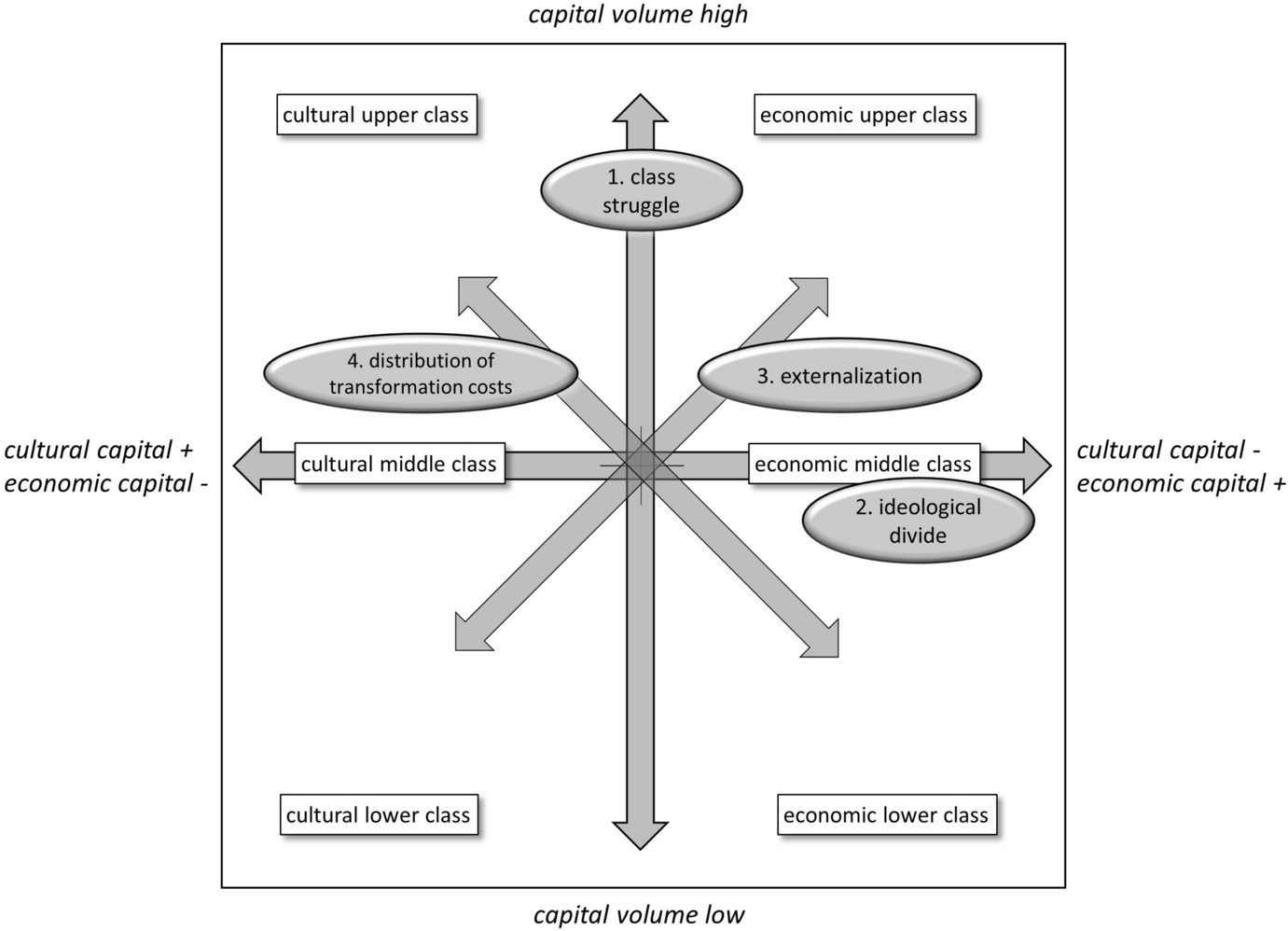
The social space is relational as the positions of persons and social classes are not absolute but defined by their distance or closeness to other positions (Bourdieu Reference Bourdieu1989). In this perspective, a person is rich, not if she owns a certain amount of money such as one million Euro, but if she owns more than most other persons within a given social space. For determining the relations in social space, more than just financial aspects are important. Also, occupation, education, material possessions such as a house, a car or a piano and the number of books in the household are used to estimate the degree and composition of economic and cultural capital. These two kinds of capital constitute the axes of the social space that can be empirically constructed and used to identify social classes (Fig. 1): the vertical axis represents the total amount of economic and cultural capital combined (capital volume). The horizontal axis reflects capital composition with a preponderance of cultural over economic capital on the left side vice versa a predomination of economic over cultural capital on the right side. This leads to a fine-grained distinction between the upper or dominating classes at the top of the social space, the middle classes and the lower or dominated classes at the bottom; and with cultural on the left and economic fractions on the right side for each of these three classes (see also Flemmen and Haakestad Reference Flemmen and Haakestad2018; Flemmen et al. Reference Flemmen, Jarness and Rosenlund2022).
Four lines of the social-ecological transformation conflict in social space

Combing previous research on the social-ecological transformation conflict and Bourdieusian relational sociology, we identify four lines of conflict located within the two axes of social space (Fig. 1):
-
1. Along the vertical axis the class struggle within the social-ecological transformation takes place: privileged middle- and upper-class fractions pursue a strategy of transformation that ensures, through coercion and hegemonic influence, they remain in power and preserve the existing structures of capitalist, growth-driven accumulation. In the shape of either eco-modernist, techno-solutionist versions of transformation or moralist claims for a lifestyle of sustainability (Neckel Reference Neckel2020), the dominating class fractions determine the course of social, technological, economic and political change over the less powerful. On the other side, at the bottom of the vertical axis, the dominated lower-class fractions perceive these demands as bureaucratic, elite programs that only increase their costs of living. Their precarious situation makes it hard to advocate their own ideas of a more socially equitable transformation.
-
2. On the horizontal axis, the ideological divide marks the second line of conflict in the social-ecological transformation. In the literature, this is described in terms of a political divide between egalitarian, social liberal, left and green voting persons as pro-transformative forces that are opposed by authoritarian, illiberal and right-wing forces that are reluctant to change fossil structures and lifestyles (for example Blühdorn Reference Blühdorn2022; Malm and The Zetkin Collective Reference Malm2021; Sommer et al. Reference Sommer, Schad, Möstl, Humpert and Kadelke2021). In the Bourdieusian social space, the first appear on the left side as the cultural class fractions that are generally in agreement with the necessity of a social-ecological transformation and an accordingly eco-social policy agenda. In opposition are the economic class fractions on the right side who possess relatively more economic than cultural capital. While only parts of them are actually right-wing and actively anti-transformative, most are conservative and skeptical of versions of the eco-social transformation that include too much redistribution or a critique of economic growth. If they do not reject eco-social policy at all, they prefer ecological modernization.
-
3. Another line of the social-ecological transformation conflict unfolds around what Lessenich (Reference Lessenich2019) calls ‘externalization’: the negative social and ecological consequences of the Western lifestyle, or in other words: of the imperial mode of living (Brand and Wissen Reference Brand, Wissen and Spash2017), are transferred onto the people in the Global South and the lower classes in the Global North. Externalization means that welfare, production and consumption in the Global North rest on the asymmetric transfer of materials, energy and human labor from other parts of the world. Within the Global North a ‘new servant class’ is doing low-paid, low-skilled service work for the more well-off (Thompson 2019). Externalization also has a gender dimension as it is mostly the women around the world who internalize social costs by caring for others and doing reproductive work (Biesecker and Hofmeister Reference Biesecker and Hofmeister2010).
In social space, externalization occurs as a diagonal line of conflict where the economic upper and middle classes are opposed to the cultural middle and lower classes. The richer economic classes more frequently and intensely use natural resources and human labor for their own purposes, be it as investments if they are entrepreneurs or as private consumption when they enjoy their high material standard of living. On the other side, the poorer cultural classes often have a lower material standard of living, requiring less appropriation of nature, and often work in occupations in which they internalize, i.e., they provide their human labor to care for others in health and education sectors.
-
4. The fourth line of conflict concerns the distribution of transformation costs and the question of who is going to pay for the necessary changes on the way to a post-fossil society. Many countries already introduced carbon pricing either through taxes or via emissions trading (or both). While there are empirical examples that these policies cause regressive distributional effects (Büchs et al. Reference Büchs, Bardsley and Duwe2011), Baranzini et al. (Reference Baranzini, van den Bergh, Carattini, Howarth, Padilla and Roca2017) argue that carbon pricing also generates public revenues which can and should be used to compensate low-income households. It is, however, a conflicting political issue whether and to what degree redistributive policies can be implemented against the interests of powerful economic actors. This struggle also echoes in the fight against job reductions in the most polluting industries like coal mining, in the resistance against new green tech infrastructure (wind turbines) or the rejection of higher prices for more sustainably produced food. Although from an ecological perspective these are important measures, they burden the poor disproportionally while the rich are better able to bear the costs associated with the social-ecological transformation.
The diagonal line of conflict over the distribution of transformation costs appears between the upper left and lower right area of the social space and is mainly a confrontation of the cultural middle- and upper-class fractions with the economic lower- and middle-class fractions. While the previous are on the one hand in support of a social-ecological transformation that includes a fairer distribution of the costs, they have on the other hand also the economic means to pay more. The latter possess less capital in total, the costs of the transformation would burden them unproportionately. In addition, they are more reluctant to support a far-reaching eco-social policy. The combination of both, leads to a rejection or even resistance against forms and parts of the social-ecological transformation which they perceive as unacceptable, like job losses for coal workers or the omission of subsidies for car drivers.
This location of the four lines of the social-ecological conflict in social space provides the basis for our empirical analyses in which we explore the homologies and heterologies between social structure and mentalities along the four lines of conflict.
A fundamental assumption of the Bourdieusian relational approach is that there are strong interdependencies between three elements of the social: (1) objective social structures like class position or occupation, (2) practices and (3) the incorporated mentalities that develop from the dispositions people acquire in social experiences. In practices, existing structures are reproduced and stabilized or contested. Structures restrict or enable certain practices, and by doing them numerous times these are incorporated and crystallized into specific mentalities which, in turn, shape future practices. This interplay is often described in terms of habitus as a ‘structured structuring structure’ (Bourdieu Reference Bourdieu1984) that functions as an inner principle for the social life of people. The circular process of reproduction and incorporation seems to allow only a little social change, but there is, however, room for innovative, subversive and heterodox practices that can lead to a transformation of mentalities and structures, including a turn toward eco-social policy or degrowth (Koch Reference Koch2020). By taking a middle position between structuralist and individualist theories, habitus theory and relational sociology focus on the interrelations between socio-structural and mentality-related elements and are therefore, very well equipped for studying social conflicts in which both dimensions are closely intertwined (recent empirical applications of this can be found for example in: Atkinson and Schmitz Reference Atkinson and Schmitz2022; Eversberg Reference Eversberg2020; Flemmen et al. Reference Flemmen, Jarness and Rosenlund2022; Fritz et al. Reference Fritz, Koch, Johansson, Emilsson, Hildingsson and Khan2021). In the next section, we describe how we operationalize the social space and the mentalities and how we combine both in a map of eco-social mentalities.
Data and methods
We used data from our own representative population survey “BioMentalities”, conducted in autumn and winter 2021/22 in Germany. Germany is the most populous country in the European Union where the discussion about eco-social policy is rather advanced and proponents and opponents of all kinds of ideas about how to shape a social-ecological transformation can be found (Eversberg Reference Eversberg2020; Fritz and Koch Reference Fritz and Koch2019). Our sample reflects the German population in terms of age, gender, education and region and includes 4000 respondents. Half of them were selected by randomly generated telephone numbers (landline and mobile) and interviewed via telephone. The other 2000 were part of a representative online panel and participated in our survey by self-filling the questionnaire online either on a PC or mobile device.
The questionnaire was developed following a sequential exploratory research strategy (Creswell Reference Creswell2009): findings from field research of qualitative case studies in four European countries, each representing a different social-ecological transformation pathway as well as a historical case study on fossil mentalities, informed the selection of questions and statements and the construction of the questionnaire (Büttner and Schmelzer 2021; Eversberg et al. Reference Eversberg, Koch, Holz, Pungas and Stein2022). The statements cover a variety of eco-social topics, for example, personal values, perceptions of social justice and change, attitudes to growth, science, the market and the state, as well as views on nature. Respondents expressed agreement or disagreement on five-point Likert-scales.
As the first out of four steps in our relational analytical procedure that follows the principles of geometric data analysis (Benzécri Reference Benzécri1992; Blasius et al. Reference Blasius, Lebaron, Le Roux and Schmitz2019; Greenacre and Blasius Reference Greenacre and Blasius2006; Hjellbrekke Reference Hjellbrekke2019; Le Roux and Rouanet Reference Le Roux and Rouanet2004), we applied principal component analysis with varimax rotation (Bro and Smilde Reference Bro and Smilde2014) to detect the underlying general and latent dimensions within respondents’ evaluations of the statements. These dimensions reflect the dispositions within the Bourdieusian relational approach. A person has multiple dispositions—some stronger, some weaker—and for each person they combine into a specific pattern of dispositions, their mentality. We, secondly, used cluster analyses (Jaeger and Banks Reference Jaeger and Banks2022) to scan the dispositions found among the respondents in our sample for these typical patterns or mentalities, respectively. We ran Ward hierarchical-agglomerative and k-means cluster analyses as well as stepwise combinations of them in order to find a stable solution under varying conditions.
In the survey, we also asked respondents a range of questions about their socio-economic situation including income, education (own and that of mother) and occupation (own and that of father) as well as how many cars they use in their household, whether they own or rent a flat or a house, how big it is, whether they possess shares and some other indicators. The goal was to collect detailed information on their cultural and economic capital to empirically construct the social space. For this purpose, we, thirdly, conducted multiple correspondence analysis with 71 categories from 14 questions on the socio-economic situation of the respondents. The fourth and last step of the relational analysis was to plot the mentalities from step two into the social space resulting from step three. In this way, structural elements and mentalities are combined in a map where the correspondences of the socio-structural lines of conflict with conflicts on the level of mentalities can be studied.
Results and discussion
Step 1—identifying dispositions toward the social-ecological transformation
We conducted a principal component analysis with varimax rotation over 32 statements on eco-social topics to extract the most important independent factors, the dispositions examination of Kaiser’s criteria (Kaiser Reference Kaiser1960) and the scree-plot, as well as substantial interpretation of the factors, suggested retaining six factors with eigenvalues exceeding 1 which accounted for 42.5% of the total variance. The six factors reflect six underlying dispositions with regard to the social-ecological transformation. These dispositions are relational: they describe aspects of someone’s attitudes in relation to the mean attitudes expressed by all respondents in the overall sample. Each of the six dispositions establishes a continuum between mutually opposed positions differing from that mean in both directions (high/positive scores vs. low/negative scores). They are characterized as follows:
-
1. Sufficiency versuss growth-orientation high scores on this disposition indicate the view that a social-ecological transformation needs to include limits and that particularly the richer countries should produce and consume less. Low scores reflect support for continuing economic growth and a deregulated economy while accepting their negative ecological consequences.
-
2. Regressive inertia versus optimistic progressivism high scores represent a regressive disposition in which, for example, globalization and immigration are rejected, and science and the media are distrusted. In contrast, negative scores stand for the appreciation of social and technological change.
-
3. Achievement and dominance versus egalitarianism positive scores point to a disposition in which competition and success in work life are important, actively altering nature is approved and efforts that seek to improve ecological conditions are devalued. Negative scores indicate a preference for equality, responsibility and care for nature.
-
4. Conservatism versus nonconformism high scores reflect a conservative-traditional disposition which is similar to the regressive-inert disposition, but the rejection of immigration and concern about social change are weaker here. Also, there is no distrust in technology, science and the media. Instead, persons with such a disposition place high importance on having a car and are annoyed by the discourse about gender-neutral language. Negative scores indicate a less traditional, more individualistic and nonconformist orientation which is open to social change.
-
5. Precarity versus active citizenship positive scores represent a sense of precarity which includes low self-efficacy, a lack of planning for the future and rejecting demands for consuming less and reducing the material living standard to help save the climate. Negative scores stand for the ability and will to actively engage oneself in social and political affairs.
-
6. Self-actualization versus self-limitation high scores signify the disposition to enjoy life and develop personally without restrictions while negative scores represent a trait that places less importance on things like having fun, traveling and having new ideas.
Step 2—mentalities as patterns of dispositions
We used the factor scores of the six dispositions and ran four different cluster analyses with varying parameters to account for variability of cluster solutions and identify stable and recurring types of mentalities (‘syndromes’). We found eight types of mentalities and each has its unique pattern of dispositions:
1. Elitist, growth-oriented mentalities combine high scores for growth-orientation, optimistic progressivism and active citizenship with clear dispositions of achievement and dominance as well as conservatism. 2. Engaged, eco-social mentalities are characterized by above-average degrees of sufficiency and egalitarianism, nonconformism and active citizenship. 3. Progressive-hedonistic mentalities reflect a pattern which is shaped by higher scores for optimistic progressivism, nonconformism and self-actualization. 4. Conservative ecological mentalities imply higher-than-average degrees of sufficiency, conservatism and active citizenship. Some varieties of this type are more regressive-inert, others have a stronger tendency of self-limitation. 5. Affirmative mentalities reflect a response pattern of agreeing with all kinds of statements, known as acquiescence bias. Correcting for this bias reveals higher scores for achievement and domination as well as nonconformism. 6. Anti-ecological mentalities are characterized by very high scores for growth-orientation and nonconformism combined with above-average scores for achievement and domination. Some mentalities of this type are more precarious while others are shaped by self-limitation. 7. Regressive, change-aversive mentalities mainly feature very high scores for regressive inertia and above average scores for growth-orientation and egalitarianism. 8. Finally, the type of alienated, reclusive mentalities marks a pattern of high scores for precarity and self-limitation, in some instances combined with conservatism.
Step 3—constructing social space
Following Bourdieu’s methodology, we used multiple correspondence analysis (MCA) to construct a model of social space containing information about the amount and composition of the cultural and economic capital of respondents. The first two axes of the model account for 68% of the explained variance.
The first axis (43%, vertical in Fig. 2) represents capital volume, i.e., amount of cultural and economic capital combined. The variables with the highest contributions to this axis are:
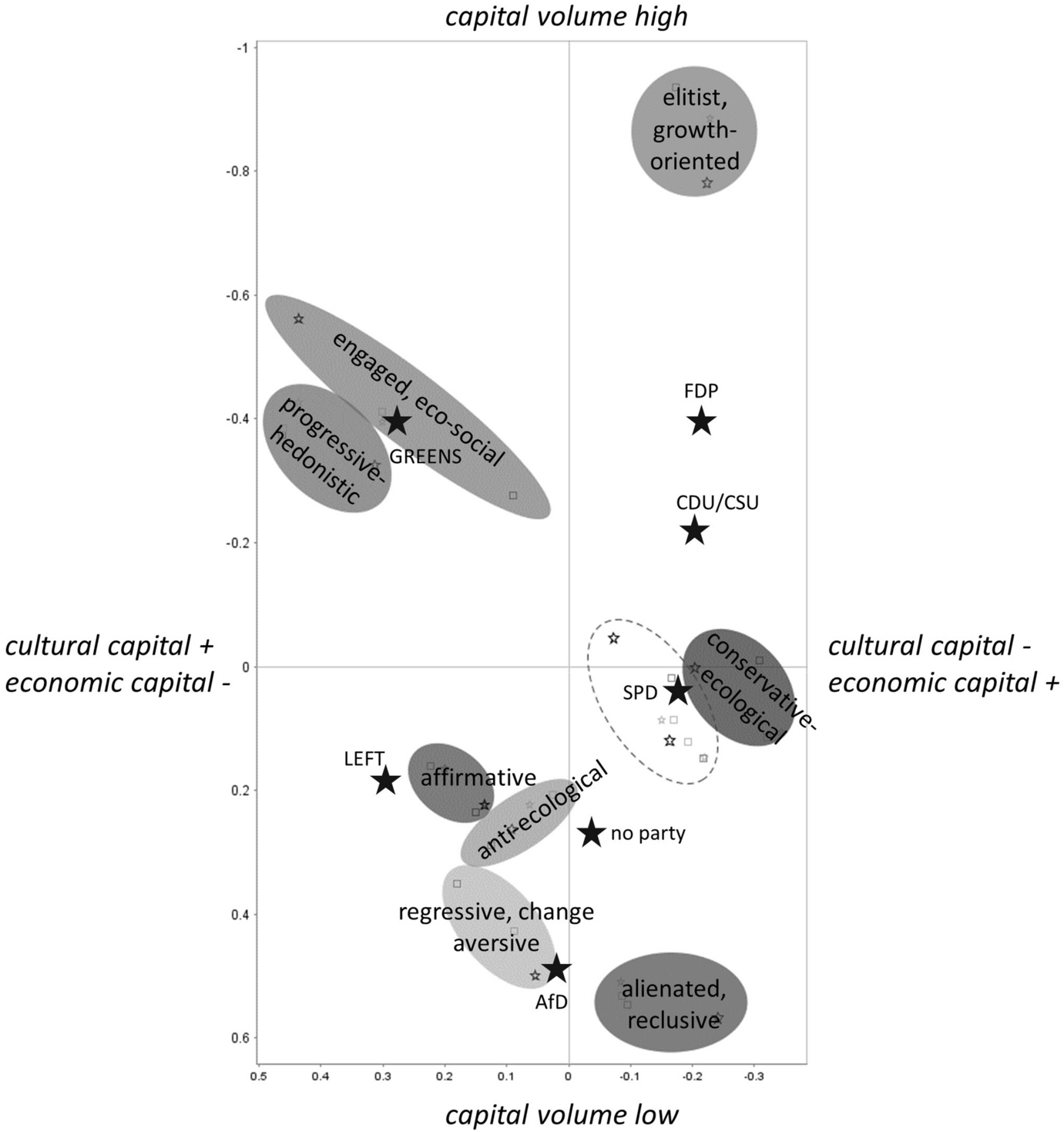
Mentalities in the German social space (additional: party preference) (The cloud encircled with dotted lines contains mentalities that can be described as conformist, politically moderate mentalities. Their profiles are not clear and stable enough to combine them to one coherent type of mentality. Although they are a part of the middle classes in Germany, we do not consider them in this analysis of lines of conflict and focus on mentalities where a clear stance toward the social-ecological-transformation can be identified).
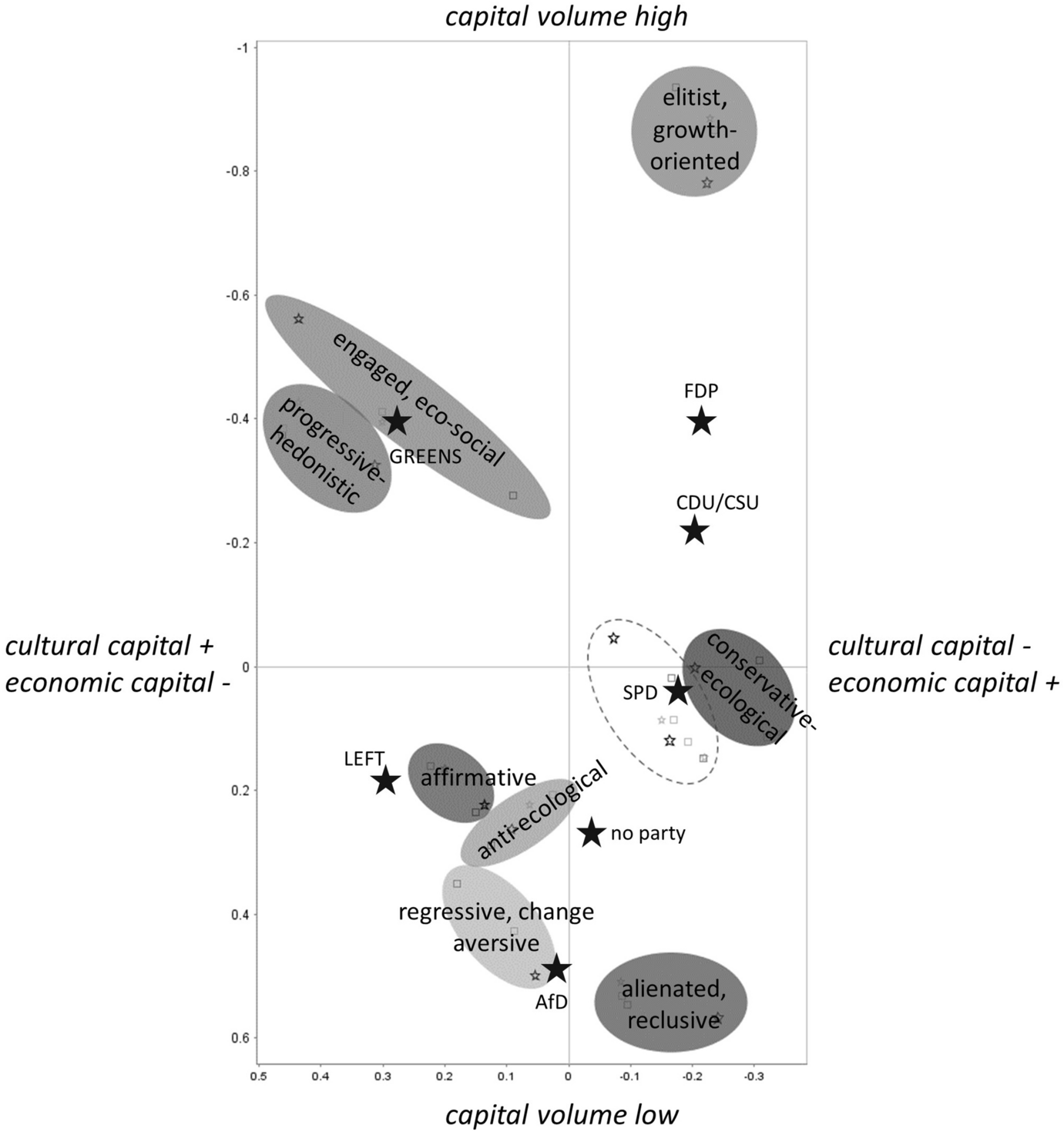
Top of axis = high capital volume Bottom of axis = low capital volume
1) university education lower educational degrees,
2) professional occupations unskilled workers,
3) highest household incomes lowest household incomes.
The second axis (15%, horizontal in Fig. 2) reflects the balance between cultural and economic capital. The highest contributing variables to this axis are:
Left side of axis = cultural + Right side of axis = economic +
1) few cars per capita in household many cars per capita in household,
2) university education of the mother lower educational degree of the mother,
3) smaller homes bigger homes.
In summary, the MCA led to a model of the social space which resembles the schematic presentation in Fig. 1 and Bourdieu’s original social space of the French society (Bourdieu Reference Bourdieu1984): The dominant/upper class fractions with high amounts of both types of capital are located at the top, the dominated/lower class fractions at the bottom. The cultural class fractions with relatively more cultural than economic capital appear on the left and the economic class fraction on the right side. In the last step, we plotted the types of mentalities into the social space to visualize the relation between socio-structural factors and mentalities in the social-ecological transformation conflict.
Step 4—mentalities in social space
Where in social space do we find the different mentalities? In Fig. 2, the eight types (‘syndromes’) are represented by clouds, each of which enclose the four mentality instances found in the four cluster analyses. We plotted their centers of gravity defined by their means on both axes in the space. All mentality types are much more scattered in space than the representation of the centers of gravity suggests. Nevertheless, there are sociologically highly relevant differences in the socio-structural location of the mentalities. We also plotted the positions of the preference for a political party in the social space to show the homology between socio-structural factors and political ideology.
Firstly, it is remarkable that mentalities are more widely distributed along the vertical than the horizontal axis. Apparently, different stances on the social-ecological transformation are more strongly linked to the total amount of capital and less to its composition. Power matters and there is only one type of mentality in the upper social space relatively isolated from all other types: elitist, growth-oriented mentalities. This indicates a strong homology between a powerful social position and a mentality that is not supporting a social-ecological transformation that would include tolerating ecological limits and calls for social justice. Instead, the upper classes prefer continuing with economic growth and keeping up capitalist values. Only visions of green growth and ecological modernization are acceptable for them. Aptly, the position of having a voting preference for the liberal party (FDP) is closest to this type of mentality.
In contrast, there are three varieties of green thought within the middle class: the engaged eco-social mentalities, the progressive hedonistic mentalities and the conservative-ecological mentalities. The first two types of mentalities are very similar in their social liberal and openness to change dispositions and are, according to their middle-upper left position in the social space, the mental manifestations of the cultural middle class. They differ in that the engaged eco-social mentalities are clearly supporting sufficiency and accepting restrictions in one’s own living standard if necessary while the progressive-hedonistic mentalities are more strongly directed toward an open-minded, optimistic progressivism that precludes setting limits to oneself or society to some degree. Persons with this type of mentality are, however, open to technological solutions for ecological problems and reject exploiting and exerting dominance over nature. A voting preference for the party The Greens is closely associated with these two types of mentalities and reflects the two main ideological fractions in the party: the so-called realists following an eco-modernist program and the more radical ecologists oriented at sufficiency. Different from these, the conservative ecological mentalities are widespread among the economic middle class: they feature the highest scores for sufficiency but, unlike the other varieties of green thought, this neither includes appreciating social change nor egalitarian ideas about society and nature. Associated voting preferences in this part of the social space mainly include the Social Democrats (SPD) and, less so, the Christian Democrats (CDU/CSU), the two biggest parties in Germany. The difference between the socially progressive cultural classes and the more social conservative economic classes thus also plays out in the social-ecological transformation and, mainly, is a tension within the middle classes. Moreover, there is also a vertical distance between the cultural class eco-social types of mentalities and the economic class conservative-ecological mentalities. The first possess more capital in total and might resemble what Bourdieu called the dominated dominating class, the cultural elites and intellectuals who are able to shape societal discourse.
The four remaining mentalities stretch from the lower cultural middle class to the economic lower class. Within this area of the social space, rejection of an eco-social policy and social-ecological transformation are widespread, most clearly among persons with two kinds of mentalities: the anti-ecological and the regressive change aversive. Interestingly, these mentalities are, in contrast to the assumption of an ideological divide, not located on the middle or lower right side but rather on the lower middle. While anti-eco-social dispositions are mostly held by politically right oriented persons and parties (see the corresponding preference for the German right-wing party AfD in the map), their socio-structural position here does not resemble this, it is not in homology. A possible explanation is that social change has occurred: already politically right-oriented classes have experienced a social decline and loss of economic capital, shifting their socio-structural position from the middle right side to the lower middle area. Additionally, other class fractions might have declined to a lower position and developed more regressive, precarious dispositions because of this experience. In any case, there is a strong mental and ideological polarization regarding support or rejection of eco-social policy between the cultural middle class and relevant parts of the lower classes. While this gap determines much of the public discourse, it unfolds over a relatively short socio-structural distance. Less attention is usually paid to the above stated gap between the eco-social mentalities of the cultural middle class and the anti-eco-social mentality of the upper class. Finally, at the bottom right of the social space, politically alienated mentalities appear in the position of an old working class who feel left behind by social change and have retreated into the private sphere. Persons with such a mentality do not seem to be inclined toward any side in this ideological divide.
Mentalities and the four lines of conflict
With regard to the four lines of conflict in the social-ecological transformation, the constellations of mentalities in the social space are partly in homology but also differ in important ways:
-
1. Vertical class struggle: on the level of mentalities the vertical class struggle occurs between elitist growth-oriented mentalities at the top and regressive, alienated types at the bottom. The rich and powerful are mainly interested in market-compliant technological versions of transformation while the poor and dominated classes are not only reluctant to accept such eco-modernist approaches but also show no support for a more inclusive and socially fair transformation. Instead, all kinds of transformations are seen as a threat.
-
2. Horizontal ideological divide: here we observe that the mentalities of the middle classes follow the pattern of a left–right divide. The conservative-ecological mentalities on the right side are, however, not against policies to improve the ecological situation. The ideological divide on the level of mentalities is rather about openness to social change and solidarity vs. tradition and exclusion. A reason for this may be that hard right opinions in Germany are less widespread among the economic middle classes and more common within the balanced lower-class fractions.
-
3. Diagonal conflict about externalizing social and ecological consequences: in this line of conflict one opponent seems to be missing on the level of mentalities. While the dispositions held by the elitist, growth-oriented mentalities in the upper right area of the social space clearly correspond with their externalizing and imperial mode of living, there is no mentality in the lower left corresponding to a caring, internalizing way of life. The regressive and anti-ecological types of mentality surely are little concerned with internalization. It is a possibility that the affirmative mentalities belong to people who actually act in a caring manner and do not outsource the costs of their lifestyle, but their pronounced disposition of achievement and dominance speaks against this interpretation. It seems more likely that the cultural lower class remains “a class on paper” in Germany with no distinctive mentality.
-
4. Diagonal conflict about the distribution of transformation costs: there is a large homology between the class fractions and mentalities. The two mentalities of the cultural middle class are in support of the social-ecological transformation and would accept bearing higher costs. On the other side, the mentalities of the economic middle and lower classes, mainly conservative-ecological and alienated, reclusive types, are not willing (and often not able) to pay higher prices or accept job losses that occur in the transformation to a post-fossil economy. However, the same is true for the balanced fractions of the lower classes which are more clearly anti-ecological. So, along this line of conflict there is a broad opposition spreading out in the lower social space mainly against the stand alone cultural middle-class.
Conclusions
In this article, we set out to investigate the multi-dimensional nature of the social-ecological transformation conflict using original empirical data from Germany. We combined socio-structural factors and mentalities in an application of the relational sociological research methodology to draw a nuanced picture along four lines of conflict in the social-ecological transformation.
In summary, the overall picture we found in our analyses seems to suggest that the prospects for a social-ecological transformation in Germany are bleak. The combination of (a) a broad front against bearing the costs that necessarily will occur, (b) a largely transformation reluctant lower class and (c) the lack of a distinctive mentality of the internalizing cultural lower class makes it hard in Germany for a social-ecological transformation to occur and eco-social policy to be implemented. But that is only one side. On the other side, the visualization of conflicts and divides also allows to identify potential alternative forms of politics and bridges that could be mobilized to overcome the current cleavages: (1) the conservative-ecological mentalities are widespread among parts of the economic middle class and feature a strong sufficiency orientation often combined with a willingness to self-limitation. These dispositions resonate with sustainable resource management and are compatible with many varieties of economic thinking. Thus, the conservative-ecological mentalities could act as a bridgehead or entry point for familiarizing economic class fractions with ideas of eco-social policy. (2) The gap between the eco-social mentalities of the cultural middle class and the growth-oriented mentalities of the economic elites can be bridged by focusing on green growth strategies and the promotion of clean technology. This is exactly what the current government coalition, consisting of social democrats, greens and liberals, is doing as they put their program of an ecological modernization of Germany into practice. It focusses, for example, on the expansion of renewable energy and the heat transition.
Both possibilities of bridging political divides are rather techno-economic variants and only address the ‘eco’ in the eco-social. For a successful social-ecological transformation, the issue of inequality must be considered. This can be achieved by (3) reducing the gap between the eco-social mentalities of the cultural middle class and the more rejecting mentalities present among the lower-class fractions. The lower class may be skeptical of a transformation but egalitarian orientations are widespread and demands for social justice and recognition fall on fertile ground. It is therefore likely that eco-social policies that put redistributive aspects in the foreground would resonate at least with the regressive and alienated mentalities that are not per se anti-ecological. So far, the Greens as the political representatives of the eco-social minded cultural middle class have either prioritized ecological over social goals or failed to communicate clearly the social components of their proposals. To bridge the gap with the lower class and gain more support in the future, the Greens or any other party interested in advancing the social-ecological transformation could more boldly draw on measures from the toolbox of eco-social policies which include strong redistributive components. These are, for example, a universal basic income, universal basic services, wealth and inheritance taxes, and working time reductions. By reducing inequality and redirecting accumulated private resources to public provisioning systems, such policies also help to curb ecologically damaging overconsumption and production and meet the demand for far-reaching changes of infrastructures and institutions that are necessary to mitigate and adapt to climate change.
Funding
Open Access funding enabled and organized by Projekt DEAL.


 Open access

