

Introduction
Over the last decades, the number of crises and disasters world-wide has increased dramatically,1 especially with a noticeable rise in major natural disasters like hurricanes, floods, or earthquakes. In addition, there are crises and war zones with more and more affected and displaced persons. Besides hunger and thirst, the affected people suffer mental and physical complaints.2 In response, humanitarian missionsReference Bennett3 have been developed, either in the form of emergency humanitarian aid or long-term projects over many years.
Humanitarian aid often takes place in foreign countries in which responders have to deal with different environmental conditions, cultures, and community norms.Reference Jones4 Moreover, humanitarian responders generally provide their support in heterogeneous situations, including people, climate, and resources. Therefore, humanitarian aid is undoubtedly a challenging mission taken together the logistical, linguistic, and cultural differences.
Physical, mental, and psychological impacts have been frequently reported among humanitarian responders, up to posttraumatic stress disorder (PTSD).Reference Amara and Kuhar5–Reference Strawn and Geracioti7 So far, the pathophysiology of PTSD is not yet fully understood. It is assumed that the noradrenergic, serotonergic, and endogenous-cannabinoid systems, as well as the hypothalamic-pituitary adrenal axis, have a predominant influence. The noradrenergic system, which is activated by stress and influences the development of depression or anxiety disorders, plays a major role in current PTSD research.Reference Amara and Kuhar5,Reference Strawn and Geracioti7–Reference Steckler and Risbrough10
According to the Diagnostic and Statistical Manual of Mental Disorders (DSM-V) definition, a person must have lived through one of the following scenarios: direct experience of a traumatic event; personal experience of a traumatic event; experience that a friend or family member was accidentally or violently threatened with injury or death; or experience repeated or extreme first-hand exposure to adverse details of a traumatic event.Reference Nietzel and Wakefield11 All of these events represent stress and activate the noradrenergic system.Reference Gorzalka, Hill and Hillard8
After the terrorist attacks in Norway (2011) and Berlin (2016), the mentioned observations could have been confirmed.Reference Skogstad, Heir, Hauff and Ekeberg12,Reference Wesemann, Zimmerman and Mahnke13 In the United States, several studies on PTSD related to the attacks on the World Trade Center (New York; 2001) were published (eg, Zvolensky, et alReference Zvolensky, Farris and Kotov14). A connection can be shown between a professional relationship to the event and an increased incidence of PTSD.Reference Zvolensky, Farris and Kotov14,Reference Zvolensky, Kotov and Schechter15 In addition to the terrorist background, major natural disasters also act as triggers for PTSD. A study by Surgenor, et al after a large earthquake in Canterbury (New Zealand; 2010) assessed police officers who were the first responders.Reference Surgenor, Snell and Dorahy16 The study showed an increased susceptibility to PTSD in those who had been affected. Sakuma, et al, who assessed the prevalence of PTSD among students that were involved in Japan after the earthquake and the nuclear disaster (2011), also supported the thesis of an increased risk of developing PTSD after being exposed to a big disaster.Reference Sakuma, Takahashi and Ueda6
It has already been shown that it is necessary to provide mental health aid to disaster relief workers in advance.Reference Fraser and Spicka17 However, it is not clear which type of security incident triggers the greatest emotions and highest stress among humanitarian responders, although this knowledge is essential to prepare the responders more specifically, and for the related incidents during their missions.
To be prepared to successfully fulfill missions abroad, especially in crisis areas, an increasing number of nongovernmental organizations (NGOs) therefore demand that responders participate in special safety and security courses. Those courses are intended to train and prepare participants for possible problems and hazards at their destination. Theoretical contents, as well as practical exercises, are taught.
The aim of this study was hence to rank four characteristic incidents according to their stressfulness, and to make them visible for humanitarian responders and their training organizations in order to prevent PTSD and other long-term consequences through better and more targeted preparation.
Methods
The study was a prospective census study of all participants in four standardized humanitarian training exercises using a validated stress assessment survey.
The stress assessment was performed during the four days of the practical part of the “Safety and Security” course at the Federal Office for Civil Protection and Disaster Assistance of the German Ministry of Interior Affairs (Berlin, Germany). The course is supported by the German Ministry of Defense, the Federal Police, Military Forces, and German Intelligence Agency, as well as other aid organizations. The course is certified according to the Hostile Environment Awareness Training (HEAT) guidelines of Europe’s New Training Initiative for Civilian Crisis Management (ENTRi; Center for International Peace Operations; Berlin, Germany). The participants were members of NGOs preparing for missions abroad. Prerequisite for participation in this course was the age of 18. The participants were trained on how to behave in a mission and deal with possible incidents. To illustrate possible security incidents, different incidents were carried out in a realistic way. Therefore, full-scale simulations were used.
This study includes the courses from July 2017, October 2017, and April 2018. At each day, one incident was evaluated. All participants were challenged with the incidents in the same order. The four evaluated incidents were a border-crossing on the first day, a carjacking on the second day, an evacuation on the third, and finally, a hostage-taking on the fourth day. Before and after each incident, the stress level was assessed with the Positive and Negative Affect Schedule (PANAS) on a paper format.Reference Watson, Clark and Tellegen18 The Research Center in Emergency and Disaster Medicine in Novara, Italy coordinated this work as a master thesis of the European Master in Disaster Medicine.
The PANAS is a valid and reliable self-report questionnaire designed to capture the emotional state of the participants. It can be used directly after an event, the same day, a week later, a year later, or anytime in general to capture the general mood. The test consists of 20 words that express feelings. Ten words express a positive (ie, interested, excited, strong, enthusiastic, proud, alert, inspired, determined, attentive, and active) and the other ten words stand for a negative (ie, distressed, upset, guilty, scared, hostile, irritable, ashamed, nervous, jittery, and afraid) feeling. The 20 terms are in random order. The participants had five rating options for each word to describe how much the word currently applied to his feelings. The five rating options vary from: “1 – very slightly;” “2 – a little;” “3 – moderately;” “4 – quite a bit,” to “5 – extremely.” For the Positive Affection (PA) scale, as well as for the Negative Affection (NA) scale, the mean scores were calculated.
The PA describes people with enthusiasm, high activity, attention, energy, concentration, and joyful commitment. Participants with low values are lethargic and sad. On the other hand, the NA is a measurement of negative tension. Participants with high scores are irritated, nervous, and anxious, while participants with low values can be described as calm and balanced.
The scores for PAs range from 10 to 50. A higher score represents a higher level of PAs. The results for NA can also range from 10 to 50. A higher score represents a higher level of NAs.
In this study, the delta of stress for each incident was conducted as the difference of the PANAS scores before and after each incident. Furthermore, the differences between the four incidents were evaluated using the Wilcoxon signed-rank test. The Wilcoxon signed-rank test is a statistical test for the relative size of the scores of the same or matched subjects under two experimental conditions by comparing the distributions for positive and negative differences of the ranks of their absolute values. Finally, the differences between participants who already had experiences in trainings and missions (n = 51) and novices (n = 18) were conducted. All statistical analyses have been conducted using the Statistical Package for Social Sciences (SPSS Statistics 24; IBM Corp.; Armonk, New York USA).
As a power analysis showed, with a sample size of N = 69, a level of significance of α = 0.05 and a power of 80%, the effect size can be estimated as d = 0.34. Significant differences were calculated with Pearson’s r.
The participation in the survey was anonymous, voluntary, and could be interrupted at any time without giving reasons. The course took place regularly in the described form and has not been carried out or modified for the current study. The study was carried out according to the declaration of Helsinki and after the approval of the local ethics committee of the University of Regensburg – Germany (reference 17-511-101).
Results
The course attracted a total of N = 72 participants, from which N = 69 (95.8%) took part in this voluntary study. The average age was M = 40.24 years (SD = 10.16) and n = 30 (43.5%) participants were male and n = 39 (56.5%) participants were female. Of the 69 participants, 51 (73.9%) had previous experience by preceding trainings or missions. A further description of the participants’ demographics can be seen in Table 1.
Demographics of the Study’s Participants

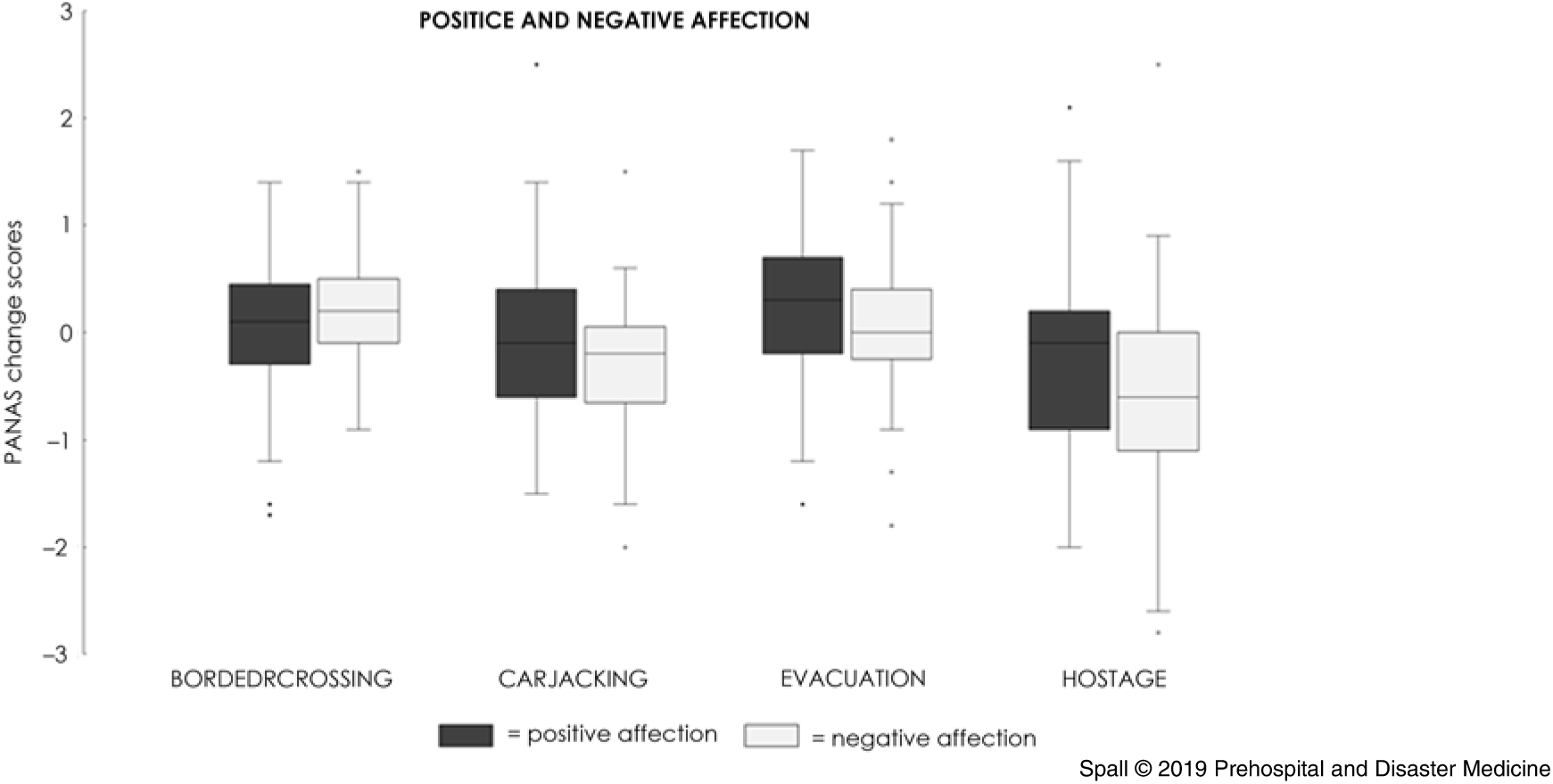
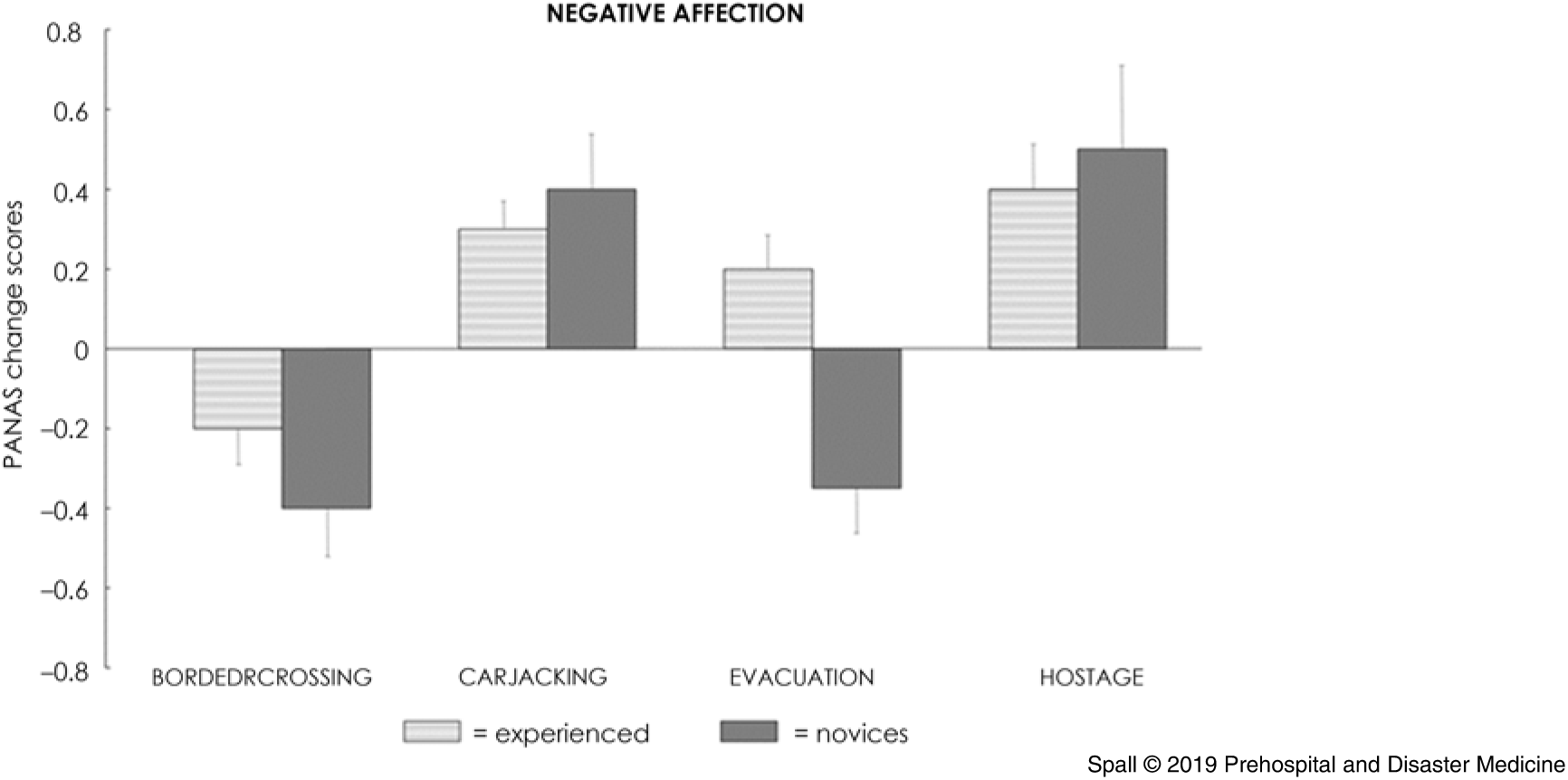
After the first incident, namely the border-crossing into a crisis area, the PA remained identical to the values before starting the incident, while the NA changed significantly (T = 523; z = −2.892; P < .01; r = −.246) and thus became less negative. The second incident, carjacking, showed slightly more PA with a change of 0.1, while the NA increased significantly by 0.3 (T = 1572.5; z = 4.187; P < .001; r = .356). In the third incident, the evacuation, the PA changed significantly by −0.3 (T = 651.5; z = −2.903; P < .01; r = −.247), while the NA remained the same. The fourth incident, the hostage-taking, showed significant changes in both affects, with a difference in the PA by 0.4 (T = 1248.5; z = 2.178; P < .05; r = .185) and in the NA by 0.5 (T = 1683.5; z = 5.306; P < .001; r = .451). Figure 1 provides an overview of the PANAS change scores for each incident. When comparing the NAs between novices and experienced participants, three of four incidents showed analogies. The only noticeable difference was in the evacuation incident. Here the change of affect in the novices was −0.35, while in the experienced group, it was 0.2 (Figure 2).
Change Scores of Participants’ Positive and Negative Affection.
Differences in Experienced and Novice Participants’ Negative Affection.
Discussion
It is not unforeseen that although the history of hostage-taking is very extensive, it is only relatively recently that there has been a systematic effort to comprehend the effects, both long-term and short-term, on rescuers as well as on individuals and their families. This is an important issue for clinical and academic reasons. In the current study, the incident “hostage-taking” has the most negative impact on the participants. However, the exercise takes only seven hours, which is relatively short compared to a possible real situation. Nevertheless, it is shown that the people here are most negatively affected. The possible causes are: lack of experience, the loss of control, and the uncertainty of the outcome.
In general, taking of foreign hostages has become particularly popular for terrorists, especially due to their effective use of extensive media coverage. Furthermore, the video-taped executions of hostages are the most devastating feature of hostage-taking. This might explain the negative vibes of the responders dealing with such situations.Reference Alexander and Klein19
During the boarder-crossing incident, the PAs remained identical while the NAs decreased. Perhaps the participants were relieved that they had overcome the first hurdle of the mission and were allowed to enter the crisis area. In novices, the decrease of the NA was twice that in experienced participants. The reason for this might be that experienced persons have already crossed borders into a crisis area several times in reality, thus, no significant change had been detected. In carjacking, the participants showed a significant increase in NA. The NA may be due to the fact that during a carjacking, a surprising robbery takes place and the vehicle is stolen. In addition, the team is exposed afterwards, cannot continue its further mission, and has to fear further attacks due to decreased protection outside the vehicle. There was no difference between novices and experienced responders.
During the evacuation under fire, the NA remained identical, but the PA decreased significantly. This probably suggests that the participants had no motivation for this incident, but rather were annoyed by it. In this incident, however, there was a clear difference between novices where the NA decreased significantly, and the experienced participants where the NA increased significantly. Participants may associate previous experience with memories of actual evacuations. Face-to-face fire evacuation trainings take the participants to the previous challenged real-disaster situations, which in turn, creates negative psychological impacts.Reference Lee, Fu and Cai20
However, it is clear that the hostage-taking situation had the greatest negative impact on the participants. This incident only takes a few hours, and therefore not nearly as long as a possible hostage situation in reality, but there is an absolute loss of control. One is completely exposed to the hostage takers and cannot tell how the incident is going to end. In addition to the significant increase in the NA, there is also a significant increase in the PA. This may be due to the fact that the participants completed the questionnaire immediately after the end of the hostage-taking. Most probably, they were relieved and simply happy that at that moment the incident was over. In the evacuation incident, there could also be no difference found between novices and experienced responders.
Previous research has shown that other incidents occur more frequently, such as general frightening situations, illnesses, or even dealing with dead bodies,Reference Connorton, Perry, Hemenway and Miller21 although armed attacks and hostage-taking of humanitarian aid workers are also taking place. The possibility of developing symptoms of PTSD exists after all of those incidents. Since humanitarian workers live through different situations during their missions, the combination can also lead to the development of PTSD, so that in the end, it is not always possible to say exactly whether an event or the combination of events was the trigger.
Some NGOs, for example the International Committee of the Red Cross (ICRC; Geneva, Switzerland), have already implemented post-operational care programs, which also place increased emphasis on psychological care in order to identify symptoms of PTSD at an early stage.Reference Aebischer Perone, Althaus and Chappuis22,23
Comparing the results of this study with the study of Connorton, et al, it is shown that stressful situations for responders during an operation are also those which can lead to the development of PTSD.
Even if only a training course as a model for a real mission has been evaluated, it is easy to see that all incidents during a mission abroad have an impact on people working in humanitarian aid and can influence or even change the work on-site. In courses, the responders can prepare themselves for special situations and train how to behave. Through appropriate preparation, the possible harmful influence that incidents may have on the responders can be reduced, and thus delayed consequences can be prevented. In addition, the selection and assessment of responders plays an important role, as already shown by McCall and Salama in 1999.Reference McCall and Salama24
Limitations
Even if the course is often a prerequisite for an assignment abroad, participation is not mandatory. Similarly, participants cannot be forced to participate in the incidents. In addition, participation in the survey is voluntary for all participants. It is possible that the participants did not or not always complete the questionnaire.
Even if the incidents are very realistic, it is only a simulation that takes place in a safe environment, and it can be interrupted or ended at any time. Possible misconduct within the incidents is insignificant, since all exercises are independent of each other.
Conclusion
In a small selection of possible relevant incidents during a mission, it could be shown that the greatest influence on emergency forces is exerted by a hostage-taking situation.
Due to the increasing risk of long-term psychological consequences and PTSD, easily available post-operative care after the mission should be given. It remains to be discussed whether mission preparation can prepare humanitarian workers or first responders more specifically for possible incidents during each individual mission in order to reduce possible long-term consequences. Further studies are needed to evaluate reasons for development of PTSD or other potential problems following humanitarian missions.
Conflicts of interest
No conflict of interests; this publication is the result of a thesis submitted in partial fulfillment of the requirements for the degree of Master of Science in Disaster Medicine (European Master in Disaster Medicine).


 Open access

