




1 Introduction (the concept of race and race-ethnicity relation)
The language of race and racism differs across cultures and states. The concepts of race and racism, and their sociopolitical significance in the USA and Western Europe, differ substantially from how these notions are understood in Southern Europe, particularly the Balkans. In the USA and Northern Europe, the culture-based concept of race is complex and fluid — a notion that indiscriminately encompasses various social groups and identities, including ethnic and religious ones (Banton Reference Banton1977; Iceland Reference Iceland2017). Racism, in this context, serves as an umbrella term denoting derogatory or discriminatory attitudes toward any social group, while ethnicity is subordinated to race, which functions as the dominant framework for organizing social and political life.
By contrast, in the ethnically structured, post-Yugoslav states of the Balkans (Macedonia, Serbia, Kosovo, Bosnia and Herzegovina), the biologically based concept of race has little social or political relevance. These fully ethnicized societies are organized around ethnicity, which serves as both the main source of political power and the key principle of social life and intergroup dynamics. Such differences in the understanding of race and ethnicity between Western and Balkan contexts have also shaped popular conceptions of racist and ethnic humor. While Western perspectives on racist and ethnic humor are well documented, Southern European and Balkan interpretations remain largely unheard and understudied. This article seeks to document these differences by giving voice to non-Western understandings of race, ethnicity, and humor.
The divergence originates in the history of colonization and migration that led to racialization, a socially constructed process that “signifies the extension of racial meanings to a previously racially unclassified relationship, social practice, or group” (Omi and Winant Reference Omi and Winant2015, 13). This process produces racial categories that blur interethnic distinctions, grouping diverse populations into broader racialized identities. In such contexts, ethnicity becomes interchangeable with race.
This interchangeability perspective has informed much scholarly work, including critical humor studies (Weaver Reference Weaver2011; Pérez Reference Pérez2022), which fail to recognize that the histories, political meanings, and social significance of race and ethnicity differ profoundly between Western and Southeastern European contexts. By overlooking these contextual differences, critical humor research has produced a conceptually broad definition of racist humor that non-discriminately lumps together instances of humor targeting non-racial groups, ethnic and religious ones in particular. For example, Weaver and Bradley (Reference Weaver and Bradley2016, 280), drawing on Wieviorka (Reference Wieviorka1995, Reference Wieviorka, Schain, Zolberg and Hossay1997), treat Islamophobia as “anti-Muslim racism,” thereby extending racism to all forms of exclusionary discourse.
Such a blurry conceptualization of racist humor may be a viable approach to studying humor in racialized societies such as the US and the UK, but it falls short when it comes to studying humor in non-racialized societies such as the post-Yugoslav states (Macedonia, Serbia, Kosovo, Bosnia, and Montenegro) that are shaped not by colonization or slavery, but by distinct political histories resulting in societies where ethnicity, rather than race, is the dominant principle of social and political organization, and consequently formative of distinct humor traditions and ideologies (Takovski and Markovikj Reference Takovski and Markovikj2025).
Our aim, therefore, is to demonstrate this distinct language of race, ethnicity, and humor and give voice to perspectives neglected in current scholarship. We seek to disentangle the conceptual blending of race and ethnicity by constructing a clearer distinction between racist and ethnic humor based on popular understandings of these terms. Popular views are a valuable testing ground for theoretical assumptions that allow the integration of emic and etic perspectives, shedding fuller light on the phenomenon. We aim not to criticize Western concepts of race and racist humor based on racialization, but to articulate an alternative interpretation overlooked in the existing literature.
Literature review
Ethnicity
Ethnicity is a collective identity defined by shared origin, descent, and history, as well as distinguishing cultural markers such as language, religion, and traditions (Horowitz Reference Horowitz1985; Fearon and Laitin Reference Fearon and Laitin2000, 20; van den Berghe Reference van den Berghe2001; Fearon Reference Fearon2003). It is “a named human population with myths of common ancestry, shared historical memories, elements of a common culture, a link with a homeland, and a sense of solidarity” (Hutchinson and Smith Reference Hutchinson and Smith1996, 6).
While a subjective belief in shared descent is a necessary condition for ethnicity (Weber Reference Weber, Roth and Wittich1968), it is not sufficient. Ethnic groups are constituted not by cultural differences per se, but by how such differences are socially and politically mobilized. Through interaction with other groups, cultural distinctions become visible and meaningful (Barth Reference Barth1969), drawing on discursively constructed narratives of history, language, and origin (Smith Reference Smith1983, Reference Smith1991; Hall Reference Hall, Hall and du Gay1996). Ethnicity thus emerges relationally and is inseparable from social contact and political context.
Ethnicity, thus defined, aligns with the European understanding of the term — as a synonym for nationhood defined by descent or territory (Malesevic Reference Malesevic2004) — and contrasts with the Anglo-American view, which adopted ‘ethnicity’ mostly as a substitute for minority groups within a larger society of the nation-state, making it interchangeable with the notion of race.
As Malesevic (Reference Malesevic2004, 5) notes, “While the Anglo-American tradition adopted ‘ethnicity’ mostly as a substitute for minority groups within a larger society of the nation-state, the European tradition regularly opted to use ethnicity as a synonym for nationhood defined historically by descent or territory. […] Nevertheless, popular discourses, in both Europe and North America, have ‘racialized’ the concept of ethnicity, that is, ‘race’ was largely preserved (in its quasi-biological sense) and has only now been used interchangeably with ‘ethnicity’.”
While we agree that ethnicity has multiple meanings across political and geographical contexts — and that American and European ideas differ — we argue, contra Malesevic, that not all European societies have racialized the meaning of ethnicity. In particular, the historically rooted conflicts in the Balkans (from the Balkan Wars and post-war territorial disputes to genocides such as Srebrenica, and modern bilateral disputes like Macedonian-Bulgarian or Kosovo-Serbian tensions) are ethnicized, not racialized. Racialization is a construct shaping intergroup dynamics in American and Western European societies that holds little relevance in the Balkans, where ethnicity has been understood as synonymous with nationhood, and the notion of race remains rooted in biological ideas (phenotypical traits such as skin color or anatomy) without significant social, political, or economic meaning.
Race, Racialization, and the Subordination/Conflation of Ethnicity
Unlike the biological notion of race, the cultural concept of race is far more complex, unstable, and contradictory (Omi and Winant Reference Omi and Winant2015), shaped by intertwined histories of colonization and migration that transformed the demographic structures of colonial societies. Race in these contexts lacks descriptive value for understanding social groups in terms of distinctive traits because it lumps together and abolishes inter-group differences. As Iceland (Reference Iceland2017) explains, immigrant groups to the USA from Southern and Eastern Europe in the late-nineteenth and early-twentieth centuries were initially viewed not only as religiously different but also as distinct races.
This indiscriminate categorization is a result of racialization, a process in which “racial meanings are extended and applied to previously racially unclassified relationships, social practices, or groups” (Omi and Winant Reference Omi and Winant2015, 13). The purpose is to maintain power hierarchies in white-dominated societies such as the USA and the UK through the “othering” of unwelcome groups (Mexicans, Latinos, Asians, Arabs, Muslims) perceived as threats to the established social, economic, and political order. Race and racialization are thus political acts of social and political subjugation and discrimination aimed at preserving power structures rather than describing cultural differences. They constitute systems of domination based on socially constructed categories of race (Wellman Reference Wellman2014), in which racial ideologies are deployed to divide people into groups that benefit the interests of the dominant group. As Waters (Reference Waters and Gallagher2022, 410–11) argues, the American racial system’s binary — Black or White — pressures individuals to conform to externally imposed identities, undermining ethnic distinctions and accelerating assimilation.
Although race and ethnicity are often treated as interchangeable, we believe there is a significant difference. Ethnicity is an endogenous system of cultural differentiation grounded in shared history, language, and customs. Race, by contrast, is an externally imposed system of domination. The conflation of the two occurs primarily in racialized societies such as the USA or Western Europe. This problematic linkage between race and ethnicity also informs scholarly and popular discourses on racist and ethnic humor. The following sections (2.3–2.5) provide a theoretical overview of Western humor scholarship and its interpretations of ethnic and racist humor, serving as a background to the different understanding of the same concepts in Balkan societies, evidenced by the data in Section 5.
Ethnic Humor
Ethnic humor ridicules a particular ethnic group on the basis of shared, well-known stereotypes about that group (Apte Reference Apte1985; Raskin Reference Raskin1985; Davies Reference Davies1990). Ethnic humor, in this context, involves pinning down undesirable qualities such as stinginess, backwardness, provinciality, and others to a particular ethnic group in a comic way or to a ludicrous extent (Davies Reference Davies1990, 4), and making “fun of different traits of a group and/or its members thanks to their social, political, cultural, religious, and economic background” (Apte Reference Apte1985, 115). In so doing, “one culture seems superior by comparing or making fun of idiosyncrasies of other cultures, including dialects and traditions” (Gonzales and Wiseman Reference Gonzales and Wiseman2005, 173).
The purpose of ethnic ridicule is to police social, geographical, and moral boundaries of a nation or an ethnic group by making fun of groups considered peripheral, provincial, or culturally ambiguous by the dominant social group that occupies the center of the social hierarchy (Davies Reference Davies1982, Reference Davies1990). Ethnic humor is thus a means of social control that helps regulate society and maintain and reinforce ethnicity-based boundaries and hierarchies by marginalizing the unwelcome other (Boskin and Dorinson Reference Boskin and Dornison1985; Apte Reference Apte1985; Davies Reference Davies1982, Reference Davies1990; Kuipers Reference Kuipers2000; Kuipers and Ent Reference Kuipers2016). Dominant social groups use ethnic humor to assert their superiority over marginalized groups (Billig Reference Billig2005), who in return use humor to challenge and subvert dominant narratives. In this respect, joking and ridicule are self-conscious weapons of ethnic minorities against the more powerful, discriminating majority. Thus understood, ethnic humor is a liberating, subversive means of resistance that playfully challenges prejudice, discrimination, and hegemonic representations (Lowe Reference Lowe1986; Schutz Reference Schutz1989; Leeven Reference Leeven1996; Rappaport Reference Rappaport2005; Saucier et al. Reference Saucier, O’Dea and Strain2016).
The definitions of what ethnic humor is and what it does are not flawless. The undesirable qualities that Davies discusses (for example, stinginess, stupidity), contained in ethnic joke scripts, are universal behavioral traits rather than group-specific; hence, they are neither ethnically defining nor related to the ethnic identity of the humor target. Definitions of this kind and the empirical material they draw upon do not tap into what Barth (Reference Barth1969) termed the “cultural stuff of ethnicity,” or the ethno-symbolic elements of identity such as history, language, culture, and traditions (for a fuller discussion of the ethnic humor–ethnic identity relation, see Takovski Reference Takovski2015, Reference Takovski2018, Reference Takovski2025).
Regardless of these conceptual challenges, these definitions never conflate ethnic and racial groups as equally plausible targets of ethnic humor. Such ambiguity is avoided through the use of ethnonyms to denote different ethnic groups. Jokes about Poles and Bosnians may thrive on the same universal scripts of stupidity, but until recently (the last two decades or so), such examples have never been labelled racist. This is not the case with racist humor, a concept that is conceptually vague and indiscriminate and more often than not made interchangeable with ethnic humor by humor scholarship, and critical humor studies in particular (Weaver Reference Weaver2011, Reference Kuipers2016; Pérez Reference Pérez2017, Reference Pérez2022).
Racist Humor and Ethnic Humor Conflation
The concept of racist humor, especially in Western humor research, draws on the problematic notion of cultural racism to refer to discriminatory and dehumanizing practices against social groups deemed unfit or unwelcome in society (for example, slaves, immigrants). Racism, in this context, is a discriminatory social practice that perpetuates inequality between the ruling majority and minority groups (van Dijk Reference van Dijk2005, 2), whose defining characteristic is the denigration of ethnic minorities (van Dijk Reference van Dijk2008, 103).
Such an understanding of racism and its ambiguous relation to nation and ethnicity informs much of current humor scholarship, where ethnicity and race are used interchangeably, and racist humor has become an umbrella term encompassing ethnic, religious, and other types of humor. Consequently, different forms of disparagement humor (ethnic, religious, sexist) are labelled racist on the basis of their presumed effects — discrimination or exclusion — rather than on the defining traits of the targeted group.
Weaver (Reference Weaver2011, 9) explains that racist humor often portrays the “other” as lacking worth or as someone who should be removed from society — an ideological structure also found in ethnic, religious, gender, and sexist humor. At the same time, he defines racist humor as humor that “draws on dichotomous stereotypes of race and/or seeks to inferiorize an ethnic or racial minority” (Weaver Reference Weaver2010, 537). The label racist therefore refers more to the act of inferiorization and exclusion than to the specific group being targeted. Racist humor, like the concept of race in race scholarship, is defined by its rhetorical, pragmatic, and political effects. From this perspective, any joke that inferiorizes a social group is racist by default.
Following Weaver, Pérez treats ethnic humor as subordinate to and interchangeable with racist humor. For him, “racist humor is humor that makes use of stereotypes, narratives, and imagery to reinforce notions of racial or ethnic inferiority and superiority” (Reference Pérez2017), and as such, it constitutes “a prevalent form of racial and ethnic dehumanization” (Reference Pérez2022). Pérez’s assertions may hold in contexts such as the USA, where relations between whites and non-whites are historically racialized; however, their explanatory value is not universal.
This conceptual blending is also evident in examples drawn from critical humor research. In The Rhetoric of Racist Humor, Weaver (Reference Weaver2011) cites the following joke as racist:
Q: Which sexual position produces the ugliest children?
A: Ask a Muslim …!!
The classification of anti-Muslim or Islamophobic jokes as racist may work under the notion of cultural racism, which covers discrimination against various social groups, including religious ones. Yet such labelling does not apply universally. The problem of the conceptual blending of racist and ethnic humor runs deep throughout the literature. As early as Reference Philips1984, Philips defined racist humor as an act that may insult (or be intended to insult), humiliate, or ridicule members of victimized groups in relation to their ethnic identity. This assumption is present today more than ever. Drawing on Sue and Golash-Boza (Reference Sue and Golash-Boza2013), Brezau (Reference Brezau2022) describes racist humor as shaped around stereotypes and imaginaries that downplay race and ethnicity as main sources of laughter. In a study on the manners in which racist humor is formative of the multicultural identities of Hawaiʻi’s natives, Yamashita (Reference Yamashita2019) explains that the “discussion of ethnic jokes indicates this topic’s significance in shaping their [natives’] racial views” (Yamashita Reference Yamashita2019), because locals use ethnicity interchangeably with race (Okamura Reference Okamura2008).
Another troublesome assumption purported by critical humor scholarship is the view that ethnic humor is a benign form of humor — racism in disguise (Weaver Reference Weaver2011; Pérez Reference Pérez2017). In fact, Weaver (Reference Weaver2010, Reference Weaver2011) prefers the term racist humor as a “global term” that includes “ethnic” and “racial” humor, arguing that the latter terms dilute the impact of racism. Moreover, he contends that discussing race-based humor as “ethnic” or “racial” frames it in more neutral and inclusive terms, thereby minimizing the relationship between humor and racism (Billig Reference Billig2001; Pérez Reference Perez2013, Reference Pérez2017; Weaver Reference Weaver2011).
This view is questionable on several grounds. Race-based humor is discussed as ethnic only within certain scholarly traditions (Pérez Reference Perez2013, Reference Pérez2017; Weaver Reference Weaver2011) and in racialized societies such as the USA and the UK. In societies where political and social hierarchies are structured along ethnic lines and where there is a history of interethnic conflict, ethnic humor is far from benign and far from race-based. Furthermore, criticism of humor as a socially acceptable vehicle of racism overlooks the deeper causes and manifestations of racism — colonialism, migration, nation-state formation, labor market organization, (un)equal access to education, social and health services, and media representation (see Takovski and Markovikj Reference Takovski and Markovikj2025).
Racist humor, therefore, is a misnomer for humor that disparages racialized, ethnic, and non-ethnic groups in certain societies. It is too broad a concept, encompassing various non-racial targets (for example, Muslims, Hebrews, Mexicans), while its empirical application remains limited to only a few contexts. Labelling humor as racist or ethnic is in the eye of the beholder: a joke may be considered racist in one society but ethnic in another.
The distinction between racist and ethnic humor is not impossible to make, especially if we look at societies where race and ethnicity have not been conflated and where racialization did not take place — such as the post-Yugoslav states (Macedonia, Kosovo, Serbia, Montenegro, Bosnia and Herzegovina) — societies structured along ethnic rather than racial lines. It is reasonable to expect that members of such societies will hold different notions of race and ethnicity and, consequently, different views of the nature and relationship between ethnic and racist humor. To document and analyze these different voices and views of ethnic and racist humor, we have conducted a series of online questionnaires with members of several Balkan post-Yugoslav societies and members of Western European societies to identify differences. Factoring in popular views will empirically validate the study’s core assumption (“There is a culturally grounded difference between ethnic and racist humor”) and shed fuller light on the phenomenon.
Methodology
To register culture-dependent variations in the understanding of the concepts of racist and ethnic humor, we designed an online survey in four languages: Macedonian, Albanian, Serbian, and English. The reason for doing so is the initial belief that there are significant humor-relevant attitudes and popular classifications that potentially overlap with the geo-cultural division between the Western Balkans (the first three versions) and north-western Europe, the UK, and the USA, targeted through the English version of the survey. The survey (Annex 1 — link to the English-language version) is divided into three sections:
-
a) Demographic section, which could help geopolitically map the clustering of views and attitudes on the subject of interest;
-
b) Social groups classification section, which required respondents to classify 24 social groups (Macedonians, Moroccans, Arabs, Black, Asians, and so on) into one of three categories (race, ethnicity, nationality) or choose the “I can’t tell” option;
-
c) Joke classification section, which required respondents to classify 20 jokes based on the joke targets into one of five categories (racist, ethnic, racist and ethnic, anti-religious, or “none”), and additionally answer two open-ended questions: “Is there a difference between racist and ethnic jokes?” (Q21) and “Can a joke be racist and ethnic at the same time?” (Q22).
Participants were recruited through several channels and methods. Macedonian participants were mostly recruited through personal Facebook posts containing a link to the Macedonian survey and an invitation shared on one of the researcher’s private profiles targeting Macedonian respondents, as well as through private, individual messages sent to Macedonian Facebook friends. Additionally, the survey link was endorsed by a few friends and acquaintances, reaching audiences outside the researcher’s personal networks. Participants from other post-Yugoslav states were targeted through private Facebook chats with an invitation to complete the Serbian-language survey and share it with close family members and friends. Additionally, a series of collective emails was sent to colleagues (academics and researchers) from several post-Yugoslav higher-education institutions, inviting them to complete and share the survey. Kosovo participants were targeted directly through recruitment from the student body to which one of the researchers had access, and by engaging assistants/helpers from the targeted population to share the Albanian-language survey link within their close circles of relatives, friends, and colleagues. Finally, the English-language survey was distributed through direct emails to friends from different European countries and by sharing the link across various professional and private groups that each researcher was part of, with an additional request to forward the link to their close contacts.
This approach was considered a viable data-collection method given the size of the targeted, non-stratified populations. The broad scope of targeted individuals and groups was chosen as a method likely to yield not only a significant number of respondents but also a diverse range of demographic profiles. Surprisingly, the general response rate appears to be less than satisfactory, but very indicative and useful. The Macedonian version of the survey was exposed to more than 20,000 Facebook users and personal contacts, but was answered by 113 respondents. The Albanian and Serbian versions, although targeted at more than one thousand Facebook users and personal contacts, received 50 and 40 responses, respectively, while the English version, directly targeting approximately 700 individuals, received only 27 responses and generated the greatest number of moralizing comments criticizing the content of the survey on the grounds of being discriminatory and raising issues regarding the ethical aspects of the research and data collection.
Data Results
Section A – Demographics
Macedonian respondents (n = 113): The majority (94) belong to the 31–40 and 41–50 age groups. Most respondents are male (67), and more than half hold a university degree (63), while 40 have an MA or PhD. Ethnically, 105 respondents identified as Macedonian, while a few identified as mixed (5) or as humans (4). Racially, Macedonians predominantly identified as White (99), while 14 offered subversive classificatory labels such as orange, rose, human race, superior race, and even European race (3).
Kosovo respondents (n = 50): Most respondents (38) are aged 18–30. Women make up 60 percent (n = 30) of the sample, and almost all participants are highly educated (26 with an MA or PhD, 23 with a BA degree). Ethnically, most respondents (39) identify as Albanian, while some (9) identify as Kosovan. Racially, 46 identify as White, and four as Albanian.
Ex-Yugoslav respondents (n = 38; Serbia, Montenegro, Bosnia and Herzegovina, Croatia, and Slovenia): Most respondents (29) belong to the 31–40 and 41–50 age groups. Twenty-two are male, and sixteen are female. Thirty-one respondents are highly educated (MA or PhD). Ethnically, most identify as Serb (16), Slovenian (4), Croat (3), Bosnian (2), or Yugoslav (2), with five choosing not to identify. Racially, this group identifies primarily as White (30), with eight reporting no race.
European respondents (n = 38; Romania, Greece, Estonia, the Netherlands, Finland, and so on): The majority are aged 41–50, followed by eight respondents aged 18–30: 23 are female, and 15 are male. The group is highly educated, with 25 holding MA or PhD degrees and 13 holding a BA. Ethnically, respondents identify as Belarusian, Chinese, Dutch (3), Estonian, Italian, Greek (3), Romanian (4), as well as broader categories such as Caucasian, European (2), Slavic (2), mixed (6), White (4), and even Northern Italian. Racially, respondents identify as White (17), White Caucasian (12), Asian (2), White Asian, Romanian, or mixed.
The demographic structure of the four respondent groups reveals several interesting patterns and differences. First, almost all respondents across the four groups are highly educated and mostly belong to the 31–40 and 41–50 age groups, except for the younger Kosovo sample. Gender distribution is generally balanced, with more female respondents in all surveys except the Macedonian one.
In terms of ethnicity, Macedonian and Kosovan respondents show little ambiguity in self-identification, with few reporting mixed ethnicity. The post-Yugoslav group differs in that several members either chose not to identify ethnically or identified as Yugoslav. Interestingly, none of the Macedonian, Kosovan, or post-Yugoslav respondents used a racial label such as White or Caucasian as an ethnonym, which contrasts with the European respondents.
The non-Balkan (European/US) group displays a richer spectrum of ethnic identification, including multiple or hybrid origins. Some respondents reported up to four ethnic affiliations and used broader, non-ethnic terms such as European, Slavic, or White (as a marker of ethnic rather than racial belonging). This indicates both a more multi-ethnic and multicultural group composition and a more complex, sometimes ambiguous, system of ethnic classification and racialization.
Racially, Macedonian, Kosovan, and post-Yugoslav respondents predominantly identify as White, with the term Caucasian used less frequently. Fewer than 5 percent reported no racial belonging or used ethnicity as a racial designation. In contrast, European respondents reported racial belonging in non-standard or mixed ethnic–racial terms, such as Romanian, White Asian, or White European.
Section B – Classifying social groups
This section was intended to register respondents’ intuitive understanding of the concepts of race and ethnicity and to use the results to interpret potential discrepancies (for example, a certain group classified as ethnicity in this section and a joke about the same group classified as racist). For reasons of economy, we shall only briefly outline the results.
Out of 24 social groups, most were classified unambiguously as belonging to one of the categories offered. Two of these — Black and White — were classified as racial groups by a large percentage of respondents across all surveys; the figures varied between 92 and 98 percent.
Many other groups show consistent classification across surveys. Montenegrins, Cubans, Finns, Macedonians, Albanians, Mexicans, Bosnians, Moroccans, Nigerians, Palestinians, Poles, Chinese, and Italians are all classified as nationality by at least 70 percent of respondents in each survey, or as ethnicity by 10–20 percent of respondents, but never as a race. Similarly, groups such as Roma, Catalans, Basques, Arabs, American Indians, and Jews were classified as ethnicities (50–60 percent) much more often than as nationality (10–20 percent).
A few social groups were classified somewhat ambiguously. Asians, although classified mostly as a racial category by 40–50 percent of respondents, were also classified as an ethnicity by 25–35 percent (varying across surveys). Black Welsh were either classified as not belonging to any category (ethnicity, nationality, race) or as either ethnicity or, to a lesser degree, nationality, but not as a race, suggesting that “Welshness” affects classification more than “blackness.” Finally, Muslims were mostly classified as not belonging to the category of ethnicity or nationality, implying awareness of the religious nature of the group.
Classifying Jokes
An initial corpus of a little over 100 jokes was collected from various publicly available web pages and platforms. Out of these, 20 were selected for the surveys (Annex 2). This narrower selection was made based on five criteria: a) the joke targets correspond to some of the social groups offered for classification in Section B, allowing a comparison between the two classifications — social groups and jokes about them; b) the targets are familiar to the respondents, and some of the joke targets are part of the respondents’ joke folklore. For example, the first four jokes target ethnicities that are very familiar to people from the Balkans and the surveyed states (Macedonia, Kosovo, Serbia, Montenegro, and so on); c) the selection includes both racist and ethnic jokes. While some jokes have unambiguous targets, such as Bosnians, Montenegrins, or Finns, clearly indicating ethnic belonging, other jokes were selected for their ambiguous targets, which could yield differing classifications across surveys. These include jokes targeting religious groups like Muslims (joke 11) or social groups that are racialized in some societies, such as Palestinians (joke 9), Arabs (joke 12), Hebrews (jokes 13 and 14), and Mexicans (jokes 19 and 20). Most of these jokes (9, 12, 13, 14, 19, 20) were taken from English-speaking web pages where they had already been framed as “racist,” so offering them to presumably non-racialized audiences was expected to produce different results; d) some jokes are deliberately ambiguous — combining two targets or introducing two scripts — such as joke 8, which features both Jesus and Poles and combines the scripts of stupidity and promiscuity, or joke 17, which combines two targets (Black and Jewish) but a single script (inferiority). These were included to measure the “force” of the classifying target/script and to determine which of the two drives the classification; e) the final selection criterion concerned the degree of insult, offensiveness, and aggression, and its impact on classification. To assess this, we selected jokes with different scripts targeting the same social group (such as jokes about Jews 13 and 14, and Blacks 17 and 18) with varying degrees of offensiveness, in order to measure the effect of script aggression on classification.
The potential effect of the joke selection on the outcome (classification) was first tested with a small group of volunteers, consisting of both fellow researchers (to offer methodologically and theoretically grounded feedback) and friends from Macedonia, Kosovo, and Estonia, to test for potential cross-cultural differences in the results. After initial testing and minor adjustments to the survey, the original English-language version was translated into three languages — Macedonian, Albanian, and Serbian — and all versions were piloted simultaneously over a two-week period.
Many of the jokes show consistent patterns of classification. For example, joke 2, about a drunk and stupid Bosnian diver, was classified as ethnic by a high percentage of respondents (75–97 percent) in all four surveys. Many other jokes were unambiguously and predominantly classified as ethnic, including joke number three (Montenegrin laziness), four (Catalan stinginess), five (Scots stupidity), six (Italians use of body language), seven (Finns sexual passivity), ten (Chinese names), fifteen (Moroccans’ criminality), nineteen (Mexicans’ laziness), and twenty (Mexicans’ illegal status). Only jokes number sixteen (white men in the NBA) and eighteen (Blacks, bike thief) were classified unambiguously as racist only (80 percent and above). Few jokes were ambiguously classified, all shown in the table below (see Table 1).
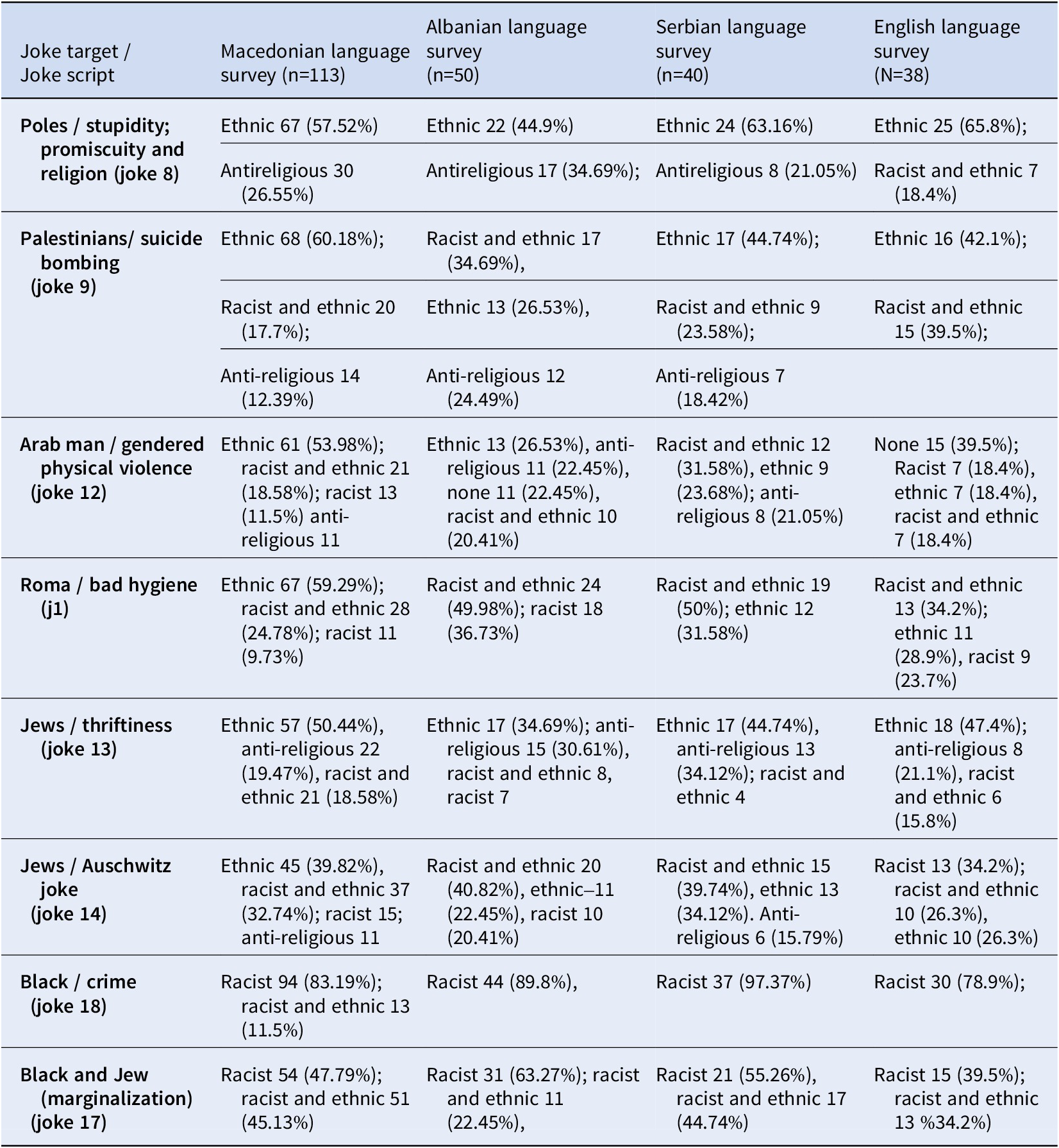
Ambiguous classification of jokes

Table 1. Long description
The table has five columns. The first column lists joke targets and scripts, including Poles with stupidity, Palestinians with suicide bombing, Arab man with gendered violence, Roma with bad hygiene, Jews with thriftiness and Auschwitz, Black with crime, and Black and Jew with marginalization. The next four columns show survey results for Macedonian (n equals 113), Albanian (n equals 50), Serbian (n equals 40), and English (N equals 38) respondents. For each joke, the table reports how many respondents classified it as ethnic, racist, anti-religious, or racist and ethnic, with both counts and percentages. For example, for the Poles joke, most respondents in all groups classified it as ethnic, but the English group also had 18.4 percent classify it as racist and ethnic. For the Black crime joke, the majority in all groups classified it as racist, with the highest percentage in the Serbian group at 97.37 percent. The table highlights variation in how different language groups interpret the target and script of each joke, with some jokes receiving multiple classifications within the same group.
Source: Compiled by authors.
Several factors affect classification. First, the presence of two joke characters or scripts affects classification. Joke 8 (“Why Christ is not born in Poland? Because they cannot find a virgin and three sages”) is classified as ethnic by the majority of respondents (57.52 percent; 44.9 percent; 63.16 percent; 65.8 percent) but also as anti-religious, most likely prompted/primed by the presence of the script “Jesus Christ.” Similarly, Joke 9 (Palestinian suicide bomber) is ambiguously considered ethnic and racist, but also anti-religious, although Palestinians were also dominantly classified as an ethnicity. It is labeled racist, likely due to the presence of the theme of violence in the joke, and anti-religious due to the perception of suicide bombers as metonyms of religious extremism. This perceptual shift is also evidenced by the ambiguous classification of Joke 12 (Arab men — gender violence), which is classified across all categories — ethnic, racist, and even anti-religious — although Arabs were unambiguously classified as ethnicity or nationality in the previous section.
The perception of aggression also affects classification. The joke about the Roma’s lack of hygiene was classified mostly as racist and ethnic, or racist only, and to a lesser degree as ethnic, although the Roma were classified as an ethnicity in the previous section, most likely due to perceived aggression.
These effects are more cogently visible in the jokes about Jews (13 and 14) and Blacks (17 and 18). Joke 13, based on the stereotype of Jewish thriftiness, is classified as ethnic but also, at the same time, as anti-religious, likely primed by the presence of the theme of the religious ritual of circumcision. Joke 14 (Auschwitz joke), although targeting the same ethnic group, is considered less ethnic and more racist. The percentage of respondents who classified this joke as either racist or ethnic-and-racist is considerably higher when compared to the previous joke. The difference is likely a result of the aggression present in the joke.
Similar observations can be made when comparing the classification of Joke 17 (Black man reading Jewish paper) and Joke 18 (Black thief). Joke 18 (Black thief) is unambiguously classified as the most racist joke, although not as severe as the Auschwitz joke or the Arab gender-based violence joke, most likely due to the unambiguous perception of the targeted social category (Black) as a racial group. However, Joke 17, which ridicules both Blacks and Jews, is less racist (as much as a 40 percent difference) and more ambiguous (racist and ethnic), most likely due to the presence of the second target and not its aggressive nature.
These tendencies show that: a) the aggressiveness of a joke frames its classification–the more aggressive, the higher the chances it will be classified as racist. Scripts such as laziness (Joke 3) or stupidity (Jokes 2 and 5) are not attributed as racist at all, whereas physical violence (suicide bombing, gender violence, genocide) tends to be more often labeled as “racist” regardless of the target; and b) the presence of more targets, themes, or characters also affects classification, by mobilizing different classification frameworks primed by the second joke script or character.
Open-ended questions
This section presents the findings of the analysis of the qualitative data collected through two open-ended questions — “Is there any difference between racist and ethnic humor, (Q 21) and “Can a joke be racist and ethnic at the same time?” (Q22). The answers were classified into three categories: a) Positive answer (“There is a clear and explicable difference between racist and ethnic humor”), b) Ambiguous answer (“The terms are conceptually overlapping or confusing”), and c) No answer. In continuation, we present the findings organized per survey.
Macedonian language survey
Question 21. “Is there a difference between racist and ethnic humor?” (80 responses)
For 73 respondents there is a clear-cut difference between racist and ethnic humor that draws on the unambiguous differentiation between race as perceived in biological and physiological terms (skin colour and physical characteristics) and ethnicity perceived as collective identity marked by cultural values, traditions, history), as explained with an example by a respondent “joke about Asian will be racist and jokes about Vietnamese will be ethnic.”
For seven respondents, the difference is not the humor target but the aggressive nature of the joke, in the parlance of respondents, “each anti-joke (insulting and violent) is racist even when the target is not a race” or “racist jokes are always bloodier,” or in a weaker form “racist jokes always have negative connotation regarding the race or ethnicity, ethnic jokes highlights a negative trait in [a] funny manner”).
Question 22. “Can a joke be racist and ethnic at the same time?” (72 responses)
Respondents believe that a joke can be racist and ethnic at the same time if: a) joke targets both and ethnic and a racial group, such as joke 17 (Black man reading a Jewish paper), or the joke unambiguously introduces representatives of both groups, such as “There was A Macedonian, an Albanian and a Black person …,” or b) if the joke character is representative of both ethnicity and race at the same time such as a joke about Black Montenegrin and the joke makes fun of both identities through double punch line or the joke.
Albanian language survey (Kosovar respondents)
Question 21. “Is there a difference between racist and ethnic humor?” (33 responses)
Twenty-eight respondents see a clear-cut difference explained as “A racist joke targets race, focusing on physical traits like skin colour or genetics, while an ethnic joke targets ethnicity, focusing on cultural traits, language, history, or traditions,” evidenced though the following examples: “Why don’t Albanians play Monopoly? Because every time someone wins, NATO comes and flips the table” (ethnic joke) and “Two Black guys go to a convenience store, pay for their stuff, and leave” (racist, subversive).
Five respondents draw the distinction based on the level of perceived aggression and insult. For them, “a racist joke is a form of humor meant to offend, belittle, and discriminate against a racial or ethnic group by reinforcing negative racial stereotypes, while ethnic jokes only emphasize the funny characteristics of a group.”
Question 22. “Can a joke be racist and ethnic at the same time?” (31 responses)
Twenty-eight respondents believe that a joke can be racist and ethnic at the same time. For more than half of them (21), such “ambiguity” is possible if the joke simultaneously targets an ethnicity and a race, such as joke 17 (Black man reading Jewish paper). Ten respondents, however, explain this possibility with the possible presence of an element of aggression.
This happens when a joke involves elements of culture or traditions of an ethnic group, but is used to belittle and discriminate against that group by spreading discrimination, hatred, or contempt towards the group. As explained by a respondent, “the joke about Palestinians as teachers of terrorists has ethnic content (Palestinian nationality) and a racist element through the association with terrorism”.
Serbian language survey (Slovenia, Croatia, Bosnia and Herzegovina, Montenegro, and Serbia)
Question 21. “Is there a difference between racist and ethnic humor?” (29 responses)
Twenty-four respondents conceive of the difference in unambiguous terms as related to race or related to ethnicity. Racist humor in this respect is based on prejudice towards a race (understood in physiological terms such as skin color) while ethnic humor is based on stereotypes about ethnic culture (traditions, mentality, and so on), thus “jokes about whites or blacks are racist, while jokes about Bosnians, Slovenes, and so on are ethnic.”
A lesser number of respondents (5) draw on the element of aggression to explain the difference between racist and ethnic humor, as captured by one respondent, racist jokes are based on hatred and contempt,” and “Racist jokes promote racial superiority, ethnic ridicules ethic weaknesses.”
Question 22. “Can a joke be racist and ethnic at the same time?” (27 responses)
Twenty respondents think that a joke can be racist and ethnic if the two aspects are materialized through two joke targets, such as joke 17, or a joke provided by a Slovenian respondent, “Why [does] Zmago Jelinčič Plemeniti (a nationalist politician) take a little black child when he walks into [a] maternity ward? So he does not spend his whole life thinking that he was feeding a Croat.”
A joke can be both, racist and ethnic, if a single ethnic group is understood as a metonym for a race “such as the joke about Chinese who are stereotypical Asians, or the joke about Moroccans that actually targets dark skinned Muslims and Arabs,” or if an “ethnic group is racialized,” thus, “the use of the term Roma gives ethnic undertone of a purely racist jokes about Gypsies. The duality is also possible because “racist jokes draw on ethnic stereotypes only to express (racial) superiority.” In other words, the ethnic element is a façade for the expression of aggression and discrimination.
English language survey
Question 21. “Is there a difference between racist and ethnic humor?” (34 responses)
Unlike the response ratio in the other surveys, the percentage of respondents in the English language survey who see a clear difference between racist and ethnic humor in terms of discernible joke targets is very low (5 out of 23). These respondents believe that “racist jokes focus on the skin color, using the stereotypes related to race, while ethnic jokes target the differences/similarities between ethnic groups, using cultural, historical, or social stereotypes.”
The majority of the respondents (16) make the difference based on the perceived aggression in the joke, its demeaning nature, and its effects. Thus, “racist jokes are meant to be offensive and downgrade a particular group (race or ethnic), the stereotype is negative, while ethnic jokes are more playful and use a particular, more neutral stereotype.”
For eight respondents, ethnic jokes are a euphemism for racist humor. For them, all ethnic jokes are racist because “any joke that rests on [a] negative stereotype about a group of people defined by shared racial/ethnic/national background can be described as racist” and “… racism tends to apply [to] all kinds of discrimination. Five respondents are not sure if there is any discernible difference.
Question 22. “Can a joke be racist and ethnic at the same time?” (33 responses)
While three respondents believe that a joke can be ethnic and racist at the same time if both groups are represented in the joke, the majority of respondents (26 out of 33) ascribe the element of aggression and discrimination as a decisive criterion for how a joke can be racist and ethnic at the same time. Interestingly, four respondents either cannot easily define the difference or stated that the survey has raised suspicion about whether such a difference is easy or possible to make.
In the respondents’ own language, joke can be ethic and racist at the same time if “a joke that builds on an ethnic stereotype with the intention of being discriminatory and/or offensive.” For these respondents, “racism is an umbrella term for all kinds of discrimination.”
Racist humor across cultures
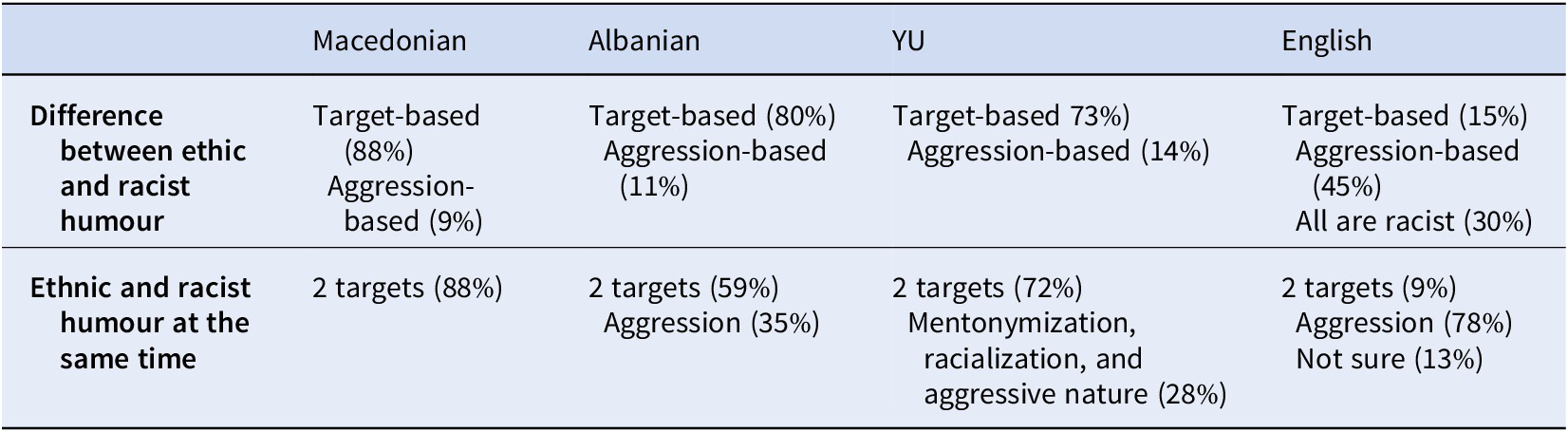
The following table (see Table 2) summarizes the answers to the four surveys, pointing to the differences:
Cross cultural differences in the interpretations of the difference between racist and ethnic humour.
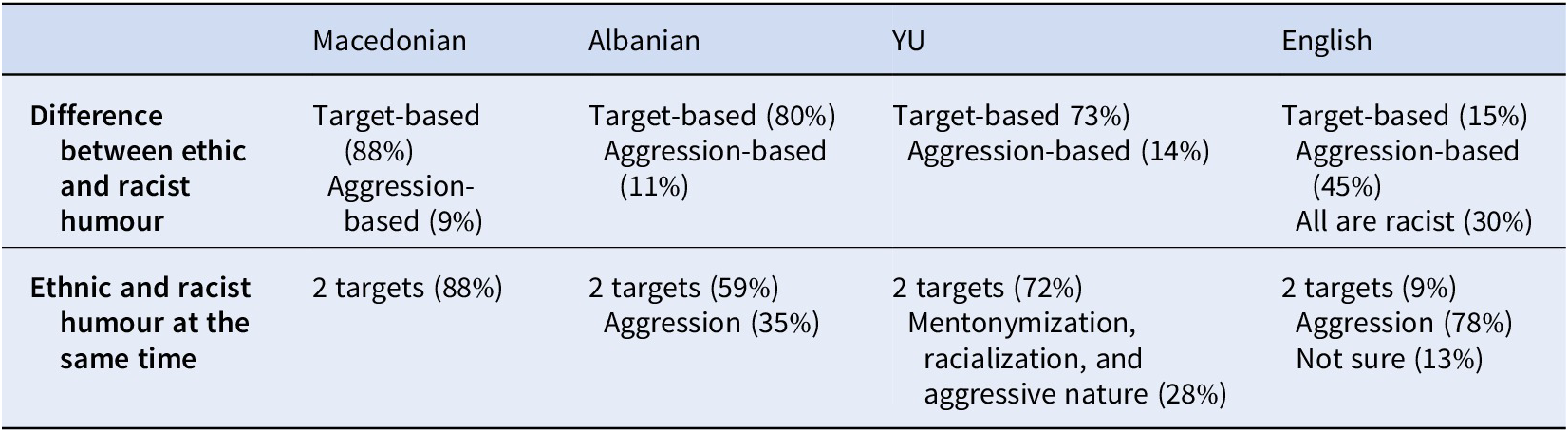
Table 2. Long description
The table has two rows and five columns. The first column lists two categories: ‘Difference between ethic and racist humour’ and ‘Ethnic and racist humour at the same time.’ For ‘Difference between ethic and racist humour,’ Macedonian responses are Target-based 88 percent and Aggression-based 9 percent; Albanian responses are Target-based 80 percent and Aggression-based 11 percent; YU responses are Target-based 73 percent and Aggression-based 14 percent; English responses are Target-based 15 percent, Aggression-based 45 percent, and All are racist 30 percent. For ‘Ethnic and racist humour at the same time,’ Macedonian responses are 2 targets 88 percent; Albanian responses are 2 targets 59 percent and Aggression 35 percent; YU responses are 2 targets 72 percent and Mentonymization, racialization, and aggressive nature 28 percent; English responses are 2 targets 9 percent, Aggression 78 percent, and Not sure 13 percent.
Source: Compiled by authors.
Based on the results, a few key observations can be made. The two key criteria deployed to distinguish and classify ethnic from racist humor are target-based versus aggression-based.
These largely overlap with the political geographies of the respondents (Balkans and non-Balkans). For the respondents for the Balkan ethnic cultures, the presence of a visible, identifiable target (be it ethnicity or race) is the classification/distinguishing trait. For them, a joke can be both ethnic and racist if the joke contains two targets. These respondents rely on a clearer cut, almost binary differentiation between racist and ethnic humor that draws on the binary understanding of race in physiognomic and ethnicity in cultural terms, and very likely, the majority of these respondents do not conceive of racism in all-inclusive terms as an ideology of discrimination against any social group.
The perception of racist humor as defined by the presence of aggression and demeaning intent is more present/typical of non-Balkan respondents, effect. In line with this, the non-Balkan respondents, much like Western humor scholarship, believe that ethnic humor is a benign form of humor. Concomitantly, non-Balkan respondents maintain a Western concept of racism as an all-encompassing form of discrimination, while at the same time they nurture a more ambiguous, racialised consciousness in which the categories of race and ethnicity are overlapping and indistinguishable.
Discussion
Western scholarship on race and ethnicity holds complex and multifaceted views on these concepts, shaped by specific political and economic histories and demographic movements, primarily colonization and immigration (Iceland Reference Iceland2017; Omi and Winant Reference Omi and Winant2015; Waters Reference Waters and Gallagher2022). In such contexts, the cultural concept of race often serves as an umbrella term overlapping with ethnicity, while racism represents an all-encompassing ideology of discrimination toward any social group. Consequently, the concepts of race and racialization are more often deployed as instruments of political division and subjugation rather than as markers of intercultural or interethnic distinction.
Humor, as a form of social commentary on human affairs and society, reflects these culturally shaped ways of seeing and discussing race, ethnicity, and humor. Western humor scholarship frequently treats the concepts of racist and ethnic humor as interchangeable, yet morally distinct. Within this scholarly tradition, racist humor is defined by its discriminatory and denigrating effects and used as an umbrella term for all forms of demeaning humor, including ethnic humor (Weaver Reference Weaver2010, Reference Weaver2011; Pérez Reference Pérez2017, Reference Pérez2022). Moreover, in racialized societies, ethnic humor has been viewed as a benign form of racist humor (Weaver Reference Weaver2010). This is understandable, as race — not ethnicity — has historically served as the dividing line between ruling classes and racialized ethnic minorities. These conflations between race and ethnicity, and between racist and ethnic humor, are further supported by the results of an English-language survey conducted among members of various European societies. However, these interpretations of race/ethnicity and racist/ethnic humor are not universal.
Findings from three surveys conducted in Western Balkan societies (Macedonia, Kosovo, Serbia, Montenegro, Bosnia and Herzegovina, Croatia, and Slovenia) reveal a markedly different understanding of race, ethnicity, and humor. These societies tend to view race in strictly biological terms, determined by physiological traits. This likely stems from their limited histories of colonization, migration, and, consequently, racialization and racism. Instead, their histories, socio-political organization, and humor ideologies are grounded in ethnicity-based frameworks. Race and racialization hold little social or political relevance in societies organized almost entirely along ethnic lines. Thus, ethnic ideologies and a biological understanding of race — seen as distinct from ethnicity — shape local views on race, ethnicity, and both racist and ethnic humor.
In these Balkan post-Yugoslav societies, the distinction between racist and ethnic humor lies in the target of the joke, not its aggression. More importantly, due to a long history of interethnic relations, contestations, and conflicts, people in these societies do not view ethnic humor as a “benign little brother” of racist humor. Their ethnic jokelore abounds with deeply offensive and humiliating examples of ethnic humor that almost no one would label racist. The very language of “racist humor,” as developed and circulated in Western Europe and the USA, offers little explanatory value for societies with different political histories and humor traditions. With the advent of the internet, however, this Western discourse increasingly attempts to colonize discussions of humor, even those coming from societies with utterly different political histories and humor traditions.
The assumption that ethnic humor is benign is typical of Western European and American societies with limited histories of interethnic tension. It also reflects a dominant strand in ethnic humor scholarship that has long perpetuated the idea that ethnic humor merely operates through universal scripts such as stupidity or cunningness — largely ignoring equally harsh and insulting material found elsewhere. Understandably, being portrayed as “stupid” is more benign and socially acceptable than being negated or symbolically erased, as many Balkan jokes — largely unknown to Western audiences — demonstrate.
Western humor scholarship is correct in claiming that racist humor is an umbrella term rooted in complex understandings of ethnicity — understandings that often conflate race and ethnicity. However, these assumptions only hold true in societies with long histories of colonization, immigration, systemic political oppression, and racism. The data presented here show that the terms racist and ethnic humor carry distinct meanings and social receptions in societies with different historical trajectories.
Our aim here is not to criticize Western concepts of race, ethnicity, racist or ethnic humor, or the conflation thereof, but to highlight the existence of an alternative conceptual framework that remains underrepresented in scholarship. In doing so, we seek to draw attention to a different language for discussing racism and racist humor, on the one hand, and ethnicity and ethnic humor, on the other—offering counter-hegemonic perspectives to the dominant social, political, and academic discourses on race, ethnicity, and humor originating in Western societies.
Conclusions
Our data demonstrate the existence of a discourse on racist and ethnic humor that differs from the one perpetuated in Western European and American societies. The articulation of this discourse will likely have little effect on how members of these societies talk about racist and ethnic humor. Scholars and laypeople alike will continue to use the same conceptual vocabulary. It is logical that many Americans, British, and Western Europeans from racialized societies will continue to perceive racist humor as a broader category of humor and to view ethnic humor as less offensive or as interchangeable with racist humor — just as members of Balkan societies will continue to understand race in biological terms and distinguish between racist and ethnic humor based on the target rather than the effect of the humor.
The merit of this study lies in its attempt to demonstrate the existence of distinct emic interpretations and understandings of ethnicity and race, and consequently, culture-based perspectives on ethnic and racist humor. The objective is to give voice to an underrepresented discourse on race, ethnicity, and humor, and thereby to empirically challenge and counterbalance the comprehensible yet geopolitically limited and conceptually biased Western views on these topics.
While the data supporting these findings may not be statistically representative, they indicate a clear tendency that warrants further investigation. Moreover, the findings build on limited previous research (Takovski and Markovikj Reference Takovski and Markovikj2025) that evidences cross-cultural differences in humor ideologies and suggests promising directions for future study.
Disclosure
The authors declare that they have no competing financial interests or personal relationships that could have appeared to influence the work reported in this paper.
Annex 1
Link to the english language online survey: https://forms.gle/kQvFMuG7f7Z4FKvF7
Annex 2 – list of jokes used in the surveys
-
1. Prior to an operation, a surgeon says to a Roma patient:
“I have good news and bad news, good news is that your problem is operable, bad news is that we have to bathe you first.”
-
2. A Police warden stops Bosnian driving suspiciously and says:
“You have to do an alco test.”
“Cool, which alcohol are we testing? Replies the Bosnian.
-
3. How do you get rid of a Montenegrin?
Offer him a job.
-
4. The wife of a Catalan (native of the province of Cataluña in eastern Spain) dies, and he goes to the local newspaper to publish an obituary. Trying to save money, he dictates a very short message to the editor: “Laia Vila died at the age of 78. In memoriam.” The editor says, “You shouldn’t worry about money. In obituaries, the first 15 words are for free.” The Catalan thinks for a while, calculates, and says, “Then add ‘Car for sale. Good condition.”
-
5. Why do Lepe people (ethnic group from Spain)/Scots put the TV set in the fridge?
To freeze the image.
-
6. What do you call an Italian without hands?
Mute.
-
7. Two Fins were talking. The first asks:
“Do you prefer Santa Claus or Sex?”
“Santa, of course, it comes more often,” replies the other.
-
8. Why wasn’t Christ born in Poland?
Because they couldn’t find three wisemen and a virgin.
-
9. A Palestinian teacher is instructing the suicide bombers. He says:
And listen carefully, because I will not repeat.
-
10. How do Chinese people name their kids? A: They drop a broom out the window and see what Sound it makes. That’s why your name is Ching Chang Chong.
-
11. Did you hear about the Muslim strip club? It features full facial nudity!
-
12. What do you say to an Arab woman who has black eyes?
Nothing, you have told her twice already.
-
13. Why are Jewish men circumcised?
Because Jewish women refuse to touch anything that isn’t at least 20 percent off.
-
14. What’s the difference between a Jew and a Pizza? Pizzas don’t scream when you put them in the oven.
-
15. Five Moroccans are sitting in a minivan. Who is the driver? A police officer.
-
16. What do you call a bunch of white guys sitting on a bench?
The NBA
-
17. A black man sits on a bench reading a Jewish newspaper. A man approaches, saying to him: Is it not enough that you are Black?
-
18. What’s a Black man on a new bike – A thief.
-
19. What’s the difference between a picnic table and a Mexican man?
A picnic table can support a family of 5
What do books have that Mexicans don’t? Papers

 Open access

