


Introduction
It is usually assumed in discussing the dynamics of ice shelves that vertical shear quantities are negligible (Reference WeertmanWeertman, 1957; Reference BuddBudd, 1966; Reference ThomasThomas, 1973[b]; Reference RobinRobin, 1975; Sanderson, in press); in Reference ThomasThomas (1973[b]) it is the sole restriction. It is worthwhile proving that this assumption is justified.
Early literature on ice shelves considered them to be of uniform thickness (Reference RobinRobin, 1953; Reference WeertmanWeertman, 1957). In this case it is true that vertical shear is zero, since the ice shelf is a uniform horizontal slab subject to zero friction at its upper and lower surfaces. It is, however, now clear that most ice shelves have appreciable thickness gradients, and in this case shear stresses are no longer precisely zero. This can be illustrated by considering ice as a perfectly plastic material and looking at the slip-line field through an ice shelf (Fig. 1). A slip-line field is represented by two orthogonal families of curves drawn so that their directions at any point coincide with the two perpendicular directions of maximum shear stress. Since the upper and lower surfaces of the ice shelf are subject to zero friction this means that slip lines must meet them at 45°. For the case of a uniform-slab ice shelf, the slip-line field is simple: lines pass straight through the ice shelf at 45° to the horizontal (Fig. 1a). For the case of a slab with varying thickness, however, the slip lines must curve in order to meet both surfaces at 45° (Fig. 1b). This curvature of the slip lines is associated with a varying component of shear stress in the vertical direction. We shall develop a method for calculating its magnitude by using a realistic power flow law for the flow properties of ice. The method involves the assumption that velocity is uniform through an ice shelf and the demonstration that this assumption is not perfectly self-consistent: it requires the existence of small shear stresses and hence small shear strain-rates.
Schematic diagram of slip-line field through an ice shelf modelled as a plastic material: a. horizontal, parallel-sided ice shelf; b. ice shelf with thickness gradient. The dashed line represents sea-level.

1. Shear stresses
Unconfined ice Shelves
We define axes as in Figure 2. The x-axis is horizontal in the direction of flow and the is z-axis measured vertically upwards from sea-level. The ice thickness is H and the elevation of the upper surface is h. The surface slope is θ. The density of the ice is ρ which we, for the moment, assume to be constant with depth. Direct stresses are denoted by σ xx , σ yy , and σ zz , and shear stresses are denoted by σ xy , σ xz and σ yz . We assume the flow-law form (Reference PatersonPaterson, 1969, chapter 6)

where


where p is hydrostatic pressure, and δ ij = 1 if i = j, and δ ij = 0 if i ≠ j. The effective stress τ is defined by

B is an empirical constant which is temperature dependent; we begin by assuming it to be constant through the ice shelf. We take n = 3.
Symbols used in discussion of ice-shelf stresses. The rectangle abfe lies on the upper surface of the ice shelf and the rectangle cdhc; is horizontal at some depth in the body of the ice shelf.

For quasi-static creep the general conditions of stress equilibrium are:


In treating the case of an unconfined ice shelf we make the following assumptions:
-
(a) that the ice shelf is floating in hydrostatic equilibrium, so that
where ρ w is the density of sea-water.(7)
-
(b) that the ice shelf is free and uniform in the y-direction; no quantities vary in this direction, and shear stresses σxy and σyz are zero.
-
(c) that ∂σ xz /∂x = 0. We shall see later (Equation (17)) that this is strictly true if ∂θ/∂x = 0.

The equilibrium Equations (4), (5), and (6) then reduce to


Integrating Equation (9) we have, in general,

where f(x, y) is some arbitrary function of x and y. At the upper surface, z = h(x), vertical force balance requires that σzz = θσ zx . However, we are for the moment assuming that σ zx is zero, therefore, since no quantities depend on y, and neglecting atmospheric pressure, we have σ zz = 0 at the upper surface. Then it follows that

Consider now the stress deviators. We have

but since the ice shelf is unconfined in the x and y directions we must have

and hence

Also, assuming that ice is incompressible we have

and, therefore, through the flow law (Equation (1))

Hence,

In calculating τ 2 in the flow law we shall treat the shear stress σ xz as small compared to the stress deviators. The result of our calculation will justify this assumption. By Equations (11) and (12) this leads to

The equation for flow in the x-direction is then, from Equations (1), (11), and (13),

Inserting Equation (10) we then have

To achieve equilibrium of forces we must balance the total force of σ xx acting over a vertical column in the ice shelf with the total force of sea-water pressure acting on it. That is,

Performing these integrations using Equation (14) we find, assuming that


which we have simplified using Equation (7). B is the average of B over depth. Substituting this into Equation (14) and now assuming B uniform with depth, we have:

This gives σ xx , as a function of depth for any thickness of ice shelf. The equation was achieved by overall balance of total internal force due to weight of ice with total external force due to sea-water pressure. We now ask whether stresses exactly balance each other at all depths through the ice shelf. We find that they do not, and that a vertical shear stress σ xz must be present to make up the balance.
Consider the equilibrium of a vertical column abcdefgh (Fig. 2). The sum of all forces on the six surfaces must be zero. We shall consider forces in the x-direction. There is zero traction on the surfaces abfe, abcd, and efgh, so if there is any imbalance between forces on aehd and bfgc it must be counteracted by shear σ zx along cdhg. This is equivalent to integrating Equation (8) with respect to z. We have:

Performing these integrations using Equation (16) we find

This shows that on our simple model, in which density and flow parameter are constant with depth, shear stress varies linearly with depth, and is independent of flow parameter. It is zero at sea-level and maximum at the bottom of the ice shelf.
By considering stresses on a small element near the surface, and using Equations (10) and (17), it can be shown that the shear traction on the slanting upper and lower surfaces is indeed zero, as it should be. Vertical forces at the surfaces do not balance properly, since we earlier assumed that σ zz = 0 at the upper surface, and yet we have now shown the existence of a non-zero shear stress σ zx = −ρgθh/2. Since σ zz = θσ zx we should strictly now have

From Equations (11) and (16) we find that
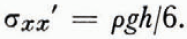
Therefore,

Surface slopes of unconfined ice shelves are generally small. For Erebus Glacier tongue (Reference HoldsworthHoldsworth, 1974), θ is approximately 3 × 10⁻³. Since z can be at most some six times the magnitude of h we see that σ zx is at most five per cent of the magnitude of σ xx′. σ zx is therefore generally negligible in comparison with σ xx′ especially since we generally find ourselves comparing the squares of these quantities, as in Equation (3).
We can also perform the calculation for a real case in which density and temperature vary with depth. The calculation is lengthy and does not lead to a simple analytic answer like that of Equation (17), but it follows the same principles as above. For a particular case we look at Erebus Glacier tongue and use data from Reference HoldsworthHoldsworth (1974). We assume that density varies with depth according to the model of Reference SchyttSchytt (1958) and we adopt a temperature variation similar to those in Reference WexlerWexler (1960). We assume that the flow parameter B has a Boltzmann temperature dependence (Reference PatersonPaterson, 1969, p. 83)

where

and T is the absolute temperature.
We fit the constant A in order to agree with value of B found by Holdsworth from his data. The result of the calculation, carried out for a point five kilometres from the hinge zone, is shown in Figure 3a. It is shown together with the result obtained by assuming a constant density and flow parameter, as in Equation (17). The shear stresses in the two cases are significantly different, but show the same form and order of magnitude.
Shear stress as a function of height z above sea-level for (a) Erebus Glacier Tongue (unconfined); (b) Amery Ice Shel, (confined). The solid line shows the result of assuming density and temperature constant with depth, and the dashed line shows the result of allowing them to vary realistically.

Confined bay ice shelves
Consider now an ice shelf in a parallel-sided bay (Reference ThomasThomas, 1973[b], fig. 2). The ice shelf is confined in the y-direction and undergoes shear at the sides. We assume that shear stress at the sides reaches a limiting value τ s (Reference ThomasThomas, 1973[b]) and write

and, therefore,

where λ is the half-width of the ice shelf. We still assume that ∂σ xy /∂x = 0, since τ s and λ are independent of x, and that ∂σ zx /∂x = 0. We assume that σ zy = 0. We can then write Equations (4), (5), and (6) as

Now


We continue to treat shear stresses as small in the effective stress expression Equation (3) and we find this leads to

Therefore, by Equations (1), (19), and (20)

From Equation (18) we still have

and so

Creep in a bay ice shelf is given by (Reference ThomasThomas, 1973[b])

where x = X marks the seaward margin of the ice shelf. By considering the dependence of this function on x we find that to first order in small quantities δx we can write

We can now, as before, consider the balance of stresses on a column in the ice shelf. Consider the column abcdfegh (Fig. 2). We must equate the forces in the x-direction over all the surfaces of the volume, but we now have to include horizontal shear stress on the surfaces abcd and efgh. The force due to stresses on these surfaces is simply

so we can write

We perform these integrations using Equations (21), (22), and (23) and we find that

Again, we find that the simple model with a constant density and flow parameter leads to a shear stress which is linearly dependent on depth and zero at sea-level. The two terms in Equation (24) are of different sign, since τ s is negative; the shear stress may therefore have different senses, depending on which term dominates. In practice the term ρgh/2 is generally the greater, which corresponds to the state of extending flow generally found in ice shelves.
From Equations (19), (21), and (22) we find that the horizontal stress deviator is given by

and therefore

Looking at data for the Amery lce Shelf (Reference ThomasThomas, 1973[a]) we see that surface slopes are about 3 × 10⁻⁴. This means that shear stresses are at most some 0.4% of direct stress deviators. It is therefore again true to say that they are negligible.
As for the unconfined ice shelf treated above we can also carry out the calculation using realistic assumptions about density and temperature profiles. Using data for station G2 on the Amery Ice Shelf we find again that shear stress is essentially of the same form and magnitude as that calculated on the simple model. Figure 3b shows shear stress as a function of depth for the two models.
2. Shear strain-rates
We consider now the deformation produced by the calculated shear stresses. We write the flow law as

and allow B to vary with depth in a realistic manner. For an unconfined ice shelf it is readily shown that

where


where

Such shear strain-rates lead to differential motion between the top and bottom of the ice shelf. For pure shear we have

where u x is the x component of velocity, so that

where s and b denote the upper and lower surfaces of the ice shelf. Integrating numerically we find that the differential motion between the top and bottom of the shelf is I8mm a−1 for the Erebus Glacier tongue and 25 mm a−1 for the Amery Ice Shelf; the top is moving faster than the bottom. These movements are negligible, perhaps not even delectable.



