

1. Introduction
The state-centric theories of political power and economic interdependence (Cooper, Reference Cooper1968, Reference Cooper1972; Keohane and Nye, Reference Keohane and Nye1973) in international political economy have limited applicability for understanding the challenges globalization poses to non-state actors. These theories conceptualize power and interdependence at the state level, whereas non-state actors experience interdependence at a grassroots level, where dynamics and vulnerabilities differ significantly.
This paper examines the political implications of grassroots economic interdependence, focusing on the context of China. Until recently, foreign firms seeking direct access to the Chinese market were required to establish joint ventures with Chinese partners, often state-owned enterprises. These joint ventures represent a form of grassroots economic interdependence, creating economic – and at times political – advantages for the Chinese government.
Building on this perspective, the paper explores an overlooked form of cross-border economic interdependence in higher education: joint degree programs (JDPs) between China and the United States. These programmes allow US universities to generate revenue from Chinese students by offering degree pathways in collaboration with Chinese universities. A prominent example involves over 40 American universities and has collectively generated more than $400 million in tuition, fees, and room and board since 2001 (U.S. International Trade Administration, 2023).
While prior studies have highlighted the growing financial reliance of US universities on international students broadly (Bound et al., Reference Bound, Braga, Khanna and Turner2020) and discussed the specific dynamics of Chinese student recruitment (Shih, Reference Shih2017), the mechanisms through which such cross-national dependencies are structured remain underexplored. The JDPs are typically structured as ‘x + y’ models, where Chinese students split their undergraduate education between a Chinese institution for the first x years and then an American partner university for y years. The Chinese universities are responsible for student recruitment, which is tightly regulated by the Chinese government.
According to Resource Dependence Theory (Pfeffer and Salancik, Reference Pfeffer and Salanik1978), an organization that relies on an external partner for critical resources becomes dependent on that partner. Western universities are widely perceived to face significant structural vulnerabilities when collaborating with Chinese partners in higher education. This vulnerability stems largely from an implicit trade barrier: foreign universities cannot establish fully owned campuses in China (Regulations of the People’s Republic of China on Chinese-Foreign Cooperation in Running Schools, Article 62). To directly access the Chinese higher education market, they must form JDPs with Chinese universities, which are predominantly state-owned.
We use Confucius Institutes (CIs) as a measure of the perceived geographic risk associated with academic collaborations involving Chinese universities. A CI is a partnership between a Chinese university and a non-Chinese university to establish Chinese language and cultural programmes at the latter. While CIs are widely perceived as a geopolitical risk (Senate, 2019), solid evidence supporting this perception is limited due to data constraints. However, the Chinese government treats CIs as a key soft power initiative, underscoring their political significance. Far from being mere language training programmes, CIs are assigned strong political implications by the Chinese government. Even for domestic propaganda purposes, the expansion of CIs in Western countries provides the Chinese government with considerable political influence over its own people. For example, the 20th anniversary of the CI in 2024 was commemorated by the World Chinese Language Conference, a state-funded event that brought together more than 2000 participants from over 160 countries. The conference was featured in prime-time national news coverage (Lianbo, Reference Lianbo2024). The content of the broadcast reinforced the narrative that Chinese language and culture enjoy universal appeal, while portraying the CIs as key facilitators of China’s cultural diplomacy and national legitimacy. On the Western side, there is widespread debate about the perceived and, at times, actual risks associated with CIs. Scholars such as Brady (Reference Brady2008), Hubbert (Reference Hubbert2019), Sahlins (Reference Sahlins2015), and Fan et al. (Reference Fan, Pan and Zhang2024) have contributed to this discussion, highlighting concerns over the political implications of these partnerships.
We find evidence in support of our theoretical argument. A particularly compelling piece of aggregated evidence is that the wave of JDPs clearly preceded the wave of CIs. From the outset, the US–China higher education collaboration was more decentralized than the US–Soviet exchange model (Bullock, Reference Bullock2016). After the signing of the ‘Understanding on the Exchange of Students and Scholars’ in 1978, university-level collaborations including JDPs between these two countries flourished. In contrast, the CI partnerships between US and Chinese institutions were all established after 2004. According to our dataset, every American university that established CI already has a preceding JDP with China. Furthermore, our regression analysis using university-level panel data from the USA provides robust evidence to reinforce our hypothesis. Additional cross-sectional data from other regions of the world further illustrate the consistency of our argument.
This paper sits at the intersection of higher education administration and international political economy. By extending economic interdependence to a subnational setting, we illustrate the geopolitical risks that subnational agents may face when engaging in globalized and commercialized partnerships with foreign partners from an authoritarian regime, extending the conventional state-centric theories of interdependence with such a regime (Starr, Reference Starr2009; Hartig, Reference Hartig2015; Liu et al., Reference Liu, Su, Wang and Huang2020).
Applying this theoretical perspective to our setting, we explain how CI expanded. The existing empirical literature on the CIs is influenced by the state-centric theoretical approach. However, the usual suspects that might drive the expansion of CIs, such as ethnic Chinese networks, economic connections with China, etc., turn out to have little explanatory power in studies using country-year data (e.g., Akhtaruzzaman et al., Reference Akhtaruzzaman, Berg and Lien2017). Our partnership-network-based evidence provides the first plausible explanation for the global expansion of the CIs.
Our insights shed light on the geopolitical risks of similar global partnership networks, including concerns surrounding technology theft in joint ventures (Tang et al., Reference Tang, Cao, Wang and Zhou2021) and talent recruitment programmes (Zweig and Siqin, Reference Zweig and Kang2020). From a policy perspective, shutting down all CIs is unlikely to resolve the resource dependence of Western universities on their Chinese partners as long as Chinese market-access constraints exist and the US universities continue to prioritize access to the Chinese market. How the West trades with China – and under what terms – plays a critical role in shaping these dynamics.
The rest of this paper is organized as follows. Section 2 discusses the problems associated with the state-centric approach to power and interdependence in our context. Section 3 highlights the theory of partnership-level resource dependence. Section 4 applies the theory to understand the soft power of China’s global education networks. Section 5 describes the data and methods. Section 6 presents the main evidence from the United States. Section 7 provides preliminary global evidence. Section 8 concludes the paper. Supplementary Tables A1–A6 are reported in the online appendix.
2. State-centric approach to power and interdependence
The state-centric view of power and interdependence understates China’s role in international academic collaboration relative to Western powers. Conventional theories emphasize coercive diplomacy tools – sanctions and bans – as key ways states leverage economic interdependence (Blackwill and Jennifer, Reference Blackwill and Harris2016; Baldwin, Reference Baldwin2020). Yet authoritarian regimes rarely use such instruments against foreign universities, and China’s coercive diplomacy is often less effective than it seems (Gholz, Reference Gholz2014; Choudhury, Reference Choudhury2021). Without coercion, these theories still expect Western states to benefit from interdependence through soft power. Higher education remains the core domain of Western soft power (Nye, Reference Nye2005; Lo, Reference Lo2011). The most competitive universities are Western, and in 2023, over one million international students enrolled in US institutions. Authoritarian elites routinely send their children to the West for study (Braw, Reference Braw2014; Ottolenghi, Reference Ottolenghi2014). Though China and Russia also promote soft power through education, research shows their influence is regionally limited or selectively appealing (Gill and Huang, Reference Gill and Huang2006; Repnikova, Reference Repnikova2022).
In summary, we need to move beyond the state-centric approach to better understand the challenges that universities in advanced democracies face under globalization and commercialization.
3. Partnership-level economic dependence
According to the Resource Dependence Theory (Pfeffer and Salancik, Reference Pfeffer and Salanik1978), dependence on external actors natively affects the goal attainment and autonomy of public and non-profit organizations (Christensen, Reference Christensen2016). Commercialization through partnership and other channels has been emphasized as a top cause of resource dependence on external actors (Ahuja et al., Reference Ahuja, Lampert and Tandon2008).
If we extend this theoretical framework to an international setting, Resource Dependence Theory implies that universities in advanced democracies tend to become dependent on their foreign partners. Autocratic states such as China usually set up explicit or implicit trade barriers to protect their local market, creating economic rents for foreign institutions that can manage to access the protected markets. Western universities may rely on their foreign partners to gain access to protected foreign market. At the micro level, the power relationship could become asymmetric in favour of universities’ foreign partners as a result of these institutional rents.
At the state level, the power relationship may also become asymmetric in favour of authoritarian countries that can mobilize non-state actors under their rule. However, we do not naïvely assume that such mobilization is costless. For example, much of China’s financial investment in developing countries is driven and implemented by profit-seeking enterprises. Despite the fact that many of these enterprises are owned by the Chinese state, they ‘have their own agency and interests that may not closely align nor be in direct response to the Chinese state’ (Liou, Reference Liou2014; Fung et al., Reference Fung, Han, Quek and Strange2022). It is not easy for the Chinese state to mobilize its vast economic power for political purposes. Nevertheless, it is certainly more difficult for Western policymakers to respond to China’s mobilization strategy using conventional trade policy instruments. Western states may not be able to ban interdependence networks without causing considerable collateral damage to themselves (Truex, Reference Truex2020; Tang et al., Reference Tang, Cao, Wang and Zhou2021). As long as decoupling is not an option, Western states need to carefully manage the associated risks. Neither is it feasible for Western states to replicate China’s mobilization strategy, which may be less compatible with the liberal economic and political orders within Western societies.
4. China’s global higher education partnerships
In this section, we will explain why China’s global JDP partnership networks, providing critical access to China’s higher education market, constitute an important interdependence network that might help facilitate the development of CI projects.
For most students from China and the rest of the developing world, a JDP is a relatively low-cost and risk-free gateway to get Western universities’ degrees. Students do not go through the expensive and risky process of applying for US colleges by themselves. Rather, they apply for these JDPs through the regular domestic college admission pathway, keeping the option of attending a regular Chinese college open. A JDP typically only requires a student to spend one or two years at the foreign partner institution as a formal international student. Sometimes students can receive a foreign degree without physically leaving China, in which case they are often charged tuition between the Chinese and international levels. The Chinese university tuition is tightly regulated by the government and has stayed at a low level of about one thousand US dollars per year for many years. The demand for JDPs is high in China. According to a report by China Education Online from 2016, 550,000 Chinese university students had enrolled in JDPs.Footnote 1 JDPs with the United States are the most popular among students (Lei and Jing, Reference Lei and Tian2020).
A typical JDP does not grant much bargaining power to universities in the developing world; it is more likely to grant bargaining power to universities in advanced liberal democracies. Why may Chinese universities gain leverage over their foreign JDP partners? According to the neoclassical economic theory of trade, the economic rents from trade increase with barriers to trade. The leverage of Chinese universities ultimately comes from their ability to help their overseas partners bypass barriers to China’s higher education market.
There are a number of trade barriers to the Chinese higher education market. First, wholly owned foreign universities do not yet exist in China. A few American universities have set up campuses in China through Chinese partners. The JDP is the main platform for accessing the Chinese higher education market. In theory, joint ownership requirements tend to increase Chinese partners’ bargaining power. In the economic domain, Western firms have found it easier to protect their technology and know-how since China started to allow wholly owned foreign enterprises (Jiang et al., Reference Jiang, Keller, Qiu and Ridley2018). Second, the highly centralized test-based university admission system, which is under the full control of the Chinese government, represents a critical trade barrier. The government determines the admission quota: the number of students each programme of a university is allowed to admit each year. No foreign universities have ever been allowed to participate in the admission system. The participation of Hong Kong, Macau, and Taiwan universities is considered a special policy favour under the ‘one China’ framework. Even if foreign universities unilaterally declare their intention to accept China’s College Admission Test (CET) for admission considerations, it is difficult for a Chinese student to obtain an official CET transcript (Crawford, Reference Crawford2015). There is not yet a way for a foreign university to verify the authenticity of a transcript provided by the student.
The barriers to Chinese higher education led to two types of JDPs. We call them semi-official and fully approved JDPs in this paper. A semi-official JDP is established by an agreement between a Chinese university and a foreign partner. The Chinese university recruits JDP students from its existing study body. A semi-official JDP normally cannot participate in the admission system and does not have an extra admission quota. When a semi-official JDP is approved by the Ministry of Education, it becomes a fully approved JDP and obtains the privilege to participate in the admission system and to receive an extra admission quota. It is not easy to receive full approval from the government. In either case, the foreign university depends on its Chinese partner for admission quota. Foreign universities with more demand for tuition money, such as large public universities in America (e.g., the University of Illinois at Urbana-Champaign; Bothwell, Reference Bothwell2018), are more dependent on their Chinese JDP partners.
The ability of the Chinese government to mobilize the JDP network, which includes both Chinese and foreign universities, also comes from its tight control of Chinese universities. Almost all Chinese universities are public universities. Each university has a Communist Party branch, whose leader has the final say over all university affairs. University leaders are political bureaucrats and respond to political incentives. When the Chinese government tries to project soft power abroad using CIs, it may do so by engaging JDP networks under its control. This could help explain why CIs are designed as partnerships between Chinese and foreign universities so that the Chinese government can leverage Chinese universities’ international collaboration networks and, in some cases, blur the boundaries between the state and non-state actors (Pan, Reference Pan2021).
5. Data and method
Our main analytical sample includes panel data on 5000 US universities from 2005 to 2016. We first get the complete set of US universities included in the official College Scorecard dataset, comprising approximately 7000 institutions. After trimming universities that are exceptionally large or small, we refine our sample to 5000 universities, which we believe are most representative of the US higher education system. We then add variables capturing the CI and JDP partnerships between China and the United States. We also make use of a comparable database at the global level, which we introduce after reporting our main findings from the United States.
5.1. Dependent variable: CIs
In 2003, China opened the first CI in South Korea and struck a deal for the first CI in America with the University of Maryland. Since then, CIs have expanded rapidly around the world. CIs are officially managed by a special government office: Office of the National Steering Group for Teaching Chinese as a Foreign Language (or commonly known as Hanban). We collected the full list of CIs from the official website of Confucius Institutes Headquarters (Hanban, 2019). The CI dataset consists of 511 CIs based in 115 countries by July 2019, including 101 CIs hosted by 102 US universities.Footnote 2 For our research question, we are primarily interested in why foreign universities are willing to host CIs, and our approach does not assume that CI presence necessarily implies political influence or institutional dependence; rather, it reflects a perceived geopolitical risk associated with partnerships involving Chinese universities. Our paper does not investigate the closure of CIs.Footnote 3 The United States has more CIs than any other country.
The dataset includes three types of information. First, it includes the names of the Chinese and foreign universities that form each CI partnership. Second, it includes the founding dates of the CIs. Third, it includes the geographic location (countries and cities) of the CIs.
Our main dependent variable is a binary dummy. It equals 1 for the year in which a US university establishes a CI and afterwards. It equals 0 otherwise. Given that our US panel spans 2005–2016, largely before CI closures occurred, this specification does not bias our analysis.
5.2. Explanatory variable: JDP
We collected data for both semi-official and fully approved JDPs. Similar to the case of the CIs, we only pay attention to the date of JDP establishment. While some programmes may later change form or scale, the partnership relationship typically continues even without formal renewal. Moreover, when universities discontinue a formal JDP, they rarely publicize this information. It is not practical to collect complete information on JDP closure. Given these constraints, our main explanatory variable is also a binary dummy, which equals 1 for the year in which a US university establishes a JDP with China and afterwards, and which equals 0 otherwise.
We collected the list of all semi-official JDPs between Chinese and American universities before 2020 from online sources. Chinese universities are eager to promote news of establishing JDPs with foreign institutions. We used Baidu.com to perform a precise search with the following keywords: the name of the American university (in Chinese or English) combined with the Chinese word for ‘cooperation’ (hezuo in Chinese). Then we manually read the search results. In total, we identified 1245 US universities with at least one cooperative programme (semi-official JDP) with Chinese universities. We recorded the earliest date on which such formal cooperation started. Consistent with our theoretical expectation, for American universities with both a JDP and CI, their JDPs were established before their CIs.
The official website of the Ministry of Education in China provides the list of all fully approved JDPs since 1991 (Ministry of Education, 2019). The list contained 2236 JDPs before July 2019, with 389 fully approved JDPs coming from the United States. The website also includes information on programme establishment date and (expected) date of licence expiration. As an expired JDP usually continues its operation as a semi-official programme, semi-official JDPs are substantially more numerous than fully approved JDPs in the data.
5.3. Control variables
We collect a number of mostly time-varying control variables. We use US News Rankings and the US Department of Education’s College ScorecardFootnote 4 as our main sources to construct control variables at the university-year level for our US panel data. We construct a comprehensive university rankingFootnote 5 to take into account the possible biases of CIs in favour of high-ranking American partners. We control for information on the existence of STEM disciplines and foreign language programmes to take into account the argument that a CI is merely a language programme or one that tries to infiltrate valuable US technology targets (Gregg, Reference Gregg2019). We control campus size to account for the argument that CIs may target large universities to expand their influence. The establishment of CIs may benefit from the existence of local Chinese American networks. We use the Asian student percentage as a proxy to control this potential link, as we have no systematic information on the share of Chinese students at each American university.
The summary statistics of our data are available in the Appendix (Table A1).
We use linear probability regression models with fixed effect following Angrist and Pischke (Reference Angrist and Pischke2009) and Timoneda (Reference Timoneda2021). We acknowledge potential limitations in causal inference arising from unobserved time-varying confounders and selection bias. For example, evolving strategic priorities of universities may simultaneously drive the establishment of both JDPs and CIs. Additionally, universities predisposed towards collaboration with China may select into both forms of partnerships non-randomly. We frame our results as suggestive of a causal pathway but recognize these design limitations and encourage future work addressing them.
5.4. Evidence from the United States
This section provides evidence that American universities are more likely to host CIs if they have JDPs with China. The baseline effect is mainly driven by large public universities. In terms of mechanisms involved, we show that American universities’ CI partners tend to be assigned by Chinese government.
6. Data pattern and anecdotes
Table 1 presents the relationship between JDPs and CIs. If a university has a fully approved JDP, the probability of establishing a CI reaches 18.5%. For universities with a semi-official JDP, this probability decreases to 8.2%. In contrast, for universities without any JDP, the probability of establishing a CI is zero. Comparing these probabilities demonstrates a clear correlation between the presence of JDPs and the establishment of CIs, providing strong support for the hypothesis that JDPs act as a significant precursor for CIs in US universities.
Different types of cooperation at 5000 US universities

Table 1 Long description
The table presents data on the relationship between Joint Degree Programs (JDPs) and Collaborative Initiatives (CIs) at 5000 US universities. It has three columns labeled 'Fully approved JDPs', 'Semi-official JDPs', and 'No JDP', and four rows labeled 'CI yes', 'CI no', and 'Total'. The first row shows that 25 universities with fully approved JDPs have CIs, representing 18.5%, while 102 universities with semi-official JDPs have CIs, representing 8.2%. The second row indicates that 110 universities with fully approved JDPs do not have CIs, representing 81.5%, and 1143 universities with semi-official JDPs do not have CIs, representing 91.8%. The third row shows the total number of universities with fully approved JDPs is 135, with semi-official JDPs is 1245, and without any JDPs is 3755. The data highlights a clear correlation between the presence of JDPs and the establishment of CIs, suggesting that JDPs significantly precede CIs in US universities.
Note: CI for Confucius Institute. JDP for joint degree program. Fully approved JDPs are included in semi-official JDPs. Data source: Authors’ database. In our dataset, 102 US universities share 101 CIs (The Texas A&M University – College Station and the Prairie View A&M University jointly host one CI).
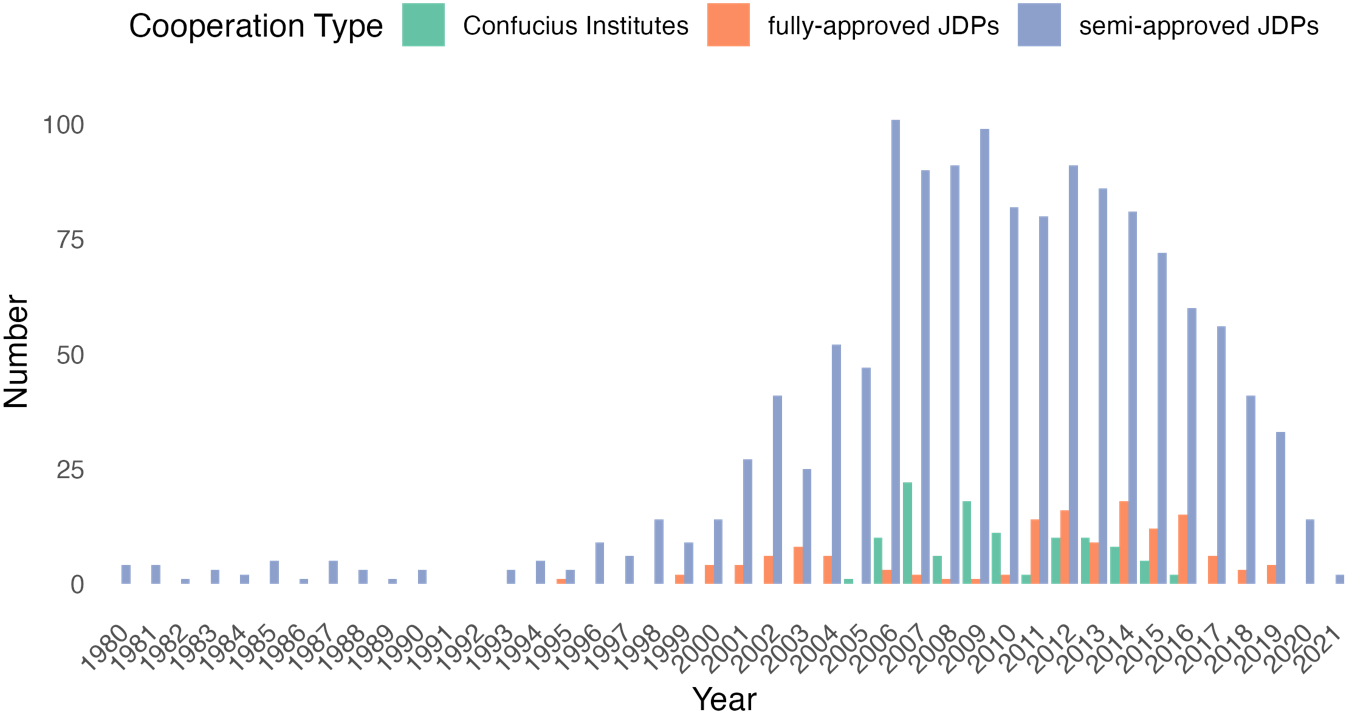
Figure 1 visualizes the evolution of Sino–US academic collaborations over time. Semi-official JDPs began to appear around 1980, shortly after the establishment of diplomatic relationships between the United States and China. Fully approved JDPs emerged approximately in 1995, while CIs only started to appear after 2003. The timeline clearly shows that JDPs preceded CIs.
US universities cooperation with Chinese universities.
Note: The timeline clearly shows that JDPs preceded CIs.

Figure 1 Long description
The bar graph compares the number of Confucius Institutes, fully-approved Joint Degree Programs (JDPs), and semi-approved JDPs between US and Chinese universities from 1980 to 2021. The x-axis represents the years, while the y-axis indicates the number of cooperation instances. The graph features three data series: Confucius Institutes in green, fully-approved JDPs in orange, and semi-approved JDPs in blue. The bars are vertical and grouped by year. The data shows a significant increase in semi-approved JDPs starting around 2000, peaking between 2005 and 2015, and then gradually declining. Confucius Institutes and fully-approved JDPs appear less frequently and show smaller fluctuations over the same period. All values are approximated.
While JDPs clearly precede CIs, American universities do not necessarily establish CIs with the same JDP partners. The process of partnership establishment is often orchestrated by the Chinese government. The first CI in America is co-operated by the University of Maryland and Nankai University in 2005. Before the CI was established, the University of Maryland and the School of International Trade and Economics in China set up a fully approved JDP in Business Administration. This programme was approved in 2001 and began enrolling students in 2003. Each year, this JDP could admit up to 120 participants, with a fee of $85,000 per person. Two years later, on June 15, 2004, Hanban Director Yan Meihua and University of Maryland President Daniel Mote signed the cooperation agreement of the first CI.
The University of Michigan, a large public university, offers a good example of how CI are embedded in a network of JDPs. It maintained a range of profitable collaborations with Chinese universities before it established a CI. In one case, the University of Michigan signed several collaboration agreements with Renmin University of China in 2005. Subsequently, in 2009, Renmin University partnered with the University of Michigan to establish a CI.
6.1. Baseline results
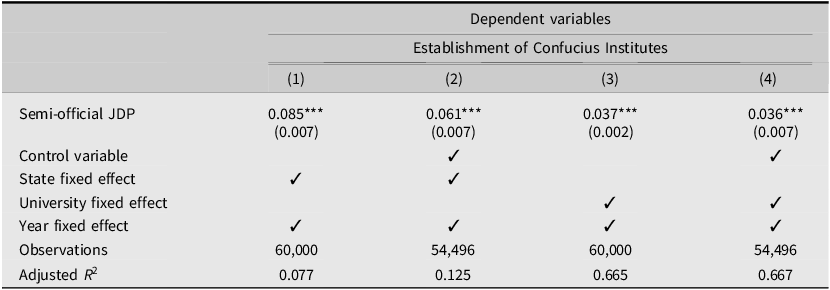
We first focus on the effects of having any semi-official JDPs with China – the most popular type of China–US joint degree partnership – on the establishment of CIs in America. Table 2 reports the baseline results of our linear probability with fixed-effect regression models of 5,000 US universities (2005–2016). We include year fixed effects for all of our models. Columns (1) and (2) report the results of the models with state fixed effects, whereas columns (3) and (4) report the results for university fixed effects. We add control variables in models that are reported in columns (2) and (4). Robust standard errors are clustered at the state (columns 1 and 2) or university (columns 3 and 4) levels.
The effect of semi-official JDPs on the establishment of Confucius Institutes in America
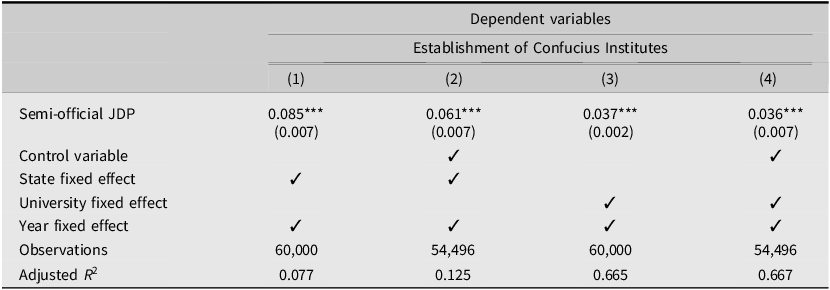
Table 2 Long description
The table presents data on the effect of semi-official joint degree partnerships (JDPs) with China on the establishment of Confucius Institutes in American universities. It includes four columns and five rows of data, with the first row listing the variables and the subsequent rows showing the results of different regression models. The columns are labeled with numbers (1) to (4), and the rows include variables such as Semi-official JDP, Control variable, State fixed effect, University fixed effect, Year fixed effect, Observations, and Adjusted R squared. The table shows the coefficients and standard errors for each model, with observations ranging from 54,496 to 60,000 and adjusted R squared values ranging from 0.077 to 0.667. The data indicates the impact of semi-official JDPs on the establishment of Confucius Institutes, with different fixed effects and control variables included in the models.
*p < 0.1;
** p < 0.05; ***p < 0.01. The control variables include annual student size and Asian student proportions. Robust standard errors are clustered at the state (column 1 and 2) or university (column 3 and 4) levels.
Column (1) shows that US universities with semi-official JDPs are 8.5 per cent more likely to host a CI in a state fixed-effect model. After including the control variables, the effect shrinks to 6.1 per cent (column 2). Column (3) shows that the JDP effect further decreases to 3.7 per cent in a university fixed-effect model. Adding more control variables barely affects the estimated effect (column 4). All of the estimated effects are statistically significant at the 1% level. Table 2 demonstrates that semi-official JDPs contribute to the expansion of CIs in America.
The detailed results of the control variables are reported in the Appendix (Table A2). Only the number of students matters for the establishment of CIs. In particular, American universities with academic disciplines in STEM fields or foreign languages are no more likely to host CIs. The findings cast doubt on the argument that the Chinese government has a master plan of infiltrating sensitive high technology through CIs.
6.2. Heterogeneity analysis
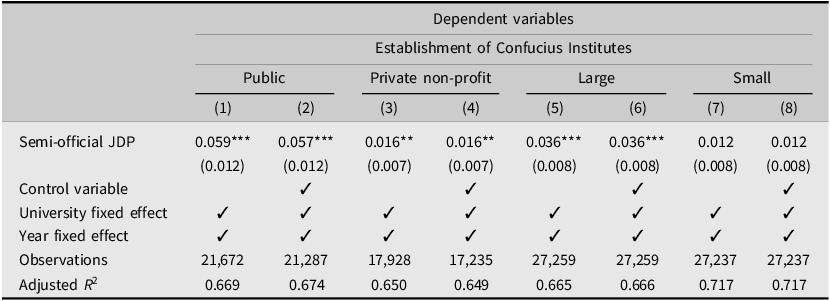
We divide our sample into roughly equal subgroups by college type or student size to study possible heterogeneous effects. We use regression models with year and university fixed effects. The findings are reported in Table 3. The results from models with control variables are reported in even-numbered columns.
Effect of semi-official JDP on establishment of CI by American university types
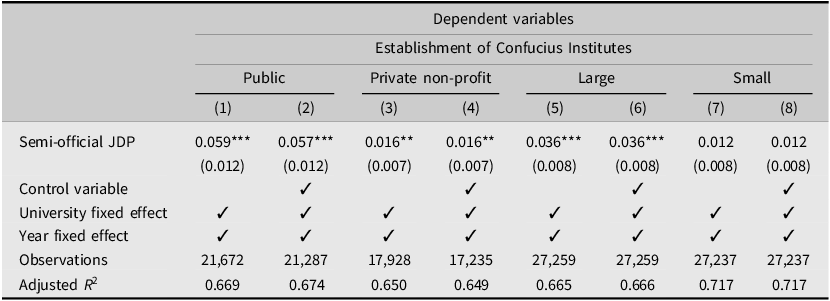
Table 3 Long description
The table presents data on the effect of semi-official JDP on the establishment of Confucius Institutes by different types of American universities. It is divided into columns representing public, private non-profit, large, and small universities. Each column includes data for semi-official JDP and control variables, with university and year fixed effects. The table has eight columns and multiple rows, with observations ranging from 17,235 to 27,259 and adjusted R-squared values between 0.649 and 0.717. Notable trends include significant effects of semi-official JDP on public and large universities.
*p < 0.1;
**p < 0.05;
***p < 0.01. For Panel A, private for-profit universities are omitted for having no Confucius Institutes.
The effects for public and private/non-profit universities are both statistically significant at the 1% level, yet the effect of public universities (approximately 0.057, see columns 1 and 2) is much greater than the effect of private/non-profit universities (approximately 0.016, columns 3 and 4). Our findings confirm the subjective perception that CIs are more likely to occur in public universities. The effects for large universities are estimated at 0.036 (columns 5 and 6), whereas the effects for small universities decrease to 0.012 (columns 7 and 8). Only the effect for large universities is statistically significant. Our findings demonstrate that the effect of JDPs for CIs is mainly driven by large public universities, confirming our hypothesis that such universities are usually more financially dependent on JDPs.
6.3. Robustness checks
Our baseline effect remains robust when we collapse our university-year-level panel data into university-level data (Table A3). Here, we also control for local political ideology. It is well known that Republican politicians and supporters are more likely to oppose CIs (Wainer and Lorin, Reference Wainer and Janet2020). We use the average percentage of presidential election votes for Democratic Party candidates in the county where a university is located to measure local political ideology. We discover that universities in Democratic counties are more likely to host CIs even in models that control for state fixed effects and other background variables. The main effects are still statistically significant at the 10% level.
Our main dependent variable is binary with many zeros. Rare events are known to induce small-sample bias in logistic regression (King and Zeng, Reference King and Zeng2001). We use a linear probability model with fixed effects, a common and defensible approach for panel data with binary outcomes, including in rare-event settings (Angrist and Pischke, Reference Angrist and Pischke2009; Timoneda, Reference Timoneda2021). As a robustness check, Table A4 reports bias-reduced logistic regression estimates using the Firth correction (Kosmidis and Firth, Reference Kosmidis and Firth2009). The results are largely consistent.
We also report the results of the panel and cross-sectional analysis in Tables A5 and A6, respectively.
7. Global evidence
To test our theory at the global level, we make use of the cross-sectional data of CIs and fully approved JDP partnerships between China and all foreign countries.
Both CI and JDP information come from the official source of the Chinese government. The universe of foreign universities is defined as those with a QS World Ranking. The average QS World Ranking (better universities have lower numerical values) is included as a control variable. We also control the Democracy Index (Marshall et al., Reference Marshall, Gurr and Jaggers2019) of the foreign country.
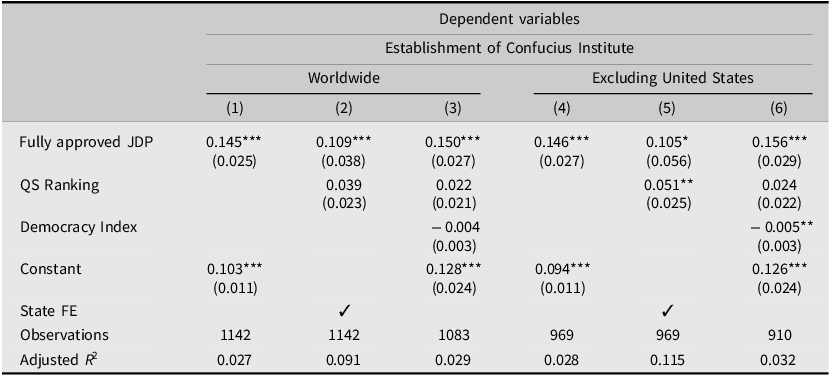
Column (1) of Table 4 shows that at the global level, JDP status is associated with a 0.145 higher chance of hosting a CI. The correlation is significant at the 1% level. The results remain robust after we include state fixed effects in Column (2). Column (3) shows a similarly strong correlation after we control the QS Ranking and the Democracy Index. We then rerun the above regressions after excluding the US universities in our sample. The findings in Columns (4–6) remain robust. Interestingly, the coefficient of the Democracy Index becomes negative and statistically significant after we exclude the US subsample (Column 5), suggesting that the Chinese government prefers to run CIs in democratic countries.
The effect of fully approved JDPs on Confucius institutions at the global level

Table 4 Long description
The table presents data on the establishment of Confucius Institutes, comparing worldwide and excluding the United States. It includes six columns with variables such as Fully approved JDP, QS Ranking, Democracy Index, and Constant. The table has rows for each variable with corresponding values and standard errors. State fixed effects and the number of observations are also included. Notable trends show a positive correlation between fully approved JDPs and the establishment of Confucius Institutes, significant at various levels. The Democracy Index shows a negative and significant correlation when excluding the United States.
*p < 0.1;
**p < 0.05; JDPs with China.
***p < 0.01. The sample only includes universities which own fully approved JDPs with China. QS Ranking data is from Quacquarelli Symonds. Democracy Index if from polity IV project (Marshall et al., Reference Marshall, Gurr and Jaggers2019).
The international evidence lends further support to our theory. Our findings about the CIs in America appear to be generalizable.
8. Discussion
We do not assume that the Chinese central government has a fully coordinated master plan intentionally linking JDPs and CIs, though some level of coordination at the provincial level is plausible. While this paper identifies a robust empirical link suggesting that JDPs serve as a foothold for CIs, this connection may not result from deliberate coordination by a single, unified Chinese government actor. Instead, the evidence points to a highly decentralized process of implementing what appears to be a key foreign policy initiative of the central government. The central government ministry (i.e., the Hanban) signals strong policy priorities and offers institutional support for CI establishment at the provincial and university levels. In turn, provinces and universities, seeking to meet these national goals, may prioritize foreign universities with existing JDPs.
Provincial governments may act as local coordinators in this process. A Monte Carlo simulation shows that if a foreign institution has a JDP collaboration with a Chinese university from province X, it is two times more likely to host a CI from province X than from any other province, even if the CI is not directly tied to its JDP partner (Table A6).
This decentralized process raises important questions about the mechanisms driving the link between JDPs and CIs. One possibility is coercion, such as implicit or explicit threats to withdraw JDPs if foreign universities do not participate in CI initiatives. However, evidence of such coercion remains unproven and may be too subtle to detect. Alternatively, the connection between JDPs and CIs could follow other paths: institutional path dependence stemming from an initial collaboration, or practical demand for Chinese language courses created by JDPs, which CIs are then established to meet. These pathways suggest that the relationship between JDPs and CIs may not always be the result of overt pressure but could emerge from more organic or pragmatic dynamics.
Regardless of the specific mechanism, our findings underscore a critical point: JDPs are significantly correlated with the expansion of a highly politicized Chinese government project. The link between JDPs and CIs highlights how grassroots economic interdependence might advance China’s soft power initiatives. This dynamic illustrates the broader geopolitical implications of seemingly decentralized and voluntary collaborations in higher education.
9. Conclusion
Building on evidence from a novel panel database of US–China higher education partnership networks, we demonstrate that legitimate for-profit joint degree partnerships between American and Chinese universities – the key government-designated arrangement needed to directly access the restricted Chinese higher education market – are correlated with the expansion of CIs in America. Using similar cross-sectional data at the global level, we discover corroborative evidence. Overall, our research highlights the potential geopolitical risks of public institution globalization and commercialization in advanced democracies.
Our paper demonstrates that the alleged soft power of CIs is essentially a derivative of Chinese economic power, or more precisely, the ability of the Chinese government to create leverage over domestic and international universities by setting market barriers to the Chinese higher education market. Chinese soft power contradicts Nye’s (Reference Nye1990) definition of soft power: the ability to do things and control others through voluntary attraction. It fits Nye’s definition of hard power, which is based on coercion or payment.
Our research focuses on why CI expanded so rapidly, but not what CI is supposed to serve. While we acknowledge that CIs are often perceived to be a soft power initiative by the Chinese government, or as a geopolitical risk by the American government, our paper refrains from making such claims. Some authors argue that CIs appear more akin to a pet project of the Chinese government and primarily feed into Chinese domestic propaganda (Starr, Reference Starr2009), in the sense that the rapid expansion of CIs in Western democracies reinforces the Chinese state narrative that Chinese culture is recovering from a century of Western-imposed humiliation under the leadership of the Chinese Communist Party.
The ability of CIs to influence American students and scholars is most likely weak, although some evidence of their soft influence does exist (Brazys and Alexander, Reference Brazys and Dukalskis2019). We also do not assume that the ability of the Chinese government to exploit economic interdependence of universities is unconstrained. The CI partnership network is disproportionately smaller than the vast for-profit joint degree partnership network. Given the tight control the Chinese government has over Chinese universities, the performance of CIs appears rather unimpressive.
Our analysis suggests that Western policymakers should prioritize addressing the issue of market access in China’s higher education sector rather than focusing solely on the alleged security threats posed by various collaboration programmes with China. The former may be a root cause of the latter problem. While it is challenging for the United States to directly influence China’s domestic regulations on higher education, some leverage can be exerted through trade negotiations and broader diplomatic engagements. Notably, the opening of the Chinese education market has not been a significant focus in past trade talks with China. Allowing foreign universities to establish fully owned campuses in China – similar to the rights granted to foreign enterprises to operate as 100% owned entities – could fundamentally reduce the risks associated with the need to form JDPs with Chinese universities.
In addition to addressing market access, it is equally important to tackle the root cause of US universities’ geopolitical vulnerabilities by reducing their financial dependence on foreign partnerships. Domestic regulatory reforms that ensure a clearer separation between foreign capital inflows and university autonomy could provide a more immediate and effective solution. Such measures would not only mitigate risks associated with foreign collaborations but also strengthen the resilience of US universities in the face of growing geopolitical challenges. By addressing both external and internal factors, policymakers can take meaningful steps to safeguard the integrity of higher education institutions while fostering more balanced international partnerships.
Supplementary material
The supplementary material for this article can be found at https://doi.org/10.1017/S1468109926100279
Funding statement
The project benefited from the research grants (RD/2024/2.24, FRSF/2025/02) from Hong Kong Metropolitan University.
The data that support the findings of this study will be made available to the public upon publication.
Competing interests
The author(s) declare none.


 Open access

