


The short-term effect of treatment of social phobia has been demonstrated in several studies, and both cognitive—behavioural treatments and pharmacological interventions have given positive findings (Reference Mattick, Peters and ClarkMattick et al, 1989; Reference Gelernter, Uhde and CimbolicGelernter et al, 1991; Reference Liebowitz, Schneier and CampeasLiebowitz et al, 1992; Reference Versiani, Nardi and MundimVersiani et al, 1992; Reference Davidson, Potts and RichichiDavidson et al, 1993; Reference Heimberg, Salzman and HoltHeimberg et al, 1993; Reference Van Vlet, den Boer and WestenbergVan Vlet et al, 1994; Reference Katzelnick, Kobak and GreistKatzelnick et al, 1995; Reference TaylorTaylor, 1996; Reference Stein, Liebowitz and LydiardStein et al, 1998). The studies vary widely in terms of outcome measures, type of control groups, sample selections and whether treatment is offered individually or in groups, making it impossible to draw meaningful comparisons between studies. A few studies have compared the effect of psychological treatment with the effect of medication (Reference Turner, Breidel and JacobTurner et al, 1994; Reference Heimberg, Liebowitz and HopeHeimberg et al, 1998), but it has been difficult to identify treatments that are clearly superior to others. Which form of treatment is chosen will therefore mainly depend on the patient's preferences and the availability of services. However, the maintenance of treatment effects after cessation of active treatment is also important in this decision.
In this study we examine the effect on generalised social phobia of 24 weeks of treatment with sertraline, with or without the addition of exposure therapy, 1 year after the start of treatment.
METHOD
People aged 18-65 years with generalised social phobia according to DSM—IV criteria (American Psychiatric Association, 1994) of at least 1 year's duration and rated as moderately ill (a score of at least 4) on the overall severity item of the severity sub-scale of the Clinical Global Impression — Social Phobia scale (CGI—SP, range 1-7, Reference Davidson, Potts and RichichiDavidson et al, 1993) were eligible for inclusion in the study. Participants were consecutively recruited from people seeking medical care at 41 different primary care centres in Norway and Sweden (n=289) and from advertisements in newspapers and other media (n=159). Three hundred and seventy-five patients were randomly assigned by a computer to receive double-blind sertraline or placebo in blocks of eight, so that four patients in each block were randomised to each treatment. No other stratification factor was used. Each block was assigned to a specific general practitioner. In both the sertraline and the placebo groups half of the patients were randomly allocated to exposure therapy or to general medical care only. A separate randomisation list was made for exposure or non-exposure treatment. Sealed envelopes for allocations from this list were kept by the investigators and opened after inclusion of the patient into the study. During this procedure equal numbers of participants were assigned to each treatment option in each block. Tablets were packaged and numbered by the sponsor and personally delivered to each investigator. Participants were evaluated at week 24 (post-treatment, n=346) and at week 52 (follow-up, n=328; Fig. 1). Of the original 375 participants, 228 were female and 147 were male; their mean age was 39.8 (s.d.=10.4) years. Mean age at symptom onset was 16.2 (s.d.=9.1) years and the mean duration of illness was 23.6 (s.d.=12.2) years. Patients with comorbid dysthymia or specific phobias were allowed to enter the study; those with panic disorder with onset before social phobia or any other current anxiety or major depressive disorder, substance misuse or an eating disorder were not eligible. In addition, patients with a lifetime history of bipolar disorder or psychosis were excluded. A comorbid psychiatric disorder was diagnosed in 133 (35%) patients; 101 (27%) had phobic anxiety disorder, 6 (1.6%) panic disorder, 6 (1.6%) dysthymia and 20 (5.3%) other diagnoses.
Trial profile.

All patients were scheduled for nine meetings with the investigator during the first 16 weeks of treatment and a final efficacy assessment after 24 weeks. The patients were randomised to four treatment groups and treated by general practitioners for 24 weeks with sertraline or a pill placebo, combined with 12 weeks of exposure therapy or of only general medical care. Exposure therapy was given in eight sessions for the first 12 weeks of treatment. Each of the sessions had an estimated duration of 15-20 min. In the first sessions, main problem areas were identified and agreement was reached about homework assignments. In the remaining sessions, the patients were instructed to gradually expose themselves to feared situations, and to keep exposure homework diaries. Details of the exposure therapy have been published elsewhere (Reference Haug, Blomhoff and HellstrømHaug et al, 2000). At week 24, patients treated with sertraline were significantly more improved than those who did not receive sertraline (χ2=12.53, P < 0.001; OR=0.534, 95% CI 0.347-0.835). No significant difference was observed between those who received exposure therapy and those who did not (χ2=2.18, P=0.140; OR=0.732, 95% CI 0.475-1.134). In the pairwise comparisons, combined sertraline and exposure (χ2=12.32, P < 0.001) and sertraline alone (χ2=10.13, P=0.002) were significantly superior to placebo. Trends towards increased efficacy of exposure alone compared with placebo (P=0.083) and combined sertraline and exposure compared with exposure alone (P=0.059) were also observed. More-detailed results have been presented in an earlier paper (Reference Blomhoff, Haug and HellstroömBlomhoff et al, 2001). One year after inclusion, all patients were asked to participate in a follow-up assessment (week 52). Those who had not improved satisfactorily at the end of week 24 could be offered further treatment during the follow-up period — either psychological treatment or medication, as decided by the clinical judgement of the general practitioner. At week 52 the participants attended an interview and filled in the same questionnaires used for assessment at base-line and at the completion of therapy (24 weeks).
Instruments
The Mini International Neuropsychiatric Interview (MINI—R; Reference Sheehan, Lecrubier and JanavsSheehan et al, 1994) was used to assess DSM—IV psychiatric diagnoses. The Clinical Global Impression Severity Scale (CGI—SP; Liebowitz, 1992) the Social Phobia Scale (SPS; Mattick & Clark, 1998), the Fear of Negative Evaluation (FNE) scale (Reference Watson and FriendWatson & Friend, 1969) and the Marks Fear Questionnaire (MFQ, Reference Marks and MatthewsMarks & Matthews, 1979) assessed the degree of social phobia. The Sheehan Disability Inventory (SDI; Reference Leon, Shear and PorteraLeon et al, 1992) and the mental health sub-scale of the MOS 36-item Short Form Health Survey (SF—36; Reference McHorney, Ware and RaczekMcHorney et al, 1993) assessed daily functioning. The Montgomery—Åsberg Depression Rating Scale (MADRS; Reference Montgomery and ÅsbergMontgomery & Åsberg, 1979) assessed degree of depression. Patients were also asked about their employment, sick leave and medical symptoms during the preceding year.
Statistical procedures
The program SAS version 6.12 for Windows (SAS Institute, 1997) was employed in all analyses. All efficacy analyses were on the intention-to-treat patient population: this population was defined as those who received at least one dose of medication and at least one efficacy evaluation post-baseline. All statistical tests were two-tailed with α=0.05. Sample size calculation was based on an estimated 20% difference between active drug and placebo. This required a sample size of at least 340 patients to detect a significant difference if β=0.10 and the drop-out rate is 35%. This procedure made the study primarily powered for analyses of sertraline v. non-sertraline and exposure v. non-exposure, but allowed also pairwise comparisons between the treatment groups. In the latter analyses, however, the power was reduced and the risk of false-negative results increased. Repeated-measures analysis of covariance for each scale measurement at 24 weeks and 52 weeks was done to test differences between treatment groups globally, adjusted for baseline values at week 0. Multiple ordinal logistic regression was also used to identify any statistical interaction between treatment groups on response. Pairwise comparisons for changes from week 24 to week 52, adjusted for baseline, were made between each of the three active-treatment groups and the placebo-only group. At each time point (24 weeks and 52 weeks) in the time point analyses all groups were compared pairwise, with Bonferroni P-value adjustments for each scale analysed.
RESULTS
Of the 375 patients assessed at baseline, 346 had a post-therapy assessment at week 24, and 328 a follow-up assessment at week 52. Only 18 patients were lost to follow-up between week 24 and week 52. The main reasons for patients dropping out were the lack of perceived need for further treatment, events unrelated to treatment such as moving to another area, or unknown reasons (Fig. 1).
Changes in psychometric scores from baseline to week 52
All four study groups had a significant reduction in scores on CGI—SP (all sub-scales), SPS, Brief Social Phobia Scale (all sub-scales; Reference Davidson, Potts and RichieDavidson et al, 1991), MFQ and FNE (P<0.001) from baseline to week 52. There were also significant reductions in MADRS score and in scores on the SDI and SF—36.
Changes in psychometric scores from week 24 to week 52
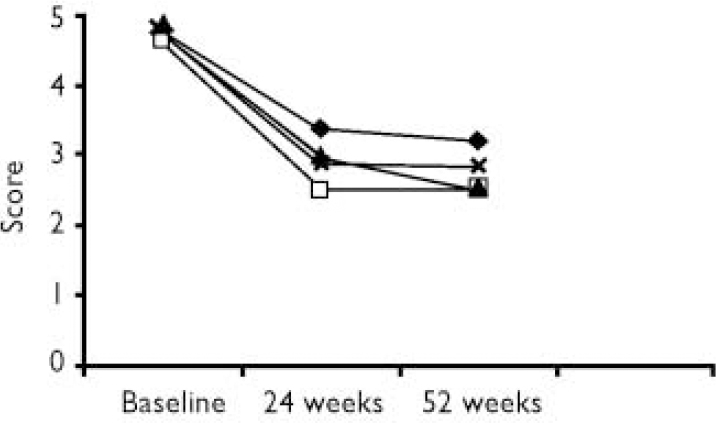
Participants who had been treated with exposure alone had a significant improvement in scores on the CGI—SP overall severity sub-scale (mean change 0.45, 95% CI 0.16-0.65, P<0.01) and disability sub-scale (mean change 0.32, 95% CI 0.06-0.52, P<0.01), and on the SPS (mean change 3.86, 95% CI 1.27-5.64, P<0.01) during follow-up. The placebo-only group also had a significant improvement on the CGI—SP overall severity sub-scale (mean change 0.25, 95% CI 0.00-0.48, P<0.05), disability sub-scale (mean change 0.32, 95% CI 0.08-0.53, P<0.01) and performance sub-scales (mean change 0.36, 95% CI 0.05-0.56, P<0.05). For the sertraline plus exposure and the sertraline-alone groups there was a slight deterioration in scores on most of the CGI sub-scales and on SPS, but the changes were not significant (Table 1, Fig. 2).
Mean scores on the Clinical Global Impression — Social Phobia overall severity sub-scale at baseline week 24 and week 52 (range 0-7). ♦, placebo; □, sertraline + exposure; ▴, exposure; ×, sertraline.
Change in scores on the Clinical Global Impression — Social Phobia (CGI—SP) severity sub-scale and the Social Phobia Scale (SPS) from week 24 to week 52

| Scale | Change in score1, mean (95% CI) | |||
|---|---|---|---|---|
| Placebo (n=82) | Sertraline+exposure (n=83) | Sertraline (n=85) | Exposure+placebo (n=78) | |
| CGI—SP severity | ||||
| Anxiety attacks | 0.26 (-0.02 to 0.50) | -0.01 (-0.23 to 0.21) | -0.05 (-0.28 to 1.19) | 0.14 (-0.14 to 0.39) |
| Avoidance | 0.22 (-0.04 to 0.47) | -0.05 (-0.31 to 0.21) | 0.05 (-0.25 to 0.30) | 0.17 (-0.10 to 0.45) |
| Performance anxiety | 0.36* (0.05 to 0.56) | -0.04 (-0.24 to 0.15) | -0.13 (-0.37 to 0.13) | 0.14 (-0.12 to 0.40) |
| Disability | 0.32** (0.08 to 0.53) | -0.05 (-0.27 to 0.18) | 0.12 (-0.19 to 0.36) | 0.32** (0.06 to 0.52) |
| Overall severity | 0.25* (0.00 to 0.48) | 0.00 (-0.23 to 0.23) | 0.10 (-0.17 to 0.33) | 0.45** (0.16 to 0.65) |
| SPS | 1.66 (-0.61 to 3.93) | 0.42 (-1.42 to 2.25) | -0.18 (-2.18 to 1.82) | 3.86** (1.27 to 5.64) |
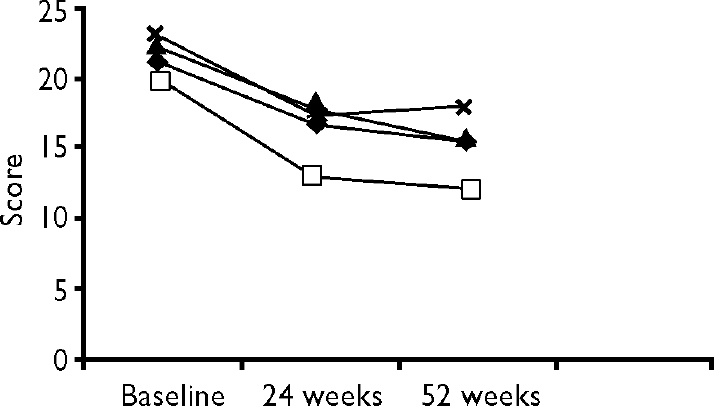
The exposure-alone group had also a significant improvement on the fear and avoidance sub-scales of the Brief Social Phobia Scale (mean changes 1.01, 95% CI 0.06-1.96, P<0.05, and 1.07, 95% CI 0.01-2.14, P<0.05, respectively), MFQ (mean change 3.46, 95% CI 1.27-5.64, P<0.01), FNE (mean change 2.36, 95% CI 0.97-3.77, P<0.01) and SF—36 (mean change 1.34, 95% CI 0.89-1.85, P<0.01) between week 24 and week 52. The placebo-only group had a significant improvement on the Brief Social Phobia Scale fear sub-scale (mean change 1.01, 95% CI 0.03-2.00, P<0.05), MFQ (mean change 3.48, 95% CI 1.12-5.83, P<0.01), FNE (mean change 1.29, 95% CI 0.92-2.65, P<0.05), SDI work sub-scale (mean change 1.07, 95% CI 0.44-1.69, P<0.01), SDI social sub-scale (mean change 0.91, 95% CI 0.27-1.54, P<0.05) and the SF—36 (mean change 1.51, 95% CI 1.01-2.45, P<0.01). For the sertraline plus exposure and the sertraline-alone groups there was a deterioration in scores on SF—36 between week 24 and week 52 (mean change -0.89, 95% CI -1.35 to 1.34, P<0.05; -1.40, 95% CI -1.90 to 1.92, P<0.01, respectively). Other changes were not significant (Table 2, Figs 3 and 4).
Mean scores on the Fear of Negative Evaluation scale at baseline, week 24 and week 52 (range 0-30). ♦, placebo; □, sertraline + exposure; ▴, exposure; ×, sertraline
Mean scores on the 36-item Short Form Health Survey at baseline, week 24 and week 52 (range 0-100). ♦, placebo; □, sertraline + exposure; ▴, exposure; ×, sertraline

Change in scores1 on the Brief Social Phobia Scale (BSPS), the Fear of Negative Evaluation (FNE) scale, the Marks Fear Questionnaire (MFQ), the Sheehan Disability Inventory (SDI), and the mental health sub-scale of the 36-item Short Form Health Survey (SF—36) from week 24 to week 52 (n=328)

| Scale | Change in score2, mean (95% CI) | |||
|---|---|---|---|---|
| Placebo (n=82) | Sertraline+exposure (n=83) | Sertraline (n=85) | Exposure+placebo (n=78) | |
| BSPS | ||||
| Fear | 1.01* (0.03 to 2.00) | 0.08 (-0.84 to 1.00) | 0.21 (-0.84 to 1.27) | 1.01* (0.06 to 1.96) |
| Somatic reaction | 0.06 (-0.54 to 0.66) | -0.40 (-0.93 to 0.13) | 0.11 (-0.55 to 0.76) | 0.05 (-0.44 to 0.54) |
| Avoidance | 0.74 (-0.24 to 1.71) | 0.09 (-0.77 to 0.94) | 0.68 (-0.31 to 1.68) | 1.07* (0.01 to 2.14) |
| MFQ | 3.48** (1.12 to 5.83) | 0.17 (-1.80 to 2.14) | -1.27 (-3.57 to 1.02) | 3.46** (1.27 to 5.64) |
| FNE | 1.29* (0.02 to 2.56) | 0.33 (-0.96 to 1.62) | -0.34 (-1.49 to 0.81) | 2.36** (0.96 to 3.77) |
| SDI | ||||
| Work | 1.07** (0.44 to 1.69) | -0.03 (-0.51 to 0.46) | -0.11 (-0.57 to 0.34) | 0.38 (-0.29 to 1.05) |
| Social | 0.91* (0.27 to 1.54) | -0.18 (-0.68 to 0.31) | 0.08 (-0.44 to 0.59) | 0.64 (-0.08 to 1.36) |
| Family | 0.46 (-0.10 to 1.02) | -0.09 (-0.45 to 0.26) | -0.05 (-0.50 to 0.40) | 0.16 (-0.31 to 0.63) |
| SF—36 | 1.51** (1.01 to 2.45) | -0.89* (-1.35 to 1.34) | -1.40** (-1.90 to 1.92) | 1.34** (0.89 to 1.85) |
Compared with the placebo group, the sertraline-alone group were found to have a significant deterioration on the CGI—SP performance anxiety sub-scale (mean difference in change 0.54, 95% CI 0.13-0.96, P=0.05), MFQ (mean difference in change 4.84, 95% CI 0.95-8.74, P=0.01), FNE (mean difference in change 2.34, 95% CI 0.15-4.54, P=0.03) and SF—36 (mean difference in change -2.92, 95% CI -4.67 to -1.17, P<0.01). There was also a significant deterioration in sertraline compared with exposure on MFQ (mean difference in change 4.10, 95% CI 0.17-8.03, P=0.03), FNE (mean difference in change 3.00, 95% CI 0.78-5.22, P<0.01) and SF—36 (mean difference in change -2.74, 95% CI -4.51 to -0.97, P<0.01). The sertraline plus exposure group had a significant deterioration in SF—36 compared with both exposure-alone and placebo (mean difference in change -2.22, 95% CI -4.02 to -0.43, P=0.01, and -2.40, 95% CI -4.17 to -0.63, P<0.01, respectively). Changes in sertraline plus exposure compared with sertraline alone and in exposure alone compared with placebo were non-significant (Tables 3 and 4, Figs 3 and 4).
Change in scores1 on the Clinical Global Impression — Social Phobia (CGI—SP) severity sub-scale and the Social Phobia Scale (SPS) from week 24 to week 52, adjusted for baseline values

| Scale | Placebo (n=82) | Sertraline+exposure (n=83) | Sertraline (n=85) | Exposure+placebo (n=78) | ||||||
|---|---|---|---|---|---|---|---|---|---|---|
| Mean (s.e.) | Mean (s.e.) | Difference from placebo | Mean (s.e.) | Difference from placebo | Mean (s.e.) | Difference from placebo | ||||
| Mean (95% CI) | P | Mean (95% CI) | P | Mean (95% CI) | P | |||||
| CGI—SP severity | ||||||||||
| Anxiety | -0.29 (0.13) | -0.05 (0.13) | 0.24 (-0.19 to 0.66) | 0.414 | 0.04 (0.12) | 0.33 (-0.09 to 0.75) | 0.156 | -0.13 (0.13) | 0.16 (-0.27 to 0.58) | 0.722 |
| Avoidance | -0.22 (0.13) | -0.01 (0.13) | 0.22 (-0.23 to 0.56) | 0.519 | -0.06 (0.13) | 0.16 (-0.28 to 0.60) | 0.719 | -0.14 (0.14) | 0.08 (-0.38 to 0.53) | 0.948 |
| Performance anxiety | -0.39 (0.12) | -0.01 (0.12) | 0.39 (-0.03 to 0.80) | 0.074 | 0.15 (0.12) | 0.54 (0.13 to 0.96) | 0.005 | 0.09 (0.13) | 0.31 (-0.12 to 0.73) | 0.209 |
| Disability | -0.35 (0.13) | 0.00 (0.13) | 0.35 (-0.07 to 0.77) | 0.125 | -0.12 (0.12) | 0.23 (-0.19 to 0.65) | 0.425 | -0.31 (0.13) | 0.04 (-0.39 to 0.46) | 0.994 |
| Overall severity | -0.25 (0.112) | 0.05 (1.12) | 0.20 (-0.21 to 0.62) | 0.514 | -0.10 (0.12) | 0.16 (-0.26 to 0.57) | 0.702 | -0.43 (0.13) | -0.18 (-0.06 to 0.24) | 0.632 |
| SPS | -2.03 (1.08) | -1.46 (1.07) | 0.57 (-3.02 to 4.16) | 0.966 | -0.31 (1.05) | 1.72 (-1.82 to 5.27) | 0.522 | -3.26 (1.10) | -1.23 (-4.87 to 2.40) | 0.762 |
Change in scores1 on the Brief Social Phobia Scale (BSPS), the Fear of Negative Evaluation (FNE) scale, the Marks Fear Questionnaire (MFQ), the Sheehan Disability Inventory (SDI) and the mental health sub-scale of the 36-item Short Form Health Survey (SF-36) from week 24 to week 52, adjusted for baseline values

| Scale | Placebo (n=82) | Sertraline+exposure (n=83) | Sertraline (n=85) | Exposure+placebo (n=78) | ||||||
|---|---|---|---|---|---|---|---|---|---|---|
| Mean (s.e.) | Mean (s.e.) | Difference from placebo | Mean (s.e.) | Difference from placebo | Mean (s.e.) | Difference from placebo | ||||
| Mean (95% CI) | P | Mean (95% CI) | P | Mean (95% CI) | P | |||||
| BSPS | ||||||||||
| Fear | -1.17 (0.50) | -0.40 (0.51) | 0.77 (-0.92 to 2.46) | 0.571 | -0.18 (0.50) | 0.99 (-0.68 to 2.66) | 0.363 | -1.02 (0.52) | 0.16 (-1.55 to 1.86) | 0.993 |
| Somatic reaction | -0.10 (0.29) | 0.19 (0.30) | 0.29 (-0.69 to 1.28) | 0.828 | -0.06 (0.29) | 0.04 (-0.93 to 1.01) | 0.999 | -0.06 (0.30) | 0.04 (-0.95 to 1.03) | 0.999 |
| Avoidance | -0.83 (0.50) | -0.41 (0.50) | 0.43 (-1.24 to 2.09) | 0.879 | -0.77 (0.49) | 0.06 (-1.59 to 1.71) | 0.999 | -0.99 (0.51) | -0.15 (-1.84 to 1.53) | 0.993 |
| MFQ | -4.22 (1.18) | -2.01 (1.19) | 2.22 (-1.75 to 6.18) | 0.411 | 0.62 (1.15) | 4.84 (0.95 to 8.74) | 0.010 | -3.48 (1.20) | 0.74 (-3.23 to 4.72) | 0.946 |
| FNE | -1.58 (0.66) | -1.09 (0.67) | 0.49 (-1.72 to 2.71) | 0.915 | 0.76 (0.65) | 2.34 (0.15 to 4.54) | 0.033 | -2.24 (0.68) | -0.66 (-2.89 to 1.58) | 0.830 |
| SDI | ||||||||||
| Work | -0.97 (0.29) | -0.08 (0.29) | 0.88 (-0.09 to 1.86) | 0.084 | -0.15 (0.28) | 0.82 (-0.14 to 1.78) | 0.113 | -0.32 (0.30) | 0.64 (-0.34 to 1.63) | 0.286 |
| Social | -0.88 (0.30) | -0.02 (0.30) | 0.86 (0.09 to 1.86) | 0.084 | -0.05 (0.29) | 0.83 (-0.16 to 1.83) | 0.121 | -0.64 (0.31) | 0.24 (-0.78 to 1.25) | 0.903 |
| Family | -0.23 (0.23) | 0.02 (0.23) | 0.25 (-0.52 to 1.02) | 0.782 | 0.07 (0.23) | 0.30 (-0.47 to 1.06) | 0.679 | -0.29 (0.24) | -0.06 (-0.84 to 0.72) | 0.996 |
| SF—36 | 1.51 (0.53) | -0.89 (0.53) | -2.40 (-4.17 to 0.63) | 0.004 | -1.40 (-0.52) | -2.92 (-4.67 to 1.17) | <0.001 | 1.34 (0.54) | -0.18 (-1.97 to 1.61) | 0.991 |
The sertraline plus exposure group had a significant deterioration in MADRS score (P<0.01) between week 24 and week 52. The changes in the other treatment groups were not significant.
Treatment during the follow-up period
Sixty-six patients (20.5%) were treated with selective serotonin reuptake inhibitors (SSRIs): 13 (15.5%) in the combined sertraline plus exposure group, 18 (21.6%) in the sertraline-alone group, 14 (19.2%) in the exposure group and 21 (19.5%) in the placebo group. Twenty-seven patients (7.6%) were offered exposure therapy by their general practitioner during the follow-up period, and 26 patients (7.0%) had been referred to a psychologist or psychiatrist.
Psychiatric diagnoses at week 52
A total of 19 patients (5.7%) had a major depression according to DSM—IV at week 52. Ten of these patients were in the group who had received the combined sertraline and exposure therapy, 2 had received sertraline alone, 4 had received exposure alone and 3 were in the placebo group.
Employment records
At the week 52 assessment 223 patients were employed and 33 were students. About a third (32%) of the patients were on sick leave the year preceding baseline; less than a quarter (23%) were on sick leave the year preceding follow-up. There was also a slight reduction in mean days of sick leave: 15.8 days in the year preceding baseline and 13.0 days in the year preceding follow-up.
DISCUSSION
This is, to our knowledge, the largest follow-up study of the treatment of social phobia, covering 375 patients. The study was carried out in primary care by a total of 45 physicians treating about 8 patients each. The patients were well known to the doctors and this provided an opportunity to make follow-up assessments of nearly all patients. Only 18 patients were lost to follow-up between weeks 24 and 52.
Maintenance of treatment effect
All four treatment groups had a significant improvement from baseline to week 52 on all the psychometric assessments. Patients who had been given exposure therapy or placebo had a further improvement in social phobia after the end of the treatment period, whereas patients who had been treated with sertraline — either alone or in combination with exposure therapy — had no further improvement during the follow-up period and there was a tendency towards deterioration. However, the deterioration was significant only for the score on SF-36 (Table 2). At week 52 the participants in both the sertraline-alone and the combined sertraline plus exposure groups had a significant deterioration compared with patients in the exposure-alone and placebo groups. These results are in accordance with the study by Liebowitz et al (Reference Liebowitz, Heimberg and Schneier1999), who concluded that cognitive—behavioural group therapy and phenelzine differed in their long-term effects, with a more favourable outcome for the group therapy. They also accord with the findings by Marks et al (Reference Marks, Swinson and Basoglu1993), in a multi-centre study of alprazolam and exposure therapy in panic disorder, that gains after alprazolam were lost during follow-up, whereas gains after exposure were maintained. Combining alprazolam with exposure marginally enhanced gains during treatment, but impaired improvement thereafter. Barlow et al (Reference Barlow, Gorman and Shear2000), in a study of imipramine and cognitive—behavioural therapy in the treatment of panic, reported similar results. From this we can conclude that exposure techniques applied in situations with low levels of anxiety achieved by medication may have less impact than exposure therapy applied in situations with a higher level of anxiety, and may lead to a higher degree of relapse after end of treatment. During the follow-up period about a fifth of the patients were treated with SSRIs, 25 (7.5%) were given exposure therapy by their general practitioner and 23 (7.0%) were referred to psychiatrists or psychologists. The treatment was initiated at the discretion of the general practitioners, so we lack information about whether the treatment was given because of insufficient improvement at week 24 or because of relapse. However, this additional treatment might have contributed to the maintenance of treatment effect during the follow-up period.
General effects
A substantial proportion of the patients improved regardless of the treatment given, and even in the placebo-alone group only about a fifth of the patients were in need of additional treatment during the follow-up period. The fact that social phobia was focused on as a problem, combined with regular contact with a general practitioner in a total of 11 sessions over 24 weeks, seemed to be sufficient treatment for many patients.
Methodological considerations
The general practitioners evaluated their own patients at both week 24 and week 52. This lack of masking may represent a potential bias. Since many of these doctors worked in single-handed practices, it was difficult to obtain masked efficacy measures. However, scores on social phobia were achieved both on investigator-rated CGI—SP overall severity and on patient-rated SPS.
To evaluate the specific effects of exposure therapy and sertraline, a waiting-list control group could have been useful. In addition, this study does not inform us of follow-up periods longer than 28 weeks. There was no systematic registration of relapses during follow-up and the physicians initiated additional treatment based on their own clinical judgement. This limits our possibility to draw firm conclusions about maintenance therapy and relapse prevention. However, the study was naturalistic and was conducted in general practice, where most patients with social phobia will have their treatment. The study also had a large sample size, which strengthens the statistical power.
Which treatment should be chosen for social phobia?
Exposure therapy, sertraline and the combination of sertraline and exposure therapy are all effective treatments for social phobia. Sertraline and the combination of sertraline and exposure seemed to have a short-term advantage, but gains were reduced during follow-up. For exposure therapy alone there seemed to be a further improvement after the end of active treatment, and there are indications that exposure therapy alone is more effective in the long term than exposure in combination with sertraline treatment. For some patients, just being in regular contact with a general practitioner focusing on social phobia as a problem is effective.
Clinical Implications and Limitations
CLINICAL IMPLICATIONS
-
▪ Sertraline, exposure therapy, and combined treatment with sertraline and exposure therapy are all effective treatments for social phobia.
-
▪ Treatment with exposure therapy alone seems to give further improvement subsequently, whereas patients treated with sertraline show a tendency towards deterioration after cessation of medication.
-
▪ Exposure therapy given alone is more effective in the long term than when given in combination with sertraline.
LIMITATIONS
-
▪ The general practitioners evaluated their own patients at both week 24 and week 52.
-
▪ There was no waiting-list control group in the study.
-
▪ There was no systematic registration of relapses during follow-up.




eLetters
No eLetters have been published for this article.