





Until 2021, there was no licensed treatment to slow the progression of Alzheimer's disease.Reference Cummings, Lee, Zhong, Fonseca and Taghva1 This significantly limited the treatment offered to people at risk of or diagnosed with Alzheimer's disease or other types of dementia. However, the emergence of a pipeline of drug treatments targeted at disease modification therapies (DMTs), and the growing evidence for dementia prevention through risk reduction, have made the prospect of slowing or preventing dementia a reality.Reference Cummings, Lee, Zhong, Fonseca and Taghva1,Reference Livingston, Huntley, Sommerlad, Ames, Ballard and Banerjee2
To embrace this progress, the current approach to diagnosing and managing Alzheimer's disease through memory assessment and treatment services will have to change.Reference Leroi, Peel, Davenport, Dunne, Ebenezer and Gopakumar3–Reference Liu, Hlavka, Coulter, Baxi, Mattke and Gidengil6 The mode of drug administration (i.e. infusion rather than oral), side-effect monitoring (i.e. serial brain scans), cost of the drug and the need to verify a diagnosis using complex biomarkers in the very earliest stages of the disease all differ from current practices.Reference Liu, Hlavka, Coulter, Baxi, Mattke and Gidengil6–Reference Cummings, Aisen, Apostolova, Atri, Salloway and Weiner9 Introducing these treatments to healthcare systems will likely present a paradigm shift in delivering Alzheimer's disease/dementia services.Reference Liu, Hlavka, Coulter, Baxi, Mattke and Gidengil6
Understanding the perspectives of the public and patients on the acceptability of DMTs for Alzheimer's disease is essential and can inform adequate preparation of services and help manage expectations of DMT eligibility and cost-effectiveness.Reference Thomas, Chalkidou, Cylus, Papanicolas and Smith10 Treatment acceptability is an important subjective evaluation made by individuals who experience (or expect to experience) Alzheimer's disease or deliver (or expect to deliver) an intervention.Reference Sekhon, Cartwright and Francis11 The extent of treatment acceptability can influence its uptake and adherence, and acceptability has become an essential factor in the implementation of new treatments, particularly if additional complexity is involved, such as in the case of DMTs for Alzheimer's disease.
While patient perspectives are vital for addressing immediate needs and current acceptability, insights from the broader public – which includes potential future patients, caregivers, family members and taxpayers – are essential for a comprehensive view of societal values and potential acceptability. This is especially true in countries with public or funded healthcare or a combination of public and private provisions, where the general public, regardless of their current health status, is involved in informing how healthcare resources are allocated.12,13
To date, no definitive study has examined the public acceptance of new Alzheimer's disease DMTs. This leaves open questions on the implementation of the new treatment paradigm for Alzheimer's disease. Recently the theoretical framework of acceptability (TFA) for health interventions was conceptualised, consisting of seven constructs: affective attitude, burden, perceived effectiveness, ethicality, intervention coherence, opportunity costs and self-efficacy,Reference Sekhon, Cartwright and Francis11 all of which are important for successful implementation. In this study, using the TFA as a guide, we aim to examine the public and health professionals’ perspectives regarding (a) the acceptability of new DMTs for Alzheimer's disease; (b) perceptions of DMT risk and benefits; and (c) the public's willingness to pay (WTP) for an Alzheimer's disease DMT and its associated determinants. Lessons learned will provide valuable benchmarks that could be adapted to fit the specific needs and resources of memory services in other small- to medium-sized healthcare systems.
Method
The reporting of this study was informed by the Strengthening the Reporting of Observational Studies in Epidemiology (STROBE) guidelines.Reference von Elm, Altman, Egger, Pocock, Gøtzsche and Vandenbroucke14
Study design and setting
An online cross-sectional survey was developed using adapted scales on knowledge and awareness of dementia, WTP questions from an unrelated study by Harapan and Anwar,Reference Harapan, Anwar, Bustamam, Radiansyah, Angraini and Fasli15 and professional, patient and public contributions, with topic domains mapping onto the TFA. Stakeholder input was gathered as part of a series of workshops regarding DMT service readiness. A survey draft was piloted, and all feedback was incorporated into a final version. The survey was anonymous and took approximately 10–15 min to complete. No financial compensation was provided to respondents. The survey was open from 23 May 2023 to 9 June 2023. Ethical approval for the study was obtained from the HPM/CGH REC Trinity College Dublin on 31 March 2023.
Participants
The survey among the general public was conducted online via the Dynata research company. It was also scripted using Google Forms and emailed to 15 national and local healthcare professional leads specialising in neurocognitive disorders in Ireland. These leads then disseminated the survey link to their extensive networks, reaching over 250 professionals. This network included clinicians in neurology, psychiatry of later life, and medicine for the elderly; nurses, allied health professionals, dementia advisors and medical social workers.
To reach out to the members of the general public in Ireland, Dynata utilised a router for sampling in line with industry standards for online research. Participants were contacted via email invitations, the Dynata app or their membership page. Upon interacting with the platform, participants were offered a variety of surveys to take part in, based on known data about them and their responses to real-time targeting questions.
Participants were provided with the survey details, enabling them to make an informed choice based on their preferences and available time. Although samples from opt-in panels such as these may be subject to unknown selection biases related to people's unobserved characteristics, the use of this data collection method has grown considerably in recent years due to its relative cost-effectiveness, with no indication of inferior results.Reference Johnston, Boyle, Adamowicz, Bennett, Brouwer and Cameron16
Survey structure
The survey comprised a structured questionnaire divided into seven sections, including demographics, disease characteristics, a case study, personal considerations, societal considerations, WTP, and knowledge and understanding of Alzheimer's disease prevention and treatment.
The structure of Ireland's healthcare system, which combines public and private provisions, warrants the importance of assessing the public's WTP for emerging DMTs, reflecting the direct financial implications for the majority of the population not fully covered by public healthcare or private insurance. Access to publicly funded services is cost-free for about 40% of the Irish population. For the rest of the population, access to public healthcare services is available but comes with co-payments attached. Around 40% of residents opt for private health insurance to supplement their healthcare needs.
Study size
The sample size was guided by practical considerations such as the survey company's reach, the accessible participant pool in Ireland and the funding available, aiming for a balance between statistical power and unnecessary use of resources. Thus, 1000 was chosen as the sample size to yield a margin of error of 3% (with 95% confidence intervals). This sample size also aligns with prior research conducted in Ireland that employed a survey company.Reference Walsh, O'Shea, Pierse, Kennelly, Keogh and Doherty17,Reference Teahan, Walsh, Doherty and O'Shea18 Indeed, the sample is broadly representative of the population over the age of 18 in Ireland based on age, gender, marital status, education and employment status, though we acknowledge it is somewhat overrepresented by younger and more highly educated people (see supplementary Table 1 available at https://doi.org/10.1192/bjp.2024.24).
Quantitative variables
DMT acceptance was captured using a 5-point Likert scale, ranging from ‘extremely unlikely’ to ‘very likely’. For the multivariate regression analysis, a new binary response variable, based on the original acceptance variable, was generated to explore the factors influencing DMT acceptance. This binary variable takes a value of 1 if a respondent was likely or very likely to accept a DMT and a value of 0 otherwise.
To assess the WTP for a DMT, we generated a variable to capture the participants’ highest WTP, following the method outlined by Harapan and Anwar.Reference Harapan, Anwar, Bustamam, Radiansyah, Angraini and Fasli15 Specifically, a list of DMT price ranges was presented to respondents (€1–4999; €5000–9999; €10 000–15 000; €15 001–20 000; €20 001–25 000). For each price range, respondents were asked how likely they were to be willing to pay, using a 5-point Likert scale ranging from very unlikely to very likely. If respondents indicated they were likely or very likely to be willing to pay, they were coded as willing to pay. To determine the amount that individuals would be willing to pay, the median of each interval was calculated. If the participant was willing to pay the lowest price (€1–4999), they were assigned the interval of that price range. The price was then increased until the participant was no longer willing to pay, i.e. they answered unlikely or very unlikely. Thus, WTP was defined as the median of the highest accepted price, i.e. the highest price the participants said they were still very likely or likely willing to pay.
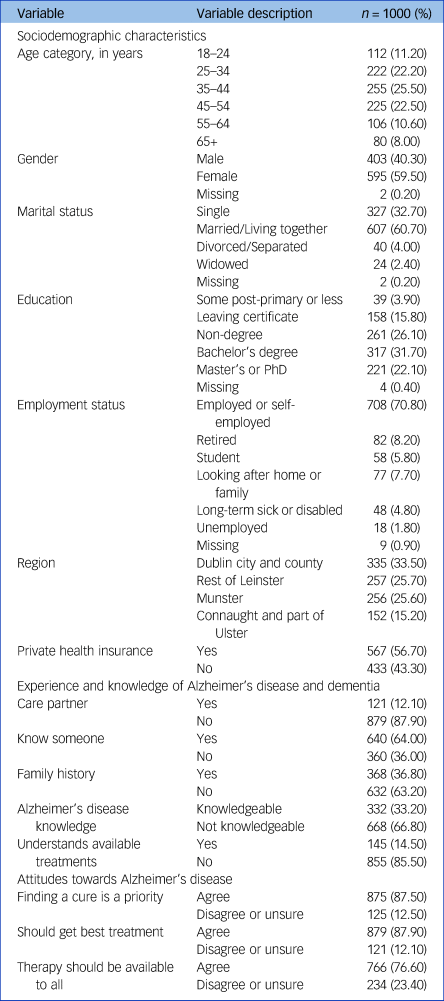
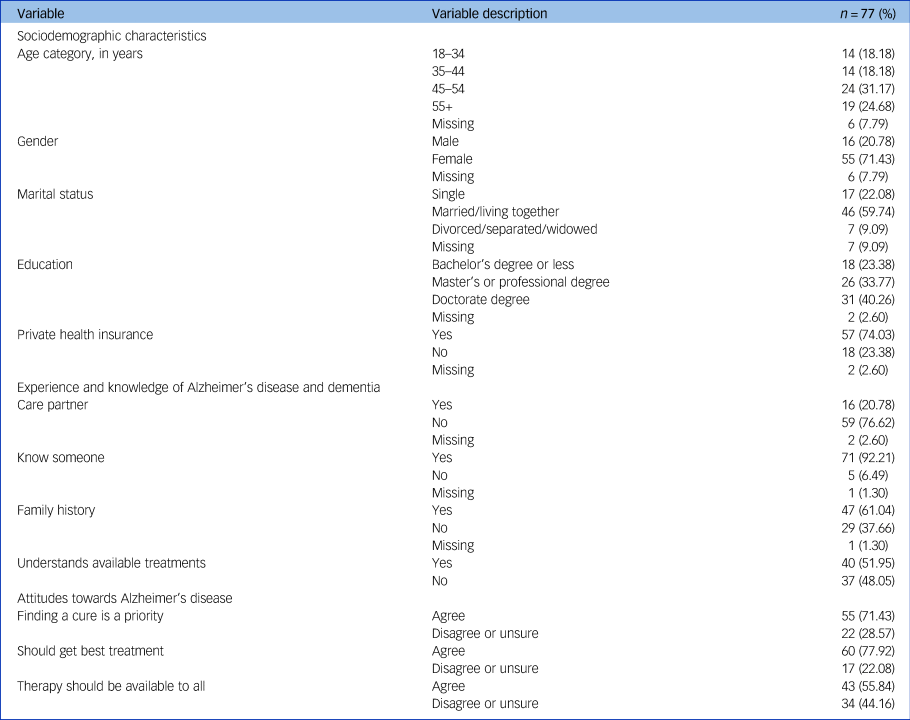
The survey included a number of explanatory variables of relevance to analysing DMT acceptance and WTP. Firstly, perceived knowledge of Alzheimer's disease or dementia was captured using three self-report questions relating to the prevention, treatment and progression of Alzheimer's disease. Respondents were asked to indicate their understanding of these three domains on a 5-point Likert scale. If they indicated that they were knowledgeable or very knowledgeable about any one of these domains, they were coded as being knowledgeable regarding Alzheimer's disease. In addition, respondents were asked to indicate their understanding of available Alzheimer's disease treatments on a 5-point scale. A binary response variable was generated, whereby respondents were coded as ‘understands available Alzheimer's disease treatments’ if they specified that they were knowledgeable or very knowledgeable. Finally, a range of attitudinal questions were included in the survey, which are also included as controls in the regression analysis. In particular, respondents were asked the following: the degree to which they think finding a cure for Alzheimer's disease is a priority; whether DMT should be available to everyone regardless of stage; and whether people with Alzheimer's disease should get the best treatment, even if the government says it is not cost-effective. The remaining explanatory variables are aligned directly to the survey. Full definitions and sample descriptive statistics for all variables are presented in Tables 1 and 2.
Sample characteristics (general public)

Sample characteristics (healthcare professionals)

Statistical methods
A series of descriptive and multivariate regression analyses were undertaken. Descriptive statistics are presented for all demographic and attitudinal variables. In our multivariate analysis, DMT acceptance for individual i is modelled as a function of a vector of personal characteristics $( {X_I^P } )$ and a vector of awareness and knowledge variables $({X_I^K})$
 such that:

Here, DMT Acceptancei is an indicator variable taking a value of one if an individual is willing to accept a DMT and a value of zero otherwise, and ${\rm \varepsilon }_i$ is a stochastic error term. The variables included in $X_I^P$
 are age, gender, marital status, education, employment status, private health insurance status, region and whether the individual is a healthcare professional. The variables included in $X_I^K$
 include whether the respondent is a care partner of someone with Alzheimer's disease, whether they know someone with Alzheimer's disease and whether they have a family history of Alzheimer's disease, as well as the two indicator variables described above capturing knowledge of Alzheimer's disease and understanding of available Alzheimer's disease treatments. In addition, three indicator variables were included, which capture respondents’ attitudes towards Alzheimer's disease, details of which are provided above. Given the binary nature of the dependent variable, a logit model was estimated, and average marginal effects are presented.
In addition, a multivariate regression analysis was undertaken to explore the factors associated with WTP for a DMT. A generalised linear model (GLM) was employed with a log-link and Poisson distribution. The distribution was informed by a modified Park test; the link function was informed by a Pearson correlation test, a Pregibon link test and a modified Hosmer and Lemeshow test. The same explanatory variables were included as detailed above, along with the ordered variable capturing DMT acceptance. Missing data were minimal and not a factor in the analysis. Statistical significance was explored at the 0.05 level, and model fit by the log-likelihood, Akaike information criterion (AIC) and Bayesian information criterion (BIC), and all analyses were performed using Stata 17 for Windows.19
Content analysis was performed for open-text answers relating to factors that participants would consider when deciding whether to accept a new DMT for Alzheimer's disease.
Results
Overview
Tables 1 and 2 present summary statistics on the characteristics of the study participants. Among the general public (Table 1), 12.1% of the sample were a care partner of someone with Alzheimer's disease or another kind of dementia, while 64% indicated that they know someone with Alzheimer's disease or dementia. Respondents were also asked if they have a family history (a blood relative) with a diagnosis of Alzheimer's disease or dementia, and 36.8% indicated that they had. In total, 33.2% of the sample believed they had good knowledge of the prevention, treatment or progression of Alzheimer's disease, while 14.5% believed they understood available Alzheimer's disease treatments.
In the health professional sample (Table 2), most participants were aged 45–54 years, with a predominant representation of females at 71.43%. Similar to the general public, health professionals indicated a strong inclination towards prioritising the search for a cure (71.43% agreement) and ensuring that people with Alzheimer's disease receive the best treatment (77.92%) and making this treatment universally available (55.84%).
Respondents were presented with a two-part case study, and on this basis, they were asked about their likelihood to accept a DMT. Among the general public, 48.4 and 64.9% among healthcare professionals indicated that they were either likely or very likely to accept a DMT, taking its effects, side-effects and other related factors into account. In terms of the factors influencing DMT acceptance, health-related considerations were crucial in the decision-making process. Concerns regarding the risk of brain haemorrhage and the modest effect of DMT influenced 52.4 and 51.1% of general public respondents and 70.1 and 67.5% of healthcare professionals, respectively. The overall health of the individual was a significant consideration for 76% of the general public and 72.3% of healthcare professionals (refer to supplementary Tables 1 and 2).
Interestingly, logistical elements, such as attendance for treatment and travel, also affected decision-making. The need for hospital visits for IV treatment was acceptable to 70.5% of the general public and 82.1% of healthcare professionals. The requirement to travel long distances for treatment was acceptable to 58.5% of the general sample and 70.1% of healthcare professionals. Cost was another important factor, with 65.8% of the general public and 61% of healthcare professionals agreeing or strongly agreeing that it influenced their decision.
Finally, respondents were asked to rank the factors influencing their decision to accept a DMT, from least to most important. The general public identified logistical and economic factors as the most important. Distance to the clinic was the leading factor, with 22.9% of respondents identifying it as the most important factor influencing their willingness to accept DMT. This was followed closely by cost to the individual (21.1%). On the other hand, the effectiveness of the drug was the most critical factor for 61% of healthcare professionals, followed by side-effects of treatment and an individual's risk of Alzheimer's disease at 10.4 and 9.1% respectively.
DMT acceptance
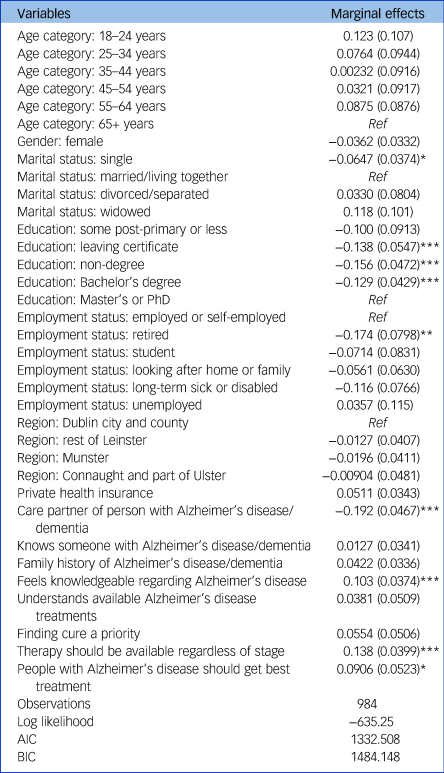
Tables 3 and 4 present the results from our binary logit model of DMT acceptance as estimated average marginal effects. In the general public survey, those who felt more knowledgeable about Alzheimer's disease demonstrated significantly increased acceptance of DMT. This group was 10.3 percentage points more likely to accept DMT compared to those with less perceived knowledge about the disease. Educational attainment was also associated with DMT acceptance. Compared to those with a master's or PhD, those with a bachelor's degree were 12.9 percentage points less likely to accept a DMT. Acceptance was an estimated 13.8 percentage points lower for those with a school leaving certificate and 15.6 percentage points lower for non-degree qualification relative to the base. There were no independent differences in DMT acceptance across age, gender or marital status, but retired individuals were 17.4 percentage points less likely to accept a DMT. Care partners of people with Alzheimer's disease/dementia were 19.2 percentage points less likely to accept DMT, while those that felt DMT should be available regardless of stage were 13.8 percentage points more likely to accept. Knowing someone with Alzheimer's disease/dementia, having a family history of Alzheimer's disease/dementia and perceived understanding of Alzheimer's disease treatments available were not significantly correlated with DMT acceptance.
DMT acceptance, logit model results (general public)

Standard errors in parentheses. AIC, Akaike information criterion; BIC, Bayesian information criterion; DMT, disease-modifying therapy; Ref, reference group. *P < 0.1, **P < 0.05, ***P < 0.01.
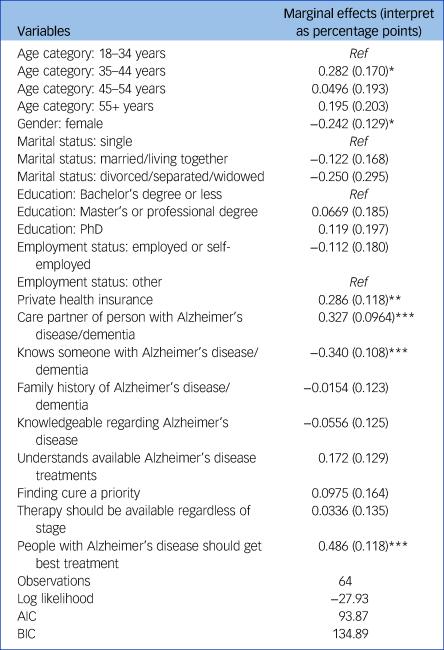
DMT Acceptance, logit model results (healthcare professionals)

Standard errors in parentheses. AIC, Akaike information criterion; BIC, Bayesian information criterion; DMT, disease-modifying therapy; Ref, reference group. *P < 0.1, **P < 0.05, ***P < 0.01.
Among healthcare professionals, females were 24.2 percentage points less likely to accept DMT, while those with PHI were 28.6 percentage points more likely. Unlike the general public, being a care partner of a person with Alzheimer's disease was positively correlated with acceptance, with care partners 32.7 percentage points more likely to accept DMT. Those who believed people with Alzheimer's disease should get the best treatment, even if the government say it is not cost-effective, were 48.6 percentage points more likely to accept.
Willingness to pay
Supplementary Table 3 presents results from the GLM model of WTP among the general public. We find that 18 to 24-year-olds are willing to pay 67.5 percentage points more than those aged 65 or over, while those with private health insurance are willing to pay 28.6 percentage points more than those without. Those with a non-degree qualification are willing to pay 45.2 percentage points less than those with a master's/PhD. As expected, those less likely to accept a DMT personally have a lower WTP. Specifically, compared to those who are very likely to accept a DMT, those who are unlikely and extremely unlikely to accept a DMT are willing to pay 62.2 and 98.6 percentage points less, respectively, while those who are unsure are willing to pay 48.6 percentage points less.
Qualitative analysis of open-ended questions
Through a content analysis of open-text responses, several themes emerged regarding the factors influencing the decision to take a new DMT. These themes include:
Cost and accessibility
Respondents highlighted the significant expenses associated with the treatment. They questioned the government's decision not to subsidise or fully cover these costs. Additionally, concerns were raised about the extra costs for travel, especially if the treatment centre is located in an urban area, and there is a potential for necessary overnight stays.
Efficacy and safety
Participants expressed reservations about potential side-effects. They sought robust evidence demonstrating the drug's effectiveness over its duration before considering it. The actual length and effectiveness of the treatment were also topics of concern.
Personal factors
Age was frequently mentioned, both in terms of cost justification and treatment appropriateness. Specific existing health conditions, like a family history of brain haemorrhage or current smoking habits, were deemed potential disqualifiers for DMT.
Support and approval
The importance of family backing and consensus from loved ones was a recurring theme. Concerns also emerged regarding the drug's approval status in Europe and calls for more comprehensive research.
Equity and quality of life
Participants expressed concerns about ageism in healthcare and emphasised that access to treatment should not be determined by financial standing. Additionally, reflections on the inevitable nature of death were shared, with some indicating they might be more inclined to use the treatment if they were younger or experiencing severe symptoms.
Governmental and support concerns
Questions arose about government funding priorities, especially in the face of the high costs. There were also apprehensions about potential treatment failure and the subsequent support mechanisms in place for such scenarios.
Discussion
This study is an online cross-sectional survey aimed at understanding both clinical and lay perspectives regarding the new DMTs for Alzheimer's disease. This survey touched on various aspects including the acceptability of these DMTs, their perceived benefits and risks, and the public's WTP for such treatments.
From our findings, health professionals showed a higher acceptance rate towards the DMTs at 65%, as opposed to the general public whose acceptance stood at 48%. Intriguingly, a significant 25% of the general respondents expressed that they were either unlikely or extremely unlikely to consider the treatment.
The 25% non-acceptance rate among the general public is counterintuitive, especially given the prevalent societal fear of conditions like dementia among those over 50.Reference Bystad, Grønli, Lilleeggen and Aslaksen20 This discord between a high level of societal fear and hesitancy to consider a potential treatment raises questions about risk perception and healthcare literacy. While our study found that perceived understanding of Alzheimer's disease treatments did not correlate significantly with DMT acceptance, it is important to note that the public's awareness often takes shape through media narratives rather than through clinical public health campaigns.Reference Wakefield, Loken and Hornik21
Through the survey, we identified various factors that may influence the acceptance of DMTs for Alzheimer's disease. Both health professionals and the general public shared concerns over health risks, such as potential brain complications. However, health professionals were significantly more worried about brain bleeds (70% among professionals versus 52% in the public) and the limited efficacy of the treatment (68 versus 51%). When it came to logistical aspects like consistent clinic visits and the associated travel, both groups considered them important; however, health professionals showed a higher adaptability to these challenges.
These findings bring another interesting observation: while the professionals focused more on the actual efficacy of the treatment, the general public weighed logistical and economic factors more heavily, emphasising issues like the convenience of clinic locations and the cost of treatment. Again, despite the promise of a potential cure, many view the treatment through the lens of their daily lives and practical considerations. This strong focus on practical and financial aspects among the public suggests a need for shared decision-making when discussing whether DMTs are appropriate.
Furthermore, if a large segment of the public base their treatment decisions on economic factors, questions arise about ensuring equitable access, especially if the costs become a barrier for certain individuals. The qualitative analysis of open-ended questions reinforced issues of healthcare equity, such as ageism and financial accessibility. Some participants also voiced concerns about the potential lack of support services if the treatment failed. As DMTs are introduced into the healthcare system and reach the implementation stage, considerations should be given to improving their accessibility. Strategies could include creating easier access to clinics or offering subsidies to make the treatments more financially attainable and integrated with current healthcare delivery.
When examining WTP, it was observed that younger people, those with higher education and those with private health insurance were more inclined to accept DMTs. There is a notable connection between an individual's personal acceptance of DMTs and their WTP.
Strengths and limitations
The study included a sample that is broadly representative of the Irish population over the age of 18 across demographics like age and gender. Results provide valuable insights into both healthcare professionals’ and the general public's attitudes toward DMTs for Alzheimer's disease, essential for effective future implementation. The study goes beyond mere acceptance rates, exploring different factors that might influence opinions, such as risk perception and WTP, thereby offering a nuanced understanding of public and professional perspectives. As the treatment in question is not yet available in Ireland, nor Europe, the study offers a timely exploration of potential barriers and facilitators, aiding in proactive planning for its introduction.
However, despite the sample's broad representativeness, it is somewhat overrepresented by younger and higher-educated individuals. This could be a limitation, given that Alzheimer's disease is more common with age and among less educated people. The study's cross-sectional design only allows for the identification of associations, but not causation. The results from the regression analysis should therefore be interpreted as independent associations rather than causal links. Although developed in consultation with experts, the WTP metric has its own interpretive limitations. Future research could benefit from more robust methods like discrete choice experiments for a deeper understanding of the WTP for DMT for Alzheimer's disease.
Despite these limitations, the study makes a novel contribution to the understanding of attitudes and concerns regarding emerging DMTs for Alzheimer's disease among healthcare professionals and the general public. This points to the need for a holistic approach incorporating educational initiatives, policy changes and support mechanisms to address these concerns and barriers, facilitating wider acceptance of DMTs in the management of Alzheimer's disease.
Conclusion
The pivotal role of education and profession in DMT for Alzheimer's disease acceptance highlights the impact of socioeconomic variables on how individuals access, interpret and utilise health information. This suggests potential disparities, as older adults or those lacking private insurance might find DMTs less accessible, leading to concerns about equitable health care access.
Given the pronounced willingness among younger demographics and those with advanced education, there is an evident need for healthcare policymakers to implement strategies or offer financial aids. This ensures that treatments remain accessible to older adults or those without extensive educational backgrounds.
These findings open up a broader ethical debate. Considering the public's varied responses, should there be a push to make the treatment compulsory? And if so, how can health professionals align this with respecting individual patient autonomy? It is a delicate balance, and one that needs thoughtful contemplation as we move forward with DMTs for Alzheimer's disease.
Future studies could employ more in-depth methodologies to better understand why specific demographic groups, especially the younger and more educated, display a heightened acceptance and WTP. Unpacking these insights could significantly enhance public health outreach and implementation strategies formulation.
Supplementary material
Supplementary material is available online at https://doi.org/10.1192/bjp.2024.24
Data availability
The data that support the findings of this study are available to other researchers upon reasonable request to the corresponding author, I.K., upon reasonable request. The analytic code supporting the findings is available to other researchers upon reasonable request to the corresponding author.
Author contributions
I.K. wrote the manuscript and S.W. conducted the analysis. All authors provided expertise from their respective fields and were involved in writing, review and editing.
Funding
This work was funded by a grant from the Irish Research Council's New Foundations scheme, awarded to I.L. It was supported by the Health Service Executive's National Dementia Office; the Alzheimer Society of Ireland; and the Global Brain Health Institute. I.K.'s research position is funded by a Health Research Board fellowship. The Health Research Board (HRB) is a State Agency under the Department of Health. The funding agency has in no way influenced the content of this article, which is independent academic research.
Declaration of interest
I.L., S.P.K. and S.O. participated in Advisory Groups with Biogen and Roche. None of the other authors declare any conflicts of interest.


 Open access


eLetters
No eLetters have been published for this article.