

On April 10, 1929, Pierre Bordes, the governor general of Algeria, issued a circular to the prefects of Algiers, Oran, and Constantine, and to the military commanders of the Southern Territories,Footnote 1 calling for a “general survey of the native female workforce.”Footnote 2 This administrative survey, which was aimed at producing both quantitative and qualitative information, was part of a plan by the colonial authorities to reform vocational training and to revitalize the handicrafts in the run-up to the centennial of French rule in Algeria. This policy met demands regarding the status and schooling of Muslim women,Footnote 3 as well as the growing desire to mobilize Algerian workers, including women, who were more than ever “called upon to collaborate effectively in the economic progress of the Colony,” as Bordes wrote in his circular.Footnote 4
Because of its scope and purpose, the 1929 survey is a valuable source for documenting the labor of Algerian women under colonial rule, as well as the administration’s growing interest in regulating it.Footnote 5 While the history of women’s work in colonial Algeria remains relatively unexplored—apart from emblematic groups such as domestic servants and sex workersFootnote 6—this survey sheds light on a less studied group: female artisans. Although they have received less scholarly attention, they epitomize another facet of colonial domination: the integration of women’s labor into global markets. In line with Muriam Haleh Davis’s work on racial capitalism in Algeria, this article shows how cultural representations of Algerian women shaped both the conditions and the forms of their economic participation within state-sponsored handicrafts, characterized by the promotion of home-based labor.Footnote 7 The survey process itself, despite its gaps and biases, reveals how the conflicting views of colonial administrators on women’s labor influenced the vocational education policy designed to manage and control women’s work. Making that work visible, classifiable, and governable served broader ideological goals: to showcase the effects of the so-called “civilizing mission” and to demonstrate the potential for the integration of Algerian women into the colonial economic order. This article thus contributes to a growing literature on social surveys as an instrument of imperial governance and domination.Footnote 8 Focusing on the methodology of a single survey, it argues that Algeria served as a laboratory for quantifying women’s labor under overlapping political, economic, and moral imperatives. It also resonates with recent work on censuses and inquiries into living standards in colonial Algeria, which identify the interwar period as a pivotal moment, when statistical surveys proliferated across the Maghreb.Footnote 9 The 1929 survey reflects the central administration’s ambition to collect data, yet in practice it relied on locally devised methods shaped by officials on the ground and their interpretation of loosely defined protocols. The survey lies at the intersection of the emerging practice of collecting labor statistics, the bureaucratic culture of administrative reporting, and the production of ethnographic knowledge about colonized women in the late 1920s.
Sara Rahnama has recently drawn scholarly attention to this survey’s significance for understanding colonial policies toward women in the interwar period; however, her work does not examine the figures themselves and relies on a limited set of sources.Footnote 10 This article draws on a broader range of archival material to shed light on the origin of the survey and its implementation, paying particular attention to the men and women who requested, collected, formatted, and transmitted the data at the various levels of the colonial bureaucracy. It situates the statistical moment of 1929 within longer standing practices of quantification of women’s work, taking into account missionary perspectives, which have often been overlooked in state-centered analyses. This article thus contributes to a more nuanced and relational understanding of the colonial state, showing how statistical knowledge was produced through collaboration, and sometimes tensions, between central authorities, local administrators, missionaries, and other intermediaries. Ultimately, it reveals the difficulty of defining and governing forms of work that blur the lines between home-based labor and wage labor. It also shows how the authorities struggled to define useful categories for educational and economic policies that sought to transform Algerian women workers into human resources in the service of colonial mise en valeur.Footnote 11
First, I outline the political context in which the survey was commissioned, in order to provide a clearer picture of its goals. Then, I focus on the measurement criteria used, raising the thorny issue of how to define the “native female workforce.” To this end, this article relies on correspondence from the Department of Handicrafts (Service de l’artisanat), an office of the General Government of Algeria. The study then examines the making of the survey, drawing on the ninety-seven reports scattered in the collections of the Archives nationales d’outre-mer (ANOM), which houses the records of the French colonial administration: ten reports from the military territories of Touggourt and Ghardaïa, eighty-six from the prefecture of Algiers, and one, together with correspondence, found in the archives of the subprefectures of Medea and Tizi-Ouzou.Footnote 12 No reports from the departments of Oran and Constantine were found in the ANOM, nor from the military territories of the Oases and Aïn-Sefra, which raises questions that I attempt to address in the conclusion; however, a copy of a report from the Oases Territory was found in the missionary archives of the White Sisters.Footnote 13 A close examination of these documents makes it possible to reconstruct the chain of information collection and transmission, and to highlight the political and personal interests underlying it. Finally, I take a closer look at the example of the Missionary Sisters of Our Lady of Africa, commonly called the White Sisters, who were prolific producers of data on women’s work.Footnote 14 This Catholic congregation ran the largest network of private workshops in Algeria (22 by 1929). Initially conceived as a means of reaching out to Algerian women and children (the targets of their mission), these workshops became centers of vocational training and women’s artisanal labor from the 1900s onward.Footnote 15 Their archives provide insight into the multiple uses of everyday accounting practices in the workshops and their gradual standardization.
Between “civilizing mission” and economic development: Colonial policies and the question of women’s work
In the preamble to the circular he sent in 1929, Pierre Bordes, who had been governor general of Algeria since 1927,Footnote 16 recalled “the impetus given to artisanal institutions, in order to provide Muslim women with the education and material resources they need to obtain gainful employment and gradually abandon ancestral customs to meet the demands of modern life.”Footnote 17 He emphasized the two objectives of the “native policy” in the 1920s: the so-called “civilizing mission,” which sought to transform social and cultural practices of colonized peoples, and the promotion of economic development through the expansion of wage labor.Footnote 18 He also situated the survey within the artisanal policy that had been in place since the beginning of the twentieth century. A first attempt to renew local handicrafts through vocational training had been initiated by the Algiers académie in the 1900s.Footnote 19 This policy gained significant momentum in the 1920s with the establishment of the Maison de l’artisanat (House of Handicrafts) in 1925. This institution included two training workshops, an exhibition hall, and the offices of the new Department of Handicrafts. Its objectives were to create weaving workshops across the country directly overseen by the central administration, to train female artisan-instructors, and to facilitate the sale of textile items (e.g., high-pile carpets, wall hangings, woolen clothing, lace, and embroidery) produced in workshops.Footnote 20
Weaving was a common domestic activity for women across Algeria, typically carried out at home by women within the family or together with other women from the village. It was primarily intended to meet household needs, such as clothing and home furnishings, but in some regions, woven goods were sold outside the home and circulated to other areas by local merchants.Footnote 21 Thus, this activity was not newly introduced by the colonial workshops; rather, they sought to take control of it, as it offered both a means of penetrating the private sphere of colonized women and an economic opportunity. The products of these workshops were marketed as “authentic” North African handicrafts, but were in fact adapted to suit the needs and tastes of a European clientele in both Algeria and mainland France—a classic case of the “invention of tradition.”Footnote 22
In 1927, the General Commission for the Centennial, which was created to coordinate preparations for the celebration of French Algeria’s centennial in 1930, allocated almost 4 million francs for artisanal education and industry.Footnote 23 Out of this, the Department of Handicrafts—officially set up in April 1929 within the General Government, although it had already existed de facto within the House of Handicrafts—received 800,000 francs for the development of women’s artisanal education. This sum was intended to finance the creation and equipping of public workshops, training expenses for 2 years, and the development of home-based work. These workshops were meant to serve as a showcase for the French “civilizing mission” and “native policy” on the occasion of the centennial, and to provide objects for the exhibitions that were planned as part of the festivities. Seven “wool-working centers” were planned to be created throughout the colony.Footnote 24 The survey may have been commissioned in the meantime to extend this list and to guide the use of the funds by making an inventory of local needs and the potential for expansion of home-based work.
The survey also reflects concerns about the status and living conditions of Algerian women. Since the French conquest, the alleged oppression of women had been used as proof of the “backwardness” of Muslim societies, thereby legitimizing the colonial project. But the inaction of colonial authorities toward women was highlighted after the First World War, when the Algerian elite and middle classes were increasingly calling for the schooling of girls.Footnote 25 Governor General Bordes presented the development of vocational education as a way of meeting these demands without upsetting the racial and gender hierarchies in the colonial society. He invoked colonialist stereotypes such as women’s confinement and the “inherent laziness” of Muslim women, which were said to be preventing married women from working outside the home.Footnote 26 Many administrators used the same racist and sexist rhetoric in their responses to the survey.Footnote 27
Beyond this rhetoric, there was also an economic issue at stake. In Algeria, statistics on women’s work emerged at the beginning of the twentieth century, with a survey of the workforce, both male and female, in the rural villages of the Algiers department,Footnote 28 followed by a first study carried out in Algiers by Germaine Laloë in 1910.Footnote 29 It was commissioned by the colonial administration, which published and widely disseminated its conclusions.Footnote 30 This interest echoed the debates in mainland France, where a new delimitation of the working and non-working populations had emerged in the late nineteenth century, driven by the political need to identify productive forces.Footnote 31 Instead of assigning all the members of a household to the profession of the head of the family, censuses of professions were individualized, which shed new light on women’s work and raised the issue of how it was to be classified. By the 1920s, the need for an updated census of the Algerian workforce arose because the colonial authorities were concerned about the need for workers in both agriculture and industry, in order to implement the mise en valeur program.Footnote 32 In 1926, Bordes’s predecessor, Maurice Violette, commissioned a study as part of his project to reform vocational education and to collect economic data for circulation among private companies, with the goal of promoting their implantation in Algeria.Footnote 33 It counted 25,821 “native” women working in the industrial and artisanal sectors.Footnote 34 The 1929 survey was supposed to extend this initiative. It was also taken up at a broader scale by the Ministry of the Colonies, which commissioned a survey on the workforce in all the colonies in November 1926.Footnote 35
The commissioning of a survey also met the demands of the academic community, which was eager for figures. A few days before Bordes’s circular, a law student from the University of Algiers wrote to the Central Statistical Office of the General Government—which had just been createdFootnote 36—requesting documentation for a study on the “native female workforce in Algeria.”Footnote 37 The Department of Native Affairs pointed out that a general survey was underway to complement Laloë’s monograph and the results of the 1926–1927 survey.Footnote 38 Private companies were making similar requests. For example, in June 1928, the administrator of a carpet company in Marseilles wrote to the governor general to inquire about the possibility of setting up a weaving factory in Algeria in order to address the shortage of Armenian workers, whom he normally employed in metropolitan France: “We believe that Algeria is particularly well placed to provide us with all the workforce we need.… We foresee the use of 1,000 to 1,500 female workers.”Footnote 39 This request reflects changing perceptions in the business community, which regarded Algeria as an almost infinite reservoir of cheap labor. However, no location met all the conditions required by the manufacturer.Footnote 40 Three months later, another company, Thébault, considered moving its lace workshops from the island of Majorca to the Kabyle village of Djemâa-Saharidj to take advantage of lower tariffs.Footnote 41 The growing political, academic, and economic interest in women’s labor thus led to the urgent need for a survey to identify potential reservoirs of labor in each district.
Defining and measuring women’s work
In his 1929 circular, Pierre Bordes detailed the quantitative and qualitative information that was to be collected by administrators in the field:
I would therefore be grateful if you could arrange for a general survey … on native women working, either alone outside their homes, or grouped together in various industrial establishments, or finally at home. The detailed information to be provided by the local authorities and then recorded in a general report for your department should cover the number of women workers in each category, their working conditions and hours, the wages they receive, etc.Footnote 42
These were the only instructions issued by the General Government. No specific form or questionnaire was laid down, leaving broad discretion to the prefects and deputy prefects in determining the scope of the survey, formulating the questions, and formatting the data.
The first ambiguous point was the age group covered by the survey. At that time, the colonial administration was struggling to enforce a minimum age for “native children” to enter industrial work: applying a French law from 1874, a decree in 1909 set the minimum age at 12,Footnote 43 but twenty years later, this was still being challenged by requests from manufacturers to postpone its application.Footnote 44 Around 500 girls also worked in the vocational courses attached to the “native schools” in the Algiers académie.Footnote 45 Should these young apprentices be counted as workers, especially for the purposes of a survey aimed at developing vocational training? Attitudes were divided: some administrators mentioned these institutions without counting their students among female workers; others included them, particularly in the case of missionary workshops.Footnote 46 But regardless of their ambiguous status and the difficulty of accounting for them in the survey, these apprentices were already integrated into the colonial economy: they received a small remuneration, they were targeted as potential future home-based workers, and the production of the school workshops was sold on the market.
The second ambiguous point had to do with the inclusion in the survey of agriculture and domestic work, the two main sectors in which Algerian women were employed. These sectors had generally been of little interest to the authorities: the Labor Inspectorate (created in 1909) confined itself to the industrial and commercial sectors. In 1929, some deputy prefects restricted the survey to industry,Footnote 47 while others did not specify sectors.Footnote 48 This led to hesitation on the part of some local administrators: one of them stressed that he would “report only for the record women working in the fields … as these categories of workers do not seem to fall within the scope of the study.”Footnote 49 In his final report, the prefect of Algiers included agricultural labor, but he restricted it to specialized tasks which could be industrialized, such as packing fruit or drying tobacco.Footnote 50 He excluded data on domestic servants (except within the city of Algiers) and general agricultural work, although numerous reports mentioned it.Footnote 51 There are two likely reasons for this choice. First, the survey was carried out by the Department of Handicrafts to guide its reforms, and not by the Department of Agriculture, Trade, and Colonization; the “native agricultural workforce” would be the subject of another survey, to be launched the next year by the Department of the Workforce.Footnote 52 Second, as the prefect pointed out, the female agricultural workforce “constitutes a floating mass that obviously eludes statistics.”Footnote 53
This highlights the main problem administrators faced in collecting and sorting data: how can home-based work be measured? This statistical difficulty regarding women’s work has been discussed extensively and in many contexts, as it testifies to the difficulty of defining the boundaries of the labor market itself.Footnote 54 As noted above, the 1929 survey aimed at assessing the female workforce, which led to an accounting of paid home-based work done by women (regardless of the husband’s occupation, which was never mentioned). But it also sought to estimate domestic activities that could become market activities if taken over by colonial institutions. The colonial authorities saw women who wove for domestic needs as a potential labor pool already skilled in handicrafts, which could be mobilized in the system of home-based work set up by most of the newly established workshops, providing home workers with equipment, raw materials, and patterns, and managing the sale of their products. Bordes’s circular emphasized that particular attention should be given to home-based work, and asked for “measures that could … encourage its development.”Footnote 55
Indeed, most of the centennial funds allocated to the Department of Handicrafts were earmarked for the purchase of 200 looms and 120 spinning wheels to develop home-based work under the supervision of the workshops. With the 1929 survey, the colonial administration sought to identify areas where these looms could be distributed to trained home-based workers. Some reports also attempted to assess the economic value of domestic handicrafts using available data: for example, by indicating the number of pieces a woman could produce within a given period, along with the average selling price.Footnote 56 In doing so, the administration was not merely collecting descriptive data, but producing new economic categories that challenged the conventional boundaries between domestic and market labor. In this respect, the 1929 survey was attempting to count women who in metropolitan France would have been classified as part of the inactive population, but in the colonial context were seen as a latent workforce that could be exploited.Footnote 57 This reveals how Algeria functioned as a laboratory for the French state. By targeting domestic, informal, and often invisible forms of labor, the administration was testing strategies to incorporate unpaid or underpaid female labor into broader circuits of production and consumption, without requiring the dismantling of existing household structures. In that sense, the colonial space was a field of innovation where new labor regimes could be imagined, tested, and rationalized under the guise of both economic modernization and cultural uplift.
In most cases, however, the criterion for coming within the scope of the study was the payment of a wage, although there were undoubtedly many gaps. Women who hired themselves out to help a neighbor with her weaving were included,Footnote 58 as were agricultural workers regularly employed on European farms.Footnote 59 Likewise, most administrators, guided by a racist and culturalist perspective, excluded “nomadic” women from their censuses, deeming them incapable of holding a wage job or being trained.Footnote 60
Understanding these objectives gives us a better idea of the parameters set out in Bordes’s circular. The first was the number of women engaged in paid work. By aggregating data from the districts within his department, the prefect of Algiers was trying to estimate the size of the workforce that could be mobilized, rather than reporting a strict reality. When administrators provided him with a range rather than one precise figure, he systematically chose the highest value.Footnote 61 In some reports, the number of women who knew how to weave was provided, in addition to the number of women who were earning an income from weaving.Footnote 62 The second parameter was wages, paid by the hour (for cleaning women), by the day (most often), by the month (for live-in maids), or by the piece (for handicraft work), although in this last case administrators converted it into a daily wage in their reports. This was an important piece of information, since the official aim of the workshops was to provide paid opportunities—seen as a path to emancipation—for working-class women.Footnote 63 The deputy prefect of Tizi-Ouzou argued that paid work done by women had a moral and social purpose, and was not intended to be profitable.Footnote 64 This may explain why no data were requested on the yield of this work nor on the cost of production. While they did indicate the types of product manufactured, most administrators said little or nothing about the volume of production or the selling price. It seems that, for at least part of the colonial administration, women’s labor was often valued more for its political significance than for its actual economic output. Finally, the request for details on working conditions and working hours provided an opportunity for administrators to describe the jobs or tasks performed by women and how the work was organized. However, some respondents neglected this point, which required more detailed responses.
Collecting data in the field, relying on intermediaries
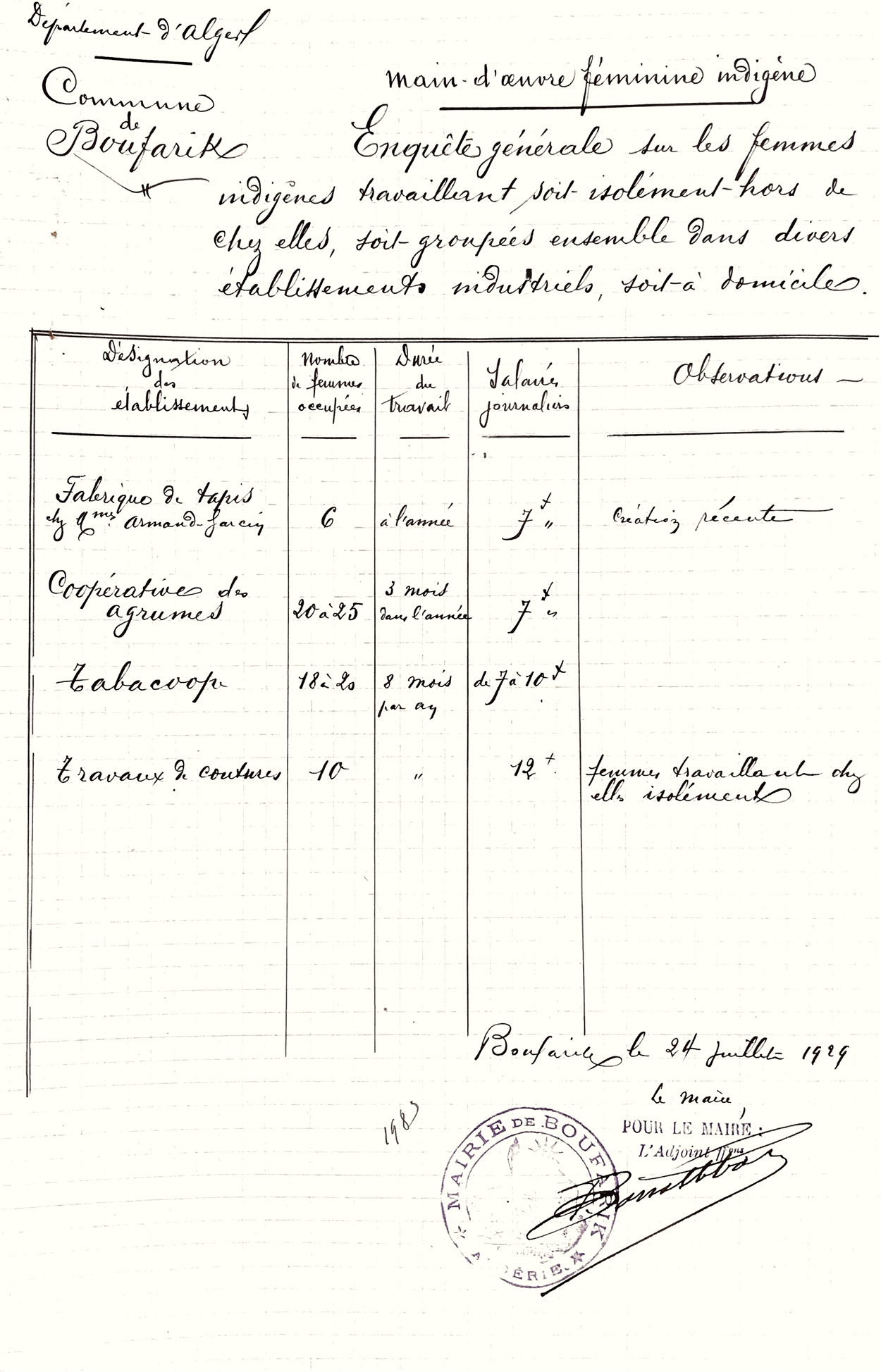
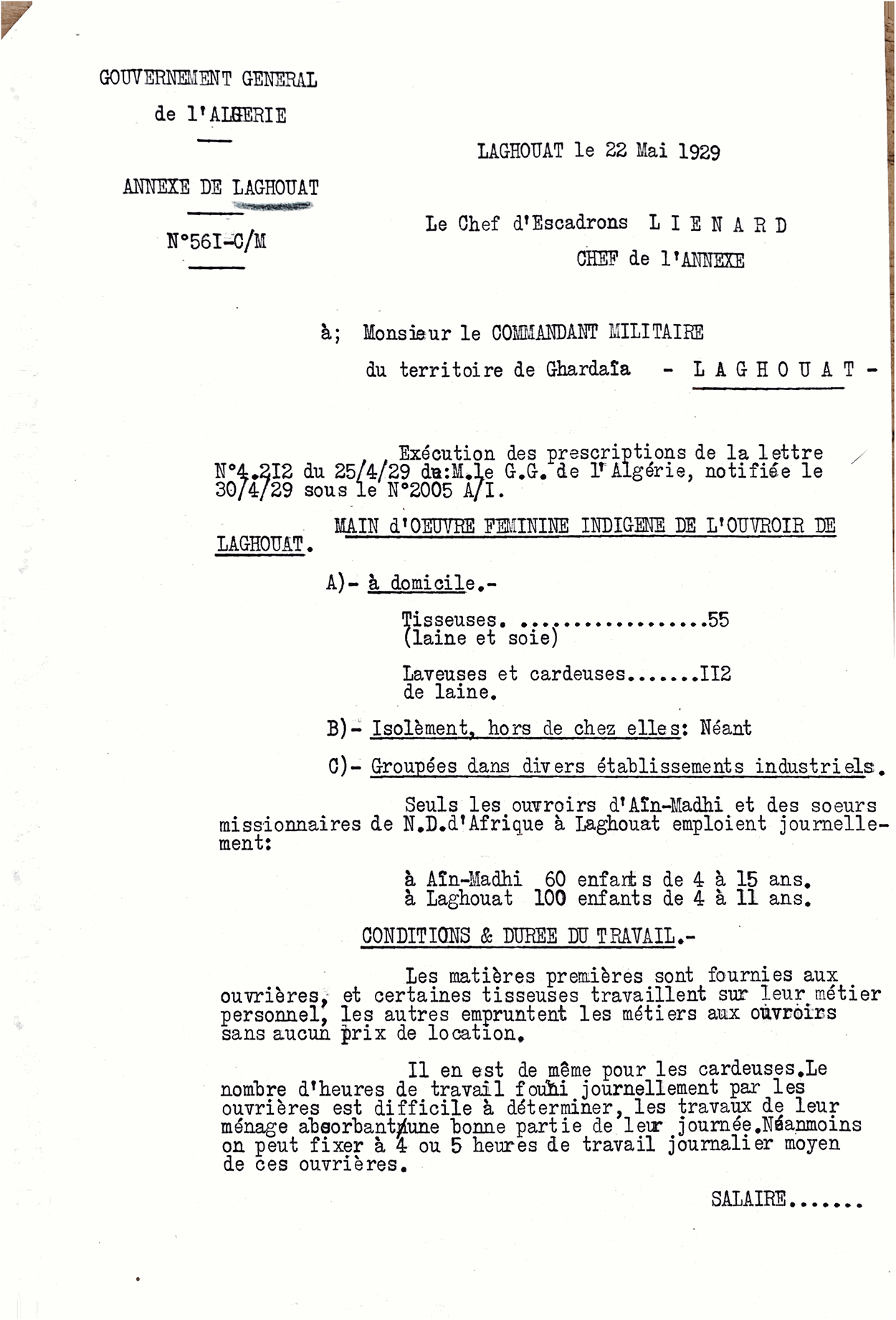
The reports submitted by local authorities present the information already synthesized and offer little insight into the practices of data gathering that were actually employed. However, a careful reading provides some clues. The first striking fact is the heterogeneity of the reports submitted, which varied in length from one paragraph to five pages. The place given to figures and the way they were formatted also differ. A dozen reports provided tables (Figure 1), while others compiled text and statistics (Figure 2) or focused only on the qualitative aspect of the survey (e.g., description of working conditions, suggestions for development), even if this meant presenting only approximate figures or vague indications (e.g., “some women,” “many,” “almost all,” etc.). This reveals that various data collection practices were employed, that information sources were of uneven quality, and that precise quantification could be difficult, all of which are common features of administrative reports of the period, especially in the colonial context.
Report from the mayor of Boufarik to the prefect of Algiers, 24 July 1929. Source: box 91/2I/50, ANOM.
Report from the head of the Laghouat Annex to the military commander of the Ghardaïa Territory, 27 May 1929, p. 1. Source: box GGA/14H/32, ANOM.
The reports also show varying degrees of interest in the subject and the results of the survey. Out of the ninety-eight reports found, thirty-two were returned before the end of April 1929. These reports were terse, stating that there were no women working outside the home, or that there was no industry likely to employ them. Moreover, they did not even attempt to assess home-based work; for example, the deputy mayor of Birkhadem, just outside Algiers, wrote: “To my knowledge, there are no workshops for native women … and none of them work at home.”Footnote 65 This shows at best a profound lack of knowledge, or more likely a lack of effort in carrying out the survey. Indeed, the lace and basket workshop of the White Sisters of Birkhadem employed 450 home workers alone, in addition to some sixty apprentices being trained in the workshop.Footnote 66
Such an attitude might be explained by the skepticism of some administrators regarding the development of vocational training and home-based work. In their recommendations, they did not hesitate to state that there were no measures likely to succeed in promoting home-based work,Footnote 67 or that it was “of no interest.”Footnote 68 Many of them subscribed to the myth that the confinement of women prevented the growth of their employment, and some of them viewed handicrafts as unprofitable “hobbies.”Footnote 69 Other reports, by contrast, sought to provide precise figures, especially in the Southern Territories (Figure 2), due to the particular interest in developing artisanal policies in the Saharan regions, where tourism was booming, providing a potential market for the workshops.Footnote 70
The survey relied on the usual bureaucratic chain of transmission. Mayors (in communes de plein exercice), administrators (in communes mixtes), or military officers (in the Southern Territories)Footnote 71 were responsible for carrying out the survey at the local level, whereas it was up to the deputy prefects and prefects (or commanders in the Southern Territories) to format the data, draw political conclusions, and pass information on to the central administration. The answers were based on the administrators’ presumed knowledge of their district and not on a dedicated investigation, as indicated by the short timeframe allotted for conducting the survey: responses were received between April 25 and August 6, and those who had not replied by early June were sent a reminder notice.Footnote 72 To collect data, mayors and administrators then turned to intermediaries. One administrator mentioned “personal research,” but also his “insistence with the caïds,”Footnote 73 though this remark remains exceptional in the reports consulted. In the 1926–1927 survey, the governor general had explicitly instructed the prefects to consult Algerian officials, but this directive was not repeated in 1929.Footnote 74 While the caïds were their usual source of information, in 1929 the administrators contacted directly the companies and workshops employing women. In the reports, the number of employees is often given for each institution, rather than for each activity (Figure 1). The administrator of the Djurdjura (Greater Kabylia) even attached to his report two accounts written by directors of workshops in his commune.Footnote 75 The first was from the carpet workshop of the White Sisters in Ouaghzen. The missionaries maintained close relations with the local authorities, who often visited and funded their workshops.Footnote 76 They were already accustomed to reporting figures about the women they worked with to the colonial administration.Footnote 77 The second report attached was written by Madame Abdeslam, the headmistress of the Aït Hichem School for Native Girls. In addition to reporting the number of pupils at the school, she “carried out a small survey of women’s work at home.”Footnote 78 However, these are the only cases mentioned of attempts to gain direct access to the women surveyed. The reliance on European women for such efforts is revealing of both administrative and ethnographic survey practices at the time, which assumed that Algerian society was divided along gender rather than racial lines, and that European women would be allowed to enter Algerian homes that were off-limits to foreign men. Information was always filtered through a male and European lens, raising questions about the degree to which it was distorted.
For local administrators, the survey was an opportunity to defend their personal or political interests. They used the report to mention previous requests that had gone unanswered,Footnote 79 or to ask for a subsidy or for the creation of a workshop.Footnote 80 Disagreements sometimes arose, for the survey was embedded in personal relationships, power struggles, and conflicts that went beyond just the concern to quantify work. For example, the deputy prefect of Tizi-Ouzou did not send the report from the mayor of Mekla to the prefect of Algiers.Footnote 81 It seems unlikely that this was a mere oversight; it might rather be that the deputy prefect considered the data exaggerated, as the mayor reported that 1,000 women were working for the White Sisters in his district,Footnote 82 whereas missionary archives indicate there were no more than 200.Footnote 83 But it was still the highest number for a single institution in the entire sub-prefecture. The deputy prefect could have sent a correction to avoid omitting these workers from his count, but he did not. It may rather have been a deliberate political decision. Indeed, a few months earlier, the deputy prefect had objected to the Thébault Company setting up a workshop in Djemâa Saharidj, arguing that women working outside their houses would raise objections from the men in the village.Footnote 84 However, the mayor of Mekla, who supported the project, offered a conflicting account in his 1929 report: he stated that the men were in no way opposed to the project and blamed its failure on the deputy prefect.Footnote 85
The intermediaries who gathered and submitted information also had their own agendas. Notably, the reports sent by the White Sisters as part of the survey were a means of promoting their activities, justifying their existence (insofar as private education required administrative authorization), and applying for subsidies. This strategy seems to have paid off: the White Sisters obtained 150,000 francs from the Centennial Commission for the construction of a new workshop in the Saharan oasis town of Ouargla.Footnote 86 In their reports, some administrators from the Southern Territories even advocated expanding missionary workshops rather than creating new public ones.Footnote 87
Quantifying women’s work in missionary workshops
The case of missionary workshops merits closer examination in order to understand how the intermediaries of the colonial administration produced the figures they transmitted. Statistical data accompanied and structured almost every document produced by the White Sisters and became increasingly standardized over time. From 1914 onward, each missionary station had to send an annual report to the motherhouse following a clear statistical pattern: the number of girls and women enrolled at each workshop, the average number attending per day, the wages paid, and the number of pieces completed.Footnote 88 These accounts relied on various forms that were filled in on a daily basis: the attendance register of apprentices, records of production, registers of payments to workers, account books, etc.Footnote 89 These figures were used to monitor the attendance of apprentices, to stagger orders, and to distribute work. They also had an accounting function, since the workshop sales contributed to the self-financing of the mission. Wages paid were sometimes recorded as an expense: in some annual reports, only the total remuneration paid to all apprentices and workers was mentioned. The officials of the White Sisters had to specify that “mention should be made, not of the total remuneration, but of the average amounts that a female worker can earn in each category, either by the day or over a week.”Footnote 90 Given that the workshops aimed to remunerate the poorest women and to inculcate Catholic values, wages were a central concern for the sisters and their superiors, since they were the main criterion for assessing the social impact of the workshop. The number of people employed was also used as an indicator of the trust that the sisters inspired in the local population and the concrete opportunities for evangelization. These multiple objectives shaped the way women’s work was perceived and quantified.
The data produced by the White Sisters reveal the importance of home-based work, which local authorities found difficult to get a clear picture of in the survey. Since the White Sisters employed a significant number of women outside their workshops and often visited them in their homes, they were not estimating it blindly, as most colonial administrators did. In 1929, the annual reports of the White Sisters recorded between 2,200 and 2,500 women and girls working in their workshops in Algeria, about two-thirds of whom worked at home. The public survey recorded only a small proportion of these women: the prefect of Algiers counted 500 women in four missionary workshops,Footnote 91 a far cry from the 1,300 to 1,400 the White Sisters counted in their eleven workshops in the department.Footnote 92 These figures should be compared with the total of 4,270 women artisans listed in the same prefectural report. Taking into account all 98 reports, the total number of Algerian women working in handicrafts or industry seems to have been approximately 22,000. Given the survey methods described above, however, this figure should be regarded as only a rough estimate. No matter how important the White Sisters’ workshops may have been, it seems unlikely that they employed a third (1,400 out of 4,270)—or even a tenth (2,200 out of 22,000)—of all the Algerian women who were employed in colonial industry and handicrafts, given the number of private and public workshops in the colony. The nuns may have exaggerated the number of women attending their workshops, but this cannot explain everything. Apart from the lack of interest on the part of some administrators, the disproportion in the figures may suggest that the means used by the colonial administration to count women workers, in particular home-based workers, were ineffective.
The figures compiled by the White Sisters cover a wide range of working conditions. Their home working system was flexible: they did not impose fixed hours or profitability targets, and work was distributed according to the women’s own requests (within the limits of what could be sold). Depending on the season, the composition of the household, and the existence of competing sources of income, working hours and production volume could vary significantly. The sisters counted all the women to whom they gave work, regardless of how regularly they worked or how much they produced. The same is true of apprentices in the workshops: the number of registered apprentices was often double the average daily attendance at the workshop. However, workforce volatility, chronic underemployment, and pluriactivity were characteristic of the Algerian labor market in the first half of the twentieth century, as Annick Lacroix points out in the case of public scribes.Footnote 93 This shows that the colonial bureaucracy was unable to account for this kind of work, which falls outside the usual terminology of salaried employment.
Conclusion
For the colonial administration of Algeria, the 1929 survey had several objectives: an informational one, to draw up an updated inventory; a prospective one, to identify reservoirs of female labor (where, how much, at what price); and a prescriptive one, to direct the centennial funds, guide vocational education reforms, and plan the development of home-based work. It also reveals that the colonial bureaucracy was hardly monolithic, as administrators had different conceptions of the “native policy” to be pursued, and of the place of Muslim women in the colonial project. Indeed, the real object of the survey was female wage labor, and the means of putting it at the service of the colonial economy.
For many administrators, the survey was also an opportunity to advance their own interests and to display their work to their superiors.Footnote 94 The process of data gathering was based on longer term projects, reflections, and practices. Being able to provide statistical information in a limited time gave the impression of knowledge and control of the territory and its inhabitants that was often far from the reality, as shown by the difficulties colonial officials had in understanding and defining women’s work, and therefore in measuring it. These methodological and terminological issues become even clearer when we look at the intermediaries on whom officials relied. The case of the missionary workshops, whose archives document the daily production of figures by a direct employer, helps in determining the importance of home-based work, which the colonial authorities found difficult to define within their categories. This challenge was not unique to the colonial period: the post-independence state of Algeria also struggled to define women’s labor and often underestimated it because of the difficulty of quantifying forms of work outside formal wage employment, as shown by the 1966 census.Footnote 95
The discrepancy between the declared ambition to carry out a “general” survey to supplement that of 1926–1927 and the results actually obtained also raises questions. In addition to the lack of enthusiasm shown by some administrators, there is no trace in the ANOM of any reports from the departments of Oran and Constantine, or from the military territories of Aïn Sefra and the Oases; only a single reminder letter sent in January 1930 was found.Footnote 96 Some of these districts did, however, respond to the survey: a copy of one of the missing reports from the Oases Territory is preserved in the archives of the White Sisters of Ouargla, and three additional reports from the same district are referenced in missionary correspondence.Footnote 97 My attempts to find traces of the survey in the inventories and files of the departments of Oran and Constantine, as well as my research at the National Archives of Algeria in Birkhadem, have so far been inconclusive. Another avenue would be to explore the files that remained in Oran and Constantine, now in the archives of the wilayas.Footnote 98
There is no trace either of a general summary of the survey or of how its results were disseminated and used. This might be explained by the rapid decline of the artisanal policy in the following years. The funding provided to mark the 1930 centennial of French rule was not sustained thereafter; indeed, the head of the Department of Handicrafts lamented the failure to increase home-based work by distributing looms.Footnote 99 The economic crisis of the 1930s further undermined public workshops by making it difficult to sell their products, which led to some of them being closed.
What then remains of the 1929 survey? It still stands out for the overall consistency of the archival record preserved, and the snapshot it provides of women’s work in colonial Algeria. Although it did not achieve exhaustiveness, and despite the questionable reliability of some of its data, it does provide a glimpse of the participation of Algerian women in the colonial economy, and the beginnings of the penetration of wage labor, contrary to the myth of women’s confinement prevalent in colonialist discourses. It also offers information on the conditions and levels of remuneration, even if it reflects only a statistical moment and does not resolve the difficulties of reconstructing trends over the long term.Footnote 100


 Open access

