

Touring the Modern
Huang Yanpei (黃炎培) was an educator. Although his attempt to arbitrate an end to the Chinese Civil War in the 1940s through the China Democratic League has diverted much attention from historians, he spent most of his career in education. He was born in 1878 in Chuansha, Jiangsu, which is now part of Shanghai, and it was in this province and city that he began his foray into what would become a lifelong undertaking. In 1905, Huang founded the influential Jiangsu Provincial Educational Association, and in 1912 he served as the Commissioner of Education of Jiangsu.Footnote 1 Soon after his promotion, he began to take educational tours around the world, painting colorful portraits of different schools in a regular column in Shanghai’s leading daily, the Shenbao. Huang was like an itinerant artist who sought inspiration abroad before returning to his studio to teach an aspiring group of followers.
In 1917, along with 786 other charter members, Huang Yanpei founded the Chinese Vocational Education Association. The influential institution advocated for vocational education, published educational magazines, and chartered and supported vocational schools.Footnote 2 It claimed as members a who’s who of prominent educator-intellectuals from China, including Cai Yuanpei (蔡元培), Liang Qichao (梁啟超), Wu Ting Fang, and Zhang Boling (張伯苓). Huang Yanpei rose to the top of this elite group to serve as director of the Association. At its height in 1925, the Vocational Education Association directly managed fifty schools, and the Ministry of Education reported a total of 1006 vocational schools across China.Footnote 3
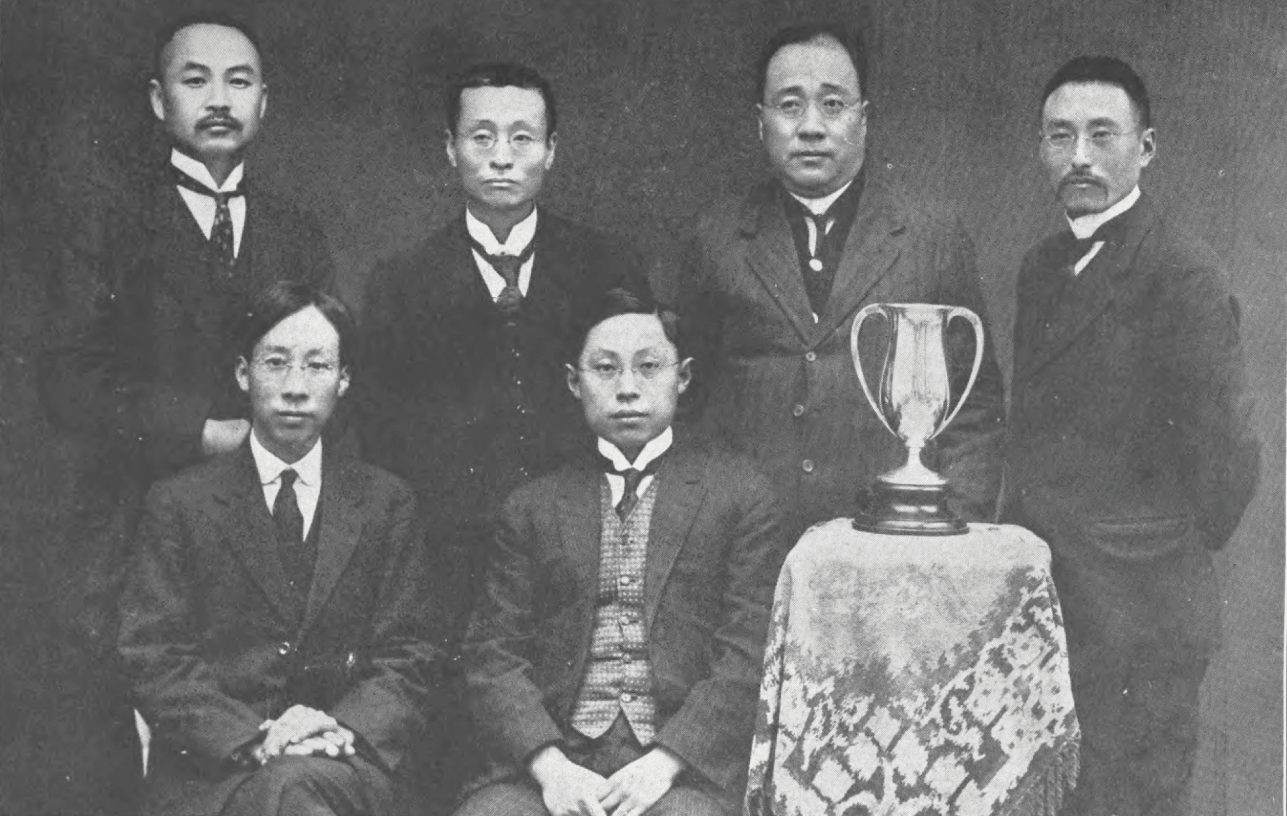
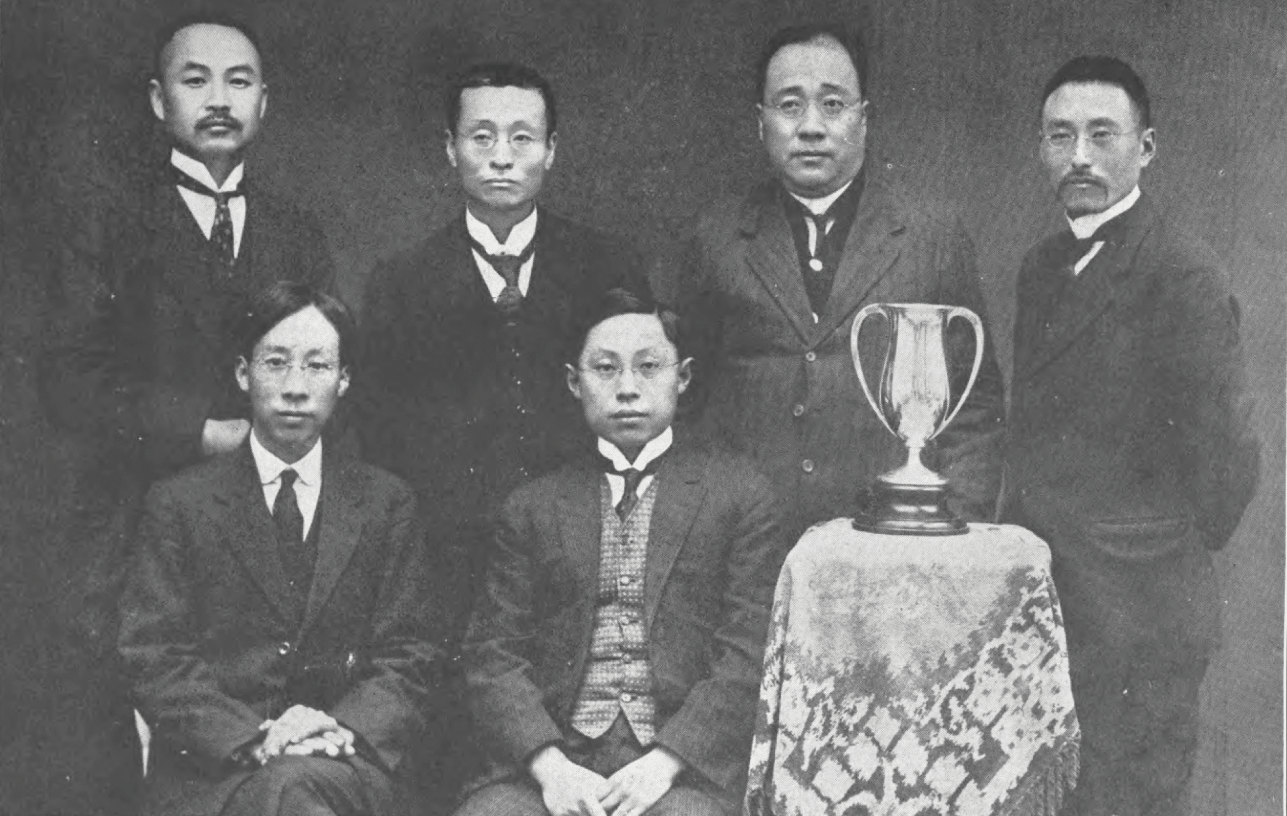
On January 8, 1917, before founding the Vocational Education Association, Huang Yanpei began his overseas tours with a journey to Japan and the Philippines, which resulted in two monographs.Footnote 4 With the war raging in Europe, Huang Yanpei had turned his attention to models closer to home. A team of prominent Chinese educators, including Kuo Ping-Wen (Guo Bingwen 郭秉文), who would later establish what would become Nanjing University, joined him for the educational excursion (Figure 3.1). After visiting Tokyo and stopping over in Shanghai, the entourage arrived in Manila on February 3. There, the group of educators met Albino Z. Sycip (Xue Minlao 薛敏老), a colleague of Huang’s who appears again in Chapter 6.
Huang Yanpei and other tour members to the Philippines, 1917
Before proceeding to inspect the schools themselves, the Chinese tour members immersed themselves in relationship-building with a series of banquets. They first traveled to the Oriental Club in Manila where they dined with representatives from the Chinese Consulate. The next night, they joined Albino Sycip and other influential residents of the archipelago for dinner.Footnote 5 After these pleasantries, which cemented important personal relationships just like the one we explored at the beginning of this part, the education tour group proceeded to the next phase of the trip. They met with the director of the Bureau of Education, toured several prominent schools, and visited with school principals, teachers, and local Chinese educators.
Philippine schools impressed members of the tour, who applied choice adjectives in their accounts that appeared in newspapers and journals back in China. The sheer scale of the educational architecture caught the attention of Kuo Ping-Wen, who noted for readers back home that the “public school system [is] in full operation with more than two-thirds of the children of school age provided with opportunities of free education.”Footnote 6 Huang Yanpei, on a different topic, wrote, “The emphasis on physical education, is something peculiar to Philippine education.”Footnote 7 Echoing Huang’s sentiments, Cai Yuanpei, the president of Peking University and a towering figure in the Chinese educational landscape, commended the emphasis on physical education in the archipelago, noting that it was one of the main reasons that the tour embarked to the Philippines in the first place.Footnote 8
For many tour members, girls’ access to education, which in turn led to prosperous careers, stood out in an all-around impressive system. Huang Yanpei, for example, noted that girls comprised 42 percent of the student population at the Philippine Normal School.Footnote 9 In an era when education became “the defining mark of modernity for a new woman,” as historian Bryna Goodman puts it, this feature of the Philippine education system certainly appealed to tour members.Footnote 10 Commenting on Filipino contributions to society more broadly, a contributor to a Chinese women’s journal described Filipinas as the most “progressive” in Asia, outlining Filipino women’s contributions to higher education, the workplace, and society at large.Footnote 11 Meanwhile, a Chinese lawyer, who penned a lengthy monograph on the archipelago after attending an international conference there, related an anecdote for his Chinese readers about a Filipina lawyer who successfully defended her client to “thunderous applause.” Perhaps with the intention of ameliorating the position of women professionals at home, the writer praised Filipinas who took up the profession of law.Footnote 12 In an era of uncertainty in China, the Philippines served as the perfect laboratory to explore alternative ways to structure society.
Featuring clear contours and a balanced color palette, the Philippine education system contrasted with China’s greyscale patchwork. The famous novelist Lao She (老捨), in a fictional account of a Martian Cat Kingdom, which exaggerated China’s societal fault lines like an impressionist painting does to a landscape, wrote sardonically, “schools have students, but no character; teachers attend to make money, administrators attend to make money, and students attend to prepare to make money. Everyone views schools as a new type of restaurant; what is education? Nobody asks.”Footnote 13 For Huang, who had likewise concluded that the greatest deficiency of Chinese schools was their “divorce from reality,” the Philippines appeared refreshingly relevant and innovative.Footnote 14
Tour members had come to the Philippines to examine the country’s vocational education system, so they stopped over at the Sales Department of the Bureau of Education to meet with experts. There, they inspected Philippine handmade products and inquired about equipment and the logistics of the program.Footnote 15 Huang and other tour members also visited the Central Luzon Agricultural School, the top-ranking agricultural high school in the Philippines; the Agricultural College of Los Baños, a branch of the University of the Philippines system that we will return to later in this chapter; and the Anglo-Chinese School, the leading Chinese school in the Philippines.
After departing from the Philippines, one tour member expressed his gratitude for the good treatment the party had received and shared his hopes that China would send another group of aspiring educators in the near future.Footnote 16 The one-month tour to the Philippines had apparently left a strong impression on Chinese educators. On May 5, 1917, only two months after the tour came to an end, Huang Yanpei, Kuo Ping-Wen, Cai Yuanpei, and others gathered for the Combined Meeting of the National Association of Educators, which resulted in the foundation of the Chinese Vocational Education Association mentioned earlier.Footnote 17
Was the founding of the Chinese Vocational Education Association directly after Huang’s and Kuo’s visit to the Philippines a coincidence? Perhaps. After all, Huang Yanpei had begun to advocate for vocational education as opposed to pragmatic education (實用主義教育) nearly a year before in a series of speeches delivered in Shanghai.Footnote 18 But the proximity of the Philippines trip to the foundation of the Vocational Education Association is too close to ignore.Footnote 19 Seeing the Philippine vocational education program in action likely gave Huang and other educators the final verification they needed that building a similar model in China was both feasible and advantageous.
Curiously, however, Huang’s biographers and historians of Chinese education have largely ignored the timing of the foundation of the Vocational Education Association as well as the influence of the archipelago on Huang’s sensibilities more broadly. They emphasize instead the influence on China of America, Japan, and Europe. Historians Wen-hsin Yeh and Margo S. Gewurtz, who write about Huang Yanpei’s visit to Southeast Asia and the Chinese Vocational Education Association respectively, do not even mention the Philippines.Footnote 20 Other scholars mention the Philippines in their research but treat it as a minor side exhibit.Footnote 21 Without the Philippines, however, the portrait of vocational education in China is incomplete.
Expanding the Tours
Beyond bringing inspiration, Huang Yanpei’s 1917 tour also brought many new friendships and collaborations that reinforced cultural ties between the Philippines and China. Just as the ritualistic exchanges of the tributary system acted as a front for diplomatic engagement and private trade, the educational tour and its ritualistic banquets served as a catalyst for private exchanges. For example, during his tour, Huang met and befriended the prominent Filipino educator Camilo Osias, who was then the president of the National University of the Philippines. Like a friendly artist who hyped his colleague’s new exhibition, Osias later led a group of Filipino educators to China to learn about their education system and provide support for Huang.
Camilo Osias, a Deweyen educator who would author a famous series of Filipino readers for schoolchildren, delivered a speech on education at the Shanghai Chamber of Commerce on his tour in 1921.Footnote 22 Osias had come as a delegate to the Far Eastern Championship Games, to which we will return in Chapter 7, but, according to reports, “educational authorities” desired to detain Osias “after [the] Olympic games to enable him to give us advice on industrial education.”Footnote 23 In his speech, Osias, standing before a friendly audience, painted a glowing portrait of vocational education. Challenging his hosts, he offered a candid comparison of the education systems in Jiangsu and the Philippines, pointing out that the Philippines spent the equivalent of ¥30 million on education per year whereas Jiangsu spent just ¥6 million despite having three times the number of students as the Philippines.Footnote 24
After the speech, several prominent Chinese educators and politicians, including Kuo Ping-wen and Chengting Thomas Wang (Wang Zhengting 王正廷), joined Camilo Osias and Huang Yanpei for yet another banquet. Mirroring Huang’s itinerary, Osias then toured several schools, including Huang’s flagship vocational school, the Chinese Vocational School.Footnote 25 Osias honed his critical but supportive message along the way with additional speeches, including one to an audience of purportedly 2–3,000 in Nanjing.Footnote 26 In those speeches, venturing beyond the frame of education, Osias voiced his support for the campaign against the Bookkeeping Act, which we learned about in Chapter 2.Footnote 27
During his first tour of the Philippines, Huang had also met and befriended the prominent local Chinese educator Gan Bun Cho (Yan Wenchu 顏文初). A year after Huang returned to China from his tour, Gan sent a letter to Huang requesting an update on Chinese educational reforms. Huang responded with a short letter that Gan published in his education journal. In his letter, Huang painted an optimistic picture of China’s potential. He sketched out the recent changes that reformers had enacted during the Combined Meeting of the National Association of Educators, and he described the development of the Jinan Institute in Nanjing – a mainland school established for Chinese overseas students.Footnote 28
In 1921, the same year of Camilo Osias’ tour, Gan Bun Cho and his educator colleagues undertook their own four-month tour to take in the Chinese educational landscape, visiting over sixty-three schools.Footnote 29 Gan, who was born in Shishi, Fujian, had moved to the Philippines in 1913 when he became the editor of the Chinese-language newspaper, the Kong Li Po (公理報).Footnote 30 During his trip back to China in 1921, Gan, along his fellow tour members, stressed the need for Chinese youth in the Philippines to follow in his footsteps and reconnect with China by studying at universities there.Footnote 31 Stuffed into Gan’s packed schedule was a detour to the Jinan Institute, where speakers from Gan’s entourage, along with the hosts, stressed unity and common goals.Footnote 32
Huang Yanpei also returned to the Philippines to inspect Chinese and vocational schools as part of a broader tour across Southeast Asia in 1921.Footnote 33 By this time, however, in part due to the success of Huang’s earlier tour, many other Chinese educators were making that same journey. For example, that same year, Chen Yousong (陳友松), a Chinese educator from Hubei who had attended the University of the Philippines, returned to the Philippines with a colleague to inspect the Philippine Normal School.Footnote 34 Echoing some of Huang Yanpei’s motifs, Chen praised the gender balance of the school, writing, “Women who lived here, were extremely happy.”Footnote 35 Elsewhere, Chen and his fellow tour members highlighted the role American teachers played in education, but they also stressed that American teachers, unlike foreign teachers in British and Dutch colonies in Southeast Asia, led students to sing the Philippine national anthem, not America’s.Footnote 36
Treating the Philippines as an educational archetype, Chinese educators highlighted the active learning strategies in Philippine pedagogy. For example, in the foreword to a translated geography textbook from the Philippines, the translator and editor depicted an impromptu activity in a Philippine classroom where students scoured through maps to locate the hometowns of visiting Chinese educators.Footnote 37 The translator wrote, “Elementary schools that can use this type of lively teaching material and teaching method right now already have [an advantage over] the old methods of forcing students to remember maps – names of mountains, names of lakes, names of cities – things that are not at all of interest.”Footnote 38 A decade earlier, the viceroy of Sichuan Province had requested that textbooks be sent from the Philippines, and the acting director of the Bureau of Education in the Philippines had obliged, sending nearly 100 textbooks.Footnote 39
While Gan Bun Cho’s primary purpose for visiting schools in China was to learn about new innovations in Chinese pedagogy to bring back to the Philippines, many other Chinese from the Philippines returned to their hometowns in China to establish schools, enhancing the overall educational link.Footnote 40 Dee C. Chuan (Li Qingquan 李清泉), a leading tycoon and community organizer in the Philippines who appears again in Chapter 5, founded the Longmen School and Shizhen Raise Virtuous Women School.Footnote 41 Another prominent Philippine Chinese businessman donated ¥130,000 to establish the Yunti School in his hometown of Heshan, Fujian.Footnote 42 Poet and educator Li Dan (李丹), meanwhile, founded a school in his hometown in Fujian in 1935 during a return trip there to mourn his recently passed mother.Footnote 43 When these Chinese entrepreneurs from the Philippines founded schools in their hometowns, they brought a little of the Philippines with them.
The Philippines was the Claude Monet, or perhaps I should say Fernando Amorsolo, for aspiring Chinese landscape artists. Even when they did not recognize the influence of the polity on their educational inclinations, Chinese educators subconsciously channeled its methods into their work. Li Dan’s emphasis on physical education and Dee C. Chuan’s encouraging of girls’ education hint at the Philippine influence.Footnote 44 In an example of a more direct connection, prominent textile merchant and devout Catholic José Tan Sunco (Chen Guangchun 陳光純) hired one of his colleagues from the Philippines, Fr. Serafin Moya, to temporarily serve as principal and teach Bible courses at his school in Quanzhou, Fujian.Footnote 45 The head of the Philippine Overseas Chinese Bank in Manila and founder of the famous Double Ten School in Xiamen, Lim Chu Cong (Lin Zhuguang 林珠光), meanwhile, modeled the curriculum of his school on that of the Anglo-Chinese School in Manila.Footnote 46
Lim Chu Cong, who served as the head of the Chinese YMCA in the Philippines, also published an article in a Chinese-language Philippine journal arguing for the popularization of sports in Chinese schools.Footnote 47 Another Chinese commentator from the Philippines similarly argued that the Fukien Christian University in Fujian needed to place more emphasis on physical education, noting, “Without physical education, the real meaning of student life will be lost.”Footnote 48 Chinese overseas leaders might not have recognized the influence of their Philippine upbringing on their pedagogical persuasions, but their schools contained many Philippine elements.
Upon his return to the Philippines in 1921, Camilo Osias reported, “My recent visit to China has given me increased interest in the welfare of the Chinese people and the Chinese Republic.”Footnote 49 Osias had traveled to China as an educator and Far Eastern Championship Games representative, but he returned as an accomplished cultural tributarist. In ways, Camilo Osias represented his generation’s Konoe Atsumaro (近衛篤麿). Konoe was a Japanese liberal who had envisioned and helped create a world of Japanese educational influence on China in an earlier era.Footnote 50 Osias, however, was the cutting-edge artist whose innovative methods led the disgruntled old-timer into quiet retirement.Footnote 51 Osias’ education work and its positive reception in China reveal a broader shift among Chinese intellectuals, who increasingly redirected their attention from Japan to the Philippines in the 1920s.
From Japan to the Philippines
Before the Philippines became a model of modernity, Japan had occupied that pedestal. Over a span of ten years, Japan defeated both China and Russia in highly publicized military engagements, colonizing Taiwan and Korea along the way. Although this aggressive strategy led many people in China to view Japan with contempt, others grudgingly respected Japan’s success and began to see Meiji-era reforms as critical to replicate.Footnote 52 Chinese and Japanese educators, each with their own motivations, collaborated on educational projects, and Chinese students trekked to Japan’s top universities to learn Japanese techniques.
In 1902, Wu Rulun (吳汝綸), in a trip much like the one Huang Yanpei would take fifteen years later, traveled to Japan on a four-month tour where he personally met the Meiji emperor. His tour resulted in a glowing 568-page compendium touting the Japanese model.Footnote 53 For students, educators, and policymakers alike, Japan represented an affordable and proven pathway to what they perceived as modernity, and Chinese observers were eager to replicate the island nation’s success by studying and adopting the country’s policies. Having read the previous two subsections, this framing should sound familiar.
Chinese observers were impressed that Japan’s national school system provided universal access, promoted social-intellectual conformity, and indoctrinated students with nationalistic sentiments.Footnote 54 Japanese officials, for their part, like other cultural internationalists of their day, eagerly welcomed Chinese students because they viewed those students as a means to extend Japanese soft power. Furthermore, many Japanese officials viewed the colony of Taiwan much like Hubert Lyautey viewed the colony in Morocco – as a “laboratory of modernity” to experiment with progressive policies. Relevant for us, they viewed it as a territory to showcase Japanese-style education.Footnote 55 Even on “mainland” China, Chinese officials, with the support of Japanese allies, attempted to implement Japanese elements in their education system.Footnote 56
“Modernity” remained a fuzzy daguerreotype, but Chinese people increasingly made out in it the contours of Honshu, Shikoku, and Kyushu. This is somewhat ironic considering historian Takeshi Hamashita’s argument that modernization in Asia “emerged as a reaction against the all-inclusive superior–subordinate relations of the traditional tribute system” that saw China perennially at the center.Footnote 57 According to Hamashita, Meiji-era industrialization was an attempt to wrest Japan from the Chinese-centered tributary system and reorient the bilateral relationship in their direction. If we use education as a barometer to measure Japan’s effectiveness in this endeavor, then we can certainly grant them high marks, but instead of tearing the countries apart, education simply reversed the flow of borrowing.Footnote 58
Japan’s influence on China expanded in the early twentieth century. From 1905 to 1906, Chinese schools employed 460 Japanese teachers, which was significantly more than any other foreign group.Footnote 59 Additionally, many Japanese cultural tributarists, like their Filipino counterparts, founded schools in China.Footnote 60 However, China’s educational relationship with Japan, like its relationship with the Philippines a decade and a half later, was one of measured symbiosis. As See Heng Teow points out, Chinese officials “actively sought to redirect the [Japanese] cultural efforts in ways that would best serve Chinese national interests and aspirations.”Footnote 61 While Japan gained influence, China gained knowledge. Educator Konoe Atsumaro had a vision, but so did his Chinese counterparts.
Of course, educational influence was not monochromatic. Japan was one of many hues in the palette of Chinese education. Historians generally identify several shifts in Chinese educational modeling. They argue that China mostly adopted European educational models and sent students there to study before 1895, after which they shifted to Japan. Japan remained the center until the United States became the new destination of choice from World War I to World War II. The Soviet Union took that mantle during the Cold War.Footnote 62 As this chapter demonstrates, however, this chronology fails to capture China’s sustained and significant interest in the Philippines. Instead of the Europe–Japan–United States–Soviet Union model, this chapter proposes a two-tiered assemblage. While wealthier people or those with access to scholarships from China began sending their children to the United States instead of Europe after World War I, less-connected Chinese families began sending their children to the Philippines instead of Japan after this same crucial turning point.
Why was World War I an inflection point? War exigencies redrew trade and supply lines, making study in Europe difficult, if not impossible. These circumstances led many Chinese students to turn to the United States, which, although involved in the fighting, was free of occupying forces. Simultaneously, in Asia, after Prime Minister Ōkuma Shigenobu (大隈重信) issued the infamous Twenty-One Demands, and after Japan attempted to enforce its Shandong Peninsula landgrab, many fed-up Chinese families began to turn away from the archipelago of innovation to the east. Instead, as the next chapter shows, many students began to direct their gaze toward the equally compelling archipelago of innovation to the south.
The Philippines offered many of the same advantages as Japan, and it surpassed Japan in several areas.Footnote 63 It boasted a well-funded common school system with highly qualified instructors. The Philippines prided itself on a young but reputable system of public universities, like the University of the Philippines, as well as an established network of missionary-founded universities, like the University of Santo Tomas and Ateneo de Manila University. The medium of instruction was English, a critical international language. Travel to the archipelago was quick and inexpensive, and room and board were affordable. Perhaps the most important asset of the Philippines, however, was that it was not Japan. The Philippines never delivered a list of Twenty-One Demands to China, and the Philippines never colonized Taiwan or Manchuria. While exclusionist policies and anti-Chinese discrimination certainly turned off some potential students, the absence of militarism attracted many others.
So, while the prominent Qing dynasty policymaker Zhang Zhidong (張之洞) had argued that Chinese students had compelling reasons to study in Japan at the turn of the century, by 1921, it was Huang Yanpei’s and Wu Ting Fang’s turn on stage, and they shared different advice.Footnote 64 Zhou Enlai (周恩來), who would become premier of the People’s Republic of China; Chiang Kai-shek (Jiang Jieshi 蔣介石), who would become leader of the Republic of China; Lu Xun (魯迅), a famous revolutionary author and doctor; He-Yin Zhen (何殷震), the prominent anarcho-feminist writer; and many other well-known and lesser-known Chinese youth studied at Japanese universities and military academies. But by 1921, the Philippines began to train and graduate its own corpus of Chinese leaders.

 Open access