

Introduction
The ever-growing fascination with the prehistoric and early historic civilisations of Asia Minor was fuelled by the foundation of the Turkish Republic in 1923, which created a greater awareness of 'Anatolian' identity (Özgüç 1982: ix-xx; Reference ErimtanErimtan 2008). This triggered a wide range of projects, each aiming to reveal the earliest occupation history of the Bronze Age Central Anatolian plateau - the so-called 'Hatti heartland'. With the discovery and excavation of the famous Alaca Höyük 'royal' tombs, dated to the late third millennium BC, a first benchmark for Turkish Early Bronze Age archaeology was set (for a recent account see Gerber 2006; Reference ZimmermannZimmermann 2006-Reference Zimmermann2007). The unrivalled splendour of these burial assemblages, their fine workmanship and advanced metalworking technologies, offered a first glimpse of the cultural potential of this archaeologically long-neglected region.
Previous research
After the first wave of research in the 1930s and 40s, archaeological and archaeometrical research focusing on Early Bronze Age activities continued at a much reduced pace. A new joint project, conceived in 2005 and realised the following year, targets questions relating to metal production and consumption in this highly innovative 'Hatti heartland', before the Hittite altering of its cultural landscape in the second millennium BC. The XRF analyses (both destructive and non-destructive) carried out so far on metal grave goods from a 'peripheral' necropolis have already yielded surprising insights into the applied alloying techniques of a small rural community in the vicinity of an early urban centre like Alaca Höyük (cf. Reference YildirimYıldırım & Zimmermann 2006; Reference ZimmermannZimmermann & Yıldırım 2007, Reference Zimmermann2008).
Metal consumption and alloying procedures - results of the latest analyses
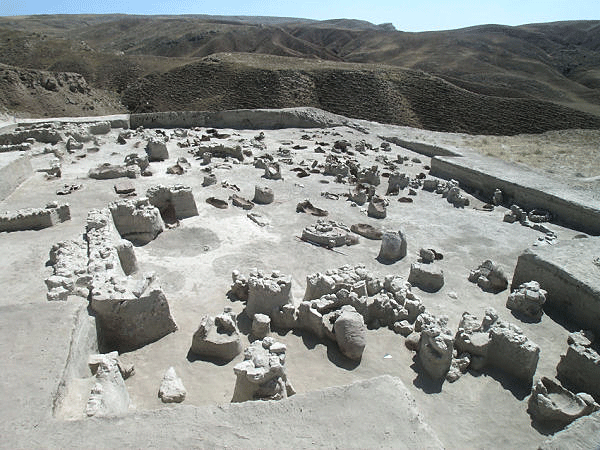
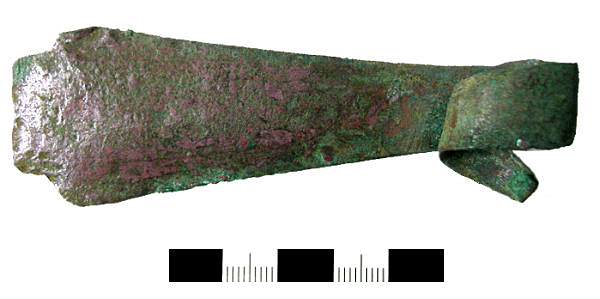
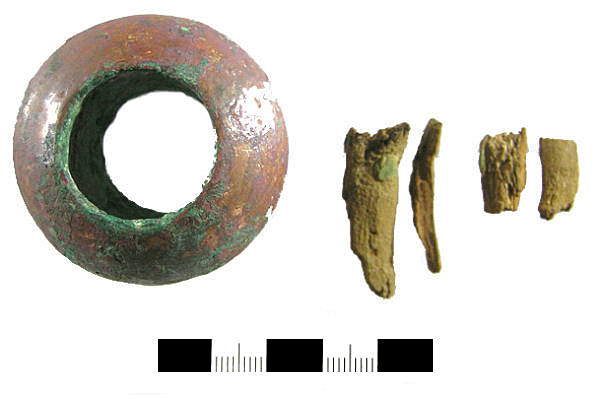
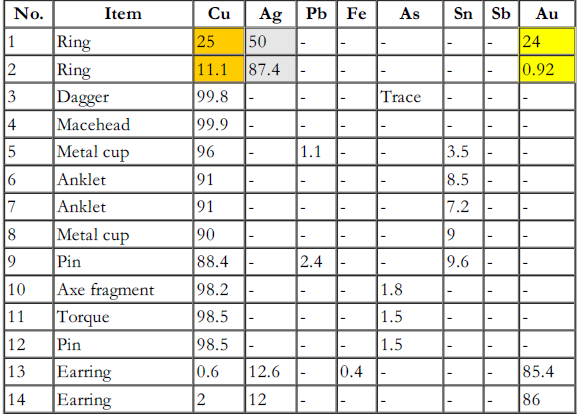
The new series of non-destructive P-XRF (Hand Held X-Ray Fluorescence Spectrometry) completed in late 2008 focused on material from Resuloğlu (see Figures 1-5), but this time also included precious metal objects. For copper-based metal objects, the results given in Table 1 identify three different categories: unalloyed copper objects (nos. 3-4), bronze objects (nos. 5-9), and arsenical copper objects (nos. 10-12). Surprisingly, not all items of utility, demanding durability and hardness, were strengthened through the addition of alloying agents. A single, intentionally bent, dagger from the Resuloğlu cemetery (Figure 2) consists of unalloyed copper, possibly rendering it too soft for practical use. The same applies to a small macehead (Figure 3) from the same site.
View of Resuloğlu Early Bronze Age cemetery.

Resuloğlu cemetery: dagger with intentionally bent blade from grave M 47.

Resuloğlu cemetery: macehead with preserved fragments of wooden shaft from grave M 141.

XRF analysis chart with selected metal items from Resuloğlu. Ag-Cu-Au alloys are highlighted

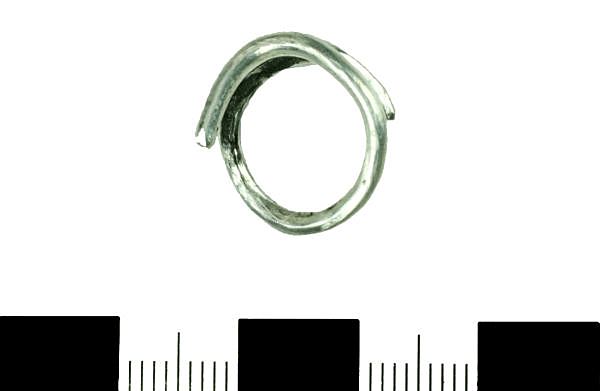
Rings made of Ag-Cu-Au alloy from Resuloğlu burial M 190.

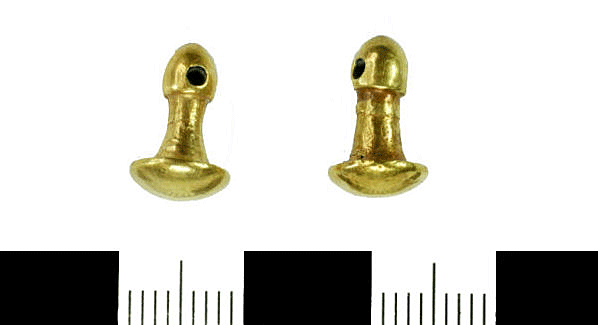
Electrum earrings from Resuloğlu burial M 185.

Of particular interest are the results obtained from scanning a selection of precious metal objects from the Resuloğlu graveyard: two supposedly silver rings (Figure 4) revealed substantial inclusions of copper and also gold (nos. 1-2). Furthermore, two earrings from a Resuloğlu burial (Figure 5), considered to be gold items, turned out to contain higher amounts of silver, and also traces of copper (nos. 13-14). The probability of a 'contaminated' crucible, where leftovers of previous smelting procedures unintentionally mixed with other metals, can be discounted: the most reasonable explanation for the 'gold' earrings would be the processing of a naturally occurring alloy of gold and silver, better known as electrum, which is known to also contain some traces of copper. The much higher values of copper detected in the two small rings, however, require a different explanation. Here, we might have evidence of a conscious attempt to alter an object's final colour with the use of different alloying agents, as already suggested for objects from the same cemetery with unusually high tin values (cf. Reference ZimmermannZimmermann & Yıldırım 2008). In the Near East, with the exception of a single arrowhead from Uruk (Reference PernickaPernicka 1995: 55), evidence for the production of a similar, deliberate silver-copper alloy has been exclusively observed at the Arslantepe 'Royal Tomb', dated to around 3000 BC (Reference HauptmannHauptmann & Palmieri 2000: 77-9), where it occurs in much greater numbers. Here, Hauptmann and Palmieri also suggest the intentional combination of these unusual alloying agents in order to 'fake a silver object' (Reference HauptmannHauptmann & Palmieri 2000: 78).
Further perspectives
The new analyses, though preliminary, underline the progressiveness and technological creativity of Central Anatolian metalworking communities, observable not only in the early urban centres, such as Alaca Höyük, but also extending into the rural communities on the periphery. Intensified fieldwork, and especially more analyses of metal artefacts from 'marginal' or long-neglected regions, might provide more evidence for such 'exotic' alloying traditions in the future, and release sites such as Arslantepe and Resuloğlu from their current isolation.
Acknowledgements
The project is run in collaboration with the Turkish Atomic Energy Authority - Sarayköy Nuclear Research and Training Centre (SANAEM), Bilkent University Department of Archaeology, Ankara University Department of Protohistory and Near Eastern Archaeology and the Museum of Anatolian Civilizations Ankara.