

Total federal government debt can be divided into marketable (largely publicly held debt) and non-marketable debt (largely internally held debt). When funds are needed the U.S. Treasury Department (Treasury) issues bills, notes, and bonds, which are sold to private individuals and entities, financial institutions, the Federal Reserve, and other governments around the world. The publicly held component of debt tallied to $16 trillion in 2019. There is also a substantial amount of internally held debt, of which the largest component is the social security trust fund. Over time, more revenue has been collected from the payroll tax to fund social security survivor, retirement, and disability benefits than has been expended. This resulted in the formation of a trust fund that is managed by Treasury as internally held debt. In 2019, the fund balance of the social security trust was about $2.8 trillion, all of which is held by Treasury. However, there are more than 700 funds managed by Treasury, one of which is related to the Thrift Savings Plan (TSP). Total internally held debt in 2019 was about $6 trillion. Total federal debt is therefore the sum of publicly held and internally held debt, which tallied to $22 trillion in 2019, but by early 2022 had increased to $31 trillion.
To sustain ongoing debt expansion, Treasury must redeem and then reissue all expiring debt. In 2019, total debt redeemed and reissued was about $91 trillion in bills, notes, bonds, and other debt instruments. Given that total debt increased by $1.2 trillion in 2019, the remaining $90 trillion was for reissuance of obligations coming to term. The amount of needed annual reissuance depends on the composition of debt outstanding in terms of term length. The shortest term length for publicly held debt is 4 weeks. Sustaining this type of short-term debt requires 13 redemptions/reissuances over the course of a year. The longest term length is a 30-year bond, which requires redemption and reissuance once every 30 years. In 2019, sustaining publicly held debt required about $13 trillion in issuance and redemptions/reissuance over the course of the year.
Therefore, the remaining $77 trillion in issuance and redemptions/reissuance must have occurred within the internally held debt category. In this article we explore the fund that is responsible for the largest component of the $77 trillion in redemptions/reissuance of internally held debt – the TSP's G-Fund. The G-Fund is one of the five funds available in a voluntary federal government employee retirement savings vehicle called the Thrift Savings Fund (TSF), which is managed as ‘internally’ held debt by Treasury. The G-Fund is debt owed (with interest) to federal government employees and retirees who made contributions to the TSF.
As a prelude to the full evaluation, our research demonstrates the following: (1) the G-Fund is exclusively composed of 1-day notes that Treasury redeems and reissues every business day. The daily turnover of the G-Fund resulted in about $55 trillion in debt reissuance in 2019; and (2) whenever the federal government is constrained by a debt ceiling, the G-Fund balance drops significantly as resources are transferred to the general fund and typically does not return to pre-constraint levels until the debt ceiling is either expanded or suspended. Our objective in this article is to clearly document these patterns and ask whether the G-Fund is managed in a way that is consistent with sound financial management practices and that represents the sole interests of fund contributors. In the next section, we offer a discussion of federal government debt issuance and reissuance/redemption over time. This section is followed by a review of the salient features of the TSF, with an emphasis on the G-Fund. We then provide a summary of the federal government debt ceiling that is followed by our hypotheses regarding the observed fluctuations in the G-Fund balance and empirical analyses. The last section concludes.
1. Overview of total federal debt
Treasury makes available an archive of the Daily Treasury Statement,Footnote 1 where for each fiscal year we access daily information on the level of public debt subject to the limit, the total debt issued, and the total debt redeemed. This information is summarized in Figure 1, which shows the total annual amounts for each of these variables from 2000 through 2020. In 2000, total government debt was about $5.5 trillion, and debt redemptions and reissuance each tallied to about $17 trillion. In 2000, the reissuance to debt ratio was approximately 3; that is, the debt reissued and redeemed over the course of the year was about three times total federal debt. In 2020, the total government debt had increased to about $23 trillion, and debt redemptions/reissuance were $117 and $121 trillion, respectively. The reissuance to debt ratio had increased to 5.3. As shown in Figure 1, federal debt exhibits a positive linear trend over time, whereas redemptions and reissuance increased at a much faster pace.
Total public debt subject to limit, issues, redemptions ($ billions), 2000–2020.
Source: Author's calculations based on U.S. Department of the Treasury information.
Note: The data used to generate this graph correspond to Table A.1 in the Appendix.

1.1 Marketable vs. non-marketable debt
Figure 1 can be disaggregated to compare the marketable debt (most of which is publicly held debt) vs. the non-marketable debt (most of which is internally held debt). This breakdown is shown in Figure 2 where we plot total marketable and non-marketable debt as well as total marketable and non-marketable redemptions and reissuances. Also reported in the figure is debt subject to limit. Figure 2 clearly shows that non-marketable redemptions/reissuance has been growing rapidly and has experienced notable fluctuations from year to year. A significant portion of non-marketable debt is held internally as 1-day securities that are turned over every business day. Figure 3 shows that most of the non-marketable redeemed and issued debt comes from Government Account Series debt. Notice that non-marketable redemptions/reissuance series are very similar to government account redemptions/reissuance series as Figures 2 and 3 indicates. Therefore, we also provide Tables A2 and A3 in the Appendix to highlight the subtle differences between both series.
Marketable and non-marketable redemptions and reissuance, and marketable and non-marketable debt subject to limit, 2000–2020.
Source: Author's calculations based on U.S. Department of the Treasury information.
Note: The data used to generate this graph correspond to Table A.2 in the Appendix.

Marketable and non-marketable redemptions and reissuance, and marketable and non-marketable debt subject to limit, 2000–2020.
Source: Author's calculations based on U.S. Department of the Treasury information.
Note: The data used to generate this graph correspond to Table A.3 in the Appendix.

This broad summary of total federal debt, redemptions, and reissuance shows that most of the redemptions and reissuances are occurring in the non-marketable (internally held) debt category. We now turn our attention to the fund that is generating the largest portion of internal redemptions and reissuances – the G-Fund.
2. The Thrift Saving Fund
As summarized by Skidmore et al. (Reference Skidmore, Austin, Kirby and Pare2020), the TSP is a voluntary savings vehicle for federal government employees that has many of the same features of a typical 401k plan. It is composed by five funds: G, F, C, S, and I. The F, C, S, and I funds are passively managed by the investment company, BlackRock. The G-fund, however, is a government securities fund held internally and is managed by Treasury. According to the 2018 TSF financial statement, total amount managed was $559 billion, of which about 45% was held in the G-Fund (Government Securities fund),Footnote 2 which is entirely composed of 1-day securities. As per U.S. Code § 8438 – Investment of Thrift Savings Fund (Section 5 (e) (1 and 2)), the Secretary of the Treasury is authorized to issue special interest-bearing obligations of the United States, but the TSF Executive Director determines the term length based on ‘due regard’ to the needs of the fund:
(1) The Secretary of the Treasury is authorized to issue special interest-bearing obligations of the United States for purchase by the Thrift Savings Fund for the Government Securities Investment Fund.
(2) (A) Obligations issued for the purpose of this subsection shall have maturities fixed with due regard to the needs of such Fund as determined by the Executive Director, and shall bear interest at a rate equal to the average market yield (computed by the Secretary of the Treasury on the basis of market quotations as of the end of the calendar month next preceding the date of issue of such obligations) on all marketable interest-bearing obligations of the United States then forming a part of the public debt which are not due or callable earlier than 4 years after the end of such calendar month.
The statute does not provide specific guidance on term length of obligations and, to our knowledge, the fact that G-Fund is exclusively composed of 1-day securities is not widely known. However, the statute indicates that interest paid will be equivalent to longer-term interest-bearing obligations. For reference, the shortest term length for marketable securities is 4 weeks. For reasons that are unclear, the Executive Director has made a decision to hold the entire G-Fund in 1-day obligations that are redeemed and reissued daily, and according to statute, has done so having taken into consideration the needs of the fund. We interpret this to mean that they are holding 1-day securities to meet the needs of fund contributors (federal employees and retirees). It is unclear to us how holding 1-day securities is in the best interest of the fund contributors, which should be the sole fiduciary responsibility of the TSF Executive Director and Board. According to U.S. Code § 8438 – Investment of Thrift Savings Fund, during a debt crisis resources are transferred out of the G-fund. Where the resources are transferred is not specified, but the legislation indicates that at the end of the debt crisis period funds ‘not otherwise appropriated’ are to be transferred from the general fund back to the G-fund. We infer that G-fund balances are transferred to the general fund at the beginning of the debt crisis. It appears that one goal of holding the G-fund in 1-day notes is so that those funds can be used by Treasury as a backstop during debt crises.
In this article, we focus our attention specifically on the G-Fund. The time series data used in this evaluation come from three sources. First, we download from Treasury the daily balances of Total Public Debt (GFDEBTN) and the G-Fund account 026X6153. We merge these two databases and adjust the dates to the business calendar in order to omit weekends and holidays. We thus eliminate non-workdays to develop a smooth time series without gaps due to weekends and holidays. The result is a workday time series dataset from January 3, 2001, through July 31st, 2020. Figure 4 illustrates the GFDEBTN ($ trillions) and the TSF ($ billions) trends from 2001 to 2020. TSF G-Fund shows an upward trend, but with significant variation over the days, months, and years, where in some periods the fund declines dramatically to levels near zero. Most of the decreases correspond to periods where the debt trend is flat due to being constrained by debt limit. During these constrained periods, extraordinary measures are used to support essential government activities. We therefore add a third time series that illustrates the debt limit (or debt ceiling), which we will discuss in detail in the next section.
Total public debt (GFDEBTN) and TSF G series trends, 2001–2020 (daily).
Source: Author's calculations based on the daily balance of Treasury Account 026X6153 from June 2001 through April 2019. Daily balances were downloaded using Python.

3. The debt ceiling
Treasury data provide historical information regarding the U.S. federal government debt limit. According to Treasury, the debt limit or debt ceiling is the ‘total amount of money that the government is authorized to borrow to meet all existing legal obligations’.Footnote 3 This restriction has been modified by Congress 22 times during the 2000–2020 period. Based mainly on the work of Austin (Reference Austin2015) and Austin (Reference Austin2019),Footnote 4 we present Table 1 that shows all the dates when the debt ceiling was modified; the changes include debt ceiling increases as well as periods of debt limit suspensions. According to Treasury, increases in the debt ceiling are necessary because ‘failing to increase the debt limit would have catastrophic economic consequences’.Footnote 5 In the last period, Congress suspended the debt ceiling, giving room for the federal government to borrow as much as needed to fund extraordinary measures taken during the COVID-19 crisis. All the debt-ceiling expansions and suspensions dating back to 2001 are shown in Figure 5 along with the total public debt.
Debt ceiling, debt suspensions, and total public debt (GFDEBTN), 2001–2020.
Source: Author's calculations based on Austin (Reference Austin2015, Reference Austin2019) reports.

Historical debt-ceiling levels, 2000–2020

Source: Author's table based on Austin (Reference Austin2015, Reference Austin2019) reports.
Note: Values are in nominal terms, not adjusted by interest or inflation.
What extraordinary measures do government authorities take to fund essential services during the debt-ceiling constraint periods? According to Treasury, ‘secretaries in both Republican and Democratic administrations have exercised the authority to take certain extraordinary measures in order to prevent the United States from defaulting on its obligations as Congress deliberated on increasing the debt limit’ (p. 1, U.S. Department of the Treasury, 2019). The available types of extraordinary measures are: (1) suspending sales of state and local government series Treasury securities, (2) declaring a ‘Debt Issuance Suspension Period’ once, (3) suspending reinvestment of the government securities investment fund, and (4) suspending reinvestment of the Exchange Stabilization Fund. The third measure indicates that once the debt limit has been reached the Treasury has authority to suspend the daily reinvestment of the Treasury securities held by the TSF G-Fund. According to Treasury (2019), once the debt limit is expanded or suspended, the G-Fund is made whole, which means that the Treasury is required to restore the fund balance plus interest on the next business day. Figures 4 and 5 show that Treasury has suspended the G-Fund many times as part of these extraordinary measures. According to U.S. Code § 8438 – Investment of Thrift Savings Fund (Section 5 (g)), the Secretary of the Treasury may suspend issuance to the G-Fund when constrained by the debt limit:
Notwithstanding subsection (e) of this section, the Secretary of the Treasury may suspend the issuance of additional amounts of obligations of the United States, if such issuances could not be made without causing the public debt of the United States to exceed the public debt limit, as determined by the Secretary of the Treasury.
As highlighted earlier, it appears that the G-fund balances are transferred to the general fund during debt limit constraint periods. If Treasury is unable to issue obligations due to the debt limit, it seems that rather than transferring balances to the general fund, they should either be returned to a TSF account and/or held in escrow on behalf of the contributors. The funds could then be returned to the G-Fund at Treasury once debt can again be issued. Note that the statute requires all funds to be returned with interest once a debt suspension period ends. Fund contributors should be made fully aware of the actions taken with their money so they can make more informed decisions about where to invest their funds. A scan of TSP newsletters available on the TSP websiteFootnote 6 indicates that contributors were not made aware of changes in the status of the G-Fund during the debt constraint periods (Figure 6).
Identification of large decreases in the G-Fund balance, 2001–2020.
Source: Author's calculations.

4. Hypotheses
The discussion and data presented above provide a framework for developing several hypotheses:
(1) The daily turnover de facto enables the Treasury to potentially use G-fund resources for purposes beyond providing fund contributors with a stable return. Data limitations prevent us from formally testing this hypothesis.
(2) During the debt constraint periods, the G-Fund balances are used to pay interest on marketable debt coming to term as well as help cover required federal spending. Given the limited publicly available data, we are again not able to formally examine or test this hypothesis. We do not have access to information on whether or how these funds are used during the debt constraint periods. Treasury officials have not responded to our inquiries.
Government documentsFootnote 7 suggest that Treasury cannot legally redeem and reissue G-Fund debt during debt constraint periods because doing so would violate the debt ceiling. However, redeeming and then reissuing debt does not increase the overall debt, but rather maintains debt at existing levels. This leads to a third testable hypothesis:
(3) The variability in the G-Fund over time is driven by the debt constraint periods.
Next, we present a formal empirical evaluation to explain the volatility in the G-Fund.
5. Empirical analysis
5.1 Data
In the previous sections, we introduced the time series of data that we will use in the empirical analysis. We compiled daily data the G-Fund, total public debt, and the debt ceiling. This information is used to create the variables we use to understand the relationship between the public debt, debt ceilings, and the G-Fund balance. Before presenting our formal analysis, we provide an overview of the G-Fund series and its relationship to historical events arising from debt-ceiling constraints, debt-ceiling expansions, and debt-ceiling suspensions.
Figure 6 presents G-Fund trends over time where we have identified all the major balance reductions that occurred between 2001 and 2020. In total, there are 11 time intervals where the G-Fund experienced significant variation in daily fund balances. This figure is central for the analysis in that it provides the broad perspective of each of the events that we analyze separately below. The beginning and end of each of these periods is marked by one of the following events.
• FDL (Federal Debt Limit): This variable marks the day when the Total Federal Debt (GFDEBTN) is constrained by the debt ceiling.Footnote 8
• DCE (Debt-Ceiling Expansion): This variable marks the day on which a debt-ceiling expansion occurs (recall that the dates of these events are given in Table 1).
• SUSP (Suspension of the Debt Ceiling): This variable indicates when the debt ceiling was suspended.
Taking into consideration Figure 6, we isolate each of the decreases into separate events. Figure 7 shows each debt-ceiling constraint period overlaid with G-Fund balances. For each event, we identify the dates related to the large decreases in the G-Fund. Each event corresponds to the key days marked in the figure using colored vertical lines: (1) a red line for FDL days, (2) a green line for DCE days, and (3) a purple line for SUSP days.
(a) Large G-Fund balance decreases and fund recovery. (b) Large G-Fund decreases and fund recovery.
Source: Author's calculations.
Note: Federal debt limit (FDL) marks the day when the total federal debt is constrained by the debt ceiling. Debt-ceiling expansion (DCE) marks the day on which a debt-ceiling expansion occurs (see Table 1). Suspension of the debt ceiling (SUSP) indicates the date when the debt ceiling was suspended.

Two patterns emerge in Figure 7. First, we see that the beginning of each graph is marked by an FDL day. Within days of an FDL day there is a significant decrease in the G-Fund; in a number of cases the balance decreases to nearly 0, and then recovers completely once a DCE occurs. In other words, when a budget constraint is imposed, the G-Fund balance diminishes. During these periods, the funds are shifted into another account/location and may be used for other purposes. Once the debt ceiling is expanded or suspended, the balance is restored. This pattern is observed in the first four events. The SUSP becomes an instrument of budgetary relief. The fifth event begins with an FDL day, the G-Fund balance decreases by nearly half and then recovers after an SUSP day. This pattern is repeated for all subsequent events, with the difference that each fund decline begins with an FDL and ends with either a DCL or SUSP day.
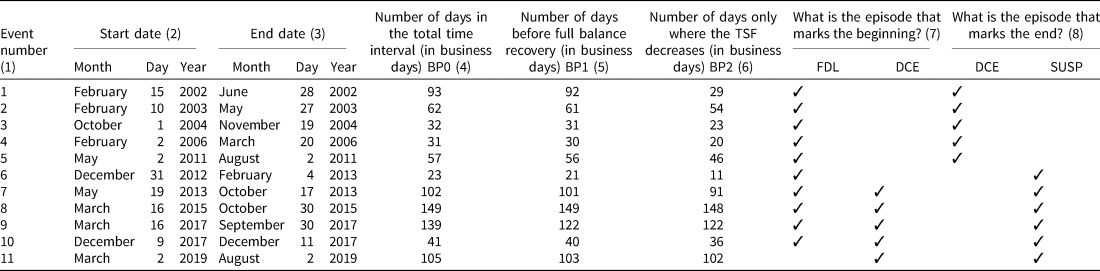
In Table 2 we present detailed information on each of these events. Columns (2) and (3) indicate the exact start and end date of each decline in the G-Fund, where one of the following three cases occurs: FDL, DCE, or SUSP. Columns (7) and (8) show precisely what type of day marks the beginning and end of each event. Additionally, column (4) indicates the number of days that elapse during each of the events. The average number of days is approximately 76 (business days). Column (5) indicates the number of days that occur before the G-fund recovers the full balance. Notice that the number of days in column (5) will be less than the number of days in column (6), because we are not counting that small window of time where the balance recovers to the levels it had prior to when the G-Fund declined. Finally, column (6) indicates the number of days of the most binding period; that is, it includes only those days where the G-Fund actually declined. Column (4) shows the number of days between the two vertical lines that appear in Figure 7. Likewise, for the interested reader we present Figures 4A and 5A in the Appendix that correspond with columns (5) and (6).
Descriptions of each G-Fund decrease
Source: Author's calculations.
Note: Column (1) indicates the event number that appears in Figure 7. Each event corresponds to a noticeable decrease in the G-Fund balance. Columns (2) and (3) indicate the month, day, and year in which each event begins and ends, respectively. Column (4) indicates the total number of days the events last. Column (5) indicates the total number of days since an event began and the G-Fund decreases to its minimum amount, that is, we do not count the day or days of recovery of the balance. Column (6) counts only the days in which the TSF declines. The start dates of each event are marked by an FDL or DCE day. However, when an FDL or DCE day occurs, several days may pass before the G-Fund drops. Therefore, this column does not consider initial days without movement in the G-Fund balance. Finally, columns (7) and (8) indicate what type of day (FDL, DCE, SUSP) marks the beginning and end of each of the events.
Note that we named columns (4), (5), and (6) as Binding Period 0 (BP0), Binding Period 1 (BP1), and Binding Period 2 (BP2), respectively. The information presented in these columns is the key to generating the independent variables that we will use in the next section. Specifically, each of these variables corresponds to an indicator variable that takes on a value of 1 during the days that we have defined as a binding period in Table 2, and 0 for the other days in our sample. The main idea is that these variables signal the periods when the public debt is constrained by a debt ceiling, and then use this information to explain the decreases in the G-Fund balance. In the following section, we provide a formal time series analysis of this relationship.
5.2 Empirical strategy
In this section we provide the empirical strategy we use to estimate the effect of public debt behavior, debt ceiling, and debt suspension on the G-Fund based on a time series econometric specification as outlined in Wooldridge (Reference Wooldridge2018). We rely on the three debt-ceiling measures described above as independent variables. However, by construction BP1 and BP2 correspond to subsets of BP0, just as BP2 is also a subset of BP1. Mathematically, we define $t_{FDL, DCE}^0$ as the day that marks the start of a binding period which can be either an FDL, a DCE, or both as indicated in Table 2. Similarly, we define $t_{DCE, SUSP}^1$
 as the day that marks the end of a binding period, which can be either a DCE or an SUSP day. Using these definitions, equations (1)–(3) define the rules associated with each variable:


Each variable imposes additional restrictions on the set that is included in the binding period. BP0t takes a value of 1 for the days that are in between the binding period including the first and last day marked by an FDL, DCE, or SUSP, and 0 otherwise. BP1t takes the value of 1 for the days that are included in the binding period but without considering the last day, because the G-Fund balance had already recovered by that time. Hence, the two additional restrictions imposed with BP1t are such that this variable takes on value of 1 only when the balance is decreasing and until it reaches the lowest point. Finally, BP2t takes the value of 1 only for the period where the G-Fund decreases, which is a subset of the whole period $[ {\;t_{FDL, DCE}^0 , \;\;t_{DCE, SUSP}^1 } ]$ . Because the three variables are similar and the interpretation is the same, for ease of notation from this point forward we collapse the notation to BP t to refer to all three variables. The main purpose of these variables is to define the time interval for when the large decrease occurs in three different ways, in case the minimum and maximum of the interval interfere with the average decrease estimate. Due to the stylized facts emerging from Figure 7, we expect a negative effect from BP t to TSF t and hence, negative regression coefficients associated with these variables.
The first time series model we use is the geometric distributed lag (GDL) model, which is a simplification of the more generalized infinite distributed lag (IDL). The IDL is specified by equation (4), where TSF t is the balance of the G-Fund in time t, BP t is a dummy variable that takes the value of 1 if we are in the interval of the binding period from Table 2 and 0 otherwise, α is the intercept, and u t is the error term:

The binding period begins when the debt is constrained by the debt ceiling and ends after a DCE or suspension. The G-Fund decreases in response to being constrained by the debt ceiling and then increases once the debt ceiling is either expanded or suspended. Therefore, the G-Fund balance depends on BP and potentially its lagged values. Hence, the next question is how many lags are needed to accurately model this relationship. The IDL model proposes infinite lags which is empirically impossible to implement; however, by making assumptions we simplify the model to create an estimable equation. Consequently, we assume that δ j depends on two parameters, γ and ρ, such that δ j = γρ j for all j = 0, 1, 2, …, with the restriction that |ρ| < 1. This restriction ensures that δ j → 0 as j → ∞, which means that the impact of BP t−j on TSF t will decrease as j becomes larger. The intuition behind this assumption is that time lags of BP will at some point end in terms of identifying days outside the binding period, and therefore the days where the G-Fund balance is no longer affected. Applying this assumption to equation (4) results in equation (5). If we lag equation (5) over one period and then multiply by ρ, we obtain equation (6). Finally, subtracting equation (6) from equation (5) results in the equation to be estimated (7), where α 0 = α(1 − ρ) and v t = u t + ρu t−1:


There are two important features about equation (7) that require some discussion. First, one of the assumptions to obtain consistent estimates from an ordinary least squares (OLS) estimator is the zero-correlation assumption, $E( {x_t^{\prime}u_t} ) = 0$ . However, by construction we have E(TSF t−1u t) ≠ 0, even assuming independence between u t with respect to BP t and all past values of TSF t and BP t. Therefore, assuming BP t is exogenous, we need an instrumentalized TSF t−1 in equation (7). The most suitable instruments to estimate (7) are BP t and BP t−1. Note that BP t−1 is a valid instrument for TSF t−1 because it meets the requirements of an instrumental variable (IV). This IV complies with the exclusion restriction since u t and u t−1 are uncorrelated with BP t−1, which implies that v t is uncorrelated with BP t−1. This suggests that the previous binding period follows the same assumptions as the current binding period, that is, they affect the TSF directly and in the period in which they occurred. In addition, the instrument also complies with the relevance assumption because BP t−1 and TSF t−1 are correlated, according to our model. The binding periods will (and do) affect the balance of the TSF.
In this case, we estimate equation (7) with IVs and adjust by serial correlation in v t. Second, we exploit the fact that {u t} may contain a specific kind of serial correlation such as assuming that {u t} follows an AR(1) model, as indicated by equation (8), with E(e t) = 0 and $Var( {e_t} ) = \sigma _e^2$ :
:

Using the assumption from equation (8) we restate equation (7) as a dynamically complete model as shown in equation (9). This model can be estimated by OLS, providing consistent estimates. Nevertheless, obtaining consistent estimates depends greatly on the assumption that {u t} follows an AR(1) model, which implies that ρ is the same parameter in equations (8) and (9). We use the approach suggested by McClain and Wooldridge (Reference McClain and Wooldridge1995) to test this assumption. Finally, it is worth noting that due to the nature of the underlying geometric series in this model, the long-run propensity (LRP) impact is γ/(1 − ρ), and can be generated from the regression coefficients:

In addition to the GDL model, we also use a more general model called rational distributed lag (RDL). Following the same notation as in the previous equations, the RDL model can be specified as shown in equation (10), which now includes a lag of BP t as an additional independent variable. The LRP in this case is (γ 0 + γ 1)/(1 − ρ):

Below, we present the findings from both models with their LRP specifications to estimate the effect of BP t on TSF t.
5.3 Results
Before presenting the formal regression analysis, we must establish whether the process that the G-Fund data follows is a unit root process or a stationary series. This is important because a unit root process implies that a shock in a contemporaneous time has a long-lasting impact, and therefore, the trend is deterministic. Consider the following AR(1) model for the G-Fund data:

If {TSF t} follows (11), then it has a unit root process if and only if ρ = 1. Notice that if α = 0 and ρ = 1, {TSF t} follows a random walk without drift. Likewise, if α ≠ 0 and ρ = 1, {TSF t} follows a random walk with drift. We subtract TSF t−1 from both sides of equation (11) to obtain equation (12):

where θ = ρ − 1, and assuming that the model is dynamically complete, we test the following hypothesis: H 0: θ = 0 against H 1: θ < 0 . Under the null hypothesis, the usual t statistic does not apply and so we must use the Dickey–Fuller distribution. We also test whether {TSF t} follows a trend-stationary process. This can be done by modifying equation (12) to include a time trend as an explanatory variable.
Before testing the unit root hypothesis, we briefly describe the statistical properties of the dependent variable. Figure 8 (left) shows the distribution of the G-Fund in billions of dollars, which reveals a distribution with positive skewness that ranges from $0.05 billion (minimum value) to $283.91 billion (maximum value). The sample mean value corresponds to approximately $119 billion, while the median value and standard deviation are approximately $108 and $71 billion, respectively. The unit root test result is presented in Table 3, which shows the estimation of equation (12) with and without a time trend. Note that in the literature these tests are known as Dickey–Fuller and augmented Dickey–Fuller test. As shown in Table 3, we reject the null hypothesis that the process is unit root at the 1% significance level for both types of models. Therefore, we can safely use the asymptotic theory to establish statistical significance in the remainder of the analysis. Finally, in Figure 8 (right) we plot the detrended G-Fund, which corresponds to our dependent variable from this point forward.
Histogram and detrended G-Fund plots.
Source: Author's calculations.
Note: Left: Histogram of TSF is the G-Fund balance in $ billions with a kernel density estimate. Right: Graph of the residuals from the regression in column (3) of Table 3, which means the detrended TSF.

Dickey–fuller, augmented Dickey–Fuller test, and detrended G-Fund regression

Standard errors in parentheses.
*p < 0.05, **p < 0.01, ***p < 0.001.
Note: Columns (1) and (2) show the Dickey–Fuller and augmented Dickey–Fuller test, respectively. The dependent variable in these regressions is ΔTSF t = TSF t − TSF t−1. Column (3) show the regression to detrend the dependent variable TSF t.
Table 4 presents results from the different econometric specifications as discussed in the previous section. The GDL (OLS) corresponds to the linear model in equation (9) which assumes that the error term follows a specific form of autocorrelation. The GDL (IV) estimates equation (7) by IV without assuming any form regarding the autocorrelation in the error term. Finally, the RDL estimates equation (10) by explicitly including the lag of the independent variable. Columns (1)–(3) use the variable BP0 in the regressions, columns (4)–(6) use the BP1 variable, and columns (7)–(9) use the BP2 variable. All standard errors are robust to heteroskedasticity and autocorrelation in the GDL (IV) and RDL estimations.
Result of the three econometric specifications using in each regression the three key variables: BP0, BP1, and BP2

Standard errors in parentheses.
*p < 0.05, **p < 0.01, ***p < 0.001.
Note: In all regressions the dependent variable is the detrended TSF in billions of dollars. Each column indicates the econometric specification we are using: geometric distributed lag (GDL) by OLS and by IV estimators, and rational distributed lag (RDL). Columns (1)–(3) use the variable BP0 in the regressions, columns (4)–(6) use the variable BP1 in the regressions, and columns (7)–(9) use the variable BP2 in the regressions. Column (1), (4), and (7) show non-robust standard errors assuming that equation (8) holds. Columns (2), (3), (5), (6), (8), and (9) use HAC standard errors by Newey–West estimator, assuming an automatic bandwidth of 48.
First, we discuss the results for the variable BP0. If we assume that the error term follows the assumption of equation (8), then as shown in column (1) the average effect of being in the binding period 0 is a decrease in the TSF of about $3.5 billion. Additionally, this model implies an LRP effect of approximately −88, which means that being in the binding period 0 leads to a long-run decline in the TSF of about $88 billion. We use McClain and Wooldridge (Reference McClain and Wooldridge1995) to test the assumption on the error term process. The procedure involves the construction of an LM test for the AR(1) serial correlation and a common coefficients regression. The null hypothesis is that the parameter ρ in equation (8) is the same as in equation (7). We obtain an LM test statistic of 17.85 (associated with a p-value of 0.000133), which provides evidence against the null hypothesis. Therefore, we proceed to estimate the linear model by an IV estimator (see column (2)). Recall that the instrument that we are using is the lag of the BP0 variable, assuming exogeneity in the contemporaneous effect of BP0 on the G-Fund. In this case, the magnitude of the estimate is larger (it implies a decrease in $16 billion) but it is not statistically significant. Finally, we calculate the RDL specification (see column (3)), where we find that the decrease is almost $12 billion but again is not statistically significant.
Second, we analyze the results for the variables BP1 and BP2. Using the same test as was used previously, we rule out in both cases that the error term follows the assumption reflected in equation (8). Even though we do not have full confidence in the OLS estimates, we present these results in Table 4 for comparison. In the case of the IV regression, we find that being in the binding period 1 decreases the TSF by $42 billion on average, while being in the binding period 2 decreases the TSF by about $52 billion. Both estimates are statistically significant at the 1% level. When we include the lagged-dependent variable in the RDL, the estimated effects correspond to a decrease in the TSF of $52 billion and nearly $60 billion in the two cases, respectively. In general, the better fitting model is the RDL based on the R 2 measure. Additionally, in all cases, we calculate the LRP impact, but we focus on the last regression found in column (9). This LRP estimate corresponds to a negative impact of almost $124 billion. In other words, being in the binding period 2 situation, which implies a situation where the G-Fund abruptly decreases due to a debt-ceiling constraint, leads to a substantial decline in the G-Fund of $124 billion. Note, however, that once the debt ceiling is expanded or suspended, the fund balance always returns to the pre-emergency amounts.
In summary, this analysis offers statistical evidence regarding the decrease of the G-Fund when there is a debt-ceiling constraint. The objective is to accurately measure the average decrease per day and the long-term effects that the reductions imply once we control for time trends and path dependence of the series.
6. Conclusion
In this article, we document the relationship between the federal debt, the federal debt ceiling, and the G-Fund daily balance. We show that during periods when the federal debt is constrained by a debt ceiling the G-Fund balance decreases by almost $60 billion on average, with a longer-term effect of a decrease of nearly $124 billion. For context, on July 31st, 2020 (the last day available in our data) the balance of the G-Fund was $284 billion. We also document the fact that Treasury holds the entire G-Fund balance in 1-day securities that are redeemed and reissued every business day. Holding the G-Fund in 1-day securities generates about $55 trillion in security redemptions and reissuance annually. Although we reached out to Treasury to ask questions about the management of the G-Fund, we have not received a response. However, from U.S. Code § 8438 – Investment of Thrift Savings Fund we see that during a debt crisis G-fund resources are transferred to the general fund. Once the crisis is over the legislation indicates that funds ‘not otherwise appropriated’ are to be transferred from the general fund back to the G-fund. Although not explicitly stated, we infer that one goal of holding the G-fund in 1-day notes is so that it can be used by Treasury as a backstop during debt crises. While this arrangement may be beneficial for Treasury in its effort to continue funding government operations during crisis periods, it may not be consistent with the stated goals of the TSP or serve the sole interests of contributors.
As described by Segal (Reference Segal2020), the U.S. Securities Exchange Commission is charged with enforcing disclosure laws that require firms incorporated in the United States and listed on the major U.S. stock exchanges to release all information that may influence investor decisions. Importantly, brokerage firms, investment managers, and analysts must also disclose information that may influence and affect investors. A case could be made that the TSF Board and Executive Director have not adequately informed fund contributors of how the G-Fund is managed, which may be a material omission. Full disclosure to all G-Fund contributors regarding the Management of the G-Fund could substantively alter their investment decisions.
Given that the TSP has a stated passive investment strategy, we would expect that very stable fund balances with all the TSP funds, especially the G-Fund. With the sole fiduciary responsibility of managing the G-Fund in a way that serves the interests of government employees and retirees who contributed to the fund, we are unaware of any financial management rationale that could justify the use of 1-day securities, or the fund balance variability exhibited in this fund. Treasury indicates that debt constraint periods prevent the issuance of obligations for the fund, which is the rationale for pulling funds out of the G-Fund account and holding them in the general fund and potentially using the funds to meet extraordinary needs brought on by debt ceilings. The patterns in the G-Fund daily balance documented in this analysis raise additional questions:
• Is the volatility in the G-Fund we document consistent with the stated passive (and secure/stable) investment strategy articulated by the TSF?
• Has TSF Board and Executive Director adequately disclosed information that could influence the investment decisions of fund contributors?
• Given the volatility of the G-Fund, should TSF contributors be compensated for the risk/volatility they assume?
• How does holding the entire G-Fund balance in 1-day securities serve the interests of G-Fund contributors?
We hope this evaluation increases transparency and motivates Treasury officials and Congress to reexamine the management of the retirement savings of more than 6 million contributors. We also hope that this evaluation motivates the TSF Board and Executive Director to more fully disclose to fund contributors how the G-Fund is managed. Last, given the extraordinary measures taken by the federal government during the COVID-19 crisis in terms of trillions of dollars in debt expansion in 2020, 2021, and beyond coupled with trillions of dollars in monetary interventions, the risks to the economy and by extension the potential for instability within debt markets is a concern. Fund managers are obliged by financial management laws to fully inform contributors of G-Fund management practices; it is the fiduciary responsibility of the TSF Board and Executive Director to provide this information and act in the sole interests of fund contributors.
Supplementary material
The supplementary material for this article can be found at https://doi.org/10.1017/S1474747223000057.
Acknowledgments
We thank Catherine Austin Fitts and Rob Kirby for their invaluable assistance in developing this article. We also thank Michael Ravniztky for assistance with preparing and submitting FOIA requests. We also thank the editor and two anonymous referees for valuable comments that helped to improve the manuscript.


 Open access

