


In the UK, the National Service Framework for Mental Health recommends the prompt assessment of young people at the first sign of a psychotic illness, in light of the ‘growing evidence that early assessment and treatment can reduce levels of morbidity’ (Department of Health, 1999). Several early intervention teams have been established around the world, some as part of research-based programmes and others as services embedded in local mental health care (Reference Edwards, McGorry, Pennel, Birchwood, Fowler and JacksonEdwards et al, 2000; Reference Spencer, Birchwood and McGovernSpencer et al, 2001). The Mental Health Policy Implementation Guide specifically plans 50 such ‘discrete, specialist’ early intervention services by 2004, catering to a population of about 1 million each, assessing about 150 new cases each year. Each service would comprise three or four teams with a maximum service case-load of about 450 (Department of Health, 2001).
We conducted a study to determine the service, resource and training implications of implementing the National Health Service (NHS) Plan in south and west London. The study aimed to:
-
(a) establish the current staff and resource provision aimed specifically at cases of first-episode psychosis within Community Mental Health Teams (CMHT) and Child and Adolescent Mental Health Service (CAMHS) teams;
-
(b) determine the annual referral rates and broad clinical-demographic details of patients with first-episode psychosis; and
-
(c) determine the resource and training implications of implementing the NHS plan in SW London.
Method
Population
South west London comprises two trusts: SW London and St George's Mental Health Trust; and West London NHS Mental Health Trust (Fig. 1). The South West London and St George's Mental Health Trust has 22 CMHTs and 5 CAMHs, serving a population of 945 700 (1996 estimate) across five boroughs: Merton, Sutton, Wandsworth, Kingston and Richmond. The local population is socio-demographically and ethnically diverse. For example, Wandsworth has large Asian and Black-Caribbean communities. There are deprived inner-city areas and areas of relative affluence. The West London NHS Mental Health Trust covers the two boroughs of Ealing and Hammersmith and Fulham, with a total population of 453 700 (1996 estimate). In three wards within Ealing, over half the population is of Indian origin. The borough of Hammersmith and Fulham contains some of the most affluent and most deprived areas in the country, and includes significant Irish, Asian, Black Caribbean and Polish communities. The West London NHS Mental Health Trust has nine CMHTs and three CAMHS.
The map shows the boundaries of London Boroughs in grey. The boroughs included in this study are in dark grey.

Assessment tool
We developed a two-stage questionnaire to identify all people with their first-episode of psychotic illness presenting to psychiatric services in the year 2000 and to determine the existing provision for their clinical management. A first-episode psychosis case was defined as any patient presenting to psychiatric services with a psychotic illness (including schizophrenia, affective psychosis and drug-related psychosis, but excluding organic psychosis) for the first time. The first part of the questionnaire gathered information on current service provision including team structure, catchment population size, availability of staff specifically trained in managing first-episode psychosis cases and management strategies used by the team. Data were collected on whether the team routinely provided various components of care including needs and risk assessment, psychosocial interventions, (cognitive-behavioural therapy (CBT), family interventions, psychoeducation), monitoring (Care Programme Approach (CPA) review, compliance) and social input (help with benefits, day care etc.) for patients with first-episode psychosis. The second part of the questionnaire collected clinical and demographic details about all those patients seen by the team in the year 2000 including details about diagnosis and current treatment status (e.g. enhanced CPA, discharged, etc.). Cases thus identified were confirmed through individual case note surveys. Additional electronic database searches were conducted to ensure that cases missed in the first stage were included in the study. No patients were individually contacted during the survey.
Data collection
The survey was conducted between April and June 2002. An initial letter describing the aims of the survey was sent to consultants and team managers for all CMHTs and CAMHS. Teams were asked to identify all cases of first-episode psychosis referred to the team between 1 January 2000 and 31 December 2000. Electronic databases were searched to identify all cases recorded in the patient information system in the two trusts. A week later, face-to-face interviews were conducted with team managers to complete the questionnaires. Cases identified by team members were compared with the database searches and any discrepancies were resolved. Medical notes of cases thus identified were scrutinised to ascertain diagnosis and ensure that they met the definition of first-episode psychosis. Keyworkers were asked to make a forced-choice diagnosis to categorise patients into one of the three categories: ‘schizophrenia and related disorders’, which included schizoaffective, delusional and acute and transient psychotic disorders; ‘affective psychosis’; and ‘drug-induced psychosis’. Ethnicity was recorded using a combination of case note data and keyworker-ascertained ethnicity.
Results
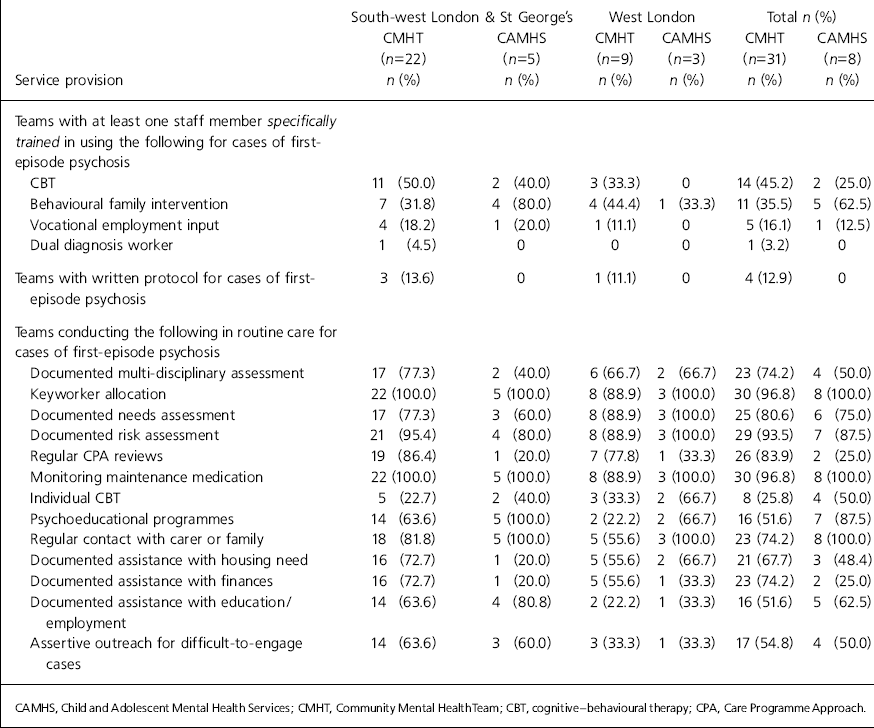
All 39 questionnaires were returned by the teams to which they had been distributed. Table 1 describes the service provision specifically aimed at patients with first-episode psychosis within each team.
Service provision for first-episode psychosis in two trusts
| South-west London & St George's | West London | Total n (%) | ||||
|---|---|---|---|---|---|---|
| Service provision | CMHT (n=22) n (%) | CAMHS (n=5) n (%) | CMHT (n=9) n (%) | CAMHS (n=3) n (%) | CMHT (n=31) n (%) | CAMHS (n=8) n (%) |
| Teams with at least one staff member specifically trained in using the following for cases of first-episode psychosis | ||||||
| CBT | 11 (50.0) | 2 (40.0) | 3 (33.3) | 0 | 14 (45.2) | 2 (25.0) |
| Behavioural family intervention | 7 (31.8) | 4 (80.0) | 4 (44.4) | 1 (33.3) | 11 (35.5) | 5 (62.5) |
| Vocational employment input | 4 (18.2) | 1 (20.0) | 1 (11.1) | 0 | 5 (16.1) | 1 (12.5) |
| Dual diagnosis worker | 1 (4.5) | 0 | 0 | 0 | 1 (3.2) | 0 |
| Teams with written protocol for cases of first-episode psychosis | 3 (13.6) | 0 | 1 (11.1) | 0 | 4 (12.9) | 0 |
| Teams conducting the following in routine care for cases of first-episode psychosis | ||||||
| Documented multi-disciplinary assessment | 17 (77.3) | 2 (40.0) | 6 (66.7) | 2 (66.7) | 23 (74.2) | 4 (50.0) |
| Keyworker allocation | 22 (100.0) | 5 (100.0) | 8 (88.9) | 3 (100.0) | 30 (96.8) | 8 (100.0) |
| Documented needs assessment | 17 (77.3) | 3 (60.0) | 8 (88.9) | 3 (100.0) | 25 (80.6) | 6 (75.0) |
| Documented risk assessment | 21 (95.4) | 4 (80.0) | 8 (88.9) | 3 (100.0) | 29 (93.5) | 7 (87.5) |
| Regular CPA reviews | 19 (86.4) | 1 (20.0) | 7 (77.8) | 1 (33.3) | 26 (83.9) | 2 (25.0) |
| Monitoring maintenance medication | 22 (100.0) | 5 (100.0) | 8 (88.9) | 3 (100.0) | 30 (96.8) | 8 (100.0) |
| Individual CBT | 5 (22.7) | 2 (40.0) | 3 (33.3) | 2 (66.7) | 8 (25.8) | 4 (50.0) |
| Psychoeducational programmes | 14 (63.6) | 5 (100.0) | 2 (22.2) | 2 (66.7) | 16 (51.6) | 7 (87.5) |
| Regular contact with carer or family | 18 (81.8) | 5 (100.0) | 5 (55.6) | 3 (100.0) | 23 (74.2) | 8 (100.0) |
| Documented assistance with housing need | 16 (72.7) | 1 (20.0) | 5 (55.6) | 2 (66.7) | 21 (67.7) | 3 (48.4) |
| Documented assistance with finances | 16 (72.7) | 1 (20.0) | 5 (55.6) | 1 (33.3) | 23 (74.2) | 2 (25.0) |
| Documented assistance with education/employment | 14 (63.6) | 4 (80.8) | 2 (22.2) | 1 (33.3) | 16 (51.6) | 5 (62.5) |
| Assertive outreach for difficult-to-engage cases | 14 (63.6) | 3 (60.0) | 3 (33.3) | 1 (33.3) | 17 (54.8) | 4 (50.0) |
In the CMHTs, almost all patients with first-episode psychosis received keyworker allocation, risk assessment and monitoring of medication. Just under half the CMHTs had staff members specifically trained in CBT or family interventions in first-episode psychosis. However, in practice, less than a quarter of the teams provided individual CBT to patients, whereas half provided some kind of psychoeducational intervention for families. Only one team had a specialist dual-diagnosis worker. Although just over half of the CMHTs offered assistance with education and employment, only one-sixth had a staff member specifically trained to offer such interventions. For CAMHS, staff provision for CBT was even lower; only half documented multidisciplinary assessment in cases of first-episode psychosis and only a quarter held regular CPA reviews. Similar to the CMHTs, keyworker allocation, risk assessment and monitoring of medication were provided routinely. Written protocols were rare, with 13% of the CMHTs and none of the CAMHS having a consensual set of guidelines to help devise management strategies for first-episode psychosis.
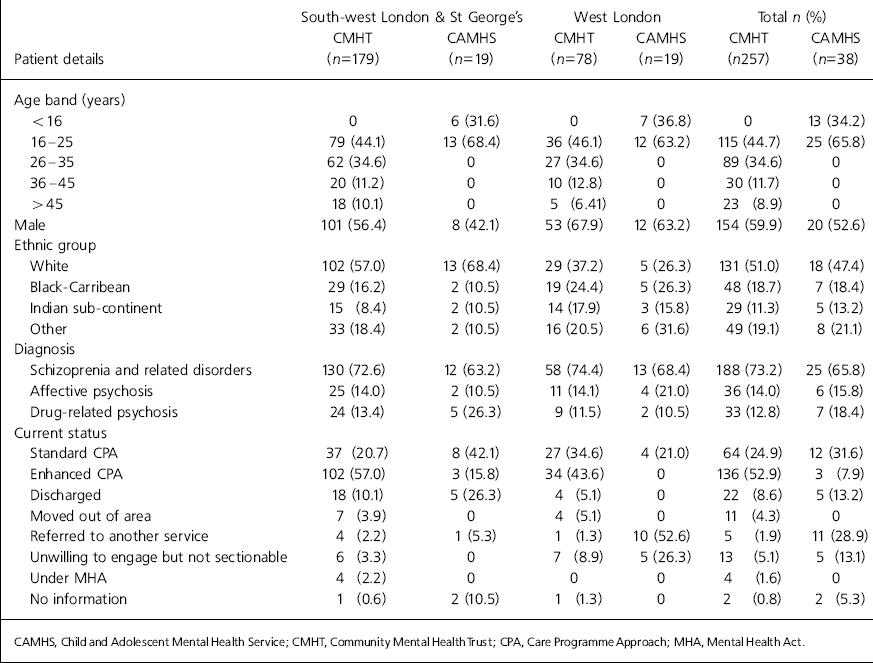
Table 2 summarises the broad clinical and socio-demographic profile of patients with first-episode psychosis identified across the two trusts in the year 2000. A total of 295 cases were identified, giving an annual incidence rate of 21/100 000/year. The reported incidence varied considerably across the teams. The rate among CMHTs varied from 2.9 (Wimbledon) to 51.9 (Mitcham) per 100 000 per year. Teams serving Mitcham, Hammersmith, Southall, Roehampton and parts of Wandsworth had the highest rates. Lower rates occurred in Wimbledon, Twickenham, Sutton and parts of Ealing. The CAMHS had much lower rates across all boroughs, ranging from 0 to 3.2 per 100 000 per year.
Socio-demographic and clinical details of cases of first-episode psychosis referred to the two trusts in 2000
| South-west London & St George's | West London | Total n (%) | ||||
|---|---|---|---|---|---|---|
| Patient details | CMHT (n=179) | CAMHS (n=19) | CMHT (n=78) | CAMHS (n=19) | CMHT (n257) | CAMHS (n=38) |
| Age band (years) | ||||||
| < 16 | 0 | 6 (31.6) | 0 | 7 (36.8) | 0 | 13 (34.2) |
| 16-25 | 79 (44.1) | 13 (68.4) | 36 (46.1) | 12 (63.2) | 115 (44.7) | 25 (65.8) |
| 26-35 | 62 (34.6) | 0 | 27 (34.6) | 0 | 89 (34.6) | 0 |
| 36-45 | 20 (11.2) | 0 | 10 (12.8) | 0 | 30 (11.7) | 0 |
| > 45 | 18 (10.1) | 0 | 5 (6.41) | 0 | 23 (8.9) | 0 |
| Male | 101 (56.4) | 8 (42.1) | 53 (67.9) | 12 (63.2) | 154 (59.9) | 20 (52.6) |
| Ethnic group | ||||||
| White | 102 (57.0) | 13 (68.4) | 29 (37.2) | 5 (26.3) | 131 (51.0) | 18 (47.4) |
| Black-Carribean | 29 (16.2) | 2 (10.5) | 19 (24.4) | 5 (26.3) | 48 (18.7) | 7 (18.4) |
| Indian sub-continent | 15 (8.4) | 2 (10.5) | 14 (17.9) | 3 (15.8) | 29 (11.3) | 5 (13.2) |
| Other | 33 (18.4) | 2 (10.5) | 16 (20.5) | 6 (31.6) | 49 (19.1) | 8 (21.1) |
| Diagnosis | ||||||
| Schizoprenia and related disorders | 130 (72.6) | 12 (63.2) | 58 (74.4) | 13 (68.4) | 188 (73.2) | 25 (65.8) |
| Affective psychosis | 25 (14.0) | 2 (10.5) | 11 (14.1) | 4 (21.0) | 36 (14.0) | 6 (15.8) |
| Drug-related psychosis | 24 (13.4) | 5 (26.3) | 9 (11.5) | 2 (10.5) | 33 (12.8) | 7 (18.4) |
| Current status | ||||||
| Standard CPA | 37 (20.7) | 8 (42.1) | 27 (34.6) | 4 (21.0) | 64 (24.9) | 12 (31.6) |
| Enhanced CPA | 102 (57.0) | 3 (15.8) | 34 (43.6) | 0 | 136 (52.9) | 3 (7.9) |
| Discharged | 18 (10.1) | 5 (26.3) | 4 (5.1) | 0 | 22 (8.6) | 5 (13.2) |
| Moved out of area | 7 (3.9) | 0 | 4 (5.1) | 0 | 11 (4.3) | 0 |
| Referred to another service | 4 (2.2) | 1 (5.3) | 1 (1.3) | 10 (52.6) | 5 (1.9) | 11 (28.9) |
| Unwilling to engage but not sectionable | 6 (3.3) | 0 | 7 (8.9) | 5 (26.3) | 13 (5.1) | 5 (13.1) |
| Under MHA | 4 (2.2) | 0 | 0 | 0 | 4 (1.6) | 0 |
| No information | 1 (0.6) | 2 (10.5) | 1 (1.3) | 0 | 2 (0.8) | 2 (5.3) |
The cohort was young, with 82% (242 cases) less than 35 years of age and 4% (13 cases) less than 16 years. There were 164 men (55.6%), with a slightly higher proportion in CMHTs (59.9%) than CAMHS. Just over half of the cohort was ethnically identified as White. Schizophrenia and related psychosis was the most common diagnostic category (213 cases, 72.2%). Most of the patients were in contact with services, with 215 (72.9%) on some form of CPA, although there was wide variation between teams on the proportion of patients on standard and enhanced CPA. Information was missing in only a very small proportion (1.3%) of the cohort.
Discussion
Questionnaire surveys of clinical practice do not necessarily provide an accurate picture of processes and activity. Care professionals completing the questionnaires might feel that their clinical services are being scrutinised and perceive pressure to provide ‘acceptable’ answers. If this were the case in our study, it could have led to some overestimation of activity levels, and therefore our findings would reflect the upper level of provision of services. In addition, the clinical activity identified in a questionnaire study might not reflect actual practice. Data on incidence are also likely to be imprecise, and any rates thus generated will be the minimum. The strengths of the current study are the 100% return rate and the wide variation in responses, suggesting that teams felt able to report actual variations in practice. Further confidence in the validity of the rates of first-episode psychosis is boosted by their similarity to a recent study in Nottingham (Reference Singh, Croudace and AminSingh et al, 2000) suggesting that our findings could be generalisable to most UK cities. Referral rates for first-episode psychosis varied dramatically across teams, possibly related to socio-demographic indices such as the Jarman score or the age profile of the catchment population.
Because of the large number of teams surveyed across the two mental health trusts, our findings suggest that, in general, CMHTs and CAMHS are not staffed adequately for managing cases of first-episode psychosis and, in particular, are unable to implement psychosocial interventions of proven efficacy. Even the availability of trained staff, such as in CBT therapists, does not translate into everyday clinical practice. The focus on risk assessment, keyworker allocation and medication monitoring probably reflects clinical priorities in busy teams where medico-legal requirements might have to take precedence over time-consuming and demanding psychosocial interventions. Our data suggest, however, that at least in the short term, teams are managing to engage patients with first-episode psychosis, as reflected both in the small proportion of disengaged patients and the high number of cases on CPA. In areas such as occupational and educational rehabilitation, teams are trying to provide services even without the availability of trained staff.
Implications for the Implementation Guide
The NHS Implementation Guide has set out a detailed plan for developing early intervention services nationwide. Fifty services are envisioned, comprising 3-4 teams, each team having 10 full-time care coordinators, a part-time consultant, a full-time staff grade doctor and other administrative staff. Services are to be provided from 08 00 h to 20 00 h, 7 days a week with a maximum keyworker to patient ratio of 1:15. There are also plans for respite beds, both for patients under 16 years of age and those between 16 and 22 years of age (Department of Health, 2001).
Implementing this guide will have major resource and training implications. A team of five G-grade community psychiatric nurses, two approved social workers, a senior and a junior psychologist, a senior occupational therapist, a part-time consultant, a staff grade and administrative staff will cost £468 934 per annum in salaries alone in London, without taking into account setting up and administrative costs (SW London and St George's Mental Health Trust figures for 2000-01). A service comprising three such teams to cater for a population of 1 million would therefore cost about £1.5 million annually (£75 million nationwide for 50 teams). With wide variations in incidence, some inner-city teams could be working at full case-load capacity of 150 patients at the end of 1 year, thereby creating difficulties in accepting new referrals. Duration of care by the early intervention services will therefore need careful consideration. The boundary between CMHTs and CAMHS will need to be porous and flexible, given the small proportion of patients with very early onset, who are also likely to have a very poor outcome. Team cultures of care- and skill-mix vary considerably between child and adult mental health services. Focusing on youth mental health services (Reference McGorryMcGorry, 1996) will require careful consideration of both the lower and upper age limits of the age group targeted by early intervention services.
Early intervention services with trained, focused and motivated staff, a well-defined operational and organisational structure and efficient links with primary care are likely to deliver an effective service to a group of patients who currently fall through the care net because of age boundaries between services and diagnostic uncertainty early in the disorder. However, although we support this opportunity for a new focus on services for this group of patients, there are two areas of concern in relation to possible secondary effects of this strategy.
In inner-city areas where there is already a current shortage of trained staff, the timetable for establishing early intervention teams might be optimistic. To establish good quality teams, it might prove necessary to disinvest from current adult mental health services. A well-resourced, high-quality service for a small proportion of first-episode cases might then stand in stark contrast to the standards of care provided to the majority of patients with chronic morbidity. Also, there will inevitably be secondary effects on CMHTs above and beyond staffing needs. Some respondents in this survey voiced concern about the effect on CMHTs of losing patients with first-episode psychosis who provide challenging but rewarding treatment demands. It will therefore be important to consider the care of cases of first-episode psychosis within the local mental health economy, including staff recruitment, retention, morale and career progression needs.
The wide variations in referral rates further suggest that rather than spreading funding evenly across a population of a million, differential resource allocation might be more suitable, after local need has been established by a survey similar to this one. Therefore, rather than a uniform service package around the country, a more flexible approach could be more appropriate, in which different models of early intervention services are established on the basis of these local factors. This would also allow research comparing the effectiveness of various services to determine which model and what components of early intervention are most beneficial.
Declaration of interest
None.
Acknowledgements
We would like to thank Dr Tamsin Kewley, Dr N Mellado-Calvo, Ms Sonja Paul, Ms Ann Traynor and all the staff of the clinical teams in the two trusts for their help with the data collection.


 Open access


eLetters
No eLetters have been published for this article.