


The institutionalization of party systems matters for the quality of democratic representation and political accountability (Morgan Reference Morgan2018; Powell Reference Powell2000; Schleiter and Voznaya Reference Schleiter and Voznaya2018). One important indicator of party system institutionalization is electoral volatility (Mainwaring Reference Mainwaring2018), namely, the net vote share that shifts between parties from one election to the next. Scholars have argued that party systems with a low electoral volatility tend to help institutionalize political uncertainty (Przeworski and Sprague Reference Przeworski and Sprague1986) and facilitate programmatic representation (Mainwaring and Torcal Reference Mainwaring, Torcal, Richard and Crotty2006). In contrast, party systems with high electoral volatility tend to produce populist leaders (Weyland Reference Weyland1999, 384) and discourage incumbent parties from making long-term policy commitments (Mainwaring and Scully Reference Mainwaring and Scully1995).
What explains the variation in electoral volatility across different countries? Previous studies have examined the effects of political institutions (Roberts and Wibbels Reference Roberts and Wibbels1999), national economic performance (Remmer Reference Remmer1993), and ethnic cleavages (Madrid Reference Madrid2005). Conventional wisdom holds that public subsidies for parties have a considerable influence on party system development in democracies (Bolleyer Reference Bolleyer2013; Casal Bértoa and Spirova Reference Casal Bértoa and Maria2019; Katz and Mair Reference Katz and Mair1995; Van Biezen Reference Van Biezen2004; Van Biezen and Kopecký Reference Van Biezen and Kopecký2001). Casas-Zamora’s (Reference Casas-Zamora2005) study of advanced democracies shows that countries that provide direct state funding (DSF) for parties have a higher level of electoral volatility.Footnote 1 However, focusing on new democracies, Birnir (Reference Birnir2005) finds that electoral volatility tends to be lower in a country where DSF for parties is available. The mixed findings suggest that the link between public funding and electoral volatility is contested.
To address the puzzle about the effect of DSF on electoral volatility, I contend that it is necessary to decompose the concept of electoral volatility into “party replacement volatility” and “stable party volatility” (Cohen, Salles Kobilanski, and Zechmeister Reference Cohen, Salles Kobilanski and Zechmeister2018), in which the former is caused by the entry and exit of parties from the party system and the latter is caused by vote shifts among established parties. Moreover, it is also necessary to differentiate rules for public subsidies by eligibility thresholds and to test how different rules affect different types of electoral volatility.
In this article, I argue that countries with less strict eligibility thresholds for DSF enhance the survival of most existing parties and prevent new parties from achieving greater success. Accordingly, I test hypotheses that suggest that countries with less strict eligibility thresholds for DSF tend to have lower levels of party replacement volatility and stable party volatility, compared to countries that provide no public funding and compared to countries that have stricter eligibility thresholds.
Using data from lower chamber elections in eighteen Latin American countries from 1978 through 2014, the empirical analysis shows that less strict eligibility thresholds for DSF correlate with lower levels of party replacement volatility. But the analysis does not provide statistically significant evidence that the provision of DSF, regardless of the level of barrier, associates with stable party volatility. The study is distinctive in that it provides a comprehensive dataset on DSF and tests explanations about different rules for DSF on different types of electoral volatility. It confirms the crucial role of public subsidies for party development in new democracies; more importantly, it contributes to the literature by presenting evidence that less strict eligibility thresholds for DSF help decrease party replacement volatility and reduce the risks associated with party replacement volatility, such as weakening of electoral accountability and a sudden rise of antiestablishment parties.
Theoretical perspectives
Why and how state funding for parties matters
Stable and well-functioning party systems are essential for the functioning of democracy (Mainwaring and Torcal Reference Mainwaring, Torcal, Richard and Crotty2006). One important institutional factor related to party system development is public funding for political parties. Why does such funding matter? It facilitates the integrative links between the state and civil society (Pierre, Svåsand, and Widfeldt Reference Pierre, Svåsand and Widfeldt2000, 4); it helps parties lower the cost of maintaining a substantial staff and institutionalized expertise (Bruhn Reference Bruhn, Levitsky, Loxton, Van Dyck and Jorge2016, 218); and it helps parties socialize their supporters into party rules (Bolleyer and Ruth Reference Bolleyer and Ruth2018, 291). In countries where no adequate public subsidies are provided for parties, high turnover among parties is more likely to occur because the high levels of financial uncertainty are likely to jeopardize parties’ organizational sustenance (Birnir Reference Birnir2005, 919–921; Booth and Robbins Reference Booth and Robbins2010, 632).
While public funding might help parties survive, some studies posit that it might undermine the quality of democratic representation. In particular, Katz and Mair’s (Reference Katz and Mair1995) “cartel party” thesis suggests that, in many Western European countries, existing parties collude to establish rules that allocate public money to themselves. As a result, public funding is used to legally enhance major parties’ dominant position in the electoral process (Molenaar Reference Molenaar2014). Moreover, such funding makes existing parties increasingly dependent on the state (Van Biezen and Kopecký Reference Van Biezen and Kopecký2001), alienates the rank-and-file membership (Bruhn Reference Bruhn2019), and makes the party organization increasingly centralized (Pierre, Svåsand, and Widfeldt Reference Pierre, Svåsand and Widfeldt2000, 3).
Many recent studies have examined the role of public funding for party system institutionalization (Booth and Robbins Reference Booth and Robbins2010; Bruhn Reference Bruhn, Levitsky, Loxton, Van Dyck and Jorge2016; Sanches Reference Sanches2018). Using the level of electoral volatility (i.e., the Pedersen Index)Footnote 2 as an indicator of party system institutionalization, Casas-Zamora’s (Reference Casas-Zamora2005, 44–45) analysis of advanced democracies showed that the introduction of DSF increases electoral volatility.Footnote 3 In contrast, focusing on seventeen new democracies in Europe, Birnir’s (Reference Birnir2005) empirical analysis demonstrates that electoral volatility tends to be lower in a country where DSF is available. Unlike the two studies mentioned above, Birnir’s (Reference Birnir2010) analysis of Western European democracies does not provide sufficient evidence that DSF is associated with electoral volatility.
The discussion above suggests that the evidence for the effects of DSF on electoral volatility is inconclusive. One important point that needs to be reexamined is the measure of electoral volatility. While the Pedersen Index is a useful indicator that captures overall support changes in a party system, it masks different patterns of electoral change. Specifically, recent studies follow the ideas of Rose and Munro (Reference Rose and Munro2003) and Birch (Reference Birch2003) to disentangle total electoral volatility into two subtypes of volatility: volatility due to the entry and exit of parties, and volatility that stems from vote shifts among existing parties. These two subtypes of volatility match with Powell and Tucker’s (Reference Powell and Tucker2014) “Type A volatility” and “Type B volatility” and Cohen, Salles Kobilanski, and Zechmeister’s (Reference Cohen, Salles Kobilanski and Zechmeister2018) “party replacement volatility” and “stable party volatility.”Footnote 4
Substantively, different types of party volatility matter differently. Stable party volatility indicates a “healthy component of representative democracy” because power reallocation between parties over time is a relevant part of a democratic regime (Powell and Tucker Reference Powell and Tucker2014, 124). In contrast, party replacement volatility is associated with party system instability that might pose challenges to the democratic process (Powell and Tucker Reference Powell and Tucker2014, 124). A higher level of party replacement indicates that many established parties lose support and eventually exit the party system and that new parties are gaining greater support, which suggests a move toward party system dealignment due to the decline of voters’ partisan attachments, politicization of new issues, or sudden rise of anti-establishment parties.
Methodologically, it is important to clarify whether the total electoral volatility is mainly driven by one of the two types of volatility, or by both (Cohen, Salles Kobilanski, and Zechmeister Reference Cohen, Salles Kobilanski and Zechmeister2018). Birnir (Reference Birnir2005) and Casas-Zamora (Reference Casas-Zamora2005) examine the relationship between DSF and total volatility, but their proposed hypotheses seem to be derived from different types of volatility. Casas-Zamora (Reference Casas-Zamora2005, 43–45) argues that DSF increases volatility because voters tend to switch their votes among existing minor parties; therefore, it is likely that Casas-Zamora’s (Reference Casas-Zamora2005) hypothesis is about stable party volatility. Birnir (Reference Birnir2005, 918–919) contends that countries that provide no DSF tend to have higher volatility because minor parties are more likely to exit the party system; therefore, it is likely that Birnir’s hypothesis focuses on party replacement volatility. In short, the research design of these two studies might be problematic because they use total volatility as the dependent variable to test hypotheses about a particular subtype of volatility.
Rules for direct state funding, party survival, and different types of electoral volatility
To better assess the effect of DSF on electoral volatility, it is necessary to examine party replacement volatility separately from stable party volatility. My main argument suggests that DSF matters for reducing party replacement volatility. The theoretical link between DSF and party replacement volatility pertains to the survival of established parties. DSF can be considered as a kind of “public venture capital” for established parties (Birnir Reference Birnir2005), and it is particularly important in countries where private funds are scarce and party membership fees are not reliable financial sources for parties (Bruhn Reference Bruhn2019). Casal Bértoa (Reference Casal Bértoa2017, 696) argues that DSF not only helps foster the continuity of existing parties but also discourages new party entries, and consequently it encourages the stability of the competition structure in the party system.
Eligibility thresholds for DSF determine the number of parties that are able to survive,Footnote 5 which in turn affects electoral volatility. A less strict eligibility threshold for DSF might reduce party replacement volatility through two mechanisms. First, a less strict eligibility threshold for DSF increases the number of parties eligible for DSF, which in turn helps more parties survive. When many established parties are entitled to receive DSF, they have both the incentives and the means to invest in building a routinized infrastructure (Bolleyer and Ruth Reference Bolleyer and Ruth2018). To be qualified for DSF, parties are often required to be formally established, maintain detailed information about party officials and members, organize locally, and submit regular financial and work reports (Bruhn Reference Bruhn, Levitsky, Loxton, Van Dyck and Jorge2016, 221). DSF provides predictable financial support for parties to hire full-time professional staff to tackle these tasks for routinizing party organization, which helps parties develop strong internal organization and campaign effectively.
Second, it is possible that, when there are numerous established parties in the party system, new parties are less likely to gain notable electoral success. Tavits (Reference Tavits2008, 121) contends that, while poor government performance makes it more likely that discontented voters support the opposition, “when most of the existing parties have had a chance to serve in government, voters may reject the opposition, because they were not satisfied with the performance of the opposition parties when these parties had a chance to serve in government.” This argument suggests that voters tend to consider existing parties that do not have governing experience as viable alternatives for voicing voters’ disapproval with the government, and when such parties are few, voters might turn to support new parties. Tavits’s (Reference Tavits2008) analysis supports this theoretical expectation in a different way, showing that the vote shares for new parties tend to decrease when a country has more existing parties without governing experience.
In my dataset, Brazil is a typical case in which a less strict eligibility threshold for DSF correlates with low party replacement volatility. In 1995, Brazil introduced a highly generous party-financing system in which the total amount of party subsidies tripled (Samuels and Zucco Reference Samuels, Zucco, Levitsky, Loxton, Van Dyck and Jorge2016, 344), and many Brazilian parties have used DSF to strengthen their party organization since then (Bruhn Reference Bruhn, Levitsky, Loxton, Van Dyck and Jorge2016, 233). In 2007, DSF provided 88.3 percent of the financial resources for the Brazilian Republican Party (PRB), a party that gained only one seat in the 2006 lower chamber election, and the party distributed 30 percent of its total funding to subnational party organizations (Ribeiro Reference Ribeiro2009, 39-41). In 2012, DSF for registered parties was US$178 million (Ribeiro Reference Ribeiro2014, 94), and each of the nine largest parties that competed in the 2010 election had a local party office (directories or provisional committees) in more than 70 percent of the country’s 5,565 municipalities (Ribeiro Reference Ribeiro2013, 252). Thirty parties participated in the 1998 general election, and twenty-five of them participated in every election from 1998 through 2014; moreover, the average vote share for new parties was merely 2.9 percent during this period.
The discussion above suggests that countries with less strict eligibility thresholds for DSF tend to have a lower level of party replacement volatility. A less strict eligibility threshold for DSF not only helps the survival of many minor parties but also discourages voters from voting for new parties when the country has many established parties without governing experience, which are seen as viable alternatives if the voters are disappointed with the government’s performance. In short, a less strict eligibility threshold for DSF might make existing parties less likely to exit the party system and make new parties less likely to gain notable electoral support. Accordingly, I propose the first testable hypothesis:
H1: A country with a less strict eligibility threshold for DSF tends to have a lower level of party replacement volatility.
Moreover, a less strict eligibility threshold for DSF enables many parties to use the subsidies to “invest in strong ties to social organizations and civil society, holding membership drives, and building an activist base” (Bruhn Reference Bruhn, Levitsky, Loxton, Van Dyck and Jorge2016, 231; see also Casal Bértoa Reference Casal Bértoa2017). These efforts might contribute to developing a support base that helps the party have stable electoral performance over time. For instance, from 1996 to 2012, 57 percent of the Brazil’s Workers’ Party (PT) funding came from DSF (Ribeiro Reference Ribeiro2014, 95), which was used for expanding local-level organization, recruiting new party members, and creating participation channels for party members (Samuels and Zucco Reference Samuels, Zucco, Levitsky, Loxton, Van Dyck and Jorge2016). In 2007, 94 percent of the Brazilian Democratic Movement’s (PMDB) funding came from DSF, and the party distributed 56 percent of its total funding to subnational party organizations (Ribeiro Reference Ribeiro2009, 39–41). In short, a less strict eligibility threshold for DSF is expected to reduce stable party volatility. Accordingly, the second hypothesis is:
H2: A country with a less strict eligibility threshold for DSF tends to have a lower level of stable party volatility.
Rules for direct state funding in Latin America
One contribution of this article to existing work on political institutions in Latin America is to present a comprehensive dataset on DSF. Uruguay (1928) and Costa Rica (1956) are the pioneers in adopting DSF. Brazil (1971), Nicaragua (1974), and Ecuador (1978) introduced DSF in the 1970s. Honduras (1981), El Salvador (1983), Guatemala (1985), Colombia (1985), Paraguay (1990), and Panama (1997) have continued to provide DSF since the introduction of their first party finance regulations. Some Latin American countries introduced indirect public subsidies and then introduced DSF, including Argentina (1961), Mexico (1987), and Chile (2003) (Casas-Zamora and Zovatto Reference Casas-Zamora and Zovatto2016, 93). In the Dominican Republic, Electoral Law 5884 permits parties to receive funding from the private sector only, and the country did not introduce DSF for parties until Law 275–97 was passed in 1997 (Cueto Reference Cueto, Gutiérrez and Zovatto2011).
In Peru, indirect public funding was introduced in 1966, and DSF for parties was introduced in 2003 in Law 28094. The third Transitory Provision of the Law stipulates that DSF would be applied as of January 2007 under the discretion of the government, but in fact DSF was not provided until June 2017 (ONPE 2017). Bolivia and Venezuela are the only two Latin America countries that recently reversed the trend of cartelizing use of party finance laws. Bolivia introduced DSF in 1997 but it was eliminated in 2008. In Venezuela, DSF was introduced in 1973, but the 1999 Constitution prohibits parties from receiving such funding (Casas-Zamora and Zovatto Reference Casas-Zamora and Zovatto2016, 93).
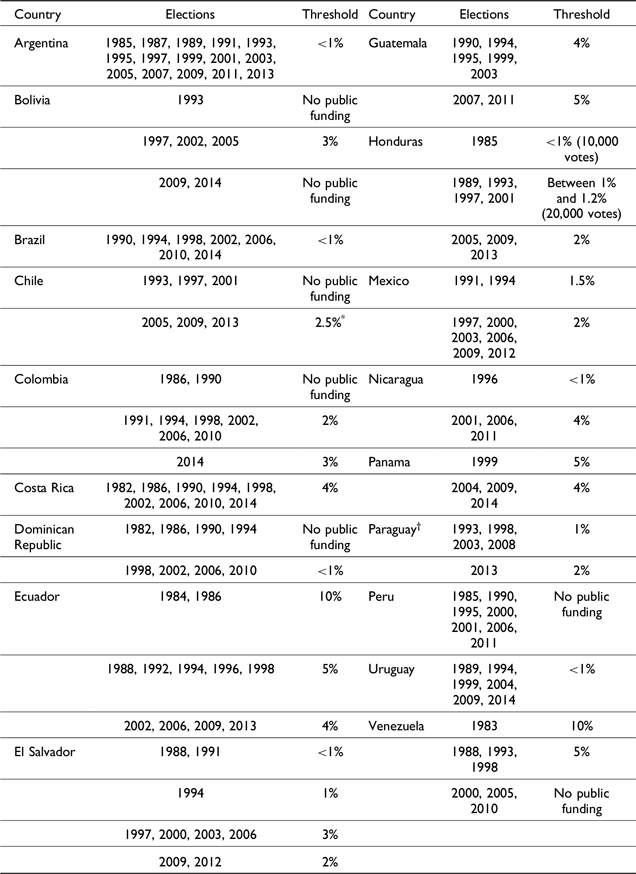
For countries that provide DSF, parties must pass a particular eligibility threshold based on vote percentage or representation in the lower chamber. In most cases, the threshold coincides with the threshold for keeping a party’s legal personality; in other words, as long as a party is able to keep its legal personality, it is eligible to receive DSF.Footnote 6 As Table 1 shows, the eligibility threshold varies across countries and time. The less strict thresholds (< 1%) allow most of the registered parties to receive DSF. In Argentina (1985–) and Brazil (1971–), all registered parties that run in elections are eligible to receive DSF, and the requirement for keeping party registry is not strict. In both countries, the laws do not require parties to pass a specific vote percentage threshold in the previous election for keeping party registry, and thus I coded their rules for DSF as less strict.
Vote percentage thresholds for direct state funding, by country and year of legislative election in Latin America (1978–2014)
Sources: See the online appendix.
* The law stipulates that DSF be available for registered parties that nominated candidates. However, the law stipulates that a party’s legal personality will be cancelled if it fails to gain 5 percent of the valid votes cast in a lower house election, in at least eight regions or in at least three contiguous regions. Because there are sixteen regions in Chile, it makes sense to code the vote percentage threshold as 2.5 percent.
† In Paraguay, the law stipulates that parties must pass the electoral threshold for the most recent two elections to keep the party’s legal personality.
In El Salvador (1988–1991), Honduras (1981–1985), Nicaragua (1996), and Uruguay (1954–), the vote percentage threshold for keeping the legal personality of a party is less than 1 percent. In the Dominican Republic (1997–), the law stipulates that a party must gain 2 percent of the votes in the presidential election to keep registry and receive DSF. However, the law also allows parties to form coalitions, and the overall performance of the coalition determines whether each member party can retain its registry. In reality, many minor parties avoid losing their registry by joining coalitions with larger parties.Footnote 7 Therefore, most registered parties in the Dominican Republic (1997–) have been able to receive DSF.
The majority of Latin American countries have laws that have a stricter eligibility threshold for DSF. Table 1 indicates that the strictest eligibility threshold requires parties to receive at least 10 percent of the vote to be eligible to receive DSF, which was adopted by Venezuela (1973–1987) and Ecuador (1978–1987). The most commonly adopted eligibility threshold is 4 percent, which can be observed in Costa Rica (1949–), Ecuador (2000–), Guatemala (1985–2003), Nicaragua (2000–), and Panama (2003–).
Research design, measurement, and estimation
This article examines the effect of different rules for DSF on different types of electoral volatility in eighteen Latin American countries from 1978 through 2014. The unit of analysis is a pair of consecutive lower chamber elections (e.g., Argentina 1983–1985). I choose to study Latin American countries for two reasons. First, in comparison to Western advanced democracies, the level of electoral volatility is exceptionally high in Latin America (Roberts Reference Roberts2015, 35). The high party system instability suggests the presence of more deeply rooted destabilizing factors. Second, Latin American countries are ideal for performing empirical analyses of electoral volatility. Because all Latin American countries have adopted presidentialism, the executive system can be held constant in the empirical analyses and will not be a concern as an intervening variable.
Dependent variables
Following the work of Powell and Tucker (Reference Powell and Tucker2014) and Cohen, Salles Kobilanski, and Zechmeister (Reference Cohen, Salles Kobilanski and Zechmeister2018), I use the formula for constructing the Pedersen Index (Pedersen Reference Pedersen1979) to generate my two main dependent variables for the analysis. The first dependent variable is party replacement volatility, which pertains to volatility due to (1) the absolute value of vote change for the established parties that contested the election at time t−1 but not the election at time t, and (2) the vote share of new parties that participated at time t but not at time t−1. Party replacement volatility is calculated by halving the sum of the above two components:
 $${\rm{Party}}\ {\rm{replacement}}\ {\rm{volatility}} = {{\left| {\sum\nolimits_{i \,= \,1}^n {{P_{i\left( {t - 1} \right)}}} + \sum\nolimits_{j \,=\, 1}^n {{P_{j\left( t \right)}}} } \right|} \over 2}$$
where i denotes disappearing parties that contested only the election at time t−1 and j denotes new parties that contested only the election at time t.
Stable party volatility, the second dependent variable, pertains to vote switching among established parties, which is calculated by halving the sum of the absolute change in established parties’ vote shares between time t−1 and time t:
 $${\rm{Stable}}\ {\rm{party}}\ {\rm{volatility}} = {{\sum\nolimits_{i \,= \,1}^n {\left| {{P_{it}} - {P_{i\left( {t - 1} \right)}}} \right|} } \over 2}$$
where i denotes established parties. In principle, each measure of volatility ranges from 0 to 100. A zero for party replacement volatility indicates that there are no established parties exiting the system and there are no new parties entering the system; a score of 100 indicates that all established parties are replaced by new parties. In contrast, the formula for constructing the Pedersen Index uses only vote shares of established parties to calculate stable party volatility. In my dataset, the correlation between these two variables is not high (r = 0.33), suggesting that the level of party replacement volatility is not strongly correlated with the level of stable party volatility.
When calculating different types of volatility, one challenge is how to define an established party and a new party, and the coding rules determine not only the estimates but also the empirical results in different ways (Casal Bértoa, Deegan-Krause, and Haughton Reference Casal Bértoa, Deegan-Krause and Haughton2017). For addressing the issues of party change due to name change, splits, mergers, or coalitions, I largely follow the coding rules of Mainwaring, Gervasoni, and España-Nájera (Reference Mainwaring, Gervasoni and España-Nájera2017).Footnote 8 However, while those rules consider that an established party will never become a new party under any circumstance, I follow Cohen, Salles Kobilanski, and Zechmeister (Reference Cohen, Salles Kobilanski and Zechmeister2018) coding rule to consider an established party as a new party at time t if it did not participate at time t−1. This is because the reentry of an established party implies that this party and new parties are in the same disadvantageous position to compete with established parties that participated in consecutive elections.
In this article, most electoral data are compiled from official results on the website of each country’s electoral administrative body; when the official data are unavailable, I rely on sources that provide national-level data (Nohlen Reference Nohlen2005) and district-level data (Eichorst and Polga-Hecimovich Reference Eichorst and Polga-Hecimovich2014; Kollman etal. Reference Kollman, Allen Hicken, Backer and Lublin2019; Lublin Reference Lublin2019; Mustillo Reference Mustillo2012).Footnote 9 Using the district-level data allows me to avoid lumping minor parties that received few votes into a category of “others” for most casesFootnote 10 and thus ensures highly accurate measures for my dependent variables.Footnote 11 For the countries that democratized in the 1980s or 1990s, only the lower chamber elections after the first democratic election are included.
Independent variables
The primary independent variable in this study is a dichotomous variable for Less Strict Eligibility Thresholds for DSF. This variable is coded 1 if a country had a vote percentage eligibility threshold for DSF for the second election in an electoral pair that is smaller than 1 percent, and 0 otherwise. I consider the threshold under 1 percent as the less strict threshold because it ensures that DSF be distributed to a large number of parties, including those that have governing experiences and those that do not. There is some variation for the observations within this threshold category. For instance, El Salvador’s (1985–1991) eligibility threshold was 0.5 percent, while Uruguay’s (1989–2004) eligibility threshold was five hundred votes, a threshold under 1 percent. To save the degrees of freedom in the model, any threshold under 1 percent is included in the less strict eligibility threshold category. The second independent variable is a dummy variable for Stricter Eligibility Thresholds for DSF. This variable is coded 1 if a country adopts a vote percentage eligibility threshold for DSF that is equal to or larger than 1 percent, and 0 otherwise.Footnote 12 The reference category in the models is countries that do not provide DSF.Footnote 13 The coding of these variables is based on various sources (Casas-Zamora and Zovatto Reference Casas-Zamora and Zovatto2015; Gutiérrez and Zovatto Reference Gutiérrez and Zovatto2011; Revenga Sánchez Reference Revenga Sánchez1993; Zovatto Reference Zovatto and Zovatto2006) and original party law documents provided by the official websites of each country’s electoral authority. While the eligibility thresholds do not account for the actual amounts of DSF, they suggest how accessible it is for small parties to receive DSF.
As Birnir (Reference Birnir2005, 927) indicates, using dummy variables to denote different eligibility thresholds for DSF is more appropriate methodologically than using an ordinal variable that captures different thresholds. This is because dummy variables do not impose linearity on the relationship between the independent variable and the dependent variable. Among the 137 observations in my dataset, 22 observations are coded 1 for No DSF, 36 observations are coded 1 for Less Strict Eligibility Thresholds for DSF, and 79 observations are coded 1 for Stricter Eligibility Thresholds for DSF.
Control variables
The empirical models control for a number of variables that could potentially influence the electoral volatility variables. First, I control for Party System Fragmentation, operationalized as the effective number of electoral parties in the first election of an electoral pair. Studies show that a country with more parties might have a higher level of electoral volatility (Roberts and Wibbels Reference Roberts and Wibbels1999), presumably because a higher number of parties better permits voters to switch to a different party if the voters’ policy preference or perception of party competence changes. In addition, as Cox (Reference Cox1997) suggests, smaller district magnitudes encourage elite coordination for electoral alliances and thus predict fewer parties. Therefore, District Magnitude controls for the possibility that permissive electoral systems tend to associate with higher levels of party system fragmentation (Cox Reference Cox1997) and higher electoral volatility (Mainwaring, Gervasoni, and España-Nájera Reference Mainwaring, Gervasoni and España-Nájera2017; Powell and Tucker Reference Powell and Tucker2014). My measure is the natural log of average district magnitude for the second election in an electoral pair.Footnote 14 Furthermore, Andrews and Bairett (Reference Andrews and Bairett2014, 311) argue that the presence of an upper chamber might encourage elite coordination in the lower chamber for passing a parliamentary agenda, and such legislative coalitions might mutually promote electoral alliances (Cox Reference Cox1997). Therefore, I follow Andrews and Bairett (Reference Andrews and Bairett2014) and include Levels of Coordination Required with the Upper Chamber, operationalized as the proportion of seats in the upper chamber in relation to the sum of seats in both chambers for the second election of an electoral pair.Footnote 15
Moreover, previous research has shown that a higher level of ideological polarization in the party system will decrease the level of electoral volatility “by anchoring parties and their constituencies in highly differentiated ideological positions” (Roberts and Wibbels Reference Roberts and Wibbels1999, 579; see also Su Reference Su2014). Therefore, models control for Ideological Polarization, which is the level of party system ideological polarization for the first election of an electoral pair. The measure of ideological polarization is calculated using Singer’s (Reference Singer2016) formula:
 $${\rm{Polarization}} = \sqrt {\mathop \sum \nolimits_{{\rm{i}}\, =\, 0}^{\rm{n}} {{\rm{V}}_i}{{\left( {{\rm{L}}{{\rm{R}}_i} - {\rm{L}}{{\rm{R}}_{mean}}} \right)}^2}} $$
where i represents each party, V is the vote share, and LR is left-right ideology scores drawn from estimates of the ideological position of parties in lower chamber elections between 1990 and 2014 (Baker and Greene Reference Baker and Greene2011; Baker Reference Baker2015).Footnote 16 This measure estimates the weighted average distance between the party’s ideology score and the weighted mean ideology score in a lower chamber election. A low polarization score suggests that the ideology scores of most parties are close to the weighted mean. Because this measure is weighted by vote share, a party system where minor parties have more extreme ideological positions than larger parties will have a lower polarization score than a party system where larger parties have more extreme ideological positions than smaller parties.
Institutional Discontinuity is controlled for in the empirical models, as studies find that electoral dynamics among parties will become more unstable after a fundamental alteration in important political institutions (Madrid Reference Madrid2005; Roberts and Wibbels Reference Roberts and Wibbels1999; Su Reference Su2014). I use the index of institutional discontinuity constructed by Roberts and Wibbels (Reference Roberts and Wibbels1999), which ranges from 0 to 3, assigning one point for each of the following scenarios: the adoption of a new constitution; an increase in voter turnout rate of more than 25 percentage points due to the enfranchisement for previously excluded citizens; and an irregular change in executive authority, including a president’s self-coup, a forced resignation of the president, a successful presidential impeachment, or an attempted coup d’état that forced the president temporarily from office. I code this variable by measuring the number of institutional discontinuity events that occurred after the first election and before the second election in an electoral pair.Footnote 17
Studies show that the party system might become more stable over time as voters have been more socialized for developing stronger party identification (Brader and Tucker Reference Brader and Tucker2001). The argument that electoral volatility diminishes over time has been supported by some studies (Tavits Reference Tavits2005) but not by others (Chiaramonte and Emanuele Reference Chiaramonte and Emanuele2017; Madrid Reference Madrid2005). To control for this trend effect, I include a variable for Years since Democracy, which is measured as the logged number of years from the inauguration of a new democracy to the second election year of an electoral pair.Footnote 18
To control for the possible effects of economic voting on electoral volatility (Kuenzi etal. Reference Kuenzi, Tuman, Rissmann and Lambright2019), the models include GDP Growth and Inflation.Footnote 19 Both variables are lagged by one year before the second election of an election pair to capture the short-term impact of economic fluctuations on volatility. Inflation is operationalized as the logged value of the inflation rate.Footnote 20 Last, I control for two variables regarding population. Madrid (Reference Madrid2005) demonstrates that, because ethnic-based parties are generally weak or nonexistent in many Latin American countries, Indigenous people are generally poorly represented and tend to switch their support to different catch-all parties over time. Therefore, I include the percentage of Indigenous Population in a country’s population (Madrid Reference Madrid2016). Moreover, I include a natural log of Electorate Size to control for the possibility that a larger population might hinder elite coordination in elections and thus might increase volatility (Andrews and Bairett Reference Andrews and Bairett2014, 314). Table 2 reports descriptive statistics for the dependent variables, independent variables, and control variables.
Descriptive statistics
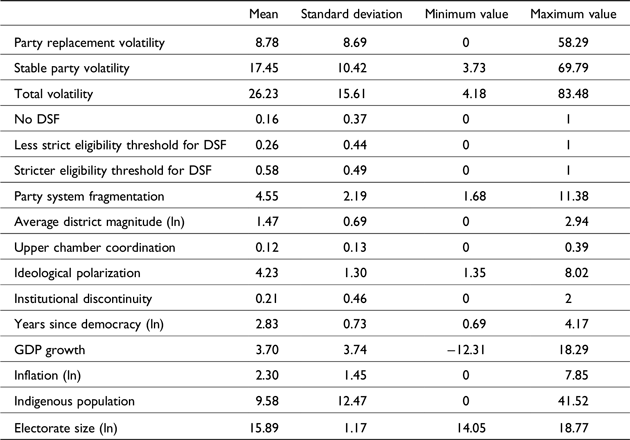
Note: The total number of observations is 137, except for average district magnitude (131).
Estimation techniques and model specification
Following previous empirical studies of electoral volatility (Birnir Reference Birnir2005, Reference Birnir2010; Powell and Tucker Reference Powell and Tucker2014), I use an ordinary least squares (OLS) regression model.Footnote 21 Because of the cross-sectional time-series structure in my data, observations within countries may not be truly independent from one to another. Therefore, I employ Huber-White sandwich robust variance estimators clustered by countries to obtain robust standard errors for the estimated coefficients.Footnote 22
In this study, two different sets of models have been specified. The first considers the effects of dummy variables for different eligibility thresholds for DSF, and the second model includes the aforementioned independent variables as well as the control variables. Models have been defined as follows:
-
Volatility (1) = β0 + β1 less strict threshold + β2 stricter threshold + ε
-
Volatility (2) = β0 + β1 less strict threshold + β2 stricter threshold + β3 party system fragmentation + β4 average district magnitude (ln) + β5 upper chamber coordination + β6 ideological polarization + β7 institutional discontinuity + β8 years since democracy (ln) + β9 GDP growth + β10 inflation (ln) + β11 indigenous population + β12 electorate size (ln) + ε
Empirical results
Table 3 presents results for the empirical models predicting different types of electoral volatility in Latin America.Footnote 23 Models 1 and 2 examine the effects of differing eligibility thresholds for DSF, while Models 3 and 4 estimate the effects of the independent variables with control variables taken into account. All models use countries that do not provide DSF for parties as the reference category.
Models for different types of electoral volatility in lower chamber elections in Latin America
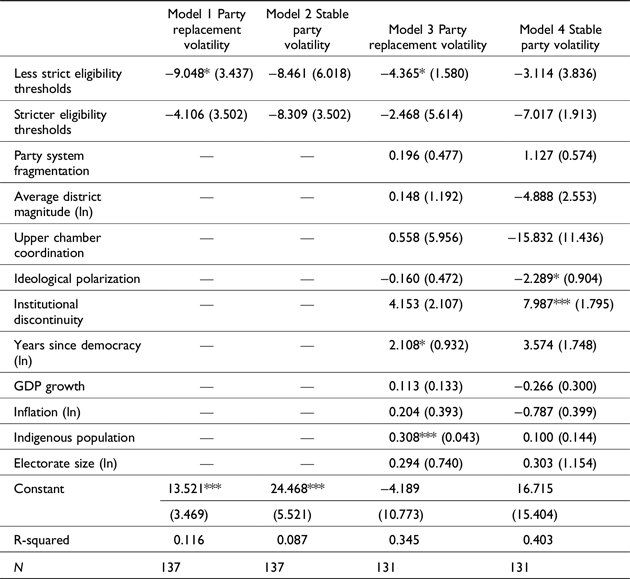
Note: Main entries are OLS estimates with robust standard errors clustered by country in parentheses. The reference category is countries that do not provide DSF.
*p ≤ 0.05; **p ≤ 0.01; *** p ≤ 0.001, two-tailed tests.
The results show strong support for H1. In Model 1 and Model 3, the less strict eligibility thresholds variable has a negative and statistically significant coefficient. Substantively, the finding in Model 3 suggests that a country with a vote percentage eligibility threshold for DSF that is smaller than 1 percent has a party replacement volatility score that is 4.4 lower than a country that provides no DSF for parties. In addition, the results in Model 1 and Model 3 show that a country with a stricter eligibility barrier for making parties eligible for receiving DSF has a lower party replacement volatility score than a country that provides no DSF. However, the analysis does not provide statistically significant evidence for this finding.Footnote 24
Regarding the results for stable party volatility (Models 2 and 4), less strict eligibility thresholds and stricter eligibility thresholds have negative coefficients but they do not reach statistical significance. This statistically insignificant finding suggests that, although less strict eligibility thresholds help existing parties be more likely to survive, they do not necessarily reduce stable party volatility. If numerous parties are able to survive due to a low eligibility threshold for DSF, the level of electoral competition might be higher and thus increase the level of stable party volatility, as Casas-Zamora’s (Reference Casas-Zamora2005) study implies. However, it is also possible that many existing parties might use DSF to strengthen their ties with voters, and thus the level of stable party volatility might be lower (Casal Bértoa Reference Casal Bértoa2017). In short, there is no strong statistically significant evidence for supporting H2.
Surprisingly, some control variables do not have theoretically expected impacts on any type of electoral volatility. Against the expectation based on economic voting theory, the estimated coefficients of GDP growth and inflation rate do not achieve statistical significance. Moreover, I find that party system fragmentation, average district magnitude, upper chamber coordination, and electorate size have no clear impact on any type of electoral volatility in my sample.
In contrast, the results for one control variable clearly indicate that different theoretical arguments should be used for explaining different types of electoral volatility. Table 3 indicates statistically significant evidence that a higher level of ideological polarization decreases stable party volatility, but the effect of polarization on party replacement volatility is not statistically significant. A seemingly unrelated estimation (SUEST) performed by Stata indicated evidence at the p < 0.05 level that the coefficients for polarization differed between Models 3 and 4. While Roberts and Wibbels (Reference Roberts and Wibbels1999) find that a more ideologically polarized party system tends to have lower total electoral volatility, my finding provides a new insight by showing that the reduction effect of ideological polarization is stronger for stable party volatility than for party replacement volatility.
Table 3 also indicates that the coefficient for institutional discontinuity is positive and statistically significant for stable party volatility but statistically insignificant for party replacement volatility. However, the SUEST test showed a lack of statistically significant evidence that the coefficients for institutional discontinuity differed between Model 3 and Model 4. In Model 3, the coefficient for years since democracy is statistically significant and positive, indicating that party replacement volatility tends to increase over time. However, contrary to Weghorst and Bernhard (Reference Weghorst and Bernhard2014, 18), my analysis in Model 4 did not provide statistically significant evidence that years since democracy has an effect on stable party volatility. Moreover, while Madrid (Reference Madrid2005) demonstrates that total electoral volatility increases with a larger Indigenous population, my finding shows that a larger Indigenous population increases party replacement volatility, but the effect of Indigenous population on stable party volatility is statistically insignificant. However, SUEST tests indicated a lack of statistically significant evidence that the coefficients for years since democracy and the coefficients for Indigenous population differed between Model 3 and Model 4. Overall, my analyses suggest that it is necessary to look beyond total electoral volatility by testing different explanations on different types of volatility.
Robustness tests
To test the robustness of my findings, I conducted a series of robustness checks and sensitivity tests based on Models 3 and 4 (see the online appendix for results). First, to consider the possibility that certain statistical outliers are driving my results, I conducted regression diagnostics of studentized residuals and Cook’s distance to identify these outliers.Footnote 25 The re-estimated results do not change much if I include fixed effects dummy variables for these observations or drop them from the models. Second, to make sure that the empirical results are not driven by the particular operationalization of the dependent variables, I recoded the dependent variables using Birch’s (Reference Birch2003, 122–123) measures of “party replacement” and “electoral volatility.” The reestimated results remain largely similar.
Third, to make sure that the empirical results are not driven by the choice of 1 percent cutoff point, I recoded this variable using a 2 percent eligibility threshold as the cutoff point. The reestimated results indicate that the coefficient for eligibility thresholds below 2 percent is negative and statistically significant for party replacement volatility, suggesting that using a different cut-off point for operationalizing the less strict eligibility threshold does not significantly affect the main finding. Fourth, I conducted another robustness check using Birnir’s (Reference Birnir2005) research design, which includes dummy variables that pertain to different eligibility thresholds for DSF. I followed this strategy by including dummy variables for vote percentage thresholds smaller than 1 percent (less strict eligibility thresholds), to vote percentage thresholds equal to 1 percent, 2 percent, 3 percent, 4 percent, 5 percent, and 10 percent.Footnote 26 With seven different eligibility thresholds for DSF being included for the test of party replacement volatility, the results remain largely unchanged for the variable of less strict eligibility thresholds.
To summarize, the empirical findings are robust across different operationalizations of dependent variables and different model specifications. The robustness checks reinforce the general theoretical expectation that less strict eligibility thresholds matter for explaining party replacement volatility.Footnote 27
Conclusion
Previous research has argued that direct state funding (DSF) for parties has an important influence on the electoral volatility of party systems, which is an important aspect of party system institutionalization. However, I argue that the causal mechanism that explains electoral volatility requires consideration of how different rules for public subsidies affect different types of electoral volatility. Using lower chamber electoral data for eighteen Latin American countries from 1978 through 2014, my empirical analyses show that countries that provide DSF for most parties that participated in elections tend to have lower levels of party replacement volatility than countries that provide no such funding. In contrast, I find that countries that require parties to achieve a higher threshold for being eligible for DSF do not necessarily have a lower level of party replacement volatility. This article does not provide statistically significant evidence that the provision of DSF, regardless of the level of barrier, correlates with vote-switching volatility between existing parties. In short, a lower barrier for DSF tends to reduce the type of electoral volatility caused by party replacement while not significantly impacting volatility among stable political parties.
My analyses carry important theoretical implications. While Birnir (Reference Birnir2005) finds that DSF decreases total volatility and thus that DSF matters for party system institutionalization, this article provides a more nuanced insight by showing that DSF serves as public venture capital primarily for established parties. The empirical results suggest that, compared to no DSF, a less strict eligibility threshold for DSF tends to produce a lower level of party replacement volatility, which is consistent with the expectation that very generous public financing for parties will prevent new parties from gaining stronger electoral support. In addition, my study does not provide evidence that DSF barriers inhibit voters from switching votes among existing parties. While it is common that a democratic country experiences party volatility to some extent, it is preferable not to have a higher level of party replacement volatility, because such volatility is more likely to associate with negative political consequences, such as lack of accountability and lack of development of party reputations, than is stable party volatility.
This article’s approach facilitates a better understanding of the mechanism about the effect of rules of direct state funding on electoral volatility in Latin America while also bringing to bear conventional explanations of party system development around the world. The empirical analysis shows that the theorized effect of some variables should influence different types of electoral volatility in different ways. For instance, while Madrid (Reference Madrid2005) finds that total electoral volatility tends to be lower in a highly polarized party system, my analysis suggests that a higher level of party system polarization tends to decrease stable party volatility but not party replacement volatility. In short, this study provides strong evidence that DSF serves as public venture capital for established parties. It also provides a critical reappraisal of the implications of the cartel party thesis for the relationship between DSF and party system institutionalization in new democracies. Last, but not least, one important substantive implication of this study is that an institutional design of a less strict eligibility threshold for party subsidies can support more stable party systems and greater political accountability, by discouraging the emergence of new parties with anti-system tendencies while not discouraging vote-switching between existing parties.
Supplementary material
To view the online appendix for this article, please visit https://doi.org/10.1017/lar.2022.9
Acknowledgements
I am grateful to Bruno Hoepers, Aníbal Pérez-Liñán, Ya-Wen Yu, L. J. Zigerell, and the anonymous reviewers for their helpful comments and suggestions on the manuscript. Funding for this research was provided by the Ministry of Science and Technology, Taiwan (grant number 106-2628-H-004 -004 -MY3).


 Open access

