

1. Introduction
The Russian invasion of Ukraine, flaring tensions between China and Taiwan, and the escalating conflicts in the Levant have reawakened interest into a concept that remained largely untouched since the Nuremberg-era trials in the aftermath of the Second World War: the crime of aggression. Exploring potential avenues for prosecuting perpetrators of aggressive wars has since come to occupy the attention of legal scholars, practitioners, and politicians with a newfound urgency.Footnote 1 However, breathing life into the provisions criminalizing aggression proves to be both legally and politically challenging given the limited jurisdictional regime of the International Criminal Court (ICC).Footnote 2 An alternative road for prosecutions could be paved by a concept that is increasingly being used to counteract the substantive selectivity of international criminal justice where the ICC remains unable to act: universal jurisdiction (UJ).Footnote 3 Domestic courts and internationalized tribunalsFootnote 4 exercising UJ may do so even when none of the traditional jurisdictional bases are available; meaning they deliver justice where the crime was committed on foreign territory, neither the perpetrator(s) nor the victim(s) are nationals of the forum state, and domestic security interests are not directly impacted.Footnote 5 In other words, the activation of UJ does not depend on territoriality, nationality or security interests, but it is the alleged crime itself that is deemed so universally reproachable that any court around the globe may hold its perpetrators accountable. This idea is also reflected in the discussions regarding the establishment of a special international tribunal for the crime of aggression committed against Ukraine.Footnote 6 Although both the victim and aggressor states may individually delegate their jurisdiction derived from territoriality or nationality to such a special tribunal, broader cross-regional support is essential to guarantee the legitimacy of potential aggression trials.Footnote 7 Moreover, the textual definitions of aggression in the legal system of states with territoriality or nationality jurisdiction, such as Article 437 of the Ukrainian Criminal Code,Footnote 8 may significantly differ from the crime of aggression as in Article 8bis of the Rome Statute. The Ukrainian provision does not, for example, textually distinguish between the decision-making leaders vis-à-vis the subjects that may be deemed ‘followers’, such as ordinary soldiers.Footnote 9 In contrast to the victim or aggressor state delegating their jurisdiction to a special tribunal or prosecuting alleged offenders themselves, a larger group of potential founding states, such as the members of the UN General Assembly or the Council of Europe, may be able to delegate their universal jurisdiction,Footnote 10 thus enabling the tribunal to adjudicate conduct captured by the international crime of aggression on behalf of a range of states.Footnote 11
However, the precise definition, material scope and application of UJ remain contentious.Footnote 12 In recent years, UJ has increasingly been invoked in cases of genocide, crimes against humanity, and war crimes.Footnote 13 Yet, the question of whether aggression, as an international crime with a somewhat distinct status, is amenable to UJ continues to divide legal scholarship. Some authors argue affirmatively, contending that international law indeed allows courts to exercise UJ over all crimes listed in the Charter of the International Military Tribunal of Nuremberg,Footnote 14 arguing that UJ is activated by the jus cogens nature of the prohibition of aggressionFootnote 15 or its status as a crime under international law.Footnote 16 Contrastingly, other scholars have questionedFootnote 17 or rejected that customary law allows UJ over aggression, pointing to the lack of domestic prosecutionsFootnote 18 or the principle of par in parem non habet imperium, which holds that domestic courts cannot adjudicate the conduct of another sovereign state.Footnote 19 Notably, the special status of aggression was accentuated when it was excluded from the 1996 Draft Code of Crimes against the Peace and Security of Mankind as a crime under UJ, while genocide, crimes against humanity and war crimes were included.Footnote 20
Opinions on the customary material scope of UJ clearly diverge. It is striking that despite the occasional reference to an alleged lack of state practice, no study has yet empirically and systematically assessed the status quo of customary international law in relation to the potential reach of UJ over the crime of aggression. To address this gap, the present article offers a legal–empirical analysis of the positions of 126 states based on their written and verbal submissions to the UN General Assembly’s Sixth Committee on Legal Questions (Sixth Committee). Section 2 briefly introduces the legal methodology used to determine the content of a jurisdictional norm under the classic inductive theory to customary international law. Section 3 outlines the empirical methodology employed for collecting and analysing evidence of a general state practice accepted as law, specifically through coding the submissions made to the Sixth Committee. Subsequently, the data is presented and explained in Section 4, followed by a discussion in Section 5. Finally, Section 6 concludes by evaluating the extent to which the findings suggest that UJ indeed extends to aggression under the classic theory of customary international law.
2. Legal theory to determine the applicability of a jurisdictional norm under customary international criminal law
Pursuant to Article 38(1)(b) of the Statute of the International Court of Justice, custom is one of the sources of international law.Footnote 21 Under the classic inductive theory,Footnote 22 the formation of a customary norm requires two constitutive elements: evidence of a general state practice (usus) and the accompanying belief that the conduct is required by international law (opinio juris).Footnote 23 This approach has been applied by international criminal courts and tribunals,Footnote 24 endorsed by the International Committee of the Red Cross (ICRC),Footnote 25 and supported by a substantial number of scholars.Footnote 26 However, inconsistencies in jurisprudence complicate the identification of a single methodology for determining the emergence and content of customary norms of international criminal law.Footnote 27 The following paragraphs will briefly operationalize the meaning of ‘state practice’ and ‘opinio juris’ in the context of this present study, as well as the meaning of generality when evaluating empirical data on state practice.
2.1 Understanding and identifying ‘state practice’
The International Law Commission (ILC) conceptualized the notion of ‘state practice’ in its 2018 Draft Conclusions on the Formation of Customary Law.Footnote 28 Accordingly, ‘State practice consists of the conduct of the State, whether in its exercise of its executive, legislative, judicial or other functions’.Footnote 29 Such conduct encompasses both physical and verbal acts, and, in certain circumstances, even inaction.Footnote 30 Similarly, the ICJ has considered official statements as evidence of verbal state practice in several cases.Footnote 31 Specifically, actions that may be considered state practice include ‘conduct in connection with resolutions adopted by an international organisation or conduct at an intergovernmental conference’.Footnote 32 In the present article, evidence that falls within the ILC conceptualization of state practice consists of: (i) the written submissions made to the Sixth Committee on the material scope of UJ in response to UN resolutions requesting such information, (ii) verbal acts by state representatives at the Committee’s annual meeting, and (iii) domestic legislative provisions on UJ that are referenced in the submissions.
2.2 Understanding and identifying ‘opinio juris’
The classic inductive approach further requires that the general practice is ‘accompanied by a conviction that it is permitted, required or prohibited by customary international law’.Footnote 33 This notion of opinio juris has been described as the ‘individual consent of the State’Footnote 34 or a ‘sense of legal right or obligation’.Footnote 35 According to the ILC Draft Conclusions, evidence of opinio juris may be found in public statements made on behalf of the state, official publications, governmental legal opinions, or state conduct in connection with international resolutions.Footnote 36 In the context of this present article, evidence of opinio juris is thus drawn from two sources: (i) written submissions to the Sixth Committee, and (ii) public statements made on behalf of the state at the Committee’s annual meetings.
Especially in relation to such verbal acts the distinction between state practice and opinio juris becomes blurred. It has been observed by the ILC that ‘[m]ore often than not, one and the same act reflects practice and legal conviction’.Footnote 37 The written and oral submissions to the Sixth Committee exemplify this dual-aspect character: the verbal act of making an intervention in the intergovernmental forum constitutes one form of state practice, while the respective statements further set out the state’s legal assessment of its rights and obligations in relation to the scope of UJ, thereby evidencing opinio juris.Footnote 38 Such conduct can therefore simultaneously serve as evidence of both elements required for the formation of customary international law.Footnote 39
2.3 Level of required generality of empirical data on state practice and ‘opinio juris’
While it is comparatively uncontroversial to define what constitutes state practice or opinio juris, the question how much evidence is required to prove that a practice is sufficiently general is comparatively contentious. As a rule, the ‘relevant practice must be general, meaning that it must be sufficiently widespread and representative, as well as consistent for custom to form’.Footnote 40 However, the ICJ also reasoned that ‘[i]t is not to be expected that … the application of the rules in question should have been perfect’ and that it is sufficient for state conduct to ‘in general be consistent with such rules’ to deduce the existence of customary law.Footnote 41 Dörr notes that ‘most customs are found to exist on the basis of practice by fewer than a dozen states’, but this claim is not empirically substantiated.Footnote 42
When turning to the jurisprudence by international courts it appears that customary norms have indeed been found to exist on the basis of analysis of the practice and opinio juris by a limited number of states. For instance, in the Lotus case, the Permanent Court of International Justice (PCIJ) cited decisive precedents of practice by only seven exclusively European and North American states.Footnote 43 Interestingly, the dissenting judges identified additional practice by some 20 states rejecting the formation of the customary norm at handFootnote 44 and identified conflicting practice by four out of the seven states cited in the judgement.Footnote 45 Nevertheless, the PCIJ concluded that a customary rule of international law had crystallized despite these inconsistencies.
More recent ICJ jurisprudence, decided after the main waves of decolonization and at a time when most present-day states were already in existence, offers a more modern perspective than the Lotus case. In 2023, the ICJ affirmed the existence of a customary normFootnote 46 based on evidence of state practice and opinio juris from 51 submissions by 39 states to the Commission on the Limits of the Continental Shelf (CLCS).Footnote 47 Again, contradictory practice by up to 20 states was identified in dissenting opinions,Footnote 48 which were neither explicitly discussed nor acknowledged in the judgement. The ICJ concluded that the disparity of positions does not necessarily negate the conclusion that ‘taken as a whole, the practice of States may be considered sufficiently widespread and uniform for the purpose of the identification of customary international law’.Footnote 49 For the sake of this study, one may therefore evaluate the generality of the data presented in the following through the lenses developed by the PCIJ and ICJ, which seem to favour a contextual, holistic assessment over a purely numerical approach.Footnote 50
3. Empirical methodology to collect evidence of a general practice accepted as law
After introducing the inductive theory on customary international law, this section sets out the empirical methodology for collecting and analysing evidence of state practice and opinio juris. It begins by introducing and describing the relevant dataset, then examines the sample’s characteristics and representativeness, along with the data collection process. The section concludes with a discussion of the methodology’s strengths and limitations, providing the foundation for the presentation of results in Section 4.
3.1 The UN General Assembly Sixth Committee on legal questions and UJ
The Sixth Committee is the primary UN body for states to confer about the challenges of international law.Footnote 51 Each UN member state is entitled to participate in the Committee’s meetings, to submit written reports and make verbal statements.Footnote 52 In 2009, Tanzania proposed a new agenda item on the ‘scope and application of universal jurisdiction’ due to its concerns about arbitrary application and potential for abuse.Footnote 53 Since then, all UN members have been invited annually to submit information on the domestic practice and understanding of UJ.Footnote 54 These written submissions and verbal statements made since 2009Footnote 55 are publicly accessible on the UN website.Footnote 56 Despite years of debate, the Committee has yet to agree on a binding definition of UJ or determine the crimes it covers. In light of this lack of consensus and the volume of submissions, a systematic analysis of their content offers valuable empirical insight into the current state of customary law on UJ.
3.2 Characteristics and representativeness of the sample
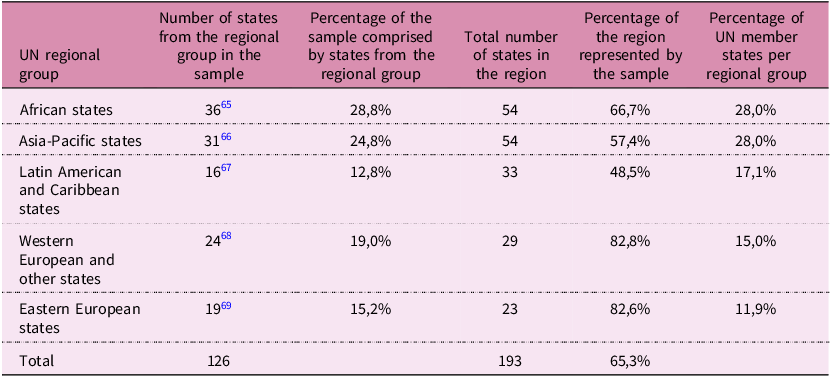
Between 2009 and 2023, 122 UN member statesFootnote 57 have submitted information on their understanding of the scope and application of UJ, comprising 161 publicly available written reports and 222 transcripts of verbal statements. Additionally, domestic criminal provisions of four Asia-Pacific states that had not submitted reports to the UN were consulted.Footnote 58 The resulting sample thus represents the practice and legal understanding of 126 UN member states, or 65.3 per cent of the current 193 UN members (see Table 1). The remaining 67 states are absent from the dataset, as they did not respond to any of the UN General Assembly resolutions requesting submissions to the Sixth Committee.Footnote 59 The sample spans all continents, includes all five permanent members of the UN Security Council, and represents diverse legal traditions.Footnote 60 As illustrated in Table 1, Asian-Pacific, Latin American, and Caribbean states are slightly underrepresented, while Western and Eastern European states are somewhat overrepresented. These imbalances are unlikely to affect the validity of the overall findings, however, since regional affiliation does not necessarily determine a state’s position on UJ or its extension to the crime of aggression. Consequently, the sample does not exclude states that are either particularly critical or supportive of extending UJ to aggression by virtue of being located in a certain region.
Representativeness of the sample by UN regional groups

3.3 Data collection and analysis
The dataset comprises a total of 383 written and verbal accounts, compiled and analysed by transferring the submissions into the coding software ATLAS.ti (22.1.5.0. version) in either English or French.Footnote 61 In an initial round of in vivo coding,Footnote 62 key themes addressed by the states in their submissions were identified by assigning labels that reflected the content of the data. This was followed by an analysis of the states’ choice of words and phrases to uncover patterns in their reasoning and a phase of grouping related pieces of text into categories and subcodes.Footnote 63 The analysis provided both a quantitative overview of the states’ acceptance or rejection of exercising UJ over the crime of aggression, as well as qualitative insights into their reasoning and characterization of UJ’s material scope. In cases where a state made conflicting statements over time, the most recent submission was considered as the definitive position on whether customary law permits the invocation of UJ in aggression cases (in line with the lex posteriori maxim).Footnote 64
3.4 Strengths and limitations of this method
This method is subject to four main limitations. First, states often use differing definitions of key terms such as ‘universal jurisdiction’ in their submissions to the Sixth Committee. For example, some states assert that UJ can only be invoked when a treaty establishes the obligation to prosecute or extradite and the applicability of UJ, while others draw a clear distinction between treaty obligations and UJ.Footnote 70 Similarly, terms like ‘crime of aggression’ or ‘crimes against peace’ may refer to different conduct depending on the state using them. The inconsistent use of legal terminology throughout the submissions requires a contextual reading to understand the specific meaning that states assign to these concepts.
Second, language barriers and the limitation of translations and optical character recognition software for Arabic and Cyrillic scripts may additionally contribute to discrepancies in terminology. Despite efforts to mitigate the possibility of translation errors by using multiple software programs,Footnote 71 the risk of inaccuracies could not be entirely eliminated.
Third, comparative research across diverse legal traditions is inherently constrained by the potential for knowledge gaps in the foreign domestic systems, which could lead to misinterpretations of the submissions. While the risk of such misinterpretations could not be ruled out entirely, it is mitigated by the fact that the approaches of the sampled states were monitored over 14 years in which the Sixth Committee discussed UJ and in which the states often repeatedly shared their understanding of the international law (2009–2023).
Fourth, one and the same state may act inconsistently and its legislative, judiciary or executive branch may at times contradict the submissions made to the Sixth Committee. This is illustrated by a number of states that – as will be shown in the following sections – were recorded as allowing the exercise of UJ over the crime of aggression, but which also recognize the limiting effects of immunities on domestic prosecutions of aggression and have declared their support for the creation of a special international tribunal on the crime of aggression.Footnote 72 Therefore, the results of this study are best understood as an initial exploration of the customary availability of UJ, rather than a comprehensive review of the practical and procedural conditions needed to prosecute aggression under international law. In other words, the analysis is limited to the data presented to the Sixth Committee. Further research could expand on this by triangulating these findings with additional examples of state practice and opinio juris, and analysing the hierarchy of practices among different state branches in case of conflicting approaches. However, such an exploration falls outside the scope of this study.
Despite these limitations of the empirical method, the considerable number of submissions and sampled states constitute the principal strengths of this study. Given the overall inhibitory context of aggression and UJ (see Section 5), considering evidence of the practice and legal conviction of 126 states from all UN regions, and over the course of 14 years, provides unique empirical insights. This data is notable for its breadth and depth in comparison to international courts determining customary normsFootnote 73 and other legal-empirical studies in the context of exploring the crime of aggression.Footnote 74 Consequently, this study has achieved a high level of saturation in delineating the extent to which UJ has come to extend to the crime of aggression under customary law.Footnote 75
4. Empirical-legal analysis of state practice and opinio juris on prosecuting the crime of aggression under universal jurisdiction
An examination of the submissions by 126 states reveals five patterns regarding the applicability of UJ to the crime of aggression. First, 23 states explicitly include aggression, or crimes against peace, within the scope of UJ. Second, 50 states condition UJ on whether the offence qualifies as a crime under international law – some looking to specific treaties, others to customary international law, and a smaller subset to ius cogens. Third, 16 states outline characteristics of UJ offences and provide non-exhaustive lists of applicable crimes, without expressly mentioning aggression. Fourth, 32 states exclude aggression from the scope of UJ. Finally, five states do not specify which crimes they consider subject to UJ. The following sections examine each of these approaches in turn and assess their significance as evidence for or against the emergence of a customary norm permitting UJ over aggression.
4.1 Explicit extension of UJ to the crime of aggression
Twenty-three statesFootnote 76 suggest that the crime of aggressionFootnote 77 may be prosecuted under UJ and without any of the traditional jurisdictional links being applicable. Three of these states did not make submissions to the UN Sixth Committee but are included based on scholarly accounts identifying their national laws extending UJ to the crime of aggression (see Section 3.2).Footnote 78 These 23 states tend to identify several conditions precedent to prosecutions, such as the presence of the accused,Footnote 79 compliance with the ne bis in idem principle,Footnote 80 or the authorization by a national authority (such as the Advocate General or Minister of Justice).Footnote 81 The feasibility of prosecutions in these jurisdictions will therefore depend on additional, context-specific factors beyond the scope of this paper. Notably, although all 23 states posit that international law permits the exercise of UJ over aggression, not all have enacted domestic legislation enabling their courts to exercise such jurisdiction in practice.Footnote 82
4.2 Applicability of UJ depending on the classification of the offence as an international crime
Fifty states make the exercise of UJ conditional on the offence qualifying as a crime under international law and the legal consequences flowing from that qualification.Footnote 83 In other words, 40 per cent of the sampled states suggest that should the crime of aggression be recognized as an international crime, their domestic courts may exercise UJ over it; if not, UJ would be unavailable. These states diverge, however, on which sources of international law determine that qualification, which in turn leads them to differing conclusions regarding the availability of UJ. On the one hand, 31 states exclusively refer to international treaties as legitimate sources to identify the international crimes that may be subject to UJ prosecutions.Footnote 84 Contrastingly, the remaining 19 refer to the unwritten rules of customary international law (that may of course be reflected in treaties) or jus cogens norms.Footnote 85 These two approaches will be addressed separately below.
4.2.1 Treaties as identifiers of international crimes subject to UJ
Of the 31 treaty-oriented states, 18 refer only to offences criminalized in treaties to which they are parties and which authorize or oblige them to prosecute certain conduct.Footnote 86 To date, the Rome Statute of the ICC is the only international treaty that some scholars argue implicitly permits domestic prosecutions for aggression under the complementarity regime.Footnote 87 However, neither the operative part nor the preamble of the Rome Statute contain an explicit obligation to criminalize or prosecute aggression,Footnote 88 and Understanding 5 to the Kampala Amendment expressly provides that it ‘shall not be interpreted as creating the right or obligation to exercise domestic jurisdiction with respect to an act of aggression committed by another state’.Footnote 89 On this basis, the 18 states requiring such a treaty basis may be regarded as opposing the customary availability of UJ for aggression.
The other 13 states refer to the Rome Statute as identifying the most serious crimes under international law and contend that such crimes, by virtue of their gravity, justify the exercise of UJ by all states.Footnote 90 In their view, the Statute’s inclusion of aggression suffices to render it amenable to UJ, even absent an explicit treaty-based obligation to prosecute. Instead of requiring the Rome Statute to create the right or obligation for states to prosecute an offence, they posit that the Statute identifies the crimes that are so serious that every state has an interest in repressing and punishing them. These submissions thus constitute evidence in favour of the availability of UJ for aggression.
4.2.2 Viewing crimes under customary international law as subject to UJ
Additionally, 19 states make the extension of UJ dependant on qualifying aggression as a crime under the customary rules of international law, without requiring a treaty basis. Seventeen of these regard all crimes under customary international law as potentially subject to UJ prosecutions;Footnote 91 two limit UJ to crimes prohibited under jus cogens, i.e., the non-derogable norms of international law.Footnote 92
Despite the abundance of scholarly literature on the question which acts qualify as international crimesFootnote 93 and the many voices suggesting that aggression is such a crime,Footnote 94 the sampled states generally refrain from defining what they understand to constitute international crimes in their Sixth Committee submissions. Nevertheless, it seems plausible to argue that the crime of aggression is indeed prohibited under customary law given that it was identified as the ‘supreme international crime’ by the Nuremberg IMT.Footnote 95 This is further supported by the fact that crimes against peace were included in the London Charter of the International Military Tribunal (entered into force in 23 states),Footnote 96 the Nuremberg Principles adopted by the UN General Assembly (which at the time had 55 members),Footnote 97 the Draft Code of Crimes against the Peace and Security of Mankind,Footnote 98 and the Rome Statute (ratified by 125 states).Footnote 99 Similarly, the prohibition of aggression is widely accepted as peremptory,Footnote 100 and it may be argued that its criminalization can thus also be derived from a jus cogens norm.Footnote 101 If this premise is accepted, the submissions of these 19 states may be read as supporting the availability of UJ for aggression.
4.3 Providing a non-exhaustive list of crimes subject to UJ
Sixteen states set out general characteristics of UJ crimes and offer a non-exhaustive illustrative list, which omits aggression.Footnote 102 The United Kingdom, for instance, explained in its 2020 submission that ‘adopting a definitive list or methodology [to identify the crimes that may be subject to UJ prosecutions] risks undermining the ability of states to agree on how best to deal with a particular crime by limiting the options they can take in respect of jurisdiction’.Footnote 103 In other words, this group acknowledges that non-listed crimes exist for which UJ could be invokedFootnote 104 and suggests that they share a common denominator that ‘triggers’ their universality.Footnote 105
To be able to prosecute a crime under UJ, these 16 states identify three conditions: the offence must be of exceptional gravity, it must negatively affect the international community as a whole, and the UJ prosecutions should help to prevent and punish internationally unacceptable conduct.Footnote 106 In line with the rationale of not limiting their discretionary exercise of jurisdiction, the states do not clarify which offences they deem to fulfil these requirements. Concluding whether their submissions should be read in favour or against the extension of UJ to aggression thus warrants a brief analysis of whether criminal aggression could be viewed as (i) exceptionally grave, (ii) negatively affecting the international community as a whole, and (iii) whether UJ prosecutions would help to prevent and punish internationally unacceptable conduct.
Firstly, one may note that aggression has been identified as the ‘supreme international crime’ by the IMTFootnote 107 and – according to its definition under Article 8bis of the Rome Statute – ‘by its character, gravity and scale, constitutes a manifest violation of the Charter of the United Nations’. Acts of aggression that reach this ‘manifest violation’ – threshold and thereby amount to criminalized forms of aggression by definition have to be exceptionally grave. Moreover, one may recall the UN General Assembly Resolution A/ES-11/L.1,Footnote 108 which was approved by 141 UN members and which stressed the ‘importance of maintaining and strengthening international peace founded upon freedom, equality, justice and respect for human rights and of developing friendly relations among nations’.Footnote 109 Accordingly, the first condition appears to be met.
Secondly, in addition to endangering international peace and infringing upon the sovereignty and territorial integrity of another country, such criminal acts of aggression likely have far-reaching adverse global effects, such as rising inflation, contributing to extreme poverty, food insecurity and environmental degradation.Footnote 110 Presuming that an act of aggression that would meet the gravity threshold cannot happen in an isolated manner not affecting the international community, one may argue that also the second condition is fulfilled.
Lastly, one may consider the role of UJ in punishing perpetrators of aggression, particularly considering the limited jurisdictional regime of the ICC. It has been shown that where the ICC is unable to act, UJ may either enable domestic prosecutions of aggression or alternatively, states may delegate UJ to an international tribunal.Footnote 111 The role of criminal justice in effectively preventing instances of crimes of aggression is questionable and, pending an empirical analysis, remains speculation. However, the ability to criminally prosecute alleged perpetrators of aggression is ultimately linked to their punishment and combatting impunity for atrocity crimes. Therefore, one may conclude that despite the contested role of criminal justice (without other transitional justice mechanisms) for the prevention of atrocity crimes,Footnote 112 the third condition is fulfilled. Therefore, the crime of aggression seems to share the characteristics of the offences identified by the 16 sampled states as being amenable to UJ.
On the basis of the above analysis, which demonstrates that the crime may be viewed as satisfying the three criteria triggering the universality of an offence, it is suggested that these submissions be treated as evidence in favour of a customary norm permitting the exercise of universal jurisdiction over aggression. However, caution is warranted: until these states explicitly address aggression, such classification remains interpretative. Should further sources produce evidence that the states in question do not, in fact, understand aggression to meet the three criteria, such an interpretation would need to be revised. This analysis may also be contextualized by noting that only 7 of the 16 states have ratified the Rome Statute,Footnote 113 none have ratified the Kampala Amendment, and only one state has incorporated the crime of aggression in its domestic legal order.Footnote 114 While aggression may share all characteristics of the listed UJ crimes, the practical initiation of domestic proceedings in these states thus seems to be legal fiction. That being said, a distinction remains between the unavailability of domestic UJ prosecutions under national laws and the question of whether the submissions signal that customary law permits or prohibits such proceedings,Footnote 115 which is the subject of the present article.
4.4 States not extending UJ to the crime of aggression
As a fourth approach, 32 sampled states oppose the extension of UJ to the crime of aggression following two lines of reasoning. Seven states reject the notion of UJ in general and over any crime,Footnote 116 while 25 states provide their own exhaustive list of the crimes subject to UJ that omits the crime of aggression or crimes against peace.Footnote 117
What stands out is that none of these 25 states treat aggression as a qualitatively distinct offence under international law requiring special consideration. In scholarly debates, by contrast, aggression is often singled out as different from the other core crimes, for example by virtue of the principle par in parem non habet imperium.Footnote 118 Yet such concerns are absent from the states’ submissions to the Sixth Committee. Even those rejecting UJ over aggression do so in categorical terms, without invoking the distinct legal or conceptual obstacles highlighted in academic discourse. At the same time, this absence may simply reflect that submissions are often prepared under constraints of time and resources, and focus on what is deemed strictly necessary to respond to the question at hand.
4.5 No information on the material scope of UJ
Finally, five of the sampled states submitted statements or reports to the Sixth Committee without addressing the crimes subject to UJ. Their submissions therefore provide no evidence regarding UJ’s material scope and, for the purposes of this article, are treated as neither supportive of nor opposed to extending UJ to the crime of aggression.
4.6 Sub-conclusion
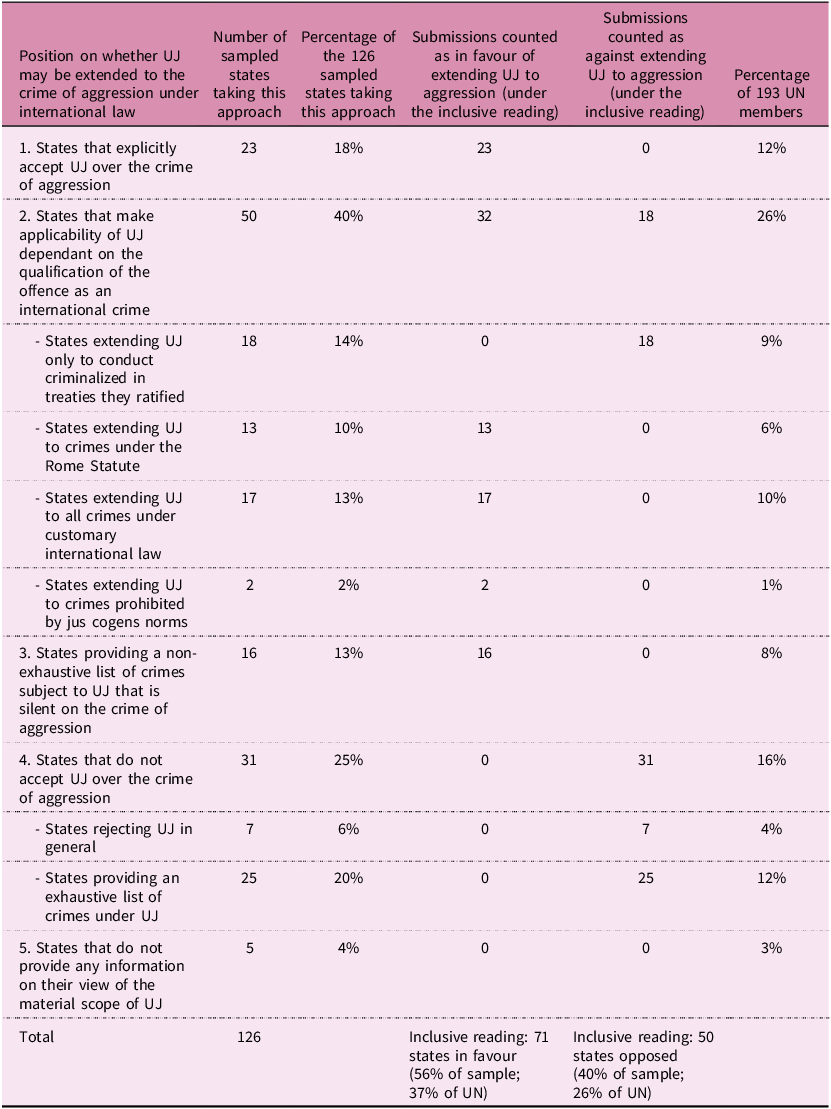
In sum, the 126 sampled states display a range of approaches to the question whether international law permits the exercise of UJ in cases concerning the crime of aggression (see Table 2). Following the line of argumentation presented in the previous paragraphs, and on an inclusive reading that treats the 16 states providing a non-exhaustive list of UJ crimes as supportive, 71 states may be counted as indicating that the crime of aggression is amenable to UJ under customary international law; 50 states do not, and 5 states provided no information on the matter. Within the broader context of the 193 UN member states, this inclusive view suggests that at least 37 per cent of the UN members support the exercise of UJ over the crime of aggression, while at least 26 per cent do not.
Positions on universality of jurisdiction over the crime of aggression
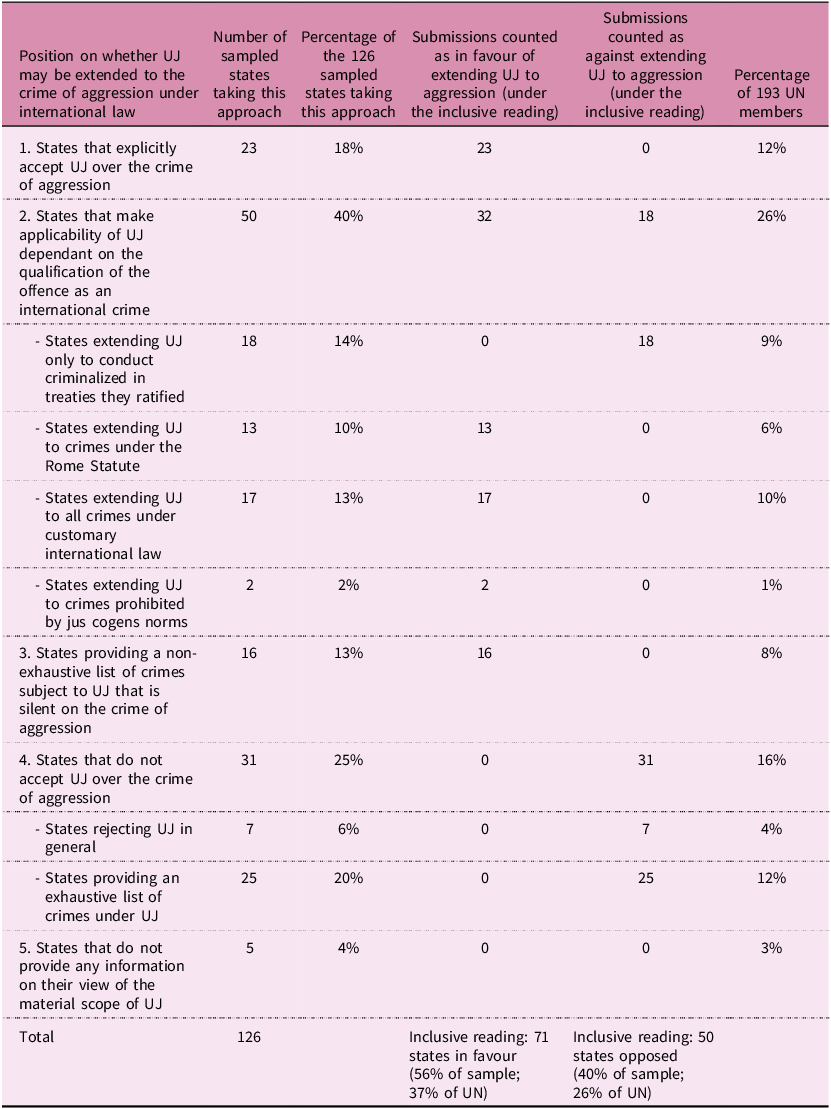
On a more conservative, exclusive reading – omitting these 16 states from the supportive category – the figures fall to 55 states in favour (44 per cent of the sample; 28 per cent of UN members). According to this count, 66 states would oppose the exercise of UJ over aggression (63 per cent of the sample; 34 per cent of UN members). The inclusive count emphasizes numerical and geographical breadth of support, whereas the exclusive count reflects a narrower evidentiary base that may influence conclusions on whether state practice is ‘sufficiently general’ under the classical inductive approach. This methodological distinction underscores the need for caution in interpreting the dataset and frames the central question for the following section: whether, under either reading, the evidence suffices to conclude that customary international law currently permits – or precludes – the exercise of UJ in respect of the crime of aggression.
5. Evaluating empirical evidence of a potential ‘general practice accepted as law’ on the application of UJ to the crime of aggression
Depending on interpretation, approximately half of the sample may be viewed as supporting the proposition that UJ can be invoked in cases of criminal aggression, while the remaining states do not do so. The critical question, however, is whether the evidence of the states’ practice is sufficiently general to conclude that a customary norm emerged, which would either allow or prohibit the exercise of UJ over the crime of aggression. In other words, is the practice sufficiently ‘widespread and representative, as well as consistent’Footnote 119 or, as the ICJ put it ‘both extensive and virtually uniform’?Footnote 120
As noted in Section 2, the requirement of generality remains contested in both doctrine and case law.Footnote 121 It arose as early as the Lotus caseFootnote 122 and was revisited in more recent ICJ jurisprudence: In the Delimitation of the Continental Shelf between Nicaragua and Colombia case, for example, the Court was faced with a situation where 39 statesFootnote 123 had made submissions in favour of an emerging customary norm, while some 20 states rejected it.Footnote 124 Although the practice by these 39 states represents only 23 per cent of the 169 UNCLOS parties,Footnote 125 the Court concluded that ‘taken as a whole, the practice of States may be considered sufficiently widespread and uniform for the purpose of the identification of customary international law’.Footnote 126 By comparison, the present dataset contains proportionally more states supporting UJ over aggression, but also a larger proportion opposing it.
5.1 Contextual factors affecting state practice on universal jurisdiction and aggression
An assessment of practice of UJ over aggression ‘as a whole’ should take into account three contextual factors that may explain the limited legislative and judicial activity. Firstly, by definition,Footnote 127 the crime of aggression requires courts to assess the illegality of a (foreign) state act and the involvement of high-level perpetrators of the aggressor state.Footnote 128 Prosecuting such cases entails significant material and diplomatic costs for the forum state, often outweighing potential political benefits.Footnote 129 Empirical research on UJ trials shows that they have primarily dealt with ‘low cost’ and lower-ranking officials, rather than politically and diplomatically delicate aggression cases.Footnote 130 This context thus may have inhibited state action regarding UJ over aggression in the past. Secondly, the availability of state practice is limited by the rare occurrence of acts of aggression clearly amounting to a violation of the prohibition of the use of force under Article 2(4) of the UN Charter.Footnote 131 The lack of situations that satisfy the elements of the crime of aggression may have prompted limited discussions and legislative initiatives to criminalize it.Footnote 132 Thirdly, the prolonged uncertainty surrounding the definition of the crime of aggression and its status as a ‘crime in limbo’ may have deterred states from implementing definitions in their domestic legal frameworks.Footnote 133 The analysed practice by the 126 states thus emerged in – and despite – a context that can be described as inhibiting legislative and judicial state practice.
In this context, greater weight may be given to submissions that explicitly address aggression over the submissions that do not touch upon the subject at all. Of the 25 states doing so, 23 explicitly include aggression within the material scope of UJ.Footnote 134 Two others – Turkmenistan and Syria – address the crime directly but exclude it from their UJ regimes: Turkmenistan lists it as a serious crime under international law to which no statute of limitations applies, yet omits it from its exhaustive list of crimes that Turkmen courts may hear under UJ.Footnote 135 Syria, by contrast, criticizes political motivations behind invoking UJ for other international crimes and warns of the risk that the criminalization of aggression will remain ‘merely ink on paper’.Footnote 136 It appears that the vast majority of submissions addressing the relationship between UJ and aggression treat aggression as a crime falling within the ambit of the jurisdictional base.
5.2 Geographical distribution and concerns of regional imbalance
The geographical distribution of practice also informs whether it is ‘widespread and representative’.Footnote 137 Over recent decades, UJ has increasingly been invoked to prevent safe havens for perpetrators of the most serious international crimes.Footnote 138 At the same time, it has attracted intense scrutiny, particularly from the African Union, over concerns of UJ being applied selectively as a neo-colonial tool of the Global North.Footnote 139 Similar criticisms weave themselves throughout the submissions made to the Sixth Committee,Footnote 140 with over 50 states expressing concerns about the application of UJ. These range from abuse and manipulation for political reasons,Footnote 141 to a lack of international consensus,Footnote 142 deteriorating international relations, the potential to trigger conflict,Footnote 143 and the perception of UJ being expensive, time consuming and inefficient.Footnote 144 To mitigate these concerns, states call for UJ to be exercised strictly in line with international law, respecting the immunities of foreign state officials, acting in good faith and as a last resort, ensuring fair trial rights, and upholding human rights standards.Footnote 145 While these concerns focus less on UJ’s material scope than on risks of selective or abusive application, it is still relevant to examine whether support for applying UJ to aggression is regionally concentrated.
Under the inclusive reading of the data, 71 states are identified as accepting UJ over aggression (see Figure 1): 18 from the African Group, 19 from the Asia-Pacific Group, 6 from the Latin American and Caribbean Group, 14 of the Western European and Other States, and 14 from the Eastern European Group. On this view, most states from four of the five UN regional groups accept UJ over the crime of aggression. The Latin American and Caribbean Group, which is also the least representative group in the sample due to the low participation in the Sixth Committee, is the only regional group where less than half (36 per cent) of the submissions qualify as evidence in favour of an emerging customary norm. This reading does not support the view that extending UJ to aggression is a project driven by certain regions and imposed on others: both, support and opposition, appear on every continent. The practice may therefore be seen as ‘widespread’ in the sense of spanning multiple regions, albeit not entirely uniform.
Comparison of approaches to extending UJ to the crime of aggression by UN region

The more restrictive interpretation of the dataset – the exclusive reading – identifies 55 states as supporting UJ over aggression. Of these, 11 are from the African Group, 11 from the Asia-Pacific Group, 5 from the Latin American and Caribbean Group, 12 from the Western European and Other States, and 14 from the Eastern European Group. Here, the Eastern European Group is the only region in which no states propose an illustrative list of UJ crimes, leaving open the question of whether UJ definitively applies to the crime of aggression. Compared with the inclusive reading, this interpretation is less uniform, but still arguably ‘widespread’.
5.3 Assessing the threshold of generality
Whether UJ extends to the crime of aggression ultimately hinges on how ‘sufficiently general’ state practice is understood. Under the inclusive reading, the submission of 71 states may be cited as evidence in favour of a customary norm allowing the exercise of UJ over aggression, while at least 50 states would oppose this view. On the exclusive reading, the numerical balance tilts towards non-acceptance, rendering the picture less consistent. Thus, on a purely numerical level, the states’ practice and opinio juris arguably is neither uniform, nor consistent. Engaging with the data on a more qualitative level, however, could support the view that the extension of UJ to aggression meets the threshold of generality required for custom formation. This conclusion is reinforced by the inhibitory context of aggression and the way in which the PCIJ and ICJ have previously assessed the generality of state practice.Footnote 146
6. Conclusion
Holding perpetrators of the crime of aggression accountable has emerged as one of the most pressing legal challenges of the current decade. Given the limited prospects of prosecutions at the ICC and the constraints inherent to proceedings based on other forms of linkage jurisdiction, the concept of UJ offers a potentially promising alternative to address the looming impunity for what has been termed the ‘supreme international crime’. The extent to which customary international law permits the exercise of UJ over another state’s aggression is a matter of contention among international scholars, largely due to the perceived lack of state practice. However, equating the absence of judicial practice to a complete lack of all state practice is a misrepresentation of the efforts of the UN General Assembly’s Sixth Committee, which annually invites states to submit information on the scope and application of UJ. The 383 written submissions and oral statements analysed in this study form evidence of both state practice and opinio juris, offering empirical insights into the emergence of a legal norm under the classical theory on customary law formation.
Two rounds of coding revealed that – according to an inclusive reading of the dataset – 71 states representing over half of the sample may be regarded as having expressed support for including aggression within the material scope of UJ. This support was conveyed in various ways: explicitly listing aggression in national UJ provisions, referencing UJ to apply to all offences under the Rome Statute, all crimes under customary international law or jus cogens, or defining UJ crimes in terms that resemble the crime of aggression while providing an illustrative, non-exhaustive list of ‘universal’ crimes that omits explicit mention of aggression. Contrastingly, at least 50 states oppose extending UJ to aggression, either because they reject the universal invocation of jurisdiction altogether, limiting it to an exhaustive list of specified crimes, or confining it to offences criminalized in treaties that authorize or oblige states parties to exercise domestic jurisdiction.
The classification of the 71 states as favouring the extension of UJ to aggression rests on two premises: First, for 19 states, it depends on the assumption that aggression is criminalized under customary law or jus cogens. Second, the qualification of 16 states as supportive is contingent on aggression meeting the conditions identified by those states that provide only illustrative lists of UJ crimes – namely, that aggression is exceptionally grave, affects the international community as a whole, and that UJ prosecutions would serve to prevent and punish conduct deemed internationally unacceptable. Rejection of either premise would result in an exclusive reading of the data and, by extension, call into question the assessment of whether the resulting practice is sufficiently general to conclude that a customary norm has crystallized.
In any event, the analysis of these empirical findings demonstrates that a substantial body of state practice and opinio juris does exist. Yet, given the ambiguities in international jurisprudence on when state practice may be considered sufficiently general, the data remains somewhat open to discussion. On a purely numerical reading of the generality requirement, aggression would not be amenable to UJ – regardless of whether the inclusive or exclusive reading of the data is favoured. A more qualitative, contextual assessment, however, could support a different conclusion, taking into account the particular inhibitory context of aggression, the geographical spread of states’ positions, as well as the ICJ’s practice of identifying customary rules on the basis of a markedly smaller number of instances of state practice. In other words, this would warrant the conclusion that customary law permits the exercise of UJ over criminal aggression.
While the empirical findings may, with some caveats, be read as supporting the view that UJ could be invoked to prosecute the crime of aggression, they also underscore that significant legal challenges would arise in determining whether it should be exercised. Many states voiced concerns over the risk of selective application for political purposes, particularly by stronger states against less powerful states. To mitigate the risks, such states identified several limitations to the application and enforcement of UJ, including adherence to the rules of international law, respect for human rights standards, and guarantees of fair trial rights. One recurring theme was the need to respect and uphold immunities of state officials – a fundamental principle of international law – which sits uneasily with UJ prosecutions of a crime that, by its international definition,Footnote 147 can only be committed by persons in leadership positions. Absent more concrete empirical insights into how UJ could operate in this context, it appears unlikely that sufficient political support would be mobilized to invoke it. Nevertheless, the present study has highlighted the merits of engaging with UJ prosecutions as a means to explore how the principle might bridge existing gaps in international criminal justice and, at last, transform the crime of aggression from a ‘paper tiger’ into an enforceable norm of international law.


 Open access

