





Introduction: resistance beyond climate litigation
Existing sociolegal concepts need reconsideration, as adapting to a changing climate raises new empirical and theoretical problems around rights and obligations. Climate-related floods, fires, droughts and storms are increasingly felt across the globe, and law is seen as an instrument for assigning who is responsible for climate change and who should bear the costs for adapting to its consequences (IPCC Reference Pörtner, Roberts, Tignor, Poloczanska, Mintenbeck, Alegría, Craig, Langsdorf, Löschke, Möller, Okem and Rama2022). There are fundamental injustices because the populations who contributed the least to carbon emissions tend to be disproportionately exposed to climate change – as well as to the adverse effects of planning interventions under economic globalization (IPCC Reference Pörtner, Roberts, Tignor, Poloczanska, Mintenbeck, Alegría, Craig, Langsdorf, Löschke, Möller, Okem and Rama2022; O’Brien and Leichenko Reference O’Brien and Leichenko2000). They include ethnic and racialized populations and other minorities, who are often overrepresented among the one billion people worldwide who live in informal and self-built urban housing solutions without sufficient public services and climate adaptation (Satterthwaite et al. Reference Satterthwaite, Archer, Colenbrander, Dodman, Hardoy, Mitlin and Patel2020). While sociolegal scholars have long studied informality and urban exclusion (Gelder Reference Gelder2013), climate change overlays a new, powerful global justice dimension onto previously local and regional affairs. Climate adaptation refers to the society-wide process of foreseeing, avoiding and moderating harm from “actual and expected climate and its effects” (IPCC Reference Pörtner, Roberts, Tignor, Poloczanska, Mintenbeck, Alegría, Craig, Langsdorf, Löschke, Möller, Okem and Rama2022, p. 2898), including meteorological, hydrological and geological hazards such as floods, heat, landslides and sea-level rise now and in the future. Common adaptation approaches by states and development actors are protecting and rehabilitating infrastructure, developing capacities in people and institutions, preventing human settlement in risk areas through zoning and planning, and restoring ecosystems that buffer against hazards (IPCC Reference Pörtner, Roberts, Tignor, Poloczanska, Mintenbeck, Alegría, Craig, Langsdorf, Löschke, Möller, Okem and Rama2022). However, climate laws and interventions are hardly neutral (Eriksen et al. Reference Eriksen, Nightingale and Eakin2015), especially when introduced into highly unequal and legally plural societies where citizens are used to creating their own norms.
This dichotomy – between climate law-in-books and law-in-action – is starkly reflected in the stories from those at the frontline of climate change. During our ethnographic fieldwork in Cartagena, Colombia, we met Mabel, a young social leader engaged in a youth mangrove conservation initiative in the flood-prone coastal swamp of La Virgen. While she was proudly taking us around to the sites where they are growing mangroves, she showed us that she had recently acquired a plot to build her own house, in defiance of the risk maps that the city uses to identify neighborhoods likely to experience flooding now and in the future. As the ethnographic field note below illustrates, Mabel drew on an informal law known as “the law of the four poles” (la ley de los cuatro palos in Spanish) to encroach on land in the seasonally flooded coastal wetland. The law can be described as a system of local rules that residents use to determine access to land in a context of exclusionary policies, extreme poverty and urban displacement. This unorthodox way to claim land and housing rights is possible because of legal pluralism, i.e., competing forms of regulation and social control in a society, and weak enforcement of the law:
“I have lived on water, mud. I have been here in times of flooding when you could only see the roofs,” says Mabel, as the street comes to an end and we walk onto a narrow footpath protruding from the cienaga (swamp). The path is made from all sorts of garbage: old car tires, plastic bottles, and debris from construction sites. “We have to take the children to school, or if you have family in another part that is not flooded, then you take them there. But we must always stay here to guard the few things we have.”
Mabel left her mother and an unruly youth behind in Venezuela and came to Cartagena in search of freedom. Four years ago, she was renting a shack for 100,000 Colombian pesos (≈24 USD) monthly, when one morning, she heard people discussing outside. Two families were claiming the same piece of land. It was the dry season, so the swamp had receded. “I should stop being stupid and paying rent,” Mabel thought and saw her opportunity to get her own house. She went out, planted four poles to mark the plot next to the disputed one and told everyone in the neighborhood that she was building her house there. She had to stay there to guard the land and started to fill the plot with garbage. Now, she has completed the main wooden structure and only needs to put the roof before she can move in. “Here everyone does the same, they find water and they put four poles, then people fill the water with old tires and all kind of garbage.” (Ethnographic field note, February 20, 2022)
Meeting Mabel was a chance to gain insight into how marginalized populations in informal settlements resist the law in a changing climate, and the political nature of their claims for survival. Cartagena is, at once, one of the richest, most touristic cities in Colombia and home to some of the country’s poorest, most violent neighborhoods. Impending threats from climate change, particularly recurrent floods, demand timely interventions. One such intervention is the municipal plan “A Competitive and Climate Compatible Cartagena (Plan 4C)” (Alcaldía de Cartagena de Indias 2014), which, among other things, prescribes supporting climate adaptation in informal neighborhoods as a model for social inclusion. Ten years after its publication, the city’s climate politics has rather stalled improvements in these areas. Mabel’s story illustrates how, in the void left by unfulfilled plans, people adapt by defying the city’s risk maps and land-use laws and further settling in flood zones. Low risk awareness and lack of choice are often cited as reasons for people to settle in risk areas; however, Mabel positions herself as a resourceful individual used to living with floods. She thinks she can adapt to climate change on her own terms: going from renter to homeowner, raising the land using garbage, planting mangroves and engaging in environmental activism. However, the informal tenure system also drives people’s hazard exposure. While Mabel’s story echoes past sociolegal debates on informal tenure and displacement (Gelder Reference Gelder2013), the emphasis here was no longer on the lack of formal titles. Instead, as climate adaptation policies and laws have emerged as new sources of urban displacement and marginalization around the world (Arnall Reference Arnall2019; Sarmiento Reference Sarmiento2018; Zeiderman Reference Zeiderman2013), including flood maps that deem some zones as “unadaptable,” we show how they inspire new forms of resistance to the law that reimagine climate adaptation from the perspective of those positioned at the margins.
Our brief encounter with Mabel pinpoints important gaps in the literature. While mounting studies show that climate change provokes legal, political and social mobilization and resistance (Brink et al. Reference Brink, Vargas Falla and Boyd2023; Woroniecki Reference Woroniecki2019), the sociolegal perspective is largely missing from the scholarly debate on climate adaptation, including the role of legal pluralism (Hoddy et al. Reference Hoddy, Halliday, Ensor, Wamsler and Boyd2022).Footnote 1 Instead, in the emerging literature on law in a changing climate, climate litigation receives disproportionate attention (IPCC Reference Pörtner, Roberts, Tignor, Poloczanska, Mintenbeck, Alegría, Craig, Langsdorf, Löschke, Möller, Okem and Rama2022; Peel and Osofsky Reference Peel and Osofsky2018; Setzer and Vanhala Reference Setzer and Vanhala2019). This reflects a growing number of domestic and international lawsuits under the banner of climate justice (Beauregard et al. Reference Beauregard, Carlson, Robinson, Cobb and Patton2021). Yet, some question the empirical significance of such high-profile climate lawsuits, which generally target states or fossil fuel companies, focus on carbon emissions, and seek high-court precedents to “save the future for children” (Sterett and Mateczun Reference Sterett and Mateczun2022, p. 296). The disproportionate focus on climate litigation underestimates how, outside the courtroom, climate change – as well as laws and policies instigated in response – shape everyday conflicts and compound existing vulnerabilities to climate events (Eriksen et al. Reference Eriksen, Schipper, Scoville-Simonds, Vincent, Adam, Brooks, Harding, Khatri, Lenaerts, Liverman, Mills-Novoa, Mosberg, Movik, Muok, Nightingale, Ojha, Sygna, Taylor, Vogel and West2021; Shokry et al. Reference Shokry, Connolly and Anguelovski2020). For example, there are growing displacements of impoverished and vulnerable groups because of new land-use laws, climate risk maps and resilient and “green” infrastructure (Magalhães Reference Magalhães2019; Shokry et al. Reference Shokry, Connolly and Anguelovski2020). As impacts intensify, climate resettlements, compensations and insurance claims are expected to increase, possibly turning risk maps into a social, political and legal battlefield (Elliott Reference Elliott2019). The focus on litigation also neglects some populations’ reluctance to use the law (Merry Reference Merry, Tamanaha, Sage and Woolcock2012). In fact, those most vulnerable to climate change often have least access to the law and litigation, which can be costly and require specific skills, connections and legal support (Buckel et al. Reference Buckel, Pichl and Vestena2024). This includes the urban poor, who often live under insecure land tenure, earn their income in the informal economy and are busy providing for their families. However, we posit that they still experience, use, and resist the law in various ways (Silbey Reference Silbey2005). Informal urban settlements represent a complex context within which the state must operate (Bayat Reference Bayat1997; Satterthwaite et al. Reference Satterthwaite, Archer, Colenbrander, Dodman, Hardoy, Mitlin and Patel2020), and where formal law may be resisted, ignored or trumped by rival legal orders that better represent locally identified interests and entitlements (de Sousa Santos Reference de Sousa Santos2006). Meanwhile, in the incipient sociolegal climate debate, to date more focused on the Global North and on reducing greenhouse gas emissions, there is little agreement on what types of claims count as legal ones, and when and how initially self-interested grievances become political in nature (Lehoucq and Taylor Reference Lehoucq and Taylor2020; Vanhala Reference Vanhala2022).
To fill the gap, this article examines how law and everyday resistance to the law intermingle to shape climate adaptation and vulnerability in marginalized settlements. Connecting concepts from the sociolegal literature and using an ethnographic case-study approach, we ask how people living in informal high-risk areas in Cartagena, Colombia, experience and resist the law in a context of legal pluralism. Our findings (Section 4) advance knowledge in the following way. First, we show the role of formal law in both addressing – and exacerbating – climate vulnerability in the studied areas. Second, we show how people’s everyday adaptation strategies are combined with resistance to state adaptation, mainly through the local and customary system of rules to access land known as “the law of the four poles,” to address their needs and aspirations. Third, we show how dwellers motivate their claim on land by challenging the legality of the state and the neutrality of law, and, rather than invoking their identities as rights-bearing or “vulnerable” citizens, they position themselves as resilient, environmental defenders.
These findings contribute to an emerging sociolegal climate debate. Climate literature has tended to assume that law is a neutral force for adaptation, and that it operates with one voice. The realization that “law is a battlefield” advances the field of climate adaptation, whose origins in natural and climate science shaped a functional outlook on society as law-abiding, stable and supportive of state control (Olsson et al. Reference Olsson, Jerneck, Thoren, Persson and O’Byrne2015; Watson Reference Watson2011; Wellstead et al. Reference Wellstead, Howlett and Rayner2017). Consequently, people resisting adaptation projects or relocations from hazardous lands have been perceived as irrational or backward – a “barrier” to adaptation to be resolved with more awareness-raising and participation (Vargas et al. Reference Vargas, Brink and Boyd2024). Only recently has such popular resistance gained explicit study by adaptation scholars (Arnall Reference Arnall2019; Brink et al. Reference Brink, Vargas Falla and Boyd2023; Gebreyes Reference Gebreyes2018). We contribute to this literature with rich descriptions of the actions and reasons people use to oppose adaptation, and the consequences. In parallel, we advance the sociolegal debate by challenging the perceived dichotomy between marginalized groups’ survival strategies and everyday resistance to the law, showing how they build a legality from below (Santos and Rodríguez-Garavito Reference Santos and Rodríguez-Garavito2005).
Theory: climate adaptation meets sociology of law
To help answer the research question about marginalized groups’ experience of and resistance to climate adaptation laws, this conceptual framework joins theory on climate adaptation and vulnerability (first subsection) with a sociolegal understanding of legal pluralism and everyday resistance to the law (second subsection), exemplified for climate resettlements in Colombia (third subsection). In particular, we advance legal pluralism as an analytical lens to uncover the political and legal claims of marginalized groups that resist climate adaptation.
Climate adaptation: from functional and apolitical view on “rules in use” to resistance to adaptation
Climate adaptation literature, for the most part, seems to assume that law has a positive effect, that society is law-abiding and stable, and that harmonization of law and social norms is possible and beneficial for adaptation (Watson Reference Watson2011). The recent Assessment Report published by the Intergovernmental Panel on Climate Change (IPCC Reference Pörtner, Roberts, Tignor, Poloczanska, Mintenbeck, Alegría, Craig, Langsdorf, Löschke, Möller, Okem and Rama2022, p. 2581) summarizes the role of law in climate action as follows:
Laws can facilitate climate action in multiple ways, including through: (i) mandating and guiding the behaviour of governance structures and actors, (ii) fostering coordination between different levels of government, (iii) enforcing climate responses, (iv) its symbolic value and (iv) aligning scientific evidence and societal norms[.]
In the report’s 3675 pages, representing the latest scientific consensus on climate change and adaptation, law is generally seen as part of governance, with reference to the interplay between formal (e.g., law) and informal (e.g., social norms) institutional or governance arrangements (IPCC Reference Pörtner, Roberts, Tignor, Poloczanska, Mintenbeck, Alegría, Craig, Langsdorf, Löschke, Möller, Okem and Rama2022). Governance fragmentation, understood as the lack of harmony between laws, regulations and policy requirements (corresponding to our legal pluralism), is mentioned as an example of maladaptation and a barrier to adaptation. The IPCC distinguishes between framework law, including laws that set a broad framework for adaptation in a country, and sectoral law, whereby climate adaptation is included in legal frameworks for e.g. water, forestry and urban planning (IPCC Reference Pörtner, Roberts, Tignor, Poloczanska, Mintenbeck, Alegría, Craig, Langsdorf, Löschke, Möller, Okem and Rama2022). In parallel, there is an emerging interest in “adaptive law” for climate adaptation and wider environmental issues; that is, regulatory approaches that avoid rigid solutions and that can navigate around law for protecting nature and people, including adaptive property law (Fitzpatrick Reference Fitzpatrick2023) and adaptive coastal management (Frohlich et al. Reference Frohlich, Smith, Fidelman, Baldwin, Jacobson and Carter2022). The climate adaptation community’s view of law is grounded in a mature, albeit rather apolitical literature on environmental governance (Hajer Reference Hajer1997), institutional analysis (Ostrom Reference Ostrom1991), socioecological systems (Berkes Reference Berkes2004), common resource management (Colding and Folke Reference Colding and Folke2001) and collective action (Bodin Reference Bodin2017). This work is empirically robust, including a large focus on principles, norms, sanctions and rewards generated by communities around the world. However, regarding (social) theory it is less robust: basic social-science concepts such as power and agency are often missing, and critics argue that much of the early adaptation research builds on an outdated view of society, namely the structural-functionalism from the 1950–1960’s (Olsson et al. Reference Olsson, Jerneck, Thoren, Persson and O’Byrne2015; Watson Reference Watson2011; Wellstead et al. Reference Wellstead, Howlett and Rayner2017). This has informed a “cockpit view” of social change, whereby society is law-abiding and supportive of state control. Moreover, much commons research was generated in rural settings with rather stable communities – a stark difference from the heterogeneous and fast-changing populations and value systems found in cities (Wamsler et al. Reference Wamsler, Brink and Rivera2013). In the recent Assessment Report (IPCC Reference Pörtner, Roberts, Tignor, Poloczanska, Mintenbeck, Alegría, Craig, Langsdorf, Löschke, Möller, Okem and Rama2022), only a few statements allude to that adaptation law can have limited impact – that is, the difference between law-in-books and law-in-action – and even fewer acknowledge that law can be problematic and reinforce climate vulnerability.
We approach climate vulnerability in a process-oriented and contextual way, highlighting root causes and dynamic pressures that erode capabilities, result in unsafe conditions and make people or systems susceptible to impacts from climate hazards such as floods or storms (Brink et al. Reference Brink, Vargas Falla and Boyd2023; Ribot Reference Ribot2011; Wisner et al. Reference Wisner, Gaillard and Kelman2012). While the term “vulnerable” is often used interchangeably with poor, marginalized or subaltern, and there is indeed an overlap as such groups tend to bear the brunt of climate disasters, they are conceptually distinct. A particular gender, class or race does not make you inherently vulnerable to climate change, but context (including material conditions, social norms, expectations, rights and duties) does (Wisner et al. Reference Wisner, Gaillard and Kelman2012). Accordingly, climate risks result from the dynamic interaction between hazards, vulnerability and exposure (IPCC Reference Pörtner, Roberts, Tignor, Poloczanska, Mintenbeck, Alegría, Craig, Langsdorf, Löschke, Möller, Okem and Rama2022).
Sociolegal scholars have long studied legal pluralism in informal settlements and life at the margins (Fernandes and Varley Reference Fernandes and Varley1998; Goytia et al. Reference Goytia, Heikkila and Pasquini2023; Razzaz Reference Razzaz1994; Van Gelder Reference Van Gelder2010), but the uptake of such debates into climate adaptation science is far behind. In fact, very few studies explicitly address legal pluralism in climate adaptation (Hoddy et al. Reference Hoddy, Halliday, Ensor, Wamsler and Boyd2022; Klepp Reference Klepp2018; Klepp and Chavez-Rodriguez Reference Klepp and Chavez-Rodriguez2018). In a pioneering review building on broader work in environmental social science, Hoddy et al. (Reference Hoddy, Halliday, Ensor, Wamsler and Boyd2022) establish that legal pluralism is not always detrimental for climate adaptation, as multiple legal orders can allow marginalized populations to bypass negative effects of a particular legal order and adapt to climate-related uncertainties in ecological or livelihood stability. Similarly, Klepp (Reference Klepp2018) used legal pluralism to study the vulnerable island of Kiribati and noted “emerging” and “travelling” legal orders drawn on in response to climate migrants’ current and future needs. However, legal pluralism, including competition or tensions between different normative orders and law-breaking in areas exposed to climate hazards, can also reinforce vulnerability and hinder adaptation. Examples include law-breaking by powerful actors, such as corruption, and by powerless or resource-poor groups, who might be pushed toward adaptive strategies that are, or become defined by those in power as illicit or illegal (Hoddy et al. Reference Hoddy, Halliday, Ensor, Wamsler and Boyd2022). Furthermore, law and legality shape adaptation processes and related resistance, through prescribing what is an appropriate response to climate hazards, what risk levels society can accept and for whom (Hoddy et al. Reference Hoddy, Halliday, Ensor, Wamsler and Boyd2022)
Legal pluralism and mobilizing the law from below
Legal pluralism is a key concept in sociolegal studies to challenge centralist ideas of law (i.e., status and formal norms produced by the state and the interpretations of the courts) as the main source of regulation and order in society (Griffiths Reference Griffiths1986, p. 3). Legal pluralism describes multiple, sometimes competing forms of regulation and social control that operate in society, where formal state law is one among many sources (de Sousa Santos Reference de Sousa Santos1977; Merry Reference Merry1988; Moore Reference Moore1973). The concept was originally used in postcolonial societies where indigenous regulation coexisted with inherited legal norms from the colonial state, but it was soon expanded to comprise western societies and systems of normative ordering ranging from customary and community law to international and economic law (Tamanaha Reference Tamanaha, Maksymilian and Giudice2017).
While the sociolegal literature has provided abundant evidence of forms of social control outside formal law (de Sousa Santos Reference de Sousa Santos1977; Ellickson Reference Ellickson1994; Vargas Reference Vargas2016), it has often perceived marginalized groups as passive objects of regulation and control. Instead, we center on alternative forms of regulation that emerge from below to resist policies and laws from the state and global institutions (Vargas and Urinboyev Reference Vargas and Urinboyev2015). This approach reflects that state law, in many cases, is a tool of domination by a privileged class, far from expressing the interests of marginalized groups (de Sousa Santos Reference de Sousa Santos1977, p. 5). In their book Globalisation from below, Santos and Rodríguez-Garavito (Reference Santos and Rodríguez-Garavito2005) argue that sociolegal studies have failed to register a growing grassroots contestation to neoliberal institutions and the formulation of alternative legal frameworks. We advance legal pluralism as an analytical tool to uncover the political and legal claims of marginalized groups resisting climate adaptation laws.
Legal pluralism can be identified in places with high levels of noncompliance and resistance to the law (Vargas and Urinboyev Reference Vargas and Urinboyev2015). Different views of popular resistance have been offered across fields such as sociology, political science and sociolegal studies. Some see resistance as acts carried out, consciously or not, as a counter-reaction to or pushback against power (Foucault Reference Foucault1982; Johansson and Vinthagen Reference Johansson and Vinthagen2016; Scott Reference Scott1989). Resistance might have varying degrees of intent (by resisters) and recognition (by targets or third-party observers) (Hollander and Einwohner Reference Hollander and Einwohner2004). Through the legal pluralist lens, resistance and noncompliance can be understood as a set of alternative norms that govern everyday life, in contrast to official state law (Ellickson Reference Ellickson1994; Villegas Reference Villegas2013). Resistance can be a rational act to gain more personal benefits – or represent a political vision of the law as illegitimate (Villegas Reference Villegas2013). In relation to the latter, leading sociolegal scholars argue that people’s resistance to the law in their everyday lives can be conscious acts that contain political claims (Merry Reference Merry1995; Sarat Reference Sarat1990; Silbey Reference Silbey2005; Vargas and Urinboyev Reference Vargas and Urinboyev2015). This ties in with the literature on legal mobilization, where a clear separation between self-interested, particularistic claims and political claims has been deemed inviable: the initial grievance might be self-interested, but the act of making a claim or the consequences political (Lehoucq and Taylor Reference Lehoucq and Taylor2020). While some scholars have considered resistance to the law by people living under poverty as mere “coping strategies” that lack clear political claims (Bayat Reference Bayat1997), we reject this and show how uncovering the motives behind resistance can expose local needs and aspirations and illustrate agency and voice (Vargas et al. Reference Vargas, Brink and Boyd2024). The same act might be framed as resistance in some contexts or cultures but not in others (Brink et al. Reference Brink, Vargas Falla and Boyd2023; Groves and Chang Reference Groves and Chang1999; Korovkin Reference Korovkin2000); therefore, empirically recognizing everyday resistance hinges on the cultural situatedness and fluency of the observer and often requires a deeper data collection than quantitative surveys and interviews.
Climate resettlements and structural vulnerability drivers in Colombia
Climate adaptation in Colombia should consider complex historical interactions between legal pluralism, land dispossession, informality and socioecological vulnerability, which have already provoked several critical studies on climate resettlements (Blanco Reference Blanco2012; Sarmiento Reference Sarmiento2018; Zeiderman Reference Zeiderman2013). Informal settlements are commonly seen as a culprit of climate vulnerability in developing cities, as they tend to emerge on land already prone to climate hazards, be densely populated, and lack proper planning, infrastructure and services (IPCC Reference Pörtner, Roberts, Tignor, Poloczanska, Mintenbeck, Alegría, Craig, Langsdorf, Löschke, Möller, Okem and Rama2022). In many such places, relocation has become a naturalized discourse, legitimated through technical language about risk zones and planning laws (Magalhães Reference Magalhães2019; Valverde Reference Valverde2005). With or without tenure, residents are exposed to harassment, forced relocations and evictions. Law appears as a neutral instrument that seeks to protect people from risks intensified by climate change. What is worse, the self-legitimizing relocation narrative tends to obscure other options of reducing vulnerability such as through place-based solutions and development improvements (Arnall Reference Arnall2019). However, considering informal settlements’ contribution to cities – their role in providing homes to one-fourthFootnote 2 of the urban population worldwide in the absence of other solutions, and helping the informal economy to provide employment, services and growth (Satterthwaite et al. Reference Satterthwaite, Archer, Colenbrander, Dodman, Hardoy, Mitlin and Patel2020; Vargas and Valencia Reference Vargas and Valencia2019) – one could use the same risk maps to argue for their protection against climate hazards. Relocation as a panacea for climate-risk reduction also ignores the past 30 years’ research on climate and disaster vulnerability, and the structural vulnerability drivers that originate outside particular neighborhoods, therefore not simply addressed through relocations (Barnett Reference Barnett2020).
In Colombia, climate vulnerability and people’s presence in coastal and riverine areas are shaped by rapid urbanization, extreme poverty, armed conflict, chronic housing shortage, austerity and constant violation of human rights. Located in rapidly urbanizing Latin America, Colombia has an urban population of 82 percent, of whom 10 percent live in informal settlements or “slums.”Footnote 3 A main driver of people’s movement to cities in Colombia, besides socioeconomic migration, is the long internal armed conflict (1964–present). While a peace agreement was signed in 2016 with FARC – the largest insurgent group in the country – the challenge of building lasting peace permeates all policymaking, including urban and environmental politics (Krause et al. Reference Krause, Clerici, López, Sánchez, Valencia, Esguerra-Rezk and Dexter2022). The war, concentrated in rural areas, left more than 6 million people internally displaced (Bandiera Reference Bandiera2021), many of whom sought refuge in informal settlements as state response was poor (Tovar and Moreno Reference Tovar and Moreno2009). More recently, since about 2015, the political-economic crisis in neighboring Venezuela has triggered an “exodus” of Venezuelan refugees and migrants, most of whom (2.5 million by March 2023) sought protection in Colombia (UNHCR 2023).
The armed conflict served to preserve an unequal social order in Colombia whereby the state narrative of security and protecting citizens from armed conflict, terror and now climate change has overshadowed traditional welfare politics and rights (Kajsiu Reference Kajsiu2019). It has allowed a continued dispossession of land, worker’s rights and pensions (a process dubbed “securitization by dispossession” by Rojas Reference Rojas, Macdonald and Ruckert2009, p. 231, and “biopolitics” by; Zeiderman Reference Zeiderman2013, p. 71), which benefited conservative sections of Colombian society such as big landowners and the agro-industrial sector. Meanwhile, the continuously dispossessed include peasants, Afro-Colombians and indigenous peoples, and a growing poor, informal and unemployed urban class (Hataya Reference Hataya2007; Rojas Reference Rojas, Macdonald and Ruckert2009).
Land dispossession and control stands in contrast with strong social movements in Colombia and Latin America (Eckstein Reference Eckstein2001). Civil society organizations such as peasant movements and human rights defenders actively resist the state (Krause et al. Reference Krause, Clerici, López, Sánchez, Valencia, Esguerra-Rezk and Dexter2022). In cities, marginalized groups use “weapons of the weak” (Scott Reference Scott1985) to expand their territories in the slums and claim their right to a decent life (Blanco Reference Blanco2012; Hataya Reference Hataya2007). Besides such quiet encroachment (Bayat Reference Bayat2000), urban protests sometimes go loud. Recent examples are massive resistance outbursts in 2019 and 2021 to then-President Ivan Duque’s (2018–2022) austerity package and tax reform bill, which gained notoriety as “anti-worker” (Abril Reference Abril2023; Luque et al. Reference Luque, Correa Ramírez and Gil Perez2022).
Strong opposition to law reforms reflects that in many cases, it is not a lack of law and regulation that creates climate vulnerability, but the law can push marginalized groups further into destitution. Colombia has the most advanced urban legal framework in Latin America and a long history of urban experimentation inspiring “best practice” elsewhere (UN-Habitat 2018). Since the 1970s, every Colombian government has imposed different strategies for creating housing for the poor through combinations of subsidies and credits, through urban upgrading, resettlement programs and stimulating private or public large-scale construction. A foundational problem is that “too many Colombians are too poor to buy their own formal house even when they receive a subsidy” (Gilbert Reference Gilbert2014, p. 267).
Moreover, urban law and markets determine risk exposure since they are instrumental to why people settle on land outside the formal market (Fernandes and Varley Reference Fernandes and Varley1998). Accessing housing through self-constructed shacks is often only possible on state-owned land in high-risk zones where the private sector has not been allowed to construct (Zeiderman Reference Zeiderman2013). In the city of Cartagena, these include the beaches and borders of lagoons and canals and the hills near the city center. Studying climate vulnerability in informal settlements in Cartagena should thereby consider a lack of formal access to housing, a history of displacement by the armed conflict and more recently, Venezuelan migrants. Cartagena displays extreme poverty, violence, hunger and destitution, which coexist in a historical city that attracts global tourists while urban plans and laws exclude a great number of marginalized citizens.
Data and methods
An ethnographic and qualitative narrative approach was used to explore how people who are vulnerable and exposed to climate change in informal settlements in Cartagena experience and resist the law. It was based on an interdisciplinary perspective, referring to the integration between concepts and methods from different scientific disciplines, with the three authors’ background in the sociolegal and climate adaptation fields, respectively. We chose Cartagena (metropolitan population of 1,088,000 in 2023) for the city’s exposure to extreme climate impacts, its historical and current resistance context, and emerging sociolegal narratives across scales (first subsection). While mainstream adaptation often misses wider social contexts and change processes by focusing too narrowly on linear consequences from biophysical impacts, we approach the topic indirectly, starting from what changes people are facing and how they link back to climate (Ensor et al. Reference Ensor, Wennström, Bhatterai, Nightingale, Eriksen and Sillmann2019). We combine narrative analysis (Bali et al. Reference Bali, Cronin and Jhangiani2020) with ethnographic observations and informal interviews, represented through ethnographic vignettes, to focus on the stories people tell about their lives. This aids in understanding their experiences, values, beliefs, decisions and (perceived and experienced) relationships of cause-and-effect (second subsection).
The “heroic” Cartagena and the swamp of La Virgen
Cartagena is Colombia’s 5th most populous city, located on the country’s northern coast to the Caribbean Sea. Cartagena has a tropical climate and is exposed to climate change impacts from increased rainfall, increased temperatures and sea-level rise (Stein and Moser Reference Stein and Moser2014). The city is of historical importance, nicknamed the “Heroic” city (La Heroica) after its valiant resistance during the Spanish siege in 1815, which eventually resulted in independence in 1821. Today, Cartagena is the foremost tourist destination in the country, and it was declared UNESCO heritage in 1984 for its colonial beauty. The city has an active industrial sector and hosts a strategic port in the country. In the Climate Adaptation Plan 4C’s pessimistic scenario of sea-level rise and heavy rainfall for 2040, floods are projected to threaten 28% of Cartagena’s inhabitants, 28% of the city’s industry, 35% of road infrastructure and 86% of historic heritage, while erosion and increased sea levels would affect 70% of the mangrove swamp areas and 100% of the city’s beaches (Alcaldía de Cartagena de Indias 2014).
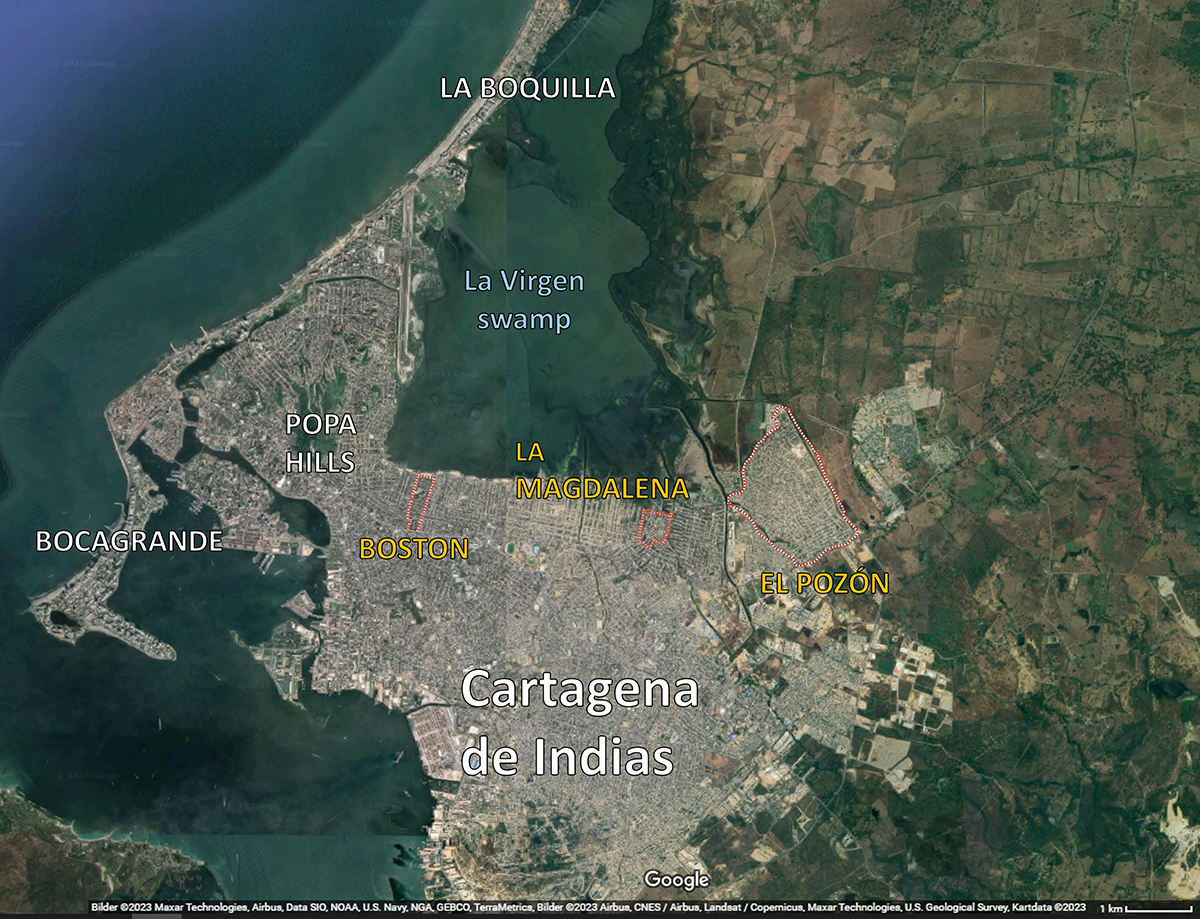
A key socioecological feature is the Ciénaga (swamp) of La Virgen, a coastal lagoon located on the north side of Cartagena and separated from the sea by the 400–800 m wide sand range La Boquilla (see Figure 1). La Virgen is a priority wetland for planning and sustainable management, including for the city’s climate adaptation (Alcaldía de Cartagena de Indias 2014). Its mangrove vegetation, consisting mainly of Avicennia germinans, or black mangrove (67%) and Rhizophora mangle, or red mangrove (30%), provides a buffer to flooding and storm surges. However, urban development has weakened some of its ecosystem functions, including through the construction of human settlements, direct logging of the mangrove and disposal of the city’s untreated wastewater (EPA Cartagena 2015).
Map of the study areas (in orange) and the La Virgen swamp (blue). Other points of reference in white (Creation: Google Maps).
Data collection, analysis and (re)presentation in vignettes
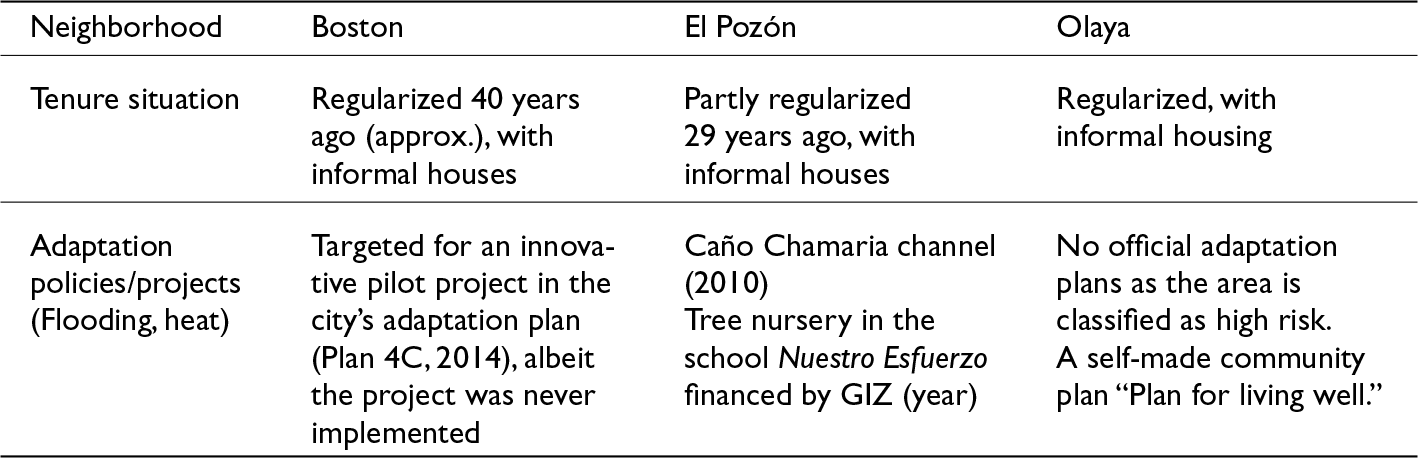
An ethnographic fieldwork on the theme of adaptation resistance on the margins was carried out in Cartagena between February and March 2022. Interviewees involved in processes relating to neighborhood upgrading and sustainability were identified through snowball method from an initial contact with a local leader via social media. As a result, we conducted open interviews with residents (n = 6), community leaders (n = 6), youth activists (n = 2), rectors of community schools (n = 2) and local government officials and politicians (n = 8) (all names were changed to protect anonymity). The semi-structured or unstructured interviews departed from the general topics of everyday risks and problems, climate hazards, adaptation interventions in the study areas, and the role of the law, including questions such as “What are the main challenges/problems you experience in relation to the environment? How are you/this neighborhood prepared for future storms, floods, heatwaves?” (To the residents) and “What kinds of adaptation interventions are possible/effective when it comes to informal settlements? What areas are more difficult to approach and why? What are the most important laws you refer to?” (To the officials). Interviews were accompanied by transect walks, i.e., walking interviews that intentionally cross or transect a community, and ethnographic notetaking (Aoki and Yoshimizu Reference Aoki and Yoshimizu2015; de Zeeuw and Wilbers Reference de Zeeuw and Wilbers2004) in informal and formalized neighborhoods around the swamp of La Virgen. Moving around in the neighborhoods allowed further informal interviews with people who were not social leaders or identified through their online activism. The study sites were purposely selected as most-likely cases of resistance to adaptation due to the combination of coastal flooding and existing government programs (see Table 1). Another fieldwork conducted in 2023 allowed us to discuss mature findings with key informants.
Characteristics of neighborhoods covered in our ethnographic fieldwork
We use ethnographic vignettes to represent this complex socioenvironmental context. Vignettes offer transparency in research, since they speak both to the experiences and challenges faced in the field and to the labor of transforming them into text (Demetriou Reference Demetriou2023). They allow the reader to come to the field with us and become a co-analyst (Schöneich Reference Schöneich2021). The following vignette describes how we gained entry to the field. While we felt vulnerable as female researchers entering a dangerous area linked with drugs and murders in the local news, it shows how our counterpart was also vulnerable, creating an encounter of two vulnerabilities:
The first thing Arturo said was “I am so relieved you are real persons.” He was a bit unsure about our encounter, as we had contacted him through Facebook, and he mentioned that “one could never be sure” [who is at the other end]. Arturo is a different political leader originating from one of the most vulnerable barrios (poor neighborhoods) in Cartagena and has a Facebook page with many followers. He had managed to enter the closed and elitist political circles of Cartagena, but upon our arrival in Colombia, he had already resigned from his official position after what social media portrayed as a political struggle. As a recognized leader, Arturo opened the door for us to the different neighborhoods around Ciénaga de la Virgen. While we felt safe having his endorsement, he said we must always watch out for ourselves. In a country where many social leaders are killed every year, he had received many threats, and he himself was always careful. (Ethnographic field note, February 16, 2022.)
Arturo’s story highlights several fieldwork challenges, above all concerning research ethics and participants’ safety. We follow the ethical guidelines of Lund University by prioritizing free and informed consent, anonymity, non-harmful practices and the nonpermanent storage of personal data.Footnote 4 Ethnographers have an even greater responsibility to uphold ethical standards, because of the high participant involvement and the evolving research questions (Madison Reference Madison2019). Rather than a one-off signature, this entailed a constant practice of reflecting on possible harm that our research might cause before and after publication, negotiating consent from participants, discussing preliminary findings with participants to identify sensitive issues and concerns, and contextualizing the data as much as possible as to avoid negative stereotypes about a group that might cause further marginalization (Vargas Reference Vargas2016).
Our chosen vignettes also underscore methodological challenges such as power dynamics, biases from speaking with social leaders and “powerful” people within communities and the risk of people “telling us what we want to hear.” We acknowledge that individual community members or social leaders do not speak for everyone; there is politics and power struggles inside those spaces, conflicts among leaders and social exclusion from below. As we will show, using “the law of the four poles” requires social capital and contacts, and newly arrived migrants and outsiders may experience further exclusion under legal pluralist rules (Vargas Reference Vargas2016). In this regard, ethnographically inspired self-reflection, observations and favoring informal interactions, along with triangulation with official documents and interviews, allowed us to present a nuanced picture of the formal and informal laws found in Cartagena. While social leaders might bring their own agenda, the knowledge, experiences and “stories” concentrated in these individuals make them competent conversation partners who can help researchers question preconceived ideas and concepts, much like academic peer review (Hale Reference Hale2001). In our case, leaders themselves were self-critical of how the rules in the informal settlement can exclude outsiders, women and children – who are often particularly vulnerable to climate change impacts.
While vignettes represent moments of insight, they often also illustrate findings that result from more comprehensive data analysis (Schöneich Reference Schöneich2021). In our case, interviews and ethnographic field notes – originally conducted in Spanish – were transcribed in English and qualitatively coded in the analysis software Atlas.ti. In a first round of bottom-up coding, we focused on identifying topics originating from the ethnographic material. We paid special attention to identifying generative mechanisms: drivers, motivations and stories about cause-and-effect. In a second round, we focused on creating category codes and themes from the first list of codes, while also applying deductive reasoning guided by adaptation and sociolegal theory.
We reached a level of triangulation and empirical saturation as many findings, including the “law of the four poles,” were brought up in both the ethnographic interviews with residents and the formal interviews with government officials and environmental activists. Moreover, we reviewed relevant sections of legal frameworks that showed up in the case – from the Colombian Constitution to more recent laws on adaptation in Cartagena. The fieldwork was initially designed to shed light on everyday resistance and legal consciousness of informal settlers in climate adaptation; however, inputs from the field guided the study toward legal pluralism as the main concept. This brought on additional literature review on legal pluralism, and we applied word-in-context (“law,” “legal”) analysis to the recent IPCC report (Reference Pörtner, Roberts, Tignor, Poloczanska, Mintenbeck, Alegría, Craig, Langsdorf, Löschke, Möller, Okem and Rama2022).
Findings: adapting and resisting in the context of legal pluralism
We chose three main ethnographic vignettes to illustrate how people at the frontline of climate change resist the official state law and how their everyday adaptation context gives rise to such resistance. They are presented in the sections below (Law reinforces differential vulnerability, Territory-based adaptation and resistance, and Challenging elite law-bending). We find that people’s resistance illustrates a form of legality that is built from below to cater to their needs and aspirations, which continue to be neglected by the state – most recently, under the global goal of climate adaptation. To some extent, legal pluralism allows them to gain a voice and recognition in the city’s climate adaptation planning.
A crosscutting theme in people's stories is the “law of the four poles”. We show how climate change adds a new layer to the local politics of land use, in which legal pluralism has long allowed people to settle using “the law of the four poles” and thereby access a roof in an exclusionary housing market (Blanco Reference Blanco2012). While its status as an informal law can be debated, this local rule system is consistently being referred to using the word “law” by residents and officials; it serves a form of social control in the community, including first-party (personal ethics), second-party (interpersonal) and third-party (community) control (Ellickson Reference Ellickson1987); and it can eventually lead to formal recognition of titles. According to our respondents, if a person’s placement of the four poles is accepted by the community, they can register their plot at the public notary using a neighbor as a witness (emphasizing third-party social control by the community, Ellickson Reference Ellickson1987). The paper issued by the notary is not equivalent to land rights, but it becomes a semiformal title of the possession, which can be bought and sold, and which can lead to acquiring the land over time. More specifically, the Civil Code of Colombia (article 2531) establishes that one can gain the title of a piece of land or house after occupying it without interruptions and in good faith for more than 10 years. Thus, formal law encourages or legitimizes the acquisition of land by the “law of the four poles.” This process, known as “acquisition by prescription” only applies to privately owned land. However, the Constitutional Court has ruled that if the state allows people to settle for a certain time in public land, settlers gain some legitimate confidence regarding their actions and local governments are required to provide alternative forms of housing before evictions (Decision SU 016 of 2021). Moreover, to compensate for lacking housing policies, or to get votes and popular support, the state has many times accepted the legalization of informal neighborhoods on public land, providing land titles and public services such as electricity, water and sewage. However, with climate change, governments are increasingly skeptical about legalizing neighborhoods and providing development improvements.
Law reinforces differential climate vulnerability
From the outside, it seems counterintuitive that people living with constant floods would resist climate adaptation laws and initiatives aimed at protecting them from dangerous climate change. However, we show how formal law has exacerbated differential climate vulnerability, stalled adaptation and resulted in “seawalls for the rich, relocation for the poor.” Meanwhile, both groups are aware that the law is not neutral, and legal pluralism shapes the progression of vulnerability as well as opportunities for resistance.
Ethnographic vignette: “We are not rich, so they say we have to be relocated”
During our ethnographic fieldwork, we met with Carlos, Edison and Jeremy, three social leaders in Boston, the neighborhood targeted for an innovative adaptation project in Cartagena’s pioneering adaptation plan “A Competitive and Climate Compatible Cartagena” (Plan 4C). The episode exemplifies how legal pluralism enables resistance of marginalized groups, as well as their presence in so-called risk zones. Despite a comprehensive legal framework and innovative adaptation plans that, on paper, govern climate adaptation and related risk reduction in Colombia and Cartagena, we find that the law in everyday practice (as it is experienced by citizens) has tended to reinforce existing social differences. Paradoxically, formal adaptation has protected those with money and contacts while stalling risk reduction for those in high-risk areas:
“Boston is the heart of the city, we have a strategic location, close to everything,” says Carlos. We walk around the neighborhood and the three leaders proudly show us the bridges that cross the canals, made from recycled plastic as part of an NGO project. “They say we have to relocate, but it hardly seems feasible for all 2800 houses here.”
Carlos was born in the Boston neighborhood 37 years ago. Like many others, his family came to Cartagena escaping the armed conflict in the countryside. Relatives advised them to claim a plot using four poles and start filling the swampy land. Upon realizing that people had filled the land and built houses, the government at the time legalized the settlement and gave people titles.
“Yes, Boston is in a flood zone” Carlos says. “But only recently, the government has classified our neighborhood as a high-risk zone, and that has been bad for us because they have stopped investing here and making improvements.”
“Even the adaptation project planned for Boston has been stalled,” adds Edison. “This stopped all our chances to improve our lives. People want to get officially connected to electricity and sewage, but now they insist we are high-risk, so nothing is possible.”
“What gets flooded is Bocagrande and what is struck by landslides is the Popa Hill,” argues Jeremy, who thinks local solutions are possible in his neighborhood and wants to build an ecological house with solar panels and water recycling. “Here we are not rich, so they say we have to be relocated.” (Ethnographic field note/transect walk, March 3, 2022)
This portrays a main contradiction throughout the study: while people contest the risk-zone classification, they are certainly not unaware of climate risks or unconcerned by the frequent floods they face. Besides state interventions, many NGOs and capacity-building projects are active in these areas. Faced with foreign researchers, community leaders anticipate what we want to hear, and commonly refer to mangrove reforestation, eco-construction and returning to the Afro-Colombian practice of building on stilts to adapt to climate change. While past initiatives seem to have raised awareness and capacities, projects often have poor continuation and fail to address structural drivers of climate vulnerability, such as poverty and exclusion. In other words, resistance is not to climate adaptation per se, but to its top-down, insufficient and unjust application.
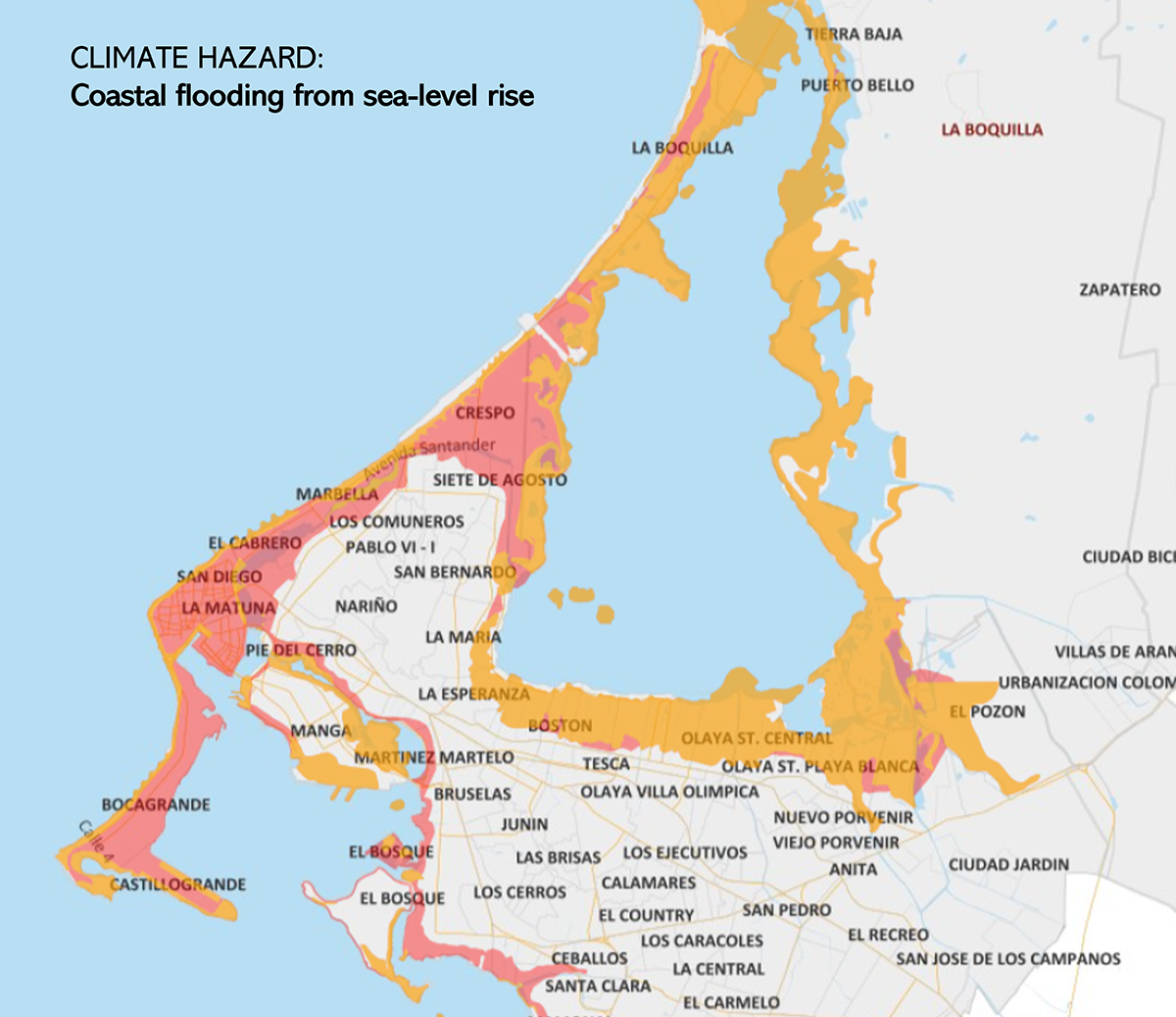
The legal framework of adaptation in Cartagena exists within the Colombian legal system where legal pluralism, overproduction of laws and norms, and ineffective law dominate (Garcia-Villegas and Rodriguez Reference Garcia-Villegas and Rodriguez2002). Climate risk is addressed through formal laws emanating from the national government, municipal laws and technical maps that regulate land use, and the inherited French civil code that regulates land acquisition (Table A.1 in Supplementary Materials). Like many cities, Cartagena was built applying colonial building codes and planning ideals from other bioclimatic zones, and deforesting and developing the coastal zone. It is not well adapted even to the present climate, and risk maps classify large parts of the city as high-risk.Footnote 5 While the Plan 4C produced maps for a wider range of hazards and scenarios, those displayed here (Figures 2 and 3) illustrate a heightened risk of pluvial (i.e., rain-induced) flooding for the poor neighborhoods near the swamp of La Virgen, while risk from coastal flooding affects most of the city’s coastline. We found considerable pluralism in the selective application of the Plan 4C and in how formal laws compete with norms that determine everyday access to land and housing: from the “the law of the four poles,” mobilized by the poor, to old titles from the colonial times, mobilized by the elite (see third subsection). According to a legal advisor to Cartagena’s municipal council:
“The parts of the plan led by the private sector are getting implemented, like improving the ports. They have raised their decks. Also the parts that are key for tourism, like maintaining the seawalls in Bocagrande where most hotels and condominiums are located. The elites moved their contacts in Bogotá and secured national funds to finance the projects that benefit them. But the people in the slums, no one will advocate for them.” (Interview, February 21, 2022, emphasis added)
Formal laws not only compete with other norms; they are also highly inefficient. Since 1989, the Colombian state has regulated urban planning and land use extensively and the country has one of the most advanced urban regulatory systems in the Latin American region (UN-Habitat 2018). Our analysis of laws related to climate adaptation (Table A.1 in Supplementary material) shows socially progressive values in existing legal frameworks, including the right to housing, health and sanitation, inscribed in the Colombian Constitution from 1991,Footnote 6 and the promotion of equality, protection and cultural diversity in disaster risk reduction, principles of the disaster law from 2012 (Law 1523). However, these laws often stay on paper, as local governments lack resources, capacity and sometimes political will to implement them.
Risk map of coastal flooding shows that most of the city’s coastline is at risk from flooding. (Created with https://midas.cartagena.gov.co/)
Risk map of pluvial flooding (due to heavy rain) with most severe impacts in the poor neighborhoods near the swamp of La Virgen. (Created with https://midas.cartagena.gov.co/)
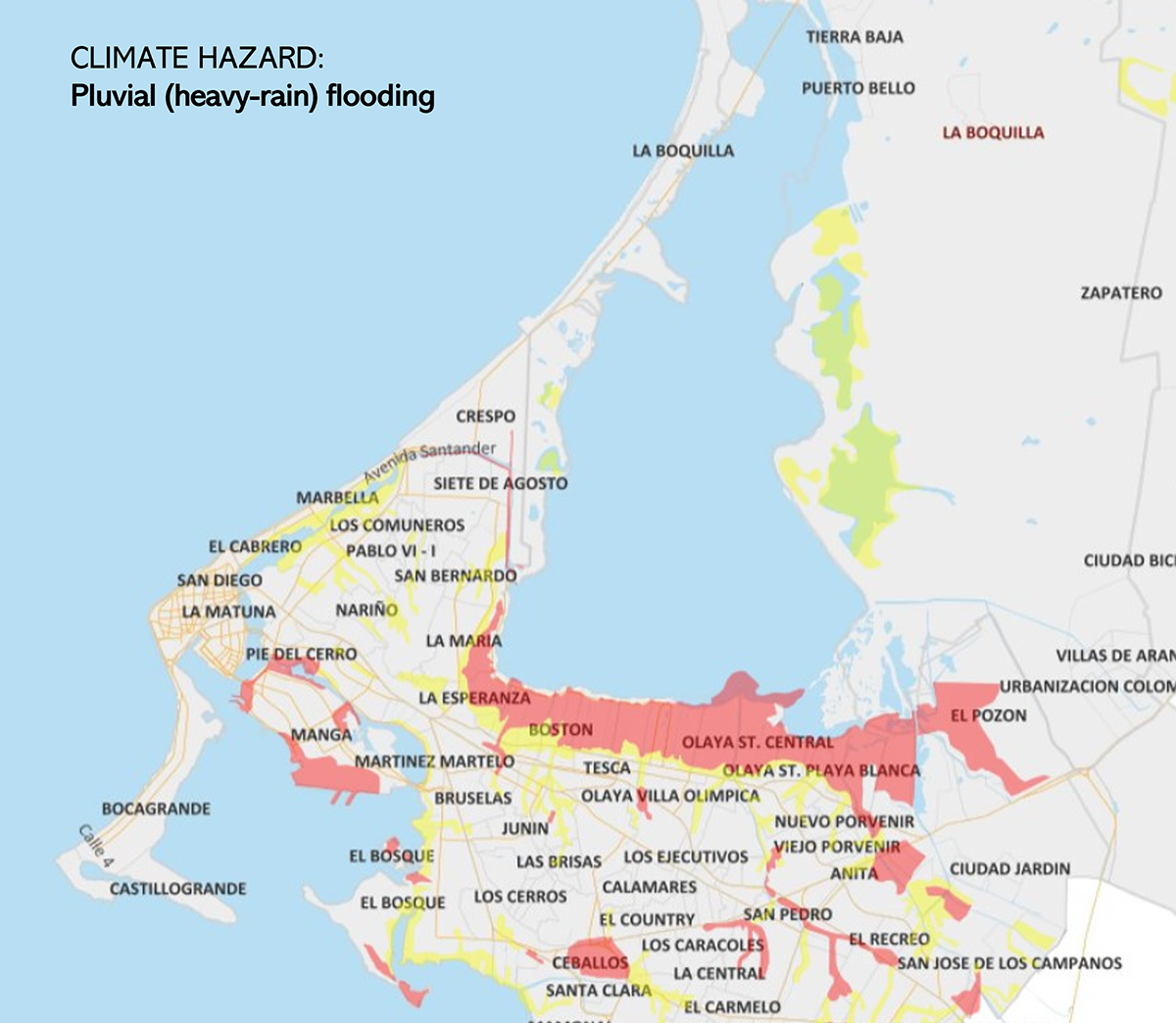
Before climate change was mainstreamed among local governments in Colombia, they already used land-tenure laws and risk maps as technocratic arguments to clear up informal settlements (Zeiderman Reference Zeiderman2013). Even when there is political will to legalize neighborhoods, the new climate risk maps (Figures 2 and 3) have become a legal barrier for marginalized communities to improve their living conditions. As seen in Boston, neighborhood improvements are postponed in areas that are already legal. Now, land invasion is no longer a land-only problem but a climate adaptation problem. Laws used to remove people from the informal settlements are contrasted with the progressive Constitution (1991), illustrating that the legal system is not entirely coherent.
The “law of the four poles,” which is well-known in Cartagena, causes frustration because formal law makes the government slow and inefficient in comparison. Victoria, one of the government officials at the environmental authority, referred to the informal settlements near the La Virgen swamp as “unadaptable.” People living in these areas should be forced to leave, but instead they are expanding, using the “law of the four poles.” “The solution in all the informal settlements is relocation and people want to have a better house,” said Victoria. She was clear that relocation was the only choice, but the government lacks resources and therefore, this was a never-ending problem. In the meantime, communities such as those in Boston, for whom adaptation has been stalled after the high-risk classification, are left in a limbo without protection.
While the “law of the four poles” is problematic because it causes further environmental degradation, people in power are aware that poverty and inequality are not addressed, and the tourist sector is increasingly linked to global markets, leaving small profit for those at the margins. This is sometimes seen as a justification for law-breaking, exemplified by one of the councilors of Cartagena:
“It is not that I am in favor of the land invasions, I want them to be controlled and have some conditions. But the tourist sector is monopolizing everything, leaving people with no opportunities to survive. In the past, people could be taxi-drivers and earn an income, but now the hotels have their own cars, they have created a monopoly and take all the profit.” (Interview, February 22, 2022)
However, the story is not as romantic as people in poverty using the “weapons of the weak” (Scott Reference Scott1985) to claim their right to participate in the tourist city. Many respondents talked about families using the “law of the four poles” to expand their territory, build new houses to rent or to give to new family members. Others speculate on land in the wetland, hoping to benefit from, or sell to illegal high-end developments. An environmental activist interviewed reflected on the city’s corrupt land-use practices:
“The [state] law is absolutely useless and the ones making the law are those occupying the territory. There are no-go zones! What starts as an informal settlement gets consolidated and we start seeing bigger, more sophisticated houses, and the state loses sovereignty over the territory. […] The state is a big problem because they have legalized hotels and other high-level constructions. One of the biggest hotels in Cartagena was built illegally on state-owned land. Then they legalized it. There is corruption at all levels in the appropriation of the land.” (Interview, February 21, 2022, emphasis added)
From a legal perspective, the precedent is not clear, and the Constitutional Court has established the need to follow due process and to reconcile the right of housing – particularly for vulnerable groups such as elderly, persons with disability, children and people displaced by the armed conflict – with the right of the state to recover public land (Decision SU 016 of 2021).
People combine territory-based adaptation strategies with resistance through rival legal orders
What does climate adaptation look like for marginalized communities in a context of legal pluralism? We show how people use several everyday and territory-based strategies to adapt to climate hazards, in combination with building a legality from below through legal pluralism, which contrasts with global agendas to regulate adaptation from above.
Ethnographic vignette: “When the storm comes, you can’t leave this place”
Barbara is a leader in the neighborhood called Playas Blancas. She is part of the community emergency committee Combas and active in different projects. As we met, she was preparing for a second-hand market to sell donated clothes to finance activities for their women’s entrepreneurship group.
“When we bought this house, the area around was all water. Now it is full of small houses.” Barbara shows us the property the community organization bought (informally, because they don’t have a title). The house is simple—with a dirt floor, plank walls and a corrugated tin roof—but the patio has five raised vegetable beds, mainly to teach women about growing food.
For Barbara, the biggest problem in this neighborhood is hunger. She dreams of a community kitchen where they could feed the children, cultivate their gardens, and work together. “Covid taught us that we’re not prepared for an emergency. The government doesn’t have the capacity to respond, they were afraid to come here and get infected, and the city is poorly connected with the countryside to receive food.”
She also worries about the youth in her neighborhood. Many end up in drugs or in gangs. “The government comes one day with a project, but they don’t finish it. We have made so many courses here, so many capacity-buildings, for nothing.”
She thinks that the climate has changed, in the sense that hurricanes are coming more often than before. “This is not from now,” she said referring to the floods and storms. “The only solution to the flooding is to invest in raising the floors of the houses.” Every year, she helps her neighbors to prepare for the rainy season, to tie up the roofs to secure them from strong winds, and make sure they don’t have holes.
“When the storm comes you can’t leave this place, if you leave you lose everything. Someone will come and steal your roof and anything they can take. When we lost our house in the hurricane, we waited until the land got dry and built the house again. During the dry months, this place is so beautiful. Here you can build anything you want.” (Ethnographic field note, February 16, 2022)
Barbara’s complex story illustrates how people use several territory-based strategies for everyday adaptation to climate change, such as raising the land, improving the house and drawing on place-based networks and community organization to reduce physical and economic vulnerability and to counter food insecurity. Here, some older residents have managed to raise their houses; they are connected to water and electricity, and have gained legal titles through mobilizing during former election periods, while the poorest people and newcomers “basically live on water” between four poles. There is participation fatigue, as projects do not sufficiently address the underlying vulnerability drivers, including loss of livelihoods, food insecurity and lack of opportunities for youth. However, one notably successful initiative is Combas (Comites Bariales de Emergencia) – neighborhood emergency committees. Barbara and Sandra, elderly community leaders, are both part of Combas. They do voluntary work mainly during the rainy season, with awareness raising, and preparing the drainage channels with sticks to mark how much the water is rising. Combas started as an initiative from a private foundation to train and support community groups on disaster prevention and risk management, before it was taken on by the local government, adding recognition to this important form of community work.
Our study shows that access to land and tenure is seen by residents as the most important precondition to adapt to climate change. The precarious life in the informal settlements expose residents to constant insecurity and the risk of losing their roofs to storms or to thieves. However, having a house is still perceived to be better than the option of renting (“I have friends who pay rent and that is the worst”). Residents consistently referred to the “law of the four poles” as a method for accessing land. However, benefitting from this customary law is linked to certain criteria and social control, namely one’s social standing in the neighborhood, one’s need for housing and according to certain accounts, restrictions on lot size and materials (Ortiz-Cañavate Reference Ortiz-Cañavate2020). Taking more land than you need, such as for subdivision and sale, is subject to disputes among social leaders. The following story about a neighbor exercising second-party social control (Ellickson Reference Ellickson1987) illustrates the expectation from neighbors to show presence, improve the land and not leaving it “abandoned” – mirroring the formal requirements for accessing land through acquisition by prescription:
Juan, a community leader, takes us to see Don Fernando, an old man who lives alone in a peninsula that connects with the swamp. Don Fernando is respected, so most people don’t dare to invade his land. In the half-hour walk to get there, we pass different houses and people greet Juan in a friendly manner. But suddenly, one man comes out of his house and starts shouting at Juan:
“You have left this piece of land abandoned and the bushes are overgrown! The other day, a thief took one of my chickens and escaped through your bushes. When are you cutting them down?” he complains. Juan apologizes and explains in a friendly manner that this piece of land is for his son and that he is waiting for him to come and help him cut the bushes. While he has a better income and situation than most people here, Juan is helping his son to get a piece of land in the same way that everyone does: with the law of the four poles. (Ethnographic field note, February 20, 2022)
So far, we have seen how residents in the informal settlements use everyday forms of resistance to climate adaptation laws by encroaching using “the law of the four poles,” mobilize for emergency response, and organize in semiformal adaptation spaces such as Combas. However, as the next section shows, some of them have formed environmental organizations. Most people we encountered during fieldwork refer to being used to living with climate hazards such as flooding, storms and heat – which they describe not as isolated phenomena (as a risk scientist might), but as interconnected to other priorities and problems in their lives regarding housing, livelihoods and health. They are aware of climate risks and have developed different everyday strategies to adapt to climate change. Examples include home gardens, marking channels with sticks, raising the ground, putting blocks to raise their beds and tying down the roof. They are proud to be active in the protection of their houses and not having to wait for government support, but they are also ready to tap into government aid that comes now and then. Creating their own rules allows them to reduce some forms of vulnerability, while others are still present: violence, lack of a stable income and lack of access to education for children. Constant exposure to such stressors increases vulnerability to climate change over time, which is also not uniform throughout the settlement. For example, in the case of small children, elderly and persons with disabilities, the vulnerability is higher and a larger flood than expected can put their lives at risk.
Law from below: challenging elite law-bending and becoming guardians of the mangrove
A key question is what legal actions or claims are available to those most vulnerable and how everyday resistance can be differentiated from mere survival strategies. This section shows how people motivate their claims on land by using legal language and challenging the legality of the state and the neutrality of formal law. In other words, rather than being unaware or simply coping, they are justifying their resistance through “the law of the four poles” as a response to the elite bending the law. Moreover, in response to the governments’ climate agenda, we observe how the city’s most vulnerable, as part of their resistance repertoires and building the law from below, mobilize new identities as “resilient” and environmental defenders.
Ethnographic vignette: “Their law is the law of plundering and forced displacement”
One day, we met with Sandra, a social leader engaged in Combas and urban gardening together with Barbara. Today, Sandra has formal titles of her house, and she has invested in raising the ground to withstand seasonal floods. But her story, like that of many others, illustrates a cycle of flood risk and displacement: repeatedly seeking shelter by filling up land in the swamp, and being told to leave for the government to recover the land. In her story, we uncover resistance in the form of legal language and political views about the land tenure laws used to displace people.
“When I came to live here with my husband, it was all mangrove and water. We had to dry the land buying debris. I have built this house with my effort,” said Sandra proudly. When she was young, she lived in Chambacú where her aunt had filled a piece of land in the swamp, but the government paid them 13 pesos as compensation to leave the land. Others got resettlement houses, but those people had to sell the houses in the end, because they could not afford the expensive utilities.
“They told us that we must leave our houses in Chambacú because that land was not good for housing and they needed to restore the ecological system. But if you go to Chambacú now, there is a large commercial building there. We are used to being displaced by armed groups, but in this case, it was the state. It was a legal displacement to give the land to commercial use. There is a powerful family, their law is the law of plundering and forced displacement. They are using titles from the Spanish time to claim land in the island of Barú. They have no limit! But people are not stupid any longer, we learnt, and we don’t move from our lands anymore.” (Interview, February 16, 2022)
As the quote from Sandra illustrates, climate adaptation becomes complicated in a legally plural setting where citizens are used to creating their own norms to access basic rights and entitlements. They do not create their own laws because they are unaware of the law – rather, they refer to the land tenure law as being bent by the elite. Sandra’s account shows how a seemingly “neutral” adaptation law, policy or risk zone classification (“land not good for housing”), exists in a context of profit-maximizing urban planning (malls and hotels) and elite mobilization of the law (“old titles from the Spanish time,” “their law is the law of plundering”). It also shows how communities challenge the legitimacy of the state – including by comparing it to armed groups – based on what they perceive as unjust land use practices. Sandra, like many other leaders in her neighborhood, has realized that to stay, they must speak the same language as the government; in her case, she is part of the emergency committee (Combas), she knows how to help her neighbors in case of flooding, and she insists they can adapt to climate change while staying on the land.
In addition to the consistent use of legal language (“law of the four poles”), our analysis identified five main narratives with which the informal settlers we interviewed challenge the legitimacy of the state to motivate their claims on land, thus revealing their resistance.
1. Challenging corrupt land use practices. As in Sandra’s account, people motivate their own claims on land by invoking the state’s corrupt land practices in ceding public land to high-end actors such as hotels. People are aware and resist the idea about law as neutral; rather, law is made and mobilized by the elite, and climate adaptation law is no exception. Angel, a local musician, was filming a video in one of the neighborhoods as we passed by. When asked what risks he sees in his area, he started rapping his answer:
“The risk is the ease of many bad things/we’ve had death as a game since we were born/education is more and more expensive/kids have more access to a drug dealer than to a school/and now the government steals the future of the children.” He mentions a school that was being built in his neighborhood, but at night people started seeing trucks taking cement and bricks from the school ground. They told residents that the ground was not good, as this was a flooding area, but everybody knew that they stole the construction materials. “Bad land and flooding is a lie” (mala tierra y inundación es mentira), says Angel. (Ethnographic field note, February 20, 2022)
Awareness of corruption and legal pluralism at all levels of the system is evident in residents’ stories: from the truck that gets paid to take debris out of the city but gains a buck by selling it illegally in Olaya, to politicians who trade construction material for votes in the settlements close to La Virgen swamp where “people are always in need of cement and bricks to improve their shacks” (Interview with community leader, February 24, 2022) – thus indirectly contributing to settlement expansion in the floodplains.
2. Comparing the reach of public and private “law.” Another way that people show their resistance and challenge the legitimacy of the state is by contrasting the reach of public law and services to that of the private economic order. This includes statements that refer to kids having more access to drugs than to a school, and asking why the garbage truck does not come to their neighborhood when “the car selling beer comes all the way to the last corner of this place.” People realize that they belong to the group of consumers, but they are not full citizens.
3. Land invasion as an inheritance scheme. A third way that people challenge the legitimacy of the government and (indirectly) motivate their claim on land is invoking the lack of opportunities for youth, a recurrent theme in the material. It is linked to corruption and needing a political connection “even for the simplest job,” as Barbara expressed. This is exemplified in our meeting with Don Fernando, a respected elder living from growing mangroves in a peninsula in the swamp:
“I built the fence because the youth are coming here to see what they can get. I don’t blame the youth, there are no opportunities for them. They are abandoned by the government and our neighborhood is burning.” He refuses to leave because he knows many people want his land. He says he has 42 children and grandchildren everywhere and he is saving this land for them. (Ethnographic field note, February 20, 2022)
Thus, invading land is a way to secure the future of the next generation – an informal “inheritance scheme” to deal with lack of social security, which we argue drives people’s presence and land speculation in risk zones.
4. Challenging the risk-zone classification. A fourth way that people motivate their claim on land is to challenge the risk-zone classification made by the government. When people declare that “we are not at high risk” (Jeremy) or “bad land and flooding is a lie” (Angel), they are not denying the occurrence of floods or climate change per se. They are challenging the perspective that hazards are something new that should take precedence over all other risks in their daily life. People also challenge the risk classification by comparing their situation to other, high-end neighborhoods like Bocagrande – where high risk leads to sea walls for protection, not relocation.
5. New environmental resistance narratives. A fifth way to motivate their claim on land is mobilizing a narrative as environmental defenders. We were surprised to meet groups that claim to be the guardians of the mangroves and the swamp, and that work to raise awareness about protecting the environment:
Juan, a known local leader, takes us to the end of Playas Blancas. On the other side of the swamp, we can see the Caribbean Sea. As we walk carefully on the mudded path, he shows how they are putting poles and building a fence to prevent more people from invading the land. “We hope to grow mangroves here and recover the area so that our houses get protection in case of storms. I work with the residents and together we have managed to make a first fence. Some politicians want to transform this into a conservation area. We want to build docks here and have eco-tourism so that visitors can see the real Cartagena. We could have fish projects and involve the community to protect and generate resources from the swamp.” (Ethnographic field note, February 20, 2022)
In contrast to the relocation narrative, these initiatives mobilize alternative visions of the future, including small-scale eco-tourism, mangrove protection and other sustainable solutions. In fact, both governments and informal communities are rebranding their old efforts and struggles under new terms such as adaptation and environmental protection. Our respondents repeatedly showed concern about the trash and environmental degradation (but they blame the government for bad policies). They see settlement expansion and the arrival of newcomers as a problem, as new invasions exacerbate the flood situation and jeopardize the possibilities to receive upgrades of their houses, a road, and schools.
Discussion: mutual learning between climate adaptation and sociology of law
Much scholarly attention has been given to climate litigation and the use of formal state law to regulate climate adaptation (IPCC Reference Pörtner, Roberts, Tignor, Poloczanska, Mintenbeck, Alegría, Craig, Langsdorf, Löschke, Möller, Okem and Rama2022; Peel and Osofsky Reference Peel and Osofsky2018; Setzer and Vanhala Reference Setzer and Vanhala2019). While important, formal law and litigation might not be accessible for marginalized groups, who often engage in everyday forms of resistance to the law. We show how the existence of legal pluralism in countries like Colombia allows marginalized communities to build a legality from below to contest exclusionary laws and policies under the global policy goal of climate adaptation.
The main empirical contribution is showing through vivid examples how residents of informal settlements experience and mobilize the law through resistance using alternative legal orders such as “the law of the four poles.” While youth in the informal settlements feel abandoned by the government and lack hope, people are fighting to access the right to housing for themselves and future generations and to address the multiple sources of vulnerability they experience, of which climate change is only one among many (Ribot Reference Ribot2011). This work is a stark reminder that climate change affects different groups in different ways, and that just and equitable climate regulation must recognize this.
Climate adaptation poses new questions to sociology of law through issues such as transboundary effects, intergenerational justice and contested accounts of the future outside a stable climate (Vanhala Reference Vanhala2022). This article shows how empirically observed everyday forms of resistance (Scott Reference Scott1989) allowed researchers to uncover alternative forms of legality from below (legal pluralism) whereby marginalized groups flight for a different form of adaptation that considers local needs and aspirations (Santos and Rodríguez-Garavito Reference Santos and Rodríguez-Garavito2005). In doing so, we revive legal pluralism as an analytical tool to consider marginalized groups at the frontline of climate change, not only as passive objects of regulation, control and structural vulnerability, but as political subjects with agency and voice (political and legal claims).
Our findings speak to longstanding sociolegal debates (e.g., Bayat Reference Bayat2000; Eckstein Reference Eckstein2001; Hollander and Einwohner Reference Hollander and Einwohner2004; Scott Reference Scott1989; Vargas and Urinboyev Reference Vargas and Urinboyev2015; Villegas Reference Villegas2013) about whether everyday resistance and quiet encroachment are simply coping mechanisms to fill immediate needs or if they can indeed constitute political demands (see Theory section). This study shows how residents combine their encroachment on land with expressing critical views and political voices about their rights, the rights of future generations and the role of the state. However, rather than using a human rights language, they frame and advance their claims with reference to local and customary legal frames (“the law of the four poles”), which is possible because the state de-facto allows for this form of legal pluralism. While their stories and positionality vary (e.g., being more-or-less established and powerful in the neighborhood), they show similar reasoning about the unfair and unjust nature of state law and the lack of hope for future generations. Like Vargas and Urinboyev (Reference Vargas and Urinboyev2015), we argue that addressing people’s noncompliance with state laws is not just a matter of introducing stricter laws or more law enforcement: it requires addressing their concerns for well-being.
Our work also advances knowledge in climate adaptation. While the adaptation field has often framed law in functional terms, that is, seeing society as stable and supportive of the state’s decision-making (Olsson et al. Reference Olsson, Jerneck, Thoren, Persson and O’Byrne2015; Watson Reference Watson2011; Wellstead et al. Reference Wellstead, Howlett and Rayner2017), our analysis of the case of Cartagena confirms the sociolegal argument that “law is a battlefield” and it speaks with more than one voice. This can be contrasted with the early adaptation debate, when pioneering adaptation scholars focusing on Cartagena argued for “capturing” poor people’s perspectives and “mainstreaming” bottom-up community asset planning into top-down citywide strategic and operational planning (Stein and Moser Reference Stein and Moser2014). The stories in this paper pinpoint the difficulty of formulating and delivering climate justice – especially in societies with high legal pluralism and conflicting norms. Law has a central role, but it is not neutral: it is constantly negotiated between the elite and the powerless engaging “with” and “against” the law. Both groups are aware of this, rather than seeing the law as distant and objective (Silbey Reference Silbey2005). The contested meaning and uses of law add a (socio)legal dimension to the existing literature on climate governance (IPCC Reference Pörtner, Roberts, Tignor, Poloczanska, Mintenbeck, Alegría, Craig, Langsdorf, Löschke, Möller, Okem and Rama2022), institutions (Ostrom Reference Ostrom2009) and the politics of adaptation (Funder et al. Reference Funder, Mweemba and Nyambe2018; Henrique and Tschakert Reference Henrique and Tschakert2019; Nightingale Reference Nightingale2017).
Our findings contribute to an emerging debate on resistance to climate adaptation (Brink et al. Reference Brink, Vargas Falla and Boyd2023). Such resistance seems counterintuitive and only recently it has gained explicit study by adaptation scholars (Arnall Reference Arnall2019; Gebreyes Reference Gebreyes2018; Henrique and Tschakert Reference Henrique and Tschakert2019). Our findings help explain resistance through illustrating how the law, in practice, has increased differential climate vulnerability through “eviction for the poor, seawalls for the rich.” The decision about whether the risk in a particular zone is mitigable or not is open for interpretation, and it often comes down to economic tradeoffs and competing political interests (Sarmiento Reference Sarmiento2018). In addition, people who relocate (voluntarily or not) surprisingly often find themselves exposed to new climate hazards (Arnall Reference Arnall2019; Brink et al. Reference Brink, Vargas Falla and Boyd2023; Sarmiento Reference Sarmiento2018).
A critical question is whether there is anything “new” in marginalized groups’ resistance to climate law (Johansson and Vinthagen Reference Johansson and Vinthagen2016). While the adaptation resistance found in Cartagena is certainly historically informed, based on existing repertoires (such as land invasions) and historical grievances, we observed new tactics whereby environmental and climate narratives are mobilized for the right to stay. We argue that resistance mimics power in this case: people are resisting a new argument for removal (climate risk), but instead of invoking their right to the city or their conditions of poverty and vulnerability, they position themselves as environmental defenders. This is different from previous literature in urban Colombia, which showed that people mainly interacted with the state via their identities as “vulnerable” and “victims” in need of protection (Rojas Reference Rojas, Macdonald and Ruckert2009; Zeiderman Reference Zeiderman2013). People in Cartagena want to get protected from flooding but on their own terms.
Finally, this work addresses an important epistemic injustice that is emerging in sociolegal climate debates: a focus on the Global North (Bogojević Reference Bogojević2023; Sterett and Mateczun Reference Sterett and Mateczun2020). There is an urgent need to understand how the world’s most marginalized are impacted by climate change and the ways in which their marginality is addressed or exacerbated by law. This qualitative study in Cartagena drew on a limited number of everyday, yet vivid stories. As with all qualitative studies, there are limits to generalization, not least due to the heterogeneity of communities (see Methods). Certainly not all community members were engaged in more organized resistance or climate adaptation; similarly to using the “law of the four poles,” this seemed to presuppose a certain time of occupation and level of establishment in the community. Moreover, the “law of the four poles” is only one example of legal pluralism specific to Cartagena, where it is recognized by some local officials, scholars and journalists (Franco and Arana Reference Franco and Arana2019; Ortega Reference Ortega2021; Ortiz-Cañavate Reference Ortiz-Cañavate2020; Quiroga Reference Quiroga2021). However, as evidence and theorizing on resistance to adaptation is growing, we can better understand how resistance works between different contexts (Ospina et al. Reference Ospina2024). Previous work shows how resistance to adaptation reflects both the type of power exerted through adaptation interventions – and place-specific cultural, historical and legal contexts, which precede or have little to do with climate adaptation processes (Brink et al. Reference Brink, Vargas Falla and Boyd2023). Colombia has a legal culture characterized by pluralism, overproduction of laws and norms, ineffective law and low trust in the legal system (Garcia-Villegas and Rodriguez Reference Garcia-Villegas and Rodriguez2002; Taylor Reference Taylor2018). This likely shapes the forms of resistance we observed. While this study focuses on Colombia, climate-motivated resettlements are highly contested and a reason for people’s resistance all over the world, not just in cities and the Global South (Brink et al. Reference Brink, Vargas Falla and Boyd2023). In the Global North, there is a large literature on housing, displacement and gentrification, which has recently taken on the question of climate-related and “green” gentrification (Shokry et al. Reference Shokry, Connolly and Anguelovski2020). Sociolegal concepts such as legal pluralism are missing from this debate and can help describe the particular social, historical and legal contexts that give rise to resistance.
Conclusion
This study investigated how law in a changing climate is experienced and resisted by residents of informal settlements in the coastal city of Cartagena. We found that vulnerable communities, often seen as marginalized and passive in terms of the law, actively resist climate adaptation plans and risk maps that are backed up by local planning bylaws and global adaptation agendas. We argue that everyday resistance in cities of the Global South is not only a strategy of daily survival. It is part of claiming a political voice in the broader climate change debate. Climate change is real, but residents of informal settlements are claiming the right to stay and adapt on their own terms.
Our findings illustrate how the law would look if created from the margins in legally plural societies. Such law would allow access to housing (exemplified through the “law of the four poles”) and satisfy basic needs while adapting to climate change. However, we find that vulnerability is not erased with the creation of law from the margins; instead, new forms of oppression (e.g., against newcomers) emerge. While people exploit legal pluralism and the associated leeway, they are asking for more state presence and rule of law to protect their houses against thieves. They want better homes, drainage channels, more mangroves, better roads, access to public services and a future for their children. So, the question is: how can the law better reflect not only the science behind climate change but also the interest and needs of marginalized communities?
We believe that scientists’ attention to climate litigation should be paired with attention to the everyday mechanisms for marginalized groups to claim rights through creating their own laws, solving conflicts and adapting to climate change on their own terms. These everyday mechanisms are often possible in the Global South because of a legal pluralistic situation, in which the state law competes with other social orders that govern lives in informal settlements. Sociolegal scholars must pay attention to claims brought outside official courts, in places where the official state law is resisted. At the same time, global adaptation agendas could better acknowledge how vulnerability is reinforced if adaptation means evictions and destitution. Successful climate adaptation goes beyond large infrastructure projects and must place people’s capabilities and daily needs, which certainly includes housing and livelihoods, at the core.
Supplementary material
The supplementary material for this article can be found at https://doi.org/10.1017/lsr.2024.55.
Acknowledgements
The authors wish to thank the anonymous respondents in Cartagena for their time and insight. The research was funded by the Swedish research council FORMAS (grant number 2018–01350). EBr also acknowledges funding from VR (grant number 2019–00498).
Author contributions
EBr led on literature review, data analysis, and writing and editing the final manuscript. AMV led on data collection in Colombia, wrote the first ethnographic field report, supervised the team’s engagement with sociolegal concepts, and cowrote the manuscript. EBo led on funding acquisition and project management. All authors contributed to theoretical and methodological design, discussing the findings, and have approved the final version of the manuscript.
Conflict of interests
The authors declare no competing interests.
Ebba Brink is a Researcher in Sustainability Science. With a background in risk management, disaster risk reduction and climate adaptation, her research focuses on justice dimensions of urban climate governance.
Ana Maria Vargas Falla is a Senior Lecturer in Sociology of Law. She is an interdisciplinary sociolegal scholar with extensive experience in citizens' everyday experiences with laws and policies and everyday resistance as a tool for bottom-up transformations in society.
Emily Boyd is a Professor in Sustainability Science. She is a social scientist with a background in international development, environment and climate change, with focus on the interdisciplinary nexus of poverty, livelihoods and resilience in relation to global environmental change.


 Open access

