


Introduction
An increasing human population and growing food demand has led to worldwide increases in land cultivation and agriculture intensification. Agricultural areas are experiencing rapid transformations with a progressive disappearance of fallows, the expansion of irrigation, and a growing use of fertilisers and pesticides (Tilman et al. Reference Tilman, Cassman, Matson, Naylor and Polasky2002, Reference Tilman, Balzer, Hill and Befort2011). These changes have led to a rapid biodiversity loss, as exemplified by widespread farmland bird declines (Donald et al. Reference Donald, Sanderson, Burfield and van Bommel2006; Rigal et al. Reference Rigal, Dakos, Alonso, Aunins, Benko and Brotons2023). Many European steppe birds are currently experiencing dramatic population declines, in part because they are more dependent than other farmland birds on the maintenance of semi-natural habitats, pastures with extensive grazing, fallows or extensive dry agricultural farmland (Rigal et al. Reference Rigal, Dakos, Alonso, Aunins, Benko and Brotons2023; Tarjuelo et al. Reference Tarjuelo, Benítez-López, Casas, Martín, García and Viñuela2020a, Reference Tarjuelo, Margalida and Mougeot2020b; Traba and Morales Reference Traba and Morales2019). This is the case of the Black-bellied Sandgrouse Pterocles orientalis (hereafter BBS), which is one of only two species of Pteroclid birds that breed in Europe (del Hoyo et al. Reference del Hoyo, Elliott and Sargatal1997; Mougeot et al. Reference Mougeot, Fernández-Tizón, Jiménez and López- Jiménez2021a).
The nominal subspecies, Pterocles orientalis orientalis, is present in the Iberian Peninsula, the Canary Islands (Fuerteventura and Lanzarote), North Africa, and the Middle East, while the subspecies P. o. arenarius is distributed in Central Asia (Benítez-López and Palacín Reference Benítez-López, Palacín, Keller, Herrando, Voříšek, Franch, Kipson and Milanesi2020; del Hoyo et al. Reference del Hoyo, Elliott and Sargatal1997). A main European stronghold of BBS is found in continental Spain and the Canary Islands, with a population estimated at 7,700–13,000 individuals in 2005 (BirdLife International 2017; Suárez et al. Reference Suárez, Hervás, Herranz and Del Moral2006). The other important European population is found in Turkey, i.e. 5,000–10,000 pairs (BirdLife International 2017). BBS’s ecology and conservation requirements are still relatively poorly known (Benítez-López and Palacín Reference Benítez-López, Palacín, Keller, Herrando, Voříšek, Franch, Kipson and Milanesi2020; Mougeot Reference Mougeot, Molina, Nebreda, del Moral, Muñoz, Real and Seoane2022; Mougeot et al. Reference Mougeot, Fernández-Tizón, Jiménez and López- Jiménez2021a). This granivorous, ground-nesting bird inhabits habitats with low vegetation cover and height, typically remnants of natural steppe-like habitats, pastures, and extensive dry arable land (Benítez-López et al. Reference Benítez-López, Viñuela, Mougeot and García2017; Martin et al. Reference Martín, Martín, Palacín, Sastre, Ponce and Bravo2014; Mougeot Reference Mougeot, Molina, Nebreda, del Moral, Muñoz, Real and Seoane2022). It is well camouflaged, elusive, and sensitive to disturbances (Mougeot et al. Reference Mougeot, Benítez-López, Casas, Garcia and Viñuela2014; Suárez et al. Reference Suárez, Martínez, Herranz and Yanes1997), and therefore difficult to detect and survey. A first national survey was conducted in Spain in 2005; as a result, the species was classified as “Vulnerable” based on population size and projected population reductions (Suárez et al. Reference Suárez, Martínez, Herranz and Yanes1997, Reference Suárez, Hervás, Herranz and Del Moral2006). In a context of rapid changes and continued farmland bird declines in Spain (Traba and Morales Reference Traba and Morales2019), it was crucial to update information on BBS distribution, population size, and recent trends. For this purpose, a second national survey was conducted in 2019, using a similar but improved methodology. The survey was promoted and coordinated by SEO/BirdLife and the method was the same as in 2005 (walked transects), but with the addition of repeated transects (several visits during 2019) throughout the range. This allowed to account for imperfect detection, which is particularly important when surveying elusive birds such as sandgrouse, and the use of state-of-the-art modelling to estimate occupancy and abundance using multi-level occupancy models and hierarchical distance sampling (HDS) models, respectively (Chandler et al. Reference Chandler, Royle and King2011; Kéry and Royle Reference Kéry and Royle2015). We report here on the results of the 2019 survey in continental Spain. We update the species’ recent distribution, population size, and abundance map, and document trends since the 2005 survey. We also report on habitat use and the proportion of the BBS population currently occupying protected areas. Finally, we discuss the species’ conservation status and main threats.
Methods
Distribution and population structure in continental Spain
Throughout the study, we used Universal Transverse Mercator (UTM) grid cells (10 × 10 km) as spatial units (hereafter UTMs), and these grid cells were the same as in the previous survey (Suárez et al. Reference Suárez, Hervás, Herranz and Del Moral2006). Recent distribution data (Mougeot Reference Mougeot, Molina, Nebreda, del Moral, Muñoz, Real and Seoane2022; Suárez et al. Reference Suárez, Hervás, Herranz and Del Moral2006) indicate that the BBS breeding range includes a maximum of 839 UTMs. According to Suárez et al. (Reference Suárez, Hervás, Herranz and Del Moral2006), the BBS population of Spain is structured into nine regional sectors (eight in the Iberian Peninsula and one in the Canary Islands). In addition to the peninsular population of Spain, there is a breeding population in Portugal estimated at 113–183 breeding pairs (Birdlife International 2017), possibly connected to the Extremadura and south regional sectors of Spain but was not surveyed in 2019.
For this work, we focused on the peninsular population of Spain (816 UTMs), excluding those on the Canary Islands (Fuerteventura and Lanzarote). Although the latter populations belong to Spain, they are geographically closer to North Africa (Morocco), and genetic exchange between the Canary Islands and Iberian Peninsula populations is extremely unlikely, so these populations can be considered as two independent conservation units. In addition, survey methods in the Canary Islands differed from those of continental Spain (Carrascal and Cabrera Reference Carrascal, Cabrera, Mougeot, Fernández-Tizón, Tarjuelo, Benítez-López and Jiménez2021; Mougeot et al. Reference Mougeot, Fernández-Tizón, Tarjuelo, Benítez-López and Jiménez2021b) and did not allow us to implement occupancy or abundance models accounting for imperfect detection. The eight regional sectors of the Iberian Peninsula are: Northern plateau, Ebro valley, Iberian system paramos, Southern plateau, Extremadura, Guadalquivir valley, subbetic peneplains, and semi-arid south-east (Figure 1a). Owing to sample size limitations (few transects and UTMs with BBS presence), the latter three regional sectors, all located in the Andalusia region, were regrouped into a single unit, hereafter referred as to the “South” regional sector. The analyses of the 2019 survey were therefore conducted considering six regional sectors (Figure 1a).
Maps showing (a) the distribution of Black-bellied Sandgrouse (BBS) in peninsular Spain, identifying the six regional sectors, and (b) the survey coverage and detection results (presences) in 2019. The survey was promoted and coordinated by SEO/BirdLife. Units are 10 × 10 km grid cells (UTMs). UTMs that were not sampled are shown in white, and those that were sampled in 2019 are shown in grey or red (without or with BBS detection, respectively).

Survey method
We used the same methodology as in the previous national survey (Suárez et al. Reference Suárez, Hervás, Herranz and Del Moral2006). Fieldwork consisted of walked transects (hereafter transects) considered the most efficient method to detect these elusive birds. Several transects were conducted within each UTM to cover all suitable habitats for BBS. Transects were walked preferably off-road or tracks and in a straight line to avoid double counting, and were typically 2–3 km long. Based on previous knowledge of the species’ habitat preferences (Benítez-López et al. Reference Benítez-López, Viñuela, Mougeot and García2017; Martín et al. Reference Martín, Martín, Palacín, Sastre, Ponce and Bravo2014), observers were asked to survey only land uses suitable for BBS, i.e. cereal, legumes, fallow land, stubble, ploughed land, grassland, pasture, traditional vineyards, low and sparse scrubland, olive groves, and other open woody areas with no or some vegetation, avoiding wooded areas and dense shrub areas, as well as tall (>20 cm) and dense crops (e.g. cereals, legumes) (Benítez-López et al. Reference Benítez-López, Viñuela, Mougeot and García2017; Martín et al. Reference Martín, Martín, Palacín, Sastre, Ponce and Bravo2014; Mougeot Reference Mougeot, Molina, Nebreda, del Moral, Muñoz, Real and Seoane2022). For each visit to a transect, the following data were recorded: (1) transect ID and corresponding UTM; (2) coordinates of the start and end of the transect, and its total length (distance walked in kilometres); (3) date; (4) start and end times; (5) a record of each BBS observation, if applicable. For bird observations, the following data were recorded: (6) number of individuals; (7) if the birds were on the ground or flying when detected; (8) coordinates of the point where birds were first detected; (10) an estimated distance of each contact (individual, pair, or group) perpendicular to the line of transect. Birds in flight were recorded at distance 0 if they crossed the transect line, and otherwise at the closest observation distance.
Surveys were carried out during the early breeding season, as in 2005 (April–July; BBS lay clutches from May until September; Mougeot Reference Mougeot, Molina, Nebreda, del Moral, Muñoz, Real and Seoane2022), preferably before the cereal harvest, because the area of suitable habitat is greatly enlarged when cereal crops are harvested (sandgrouse avoid tall cereals but use stubble; Martín et al. Reference Martín, Martín, Palacín, Sastre, Ponce and Bravo2014; Sanz Pérez et al. Reference Sanz Pérez, Tarjuelo, Giralt, Sardà-Palomera, Mougeot and Santiesteban2022; Tarjuelo et al. Reference Tarjuelo, Benítez-López, Casas, Martín, García and Viñuela2020a). The recommended sampling dates differed between regions, according to the climatic variability between them (see Supplementary material Table S1). Surveys were conducted preferably during the first three hours after sunrise and the last three hours before sunset, when the birds are more active and detectable (Mougeot et al. Reference Mougeot, Benítez-López, Casas, Garcia and Viñuela2014; Suárez et al. Reference Suárez, Hervás, Herranz and Del Moral2006). Surveys were not conducted under rainy or windy conditions (wind speed >20 km/hour). Analyses included sampling date and hour as covariates (see below). In some areas, BBS occur in sympatry with Pin-tailed Sandgrouse Pterocles alchata, but rarely occupy the same fields or use the same feeding grounds and roosts (Benítez-López et al. Reference Benítez-López, Viñuela, Mougeot and García2017). These two species are easy to distinguish by their size, colour pattern, and calls (del Hoyo et al. Reference del Hoyo, Elliott and Sargatal1997), and typically occur at low densities, so the presence of one species is unlikely to affect the detection of the other (Mougeot et al. Reference Mougeot, Fernández-Tizón, Tarjuelo, Benítez-López and Jiménez2021b; Suarez et al. Reference Suárez, Hervás, Herranz and Del Moral2006).
Within each region, observers were asked to visit some transects several times (three to four repeated visits during a maximum period of one month) during the 2019 survey period, with separate records completed for each visit (Table S1). Repeated visits were used to account for imperfect detection when analysing distribution (using occupancy models) or abundance (using HDS models).
Survey data
In terms of spatial coverage, a total of 660 UTMs from the BBS range were surveyed in 2019, i.e. 81% of the distribution area (Table 1, Figure 1b). Survey coverage ranged between 64% and 95% of UTMs, depending on the regional sector (Table 1). A total of 2,257 visits to 1,750 transects (7,001 km of walked transects) were carried out, with an average survey effort of 10.6 ± 8.2 km/UTM. Survey effort in each regional sector is summarised in Table S1. Overall, 282 transects (14.5%) were visited several times during the 2019 breeding season, of which 75 were visited twice (26.6%), 189 were visited three times (67.0%), and 18 were visited four times (6.4%). These repeated visits were conducted in all regional sectors, but in varying proportions (Table S1): fewer transects were repeated in the Northern plateau (3%) than in the Southern plateau and Iberian system paramos (13–18%) or in the Ebro valley, Extremadura, and South (21–50%).
Occurrence and occupancy results from the 2019 survey. Distribution (see methods) and survey data are given as the number of UTMs (10 × 10 km) grid cells (n UTMs) and occurrence or occupancy data as the proportion of UTMs with Black-bellied Sandgrouse present. BCI 95% = 95% Bayesian confidence interval; UTM = Universal Transverse Mercator

Habitat use and protection level
All the 2019 BBS sightings were georeferenced, so this information was used to extract a posteriori information on land use (using CORINE Land Cover 2018; https://datos.gob.es/es/catalogo/e00125901-spaignclc2018) and protection level based on the spatial boundaries of protected areas (https://www.miteco.gob.es/es/cartografia-y-sig/ide/descargas/biodiversidad.html). For this purpose, we used all the BBS sightings (n = 1,841 sightings of 2,989 individuals) and determined which proportion of individuals occurred in each habitat type and protected areas. Habitat use was not compared with availability because our aim was not to study habitat selection, which had been the focus of previous studies (Benitez et al. Reference Benítez-López, Viñuela, Mougeot and García2017; Martin et al. Reference Martín, Martín, Palacín, Sastre, Ponce and Bravo2014), but to report on the broad habitat types used by BBS in 2019 (agricultural versus natural), which have different associated threats.
CORINE land-cover types were regrouped into three main habitat categories: (1) agricultural (non-irrigated arable land, permanently irrigated land, vineyards, olive groves, fruit trees, complex cultivation patterns, and agroforestry areas); (2) agricultural with natural vegetation (land principally occupied by agriculture, with significant areas of natural vegetation); (3) natural habitats and pastures (pastures, natural grasslands, sparsely vegetated areas, transitional woodland–shrub, sclerophyllous vegetation, inland marshes, and water bodies – the latter two used by BBS when dry).
Protection levels were summarised as follows: (1) protected areas (including the following: Ramsar sites, national parks and their peripheral areas, biosphere reserves, Natura 2000 network or other types of protected areas); (2) unprotected Important Bird and Biodiversity Areas (IBAs), i.e. areas identified by Birdlife International to highlight their ornithological value); (3) unprotected areas of undocumented conservation value.
In addition, we classified each transect as within or outside a protected area based on the locations of start and end points. Overall, 37% of transects were conducted (in part or totally) within protected areas. We included this covariate in our occupancy models to test for differences in BBS occupancy inside versus outside protected areas at transect level.
Statistical analyses
Occupancy models
We used a multilevel occupancy model (Kéry and Royle Reference Kéry and Royle2015) to analyse BBS distribution using the 2019 survey data. We used UTMs as sampling units (first level), transects within each UTM (second level), and their corresponding repetitions (repeated visits to transects), to make inferences about detection and occupancy probabilities. Occupancy probability was obtained for each UTM grid cell and summarised by regional sector. Occupancy models were fitted using JAGS and multilevel Bayesian hierarchical models (Plummer Reference Plummer2003; R Core Team 2020). These models have two components: a detection sub-model and an occupancy sub-model, which are linked by probability definitions and are modelled using different covariates (Mackenzie et al. Reference MacKenzie, Nichols, Lachman, Droege, Royle and Langtimm2002). For the detection sub-model, we tested the following covariates: transect length, time of day, and Julian date, and we used different intercepts for each regional sector to account for differences in detectability between regions. For the occupancy sub-model at transect level, we tested for spatial autocorrelation (Bardos et al. Reference Bardos, Guillera-Arroita and Wintle2015), using the “autocov_dist” function of the spdep package (Bivand Reference Bivand2022; Bivand and Wong Reference Bivand and Wong2018; Bivand et al. Reference Bivand, Pebesma and Gómez-Rubio2013; Pebesma and Bivand Reference Pebesma and Bivand2023), which creates a matrix with symmetry of the neighbourhood that represents the pair-wise spatial relationship or covariance structure. We considered a coefficient to have strong support if its 95% Bayesian credible interval (BCI) did not overlap zero and moderate support if the 75% BCI did not overlap zero.
Abundance models
We used an HDS model (Chandler et al. Reference Chandler, Royle and King2011; Sollman et al. Reference Sollmann, Gardner, Williams, Gilbert and Veit2016), which allows the simultaneous modelling of the abundance function and detection parameters. The distance modelling methodology focuses on detection functions, which model the probability of detecting an animal as a function of its distance to the transect line (Buckland et al. Reference Buckland, Marsden and Green2008; Thomas et al. Reference Thomas, Buckland, Burnham, Anderson, Laake, Borchers, El-Shaarawi and Piegorsch2002). Using observations of flying birds may overestimate population size (Buckland et al. Reference Buckland, Marsden and Green2008), so we used only data from birds detected on the ground to estimate abundances. We used the following covariates: time of day, Julian date, and regional sector for the detection sub-model, and spatial autocorrelation (using the spdep package; Bardos et al. Reference Bardos, Guillera-Arroita and Wintle2015; Bivand and Wong Reference Bivand and Wong2018) and regional sector for the abundance sub-model. Spatial autocorrelation considered that the abundance of one grid cell could be related to that of adjacent grid cells. HDS models were fitted using the “gdistsamp” function of the R package unmarked (Fiske and Chandler Reference Fiske and Chandler2011), which allows the models to be fitted with a Poisson or negative binomial distribution if the data are over dispersed (Chandler Reference Chandler2020). The “gdistsamp” function was used to test for temporary emigration between samples, which was not detected in a first analysis, so we stacked the repeated samples thereby enlarging the sample size.
Before model fitting, we truncated the data based on their distance to the transect line. Following Buckland et al. (Reference Buckland, Anderson, Burnham and Laake1993), we truncated the data using a maximum truncation distance of 450 m from the transect line, which removed 6.4% of the observations, and regrouped them using 50-m classes (Figure S3). These detection distances were consistent with, although slightly larger, than those used in the 2005 survey (Suárez et al. Reference Suárez, Hervás, Herranz and Del Moral2006). Model selection was performed in two steps using the Akaike information criterion (AIC) (Burnham and Anderson Reference Burnham and Anderson2002). First, the null models were fitted (considering the model with the lowest AIC score to be the best fit) to select the detection function, comparing the semi-normal, exponential, and hazard rate functions, and comparing, in all cases, the fit using a Poisson or negative binomial distribution. In the following step, we selected first the covariates for the detection sub-model, and then those of the abundance sub-model, using AIC comparisons. Quadratic terms were tested for the continuous covariates to allow for possible non-linear relationships. Interactions between covariates were also tested. Analyses and model fitting were performed using the unmarked package (Fiske and Chandler Reference Fiske and Chandler2011) in R (R Core Team 2020). We used a parametric bootstrap to test the goodness of fit of the top-ranked model. We simulated 1,000 data sets from this model and used error sums-of-squares, chi-square, and Freeman–Tukey fit statistics to quantify the fit of this model to the data sets. This test indicated some unmodelled over-dispersion in our model (c ̂=2.6).
Finally, the best model and the “predict” function in unmarked were used to obtain abundance estimates in the unsampled UTMs of the BBS breeding distribution in peninsular Spain. For this, we considered an occupied area of 384 ha/UTM, equivalent to the average occupied area in the sampled UTMs.
Population trends
During the previous 2005 survey (Suárez et al. Reference Suárez, Hervás, Herranz and Del Moral2006), transects were not repeated, and not all data were georeferenced, so HDS modelling could not be applied to estimate BBS abundance. Population estimates were derived using a different method and are not directly comparable with the 2019 data. To study trends, we used the Kilometric Index of Abundance (KIA), i.e. the number of birds counted per kilometre of walked transect), which was easily obtained for both surveys (2005 transects were referenced according to their UTM and regional sector). Sampling effort and detection probability were assumed to be comparable between surveys (i.e. the detection function did not vary between years or observers, regions or time of day when considering the whole set of UTMs within the same regional sector). We compiled data at transect level on the number of birds counted, the effort (kilometres of transects), the UTM, and associated regional sector for each survey (2005 and 2019). To test for significant trends and differences between regional sectors, we used a mixed regression model that included year, regional sector, and their interaction as fixed factors, and the UTM identity as a random effect. The dependent variable (BBS count) was fitted to the model using a negative binomial distribution, with survey effort (log-transformed kilometres of transects) included as an offset to account for differences in survey effort between UTMs or years.
Results
Occurrence data and occupancy modelling
BBS presence was detected in 285 UTM squares (43% of sampled UTMs, n = 660), with apparent differences between regional sectors: occurrence was lowest in the Northern and Southern plateaus, and highest in Extremadura (Table 1, Figure 1b). To account for imperfect detection, occupancy modelling was applied to the survey data. The best occupancy model included in the detectability sub-model different intercepts between regional sectors, and the following covariates: survey effort (transect length; 0.27 BCI 95%: 0.06–0.50), time of day (-0.17 BCI 95%: -0.36–0.01), and Julian date (0.13 BCI 95%: -0.06–0.31). Detection probability increased with transect length, with a minimum of 5.3 km of walked transect being needed to ensure a detection probability >0.60 (Figure S1). Detection probability also decreased throughout the day (being highest early morning) (Figure S2) and differed between regional sectors. Detectability was higher in Extremadura (0.77) and South (0.76) than in the Ebro valley (0.48), Iberian system paramos (0.55), Northern plateau (0.31) or Southern plateau (0.38). At the transect level, we found moderate support for a higher probability of occupancy when an adjacent transect was occupied (spatial autocorrelation parameter estimate: 1.18 BCI: -0.03–2.81), possibly reflecting some degree of aggregation of the species or its preferred habitats. We also found a positive effect of protected areas (0.74 BCI: 0.09–1.41) on occupancy. At UTM level, occupancy was estimated at 0.58 (BCI 95%: 0.55–0.61). Regarding the regional sectors, occupancy was lowest in the Southern and Northern plateaus (0.46 and 0.51), intermediate in the Ebro valley (0.55), and highest in the South and Extremadura regional sectors (0.69–0.73). Overall, the species was estimated to occupy 382 UTMs (BCI 95%: 363–398) in 2019. The occupancy map of BBS revealed important range contractions in the Northern and Southern plateaus and Ebro valley, and an overall high degree of fragmentation in continental Spain (Figure 2).
Maps showing (a) the occupancy and (b) the abundance of Black-bellied Sandgrouse in continental Spain. Colours indicate the occupation probability (a; blue) or estimated number of individuals (b; red) in each UTM 10 × 10-km grid cells surveyed during 2019.

Abundances estimated using HDS
A total of 2,989 BBS were detected during the surveys, 51.9% of them on the ground. The exponential detection function was best suited for the detectability function (Table S2, Figure S3), and the negative binomial error distribution was selected for modelling abundance (Table S2). In the final model, time of day in interaction with Julian date was significant for the detection sub-model. This interaction indicated that the daytime effect on detectability (higher detection probability during the early hours of the day) was more pronounced in summer than in spring. Julian date and quadratic Julian date were also significant, revealing a decrease in detectability throughout the breeding season. The categorical covariate regional sector was also significant (Table S2), with detectability lower in the Southern and Northern plateaus, higher in the South, and intermediate in other regional sectors. In the abundance sub-model, the only significant covariate was the regional sector, indicating significant differences between these. Spatial autocorrelation was not selected in the best model, although the AIC score would not rule out its inclusion (Table S2).
In occupied areas, the estimated density averaged 1.33 individuals/km2 (95% confidence interval: 0.90–2.00 individuals/km2). We estimated a total of 4,025 BBS in sampled areas (1,840–7,609 individuals) (Table S3). Extrapolating these estimates to the unsampled UTMs provided an additional 697 individuals (461–1,075) (Table S3). For continental Spain, estimates for sampled and unsampled areas provided a total population of 4,722 individuals, distributed as follows in the six regional sectors (Figure 2b): 1,030 individuals in the Southern plateau (21.8%); 973 individuals in the Iberian system paramos (20.6%); 903 individuals in the Ebro valley (19.1%); 855 individuals in Extremadura (18.1%); 700 individuals in the South (14.8%); 262 individuals in the Northern plateau (5.5%).
Population trends
The analysis of the 2005 and 2019 KIAs showed that the number of BBS per kilometre of transect varied between regional sectors (X 2 = 25.21; df = 5; P <0.001), and between years depending on regional sector (significant year by regional sector interaction: X 2 = 56.86; df = 5; P <0.001) (Figure 3). Post-hoc tests revealed a significant reduction in KIA in the Northern plateau (z = 5.44; P <0.001; -70%), Ebro valley (z = 10.29; P <0.001; -81%), Iberian system paramos (z = 4.61; P = 0.003; -64%), and in the Southern plateau (z = 6.04; P <0.001; -70%). KIAs did not differ significantly between years in Extremadura (z = 0.30; P = 1.00; -6%) or in the South (z = 0.05; P = 1.00; -1%). The same model, but without the interaction, indicated a significant KIA difference between years (X 2 = 117.43; df = 1; P <0.001), with an overall 63% reduction in the peninsular range of BBS.
Kilometric Abundance Index (KAI) (mean and 95% confidence interval) of Black-bellied sandgrouse according to survey years (2005 and 2019) and regional sector (Ebro valley; Iberian system paramos; Northern plateau; Southern plateau; Ext. = Extremadura; South = Guadalquivir valley, subbetic peneplains, and semi-arid south-east). Number above graphs refers to the percentage change in KAI between 2005 and 2019 in each regional sector.

Habitat use and protection level
Most of the BBS counted in 2019 occupied agricultural areas (72.3%), followed by areas with natural vegetation or pastures (24.6%) (Table 2). The relative importance of agricultural areas was very high in the Southern plateau (95.6%), Ebro valley (86.5%), and in the South regional sectors (84.0%). Pastures and natural vegetation areas were important in two regional sectors: the Iberian system paramos (37.6%) and Extremadura (35.4%), two regions where BBS frequently occur in areas used for extensive sheep or cattle rearing. Few BBS occurred in agricultural areas with natural vegetation (3%), with a higher occurrence in the Iberian system paramos (12.6%). Overall, the importance of agricultural landscapes was very high for BBS.
Habitat use and protection levels of Black-bellied Sandgrouse surveyed in 2019 (n = 2,989 observed during transects)
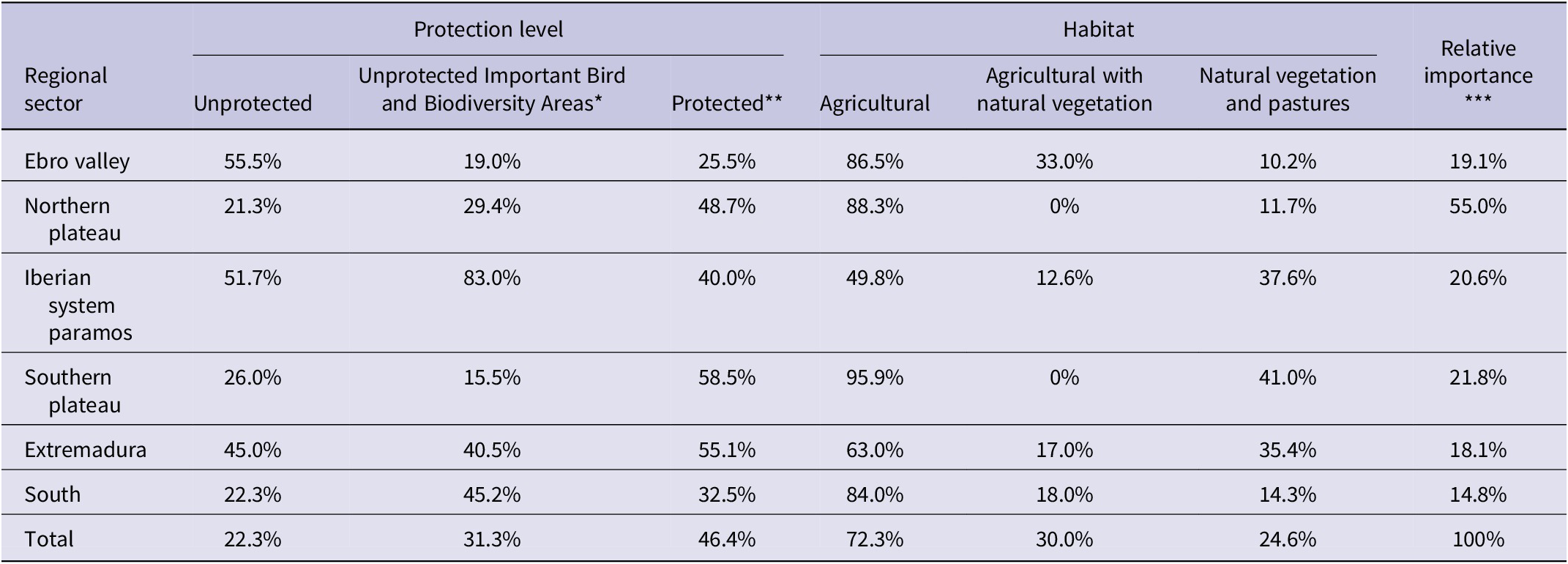
* IBAs that do not have protection status; ** see Methods for details; ***2019 population size as percentage of the total Black-bellied Sandgrouse population of continental Spain.
We also found that 46.4% of BBS were detected in protected areas, and 98% of these were within areas of the Natura 2000 network. There were notable differences between regional sectors (Table 3): the least protected were the Ebro valley (25.5%), Northern plateau (35%), and South (32.5%), where most BBS occurred outside protected areas. Overall, 53.6% of BBS were in unprotected areas, although 31.3% were in unprotected areas identified as IBAs. The proportion of birds using unprotected IBAs was higher in Extremadura and the South (Andalusia), with 40.5% and 45.2%, respectively (Table 3). BBS using pastures and natural vegetation were more frequently found within protected areas (72.3%) than those using agricultural areas (40.8%) or agricultural areas with natural vegetation (39.7%).
Summary of Black-bellied Sandgrouse population estimates and trends in peninsular Spain, 2005–2019. KIA = Kilometric Index of Abundance

* Population sizes in 2005 were combined for these three regional sectors (Suárez et al. Reference Suárez, Hervás, Herranz and Del Moral2006) and therefore the 2019 data are presented comparably.
Discussion
Historical and recent population declines
Previous surveys evidenced BBS population declines and range contractions in peninsular Spain (Suárez et al. Reference Suárez, Hervás, Herranz and Del Moral2006), and the latest survey confirmed this trend, with important losses in terms of distribution range and population size between 2005 and 2019. The first breeding bird atlas (Martí and del Moral Reference Martí and del Moral2003) estimated an historical BBS distribution area of c.1,000 UTM grid squares, a range that was reduced to 816 UTMs in 2005 (Mougeot Reference Mougeot, Molina, Nebreda, del Moral, Muñoz, Real and Seoane2022; Suárez et al. Reference Suárez, Hervás, Herranz and Del Moral2006). In 2019, BBS presence was detected in only 285 UTMs (43% of the surveyed UTMs), and occupancy data, which account for imperfect detection, indicate a currently occupied range of 382 UTMs (Table 1). Survey coverage was greater in 2019 than in 2005, both in terms of surveyed UTMs and kilometres of transects (Mougeot et al. Reference Mougeot, Fernández-Tizón, Tarjuelo, Benítez-López and Jiménez2021b; Suárez et al. Reference Suárez, Hervás, Herranz and Del Moral2006), and accounting for imperfect detection makes the 2019 results more robust. Occupancy averaged 0.58, meaning that in 2019 the species occupied about half of its previous (2003–2005) breeding range, and possibly only one third of its historical range (Martí and del Moral Reference Martí and del Moral2003). These data evidence a long-term shrinking trend of the BBS range in continental Spain. Recent distribution losses have been heterogeneous and more pronounced in the Southern and Northern plateaus and the Ebro valley (occupancies of 0.46–0.55) than in other regional sectors (Table 1, Figure 2).
Range losses were associated with important population declines, as revealed by the KIA comparison between surveys indicating an overall 63% decline (Table 3). The situation of BBS is very alarming in the Northern plateau, Ebro valley, and the Iberian system paramos, three regional sectors in the north of Spain that together hold 45.2% of the 2019 continental population. The 2019 survey estimated a total of 2,138 birds and KIA comparisons revealed significant abundance reductions of 64–81% in these regional sectors (Table 3, Figure 3). The BBS situation is also worrying in the Southern plateau, which held 21.8% of the 2019 continental population. In this regional sector, 1,030 birds were estimated in 2019, and the KIA comparison indicated a significant negative trend, with a 70% reduction in the abundance index (Figure 3). In Extremadura, the 2019 population size was estimated at 855 birds, where KIA comparison indicated a moderate non-significant decline (-6%). In the South region, we observed a similar situation. The 2019 population was estimated at 700 birds, with no apparent decline. Until further evaluations, these two regional sectors should be considered as stable or in moderate decline.
The marked population declines reported in the centre and northern half of the Iberian Peninsula are a main cause for concern. The BBS population is increasingly fragmented, especially in the Northern and Southern plateaus, and in the South (Andalusia). This may have important consequences such as a loss of connectivity and impaired gene flow between isolated regional sectors. Little is known about BBS movements, but preliminary data from GPS-tagged birds revealed seasonal movements by adults of up to 60 km, most frequently less than 30 km (Mougeot, unpublished data). Juvenile dispersal distances could be larger but are currently unknown. Given the rapid range contractions and current levels of population fragmentation, a detailed study of the genetic structure of the BBS of the Iberian Peninsula is needed. It would shed light on the level of genetic isolation and gene flow between regional sectors or isolated occupied areas within these, and provide information on habitat and landscape features that prevent dispersal and connectivity. Future work should also determine the drivers of population declines and their relative importance at national and regional levels.
Conservation status and threats
The current conservation status of BBS in Spain is “Vulnerable” (Suárez et al. Reference Suárez, Hervás, Herranz and Del Moral2006; Mougeot Reference Mougeot, Fernández-Tizón, Jiménez and López- Jiménez2021a). However, a clear distinction should be made between the Canary Islands population and that of continental (peninsular) Spain. Both belong to Spain but should be considered as separate conservation units (>1,000 km apart), one associated with Portugal (Iberian Peninsula) and the other probably more closely linked to populations in North Africa (the Canary Islands). Genetic differentiation between BBS from the Iberian Peninsula, Canary Islands, and northern Africa should be confirmed in future studies. Given the recent negative trend (63% KIA decline between 2005 and 2019) and the current scenario of continuous decline (the peninsular population was already declining before 2005; Suárez et al. Reference Suárez, Hervás, Herranz and Del Moral2006), the conservation status of BBS should be upgraded to “Endangered” in continental Spain (Mougeot Reference Mougeot, Molina, Nebreda, del Moral, Muñoz, Real and Seoane2022). Our results indicated an annual decline rate of 4.5% over 14 years (based on KIA comparisons). Over a maximum period of 20 years (three generations), the BBS population decline rate exceeds the 50% threshold established for the “Endangered” category (Mougeot Reference Mougeot, Molina, Nebreda, del Moral, Muñoz, Real and Seoane2022).
In terms of habitat use and protection level in continental Spain, it is noteworthy that the 2019 BBS population primarily uses agricultural land (75.3% of counted individuals) and is probably insufficiently protected (46.4% of birds counted in protected areas) (Table 3). Occupancy was higher inside protected areas, but only 37% of transects were inside protected areas, so more than half of the Spanish population currently lives outside protected areas. This means that the BBS fate is intimately linked to agricultural changes and practices, and to the environmental policies for protecting its key habitats. The management of farmland habitats, including pastures, are regulated by the EU Common Agricultural Policy and associated conservation instruments. Within the EU, Spain holds 95% of the BBS population, and the future of this EU population stronghold will strongly depend on the EU Common Agricultural Policy and its commitment to reverse farmland bird declines (Morales et al. Reference Morales, Díaz, Giralt, Sardà-Palomera, Traba and Mougeot2022; Tarjuelo et al. Reference Tarjuelo, Margalida and Mougeot2020b). Indeed, the main threats for this species are linked to the loss or transformation of suitable habitats and the intensification of agriculture: natural habitat or fallow loss, abandonment of rain-fed cereal cultivation or extensive sheep grazing, increase in irrigated crop areas, disappearance of crop rotations, changes from herbaceous to woody crops, or reforestation of agricultural land (Benítez-López and Palacín Reference Benítez-López, Palacín, Keller, Herrando, Voříšek, Franch, Kipson and Milanesi2020; Benítez-López et al. Reference Benítez-López, Viñuela, Mougeot and García2017; Martín et al. Reference Martín, Martín, Palacín, Sastre, Ponce and Bravo2014; Tarjuelo et al. Reference Tarjuelo, Benítez-López, Casas, Martín, García and Viñuela2020a). Some agricultural practices, such as ploughing of fallow land during breeding, can lead to the destruction of nests, and the widespread use of pesticides in modern agriculture is also a significant threat (Rigal et al. Reference Rigal, Dakos, Alonso, Aunins, Benko and Brotons2023). Herbicide application in cropped fields and fallows reduces the amount of favourable habitat and food for steppe birds (Sanz-Pérez et al. Reference Sanz Pérez, Tarjuelo, Giralt, Sardà-Palomera, Mougeot and Santiesteban2022; Tarjuelo et al. Reference Tarjuelo, Margalida and Mougeot2020b), and herbicide spraying on clutches can reduce hatching success (Ortiz-Santaliestra et al. Reference Ortiz Santaliestra, Alcaide, Mateo and Mougeot2020). BBS is mainly granivorous and its diet includes more weeds in spring than in autumn–winter, when the consumption of crop plants increases (Cabodevilla et al. Reference Cabodevilla, Mougeot, Bota, Mañosa, Cuscó and Martínez-García2021, Cabodevilla et al. in prep.). The consumption of pesticide-coated seeds (treated with fungicides or insecticides) during the cereal sowing season (autumn–winter) could negatively affect survival and reproduction, as revealed for sympatric farmland birds (Fernández-Vizcaino et al. Reference Fernández Vizcaíno, Ortiz Santaliestra, Fernandez-Tizon, Mateo and Mougeot2022; Lopez-Antia et al. Reference Lopez-Antia, Ortiz Santaliestra, Mougeot, Camarero and Mateo2021).
Beyond agricultural drivers of decline, BBS also faces other anthropogenic threats. Urbanisation and large infrastructure projects, such as renewable energy production plants (photovoltaic plants and wind farms), which are often built on unproductive farmland suitable for sandgrouse, can strongly reduce the quantity and quality of favourable habitat for the species (Santangelli et al. Reference Santangeli, Cardillo, Pes and Aresu2023; Serrano et al. Reference Serrano, Margalida, Perez-Garcia, Juste, Traba and Valera2021). Associated infrastructures (e.g. maintenance tracks, electrical substations, powerlines, etc.) can also contribute to increasing disturbance, which is known to affect sandgrouse (Benítez-López et al. Reference Benítez-López, Viñuela, Mougeot and García2017; Casas et al. Reference Casas, Benitez-Lopez, Tarjuelo, Barja, Viñuela and Garcia2016; Mougeot et al. Reference Mougeot, Benítez-López, Casas, Garcia and Viñuela2014), and to increasing mortality through collisions with powerlines (Marques et al. unpublished). Illegal hunting (poaching) has been documented in sandgrouse (Benítez-López et al. Reference Benítez-López, Casas, Mougeot, García, Martín, Tatin, Wolff and Viñuela2015), although its importance as a mortality factor remains unknown in Spain. Natural predation is also a main cause of adult mortality and breeding failure (Mougeot Reference Mougeot, Molina, Nebreda, del Moral, Muñoz, Real and Seoane2022).
The above-mentioned threats are likely to persist or increase in the future (e.g. agricultural intensification, renewable energy developments), and enhancing the protection of key habitats and areas should be a priority. BBS occupancy was higher inside rather than outside protected areas, suggesting that protection has a key role to play. However, it is difficult to know if declines were more pronounced outside than inside protected areas, or if the remaining suitable areas for BBS and other steppe birds are being increasingly protected. Regarding protection levels, it is noteworthy that more than half of the continental population of Spain still lacks protection. BBS frequently occur in IBAs that, despite their recognised importance for this and other species, are located outside protected areas. The vast majority of BBS occurring in protected areas were in the Natura 2000 network (98%), the most ambitious target for the protection of habitats and species in Europe (https://www.eea.europa.eu/). High value farmland within the Natura 2000 network might be less prone to landscape homogenisation or land-use transformations (Anderson and Mammides Reference Anderson and Mammides2020). However, protection often fails to prevent unfavourable land developments (Rodríguez-Rodríguez and Martínez-Vega Reference Rodríguez-Rodríguez and Martínez-Vega2018) or improve the population status of declining steppe birds (Palacín and Alonso Reference Palacín and Alonso2018). A lack of designation of crucial areas for the conservation of BBS and a lack of specific measures for its protection, such as the approval and implementation of recovery or conservation plans, can jeopardise the future viability of its population in the Iberian Peninsula.
In conclusion, the recent population declines of BBS in peninsular Spain are of extreme concern and a higher conservation status is required to mobilise resources and implement conservation initiatives aimed at halting or reversing these declines. Key initiatives that should be swiftly implemented include the preservation of semi-natural habitats, the maintenance of extensive agricultural practices and sheep grazing, and increasing the level of protection of key habitats and areas for BBS. Such measures would not only benefit BBS, but also a wider range of sympatric steppe and farmland birds that are declining because of agricultural intensification.
Acknowledgements
We are very grateful to SEO/BirdLife for promoting and coordinating the survey, and special thanks are due to Juan Carlos Del Moral and Blas Molina for leading and managing the bird monitoring programmes in Spain and the 2019 sandgrouse survey. We are also extremely grateful to all the people that made this survey possible: fieldworkers, regional coordinators and regional governments that provided personnel or funding. We thank J. Varela and J. A. Sencianes for the drawings in Figures 1 and 3, respectively. The paper contributes to the projects ELECTROSTEPPE (TED2021-130352B-I00; funded by MCIN/AEI/10.13039/501100011033 and the EU “NextGenerationEU”/PRTR) and 022-GRIN-34462 awarded by the University of Castilla-La Mancha & Fondo Europeo de Desarrollo Regional (FEDER). R.T. was supported by CLU-2019-01 – iuFOR Institute Unit of Excellence’ of the University of Valladolid, funded by the Junta de Castilla y León and the EU (ERDF “Europe drives our growth”). A.B.-L. was supported by a Ramón y Cajal grant (RYC2021-031737-I) funded by MCIN/AEI/10.13039/501100011033 and the EU (“NextGenerationEU”/PRTR).
Supplementary material
The supplementary material for this article can be found at https://doi.org/10.1017/S0959270924000066.


 Open access

