





INTRODUCTION
The spread of agriculture, stockbreeding, and sedentary life in Europe is one of the most widely discussed topics in world archaeology. However, the spatial frames for numerous analyses—including material culture, paleobotanical and paleozoological assemblages, and ancient DNA—are mostly limited to the Balkans and Central/Western Europe (e.g., Fort Reference Fort2015; Gaastra et al. Reference Gaastra, Greenfield and Vander Linden2018; Kolář et al. Reference Kolář, Kuneš, Szabó, Hajnalová, Svitavská Svobodová, Macek and Tkáč2018; Kristiansen Reference Kristiansen2022; Mathieson et al. Reference Mathieson2018; Pinhasi et al. Reference Pinhasi, Joaquim and Ammerman2005; Shennan Reference Shennan2018; Whittle Reference Whittle2018). Research has only recently begun to reassess the northeasterly spread of the Neolithic “package” and the chronology of sub-Neolithic groups at the northeastern periphery of “Old Europe” (Gaskevych Reference Gaskevych2011; Motuzaite-Matuzeviciute 2014; Motuzaite-Matuzeviciute et al. Reference Motuzaite-Matuzeviciute, Lillie and Telizhenko2015; Endo et al. Reference Endo, Nasu, Haskevych, Gershkovych, Videiko and Yanevich2021). This paper refines the space-time framework for the agrarian colonization of the forest-steppe region of Central Ukraine, which includes much of the territory between the Dniester and Dnieper rivers (Figure 1). We accomplish this through a multi-faceted approach that combines conventional forms of settlement archaeology and ceramic chronology, spatial analysis, and targeted accelerator mass spectrometry (AMS) 14C dating of significant sites belonging to the Eneolithic Eastern Tripolye culture (ETC). Additionally, data from our analyses allow us to test two concepts of colonization, the wave of advance and leapfrog colonization models. The widely known wave of advance model suggested by Albert Ammerman and Luigi Cavalli-Sforza (Reference Ammerman, Cavalli-Sforza, Renfrew and Cooke1979, Reference Ammerman and Cavalli-Sforza1984) assumes that demographic pressure induces demic diffusion, resulting in the colonization of new territories at a nearly constant rate. Meanwhile, the leapfrog colonization model proposes that migrations tend to have a more “planned” character, taking the form of direct long-distance migration to preferred areas and targeted niche construction (Zilhão Reference Zilhão2001, Reference Zilhão, Ammerman and Biagi2003; Zvelebil Reference Zvelebil2001; Zvelebil and Rowley-Conwy Reference Zvelebil, Rowley-Conwy and Zvelebil1986). Our case study presents the Neolithization of a peripheral “no-man’s land,” or more accurately a territory populated by sub-Neolithic groups of low population size and density, directly adjoining the agricultural frontier of Southeastern and Central Europe.
Map of the study area and its location within Europe, including sites sampled for 14C dating and other important locations mentioned in this paper.
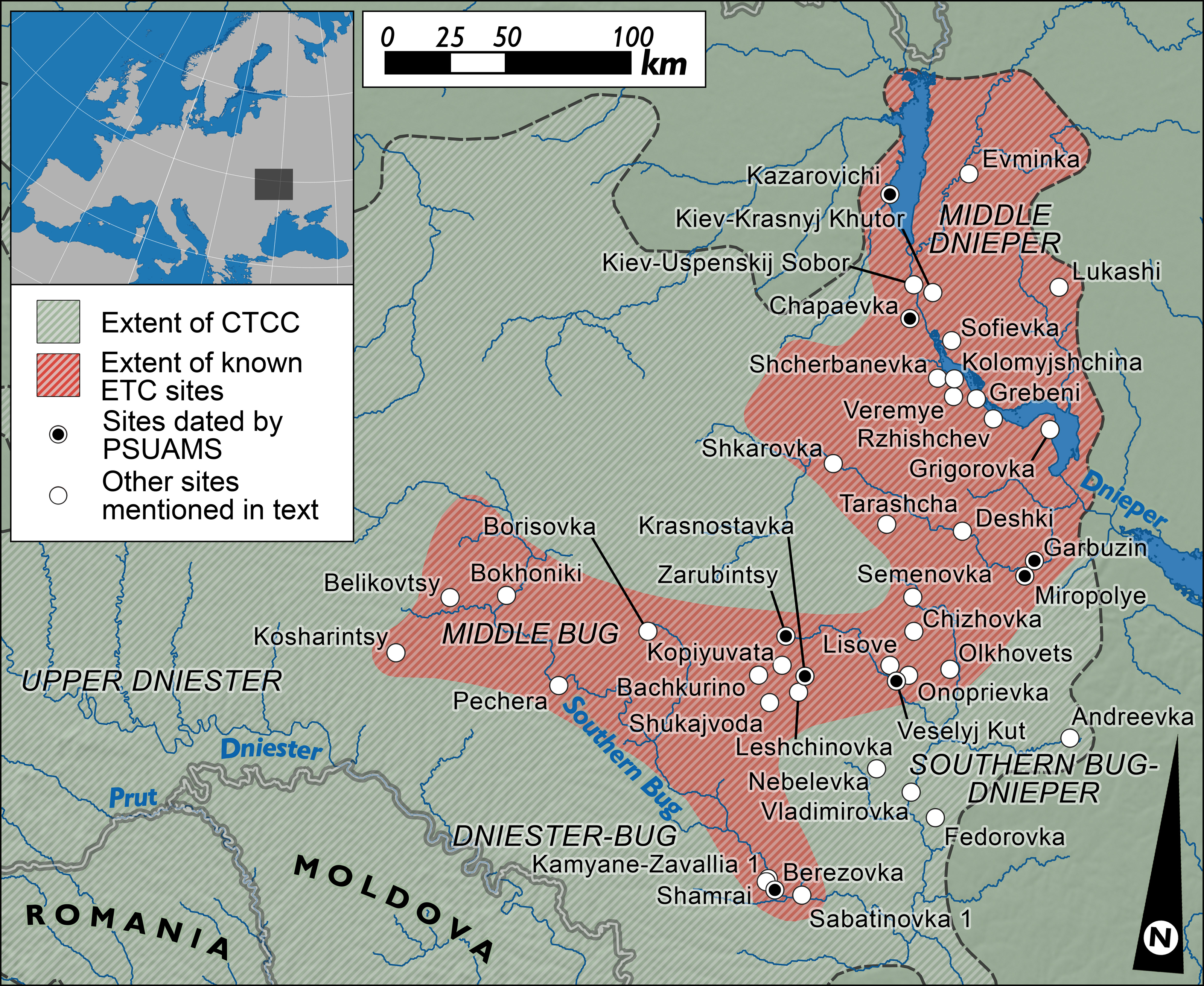
Until recently, the spread of farming in the forest-steppe zone of the Dniester region and the territory of Ukraine west of the Dnieper was mainly associated with two Middle Neolithic cultures in the second half of the 6th millennium BC: the Linear Pottery (e.g., Passek and Chernysh Reference Passek and Chernysh1963; Saile et al. Reference Saile, Dębiec, Posselt, Ţerna and Kiosak2016) and Bug-Dniester cultures (e.g., Danilenko Reference Danilenko1969; Markevich Reference Markevich1974). However, current paleobotanical studies have shown no evidence that agriculture was a component of the Bug-Dniester economy (Endo et al. Reference Endo, Nasu, Haskevych, Gershkovych, Videiko and Yanevich2021). Linear Pottery sites are concentrated in the Upper and Middle Dniester area, with only a few isolated settlements to be found several hundred kilometers east, almost reaching the Dnieper (Gaskevych Reference Gaskevych2006). Conversely, a comparatively densely populated system of sedentary agriculture is evident among the settlements of the younger Cucuteni-Tripolye cultural complex (CTCC), which originated in the Muntenia region of Romania at the beginning of the 5th millennium BC (Mantu Reference Mantu1998). It should be noted that this cultural complex belongs to the Eneolithic (or Chalcolithic; “Copper Age”) and our discussion of Neolithization refers specifically to the spread of agriculture and stockbreeding, recognizing the multilinear nature of cultural change and its differential rates in various regions. While the “core” area of the CTCC lies between the Carpathians and the Dniester, the early Tripolye culture (period Tripolye A) exhibits patterns similar to those seen in the earlier Linear Pottery colonization. Several settlements of this period can be observed hundreds of kilometers east of the main area of occupation (e.g., Videiko Reference Videiko2013). These peripheral sites exhibit some developmental delay in comparison to the main Cucuteni culture area and may be dated to the period of approximately 4600–4500 BC.
Despite these few ephemeral precursors, widespread agrarian colonization of the territory between the Dniester and Dnieper rivers should be associated with ETC sites of the middle period of the CTCC’s development (Tripolye BI/Cucuteni A3), which manifest archaeologically as a persistent system of interrelated material and settlements. In seeking to date and analyze these settlements, our sampling strategy was guided by a highly complex relative chronology of ceramic types that has been in continuous development since the first half of the 20th century. It is therefore appropriate to present a brief overview of the ETC and its place in the structure of the overall CTCC.
THE EASTERN TRIPOLYE CULTURE
Categorization
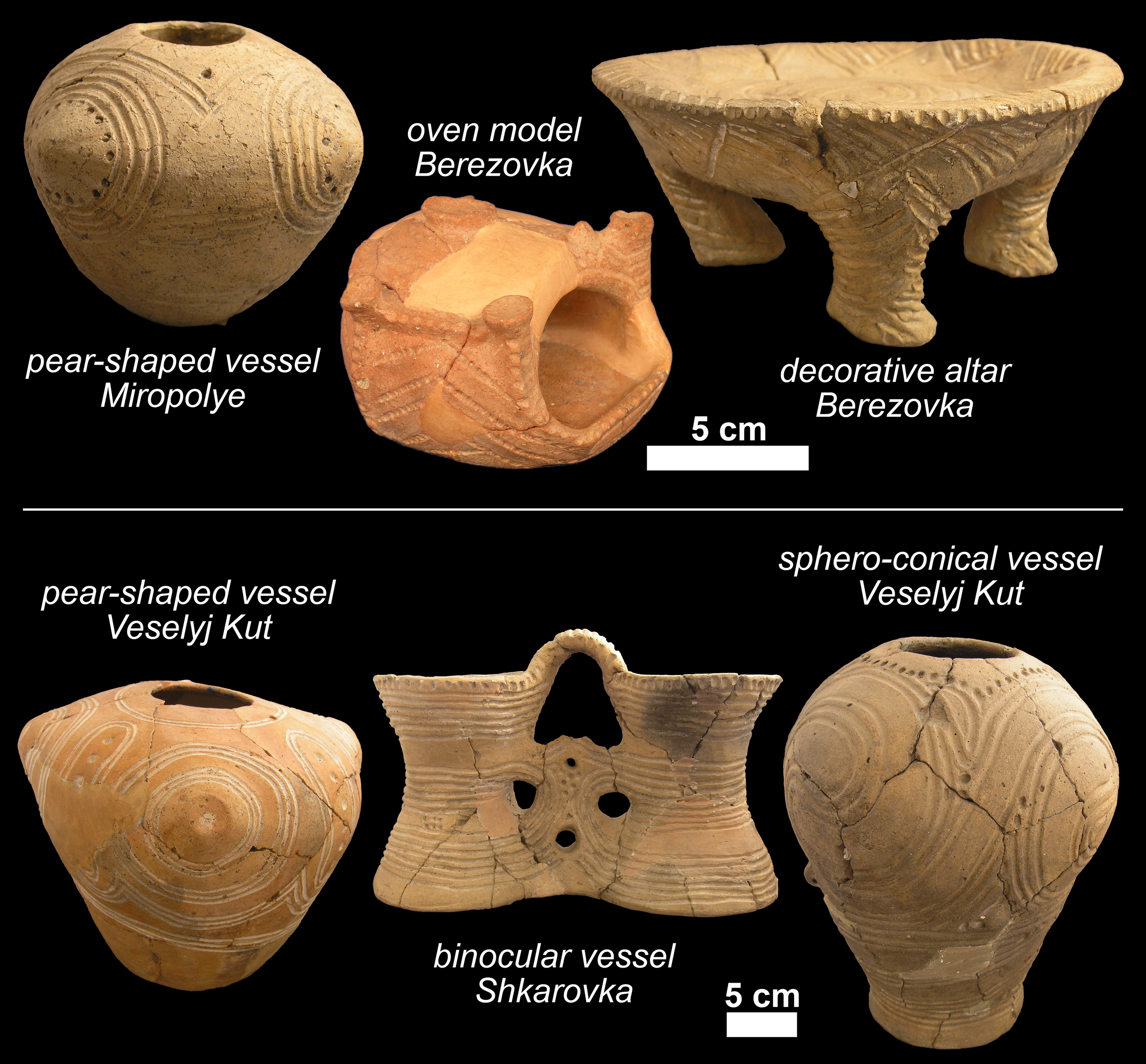
The widespread term “Cucuteni-Tripolye cultural complex” is used as a short form to denote a continuum of closely related Eneolithic groups, mostly in modern Romania, Moldova and Ukraine. In current usage, this includes the Precucuteni, Ariușd, Cucuteni, Eastern Tripolye, and Western Tripolye cultures (Tsvek Reference Tsvek2006; Ryzhov Reference Ryzhov2007, Reference Ryzhov2021). We should note that, as is the norm in archaeological practice, the term “culture” in this case means only the level of similarity between the material assemblages and has no ethnic, social or economic connotation (Furholt Reference Furholt2011). The transformation of the Precucuteni into the Cucuteni culture marks a change in pottery styles, from mostly incised pottery (with a low quantity exhibiting post-firing painted ornamentation) to elaborate painted pottery with pigments applied before firing (Dumitrescu Reference Dumitrescu1963). The impact of these transformations on the peripheral Early Tripolye ceramic assemblages was twofold. Firstly, as populations inhabiting the Middle Dniester region (the Tripolye “core” area) started to implement new stylistic traditions, the groups living in the area of the Southern Bug river continued developing the earlier styles of incised ornamentation (Figure 2). The coexistence of those two traditions for several centuries is confirmed by mutual imports and several previously obtained 14C dates. The formation of the ETC can be discerned by numerous differences in pottery morphology and decoration, distinguishing this cultural unit from both the earlier Precucuteni materials and synchronous WTC assemblages (Tsvek Reference Tsvek2006). These ceramics mostly exhibit incised and fluted ornamentation in linear and spiral patterns, in contrast with the polychrome painted pottery found among other CTCC groups.
Examples of ETC ceramics dating to Tripolye BI from the Southern Bug-Dnieper region of Ukraine (collections of the Institute of Archaeology of the National Academy of Sciences, Kiev, Ukraine; photos by Y.Y. Rassamakin).
Chronology
Table 1 presents the relative chronology of the ETC sites, which is based on three taxonomic levels: (1) individual sites; (2) site “types” based upon certain diagnostic assemblages; and (3) broader settlement groups (“local groups” or “variants”) that contain one or more site types exhibiting evolutionary continuity with one another. This chronology is a combination of schemes proposed by Elena Tsvek, Vladimir Kruts, Sergei Ryzhov and Sergej Gusev (Kruts Reference Kruts1977; Gusev Reference Gusev1993; Ryzhov Reference Ryzhov2002, Reference Ryzhov2007, Reference Ryzhov2015, Reference Ryzhov2021; Tsvek Reference Tsvek2006). Tsvek (Reference Tsvek1980, Reference Tsvek1989, Reference Tsvek2006) arranges the development of ETC settlements, which belong to periods BI, BI-II and BII in the general Tripolye periodization scheme (Passek Reference Passek1949; Vinogradova Reference Vinogradova1983), into four stages, each of them subdivided into regional variations and site types. Here we expand Tsvek’s chronology by adding the Belikovtsy-type settlements of the Middle Bug region (Gusev Reference Gusev1993) as well as the series of late ETC local groups in the Middle Dnieper region belonging to periods BIII, CI and CII (Kruts Reference Kruts1977; Ryzhov Reference Ryzhov2002). Our general periodization and terminology follow Ryzhov (Reference Ryzhov2021).
Relative chronology of ETC local groups and type sites.

The origin and early development of the ETC is associated with the settlements of the Middle Bug, Southern Bug, and Bug-Dnieper regional variations. These variations are further broken into the Borisovka-type sites of the Middle Bug region, the Sabatinovka-type sites of the Southern Bug, and a set of three sequential site types in the Bug-Dnieper region (Zarubintsy, Krasnostavka and Onoprievka). Ceramic assemblages belonging to this first stage of ETC settlements demonstrate a significant decrease in earlier (Precucuteni/Tripolye A) traditions and the formation of new unique pottery forms and ornamentation, mostly represented by incisions and fluted decorations. Borisovka, Zarubintsy, and the lower layer of Berezovka are among the earliest settlements of this stage. Similarities in pottery allowed Tsvek to synchronize the later Krasnostavka-type sites, generally dated to Tripolye BI, with settlements in Romania belonging to Cucuteni A3 and the beginning of Cucuteni A4 (Tsvek Reference Tsvek2006). The latest settlements of the first stage are represented by the Onoprievka-type sites.
Further development of the ETC traditions is also linked to the Middle Bug, Southern Bug and Bug-Dnieper regional variations. In the Bug-Dnieper interfluve the sequence of the second stage of settlements is represented by Shkarovka and Veselyj Kut-type sites, both attributed to Tripolye BI-II (a transitional period within the Tripolye periodization that was suggested by Vinogradova Reference Vinogradova1983). Similarities in pottery assemblages suggested that the Shkarovka-type settlements were synchronous with Cucuteni A4 sites in Romania (Tsvek Reference Tsvek2006). Certain stylistic elements of Shkarovka-type vessels have analogies in earlier sites, which was previously understood as a continuous trend in the development of ornamentation schemes. Later, Veselyj Kut-type pottery demonstrates the domination of incisions and fluted decorations, and the introduction of a new form of decoration combining both incised and fluted forms. It is important to note that pottery assemblages of this type also demonstrate a significant increase in painted pottery (previously associated with WTC influences), as well as ceramic imports from the Malice culture of southeastern Poland and Western Ukraine and Late Tisza traditions from present-day Hungary. During the second stage of the ETC its populations reached the Middle Dnieper region, leaving behind sites of the Shcherbanevka type. According to the relative chronology, these are contemporaneous to Veselyj Kut-type settlements.
The third stage of the ETC’s development is associated with Tripolye BII in Passek’s periodization. During this period, the territory of the ETC significantly decreased and differences in ceramic assemblages are represented by two regional variations: Bug-Dnieper and Dnieper. In the Bug-Dnieper region, settlements of the Miropolye type continued the development of stylistic traditions seen at Veselyj Kut. Sites of the Miropolye type were then replaced by Garbuzin-type settlements. Meanwhile, in the Middle Dnieper region, settlements of the Veremye type continued the development of Shcherbanevka-type traditions, with significant influences from Miropolye-type ceramics. The incidence of painted ceramics notably increases around this time. While, in Miropolye-type assemblages, painted pottery accounted for 10 percent of the total, at Garbuzin the portion of painted pottery reaches 60 percent. At the same time, the percentage of vessels with incised ornamentation typical of the ETC decreases from over 40 percent to 11–12 percent (Tsvek Reference Tsvek2006).
The fourth stage of the ETC shows further decrease in the size of settled territory, becoming limited to the Middle Dnieper region (roughly equivalent to Kievskaya oblast in modern Ukraine). Veremye-type sites were replaced by settlements of the Kolomyjshchinskaya local group. According to Ryzhov (Reference Ryzhov2002, Reference Ryzhov2021), its structure included four site types: Kolomyjshchina 2 (Tripolye BII), Rzhishchev (Tripolye BII–BIII), Kolomyjshchina 1 (Tripolye BIII) and Chapaevka (Tripolye BIII). Rzhishchev, Kolomyjshchina 1 and Chapaevka-type sites are located in three neighboring micro-regions. Kolomyjshchina 1-type settlements replace Kolomyjshchina 2-type settlements in the same micro-region, while Chapaevka-type settlements are viewed as the latest manifestation of the Kolomyjshchinskaya local group. It should be noted that Chapaevka-type settlements and cemeteries are numerous on both sides of the Dnieper and that Kruts (Reference Kruts1977) viewed these sites as a separate (Chapaevskaya) local group.
The decline of the ETC is associated with the Lukashevskaya (Tripolye CI; Ryzhov Reference Ryzhov2007) and Sofievskaya (Tripolye CII) local groups (Kruts Reference Kruts1977). As with other Late Tripolye sub-groups, the material assemblage (including ceramics) associated with Sofievskaya sites is heavily influenced by the traditions of neighboring cultural units, such as the forest sub-Neolithic and Pivikha cultures (Kruts Reference Kruts1977).
Excavations and Contexts
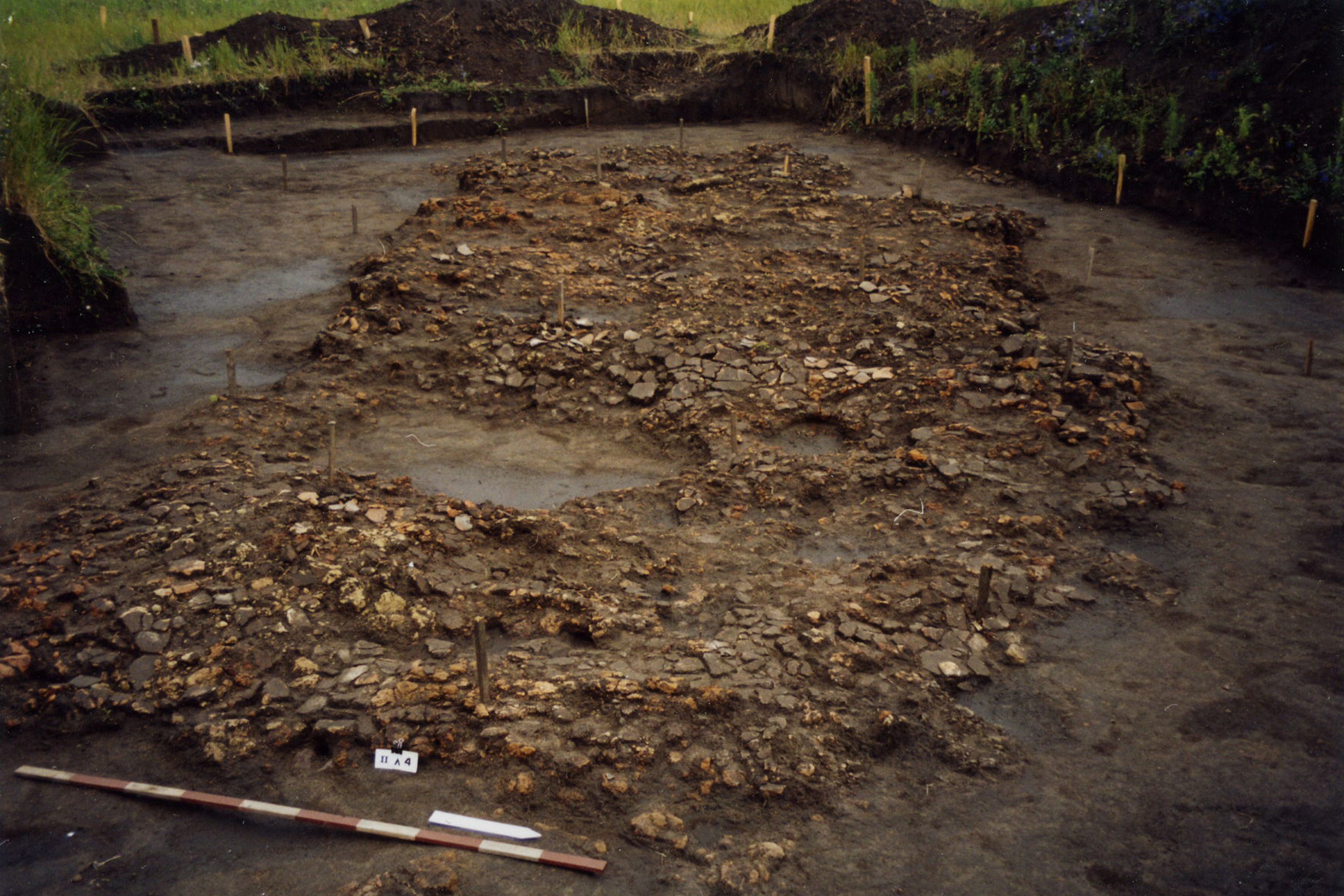
The use of relative changes in ceramic types as the prevailing means of understanding the development and distribution of sub-groups of the CTCC is dictated by the fact that the majority of known sites are single-layer settlements with a limited period of habitation. The inhabitants of these communities used both semi-subterranean houses (known in the archaeological literature as zemlianki) and above-ground structures made from wattle and daub (ploshchadki). The latter take the form of a rectangular mass of burned and vitrified daub, created by the intentional destruction of houses by fire (Figure 3). Ploshchadki constitute a “time capsule” of comparatively well-preserved materials and their painstaking excavation and disassembly provides a wealth of information on domestic architecture, material culture, and occasionally even carbonized paleobotanical materials. The lack of stratigraphy at most CTCC sites means that 14C sampling is usually restricted to materials lying within or beneath coherent features such as pits and house remains.
A typical excavation of an ETC settlement: Ploshchadka 4 at Rzhishchev-Ripnitsa 1, 2004 (photo by V.A. Shumova).
Extant Radiocarbon Data
Our project is the first to produce a series of AMS 14C dates focusing on the developmental dynamics of the ETC. Our analysis is bolstered by a small number of recent dates from disparate sites (Kiosak Reference Kiosak, Kotova, Tinner, Szidat, Nielsen, Brugger, de Capitani, Gobet and Makhortykh2021; Shatilo Reference Shatilo2021), as well as by a selection of older conventional 14C dates. From the early 1970s to the 2000s, 59 dates were produced relating to the ETC (see Supplementary Data, Table S1). Of these, 54 were produced by the Kiev Radiocarbon Laboratory (lab code Ki), while three were produced in Berlin (East Germany; lab code Bln) and two by the University of California, Los Angeles (UCLA). As with most dates of this period, these were produced using gas proportional and liquid scintillation counting (GPC and LSC) methods, with uncertainty values ranging from ∼40 to 170 14C years.
These dates were not controversial during the 1970s and 80s, prior to the establishment of a coherent absolute chronology of the Neo-Eneolithic period. However, in time many have proven to compare very poorly with results from subsequent studies on roughly synchronous materials in neighboring regions, often diverging by hundreds or even thousands of years. This divergence can likely be explained by taphonomic conditions at certain sites and a lack of quality control and anti-contamination measures in laboratories during the Soviet and immediate post-Soviet eras (Harper Reference Harper2021). For the purposes of our analysis, older conventional dates are generally disregarded unless no other data are available for a given context of interest or they are corroborated by modern results. While dates on bone represent a plurality of the older 14C sample, we exclusively make use of bone samples for the sake of internal consistency and to preclude interpretive problems associated with the “old wood” problem inherent to charcoal dating.
METHODS
AMS Radiocarbon Dating and Analysis
Here we report 18 new AMS 14C dates on faunal bones analyzed at the Penn State Accelerator Mass Spectrometry Laboratory (PSUAMS). Samples were collected from the archives of the Institute of Archaeology of the National Academy of Sciences of Ukraine in Kiev. They originate from sealed contexts at eight well-studied ETC type sites, excavated between 1955 and 1992 in campaigns led by Elena Tsvek, Dimitri Telegin, Vladimir Kruts, Valentin Danilenko and Vladimir Tsybeskov.
Bone collagen for 14C and stable isotope analyses was extracted and purified at the Pennsylvania State University using a modified Longin method with ultrafiltration (Kennett et al. Reference Kennett, Plog, George, Culleton, Watson, Skoglund, Rohland, Mallick, Stewardson, Kistler, LeBlanc, Whiteley, Reich and Perry2017). Bones were manually cleaned of adhering sediment and the exposed surfaces removed with an X-acto blade. While the employed protocols can work on well-preserved materials of ∼100 mg or less, our samples generally displayed poor-to-moderate preservation after being subject to 6000 years of taphonomic processes including exposure to acidic soils. Therefore, larger samples (600–1000 mg) were used to ensure ample collagen yields. Samples were first demineralized for 24–36 hours in 0.5N HCl at 5°C. The pseudomorph was then rinsed to neutrality in multiple changes of Nanopure H2O, before being gelatinized for 10 hours at 60°C in 0.01N HCl. The resulting gelatin was lyophilized, visually inspected and then weighed to determine percent yield as a first evaluation of the degree of bone collagen preservation, with yields in the 0–3% range generally being rejected. Rehydrated gelatin solution was pipetted into precleaned Centriprep (McClure et al. Reference McClure, García Puchol and Culleton2010) ultrafilters (retaining 30 kDa molecular weight gelatin) and centrifuged 3 times for 20 minutes, diluted with Nanopure H2O, and centrifuged 3 more times for 20 minutes to desalt the solution. Carbon and nitrogen concentrations and stable isotope ratios were measured at the Yale Analytical and Stable Isotope Center with a Costech elemental analyzer (ECS 4010) and Thermo DeltaPlus analyzer. Sample quality was evaluated by examining the % crude gelatin yield, %C, %N and C:N ratios before AMS 14C dating. C:N ratios for the 18 dated samples fell between 3.20 and 3.57, a range indicative of acceptable collagen preservation (Van Klinken Reference Van Klinken1999).
Collagen samples were combusted for three hours at 900°C in vacuum-sealed quartz tubes with CuO and Ag wires. Sample CO2 was reduced to graphite at 550 °C using H2 and a Fe catalyst, with reaction water drawn off with Mg(ClO4)2 (Santos et al. Reference Santos, Southon, Druffel-Rodriguez, Griffin and Mazon2004). Graphite samples were pressed into targets in Al cathodes and loaded on the target wheel for AMS analysis. The 14C ages were corrected for mass-dependent fractionation with measured δ13C values (Stuiver and Polach Reference Stuiver and Polach1977) and compared with samples of Pleistocene whale bone (backgrounds, 48,000 14C BP), late Holocene bison bone (∼1850 14C BP), late AD 1800s cow bone and OX-2 oxalic acid standards for calibration. In those cases where ultrafiltration returned an unacceptably low gelatin yield, samples were processed according to the XAD amino acid purification method (after Lohse et al. Reference Lohse, Madsen, Culleton and Kennett2014).
Spatial Analysis
In order to evaluate whether ETC colonization of the forest-steppe region of Ukraine adheres to a wave of advance or leapfrog colonization-type scenario, we assembled a spatial dataset of settlement sites to be analyzed using QGIS software. After assigning sites to one of six chronological phases, we calculated the mean geographic center (MGC) of settlement for each phase. By measuring the distance between MGCs of subsequent phases, we can then derive the rate and vector of population movement. For the purposes of this analysis we do not weigh the settlements by size or estimated population, because these values are far from complete and we lack a representative sample for reasonable imputation of values for each relevant chronological phase.
Research into the CTCC has been ongoing for over a century, with a vibrant history of archaeological investigation of sites that are both extant and destroyed by modern activities. Recent efforts to catalog Neo-Eneolithic sites in Ukraine, Moldova and Romania produced the Eastern European Neo-Eneolithic Sites Repository (EENSR), which contains data on over 8000 sites and habitational levels (Harper et al. Reference Harper, Diachenko, Rassamakin and Kennett2019). From EENSR, we extracted 129 entries that represent well-attested ETC sites with known relative chronological assignments (Supplementary Data, Table S5). While the overall population of ETC sites can be assumed to be far larger (especially in the Middle Dnieper region), we took a conservative approach to ascribing sites to the ETC. This precludes misidentification of sites, especially in the Southern Bug-Dnieper region, where there is substantial spatial and chronological overlap with WTC sites.
RESULTS
Resolving the absolute sequence of ETC sites
The reported uncertainty of our dates ranged from 20–30 14C years, with the majority falling at ±25. All calibrated 14C ages were calculated in OxCal version 4.4 (Bronk Ramsey Reference Bronk Ramsey2021) using the IntCal20 calibration curve (Reimer et al. Reference Reimer, Austin, Bard, Bayliss, Blackwell, Ramsey, Butzin, Cheng, Edwards, Friedrich, Grootes, Guilderson, Hajdas, Heaton, Hogg, Hughen, Kromer, Manning, Muscheler, Palmer, Pearson, van der Plicht, Reimer, Richards, Scott, Southon, Turney, Wacker, Adolphi, Büntgen, Capano, Fahrni, Fogtmann-Schulz, Friedrich, Köhler, Kudsk, Miyake, Olsen, Reinig, Sakamoto, Sookdeo and Talamo2020). The sampled bones were not subjected to specialist zooarchaeological analysis, but the majority appeared to be from ungulate species (such as sheep, cattle, and deer). Carbon isotope measurements are consistent with herbivores grazing in a mixed environment of forest and grassland, though comparatively enriched δ15N values in some samples may be indicative of predatory species or certain domesticated species (such as pigs or dogs) consuming a more omnivorous diet. Radiocarbon results and associated data are reported in Table 2 (for further detail, see Supplementary Data, Table S2).
PSUAMS radiocarbon dates and stable isotope measurements for eight ETC sites.

* Omitted outliers.
In order to test the validity of the relative chronology 15 of our AMS 14C dates, along with 28 other extant dates (10 AMS and 18 legacy conventional dates), were placed in a Bayesian sequence of 13 phases using OxCal 4.3 (Supplementary Data, Table S3). Three outliers, PSUAMS-4699, -4702, and -4636, returned poor model agreement (A<60) with extant 14C data and were omitted using the manual rejection method outlined by Bronk Ramsey (Reference Bronk Ramsey2009). Our date from Krasnostavka (PSUAMS-4702, 5120 ± 25 BP, 3985–3800 cal BC [2σ]) considerably post-dates this site’s ascription to Tripolye BI and contravenes its relative synchronization with Cucuteni A3/A4. Divergent results from past dating (cf. Ki-882, Ki-1204) suggest that this site requires more detailed research to better assess its chronology and taphonomic conditions. PSUAMS-4699 (5190 ± 20 BP, 4045–3960 cal BC [2σ]), from Garbuzin, showcased poor model agreement with three well-grouped later dates (cf. PSUAMS-4701, -4633, -4700). Finally, one of our dates from Chapaevka (PSUAMS-4636, 5045 ± 20 BP, 3950–3780 cal BC [2σ]) appears to belong to an earlier occupational phase, contrary to another date that corroborated prior results (cf. PSUAMS-4634, Bln-631, Ki-880). These dates are no less “valid” from the point of view of quality control, but they have weakly defined provenience and likely represent intrusive materials or ephemeral, previously undocumented habitational events which we cannot reliably ascribe to a known relative chronological phase at this time.
While there is considerable overlap between the calibrated probability distributions of our dates, it is important to remain cognizant that these ranges do not describe duration, but rather the likelihood that a single, discrete event (i.e., the time at which an organism died and ceased carbon fixation) occurred at a given time. Thus, consideration of the density and ordering of observations is generally much more archaeologically meaningful than that of discrete or summed probability densities. Bayesian sequencing, with its ability to integrate relative chronological assumptions, helps greatly in resolving this ordering. It especially helps in compensating for several calibration curve anomalies, which include a plateau from ca. 4200–4000 cal BC and a prominent reversal at ca. 3900–3800 cal BC. These have been considered by some studies (e.g., Brummack and Diaconescu Reference Brummack and Diaconescu2014), but generally go ignored in regional archaeological discourse.
Boundary assumptions were dictated by the relative sequence of sites; for the span of ca. 4300–3800 cal BC, the relative chronology of sites indicates a fairly straightforward sequence with one site-type replacing another. However, later phases such as the Lukashevskaya and Sofievskaya local groups are poorly dated and constrained. Therefore, these phases were defined as having gaps to either side of them, while the overall sequence was constrained by a terminus ante quem of 4400 ± 20 BP. This is derived from a date from Golyshev in Western Volhynia (PSUAMS-4697; Harper et al. Reference Harper, Diachenko, Rassamakin, Chernovol, Shumova, Nechitailo, Chabaniuk, Tsvek, Bilas, Pohoralskyi, Eccles, Kennett and Ryzhov2021), which represents the latest material complexes of Tripolye CII. Our understanding of major cultural transitions, such as the beginnings of periods Tripolye CI or CII, still must be informed by developments in neighboring regions. However, for the first time we can clearly delineate the sequence of ETC sites during Tripolye BI and BII, while also having a clearer idea of the timing of these phases and their duration (Figure 4). The high agreement index of our model (Amodel : 202.7; Aoverall: 184.5), indicates that there is very little divergence from the observed 14C data and the relative sequence of sites. The CQL2 code necessary for replicating this model can be found in the Supplementary Data (Table S4).
Top: summary results of a Bayesian sequence of dated ETC sites consisting of 43 14C dates in 13 phases, color-coded according to the periodization of the Tripolye culture. Black bars indicate mean model phase boundaries. The end of the sequence is constrained by a terminus ante quem consisting of a Late Tripolye CII date from Golyshev (Harper et al. Reference Harper, Diachenko, Rassamakin, Chernovol, Shumova, Nechitailo, Chabaniuk, Tsvek, Bilas, Pohoralskyi, Eccles, Kennett and Ryzhov2021). Bottom: general relative sequence of ETC local groups and site types, revised according to these results.

The Changing Spatial Distribution of ETC Settlements
Over the course of a period of roughly 1250 years the MGC of ETC sites shifted by approximately 270 km, with an average annual movement rate of between 0.10 and 0.55 km (Table 3; Figure 5). Our current knowledge allows us to divide our broader sample of ETC sites into six cross-regional phases of variable length, from 4300–4100, 4100–3950, 3950–3700, 3700–3500, 3500–3300, and 3300–2950 BC.
Rates of movement in the mean geographic center of sites.

Map of the known sites of the Eastern Tripolye Culture (ETC), grouped by chronological periods. Sites with materials dated by PSUAMS are labeled. Changes in the space-time distribution of sites can be discerned by their shifting mean geographic center (MGC), which follows a predominately north-northeasterly vector over the lifespan of the ETC (see also Table 3).

From 4300–4100 BC (corresponding with Early Tripolye BI in this region), the first ETC sites were established in the Southern Bug river valley. Over the next century, the number of sampled settlements quintuples in number and moves ∼80 km northward, into the Southern Bug-Dnieper interfluve. However, the most rapid shift in ETC settlements occurs during the interval of 3950–3700 BC (roughly corresponding with Tripolye BII), when the annual rate of MGC movement reaches its apex (∼550 m/yr) and the core of settlement nearly reaches the Middle Dnieper region. From this point until the end of the CTCC, annual movement slows considerably, with the last six centuries of ETC settlement constrained to smaller-scale movements within the Middle Dnieper region.
DISCUSSION
Our results reinforce and modify the ETC and CTCC chronology in several key ways. Using only relative chronology and cross-dating, we previously considered ∼4350 BC to be the start of the ETC and Tripolye BI in the forest-steppe (Harper Reference Harper2016). Three recent AMS dates from Berezovka, Kamyane-Zavallia, and Shamrai (Kiosak et al. Reference Kiosak, Kotova, Tinner, Szidat, Nielsen, Brugger, de Capitani, Gobet and Makhortykh2021) are supportive of a date of ∼4300 BC, confirming this aspect of the chronology. On a site-specific level, dates from the early multi-layer site of Berezovka establish a terminus post quem for the ETC as a whole and allow direct comparisons at several temporal intervals. Results from this site support the previous observation of Tsvek (Reference Tsvek2006) that 2–3 distinct habitations are present, which we designate Berezovka I, II and III. Our dates completely revise the absolute chronology for periods Tripolye BI-II and BII among the sites of the ETC and support the notion that, rather than being a discrete chronological period, Tripolye BI-II represents only stylistic variation in pottery within BI, which itself shows some amount of overlap with Tripolye BII.
Our dates from Veselyj Kut, Miropolye and Garbuzin delineate the main sequence of the Bug-Dnieper variant of the ETC, confirming the relative sequence of sites. The phase boundaries reported in our sequenced results agree with the relative chronological consensus that site types succeeded one another in more or less predictable intervals, with a duration of ∼50 years being the average during our best-sampled interval of ∼4300–3800 cal BC. This is incidentally in agreement with the widely held and often-repeated assessment that the usable lifetime of a settlement was somewhere around 50 years (Kruts Reference Kruts1989; Markevich Reference Markevich1981). While serial resettlement from one “generation” to the next was not always universal, it was the prevailing norm within the Neo-Eneolithic economy and was to some degree founded on principles of optimal habitat selection (Harper et al. Reference Harper, Diachenko, Rassamakin and Kennett2019).
Fewer data exist for reassessing the chronology of later ETC periods, for which we have only two AMS 14C dates, plus 15 legacy radiocarbon dates. However, available AMS data provide a framework for assessing the validity of older results; five conventional dates from Grebeni and four from Grigorovka-Khatyshche (Videiko Reference Videiko2003) fill in plausible temporal ranges for much of the Kolomijshchinskaya local group. Meanwhile, our results from Chapaevka corroborate previous findings (Quitta and Kohl Reference Quitta and Kohl1969; Telegin Reference Telegin1985; Kovalyukh et al. Reference Kovalyukh, Videiko and Skripkin1995). The paucity of Chapaevka-type sites and short duration of their existence supports the position that these sites are in fact a sub-group representing the final period of the Kolomyjshchinskaya local group, rather than a distinct local group (cf. Kruts Reference Kruts1977; Ryzhov Reference Ryzhov2002). Overall, the modeled duration of the Kolomijshchinskaya local group (Tripolye BII–BIII) is ∼3850–3550 cal BC.
In terms of the “Late Tripolye” (periods CI and CII), our single date from Kazarovichi is comparable to relative analogs from the WTC (Harper et al. Reference Harper, Diachenko, Rassamakin, Chernovol, Shumova, Nechitailo, Chabaniuk, Tsvek, Bilas, Pohoralskyi, Eccles, Kennett and Ryzhov2021) and provides the only reliable date for the Lukashevskaya local group, previously represented by two outliers from the site Evminka 1 (Mallory Reference Mallory1977). Both the Lukashevskaya and Sofievskaya local groups continues to be poorly constrained and deficient in terms of their absolute dating. The cemeteries of the Sofievskaya local group were conventionally dated by a series from the Kiev Radiocarbon Laboratory (Kovalyukh et al. Reference Kovalyukh, Videiko and Skripkin1995) that returned anomalously young results with 2σ ranges impinging on the Early and Middle Bronze Age. Half of these dates remain plausible if constrained using our cross-dated terminus ante quem, but these are tentative at best. At present we see no compelling reason to consider the continuation of Tripolye CII beyond the general span of 3350/3300–2950 BC (Diachenko and Harper Reference Diachenko and Harper2016), which has been corroborated by research in other regions (Klochko et al. Reference Klochko, Kośko, Potupchyk, Włodarczak, Żurkiewicz and Ivanova2015; Harper et al. Reference Harper, Diachenko, Rassamakin, Chernovol, Shumova, Nechitailo, Chabaniuk, Tsvek, Bilas, Pohoralskyi, Eccles, Kennett and Ryzhov2021).
The Neolithization of Right-bank Ukraine occurred with varying rates of colonization. While our use of annual averages recalls much from the wave of advance model, we use it only to summarize the magnitude of these movements and instead lend our support to a leapfrog colonization model on the basis of spatial discontinuities in the distribution of pottery types and their associated settlements. During late Tripolye BI MGC moved by 0.505 km/year (4100–3950 BC), with these population movements being associated with the migration of the ETC population to the Southern Bug-Dnieper interfluve. Here, settlements grew up to several dozen hectares in area; in the case of the largest sites, nearly 60 ha (Onoprievka, and Veselyj Kut; area recalculated from Tsvek Reference Tsvek2006). Notably, during this same time period, WTC populations of the Vladimirovskaya local group migrated from the Middle Dniester region to the southern part of the Southern Bug-Dnieper region, resulting in the formation of the giant-settlement of Fedorovka (∼120 ha) and the chronologically subsequent site of Vladimirovka (∼50 ha) (Diachenko and Menotti Reference Diachenko and Menotti2012). From 3950–3700 BC, an increase in the movement of ETC sites (0.548 km/year) corresponds to further consolidation within the Southern Bug-Dnieper interfluve, as well as long-distance migration to the Middle Dnieper region. The beginning of this time range also includes massive migration of WTC population into this territory, manifested by the formation of the giant-settlement of Nebelevka (∼240 ha) and formation of WTC settlements in the eastern part of the Southern Bug-Dnieper interfluve (Ryzhov Reference Ryzhov2007; Diachenko and Menotti Reference Diachenko and Menotti2012; cf. Chapman and Gaydarska Reference Chapman, Gaydarska, Müller, Rassmann and Videiko2016; Nebbia et al. Reference Nebbia, Gaydarska, Millard and Chapman2018; Chapman et al. Reference Chapman, Gaydarska and Nebbia2019; Harper Reference Harper2019; Harper et al. Reference Harper, Diachenko, Rassamakin and Kennett2019; Gaydarska Reference Gaydarska2020). Later, further WTC migration from the Upper Dniester region occurs, bringing an even greater agglomeration of population and further giant-settlement development. The formation of the Tomashovskaya group sites of Sushkovka and Dobrovody manifest this process (Diachenko and Menotti Reference Diachenko and Menotti2012).
Our newly obtained radiocarbon dates significantly change the state of the ETC local group sequences and their synchronization with neighboring WTC groups. Without this evidence, one would find it very complicated if not impossible to propose the contemporaneous functioning of Berezovka (Tripolye BI), Veselyj Kut (Tripolye BI-II) and Vladimirovka (Tripolye BII), to say nothing of the synchronicity between Onoprievka (late Tripolye BI) and Fedorovka (Tripolye BII). In this respect, it is important to emphasize that different approaches to the relative chronology of sites at the Neolithic frontier are deeply grounded in common understanding of colonization models. Previous understanding of the spatial development of ETC, in many ways similar to the demic diffusion model (Tsvek Reference Tsvek2006), suggest a far more gradual change in pottery styles in which a slow recombination of Precucuteni traditions resulted in the further evolution of ETC ceramic styles. Besides medium- and long-distance migrations to “no-man’s land” that generally preserved existing traditions (e.g., Shcherbanevka, Veremye), we observe that the majority of long-distance migrations reached the far periphery of the cultural complex, which was already inhabited. This caused the formation of site clusters initially characterized by different ceramic traditions in the same micro-regions, while further interactions between populations of these clusters resulted in rapid change of pottery assemblages, often in a punctuated manner.
The reassessed chronology of the ETC sites complements the wider issue of the general periodization and chronology of the CTCC. Previously, researchers were generally unable to accurately estimate the duration of Tripolye BI-II; its overlap with BI and BII settlements tended to be explained by overlapping distributions of 14C dates with high uncertainty, along with the contention that Tripolye BI-II was by nature a short chronological period (e.g., Manzura Reference Manzura2005; Rassamakin Reference Rassamakin and Menotti2012). However, this explanation did not resolve the issue of the demographic gap that becomes apparent when Tripolye BI-II settlements are taken as a population proxy. For instance, the dataset presented by Valentin Dergachev (Reference Dergachev2007) includes 679 sites dated to Cucuteni A/Tripolye BI and 357 sites dated to Cucuteni A-B/Tripolye BII, while both time ranges were assumed to have approximately equal duration (e.g., Diachenko Reference Diachenko2010; Harper Reference Harper2016). More recently Tkachuk (Reference Tkachuk2015; Tkachuk and Shevchuk Reference Tkachuk and Shevchuk2007) and Diachenko (Reference Diachenko, Müller, Rassmann and Videiko2016) suggested that early Tripolye BII sites in core areas and Tripolye BI-II sites in peripheral territories existed synchronously, making the development of Tripolye BI-II settlements in core areas contemporaneous with late Tripolye BI sites in the periphery. Our radiocarbon dates mostly obviate this suggestion, demonstrating the synchronous nature of Tripolye BI and BI-II within the ETC. At the level of the entire cultural complex, the list of synchronous sites may also be extended with sites belonging to Tripolye BII, or in our case WTC settlements of the Southern Bug and Southern Bug-Dnieper regions. Therefore, and in light of similar results obtained for the Western Tripolye culture (Harper et al. Reference Harper, Diachenko, Rassamakin, Chernovol, Shumova, Nechitailo, Chabaniuk, Tsvek, Bilas, Pohoralskyi, Eccles, Kennett and Ryzhov2021), we consider Tripolye BI-II as a stylistic rather than a chronological unit. This conclusion has crucial importance for chronological frames of the earliest interactions between the inhabitants of “Old Europe” and pastoralists of the Great Eurasian Steppe.
In this respect, one of the goals of our further studies in Central Ukraine is the correlation of the absolute and relative chronology of steppe Eneolithic sites with the chronology of the ETC. The development of pastoral societies was highly dependent on the dynamics of CTCC populations (including ETC groups), which were the direct neighbors of inhabitants of the steppe region. Most currently available radiocarbon dates obtained for steppe Neolithic sites (mainly cemeteries) are older LSC dates that require critical reassessment, since they suggest improbably long or early contacts across the steppe frontier and do not allow for a fine-grained chronology (Tsvek and Rassamakin Reference Tsvek and Rassamakin2005). It is unlikely that the perceived contacts between steppe groups and early ETC sites (such as Berezovka and Sabatinovka 1) persisted in an uninterrupted manner (Rassamakin Reference Rassamakin2011). Numerous artifact classes which are known from steppe Eneolithic sites are also found at early ETC settlements, especially at Berezovka. Later steppe Eneolithic sites must also be contextualized within their relationship with ETC settlements. For instance, fragments of ceramic imports which are typical for the Sredniy Stog 2 culture in the Dnieper region were found at the settlement of Miropolye (Tsvek and Rassamakin Reference Tsvek and Rassmakin2003, Reference Tsvek and Rassamakin2005). Between these observed exchanges of material there is a substantial gap, including Tripolye BI-II, and much of BII, which precludes the clear-cut synchronization of steppe Eneolithic sites and ETC settlements. AMS 14C dates are generally lacking for sites of the steppe Eneolithic, though a small number are beginning to be reported for major sites like Dereivka (e.g., Mathieson et al. Reference Mathieson2018). The dates reported here open a new perspective for resolving cultural contacts across the steppe frontier and presage one of the next phases of our work.
One of the most important broader ramifications of our new data is the ability to create a new synchronization of WTC and ETC sites in the Southern Bug-Dnieper interfluve. Earlier discussions of settlement chronology and cultural interrelationships in this region were universally framed in the context of the formation of the Vladimirovskaya-Tomashovskaya giant-settlements. For instance, Shmaglij and Videiko (Reference Shmaglij and Videiko2002) opposed the idea that giant-settlement formation occurred due to possible invasion from the steppe and suggested that tensions between different Tripolye groups could lead to the agglomeration of both populations. However, their idea was not supported by available radiocarbon and archaeomagnetic dates at that time, justifying the opposing conclusion that ETC populations migrated from the Southern Bug-Dnieper interfluve to the Ros and Dnieper river valleys prior to the arrival of WTC populations (e.g., Kruts Reference Kruts1989; Tsvek Reference Tsvek1989). This position created an interpretive problem regarding the origins of WTC pottery discovered at numerous sites of the ETC in the Southern Bug-Dnieper region, especially considering the broad range of dates represented by the usage of these materials and their related forms and ornamentation motifs. Tsvek (Reference Tsvek2006) considered these ceramics as “imports” from the Dniester area based on the general understanding of a somewhat older site chronology. Importantly, however, ETC influences were noted in pottery assemblages of the Vladimirovskaya and Nebelevskaya local groups of the WTC in the Southern Bug-Dnieper interfluve (Ryzhov Reference Ryzhov1993, Reference Ryzhov2015). In light of the chronology established by our project, mutual ceramic “imports” and influences suggest synchronicity of the Veselyj Kut-type settlements with Vladimirovskaya and early Nebelevskaya group sites, which may reopen debate regarding relations between ETC and WTC populations. The correspondence between the arrival of WTC local groups in the Southern Bug-Dnieper region and the departure of ETC populations for the Middle Dnieper region is compelling, though evidence for violent competition remains scant (as it is within the broader CTCC).
Between 3700 and 3500 BC the annual rate of movement for ETC sites decreases (0.190 km/year), corresponding to movement north along the Dnieper river. In the case of the WTC, a further small-scale migration is indicated by the establishment of the giant-settlement of Majdanetskoe (∼210 ha) and changes in its pottery style. Later WTC settlement in the Southern Bug-Dnieper interfluve mainly inhabits previously uninhabited micro-regions, which did not lead to the general extension of their territory. Meanwhile, ETC populations further migrate to the eastern bank of the Dnieper and further north towards Belarus, resulting in the characteristic distribution of Late Tripolye sites in modern Kiev and its surrounding area belonging to the Lukashevskaya and Sofievskaya local groups.
CONCLUSION
In the wider perspective, the observed complicated relationship between pottery styles and calendar chronology is likely caused by leapfrog colonization of the forest-steppe region of Ukraine by both ETC and WTC populations. We continue to support the position that behaviors within this region are predicated on principles of “false urbanization” (Diachenko Reference Diachenko and Menotti2012; Harper Reference Harper2016), whereby the rapid and repeating formation and collapse of large sites is indicative of migrating populations arriving and then dispersing within the destination region. The settlement dynamics of the ETC, while they occurred on a smaller scale, display a similar pattern to the later WTC migrations. However, our higher-resolution chronology allows us to consider the prospect of ever greater synchronicities and interrelationships between these groups.
We explored two scenarios for the Neolithization of the forest-steppe region, leapfrog colonization versus demic diffusion, which can be expected to result in distinctive patterns of material culture. Short-distance migrations from the far periphery of a culture to a “no-man’s land” beyond should generally result in the preservation and gradual development of ceramic traditions, giving the appearance of a steady diffusion of material culture types. Leapfrog colonization, meanwhile, entails long-distance migrations extending from core areas into the far periphery, resulting in the distribution of regionally discontinuous styles of material culture. In case of the ETC, we mostly observe the latter; the formation of site clusters was initially characterized by different ceramic traditions coexisting within the same micro-regions, while further interactions between populations of these clusters resulted in rapid change of pottery assemblages. Synchronous long-distance migrations of sub-populations bringing new pottery styles to new areas and further recolonization of already populated niches creates a complex patchwork of cultural change, featuring the simultaneous use of old and new stylistic traditions within the same cultural complex. Therefore, traditional typological approaches to assessing site sequences become very complicated and weak on their own, requiring a great deal of cross-regional comparison and subjective assessment. When combined with AMS radiocarbon dating, however, we finally obtain the necessary resolution to assess the fine-grained relative chronology of the CTCC. The ETC site sequence and synchronization between WTC and ETC settlements developed in this paper provides a new framework for the further exploration of issues of migratory behavior within the CTCC and the interactions of its population with neighboring groups, including populations of Great Eurasian Steppe and cultural change at the northeastern periphery of Neolithic Europe.
ACKNOWLEDGMENTS
This research was made possible by a partnership between the Institute of Archaeology of the National Academy of Sciences of Ukraine and the Pennsylvania State University. Funding was provided by a grant from the U.S. National Science Foundation (BCS-1725067; T.K.H. and D.J.K.). Our thanks go out to Valentina Shumova for providing excavation photos from Rzhishchev. We are sad to report that our colleagues Elena Tsvek and Sergei Ryzhov passed away during the preparation of this article (in 2020 and 2022, respectively). We are grateful for their participation in this work and, along with our departed colleague Vladimir Kruts, we pay tribute to a cohort of Ukrainian archaeologists whose decades of research into the Tripolye Culture were unparalleled.
AUTHOR CONTRIBUTIONS
T.K.H. and A.D. designed research; T.K.H., A.D., and L.R.E performed analysis; T.K.H., A.D., S.N.R., Y.Y.R., and E.V.T. contributed data; T.K.H. created the figures; D.J.K. supervised research; T.K.H., A.D., Y.Y.R., and D.J.K. wrote the text with input from all coauthors.
COMPETING INTERESTS
The authors have no competing interests to declare.
SUPPLEMENTARY MATERIAL
To view supplementary material for this article, please visit https://doi.org/10.1017/RDC.2023.28


 Open access

