


1. Introduction
Industry 5.0 is often described as the logical continuation of Industry 4.0, extending digitally interconnected and decentralised modes of industrial work and collaboration (Reference Li and DuanLi & Duan, 2025; Reference Xu, Sun, Han and TangXu et al., 2025). Industry 5.0 represents a shift towards a human-centred socio-technical paradigm in which intelligent technologies are intended to augment, rather than replace, human creativity and responsibility (Reference Carayannis and Morawska-JancelewiczCarayannis & Morawska-Jancelewicz, 2022; Reference Ghobakhloo, Iranmanesh, Morales, Nilashi and AmranGhobakhloo et al., 2023). This transition reconfigures design as a knowledge-intensive and multi-stakeholder activity, placing substantial demands on how design knowledge is captured, represented and communicated (Reference Lee and Ahmed-KristensenLee & Ahmed-Kristensen, 2024). Human-Centred Design (HCD) methodologies promote continuous stakeholder involvement and iterative co-creation rather than isolated requirements elicitation or evaluation activities (Reference Van Velsen, Ludden and GrünlohVan Velsen et al., 2022). However, persistent difficulties remain in systematically capturing and representing stakeholder knowledge and in translating user expectations into design outcomes (Reference Bazzano, Martin, Hicks, Faughnan and MurphyBazzano et al., 2017; Reference Volk and ZerfassVolk & Zerfass, 2021). Developing robust mechanisms for multi-stakeholder knowledge exchange is therefore a critical prerequisite for realising the human-centred, inclusive and sustainable ambitions of Industry 5.0 (Reference Alves and de CarvalhoAlves & de Carvalho, 2023).
Against this background, Knowledge Representation (KR) has increasingly been recognised as an enabling discipline for structuring, organising and reusing heterogeneous design knowledge. While early KR approaches mainly focused on static formalisation. However, in recent advances, particularly knowledge graphs integrated with data-driven and learning-based techniques, KR is found to enable adaptive and computationally operational models, indicating that KR can support both the preservation of established knowledge and the computational creation of new design knowledge.
This review adopts a dual-function analytical lens that distinguishes KR as a mechanism for transmitting established design knowledge among stakeholders and as a generative framework for producing new design concepts and solution alternatives. By mapping existing KR studies across design stages and stakeholder interaction contexts, this paper provides a critical synthesis of current applications and identifies where the communicative and generative potential of KR remains under-developed in relation to the human-centred aspirations of Industry 5.0.
2. Method
2.1. Review scope and data source
This review focuses on peer-reviewed studies in product design and engineering design that explicitly employ knowledge representation (KR) to support design activities. To ensure coverage of high-quality and well-established research venues, the Web of Science Core Collection was selected as the primary data source. The review targets studies published between 2019 and 2025. This period was chosen to capture recent advances in knowledge representation, knowledge graphs, ontologies and AI-enabled design systems that are relevant to contemporary digital and human-centred design practices.
2.2. Search strategy and study selection
The search strategy was designed to retrieve studies addressing both knowledge representation and design activities. Search strings were constructed using combinations of terms related to “communication OR generation OR representation AND knowledge AND product design.”
In this study, “knowledge” refers to structured design-related information that can be formalised and computationally processed within knowledge representation (KR) systems, including requirements, constraints, decisions, rationales and design alternatives. “Communication” is defined as the structured exchange and alignment of such knowledge among designers and other stakeholders, as enacted through KR-mediated artefacts and systems (Reference Zhang, Liu, Evans and LiuZhang et al., 2021a; Reference Rea Minango, Hedlind and MaffeiRea Minango et al., 2024).Based on this understanding, the review adopts a dual-function analytical lens: knowledge transmission concerns the formalisation and transfer of established design knowledge, whereas knowledge generation refers to the computational production or synthesis of new design alternatives.
The retrieved records were screened in two stages. First, titles and abstracts were examined to remove publications that were clearly outside the scope of product design and engineering design (e.g., studies focusing solely on software engineering, healthcare or business process modelling without a design context). After this stage, 123 studies were retained for further examination and were used to characterise stakeholder involvement and communication contexts in design.
Second, full-text screening was conducted to identify studies that explicitly employed some form of structured knowledge representation to support design-related tasks, decision-making or collaboration. Studies were excluded if knowledge representation was only mentioned at a conceptual level without methodological or system-level implementation, or if the work focused exclusively on data analytics without a design application. Eventually, 83 articles were retained for the functional and stage-based analysis reported in Sections 3.1–3.3, while the broader set of 123 studies was used to characterise stakeholder involvement patterns.
2.3. Analytical framework
This review adopts a dual-function analytical lens to examine how knowledge representation is used in product design research. The lens distinguishes between two core functions of KR: transmission and generation.
KR-transmission refers to the structured representation and transfer of design-related information, such as requirements, constraints, assumptions, decisions and rationales, among designers and other stakeholders; and
KR-generation refers to the use of KR to computationally derive, retrieve, synthesise or recombine knowledge in order to support the creation of conceptual design ideas or solution alternatives.
In addition to the dual-function analytical lens, two further analytical dimensions were employed, in order to capture both the social configuration of design communication and its temporal positioning within the design process. First, stakeholder interaction was used to characterise the communication context supported by KR, including designer–user, designer–expert, designer–manufacturer and designer–other stakeholder interactions. Second, the five-stage design thinking process (Empathise, Define, Ideate, Prototype and Test) was adopted solely as an analytical structure for organising and comparing how the two KR functions are enacted across different phases of the design process. The design thinking model is not used as a theoretical framework in this study, but as a widely recognised and stage-explicit representation of the design process that enables consistent cross-study mapping.
2.4. Data extraction and synthesis
All selected studies were manually analysed by the first author. For each study, the form of knowledge representation employed, the design task or activity supported, the type of stakeholder interaction involved, the design stage(s) addressed, and the role played by KR in the design activity were extracted. An initial open coding was conducted to capture how KR was operationalised in each study. These codes were then iteratively grouped according to whether KR primarily supported the transmission of design knowledge between stakeholders or the generation of new design concepts or solution alternatives. Each study was subsequently mapped to one KR function (transmission or generation), one or more stakeholder interaction types, and one or more design thinking stages. This mapping enabled a structured synthesis of how KR functions are distributed across design stages and stakeholder relationships. To enhance the transparency of the mapping process, Section 3.2 provides an illustrative example showing how an individual study was assigned to specific functions, stakeholders and design stages (Table 1). The resulting mappings form the basis for the cross-study comparison reported in Table 1 and the synthesis matrix presented in Table 2.
3. Findings
3.1. Dual functions of knowledge representation for design communication
Guided by the proposed dual-function analytical lens, this section defines and analyses KR-transmission and KR-generation as two distinct modes of design communication. In this review, KR-transmission refers to the use of KR to store and transfer knowledge among stakeholders. By contrast, KR-generation refers to the use of KR to create conceptual design ideas and decisions.
To operationalise the dual-function lens, each reviewed study was assigned to a single dominant KR function based on its primary reported use, and classified according to the explicit role played by KR in the reported design activity rather than the underlying representation technology.
Across the 123 studies retained after the title and abstract screening, 66 studies report KR-supported interactions among designers, while 67 studies report KR-supported interactions between designers and other stakeholders (including users, experts and manufacturers). As some studies involve both designer–designer and designer–stakeholder communication settings, these two groups are not mutually exclusive. This distribution provides the empirical basis for examining stakeholder involvement patterns in the subsequent analysis.
An illustrative example is provided to demonstrate the mapping procedure. In the study by Reference Zhang, Liu, Evans and LiuZhang et al. (2021a), a structured KR framework is proposed to support design communication by formalising design information and enabling its consistent exchange between designers and other project participants. The role of KR in this work is to represent design knowledge and facilitate its interpretation and sharing across different actors. No computational mechanisms are used to derive new design concepts or alternatives from the represented knowledge. The study is therefore classified as supporting knowledge transmission and is mapped to a designer–stakeholder interaction context and to the Empathise and Define stages, as the reported application focuses on early-stage design communication and problem clarification.
3.2. Distribution of communication across design process
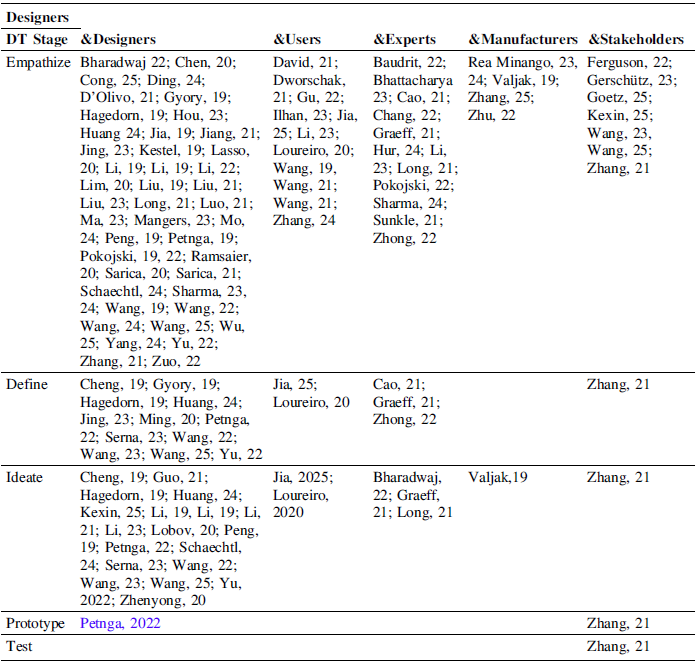
Table 1 summarises how KR enables communication among stakeholders based on the 83 selected studies and how it is distributed across the five design thinking stages and stakeholder interaction contexts. The mapping reveals clear and systematic patterns. Due to spatial constraints, the table employs abbreviated notation for publication years (e.g., 23 for 2023).
Across the reviewed studies, KR transmission is the dominant function in multi-stakeholder settings. KR is most frequently used to support the structured exchange and alignment of design requirements, constraints, assumptions, decisions and rationales between designers and other actors, including users, domain experts and manufacturing stakeholders. Such applications are commonly reported in communication- and coordination-oriented systems. Transmission-oriented applications are particularly concentrated in the Empathize and Define stages, where KR is employed to capture stakeholder needs, contextual information and problem formulations, and to facilitate shared understanding.
State-of-the-art summary

Table 1 Long description
The table presents a structured synthesis of how knowledge representation (KR) functions are distributed across design stages and stakeholder relationships in various studies. It includes columns for DT Stage, Designers, Users, Experts, Manufacturers, and Stakeholders. Each row lists specific studies and their corresponding design stages and stakeholder interactions. The table captures the form of knowledge representation, the design task or activity supported, the type of stakeholder interaction involved, the design stage(s) addressed, and the role played by KR in the design activity. The data is organized to show how KR is operationalized in each study and grouped according to whether KR primarily supports the transmission of design knowledge between stakeholders or the generation of new design concepts or solution alternatives. Each study is mapped to one KR function (transmission or generation), one or more stakeholder interaction types, and one or more design thinking stages.
In contrast, KR-generation is largely concentrated within designer-to-designer interactions. In these studies, KR is primarily used as an operational knowledge base for computational reasoning, retrieval or synthesis to support the exploration and creation of conceptual design ideas and solution alternatives (Reference Sarica and LuoSarica and Luo, 2021; Reference Yu, Zhao and ZhaoYu et al., 2022; Reference Wang, Sun, Peng, Hua, Wang and YanWang et al., 2024; Reference Cong, Yu, Chu, Huang, Ding, Fang and WangCong et al., 2025; Reference Wu, Tan, Wu and ZhaWu et al., 2025a). Generation-oriented uses of KR are most visible in the Ideate stage and are typically embedded in designer-centred ideation or concept generation workflows (Reference Huang, Wang, Wang, Peng, Li and YanHuang et al., 2024; Reference Jia, Zhang and SaadJia et al., 2025).
A comparison across stakeholder relationships further highlights this functional separation. While designer–user, designer–expert and designer–manufacturer interactions are regularly supported through transmission-oriented KR (Reference Zhang, Liu, Evans and LiuZhang et al., 2021a; Reference Rea Minango and MaffeiRea Minango and Maffei, 2023; Reference Zhu, Zhang, Shi, Qian, Qimuge and SongZhu et al., 2022), generation-oriented applications in these interaction contexts remain scarce. Only a limited number of studies report KR being used to actively propose or generate design concepts in collaboration with non-design stakeholders (e.g. Reference Jing, Yang, Ma, Xie, Li and JiangJing et al., 2023; Reference Wang, Sun, Peng, Hua, Wang and YanWang et al., 2024).
Across design stages, both functions are strongly skewed towards the early and conceptual phases of the design process. Empathise, Define and Ideate account for most reported applications (Reference Hagedorn, Smith, Krishnamurty and GrosseHagedorn et al., 2019; Reference Sarica and LuoSarica and Luo, 2021; Reference Yu, Zhao and ZhaoYu et al., 2022; Reference Rea Minango, Hedlind and MaffeiRea Minango et al., 2024), whereas the Prototype and Test stages show markedly fewer KR-based interventions. When KR is used in later stages, it predominantly supports transmission, such as the formalisation and exchange of design and manufacturing information for downstream activities (Reference Zhu, Zhang, Shi, Qian, Qimuge and SongZhu et al., 2022; Reference Rea Minango, Hedlind and MaffeiRea Minango et al., 2024), rather than the generation of new design alternatives.
Overall, the mapping reveals a clear functional imbalance between transmission-oriented and generation-oriented applications across stakeholder interactions and design stages.
3.3. A two-dimensional synthesis view of KR communication patterns
To synthesise the distribution patterns identified in Table 1, this section presents a two-dimensional synthesis view of KR-supported design communication based on the proposed dual-function analytical lens. The horizontal axis represents stakeholder interactions (designer–designer, designer–user, designer–expert and designer–manufacturer, designer–other stakeholder), while the vertical axis distinguishes between knowledge transmission and knowledge generation.
Qualitative matrix of KR functions across stakeholder interaction contexts

Table 2 summarises the distribution of KR-supported design communication patterns using a qualitative two-dimensional synthesis matrix. The horizontal axis differentiates stakeholder interaction contexts, including designer–designer, designer–user, designer–expert, designer–manufacturer and designer–other stakeholder relationships. The vertical axis distinguishes the two KR functions identified in this study, namely knowledge transmission and knowledge generation. The stars in each cell represent the relative density of studies mapped to each function–stakeholder combination, derived from the qualitative coding and mapping results reported in Table 1, a higher number of stars indicates a relatively higher concentration of studies compared with other cells. This matrix does not present exact frequencies, but provides a compact synthesis of the dominant and under-represented communication patterns observed across the reviewed studies.
The synthesis view highlights a strong concentration of KR-generation in designer–designer interactions. In these settings, KR is primarily used to support computational reasoning, retrieval and recombination of design knowledge for the exploration of conceptual design ideas (Reference Sarica and LuoSarica & Luo, 2021; Reference Yu, Zhao and ZhaoYu et al., 2022). Generation-oriented uses of KR in designer–expert, designer–user, designer–manufacturer and designer-other stakeholders interactions are almost entirely absent, with only isolated examples reported (Reference Valjak and BojčetićValjak & Bojčetić, 2019) . By comparison, KR-transmission is widely employed across all stakeholder interactions. KR is consistently used to structure and communicate design requirements, constraints, assumptions, decisions and underlying rationales between designers and non-design stakeholders, including users, domain experts and manufacturing partners (Reference Rea Minango and MaffeiRea Minango & Maffei, 2023).
Taken together, the two-dimensional synthesis view reveals a clear functional asymmetry in current KR practice. While transmission-oriented applications support communication across a broad range of stakeholder relationships, generation-oriented applications remain largely designer-centred. This asymmetry indicates that existing KR research has primarily addressed the communicative needs of coordination and information alignment, whereas its potential as a shared generative infrastructure for collaborative and participatory design has so far been only marginally explored.
4. Future research directions from a dual-function perspective
Based on the distribution patterns reported in Sections 3.2 and 3.3, three focused directions for future research can be identified.
(1) Extending knowledge generation beyond designer–designer interaction.
Generation-oriented KR remains largely confined to designer-centred ideation contexts (Reference Huang, Wang, Wang, Peng, Li and YanHuang et al., 2024; Reference Wang, Sun, Peng, Hua, Wang and YanWang et al., 2024; Reference Cong, Yu, Chu, Huang, Ding, Fang and WangCong et al., 2025; Reference Wu, Tan, Wu and ZhaWu et al., 2025a). Its application in designer–user, designer–expert and designer–manufacturer settings remains extremely limited. Future studies should therefore investigate how generative KR models can be adapted to incorporate heterogeneous stakeholder knowledge and preferences, enabling collaborative and participatory design scenarios.
(2) Integrating KR-transmission and KR-generation within unified communication workflows.
Existing KR systems tend to separate transmission-oriented communication support from generation-oriented computational design support. Although integrated KR-based reasoning and design support has been demonstrated in multi-domain and co-design contexts (Reference Cao, Liu, Ye and ZhaoCao et al., 2021; Reference PetngaPetnga, 2022a), the two functions are rarely designed as complementary components of a single communication workflow. Future research should therefore focus on KR infrastructures in which transmitted stakeholder knowledge can be directly operationalised for generative reasoning and design synthesis.
(3) Strengthening KR-supported communication in later design stages.
Both transmission and generation functions are underrepresented in the Prototype and Test stages. While KR has been applied to downstream and lifecycle-oriented activities, such as digital-twin-based design optimisation and end-of-life process modelling (Reference Lim, Zheng, Chen and HuangLim et al., 2020; Reference Mangers, Amne Elahi and PlapperMangers et al., 2023) and manufacturing and assembly knowledge integration (Reference Guo, Yan, Lu, Zhou and YangGuo et al., 2021; Reference Zhu, Zhang, Shi, Qian, Qimuge and SongZhu et al., 2022; Reference Rea Minango, Hedlind and MaffeiRea Minango et al., 2024), these applications are rarely positioned as continuous communication infrastructures for multi-stakeholder design. Future work should therefore explicitly explore how dual-function KR can support stakeholder interaction and design iteration in later design phases.
5. Conclusion
This paper investigates how knowledge representation (KR) supports design communication through a dual-function analytical lens. By distinguishing between knowledge transmission and knowledge generation, the review reframes KR as a communication infrastructure that links designers with other stakeholders throughout the design process. The findings reveal a clear functional asymmetry: transmission-oriented KR dominates designer–user, designer–expert and designer–manufacturer interactions and is mainly applied in early conceptual stages, whereas generation-oriented KR is largely confined to designer–designer contexts for ideation and solution exploration. Both functions remain sparsely represented in later design stages, particularly during prototyping and testing.
By synthesising these distribution patterns, this study contributes a structured perspective on how KR functions are situated across stakeholder relationships and design stages. The proposed dual-function lens enables systematic comparison of heterogeneous KR applications and highlights under-explored opportunities for extending KR-supported communication beyond designer-centred ideation and early-stage information exchange.
Future research should therefore focus on developing KR-based communication infrastructures that integrate transmission and generation within unified workflows, enable collaborative generative design with non-design stakeholders, and support continuous interaction and knowledge use in later design stages. Addressing these directions is essential for realising the broader potential of KR to support human-centred, multi-stakeholder design practices in line with the ambitions of Industry 5.0.


 Open access

