


Introduction
What factors influence state compliance with damages awarded by the Inter-American Court of Human Rights (IACtHR)? The IACtHR has become an increasingly active international human rights legal body in the past several decades, with thirty-four decisions rendered by the Court in 2022 alone. Each judgment against the state involves numerous measures of reparation; in 2022, the IACtHR was monitoring compliance with 1,492 measures of reparation from 280 cases. Compensation is the most common form of reparation in international law and can include monetary payments made to victims and beneficiaries for material and immaterial losses as a result of human rights violations (Carrillo Reference Carrillo and de Grieff2006). The award of monetary damages represents a large proportion of remedial orders made by the IACtHR. Hillebrecht (Reference Hillebrecht2014) shows that from 2008–2010, monetary damages represented around 18.5% of the total measures of reparation ordered by the Court. Moreover, the awards themselves are quite large relative to the economies of the countries being ordered to pay. The total award in IACtHR judgments, including both pecuniary and nonpecuniary damages, is frequently over one million dollars per case (Haglund and Parente Reference Haglund and Parente2023). In the seventy-seven judgments issued between 2015 and 2019, the IACtHR awarded about $70.7 million in damages, roughly 1.3% of the total GDP of Suriname, the poorest member-state in the Inter-American system.Footnote 1
Despite the large awards, the probability of paying compensation tends to be higher than the probability of complying with other ordered remedies, like prosecuting offenders, repealing laws, and providing medical treatment to victims. Hillebrecht (Reference Hillebrecht2014, 52) finds that financial reparations have a compliance rate of 55%, which is higher than the compliance rate for general measures of accountability (14%) and non-repetition (23%). Similarly, Pérez-Liñan, Schenoni, and Morrison (Reference Pérez-Liñan, Schenoni and Morrison2023) find that indemnification has a compliance rate of 64.2%, higher than compliance with other types of measures, including non-repetition (29.8%), rehabilitation (17%), and prosecution (10.7%). Although monetary compensation is not the only form of remedy, it is considered to be the “official standard to reparation” (Chavez Reference Chavez2017, 374), which may explain why the overall compliance rate is so high.Footnote 2
However, looking at the overall compliance rate with reparations orders like the payment of monetary damages, obscures the highly variable time to compliance among individual cases. Our data show that states pay damages anywhere from two to 252 months after the judgment. The numerous factors that explain why states are able to pay monetary compensation faster than other forms of reparation apply equally to each monetary award, and are unlikely to vary over time.Footnote 3 It is therefore puzzling why there is so much variation in time to compliance with the payment of monetary damages. This level of variation suggests a heretofore missed opportunity to examine factors that influence compliance within a particular type of remedy, rather than factors that explain differences in compliance between remedies of different types. By holding the type of order constant, we can critically examine potential explanations for compliance.
We argue that case-level factors explain the variation in time to compliance among monetary awards. Disaggregation of IACtHR judgments into case-level characteristics allows us to investigate previously unexamined variation in state compliance across cases and states (Stiansen, Naurin, and Bøyum Reference Stiansen, Naurin and Bøyum2020; Schroeder and Lindholm Reference Schroeder and Lindholm2023). First, awards vary tremendously in size, which may create fiscal capacity concerns on the part of the state. Depending on the size of the award, it may be prohibitively costly to make the payments ordered by the Court. As developing countries with limited access to resources to pay victims, many states in the Americas struggle to make payments to victims. We argue that as the size of monetary awards grows, states are less likely to comply with the payment of monetary damages. However, states with more tax revenue have increased fiscal capacity to comply, so we also expect that the negative effect of large awards on time to compliance is less severe in wealthier states.
Second, judgments vary in terms of the number of victims receiving monetary awards. The number of award recipients can be anywhere from one to, in some cases, several hundred. Large numbers of victims might create logistical problems for the state, inhibiting timely payment of damages. We suggest that cases involving more victims require greater coordination among bureaucratic actors to ensure that the award is appropriately dispensed to all of the victims; as a result, compliance is likely to take longer. On the other hand, this negative effect on time to compliance may be attenuated by state institutions that are responsible for dispensing monetary awards.
Finally, victim identity varies across IACtHR cases. The identity of victims receiving compensation can render states more (or less) willing to comply with the payment of damages in a given case. Many states face multiple judgments at the same time, requiring them to prioritize which awards to pay out in what order. We argue that states are more likely to comply faster in cases involving “ideal” victims like women and children compared to cases involving “non-ideal” victims like convicted or alleged criminals. The public may view certain victims as less deserving of monetary awards, which generates less pressure toward compliance, or even pressure against compliance when the public is unsympathetic toward a victim.
In what follows, we discuss foundational literature on government compliance with international human rights law. We then elaborate a theoretical logic explaining how case-level factors, including the size of monetary awards, the number of victims to be compensated, and the identity of victims of human rights abuses influence states’ fiscal capacity, bureaucratic capacity, and willingness to comply with the payment of damages awarded by the IACtHR. Next, we present our research design and introduce our original data on state compliance with monetary damages awarded by the IACtHR. Finally, we present our results and offer some concluding comments.
Compliance with payment of monetary awards
Compliance with the obligations specified in international human rights treaties or court judgments is argued to be driven by several factors, including government capacity (Chayes and Chayes Reference Chayes and Chayes1993) and willingness (Downs, Rocke, and Barssom Reference Downs, Rocke and Barsoom1996), both of which can affect time to compliance with payment of monetary damages. Beginning with capacity, Chayes and Chayes (Reference Chayes and Chayes1993) argue that noncompliance is often not driven by deliberate or intentional violations, but instead by managerial issues, including state capability and capacity shortcomings. Capacity issues are most common when international law imposes affirmative obligations on states (Chayes and Chayes Reference Chayes and Chayes1993, 193). Indeed, prior research shows that access to resources ensures greater state capacity to change human rights behavior (Clay and DiGiuseppe Reference Clay and DiGiuseppe2017) and comply with general measures of regional human rights courts (Haglund Reference Haglund2020). Moreover, bureaucratic efficacy enhances the level of compliance with international human rights treaties (Cole Reference Cole2015).
Capacity challenges are particularly pertinent to reparations orders to pay monetary damages. Orders to pay monetary damages are affirmative obligations with a direct monetary value. Less developed states, for example, have fewer resources to pay monetary damages. Building on this line of work, we argue that capacity challenges not only vary across states based on the state’s fiscal or bureaucratic capacity to comply, but also vary across reparations orders in IACtHR judgments. States are ordered to pay damages ranging substantially in value to victims ranging substantially in number, which means that the state compliance decision-calculus is driven not only by the fiscal and bureaucratic capacity of the state, but also by various characteristics of the case.
One case-level characteristic that influences the state’s capacity to comply involves the number of victims to be compensated. Individuals eligible to receive monetary awards are both direct and indirect victims.Footnote 4 The direct victim of human rights abuse is the individual(s) whose rights were violated and was immediately injured as a result of the violation. Additionally, IACtHR case law establishes that the parents, children, and permanent partners of the direct victim suffered a violation of their own right to personal integrity, particularly in cases involving massacres, forced disappearances, and extrajudicial executions, making them indirect victims.Footnote 5 Thus, indirect victims usually include the immediate family and dependents of direct victims.
In addition to the variation in the number of victims influencing state capacity to comply, the size of monetary awards also varies substantially, meaning that state capacity to comply will vary based on the size of the award made by the IACtHR in each judgment. Because states are ordered to pay monetary damages to both direct and indirect victims of rights abuses, the size of monetary awards is substantial.Footnote 6 Moreover, monetary awards have grown over time. During the first decade of reparations judgments, the Court typically awarded monetary damages of $200,000 or less in value (Cassel Reference Cassel, Bossuyt, Lemmens, De Feyter and Parmentier2006, 93). However, after 2001, in response to several cases involving massacres and multiple victims, the Court began granting multi-million dollar judgments. For example, the Court awarded a $7.925 million judgment to victims (many indirect) of a massacre of 268 peasants by the military in an indigenous village in Guatemala,Footnote 7 $6.985 million for the torture and killing of 16 individuals by the paramilitary in Colombia,Footnote 8 $5.482 million for disappearances and killings of thirty-seven demonstrators in Venezuela,Footnote 9 and $3.659 million for the twelve deaths and twenty-three injuries from a fire in a Paraguayan juvenile detention centerFootnote 10 (Cassel Reference Cassel, Bossuyt, Lemmens, De Feyter and Parmentier2006, 94).
Beyond capacity challenges, many scholars highlight variation in state willingness to comply with international human rights treaties or court judgments. The presence of domestic institutions can constrain the behavior of governmental actors, generating incentives to comply. For example, scholars find that domestic judicial independence allows for international law to be enforced domestically and encourages domestic actors to comply with international legal obligations (Powell and Staton Reference Powell and Staton2009; Conrad and Ritter Reference Conrad and Ritter2019; Haglund Reference Haglund2020). Others argue that electoral institutions can provide incentives for elected officials to comply with reparations orders of an international court (Haglund Reference Haglund2020; Parente Reference Parente2025).
Like capacity, government willingness to comply with reparations orders varies across judgments. Government officials have greater incentives to comply with reparations orders when the public holds preferences for compliance because the public will support government officials who adopt their preferred policies. However, because the public does not always prefer compliance, those in power may have incentives not to comply with international human rights legal commitments (Conrad, Hill, and Moore Reference Conrad, Hill Daniel and Moore2018; Lupu and Wallace Reference Lupu and Wallace2019; Haglund Reference Haglund2020; Parente Reference Parente2025). Anecdotal evidence suggests that public support varies for general measures ordered by the IACtHR. For example, reparations orders requiring states to abolish the death penalty often meet barriers to compliance amidst strong public support for the death penalty.Footnote 11 Similar controversy often exists over IACtHR orders to overturn amnesty laws.Footnote 12
The government may have incentives to comply with the payment of monetary damages when the public supports or sympathizes with victims. However, the public may not support the payment of monetary damages to all victims of rights abuse. Anti-compliance constituencies can facilitate non-compliance by dampening government willingness to comply when the payment of monetary damages is to individuals or groups that are politically unpopular among the public (Búzás Reference Búzás2018) or when the perpetrator of rights abuses is well liked by the public (Parente Reference Parente2025). We argue that government willingness to comply with the payment of monetary damages varies by the type of victim(s) involved in each case, with some victims garnering more sympathy and support (e.g., women and children) and some garnering little (e.g., convicted criminals). In what follows, we turn to testable implications of the roles of capacity and willingness in shaping state compliance with the payment of monetary damages awarded by the IACtHR.
Award sizes and fiscal capacity to comply
Beginning with state fiscal capacity to comply, we examine the considerable variation in the size of monetary awards. In our dataset, pecuniary awards range between $555 and $28 million USD, while non-pecuniary awards range from $2,000 to $14.9 million.Footnote 13 While the range for pecuniary damages is much higher, the mean pecuniary damage award is $264,040, compared to the mean non-pecuniary damage award of $757,900. Because awards at the IACtHR are compensatory, and not punitive, the award totals represent the Court’s best calculation of the harm done to the victim and next of kin.
The size of the total monetary award in a case might create significant resource constraints on the part of the state. Evidence indicates that international courts consider the role of domestic political and economic circumstances in limiting or facilitating state ability and willingness to comply with reparations orders (Altwick-Hámori, Altwicker, and Peters Reference Altwicker-Hámori, Altwicker and Peters2016; Sandholtz and Padilla Reference Sandholtz and Padilla2020). With respect to state capacity to pay monetary damages, Crawford (Reference Crawford2013, 481) highlights that concerns over the inability of states to pay monetary damages was an issue discussed by the drafters of the International Law Commission’s Articles of Responsibility of States for Internationally Wrongful Acts because of the fear that the amount of the claims would negatively impact the subsistence of certain populations. States have also directly indicated the difficulty they face in making large payments. In the 2006 judgment of Miguel Castro-Castro Prison v. Peru, Peru noted that “if the Court’s standards were to be applied, a compensation of approximately $17,052,000 (USD) would be set between the deceased and the injured, without taking into account those submitted to cruel treatments which would be 322 people” and this would generate damages awarded that “would be a state obligation difficult to handle” (para. 412).
Thus, the value of pecuniary and non-pecuniary damages awarded by the IACtHR may affect time to compliance. We expect that higher awards are more likely to raise fiscal capacity concerns, resulting in lower probabilities of compliance in a given year. More formally, we posit:
H1: States are less likely to comply with IACtHR judgments awarding higher value pecuniary and non-pecuniary damages than judgments awarding lower value damages.
However, we recognize that not all states face equal capacity limitations to pay out monetary damages. Although many Latin American states face resource limitations, states have varying levels of capacity to raise additional revenue to pay out monetary damages awarded by the IACtHR. As a result, some Latin American states face fewer budgetary challenges in paying out monetary damages and thereby complying with this form of financial reparation. Although we expect a negative relationship between the value of monetary damages awarded in a judgment and time to compliance with the payment of monetary damages, we expect this relationship to be less negative for states with fewer capacity limitations, as in those with greater fiscal capacity. Thus, we expect:
H1a: The negative relationship between the value of pecuniary and non-pecuniary damages awarded by the IACtHR and state compliance is weakened in states with greater fiscal capacity.
Number of victims and bureaucratic capacity to comply
In addition to fiscal capacity, we also argue that bureaucratic challenges can hinder compliance with the payment of monetary damages. The number of victims in a single judgment can vary quite substantially, with some judgments involving only a single victim and others involving hundreds. Several IACtHR judgements involve massacres of entire communities and groups of people. For example, in the 2004 Plan de Sanchez Massacre v. Guatemala judgment, members of the military and other state actors perpetrated massive human rights abuses against hundreds of members of the Mayan indigenous community, including killing over 250 people.Footnote 14 Plan de Sanchez Massacre v. Guatemala was a landmark judgment in that it represented the first time reparations were ordered for the survivors and next of kin in a full scale massacre (Antkowiak Reference Antkowiak2008). The Court adopted a flexible approach in determining who could qualify as a victim, “considering that those unable to prove their identity could also classify as victims if certain requirements were met" (Sandoval Reference Sandoval2017, 2). The state was ordered to pay $5,000 for pecuniary damages and $20,000 for non-pecuniary damages per victim, meaning the state had to pay $7.9 million to provide redress as a result of the Plan de Sanchez judgment (Sandoval Reference Sandoval2017). Following Plan de Sanchez, four more massacre cases were heard by the IACtHR over two years (Antkowiak Reference Antkowiak2008), involving hundreds of victims, both direct victims and their next of kin.
For the state to fully comply, the state must possess the appropriate personal information for all victims in order to make payments, which can require substantial coordination across domestic institutions. Moreover, victims eligible to receive payments awarded by the IACtHR must register with the appropriate domestic body in order to receive compensation, which may be challenging if victims are not aware of the process. The process is further complicated by specific orders of the IACtHR, which can include designating payments through a trust, rather than a bank account because “trusts are institutions designed to increase the real value of assets” (Pasqualucci Reference Pasqualucci1996, 52). Moreover, Pasqualucci (Reference Pasqualucci1996) notes that the IACtHR sometimes even specifies the operational details of the trust. For example, in the 1993 reparations judgment of Aloeboetoe et al. v. Suriname, the Court stipulated that the trust fund be set up in dollars “under the most favorable conditions consistent with banking practice.”Footnote 15 The IACtHR even recognizes some of the sizeable obstacles faced by victims in claiming reparations, particularly indigenous and tribal peoples (Antkowiak Reference Antkowiak2014). For example, in the Moiwana Village case, the IACtHR provided petitioners with “more lattitude…with respect to acceptable means of proving identity” because “many Maroons do not possess formal identity documents, and were never inscribed in the national registry.”Footnote 16
The large number of victims in many IACtHR judgments requires utilizing the existing state bureaucratic apparatus to disseminate payments. As the number of victims awarded damages in a judgment grows, the bureaucratic burden placed on the state grows as well. Formally, we expect:
H2: States are less likely to comply with IACtHR awards to pay pecuniary and non-pecuniary damages in judgments involving larger numbers of victims than in judgments involving smaller numbers of victims.
However, some states experience a greater bureaucratic burden than others when it comes to disseminating damages awarded by the IACtHR. Bureaucratic capacity, including capacity that is administrative in nature, contributes to the capacity of the state to “implement logistically political decisions” (Mann Reference Mann1984). Cole (Reference Cole2015, 414) notes that bureaucratic institutions empower states to effectively engage in rights protection and finds that “bureaucratic capacity will give states the administrative and logistical abilities to implement their human rights treaty commitments.”
We argue that the presence of a domestic reparations program (DRP) represents a direct indicator of bureaucratic capacity to comply with IACtHR orders to pay monetary damages. Many states under the IACtHR’s jurisdiction have set up DRPs, which are transitional justice mechanisms designed to provide the bureaucratic infrastructure necessary for providing reparations to victims of human rights abuses. DRPs are “domestic executive or legislative initiatives which identify a group of victims as beneficiaries of reparation and then provide them with redress, usually through similar reparations measures; a summary and fast process; and without the legal costs and high burden and standard of proof required in a judicial setting” (Sandoval Reference Sandoval2017, 2). DRPs exist in many countries in Latin America. For example, Colombia established a DRP through the enactment of the 2011 Victims and Land Restitution Law, providing reparations to individual and collective victims of killing, internal displacement, torture, kidnapping, and other abuses on or after January 1, 1985. Victims can claim reparation by registering with the National Registry of Victims and providing documentation on how they were victimized during the time frame established by the law (Sandoval Reference Sandoval2017, 2).
When the IACtHR has evidence of the effectiveness of state DRPs, the IACtHR can work through this domestic institution to provide redress to victims. For example, the case of Operation Genesis v. Colombia involved the displacement of around 3,500 Afro-descendants living in communities in the northeast of Colombia as a result of an anti-guerilla operation (Operation Genesis). During the operation, one of the members of the displaced communities, Marino Lopez, was killed.Footnote 17 In total, 372 victims were identified by the IACtHR (Sandoval Reference Sandoval2017, 8). The IACtHR ordered Colombia to provide reparation, including compensation, through its DRP within a year of notification of judgment. Additionally, in the case of Rio Negro Massacres v. Guatemala, which involved five massacres in the early 1980s in Guatemala, the state claimed that victims had received reparations through the DRP and that the state was able to pay reparations to all victims in the same manner. The IACtHR acknowledged the DRP, finding that “the amounts that have already been awarded to the victims in this case at the domestic level under the PNR [National Reparations Program] must be recognized as part of the reparation due to them and subtracted from the amounts established by the Court.”Footnote 18
These examples suggest that DRPs provide the bureaucratic infrastructure necessary to disseminate damages awarded by the IACtHR. Thus, we expect:
H2a: The negative relationship between the number of victims in an IACtHR judgment and state compliance is weakened in states with greater bureaucratic capacity (e.g., DRPs).
Victim identity and willingness to comply
Moving beyond capacity, we argue that compliance is also driven by the identity of victims involved in IACtHR cases. Victims of human rights violations vary from marginalized individuals and groups (e.g., members of indigenous groups), to political dissidents, to even those convicted of contravening legal statute and serving prison sentences. We know relatively little about whether and to what extent victim identity impacts the behavior of the IACtHR and state compliance with remedial orders of the IACtHR (Stiansen, Naurin, and Bøyum Reference Stiansen, Naurin and Bøyum2020). However, Greenstein (Reference Greenstein2020) suggests that victim identity matters for securing reparations. In her in-depth case study on a West German reparations policy, Greenstein (Reference Greenstein2020) shows that prejudice and the lack of an advocacy organization prevented many Romani Germans from accessing reparations promised by West German law. Victims lacking public support and organizational structure can inhibit government willingness to pay out reparations.
We argue that victims considered “blameless” are viewed by the public as more deserving of awards than victims perceived to be at fault or having done something to deserve the human rights abuses perpetrated against them. Christie (Reference Christie and Fattah1986, 18) differentiates between “ideal” and “non-ideal” victims, in which an “ideal” victim is “a person or category of individuals who - when hit by crime - most readily are given the complete and legitimate status of being a victim.” For example, the ideal victim might include elderly victims of robberies or burglaries, or children who are sexually abused (Christie Reference Christie and Fattah1986). These “blameless” victims garner sympathy and support from the public, including the expectation of state actions like publicly funded compensation schemes as a way to repair their suffering to the extent possible (Miers Reference Miers2019). Ideal victims meet several criteria, including weakness and vulnerability (Schwöbel-Patel Reference Schwöbel-Patel2018); as such, women and children are often considered ideal victims (Kapur Reference Kapur2002). Haglund and Parente (Reference Haglund and Parente2023) argue that women and children victims are perceived by the public to be of privileged status and the public perceives their suffering to be more legitimate and worthy of compensation. We expect that because the public is more likely to support the payment of damages in judgments involving women and children victims, governments are more willing to comply.Footnote 19
On the other hand, victims not considered blameless garner less sympathy and support from the public. McEvoy and McConnachie (Reference McEvoy, McConnachie, Spencer and Walklate2016, 115) claim that “when victims are not faultless […] they become more problematic, both as an object of public empathy but also in terms of their entitlement to formal compensation on the part of the state.” Miers (Reference Miers2019, 8) highlights this notion with respect to the United Kingdom’s publicly funded compensation scheme for injuries caused to victims of violent crime in the UK, noting “the distinction between ideal (‘deserving’) and non-ideal (‘undeserving’) victims continues to be central to its political legitimacy…the government considered it inappropriate for those with significant criminal records, whose own conduct before, during or after the incident led to their being injured, or who were otherwise of bad character, to receive compensation from public funds.” Government and public backlash is evident in cases involving non-ideal victims. For example, statements from public officials in Peru reflect the unwillingness of the state to pay reparations to victims the state views to be terrorists (Sandoval Reference Sandoval2017, 4). In response to an impending 2015 IACtHR judgment, Peruvian President Humala stated “What I can tell the court and the country is that I am not going to give them a single sol, I am not going to give up a single sol, to the terrorists or their relatives; The Peruvian State is not going to pay a single sol, no matter what the court orders, I am not going to pay money to those who murdered our families and left the country in mourning” (RPP Noticias 2015).Footnote 20 Compliance with the payment of monetary damages to “non-ideal” victims is more likely to generate public backlash. As a result, we expect the state to be less willing to comply with the payment of monetary damages when judgments involve “non-ideal victims.”
For example, consider two judgments against Ecuador. The case of Herrera Espinoza et al. v. Ecuador involved the prosecution of members of a drug trafficking cartel. Specifically, four foreign individuals were arrested during a drug enforcement operation in 1994, denied legal counsel, sustained injuries consistent with torture, and provided incriminating statements to the police. In 2016, the IACtHR found that the state had violated several rights, including the victims’ rights to be free from torture and cruel, inhumane, and degrading treatment; their rights to personal liberty and security; and their right to a fair trial. The Court ordered Ecuador to undertake many reparations, including awarding non-pecuniary damages of $10,000 each to three of the victims and $80,000 in non-pecuniary damages to one victim for torture and unjustified detention.Footnote 21 In a 2019 compliance monitoring report, the IACtHR noted the state had only partially complied with the monetary reparation, as restitution payment for some of the victims was pending.Footnote 22
In a second judgment, Guzmán Albarracín et al. v. Ecuador, the IACtHR found that the state was responsible for the sexual violence suffered by fourteen year old Paola del Rosairo Guzmán Albarracín by the Assistant Principal of the public school she attended, which was tolerated by the school and related to the victim’s suicide. The Court found that Ecuador had violated the right to personal integrity, judicial guarantees, and judicial protection, among other articles of the American Convention.Footnote 23 Among the various reparations ordered, Ecuador was ordered to pay compensation for pecuniary and non-pecuniary damages to the victim’s mother and sister. Specifically, the Court ordered the state to pay $200,000 to the victim’s family as well as $56,502 for expected lost income of the victim. Additionally, the Court also ordered the state to pay $210,000 in non-pecuniary damages for the suffering experienced by the victim, her mother, and her sister. Importantly, despite the larger award in this case, within a year of the judgment, Ecuador had paid the damages.Footnote 24
Ecuador’s capacity to comply with the orders to pay monetary damages in the case of Herrera Espinoza et al. v. Ecuador and Guzmán Albarracín et al. v. Ecuador is arguably similar. The judgments occurred only one year apart (2019 and 2020), and state-level capacity largely remained unchanged. Both judgments involved only a few victims, four direct victims in the Herrera Espinoza et al. case and a single direct victim (deceased) and two beneficiaries in the Guzmán Albarracín et al. case. The damages awarded were substantially larger in the Guzmán Albarracín et al. case, and capacity concerns would suggest lower levels of compliance as a result. Yet compliance with the payment of monetary damages has been delayed (and only partial) in the Herrera Espinoza et al. case and almost immediate in the Guzmán Albarracín et al. case. The difference? In Herrera Espinoza et al. v. Ecuador, the victims were “non-ideal,” specifically foreign members of a drug trafficking cartel. Being situated between Colombia (the world’s largest cocaine refiner) and Peru (the world’s largest coca leaf grower), Ecuador has experienced a long battle with narcotics smuggling. At the time of the arrests of the victims in this case, the public was supportive of the police carrying out drug raids to help maintain peace in the country (Lusk Reference Lusk2019, 1204). In contrast, the victim in Guzmán Albarracín et al. v. Ecuador was a female minor who had suffered sexual abuse; in other words, an “ideal” blameless victim. In the latter case, there was likely greater public support for compliance, and subsequently greater state willingness to comply, despite capacity challenges.
The theoretical logic outlined above suggests the following observable implication:
H3: States are more likely to comply with the payment of pecuniary and non-pecuniary damages in judgments involving ideal victims (e.g., women and children) than they are to comply with the payment of damages in judgments involving non-ideal victims (e.g., individuals who have perpetrated a crime).
Empirical analysis
Measuring compliance
To test these hypotheses, we begin by identifying all orders for payments of pecuniary and non-pecuniary damages in judgments against the state from 1989 through 2019 (228 judgments in total). Pecuniary damages are material, compensating the actual losses suffered as a direct result of a human rights violation. This can include lost profits, loss of property which has been taken, and costs for medical treatment following a physical injury, among other types of loss (Altwicker-Hámori, Altwicker, and Peters Reference Altwicker-Hámori, Altwicker and Peters2016, 6). Non-pecuniary damages (e.g., moral damages) include “the harm suffered by victims as a result of the human rights violation that are not immediately financial in nature" (Gonzalez-Salzberg Reference Gonzalez-Salzberg2021, 83); this includes “the trauma, anxiety, anger, etc. coming with the attack on human dignity, the loss of trust in state institutions, the loss of beloved persons, the mental and physical pain lasting after torture, imprisonment, censorship, separation from family members, and so on” (Altwicker-Hámori, Altwicker, and Peters Reference Altwicker-Hámori, Altwicker and Peters2016, 6). Both pecuniary and non-pecuniary damages can be awarded in the same case, so the 228 cases yield 416 payment orders.
To measure time to compliance with each of these orders, we looked at evidence from the Inter-American Court’s monitoring reports. In each monitoring report, the Court reviews the orders given to the state and decides whether the state has fully complied, partially complied, or not yet complied based on information from all parties. Claims by both the victim and the state are verified by each other; the Court generally does not accept a payment order as having been fulfilled unless and until both sides agree that it has been paid. Through December 2023, 407 of the 416 pecuniary and non-pecuniary payment orders had been monitored at least once; we exclude the nine unmonitored orders as we do not have any information about the state’s payment status for them. If the Court declares full compliance with the payment order in a particular monitoring report, we then search the report to find the year in which payment was made. In about 15% of instances of full compliance, the payment was made in the same year as the monitoring report was issued (although not necessarily in the same month). On average, monitoring reports lag behind actual payments by 1.74 years. Thus, using the actual payment year gives us the most accurate possible measure of time to compliance. Of the 407 monitored orders, 62.7% eventually result in full compliance, 23.8% result in non-compliance, and the remaining 13.5% end in partial compliance.
However, we are interested in time to compliance, not just the outcome of compliance. Thus, we construct a time series version of the dataset in which the unit of analysis is a payment-order-year. The outcome (full compliance) is coded as 1 if the state fully complied with the order in that year and 0 otherwise. Payment orders remain in the dataset while they are pending compliance. Thus, the 407 monitored payment orders generate 2,770 payment-order-year observations.
Independent variables
Our main independent variable for hypothesis 1 is Monetary award, which is the size of the monetary award in US dollars from Haglund and Parente (Reference Haglund and Parente2023).Footnote 25 To test hypothesis 1a, we interact Monetary award with Revenue, which is total tax revenue as a percentage of GDP.Footnote 26 Because of the large range and heavy right skew in monetary awards, we log the awards in all cases.Footnote 27
To test hypothesis 2, we use the total number of direct and indirect victims in each case from Haglund and Parente (Reference Haglund and Parente2023). As the total number of victims can range from one to over 10,000 depending on the case, we also log this number.Footnote 28 For hypothesis 2, we interact the logged number of victims with the binary variable Reparations program from Greenstein (Reference Greenstein2018). The reparations program variable is coded as 1 if Greenstein indicates the state has a DRP that has paid at least one victim, and 0 otherwise. States that have DRPs have the bureaucratic infrastructure in place to compensate victims and fulfill orders to pay monetary reparations from the IACtHR, even if the domestic reparations apparatus does not exist to compensate victims in Inter-American cases specifically.Footnote 29
To test hypothesis 3, we create binary variables Female victims only and Minor victims only, indicating whether all the victims in the case are females or minors (18 years of age and under), respectively. We also interact these variables (Female × minor victims only) to account for the possibility that female children are given additional special consideration as being members of both vulnerable classes. Since we are interested in assessing the effect of women or child victims compared to non-ideal victims, we exclude the three instances in which the victim is a female criminal and the two instances in which the victim is a criminal (male) minor.Footnote 30 This is admittedly the easiest possible test of the argument. However, if we do not find that women and children (the most sympathetic victims) are paid faster than the least sympathetic victims, we should have little confidence that victim identity affects compliance at all. Additionally, as a more robust test, we compare time to compliance with awards paid to female victims, minor victims, alleged criminals, and convicted criminals compared to all other victims.
Models and control variables
We conduct a discrete time event history analysis with dummy variables for each year post-judgment to capture duration dependence, following Parente (Reference Parente2025) and Pérez-Liñan, Schenoni, and Morrison (Reference Pérez-Liñan, Schenoni and Morrison2023). The dependent variable is the hazard, or probability of full compliance in a given year, conditional on covariates and non-compliance in all previous years. Any order not fully complied with by December 2023 is considered right-censored.Footnote 31
We include several control variables to account for alternative explanations for compliance. First, we include three variables to capture other indicators of state willingness. The first is Preliminary objections, which is the number of preliminary objections filed by the state. Higher levels of preliminary objections may be indicative of less willingness to comply since the state was trying hard to get the case thrown out prior to the merits ruling. We also include Accept responsibility, which is an ordinal variable measuring whether the state fully accepted, partially accepted, or did not accept responsibility for the violation prior to the ruling on the merits. Accepting responsibility may indicate greater willingness to comply because the state has already conceded the violation. The third willingness variable is Impunity, which captures the number of years that have passed since the violation occurred. We are agnostic as to the direction of this variable: more impunity might indicate less willingness to comply (since the state has allowed the violation to go unremedied for so long), or it could indicate greater willingness to comply (since the perpetrators may no longer be in power).
Second, we include variables to control for state characteristics that may contribute to compliance. We include Government effectiveness from Worldwide Governance Indicators, capturing perceptions about the quality of state services. We expect higher levels of government effectiveness to be correlated with greater levels of compliance. We also include Rule of law, expecting that states with greater rule of law will be more likely to comply (Simmons Reference Simmons2009).
Third, we include variables for case-level factors that may affect compliance. We include binary variables for Article 4 and 5 violations, which indicate cases in which the right to life and right to physical integrity, respectively, were violated. We are again agnostic as to the direction of these variables. On the one hand, Article 4 and 5 violations are serious violations, and would likely be recognized as such by the public; therefore, states might be more likely to comply in these cases, as the public perceives those cases to involve severe or legitimate violations worthy of compensation. On the other hand, Haglund and Parente (Reference Haglund and Parente2023) show that the size of monetary awards is larger in cases involving Article 4 and 5 violations, which means compliance might be less likely, as the awards would be higher. Next, we include a variable for Cumulative orders which is the total number of monetary orders the state has received to date. States that have received more orders overall might face more financial or bureaucratic constraints on compliance.
Finally, we include an indicator variable for whether the payment order is for non-pecuniary damages and country fixed effects to capture other differences between states not already captured by our existing battery of controls.Footnote 32 Where appropriate, we also include controls for our other hypotheses to isolate the effect of the variable of interest.
Results
Before testing hypothesis 1 statistically, we calculated the average award across different award types and level of compliance, as displayed in Table 1. Note that the compliance level reflects the final observed level of compliance by December 2023. The number below the award size is the number of cases at that combination of compliance level and award type. For example, states fully complied with 119 pecuniary damage awards, partially complied with twenty-three of them, and did not comply with forty-three of them. However, the average pecuniary damage award that was not complied with was almost double the average pecuniary damage award with which states fully complied ($978,000 compared to $516,000). The variation for non-pecuniary damages is even more stark. The average fully paid non-pecuniary damage award was about $380,000, but the average size of a non-pecuniary damage award that was not paid with was almost four times as much, at $1.39 million. Thus, Table 1 provides suggestive evidence in favor of our first hypothesis: states are less likely to comply with larger awards.
On Average, Larger Awards Are Less Likely to Be Fully Complied With
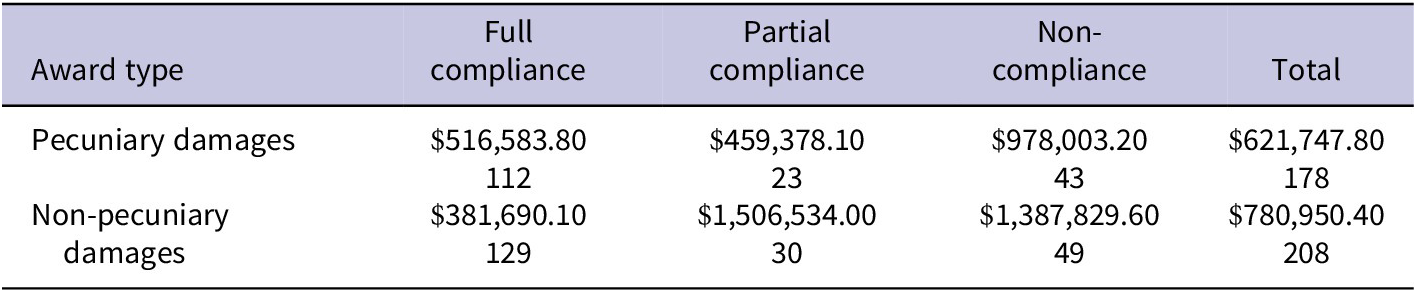
Notes: Number of cases falling into each compliance level appears below the average amount. Awards in currencies other than USD or for which an exact number is not available (confidential or domestically ordered) are excluded, as are awards in judgments that have never been monitored.
The results of our statistical tests of hypothesis 1 appear in Table 2. In Models (1) and (3) we present the results for hypotheses 1 and 1a, respectively, without any control variables; Models (2) and (4) test those hypotheses with controls included. The coefficient on monetary award in Model (2) is negative and statistically significant, indicating that the probability of compliance is decreasing as the award size increases. Specifically, the coefficient −0.23 tells us that a log-unit change in the monetary award corresponds to a 20% decrease in the probability of compliance.Footnote 33 For example, in any given year states are 80% as likely to comply with an award of $136,000 compared to an award of $50,000.Footnote 34
Higher Monetary Awards Are Associated with Lower Probability of Compliance in a Given Year
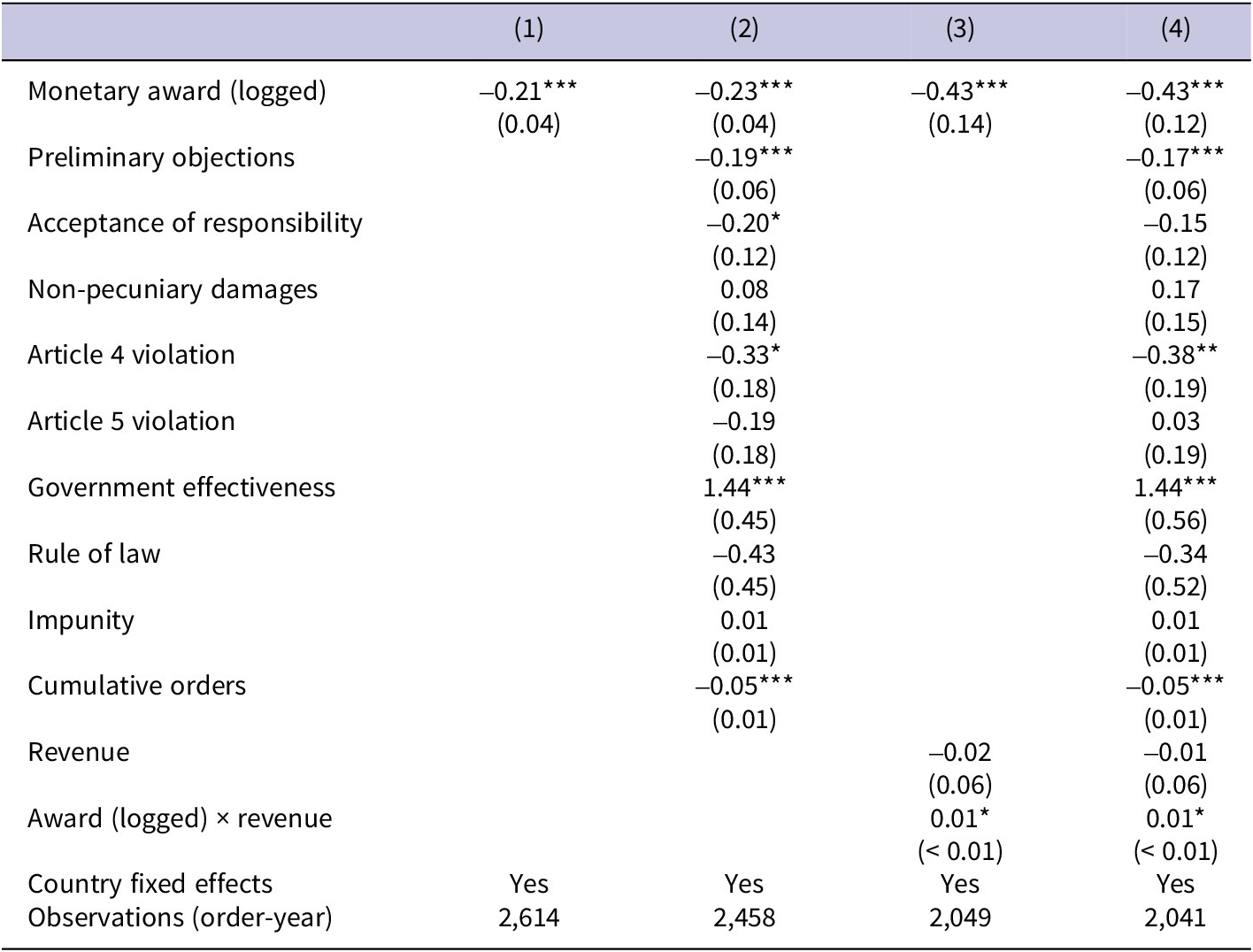
Note: *p < 0.1, **p < 0.05, ***p < 0.01.
Several of our control variables are also statistically significant. The coefficient on preliminary objections is negative and statistically significant, indicating that states filing preliminary objections are less likely to comply, as expected. States are also less likely to comply when payment orders come from cases involving Article 4 violations, perhaps reflecting the larger amounts awarded in these cases (Haglund and Parente Reference Haglund and Parente2023). Government effectiveness is positive and statistically significant, as expected, while cumulative orders is negative and statistically significant, also as expected. However, even controlling for these alternative explanations, the results of our main variable of interest hold.
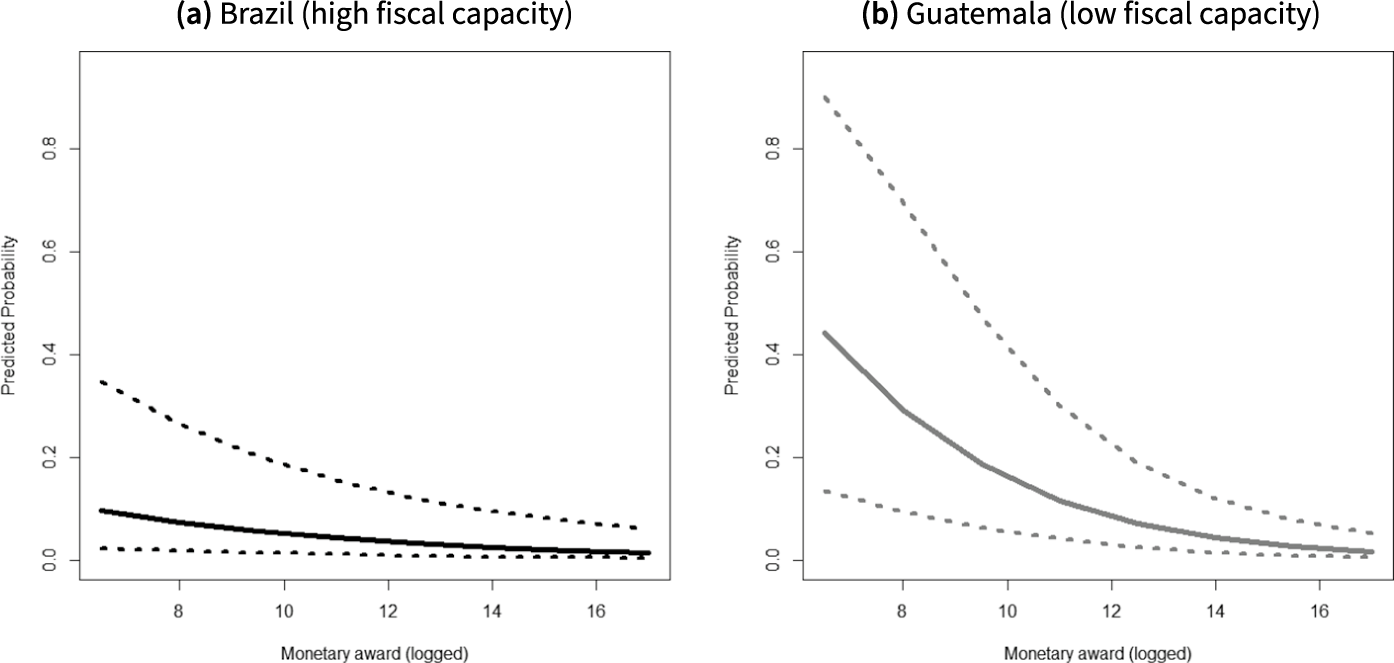
The results for hypothesis 1a appear in the last column of Table 2. Again, the unconditional effect of larger awards on compliance is negative. The interaction term is positive and statistically significant, which supports our hypothesis: the effects of a high award on compliance are attenuated by a state’s fiscal capacity. To better illustrate how having greater fiscal capacity changes the probability of compliance as award size increases, we plot the predicted probabilities of compliance for Guatemala (low fiscal capacity) and Brazil (high fiscal capacity) in Figure 1. All other variables are held constant at the mean level for Guatemala and Brazil, respectively. The predicted probabilities can be interpreted as the probability that Brazil and Guatemala comply with a payment in the fifth year after the judgment.Footnote 35 For Brazil (left panel), the probability of compliance decreases as award size increases, but does so at a fairly slow rate; the line is almost flat. Brazil in general also has a much lower probability of compliance, which is why even when the award size is small, the probability of compliance is only about 10%. For Guatemala, on the other hand, the probability of compliance decreases much more rapidly as award size increases. This indicates the effect of award size on compliance is more prominent in states with lower revenue and thus, we argue, lower fiscal capacity to comply.
The Negative Effect of Award Size on Compliance is Weaker in States with Higher Fiscal Capacity. Notes: Predicted probability is the probability of compliance in the fifth year post-judgment, all else held constant at its mean for the country. Dashed line is the 95% confidence interval.
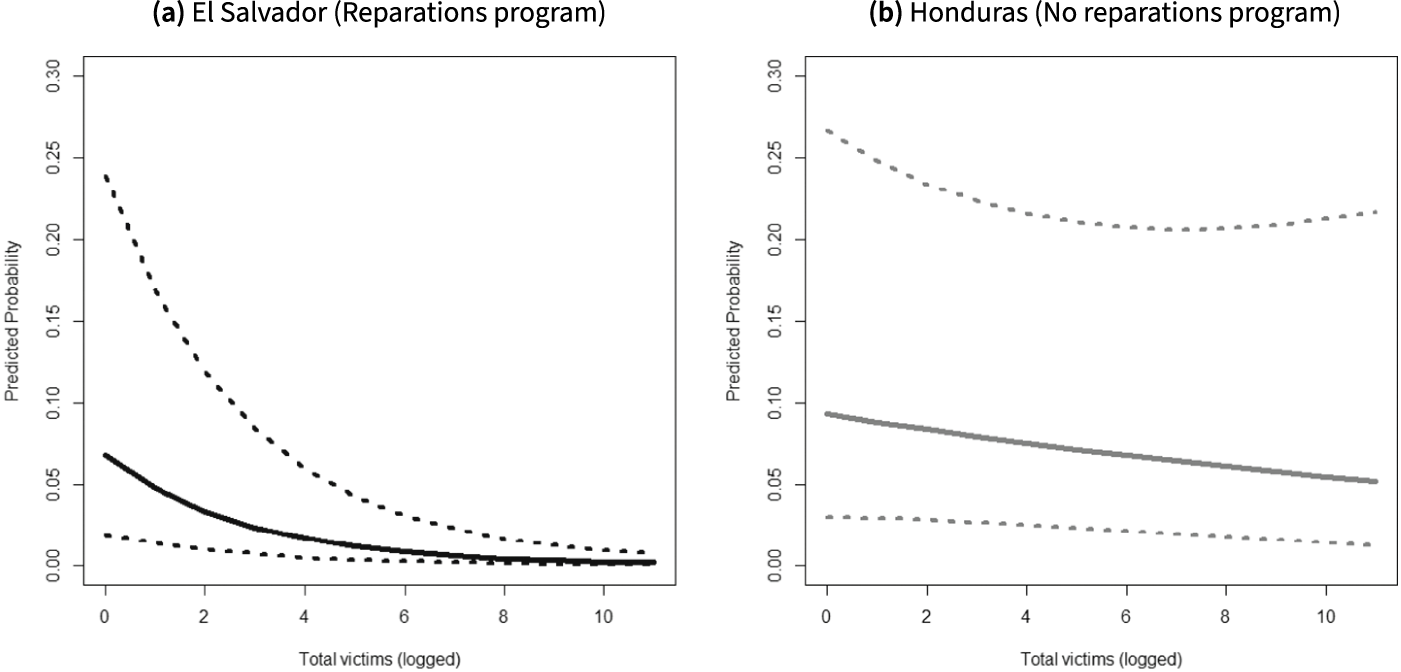
The results for hypotheses 2 and 2a appear in Table 3. Models (5) and (7) present the results without controls, while Models (6) and (8) include all controls. As predicted, the coefficient on total victims is negative and statistically significant in most models, with the exception of Model (7). Substantively, the coefficient in Model (6) tells us that a log-unit change in the number of victims in the case decreases the probability of compliance by about 24%. In other words, in a given year, states are 76% as likely to comply in a case involving three victims than they are in a case involving a single victim.Footnote 36 Hypothesis 2a, however, is not supported. Model (8) indicates that the unconditional effect of having a DRP is positive and statistically significant. However, the interaction effect is negative and statistically significant, indicating that the negative effect of total number of victims is stronger in states with DRPs, which is the opposite of what we predicted. We illustrate this variation in Figure 2 by comparing the predicted probabilities of compliance in the fifth year after the judgment for El Salvador, which has had a reparations program since 1995, and Honduras, which has never had a reparations program.Footnote 37 For El Salvador (left panel), the probability of compliance in the fifth year after the judgment decreases precipitously as the total number of victims increases. For Honduras (right panel), the probability of compliance also decreases as the total number of victims increases, but does so at a slower rate.
Higher Numbers of Victims are Associated with Lower Probability of Compliance in a Given Year
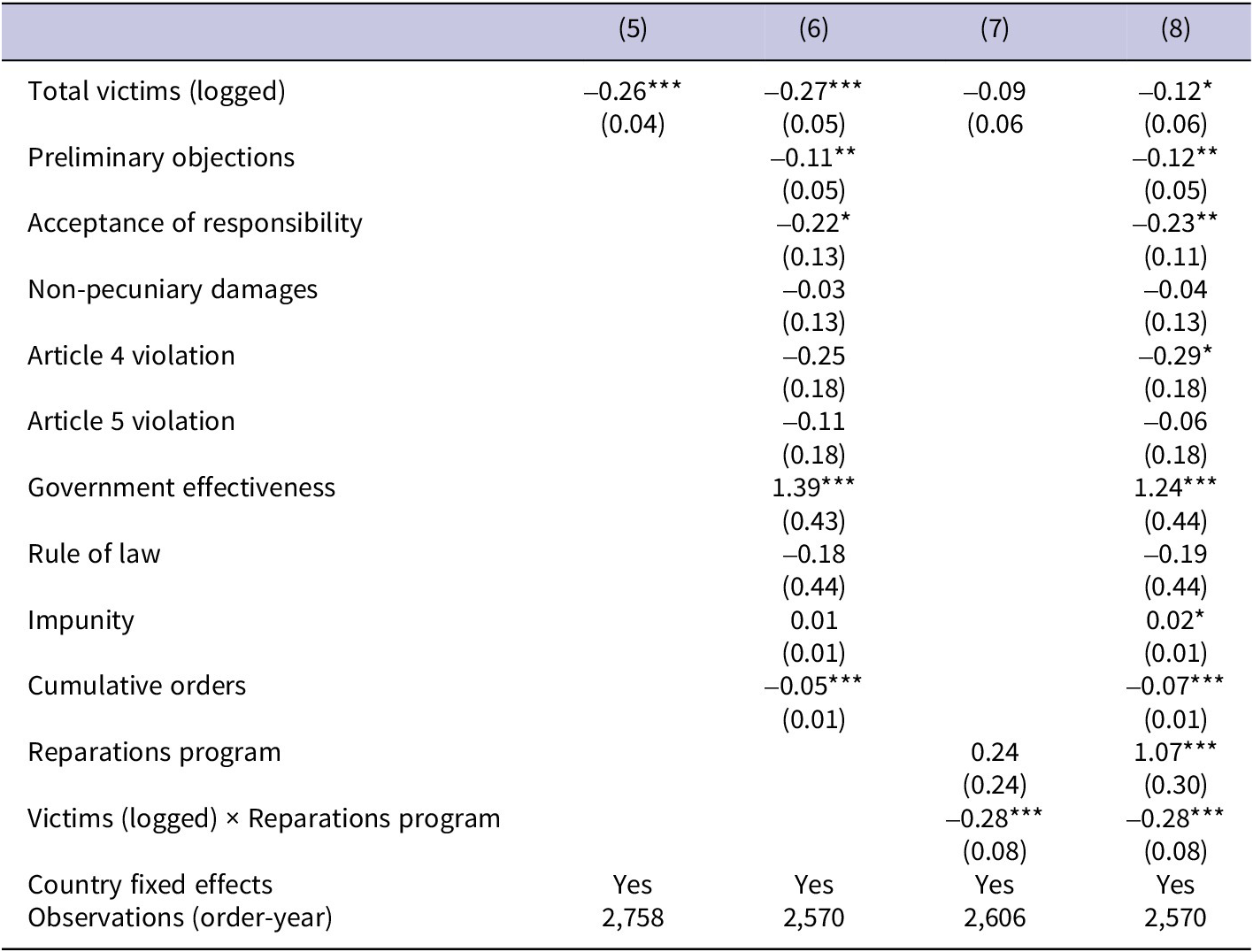
Note: *p < 0.1, **p < 0.05, ***p < 0.01.
The Negative Effect of Total Victims on Compliance is Stronger in States with a DRP. Notes: Predicted probability is the probability of compliance in the fifth year after the judgment, all else held constant at its mean for the country. Dashed line is the 95% confidence interval.
We suspect that the lack of support for hypothesis 2a may be driven by the complicated relationship that exists between the IACtHR and DRPs. The presence of a DRP can have countervailing effects on state compliance. Although the DRP may provide the bureaucratic infrastructure for the state to make payments to victims, the DRP can also create tension, and even conflict, between the state and the IACtHR. Sandoval (Reference Sandoval2017, 3) argues that this tension exists because DRPs do not always follow standards set by the IACtHR on reparations, and some states view IACtHR adjudication on the coexistence of DRPs and IACtHR reparations orders as a violation of their sovereignty, given the subsidiary nature of the Court. Sandoval (Reference Sandoval2017) traces the jurisprudential turn of the IACtHR as it relates to DRPs, showing that the IACtHR initially tried to reconcile the coexistence of these reparations systems by disregarding DRPs. However, around 2010, the IACtHR began to allow DRPs to influence the amounts it ordered as compensation, and by 2013 onward, it began to defer decisions on reparations to states with strong DRPs (with qualifications). As a result of the evolving role of DRPs as it relates to monetary awards by the IACtHR, Sandoval (Reference Sandoval2017, 13) warns “the court is yet to articulate proper legal arguments and address a crucial issue when there is a coexistence of regimes, which is whether or not the legal standards applied by DRPs are compatible with international human rights law and with the court’s own jurisprudence.”
In IACtHR judgments involving many victims, DRPs may have already compensated some victims, though the compensation may be insufficient according to IACtHR standards. For example, in the case of Maldonado Vargas v. Chile, victims before the IACtHR had received reparations through the DRP, but the IACtHR found that the victims were entitled to reparations for different human rights violations under consideration by the Court, including the right to a fair trial and judical guarantees (Sandoval Reference Sandoval2017, 9). There are three reasons why states may be resistant to paying additional damages to victims that have been compensated through a DRP. First, doing so may open the state up to criticism for not compensating all victims of the same violation equally, if some are compensated only by the DRP and others receive additional awards from the IACtHR. Second, this may open the door for other victims to pursue litigation through the IACtHR, in pursuit of larger awards. Finally, there is the additional bureaucratic hurdle of not just disseminating an award ordered by the IACtHR, but also determining which and how many victims have already been paid under the DRP, and whether that compensation is sufficient based on the IACtHR ruling.
The results for the control variables for models (6) and (8) are similar to what we found in Table 2. Preliminary objections and cumulative orders are negative and statistically significant, while government effectiveness is positive and statistically significant. This time, we also find that the coefficient on state acceptance of responsibility is negative and statistically significant, indicating that states that partially or fully accept responsibility are less likely to comply in a given year than states that did not accept responsibility at all. While this seems on its face counter to expectations, it might also be the case that states that accept responsibility are being told to pay higher damages, which is what we find: the average award (across pecuniary and non-pecuniary) for states that do not accept responsibility is $662,974, but the average for states that partially and fully accept is $1.53 million and $1.45 million, respectively, so this could just be capturing the fact states are less likely to pay higher awards and be unrelated to the acceptance of responsibility in and of itself.
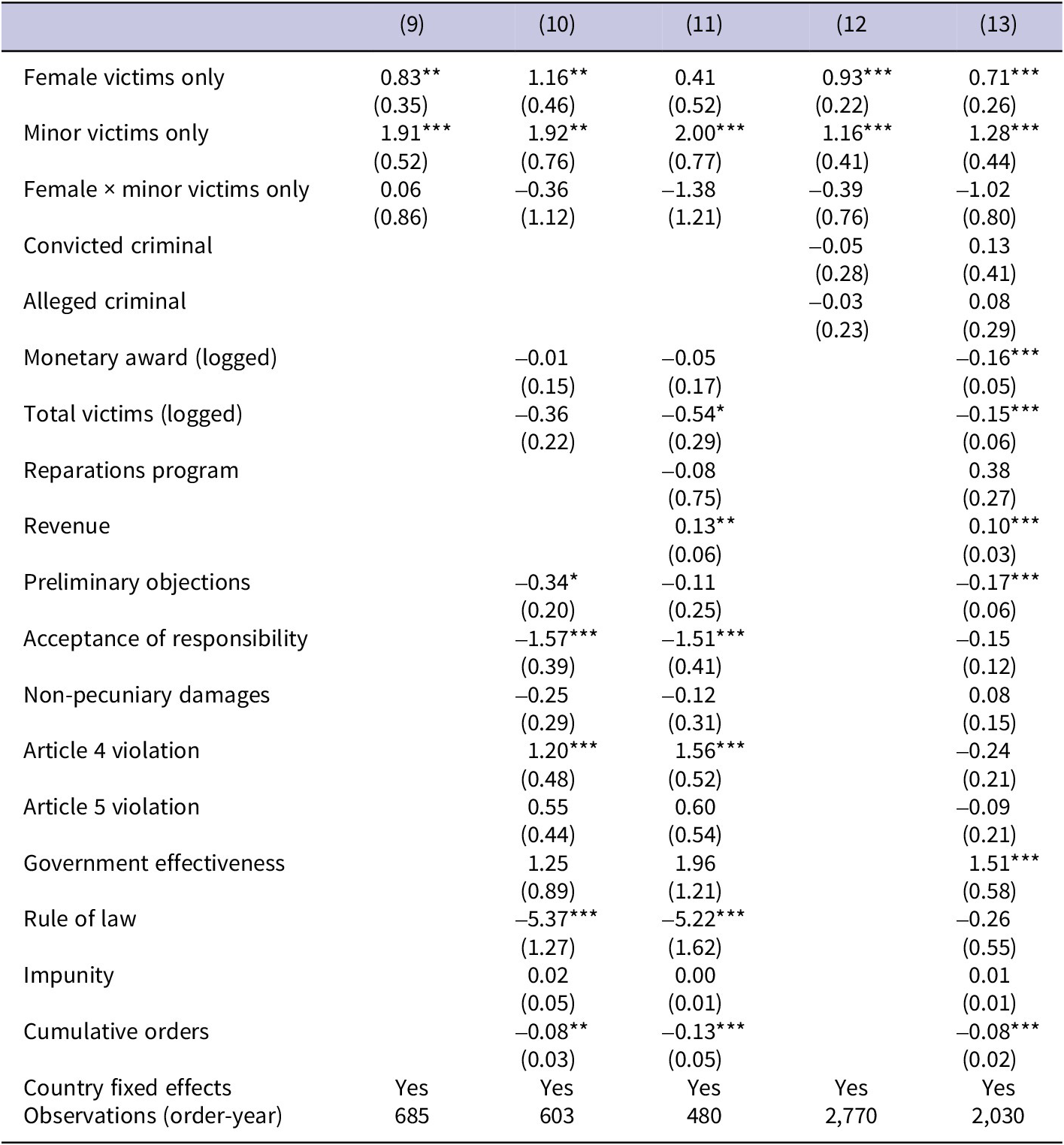
Turning to hypothesis 3, the results appear in Table 4. In Models (9), (10), and (11), we compare female and minor victims to alleged and convicted criminals, subsetting the data to include only instances in which the victims are females, minors, alleged, or convicted criminals. This gives us seventy-one total cases, which generate 128 pecuniary and non-pecuniary payment orders, and 685 order-year observations. Again, this is an easy gut-check test: if the state does not comply faster in cases involving women and children (most sympathetic) compared to cases involving convicted or alleged criminals (least sympathetic), we should not expect sympathy to matter in terms of time to compliance. In Models (12) and (13), we compare female victims, minor victims, alleged criminals, and convicted criminals to all other victim types, which is a harder test. As shown in Table 4, the coefficient on Female victims only is positive and statistically significant in four models (all except Model (11)) and the coefficient Minor victims only is positive and statistically significant in all models. We expect this is perhaps due to the heavily restricted sample size in Model (11), which only has 428 observations, given availability of the controls. The interaction effect is not significant, indicating that there is no extra benefit to female minor victims relative to simply being a minor or female. Substantively, the coefficients in Model (10) tell us that states are 3.2 times more likely to comply in a given year with orders involving female victims only, and 6.8 times more likely to comply in a given year with orders in cases involving children only, compared to cases that involve adult criminals (alleged or convicted).
States Are More Likely to Comply with Cases Involving Women and Minor Victims in A Given Year
Note: *p < 0.1, **p < 0.05, ***p < 0.01.
In Model (13), we see that states are more likely to pay monetary damages in cases involving “ideal” victims (women and children) in a given year compared to cases involving other types of victims. The coefficients on convicted and alleged criminals are not statistically significant, so countries are not more or less likely to comply in cases involving those victims compared to other types. Thus, there is more of a positive effect for the “ideal” victims than there is a negative one for “non-ideal” victims.
Among the control variables, only revenue and cumulative orders are statistically significant across all three models. Higher fiscal capacity is associated with greater probability of compliance, while cumulative orders is associated with a lower probability of compliance. In Models (10) and (11), the coefficients on acceptance of responsibility and rule of law are negative and statistically significant, while the coefficient on Article 4 violation is positive and statistically significant. However, these effects disappear when all victim types are in the sample.
Our online appendix contains an omnibus model that combines variables of interest from hypotheses 1 and 2. We find that the states are less likely to comply with cases involving larger awards and less likely to comply with cases involving more victims when both variables are included in the model. These effects hold when we add in the controls for fiscal capacity and DRPs. We also include a robustness check with alternative measures of fiscal capacity. Additionally, the online appendix contains a case illustration of the dynamics we have identified, by considering how states prioritize payments when they have multiple judgments pending against them at the same time. We examine how Guatemala and Peru each handled three judgments against them between July 2004 and March 2005. Consistent with our hypotheses, we find that the judgments involving higher awards and more victims took longer to comply with. Moreover, we find that Peru complied faster than expected, given the number of victims and large size of the award, in the one case involving two minor victims who were extrajudicially executed by police.
Conclusion
Financial compensation represents the most widely accepted form of remedy in the IACtHR, and the relatively high rate of compliance with the payment of monetary damages by states demonstrates the widespread acceptance of financial awards by the IACtHR. However, there is substantial variation in the time to compliance with the payment of monetary damages. By holding this form of reparations order constant, we provide novel insights into case-level factors at play in explaining time to compliance. Common explanations for compliance across different types of reparations orders cannot explain variation in time to compliance within orders of the same type. As a result, we focus on case-level characteristics that influence the capacity and willingness of states to comply with the payment of orders. In doing so, we utilize original data on compliance with monetary damages and case-level characteristics to shed light on a set of factors that explain important variation in compliance within a single type of reparation order.
We focus on the importance of three case-level characteristics in explaining time to compliance. First, we argue that the size of monetary awards can generate fiscal capacity concerns for recipients of IACtHR orders to pay monetary damages. We show that as the size of awards grow, the likelihood of compliance in a given year declines. However, this negative effect is attenuated by state fiscal capacity. That is, as government revenue grows, the negative relationship between the size of the award and likelihood of compliance in a given year is weaker.
Second, as the number of victims in a case grows, lack of domestic bureaucratic capacity can inhibit the timely payment of damages. We show that the number of victims is negatively associated with the likelihood of compliance in a given year. We also expected that the negative effect of number of victims on the likelihood of compliance would decline in the presence of state institutions responsible for dispensing monetary awards (e.g., DRPs). We did not find this to be the case, however. Instead, we found that while the unconditional effect of DRPs on the probability of compliance in a given year is positive, the probability of compliance in a given year declined more as the total number of victims in a case grew for states with DRPs (relative to states without DRPs). Although DRPs can provide the bureaucratic capacity for states to pay monetary damages, their presence can further delay compliance in cases with many victims. Future work should consider the impact of DRPs on award decisions made by the IACtHR, as well as how the presence of DRPs influences state compliance with IACtHR orders.
Finally, victim identity varies across IACtHR cases. We argue that states are more willing to comply with the payment of monetary damages in cases involving “ideal” victims, such as women and children, compared to non-ideal victims. The public is more likely to view such victims as deserving of monetary awards, generating greater pressure on the government to comply. On the other hand, we argue that the likelihood of compliance declines for cases involving “non-ideal” victims, such as convicted or alleged criminals. The public is generally less sympathetic to such victims, generating little pressure on the government to comply, or even pressure not to comply. We find cases involving females and minors are associated with greater likelihood of compliance in a given year, compared to non-ideal victims and when compared to all victim types. We also find no significant negative influence of “non-ideal” victims (e.g., alleged or convicted criminals) on the likelihood of compliance. This finding is encouraging, providing some evidence to suggest that states are not systematically less likely to comply when victims are “non-ideal.”
This study has important policy implications for how the IACtHR should think about (non-)compliance with payments of monetary damages. Specifically, when the IACtHR renders judgments involving high value damages or large numbers of victims, compliance is likely to be delayed. This is particularly likely to be the case for high value damages awarded in poorer states, as state capacity will inhibit the ability of the state to comply. In monitoring compliance, the IACtHR should expect delayed compliance with the payment of monetary damages under these conditions. Moreover, victim identity can facilitate more timely compliance. Specifically, regardless of capacity limitations, the state is likely to comply more quickly when the victims are “ideal” (e.g., women and children). In monitoring compliance, the Court should be aware of these case-level factors that encourage or inhibit compliance with the payment of monetary damages, and consider strategies to enhance monitoring efforts in cases likely to result in lower compliance.
Future research should consider the relationship between the IACtHR and DRPs. We expected DRPs to provide the necessary bureaucratic capacity for the state to pay out monetary damages in cases involving large numbers of victims (where greater bureaucratic capacity is needed to ensure timely payment). We found, however, that in cases involving large numbers of victims, DRPs did not make compliance with the payment of monetary damages more likely or more immediate. Future work might consider the complicated relationship between DRPs and the IACtHR, including the changing nature of the relationship between the IACtHR and DRPs over time (Sandoval Reference Sandoval2017). Moreover, there appears to be variation in the effectiveness of DRPs, which may further illuminate this complicated relationship. Future work should also consider the impact of other case-level factors (e.g., number of reparations orders, type of human rights violation) on state compliance with the payment of monetary damages. Considering variation in compliance within other types of reparations orders like symbolic measures, measure of rehabilitation, or general measures of non-repetition also represents a promising avenue for future research, particularly for advancing our knowledge of the impact of the IACtHR on government behavior.
Supplementary material
The supplementary material for this article can be found at http://doi.org/10.1017/jlc.2024.28.
Data availability statement
All replication materials are available on the Journal of Law and Courts Dataverse archive, located at https://doi.org/10.7910/DVN/V0GLQF.
Acknowledgments
For helpful feedback, we thank Claire Greenstein, Courtney Hillebrecht, Yon Lupu, Hayley Munir, Gino Pauselli, Aníbal Pérez-Liñan, Marcy Shieh, and Justin Wedeking. We also thank participants in the 2024 annual meeting of the International Studies Association, the 2024 participants of the Measuring and Predicting Political Violence Conference at University of Georgia, and various renditions of the Law and Courts Junior Women’s Writing Group. Louise Byrne, Callie Davidson, and Alexandra Fiul provided excellent research assistance.
Financial support
Research assistants were paid by Christopher Newport University’s Reiff Center for Human Rights and Conflict Resolution and we gratefully acknowledge their support.
Competing interest
The authors declare no conflicts of interest.


 Open access

