

Introduction
Background
Mental health disorders often emerge in childhood and adolescence, in 48.4% of cases before the age of 18 and in 62.5% before the age of 25 (Solmi et al., Reference Solmi, Radua, Olivola, Croce, Soardo, Salazar de Pablo, Il Shin, Kirkbride, Jones, Kim, Kim, Carvalho, Seeman, Correll and Fusar-Poli2022). Moreover, early emergence of mental disorders is associated with future negative outcomes, such as negative mental health outcomes, reduced occupational performance and more legal and social problems (Copeland et al., Reference Copeland, Wolke, Shanahan and Costello2015; Johnson et al., Reference Johnson, Dupuis, Piche, Clayborne and Colman2018; Veldman et al., Reference Veldman, Reijneveld, Verhulst, Ortiz and Bültmann2017). A crucial facet to prevent worsening of symptoms and to improve prognosis is to provide early and accessible mental health care for young people, with care being stable and ongoing for those who continue to need it. Instead, continuity of care is often hampered by the division between Child and Adolescent Mental Health Services (CAMHS) and Adult Mental Health Services (AMHS), which in most countries occurs at the age of 18 (Signorini et al. Reference Signorini, Singh, Marsanic, Dieleman and Dodig-Ćurković2018; McGrandles and McMahon Reference McGrandles and McMahon2012).
In countries throughout the world, the transition process between CAMHS and AMHS is ill-prepared and young people often feel insufficiently informed about the transition (Broad et al., Reference Broad, Sandhu, Sunderji and Charach2017; Signorini et al. Reference Signorini, Singh, Marsanic, Dieleman and Dodig-Ćurković2018). Many young people are confronted with a sudden stop in care when they reach the age limit of CAMHS (Appleton et al., Reference Appleton, Connell, Fairclough, Tuomainen and Singh2019; Butterworth et al., Reference Butterworth, Singh, Birchwood, Islam, Munro, Vostanis, Paul, Khan and Simkiss2017; Murcott Reference Murcott2014). This stop in care is not only harmful in terms of the burden and consequences of mental health problems, but it also coincides with a range of simultaneously occurring life transitions (Broad et al., Reference Broad, Sandhu, Sunderji and Charach2017). Life transitions might include finishing post-16 education, starting tertiary education or a job, moving away from home, and legally reduced parental involvement (Broad et al., Reference Broad, Sandhu, Sunderji and Charach2017; Hovish et al., Reference Hovish, Weaver, Islam, Paul and Singh2012). Hence, young people who require care beyond the transition age need this care to be stable and ongoing. In reality, their mental health care is often fully disrupted for a long time or never continues after leaving CAMHS (Appleton et al., Reference Appleton, Connell, Fairclough, Tuomainen and Singh2019; McNicholas et al., Reference McNicholas, Adamson, McNamara, Gavin, Paul, Ford, Barry, Dooley, Coyne, Cullen and Singh2015; Singh Reference Singh2009). Furthermore, young people who do rapidly continue from CAMHS to AMHS often experience an unprepared transfer rather than an organised transition (Paul et al., Reference Paul, Ford, Kramer, Islam, Harley and Singh2013).
The absence of a connection, collaboration or overlap between CAMHS and AMHS is one of the greatest transition problems by service users as reported in surveys (Signorini et al. Reference Signorini, Singh, Marsanic, Dieleman and Dodig-Ćurković2018). In addition, young people in the United Kingdom (UK) and Canada have reported feeling completely unprepared for the transition and report never having been involved in its planning (Cleverley et al., Reference Cleverley, Lenters and McCann2020; Dunn Reference Dunn2017). Generally, the transition period was never designed based on young people’s needs and preferences, whilst their involvement is crucial when devising care plans and procedures for their own care (Muñoz-Solomando et al., Reference Muñoz-Solomando, Townley and Williams2010). Young people with lived experiences of the transition can provide personal insights into barriers and needs to potentially improve care for future service users as well.
Despite the insights which service user input can offer, there is a lack of in-depth qualitative studies on transition problems and solutions experienced by young service users in most countries. Such studies have mostly been conducted in the United States (US), the UK (Broad et al., Reference Broad, Sandhu, Sunderji and Charach2017; Butterworth et al., Reference Butterworth, Singh, Birchwood, Islam, Munro, Vostanis, Paul, Khan and Simkiss2017), or Canada (Cleverley et al., Reference Cleverley, Lenters and McCann2020). Other studies included a specific diagnosis, e.g., ADHD (Swift et al., Reference Swift, Hall, Marimuttu, Redstone, Sayal and Hollis2013) or anorexia nervosa (Lockertsen et al., Reference Lockertsen, Holm, Nilsen, Rø, Burger and Røssberg2021). To our knowledge, in the past ten years no studies have explored the needs and preferences in service transitions experienced by young people with a variety of psychiatric diagnoses in European countries. The present pan-European study offers insights into comparisons of service user experiences and solutions that may be valid across national boundaries and care systems.
Worldwide, case management systems and funding of CAMHS and AMHS are largely separate. The usual transition age is 18, which is the usual recognised age in the countries included in this study: the UK, Ireland, the Netherlands and Croatia. In practice, in the UK the transition age tends to range from 16 to 18 years of age and in the Netherlands from 18 to 21 (Signorini et al. Reference Signorini, Singh, Marsanic, Dieleman and Dodig-Ćurković2018). In Ireland, the boundary at the age of 18 is comparably stricter and many AMHS teams agree to take referrals up to two years before the age of 18 (McNicholas et al., Reference McNicholas, Adamson, McNamara, Gavin, Paul, Ford, Barry, Dooley, Coyne, Cullen and Singh2015). To our knowledge, Croatia’s age boundary has not been evaluated in practice. In all four countries, there is a lack of connection between CAMHS and AMHS, with specific organisational differences detailed in Signorini et al. (Reference Signorini, Singh, Marsanic, Dieleman and Dodig-Ćurković2018).
Insurance and care costs are also arranged in different ways in the included countries. In the UK, national health systems are publicly funded regardless of age (Anderson et al., Reference Anderson, Pitchforth, Edwards, Alderwick, McGuire and Mossialos2022). In Ireland, costs are largely covered by public insurance with some services requiring a private policy (Kapur Reference Kapur2020). In the Netherlands, once a young person turns 18, the first 385 euros of costs made are paid by themselves as a mandatory deductible, an extra voluntary deductible can be added, and the chosen care package paid at a private insurance then determines the percentage and inclusion of certain forms of care that can be insured (Kroneman et al. Reference Kroneman, Boerma, van den Berg, Groenewegen, de Jong and van Ginneken2016). In Croatia, the health system is funded through contributions to the Croatian Health Insurance Fund, free of charge up to age 27 for students and otherwise up to age 18 (Ivezic et al., Reference Ivezic, Kuzman and Radic2009; Mestrovic et al. Reference Mestrovic, Bralic, Simetin, Mujkic, Radonić, Rodin, Trošelj, Stevanović, Benjak, Pristaš, Mayer and Tomić2016). In all four countries, coverage often excludes treatment at private practices and sometimes or partly excludes medication.
The aim of the present qualitative study was to gather experiences and proposed solutions regarding the service boundary by interviewing young people who experienced transitional care and their parents/caregivers. This study is part of MILESTONE (“Managing the Link and Strengthening Transition from Child to Adult Mental Healthcare”), a five-year (2014–19) large multi-centre research project on transitional care in Europe (Tuomainen et al., Reference Tuomainen, Schulze, Warwick, Paul, Dieleman, Franić, Madan, Maras, McNicholas, Purper-Ouakil, Santosh, Signorini, Street, Tremmery, Verhulst, Wolke and Singh2018). MILESTONE includes a large cohort study and a clinical trial on “managed transition”, with over 1000 participants from eight countries, aimed at learning whether and how young people are supported during the transition in various countries and to identify possible improvements (Singh et al. Reference Singh, Tuomainen, Girolamo, Maras, Santosh and McNicholas2017, Reference Singh, Tuomainen, Bouliotis, Canaway, De Girolamo and Dieleman2021; Gerritsen et al. Reference Gerritsen, Maras, van Bodegom, Overbeek, Verhulst and Wolke2021; Reference Gerritsen, van Bodegom, Overbeek, Maras, Verhulst and Wolke2022).
Methods
Participants
Participants were recruited from the larger pool of the 270 MILESTONE study participants living in the UK, Ireland, the Netherlands and Croatia (Singh et al. Reference Singh, Tuomainen, Girolamo, Maras, Santosh and McNicholas2017). The local research assistant asked these young people whether they wanted to participate in a qualitative interview. In the overall MILESTONE study, this was during the fourth time point (T4) at second-year follow-up. For three study purposes, 41 interviews were held in total, with young people and/or parents/caregivers, about 38 individual young people. Parents/caregivers were invited by the same mechanism and everyone who was interviewed provided documented consent, which was re-checked before the interviews.
The present study regarding services transition is one of three qualitative evaluations and herein inclusion only held for young people who experienced mental health services both before and after having been 18 years old. Hence, two young people were excluded due to not yet being 18 and not having experienced a service transition. Out of the 36 remaining young people, 11 were in Ireland, 12 in Croatia, five in the Netherlands and eight in the UK. Furthermore, 23 young people were aged 18 or older at the time of the interviews but their care had ended before passing the age of 18, hence, they never transitioned. Thus, interviews regarding 13 young people met the present study’s criterion of having experienced care before and after turning 18.
Data collection
Interview data collection occurred between September 2018 and January 2019. MILESTONE researchers conducted all interviews via telephone, online, or face-to-face, depending on participant preference. The duration of each interview was one hour. The interviews were semi-structured to stimulate the sharing of experiences. A topic guide with open-ended questions was developed with the input of an advisory team within MILESTONE, including young people, parents and carers. This included questions regarding transition experiences, CAMHS, and AMHS. In the present study, we report on the findings of the experiences of young people who were service users before and after turning 18. The relevant questions for this research area were: (1) How did you experience your transition to adult services?; and (2) What would have constituted an ideal transition for you? In addition, participants received a topic list, found in Appendix 1. The interviewers read the topic list out loud and asked the participants which topics they found most important and whether they wanted to elaborate on them.
Interviews were held and transcribed in the local language. Dutch and Croatian transcripts were translated to English by professional translation organisations. The following abbreviations are used to indicate the country of the interviewee: UK (the United Kingdom), IRE (Ireland), NL (the Netherlands) and CRO (Croatia). When a young person expressed that they would feel more comfortable being interviewed if their parent/caregiver attended, then this was allowed. In the end, nine interviews were held one-to-one with a young person, two with only a parent/caregiver, one with two young people of which one had not transitioned and one with both a parent/caregiver and young person simultaneously. These different combinations were a result of the overall interview study for its multiple purposes and were not specifically chosen for the present objective.
Data analysis
All analyses were conducted using ATLAS.ti version 9. Interviews were read repeatedly to familiarise with the data and to establish which sections were relevant for this part of the study. Reading and re-reading is the first important step of thematic analysis, followed by the adding of relevant codes (Boeije Reference Boeije2014; Braun and Clarke Reference Braun and Clarke2006). In order to reflect collaboratively, SL and AB coded two of the same interviews. SL had administered two of the Dutch interviews, while AB had no relation to the respondents. AB then coded the remaining interviews and merged codes which they deemed to have an identical or highly resembling meaning. The resulting codes and full dataset were searched and reviewed to generate themes, after which themes were given definitions and designated names. Lastly, SL and AB again collaboratively reviewed the codes and themes in relation to the research aim of discovering problems and areas of improvement throughout the transition process.
Results
Characteristics and service use paths of the participants
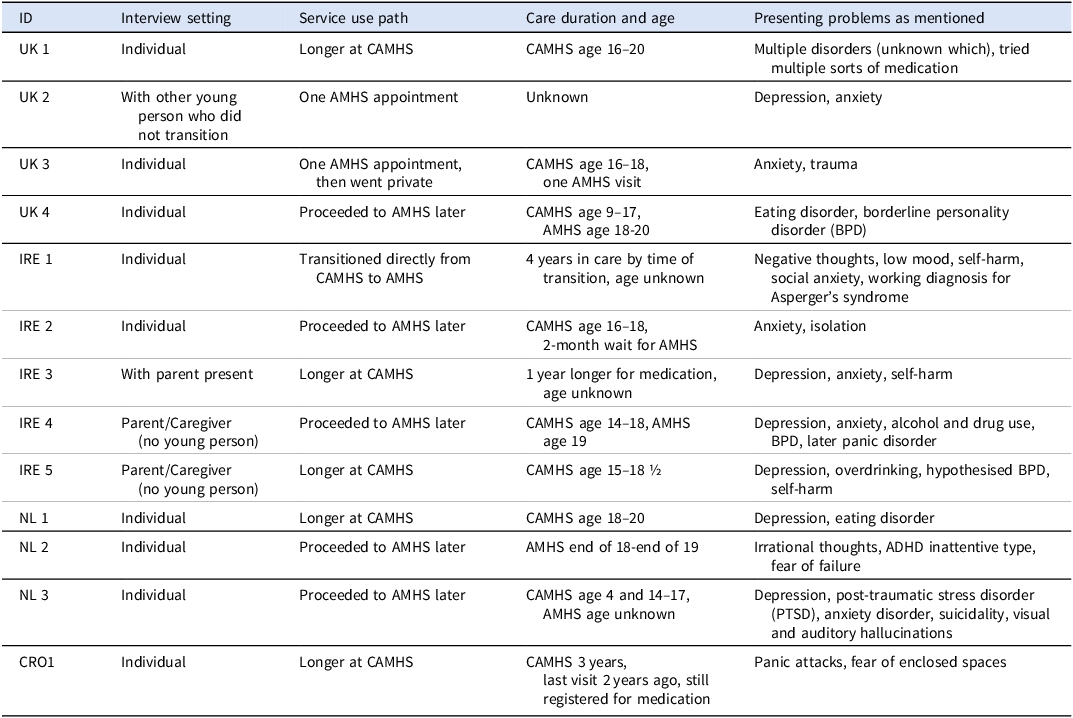
Of the 13 included young people, nine were female, and ages at the time of the interview ranged from 18 to 24. The ages at which young people attended services and their presenting problems are shown in Table 1 according to what the participants shared in the interviews. This was all discussed narratively; it was not asked which specific disorder was meant and whether it was diagnosed. Their living situation (alone or with family) and occupation (education, work or none) varied. Only one participant transitioned from CAMHS to AMHS at the age of 18 and experienced continuity of care. For two others, care ended after one session at AMHS. Furthermore, five young people re-accessed AMHS by themselves after a period of no mental health service use and five others remained at CAMHS beyond the age of 18 (Table 1).
Participants’ interview setting and their service use as stated in the interviews
Main outcomes
The following five main themes were identified, all representing problems and areas of improvement for young people turning 18 in mental health services: (1) Minimal to no preparation for the transition; (2) Unexpected changes when turning 18; (3) Barriers to adult care; (4) Communication between services; and (5) Ongoing care.
Minimal to no preparation for the transition
Young people reported examples of insufficient preparations for the transition. They indicated that their CAMHS professional had mentioned the transition at a late stage, right before the end of CAMHS or not at all. Young people noted that the end of CAMHS was mentioned in an abrupt manner:
“They just gave me a leaflet and said, “Well, you can’t come here anymore because you’re too old.”' (UK Young person 3)
“I was told “well, your dossier is closed now, but if there is a problem in the future, then we cannot provide that care to you, so you will be referred to another practice via your GP” and that is the only thing I have been told”. (NL Young person 3)
Young people said that they would have preferred timely and clear communication from CAMHS to them regarding when the transition should start and how it would work. One young person said that their transition went quite seamlessly, however, it seems they were referring to a rapid transfer rather than an informed transition as they did not know what to expect and proposed a brief AMHS preparation workshop:
“I transitioned pretty seamlessly, yeah. I do not think there was a long wait at all to get to AMHS, yeah. […] I would easily say a month or two in advance, we had started talking about it. […] I wasn’t really sure what was going to happen or what exactly it was. […] What would’ve been nice at the time would’ve been maybe, kind of, a sit-down and an explanation, as in: “This is what the adult mental health services are, and this is what’s going to happen.” […] Maybe, kind of, a slight workshop”. (IRE Young person 1)
Relatedly, participants mentioned that it was very important for them to be assisted in finding mental health services or organisations they could transition into. The route to new support or treatment was often described as difficult to find and CAMHS did not prepare them for this. They felt left to their own devices and would have preferred guidance. Arranging it themselves was difficult and took a long time, also due to being sent from pillar to post:
“That is quite a detour, because then I first went to the school dean, who referred me to the school psychologist, who referred me to the GP, the GP then referred me to a psychiatrist and there I was on the waiting list for two months. So, by the time I got my care, it was actually too late. By the time I ended up in the care, I had already quit school”. (NL Young person 2)
One participant described their ideal scenario, in which services were proactive and overlapping:
“Would you like us to help you like sign up for the new thing that you have to move onto?” rather than just go off and do it by yourself and sort that out all by yourself […] so it blends in, if that makes sense”. (UK Young person 3)
Unexpected changes when turning 18
Young people were faced with various abrupt changes after turning 18, in addition to the unprepared transition arrangements. One of the major changes was an unanticipated high level of autonomy, such as making their own decisions and experiencing higher expectations than in CAMHS. Some felt that the change was too sudden, while others felt more heard and taken seriously:
“I really notice that they appeal to you a little differently because you are suddenly 18 and you have to make your own decisions and that they no longer check with your parents […] and well, if I say “no,” it actually does not happen. And I find that responsibility a bit weird, very sudden, because I wasn’t used to it”. (NL Young person 2)
“I was simply approached in a mature way. […] I liked it that I, well, let’s say that I felt that my own opinion was more heard. […] That I was taken more seriously or something”. (NL Young person 3)
Similarly, young people noticed that the level of parental involvement suddenly changed when they turned 18. Not only did decisions shift to the young person; their parents/caregivers were entirely not involved anymore. Although this change was often experienced as positive, it was repeatedly mentioned that young people wanted to maintain the option to involve parents/caregivers when in need and to decide the extent of the involvement:
“You should have the option to have your family involved probably. It’s not for everyone at all, but if you’re used to having your family involved […] that will put you at ease possibly”. (UK Young person 1)
Moreover, parents/caregivers often used to arrange appointments with CAMHS and after turning 18 young people felt they were suddenly expected to make their own decisions and contact services autonomously. Participants explained they felt scared to call a stranger and postponed making the calls:
“I have to contact the psychologist and the GP myself. I don’t have anyone anymore who does that for me. These are all things that I have not done before.” […] Sometimes I also think “Oh, yes, but I can also do that tomorrow”, only that tomorrow never comes”. (NL Young person 2)
“Picking up the phone and talking to a stranger is quite a hurdle itself. […] It can trigger anxiety”. (UK Young person 3)
Young people mentioned that the abrupt change in parental involvement was difficult for their parents. One parent noted that they were relieved to be kept informed by their child so they could still help out when needed:
“It’s very hard to go from me being involved to not being involved. And I’ve said this to [young person] loads of times, when you’re well, you just tell me I can be involved. So that when you’re not well I can step in going to the doctor. […] [Young person] is happy to have me involved, which is a huge relief”. (IRE Parent/Caregiver 4)
Barriers to adult care
Further problems in the transition process consisted of reasons why young people were less inclined to move on to adult care. Several young people and parents/caregivers did not mention problems regarding access to AMHS, however. Specifically, the young person from Croatia (CRO1) and one young person from Ireland (IRE3) noted that their care only formally continued to still receive medication. Furthermore, interviewed parents (IRE4 and IRE5) shared that CAMHS thoroughly discussed with the young person and parent/caregiver whether care could be ended and that they mutually agreed after staying at CAMHS longer (IRE5) and after requiring no care for a while before proceeding to AMHS later on (IRE4).
Others shared their experienced barriers when accessing adult care, the prime one being the transition to a new healthcare professional in adult services. Establishing a therapeutic relationship with a healthcare professional in CAMHS had taken time, effort and trust. Young people felt anxious about the prospect of starting over, not knowing what to expect from a new person and not wanting to tell their story again. Some were inclined to refuse a transition if it meant seeing a new professional:
“I feel like adult services are a lot more intimidating than child services. So, I probably would’ve been less keen to go again, whereas obviously at the CAMHS clinic centre, I knew who my therapist was, I knew she was lovely, I knew we got on. So, it’s a lot less intimidating so I’m more motivated to go there and do it”. (UK Young person 1)
“I think: ‘well, I do not know if I can do it: tell everything again.”’ (NL Young person 1)
Young people from the Netherlands and the UK explained that care costs formed another obstacle for continuing care in adult services. Prior to turning 18, the government or their parents had paid for treatment expenses. As this responsibility shifted, some young people decided to end their treatment:
“I stopped my care just before my 18th, because then I had to pay the care myself and the psychologist in that care package is rather expensive, so I thought: “never mind.”’ (NL Young person 2)
“I’ve definitely been less likely to want to take medication because I know I now have to pay like £9 for it, whereas when you’re a child you don’t have to pay at all, or when you’re in full time education you don’t have to pay”. (UK Young person 4).
Young people expressed that the waiting lists for (adult) services were often very long and that this was highly demotivating. Specifically, they said:
“We were looking at treatments specifically focused on depression, and there are waiting lists of a year for that, while I had been in bed for half a year […] and that you’re sure when you’re in such a low point: ‘never mind, I won’t make that.”’ (NL Young person 1)
“I’ve spent more of the last two years on waiting lists than I have getting treatment”. (UK Young person 4)
Furthermore, young people mentioned that moving to a new city was a problem because of having to find and arrange contact with a new care provider in a new area. The transition age is often set at 18, an age at which many young people start their studies and move away from home. Others reported being too busy, for example due to combining work, school and other tasks that were expected of them. In addition, work or study hours often overlapped with service opening hours.
“I also stopped there because then I moved to [City 1] for my current studies. And now I’m looking for a new psychiatrist again. […] It was just unrealistic to move on back then, because I only had time on the weekends, which was when they were closed”. (NL Young person 2)
Differences between CAMHS and AMHS also acted as barriers. First, young people mentioned that the physical environment was completely different and less appealing in AMHS. Whilst CAMHS was experienced as warm and inviting, AMHS was experienced as cold and empty. This was especially mentioned in, but not necessarily limited to, the UK:
“It’s just not a very nice place, literally sitting in the tiniest room in a basement. In a stressful situation, anyway, it is not the nicest thing. […] Whereas I’m used to it being big rooms, with sofas, and white boards, and all of this, it’s much less clinical and scary. […] It does make a difference if you’re already stressed”. (UK Young person 1)
Second, young people remarked that the threshold for receiving treatment in AMHS seemed higher than in CAMHS and that the magnitude of their problems felt more acknowledged in CAMHS than in AMHS:
“I think that to get help in AMHS, you probably have to be more ill than you would in CAMHS and that is harmful because you can just have loads of people getting worse and worse and not receiving help”. (UK Young person 4)
“I almost felt undiagnosed for [anxiety] when I went into AMHS, whereas in CAMHS, I felt maybe a little bit over-diagnosed. […] [AMHS] was very helpful. Sometimes, I felt like, my problems were taken seriously, but their magnitude was not, entirely, taken to heart”. (IRE Young person 1)
Communication between services
A fourth problem identified in the transition process was the lack of communication and information-sharing between services. None of the participants reported an overlap or contact between services and documentation was rarely shared between CAMHS and AMHS. One young person mentioned that it was very helpful that AMHS had already received information from CAMHS, such as the diagnosis, or their patient file:
“I also noticed that everything went faster over there, probably because I already had my diagnosis. So that saved some time. I had new medication within two appointments, so I didn’t have to do everything again to see what I needed”. (NL Young person 2)
Other young people noted that information-sharing between services was insufficient or non-existent. This meant completing the same questionnaires twice, even though the first lot had already been sent from CAMHS to AMHS. In other cases, AMHS did not receive any records from CAMHS at all:
“They didn’t, because I had to go through the whole thing again with them so it was a load of questions”. (IRE Young person 2)
Ongoing care
When a young person was referred from CAMHS to AMHS to transition, ongoing care was still disrupted when AMHS did not contact the young person after a first appointment:
“They referred me to adult services, I had one appointment there and then they said: “Right, we’ll send you a letter in a couple of weeks” and I've never heard of them and that was two years ago”. (UK Young person 2)
To avoid dropping out of care or falling between the gap of CAMHS and AMHS, it has been suggested to overlap CAMHS and AMHS care. Specifically, young people mentioned that they would have preferred to be introduced to AMHS before leaving CAMHS, for example by meeting the new professional already without having severed contact with their professional at CAMHS. Although most young people mentioned a lack of continuity of care, ideas to overlap care originated from the UK. Other young people mentioned that ongoing care would be ideal, for example, by staying in CAMHS beyond the age of 18.
“Maybe meet the adult counsellor beforehand so then you don’t just jump straight in to it with a completely different person”. (UK Young person 2)
“Erm … [the ideal scenario would have been] just staying in the clinic when I was 18” “Because they could see me more often and I really like seeing her because she was like really helpful.” (IRE Young person 2)
Other young people mentioned that youth mental health teams could specifically support their age group and help fill the transition gap. Additionally, youth teams might reach young people who are reluctant to attend adult services that cater for a wider age range and thus older adults as well:
“I think there should be a transition thing for young adults, say seventeen to twenty-one, I think there should be a different service. Because the cold clinical adult psychiatrist, that’s probably fine if you are 45 and you’ve got a job and you’re used to a cold office environment, you’re probably used to being more adult”. (UK Young person 2).
Discussion
This study explored young people’s transition experiences and perspectives when crossing the age boundary between mental health services in four European countries. One young person felt satisfied with their transition to adult services which occurred quickly and was thoroughly followed up by AMHS. For all others, the transition had broken off after one visit at AMHS, abruptly ended at CAMHS or was not considered necessary. The latter group consisted of young people who remained in CAMHS past the age boundary or who returned to AMHS themselves after a period of no service. The small number of immediate transitions reflects the small proportion of young people in the MILESTONE study whose care directly continued in adult services (Singh et al. Reference Singh, Tuomainen, Bouliotis, Canaway, De Girolamo and Dieleman2021). Moreover, the process of the one young person who experienced a quick transition to AMHS could perhaps better be described as a transfer because a transition entails a prepared process, which did not occur in their case either.
Previous qualitative research in this area has only focused on specific diagnoses, e.g., ADHD in the UK (Swift et al., Reference Swift, Hall, Marimuttu, Redstone, Sayal and Hollis2013) or anorexia nervosa in Norway (Lockertsen et al., Reference Lockertsen, Holm, Nilsen, Rø, Burger and Røssberg2021). Other research has focused on ethical aspects such as autonomy and potential harms in the transition (O’Hara et al. Reference O’Hara, Holme, Tah, Franic, Vrljičak Davidović, Paul, Singh, Street, Tuomainen, Schulze and McNicholas2020), the transition gap after exiting CAMHS when AMHS care has not been arranged or begun (Appleton et al., Reference Appleton, Elahi, Tuomainen, Canaway and Singh2021), interviewed parents and professionals (Hill et al., Reference Hill, Wilde and Tickle2019) or transpired more than ten years ago in the UK (Hovish et al., Reference Hovish, Weaver, Islam, Paul and Singh2012; Singh et al., Reference Singh, Paul, Ford, Kramer, Weaver, McLaren, Hovish, Islam, Belling and White2010) and US (Jivanjee and Kruzich Reference Jivanjee and Kruzich2011). A more recent UK-study included interviews with youth, parents and practitioners to help design a transition preparation programme, of which four interviews were with young people who transitioned (Dunn Reference Dunn2017) and, in Canada, eight young people were interviewed after their transition (Cleverley et al., Reference Cleverley, Lenters and McCann2020). Cleverley et al. (Reference Cleverley, Lenters and McCann2020) and Dunn (Reference Dunn2017) reported that young people were insufficiently informed, often not involved in the transition planning at all, or only at the last moment. In the present study, these results were recognised in the UK, The Netherlands and Ireland; young people mentioned an insufficient to non-existent preparation for transitioning, including finding a new service. The latter finding also corresponds with previous studies regarding barriers to care (Appleton et al., Reference Appleton, Elahi, Tuomainen, Canaway and Singh2021; Leijdesdorff et al., Reference Leijdesdorff, Klaassen, Wairata, Rosema, van Amelsvoort and Popma2021). In European countries, 44% of care providers only sometimes prepare young people for ending and starting a new therapeutic relationship in AMHS (Signorini et al. Reference Signorini, Singh, Marsanic, Dieleman and Dodig-Ćurković2018). The present study showed that this is in stark contrast to young people’s needs. Having to engage with a new therapist may be especially worrying for young people who have developed distrust (Butterworth et al., Reference Butterworth, Singh, Birchwood, Islam, Munro, Vostanis, Paul, Khan and Simkiss2017). All these aspects highlight the need for early preparation regarding the end of care and transition to new services while the young person is still in CAMHS.
Young people from the UK, The Netherlands and Ireland mentioned in the present study that they experienced abrupt changes in responsibility and parental involvement, which corresponds with findings from the UK and Canada (Broad et al., Reference Broad, Sandhu, Sunderji and Charach2017; Cleverley et al., Reference Cleverley, Lenters and McCann2020; Dunn Reference Dunn2017). Reported abrupt changes might relate to the strong difference in focus of CAMHS and AMHS. While CAMHS focus on context, family and development, AMHS mostly focus on the individual and their disorders, are less inclined to include family, and expect more autonomy and financial capabilities (Hill et al., Reference Hill, Wilde and Tickle2019; Singh et al., Reference Singh, Evans, Sireling and Stuart2005). This shift can even lead to disengagement from services because the different approach in AMHS demands a new adult identity and mental illness identity which is challenging to adopt (McNamara et al., Reference McNamara, Coyne, Ford, Paul, Singh and McNicholas2017).
Other mentioned barriers to adult services included waiting lists, the physical environment within AMHS, moving to a new city for studies, being too busy to continue with treatment and new treatment costs. These barriers correspond with a study on access to care in the Netherlands (Leijdesdorff et al., Reference Leijdesdorff, Klaassen, Wairata, Rosema, van Amelsvoort and Popma2021). In the present study, care costs were mentioned by a young person from the UK specifically about medication and a Dutch young person for whom the relevant insurance package was too expensive. Another difference that young people noticed between services was that AMHS appeared to accept individuals with more severe mental health problems than CAMHS, which has arisen in other studies as well (Appleton et al., Reference Appleton, Elahi, Tuomainen, Canaway and Singh2021; McNicholas et al., Reference McNicholas, Adamson, McNamara, Gavin, Paul, Ford, Barry, Dooley, Coyne, Cullen and Singh2015). The higher threshold might result from a narrower interpretation of adult definitions related to mental health severity than child definitions (Davis and Sondheimer Reference Davis and Sondheimer2005).
Important themes for young people were early communication with them, communication between services, and ensuring ongoing care, which was again mentioned unanimously in all countries but did not arise in the single brief Croatian interview. Proposed solutions were to create an overlap in care, to arrange an AMHS appointment while still in CAMHS, or to organise joint meetings. Other studies have also suggested that CAMHS and AMHS should overlap for a period of time (Cleverley et al., Reference Cleverley, Lenters and McCann2020) and that protocols should be developed and used to facilitate this (Muñoz-Solomando et al., Reference Muñoz-Solomando, Townley and Williams2010). However, in practice, this connection is lacking throughout Europe, with no joint working in 79% of examined countries, a general lack of protocols, rarely any shared documentation, and no transition professionals (Signorini et al. Reference Signorini, Singh, Marsanic, Dieleman and Dodig-Ćurković2018).
To bridge gaps between CAMHS and AMHS, interagency agreements and cross training might be installed (Davis and Sondheimer Reference Davis and Sondheimer2005) with appointed professionals who specialise in transitions (Singh Reference Singh2009). The UK’s National Institute for Health and Care Excellence (NICE) transition guidelines promote a professional transition worker, a personalised transition plan and guidance six months pre- and post-transfer (Singh et al., Reference Singh, Anderson, Liabo and Ganeshamoorthy2016). Yet, the young people in the present study did not see any of this occurring in practice, and these processes have rarely been found in other European studies (Leavey et al., Reference Leavey, McGrellis, Forbes, Thampi, Davidson, Rosato, Bunting, Divin, Hughes, Toal, Paul and Singh2019; Signorini et al. Reference Signorini, Singh, Marsanic, Dieleman and Dodig-Ćurković2018). Updated guidelines with recommendations from NICE have also been published in The Netherlands, with a dissemination and implementation plan to ensure that young people experience these processes in practice (Federation Medical Specialists 2022).
Another proposed solution is to avoid a gap in care at the transition boundary altogether, for example by letting young people remain in CAMHS beyond the age of 18. This often occurred in the present study, rather situationally than by configurations in official policy, which could lead to less capacity for new referrals and to longer waiting lists (Islam et al., Reference Islam, Ford, Kramer, Paul, Parsons, Harley, Weaver, McLaren and Singh2016). Instead, age ranges could be configured permanently. The NHS in England has made a long-term plan to offer mental health care for 0- to 25-year-olds (NHS England Reference England2015; House of Commons Health and Social Care Committee, 2021).
A related proposal is to install youth mental health (YMH) teams: departments within mental health services which are specifically devoted to treating young people of a wide age range, without a transition at the highly turbulent age of 18. For example, a YMH team for 15–25-year-olds in the Netherlands has been shown to provide effective care with significant improvements in symptoms and functioning (Leijdesdorff et al., Reference Leijdesdorff, Postma, van Kersbergen, Marchetta and van Amelsvoort2020). Furthermore, early intervention mental health initiatives in the lines of headspace Australia have spread over the world, where service accessibility is in the forefront and where the age range is often 12–25. In Ireland, the non-profit organisation Jigsaw was installed as National Centre for Youth Mental Health, providing mental health support for mild-to-moderate mental health problems among 12- to 25-year-olds (O’Keeffe et al., Reference O’Keeffe, O’Reilly, O’Brien, Buckley and Illback2015). In the Netherlands, the @ease mental health walk-in centres were installed for young people aged 12 to 25 to speak with trained peers about mental health-related problems (Boonstra et al. Reference Boonstra, van Mastrigt, Evers, van Amelsvoort and Leijdesdorff2023; Leijdesdorff et al., Reference Leijdesdorff, Rosema, Klaassen, Popma and van Amelsvoort2022). Visitors include young people who fell between the gap of services due to an unmanaged transition or who are on a waiting list for a specialised service.
In the present study, young people were in favour of a YMH team or staying in CAMHS for longer, to keep seeing their familiar therapist and to stay in the preferred physical environment. Importantly, these paths also require clear preparations regarding changes in autonomy and finances. Some young people regarded new responsibilities as learning experiences, but others found the changes sudden and felt left to their own devices. Given previous findings that maturity levels can vary a lot within the same age (Lindgren et al., Reference Lindgren, Söderberg and Skär2013), a solution might be to offer care according to developmental age, instead of calendar age, as has been suggested by mental health professionals (Gerritsen et al., Reference Gerritsen, Dieleman, Beltman, Tangenbergh, Maras, van Amelsvoort and van Staa2020) and young people (Cleverley et al., Reference Cleverley, Lenters and McCann2020).
Implications
Based on the present findings, mental health services can either improve the current transition processes or alter age limits. Suggested improvements within the current division were: (1) early preparation and communication regarding the transition, its changes and finding a new service; (2) overlapping CAMHS and AMHS throughout the transition by already introducing the young person at AMHS whilst not yet leaving CAMHS; and (3) thorough communication between services, including sharing documentation and installing meetings to work jointly. Options in changing age limits would be to extend the age range and enhance the capacity, or to install dedicated YMH teams. This would help avoid a service transition during a time when young people may be especially vulnerable due to the emergence of serious mental health difficulties and transitions in other life domains.
In places where CAMHS and AMHS remain separate, it is important to learn from young people’s experiences of being demotivated by the environmental and vision differences, such as the less-friendly physical environment in AMHS, the focus on the individual instead of also on their context and network as it had been in CAMHS, shifting to new responsibilities and noticing that worse mental illness seems to be required for AMHS. AMHS could adapt to this by decorating spaces in a less clinical fashion and devoting attention to the experienced shifts and the person in their context. Increasingly, the vision in adult services is changing to a transdiagnostic focus on mental health and meaning instead of on curing illness within an individual, making the shift from the contextual approach in CAMHS less drastic.
Strengths and limitations
The present study is the first pan-European study designed specifically to interview young people with varying diagnoses regarding their experiences and views of the child/adolescent mental health services transition. The main strength is the insight obtained from young people receiving mental health care in various countries when turning 18. Previous related studies have been from over 10 years ago, focused on one diagnosis or were situated in one country. Interviews were performed in the UK, Ireland, The Netherlands and Croatia, offering a broad but personal insight regarding the current state of affairs in these countries and suggestions for a better transition.
A limitation of the present study was that only one included interview was from Croatia. In addition, the interview offered limited information as the participant answered with brief replies. While originally 12 young people were interviewed in Croatia, 11 ended their care at CAMHS. The one remaining interview cannot be regarded as representative for the transition in Croatian mental health care. Furthermore, while most interviews were held one-to-one, one of the included studies was held with a young person and parent/caregiver and one with two young people. This might have resulted in different discussed problems and suggestions than would have arisen in individual interviews. However, this was the preference of these participants to speak more openly and comfortably. Additionally, they complemented each other and might have offered more information than they would have recollected independently.
Supplementary material
The supplementary material for this article can be found at https://doi.org/10.1017/ipm.2024.5.
Acknowledgements
The authors would like to thank the young people, parents/caregivers and organisations who participated in this interview study. MILESTONE Consortium members: Swaran Singh, Helena Tuomainen, Jason Madan, Moli Paul, Dieter Wolke, Jane Warwick, Alistair Canaway, Amanda Tuffrey, Anna Wilson, Charlotte Gatherer, Leanne Walker (University of Warwick, UK); Giovanni de Girolamo, Giulia Signorini (Saint John of God Clinical Research Center, Italy); Paramala Santosh (Kings College London, UK); Diane Purper-Ouakil, Frederick Russet, Virginie Maurice (Centre Hospitalier Universitaire de Montpelier, France); Athanasios Maras, Larissa van Bodegom (Yulius Academy, Netherlands); Ulrike Schulze (University of Ulm, Germany); Sabine Tremmery, Gaelle Hendrickx (Katholieke Universiteit Leuven, Belgium); Fiona McNicholas (University College Dublin, Ireland); Tomislav Franic (University Hospital Split, Croatia); Gwen Dieleman, Suzanne Gerritsen (Erasmus Medical Centre, Netherlands); Andrea Wohner (Concentris Research Management GmbH, Germany).
Data availability
Authors elect to share no data due to privacy and ethical constrictions: various interviews included descriptions of unique personal experiences, care centres, professionals or family members and we wish to maintain anonymity for all parties.
Financial support
This work was supported by the European Union’s Seventh Framework programme under agreement number 602442.
Competing interests
The authors have no competing or potential interests to declare that are relevant to the content of this article.
Ethical standard
Ethical approval was received from the NRES Committee of West Midlands - South Birmingham (REC reference number: 15/WM/0052). Prior to data collection, all participants (young people and parents/caregivers) gave full consent and confidentiality was maintained throughout all research steps, including anonymized and safe storage of interviews and analyses.


 Open access

